Aller au contenu
Santé publique · Gouvernance · Gestion · Droit · Intervention sociale et intersectorialité

eric.bernier.1@umontreal.ca(263) 384-3050Prendre rendez-vous

Ma thèse CV Affiche
Portrait d’Éric Bernier

Éric Bernier

Doctorant en santé publique (2e année) · Juriste · Entrepreneur · Éducateur spécialisé

Des personnes aux politiques : une lecture intégrée des systèmes de santé

De l’accompagnement des personnes à la recherche en santé publique, mon parcours m’a conduit à explorer les différentes échelles du système de santé : des réalités individuelles aux organisations, jusqu’aux politiques publiques et à la gouvernance.

Ces expériences, à la croisée du terrain, de la gestion, du droit et de la recherche, ont nourri une conviction : transformer les systèmes de santé suppose de faire dialoguer les expériences humaines, les savoirs scientifiques, les dynamiques collectives et les choix politiques.

Mon ambition est d’ouvrir des portes entre ces univers qui se côtoient sans toujours se comprendre, de décloisonner les perspectives et de rapprocher la recherche de l’action, pour favoriser l’autodétermination, éclairer les décisions collectives et contribuer à une société plus juste et en meilleure santé.

Thèse codirigée par les Dres Nadia Sourial, Ph. D., et Géraldine Layani, M.D. · Chaire de recherche GSK en gestion optimale des maladies chroniques · CRCHUM · Boursier FRQ (B2)

Explorer librement

Explorer mon univers

Glissez pour explorerCliquez sur une porte pour entrerBalayez les portesTouchez pour entrer

6 portes

Faites glisser pour regarder à gauche ou à droite, ou déplacez la souris vers les bords. Cliquez sur une porte ou une rubrique pour entrer.

Thèse, méthodes, travaux, publications et innovations

Implantation, notions clés, enseignement et vulgarisation scientifique

Biographie, parcours, expertises et valeurs

Représentation, recherche, distinctions, loisirs

Logiciels, lectures, vidéos et balados

eric.bernier.1@umontreal.ca · (263) 384-3050

Cliquez sur une porte pour entrer

Le parcours en un coup d’œil

  1. Depuis 2025Doctorat en santé publique, École de santé publique de l’Université de Montréal (ESPUM) et Centre de recherche du CHUM (CRCHUM), Canada
  2. 2025Master en droit public (droit de la santé et droit social), Paris-Panthéon-Assas (France)
  3. 2024–2025Chargé de mission médico-sociale, Agence nationale d’appui à la performance (ANAP, France)
  4. 2024Maîtrise en direction des structures médico-sociales, Université de Bretagne Occidentale (UBO, France)Diplôme universitaire en entrepreneuriat et management, IAE de Brest (France)Stage en direction d’EHPAD, Fondation Ildys, Landerneau (France)
  5. 2020–2023Éducateur spécialisé, Adapei 35 (France)
  6. 2016–2024Directeur de séjours pour adultes en situation de handicap (France)

Le parcours en chiffres

Handicap & répit

ans auprès de personnes en situation de handicap
10
séjours adaptés dirigés
100+
personnes ayant bénéficié de vacances hors institution
≈1 000
familles et professionnels concernés par le répitEstimation de l’entourage des personnes accompagnées
≈1 000

Formation & enseignement

diplômes universitaires de second cycle
4
charges d’auxiliaire d’enseignementUniversité de Montréal
4
mentions spéciales du jury
3
prix de la meilleure afficheGFSP 2026 · 3e cycle
1

Réseaux & mobilisation

étudiants représentés
3 000
experts du réseau médico-socialContribution à l’animation du réseau
30
participations cumulées aux webinaires et communautés de pratiqueGestionnaires et professionnels de santé
2 000+
étudiants dans l’enquête régionale sur la santé mentaleConception et pilotage de l’enquête
1 000
Précisions sur les indicateurs
  • Handicap et répit : ordres de grandeur estimatifs sur l’ensemble du parcours. Le répit concerne les familles et les professionnels accompagnants. Les deux estimations décrivent des publics liés ; elles ne s’additionnent pas et ne constituent pas un décompte individuel vérifié.
  • Enseignement : Université de Montréal.
  • Meilleure affiche : GFSP, 2026, 3e cycle et postdoctorat.
  • Réseau médico-social : contribution à l’animation du réseau d’experts.
  • Webinaires et communautés de pratique : animation et modération ; audience cumulée de gestionnaires et de professionnels de santé.
  • Santé mentale : conception et pilotage d’une enquête régionale auprès d’étudiants.

Thèse en cours · Sujet en construction, susceptible de fortes évolutions

ᐊᑎᖓ ᑕᐃᒪᐃᓐᓇᐅᓇᓂ

ᑎᒥᐅᔪᑦ ᐊᑦᔨᒌᖕᖏᑐᑦ ᐃᑲᔪᕐᓯᓂᖏᓐᓂᒃ ᐋᕐᕿᓱᐃᓂᖅ, ᐃᓐᓇᑐᖃᐃᑦ ᐃᓪᓗᒥᓂ ᐃᓅᓯᖃᕐᑐᑦ ᑭᖕᖒᒪᒋᔭᖏᓐᓄᑦ ᐋᓐᓂᐊᖃᕐᓂᖏᓐᓄᓪᓗ: ᖃᓄᐃᓕᖓᓃᑦ, ᐃᑲᔪᕐᓯᕖᑦ ᓄᓇᖕᖑᐊᖏᑦ ᑲᑐᑦᔨᒪᓃᓪᓗ

Codirection : Dre Nadia Sourial (Ph. D.) · Dre Géraldine Layani (M.D., M. Sc.)École de santé publique de l’Université de Montréal (ESPUM)Ph. D., ᓇᐅᓕᒫᓂᒃ ᐃᓗᓯᓕᕆᓂᖅ · ᐃᓗᓯᓕᕆᓂᕐᒥ ᐊᐅᓚᑦᓯᒍᓰᑦ, ᑎᒥᐅᔪᑦ ᒪᓕᒉᓪᓗ (SOPS) · ᐅᑭᐅᖅ 2Chaire de recherche GSK en gestion optimale des maladies chroniquesFonds de recherche du Québec, Ph. D.-ᒧᑦ ᑮᓇᐅᔭᓂᒃ ᐃᑲᔪᕐᓯᒍᑎ (B2)Chaire de recherche GSK en gestion optimale des maladies chroniques · Fonds de recherche du Québec · CRCHUM · ESPUM · Université de Montréal
ᖃᐅᔨᓴᕐᓂᐅᑉ ᐊᐱᕆᐅᑎᖓ

ᖃᓄᖅ ᑎᒥᐅᔪᑦ ᐊᑦᔨᒌᖕᖏᑐᑦ ᐃᑲᔪᕐᓯᓂᖏᑦ ᐋᕐᕿᓱᕐᑕᐅᕙᑦ ᒫᓐᓇ ᐃᓐᓇᑐᖃᐃᑦ ᐃᓪᓗᒥᓂ ᐃᓅᓯᖃᕐᑐᑦ ᑭᖕᖒᒪᒋᔭᖏᓐᓄᑦ ᐋᓐᓂᐊᖃᕐᓂᖏᓐᓄᓪᓗ: ᖃᓄᐃᓕᖓᓃᑦ, ᐃᑲᔪᕐᓯᕖᑦ, ᑲᑐᑦᔨᒪᓃᓪᓗ?

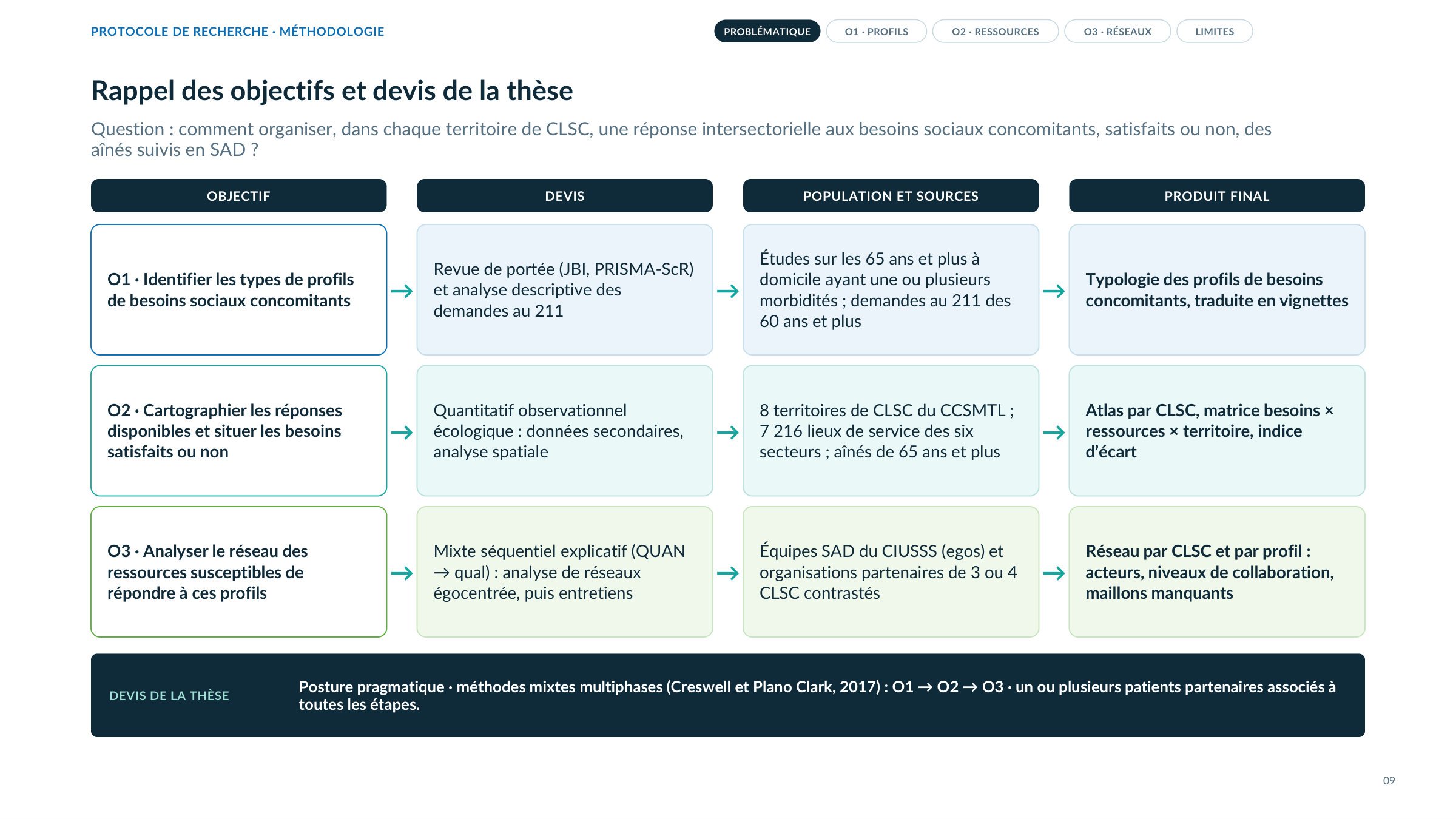
Devis : méthodes mixtes multiphases (Creswell et Plano Clark, 2017), posture pragmatique ; O1 revue de portée (JBI, PRISMA-ScR) et analyse descriptive du 211 ; O2 étude quantitative observationnelle écologique ; O3 devis mixte séquentiel explicatif (QUAN → qual), analyse de réseaux égocentrée.

01ᖃᓄᐃᑦᑑᓂᖓ

ᖃᐅᔨᓴᕐᓂᐅᑉ ᐊᐱᕆᐅᑎᖓ

ᖃᓄᖅ ᑎᒥᐅᔪᑦ ᐊᑦᔨᒌᖕᖏᑐᑦ ᐃᑲᔪᕐᓯᓂᖏᑦ ᐋᕐᕿᓱᕐᑕᐅᕙᑦ ᒫᓐᓇ ᐃᓐᓇᑐᖃᐃᑦ ᐃᓪᓗᒥᓂ ᐃᓅᓯᖃᕐᑐᑦ ᑭᖕᖒᒪᒋᔭᖏᓐᓄᑦ ᐋᓐᓂᐊᖃᕐᓂᖏᓐᓄᓪᓗ: ᖃᓄᐃᓕᖓᓃᑦ, ᐃᑲᔪᕐᓯᕖᑦ, ᑲᑐᑦᔨᒪᓃᓪᓗ?

1. Le problème : des besoins qui dépassent l’offre

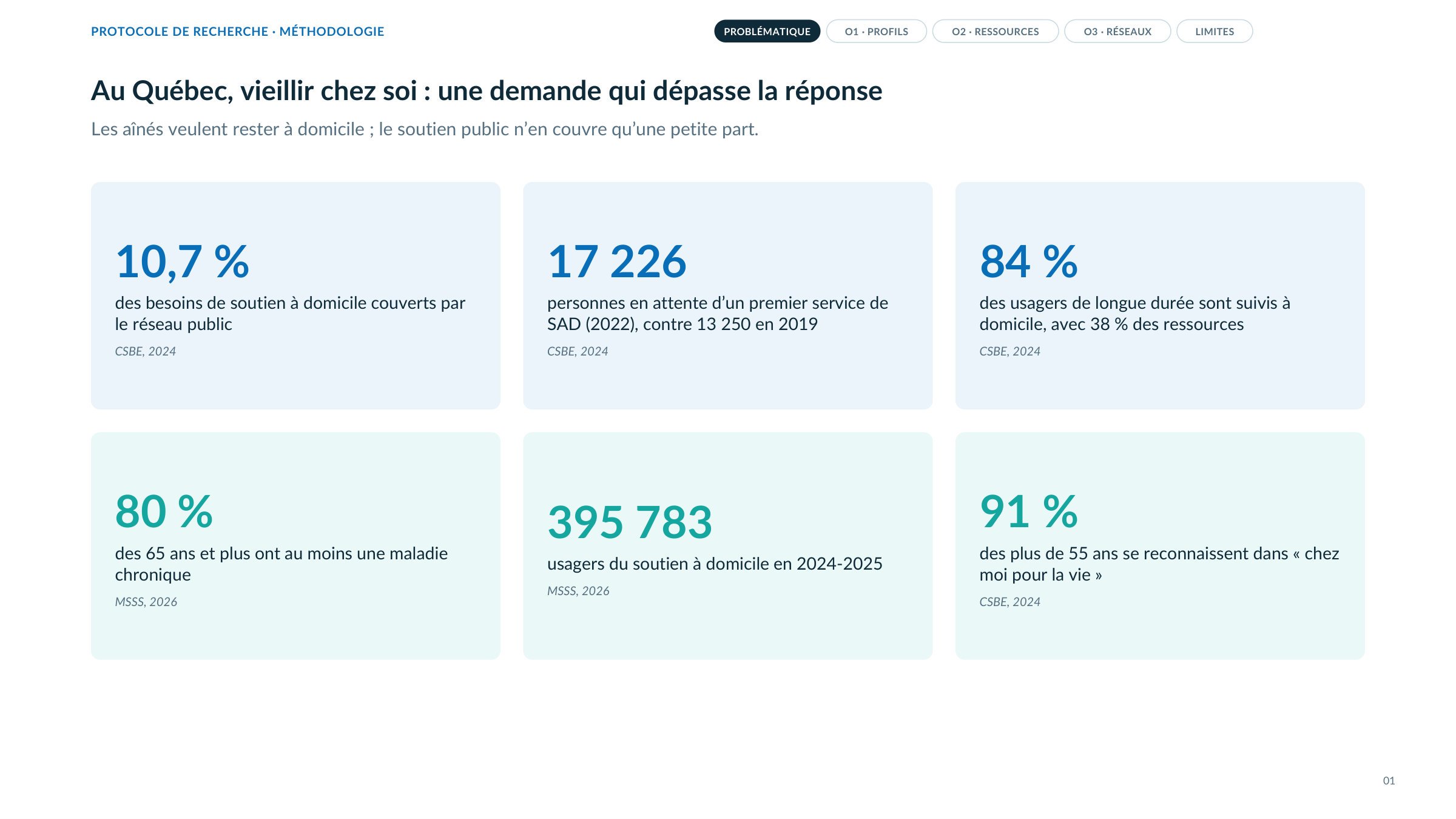
Au Québec, le soutien à domicile (SAD) regroupe les soins et les services offerts chez la personne par le réseau public, surtout par l’équipe du CLSC (centre local de services communautaires). En 2024-2025, il a servi 395 783 personnes, pour 37,2 millions d’heures ; 17 883 personnes attendaient un premier service. Chez les 65 ans et plus, 80 % vivent avec au moins une maladie chronique et la moitié avec plusieurs (multimorbidité) (Ministère de la Santé et des Services sociaux [MSSS], 2026a, p. 4 et 6).

Part des besoins couverts par le réseau public, 2023

Soutien à domicile10,7 %
RI-RTF68,8 %
CHSLD98,9 %

Le SAD : 25,4 des 234,7 millions d’heures requises (CSBE, 2024, p. 11).

Personnes en attente d’un premier service de SAD

31 mars 201913 250
31 mars 202217 226

Hausse d’environ 30 % en trois ans (CSBE, 2024, p. 2 et 96).

Usagers et ressources de longue durée

Usagers suivis en SAD84 %
Ressources au SAD38 %

L’hébergement reçoit 62 % des fonds pour 16 % des usagers (CSBE, 2024, p. 7).

Santé des 65 ans et plus au Québec

Au moins une maladie chronique80 %
Multimorbiditéla moitié

Et 91 % des plus de 55 ans se reconnaissent dans « chez moi pour la vie » (CSBE, 2024, p. 7 ; MSSS, 2026a, p. 4).

ᐋᓐᓂᐊᖃᕐᓇᙱᓐᓂᕐᒧᑦ ᑲᒥᓯᓇᐅᑉ (CSBE) ᐅᖃᐅᓯᕆᔭᖓ: ᐃᓪᓗᒥ ᐃᑲᔪᕐᓯᓂᖅ ᐱᔭᕐᓂᕐᓇᑦᑐᖅ, ᑲᑎᑦᑕᐅᓯᒪᙱᑦᑐᖅ. 2023-ᒥ, ᑲᕙᒪᐅᑉ ᐃᑲᔪᕐᓯᓂᖓ 25,4 ᒥᓕᐊᓐ ᐃᑲᕐᕋᓂᒃ 234,7 ᒥᓕᐊᓐ ᐱᔭᕆᐊᖃᕐᑕᐅᔪᓂᒃ: 10,7 %, CHSLD-ᒥ 98,9 %. ᐅᑕᕐᕿᔪᑦ 13 250-ᓂᒃ (2019) 17 226-ᓄᑦ (2022) ᐊᐅᓚᔪᑦ. ᐊᓯᖏᑦ ᐃᓚᒥᓄᑦ, ᓄᓇᓕᓐᓄᑦ, ᐃᒻᒥᓂᒃ ᐱᓇᓱᐊᕐᕕᖕᓄᓪᓗ ᐊᑐᕐᑐᑦ.

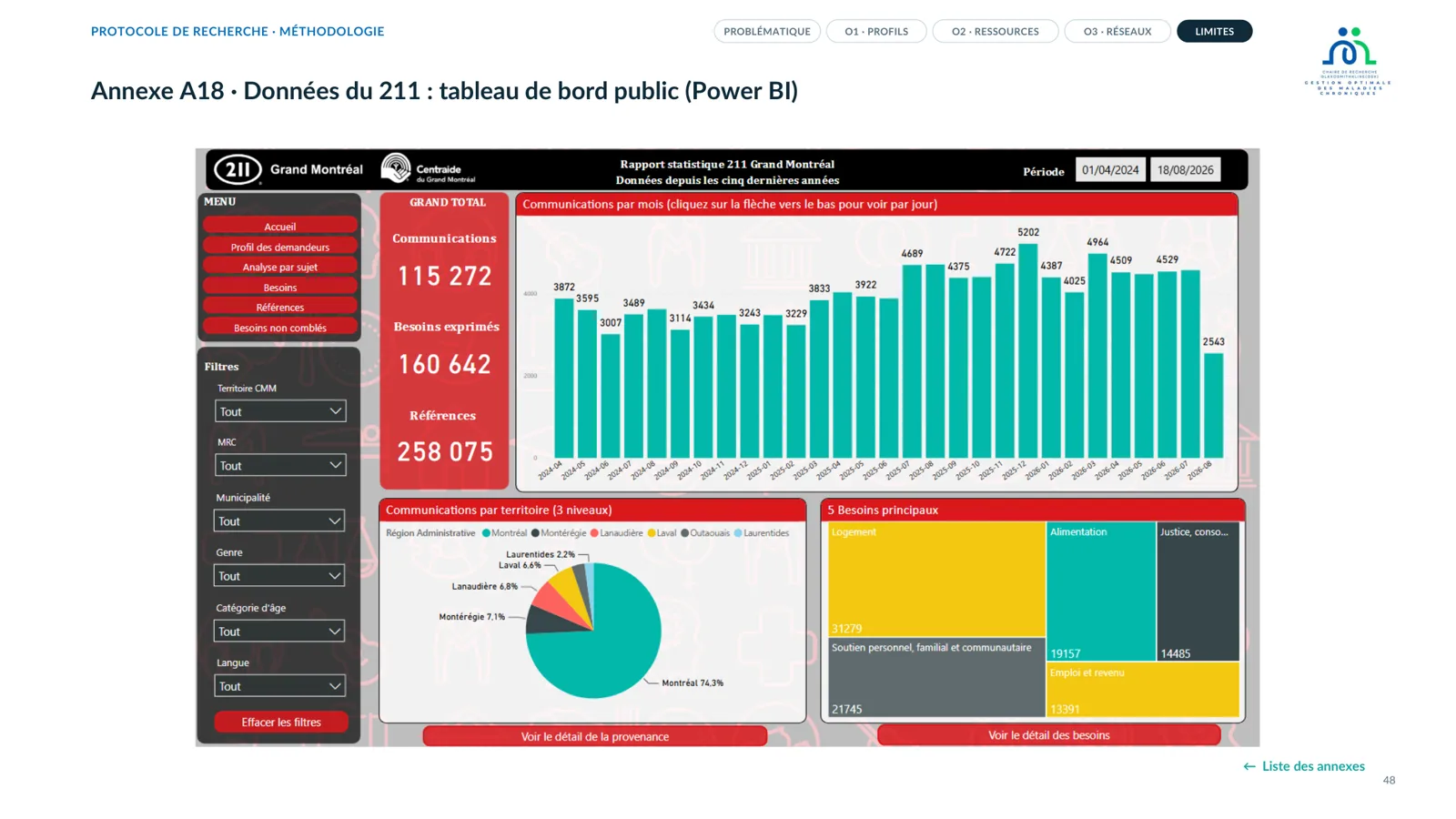
ᖃᐅᔨᓴᕐᕕᖕᒥ (CCSMTL, 8 CLSC ᓄᓇᖏᑦ), 48 575 ᐃᓄᐃᑦ 65 ᐅᑭᐅᓕᐅᕐᑐᑦ ᖁᓛᓄᑦ 2026-ᒥ (ISQ). 2021-ᒥ, 28,6 % ᐃᓄᐃᑦ ᒪᓐᓇᐅᓯᐅᑉ ᐊᑖᓃᑦᑐᑦ, 41,8 % Pointe-Saint-Charles-ᒥ. 211-ᒥ, 70 ᐅᑭᐅᓕᐅᕐᑐᑦ ᐱᔭᕆᐊᑭᑦ: ᐃᑲᔪᕐᓯᓂᖅ (21,9 %) ᐃᓪᓗᓕᐅᕐᓂᕐᓗ (13,4 %). ᐱᔭᕆᐊᑭᑦ ᐊᑐᕐᑕᐅᙱᑦᑐᑦ: «ᐃᑲᔪᕐᓯᓂᖃᙱᑦᑐᖅ» (324), ᐃᓚᐅᓂᕐᒧᑦ ᒪᓕᒐᐃᑦ (210), ᐊᐅᓪᓚᑦᑎᑦᓯᒍᑎᖃᙱᓐᓂᖅ (66). 44 ᑐᑦᓯᕋᐅᑎᑦ ᑕᐃᒪᐃᓐᓇᖅ CLSC-ᒥᑦ.

CSBE ᓈᓴᐅᑎᖏᑦ 2023: 10,7 % ᐃᓪᓗᒥ
ᐃᑲᕐᕋᐃᑦ ᐱᔭᕆᐊᖃᕐᑕᐅᔪᑦ ᐊᑐᕐᑕᐅᔪᓪᓗ, ᑯᐯᒃ, 2023: 10,7 % ᐃᓪᓗᒥ. ᐊᔾᔨᙳᐊᖅ: Commissaire à la santé et au bien-être (2024), Bien vieillir chez soi, tome 4, p. 11.
Diapositive : au Québec, vieillir chez soi, une demande qui dépasse la réponse, six chiffres clés
Les six chiffres clés du problème québécois. Source : Bernier, E. (2026). Méthodologie de la thèse O1-O3 [présentation], diapositive 2.

2. Quand les besoins se cumulent, la réponse se complique

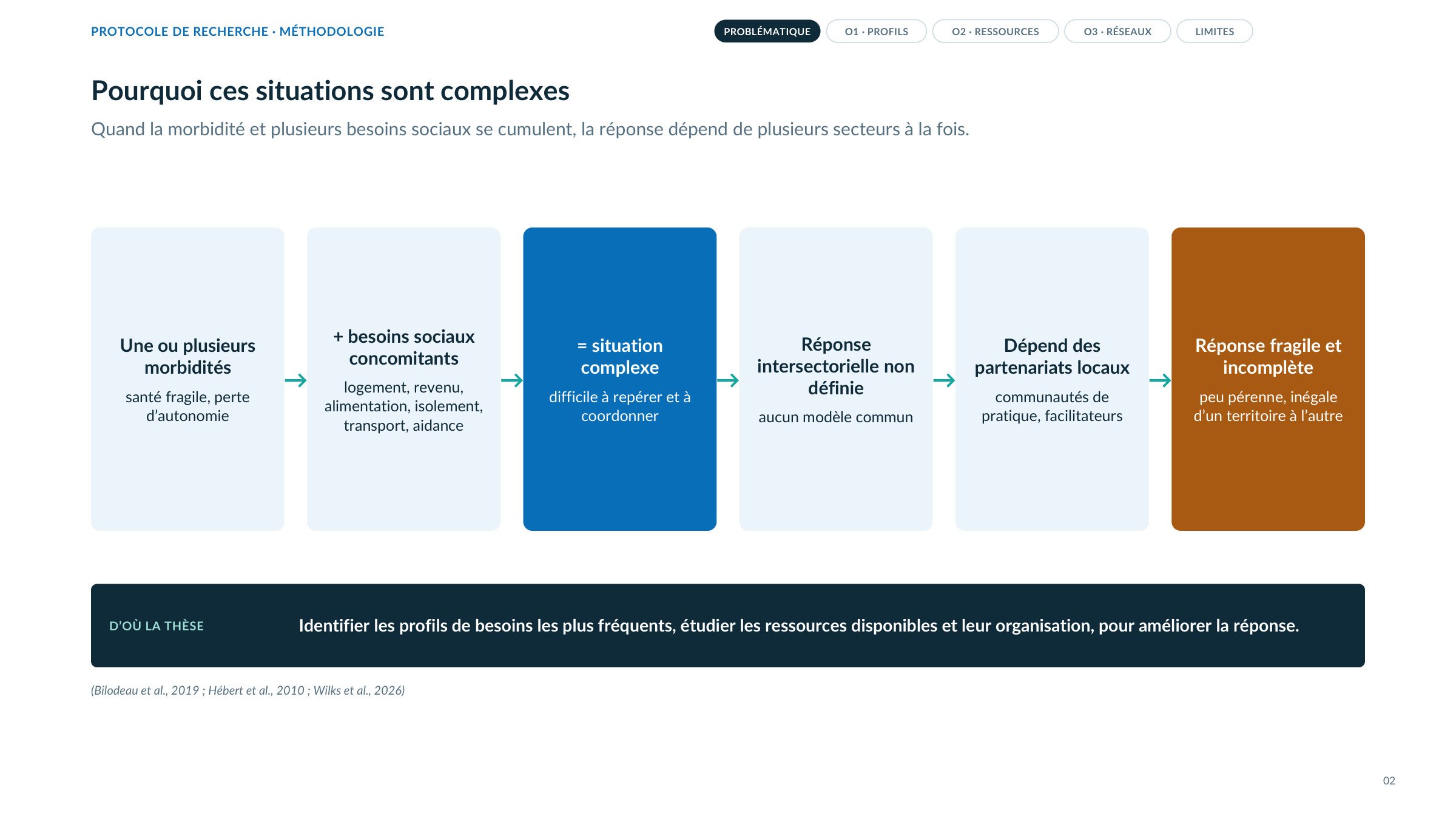
Une personne aînée peut vivre en même temps avec une ou plusieurs morbidités (des problèmes de santé, aigus ou chroniques) et plusieurs besoins sociaux : un logement mal adapté, un revenu trop faible, l’isolement, l’absence de transport, un proche aidant épuisé. On parle de besoins sociaux concomitants. Ensemble, ces éléments sont des facteurs de complexité : chacun rend l’autre plus difficile à régler, et le parcours de la personne devient moins fluide (Safford et al., 2007 ; Grembowski et al., 2014 ; Schaink et al., 2012 ; Johnson et Bacsu, 2018). La politique Mieux chez soi le reconnaît : quand les besoins touchent plusieurs sphères de la vie, « plusieurs intervenants doivent travailler ensemble », et les maladies chroniques « contribuent à complexifier et à intensifier les besoins » à domicile (MSSS, 2026a, p. 4).

Ces situations sont difficiles à repérer, car aucun service ne voit à lui seul l’ensemble des besoins d’une personne. Elles sont aussi difficiles à coordonner : le CSBE décrit un écosystème du SAD « complexe, peu intégré et peu performant ». On ne sait pas toujours organiser une réponse commune, adaptée et coordonnée. Il est plausible que, sur un même territoire, des organismes ne se connaissent pas ou ne travaillent pas ensemble, et qu’une ressource manque sans qu’on sache qu’une autre, d’un autre secteur, pourrait la remplacer. Aucune étude ne le démontre directement : c’est une inférence, que suggèrent les travaux sur les réseaux de services, sur la capacité des organismes communautaires et sur la difficulté à trouver l’aide disponible (Lemieux-Charles et al., 2005 ; Varda et al., 2020 ; Hogg-Graham et al., 2021 ; Macleod et al., 2017). Au 211, le motif le plus fréquent des besoins non comblés des 60 ans et plus est d’ailleurs « service non disponible ».

Diapositive : de la morbidité et des besoins sociaux concomitants à une réponse fragile et incomplète
La chaîne de la complexité : une ou plusieurs morbidités, plus des besoins sociaux concomitants, donnent une situation difficile à repérer et à coordonner. Source : Bernier, E. (2026). Méthodologie de la thèse O1-O3 [présentation], diapositive 3.

3. Plusieurs portes d’entrée, pas une seule

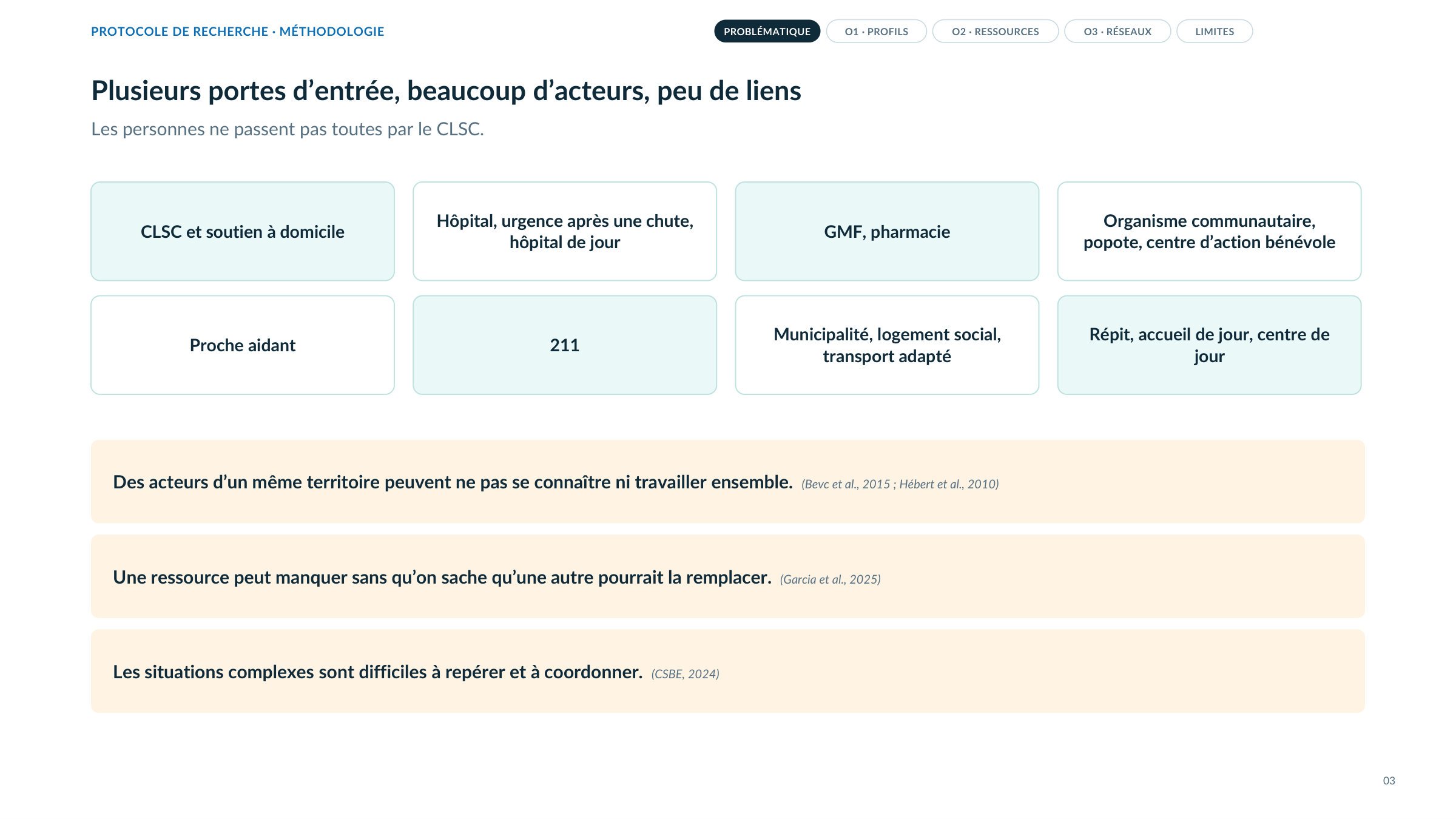
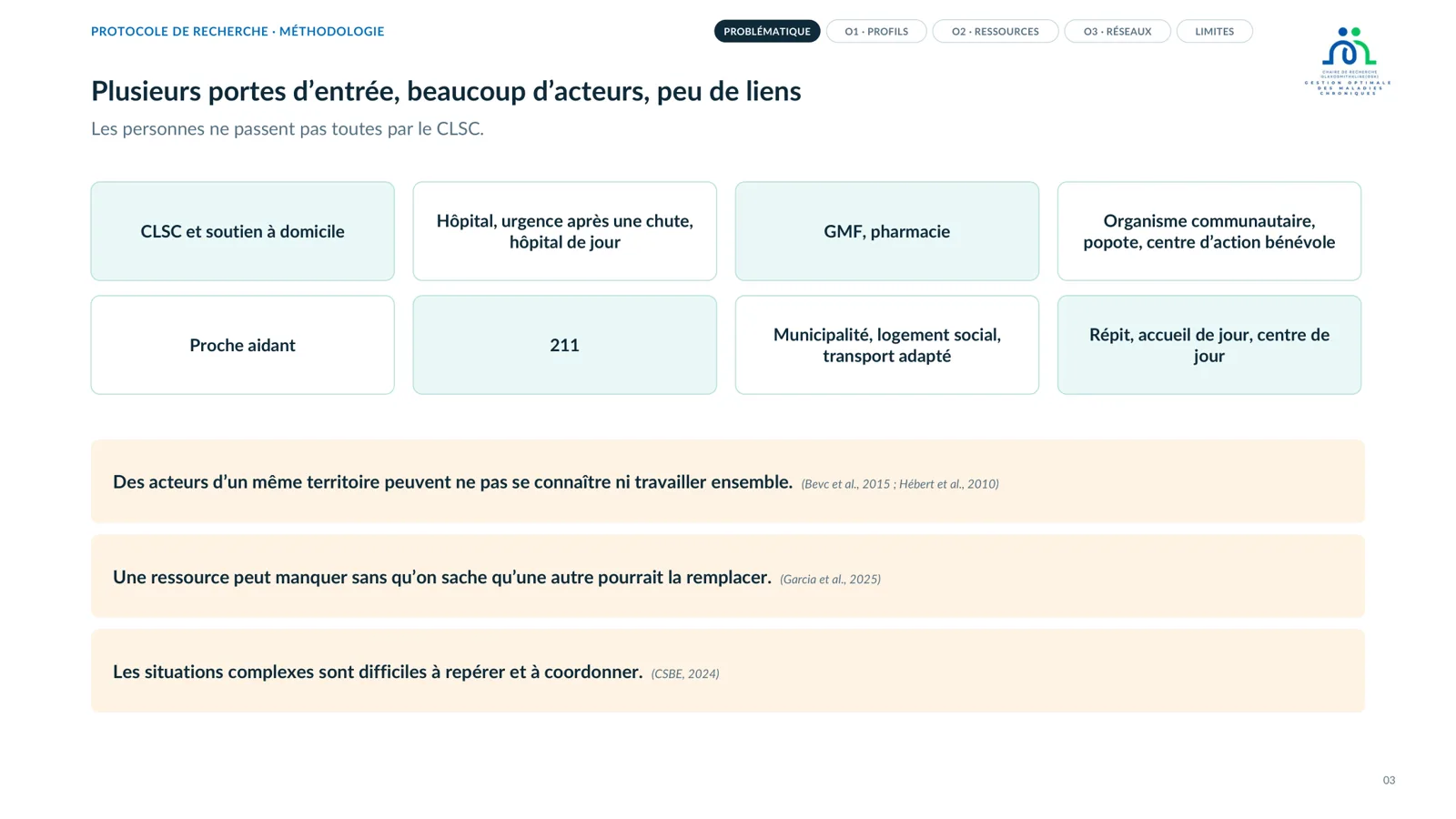
La politique Mieux chez soi veut faire du CLSC « la porte d’entrée principale » (MSSS, 2026a, p. XII). Dans les faits, une personne aînée entre dans le réseau par bien des portes : l’équipe SAD du CLSC ; l’hôpital de jour ; une hospitalisation ; l’urgence, après une chute ; les soins à domicile du CISSS ou du CIUSSS (les établissements régionaux de santé et de services sociaux) ; le groupe de médecine de famille (GMF) ; la pharmacie ; la municipalité ; le logement social ; le transport adapté ; un organisme communautaire ; un proche aidant ; le 211, service d’information et de référence. Chaque porte voit une partie de la situation ; aucune ne garantit que l’ensemble des besoins sera pris en compte.

Diapositive : plusieurs portes d’entrée, beaucoup d’acteurs, peu de liens
Les portes d’entrée et ce qui les relie mal. Source : Bernier, E. (2026). Méthodologie de la thèse O1-O3 [présentation], diapositive 4.
PersonneaînéeCLSC et SADHôpital de jourHospitalisationUrgence après une chuteGMFPharmacieOrganisme communautaireProche aidant211MunicipalitéLogement socialTransport adapté
Douze portes d’entrée possibles ; le CLSC, voulu comme porte principale (MSSS, 2026a, p. XII), n’en est qu’une. Aucune ne voit à elle seule l’ensemble des besoins.

4. Ce qui existe déjà au Québec pour intégrer les services

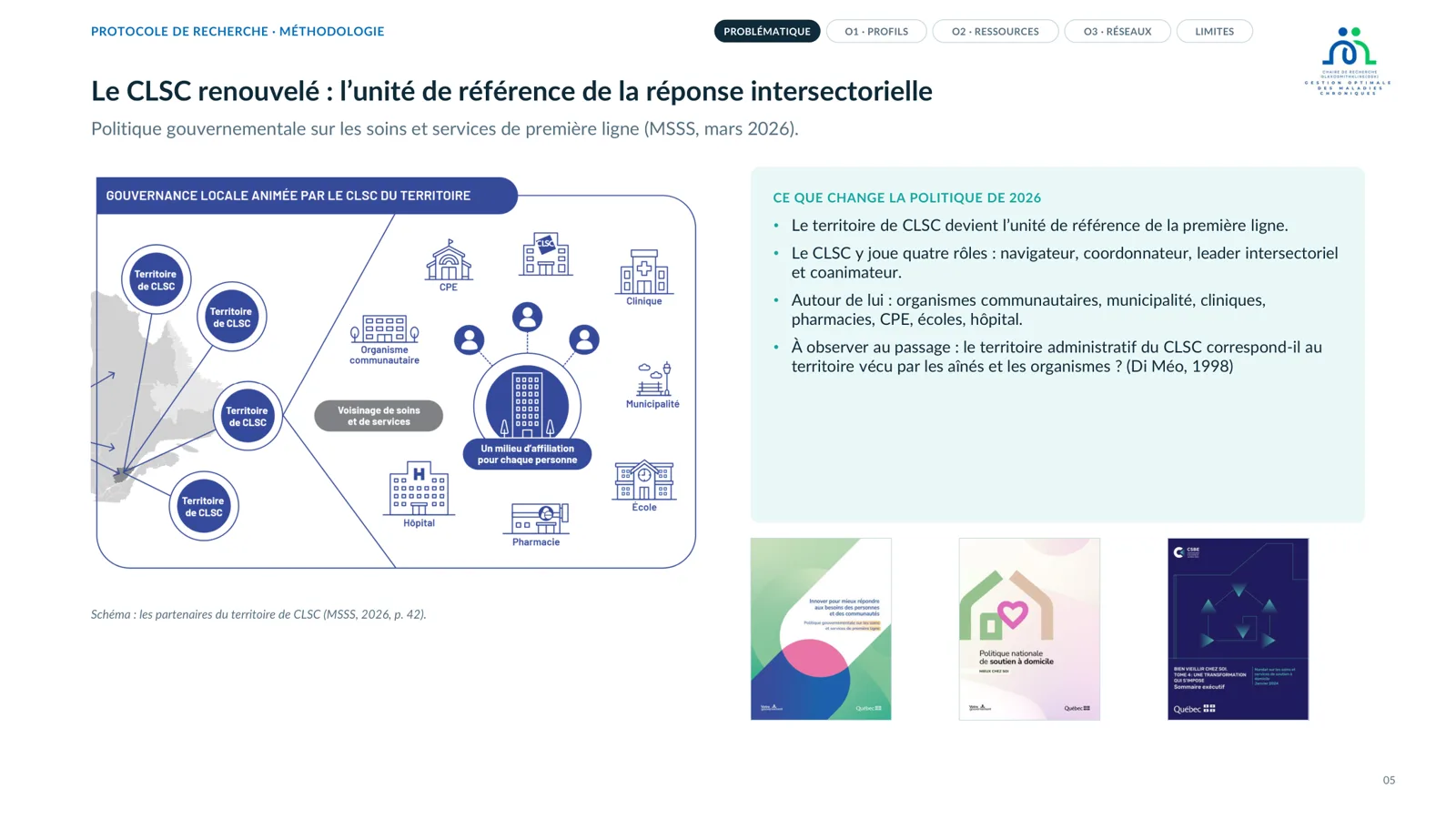
ᐱᒍᑦᔨᒋᐊᖕᖓᒍᑎᓄᑦ ᒪᓕᒐᖅ (MSSS, 2026) ᐃᓅᔪᓂᒃ ᑕᒪᕐᒥᒃ CLSC-ᐅᑉ ᓄᓇᖓᓄᑦ ᑲᑎᑦᓯᔪᖅ, ᑐᖕᖓᕕᐅᓕᕐᑐᖅ (ᒪᑉᐱᒐᖅ 15). CLSC ᓯᑕᒪᓂᒃ ᐱᓇᓱᐊᕈᑎᖃᕐᑐᖅ: ᐊᕐᖁᓯᕐᑎ, ᐋᕐᕿᓱᐃᔨ, ᐊᓯᖏᓐᓂᒃ ᓯᕗᓕᕐᑎ, ᑲᑐᔾᔨᔨ (ᒪᑉᐱᒐᖅ 42).

Plusieurs dispositifs rapprochent déjà les acteurs. PRISMA, un modèle québécois d’intégration des services pour les personnes âgées en perte d’autonomie, a réuni un guichet unique, la gestion de cas, un outil d’évaluation commun et la concertation des partenaires ; son évaluation a montré moins de déclin fonctionnel et moins de besoins non comblés (Hébert et al., 2003, 2010 ; Couturier et al., 2021). L’Approche intégrée de proximité pour les personnes aînées (AIPPA) du MSSS (2024) mise sur des pratiques collaboratives et le repérage des personnes qui ont des besoins (p. 8), sur les travailleurs de milieu du programme ITMAV et sur les organisateurs communautaires des établissements (p. 28), ainsi que sur des communautés de pratique (p. 59 ; Ranmuthugala et al., 2011). L’organisateur communautaire, rattaché au service d’organisation communautaire du CISSS ou du CIUSSS, fait le lien entre l’établissement et les organismes du milieu (Bourque et Lachapelle, 2010).

ᐊᓯᖏᓐᓂᒃ ᐱᓇᓱᐊᕐᕕᖕᓂᒃ ᑲᑐᔾᔨᓂᖅ ᓄᑖᙱᑦᑐᖅ: Chez soi : le premier choix (2003), RUISSS (2022) ᐱᖓᓲᔪᐊᑦ ᐱᓇᓱᐊᕐᕕᐅᔪᑦ ᓯᑕᒪᓗ ᐱᓇᓱᖃᑎᒌᓐᓂᕐᒧᑦ ᖁᑦᑎᓂᖏᑦ (ᑐᓴᕐᑎᑦᓯᓂᖅ, ᐱᓇᓱᖃᑎᒌᓐᓂᖅ, ᐋᕐᕿᓱᐃᓂᖅ, ᑲᑎᑦᑕᐅᓂᖅ). ᐱᑕᖃᙱᑦᑐᖅ: ᓄᓇᒥ ᑕᒪᕐᒥ, ᓇᓪᓕᐅᒃ ᐱᓇᓱᐊᕐᕕᐅᔪᑦ ᑲᑐᔾᔨᔭᐅᔭᕆᐊᓕᒃ.

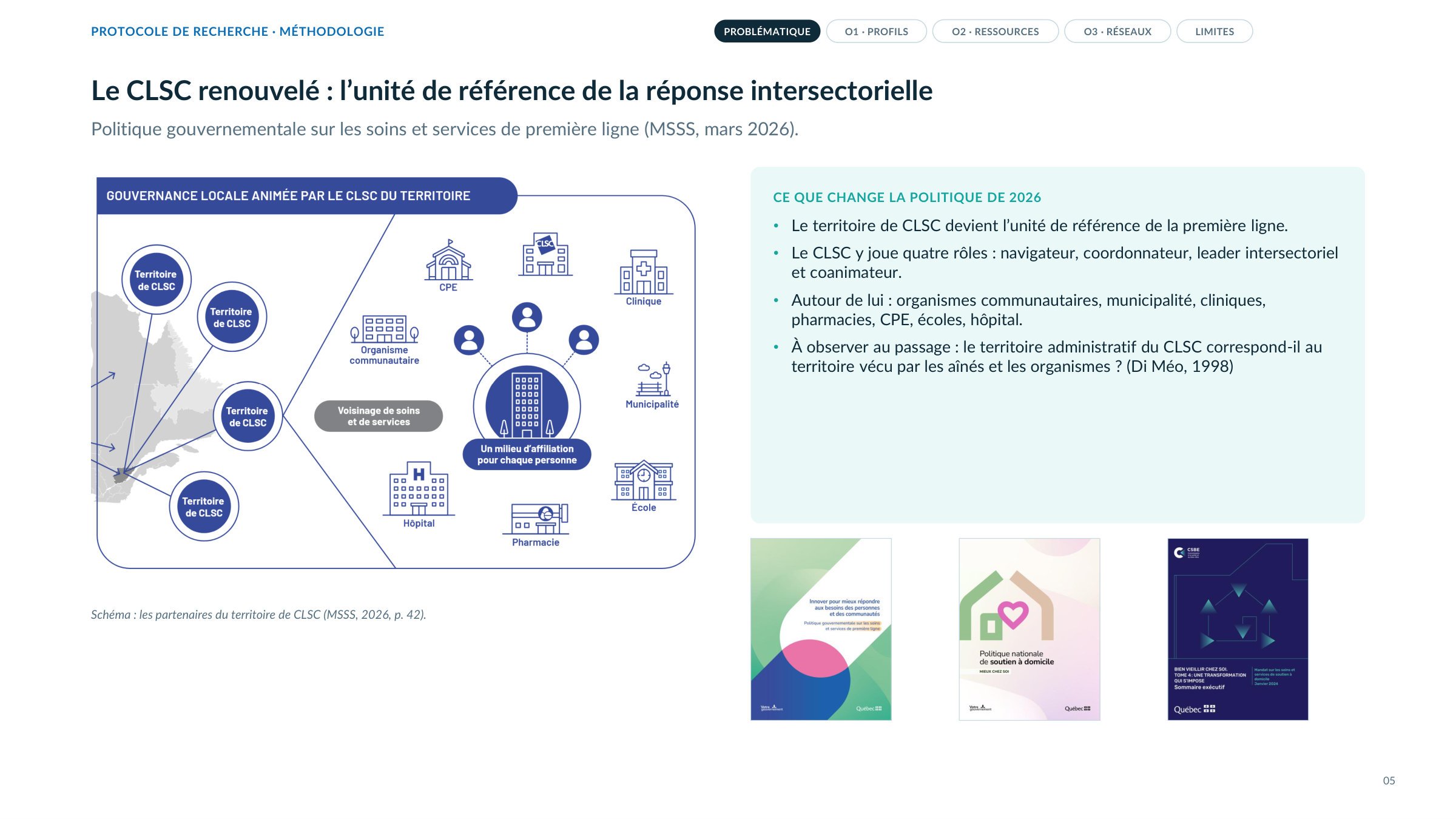
ᒪᓕᒐᖅ: CLSC ᓯᑕᒪᓂᒃ ᐱᓇᓱᐊᕈᑎᖃᕐᑐᖅ
CLSC ᓯᑕᒪᓂᒃ ᐱᓇᓱᐊᕈᑎᖃᕐᑐᖅ: ᐊᕐᖁᓯᕐᑎ, ᐋᕐᕿᓱᐃᔨ, ᓯᕗᓕᕐᑎ, ᑲᑐᔾᔨᔨ. ᐊᔾᔨᙳᐊᖅ: MSSS (2026), Politique gouvernementale sur les soins et services de première ligne, p. 42.

Ce schéma, avec la littérature, a servi à délimiter les secteurs étudiés dans la thèse (MSSS, 2026b, p. 42 ; Bilodeau et al., 2019).

Ces dispositifs sont précieux, mais la réponse intersectorielle reste peu visible. Elle repose souvent sur des partenariats locaux : une communauté de pratique, une table de concertation, une personne qui joue le rôle de facilitatrice. Si cette personne part ou si le financement s’arrête, la réponse s’affaiblit : elle est peu pérenne et souvent incomplète. Surtout, aucun de ces dispositifs ne dit quelles combinaisons de besoins reviennent le plus, quelles ressources existent pour chacune sur un territoire, ni comment le réseau s’organise aujourd’hui pour y répondre. C’est précisément ce que vise la thèse.

Diapositive : le CLSC renouvelé, unité de référence de la réponse intersectorielle
Ce que change la Politique de 2026 (MSSS, 2026b, p. 15 et 42). Source : Bernier, E. (2026). Méthodologie de la thèse O1-O3 [présentation], diapositive 6.

5. Ce que la littérature a déjà tenté

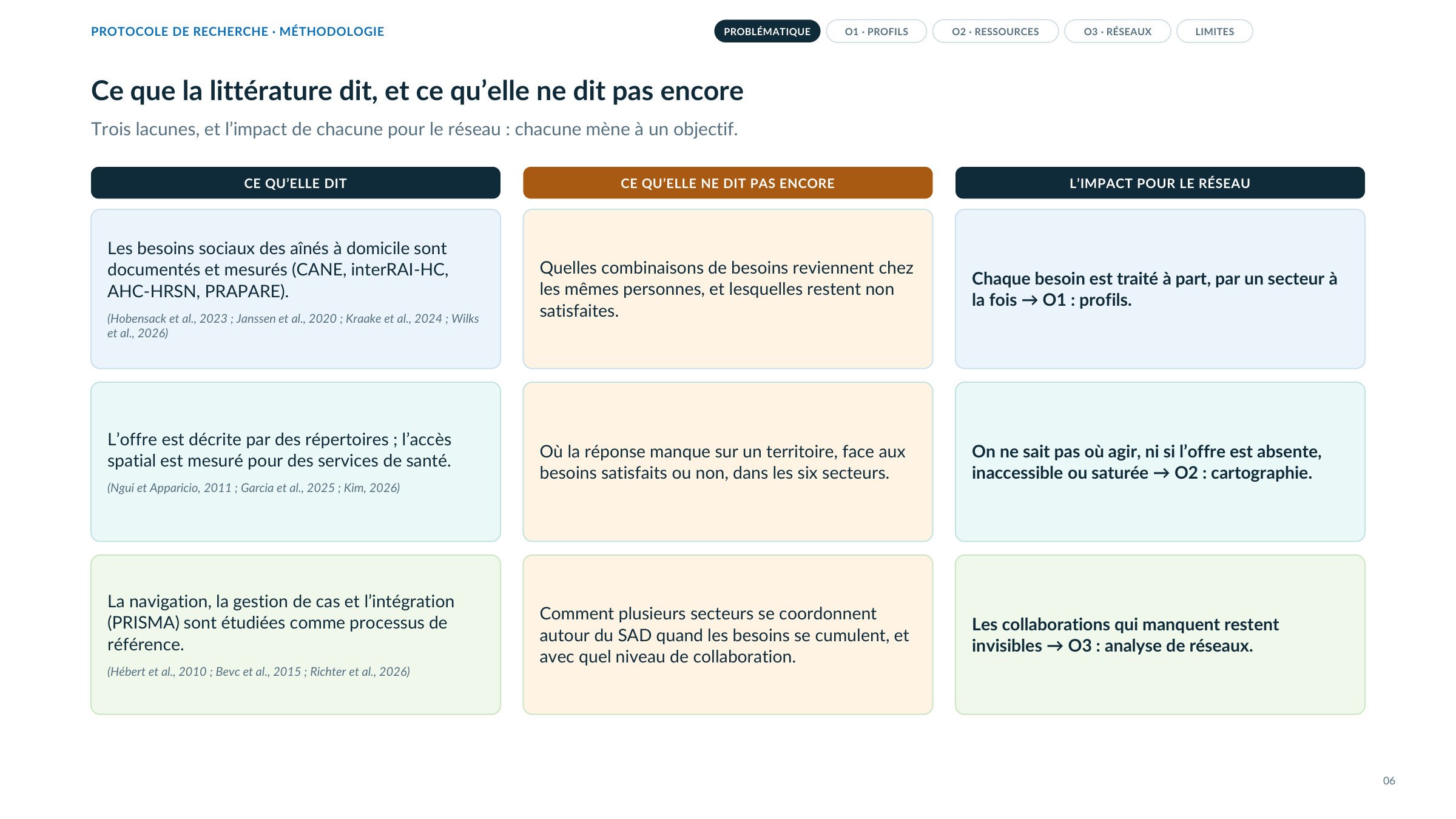
ᐅᖃᐅᓯᕆᔭᖏᑦ: ᐃᓐᓇᑐᖃᐃᑦ ᐃᓪᓗᒥ ᐱᔭᕆᐊᑭᖏᑦ ᐊᒥᓱᐃᑦ ᑲᑎᓯᒪᓪᓗᑎᒡᓗ (McManus et al., 2025; Kreuter et al., 2021; Janssen et al., 2020).

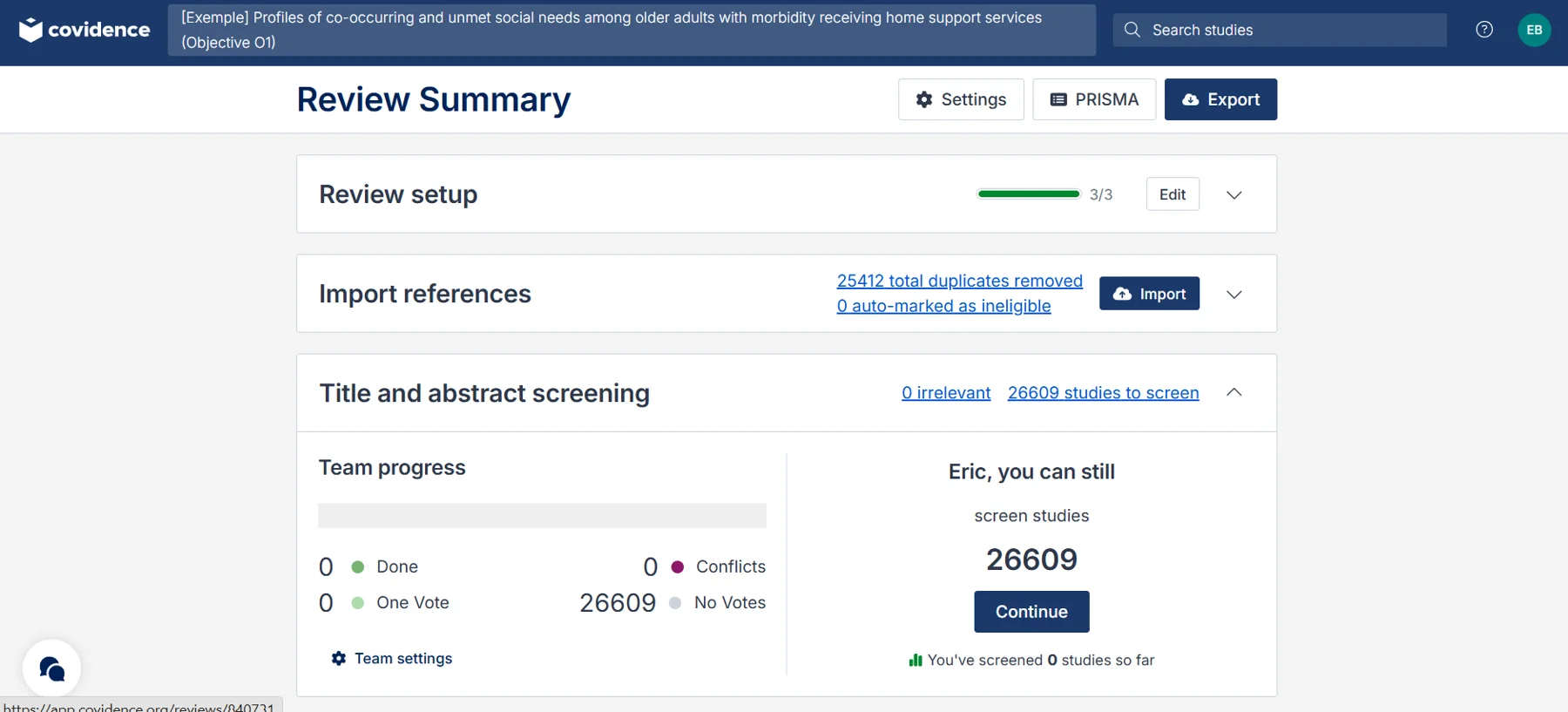
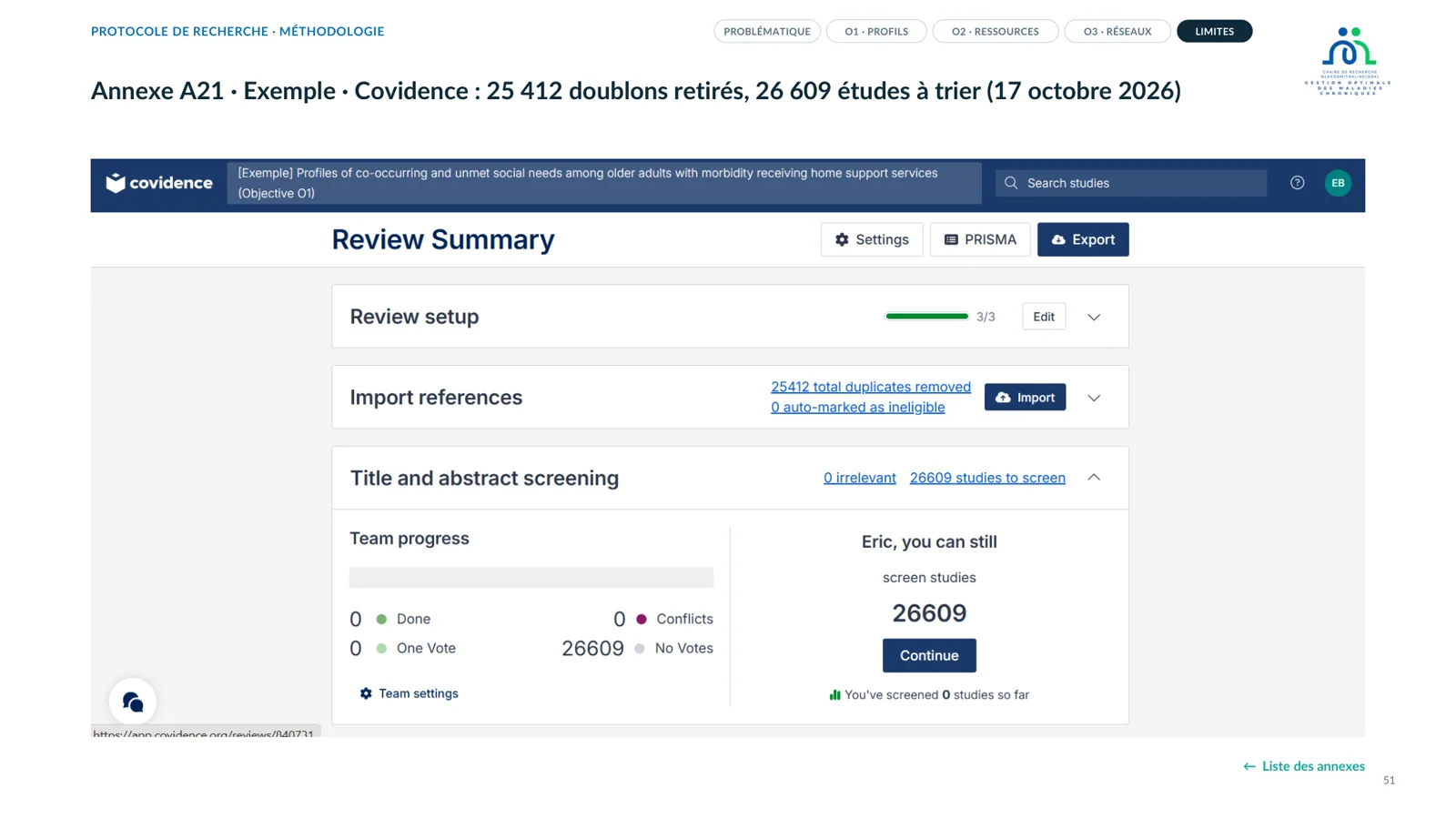
ᐅᖃᐅᓯᕆᓯᒪᙱᑕᖏᑦ: ᓇᓪᓕᐅᒃ ᐱᔭᕆᐊᑭᑦ ᑲᑎᓯᒪᔪᑦ SAD-ᒥ, ᓄᓇᒥ ᐃᑲᔪᕐᓯᓂᕐᓄᑦ ᑲᑎᑦᑕᐅᓯᒪᙱᑦᑐᑦ. O1-ᐅᑉ ᖃᐅᔨᓴᕐᓂᖓ: 60 957 ᑎᑎᕋᖅᓯᒪᔪᑦ; 8 938 2006-ᒥ ᓯᕗᓂᐊᓂ ᐲᔭᕐᑕᐅᔪᑦ; 52 021 Covidence-ᒧᑦ; 25 412 ᐊᑦᔨᒌᑦ ᐲᔭᕐᑕᐅᔪᑦ; 26 609 ᖃᐅᔨᓴᕐᑕᐅᔭᕆᐊᓖᑦ.

Des travaux ont déjà cartographié les besoins et les ressources des aînés : au Québec, l’étude dirigée par Anne-Marie Séguin (INRS) pour la Société d’habitation du Québec (2018) a décrit les besoins satisfaits ou non des 75 ans et plus selon le type de milieu, puis les ressources locales et les stratégies des personnes. Juliette Duc et ses collègues ont cartographié, avec QGIS et R, l’offre et la demande de services des 65 ans et plus dans tout le Québec : moins de services par personne âgée en milieu rural et une forte variabilité locale (Duc et al., 2026). D’autres ont décrit des profils de besoins chez les personnes atteintes de démence vivant à domicile (Janssen et al., 2020) ou analysé des réseaux de services par l’analyse des réseaux sociaux, la SNA (Urbanoski et al., 2018). Aucun travail repéré ne relie encore les besoins sociaux concomitants et la ou les morbidités comme facteurs de complexité, à l’échelle d’un territoire de CLSC.

ᓇᓗᓇᕐᑐᖅ ᐱᒻᒪᕆᐅᓛᖅ

ᐊᐱᕆᐅᑎᐅᑉ ᐃᓚᖏᓐᓄᑦ ᐊᑐᓂ ᐊᓪᓚᓯᒪᔪᑦ ᐱᑕᖃᕐᑐᑦ: ᐃᓅᓯᕐᒥ ᑭᖕᖒᒪᒋᔭᑦ ᐊᒥᓱᑦ ᓈᓴᕐᑕᐅᓂᖏᑦ, ᐊᑕᐅᑦᓯᑯᑦ ᐱᑕᖃᕐᓂᖏᑦ, ᐋᓐᓂᐊᓯᐅᕐᑕᐅᔪᑦ ᐃᑲᔪᕐᑕᐅᒐᓱᓐᓂᖏᑦ, ᐃᑲᔪᕐᓯᒍᓰᓪᓗ. ᑭᓯᐊᓂ ᑲᑎᑦᓯᓂᖅ ᓇᓂᑕᐅᖕᖏᑐᖅ, ᐃᓄᓐᓄᑦ ᐃᓐᓇᐅᓕᕐᑐᓄᑦ ᐱᒍᑦᔨᒋᐊᖕᖓᒍᑎᓂ, ᑲᑎᑦᓯᔪᖅ ᑭᖕᖒᒪᒋᔭᑦ ᓈᒻᒪᒃᓴᕐᑕᐅᓯᒪᖕᖏᓂᖏᓐᓂᒃ, ᐊᑕᐅᑦᓯᑯᑦ ᐱᑕᖃᕐᓂᖏᓐᓂᒃ, ᐋᓐᓂᐊᓯᐅᕐᑕᐅᔪᑦ ᓯᕗᓪᓕᐅᑎᓂᖏᓐᓂᒃ, ᐊᑦᔨᒥᓄᑦ ᑲᑐᑦᔨᒪᓂᖏᓐᓂᒃ, ᐃᑲᔪᕐᓯᓂᐅᑉ ᑲᑐᑦᔨᒪᓂᖏᓐᓂᒃ, ᐊᕐᖁᑎᒥᓪᓗ ᐋᕐᕿᒋᐊᕐᕕᖓᓄᑦ ᑎᑭᓪᓗᒍ. ᑕᐃᒪᓐᓇ ᓇᓗᓇᕐᑐᖅ ᑐᕌᖓᔪᖅ ᑭᖕᖒᒪᒋᔭᑦ ᐋᕐᕿᓯᒪᓂᖏᑦ ᑎᒥᐅᔪᓪᓗ ᐊᑦᔨᒌᖕᖏᑐᑦ ᐃᑲᔪᕐᓯᓂᖏᑕ ᐋᕐᕿᓯᒪᓂᖏᑦ ᖃᓄᖅ ᑲᑐᑦᔨᒪᒻᒪᖔᑕ, ᓱᒧᓪᓗ ᑭᖕᖒᒪᒋᔭᑦ ᐃᓚᖏᑦ ᓇᓗᓀᕐᑕᐅᓯᒪᒐᓗᐊᕐᓱᑎᒃ ᐱᑕᖃᕐᑐᐃᓐᓇᕐᒪᖔᑕ.

ᖃᐅᔨᓴᕈᓯᖅ ᓱᓕᑦᓯᐊᕆᐊᖃᕐᒪᑦ, ᐅᖃᐅᓯᖅ ᓂᓪᓕᐅᑎᑕᐅᔪᖅ ᐅᑯᐊᖑᔪᖅ « PubMed-ᒥ Cairn-ᒥᓗ ᕿᓂᕐᓂᓂ ᐱᓇᓱᐊᕐᑕᐅᓯᒪᔪᓂ ᑲᑎᑦᓯᓂᖅ ᓇᓂᑕᐅᖕᖏᑐᖅ », ᐅᑯᐊᖑᓇᓂ « ᑲᑎᑦᓯᓂᖅ ᐱᑕᖃᖕᖏᑐᖅ ».

Diapositive : ce que la littérature dit, ce qu’elle ne dit pas encore, et l’impact pour le réseau
Trois lacunes, chacune menant à un objectif. Source : Bernier, E. (2026). Méthodologie de la thèse O1-O3 [présentation], diapositive 7.

6. Une réponse intersectorielle, pas seulement une intervention individuelle

Le travailleur social du SAD évalue la situation d’une personne, l’oriente et l’accompagne : c’est une intervention individuelle, essentielle. Une réponse intersectorielle aux besoins sociaux concomitants d’une personne ayant une ou plusieurs morbidités est autre chose : c’est l’organisation, sur un territoire, de plusieurs secteurs (santé, services sociaux, communautaire, municipalité, habitation, transport) qui agissent ensemble, de façon durable, pour une même combinaison de besoins. L’enjeu, aujourd’hui, n’est pas le savoir-faire des intervenants : c’est l’absence d’une organisation commune. Chaque intervenant reconstruit, cas par cas, un réseau qui pourrait être connu à l’avance. Le travail social évalue, oriente et coordonne au cas par cas ; une réponse intersectorielle organise d’avance plusieurs secteurs autour d’un profil (Couturier et al., 2022 ; Bilodeau et al., 2019). L’enjeu : passer de « qui connaît qui » à une réponse organisée et pérenne.

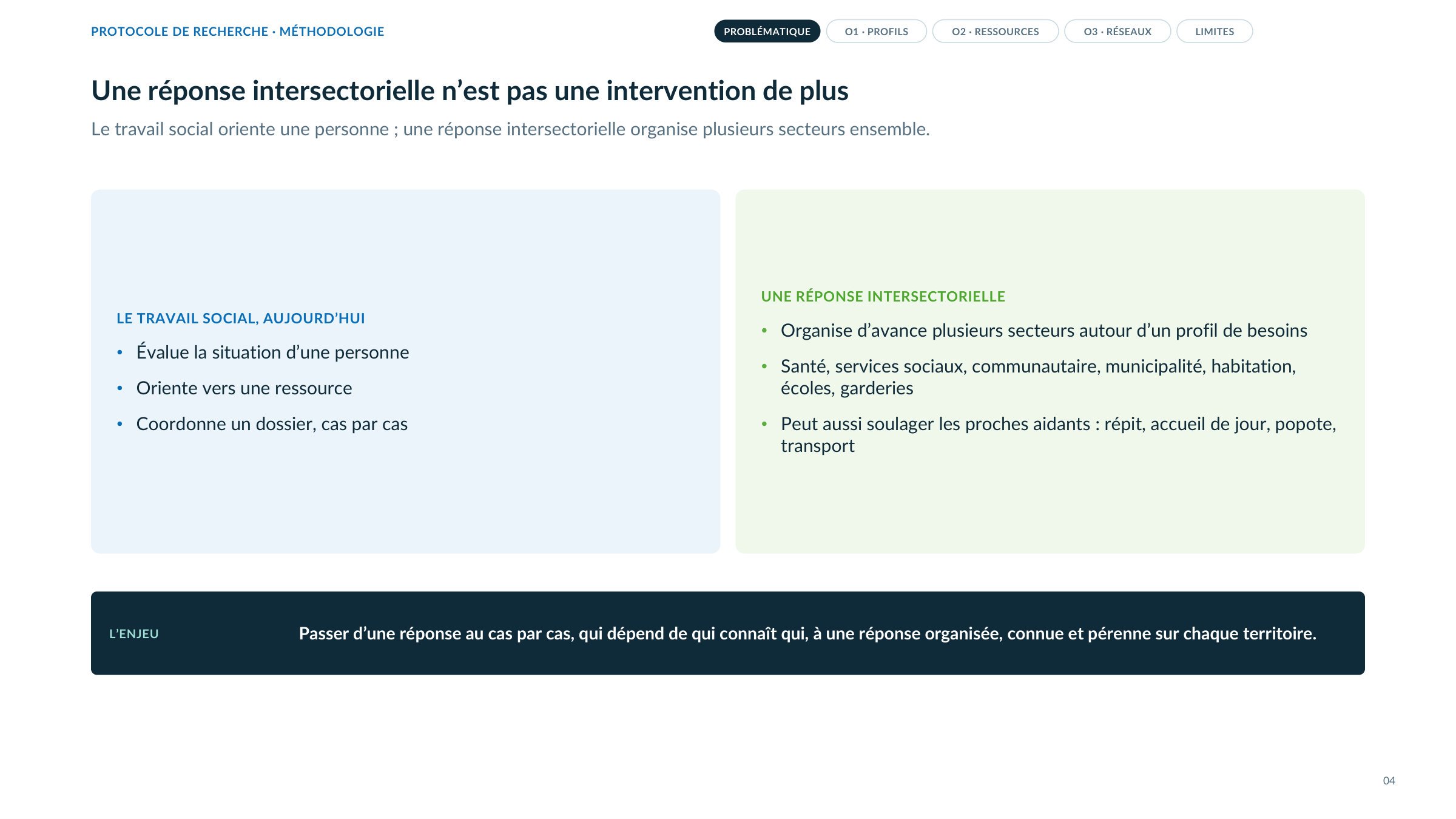
Diapositive : une réponse intersectorielle n’est pas une intervention de plus
Travail social et réponse intersectorielle. Source : Bernier, E. (2026). Méthodologie de la thèse O1-O3 [présentation], diapositive 5.
Travail social, aujourd’huiRéponse intersectorielle visée
Évalue la situation d’une personneOrganise d’avance plusieurs secteurs autour d’un profil de besoins
Oriente vers une ressourceSanté, services sociaux, communautaire, municipalité, habitation, écoles, garderies
Coordonne un dossier, cas par casSoulage aussi les proches aidants : répit, accueil de jour, popote, transport
Dépend de « qui connaît qui »Organisée, connue et pérenne sur chaque territoire

D’après Couturier et al. (2022) et Bilodeau et al. (2019).

7. Volet secondaire : territoire vécu et territoire administratif

La Politique de 2026 fait du territoire de CLSC l’unité de référence. Ses Orientations précisent que ce territoire « n’est plus un simple découpage administratif, mais un espace vivant » et que les 166 territoires actuels ne doivent pas être vus comme des « finalités en soi » (MSSS, 2026c, sommaire et p. 4 ; MSSS, 2026b, p. 42). Or les territoires de CLSC ont d’abord été définis pour assigner une population à chaque établissement (MSSS, Recommandations sur la gestion des données territoriales) ; à Montréal, la santé publique a d’ailleurs découpé l’île en 101 voisinages, plus proches des communautés, et les unités administratives ne correspondent pas toujours aux milieux vécus (Di Méo, 1998 ; Riva et al., 2008 ; Macé, 2010 ; Breton et al., 2009). En second plan, la thèse vérifiera si les ressources que les personnes utilisent réellement suivent le découpage du CLSC ou le débordent.

8. L’idée de la thèse

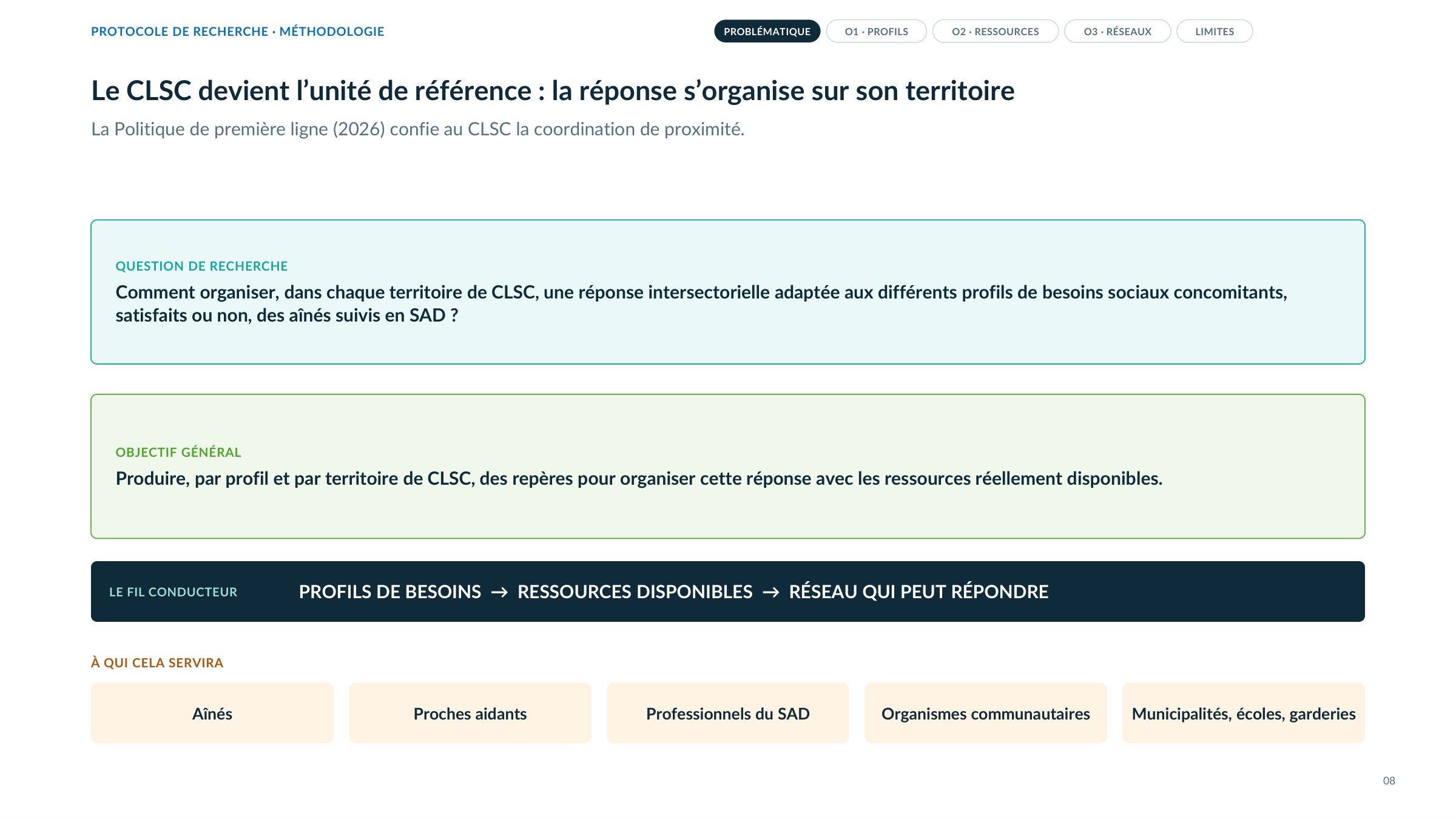
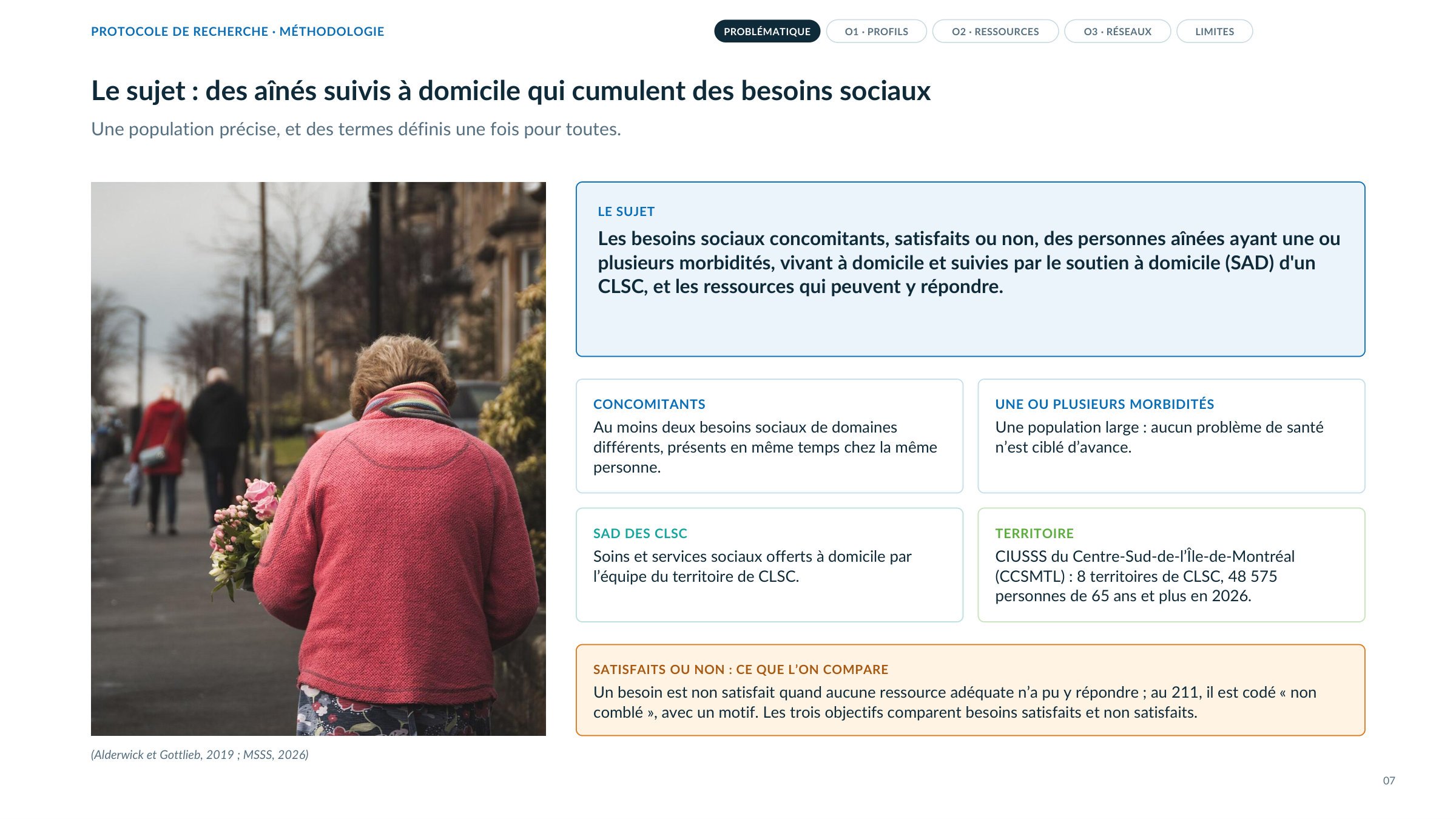
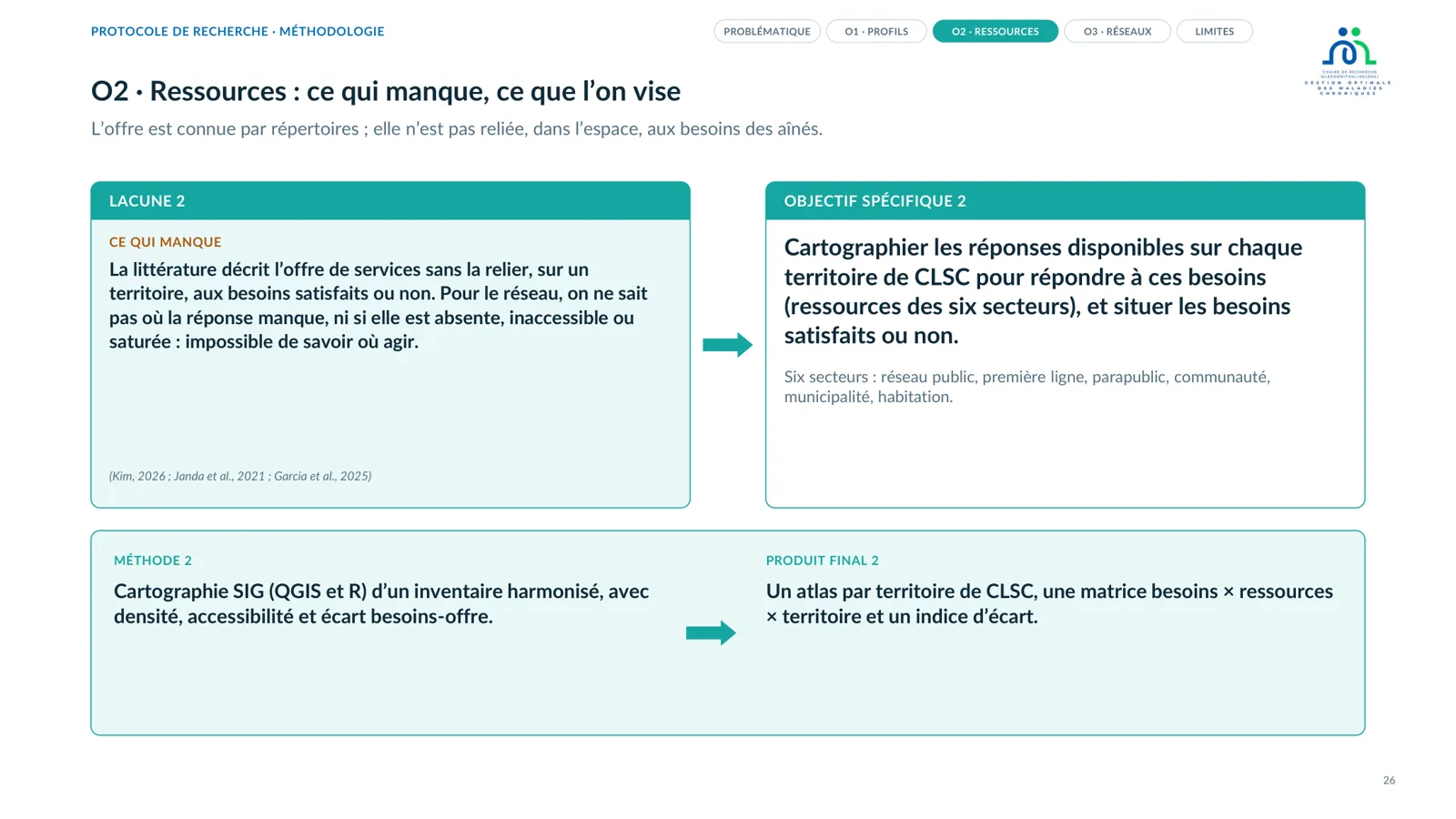
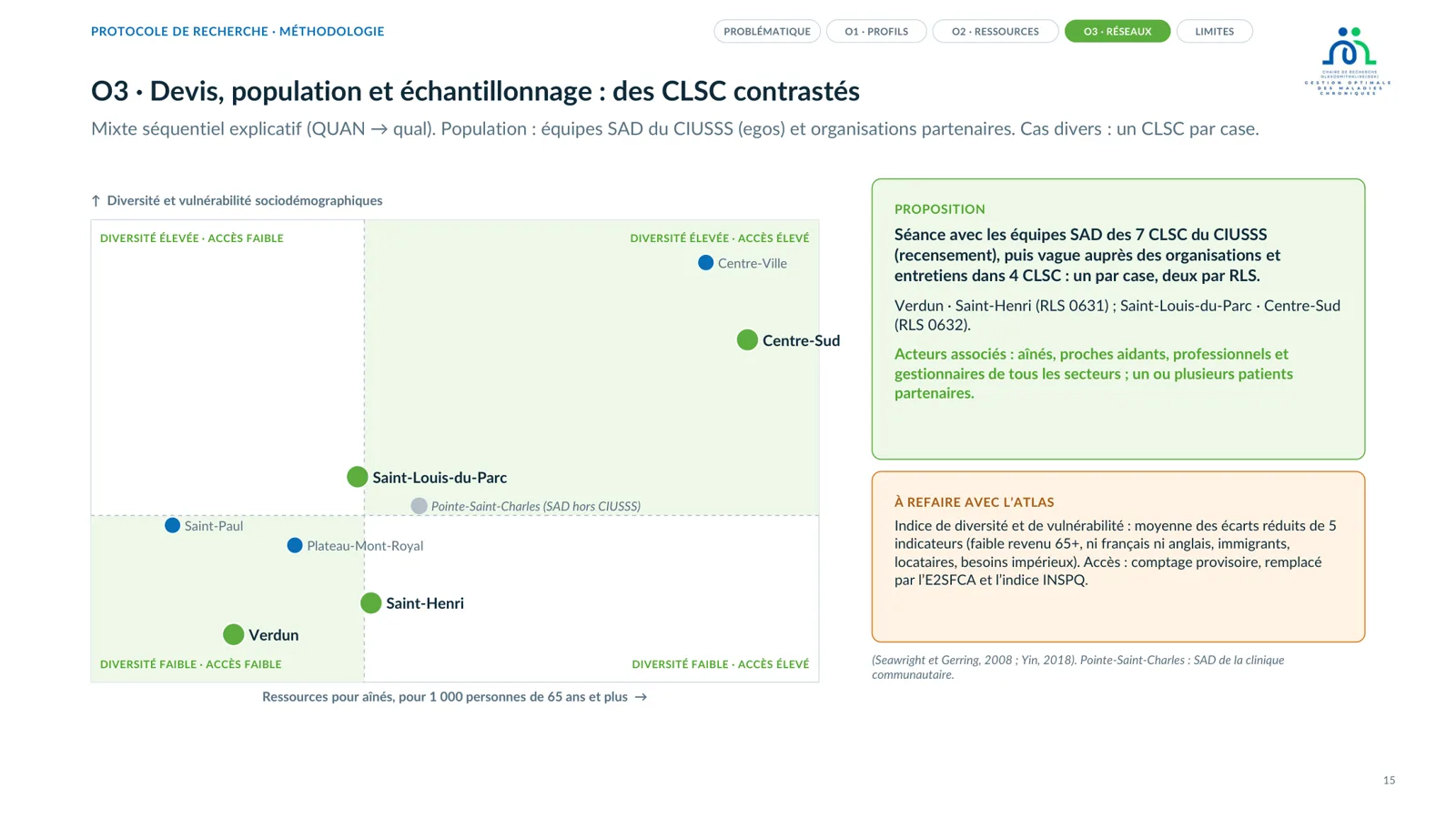
D’où l’idée de départ : identifier les profils de besoins sociaux concomitants les plus fréquents chez les aînés suivis en SAD ; pour chaque profil, repérer les ressources disponibles sur chaque territoire de CLSC ; puis comprendre comment la réponse s’organise aujourd’hui, afin de l’améliorer. La thèse porte sur les personnes aînées ayant une ou plusieurs morbidités, qui vivent à domicile et sont suivies par le SAD des huit territoires de CLSC du CIUSSS du Centre-Sud-de-l’Île-de-Montréal (48 575 personnes de 65 ans et plus en 2026).

9. Ma posture

Ma réflexion part de mon parcours entre plusieurs secteurs et de mon observation des politiques du maintien à domicile, sur lesquelles j’ai travaillé à l’ANAP. Comme éducateur spécialisé, j’ai vu à quel point il est difficile d’organiser une réponse commune aux situations les plus complexes, quand plusieurs services interviennent sans se coordonner. Cette thèse cherche à rendre visible, et donc organisable, ce qui repose aujourd’hui surtout sur la bonne volonté de chacun.

ᐊᓪᓚᖁᑏᑦ ᑐᖕᖓᕕᐅᔪᑦ

ᐅᑯᐊ ᐊᑖᓂ ᐊᓪᓚᖁᑏᑦ ᐃᓱᒪᒋᔭᐅᔪᑦ ᐋᕐᕿᓯᒪᓂᖏᓐᓂᒃ ᑐᑭᓯᓇᕐᓯᑎᑦᓯᔪᑦ. ᐊᑎᖓ, ᐊᐱᕆᐅᑎᖓ, ᑐᑭᖓ ᐱᒻᒪᕆᐅᔪᖅ ᑐᕌᒐᓪᓗ, ᐊᑐᓂ ᐃᓂᒥᓂ ᑕᑯᑎᑕᐅᔪᑦ, ᐸᕐᓀᕈᑎᐅᑉ ᒫᓐᓇ ᑭᓪᓕᖏᑦ.

ᖃᐅᔨᓴᕐᓂᐅᑉ ᐸᕐᓀᕈᑎᖓᓂᒃ ᐃᓱᒪᒋᔭᐅᔪᓂᒃ ᐋᕐᕿᓯᓂᖅ

ᒫᓐᓇ ᐃᓱᒪᒋᔭᐅᔪᓂᒃ ᐋᕐᕿᓯᓂᕐᒥ ᐱᓇᓱᐊᕐᐳᖓ: ᐊᓪᓚᓯᒪᔪᑦ ᓴᕐᕿᑎᑕᐅᓯᒪᔪᑦ ᓯᕗᓪᓕᐅᑎᑕᐅᔪᑦ, ᓇᓗᓇᕐᑐᑦ ᑕᑯᑎᑦᓯᔭᖏᑦ, ᐃᓕᓐᓂᐊᕐᓂᕐᒧᓪᓗ ᐅᖃᓕᒫᒐᑦ ᐃᑲᔪᕐᓯᔪᑦ.

222ᐊᓪᓚᓯᒪᔪᑦ ᓂᓪᓕᐅᑎᑕᐅᔪᑦ
39ᐅᖃᓕᒫᒐᑦ ᓯᕗᓪᓕᐅᑎᑕᐅᔪᑦ
83ᐅᖃᓕᒫᒐᑦ ᐱᒻᒪᕆᐅᔪᑦ
9ᓇᓗᓇᕐᑐᑦ ᐃᓚᖏᑦ ᕿᒥᕐᕈᑕᐅᔪᑦ

ᓯᕗᓪᓕᐅᑎᑕᐅᓂᖏᑦ ᒪᓕᑦᓱᒋᑦ ᐊᕕᑦᑐᓯᒪᓂᖏᑦ

ᓯᕗᓪᓕᐅᑎᑕᐅᓂᖓ 539
ᓯᕗᓪᓕᐅᑎᑕᐅᓂᖓ 483
ᓯᕗᓪᓕᐅᑎᑕᐅᓂᖓ 346
ᓯᕗᓪᓕᐅᑎᑕᐅᓂᖓ 224
ᓯᕗᓪᓕᐅᑎᑕᐅᓂᖓ 130

ᐊᓪᓚᓯᒪᔪᑦ ᓇᑭᑦ ᐱᔭᐅᒻᒪᖔᑕ

  • PubMed112
  • Embase ᐊᒻᒪᓗ MEDLINE (Ovid)95
  • Cairn15

ᐊᓪᓚᓯᒪᔪᑦ ᑲᑎᑦᑕᐅᓯᒪᔪᑦ Ovid-ᒥᑦ (Embase, MEDLINE), PubMed-ᒥᑦ Cairn-ᒥᓪᓗ, ᐊᓪᓚᓯᒪᔪᓪᓗ ᐊᑐᓂ ᓯᕗᓪᓕᐅᑎᑕᐅᓯᒪᔪᑦ ᖃᐅᔨᓴᕐᓂᐅᑉ ᐊᐱᕆᐅᑎᖓᓄᑦ ᑲᑐᑦᔨᒪᓂᖓ ᒪᓕᑦᓱᒍ.

ᐊᓪᓚᓯᒪᔪᓂ ᓱᓕ ᓇᓗᓇᕐᑐᑦ

ᓇᓗᓇᕐᑐᑦ ᐃᓚᖏᓐᓄᑦ ᕿᒥᕐᕈᑕᐅᔪᓄᑦ 9-ᓄᑦ ᐊᑐᓂ, ᑐᑭᓯᑎᑦᓯᒍᑎ ᑕᑯᑎᑦᓯᔪᖅ ᐊᓪᓚᓯᒪᔪᑦ ᖃᓄᐃᓕᖓᓂᖏᓐᓂᒃ, ᓇᓗᓇᕐᑐᐅᑉ ᐱᒻᒪᕆᐅᓂᖓᓂᒃ, ᐊᓪᓚᖁᑎᓂᓪᓗ ᐃᓚᖏᓐᓂᒃ.

ᐃᓱᒪᒋᔭᐅᔪᑦ ᐋᕐᕿᓯᒪᓂᖏᑦ

ᐱᒻᒪᕆᐅᔪᖅ

ᐱᑕᖃᕐᑐᖅ, ᑭᓯᐊᓂ ᓱᓕ ᐊᑦᔨᒌᑦᑐᑯᑦ ᐋᕐᕿᓯᒪᖕᖏᑐᖅ

PubMed-ᒥ ᖃᐅᔨᓴᕐᓃᑦ ᐊᕕᑦᑐᕐᓂᕐᓴᐅᓕᕐᑐᑦ ᐃᓅᓯᕐᒥ ᐊᔪᕐᓇᕐᓂᐅᓇᔭᕐᑐᒥᒃ (risque social), ᐃᓅᓯᕐᒥ ᑭᖕᖒᒪᒋᔭᒥᒃ, ᐃᑲᔪᕐᑕᐅᒐᓱᓐᓂᕐᒥᓪᓗ. Cairn-ᒥ ᐅᐃᕖᑎᑐᑦ ᐊᓪᓚᓯᒪᔪᑦ ᐃᓚᒋᐊᕐᑐᑦ ᐅᖃᐅᓯᓂᒃ ᐊᔪᕐᓴᓂᕐᒥᒃ ᐃᓅᓯᕐᒥᓗ ᐊᔪᕐᓴᓂᕐᒥᒃ (précarité, vulnérabilité sociale), ᐊᒥᓱᐊᕈᑎᒃ ᐃᓚᓂᒃ ᐊᒥᓱᓂᒃ ᐱᑕᖃᕐᑐᓂᒃ, ᑭᓯᐊᓂ ᑐᑭᖏᑦ ᐊᖏᓂᕐᓴᐅᔪᑦ ᑭᖕᖒᒪᒋᔭᒥᑦ ᓈᒻᒪᒃᓴᕐᑕᐅᓯᒪᖕᖏᑐᒥᑦ.

Gruß 2021; Tucher 2026; Tudrej 2019; Karran 2023

ᓈᓴᐃᓂᖅ

ᐱᒻᒪᕆᐅᔪᖅ

ᐅᓄᕐᑐᑦ, ᑭᓯᐊᓂ ᐊᑦᔨᒌᖕᖏᑐᑦ

ᓈᓴᐅᑏᑦ ᐊᑦᔨᒌᖕᖏᑦᑑᓗᐊᕐᑐᑦ ᐃᓚᖏᑎᒍᑦ, ᑭᓪᓕᖏᑎᒍᑦ, ᐊᑐᕐᑕᐅᓂᖏᑎᒍᓪᓗ. Cairn-ᒥ ᓇᓂᑕᐅᔪᑦ ᐊᔪᕐᓴᓂᕐᒧᑦ ᓈᓴᐅᑏᑦ ᐃᓚᓂᒃ ᐊᒥᓱᓂᒃ ᓈᓴᐃᔪᑦ, EPICES PRECAR-ᓗ ᐊᑦᔨᖏᑦ, ᐊᑦᔨᒌᖕᖏᑐᑦ ᐊᐱᕐᓲᑎᓂᒃ ᐃᓅᓯᕐᒥ ᑭᖕᖒᒪᒋᔭᓂᒃ ᓈᒻᒪᒃᓴᕐᑕᐅᓯᒪᖕᖏᑐᓂᒃ ᓈᓴᐃᔪᓂᒃ.

Zein 2026; Karran 2023; Tudrej 2019; Rogers 2025

ᖃᓄᐃᓕᖓᓂᖏᑦ / ᖃᓄᑎᒋ ᐱᑕᖃᕐᒪᖔᑕ (prévalence)

ᐱᒻᒪᕆᐅᓗᐊᖕᖏᑐᖅ

ᐊᓪᓚᓯᒪᑦᓯᐊᕐᑐᖅ ᑭᖕᖒᒪᒋᔭᒧᑦ ᐊᑕᐅᓯᕐᒧᑦ ᐅᖓᑖᓄᓪᓗ

ᖃᐅᔨᓴᕐᓃᑦ ᐊᒥᓱᑦ ᐅᓂᒃᑳᕆᔪᑦ ᖃᓄᑎᒋ ᐱᑕᖃᕐᒪᖔᑕ ᐃᓚᒧᑦ ᐊᑐᓂ, ᑭᖕᖒᒪᒋᔭᓪᓗ ᑲᑎᑦᓯᒪᓂᖏᓐᓂᒃ, ᑭᓯᐊᓂ ᒪᓂᒪᑦᓯᐊᖕᖏᑐᑦ ᓈᓴᐅᑏᑦ ᐊᑦᔨᓕᐅᑎᔭᕆᐊᑭᖕᖏᑐᑦ ᑭᖕᖒᒪᒋᔭᐅᑉ ᑐᑭᖓ ᓈᓴᐅᑎᓪᓗ ᐊᑦᔨᒌᖕᖏᑉᐸᑕ.

Jih 2023; Bleacher 2020; Fiori 2021

ᐊᒥᓱᐅᓂᖏᑦ / ᐊᑕᐅᑦᓯᑯᑦ ᐱᑕᖃᕐᓂᖏᑦ

ᐱᒻᒪᕆᐅᔪᖅ

ᓄᑖᖑᔪᖅ, ᑭᓯᐊᓂ ᒫᓐᓇ ᓇᓗᓀᕐᓯᒪᔪᖅ

ᐃᓅᓯᕐᒥ ᑭᖕᖒᒪᒋᔭᑦ ᐅᕝᕙᓘᓐᓃᑦ ᐊᔪᕐᓇᕐᓃᑦ ᐊᒥᓱᑦ ᐊᑕᐅᑦᓯᑯᑦ ᐱᑕᖃᕐᓲᑦ, ᐊᒻᒪᓗ ᑲᑎᑦᓯᒪᔪᑦ (grappes), ᐊᕕᑦᑐᓯᒪᔪᑦ (classes), ᑲᑎᑦᓯᒪᓂᖏᑕᓗ ᓈᓴᐅᑎᖏᑦ ᐱᖁᔨᒍᑎᐅᓯᒪᔪᑦ. ᖃᐅᔨᓴᕐᓂᖅ ᓄᑖᖅ ᑕᑯᑎᑦᓯᒥᔪᖅ ᐊᔪᕐᓇᕐᓃᑦ ᐊᒥᓱᐅᒐᐃᑉᐸᑕ, ᐃᑲᔪᕐᑕᐅᒐᓱᓐᓂᖅ ᐱᑕᖃᕐᓂᕐᓴᐅᓗᐊᕐᓲᖅ.

Vest 2025; Kreuter 2021; Zeng 2024; Tucher 2026

ᐋᓐᓂᐊᓯᐅᕐᑕᐅᔪᑦ ᓯᕗᓪᓕᐅᑎᓂᖏᑦ

ᐱᒻᒪᕆᐅᓗᐊᕐᑐᖅ

ᖃᐅᔨᓴᕐᓃᑦ ᐃᓚᖏᑦ ᑐᕌᖓᔪᑦ, ᑭᓯᐊᓂ ᖃᐅᔨᓴᕐᓂᖅ ᓱᓕ ᐱᕈᕐᓴᓗᐊᖕᖏᑐᖅ

ᐊᓪᓚᓯᒪᔪᑦ ᐱᓗᐊᕐᑐᒥᒃ ᓈᓴᐃᔪᑦ ᐃᑲᔪᕐᑕᐅᒐᓱᓐᓂᕐᒥᒃ, ᑐᕌᒐᓂᒃ ᐊᖏᖃᑎᒌᒍᑕᐅᔪᓂᒃ, ᐊᖏᕐᑕᐅᔪᓐᓇᓂᕐᒥᒃ ᓯᕗᓪᓕᐅᑎᓂᕐᒥᓪᓘᓃᑦ, ᐊᒻᒪᓗ ᖃᐅᔨᓴᕐᓃᑦ ᓄᑖᑦ ᐊᕕᑦᑐᕐᓂᕐᓴᐅᑎᑦᓯᔪᑦ ᐊᔪᕐᓇᕐᓂᕐᒥᒃ ᓇᓂᑕᐅᔪᒥᒃ ᐃᑲᔪᕐᓯᓂᕐᒥᓪᓗ ᐱᔪᒪᔭᐅᔪᒥᒃ. e-CARE-ᐅᑉ ᖃᐅᔨᓴᕐᓂᖏᑦ ᑕᑯᑎᑦᓯᔪᑦ ᐃᑲᔪᕐᓯᓂᕐᒥᒃ ᐋᓐᓂᐊᓯᐅᕐᑕᐅᔪᐅᑉ ᓱᑲᓐᓂᖓᓄᑦ ᓯᕗᓪᓕᐅᑎᔭᖏᓐᓄᓪᓗ ᓈᒻᒪᓈᑦᑐᒥᒃ, ᑭᖕᖒᒪᒋᔭᓂᒃ ᓯᕗᓪᓕᐅᑎᓂᕐᒧᑦ ᐊᑦᔨᒌᑦᑐᒥᒃ ᓴᓇᖕᖏᑐᑦ.

O’Loughlin 2022; Gruß 2021; Tucher 2026; Vasan 2026; Ouanhnon 2022

ᑭᖕᖒᒪᒋᔭᑦ ᐊᑦᔨᒥᓄᑦ ᑲᑐᑦᔨᒪᓂᖏᑦ

ᐱᒻᒪᕆᐅᓗᐊᕐᑐᖅ

ᐱᓗᐊᕐᑐᒥᒃ ᐅᓂᒃᑳᑕᐅᔪᑦ ᐊᑕᐅᑦᓯᑯᑦ ᐱᑕᖃᕐᓂᐅᓪᓗᑎᒃ ᐅᕝᕙᓘᓐᓃᑦ ᐱᔭᕆᐊᑭᖕᖏᓂᐅᓪᓗᑎᒃ ᐃᓘᓐᓈᒍᑦ

ᓈᓴᐅᑎᑎᒍᑦ ᕿᒥᕐᕈᓃᑦ ᐱᓗᐊᕐᑐᒥᒃ ᐊᓪᓚᓯᔪᑦ ᑭᖕᖒᒪᒋᔭᑦ ᖃᓄᐃᓕᖓᓃᓪᓗ ᐊᑕᐅᑦᓯᑯᑦ ᐱᑕᖃᕐᓂᖏᓐᓂᒃ. Cairn-ᒥ ᐅᐃᕖᑎᑐᑦ ᐊᐱᕐᓱᕐᓂᑎᒍᑦ ᖃᐅᔨᓴᕐᓃᑦ ᐅᓂᒃᑳᕆᔪᑦ ᐊᔪᕐᓇᕐᓂᓂᒃ ᐃᓅᓯᕐᒥ, ᐊᓪᓚᑦᓭᓂ, ᑮᓇᐅᔭᓂ ᐃᓗᓯᕐᒥᓗ ᑲᑐᑦᔨᒪᓂᖏᓐᓂᒃ, ᑭᓯᐊᓂ ᐊᒥᓲᖕᖏᑐᒥᒃ ᓇᒧᑦ ᑐᕌᖓᓂᖏᓐᓂᒃ, ᒪᓕᑦᑐᐃᓐᓇᕐᓂᖏᓐᓂᒃ ᓱᒧᓪᓘᓃᑦ ᐱᑦᔪᑎᖏᓐᓂᒃ.

Vest 2025; Kreuter 2021; Marron-Delabre 2015; Ouanhnon 2022

ᐋᕐᕿᒋᐊᕐᓂᖅ / ᐊᕐᖁᑎ

ᐱᒻᒪᕆᐅᓗᐊᕐᑐᖅ

ᐱᕈᕐᓴᓕᕐᑐᖅ, ᑭᓯᐊᓂ ᐱᓗᐊᕐᑐᒥᒃ ᓈᓴᐅᑎᓂᒃ ᐊᑯᓐᓂᖓᓂ ᐃᓂᖃᕐᑐᓂᒃ ᐊᑐᕐᑐᖅ

ᖃᐅᔨᓴᕐᓂᖅ ᐊᕕᑦᑐᕐᓂᕐᓴᐅᓕᕐᑐᖅ ᖃᐅᔨᓴᐃᓂᕐᒥᒃ (dépistage), ᐊᓯᐊᓄᑦ ᑐᕌᕐᑎᑦᓯᓂᕐᒥᒃ, ᑲᑐᑦᔨᓂᕐᒥᒃ, ᐃᑲᔪᕐᓯᓂᕐᒥᒃ ᐱᔭᐅᔪᒥᒃ ᐋᕐᕿᒋᐊᕐᓂᕐᒥᓪᓗ. e-CARE-ᐅᑉ ᐅᐃᕖᑎᑐᑦ ᖃᐅᔨᓴᕐᓂᖏᑦ ᒪᓕᑦᑐᒥᔪᑦ ᓂᕆᐅᓇᕐᑐᓂᒃ ᑕᑯᑦᓴᐅᔪᓂᒃ: ᐱᔪᓐᓇᐅᑎᓂᒃ ᐱᓕᕐᓂᖅ, ᓘᒃᑖᕐᒧᑦ ᒪᓕᑦᑐᒥᒃ ᐃᓯᕐᓂᖅ, ᐃᓪᓗᖃᕐᓂᖅ, ᐊᕐᖁᑎᒥᓗ ᐃᒻᒥᓂᒃ ᐱᔪᓐᓇᕐᓂᖅ, ᑭᓯᐊᓂ ᑭᖕᖒᒪᒋᔭᐅᑉ ᐊᑐᓂ ᐋᕐᕿᒋᐊᕐᓂᖓ ᐊᑦᔨᒌᑦᑐᑯᑦ ᓈᓴᕐᑕᐅᖕᖏᑐᖅ.

Steeves-Reece 2022; Hausmann 2024; Ouanhnon 2022; Agarwal 2025

ᑲᑐᑦᔨᒪᓃᑦ / ᑎᒥᐅᔪᑦ ᐊᑦᔨᒌᖕᖏᑐᑦ ᐃᑲᔪᕐᓯᓂᖏᑦ

ᐱᒻᒪᕆᐅᓗᐊᕐᑐᖅ ᑲᑎᑦᓯᓂᕐᒧᑦ

ᐊᓪᓚᓯᒪᔪᑦ ᐅᓄᕐᑐᑦ, ᑭᓯᐊᓂ ᐊᒥᓱᐊᕈᑎᒃ ᐋᓐᓂᐊᓯᐅᕐᑕᐅᔪᑦ ᑭᓯᑦᑕᐅᓯᒪᔪᖏᓐᓂᑦ ᐊᕕᑦᑐᓯᒪᔪᑦ

PubMed-ᒥ ᐊᓪᓚᓯᒪᔪᑦ ᐅᓂᒃᑳᕆᔪᑦ ᑐᑭᒧᐊᑦᑎᓯᓂᕐᒥᒃ (navigation), ᓄᓇᓕᓐᓂ ᐃᓗᓯᓕᕆᔨᓂᒃ, ᐋᓐᓂᐊᓯᐅᕐᓂᐅᑉ ᐱᖁᔭᓕᕆᓂᐅᓪᓗ ᐱᓇᓱᖃᑎᒌᓐᓂᖏᓐᓂᒃ, ᐊᓯᐊᓄᓪᓗ ᑐᕌᕐᑎᑦᓯᓂᕐᓂᒃ ᐃᓱᓕᑦᑕᐅᔪᓂᒃ (boucles de référence fermées); Cairn-ᒥᓗ ᐅᓂᒃᑳᕆᔭᐅᔪᑦ ᐃᓄᓕᕆᔩᑦ ᓘᒃᑖᑦ ᐃᓘᓐᓈᒍᑦ ᐋᓐᓂᐊᓯᐅᕐᑎᐅᔪᑦ ᐊᓯᐊᓂ, MSP-ᑦ, CPTS-ᑦ, DAC-ᑦ, ᓄᓇᒥᓗ ᐊᑕᐅᑦᓯᑰᕐᑎᓯᓂᖅ. ᑭᓯᐊᓂ ᑲᑐᑦᔨᒪᓃᑦ ᐋᕐᕿᓯᒪᓂᖏᑦ ᐊᒥᓲᖕᖏᑐᒥᒃ ᑲᑐᑦᔨᑕᐅᓲᑦ ᑭᖕᖒᒪᒋᔭᑦ ᖃᓄᐃᓕᖓᓂᖏᓐᓄᑦ ᐋᕐᕿᒋᐊᕐᓂᖏᓐᓄᓪᓗ.

Hogg-Graham 2021; Tevaearai 2022; Yatim & Sebai 2021; Lessi 2023; Ouanhnon 2022

ᑲᑎᑦᓯᓂᖅ ᐃᓘᓐᓈᒍᑦ

ᓇᓗᓇᕐᑐᖅ ᐱᒻᒪᕆᐅᓛᖅ

PubMed-ᒥ Cairn-ᒥᓗ ᕿᒥᕐᕈᓂᓐᓂ ᓇᓂᑕᐅᖕᖏᑐᖅ

ᑲᑎᑦᓯᓂᖅ ᓇᓂᑕᐅᖕᖏᑐᖅ, ᐃᓄᓐᓄᑦ ᐃᓐᓇᐅᓕᕐᑐᓄᑦ ᐱᒍᑦᔨᒋᐊᖕᖓᒍᑎᓄᑦ ᐃᓯᕐᑐᓄᑦ, ᑲᑎᑦᓯᔪᖅ: ᑭᖕᖒᒪᒋᔭᑦ ᓈᒻᒪᒃᓴᕐᑕᐅᓯᒪᖕᖏᓂᖏᑦ, ᐃᓚᖏᑦ ᐊᒥᓱᑦ ᓈᓴᕐᑕᐅᓂᖏᑦ, ᐊᑕᐅᑦᓯᑯᑦ ᐱᑕᖃᕐᓂᖏᑕ ᐋᕐᕿᓯᒪᓂᖏᑦ, ᐋᓐᓂᐊᓯᐅᕐᑕᐅᔪᐅᑉ ᓯᕗᓪᓕᐅᑎᓂᖏᑦ, ᐊᑦᔨᒥᓄᑦ ᑲᑐᑦᔨᒪᓂᖏᑦ, ᑲᑐᑦᔨᒪᓃᑦ ᐃᓚᐅᑎᑕᐅᔪᓐᓇᕐᑐᑦ ᐋᕐᕿᓯᒪᓂᖏᑦ, ᐊᕐᖁᑎᓪᓗ ᐋᕐᕿᒋᐊᕐᕕᖓᓄᑦ ᑎᑭᓪᓗᒍ.

Karran 2023; Vest 2025; Chang 2026; Tudrej 2019; Ouanhnon 2022

Les 39 lectures prioritaires
  1. Dahrouge et al. (2026) A Randomized Controlled Trial of Social Prescribing: Comparing a Comprehensive Navigation Model With Signposting Essai randomisé
  2. Dina Zein; Kriti Gogia; Jenifer Clapp; Alessandra Calvo-Friedman; Nichola J Davis; Ji E Chang (2026) Convergence and differences across social needs identified through structured screeners and clinical assessments Article
  3. Mayo Clinic team (2026) Coordinating Multisector Efforts to Address Social Needs in a Rural Midwestern Primary Care Setting Cohorte comparative
  4. Russell et al. (2026) Racial, Ethnic, and Sex Differences in Social Risks and Social Needs Concordance Among Veterans Enquête transversale pondérée
  5. Stephanie S Loo et al. (2026) Experiences of Social Risk Screening in the Safety-Net Among Patients with Mental Health Needs Article qualitatif
  6. Bolen et al. (2025) The Impact of a Bidirectional Clinic to Community Social Care Referral Program Étude de programme
  7. Coletti D.J.; Andrews A.; Rooney E.; Chen A.; Alvarenga J.; Verbsky J. (2025) YEAR TWO, WE FOLLOW THROUGH: LONGITUDINAL SOCIAL DETERMINANTS OF HEALTH SCREENING IN A LARGE ACADEMIC RESIDENT PRACTICE. Conference Abstract
  8. Fennelly et al. (2025) Comparison of the Performance of Three Health Related Social Needs Screening Tools Étude comparative
  9. Hatef et al. (2025) An Electronic Health Record-Based Platform for Social Needs Assessment and Navigation Services: Preliminary Results of an RCT Essai randomisé
  10. Lewis et al. (2025) Optimizing the community resource specialist to address social needs in primary care: results from a pragmatic quality improvement evaluation Évaluation pragmatique d’amélioration de la qualité
  11. Saluja K; Mahbub A; Gauthier AP; Lemonde M; Timony P; Durand F; Dahrouge S (2025) Understanding patient barriers and enablers to accessing community resources: a qualitative study to inform navigation service delivery. Clinical Trial; Journal Article
  12. Vest J.R.; Wu W.; Conner K. (2025) Clusters of Health-Related Social Needs Among Adult Primary Care Patients. Article
  13. Vest et al. (2025) Performance of 4 Methods to Assess Health-Related Social Needs Étude comparative de méthodes
  14. Clapp et al. (2024) Implementing and monitoring high-quality community health worker care in adult primary care at New York City Health + Hospitals Étude d’implantation et de suivi
  15. Drake et al. (2024) Association of Patient-Reported Social Needs with Emergency Department Visits and Hospitalizations Among Federally Qualified Health Center Patients Cohorte rétrospective
  16. Gilbert et al. (2024) Patient Preferences for Addressing Unhealthy Behaviors, Mental Health Challenges, and Social Needs in Primary Care Analyse dans un essai randomisé
  17. Jane Jih; Antony Nguyen; Irena Cenzer; Jennifer Morrish (2023) Burden of unmet health-related social needs in an academic adult primary care practice in San Francisco California Article
  18. Renaud et al. (2023) Addressing Health-Related Social Needs Via Community Resources: Lessons From Accountable Health Communities Évaluation de programme avec comparaison randomisée
  19. Shi et al. (2023) Social Needs Assessment and Linkage to Community Health Workers in a Large Urban Hospital System Cohorte observationnelle
  20. Teggart et al. (2023) Effectiveness of system navigation programs linking primary care with community-based health and social services: a systematic review Revue systématique
  21. Zhang WJ; Fornili K (2023) Screening for Social Determinants of Health Among Medicare Beneficiaries in Primary Care During the Covid-19 Pandemic in Prince George's County, Maryland. Journal Article
  22. Cene CW; Buys E; Clark JW; Foley K; True V; Kiger J; Salter AS (2022) Better Together: A Descriptive Analysis of a Medical-Legal Partnership in Western North Carolina. Journal Article
  23. Jones K.G.; Roth S.E.; Vartanian K.B. (2022) Health and Health Care Use Strongly Associated with Cumulative Burden of Social Determinants of Health. Article
  24. Kristen O'Loughlin et al. (2022) Patient Preferences for Discussing and Acting on Health-Related Needs in Primary Care Article qualitatif
  25. Ouanhnon L; Esquerre B; Champrobert K; Buerba A; Pariente K (2022) Projet e-CARE : un dispositif expérimental d’aide au parcours de soin pour les patients en situation de précarité. Bilan après deux ans Évaluation descriptive de dispositif
  26. Sandhu et al. (2022) Patient Barriers to Accessing Referred Resources for Unmet Social Needs Étude qualitative dirigée intégrée à un suivi
  27. Heller CG; Rehm CD; Parsons AH; Chambers EC; Hollingsworth NH; Fiori KP (2021) The association between social needs and chronic conditions in a large, urban primary care population. Journal Article; Research Support, N.I.H., Extramural; Research Support, Non-U.S. Gov't; Research Support, U.S. Gov't, P.H.S.
  28. Hogg-Graham et al. (2021) Exploring the capacity of community-based organisations to absorb health system patient referrals for unmet social needs Méthodes mixtes + analyse de réseau social
  29. Lian et al. (2021) Factors Associated with Patients' Connection to Referred Social Needs Resources at a Federally Qualified Health Center Cohorte rétrospective
  30. Palakshappa D.; Benefield A.J.; Furgurson K.F.; Harley M.G.; Bundy R.; Moses A.; Taxter A.J.; Bensinger A.S.; Cao X.; Denizard-Thompson N.; Rosenthal G.E.; Miller D.P. (2021) Feasibility of Mobile Technology to Identify and Address Patients' Unmet Social Needs in a Primary Care Clinic. Article
  31. Bleacher et al. (2020) Associations Between Patients' Unmet Social Needs and Self-Reported Health Confidence at One Primary Care Clinic Étude transversale / amélioration de la qualité
  32. Rogers et al. (2020) Patients' Attitudes and Perceptions Regarding Social Needs Screening and Navigation: Multi-site Survey in a Large Integrated Health System Enquête multisite
  33. Buitron de la Vega et al. (2019) Implementing an EHR-based screening and referral system to address social determinants of health in primary care Étude d’implantation
  34. Sarah R Reves; Jonathan P O'Neal; Martha M Gonzalez; Chantal McHenry; Molly Favour; Rebecca S Etz (2019) A 60-Second Survey to Identify Patients' Unmet Social Needs Article
  35. Hsu et al. (2018) Evaluation of the Learning to Integrate Neighborhoods and Clinical Care Project: Findings from Implementing a New Lay Role into Primary Care Teams to Address Social Determinants of Health Évaluation de programme mixte
  36. Rodriguez J.; Nafisi A.; Rob-Inson C.; Arteaga E.; Pierce L.D.; Sunn L.; Kim K.J. (2018) Social determinants of health screening and com-munity resource referral in a safety-net resident primary care clinic. Conference Abstract
  37. Sundar et al. (2018) Universal Screening for Social Needs in a Primary Care Clinic: A Quality Improvement Approach Amélioration de la qualité
  38. Page-Reeves et al. (2016) Addressing Social Determinants of Health in a Clinic Setting: The WellRx Pilot in Albuquerque, New Mexico Étude pilote
  39. Popay J.; Kowarzik U.; Mallinson S.; Mackian S.; Barker J. (2007) Social problems, primary care and pathways to help and support: Addressing health inequalities at the individual level. Part I: The GP perspective. Article
Les 83 lectures importantes
  1. Cook N; Pisciotta M; Larson Z; Fein HL; Donovan J; McGrath BM; Gunn R; Owens-Jasey C; Templeton A; Volk-Britton M; Nishiike Y; Stowe S; Gold R (2026) Using a Modified Delphi Process to Develop an Intervention to Support Care Coordination of Patient Social Needs in Primary Care Delphi modifié / développement d’intervention
  2. Eva Chang; Iridian Guzman; Nicole Glowacki; Rasha Khatib (2026) Implementation of Social Needs Screening and Intervention in Primary Care: A Systematic Review of Program-Level Determinants Revue systématique
  3. Graham et al. (2026) Merging Law and Medicine: Patient Attitudes About and Experiences with Social Needs Screening and Medical-Legal Partnerships in Primary Care Enquête nationale
  4. Gruber E; Grisham R; Arem H; Starling CM; Smith M; Dortch F; Perman C (2026) Experiences of Maryland Primary Care Practices in Addressing Social Needs Through a Novel Value-Based Payment Méthodes mixtes
  5. Isabelle Weld-Blundell et al. (2026) Social Needs Screening Tools for Clinical Populations in Australia and New Zealand: A Scoping Review and Critical Analysis Revue de portée
  6. Kosowan et al. (2026) Implementing the screening for poverty and related social determinants and intervening to improve knowledge of and links to resources (SPARK) in primary care clinics across Canada Cohorte d’implantation
  7. Multistakeholder study team (2026) Defining the Social Needs Service Cascade: Evidence From A Multistakeholder Qualitative Study Étude qualitative multiacteurs
  8. Park JK; Beck AF; Warren K; Sage WM (2026) Medical-Legal Partnership as Value-Based Primary Care: Interprofessional Teamwork for Health-Related Social Needs. [Review] Journal Article; Review
  9. Ralston et al. (2026) Outreach Assessment for Social Health Needs in Patients with Multiple Chronic Conditions: Qualitative Study of Patient Experience Étude qualitative multicentrique
  10. Tucher EL; Knox MJ; Grant RW; Brown MC (2026) Factors Associated With Patients Wanting Assistance With Their Social Risks Étude transversale pondérée
  11. Vasan A; Knowles M; Flerchinger S; Tandy TK; Mosen D; Soltesz J; Paradis O; Friedman N; Long JA; Ertz-Berger BL; Kangovi S (2026) Effects of a Standardized Community Health Worker Intervention on Health Care Utilization Within an Integrated Delivery System Essai randomisé / analyse prospective
  12. Wright T; Jenkinson DJ; Yu D; Tierney S; Ford J; Tatton S; Yameen F; Jinks C; Parry E (2026) Screening for social determinants of health in primary care: protocol for a feasibility study. Journal Article
  13. Agarwal G; Ziesmann A; Paramalingam A; Nair K; Delleman B; Edwards D; Crowe S; Tye H (2025) Perceptions of primary care patients attending a legal health clinic: a qualitative descriptive study Étude qualitative descriptive
  14. Anonymous (2025) Community Health Workers Systematically Assessing and Addressing Social Determinants of Health to Improve Outcomes in Community Health Centers (CHW-SYSTIM). Clinical Trial
  15. Anonymous (2025) Measuring Patient Reported Needs in Outpatient Liver Disease Management. Clinical Trial
  16. Elaine De Leon; Sneha Panganamamula; Antoinette Schoenthaler (2025) Health-Related Social Needs Discussions in Primary Care Encounters in Safety-Net Clinics: A Qualitative Analysis Article qualitatif
  17. Hudon et al. (2025) Planning the scale-up of integrated care for adults with complex health and social needs in Quebec Étude d’implantation/planification
  18. Kelsea LeBeau; Erin M Bergner; Joyce W Harris; Laurie L Novak; Isaac Schlotterbeck; Sunil Kripalani; Lyndsay A Nelson (2025) Optimizing the Collection, Integration, and Use of Health-Related Social Needs Data in the Primary Care Setting: Recommendations Derived From Key Interest-Holders Article qualitatif
  19. Kosowan et al. (2025) Validation of a standardised approach to collect sociodemographic and social needs data in Canadian primary care: cross-sectional study of the SPARK tool Étude de validation
  20. Llamocca EN; Bossick AS; White Perkins D; Ahmedani BK; Behrendt R; Bloemen A; Murphy A; Kulkarni A; Lockhart E (2025) Health-related social needs screening, reporting, and assistance in a large health system Étude transversale sur dossiers cliniques
  21. Napierala H; Jeske N; Roll S; Köberlein-Neu J; Herrmann WJ (2025) Social prescribing to improve health and well-being of patients presenting with non-medical health related social needs in primary care: Study protocol of a multi-center randomized controlled pragmatic feasibility trial Protocole d’essai randomisé pragmatique
  22. Olson et al. (2025) Getting Inside Closed-Loop Referrals: Exploring the Patient Experience of Finding and Connecting to Social Care With a Community Resource Referral System Using a Community-Based Participatory Approach Méthodes mixtes participatives
  23. Pola-Garcia M.; Enriquez Martin N.; Turon Lanuza A.; Mendez-Lopez F.; Gasch-Gallen A.; Lou Alcaine M.L.; Benede Azagra C.B. (2025) Assessing the implementation and impact of a social prescribing protocol in primary care. Article
  24. Rao M.; Maciejewski M.; Greene A.L.; Smith V.A.; Slightam C.; Cohen A.; Jacobs J.; Blalock D.V.; Kimerling R.; Zulman D.M. (2025) PREVALENCE OF 18 SOCIAL RISKS IN A NATIONAL SURVEY OF VETERANS HEALTH ADMINISTRATION PATIENTS. Conference Abstract
  25. Sidebottom et al. (2025) Health-Related Social Needs and Health Care Utilization in the Accountable Health Communities Model Cohorte/évaluation AHC
  26. Vest et al. (2025) Health-related social needs, methods, and concerns for a polysocial risk score: an expert panel Delphi / panel d’experts
  27. Agarwal et al. (2024) Integrating a Legal Clinic Program Within Urban Primary Healthcare Étude de programme
  28. Carroll J.K.; Fernald D.H.; Hall T.L.; Groves H.M.; Grant G.; Sherrill A.; Crispe K.; Brown A.; Lampe S.; Perry Dickinson W. (2024) A Unique Model and Workforce to Address Health-Related Social Needs and Health Equity: Regional Health Connectors in Colorado. Article
  29. Drake et al. (2024) Implementation of NCCARE360, a Digital Statewide Closed-Loop Referral Platform to Improve Health and Social Care Coordination: Evidence from the North Carolina COVID-19 Support Services Program Étude de cas d’implantation
  30. Gore R; Engelberg RS; Johnson D; Jebb O; Schwartz MD; Islam N (2024) Integrating Community Health Workers' Dual Clinic-Community Role in Safety-Net Primary Care: Implementation Lessons from a Pragmatic Diabetes-Prevention Trial Étude qualitative d’implantation
  31. Hatef E; Richards T; Topel K; Hail S; Kitchen C; Shaw K; Zhang T; Lasser EC; Weiner JP (2024) Piloting a Clinical Decision Support Tool to Identify Patients With Social Needs and Provide Navigation Services and Referral to Community-Based Organizations: Protocol for a Randomized Controlled Trial Protocole d’essai randomisé
  32. Hausmann et al. (2024) Participation of Veterans Affairs Medical Centers in veteran-centric community-based service navigation networks: A mixed methods study Méthodes mixtes interorganisationnelles
  33. Hudon et al. (2024) Opportunities of integrated care to improve equity for adults with complex health and social needs: a qualitative study Étude qualitative
  34. Leung C.W.; Patel M.R.; Miller M.; Spring E.; Wang Z.; Wolfson J.A.; Cohen A.J.; Heisler M.; Hao W. (2024) Food Insecurity at a Large Academic Medical Center: Understanding the Five-Year Prevalence, Trends, Associated Health-Related Social Risks, and Requests for Assistance. Conference Abstract
  35. Leung C.W.; Patel M.R.; Miller M.; Spring E.; Wang Z.; Wolfson J.A.; Cohen A.J.; Heisler M.; Hao W. (2024) Food Insecurity Prevalence and Risk Factors at a Large Academic Medical Center in Michigan. Article
  36. Moon et al. (2024) Automated Identification of Patients' Unmet Social Needs in Clinical Text Using Natural Language Processing Étude de développement/validation d’algorithmes
  37. Parchman ML; Stefanik-Guizlo K; Penfold RB; Holden E; Shah AC (2024) Improving Diabetes Control in a Medicaid Managed Care Population With Complex Needs Évaluation de programme
  38. Sabatino et al. (2024) Identifying and addressing health-related social needs: a Medicaid member perspective Étude qualitative
  39. Sosso J.L.; Fischer K.M.; Lampman M.A.; Garrison G.M.; Stacey S.K.; Bernard M.E.; Foss R.M.; Jegen D.A.; Allen S.V.; Thacher T.D. (2024) Relationship Between Social Risks and Diabetes Metrics in a US Health System. Article
  40. Walker R.J.; Williams J.S.; Linde S.; Egede L.E. (2024) Social Risk and Clinical Outcomes Among Adults With Type 2 Diabetes. Article
  41. Zeng et al. (2024) Patterns of Social Needs Among Patients in a Large Health System Analyse par classes latentes
  42. Anonymous (2023) The Hotspotters Project. Pursuing the Triple Aim in Hotspotters: Identification and Integrated Care. Clinical Trial
  43. Egede L.E.; Walker R.J.; Linde S.; Williams J.S. (2023) IDENTIFYING INDIVIDUALS WITH HIGHEST SOCIAL RISK IN ADULTS WITH TYPE 2 DIABETES: TWO PARAMETER ITEM RESPONSE THEORY METHODOLOGY. Conference Abstract
  44. Emma L Karran et al. (2023) The 'what' and 'how' of screening for social needs in healthcare settings: a scoping review Revue de portée
  45. Kerry K Meltzer; Corinne M Rhodes; Anna U Morgan; Gillian L Lautenbach; Judy A Shea; Marguerite A Balasta (2023) Insights Into Patients' Perceptions of Health-Related Social Needs and the Role of the Adult Primary Care Clinic Article qualitatif
  46. Rao M.; Maciejewski M.; Nelson K.; Marcotte L.M.; Zulman D. (2023) BEYOND SCREENING AND REFERRAL: A PRAGMATIC FRAMEWORK FOR HEALTH CARE SYSTEMS TO DETERMINE THE ACTIONABILITY OF SOCIAL RISKS. Conference Abstract
  47. Williams J.S.; Linde S.; Walker R.J.; Egede L.E. (2023) RELATIONSHIP BETWEEN SOCIAL RISK INDICATORS AND CLINICAL OUTCOMES FOR ADULTS WITH TYPE 2 DIABETES: A LATENT CLASS ANALYSIS. Conference Abstract
  48. Albert et al. (2022) Do patients want clinicians to ask about social needs and include this information in their medical record? Enquête transversale
  49. Alice F Yan et al. (2022) Effectiveness of Social Needs Screening and Interventions in Clinical Settings on Utilization, Cost, and Clinical Outcomes: A Systematic Review Revue systématique
  50. Anna Louise Steeves-Reece et al. (2022) Social Needs Resource Connections: A Systematic Review of Barriers, Facilitators, and Evaluation Revue systématique mixte
  51. Beidler et al. (2022) "More than just giving them a piece of paper": Interviews with Primary Care on Social Needs Referrals to Community-Based Organizations Étude qualitative nationale
  52. Broaddus-Shea et al. (2022) Health-related social needs screening communication in primary care: patient and staff perspectives Étude qualitative
  53. Jopling et al. (2022) TeamCare: an interprofessional primary care intervention for patients with complex health and social needs Protocole/étude d’intervention
  54. Khan et al. (2022) Exploring Intra and Interorganizational Integration Efforts Involving the Primary Care Sector - A Case Study from Ontario Étude de cas + approche de réseau social
  55. Mathieu Bujold; Pierre Pluye; France Légaré; Participatory Review Team (2022) Decision-making and related outcomes of patients with complex care needs in primary care settings: a systematic literature review with a case-based qualitative synthesis Revue systématique mixte
  56. McQueen et al. (2022) Associations among social needs, health and healthcare utilization, and desire for navigation services among US Medicaid beneficiaries with type 2 diabetes Enquête transversale
  57. Simpson et al. (2022) Understanding social care need through primary care big data: a scoping review Revue de portée
  58. Tevaearai M; Hangartner E; Dory É; Abelairas H; Marion-Veyron R; Pahud Vermeulen B; Bodenmann P (2022) Chapitre 3.17. Une unité sociale installée au cœur des consultations de médecine générale Chapitre d’ouvrage / retour d’expérience
  59. Chagin et al. (2021) A Framework for Evaluating Social Determinants of Health Screening and Referrals for Assistance Développement de cadre + application
  60. Drake et al. (2021) Implementation of social needs screening in primary care: a qualitative study using the health equity implementation framework Étude qualitative d’implantation
  61. Emily Ruiz Escobar; Shweta Pathak; Carrie M Blanchard (2021) Screening and Referral Care Delivery Services and Unmet Health-Related Social Needs: A Systematic Review Revue systématique
  62. Fiori et al. (2021) Scaling-up social needs screening in practice: a retrospective, cross-sectional analysis of data from electronic health records from Bronx county, New York, USA Analyse rétrospective d’implantation
  63. Fraze et al. (2021) Resource Brokering: Efforts to Assist Patients With Housing, Transportation, and Economic Needs in Primary Care Étude qualitative organisationnelle
  64. Gruß I; Varga A; Brooks N; Gold R; Banegas MP (2021) Patient Interest in Receiving Assistance with Self-Reported Social Risks Étude transversale
  65. Matthew W Kreuter; Rachel Garg; Linda Li; Laura McNulty; Tess Thompson; Amy McQueen; Alina A Luke (2021) How Do Social Needs Cluster Among Low-Income Individuals? Article
  66. Nguyen et al. (2021) Receipt of Social Needs Assistance and Health Center Patient Experience of Care Analyse d’enquête nationale
  67. Piemeu et al. (2021) Expectations and needs of socially vulnerable patients for navigational support of primary health care services Étude qualitative
  68. Sahil Sandhu; Jacqueline Xu; Howard Eisenson; Janet Prvu Bettger (2021) Workforce Models to Screen for and Address Patients' Unmet Social Needs in the Clinic Setting: A Scoping Review Revue de portée
  69. Boch et al. (2020) Integrative Review of Social Determinants of Health Screening Tools Used in Primary Care Revue intégrative
  70. Iott et al. (2020) More than a Database: Understanding Community Resource Referrals within a Socio-Technical Systems Framework Étude qualitative sociotechnique
  71. Johnston KJ; Mittler J; Hockenberry JM (2020) Patient social risk factors and continuity of care for Medicare beneficiaries. Journal Article; Observational Study; Research Support, Non-U.S. Gov't
  72. Krist et al. (2020) Enhanced care planning and clinical-community linkages versus usual care to address basic needs of patients with multiple chronic conditions: a clinician-level randomized controlled trial Protocole d’essai randomisé
  73. Manian et al. (2020) Social needs intervention dosage and successful resource connections Étude observationnelle de programme
  74. Samuels-Kalow et al. (2020) The terminology of social emergency medicine: Measuring social determinants of health, social risk, and social need Article conceptuel
  75. Berkowitz et al. (2019) Impact of Social Needs Navigation on Utilization Among High Utilizers in a Large Integrated Health System: a Quasi-experimental Study Étude quasi-expérimentale
  76. Santo et al. (2019) Patient-Defined Visit Priorities in Primary Care: Psychosocial Versus Medically Focused Concerns Étude observationnelle
  77. Tudrej BV; Martinière A; Etonno R; Reif C; Emery S; Hervé C; Birault F (2019) Scores de précarité en pratique clinique Revue des outils / article de synthèse
  78. Jules McGregor; Stewart W Mercer; Fiona M Harris (2018) Health benefits of primary care social work for adults with complex health and social needs: a systematic review Revue systématique
  79. Leppin et al. (2018) Applying Social Network Analysis to Evaluate Implementation of a Multisector Population Health Collaborative That Uses a Bridging Hub Organization Analyse de réseau social d’implantation
  80. Valaitis et al. (2018) Navigation delivery models and roles of navigators in primary care: a scoping literature review Revue de portée
  81. Flye Sainte Marie C; Querrioux I; Baumann C; Di Patrizio P (2015) Difficultés des médecins généralistes dans la prise en charge de leurs patients précaires Étude mixte
  82. Marron-Delabre A; Rivollier E; Bois C (2015) Relation médecin-patient en situation de précarité économique : point de vue des patients Étude qualitative
  83. Whitford D.L.; Chan W.-S. (2007) A randomised controlled trial of a lengthened and multi-disciplinary consultation model in a socially deprived community: A study protocol. Article

01.2 · Axes de recherche

Axes de recherche

Six axes pour relier les questions de recherche aux travaux et aux expériences qui les nourrissent. Chaque carte ouvre un contenu précis du site.

Axes principaux

Axes secondaires

Travaux en cours

Articles et manuscrits en cours d’écriture, en parallèle de la thèse.

Épistémologie et transfert de connaissances

En travaux

Epistemic return in public health governance: The road back from health to science

Bernier, É.

L’impact de la recherche est d’ordinaire pensé dans un seul sens, de la connaissance vers les politiques et les pratiques. L’article propose une santé publique conçue comme science réflexive de la gouvernance : il précise à quelles conditions les conséquences observées sur le terrain et les savoirs des populations concernées peuvent exiger que l’on réexamine les catégories, les indicateurs et les règles en amont. Le concept se traduit en un audit documentaire, mis à l’essai sur quatre chaînes institutionnelles.

Retour épistémiqueGouvernance réflexiveImpact de la recherche

Systèmes de santé et soins primaires

En cours de soumission à BJGP Open

Potentially avoidable hospitalisations and primary care: the role of patient experience across Commonwealth countries

Bernier, É., Algoët, A., Sourial, N., Layani, G., Vedel, I., Calafiore, M.

Gouvernance et espace public

Manuscrit en préparation

Prise de parole des médecins dans l’espace public québécois lors des débats entourant le projet de loi n° 2 : une analyse qualitative du discours critique

Bernier, É., Aïssi, F., Diene Faye, C., Boukari Abdo, S.

Droit de la santé

Manuscrit en préparation

Vieillir chez soi à l’épreuve du droit : l’effectivité du choix du lieu de vie en droit français et en droit québécois

Bernier, É. · article de doctrine

01.3 · Publications

Publications et travaux en cours

Communications scientifiques, mémoires soutenus et manuscrits en cours sont présentés ici avec leurs titres, auteurs et statuts respectifs.

BIBLIOTHÈQUE SCIENTIFIQUE

Explorer les travaux par format

Manuscrits, affiches, communications et mémoires : quatre chemins pour parcourir les travaux scientifiques.

  1. 01Questionner
  2. 02Écrire
  3. 03Présenter
  4. 04Partager
Collection sélectionnée :Articles scientifiques

Manuscrits soumis et en préparation

Articles soumis ou en cours de rédaction, parallèlement à la thèse.

Systèmes de santé et soins primaires

Soumis à BJGP Open

Patient experience and potentially avoidable hospitalisations across OECD countries: exploratory ecological study

Éric Bernier (LL.M, PhD student), Nadia Sourial (PhD), Isabelle Vedel (PhD), Géraldine Layani (MD, M.Sc), Aurélien Algoet (MD), Matthieu Calafiore (MD, PhD)

Épistémologie et transfert de connaissances

En travaux

Epistemic return in public health governance: The road back from health to science

Bernier, É.

L’impact de la recherche est d’ordinaire pensé dans un seul sens, de la connaissance vers les politiques et les pratiques. L’article propose une santé publique conçue comme science réflexive de la gouvernance : il précise à quelles conditions les conséquences observées sur le terrain et les savoirs des populations concernées peuvent exiger que l’on réexamine les catégories, les indicateurs et les règles en amont. Le concept se traduit en un audit documentaire, mis à l’essai sur quatre chaînes institutionnelles.

Retour épistémiqueGouvernance réflexiveImpact de la recherche

Gouvernance et espace public

Manuscrit en préparation

Prise de parole des médecins dans l’espace public québécois lors des débats entourant le projet de loi n° 2 : une analyse qualitative du discours critique

Bernier, É., Aïssi, F., Diene Faye, C., Boukari Abdo, S.

Droit de la santé

Manuscrit en préparation

Vieillir chez soi à l’épreuve du droit : l’effectivité du choix du lieu de vie en droit français et en droit québécois

Bernier, É. · article de doctrine

01.4 · Posture de recherche

Posture de recherche

Une recherche située, critique et réflexive

Ma posture de recherche porte sur la manière de poser les problèmes, de construire les catégories d’analyse et de produire des connaissances discutables et révisables. Elle articule une lecture relationnelle des situations de santé, l’examen des institutions et la réflexivité du chercheur.

01Positionnement du chercheur

Situer le regard, expliciter les choix

Je conçois les personnes comme des êtres singuliers, inscrits dans des relations, une histoire et des milieux sociaux, matériels et vivants dont elles dépendent. Chacun peut avoir des aspirations propres ; les possibilités de les réaliser se construisent aussi dans les conditions de vie, les ressources disponibles et les rapports aux autres. Cette tension entre singularité et interdépendance traverse ma manière de comprendre la santé.

Ma place de chercheur se situe dans ce même monde. Mon parcours auprès de personnes en situation de handicap, en droit, en gestion et en santé publique oriente les problèmes auxquels je suis attentif. J’assume cette situation comme un point de départ à examiner : rendre visibles mes choix, accueillir la contradiction et laisser l’enquête déplacer mes catégories.

La réflexivité consiste à examiner comment la question posée, les catégories retenues, les acteurs inclus et les conditions de l’enquête orientent les connaissances produites. J’explicite ces choix, les interprétations concurrentes et les limites des conclusions, afin que le raisonnement puisse être discuté.

01.5 · Méthodes de recherche

Méthodes de recherche mobilisées

De la question à l’observation : chaque question appelle ses données, sa méthode d’analyse et son interprétation. Je choisis les méthodes selon ce qu’il faut éclairer, en croisant les disciplines.
Construire un devis, recueillir des données et choisir une stratégie d’analyse sont des décisions liées à la question de recherche. Les approches présentées ci-dessous en précisent les possibilités, les exigences et les limites.

Méthodes mixtes

Analyses quantitatives et qualitatives intégrées : analyse de réseaux, régressions, analyse thématique, analyse documentaire et cartographie, réunies dans des tableaux d’intégration.

Boîte à outils

Analyse de données

Positron (R)PythonNVivoQGISExcel

Collaboration et animation

MiroKlaxoonCanva

Bureautique

Office 365

Analyse de réseaux sociaux égocentrée et sociocentrée

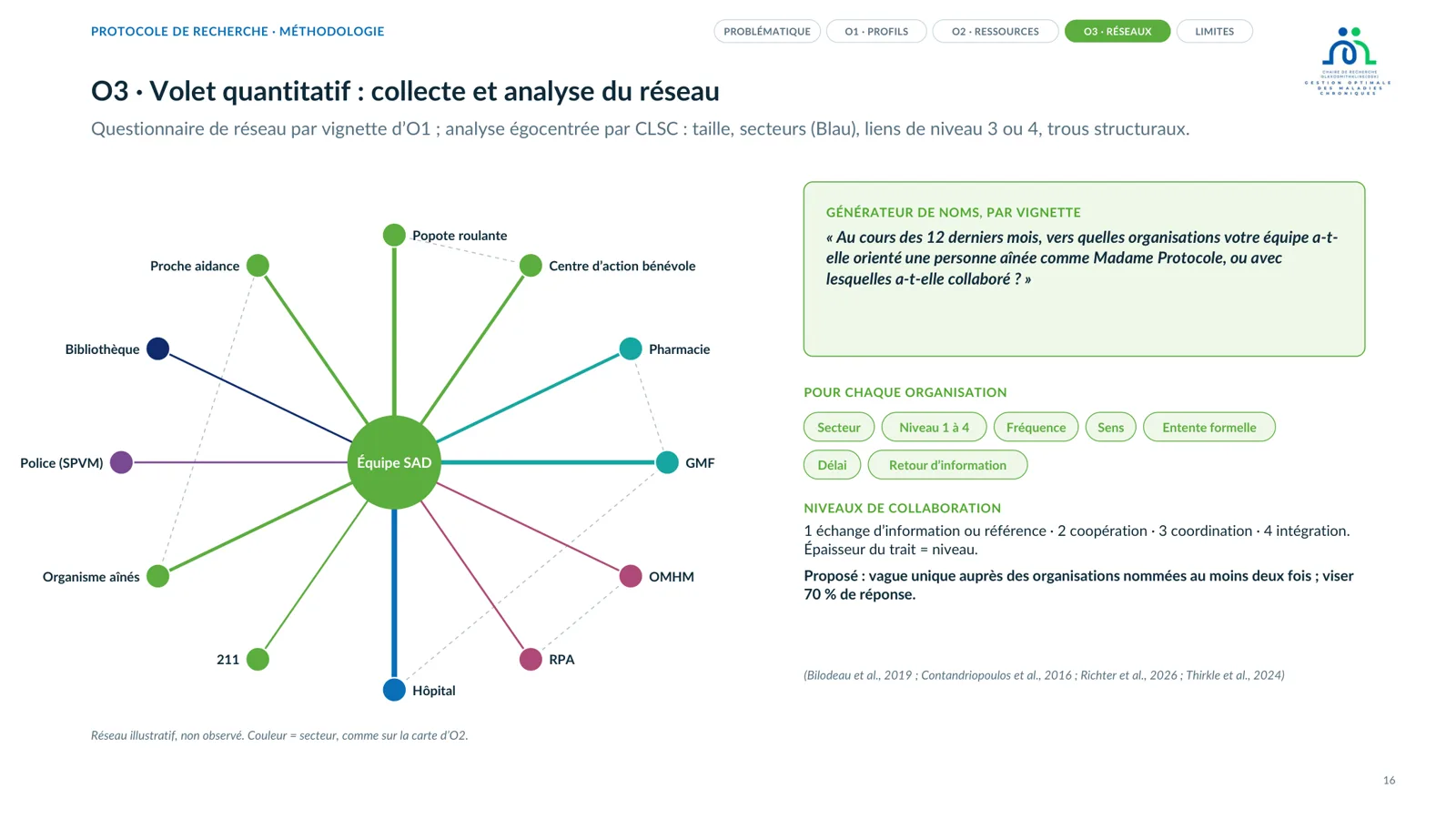
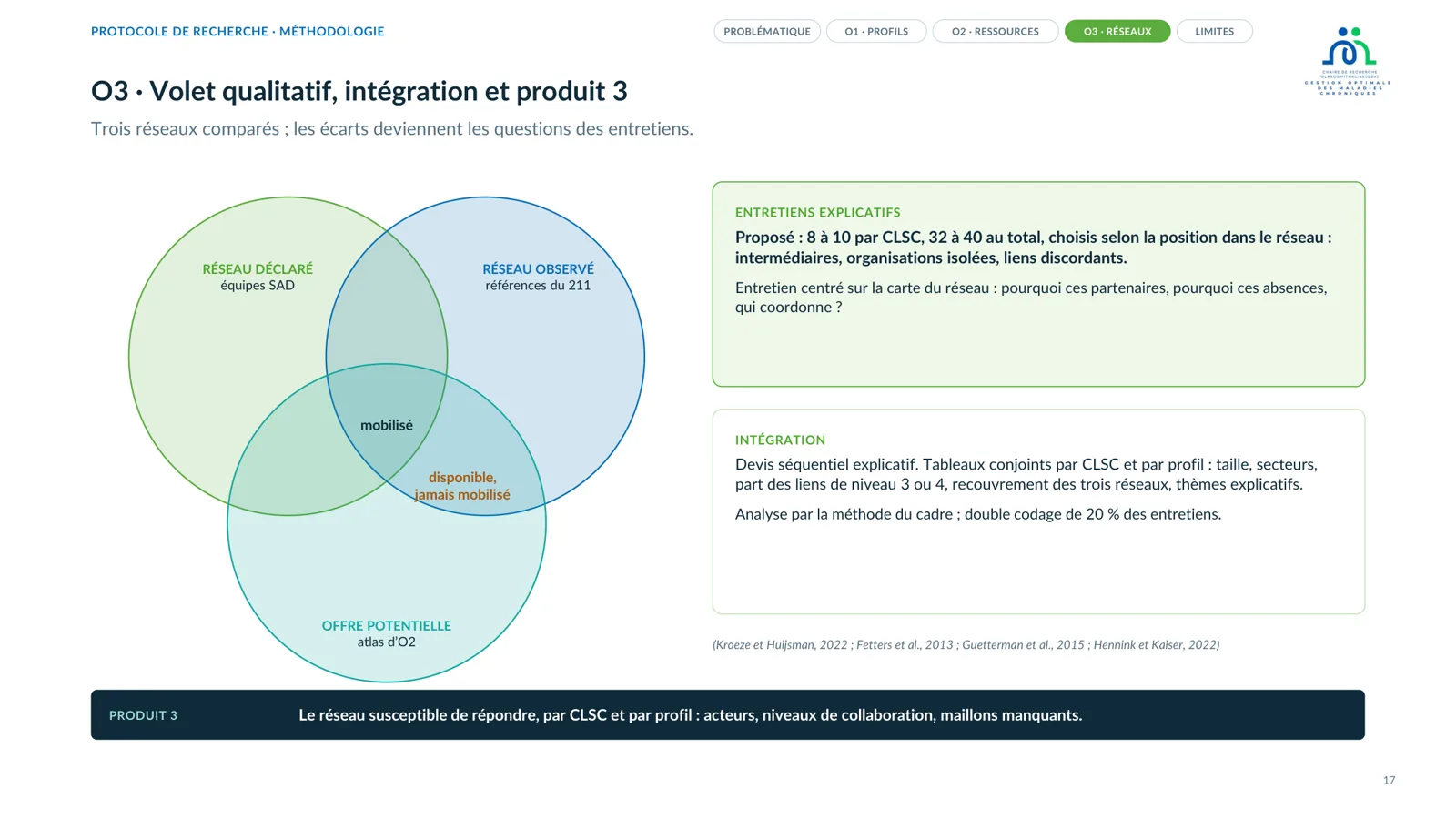
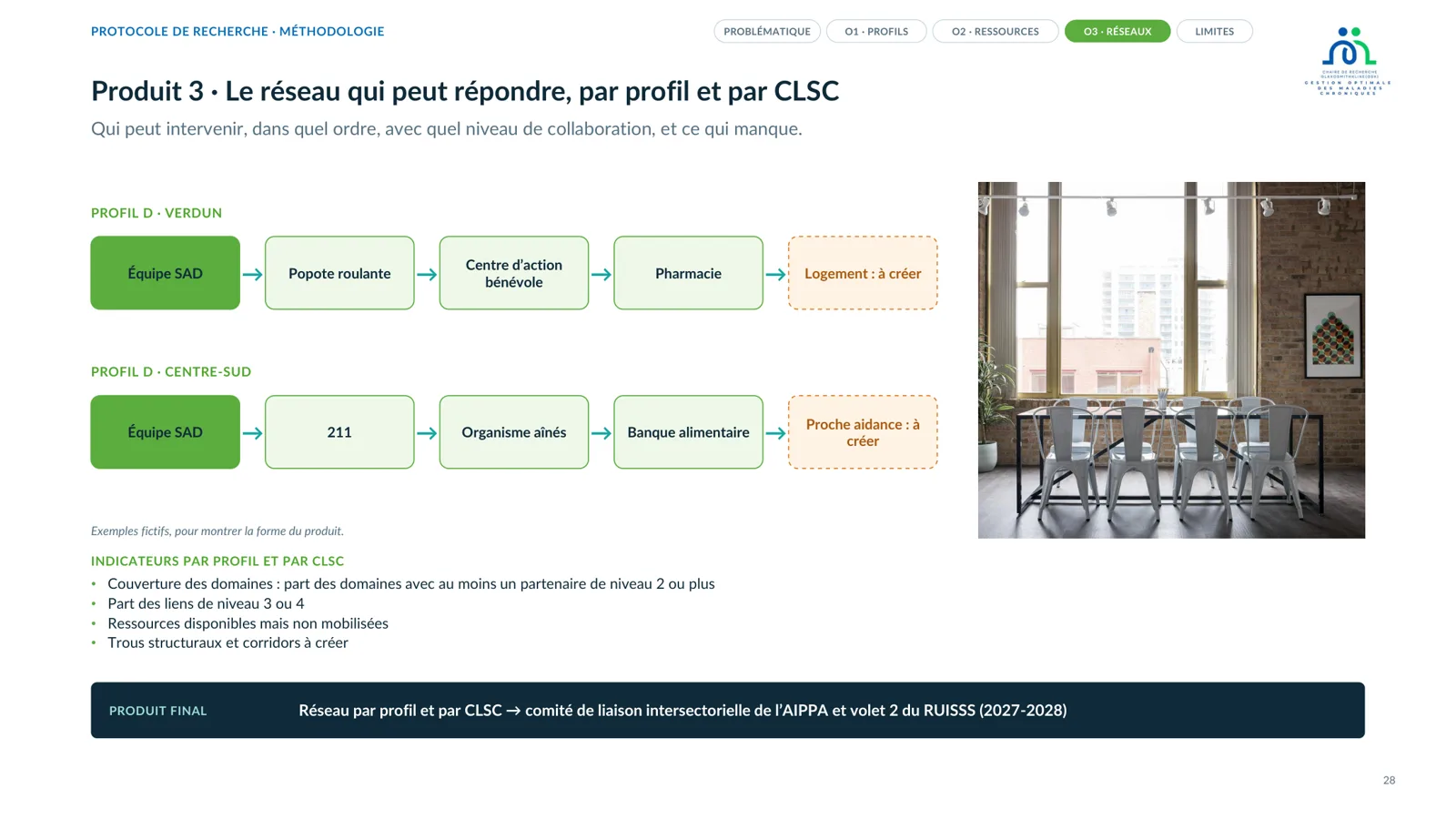
L’analyse de réseaux sociaux décrit les relations entre acteurs plutôt que leurs seuls attributs. L’approche sociocentrée examine l’ensemble des liens d’une population délimitée ; l’approche égocentrée part d’un répondant (ego) et des interlocuteurs qu’il nomme (alters). Dans ma thèse, le réseau est égocentré sur l’équipe de soutien à domicile (SAD) de chaque CLSC. Pour chaque vignette, l’équipe nomme les organisations vers lesquelles elle a orienté une personne aînée, ou avec lesquelles elle a collaboré, au cours des 12 derniers mois. Elle précise le niveau de collaboration, de 1 (échange d’information ou référence) à 4 (intégration). Ce réseau déclaré est comparé aux références du 211 et à l’atlas des ressources, puis expliqué en entretien.

Réseau égocentré de coordination en promotion de la santé municipale : l’acteur focal (ego) au centre, relié à ses interlocuteurs (alters).
Réseau égocentré de coordination en promotion de la santé municipale : l’acteur focal (ego) au centre, relié à ses interlocuteurs (alters). Figure 1 de Richter, Mamontova et Kühne (2026), BMC Health Services Research, CC BY 4.0
Réseau sociocentré de 27 organisations de santé mentale et de services sociaux au Timor-Leste, selon la fréquence des contacts sur un an.
Réseau sociocentré de 27 organisations de santé mentale et de services sociaux au Timor-Leste, selon la fréquence des contacts sur un an. Figure 2 de Hall et al. (2019), International Journal of Mental Health Systems, CC BY 4.0

Cartographie et systèmes d’information géographique

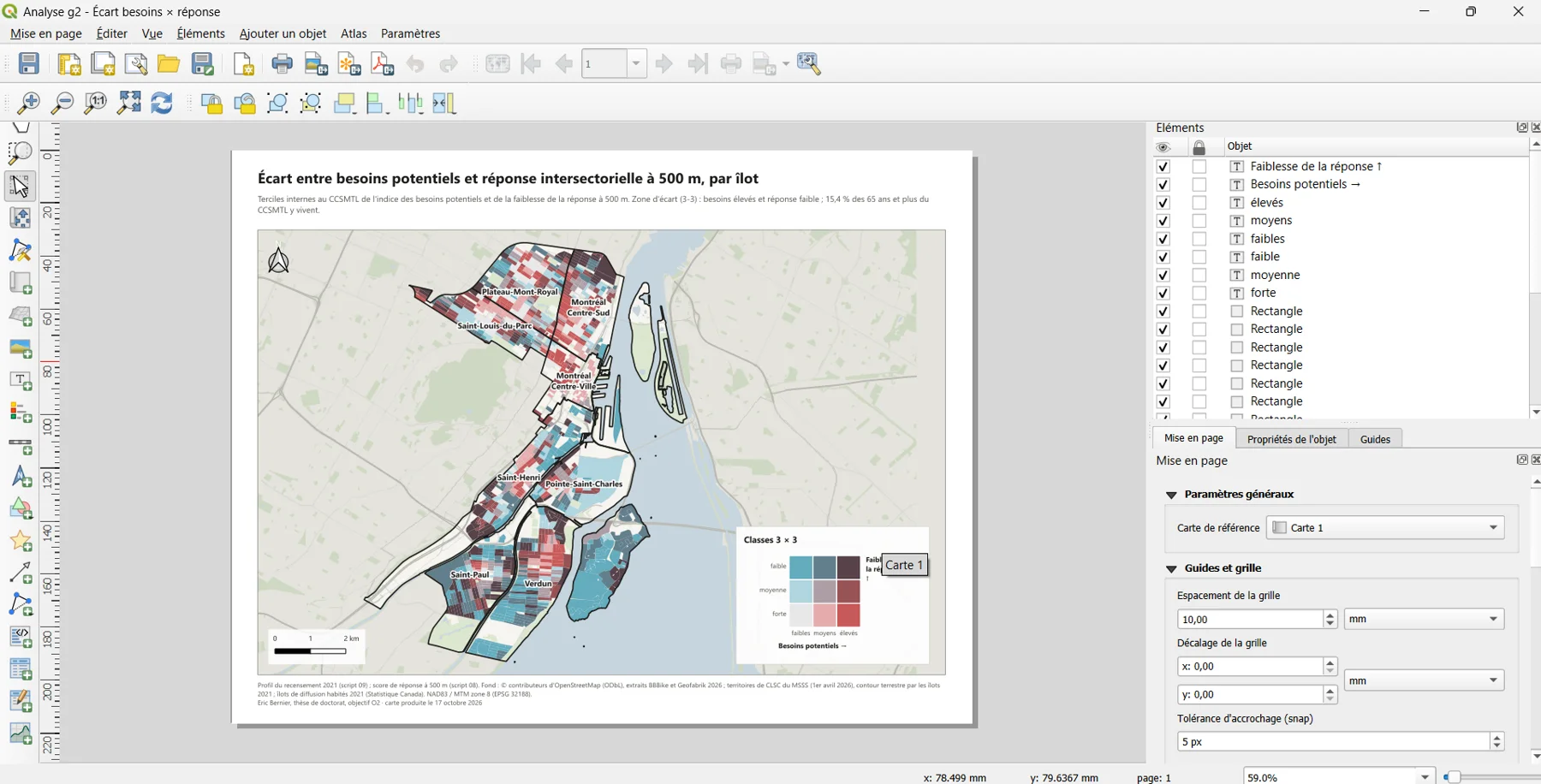
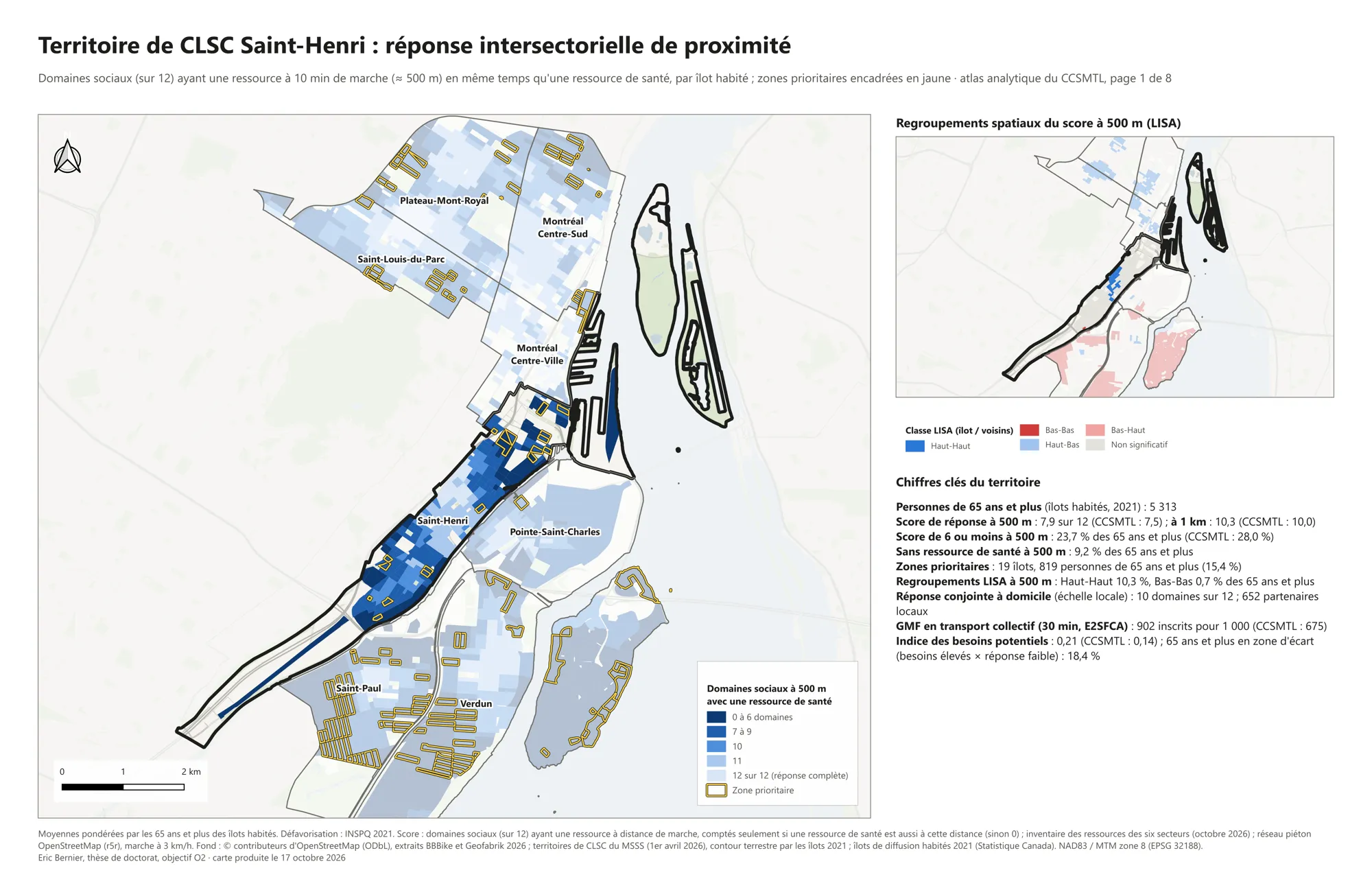
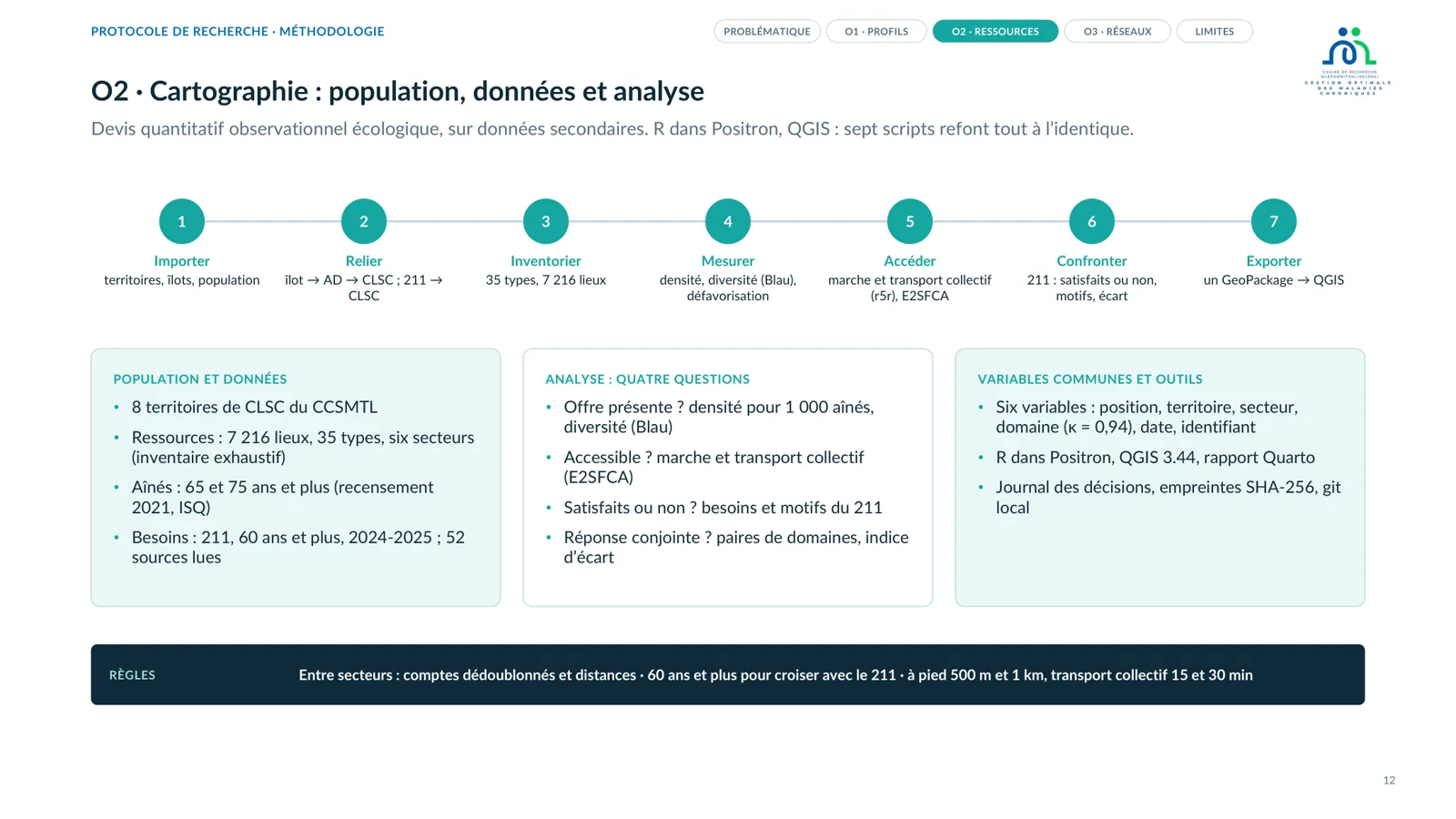
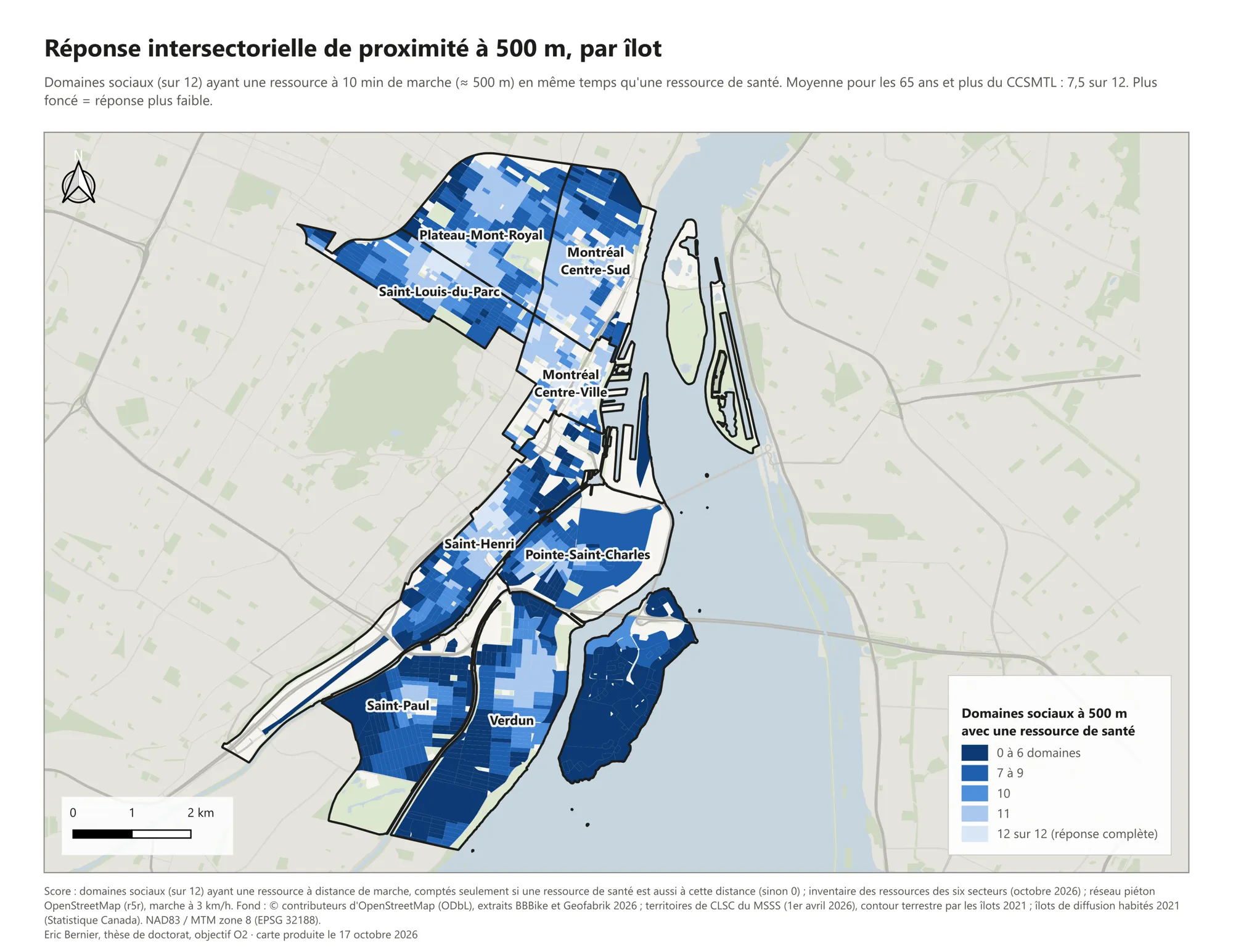
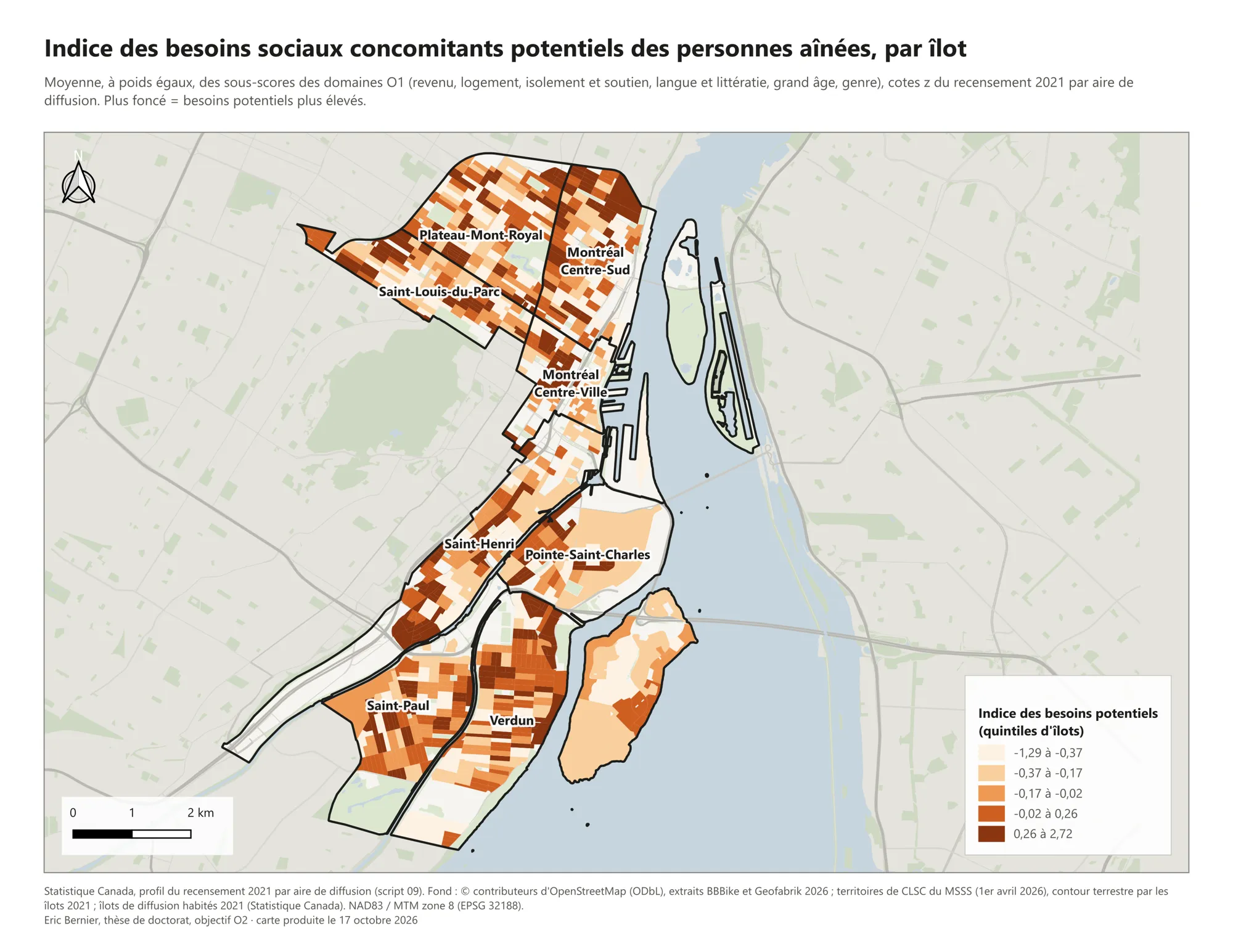
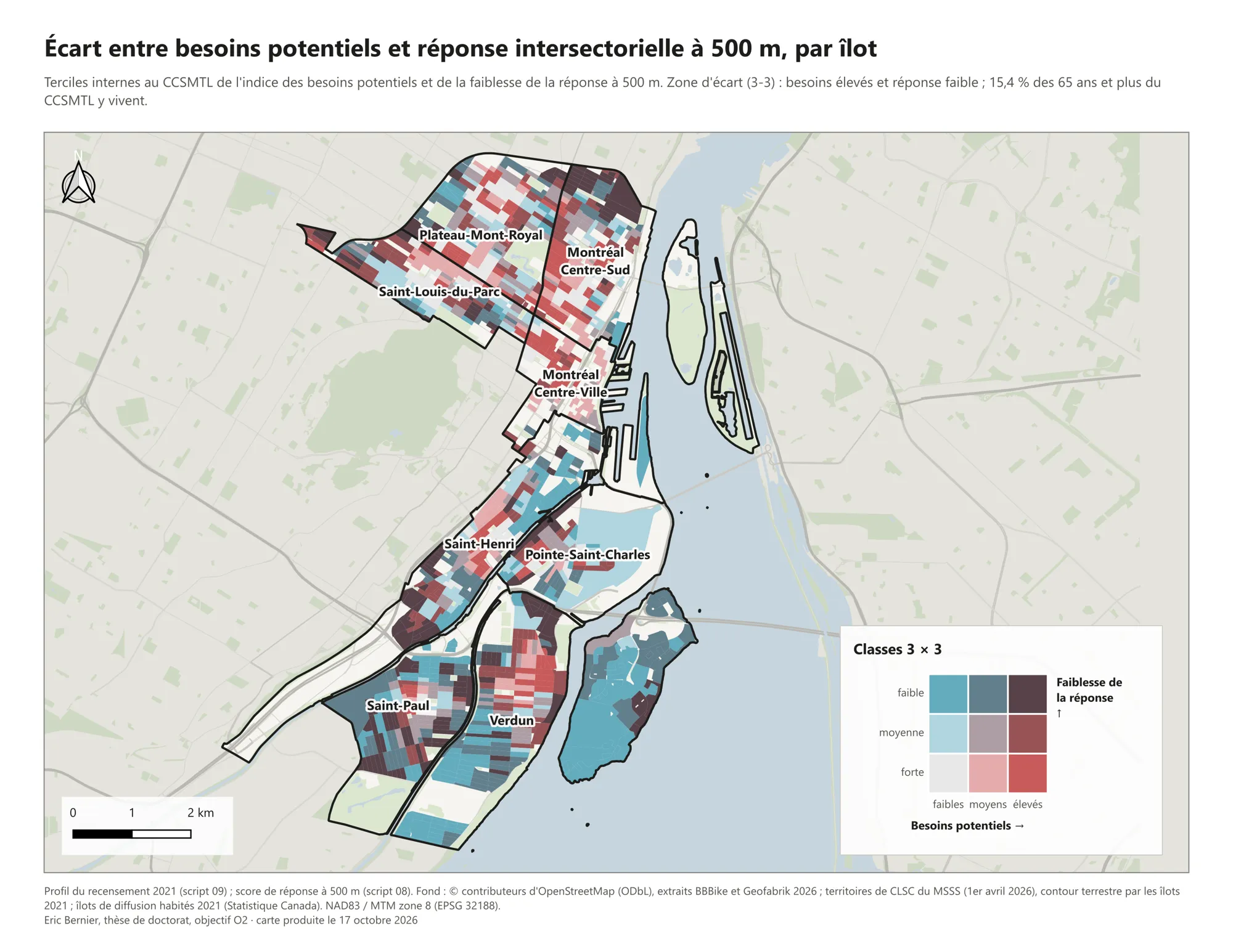
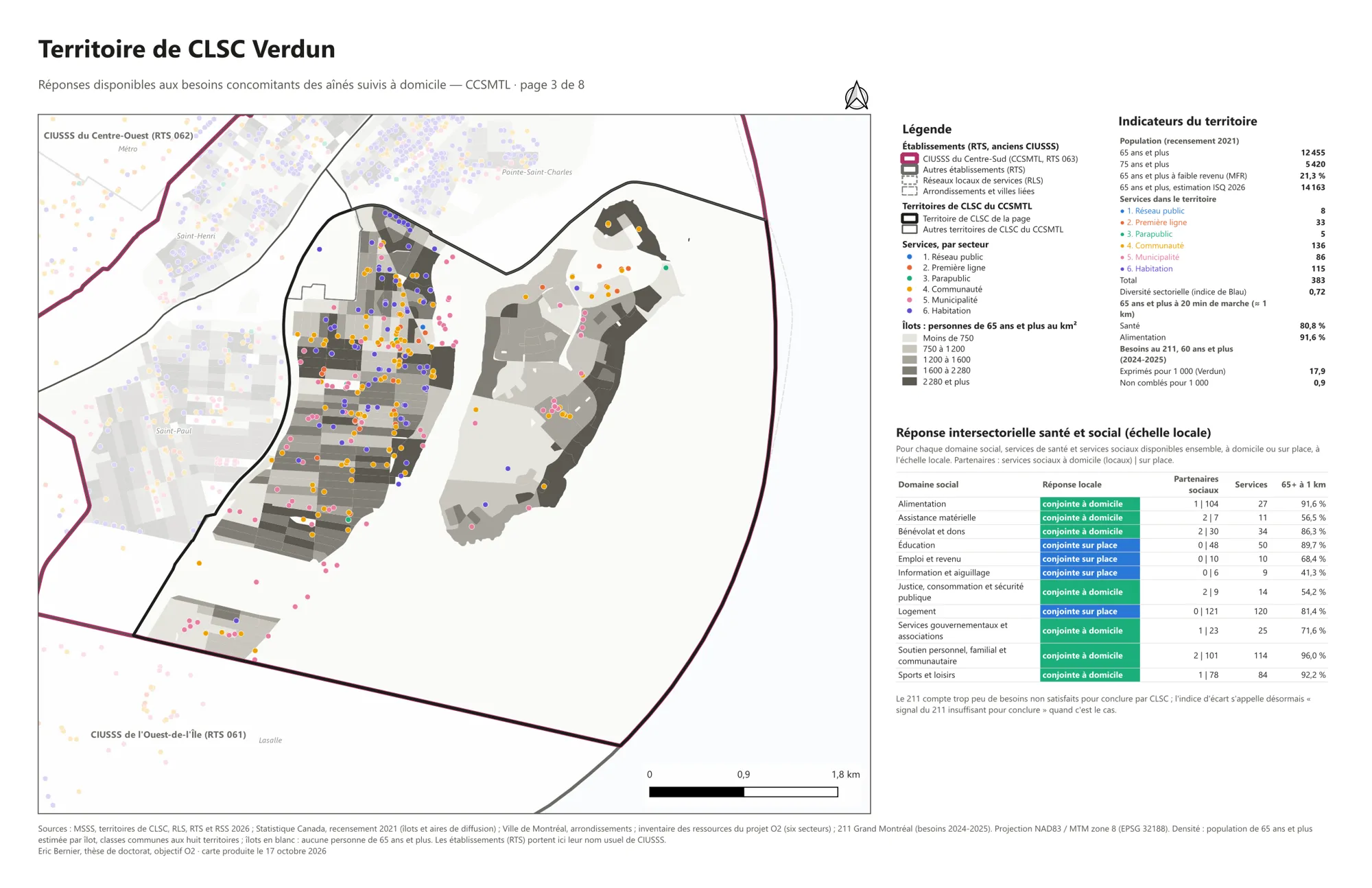
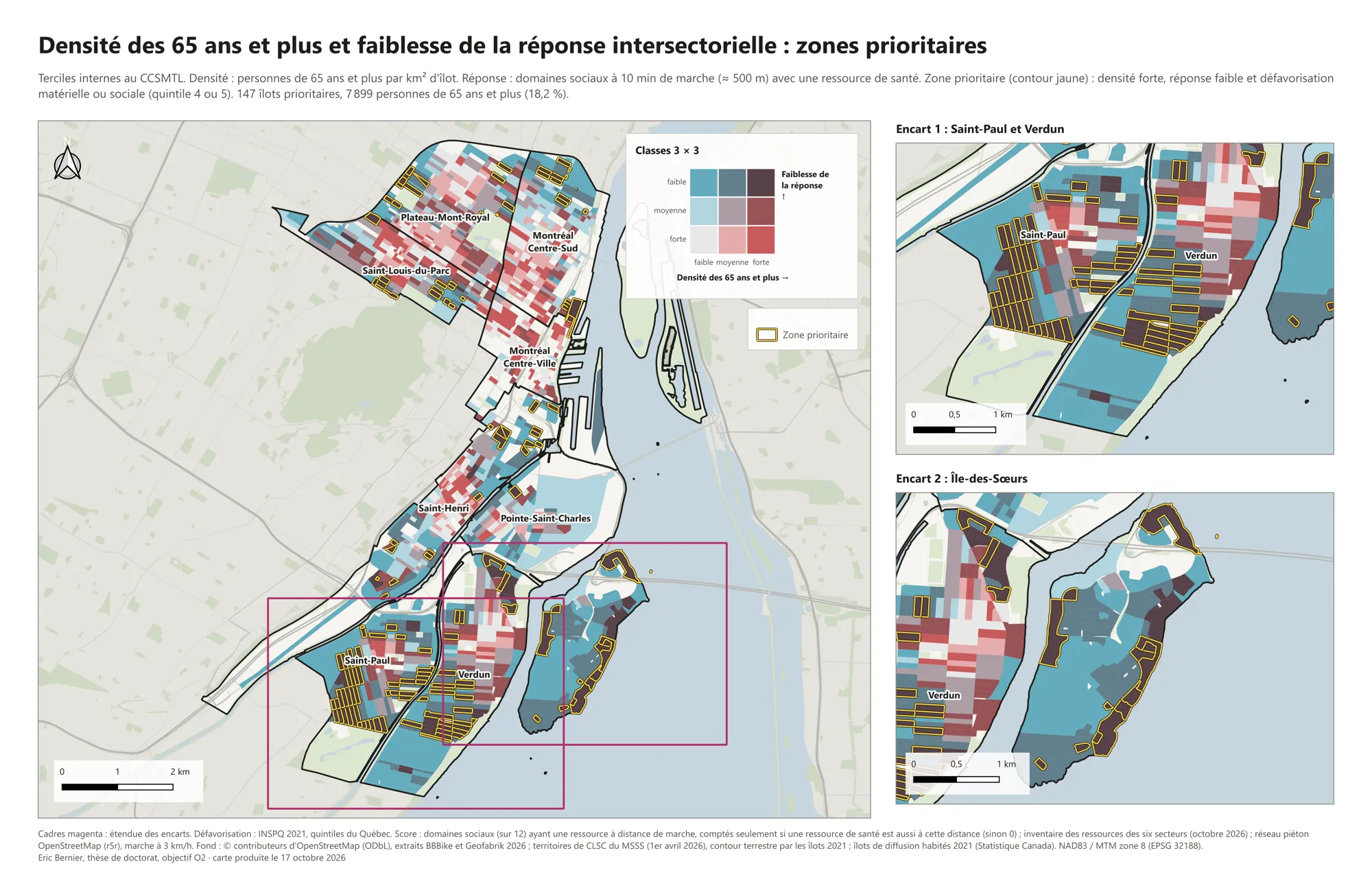
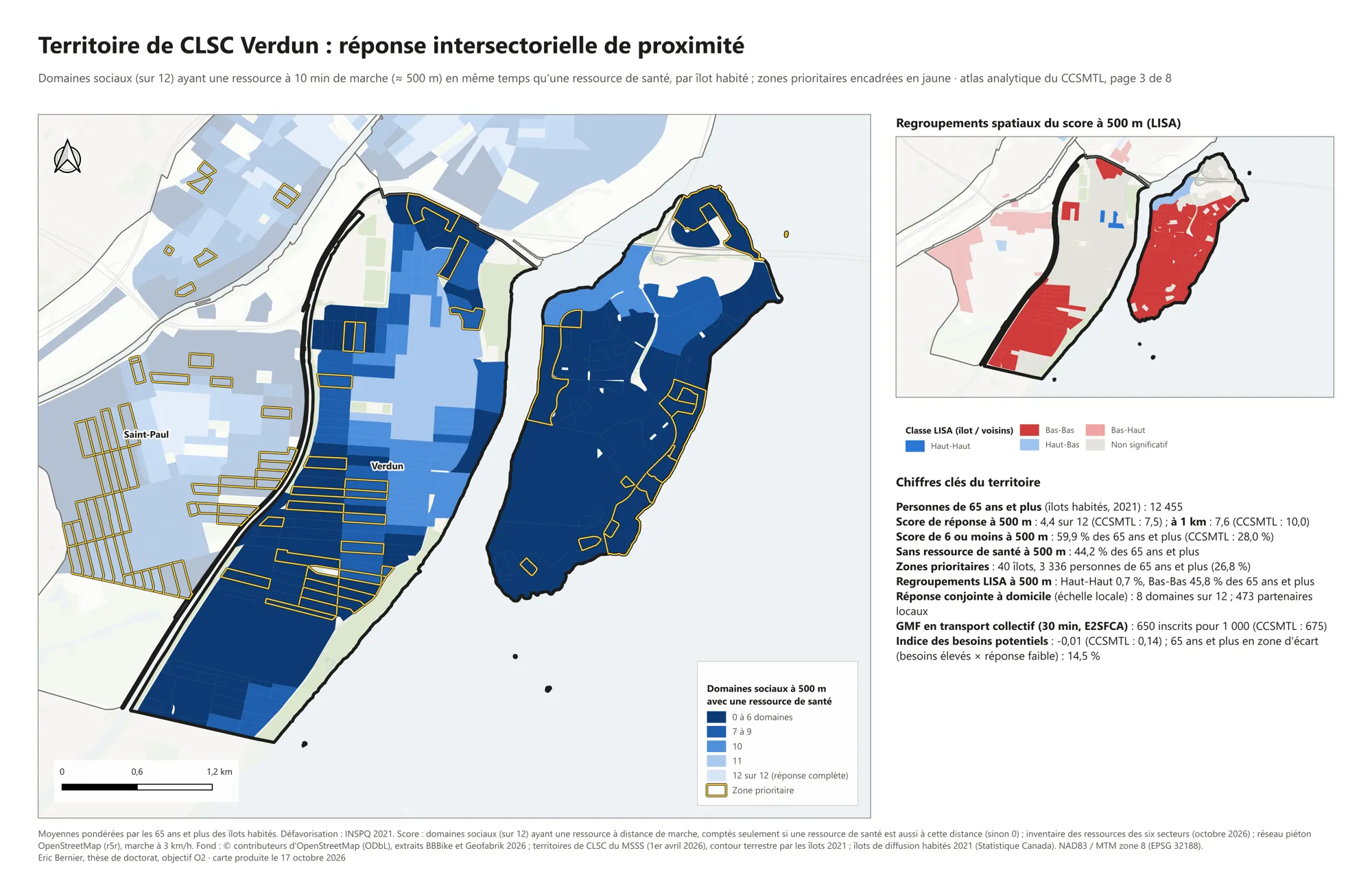
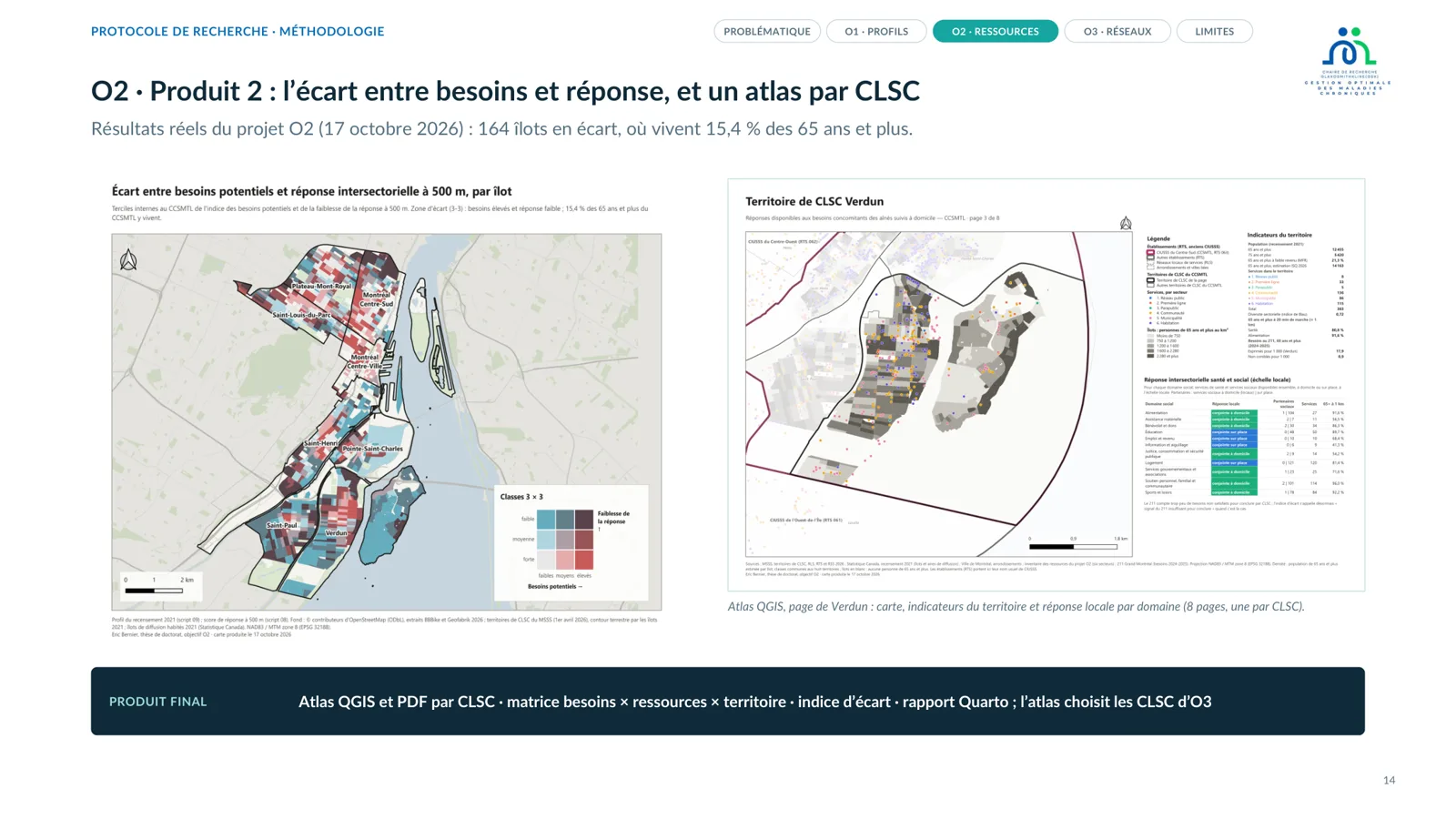
La cartographie et les systèmes d’information géographique (SIG) relient des données à leur localisation pour décrire la répartition des services, des besoins et des populations sur un territoire. Les mesures d’accessibilité potentielle, comme la méthode à deux étapes des aires de desserte flottantes (2SFCA), mettent en rapport l’offre de services, la demande et la distance qui les sépare. J’en ai acquis les bases dans un MOOC de l’Université de Genève. Dans ma thèse, la cartographie est l’objectif O2 : un atlas des ressources par territoire de CLSC, l’accessibilité E2SFCA à pied et en transport collectif, et un indice d’écart entre besoins et offre.

  • Guagliardo, M. F. (2004). Spatial accessibility of primary care: Concepts, methods and challenges. International Journal of Health Geographics, 3, Article 3. https://doi.org/10.1186/1476-072X-3-3
  • Luo, W., & Wang, F. (2003). Measures of spatial accessibility to health care in a GIS environment: Synthesis and a case study in the Chicago region. Environment and Planning B: Planning and Design, 30(6), 865–884. https://doi.org/10.1068/b29120
  • Ngui, A. N., & Apparicio, P. (2011). Optimizing the two-step floating catchment area method for measuring spatial accessibility to medical clinics in Montreal. BMC Health Services Research, 11, Article 166. https://doi.org/10.1186/1472-6963-11-166
Accessibilité spatiale aux cliniques médicales de Montréal selon la méthode 2SFCA, version classique et version optimisée.
Accessibilité spatiale aux cliniques médicales de Montréal selon la méthode 2SFCA, version classique et version optimisée. Figure 3 de Ngui et Apparicio (2011), BMC Health Services Research, CC BY 2.0
Localisation des services de santé et de services sociaux de la région métropolitaine de Montréal en 2015, dont les CLSC (carte d).
Localisation des services de santé et de services sociaux de la région métropolitaine de Montréal en 2015, dont les CLSC (carte d). Figure 4 d’Apparicio et al. (2017), International Journal of Health Geographics, CC BY 4.0

Programmation reproductible : R et Python dans Positron, et le shell

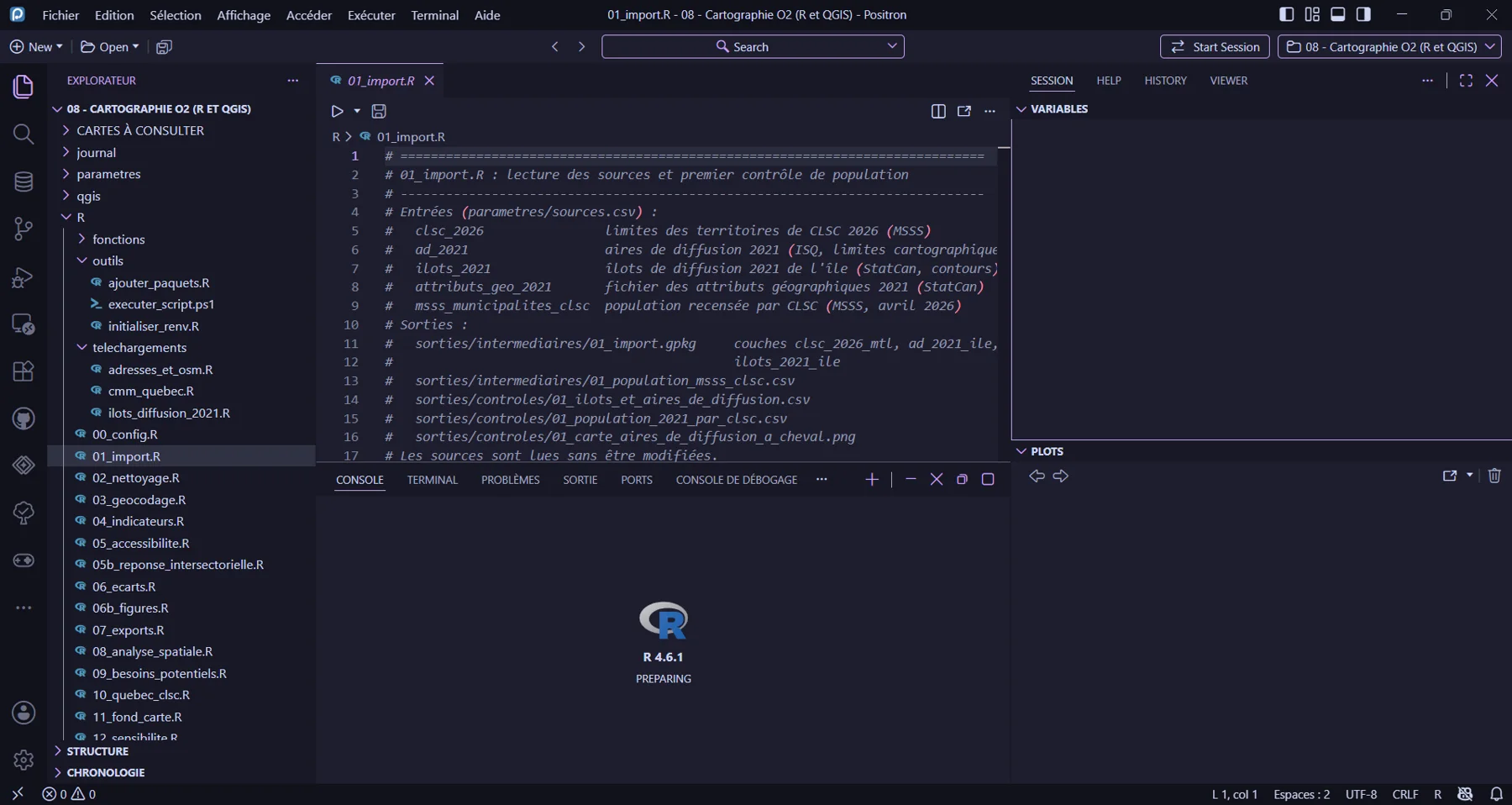
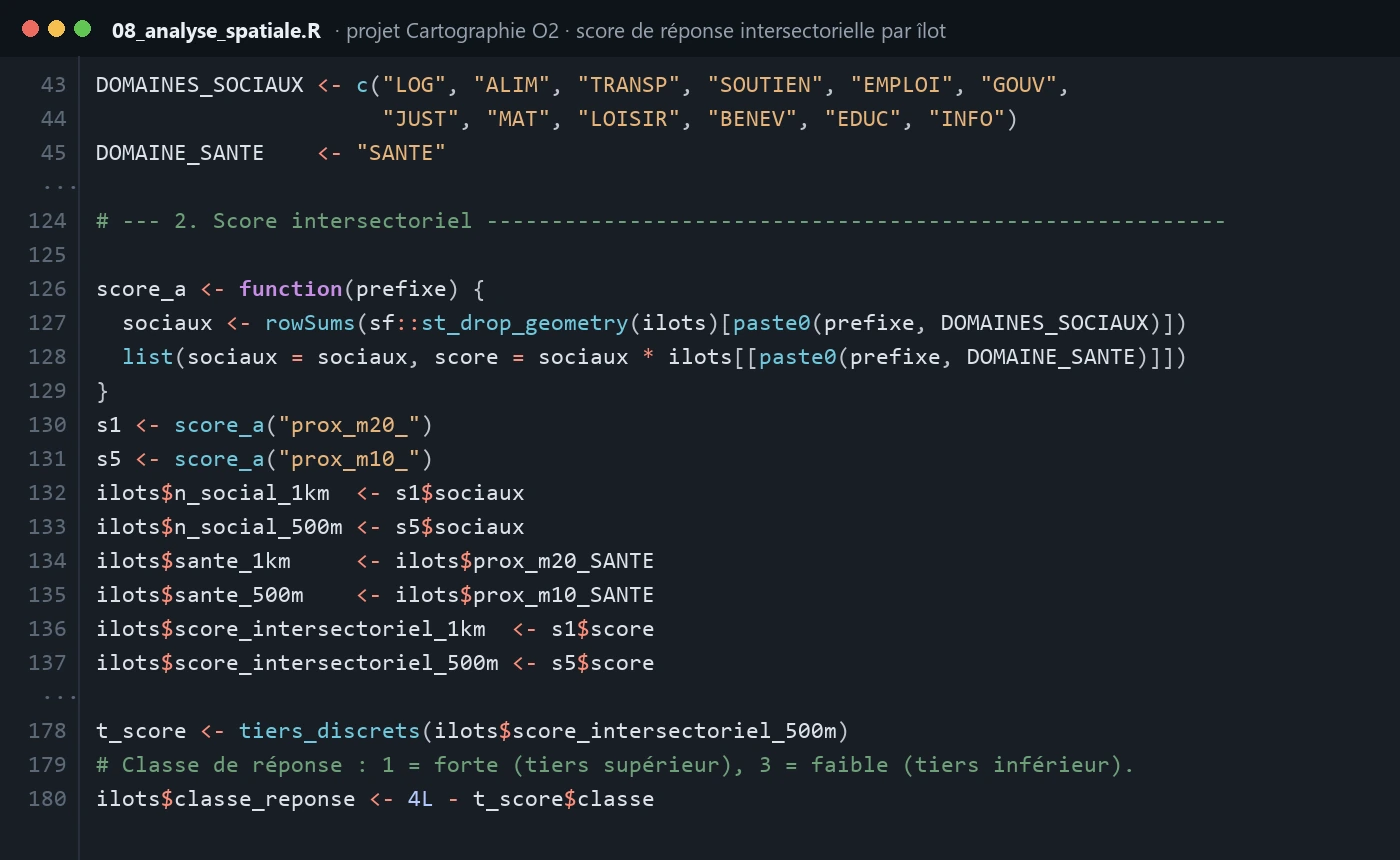
La programmation reproductible consiste à conduire chaque étape d’une analyse, de l’importation des données aux figures, dans des scripts qui peuvent être réexécutés et vérifiés. Je code en R et en Python dans Positron, l’environnement de développement de Posit, et j’enchaîne les traitements en ligne de commande dans le shell. En R, le tidyverse structure la préparation des données ; igraph et statnet servent à construire les réseaux et à calculer centralité, densité et cohésion ; sf gère les données spatiales. Python complète cette chaîne pour la préparation et l’automatisation des données. Le tout relie, dans un même projet documenté, les données de réseau, les données territoriales et les figures.

  • Handcock, M. S., Hunter, D. R., Butts, C. T., Goodreau, S. M., & Morris, M. (2008). statnet: Software tools for the representation, visualization, analysis and simulation of network data. Journal of Statistical Software, 24(1), 1–11. https://doi.org/10.18637/jss.v024.i01
  • Pebesma, E. (2018). Simple features for R: Standardized support for spatial vector data. The R Journal, 10(1), 439–446. https://doi.org/10.32614/RJ-2018-009
  • Wickham, H., Averick, M., Bryan, J., Chang, W., McGowan, L. D., François, R., Grolemund, G., Hayes, A., Henry, L., Hester, J., Kuhn, M., Pedersen, T. L., Miller, E., Bache, S. M., Müller, K., Ooms, J., Robinson, D., Seidel, D. P., Spinu, V., . . . Yutani, H. (2019). Welcome to the tidyverse. Journal of Open Source Software, 4(43), Article 1686. https://doi.org/10.21105/joss.01686
Réseau d’organisations engagées dans la prévention des zoonoses émergentes, coloré par secteur ; analyse avec igraph et statnet, figure produite dans R avec ggraph.
Réseau d’organisations engagées dans la prévention des zoonoses émergentes, coloré par secteur ; analyse avec igraph et statnet, figure produite dans R avec ggraph. Figure 2 de Clifford Astbury et al. (2024), Globalization and Health, CC BY 4.0
Sociogrammes des interactions entre organisations en Guinée et en Sierra Leone (paludisme et COVID-19), produits dans R avec le tidyverse, tidygraph et ggraph.
Sociogrammes des interactions entre organisations en Guinée et en Sierra Leone (paludisme et COVID-19), produits dans R avec le tidyverse, tidygraph et ggraph. Figure 1 de Feddern et al. (2025), PLOS ONE, CC BY 4.0

Analyse qualitative thématique et de réseaux

L’analyse thématique repère, organise et interprète des régularités de sens dans un corpus d’entretiens ou de documents, selon un processus itératif qui va du codage initial à la définition des thèmes. Je conduis ce codage dans NVivo, qui permet de documenter l’arbre de codes, les mémos et les regroupements successifs. Dans ma thèse, les entretiens explicatifs sont centrés sur la carte du réseau de chaque équipe SAD. La méthode du cadre (Framework Method) associe codes déductifs et inductifs dans une matrice participants × thèmes pour comparer les secteurs, les positions dans le réseau et les profils. Un double codage de 20 % du corpus, un journal réflexif et une restitution aux participants sont prévus avant l’intégration des volets quantitatif et qualitatif.

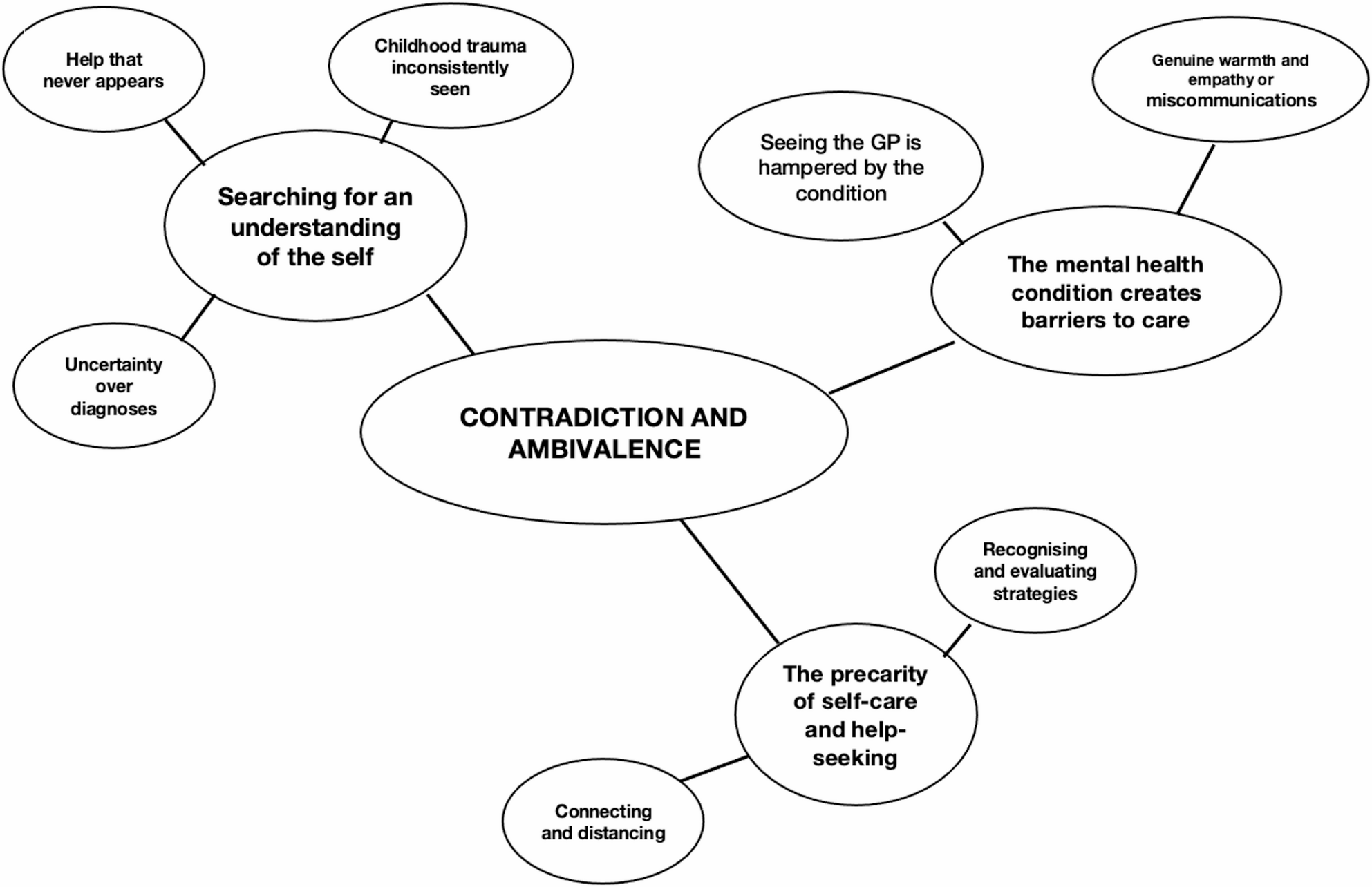
Carte thématique issue d’une analyse thématique réflexive d’entretiens codés dans NVivo, sur l’accès aux soins primaires.
Carte thématique issue d’une analyse thématique réflexive d’entretiens codés dans NVivo, sur l’accès aux soins primaires. Figure 1 d’Instone et al. (2026), BMC Primary Care, CC BY 4.0
Carte de réseau dessinée en entretien puis numérisée, dans une analyse qualitative d’un réseau intersectoriel de promotion de la santé.
Carte de réseau dessinée en entretien puis numérisée, dans une analyse qualitative d’un réseau intersectoriel de promotion de la santé. Figure 1 de Fleuren, Thiel et Frahsa (2021), International Journal of Environmental Research and Public Health, CC BY 4.0

Analyse critique du discours

J’ai mené une analyse qualitative du discours critique des médecins québécois lors des débats entourant le projet de loi n° 2. Le corpus raisonné compte 42 documents de presse et communiqués (base Eureka, mai à décembre 2025), codés chronologiquement jusqu’à la stabilité de l’architecture des codes. L’analyse articule le modèle tridimensionnel de Fairclough (le texte, les pratiques de production et de circulation, le contexte sociopolitique), la théorie du cadrage et l’attribution des rôles narratifs : victimes, responsables, protecteurs. Chaque citation est tracée jusqu’à sa source, et l’analyse distingue ce que disent les textes de leur interprétation sociologique.

  • Entman, R. M. (1993). Framing: Toward clarification of a fractured paradigm. Journal of Communication, 43(4), 51–58. https://doi.org/10.1111/j.1460-2466.1993.tb01304.x
  • Fairclough, N. (1995). Critical discourse analysis: The critical study of language. Longman.
  • Hennink, M. M., Kaiser, B. N., & Marconi, V. C. (2017). Code saturation versus meaning saturation: How many interviews are enough? Qualitative Health Research, 27(4), 591–608. https://doi.org/10.1177/1049732316665344
  • Shanahan, E. A., Jones, M. D., & McBeth, M. K. (2018). How to conduct a Narrative Policy Framework study. The Social Science Journal, 55(3), 332–345. https://doi.org/10.1016/j.soscij.2017.12.002
Pratique sociale : contexte sociopolitiquePratique discursive : production et circulationTexte
Modèle tridimensionnel de l’analyse critique du discours Schéma d’après Fairclough (1995)

Études de cas : comprendre une organisation dans son contexte

L’étude de cas examine en profondeur un phénomène situé : organisation, territoire, politique ou dispositif. Le devis peut porter sur un cas, plusieurs cas ou des unités imbriquées ; sa force tient à l’articulation du phénomène et de son contexte.

Délimiter et sélectionner
Expliciter l’unité d’analyse, les frontières temporelles et organisationnelles et la raison du choix des cas : cas typique, contrasté ou particulièrement informatif.
Croiser les matériaux
Articuler entretiens, documents, observations et données chiffrées. Construire une analyse de chaque cas, puis une comparaison transversale si le devis comporte plusieurs cas.
Portée des conclusions
Conserver une chaîne de preuves, examiner les explications rivales et décrire le contexte. La transférabilité repose sur le raisonnement analytique, sans présumer une représentativité statistique.
  1. Délimiter le cas
  2. Croiser les sources
  3. Analyser les mécanismes
  4. Discuter la transférabilité
Une enquête contextualisée, avec des unités et une logique de comparaison explicites.

Entretiens qualitatifs : expériences, pratiques et logiques d’action

Les entretiens, notamment semi-dirigés, explorent le sens des expériences, les décisions et les pratiques. Un guide ouvert organise les thèmes tout en laissant place aux relances, aux imprévus et aux contradictions.
Échantillonnage raisonné
Rechercher des perspectives pertinentes et contrastées. Ajuster le recrutement à la richesse informative, à la spécificité de l’échantillon et à la qualité du dialogue, plutôt qu’à un effectif universel.
Recueil et analyse
Prétester le guide, recueillir le consentement, documenter les conditions d’entretien et organiser transcription et pseudonymisation. Relier le codage aux extraits, par exemple dans une matrice de la Framework Method.
Réflexivité et transparence
Expliciter la position du chercheur, les relations d’enquête et les choix interprétatifs. COREQ soutient la transparence du compte rendu ; un entretien ne permet pas d’estimer une prévalence.
  • Malterud, K., Siersma, V. D., & Guassora, A. D. (2016). Sample size in qualitative interview studies: Guided by information power. Qualitative Health Research, 26(13), 1753–1760. https://doi.org/10.1177/1049732315617444
  • Gale, N. K., Heath, G., Cameron, E., Rashid, S., & Redwood, S. (2013). Using the framework method for the analysis of qualitative data in multi-disciplinary health research. BMC Medical Research Methodology, 13, Article 117. https://doi.org/10.1186/1471-2288-13-117
  • Tong, A., Sainsbury, P., & Craig, J. (2007). Consolidated criteria for reporting qualitative research (COREQ): A 32-item checklist for interviews and focus groups. International Journal for Quality in Health Care, 19(6), 349–357. https://doi.org/10.1093/intqhc/mzm042
  1. Choisir les perspectives
  2. Conduire et documenter
  3. Coder et interpréter
  4. Discuter les contre-exemples
Le matériau est produit dans une interaction : contexte et réflexivité font partie de l’analyse.

Conception et mise en œuvre de questionnaires

Une enquête par questionnaire traduit une question de recherche en mesures comparables. Elle articule population cible, stratégie d’échantillonnage, choix des questions et modalités d’administration, en ligne, par téléphone ou en présence.

Construire les mesures
Définir les concepts, privilégier des items adaptés et préciser les périodes de référence. Pour une échelle nouvelle, examiner validité de contenu, structure et fidélité ; un questionnaire n’est pas automatiquement une échelle psychométrique.
Prétester puis déployer
Utiliser des entretiens cognitifs pour comprendre l’interprétation des questions, puis un pilote. Prévoir accessibilité, langues, durée, consentement, confidentialité et relances adaptées.
Qualifier les estimations
Documenter couverture, participation, non-réponse et données manquantes. Appliquer les pondérations lorsque le plan l’exige ; un grand effectif ne corrige pas à lui seul un biais de sélection.
  1. Définir et échantillonner
  2. Construire et prétester
  3. Administrer et suivre
  4. Analyser la qualité
La qualité se construit avant, pendant et après l’administration du questionnaire.
Analyse de données secondaires

L’analyse secondaire réutilise des données existantes (enquêtes, cohortes, données administratives ou bases institutionnelles) pour répondre à une question définie. Elle exige de comprendre pourquoi, auprès de qui et comment ces données ont été produites.
Adéquation des données
Examiner population couverte, unité d’observation, calendrier, dictionnaire de variables et comparabilité. Distinguer un indicateur administratif d’une mesure directe du besoin ou de l’expérience.
Préparation reproductible
Documenter accès autorisé, nettoyage, recodages, appariements et exclusions. Tenir compte du plan d’enquête et des changements de définition ; tracer les transformations dans des scripts.
Biais et transparence
Examiner erreurs de mesure, données manquantes, sélection et confusion. RECORD précise le compte rendu des données de santé courantes ; leur disponibilité ne garantit ni représentativité ni identification causale.
  • Cheng, H. G., & Phillips, M. R. (2014). Secondary analysis of existing data: Opportunities and implementation. Shanghai Archives of Psychiatry, 26(6), 371–375. https://pmc.ncbi.nlm.nih.gov/articles/PMC4311114/
  • Benchimol, E. I., Smeeth, L., Guttmann, A., Harron, K., Moher, D., Petersen, I., Sørensen, H. T., von Elm, E., Langan, S. M., & RECORD Working Committee. (2015). The REporting of studies Conducted using Observational Routinely-collected health Data (RECORD) Statement. PLOS Medicine, 12(10), Article e1001885. https://doi.org/10.1371/journal.pmed.1001885
  1. Évaluer l’adéquation
  2. Documenter la provenance
  3. Harmoniser et analyser
  4. Tester la robustesse
Partir de la question et des conditions de production des données, puis expliciter les transformations.

Inférence causale et évaluation quasi expérimentale

L’inférence causale vise l’effet d’une intervention ou d’une exposition par rapport à une alternative définie. Elle distingue la question causale de l’association observée et articule population, intervention, comparaison, temporalité et résultat.

Définir l’effet recherché
Préciser l’estimand et le temps zéro ; expliciter les relations supposées dans un graphe causal (DAG). Selon la question, définir l’essai cible que les données permettraient d’émuler.
Choisir une stratégie d’identification
Discuter échangeabilité, positivité et cohérence. Standardisation, pondération ou autres ajustements dépendent des données ; les différences de différences exigent notamment des tendances parallèles plausibles.
Examiner les alternatives
Une série temporelle interrompue demande d’examiner tendance, saisonnalité, autocorrélation et événements concomitants. Analyses de sensibilité et limites de confusion résiduelle accompagnent l’interprétation.
  • Hernán, M. A., & Robins, J. M. (2020). Causal inference: What if. Chapman & Hall/CRC. https://miguelhernan.org/whatifbook
  • Lopez Bernal, J., Cummins, S., & Gasparrini, A. (2017). Interrupted time series regression for the evaluation of public health interventions: A tutorial. International Journal of Epidemiology, 46(1), 348–355. https://doi.org/10.1093/ije/dyw098
  1. Formuler l’effet causal
  2. Expliciter les hypothèses
  3. Identifier et estimer
  4. Éprouver la sensibilité
Une estimation causale dépend d’un devis et d’hypothèses défendables ; le modèle statistique intervient dans ce cadre.

Analyse comparative des systèmes de santé : MSSD et MDSD

La comparaison met en relation gouvernance, financement, ressources, organisation des services et résultats. Les travaux de Carsten Anckar éclairent deux logiques de sélection des cas : most similar systems design (MSSD) et most different systems design (MDSD).

MSSD · Systèmes les plus similaires
Comparer des systèmes proches sur des dimensions de contexte, mais différents sur le résultat étudié, afin d’examiner les différences organisationnelles ou politiques susceptibles de l’éclairer.
MDSD · Systèmes les plus différents
Comparer des systèmes contrastés présentant un résultat commun pour explorer les facteurs partagés susceptibles d’y contribuer. Ces logiques orientent la sélection ; elles ne constituent pas une randomisation.
Comparer ce qui est comparable
Justifier les pays ou territoires, harmoniser concepts, périodes et indicateurs, puis analyser mécanismes et trajectoires. Prendre en compte les différences internes, l’histoire des réformes et les limites d’une inférence à partir d’un petit nombre de systèmes.
  • Anckar, C. (2008). On the applicability of the most similar systems design and the most different systems design in comparative research. International Journal of Social Research Methodology, 11(5), 389–401. https://doi.org/10.1080/13645570701401552
  • World Health Organization & European Observatory on Health Systems and Policies. (2022). Health system performance assessment: A framework for policy analysis. World Health Organization. https://www.who.int/publications/i/item/9789240042476/
  1. Définir le résultat
  2. Justifier MSSD ou MDSD
  3. Harmoniser les indicateurs
  4. Comparer les mécanismes
La sélection raisonnée des systèmes sert une question explicative, au-delà d’un classement de performances.

01.6 · Synthèse documentaire · 14 octobre 2026

IA : programmer, produire des connaissances et penser ses effets sur la société

Cette salle associe la programmation assistée, la création d’outils et une réflexion sur la recherche, l’apprentissage et la santé publique. Elle s’appuie sur les travaux scientifiques consacrés aux bénéfices, aux limites et aux transformations sociales de ces technologies.

01Programmation et agents

Piloter un travail de développement assisté

Un assistant conversationnel propose une réponse ; un agent peut enchaîner lecture de fichiers, modifications et exécution d’outils. Cette capacité change l’organisation du travail : il faut spécifier ce qu’il peut faire, conserver une trace et évaluer la solution produite.

Du besoin à une spécification

Définir les utilisateurs, les données nécessaires, les fonctions attendues et les contraintes d’accessibilité. Décomposer les changements en unités compréhensibles permet de discuter une solution et de reprendre le travail sans perdre sa logique.

Contexte du projet et architecture

La cohérence d’un outil dépend des fichiers, des dépendances, de la structure des données et des choix déjà faits. Un code plausible localement peut être inadapté au reste du projet : l’assistant doit travailler avec ce contexte.

Débogage, reprise et maintenance

Lire une erreur, reproduire le problème, expliquer sa cause et corriger la partie concernée. La maintenabilité compte autant que le fonctionnement immédiat : noms explicites, documentation, versions et possibilité de revenir sur une modification.

Contrôler l’autonomie des agents

Adapter les droits d’accès, les actions et les points de décision à l’enjeu. Un agent qui agit sur des fichiers, des données ou des services demande davantage de supervision qu’une suggestion de texte.

Bengio et al. (2026)

Fiabilité du code scientifique

Examiner les unités, les valeurs manquantes, les transformations et les hypothèses. Des exemples connus, des contrôles ciblés et la reproductibilité servent à évaluer le comportement du programme et le sens scientifique de ses sorties.

Mesurer la valeur produite

La productivité dépend de la tâche, de l’expérience et de l’outil. Les études METR de 2025 et leur mise à jour méthodologique de 2026 invitent à distinguer impression de rapidité, qualité et gain réellement mesuré.

Becker et al. (2025) · METR (2026)

Le nombre de lignes générées est un indicateur pauvre. Ce qui m’intéresse : un outil utile, compréhensible, accessible et que l’on peut faire évoluer.

02.1 · Implantation

Transfert de connaissances et implantation

Faire circuler les savoirs entre les personnes, les milieux de pratique et la recherche, puis examiner ce qu’ils permettent réellement de changer.

02Transfert de connaissances et implantation

03 · Implantation

Transfert de connaissances et implantation

Faire circuler les savoirs entre les personnes, les milieux de pratique et la recherche, puis examiner ce qu’ils permettent réellement de changer.

Dans ma thèse, la mobilisation des connaissances accompagne la recherche : elle n’est ni une étude d’implantation ni une évaluation de politique.

Ressources

Formation complétéeMobilizeU, mobilisation des connaissances · Research Impact Canada et Université York, 2026 · En savoir plus

Cinq temps

Transfert de connaissances et implantationCinq temps

Construire la question avec les milieux

Tout commence par l’écoute : repérer avec les milieux les besoins et les décisions à éclairer, puis préciser qui participe, à quel moment et avec quelle influence. Les plans de transfert négligent souvent la connaissance fine des publics (Tchameni Ngamo et al., 2016) ; l’application intégrée des connaissances, elle, associe les utilisateurs des résultats dès la formulation de la question (Jull et al., 2017). Le respect, la pertinence, la réciprocité et la responsabilité guident cette première rencontre (Kirkness et Barnhardt, 1991).

BesoinsParticipation

Ces cinq temps s’inspirent du modèle des connaissances à l’action (Graham et al., 2006) et du cadre de Ward (2017).

Chaque chantier relie la littérature scientifique à ma pratique.

Huit chantiers de la mobilisation des connaissancesLittérature scientifique

Faire circuler les savoirs dans les deux sens

Mobiliser, c’est faire circuler les savoirs de la recherche vers les milieux, mais aussi des milieux et des personnes vers la recherche. Le modèle des connaissances à l’action distingue la création des connaissances et le cycle de leur mise en action : cerner un problème, adapter les savoirs au contexte, repérer les obstacles, soutenir puis suivre l’usage (Graham et al., 2006). Cinq questions organisent la démarche, quoi transférer, à qui, par qui, comment et avec quel effet, et l’on mobilise d’abord des ensembles de preuves plutôt qu’une étude isolée (Grimshaw et al., 2012). Le courtage de connaissances donne un visage à ce travail de liaison (Munerol et al., 2013).

Graham et al. (2006)Grimshaw et al. (2012)Ward et al. (2012)Munerol et al. (2013)

Dans ma thèse : un plan de mobilisation des connaissances

Pourquoi, quoi, à qui, comment

Le cadre de Ward structure le plan en quatre questions : préciser le quoi, le pourquoi et le qui avant de choisir le comment, les formats et les canaux.

(Ward, 2017)

Des connaissances à l’action

Le modèle des connaissances à l’action encadre la production, l’adaptation, la communication et le suivi des connaissances, sans prétendre en assurer l’adoption durable.

(Graham et al., 2006)

Des partenariats fondés sur les 4R

Respect, pertinence, réciprocité et responsabilité guident les partenariats avec les patients et les milieux, en s’appuyant sur le cadre d’engagement des patients des IRSC.

(Kirkness et Barnhardt, 1991 ; IRSC, 2014 ; Bowen et Graham, 2013)

Un dialogue délibératif

Un dialogue avec les équipes SAD et leurs partenaires transforme les modèles de trajectoires et les cartes en repères contextualisés, avec un retour aux participants. La participation est rapportée selon GRIPP2.

(Boyko et al., 2012 ; Lavis et al., 2009 ; Staniszewska et al., 2017)

Suivre la contribution, pas l’attribution

Quatre indicateurs (production, portée, appropriation, utilisation documentée) et un registre permettent d’apprécier la contribution plausible de la recherche, sans lui attribuer les changements ultérieurs.

(Morton, 2015)

Repères en science de l’implantation

CFIR 2.0

Examiner le contexte et les déterminants qui facilitent ou freinent l’implantation.

(Damschroder et al., 2022)

Résultats d’implantation

Distinguer acceptabilité, adoption, pertinence, faisabilité, fidélité, coût, pénétration et pérennité.

(Proctor et al., 2011)

Impact de la recherche

Les cadres d’impact cartographient surtout le chemin aller, de la recherche vers la pratique ; mes travaux interrogent aussi le chemin retour.

(Greenhalgh et al., 2016 ; Brownson et al., 2026)

Approche par contributions

Relier les productions aux usages, puis aux changements documentés, en examinant les autres influences possibles.

(Morton, 2015 ; Bayley et Phipps, 2019)

Coproduction et application intégrée

Les mécanismes de coproduction dépendent de l’infrastructure, de la clarté des rôles et du partage du pouvoir ; leurs coûts comptent aussi.

(Graham et al., 2019 ; Kothari et al., 2025 ; Oliver et al., 2019)

Une science de l’implantation critique

Théoriser plutôt qu’appliquer les cadres comme des listes de contrôle.

(Kislov et al., 2019)

Participation et délibération

Concevoir et évaluer des processus de participation publique qui laissent une trace de leur influence.

(Abelson et al., 2003 ; OCDE, 2022)

Pourquoi l’implantation

Prouver qu’une innovation est efficace ne suffit pas à garantir qu’elle sera adoptée.

(Bauer et Kirchner, 2020)

Stratégies d’implantation

La compilation ERIC offre un vocabulaire commun de 73 stratégies pour décrire, choisir et rapporter les stratégies employées.

(Powell et al., 2015)

Interventions complexes

L’implantation devient une phase à part entière, avec le contexte, la théorie du programme et les parties prenantes au centre.

(Skivington et al., 2021)

Implanter auprès des aînés

Au Québec, l’implantation d’un accompagnement citoyen pour la participation sociale des aînés éclaire les conditions qui comptent.

(Gobeil et al., 2023)

Bibliographie (APA)
  1. Abelson, J., Forest, P.-G., Eyles, J., Smith, P., Martin, E., & Gauvin, F.-P. (2003). Deliberations about deliberative methods: Issues in the design and evaluation of public participation processes. Social Science & Medicine, 57(2), 239–251. https://doi.org/10.1016/S0277-9536(02)00343-X
  2. Barwick, M., Phipps, D., Myers, G., Johnny, M., & Coriandoli, R. (2014). Knowledge translation and strategic communications: Unpacking differences and similarities for scholarly and research communications. Scholarly and Research Communication, 5(3). https://doi.org/10.22230/src.2014v5n3a175
  3. Bauer, M. S., & Kirchner, J. (2020). Implementation science: What is it and why should I care? Psychiatry Research, 283, Article 112376. https://doi.org/10.1016/j.psychres.2019.04.025
  4. Bayley, J. E., & Phipps, D. (2019). Building the concept of research impact literacy. Evidence & Policy, 15(4), 597–606. https://doi.org/10.1332/174426417X15034894876108
  5. Beaulieu, M.-D. (2016). Construction et hiérarchisation des données probantes en santé : savoirs scientifiques, expérientiels et contextuels. Revue du CREMIS, 9(2), 9-15. https://cremis.ca/publications/articles-et-medias/construction-et-hierarchisation-des-donnees-probantes-en-sante-savoirs-scientifiques-experientiels-et-contextuels/
  6. Berrada, M. (2026, 2 juin). Recherche et politiques publiques : comment mieux faire circuler les savoirs ? Affaires universitaires. https://www.affairesuniversitaires.ca/actualites/recherche-et-politiques-publiques-comment-mieux-faire-circuler-les-savoirs/
  7. Boaz, A., Hanney, S., Borst, R., O’Shea, A., & Kok, M. (2018). How to engage stakeholders in research: Design principles to support improvement. Health Research Policy and Systems, 16, Article 60. https://doi.org/10.1186/s12961-018-0337-6
  8. Bowen, S. J., & Graham, I. D. (2013). From knowledge translation to engaged scholarship: Promoting research relevance and utilization. Archives of Physical Medicine and Rehabilitation, 94(1 Suppl.), S3–S8. https://doi.org/10.1016/j.apmr.2012.04.037
  9. Boyko, J. A., Lavis, J. N., Abelson, J., Dobbins, M., & Carter, N. (2012). Deliberative dialogues as a mechanism for knowledge translation and exchange in health systems decision-making. Social Science & Medicine, 75(11), 1938–1945. https://doi.org/10.1016/j.socscimed.2012.06.016
  10. Breton, H. (2025). Savoirs expérientiels en santé : revue systématique de littérature. Santé Publique, 37(3), 241-251. https://doi.org/10.3917/spub.255.0241
  11. Brownson, R. C., Iwelunmor, J., Odeny, T. A., Proctor, E. K., & Geng, E. H. (2026). So what? Elevating the impact of implementation science. Implementation Science Communications, 7, 2. https://doi.org/10.1186/s43058-025-00831-9
  12. Bulloch, M. N. (Animatrice). (2024, 17 juillet). SCCM Pod-520: Implementation science: From evidence to practice [Balado]. Dans SCCM Podcast. Society of Critical Care Medicine. https://www.sccm.org/communications/sccm-podcast/sccm-podcast-all-episodes/sccm-pod-520-implementation-science-from-evidence-to-practice
  13. Centre de collaboration nationale des méthodes et outils. (2016, 4 juillet). CCNMO - Prise de décisions fondée sur des données probantes [Vidéo]. YouTube. https://www.youtube.com/watch?v=XrZjc3Flrz8
  14. Courcy, I., Bureau, A., & Grenier, G. (2022). L’art visuel comme outil de pratique en mobilisation et transfert de connaissances : retour sur un projet de cocréation d’une murale alliant la recherche, l’art et des savoirs expérientiels. Revue francophone de recherche sur le transfert et l’utilisation des connaissances, 6(3). https://doi.org/10.18166/tuc.2022.6.3.25
  15. Crowley, D. M., & Scott, J. T. (2023). To support evidence-based policymaking, bring researchers and policymakers together. Issues in Science and Technology, 39(2), 31-35. https://issues.org/evidence-based-policymaking-researchers-policymakers-collaborate-crowley-scott/
  16. Dagenais, C., Hot, A., & Ridde, V. (2023, 21 février). Communiquer efficacement les connaissances scientifiques permet de sauver des vies. The Conversation. https://theconversation.com/communiquer-efficacement-les-connaissances-scientifiques-permet-de-sauver-des-vies-197191
  17. Damschroder, L. J., Reardon, C. M., Widerquist, M. A. O., & Lowery, J. (2022). The updated Consolidated Framework for Implementation Research based on user feedback. Implementation Science, 17, 75. https://doi.org/10.1186/s13012-022-01245-0
  18. Dancause, L. (2023). Guide pédagogique sur la mobilisation des connaissances (L. Cardinal & J. Luckerhoff, dir.). Laboratoire interdisciplinaire de recherche sur l’enseignement supérieur. https://www.erudit.org/fr/livres/hors-collection/guide-pedagogique-sur-la-mobilisation-des-connaissances/
  19. David, G., & Grégoire, A. (2018). Guide pratique – Stratégie de partenariat avec les patients et le public en recherche. Unité de soutien SRAP du Québec. https://ceppp.ca/wp-content/uploads/2021/01/USSQ_Guide-pratique-SPPP-en-recherche_V1.pdf
  20. Diany, R., Fitzgibbon-Collins, L. K., & Gagliano Taliun, S. A. (2025). Ten simple rules for getting started with knowledge mobilization. PLOS Computational Biology, 21(4), e1012888. https://doi.org/10.1371/journal.pcbi.1012888
  21. Équipe RENARD. (2023, 26 mai). Ancrage historique et évolution du courtage de connaissances [Vidéo]. YouTube. https://www.youtube.com/watch?v=3uucW5ZOp-g
  22. Équipe RENARD. (2023, 29 mai). Les compétences clés pour agir en courtage de connaissances [Vidéo]. YouTube. https://www.youtube.com/watch?v=RGVmhf9Wyzo
  23. Esmail, R., Hanson, H. M., Holroyd-Leduc, J., Brown, S., Strifler, L., Straus, S. E., Niven, D. J., & Clement, F. M. (2020). A scoping review of full-spectrum knowledge translation theories, models, and frameworks. Implementation Science, 15, Article 11. https://doi.org/10.1186/s13012-020-0964-5
  24. Fillol, A., Traverson, L., Zitti, T., Bars, G., Minssieux, N., Hot, A., Dagenais, C., & Ridde, V. (2026). Évaluation d’une intervention de courtage de connaissances à l’Agence régionale de santé Île-de-France. Santé Publique, 38(1), 15-34. https://doi.org/10.3917/spub.261.0015
  25. Gainforth, H. L., Hoekstra, F., McKay, R., McBride, C. B., Sweet, S. N., Martin Ginis, K. A., Anderson, K., Chernesky, J., Clarke, T., Forwell, S., Maffin, J., McPhail, L. T., Mortenson, W. B., Scarrow, G., Schaefer, L., Sibley, K. M., Athanasopoulos, P., & Willms, R. (2021). Integrated knowledge translation guiding principles for conducting and disseminating spinal cord injury research in partnership. Archives of Physical Medicine and Rehabilitation, 102(4), 656-663. https://doi.org/10.1016/j.apmr.2020.09.393
  26. Georgalakis, J. (2023, 16 janvier). We need to talk about equity in knowledge mobilisation. Transforming Evidence. https://transforming-evidence.org/blog/we-need-to-talk-about-equity-in-knowledge-mobilisation
  27. Gervais, M.-J., Souffez, K., & Ziam, S. (2016). Quel impact avons-nous ? Vers l’élaboration d’un cadre pour rendre visibles les retombées du transfert des connaissances. Revue francophone de recherche sur le transfert et l’utilisation des connaissances, 1(1). https://doi.org/10.18166/tuc.2016.1.1.5
  28. Gobeil, J., Gaumond, V., Germain, S., Vézina, A., Duguay, A.-M., & Levasseur, M. (2023). Implantation de l’Accompagnement-citoyen personnalisé d’intégration communautaire (APIC) : vers l’optimisation de la mise en œuvre de cette approche novatrice visant la participation sociale des aînés. Canadian Journal on Aging / La Revue canadienne du vieillissement, 42(4), 551-564. https://doi.org/10.1017/S0714980823000132
  29. Gobel, U. (2021, 8 février). Knowledge mobilization will help Canada face the next major challenge. Policy Options. https://policyoptions.irpp.org/magazines/february-2021/knowledge-mobilization-will-help-canada-face-the-next-major-challenge/
  30. Graham, I. D., Logan, J., Harrison, M. B., Straus, S. E., Tetroe, J., Caswell, W., & Robinson, N. (2006). Lost in knowledge translation: Time for a map? Journal of Continuing Education in the Health Professions, 26(1), 13–24. https://doi.org/10.1002/chp.47
  31. Graham, I. D., McCutcheon, C., & Kothari, A. (2019). Exploring the frontiers of research co-production: The Integrated Knowledge Translation Research Network concept papers. Health Research Policy and Systems, 17, 88. https://doi.org/10.1186/s12961-019-0501-7
  32. Greenhalgh, T., Hinton, L., Finlay, T., Macfarlane, A., Fahy, N., Clyde, B., & Chant, A. (2019). Frameworks for supporting patient and public involvement in research: Systematic review and co-design pilot. Health Expectations, 22(4), 785-801. https://doi.org/10.1111/hex.12888
  33. Greenhalgh, T., Raftery, J., Hanney, S., & Glover, M. (2016). Research impact: A narrative review. BMC Medicine, 14, 78. https://doi.org/10.1186/s12916-016-0620-8
  34. Grimshaw, J. M., Eccles, M. P., Lavis, J. N., Hill, S. J., & Squires, J. E. (2012). Knowledge translation of research findings. Implementation Science, 7, Article 50. https://doi.org/10.1186/1748-5908-7-50
  35. Harvey, G., & Kitson, A. (2016). PARIHS revisited: From heuristic to integrated framework for the successful implementation of knowledge into practice. Implementation Science, 11, Article 33. https://doi.org/10.1186/s13012-016-0398-2
  36. Hoekstra, F., Mrklas, K. J., Khan, M., McKay, R. C., Vis-Dunbar, M., Sibley, K. M., Nguyen, T., Graham, I. D., SCI Guiding Principles Consensus Panel, & Gainforth, H. L. (2020). A review of reviews on principles, strategies, outcomes and impacts of research partnerships approaches: A first step in synthesising the research partnership literature. Health Research Policy and Systems, 18, Article 51. https://doi.org/10.1186/s12961-020-0544-9
  37. Institut du Nouveau Monde. (2026, 31 mars). Quand l’expertise académique rencontre le vécu du terrain (Épisode 2) [Balado]. Dans Le Réverbère : mini-série sur la science citoyenne. YouTube. https://www.youtube.com/watch?v=J6gVGWA_yhc
  38. Instituts de recherche en santé du Canada. (2012). Guide de planification de l’application des connaissances aux IRSC : approches intégrées et de fin de subvention. https://irsc-cihr.gc.ca/f/documents/kt_lm_ktplan-fr.pdf
  39. Instituts de recherche en santé du Canada. (2014). Cadre d’engagement des patients de la Stratégie de recherche axée sur le patient. https://cihr-irsc.gc.ca/f/48413.html
  40. Jabet, C., & Petitgand, C. (2022, 21 juillet). Au-delà de l’acceptabilité sociale, ouvrir le dialogue pour favoriser la participation citoyenne au débat sur l’utilisation des données de santé. Fonds de recherche du Québec. https://frq.gouv.qc.ca/ouvrir-le-dialogue-pour-favoriser-la-participation-citoyenne/
  41. Jull, J., Giles, A., & Graham, I. D. (2017). Community-based participatory research and integrated knowledge translation: Advancing the co-creation of knowledge. Implementation Science, 12, Article 150. https://doi.org/10.1186/s13012-017-0696-3
  42. Kirkness, V. J., & Barnhardt, R. (1991). First Nations and higher education: The four R’s—Respect, relevance, reciprocity, responsibility. Journal of American Indian Education, 30(3), 1–15.
  43. Kislov, R., Pope, C., Martin, G. P., & Wilson, P. M. (2019). Harnessing the power of theorising in implementation science. Implementation Science, 14, 103. https://doi.org/10.1186/s13012-019-0957-4
  44. Kothari, A., Sibbald, S. L., McCutcheon, C., Berta, W., Urquhart, R., Horsley, T., Comer, L., & Graham, I. D. (2025). How does integrated knowledge translation work? A realist review. Health Research Policy and Systems, 23, 102. https://doi.org/10.1186/s12961-025-01374-0
  45. Kwan, B. M., Brownson, R. C., Glasgow, R. E., Morrato, E. H., & Luke, D. A. (2022). Designing for dissemination and sustainability to promote equitable impacts on health. Annual Review of Public Health, 43, 331-353. https://doi.org/10.1146/annurev-publhealth-052220-112457
  46. Lavis, J. N., Boyko, J. A., Oxman, A. D., Lewin, S., & Fretheim, A. (2009). SUPPORT Tools for evidence-informed health Policymaking (STP) 14: Organising and using policy dialogues to support evidence-informed policymaking. Health Research Policy and Systems, 7(Suppl. 1), S14. https://doi.org/10.1186/1478-4505-7-S1-S14
  47. Lemire, N., Souffez, K., & Laurendeau, M.-C. (2009). Animer un processus de transfert des connaissances : bilan des connaissances et outil d’animation. Institut national de santé publique du Québec. https://www.inspq.qc.ca/publications/1012
  48. Les humains derrière la recherche en soins palliatifs. (2025, 13 novembre). Le pont entre la recherche et le terrain [Balado]. Apple Podcasts. https://podcasts.apple.com/ca/podcast/le-pont-entre-la-recherche-et-le-terrain/id1608211841?i=1000736634362
  49. Lomas, J. (2007). The in-between world of knowledge brokering. BMJ, 334(7585), 129-132. https://doi.org/10.1136/bmj.39038.593380.AE
  50. Massuard, M. (2023). Guide pour accompagner l’implantation de pratiques prometteuses dans un établissement : soutien à l’implantation de pratiques prometteuses et au transfert de connaissances dans le réseau de la santé et des services sociaux (J. Lane, dir.). Ministère de la Santé et des Services sociaux. https://publications.msss.gouv.qc.ca/msss/fichiers/2023/23-516-04W.pdf
  51. Mayne, J. (2012). Contribution analysis: Coming of age? Evaluation, 18(3), 270-280. https://doi.org/10.1177/1356389012451663
  52. Morton Ninomiya, M. E., Maddox, R., Brascoupé, S., Robinson, N., Atkinson, D., Firestone, M., Ziegler, C., & Smylie, J. (2022). Knowledge translation approaches and practices in Indigenous health research: A systematic review. Social Science & Medicine, 301, Article 114898. https://doi.org/10.1016/j.socscimed.2022.114898
  53. Morton, S. (2015). Progressing research impact assessment: A “contributions” approach. Research Evaluation, 24(4), 405–419. https://doi.org/10.1093/reseval/rvv016
  54. Munerol, L., Cambon, L., & Alla, F. (2013). Le courtage en connaissances, définition et mise en œuvre : une revue de la littérature. Santé Publique, 25(5), 587-597. https://doi.org/10.3917/spub.135.0587
  55. NCI Scientific Events and Resources. (2022, 23 février). TIDIRC: Introduction to dissemination & implementation science [Vidéo]. YouTube. https://www.youtube.com/watch?v=DO2tv7DqL3w
  56. Nilsen, P. (2015). Making sense of implementation theories, models and frameworks. Implementation Science, 10, Article 53. https://doi.org/10.1186/s13012-015-0242-0
  57. OECD. (2022). OECD guidelines for citizen participation processes. OECD Publishing. https://doi.org/10.1787/f765caf6-en
  58. Oliver, K., & Cairney, P. (2019). The dos and don’ts of influencing policy: A systematic review of advice to academics. Palgrave Communications, 5, Article 21. https://doi.org/10.1057/s41599-019-0232-y
  59. Oliver, K., Kothari, A., & Mays, N. (2019). The dark side of coproduction: Do the costs outweigh the benefits for health research? Health Research Policy and Systems, 17, 33. https://doi.org/10.1186/s12961-019-0432-3
  60. Oliver, K., Malin, J., Akerlof, K. L., Day, E., Grant, S., McGill, E., Lorenc, T., Martin, P., Lam, J., Williamson, L. E., Mouthaan, M., Pleguezuelo, V. C., Iqbal, S., Jaques, L., Nyanchoka, M., Cesar Alejandre, J., Lane, L., Persson, E., Forde, H., . . . Falconer, J. (2026). What factors influence evidence use in policy? An updated systematic map. Humanities and Social Sciences Communications. Publication en ligne anticipée. https://doi.org/10.1057/s41599-026-08391-6
  61. Plamondon, K. M., Caxaj, C. S., Graham, I. D., & Bottorff, J. L. (2019). Connecting knowledge with action for health equity: A critical interpretive synthesis of promising practices. International Journal for Equity in Health, 18, Article 202. https://doi.org/10.1186/s12939-019-1108-x
  62. Plouffe, L. (2015, 20 novembre). Les retombées vers les milieux : dans quelle mesure l’évaluation du transfert des connaissances est-elle possible? [Vidéo]. Institut de recherche Robert-Sauvé en santé et en sécurité du travail. https://www.irsst.qc.ca/publications-et-outils/video/i/100291/n/les-retombees-vers-les-milieux-dans-quelle-mesure-l-evaluation-du-transfert-des-connaissances-est-elle-possible-
  63. Pomey, M.-P., Flora, L., Karazivan, P., Dumez, V., Lebel, P., Vanier, M.-C., Débarges, B., Clavel, N., & Jouet, E. (2015). Le « Montreal model » : enjeux du partenariat relationnel entre patients et professionnels de la santé. Santé Publique, 27(1, suppl.), S41-S50. https://doi.org/10.3917/spub.150.0041
  64. Powell, B. J., Waltz, T. J., Chinman, M. J., Damschroder, L. J., Smith, J. L., Matthieu, M. M., Proctor, E. K., & Kirchner, J. E. (2015). A refined compilation of implementation strategies: Results from the Expert Recommendations for Implementing Change (ERIC) project. Implementation Science, 10, Article 21. https://doi.org/10.1186/s13012-015-0209-1
  65. Proctor, E., Silmere, H., Raghavan, R., Hovmand, P., Aarons, G., Bunger, A., Griffey, R., & Hensley, M. (2011). Outcomes for implementation research: Conceptual distinctions, measurement challenges, and research agenda. Administration and Policy in Mental Health and Mental Health Services Research, 38(2), 65–76. https://doi.org/10.1007/s10488-010-0319-7
  66. Pullmann, M., & King, K. (Animateurs). (2024, 8 juin). Season 2, Ep 1: David Chambers [Balado]. Dans That Implementation Science Podcast. Podbean. https://thatimplementationsciencepodcast.podbean.com/e/season-2-ep-1-david-chambers/
  67. Ridde, V., Hot, A., & Dagenais, C. (2025, 16 février). Pour mieux communiquer la science, commençons par bien choisir nos mots. The Conversation. https://theconversation.com/pour-mieux-communiquer-la-science-commencons-par-bien-choisir-nos-mots-247661
  68. Skipper, Y., & Pepler, D. J. (2020). Knowledge mobilization: Stepping into interdependent and relational space using co-creation. Action Research. Publication anticipée en ligne. https://doi.org/10.1177/1476750320960810
  69. Skivington, K., Matthews, L., Simpson, S. A., Craig, P., Baird, J., Blazeby, J. M., Boyd, K. A., Craig, N., French, D. P., McIntosh, E., Petticrew, M., Rycroft-Malone, J., White, M., & Moore, L. (2021). A new framework for developing and evaluating complex interventions: Update of Medical Research Council guidance. BMJ, 374, Article n2061. https://doi.org/10.1136/bmj.n2061
  70. Souffez, K., & Laurendeau, M.-C. (s. d.). Outil pour soutenir l’élaboration d’un plan de transfert des connaissances. Institut national de santé publique du Québec. https://www.inspq.qc.ca/sites/default/files/publications/outil_pour_soutenir_l_elaboration_d_un_plan_de_transfert_des_connaissances.pdf
  71. Staniszewska, S., Brett, J., Simera, I., Seers, K., Mockford, C., Goodlad, S., Altman, D. G., Moher, D., Barber, R., Denegri, S., Entwistle, A., Littlejohns, P., Morris, C., Suleman, R., Thomas, V., & Tysall, C. (2017). GRIPP2 reporting checklists: Tools to improve reporting of patient and public involvement in research. BMJ, 358, j3453. https://doi.org/10.1136/bmj.j3453
  72. Stoll, M., Kerwer, M., Lieb, K., & Chasiotis, A. (2022). Plain language summaries: A systematic review of theory, guidelines and empirical research. PLOS ONE, 17(6), Article e0268789. https://doi.org/10.1371/journal.pone.0268789
  73. Tchameni Ngamo, S., Souffez, K., Lord, C., & Dagenais, C. (2016). Do knowledge translation (KT) plans help to structure KT practices? Health Research Policy and Systems, 14, Article 46. https://doi.org/10.1186/s12961-016-0118-z
  74. Unité de soutien SSA Québec. (2025, 21 février). Expériences du midi: Recherche en partenariat avec une citoyenne-chercheuse [Vidéo]. YouTube. https://www.youtube.com/watch?v=TNwIcNyGjwY
  75. Villeneuve, V., & Tousignant, C. (Animatrices). (2024, 30 septembre). Patient partenaire : des alliés pour la recherche (Épisode 23) [Balado]. Dans Des femmes comme vous. Les Radieuses Magazine. https://www.youtube.com/watch?v=27KRzWNoxAA
  76. Ward, V. (2017). Why, whose, what and how? A framework for knowledge mobilisers. Evidence & Policy, 13(3), 477–497. https://doi.org/10.1332/174426416X14634763278725
  77. Ward, V., Smith, S., House, A., & Hamer, S. (2012). Exploring knowledge exchange: A useful framework for practice and policy. Social Science & Medicine, 74(3), 297-304. https://doi.org/10.1016/j.socscimed.2011.09.021
  78. Ziam, S., Lanoue, S., McSween-Cadieux, E., Gervais, M.-J., Lane, J., Gaid, D., Chouinard, L. J., Dagenais, C., Ridde, V., Jean, E., Fleury, F. C., Hong, Q. N., & Prigent, O. (2024). A scoping review of theories, models and frameworks used or proposed to evaluate knowledge mobilization strategies. Health Research Policy and Systems, 22, Article 8. https://doi.org/10.1186/s12961-023-01090-7

02.2 · Transmission

« Faire avec » et non « faire pour »

Seize notions pour comprendre les liens entre les personnes, la production des savoirs et la transformation des systèmes. Chacune est définie, reliée à mon approche et accompagnée de références scientifiques ou institutionnelles au format APA.

01Personnes et pouvoir d’agir

Personnes et pouvoir d’agir

Autodétermination

Être acteur de sa vie : choisir, décider et poursuivre des objectifs qui ont du sens pour soi. Cela suppose des occasions réelles de choix, la reconnaissance des préférences et des soutiens adaptés aux capacités et au contexte de la personne.

Dans mon approche

Dans l’accompagnement éducatif et la réflexion sur le choix du lieu de vie, soutenir les préférences de la personne et sa possibilité d’agir.

Pour préciser. Le modèle fonctionnel de Wehmeyer décrit les conduites autodéterminées ; la théorie de Ryan et Deci porte sur la motivation et les besoins d’autonomie, de compétence et d’appartenance.

Références (APA)
  1. Lachapelle, Y., Wehmeyer, M. L., Haelewyck, M.-C., Courbois, Y., Keith, K. D., Schalock, R., Verdugo, M. A., & Walsh, P. N. (2005). The relationship between quality of life and self-determination: An international study. Journal of Intellectual Disability Research, 49(10), 740–744. https://doi.org/10.1111/j.1365-2788.2005.00743.x
  2. Ryan, R. M., & Deci, E. L. (2000). Self-determination theory and the facilitation of intrinsic motivation, social development, and well-being. American Psychologist, 55(1), 68–78. https://doi.org/10.1037/0003-066X.55.1.68
  3. Wehmeyer, M. L. (2005). Self-determination and individuals with severe disabilities: Re-examining meanings and misinterpretations. Research and Practice for Persons with Severe Disabilities, 30(3), 113–120. https://doi.org/10.2511/rpsd.30.3.113

Pouvoir d’agir (empowerment)

Développer la possibilité réelle, pour une personne ou un collectif, d’agir sur ce qui compte à ses yeux. Ce processus articule compétences, ressources, droits, reconnaissance et accès aux espaces de décision.

Dans mon approche

Concevoir des outils qui laissent des choix aux utilisateurs et questionner les obstacles sociaux et organisationnels qui limitent ces choix.

Pour préciser. Le pouvoir d’agir comprend des dimensions individuelles, collectives et structurelles ; l’accès aux ressources compte autant que les dispositions personnelles.

Références (APA)
  1. Le Bossé, Y. (2003). De l’« habilitation » au « pouvoir d’agir » : vers une appréhension plus circonscrite de la notion d’empowerment. Nouvelles pratiques sociales, 16(2), 30–51. https://doi.org/10.7202/009841ar
  2. Rappaport, J. (1987). Terms of empowerment/exemplars of prevention: Toward a theory for community psychology. American Journal of Community Psychology, 15(2), 121–148. https://doi.org/10.1007/BF00919275

Participation active

Associer les personnes aux questions et aux décisions qui les concernent, en leur donnant les moyens d’intervenir : information compréhensible, temps, accessibilité et reconnaissance de leurs contributions. Leur influence peut porter sur les besoins, les options, les choix et l’évaluation.

Dans mon approche

Dans les démarches de partenariat, préciser qui participe, à quel moment et comment les contributions influencent les décisions.

Pour préciser. Consultation, collaboration et décision partagée impliquent des degrés différents d’influence. Rendre cette influence explicite permet d’apprécier la portée de la participation.

Références (APA)
  1. Arnstein, S. R. (1969). A ladder of citizen participation. Journal of the American Institute of Planners, 35(4), 216–224. https://doi.org/10.1080/01944366908977225
  2. Carman, K. L., Dardess, P., Maurer, M., Sofaer, S., Adams, K., Bechtel, C., & Sweeney, J. (2013). Patient and family engagement: A framework for understanding the elements and developing interventions and policies. Health Affairs, 32(2), 223–231. https://doi.org/10.1377/hlthaff.2012.1133

Équité

Créer des conditions plus justes d’accès aux ressources, à la participation et à la santé, en tenant compte des besoins et des obstacles rencontrés. L’équité vise les désavantages évitables et injustes qui freinent la réalisation des capacités et des volontés.

Dans mon approche

Dans mes valeurs et mes réflexions en santé publique, tenir compte des conditions sociales et des soutiens qui rendent les choix réellement possibles.

Pour préciser. Des soutiens différents peuvent être nécessaires pour permettre à toutes et tous d’exercer leurs capacités et de concrétiser leurs choix.

Références (APA)
  1. Braveman, P., & Gruskin, S. (2003). Defining equity in health. Journal of Epidemiology & Community Health, 57(4), 254–258. https://doi.org/10.1136/jech.57.4.254
  2. World Health Organization. (2024). Achieving well-being: A global framework for integrating well-being into public health utilizing a health promotion approach. https://iris.who.int/handle/10665/376200

02.3 · Enseignement

Enseigner pour comprendre, juger et agir avec les autres

Mon ambition universitaire prolonge une question qui traverse mon parcours d’éducateur spécialisé : comment créer les conditions pour qu’une personne développe ses capacités, exerce son jugement et trouve sa place dans une action collective ? En santé publique, cette question relie la maîtrise des connaissances, l’attention aux expériences humaines et la responsabilité des décisions. Je souhaite en faire le fil conducteur de mon enseignement.

01Vision de l’enseignement

Former des personnes capables de penser une situation et d’y prendre part

La connaissance comme pouvoir de compréhension et d’action

Enseigner à l’université engage davantage que l’organisation d’un contenu à restituer. Il s’agit de donner accès à des connaissances exigeantes, à leur histoire et aux démarches qui permettent de les discuter. Je souhaite que les étudiants puissent expliquer comment une conclusion a été produite, ce qu’elle permet d’affirmer et ce qui demeure incertain. Un concept devient formateur lorsqu’il transforme la lecture d’une situation : reconnaître un déterminant social, rendre visible un choix d’organisation ou comprendre pourquoi une intervention produit des effets différents selon les personnes.

À la suite de la distinction proposée par Biesta entre qualification, socialisation et subjectivation, je conçois trois responsabilités complémentaires : transmettre des savoirs et des capacités, permettre d’entrer dans une communauté de pratiques et soutenir la possibilité de s’y situer comme sujet. Former un professionnel compétent implique aussi qu’il puisse interroger les normes de son milieu, argumenter un désaccord et répondre des conséquences de son action.

Une autorité pédagogique qui rend le raisonnement accessible

Mon rôle serait d’organiser une progression, de nommer les exigences et de rendre explicites les critères d’un raisonnement solide. La participation étudiante s’appuie sur ce cadre. Un dialogue fécond demande des connaissances, une préparation et des règles qui permettent de confronter les arguments sans disqualifier les personnes. Je souhaite expliquer mes choix pédagogiques, accueillir les objections et savoir reconnaître une limite ou une erreur. L’autorité universitaire trouve ainsi sa légitimité dans une responsabilité assumée et dans la possibilité de discuter ses raisons.

Freire et hooks m’offrent ici des repères pour penser une relation où l’expérience des étudiants compte et où l’apprentissage engage leur rapport au monde. J’en retiens une exigence : faire place à la parole tout en travaillant sa mise à l’épreuve. Une expérience vécue peut révéler une question décisive ; une proposition empirique demande ensuite des sources et une méthode appropriées. Respecter la personne et discuter la validité d’une affirmation participent du même travail éducatif.

Appuis à cette réflexion : Biesta (2009) · Freire (2018) · hooks (1994)

02.4 · Vulgarisation scientifique

Partager les connaissances, donner des prises et ouvrir le dialogue

Je souhaite faire de la vulgarisation scientifique un espace où chacun peut comprendre une question, examiner les raisons d’une affirmation et participer à la discussion. Mon parcours en éducation spécialisée, en droit, en gestion et en santé publique nourrit une même attention : relier des connaissances exigeantes aux situations vécues, sans effacer les incertitudes ni la diversité des points de vue. Cette rubrique rassemble une vision, des explications visuelles, des exemples de formats et des ressources pour passer à la pratique.

Des formats complémentaires pour une même exigence

Carrousel : organiser une progression visuelle

Vidéo : rendre un mécanisme visible

Balado : faire dialoguer des perspectives

01Vision et publics

Rendre la science discutable et utile dans la vie collective

Comprendre, se situer et pouvoir participer

L’accès à une information ne donne pas automatiquement les moyens de l’interpréter. Je souhaite expliquer comment un savoir est construit, ce qu’il change dans la compréhension d’un problème et ce qu’il laisse ouvert. Mon ambition est que les personnes puissent poser une question plus précise, reconnaître une limite et situer une décision. La curiosité peut ouvrir la rencontre ; la possibilité de retrouver les sources et de discuter les raisons lui donne une profondeur.

Faire avec les publics

Mon expérience d’éducateur spécialisé m’invite à partir des capacités, des contraintes et des projets des personnes. Un proche aidant, un étudiant ou une personne engagée dans une association peuvent rencontrer le même sujet avec des questions différentes. Je souhaite faire place à ces expériences pour choisir le point d’entrée et rendre visibles des problèmes que le langage institutionnel laisse parfois de côté. Ce dialogue demande du temps, une écoute et une réponse sur ce qui a été retenu.

Une responsabilité de mise en relation

Communiquer sur la santé engage des données, des expériences et des choix collectifs. Je souhaite distinguer ces registres : un témoignage éclaire une expérience située ; une étude répond à une question dans certaines conditions ; une décision mobilise aussi des valeurs et des contraintes. Les faire dialoguer aide à comprendre les désaccords. Cela demande de préciser mon rôle, les sources utilisées et les éventuels intérêts en jeu, puis de rendre une correction visible lorsqu’elle devient nécessaire.

Quatre formes de relation avec les publics

Expliquer

Mettre une connaissance à disposition.

Une capsule explique ce qu’est un besoin social co-occurrent.

Dialoguer

Faire circuler questions, savoirs et objections.

Un échange fait émerger les difficultés rencontrées entre plusieurs services.

Coconstruire

Partager des choix sur le contenu ou la démarche.

Des personnes concernées contribuent à choisir les exemples et les questions à traiter.

Délibérer

Examiner ensemble des options et leurs conséquences.

Un atelier confronte plusieurs réponses possibles à un problème d’organisation.

Ces formes répondent à des objectifs différents et peuvent se combiner. Inviter des commentaires ne suffit pas à partager une décision : il faut préciser ce qui est réellement ouvert à la participation.

Pour approfondir : National Academies (2017) · NCCPE · Public engagement · UNESCO (2021) · Open science

03.1 · Biographie

Des expériences humaines aux transformations collectives

Éducateur spécialisé, juriste, entrepreneur et doctorant en santé publique, mon parcours s’est construit à la rencontre de différents univers : l’accompagnement des personnes, la gestion des organisations, le droit, les politiques publiques et la recherche.

Derrière cette diversité se trouve une même ambition : comprendre les mécanismes qui façonnent les trajectoires individuelles et collectives, pour contribuer à des sociétés plus justes, solidaires et capables de reconnaître les possibilités d’agir de chacun.

Mon cheminement, personnel comme professionnel, nourrit une conviction : les réalités humaines ne peuvent être dissociées des systèmes sociaux, organisationnels et politiques dans lesquels elles s’inscrivent.

Il suit une dynamique ascendante : de l’accompagnement des personnes vers la transformation des organisations et des politiques de santé et de services sociaux, avec une orientation claire vers l’appui à la décision publique.

Les réalités humaines ne peuvent être dissociées des systèmes sociaux, organisationnels et politiques dans lesquels elles s’inscrivent.
  1. 01

    Se construire hors des trajectoires conventionnelles

    Mon parcours commence en France, dans un milieu populaire, marqué notamment par une expérience de l’aide sociale à l’enfance et une déscolarisation à seize ans.

    Loin d’un cheminement académique conventionnel, j’ai progressivement construit ma trajectoire par le travail, l’exploration de différents milieux et la reprise d’études.

    Ces expériences, tout comme ma neuroatypie, ont nourri mon indépendance de pensée, ma capacité d’adaptation et mon intérêt pour les mécanismes de reproduction sociale, d’émancipation et de solidarité. Elles contribuent aujourd’hui à mon regard sur les institutions et sur la diversité des expériences humaines.

  2. 02

    La création, la rencontre et l’éthique du prendre soin

    Mon intérêt pour la musique m’a conduit à entreprendre une licence en musicologie, parallèlement à mes premières expériences dans l’animation, puis à la responsabilité de séjours adaptés auprès de personnes en situation de handicap.

    Au-delà de leurs différences, ces univers m’ont permis d’explorer les rapports humains sous plusieurs dimensions : l’expression individuelle, la vie collective, l’accompagnement et la responsabilité envers autrui.

    Au fil de onze années d’engagement auprès de la vulnérabilité humaine, ces expériences ont progressivement donné une place centrale à l’éthique du prendre soin, à la reconnaissance des capacités individuelles et à l’importance d’un accompagnement qui favorise l’autonomie plutôt que la dépendance. Elles m’ont aussi montré la force des mécanismes de solidarité.

  3. 03

    De l’accompagnement à l’autodétermination

    Après plusieurs années d’engagement sur le terrain, j’ai souhaité donner une nouvelle orientation à mon activité professionnelle, guidé par une réflexion sur l’utilité sociale et sur la place que je souhaitais occuper dans la société.

    J’ai ainsi repris des études en éducation spécialisée pour approfondir les fondements théoriques, éthiques et méthodologiques de l’accompagnement dans les secteurs social et médico-social, en recentrant ma pratique sur l’autodétermination et le « faire avec » les personnes.

    Mon mémoire de pratique professionnelle, consacré à l’influence des pratiques éducatives sur l’autodétermination, a constitué un tournant dans mon questionnement : comment favoriser la liberté de choix des personnes lorsque les conditions de leur accompagnement sont aussi déterminées par le fonctionnement des institutions ?

  4. 04

    Comprendre les organisations pour transformer les pratiques

    Cette interrogation m’a conduit à élargir ma réflexion aux organisations elles-mêmes.

    J’ai poursuivi une formation en direction et gestion des établissements sanitaires et médico-sociaux, ainsi qu’un diplôme universitaire en entrepreneuriat à l’IAE de Brest, obtenu en 2023.

    J’y ai approfondi les enjeux de management, de financement, de coordination, de ressources humaines et de conduite du changement. J’y ai constaté que les difficultés des structures, du financement au travail partenarial et au recrutement, étaient largement conditionnées par les politiques publiques de santé.

    J’ai surtout cherché à comprendre les conditions qui permettent aux professionnels de traduire leurs intentions en pratiques effectives, et aux organisations de concilier leurs contraintes avec les besoins des personnes.

  5. 05

    Du fonctionnement des institutions à la gouvernance des systèmes de santé

    L’étude des organisations m’a amené à explorer les mécanismes qui orientent leurs décisions : les cadres juridiques, les politiques publiques, la planification, les dispositifs de financement et les modalités de gouvernance.

    J’ai poursuivi cette réflexion à l’Université Paris-Panthéon-Assas, en droit public, sanitaire et social, pour dépasser les problématiques gestionnaires et adopter une approche multiniveau du système de santé et des instruments juridiques de la solidarité nationale, puis comme chargé de projets à l’Agence nationale d’appui à la performance (ANAP).

    Cette expérience m’a permis de travailler à l’articulation entre orientations nationales et réalités opérationnelles, en traduisant ces orientations en dispositifs concrets, au contact des enjeux rencontrés par les gestionnaires, les professionnels et les usagers du système de santé.

    Elle a renforcé mon intérêt pour les difficultés de mise en œuvre des politiques publiques, particulièrement lorsque les réponses à apporter supposent de dépasser les frontières entre organisations et secteurs d’intervention. Consolidée par un mémoire de recherche, cette immersion a révélé les difficultés de mise en œuvre des modèles de soins et services intégrés, et la nécessité d’une approche intersectorielle et interdisciplinaire face aux pratiques en silos. J’ai alors sollicité plusieurs chercheurs québécois en leur présentant mes constats et un projet de mise en contraste des systèmes de santé, pour trouver des réponses aux difficultés de mise en œuvre du maintien à domicile.

  6. 06

    Produire des connaissances pour éclairer l’action collective

    Aujourd’hui, mon doctorat en santé publique à l’Université de Montréal, sous la direction des Dres N. Sourial et G. Layani, prolonge ce cheminement.

    Mes travaux portent sur l’organisation des systèmes de santé et de services sociaux, les besoins sociaux des populations, les collaborations intersectorielles et les conditions de mise en œuvre de réponses intégrées, notamment dans le soutien à domicile.

    Mon approche est résolument interdisciplinaire et pragmatique. Elle vise à rapprocher les expériences vécues, les connaissances scientifiques et les réalités décisionnelles pour mieux comprendre les phénomènes étudiés et contribuer à la transformation des pratiques et des politiques publiques.

    Je porte une attention particulière aux populations en perte d’autonomie et éloignées des services, à la recherche partenariale, qui intègre les patients comme producteurs de savoirs, au transfert des connaissances et à leur mobilisation par les personnes, les professionnels, les organisations et les décideurs.

    Cette volonté de créer, d’expérimenter et de proposer se prolonge également dans l’entrepreneuriat, notamment à travers le développement d’OWNNIGHT, un projet en cours de création.

Une vision qui relie les expériences, les savoirs et l’action

Je crois que les savoirs académiques, professionnels et expérientiels gagnent à être confrontés plutôt que hiérarchisés.

Mon parcours m’a permis de découvrir différentes strates de la société et du système de santé, d’y occuper des positions diverses et d’en observer les interactions. Cette pluralité de perspectives constitue aujourd’hui l’une des ressources de ma démarche scientifique.

La recherche représente pour moi un instrument de compréhension, mais aussi d’émancipation humaine, de justice sociale et d’appui à la décision collective. Sa valeur réside autant dans la rigueur des connaissances produites que dans leur capacité à nourrir le débat, à éclairer les choix et à soutenir leur mise en œuvre.

Elle s’inscrit dans les Objectifs de développement durable de l’Organisation des Nations Unies : l’amélioration du bien-être des aînés, la réduction des inégalités face au maintien à domicile et la consolidation d’institutions inclusives et responsables. À terme, mon ambition est de devenir un chercheur autonome, reconnu pour son engagement à articuler données probantes, dialogue entre parties prenantes et vulgarisation auprès du grand public.

Curiosité intellectuelle, résilience, autonomie, sens critique, coconstruction et audace d’entreprendre sont autant de valeurs qui traversent mon cheminement.

Je souhaite poursuivre cette exploration à l’interface des disciplines et des milieux, convaincu que les réponses aux défis contemporains de santé publique nécessitent de faire dialoguer les personnes, les savoirs et les institutions.

Ad astra per aspera : par des sentiers ardus jusqu’aux étoiles.

03.2 · Le parcours

Formations et expériences

Du terrain aux politiques de santé

De l’éducation spécialisée au doctorat : les diplômes, les postes et les formations qui jalonnent le parcours.

Formation continue · 2026

  • Conduite responsable de la recherche · CRCHUM
  • Pratique d’auxiliaire de recherche · Université de Montréal
  • MobilizeU, mobilisation des connaissances · Research Impact Canada et Université York

Diplômes français évalués par le MIFI (Québec) et WES Canada.

  1. En cours
    Entrepreneuriat

    Création d’OWNNIGHT · entrepreneur

    Application Android de bien-être et d’éducation au sommeil : plan individualisé, leçons et séances guidées.

  2. Depuis 2025
    Formation

    Doctorat en santé publique · ESPUM

    Option systèmes, organisations et politiques de santé (SOPS), 2e année. Stagiaire de recherche au CRCHUM : politiques de soins primaires, intersectorialité et intégration des soins et services.

    Moyenne cumulative : 4,1

  3. Automne 2026
    Expérience

    Auxiliaire d’enseignement · SPU 7001, ASA 6754 et ASA 6765

    Université de Montréal.

  4. Hiver 2026
    Expérience

    Auxiliaire d’enseignement · ASA 6754

    Système de santé et santé des populations, Université de Montréal : accompagnement des étudiants, correction des examens écrits et oraux.

  5. 2025
    Formation

    Master en droit public spécialisé en droit de la santé et droit social

    Droit public, droit social et droit de la santé · Université Paris Panthéon-Assas, mention spéciale du jury.

  6. 2024–2025
    Expérience

    Chargé de mission · Agence nationale d’appui à la performance

    Paris. Copilotage du réseau des experts, animation de webinaires, recueil et analyse de données, animation et coconstruction de séances de communautés de pratique.

  7. 2024
    Formation

    Maîtrise en direction d’établissements de santé

    Université de Bretagne Occidentale, mention spéciale du jury.

  8. 2023
    Expérience

    Stage de direction en EHPAD

    Établissement d’hébergement pour personnes âgées dépendantes, l’équivalent d’un CHSLD au Québec : stage auprès de la direction.

  9. 2023
    Formation

    Diplôme universitaire en entrepreneuriat

    Institut d’administration des entreprises (IAE) de Brest, mention spéciale du jury.

  10. 2023
    Formation

    Diplôme d’État d’éducateur spécialisé

    Académie de Rennes.

  11. 2020–2023
    Expérience

    Éducateur spécialisé

    Foyer d’hébergement, Adapei 35, Saint-Malo : évaluer les besoins, coconstruire les projets individualisés, coordonner une équipe pluridisciplinaire.

  12. 2016–2024
    Expérience

    Responsable de séjours de répit

    Séjours adaptés pour personnes en situation de handicap, Brest : coconstruction du projet pédagogique, accompagnement socioéducatif, activités de loisirs et suivi des traitements ; encadrement, projets de service, gestion des équipes, du budget et de la logistique.

03.3 · Parcours

Juriste en droit de la santé et en droit social

Formé au droit sanitaire et social à l’Université Paris-Panthéon-Assas (master, mention spéciale du jury), j’analyse l’environnement juridique des établissements, des professionnels et des politiques de santé, des droits des personnes jusqu’au contentieux.

Droit de la santé et de la protection sociale

  • Grands enjeux du droit de la santé
  • Économie et politiques de santé
  • Droits des patients et des personnes vulnérables
  • Droit de la sécurité sociale
  • Droit de l’aide et de l’action sociales
  • Droit du handicap et de la perte d’autonomie

Régulation des établissements et services

  • Planification et régime des autorisations
  • Inspections et contrôles des établissements et services
  • Coopérations et contractualisations
  • Évaluations et modes de financement

Gestion des établissements et services

  • Gouvernance des établissements de santé
  • Gouvernance des établissements et services sociaux et médico-sociaux
  • Tarification, gestion financière et comptable
  • Droit des professions de santé
  • Gestion et statuts des personnels

Responsabilités et contentieux

  • Contentieux de la sécurité sociale, de l’aide et de l’action sociales
  • Responsabilité et contentieux administratifs
  • Responsabilité et contentieux civils
  • Responsabilité et contentieux pénaux

Droit du travail

  • Droit du travail
  • Droit du travail spécial du secteur social et médico-social
  • Gestion des ressources humaines et relations de travail

Travaux juridiques

  • Mémoire : « Vieillir chez soi : réalités et mise en œuvre du virage domiciliaire. Une étude comparée France / Québec », sous la direction de Benoît Apollis
  • Article doctrinal en préparation : « Vieillir chez soi à l’épreuve du droit : l’effectivité du choix du lieu de vie en droit français et en droit québécois »

03.4 · Parcours

Gestionnaire d’établissements sociaux et médico-sociaux

Formé à la direction des structures médico-sociales et de services aux personnes à l’Université de Bretagne Occidentale (master, mention spéciale du jury), j’ai exercé la gestion au quotidien comme responsable de séjours adaptés, puis lors d’un stage de direction en EHPAD.

Stratégie et projets

  • Planification stratégique
  • Projet d’établissement et projet de service
  • Pilotage et gestion de projet
  • Management de la qualité et évaluation

Management et ressources humaines

  • Management des organisations
  • Clinique des organisations
  • Gestion des ressources humaines et de la masse salariale
  • Plannings de travail, conduite de réunion et communication managériale

Finances et comptabilité

  • Gestion comptable
  • Gestion budgétaire et financière (CPOM, EPRD)
  • Comptabilité publique et finances locales
  • Principes de tarification

Financements et partenariats

  • Recherche de financements et philanthropie
  • Coopérations et contractualisations
  • Politiques sociales

Connaissance du secteur

  • Typologie des établissements et services sociaux et médico-sociaux
  • Handicap, personnes âgées, services à domicile et ESAT
  • Sujet, lien social et vulnérabilité

Expérience

  • Responsable de séjours adaptés (2016–2024) : équipes, budget, logistique et projets de service
  • Stage de direction en EHPAD (2023)
  • Chargé de mission à l’ANAP (2024–2025)

03.5 · Parcours

Éducateur spécialisé

Diplômé d’État (Académie de Rennes, 2023), j’ai accompagné des personnes en situation de handicap, dont des personnes autistes, en foyer d’hébergement et en séjours adaptés, avec une conviction : soutenir leur autodétermination.

Relation éducative spécialisée

  • Accompagnement socio-éducatif au quotidien
  • Relation éducative favorisant l’autonomie
  • Soutien à l’autodétermination et au pouvoir d’agir

Conception et conduite de projet

  • Évaluation des besoins et des attentes
  • Coconstruction du projet personnalisé
  • Coordination et suivi des projets

Travail en équipe et communication

  • Coordination d’une équipe pluridisciplinaire
  • Écrits professionnels et transmissions
  • Travail avec les familles et les proches

Partenariats et réseaux

  • Dynamiques interinstitutionnelles
  • Partenariats avec les acteurs du territoire
  • Coordination des parcours

Savoirs mobilisés

  • Psychologie du développement et psychopathologie
  • Handicap, autisme et vieillissement
  • Sociologie et droit de l’action sociale

Expérience

  • Éducateur spécialisé en foyer d’hébergement (Adapei 35, 2020–2023)
  • Responsable de séjours adaptés (2016–2024)
  • Mémoire : parcours de vie et autodétermination (2023)

Correspondances professionnelles au Québec

Le rattachement d’un poste dépend des fonctions réellement exercées et du public accompagné. En hébergement de personnes en situation de handicap, les missions peuvent associer accompagnement social au quotidien et apprentissages éducatifs adaptés ; ces deux fiches permettent d’en préciser les dimensions.

CNP 42201 · Services sociaux et communautaires

Accompagnement psychosocial, accès aux ressources, soutien dans la vie quotidienne et participation sociale. Cette catégorie comprend notamment des fonctions d’éducation spécialisée en services sociaux et communautaires et des emplois en foyers de groupe.

Consulter la fiche officielle

CNP 42203 · Éducation adaptée et réadaptation

Interventions éducatives auprès de personnes ayant une déficience, centrées sur la communication, les apprentissages adaptés, les compétences sociales et pratiques, l’autonomie et la réadaptation.

Consulter la fiche officielle

Compétences d’intervention mobilisées

  • Intervenir auprès de personnes aux prises avec diverses problématiques (santé mentale, dépendances, troubles du langage, régulation des émotions)
  • Identifier les obstacles cognitifs, sociaux et affectifs
  • Élaborer un plan d’intervention avec des objectifs et des actions précises
  • Évaluer les limitations et les capacités pour fixer des objectifs d’adaptation et de réadaptation
  • Aider les personnes à acquérir des compétences sociales et pratiques
  • Collaborer avec d’autres spécialistes (conseillers en réadaptation, orthophonistes, ergothérapeutes)

03.6 · Parcours

Entreprendre pour répondre à des besoins réels

Penser en entrepreneur, c’est partir d’un besoin mal comblé, imaginer une réponse utile et la construire avec les personnes concernées.

Comprendre les besoins

  • Personas et parcours des utilisateurs
  • Étude de marché et analyse d’opportunité
  • Tests et itérations avec les personnes concernées

Construire le projet

  • Modèle d’affaires et plan d’affaires
  • Stratégie marketing et développement
  • Gestion financière du projet

Financer

  • Recherche de financements : subventions, prêts d’honneur, investisseurs
  • Philanthropie et partenariats
  • Prévisionnel financier

Cadre juridique

  • Choix de la structure juridique
  • Propriété intellectuelle
  • Protection des données personnelles

Diriger

  • Management d’équipe et leadership
  • Pilotage et gouvernance du projet

Projets en cours

  • OWNNIGHT, application d’éducation au sommeil fondée sur la TCC-I
  • Les Sphères, applications pour comprendre l’épidémiologie et les statistiques

Innovations

Des applications pour apprendre et prendre soin

Deux projets numériques conçus à partir de besoins concrets : rendre les connaissances utiles, accessibles et mobilisables au quotidien.

OWNNIGHT

La science de ton sommeil, entre tes mains.

Projet entrepreneurial en cours · Android

Ce que c’est

Une application Android de bien-être et d’éducation au sommeil, en français et en anglais. Elle propose un plan individualisé qui s’ajuste aux réponses de la personne, de courtes leçons, des séances guidées, des outils pour apaiser l’esprit, un rituel du soir et des histoires lues à voix haute.

Le but

Donner à chacun les moyens d’agir sur son sommeil : s’autoévaluer, comprendre ce qui se joue la nuit et apprendre à en prendre soin, grâce à une éducation au sommeil fondée sur la thérapie cognitive et comportementale de l’insomnie (TCC-I).

La lacune comblée

L’accompagnement fondé sur la TCC-I, traitement de première intention de l’insomnie, reste difficile d’accès, et beaucoup d’applications se contentent de mesurer le sommeil sans aider à le comprendre, tout en exploitant les données personnelles. OWNNIGHT mise sur l’empowerment : la personne apprend, s’autoévalue et devient actrice de son sommeil. Tout reste sur le téléphone, chiffré, sans compte.

Écran d’accueil d’OWNNIGHT : la soirée et le plan de la semaineUne leçon d’OWNNIGHT : l’horloge biologique et la pression de sommeilLe suivi de la semaine dans OWNNIGHT

Les Sphères

Épisphère et Statosphère : comprendre l’épidémiologie et les statistiques, à son rythme.

Ordinateur, tablette et téléphone · hors ligne

Ce que c’est

Deux applications d’apprentissage sœurs, l’une pour l’épidémiologie, l’autre pour les statistiques. Elles fonctionnent hors ligne sur ordinateur, tablette et téléphone : leçons expliquées pas à pas, diapositives commentées, fiches, questions à choix multiples avec rétroaction, cartes à mémoriser, exercices corrigés et suivi des progrès, avec un tuteur intégré, Sigma.

Le but

Aider à comprendre les méthodes plutôt qu’à les mémoriser : chaque formule est expliquée par ce qu’elle fait, puis lue pas à pas, et chacun organise sa révision selon ses besoins.

La lacune comblée

Les méthodes quantitatives intimident souvent les personnes venues d’autres disciplines, et les ressources sont dispersées, souvent en anglais ou très techniques. Les Sphères réunissent tout au même endroit, en français, avec une progression accessible et des explications en langage clair.

Une leçon expliquée pas à pasUne question à choix multiples avec rétroactionLes cartes à mémoriser

Logiciels pédagogiques

Comprendre les méthodes en les pratiquant

Deux espaces d’apprentissage autonomes pour lire, calculer, s’entraîner et revenir sur ses erreurs. Les leçons et les QCM sont proposés en français.

Statosphère

Statistiques descriptives, probabilités, inférence, modèles de régression, graphes causaux, expériences et pratique de R.

27 chapitres1 544 QCM commentés

Démarrer dans le navigateur ↗

Épisphère

Mesures de fréquence et d’association, devis d’étude, biais, standardisation, dépistage, essais, survie et évaluation.

20 chapitres2 100 QCM commentés

Démarrer dans le navigateur ↗
  1. 01Comprendre une notion
  2. 02Poser le calcul
  3. 03Répondre et expliquer
  4. 04Revenir sur ses erreurs

Les versions publiques sont distinctes des applications personnelles. Elles réunissent les notions, les leçons, les formules, les cartes et les QCM ; leurs exercices de calcul utilisent de nouvelles données fictives. L’avancement est conservé localement dans ce navigateur.

03.7 · Valeurs

Ce qui guide ma pratique

Six valeurs qui orientent mon travail, du terrain à la recherche.

DeviseAd astra per asperaPar des sentiers ardus jusqu’aux étoiles

01

Pensée critique

Explorer d’autres disciplines et façons de penser, confronter les idées et questionner les évidences, les données et les institutions, à commencer par ses propres convictions.

02

Résilience

Faire des épreuves traversées une ressource pour avancer.

03

Autonomie

Penser par soi-même et soutenir chez chacun la capacité de choisir sa vie.

04

Coconstruire pour le bien collectif

Faire avec les personnes, et non pour elles : une recherche à impact, menée avec et pour les gens.

05

Audace d’innover

Oser proposer, innover, créer et mettre en œuvre de nouvelles réponses.

06

Équité

Permettre, autant que possible, à toutes et tous de développer pleinement leurs capacités et de concrétiser leurs volontés.

04.1 · Engagements

Représenter, contribuer, s’engager

Une présence dans la vie étudiante et scientifique, en continuité avec le parcours.

Représentation étudiante7

  • Depuis 2026 · En cours

    Coordinateur au doctorat en santé publique · AÉÉSPUM

    Élu.

  • En cours

    Coordination du mentorat solidaire · programme de doctorat en santé publique

    ESPUM, Université de Montréal.

  • En cours

    Représentant étudiant au comité du programme de doctorat en santé publique

    ESPUM, Université de Montréal.

  • Depuis 2026 · En cours

    Représentant étudiant du doctorat · DGEPS

    Département de gestion, d’évaluation et de politique de santé, ESPUM.

  • Hiver 2026

    Ambassadeur de l’Université de Montréal

  • 2022–2024

    Représentant élu au conseil d’administration du CROUS

    France.

  • 2021

    Président du bureau régional des étudiants en travail social d’Askoria

    France.

04.2 · Engagements

Représenter, contribuer, s’engager

Membre étudiant

Chaire de recherche GSK en gestion optimale des maladies chroniquesGroupe francophone en soins primaires (GFSP)Réseau québécois de recherche sur le vieillissement (RQRV)Canadian Association for Health Services and Policy Research (CAHSPR)Centre de recherche en santé publique (CReSP)Centre de recherche du CISSS de Chaudière-AppalachesCentre interuniversitaire de recherche en analyse des organisations (CIRANO)

Communauté scientifique2

  • En cours

    Comité scientifique étudiant du congrès de l’AÉÉSPUM

    Membre.

  • Juin 2026

    Comité scientifique de la journée de la relève du GFSP

    Membre étudiant.

04.3 · Engagements

Représenter, contribuer, s’engager

Bourses et distinctions4

  • 2026

    Prix de la meilleure présentation par affiche, 3e cycle et postdoctorat

    Journée de la relève, Groupe francophone en soins primaires.

  • 2025
  • 2025

    Bourse de recrutement international

    Études supérieures et postdoctorales, Université de Montréal.

  • 2023–2025

    Trois mentions spéciales du jury

    Excellence académique.

04.4 · Engagements

Représenter, contribuer, s’engager

Engagement citoyen2

  • 2023

    Sapeur-pompier volontaire

    Centre d’incendie et de secours de Dinard, France.

  • 2013

    Bénévolat et service civique

    Association de la fondation étudiante pour la ville (AFEV), France : coordination des étudiants bénévoles et accompagnement d’une jeune dans son parcours scolaire et culturel.

04.5 · Engagements

Représenter, contribuer, s’engager

Sports et loisirs8

Illustration de coureurs fictifs à Paris, avec l’Arc de Triomphe en arrière-plan
SportPratique du marathonMarathons de Paris 2025 et 2026, marathon de Montréal 2026.Illustration · Paris
Piano, écriture musicale et guitare
MusiquePiano, écriture musicale et guitare
Hockey sur glace
SportHockey sur glace
Développement d’outils numériques
ProgrammationDéveloppement d’outils numériques
Réflexions et vulgarisation scientifique
CultureRéflexions et vulgarisation scientifiqueSciences de la vie et de la Terre, philosophie, géopolitique, science politique, physique, astronomie.
Illustration d’une chienne noire et blanche en canicross, avec un homme courant derrière
SportCanicrossCourse à pied avec ma chienne.Illustration
Un stylo posé sur une lettre manuscrite
ÉcritureRoman en cours de rédactionUn échange épistolaire, rétrospectif et réflexif, entre un homme de 2026 et une femme de 2250. Leur romance platonique explore et rend accessibles des réflexions sur la condition humaine, la pensée systémique et les relations entre l’humanité et son environnement.
Aperçu de mon application de bien-être OWNNIGHT
CréationOutils de bien-être et de détenteCréation d’outils fondés sur les principes des thérapies cognitives et comportementales (TCC) et sur la mobilisation des sens, pour accompagner le bien-être et la détente.

Ressources

05.1 · Logiciels pédagogiques

Comprendre les méthodes en les pratiquant

Deux espaces d’apprentissage autonomes pour lire, calculer, s’entraîner et revenir sur ses erreurs. Les leçons et les QCM sont proposés en français.

Statosphère

Statistiques descriptives, probabilités, inférence, modèles de régression, graphes causaux, expériences et pratique de R.

27 chapitres1 544 QCM commentés

Démarrer dans le navigateur ↗

Épisphère

Mesures de fréquence et d’association, devis d’étude, biais, standardisation, dépistage, essais, survie et évaluation.

20 chapitres2 100 QCM commentés

Démarrer dans le navigateur ↗
  1. 01Comprendre une notion
  2. 02Poser le calcul
  3. 03Répondre et expliquer
  4. 04Revenir sur ses erreurs

Les versions publiques sont distinctes des applications personnelles. Elles réunissent les notions, les leçons, les formules, les cartes et les QCM ; leurs exercices de calcul utilisent de nouvelles données fictives. L’avancement est conservé localement dans ce navigateur.

Bibliographie

La bibliothèque des savoirs

Toutes les références citées sur le site, réunies en format APA et classées par ordre alphabétique.

1 003 références · APA

La bibliothèque des savoirs

1003 références

A

  • Aalikhani, R., Rasouli, M. R., Ghanbari, H., Fathian, M., & Aliahmadi, A. (2026). Exploring the role of fundamental factors on developing an effective network governance in healthcare systems: A structural equation modeling-based study. Journal of Health Organization and Management, 40(1), 71–91. https://doi.org/10.1108/jhom-08-2024-0355
  • Abbott, A. (1988). The system of professions: An essay on the division of expert labor. University of Chicago Press. https://doi.org/10.7208/chicago/9780226189666.001.0001
  • Abelson, J., Forest, P.-G., Eyles, J., Smith, P., Martin, E., & Gauvin, F.-P. (2003). Deliberations about deliberative methods: Issues in the design and evaluation of public participation processes. Social Science & Medicine, 57(2), 239–251. https://doi.org/10.1016/S0277-9536(02)00343-X
  • Abidin, C. (2018). Internet celebrity: Understanding fame online. Emerald Publishing. https://doi.org/10.1108/9781787560765
  • ABIM Foundation, ACP–ASIM Foundation, & European Federation of Internal Medicine. (2002). Medical professionalism in the new millennium: A physician charter. Annals of Internal Medicine, 136(3), 243–246. https://doi.org/10.7326/0003-4819-136-3-200202050-00012
  • Abramson, J., Adler, J., Dunger, J., Evans, R., Green, T., Pritzel, A., Ronneberger, O., Willmore, L., Ballard, A. J., Bambrick, J., Bodenstein, S. W., Evans, D. A., Hung, C. C., O’Neill, M., Reiman, D., Tunyasuvunakool, K., Wu, Z., Žemgulytė, A., Arvaniti, E., …, Jumper, J. M. (2024). Accurate structure prediction of biomolecular interactions with AlphaFold 3. Nature, 630(8016), 493-500. https://doi.org/10.1038/s41586-024-07487-w
  • Adéquation des donnéesExaminer population couverte, unité d’observation, calendrier, dictionnaire de variables et comparabilité. Distinguer un indicateur administratif d’une mesure directe du besoin ou de l’expérience.Préparation reproductibleDocumenter accès autorisé, nettoyage, recodages, appariements et exclusions. Tenir compte du plan d’enquête et des changements de définition ; tracer les transformations dans des scripts.Biais et transparenceExaminer erreurs de mesure, données manquantes, sélection et confusion. RECORD précise le compte rendu des données de santé courantes ; leur disponibilité ne garantit ni représentativité ni identification causale.Cheng, H. G., & Phillips, M. R. (2014). Secondary analysis of existing data: Opportunities and implementation. Shanghai Archives of Psychiatry, 26(6), 371–375. https://pmc.ncbi.nlm.nih.gov/articles/PMC4311114/
  • Adi, S., Bosson-Rieutort, D., Breton, M., Smithman, M. A., Laberge, M., & Sourial, N. (2026). The use of centralized waiting lists for attachment to family physicians in Quebec, Canada: predictive factors and association with non-urgent emergency department use. BMC Health Services Research, 26(1), 192. https://doi.org/10.1186/s12913-025-13941-w
  • Agarwal, G., Pirrie, M., Edwards, D., Delleman, B., Crowe, S., Tye, H., & Mallin, J. (2024). Effect of a Legal Clinic Program Within an Urban Primary Health Care Center on Social Determinants of Health: A Program Evaluation. Journal of Primary Care & Community Health, 15, Article 21501319241245849. https://doi.org/10.1177/21501319241245849
  • Agarwal, G., Ziesmann, A., Paramalingam, A., Nair, K., Delleman, B., Edwards, D., Crowe, S., & Tye, H. (2025). Perceptions of primary care patients attending a legal health clinic: a qualitative descriptive study. BMC Health Services Research, 25(1), Article 1614. https://doi.org/10.1186/s12913-025-13759-6
  • Agence de la santé publique du Canada. (2024). Stratégie scientifique 2024-2025 à 2029-2030. Rapport institutionnel intégral . https://www.canada.ca/fr/sante-publique/services/publications/science-recherche-et-donnees/strategie-scientifique-2024-2025-2029-2030.html
  • Agence nationale d’appui à la performance. (2023, 7 septembre). Franchissez le cap de l’habitat intermédiaire ! https://anap.fr/s/article/franchissez-le-cap-de-l-habitat-intermediaire
  • Agence nationale d’appui à la performance. (2024, 19 novembre). Le Centre de Ressources Territorial : une ambition nouvelle. https://anap.fr/s/article/centre-ressources-territorial-crt-ambition-nouvelle
  • Agence nationale d’appui à la performance. (2024, 2 avril). Réforme des SAD : tous les outils Anap. https://www.anap.fr/s/article/reforme-services-autonomie-a-domicile
  • Agence nationale d’appui à la performance. (s.d.). Domicile du futur [Programme thématique].
  • Akgün, F. E., & Akgün, M. (2026). Governing generative AI in healthcare: A normative conceptual framework for epistemic authority, trust, and the architecture of responsibility. Healthcare, 14(8), 1098. https://doi.org/10.3390/healthcare14081098
  • Akrich, M. et Rabeharisoa, V. (2012). L'expertise profane dans les associations de patients, un outil de démocratie sanitaire. Santé Publique, 24(1), 69–74. https://doi.org/10.3917/spub.121.0069
  • Alami, H., Fortin, J.-P., Gagnon, M.-P., Pollender, H., Têtu, B., & Tanguay, F. (2017). The challenges of a complex and innovative telehealth project: A qualitative evaluation of the Eastern Quebec Telepathology Network. International Journal of Health Policy and Management, 7(5), 421–432. https://doi.org/10.15171/ijhpm.2017.106
  • Alasia, A., Bédard, F., Bélanger, J., Guimond, E., & Penney, C. (2017). Measuring remoteness and accessibility: A set of indices for Canadian communities (Reports on Special Business Projects, Catalogue no. 18-001-X). Statistics Canada.
  • Alba, C. (2026). Sentiments and discourse surrounding the Make America Healthy Again (#MAHA) movement on social media. Journal of Epidemiology and Population Health, 74(1), 203167. https://doi.org/10.1016/j.jeph.2026.203167
  • Albert, S. M., McCracken, P., Bui, T., Hanmer, J., Fischer, G. S., Hariharan, J., & James, A. E. (2022). Do patients want clinicians to ask about social needs and include this information in their medical record?. BMC Health Services Research, 22(1), Article 1275. https://doi.org/10.1186/s12913-022-08652-5
  • Alderwick, H., & Gottlieb, L. M. (2019). Meanings and misunderstandings: A social determinants of health lexicon for health care systems. The Milbank Quarterly, 97(2), 407–419. https://doi.org/10.1111/1468-0009.12390
  • Alderwick, H., Hutchings, A., Briggs, A., & Mays, N. (2021). The impacts of collaboration between local health care and non-health care organizations and factors shaping how they work: A systematic review of reviews. BMC Public Health, 21(1), 753. https://doi.org/10.1186/s12889-021-10630-1
  • Aldridge, W. N. (1996). Mechanisms and concepts in toxicology. Taylor & Francis. https://doi.org/10.4324/9780203211212
  • Alexander, R. (2023). Telling stories with data: With applications in R. CRC Press. https://doi.org/10.1201/9781003229407
  • Alfrink, K., Keller, I., Kortuem, G., & Doorn, N. (2023). Contestable AI by design: Towards a framework. Minds and Machines, 33(4), 613–639. https://doi.org/10.1007/s11023-022-09611-z
  • Alliance for Health Policy and Systems Research. (2026, February 2). Systems thinking for health systems strengthening – changing the frame . World Health Organization. https://ahpsr.who.int/newsroom/news/item/02-02-2026-systems-thinking-for-health-systems-strengthening-changing-the-frame
  • Amri, M., Chatur, A., & O'Campo, P. (2022). An umbrella review of intersectoral and multisectoral approaches to health policy. Social Science & Medicine, 315, 115469. https://doi.org/10.1016/j.socscimed.2022.115469
  • Anaf, J., Baum, F., Freeman, T., Labonte, R., Javanparast, S., Jolley, G., Lawless, A., & Bentley, M. (2014). Factors shaping intersectoral action in primary health care services. Australian and New Zealand Journal of Public Health, 38(6), 553–559. https://doi.org/10.1111/1753-6405.12284
  • Anderson, W. (2006). Colonial pathologies: American tropical medicine, race, and hygiene in the Philippines. Duke University Press. https://doi.org/10.1215/9780822388081
  • Angrist, J. D., & Pischke, J.-S. (2015). Mastering ’metrics: The path from cause to effect. Princeton University Press.
  • Anselin, L. (1995). Local indicators of spatial association—LISA. Geographical Analysis, 27(2), 93–115. https://doi.org/10.1111/j.1538-4632.1995.tb00338.x
  • Ansell, C., & Gash, A. (2008). Collaborative governance in theory and practice. Journal of Public Administration Research and Theory, 18(4), 543–571. https://doi.org/10.1093/jopart/mum032
  • Apparicio, P., Abdelmajid, M., Riva, M., & Shearmur, R. (2008). Comparing alternative approaches to measuring the geographical accessibility of urban health services: Distance types and aggregation-error issues. International Journal of Health Geographics, 7(1), 7. https://doi.org/10.1186/1476-072x-7-7
  • Arel-Bundock, V. (2021). Analyse causale et méthodes quantitatives : une introduction avec R, Stata et SPSS. Presses de l'Université de Montréal. https://doi.org/10.1515/9782760643222
  • Arel-Bundock, V. (2021). Analyse causale et méthodes quantitatives. Presses de l’Université de Montréal.
  • Arel-Bundock, V. (2026). Model to meaning: How to interpret statistical models with R and Python. CRC Press.
  • Argyris, C., & Schön, D. A. (1978). Organizational learning: A theory of action perspective. Addison-Wesley.
  • Ariaans, M., Linden, P., & Wendt, C. (2021). Worlds of long-term care: A typology of OECD countries. Health Policy, 125(5), 609–617. https://doi.org/10.1016/j.healthpol.2021.02.009
  • Arksey, H., & O'Malley, L. (2005). Scoping studies: Towards a methodological framework. International Journal of Social Research Methodology, 8(1), 19–32. https://doi.org/10.1080/1364557032000119616
  • Arnstein, S. R. (1969). A ladder of citizen participation. Journal of the American Institute of Planners, 35 (4), 216–224. https://doi.org/10.1080/01944366908977225
  • Arpin, E., Gautier, L., & Quesnel-Vallée, A. (2025). Quebec: A health system profile. University of Toronto Press. https://doi.org/10.3138/9781487561123
  • Arrow, K. J. (1963). Uncertainty and the welfare economics of medical care. American Economic Review, 53(5), 941–973.
  • Arsenault-Lapierre, G., Bui, T., Godard-Sebillotte, C., Kang, N., Sourial, N., Rochette, L., Massamba, V., Quesnel-Vallée, A., & Vedel, I. (2024). Sex Differences in Healthcare Utilization in Persons Living with Dementia Between 2000 and 2017: A Population-Based Study in Quebec, Canada. Journal of Aging and Health, 37(3-4), 243–254. https://doi.org/10.1177/08982643241242512
  • Arxer, S. L. (2026). Differentiated trust: Navigating credibility landscapes in community-engaged research. Frontiers in Public Health, 14, 1846231. https://doi.org/10.3389/fpubh.2026.1846231
  • Asirvatham, R., Nelson, A., Northam, J., & Lucyk, K. (2024). Methods for evaluating intersectoral action partnerships to address the social determinants of health: A scoping review. Health Promotion and Chronic Disease Prevention in Canada, 44(10), 440–449. https://doi.org/10.24095/hpcdp.44.10.04
  • ASPIRE: a pedagogical framework for integrating generative artificial intelligence in public health education (2026). Frontiers in Education. https://www.frontiersin.org/journals/education/articles/10.3389/feduc.2026.1831419/full
  • Aujla, N., Frost, H., Guthrie, B., Hanratty, B., Kaner, E., O'Donnell, A., Ogden, M. E., Pain, H. G., Shenkin, S. D., & Mercer, S. W. (2023). A comparative overview of health and social care policy for older people in England and Scotland, United Kingdom (UK). Health Policy, 132, 104814. https://doi.org/10.1016/j.healthpol.2023.104814
  • Azari, R., & Borisch, B. (2023). What is public health? A scoping review. Archives of Public Health, 81(1), 86. https://doi.org/10.1186/s13690-023-01091-6

B

  • Barbazza, E., & Tello, J. E. (2014). A review of health governance: Definitions, dimensions and tools to govern. Health Policy, 116(1), 1–11. https://doi.org/10.1016/j.healthpol.2014.01.007
  • Bardsley, M., Blunt, I., Davies, S., & Dixon, J. (2013). Is secondary preventive care improving? Observational study of 10-year trends in emergency admissions for conditions amenable to ambulatory care. BMJ Open, 3(1), e002007. https://doi.org/10.1136/bmjopen-2012-002007
  • Barlet, M., Coldefy, M., Collin, C. et Lucas-Gabrielli, V. (2012). L'accessibilité potentielle localisée (APL) : une nouvelle mesure de l'accessibilité aux soins appliquée aux médecins généralistes libéraux en France (Document de travail no 51). Institut de recherche et documentation en économie de la santé.
  • Barnett, R. (2004). Learning for an unknown future. Higher Education Research & Development, 23(3), 247–260. https://doi.org/10.1080/0729436042000235382
  • Barré, R. (2015). Le contrat science-société : dynamiques politiques et sociales d'une refondation. Le cas de l'expertise scientifique. Dans J. Lesourne et D. Randet (dir.), La recherche et l'innovation en France (p. 287–322). Odile Jacob. https://doi.org/10.3917/oj.lesou.2015.01.0287
  • Barros, P. P., Brouwer, W. B. F., Thomson, S., & Varkevisser, M. (2016). Competition among health care providers: Helpful or harmful? The European Journal of Health Economics, 17(3), 229–233. https://doi.org/10.1007/s10198-015-0736-3
  • Bartsch, A., Neuberger, C., Stark, B., Karnowski, V., Maurer, M., Pentzold, C., Quandt, T., Quiring, O., & Schemer, C. (2025). Epistemic authority in the digital public sphere. An integrative conceptual framework and research agenda. Communication Theory, 35(1), 37–50. https://doi.org/10.1093/ct/qtae020
  • Barwick, M., Phipps, D., Myers, G., Johnny, M., & Coriandoli, R. (2014). Knowledge translation and strategic communications: Unpacking differences and similarities for scholarly and research communications. Scholarly and Research Communication, 5(3). https://doi.org/10.22230/src.2014v5n3a175
  • Bashford, A. (2004). Imperial hygiene: A critical history of colonialism, nationalism and public health. Palgrave Macmillan. https://doi.org/10.1057/9780230508187
  • Bassoli, E., Lefebvre, M., & Schoenmaeckers, J. (2025). Home vs. nursing care: Unpacking the impact on health and well-being. Social Science & Medicine, 385, 118533. https://doi.org/10.1016/j.socscimed.2025.118533
  • Bastani, H., Bastani, O., Sungu, A., Ge, H., Kabakcı, Ö., & Mariman, R. (2025). Generative AI without guardrails can harm learning: Evidence from high school mathematics. Proceedings of the National Academy of Sciences, 122(26), Article e2422633122. ↗. https://doi.org/10.1073/pnas.2422633122
  • Basu, S., Berkowitz, S. A., Davis, C., Drake, C., Phillips, R. L., & Landon, B. E. (2023). Estimated costs of intervening in health-related social needs detected in primary care. JAMA Internal Medicine, 183(8), 762–774. https://doi.org/10.1001/jamainternmed.2023.1964
  • Bauer, M. S., & Kirchner, J. (2020). Implementation science: What is it and why should I care? Psychiatry Research, 283, Article 112376. https://doi.org/10.1016/j.psychres.2019.04.025
  • Baugh Littlejohns, L. K., & Willis, C. D. (2018). Collaborative value creation framework: The potential for strengthening intersectoral partnerships in chronic disease prevention. Progress in Community Health Partnerships: Research, Education, and Action, 12(4), 463–472. https://doi.org/10.1353/cpr.2018.0071
  • Baum, F. (2008). The new public health (3rd ed.). Oxford University Press.
  • Baum, F., Delany-Crowe, T., MacDougall, C., Lawless, A., van Eyk, H., & Williams, C. (2017). Ideas, actors and institutions: Lessons from South Australian Health in All Policies on what encourages other sectors’ involvement. BMC Public Health, 17(1), 811. https://doi.org/10.1186/s12889-017-4821-7
  • Baum, F., Lawless, A., & Williams, C. (2013). Health in All Policies from international ideas to local implementation: Policies, systems, and organizations. In C. Clavier & E. de Leeuw (Eds.), Health promotion and the policy process (pp. 188–217). Oxford University Press. https://doi.org/10.1093/acprof:oso/9780199658039.003.0010
  • Bayley, J. E., & Phipps, D. (2019). Building the concept of research impact literacy. Evidence & Policy, 15(4), 597–606. https://doi.org/10.1332/174426417X15034894876108
  • Beaulieu, M.-D. (2016). Construction et hiérarchisation des données probantes en santé : savoirs scientifiques, expérientiels et contextuels. Revue du CREMIS, 9(2), 9-15. https://cremis.ca/publications/articles-et-medias/construction-et-hierarchisation-des-donnees-probantes-en-sante-savoirs-scientifiques-experientiels-et-contextuels/
  • Becker, J., Rush, N., Barnes, E., & Rein, D. (2025). Measuring the impact of early-2025 AI on experienced open-source developer productivity [Preprint]. arXiv. https://doi.org/10.48550/arXiv.2507.09089
  • Beer, D. (2017). The social power of algorithms. Information, Communication & Society, 20(1), 1–13. https://doi.org/10.1080/1369118x.2016.1216147
  • Beidler, L. B., Razon, N., Lang, H., & Fraze, T. K. (2022). “More than just giving them a piece of paper”: Interviews with Primary Care on Social Needs Referrals to Community-Based Organizations. Journal of General Internal Medicine, 37(16), 4160-4167. https://doi.org/10.1007/s11606-022-07531-3
  • Béland, F., Bergman, H., Lebel, P., Clarfield, A. M., Tousignant, P., Contandriopoulos, A.-P., & Dallaire, L. (2006). A system of integrated care for older persons with disabilities in Canada: Results from a randomized controlled trial. The Journals of Gerontology: Series A, 61(4), 367–373. https://doi.org/10.1093/gerona/61.4.367
  • Benchimol, E. I., Smeeth, L., Guttmann, A., Harron, K., Moher, D., Petersen, I., Sørensen, H. T., von Elm, E., Langan, S. M., & RECORD Working Committee. (2015). The REporting of studies Conducted using Observational Routinely-collected health Data (RECORD) Statement. PLOS Medicine, 12(10), Article e1001885. https://doi.org/10.1371/journal.pmed.1001885
  • Bengio, Y., Clare, S., Prunkl, C., Murray, M., Andriushchenko, M., Bucknall, B., Bommasani, R., Casper, S., Davidson, T., Douglas, R., Duvenaud, D., Fox, P., Gohar, U., Hadshar, R., Ho, A., Hu, T., Jones, C., Kapoor, S., Kasirzadeh, A., … Mindermann, S. (2026). International AI Safety Report 2026 (DSIT 2026/001). Department for Science, Innovation and Technology. https://internationalaisafetyreport.org/publication/international-ai-safety-report-2026
  • Benoit, M., & Marier, P. (2024). When hidden politics become visible: Administrative burden experiences of older adults and professionals in home care. International Journal of Social Welfare, 33(4), 832–845. https://doi.org/10.1111/ijsw.12664
  • Benson, J. K. (1977). Organizations: A dialectical view. Administrative Science Quarterly, 22(1), 1–21. https://doi.org/10.2307/2391741
  • Berger, P. L., & Luckmann, T. (1966). The social construction of reality: A treatise in the sociology of knowledge. Doubleday.
  • Bergholtz, J., Wolf, A., Crine, V., Cleeve, H., Santana, M.-J., & Björkman, I. (2024). Patient and public involvement in healthcare: A systematic mapping review of systematic reviews – identification of current research and possible directions for future research. BMJ Open, 14(9), e083215. https://doi.org/10.1136/bmjopen-2023-083215
  • Berkman, L. F., Kawachi, I., & Glymour, M. M. (Eds.). (2014). Social epidemiology (2nd ed.). Oxford University Press. https://doi.org/10.1093/med/9780195377903.001.0001
  • Berrada, M. (2026, 2 juin). Recherche et politiques publiques : comment mieux faire circuler les savoirs ? Affaires universitaires. https://www.affairesuniversitaires.ca/actualites/recherche-et-politiques-publiques-comment-mieux-faire-circuler-les-savoirs/
  • Bevan, G., & Hood, C. (2006). What's measured is what matters: Targets and gaming in the English public health care system. Public Administration, 84(3), 517–538. https://doi.org/10.1111/j.1467-9299.2006.00600.x
  • Bickler, P. E., Feiner, J. R., & Severinghaus, J. W. (2005). Effects of skin pigmentation on pulse oximeter accuracy at low saturation. Anesthesiology, 102(4), 715–719. https://doi.org/10.1097/00000542-200504000-00004
  • Biehl, J. (2016). Patient-citizen-consumers: Judicialization of health and metamorphosis of biopolitics. Lua Nova, (98), 77–105. https://doi.org/10.1590/0102-6445077-105/98
  • Biesta, G. (2009). Good education in an age of measurement: On the need to reconnect with the question of purpose in education. Educational Assessment, Evaluation and Accountability, 21, 33–46. https://doi.org/10.1007/s11092-008-9064-9
  • Biggs, J. (1996). Enhancing teaching through constructive alignment. Higher Education, 32, 347–364. https://doi.org/10.1007/BF00138871
  • Bilodeau, A., Chabot, C., Di Sante, M., Martin, N., & Potvin, L. (2023). Two strategies used by local intersectoral networks to create healthier environments: A cross-case analysis in the Montreal urban setting. Critical Public Health, 33(5), 672–682. https://doi.org/10.1080/09581596.2023.2260936
  • Bilodeau, A., Galarneau, M., Fournier, M. et Potvin, L. (2011). L’Outil diagnostique de l’action en partenariat : fondements, élaboration et validation. Canadian Journal of Public Health, 102(4), 298–302. https://doi.org/10.1007/bf03404054
  • Birk, H. O., Vrangbæk, K., Rudkjøbing, A., Krasnik, A., Eriksen, A., Richardson, E., & Jervelund, S. S. (2024). Denmark: Health system review. Health Systems in Transition, 26(1), i–152.
  • Birn, A.-E., Pillay, Y., & Holtz, T. H. (2017). Textbook of global health (4th ed.). Oxford University Press.
  • Bivand, R. S., & Wong, D. W. S. (2018). Comparing implementations of global and local indicators of spatial association. TEST, 27(3), 716–748. https://doi.org/10.1007/s11749-018-0599-x
  • Bleacher, H., English, A., Leblanc, W., & Dickinson, L. M. (2020). Associations Between Patients’ Unmet Social Needs and Self-Reported Health Confidence at One Primary Care Clinic. Journal of Primary Care & Community Health, 11, Article 2150132720921329. https://doi.org/10.1177/2150132720921329
  • Blondel, V. D., Guillaume, J.-L., Lambiotte, R. et Lefebvre, E. (2008). Fast unfolding of communities in large networks. Journal of Statistical Mechanics , P10008. https://arxiv.org/abs/0803.0476
  • Blumenthal, D. (2005). Reverse translation in health policy and management: From bedside to bench and beyond. Health Services Research, 40(1), 9–18. https://doi.org/10.1111/j.1475-6773.2005.00339.x
  • Blus-Kadosh, I., & Hartal, G. (2024). “We have knowledge that is unique”: Patient activism and the promotion of trans-inclusive primary care. Social Science & Medicine, 344, 116654. https://doi.org/10.1016/j.socscimed.2024.116654
  • Boaz, A., Hanney, S., Borst, R., O’Shea, A., & Kok, M. (2018). How to engage stakeholders in research: Design principles to support improvement. Health Research Policy and Systems, 16, Article 60. https://doi.org/10.1186/s12961-018-0337-6
  • Boch, S., Keedy, H., Chavez, L., Dolce, M., & Chisolm, D. (2020). An Integrative Review of Social Determinants of Health Screenings used in Primary Care Settings. Journal of Health Care for the Poor and Underserved, 31(2), 603-622. https://doi.org/10.1353/hpu.2020.0048
  • Bögenhold, D. (2020). History of economic thought as an analytic tool: Why past intellectual ideas must be acknowledged as lighthouses for the future. International Advances in Economic Research, 26(1), 73–87. https://doi.org/10.1007/s11294-020-09775-3
  • Böhm, K., Schmid, A., Götze, R., Landwehr, C., & Rothgang, H. (2013). Five types of OECD healthcare systems: Empirical results of a deductive classification. Health Policy, 113(3), 258–269. https://doi.org/10.1016/j.healthpol.2013.09.003
  • Bolen, S. D., Lever, J., Mundorf, C., Jenkins, A., Waitzman, R., Smith, S., Finley, M., Daprano, J., Johnson, E., Masotya, M., Joshi, S., Gunder, A., Lohr, M. E., Bar-Shain, D., Kaelber, D. C., Khaled, T., Sumerauer, D., Gullet, H., & Stange, K. C. (2025). The Impact of a Bidirectional Clinic to Community Social Care Referral Program. Medical Care, 63(6), 449-457. https://doi.org/10.1097/MLR.0000000000002144
  • Bollyky, T. J., Hulland, E. N., Barber, R. M., Collins, J. K., Kiernan, S., Moses, M., Pigott, D. M., Reiner Jr, R. C., Sorensen, R. J. D., Abbafati, C., Adolph, C., Allorant, A., Amlag, J. O., Aravkin, A. Y., Bang-Jensen, B., Carter, A., Castellano, R., Castro, E., Chakrabarti, S., . . . Dieleman, J. L. (2022). Pandemic preparedness and COVID-19: An exploratory analysis of infection and fatality rates, and contextual factors associated with preparedness in 177 countries, from Jan 1, 2020, to Sept 30, 2021. The Lancet, 399(10334), 1489–1512. https://doi.org/10.1016/s0140-6736(22)00172-6
  • Bolster-Foucault, C., Vedel, I., Busa, G., Hacker, G., Sourial, N., & Quesnel-Vallée, A. (2024). Social inequity in ageing in place among older adults in Organisation for Economic Cooperation and Development countries: A mixed studies systematic review. Age and Ageing, 53(8), afae166. https://doi.org/10.1093/ageing/afae166
  • Bonal, M., Padilla, C., Chevillard, G. et Lucas-Gabrielli, V. (2025). Une approche multiprofessionnelle de l'accessibilité aux soins de premier recours : des configurations territoriales très diverses (Document de travail no 93). Institut de recherche et documentation en économie de la santé.
  • Bonnan, D., Kröger, E., Maheu, A., Morin, M., Bélanger, L., Vedel, I., Wilchesky, M., Sirois, C., Dallaire, C., Durand, É., Couturier, Y., Sourial, N., & Guénette, L. (2026). Implementation of pharmacists' services into the care trajectory of older adults with neurocognitive disorder in multidisciplinary primary care clinics: A mixed-methods study. Exploratory Research in Clinical and Social Pharmacy, 23, 100786. https://doi.org/10.1016/j.rcsop.2026.100786
  • Bonnan, D., Kröger, E., Maheu, A., Morin, M., Bélanger, L., Vedel, I., Wilchesky, M., Sirois, C., Dallaire, C., Durand, É., Couturier, Y., Sourial, N., Audet, A. S., Coulombe, M., Audet, M., Archambault, P., & Guénette, L. (2026). Pharmacist-led interventions to optimize the pharmacotherapy of older adults under evaluation for or living with a neurocognitive disorder in the community: A quasi-experimental study. Journal of the American Pharmacists Association, 66(3), 103053. https://doi.org/10.1016/j.japh.2026.103053
  • Borkman, T. (1976). Experiential knowledge: A new concept for the analysis of self-help groups. Social Service Review, 50 (3), 445–456. https://doi.org/10.1086/643401
  • Boswell, C. (2009). The political uses of expert knowledge: Immigration policy and social research. Cambridge University Press. https://doi.org/10.1017/cbo9780511581120
  • Bouckaert, G. (2023). The neo-Weberian state: From ideal type model to reality? Max Weber Studies, 23(1), 13–59. https://doi.org/10.1353/max.2023.0002
  • Boulkedid, R., Abdoul, H., Loustau, M., Sibony, O., & Alberti, C. (2011). Using and reporting the Delphi method for selecting healthcare quality indicators: A systematic review. PLoS ONE, 6(6), e20476. https://doi.org/10.1371/journal.pone.0020476
  • Boulton, R., Sandall, J., & Sevdalis, N. (2020). The cultural politics of ‘implementation science’. Journal of Medical Humanities, 41(3), 379–394. https://doi.org/10.1007/s10912-020-09607-9
  • Bourdieu, P. (1975). The specificity of the scientific field and the social conditions of the progress of reason. Social Science Information, 14(6), 19–47. https://doi.org/10.1177/053901847501400602
  • Bourdieu, P. (1991). Language and symbolic power. Harvard University Press.
  • Bourdieu, P. (2001). Science de la science et réflexivité. Raisons d'agir.
  • Bovens, M. (2007). Analysing and assessing accountability: A conceptual framework. European Law Journal, 13(4), 447–468. https://doi.org/10.1111/j.1468-0386.2007.00378.x
  • Bowen, S. J., & Graham, I. D. (2013). From knowledge translation to engaged scholarship: Promoting research relevance and utilization. Archives of Physical Medicine and Rehabilitation, 94(1 Suppl.), S3–S8. https://doi.org/10.1016/j.apmr.2012.04.037
  • Bowker, G. C., & Star, S. L. (1999). Sorting things out: Classification and its consequences. The MIT Press. https://doi.org/10.7551/mitpress/6352.001.0001
  • Boyko, J. A., Lavis, J. N., Abelson, J., Dobbins, M., & Carter, N. (2012). Deliberative dialogues as a mechanism for knowledge translation and exchange in health systems decision-making. Social Science & Medicine, 75(11), 1938–1945. https://doi.org/10.1016/j.socscimed.2012.06.016
  • Braun, V., & Clarke, V. (2006). Using thematic analysis in psychology. Qualitative Research in Psychology, 3(2), 77–101. https://doi.org/10.1191/1478088706qp063oa
  • Braveman, P., & Gruskin, S. (2003). Defining equity in health. Journal of Epidemiology & Community Health, 57 (4), 254–258. https://doi.org/10.1136/jech.57.4.254
  • Breton, H. (2025). Savoirs expérientiels en santé : revue systématique de littérature. Santé Publique, 37(3), 241-251. https://doi.org/10.3917/spub.255.0241
  • Breton, M., Denis, J.-L., & Lamothe, L. (2010). Incorporating public health more closely into local governance of health care delivery: Lessons from the Québec experience. Canadian Journal of Public Health, 101(4), 314–317. https://doi.org/10.1007/bf03405293
  • Breton, M., Maillet, L., Haggerty, J., & Vedel, I. (2014). Mandated local health networks across the province of Québec: A better collaboration with primary care working in the communities? London Journal of Primary Care, 6(4), 71–78. https://doi.org/10.1080/17571472.2014.11493420
  • Breton, M., Pineault, R., Levesque, J.-F., Roberge, D., Da Silva, R. B., & Prud’homme, A. (2013). Reforming healthcare systems on a locally integrated basis: Is there a potential for increasing collaborations in primary healthcare? BMC Health Services Research, 13(1), 262. https://doi.org/10.1186/1472-6963-13-262
  • Brière-Dulude, S., Melgares, L., Labourot, J., Deslauriers, T., Gélinas, I., Layani, G., & Vachon, B. (2023). [Sondage sur les pratiques des médecins de famille et sur la collaboration interprofessionnelle avec des ergothérapeutes en GMF quant au dépistage des conducteurs à risque]. Canadian Journal on Aging, 43(2), 266–274. https://doi.org/10.1017/S0714980823000673
  • Broaddus‐Shea, E. T., Fife Duarte, K., Jantz, K., Reno, J., Connelly, L., & Nederveld, A. (2022). Implementing health‐related social needs screening in western Colorado primary care practices: Qualitative research to inform improved communication with patients. Health & Social Care in the Community, 30(5). https://doi.org/10.1111/hsc.13752
  • Brown, P. (1992). Popular epidemiology and toxic waste contamination: Lay and professional ways of knowing. Journal of Health and Social Behavior, 33(3), 267–281. https://doi.org/10.2307/2137356
  • Brown, P. (1997). Popular epidemiology revisited. Current Sociology, 45(3), 137–156. https://doi.org/10.1177/001139297045003008
  • Brown, P., & Mikkelsen, E. J. (1990). No safe place: Toxic waste, leukemia, and community action. University of California Press.
  • Brownson, R. C., Fielding, J. E., & Maylahn, C. M. (2009). Evidence-based public health: A fundamental concept for public health practice. Annual Review of Public Health, 30(1), 175–201. https://doi.org/10.1146/annurev.publhealth.031308.100134
  • Brownson, R. C., Iwelunmor, J., Odeny, T. A., Proctor, E. K., & Geng, E. H. (2026). So what? Elevating the impact of implementation science. Implementation Science Communications, 7, 2. https://doi.org/10.1186/s43058-025-00831-9
  • Brownson, R. C., Kumanyika, S. K., Kreuter, M. W., & Haire-Joshu, D. (2021). Implementation science should give higher priority to health equity. Implementation Science, 16(1), 28. https://doi.org/10.1186/s13012-021-01097-0
  • Brugnara, L., Jaramillo, C., Olarte-Peña, M., Karl, L., Deckert, A., Marx, M., Horstick, O., Dambach, P., & Fehr, A. (2023). Strengthening national public health institutes: A systematic review on institution building in the public sector. Frontiers in Public Health, 11, 1146655. https://doi.org/10.3389/fpubh.2023.1146655
  • Bucher, T. (2018). If...then: Algorithmic power and politics. Oxford University Press. https://doi.org/10.1093/oso/9780190493028.001.0001
  • Buitron de la Vega, P., Losi, S., Sprague Martinez, L., Bovell-Ammon, A., Garg, A., James, T., Ewen, A. M., Stack, M., DeCarvalho, H., Sandel, M., Mishuris, R. G., Deych, S., Pelletier, P., & Kressin, N. R. (2019). Implementing an EHR-based Screening and Referral System to Address Social Determinants of Health in Primary Care. Medical Care, 57(Suppl 2), S133-S139. https://doi.org/10.1097/MLR.0000000000001029
  • Bujold, M., Pluye, P., Légaré, F., the Participatory Review Team, Hong, Q. N., Beaulieu, M.-C., Bush, P. L., Couturier, Y., El Sherif, R., Gagnon, J., Giguère, A., Gore, G., Goulet, S., Grad, R., Granikov, V., Hudon, C., Kröger, E., Kudrina, I., Loignon, C., … Wensin, M. (2022). Decision-making and related outcomes of patients with complex care needs in primary care settings: a systematic literature review with a case-based qualitative synthesis. BMC Primary Care, 23(1), Article 279. https://doi.org/10.1186/s12875-022-01879-5
  • Bull, C., Teede, H., Watson, D., & Callander, E. J. (2022). Selecting and implementing patient-reported outcome and experience measures to assess health system performance. JAMA Health Forum, 3(4), e220326. https://doi.org/10.1001/jamahealthforum.2022.0326
  • Bunton, R., & Macdonald, G. (Eds.). (2002). Health promotion: Disciplines, diversity and developments (2nd ed.). Routledge.
  • Burau, V., & Blank, R. H. (2006). Comparing health policy: An assessment of typologies of health systems. Journal of Comparative Policy Analysis: Research and Practice, 8(1), 63–76. https://doi.org/10.1080/13876980500513558
  • Burlacu, D., & Roescu, A. (2021). Public opinion on healthcare. In E. M. Immergut, K. M. Anderson, C. Devitt, & T. Popic (Eds.), Health politics in Europe: A handbook (pp. 49–68). Oxford University Press. https://doi.org/10.1093/oso/9780198860525.003.0003
  • Buxton, M., & Hanney, S. (1996). How can payback from health services research be assessed? Journal of Health Services Research & Policy, 1(1), 35–43. https://doi.org/10.1177/135581969600100107

C

  • Cacace, M., Ettelt, S., Mays, N., & Nolte, E. (2013). Assessing quality in cross-country comparisons of health systems and policies: Towards a set of generic quality criteria. Health Policy, 112(1-2), 156–162. https://doi.org/10.1016/j.healthpol.2013.03.020
  • Cairney, P. (2016). The politics of evidence-based policy making. Palgrave Macmillan. https://doi.org/10.1057/978-1-137-51781-4
  • Cairney, P., & Oliver, K. (2017). Evidence-based policymaking is not like evidence-based medicine, so how far should you go to bridge the divide between evidence and policy? Health Research Policy and Systems, 15(1), 35. https://doi.org/10.1186/s12961-017-0192-x
  • Callon, M., Lascoumes, P. et Barthe, Y. (2001). Agir dans un monde incertain : essai sur la démocratie technique. Seuil.
  • Calvó-Perxas, L., Vilalta-Franch, J., Litwin, H., Mira, P., & Garre-Olmo, J. (2021). A longitudinal study on public policy and the health of in-house caregivers in Europe. Health Policy, 125(4), 436–441. https://doi.org/10.1016/j.healthpol.2021.02.001
  • Campbell, D. T. (1979). Assessing the impact of planned social change. Evaluation and Program Planning, 2(1), 67–90. https://doi.org/10.1016/0149-7189(79)90048-x
  • Camus, A. (1985). L’Homme révolté. Gallimard. (Œuvre originale publiée en 1951). https://www.cercle-enseignement.com/Ouvrages/Gallimard/Folio-essais/L-Homme-revolte
  • Canadian Institute for Health Information. (2025). Primary health care, 2025.
  • Canguilhem, G. (1966). Le normal et le pathologique. Presses universitaires de France.
  • Car, J., Ke, Y., Jin, L., Ong, J. C. L., Thirunavukarasu, A. J., Cheung, C. Y., Tham, Y. C., Ting, D. S. W., Ong, M. E. H., Compton, S., Narayan, A., Keane, P. A., Wong, T. Y., Bates, D. W., Tan, P., & Liu, N. (2026). AI-induced never-skilling in medical education. Nature Medicine, 32, 1997–2006. ↗. https://doi.org/10.1038/s41591-026-04438-y
  • Carless, D., & Boud, D. (2018). The development of student feedback literacy: Enabling uptake of feedback. Assessment & Evaluation in Higher Education, 43(8), 1315–1325. https://doi.org/10.1080/02602938.2018.1463354
  • Carman, K. L., Dardess, P., Maurer, M., Sofaer, S., Adams, K., Bechtel, C., & Sweeney, J. (2013). Patient and family engagement: A framework for understanding the elements and developing interventions and policies. Health Affairs, 32 (2), 223–231. https://doi.org/10.1377/hlthaff.2012.1133
  • Carnegie Mellon University, Eberly Center. (n.d.). Articulate your learning objectives. https://www.cmu.edu/teaching/designteach/design/learningobjectives.html
  • Carnegie Mellon University, Eberly Center. (n.d.). Formative vs summative assessment. https://www.cmu.edu/teaching/assessment/basics/formative-summative.html
  • Carnevale, C. R., Woldetsadik, M. A., Shiver, A., Gutierrez, M., Chhea, C., Ilori, E., Jani, I., MaCauley, J., Mukonka, V., Nsanzimana, S., Ospina, M. L., Raji, T., Spotts Whitney, E. A., & Bratton, S. (2023). Benefits and challenges of consolidating public health functions into a national public health institute: A policy analysis. Health Policy and Planning, 38(3), 342–350. https://doi.org/10.1093/heapol/czac102
  • Carroll, C., Booth, A., Leaviss, J., & Rick, J. (2013). “Best fit” framework synthesis: Refining the method. BMC Medical Research Methodology, 13(1), 37. https://doi.org/10.1186/1471-2288-13-37
  • Carroll, J. K., Fernald, D. H., Hall, T. L., Groves, H. M., Grant, G., Sherrill, A., Crispe, K., Brown, A., Lampe, S., & Perry Dickinson, W. (2023). A Unique Model and Workforce to Address Health-Related Social Needs and Health Equity: Regional Health Connectors in Colorado. Health Promotion Practice, 25(5), 885-894. https://doi.org/10.1177/15248399231173703
  • Cash, D. W., Clark, W. C., Alcock, F., Dickson, N. M., Eckley, N., Guston, D. H., Jäger, J., & Mitchell, R. B. (2003). Knowledge systems for sustainable development. Proceedings of the National Academy of Sciences, 100(14), 8086–8091. https://doi.org/10.1073/pnas.1231332100
  • Casper, S., Galeev, O., Bengio, Y., Kankanhalli, M., Sie, L. W., Maharaj, T., Meserole, C., Ong, L., Russell, S., Song, D., Tegmark, M., Tse, B., Lan, X., Yao, A., Ya-Qin, Z., Bowen, Z., Bello, I., Ng, K. Y., Wilfred, V., … Mindermann, S. (2026). The 2026 Singapore consensus on global AI safety research priorities [Preprint]. arXiv. https://doi.org/10.48550/arXiv.2608.14611
  • CAST (2024). UDL Guidelines 3.0: Strategy Development. https://udlguidelines.cast.org/action-expression/strategy-development/
  • CAST. (2024). Strategy development. Universal Design for Learning Guidelines, version 3.0. https://udlguidelines.cast.org/action-expression/strategy-development/
  • CAST. (2024). Universal Design for Learning Guidelines, version 3.0. https://udlguidelines.cast.org/
  • Castel, R. (1995). Les métamorphoses de la question sociale : une chronique du salariat. Fayard.
  • Celentano, D. D., Szklo, M., & Farag, Y. M. K. (2024). Gordis epidemiology (7th ed.). Elsevier.
  • Cené, C. W., Buys, E., Clark, J. W., Foley, K., True, V., Kiger, J., & Salter, A. S. (2022). Better Together: A Descriptive Analysis of a Medical-Legal Partnership in Western North Carolina. North Carolina Medical Journal, 83(5), 375-381. https://doi.org/10.18043/ncm.83.5.375
  • Centers for Disease Control and Prevention. (2012). Cartographic guidelines for public health.
  • Centers for Disease Control and Prevention. (2024). Cognitive interviewing. Collaborating Center for Question Design and Evaluation Research. https://www.cdc.gov/nchs/ccqder/question-evaluation/cognitive-interviewing.html
  • Centers for Disease Control and Prevention. (n.d.). How to use the Index. The CDC Clear Communication Index. https://www.cdc.gov/ccindex/tool/how-to-use.html
  • Centre de collaboration nationale des méthodes et outils. (2016, 4 juillet). CCNMO - Prise de décisions fondée sur des données probantes [Vidéo]. YouTube. https://www.youtube.com/watch?v=XrZjc3Flrz8
  • Cepeda, N. J., Pashler, H., Vul, E., Wixted, J. T., & Rohrer, D. (2006). Distributed practice in verbal recall tasks: A review and quantitative synthesis. Psychological Bulletin, 132(3), 354–380. https://doi.org/10.1037/0033-2909.132.3.354
  • Cetin-Sahin, D., Godard-Sebillotte, C., Bronskill, S. E., Seitz, D., Morgan, D. G., Maclagan, L. C., Sourial, N., Quail, J., Gruneir, A., Wilchesky, M., Rochette, L., Massamba, V. K., Youngson, E., Diong, C., Smith, E. E., Arsenault-Lapierre, G., Le Berre, M., Maxwell, C. J., Kosteniuk, J., … Vedel, I. (2025). The COVID-19 Pandemic and Dementia: a Multijurisdictional Meta-Analysis of the Impact of the First Two Pandemic Waves on Acute Health-care Utilization and Mortality in Canada. Canadian Geriatrics Journal, 28(1), 16–30. https://doi.org/10.5770/cgj.28.776
  • Cetin-Sahin, D., Sourial, N., Bronskill, S. E., Seitz, D., Maclagan, L. C., Godard-Sebillotte, C., Massamba, V. K., Rochette, L., Wilchesky, M., Feldman, S., Gruneir, A., Smith, E. E., Beuscart, J. B., Montero-Odasso, M., Diong, C., Arsenault-Lapierre, G., Kosteniuk, J., Sivananthan, S., Bosson-Rieutort, D., … Vedel, I. (2025). Family physician and specialist care for persons with dementia living in the community: through thick and thin. Family Practice, 43(1). https://doi.org/10.1093/fampra/cmaf105
  • Chan, M.-p. S., & Albarracín, D. (2023). A meta-analysis of correction effects in science-relevant misinformation. Nature Human Behaviour, 7 , 1514–1525. https://doi.org/10.1038/s41562-023-01623-8
  • Chang, E., Guzman, I., Glowacki, N., & Khatib, R. (2026). Implementation of social needs screening and intervention in primary care: A systematic review of program-level determinants. Annals of Internal Medicine, 179(1), 95–106. https://doi.org/10.7326/annals-25-00308
  • Charette, A. (2026). Autonomy and the governance of ‘ageing in place’. Social Policy and Society, 25(4), 827–840. https://doi.org/10.1017/s1474746425000260
  • Charles, A. (2022). Integrated care systems explained: Making sense of systems, places and neighbourhoods. The King's Fund.
  • Charmaz, K. (2014). Constructing grounded theory (2nd ed.). SAGE.
  • Chevreul, K., & Berg Brigham, K. (2013). Financing long-term care for frail elderly in France: The ghost reform. Health Policy, 111(3), 213–220. https://doi.org/10.1016/j.healthpol.2013.05.013
  • Chilvers, J., & Kearnes, M. (Eds.). (2016). Remaking participation: Science, environment and emergent publics. Routledge. https://doi.org/10.4324/9780203797693
  • Chircop, A., Bassett, R., & Taylor, E. (2015). Evidence on how to practice intersectoral collaboration for health equity: A scoping review. Critical Public Health, 25(2), 178–191. https://doi.org/10.1080/09581596.2014.887831
  • Clapp, J., Calvo-Friedman, A., Tan, Y. J., Kumar, S. L., Lupi, J., Conley, D., Perdomo, E., & Davis, N. J. (2024). Implementing and monitoring high-quality community health worker care in adult primary care at New York City Health + Hospitals. BMC Primary Care, 25(1), Article 320. https://doi.org/10.1186/s12875-024-02571-6
  • Clavier, C., & de Leeuw, E. (Eds.). (2013). Health promotion and the policy process. Oxford University Press. https://doi.org/10.1093/acprof:oso/9780199658039.001.0001
  • Cohen, A. J., Ross Anderson, H., Ostro, B., Pandey, K. D., Krzyzanowski, M., Künzli, N., Gutschmidt, K., Pope, A., Romieu, I., Samet, J. M., & Smith, K. (2005). The global burden of disease due to outdoor air pollution. Journal of Toxicology and Environmental Health, Part A, 68(13-14), 1301–1307. https://doi.org/10.1080/15287390590936166
  • Coleman, M. D. (2005). Human drug metabolism: An introduction. Wiley. https://doi.org/10.1002/0470032669
  • Collin, S. et Lamothe, L. (2020). Le difficile pilotage d’une réforme d’un système de santé : cas du Nouveau-Brunswick (Canada). Santé Publique, 32(2), 211–219. https://doi.org/10.3917/spub.202.0211
  • Collins, H. M., & Evans, R. (2002). The third wave of science studies: Studies of expertise and experience. Social Studies of Science, 32(2), 235–296. https://doi.org/10.1177/0306312702032002003
  • Collins, H. M., & Evans, R. (2007). Rethinking expertise. University of Chicago Press.
  • Collonnaz, M., Riglea, T., Kalubi, J., O'Loughlin, J., Naud, A., Kestens, Y., Agrinier, N., & Minary, L. (2022). Social network analysis to study health behaviours in adolescents: A systematic review of methods. Social Science & Medicine, 315, 115519. https://doi.org/10.1016/j.socscimed.2022.115519
  • Cologna, V., Mede, N. G., Berger, S., Besley, J., Brick, C., Joubert, M., Maibach, E. W., Mihelj, S., Oreskes, N., Schäfer, M. S., van der Linden, S., Abdul Aziz, N. I., Abdulsalam, S., Shamsi, N. A., Aczel, B., Adinugroho, I., Alabrese, E., Aldoh, A., Alfano, M., . . . Zwaan, R. A. (2025). Trust in scientists and their role in society across 68 countries. Nature Human Behaviour, 9(4), 713–730. https://doi.org/10.1038/s41562-024-02090-5
  • Commissaire à la santé et au bien-être. (2023). Bien vieillir chez soi. Tome 3 : poser un diagnostic pour agir. Gouvernement du Québec.
  • Commissaire à la santé et au bien-être. (2024). Bien vieillir chez soi. Tome 4 : une transformation qui s'impose. Gouvernement du Québec.
  • Commissaire à la santé et au bien-être. (2025). La contribution de l'approche de santé populationnelle au développement d'un système de santé et de services sociaux axé sur la valeur. Gouvernement du Québec.
  • Commission d'enquête sur les services de santé et les services sociaux. (1988). Rapport de la Commission d'enquête sur les services de santé et les services sociaux. Les Publications du Québec.
  • Commission on Social Determinants of Health. (2008). Closing the gap in a generation: Health equity through action on the social determinants of health. World Health Organization.
  • Construire les mesuresDéfinir les concepts, privilégier des items adaptés et préciser les périodes de référence. Pour une échelle nouvelle, examiner validité de contenu, structure et fidélité ; un questionnaire n’est pas automatiquement une échelle psychométrique.Prétester puis déployerUtiliser des entretiens cognitifs pour comprendre l’interprétation des questions, puis un pilote. Prévoir accessibilité, langues, durée, consentement, confidentialité et relances adaptées.Qualifier les estimationsDocumenter couverture, participation, non-réponse et données manquantes. Appliquer les pondérations lorsque le plan l’exige ; un grand effectif ne corrige pas à lui seul un biais de sélection.Boateng, G. O., Neilands, T. B., Frongillo, E. A., Melgar-Quiñonez, H. R., & Young, S. L. (2018). Best practices for developing and validating scales for health, social, and behavioral research: A primer. Frontiers in Public Health, 6, Article 149. https://doi.org/10.3389/fpubh.2018.00149
  • Contandriopoulos, A.-P., Denis, J.-L., Touati, N. et Rodriguez, R. (2001). Intégration des soins : dimensions et mise en œuvre. Ruptures, revue transdisciplinaire en santé, 8(2), 38–52.
  • Contandriopoulos, D., & Law, M. R. (2021). Policy changes and physicians opting out from Medicare in Quebec: An interrupted time-series analysis. Canadian Medical Association Journal, 193(7), E237–E241. https://doi.org/10.1503/cmaj.201216
  • Contandriopoulos, D., Champagne, F., & Denis, J.-L. (2014). The multiple causal pathways between performance measures’ use and effects. Medical Care Research and Review, 71(1), 3–20. https://doi.org/10.1177/1077558713496320
  • Controller and Auditor-General. (2015). Whānau Ora: The first four years. Office of the Auditor-General.
  • Cook, N., Pisciotta, M., Larson, Z., Fein, H. L., Donovan, J., McGrath, B. M., Gunn, R., Owens‐Jasey, C., Templeton, A., Volk‐Britton, M., Nishiike, Y., Stowe, S., & Gold, R. (2025). Using a Modified Delphi Process to Develop an Intervention to Support Care Coordination of Patient Social Needs in Primary Care. Journal of Advanced Nursing, 82(4), 3779-3787. https://doi.org/10.1111/jan.70109
  • Corbière, M., & Larivière, N. (2020). Méthodes qualitatives, quantitatives et mixtes, 2e édition. Presses de l'Université du Québec. https://doi.org/10.2307/j.ctv1c29qz7
  • Corbin, J. H., Jones, J., & Barry, M. M. (2018). What makes intersectoral partnerships for health promotion work? A review of the international literature. Health Promotion International, 33(1), 4–26. https://doi.org/10.1093/heapro/daw061
  • Corburn, J. (2005). Street science: Community knowledge and environmental health justice. The MIT Press. https://doi.org/10.7551/mitpress/6494.001.0001
  • Courcy, I., Bureau, A., & Grenier, G. (2022). L’art visuel comme outil de pratique en mobilisation et transfert de connaissances : retour sur un projet de cocréation d’une murale alliant la recherche, l’art et des savoirs expérientiels. Revue francophone de recherche sur le transfert et l’utilisation des connaissances, 6(3). https://doi.org/10.18166/tuc.2022.6.3.25
  • Couturier, Y., Bonin, L. et Belzile, L. (2016). L'intégration des services en santé : une approche populationnelle. Presses de l'Université de Montréal. https://doi.org/10.4000/books.pum.2767
  • Couturier, Y., Lanoue, S., Karam, M., Guillette, M., & Hudon, C. (2023). Social workers coordination in primary healthcare for patients with complex needs: A scoping review. International Journal of Care Coordination, 26(1), 5–25. https://doi.org/10.1177/20534345221122952
  • Crépault, J.-F., Russell, C., Watson, T. M., Strike, C., Bonato, S., & Rehm, J. (2023). What is a public health approach to substance use? A qualitative systematic review and thematic synthesis. International Journal of Drug Policy, 112, 103958. https://doi.org/10.1016/j.drugpo.2023.103958
  • Creswell, J. W. (2007). Qualitative inquiry and research design: Choosing among five approaches (2nd ed.). SAGE.
  • Creswell, J. W., & Creswell, J. D. (2023). Research design: Qualitative, quantitative, and mixed methods approaches (6th ed.). SAGE.
  • Creswell, J. W., & Plano Clark, V. L. (2017). Designing and conducting mixed methods research (3rd ed.). SAGE.
  • Crowley, D. M., & Scott, J. T. (2023). To support evidence-based policymaking, bring researchers and policymakers together. Issues in Science and Technology, 39(2), 31-35. https://issues.org/evidence-based-policymaking-researchers-policymakers-collaborate-crowley-scott/
  • Culyer, A. J. (1985). A health economist on medical sociology: Reflections by an unreconstructed reductionist. Social Science & Medicine, 20(10), 1013–1021. https://doi.org/10.1016/0277-9536(85)90257-6
  • Culyer, A. J. (2007). Equity of what in healthcare? Why the traditional answers don't help policy—and what to do in the future. HealthcarePapers, 8(sp), 12–26. https://doi.org/10.12927/hcpap.2007.19216
  • Culyer, A. J., & Evans, R. G. (1996). Mark Pauly on welfare economics: Normative rabbits from positive hats. Journal of Health Economics, 15(2), 243–251. https://doi.org/10.1016/0167-6296(95)00040-2
  • Currie, G., Dingwall, R., Kitchener, M., & Waring, J. (2012). Let’s dance: Organization studies, medical sociology and health policy. Social Science & Medicine, 74(3), 273–280. https://doi.org/10.1016/j.socscimed.2011.11.002
  • Cutler, D. M., & Zeckhauser, R. J. (1998). Adverse selection in health insurance. Forum for Health Economics & Policy, 1(1). https://doi.org/10.2202/1558-9544.1056

D

  • da Silveira Fleck, A., Vachon, J., Buteau, S., Laouan-Sidi, E. A., Hatzopoulou, M., Weichenthal, S., & Smargiassi, A. (2022). Exposure to ultrafine particles and the incidence of asthma in children: A population-based cohort study in Montreal, Canada. Environmental Epidemiology, 7(1), e236. https://doi.org/10.1097/ee9.0000000000000236
  • Dab, W. (2020). Santé et environnement. Presses universitaires de France. https://doi.org/10.3917/puf.dab.2020.01
  • Dagenais, C., Hot, A., & Ridde, V. (2023, 21 février). Communiquer efficacement les connaissances scientifiques permet de sauver des vies. The Conversation. https://theconversation.com/communiquer-efficacement-les-connaissances-scientifiques-permet-de-sauver-des-vies-197191
  • Dahler-Larsen, P. (2014). Constitutive effects of performance indicators: Getting beyond unintended consequences. Public Management Review, 16(7), 969–986. https://doi.org/10.1080/14719037.2013.770058
  • Dahrouge, S., Gauthier, A. P., Durand, F., Lemonde, M., Timony, P., Saluja, K., Kendall, C. E., Premji, K., Chomienne, M.-H., Taljaard, M., Hoyles, J., Toal-Sullivan, D., James, K., Presseau, J., & Prud’homme, D. (2026). A randomized controlled trial of social prescribing: Comparing a comprehensive navigation model with signposting. The Annals of Family Medicine, 24(4), 301–310. https://doi.org/10.1370/afm.250265
  • Dale, E., Peacocke, E. F., Movik, E., Voorhoeve, A., Ottersen, T., Kurowski, C., Evans, D. B., Norheim, O. F., & Gopinathan, U. (2023). Criteria for the procedural fairness of health financing decisions: A scoping review. Health Policy and Planning, 38(Supplement_1), i13–i35. https://doi.org/10.1093/heapol/czad066
  • Dalmer, N. K. (2019). A logic of choice: Problematizing the documentary reality of Canadian aging in place policies. Journal of Aging Studies, 48, 40–49. https://doi.org/10.1016/j.jaging.2019.01.002
  • Dalsania, K. A., Ménard, A., Sundararaman, S., Rahgozar, A., de Lima, S., Lu, X., Al-Ali, A., Singh, K., Hakimjavadi, R., Yan, H., Sethuram, C., Bergman, H., LaPlante, J., McIsaac, D., Rahimi, S. A., Sourial, N., Thandi, M., Wong, S., Liddy, C., … Karunananthan, S. (2026). Use of Conventional Artificial Intelligence Methods in the Identification of Frailty: A Scoping Review. Journal of the American Geriatrics Society, 74(7), 2103–2114. https://doi.org/10.1111/jgs.70387
  • Dambha-Miller, H., Simpson, G., Hobson, L., Roderick, P., Little, P., Everitt, H., & Santer, M. (2021). Integrated primary care and social services for older adults with multimorbidity in England: a scoping review. BMC Geriatrics, 21(1), Article 674. https://doi.org/10.1186/s12877-021-02618-8
  • Damschroder, L. J., Reardon, C. M., Widerquist, M. A. O., & Lowery, J. (2022). The updated Consolidated Framework for Implementation Research based on user feedback. Implementation Science, 17 , Article 75. https://doi.org/10.1186/s13012-022-01245-0
  • Dancause, L. (2023). Guide pédagogique sur la mobilisation des connaissances (L. Cardinal & J. Luckerhoff, dir.). Laboratoire interdisciplinaire de recherche sur l’enseignement supérieur. https://www.erudit.org/fr/livres/hors-collection/guide-pedagogique-sur-la-mobilisation-des-connaissances/
  • Daniel, W. W., & Cross, C. L. (2013). Biostatistics: A foundation for analysis in the health sciences (10th ed.). Wiley.
  • Daniels, N., & Sabin, J. (1997). Limits to health care: Fair procedures, democratic deliberation, and the legitimacy problem for insurers. Philosophy & Public Affairs, 26(4), 303–350. https://doi.org/10.1111/j.1088-4963.1997.tb00082.x
  • Dassieu, L., Develay, E., Beauchet, O., Quesnel-Vallée, A., Godard-Sebillotte, C., Tchouaket, E., Puzhko, S., Karunananthan, S., Archambault, P., Launay, C., Holyoke, P., Sauriol, C., Galery, K., & Sourial, N. (2022). Implementing a Telehealth Support Tool for Community-Dwelling Older Adults During the COVID-19 Pandemic: A Qualitative Investigation of Provider Experiences. Journal of Aging & Social Policy, 36(6), 1200–1217. https://doi.org/10.1080/08959420.2022.2111166
  • Daston, L., & Galison, P. (2007). Objectivity. Zone Books.
  • David, G., & Grégoire, A. (2018). Guide pratique – Stratégie de partenariat avec les patients et le public en recherche. Unité de soutien SRAP du Québec. https://ceppp.ca/wp-content/uploads/2021/01/USSQ_Guide-pratique-SPPP-en-recherche_V1.pdf
  • Davies, T. M., Marshall, J. C., & Hazelton, M. L. (2018). Tutorial on kernel estimation of continuous spatial and spatiotemporal relative risk. Statistics in Medicine, 37(7), 1191–1221. https://doi.org/10.1002/sim.7577
  • De Bruycker, I., & Hanegraaff, M. (2024). The people versus the money: What drives interest group influence in the European Union? European Journal of Political Research, 63(1), 26–44. https://doi.org/10.1111/1475-6765.12582
  • de Leeuw, E. (2017). Engagement of sectors other than health in integrated health governance, policy, and action. Annual Review of Public Health, 38(1), 329–349. https://doi.org/10.1146/annurev-publhealth-031816-044309
  • de Leeuw, E. (2021). One Health(y) Cities: Cities are pandemic ecosystems and that’s where the action ought to happen. Cities & Health, 5(sup1), S26–S31. https://doi.org/10.1080/23748834.2020.1801114
  • De Leon, E., Panganamamula, S., & Schoenthaler, A. (2025). Health-related social needs discussions in primary care encounters in safety-net clinics: A qualitative analysis. JAMA Network Open, 8(3), e251997. https://doi.org/10.1001/jamanetworkopen.2025.1997
  • De Marchis, E. H., Alderwick, H., & Gottlieb, L. M. (2020). Do patients want help addressing social risks? The Journal of the American Board of Family Medicine, 33(2), 170–175. https://doi.org/10.3122/jabfm.2020.02.190309
  • De Marchis, E. H., Hessler, D., Fichtenberg, C., Fleegler, E. W., Huebschmann, A. G., Clark, C. R., Cohen, A. J., Byhoff, E., Ommerborn, M. J., Adler, N., & Gottlieb, L. M. (2020). Assessment of social risk factors and interest in receiving health care–based social assistance among adult patients and adult caregivers of pediatric patients. JAMA Network Open, 3(10), e2021201. https://doi.org/10.1001/jamanetworkopen.2020.21201
  • de Montigny, J. G., Desjardins, S., & Bouchard, L. (2019). The fundamentals of cross-sector collaboration for social change to promote population health. Global Health Promotion, 26(2), 41–50. https://doi.org/10.1177/1757975917714036
  • de Savigny, D., & Adam, T. (Eds.). (2009). Systems thinking for health systems strengthening . World Health Organization. https://ahpsr.who.int/publications/i/item/2009-11-13-systems-thinking-for-health-systems-strengthening
  • Défenseur des droits. (2021). Les droits fondamentaux des personnes âgées accueillies en EHPAD.
  • Degeling, C., Carter, S. M., & Rychetnik, L. (2015). Which public and why deliberate? – A scoping review of public deliberation in public health and health policy research. Social Science & Medicine, 131, 114–121. https://doi.org/10.1016/j.socscimed.2015.03.009
  • Degeling, C., Rychetnik, L., Street, J., Thomas, R., & Carter, S. M. (2017). Influencing health policy through public deliberation: Lessons learned from two decades of citizens'/community juries. Social Science & Medicine, 179, 166–171. https://doi.org/10.1016/j.socscimed.2017.03.003
  • Delamater, P. L. (2013). Spatial accessibility in suboptimally configured health care systems: A modified two-step floating catchment area (M2SFCA) metric. Health & Place, 24, 30–43. https://doi.org/10.1016/j.healthplace.2013.07.012
  • Délimiter et sélectionnerExpliciter l’unité d’analyse, les frontières temporelles et organisationnelles et la raison du choix des cas : cas typique, contrasté ou particulièrement informatif.Croiser les matériauxArticuler entretiens, documents, observations et données chiffrées. Construire une analyse de chaque cas, puis une comparaison transversale si le devis comporte plusieurs cas.Portée des conclusionsConserver une chaîne de preuves, examiner les explications rivales et décrire le contexte. La transférabilité repose sur le raisonnement analytique, sans présumer une représentativité statistique.Crowe, S., Cresswell, K., Robertson, A., Huby, G., Avery, A., & Sheikh, A. (2011). The case study approach. BMC Medical Research Methodology, 11, Article 100. https://doi.org/10.1186/1471-2288-11-100
  • Dell’Olio, M., Whybrow, P., & Reeve, J. (2023). Examining the knowledge work of person-centred care: Towards epistemic reciprocity. Patient Education and Counseling, 107, 107575. https://doi.org/10.1016/j.pec.2022.107575
  • Denis, J.-L. (2025). The big swing: Reforming governance authorities in Canadian health systems. HealthcarePapers, 23(2), 10–22. https://doi.org/10.12927/hcpap.2025.27705
  • Denis, J.-L., & Usher, S. (2017). Governance must dive into organizations to make a real difference: Comment on "Governance, government, and the search for new provider models". International Journal of Health Policy and Management, 6(1), 49–51. https://doi.org/10.15171/ijhpm.2016.89
  • DeSalvo, K. B., Wang, Y. C., Harris, A., Auerbach, J., Koo, D., & O’Carroll, P. (2017). Public Health 3.0: A call to action for public health to meet the challenges of the 21st century. Preventing Chronic Disease, 14 , Article E78. https://doi.org/10.5888/pcd14.170017
  • Desjeux, C. (2022). Droit de vote des aînés sous tutelle : variations d'interprétation de l'inclusion et droits de vote des personnes protégées. Gérontologie et société, 44(167), 99–116. https://doi.org/10.3917/gs1.167.0099
  • Deslauriers, L., McCarty, L. S., Miller, K., Callaghan, K., & Kestin, G. (2019). Measuring actual learning versus feeling of learning in response to being actively engaged in the classroom. Proceedings of the National Academy of Sciences, 116(39), 19251–19257. https://doi.org/10.1073/pnas.1821936116
  • Develay, É., Dassieu, L., Beauchet, O., Galery, K., Quesnel-Vallée, A., Karunananthan, S., Godard-Sebillotte, C., Archambault, P., Launay, C., Tchouaket, É., Puzhko, S., Holyoke, P., & Sourial, N. (2024). Prioritizing Protecting Oneself Over the COVID-19 Virus Versus Other Health and Social Needs Among Older Adults Living Alone: A Qualitative Study. The Gerontologist, 64(9). https://doi.org/10.1093/geront/gnae089
  • Dewey, J. (1927). The public and its problems. Henry Holt and Company. https://www.gutenberg.org/ebooks/71000
  • Diany, R., Fitzgibbon-Collins, L. K., & Gagliano Taliun, S. A. (2025). Ten simple rules for getting started with knowledge mobilization. PLOS Computational Biology, 21(4), e1012888. https://doi.org/10.1371/journal.pcbi.1012888
  • Dixon-Woods, M., Cavers, D., Agarwal, S., Annandale, E., Arthur, A., Harvey, J., Hsu, R., Katbamna, S., Olsen, R., Smith, L., Riley, R., & Sutton, A. J. (2006). Conducting a critical interpretive synthesis of the literature on access to healthcare by vulnerable groups. BMC Medical Research Methodology, 6(1), 35. https://doi.org/10.1186/1471-2288-6-35
  • Dobbins, M., & Buckeridge, D. (2020). Precision public health: Dream or reality? Canada Communicable Disease Report, 46(6), 160. https://doi.org/10.14745/ccdr.v46i06a01
  • Donabedian, A. (1988). The quality of care: How can it be assessed? JAMA, 260(12), 1743–1748. https://doi.org/10.1001/jama.1988.03410120089033
  • Donabedian, A. (2005). Evaluating the quality of medical care. The Milbank Quarterly, 83(4), 691–729. https://doi.org/10.1111/j.1468-0009.2005.00397.x
  • Dorfman, L., & Krasnow, I. D. (2014). Public health and media advocacy. Annual Review of Public Health, 35(1), 293–306. https://doi.org/10.1146/annurev-publhealth-032013-182503
  • dos Anjos Fonseca, A., Martufi, V., de Araújo, W. A., Pimenta, D. M., de Lima, A. M. P., de Faria, J. A. P., Dias, D. L. C., dos Anjos, E. F., Flores Quispe, M. D. P., Piloto, G. R., Lima, V. M. Q., Ferré, F., Sampaio, M. A. G. A., de Souza Lopes, E., de Mello, B. H., Daltro, D. C. T., de Almeida, M. R. S., Lima, R. T., Pinto Junior, E. P., . . . Ichihara, M. Y. T. (2025). Public engagement with science: An inclusive approach to innovate in health research with real-world data. BMC Medical Research Methodology, 25(1), 88. https://doi.org/10.1186/s12874-025-02530-4
  • Dotson, K. (2011). Tracking epistemic violence, tracking practices of silencing. Hypatia, 26(2), 236–257. https://doi.org/10.1111/j.1527-2001.2011.01177.x
  • Drake, C., Alfaro, J. M., Rader, A., Maciejewski, M. L., Lee, M. S., Xu, H., Wilson, L. E., Berkowitz, S. A., & Eisenson, H. (2024). Association of Patient-Reported Social Needs with Emergency Department Visits and Hospitalizations Among Federally Qualified Health Center Patients. Journal of General Internal Medicine, 39(11), 2069-2078. https://doi.org/10.1007/s11606-024-08774-y
  • Drake, C., Batchelder, H., Lian, T., Cannady, M., Weinberger, M., Eisenson, H., Esmaili, E., Lewinski, A., Zullig, L. L., Haley, A., Edelman, D., & Shea, C. M. (2021). Implementation of social needs screening in primary care: a qualitative study using the health equity implementation framework. BMC Health Services Research, 21(1), Article 975. https://doi.org/10.1186/s12913-021-06991-3
  • Dries, C., McDowell, M., Rebitschek, F. G., & Leuker, C. (2024). When evidence changes: Communicating uncertainty protects against a loss of trust. Public Understanding of Science, 33(6), 777–794. https://doi.org/10.1177/09636625241228449
  • Drulhe, M. (1996). Santé et société : le façonnement sociétal de la santé. Presses universitaires de France.
  • Dubuc, N., Dubois, M.-F., Raîche, M., Gueye, N. R., & Hébert, R. (2011). Meeting the home-care needs of disabled older persons living in the community: Does integrated services delivery make a difference? BMC Geriatrics, 11(1), 67. https://doi.org/10.1186/1471-2318-11-67
  • Dubuc, N., Hébert, R., Desrosiers, J., Buteau, M., & Trottier, L. (2006). Disability-based classification system for older people in integrated long-term care services: The Iso-SMAF profiles. Archives of Gerontology and Geriatrics, 42(2), 191–206. https://doi.org/10.1016/j.archger.2005.07.001
  • Duc, J., Veljanovic, N., Barbat-Artigas, S., Buckeridge, D. L., & Bosson-Rieutort, D. (2026). Spatial analysis of healthcare services availability and demand for people aged 65 and over in Québec. Research in Health Services & Regions, 5(1), Article 2. https://doi.org/10.1007/s43999-026-00085-5
  • Dudo, A. (2013). Toward a model of scientists’ public communication activity: The case of biomedical researchers. Science Communication, 35(4), 476–501. https://doi.org/10.1177/1075547012460845
  • Dumez, H. (2016). Méthodologie de la recherche qualitative : les 10 questions clés de la démarche compréhensive (2e éd.). Vuibert.
  • Duminy, L., Ress, V., & Wild, E.-M. (2022). Complex community health and social care interventions – Which features lead to reductions in hospitalizations for ambulatory care sensitive conditions? A systematic literature review. Health Policy, 126(12), 1206–1225. https://doi.org/10.1016/j.healthpol.2022.10.003
  • Duncan, E., O'Cathain, A., Rousseau, N., Croot, L., Sworn, K., Turner, K. M., Yardley, L., & Hoddinott, P. (2020). Guidance for reporting intervention development studies in health research (GUIDED): An evidence-based consensus study. BMJ Open, 10(4), e033516. https://doi.org/10.1136/bmjopen-2019-033516
  • Dunlosky, J., Rawson, K. A., Marsh, E. J., Nathan, M. J., & Willingham, D. T. (2013). Improving students’ learning with effective learning techniques: Promising directions from cognitive and educational psychology. Psychological Science in the Public Interest, 14(1), 4–58. https://doi.org/10.1177/1529100612453266
  • Durovich, C. J., & Roberts, P. W. (2018). Designing a community-based population health model. Population Health Management, 21(1), 13–19. https://doi.org/10.1089/pop.2017.0015

E

  • Eaton, D. L., & Gilbert, S. G. (2013). Principles of toxicology. In C. D. Klaassen (Ed.), Casarett and Doull's toxicology: The basic science of poisons (8th ed., pp. 13–48). McGraw-Hill.
  • Eccles, M. P., & Mittman, B. S. (2006). Welcome to implementation science. Implementation Science, 1(1), 1. https://doi.org/10.1186/1748-5908-1-1
  • Échantillonnage raisonnéRechercher des perspectives pertinentes et contrastées. Ajuster le recrutement à la richesse informative, à la spécificité de l’échantillon et à la qualité du dialogue, plutôt qu’à un effectif universel.Recueil et analysePrétester le guide, recueillir le consentement, documenter les conditions d’entretien et organiser transcription et pseudonymisation. Relier le codage aux extraits, par exemple dans une matrice de la Framework Method.Réflexivité et transparenceExpliciter la position du chercheur, les relations d’enquête et les choix interprétatifs. COREQ soutient la transparence du compte rendu ; un entretien ne permet pas d’estimer une prévalence.Malterud, K., Siersma, V. D., & Guassora, A. D. (2016). Sample size in qualitative interview studies: Guided by information power. Qualitative Health Research, 26(13), 1753–1760. https://doi.org/10.1177/1049732315617444
  • Ecker, U., Roozenbeek, J., van der Linden, S., Tay, L. Q., Cook, J., Oreskes, N., & Lewandowsky, S. (2024). Misinformation poses a bigger threat to democracy than you might think. Nature, 630(8015), 29–32. https://doi.org/10.1038/d41586-024-01587-3
  • Einav, L., & Finkelstein, A. (2018). Moral hazard in health insurance: What we know and how we know it. Journal of the European Economic Association, 16(4), 957–982. https://doi.org/10.1093/jeea/jvy017
  • Emerson, K., Nabatchi, T., & Balogh, S. (2012). An integrative framework for collaborative governance. Journal of Public Administration Research and Theory, 22(1), 1–29. https://doi.org/10.1093/jopart/mur011
  • Emmanuelli, J., Frossard, J.-B. et Vincent, B. (2024). Lieux de vie et accompagnement des personnes âgées en perte d’autonomie : les défis de la politique domiciliaire. Se sentir chez soi où que l’on soit (Rapport no 2023-014R). Inspection générale des affaires sociales. https://www.igas.gouv.fr/IMG/pdf/2023-014r_-_rapport-2.pdf
  • Entman, R. M. (1993). Framing: Toward clarification of a fractured paradigm. Journal of Communication, 43(4), 51–58. https://doi.org/10.1111/j.1460-2466.1993.tb01304.x
  • Epstein, S. (1995). The construction of lay expertise: AIDS activism and the forging of credibility in the reform of clinical trials. Science, Technology, & Human Values, 20(4), 408–437. https://doi.org/10.1177/016224399502000402
  • Epstein, S. (1996). Impure science: AIDS, activism, and the politics of knowledge. University of California Press. https://doi.org/10.1525/9780520921252
  • Équipe RENARD. (2023, 26 mai). Ancrage historique et évolution du courtage de connaissances [Vidéo]. YouTube. https://www.youtube.com/watch?v=3uucW5ZOp-g
  • Équipe RENARD. (2023, 29 mai). Les compétences clés pour agir en courtage de connaissances [Vidéo]. YouTube. https://www.youtube.com/watch?v=RGVmhf9Wyzo
  • Esmail, R., Hanson, H. M., Holroyd-Leduc, J., Brown, S., Strifler, L., Straus, S. E., Niven, D. J., & Clement, F. M. (2020). A scoping review of full-spectrum knowledge translation theories, models, and frameworks. Implementation Science, 15, Article 11. https://doi.org/10.1186/s13012-020-0964-5
  • Espeland, W. N., & Sauder, M. (2007). Rankings and reactivity: How public measures recreate social worlds. American Journal of Sociology, 113(1), 1–40. https://doi.org/10.1086/517897
  • Espeland, W. N., & Stevens, M. L. (2008). A sociology of quantification. European Journal of Sociology, 49(3), 401–436. https://doi.org/10.1017/s0003975609000150
  • Ethier, A., Dubois, M.-F., Savaria, V., & Carrier, A. (2024). Tensions experienced by case managers working in home care for older adults in Quebec: First level analysis of an institutional ethnography. BMC Health Services Research, 24(1), 296. https://doi.org/10.1186/s12913-024-10709-6
  • Étude expérimentale multinationale. (2023). Psychological inoculation strategies to fight climate disinformation across 12 countries. Nature Human Behaviour. https://doi.org/10.1038/s41562-023-01736-0
  • Evans, R. G. (1984). Strained mercy: The economics of Canadian health care. Butterworths.
  • Evans, R. G. (2007). Economic myths and political realities: The inequality agenda and the sustainability of Medicare. In B. Campbell & G. P. Marchildon (Eds.), Medicare: Facts, myths, problems, promise (pp. 113–155). James Lorimer.
  • Evans, R. G. (2012). A new paradigm for health economics? We have three already! Nordic Journal of Health Economics, 1(1). https://doi.org/10.5617/njhe.199
  • Evans, T., Whitehead, M., Diderichsen, F., Bhuiya, A., & Wirth, M. (Eds.). (2001). Challenging inequities in health: From ethics to action. Oxford University Press. https://doi.org/10.1093/acprof:oso/9780195137408.001.0001
  • Everitt, B. S., Landau, S., Leese, M., & Stahl, D. (2011). Cluster analysis (5th ed.). Wiley. https://doi.org/10.1002/9780470977811
  • Evetts, J. (2011). A new professionalism? Challenges and opportunities. Current Sociology, 59(4), 406–422. https://doi.org/10.1177/0011392111402585
  • Exley, J., Glover, R., McCarey, M., Reed, S., Ahmed, A., Vrijhoef, H., Manacorda, T., Vaccaro, C., Longo, F., Stewart, E., Mays, N., & Nolte, E. (2024). Governing integrated health and social care: An analysis of experiences in three European countries. International Journal of Integrated Care, 24, 9. https://doi.org/10.5334/ijic.7610

F

  • Facione, P. A. (1990). Critical thinking: A statement of expert consensus for purposes of educational assessment and instruction. Research findings and recommendations . American Philosophical Association. https://eric.ed.gov/?id=ED315423
  • Fafard, P., McNena, B., Suszek, A., & Hoffman, S. J. (2018). Contested roles of Canada’s chief medical officers of health. Canadian Journal of Public Health, 109(4), 585–589. https://doi.org/10.17269/s41997-018-0080-3
  • Fairclough, N. (1995). Critical discourse analysis: The critical study of language. Longman.
  • Fassin, D. (2009). Les économies morales revisitées. Annales. Histoire, Sciences Sociales, 64(6), 1235–1266. https://doi.org/10.1017/s0395264900027499
  • Fassin, D. (2018). La vie : mode d’emploi critique. Seuil. https://doi.org/10.3917/ls.fassi.2018.01
  • Fassin, D. (2018). Life: A critical user's manual. Polity Press.
  • Fassin, D. (2020). De l'inégalité des vies : leçon inaugurale prononcée au Collège de France le jeudi 16 janvier 2020. Collège de France. https://doi.org/10.4000/books.cdf.10093
  • Felder, M., Bal, R., Ree, E., Sogstad, M., Stoddart, S., Ellis, L. A., Tibu, F., Vola, F., Cantarelli, P., Delgado-Saborit, J. M., Aparicio, E., Lahti, M., Kankaanpää, E., Wiig, S., Wallenburg, I., & Lyng, H. B. (2026). Different systems, same challenges: A comparative analysis of long-term care resilience in Norway, Finland, the Netherlands, Romania, Spain, Italy and Australia. Health Policy, 163, 105484. https://doi.org/10.1016/j.healthpol.2025.105484
  • Fennelly, K. M., Calvo-Friedman, A., Clapp, J., Hyppolite, J., Massar, R., Kwok, L., Davis, N. J., & Berry, C. A. (2025). Comparison of the Performance of Three Health Related Social Needs Screening Tools. The Journal of the American Board of Family Medicine, 38(5), 855-867. https://doi.org/10.3122/jabfm.2025.250008R1
  • Ferlie, E., & McGivern, G. (2014). Bringing Anglo-governmentality into public management scholarship: The case of evidence-based medicine in UK health care. Journal of Public Administration Research and Theory, 24(1), 59–83. https://doi.org/10.1093/jopart/mut002
  • Fernainy, P., Godard-Sebillotte, C., Lacasse, A., Layani, G., Longo, C., Kaczorowski, J., Rodriguez, M. A., Poitras, M. E., Breton, M., Lussier, M. T., Couturier, Y., Hudon, C., & Sourial, N. (2025). Causal mediation analysis: what is it and how can it be used to inform practice and policy?. Family Practice, 42(4). https://doi.org/10.1093/fampra/cmaf043
  • Fetters, M. D., Curry, L. A., & Creswell, J. W. (2013). Achieving integration in mixed methods designs—Principles and practices. Health Services Research, 48(6pt2), 2134–2156. https://doi.org/10.1111/1475-6773.12117
  • Fillol, A., Traverson, L., Zitti, T., Bars, G., Minssieux, N., Hot, A., Dagenais, C., & Ridde, V. (2026). Évaluation d’une intervention de courtage de connaissances à l’Agence régionale de santé Île-de-France. Santé Publique, 38(1), 15-34. https://doi.org/10.3917/spub.261.0015
  • Fineberg, H. V. (2013). Public health in a time of government austerity. American Journal of Public Health, 103(1), 47–49. https://doi.org/10.2105/ajph.2012.301019
  • Fineberg, H. V. (2013). The paradox of disease prevention: Celebrated in principle, resisted in practice. JAMA, 310(1), 85. https://doi.org/10.1001/jama.2013.7518
  • Finkelstein, A., Zhou, A., Taubman, S., & Doyle, J. (2020). Health care hotspotting — A randomized, controlled trial. New England Journal of Medicine, 382(2), 152–162. https://doi.org/10.1056/nejmsa1906848
  • Finlay, L. (2002). Negotiating the swamp: The opportunity and challenge of reflexivity in research practice. Qualitative Research, 2 (2), 209–230. https://doi.org/10.1177/146879410200200205
  • Fiori, K. P., Heller, C. G., Flattau, A., Harris-Hollingsworth, N. R., Parsons, A., Rinke, M. L., Chambers, E., Hodgson, S., Chodon, T., & Racine, A. D. (2021). Scaling-up social needs screening in practice: a retrospective, cross-sectional analysis of data from electronic health records from Bronx county, New York, USA. BMJ Open, 11(9), e053633. https://doi.org/10.1136/bmjopen-2021-053633
  • Fischer, B. (2023). The continuous opioid death crisis in Canada: Changing characteristics and implications for path options forward. The Lancet Regional Health - Americas, 19, 100437. https://doi.org/10.1016/j.lana.2023.100437
  • Fiset-Laniel, J., Guyon, A., Perreault, R., & Strumpf, E. C. (2020). Public health investments: Neglect or wilful omission? Historical trends in Quebec and implications for Canada. Canadian Journal of Public Health, 111(3), 383–388. https://doi.org/10.17269/s41997-020-00342-1
  • Fiske, S. T., & Dupree, C. (2014). Gaining trust as well as respect in communicating to motivated audiences about science topics. Proceedings of the National Academy of Sciences, 111(supplement_4), 13593–13597. https://doi.org/10.1073/pnas.1317505111
  • Fitch, K., Bernstein, S. J., Aguilar, M. D., Burnand, B., LaCalle, J. R., Lázaro, P., van het Loo, M., McDonnell, J., Vader, J. P., & Kahan, J. P. (2001). The RAND/UCLA appropriateness method user's manual. RAND.
  • FitzGerald, M., Gunja, M. Z., & Tikkanen, R. (2022). Primary care in high-income countries: How the United States compares. The Commonwealth Fund. https://doi.org/10.26099/xz8y-3042
  • Fleuren, T., Thiel, A., & Frahsa, A. (2021). Identification of Network Promoters in a Regional and Intersectoral Health Promotion Network: A Qualitative Social Network Analysis in Southern Germany. International Journal of Environmental Research and Public Health, 18(16), 8372. https://doi.org/10.3390/ijerph18168372
  • Flye Sainte Marie, C., Querrioux, I., Baumann, C., & Di Patrizio, P. (2015). Difficultés des médecins généralistes dans la prise en charge de leurs patients précaires. Santé Publique, Vol. 27(5), 679-690. https://doi.org/10.3917/spub.155.0679
  • Folke, C., Hahn, T., Olsson, P., & Norberg, J. (2005). Adaptive governance of social-ecological systems. Annual Review of Environment and Resources, 30(1), 441–473. https://doi.org/10.1146/annurev.energy.30.050504.144511
  • Fontaine, G. (2020). Process tracing for comparative policy analysis: A realist approach. In B. G. Peters & G. Fontaine (Eds.), Handbook of research methods and applications in comparative policy analysis. Edward Elgar. https://doi.org/10.4337/9781788111195.00024
  • Forst, R. (2012). The right to justification: Elements of a constructivist theory of justice (J. Flynn, Trans.). Columbia University Press.
  • Foucault, M. (1976). Histoire de la sexualité : vol. 1. La volonté de savoir. Gallimard.
  • Foucault, M. (1982). The subject and power. Critical Inquiry, 8(4), 777–795. https://doi.org/10.1086/448181
  • Foucault, M. (1997). « Il faut défendre la société » : cours au Collège de France (1975-1976). Gallimard et Seuil.
  • Foucault, M. (2000). Truth and juridical forms. In J. D. Faubion (Ed.), Power: Essential works of Foucault, 1954–1984 (Vol. 3, pp. 1–89). The New Press.
  • Foucault, M. (2004). Naissance de la biopolitique : cours au Collège de France (1978-1979). Gallimard et Seuil.
  • Foucault, M. (2004). Sécurité, territoire, population : cours au Collège de France (1977-1978). Gallimard et Seuil.
  • Fournier, P., Gauvin, L. et Chambaud, L. (2023). Environnement et santé publique. Dans Environnement et santé publique : fondements et pratiques (p. 39–68). Presses de l'EHESP. https://doi.org/10.3917/ehesp.goupi.2023.01.0039
  • Frahsa, A., Liwanag, H. J., Kobler Betancourt, C., Ipekci, A. M., Minder, B., & Schow, D. (2025). A scoping review of community participation in public health research and action during the COVID-19 pandemic: Exploring approaches on the continuum between utilitarianism and empowerment. Social Science & Medicine, 385, 118556. https://doi.org/10.1016/j.socscimed.2025.118556
  • Frank, P., & Ottoboni, M. A. (2011). The dose makes the poison: A plain-language guide to toxicology (3rd ed.). Wiley. https://doi.org/10.1002/9780470918449
  • Freeman, R., & Frisina, L. (2010). Health care systems and the problem of classification. Journal of Comparative Policy Analysis: Research and Practice, 12(1-2), 163–178. https://doi.org/10.1080/13876980903076278
  • Freeman, S., Eddy, S. L., McDonough, M., Smith, M. K., Okoroafor, N., Jordt, H., & Wenderoth, M. P. (2014). Active learning increases student performance in science, engineering, and mathematics. Proceedings of the National Academy of Sciences, 111(23), 8410–8415. https://doi.org/10.1073/pnas.1319030111
  • Freidson, E. (1970). Profession of medicine: A study of the sociology of applied knowledge. Dodd, Mead.
  • Freidson, E. (2001). Professionalism: The third logic. University of Chicago Press.
  • Freidson, E. (2007). Professional dominance: The social structure of medical care (2nd ed.). Aldine Transaction.
  • Freire, P. (2018). Pedagogy of the oppressed (M. B. Ramos, Trans.; 50th anniversary ed.). Bloomsbury Academic. https://www.bloomsbury.com/us/pedagogy-of-the-oppressed-9781501314162/
  • Fricker, M. (2007). Epistemic injustice: Power and the ethics of knowing . Oxford University Press. https://doi.org/10.1093/acprof:oso/9780198237907.001.0001
  • Frieden, T. R., & Koplan, J. P. (2010). Stronger national public health institutes for global health. The Lancet, 376(9754), 1721–1722. https://doi.org/10.1016/s0140-6736(10)62007-7
  • Frisina Doetter, L., Schmid, A., de Carvalho, G., & Rothgang, H. (2021). Comparing apples to oranges? Minimizing typological biases to better classify healthcare systems globally. Health Policy OPEN, 2, 100035. https://doi.org/10.1016/j.hpopen.2021.100035
  • Frohlich, K. L., & Potvin, L. (2008). Transcending the known in public health practice: The inequality paradox: The population approach and vulnerable populations. American Journal of Public Health, 98(2), 216–221. https://doi.org/10.2105/ajph.2007.114777
  • Frumkin, H. (Ed.). (2016). Environmental health: From global to local (3rd ed.). Jossey-Bass.
  • Fung, A. (2006). Varieties of participation in complex governance. Public Administration Review, 66(s1), 66–75. https://doi.org/10.1111/j.1540-6210.2006.00667.x
  • Funtowicz, S. O., & Ravetz, J. R. (1993). Science for the post-normal age. Futures, 25(7), 739–755. https://doi.org/10.1016/0016-3287(93)90022-l

G

  • Gaid, D., Giasson, G., Gaboury, I., Houle, L., Layani, G., Menear, M., de Tilly, V. N., Pomey, M. P., & Vachon, B. (2024). Quality priorities related to the management of type 2 diabetes in primary care: results from the COMPAS + quality improvement collaborative. BMC Primary Care, 25(1), 397. https://doi.org/10.1186/s12875-024-02641-9
  • Gainforth, H. L., Hoekstra, F., McKay, R., McBride, C. B., Sweet, S. N., Martin Ginis, K. A., Anderson, K., Chernesky, J., Clarke, T., Forwell, S., Maffin, J., McPhail, L. T., Mortenson, W. B., Scarrow, G., Schaefer, L., Sibley, K. M., Athanasopoulos, P., & Willms, R. (2021). Integrated knowledge translation guiding principles for conducting and disseminating spinal cord injury research in partnership. Archives of Physical Medicine and Rehabilitation, 102(4), 656-663. https://doi.org/10.1016/j.apmr.2020.09.393
  • Gale, N. K., Heath, G., Cameron, E., Rashid, S., & Redwood, S. (2013). Using the framework method for the analysis of qualitative data in multi-disciplinary health research. BMC Medical Research Methodology, 13, Article 117. https://doi.org/10.1186/1471-2288-13-117
  • Galea, S., & Vaughan, R. D. (2019). The future of a public health of consequence: A public health of consequence, December 2019. American Journal of Public Health, 109(12), 1628–1629. https://doi.org/10.2105/ajph.2019.305381
  • Gartner, J. B., Benharbit, B., Layani, G., Sasseville, M., Lemaire, C., Bergeron, F., Wilhelmy, C., Menear, M., & Côté, A. (2023). Implementation model for a national learning health system (IMPLEMENT-National LHS): a concept analysis and systematic review protocol. BMJ Open, 13(10), e073767. https://doi.org/10.1136/bmjopen-2023-073767
  • Gautier, L., & Layani, G. (2026). Bridging the Gap in Social Prescribing: "Lived Territories" as Community Pivots for Proximity-Based Health Systems. HealthcarePapers, 23(4), 49–55. https://doi.org/10.12927/hcpap.2026.27927
  • GBD 2019 Acute and Chronic Care Collaborators. (2025). Characterising acute and chronic care needs: Insights from the Global Burden of Disease Study 2019. Nature Communications, 16(1), 4235. https://doi.org/10.1038/s41467-025-56910-x
  • Genet, N., Kroneman, M., & Boerma, W. G. W. (2013). Explaining governmental involvement in home care across Europe: An international comparative study. Health Policy, 110(1), 84–93. https://doi.org/10.1016/j.healthpol.2013.01.009
  • Georgalakis, J. (2023, 16 janvier). We need to talk about equity in knowledge mobilisation. Transforming Evidence. https://transforming-evidence.org/blog/we-need-to-talk-about-equity-in-knowledge-mobilisation
  • George, A. L., & Bennett, A. (2005). Case studies and theory development in the social sciences. MIT Press.
  • Germain, N., Jémus-Gonzalez, E., Couture, V., Côté, É., Morin, M., Toulouse-Fournier, A., Bert, L., Giguère, R., Sinha, S., Sourial, N., Chartier, L. B., Witteman, H. O., Légaré, F., Samb, R., Turcotte, S., Chandavong, S., Abrougui, L., Robitaille, J., & Archambault, P. M. (2024). Caregivers' burden of care during emergency department care transitions among older adults: a mixed methods cohort study. BMC Geriatrics, 24(1), 788. https://doi.org/10.1186/s12877-024-05388-1
  • Germain, N., Toulouse-Fournier, A., Samb, R., Côté, É., Couture, V., Turcotte, S., Morin, M., Couturier, Y., Chartier, L. B., Sourial, N., Sinha, S. K., Melady, D., Hardy, M. S., Fleet, R., Légaré, F., Roy, D. A., Witteman, H. O., Mercier, É., Rivard, J., … Archambault, P. M. (2025). Caregiver Burden and 30-Day Emergency Department Revisits. JAMA Network Open, 8(9), e2531166. https://doi.org/10.1001/jamanetworkopen.2025.31166
  • Gervais, M.-J., Souffez, K., & Ziam, S. (2016). Quel impact avons-nous ? Vers l’élaboration d’un cadre pour rendre visibles les retombées du transfert des connaissances. Revue francophone de recherche sur le transfert et l’utilisation des connaissances, 1(1). https://doi.org/10.18166/tuc.2016.1.1.5
  • Getis, A., & Ord, J. K. (1992). The analysis of spatial association by use of distance statistics. Geographical Analysis, 24(3), 189–206. https://doi.org/10.1111/j.1538-4632.1992.tb00261.x
  • Getzen, T. E. (2000). Health care is an individual necessity and a national luxury: Applying multilevel decision models to the analysis of health care expenditures. Journal of Health Economics, 19(2), 259–270. https://doi.org/10.1016/s0167-6296(99)00032-6
  • Gieryn, T. F. (1983). Boundary-work and the demarcation of science from non-science: Strains and interests in professional ideologies of scientists. American Sociological Review, 48(6), 781–795. https://doi.org/10.2307/2095325
  • Gieryn, T. F. (1999). Cultural boundaries of science: Credibility on the line. University of Chicago Press. https://doi.org/10.7208/chicago/9780226824420.001.0001
  • Gilbert, J. L., Brooks, E. M., Funk, A., Webel, B., Britz, J., Kelly, C., Wilson, J., Lee, J. H., Sabo, R. T., Huebschmann, A., Glasglow, R. E., & Krist, A. H. (2024). Patient Preferences for Addressing Unhealthy Behaviors, Mental Health Challenges, and Social Needs in Primary Care. Journal of Primary Care & Community Health, 15, Article 21501319241307741. https://doi.org/10.1177/21501319241307741
  • Gillespie, T. (2014). The relevance of algorithms. In T. Gillespie, P. J. Boczkowski, & K. A. Foot (Eds.), Media technologies: Essays on communication, materiality, and society (pp. 167–194). MIT Press. https://doi.org/10.7551/mitpress/9042.003.0013
  • Gillespie, T. (2018). Custodians of the internet: Platforms, content moderation, and the hidden decisions that shape social media. Yale University Press. https://doi.org/10.12987/9780300235029
  • Glavovic, B. C., Smith, T. F., & White, I. (2022). The tragedy of climate change science. Climate and Development, 14(9), 829–833. https://doi.org/10.1080/17565529.2021.2008855
  • Gobeil, J., Gaumond, V., Germain, S., Vézina, A., Duguay, A.-M., & Levasseur, M. (2023). Implantation de l’Accompagnement-citoyen personnalisé d’intégration communautaire (APIC) : vers l’optimisation de la mise en œuvre de cette approche novatrice visant la participation sociale des aînés. Canadian Journal on Aging / La Revue canadienne du vieillissement, 42(4), 551-564. https://doi.org/10.1017/S0714980823000132
  • Gobel, U. (2021, 8 février). Knowledge mobilization will help Canada face the next major challenge. Policy Options. https://policyoptions.irpp.org/magazines/february-2021/knowledge-mobilization-will-help-canada-face-the-next-major-challenge/
  • Godin, J., Theou, O., Black, K., McNeil, S. A., & Andrew, M. K. (2019). Long-term care admissions following hospitalization: The role of social vulnerability. Healthcare, 7(3), 91. https://doi.org/10.3390/healthcare7030091
  • Godin, K., Stapleton, J., Kirkpatrick, S. I., Hanning, R. M., & Leatherdale, S. T. (2015). Applying systematic review search methods to the grey literature: A case study examining guidelines for school-based breakfast programs in Canada. Systematic Reviews, 4(1), 138. https://doi.org/10.1186/s13643-015-0125-0
  • Goh, E., Gallo, R., Hom, J., Strong, E., Weng, Y., Kerman, H., Cool, J. A., Kanjee, Z., Parsons, A. S., Ahuja, N., Horvitz, E., Yang, D., Milstein, A., Olson, A. P. J., Rodman, A., & Chen, J. H. (2024). Large Language Model Influence on Diagnostic Reasoning. JAMA Network Open, 7(10), e2440969. https://doi.org/10.1001/jamanetworkopen.2024.40969
  • Gore, R., Engelberg, R. S., Johnson, D., Jebb, O., Schwartz, M. D., & Islam, N. (2023). Integrating Community Health Workers’ Dual Clinic-Community Role in Safety-Net Primary Care: Implementation Lessons from a Pragmatic Diabetes-Prevention Trial. Journal of General Internal Medicine, 39(5), 774-781. https://doi.org/10.1007/s11606-023-08512-w
  • Goria, S., Stempfelet, M. et de Crouy-Chanel, P. (2010). Introduction aux statistiques spatiales et aux systèmes d'information géographique en santé environnement : application aux études écologiques. Institut de veille sanitaire.
  • Gostin, L. O., Finch, A., & Lurie, P. (2025). Making America healthy again: Remedies for Robert F. Kennedy Jr.'s campaign against chronic disease. Hastings Center Report, 55(4), 2–8. https://doi.org/10.1002/hast.5020
  • Gottlieb, L. M., Wing, H., & Adler, N. E. (2017). A systematic review of interventions on patients’ social and economic needs. American Journal of Preventive Medicine, 53(5), 719–729. https://doi.org/10.1016/j.amepre.2017.05.011
  • Goudet, A., Doré, C., Hyppolite, S.-R., Lévesque, N., Joseph, J.-A., Maltais, D., Bourque, D., & Maillet, L. (2024). Integrated place-based primary interventions: Levers and tensions related to multilevel governance for community integrated pathways, a multiple case study. Health Services Insights, 17, 11786329241234997. https://doi.org/10.1177/11786329241234997
  • Graham, I. D., Logan, J., Harrison, M. B., Straus, S. E., Tetroe, J., Caswell, W., & Robinson, N. (2006). Lost in knowledge translation: Time for a map?. Journal of Continuing Education in the Health Professions, 26(1), 13–24. https://doi.org/10.1002/chp.47
  • Graham, I. D., McCutcheon, C., & Kothari, A. (2019). Exploring the frontiers of research co-production: The Integrated Knowledge Translation Research Network concept papers. Health Research Policy and Systems, 17, 88. https://doi.org/10.1186/s12961-019-0501-7
  • Graham, J. D., Kraschnewski, J. L., Allen, S. I., Makhlouf, M., Llavona-Ortiz, J., & Calo, W. A. (2026). Merging Law and Medicine: Patient Attitudes About and Experiences with Social Needs Screening and Medical-Legal Partnerships in Primary Care. Journal of Primary Care & Community Health, 17, Article 21501319251411488. https://doi.org/10.1177/21501319251411488
  • Graham, L., Brundle, C., Harrison, N., Andre, D., Clegg, A., Forster, A., & Spilsbury, K. (2024). What are the priorities for research of older people living in their own home, including those living with frailty? A systematic review and content analysis of studies reporting older people’s priorities and unmet needs. Age and Ageing, 53(1), afad232. https://doi.org/10.1093/ageing/afad232
  • Green-Pedersen, C., & Jensen, C. (2019). Electoral competition and the welfare state. West European Politics, 42(4), 803–823. https://doi.org/10.1080/01402382.2019.1565736
  • Green, L. W., & Kreuter, M. W. (2005). Health program planning: An educational and ecological approach (4th ed.). McGraw-Hill.
  • Greenhalgh, T., & Fahy, N. (2015). Research impact in the community-based health sciences: An analysis of 162 case studies from the 2014 UK Research Excellence Framework. BMC Medicine, 13(1), 232. https://doi.org/10.1186/s12916-015-0467-4
  • Greenhalgh, T., & Papoutsi, C. (2018). Studying complexity in health services research: Desperately seeking an overdue paradigm shift. BMC Medicine, 16(1), 95. https://doi.org/10.1186/s12916-018-1089-4
  • Greenhalgh, T., Hinton, L., Finlay, T., Macfarlane, A., Fahy, N., Clyde, B., & Chant, A. (2019). Frameworks for supporting patient and public involvement in research: Systematic review and co-design pilot. Health Expectations, 22(4), 785-801. https://doi.org/10.1111/hex.12888
  • Greenhalgh, T., Raftery, J., Hanney, S., & Glover, M. (2016). Research impact: A narrative review. BMC Medicine, 14(1), 78. https://doi.org/10.1186/s12916-016-0620-8
  • Greenhalgh, T., Robert, G., Macfarlane, F., Bate, P., Kyriakidou, O., & Peacock, R. (2005). Storylines of research in diffusion of innovation: A meta-narrative approach to systematic review. Social Science & Medicine, 61(2), 417–430. https://doi.org/10.1016/j.socscimed.2004.12.001
  • Greenhalgh, T., Wherton, J., Sugarhood, P., Hinder, S., Procter, R., & Stones, R. (2013). What matters to older people with assisted living needs? A phenomenological analysis of the use and non-use of telehealth and telecare. Social Science & Medicine, 93, 86–94. https://doi.org/10.1016/j.socscimed.2013.05.036
  • Greer, S. L., Vasev, N., & Wismar, M. (2017). Fences and ambulances: Governance for intersectoral action on health. Health Policy, 121(11), 1101–1104. https://doi.org/10.1016/j.healthpol.2017.09.014
  • Greer, S. L., Vasev, N., Jarman, H., Wismar, M., & Figueras, J. (2019). It's the governance, stupid! TAPIC: A governance framework to strengthen decision making and implementation (Policy Brief 33). European Observatory on Health Systems and Policies.
  • Greer, S. L., Wismar, M., & Figueras, J. (Eds.). (2016). Strengthening health system governance: Better policies, stronger performance. Open University Press.
  • Grimes, D. R. (2025). “Make America Healthy Again” will make the world sicker: The public health policies of the US administration will have dire results for national and global health. EMBO Reports, 26(23), 5639–5643. https://doi.org/10.1038/s44319-025-00639-7
  • Grimshaw, J. M., Eccles, M. P., Lavis, J. N., Hill, S. J., & Squires, J. E. (2012). Knowledge translation of research findings. Implementation Science, 7, Article 50. https://doi.org/10.1186/1748-5908-7-50
  • Grootjans, S. J. M., Stijnen, M. M. N., Kroese, M. E. A. L., Ruwaard, D., & Jansen, M. W. J. (2022). Collaborative governance at the start of an integrated community approach: A case study. BMC Public Health, 22(1), 1013. https://doi.org/10.1186/s12889-022-13354-y
  • Grossman, M. (1972). On the concept of health capital and the demand for health. Journal of Political Economy, 80(2), 223–255. https://doi.org/10.1086/259880
  • Gruber, E., Grisham, R., Arem, H., Starling, C. M., Smith, M., Dortch, F., & Perman, C. (2025). Experiences of Maryland Primary Care Practices in Addressing Social Needs Through a Novel Value‐Based Payment. Health Services Research, 61(1), Article e70058. https://doi.org/10.1111/1475-6773.70058
  • Gruß, I., Varga, A., Brooks, N., Gold, R., & Banegas, M. P. (2021). Patient Interest in Receiving Assistance with Self-Reported Social Risks. The Journal of the American Board of Family Medicine, 34(5), 914-924. https://doi.org/10.3122/jabfm.2021.05.210069
  • Guagliardo, M. F. (2004). Spatial accessibility of primary care: Concepts, methods and challenges. International Journal of Health Geographics, 3, Article 3. https://doi.org/10.1186/1476-072X-3-3
  • Guerrero-Torres, L., Shroff, Z. C., Hanefeld, J., Lee, V. J., Lynes, S., Muvunyi, C., Namara, G., Raji, T., Zuber, A., Hersey, S., & Rasanathan, K. (2025). Governance and structure of national public health agencies: A critical foundation for strengthening public health security. BMJ Global Health, 10(5), e017724. https://doi.org/10.1136/bmjgh-2024-017724
  • Guglielmin, M., Muntaner, C., O’Campo, P., & Shankardass, K. (2018). A scoping review of the implementation of Health in All Policies at the local level. Health Policy, 122(3), 284–292. https://doi.org/10.1016/j.healthpol.2017.12.005
  • Guleid, F. H., Barasa, E., Abiiro, G. A., & Nzinga, J. (2025). Beyond evidence: How actor dynamics and power shape knowledge translation for health policy in Kenya. Health Policy and Planning, 40(8), 819–830. https://doi.org/10.1093/heapol/czaf050
  • Guleid, F. H., Barasa, E., Abiiro, G. A., & Nzinga, J. (2026). Reframing knowledge translation for health policy in Kenya: Actors, practices and the constitutive role of context. Health Research Policy and Systems, 24(1), 47. https://doi.org/10.1186/s12961-026-01482-5

H

  • Habermas, J. (1989). The structural transformation of the public sphere: An inquiry into a category of bourgeois society. MIT Press.
  • Habib, H. H., Zhang, C., Hill, K., Vaz, L. M. E., Rawlins, B., Tunçalp, Ö., Muzigaba, M., Brownwood, I., & Afulani, P. A. (2026). Global scoping review of key domains of patient-reported experience of care measures across life stages and healthcare technical areas. BMJ Open, 16(1), e103782. https://doi.org/10.1136/bmjopen-2025-103782
  • Haby, M. M., Reveiz, L., Thomas, R., & Jordan, H. (2025). An integrated framework to guide evidence-informed public health policymaking. Journal of Public Health Policy, 46(1), 193–210. https://doi.org/10.1057/s41271-024-00535-9
  • Hacker, J. S. (2004). Dismantling the health care state? Political institutions, public policies and the comparative politics of health reform. British Journal of Political Science, 34(4), 693–724. https://doi.org/10.1017/S0007123404000250
  • Hacking, I. (1990). The taming of chance. Cambridge University Press. https://doi.org/10.1017/cbo9780511819766
  • Haggerty, J. L., Reid, R. J., Freeman, G. K., Starfield, B. H., Adair, C. E., & McKendry, R. (2003). Continuity of care: A multidisciplinary review. BMJ, 327(7425), 1219–1221. https://doi.org/10.1136/bmj.327.7425.1219
  • Hall, P. A., & Lamont, M. (Eds.). (2009). Successful societies: How institutions and culture affect health. Cambridge University Press. https://doi.org/10.1017/cbo9780511816192
  • Handcock, M. S., Hunter, D. R., Butts, C. T., Goodreau, S. M., & Morris, M. (2008). statnet: Software tools for the representation, visualization, analysis and simulation of network data. Journal of Statistical Software, 24(1), 1–11. https://doi.org/10.18637/jss.v024.i01
  • Handley, M. A., Lyles, C. R., McCulloch, C., & Cattamanchi, A. (2018). Selecting and improving quasi-experimental designs in effectiveness and implementation research. Annual Review of Public Health, 39(1), 5–25. https://doi.org/10.1146/annurev-publhealth-040617-014128
  • Hao, Q., Xu, F., Li, Y., & Evans, J. (2026). Artificial intelligence tools expand scientists’ impact but contract science’s focus. Nature, 649, 1237–1243. https://doi.org/10.1038/s41586-025-09922-y
  • Harrison, S., & Dowswell, G. (2002). Autonomy and bureaucratic accountability in primary care: What English general practitioners say. Sociology of Health & Illness, 24(2), 208–226. https://doi.org/10.1111/1467-9566.00291
  • Harvey, G., & Kitson, A. (2016). PARIHS revisited: From heuristic to integrated framework for the successful implementation of knowledge into practice. Implementation Science, 11, Article 33. https://doi.org/10.1186/s13012-016-0398-2
  • Hatef, E., Richards, T., Hail, S., Zhang, T., Topel, K., Kitchen, C., Shaw, K. C., & Weiner, J. P. (2025). An Electronic Health Record–Based Platform for Social Needs Assessment and Navigation Services: Preliminary Results of an RCT. AJPM Focus, 4(4), 100344. https://doi.org/10.1016/j.focus.2025.100344
  • Hausmann, L. R. M., Goodrich, D. E., Rodriguez, K. L., Beyer, N., Michaels, Z., Cantor, G., Armstrong, N., Eliacin, J., Gurewich, D. A., Cohen, A. J., & Mor, M. K. (2024). Participation of Veterans Affairs Medical Centers in veteran‐centric community‐based service navigation networks: A mixed methods study. Health Services Research, 59(3), Article e14286. https://doi.org/10.1111/1475-6773.14286
  • Hautea, S., Besley, J. C., & Choung, H. (2024). Communicating trust and trustworthiness through scientists’ biographies: Benevolence beliefs. Public Understanding of Science, 33(7), 872–883. https://doi.org/10.1177/09636625241228733
  • Hawe, P., Shiell, A., & Riley, T. (2004). Complex interventions: How “out of control” can a randomised controlled trial be? BMJ, 328(7455), 1561–1563. https://doi.org/10.1136/bmj.328.7455.1561
  • Hearld, L. R., & Alexander, J. A. (2012). Patient-centered care and emergency department utilization: A path analysis of the mediating effects of care coordination and delays in care. Medical Care Research and Review, 69(5), 560–580. https://doi.org/10.1177/1077558712453618
  • Hébert, R. (1997). Functional decline in old age. CMAJ, 157(8), 1037–1045.
  • Hébert, R. (2009). Home care: From adequate funding to integration of services. HealthcarePapers, 10(1), 58–64. https://doi.org/10.12927/hcpap.2009.21224
  • Hébert, R., Durand, P. J., Dubuc, N., & Tourigny, A. (2003). Frail elderly patients: New model for integrated service delivery. Canadian Family Physician, 49, 992–997.
  • Hébert, R., Durand, P. J., Dubuc, N., & Tourigny, A. (2003). PRISMA: A new model of integrated service delivery for the frail older people in Canada. International Journal of Integrated Care, 3(1), e08. https://doi.org/10.5334/ijic.73
  • Hébert, R., Raîche, M., Dubois, M.-F., Gueye, N. R., Dubuc, N., Tousignant, M., & PRISMA Group. (2010). Impact of PRISMA, a coordination-type integrated service delivery system for frail older people in Quebec (Canada): A quasi-experimental study. The Journals of Gerontology: Series B, 65B(1), 107–118. https://doi.org/10.1093/geronb/gbp027
  • Hegel, G. W. F. (2018). The phenomenology of spirit (T. Pinkard, Trans.). Cambridge University Press. (Original work published 1807). https://www.cambridge.org/core/books/georg-wilhelm-friedrich-hegel-the-phenomenology-of-spirit/6FEDB42FDEF2E5FF97FEAE0EEEDABE8E
  • Heiss, R., Woloshin, S., Dave, S., Engel, E., Gell, S., & Willis, E. (2025). Responding to public health challenges of medical advice from social media influencers. BMJ, 391, e086061. https://doi.org/10.1136/bmj-2025-086061
  • Heller, C. G., Rehm, C. D., Parsons, A. H., Chambers, E. C., Hollingsworth, N. H., & Fiori, K. P. (2021). The association between social needs and chronic conditions in a large, urban primary care population. Preventive Medicine, 153, 106752. https://doi.org/10.1016/j.ypmed.2021.106752
  • Hendriks, F., Kienhues, D., & Bromme, R. (2016). Trust in science and the science of trust. In B. Blöbaum (Ed.), Trust and communication in a digitized world: Models and concepts of trust research (pp. 143–159). Springer. https://doi.org/10.1007/978-3-319-28059-2_8
  • Hennink, M. M., Kaiser, B. N., & Marconi, V. C. (2017). Code saturation versus meaning saturation: How many interviews are enough? Qualitative Health Research, 27(4), 591–608. https://doi.org/10.1177/1049732316665344
  • Hernán, M. A., & Robins, J. M. (2020). Causal inference: What if. Chapman & Hall/CRC. https://miguelhernan.org/whatifbook
  • Hertzman, C., & Boyce, T. (2010). How experience gets under the skin to create gradients in developmental health. Annual Review of Public Health, 31(1), 329–347. https://doi.org/10.1146/annurev.publhealth.012809.103538
  • Hess, D. J. (2007). Alternative pathways in science and industry: Activism, innovation, and the environment in an era of globalization. MIT Press.
  • Hill, A. B. (1965). The environment and disease: Association or causation? Proceedings of the Royal Society of Medicine, 58(5), 295–300. https://doi.org/10.1177/003591576505800503
  • Hoekstra, F., Mrklas, K. J., Khan, M., McKay, R. C., Vis-Dunbar, M., Sibley, K. M., Nguyen, T., Graham, I. D., SCI Guiding Principles Consensus Panel, & Gainforth, H. L. (2020). A review of reviews on principles, strategies, outcomes and impacts of research partnerships approaches: A first step in synthesising the research partnership literature. Health Research Policy and Systems, 18, Article 51. https://doi.org/10.1186/s12961-020-0544-9
  • Hogan, B., Carrasco, J. A., & Wellman, B. (2007). Visualizing personal networks: Working with participant-aided sociograms. Field Methods, 19(2), 116–144. https://doi.org/10.1177/1525822X06298589
  • Hogg-Graham, R., Edwards, K., Ely, T., Mochizuki, M., & Varda, D. (2021). Exploring the capacity of community-based organisations to absorb health system patient referrals for unmet social needs. Health & Social Care in the Community, 29(2), 487–495. https://doi.org/10.1111/hsc.13109
  • Hogg, W., Rowan, M., Russell, G., Geneau, R., & Muldoon, L. (2008). Framework for primary care organizations: The importance of a structural domain. International Journal for Quality in Health Care, 20(5), 308–313. https://doi.org/10.1093/intqhc/mzm054
  • Holling, C. S. (Ed.). (1978). Adaptive environmental assessment and management. Wiley.
  • Hollstein, B. (2024). Qualitative and mixed methods. In J. McLevey, J. Scott, & P. J. Carrington (Eds.), The Sage handbook of social network analysis (2nd ed., pp. 562–574). Sage. https://doi.org/10.4135/9781529614695.n38
  • Holt-Lunstad, J. (2022). Social connection as a public health issue: The evidence and a systemic framework for prioritizing the “social” in social determinants of health. Annual Review of Public Health, 43(1), 193–213. https://doi.org/10.1146/annurev-publhealth-052020-110732
  • Holt-Lunstad, J., Smith, T. B., Baker, M., Harris, T., & Stephenson, D. (2015). Loneliness and social isolation as risk factors for mortality: A meta-analytic review. Perspectives on Psychological Science, 10(2), 227–237. https://doi.org/10.1177/1745691614568352
  • Hood, C. M., Gennuso, K. P., Swain, G. R., & Catlin, B. B. (2016). County health rankings: Relationships between determinant factors and health outcomes. American Journal of Preventive Medicine, 50(2), 129–135. https://doi.org/10.1016/j.amepre.2015.08.024
  • Hood, C., & Dixon, R. (2015). A government that worked better and cost less?: Evaluating three decades of reform and change in UK central government. Oxford University Press. https://doi.org/10.1093/acprof:oso/9780199687022.001.0001
  • hooks, b. (1994). Teaching to transgress: Education as the practice of freedom. Routledge. https://doi.org/10.4324/9780203700280
  • Hsu, C., Hertel, E., Johnson, E., Cahill, C., Lozano, P., Ross, T. R., Ehrlich, K., Coleman, K., BlueSpruce, J., Cheadle, A., Matthys, J., Chapdelaine, M., Gray, M., Tufte, J., & Robbins, M. (2018). Evaluation of the Learning to Integrate Neighborhoods and Clinical Care Project: Findings from Implementing a New Lay Role into Primary Care Teams to Address Social Determinants of Health. The Permanente Journal, 22(4S), Article 18-101. https://doi.org/10.7812/TPP/18-101
  • Hudon, C., Bisson, M., Chouinard, M.-C., Moullec, G., del Barrio, L. R., Angrignon-Girouard, É., Pratte, M.-M., & Poirier, M.-D. (2024). Opportunities of integrated care to improve equity for adults with complex needs: A qualitative study of case management in primary care. BMC Primary Care, 25(1), 391. https://doi.org/10.1186/s12875-024-02643-7
  • Hudon, C., Lemay-Compagnat, A., Bisson, M., Chouinard, M.-C., Moullec, G., Rodriguez del Barrio, L., Angrignon-Girouard, É., Poirier, M.-D., & Pratte, M.-M. (2025). Planning the scale-up of integrated care programs: A qualitative multiple-case study of case management for adults with complex needs in Quebec, Canada. Health Policy, 160, 105321. https://doi.org/10.1016/j.healthpol.2025.105321
  • Hunter, D. J., Littlejohns, P., & Weale, A. (2022). Reforming the public health system in England. The Lancet Public Health, 7(9), e797–e800. https://doi.org/10.1016/s2468-2667(22)00199-2
  • Hurley, J. (2000). An overview of the normative economics of the health sector. In A. J. Culyer & J. P. Newhouse (Eds.), Handbook of health economics (Vol. 1A, pp. 55–118). Elsevier. https://doi.org/10.1016/S1574-0064(00)80161-4

I

  • ICMJE (2026). Recommendations: Use of AI by Authors. Updated January 2026. https://icmje.org/recommendations/browse/artificial-intelligence/ai-use-by-authors.html
  • ICMJE (2026). Use of Artificial Intelligence in Publishing. https://icmje.org/recommendations/browse/artificial-intelligence/
  • Ienca, M., Gounder, C., & Emanuel, E. J. (2026). The paradox of trust in health care in the age of social media. The Lancet, 407(10531), 909–914. https://doi.org/10.1016/s0140-6736(25)02556-5
  • Immergut, E. M. (1992). Health politics: Interests and institutions in Western Europe. Cambridge University Press.
  • Infante-Rivard, C. (1993). Childhood asthma and indoor environmental risk factors. American Journal of Epidemiology, 137(8), 834–844. https://doi.org/10.1093/oxfordjournals.aje.a116745
  • Initiative sur le partage des connaissances et le développement des compétences. (2012). Référentiel de compétences pour relever le défi de l'exercice de la responsabilité populationnelle à l'intention des CSSS et de leurs partenaires. Institut national de santé publique du Québec.
  • Inspection générale des affaires sociales. (2023). Soutenir les aidants en levant les freins au développement de solutions de répit.
  • Institut de la statistique du Québec. (2025). Les pratiques culturelles au Québec : entre tradition et transformation. Enquête québécoise sur les loisirs culturels et le divertissement, 2024. Présentation des résultats et accès au rapport . https://statistique.quebec.ca/fr/communique/pratiques-culturelles-au-quebec-2024
  • Institut du Nouveau Monde. (2026, 31 mars). Quand l’expertise académique rencontre le vécu du terrain (Épisode 2) [Balado]. Dans Le Réverbère : mini-série sur la science citoyenne. YouTube. https://www.youtube.com/watch?v=J6gVGWA_yhc
  • Institut national de santé publique du Québec. (2023). Légionellose : méthode de détection d'agrégats spatiotemporels. Synthèse méthodologique.
  • Institut national de santé publique du Québec. (s. d.). Inégalités sociales de santé (ISS).
  • Institute of Medicine. (2013). Best care at lower cost: The path to continuously learning health care in America. National Academies Press. https://doi.org/10.17226/13444
  • Instituts de recherche en santé du Canada. (2012). Guide de planification de l’application des connaissances aux IRSC : approches intégrées et de fin de subvention. https://irsc-cihr.gc.ca/f/documents/kt_lm_ktplan-fr.pdf
  • Instituts de recherche en santé du Canada. (2014). Cadre d’engagement des patients de la Stratégie de recherche axée sur le patient. https://cihr-irsc.gc.ca/f/48413.html
  • International Commission on the Futures of Education. (2021). Reimagining our futures together: A new social contract for education. UNESCO. https://unesdoc.unesco.org/ark:/48223/pf0000379707
  • International Labour Organization & NASK. (2025). Generative AI and jobs: A refined global index of occupational exposure (ILO Working Paper No. 140). https://www.ilo.org/publications/generative-ai-and-jobs-2025-update
  • Irwin, A. (1995). Citizen science: A study of people, expertise and sustainable development. Routledge.
  • Israel, B. A., Schulz, A. J., Becker, A. B., Reyes, C. L., Parker, E. A., & Reyes, A. G. (2026). Community-based participatory research: Evolution and significant developments. Annual Review of Public Health, 47(1), 135–157. https://doi.org/10.1146/annurev-publhealth-082224-022223
  • Israel, B. A., Schulz, A. J., Parker, E. A., & Becker, A. B. (1998). Review of community-based research: Assessing partnership approaches to improve public health. Annual Review of Public Health, 19, 173–202. https://doi.org/10.1146/annurev.publhealth.19.1.173

J

  • Jaakkola, E. (2020). Designing conceptual articles: Four approaches. AMS Review, 10(1-2), 18–26. https://doi.org/10.1007/s13162-020-00161-0
  • Jabet, C., & Petitgand, C. (2022, 21 juillet). Au-delà de l’acceptabilité sociale, ouvrir le dialogue pour favoriser la participation citoyenne au débat sur l’utilisation des données de santé. Fonds de recherche du Québec. https://frq.gouv.qc.ca/ouvrir-le-dialogue-pour-favoriser-la-participation-citoyenne/
  • Jacques, O., & Noël, A. (2022). The politics of public health investments. Social Science & Medicine, 309, 115272. https://doi.org/10.1016/j.socscimed.2022.115272
  • Jacques, O., Arpin, E., Ammi, M., & Noël, A. (2023). The political and fiscal determinants of public health and curative care expenditures: Evidence from the Canadian provinces, 1980–2018. Canadian Journal of Public Health, 114(4), 584–592. https://doi.org/10.17269/s41997-023-00751-y
  • Jacques, O., Ben Jelili, E. et Arpin, E. (2024). Divergences et convergences idéologiques sur les dépenses sociales et de santé. Sociologie et sociétés, 56(1-2), 287–316. https://doi.org/10.7202/1121164ar
  • Jagosh, J., Macaulay, A. C., Pluye, P., Salsberg, J., Bush, P. L., Henderson, J., Sirett, E., Wong, G., Cargo, M., Herbert, C. P., Seifer, S. D., Green, L. W., & Greenhalgh, T. (2012). Uncovering the benefits of participatory research: Implications of a realist review for health research and practice. The Milbank Quarterly, 90(2), 311–346. https://doi.org/10.1111/j.1468-0009.2012.00665.x
  • Jaluzot, B. (2005). Méthodologie du droit comparé : bilan et prospective. Revue internationale de droit comparé, 57(1), 29–48. https://doi.org/10.3406/ridc.2005.19332
  • Jang, A., Lee, Y., & Choi, Y. (2026). A cross-national comparative study on the de-familialization in caring for older people: Focusing on the location of care. Journal of Applied Gerontology, 07334648261457770. https://doi.org/10.1177/07334648261457770
  • Janssen, N., Handels, R. L., Köhler, S., Gonçalves-Pereira, M., Marques, M. J., Irving, K., Hopper, L., Bieber, A., Orrell, M., Selbæk, G., Michelet, M., Wimo, A., Zanetti, O., Portolani, D. M., Woods, B., Jelley, H., Evers, S. M., & Verhey, F. R. (2020). Profiles of Met and Unmet Needs in People with Dementia According to Caregivers’ Perspective: Results from a European Multicenter Study. Journal of the American Medical Directors Association, 21(11), 1609-1616.e1. https://doi.org/10.1016/j.jamda.2020.05.009
  • Jara, K. T., Hernandez, J. I., Mouter, N., Brouwer, W., & van Exel, J. (2025). Preferences of citizens in Peru for school opening during a public-health crisis: A participatory value evaluation study. Social Science & Medicine, 365, 117581. https://doi.org/10.1016/j.socscimed.2024.117581
  • Jasanoff, S. (2003). Technologies of humility: Citizen participation in governing science. Minerva, 41(3), 223–244. https://doi.org/10.1023/a:1025557512320
  • Jasanoff, S. (2005). Designs on nature: Science and democracy in Europe and the United States. Princeton University Press. https://doi.org/10.1515/9781400837311
  • Jasanoff, S. (Ed.). (2004). States of knowledge: The co-production of science and social order. Routledge. https://doi.org/10.4324/9780203413845
  • Jatobá, A., Castro-Nunes, P., & Rodrigues de Carvalho, P. V. (2025). On the epistemology of resilience in public health: A novel perspective in a changing world. Frontiers in Health Services, 4, 1453006. https://doi.org/10.3389/frhs.2024.1453006
  • Javanparast, S., Baum, F., Ziersch, A., & Freeman, T. (2022). A framework to determine the extent to which regional primary healthcare organisations are comprehensive or selective in their approach. International Journal of Health Policy and Management, 11(4), 479–488. https://doi.org/10.34172/ijhpm.2020.182
  • Jenkins, E. L., Ilicic, J., Barklamb, A. M., & McCaffrey, T. A. (2020). Assessing the credibility and authenticity of social media content for applications in health communication: Scoping review. Journal of Medical Internet Research, 22(7), e17296. https://doi.org/10.2196/17296
  • Jennings, B., & Gostin, L. O. (2025). The crisis of public trust and legitimacy in public health: Being successful in a world in turmoil. Journal of Public Health, 47(Supplement_1), i5–i7. https://doi.org/10.1093/pubmed/fdaf099
  • Jensen, C., & Petersen, M. B. (2017). The deservingness heuristic and the politics of health care. American Journal of Political Science, 61(1), 68–83. https://doi.org/10.1111/ajps.12251
  • Jensen, P., Rouquier, J.-B., Kreimer, P., & Croissant, Y. (2008). Scientists who engage with society perform better academically. Science and Public Policy, 35(7), 527–541. https://doi.org/10.3152/030234208x329130
  • Jih, J., Nguyen, A., Cenzer, I., & Morrish, J. (2023). Burden of unmet health-related social needs in an academic adult primary care practice in San Francisco California. BMC Primary Care, 24(1), 166. https://doi.org/10.1186/s12875-023-02125-2
  • Johnson, S., & Bacsu, J. (2018). Understanding complex care for older adults within Canadian home care: a systematic literature review. Home Health Care Services Quarterly, 37(3), 232-246. https://doi.org/10.1080/01621424.2018.1456996
  • Johnston, K. J., Mittler, J., & Hockenberry, J. M. (2020). Patient social risk factors and continuity of care for Medicare beneficiaries. Health Services Research, 55(3), 445-456. https://doi.org/10.1111/1475-6773.13272
  • Jolley, G., Lawless, A., & Hurley, C. (2008). Framework and tools for planning and evaluating community participation, collaborative partnerships and equity in health promotion. Health Promotion Journal of Australia, 19(2), 152–157. https://doi.org/10.1071/he08152
  • Jones, K. G., Roth, S. E., & Vartanian, K. B. (2022). Health and Health Care Use Strongly Associated with Cumulative Burden of Social Determinants of Health. Population Health Management, 25(2), 218-226. https://doi.org/10.1089/pop.2021.0255
  • Jopling, S., Wodchis, W. P., Rayner, J., & Rudoler, D. (2022). Who gets access to an interprofessional team-based primary care programme for patients with complex health and social needs? A cross-sectional analysis. BMJ Open, 12(12), e065362. https://doi.org/10.1136/bmjopen-2022-065362
  • Jouzel, J.-N., Prete, G., Soutjis, B., & Demortain, D. (2026). Ask the dust: The rise of popular expology in pesticide activism in France. Science, Technology, & Human Values, 01622439261447071. https://doi.org/10.1177/01622439261447071
  • Joynt, K. E., Gawande, A. A., Orav, E. J., & Jha, A. K. (2013). Contribution of preventable acute care spending to total spending for high-cost Medicare patients. JAMA, 309(24), 2572–2578. https://doi.org/10.1001/jama.2013.7103
  • Jubran, A., & Tobin, M. J. (1990). Reliability of pulse oximetry in titrating supplemental oxygen therapy in ventilator-dependent patients. Chest, 97(6), 1420–1425. https://doi.org/10.1378/chest.97.6.1420
  • Jull, J., Giles, A., & Graham, I. D. (2017). Community-based participatory research and integrated knowledge translation: Advancing the co-creation of knowledge. Implementation Science, 12 , Article 150. https://doi.org/10.1186/s13012-017-0696-3
  • Jünger, S., Payne, S. A., Brine, J., Radbruch, L., & Brearley, S. G. (2017). Guidance on Conducting and REporting DElphi Studies (CREDES) in palliative care: Recommendations based on a methodological systematic review. Palliative Medicine, 31(8), 684–706. https://doi.org/10.1177/0269216317690685

K

  • Kangovi, S., Mitra, N., Grande, D., Long, J. A., & Asch, D. A. (2020). Evidence-based community health worker program addresses unmet social needs and generates positive return on investment. Health Affairs, 39(2), 207–213. https://doi.org/10.1377/hlthaff.2019.00981
  • Kao, Y.-H., Lin, W.-T., Chen, W.-H., Wu, S.-C., & Tseng, T.-S. (2019). Continuity of outpatient care and avoidable hospitalization: A systematic review. The American Journal of Managed Care, 25(4), e126–e134.
  • Karran, E. L., Cashin, A. G., Barker, T., Boyd, M. A., Chiarotto, A., Dewidar, O., Petkovic, J., Sharma, S., Tugwell, P., & Moseley, G. L. (2023). The 'what' and 'how' of screening for social needs in healthcare settings: A scoping review. PeerJ, 11, e15263. https://doi.org/10.7717/peerj.15263
  • Kass, N. E. (2001). An ethics framework for public health. American Journal of Public Health, 91(11), 1776–1782. https://doi.org/10.2105/ajph.91.11.1776
  • Kelly-Irving, M., & Delpierre, C. (2021). Framework for understanding health inequalities over the life course: The embodiment dynamic and biological mechanisms of exogenous and endogenous origin. Journal of Epidemiology and Community Health, 75(12), 1181–1186. https://doi.org/10.1136/jech-2021-216430
  • Kent, C. (1998). Basics of toxicology. Wiley.
  • Kerasidou, A., & Kerasidou, C. X. (2026). Epistemic authority and medical AI: Epistemological differences and challenges in medical practice. Medicine, Health Care and Philosophy, 29(1), 89–95. https://doi.org/10.1007/s11019-025-10306-2
  • Kestin, G., Miller, K., Klales, A., Milbourne, T., & Ponti, G. (2025). AI tutoring outperforms in-class active learning: an RCT introducing a novel research-based design in an authentic educational setting. Scientific Reports, 15(1), Article 17458. ↗. https://doi.org/10.1038/s41598-025-97652-6
  • Khan, A. I., Harris, J. K., Barnsley, J., & Wodchis, W. (2022). Exploring Intra and Interorganizational Integration Efforts Involving the Primary Care Sector – A Case Study from Ontario. International Journal of Integrated Care, 22(3), 15. https://doi.org/10.5334/ijic.5541
  • Khatri, R. B., Erku, D., Endalamaw, A., Wolka, E., Nigatu, F., Zewdie, A., & Assefa, Y. (2023). Multisectoral actions in primary health care: A realist synthesis of scoping review. PLOS ONE, 18(8), e0289816. https://doi.org/10.1371/journal.pone.0289816
  • Kickbusch, I. (2014). Governance for health, wellbeing and sustainability—What is at stake. Global Health Promotion, 21(1 Suppl.), 83. https://doi.org/10.1177/1757975914521352
  • Kickbusch, I. (2019). Health promotion 4.0. Health Promotion International, 34(2), 179–181. https://doi.org/10.1093/heapro/daz022
  • Kickbusch, I., & Gleicher, D. (2012). Governance for health in the 21st century. WHO Regional Office for Europe.
  • Kidd, M., Bates, S. M., & Greenfield, D. (2025). Improving primary care through multidisciplinary teamwork: Possibilities and challenges. International Journal for Quality in Health Care, 37(1), mzaf021. https://doi.org/10.1093/intqhc/mzaf021
  • Kilduff, M., & Tsai, W. (2003). Social networks and organizations. SAGE. https://doi.org/10.4135/9781849209915
  • Killian, L., & Coletti, M. (2017). The role of universal health literacy precautions in minimizing "medspeak" and promoting shared decision making. AMA Journal of Ethics, 19(3), 296–303. https://doi.org/10.1001/journalofethics.2017.19.3.pfor1-1703
  • Kindig, D. A. (2007). Understanding population health terminology. The Milbank Quarterly, 85(1), 139–161. https://doi.org/10.1111/j.1468-0009.2007.00479.x
  • Kingdon, J. W. (2011). Agendas, alternatives, and public policies (2nd ed., updated). Longman.
  • Kirkness, V. J., & Barnhardt, R. (1991). First Nations and higher education: The four R’s—Respect, relevance, reciprocity, responsibility. Journal of American Indian Education, 30(3), 1–15.
  • Kislov, R., Pope, C., Martin, G. P., & Wilson, P. M. (2019). Harnessing the power of theorising in implementation science. Implementation Science, 14(1), 103. https://doi.org/10.1186/s13012-019-0957-4
  • Klee, R. (1997). Introduction to the philosophy of science: Cutting nature at its seams. Oxford University Press.
  • Klein, R. (1993). Dimensions of rationing: Who should do what? BMJ, 307(6899), 309–311. https://doi.org/10.1136/bmj.307.6899.309
  • Kleinbaum, D. G., & Klein, M. (2010). Logistic regression: A self-learning text (3rd ed.). Springer. https://doi.org/10.1007/978-1-4419-1742-3
  • Kleinbaum, D. G., & Klein, M. (2012). Survival analysis: A self-learning text (3rd ed.). Springer. https://doi.org/10.1007/978-1-4419-6646-9
  • Klemke, E. D., Hollinger, R., & Rudge, D. W. (Eds.). (1998). Introductory readings in the philosophy of science (3rd ed.). Prometheus Books.
  • Knorr Cetina, K. (1999). Epistemic cultures: How the sciences make knowledge. Harvard University Press. https://doi.org/10.4159/9780674039681
  • Koetke, J., Schumann, K., Bowes, S. M., & Vaupotič, N. (2025). The effect of seeing scientists as intellectually humble on trust in scientists and their research. Nature Human Behaviour, 9(2), 331–344. https://doi.org/10.1038/s41562-024-02060-x
  • Kok, M. O., & Schuit, A. J. (2012). Contribution mapping: A method for mapping the contribution of research to enhance its impact. Health Research Policy and Systems, 10(1), 21. https://doi.org/10.1186/1478-4505-10-21
  • Kosowan, L., Katz, A., Howse, D., Adekoya, I., Delahunty-Pike, A., Seshie, A. Z., Marshall, E. G., Aubrey-Bassler, K., Abaga, E., Cooney, J., Robinson, M., Senior, D., Zsager, A., O’Rourke, J. J., Neudorf, C., Irwin, M., Muhajarine, N., & Pinto, A. D. (2025). Validation of a standardised approach to collect sociodemographic and social needs data in Canadian primary care: Cross-sectional study of the SPARK tool. BMJ Open, 15(9), e091318. https://doi.org/10.1136/bmjopen-2024-091318
  • Kosowan, L., O’Rourke, J. J., Howse, D., Williams, L., Adekoya, I., Seshie, A. Z., Delahunty-Pike, A., Smithman, M. A., Katz, A., Abaga, E., Zsager, A., Cooney, J., Robinson, M., Senior, D. M., Aubrey-Bassler, K., Marshall, E. G., Neudorf, C., Muhajarine, N., Fortuna, I., … Pinto, A. D. (2026). Implementing the screening for poverty and related social determinants and intervening to improve knowledge of and links to resources (SPARK) in primary care clinics across Canada. Family Practice, 43(3), Article cmaf109. https://doi.org/10.1093/fampra/cmaf109
  • Kothari, A., Sibbald, S. L., McCutcheon, C., Berta, W., Urquhart, R., Horsley, T., Comer, L., & Graham, I. D. (2025). How does integrated knowledge translation work? A realist review. Health Research Policy and Systems, 23(1), 102. https://doi.org/10.1186/s12961-025-01374-0
  • Kreuter, M. W., Garg, R., Li, L., McNulty, L., Thompson, T., McQueen, A., & Luke, A. A. (2021). How do social needs cluster among low-income individuals? Population Health Management, 24(3), 322–332. https://doi.org/10.1089/pop.2020.0107
  • Kreuter, M. W., Thompson, T., McQueen, A., & Garg, R. (2021). Addressing social needs in health care settings: Evidence, challenges, and opportunities for public health. Annual Review of Public Health, 42(1), 329–344. https://doi.org/10.1146/annurev-publhealth-090419-102204
  • Kreuter, M., Garg, R., Thompson, T., McQueen, A., Javed, I., Golla, B., Caburnay, C., & Greer, R. (2020). Assessing The Capacity Of Local Social Services Agencies To Respond To Referrals From Health Care Providers. Health Affairs, 39(4), 679-688. https://doi.org/10.1377/hlthaff.2019.01256
  • Kröger, T. (2022). Care poverty: When older people’s needs remain unmet. Springer. https://doi.org/10.1007/978-3-030-97243-1
  • Kroneman, M., Boerma, W., van den Berg, M., Groenewegen, P., de Jong, J., & van Ginneken, E. (2016). Netherlands: Health system review. Health Systems in Transition, 18(2), 1–239.
  • Kuhlmann, E., Blank, R. H., Bourgeault, I. L., & Wendt, C. (Eds.). (2015). The Palgrave international handbook of healthcare policy and governance. Palgrave Macmillan. https://doi.org/10.1057/9781137384935
  • Kwan, B. M., Brownson, R. C., Glasgow, R. E., Morrato, E. H., & Luke, D. A. (2022). Designing for dissemination and sustainability to promote equitable impacts on health. Annual Review of Public Health, 43, 331-353. https://doi.org/10.1146/annurev-publhealth-052220-112457
  • Kwan, M.-P. (2012). The uncertain geographic context problem. Annals of the Association of American Geographers, 102(5), 958–968. https://doi.org/10.1080/00045608.2012.687349
  • Kwon, J.-Y., Mehdipour, A., Verdam, M., Moynihan, M., O'Rourke, J. J., Kosowan, L., Schick-Makaroff, K., & Sawatzky, R. (2026). Patterns of social determinants of health and their associations with health indicators: A latent class analysis. Journal of Clinical Epidemiology, 198, 112392. https://doi.org/10.1016/j.jclinepi.2026.112392

L

  • Laberge, M., Carrier, M., Breton, M., Boulanger, É., Gogovor, A., Layani, G., Landa, P., Poitras, M. E., Sourial, N., & Strumpf, E. (2026). Having or losing a family physician: a protocol for a survey-based study of patient's continuity of primary care experience in Quebec, Canada. BMJ Open, 16(7), e123562. https://doi.org/10.1136/bmjopen-2026-123562
  • Labonté, R., & Ruckert, A. (2019). Health equity in a globalizing era: Past challenges, future prospects. Oxford University Press. https://doi.org/10.1093/oso/9780198835356.001.0001
  • Lachapelle, Y., Wehmeyer, M. L., Haelewyck, M.-C., Courbois, Y., Keith, K. D., Schalock, R., Verdugo, M. A., & Walsh, P. N. (2005). The relationship between quality of life and self-determination: An international study. Journal of Intellectual Disability Research, 49 (10), 740–744. https://doi.org/10.1111/j.1365-2788.2005.00743.x
  • Lalonde, M. (1974). Nouvelle perspective de la santé des Canadiens : un document de travail. Gouvernement du Canada.
  • Lamarche, P., & Maillet, L. (2016). The performance of primary health care organizations depends on interdependences with the local environment. Journal of Health Organization and Management, 30(6), 836–854. https://doi.org/10.1108/jhom-09-2015-0150
  • Lane, C., McCrabb, S., Turon, H., Bialek, C., Couper, L., Wilczynska, M., Gray, S., Barnes, C., Fee, M., Kuchenmüller, T., Marques Romao, D. M., & Wolfenden, L. (2026). Learning health system for implementation, scale-up, and sustainment: A systematic review to consolidate guidance for improvement. Implementation Science, 21. ↗. https://doi.org/10.1186/s13012-025-01482-z
  • Lang, T. (2015). Déterminants sociaux, santé et politiques publiques : mobiliser toutes les connaissances. Santé Publique, 27(5), 619–621. https://doi.org/10.3917/spub.155.0619
  • Larson, M. S. (1977). The rise of professionalism: A sociological analysis. University of California Press. https://doi.org/10.1525/9780520323070
  • Lash, T. L., VanderWeele, T. J., Haneuse, S., & Rothman, K. J. (2021). Modern epidemiology (4th ed.). Wolters Kluwer.
  • Latapy, M., Magnien, C. et Del Vecchio, N. (2008). Basic notions for the analysis of large two-mode networks. Social Networks, 30 (1), 31–48. https://www-complexnetworks.lip6.fr/~magnien/Publis/16bipartis/article.pdf
  • Latif, A. A., Lee, K. W., Phang, K., Rashid, A. A., Chan, N. N., Peh, S. C., Thilaganathan, T., & Ooi, P. B. (2022). Patient-related factors associated with medication adherence behavior in patients with end-stage renal disease: A systematic review. Tzu Chi Medical Journal, 34(4), 473–484. https://doi.org/10.4103/tcmj.tcmj_212_21
  • Lauwerys, R. (2007). Toxicologie industrielle et intoxications professionnelles (5e éd.). Elsevier Masson.
  • Lavis, J. N., Boyko, J. A., Oxman, A. D., Lewin, S., & Fretheim, A. (2009). SUPPORT Tools for evidence-informed health Policymaking (STP) 14: Organising and using policy dialogues to support evidence-informed policymaking. Health Research Policy and Systems, 7(Suppl. 1), S14. https://doi.org/10.1186/1478-4505-7-S1-S14
  • Layani, G., Schweitzer, A., Yapi, S. M., Balasingam, T., Berthelet, L., Pierre, M., Tremblay, A., Sourial, N., Boivin, A., Sasseville, M., Gartner, J. B., Côté, A., Bergeron, F., Lessard, L., & Vachon, B. (2025). Identifying characteristics of intersectoral health interventions between the primary care and community settings for people living with obesity: an environmental scan protocol. BMJ Open, 15(3), e091610. https://doi.org/10.1136/bmjopen-2024-091610
  • Layani, G., Tremblay, A., Lussier, M. T., Godbout, I., Bihan, H., Gosselin, C., Pierre, M., Motulsky, A., Brault, I., Rodrigues, I., Kaczorowski, J., Vanier, M. C., & Yapi, S. M. (2024). Cross-Sector Collaboration to Improve Access to Community Services for People Living With Diabetes: Contributions From Actor-Network Theory. Health Services Insights, 17, 11786329231222408. https://doi.org/10.1177/11786329231222408
  • Layani, G., Yapi, S. M., Schweitzer, A., Balasingam, T., Berthelet, L., Bergeron, F., Gartner, J.-B., L’Espérance, A., Sasseville, M., Lessard, L., Coté, A., Boivin, A., Vachon, B., Lentilhac, B., & Sourial, N. (2026). Intersectoral interventions for people living with obesity: A scoping review and bibliometric analysis. BMC Public Health, 26(1), 2249. https://doi.org/10.1186/s12889-026-27953-6
  • Le Bihan, B. (2012). The redefinition of the familialist home care model in France: The complex formalization of care through cash payment. Health & Social Care in the Community, 20(3), 238–246. https://doi.org/10.1111/j.1365-2524.2011.01051.x
  • Le Bihan, B., & Martin, C. (2010). Reforming long-term care policy in France: Private–public complementarities. Social Policy & Administration, 44(4), 392–410. https://doi.org/10.1111/j.1467-9515.2010.00720.x
  • Le Bossé, Y. (2003). De l’« habilitation » au « pouvoir d’agir » : vers une appréhension plus circonscrite de la notion d’empowerment. Nouvelles pratiques sociales, 16 (2), 30–51. https://doi.org/10.7202/009841ar
  • LeBeau, K., Bergner, E. M., Harris, J. W., Novak, L. L., Schlotterbeck, I., Kripalani, S., & Nelson, L. A. (2025). Optimizing the Collection, Integration, and Use of Health-Related Social Needs Data in the Primary Care Setting: Recommendations Derived From Key Interest-Holders. Journal of Primary Care & Community Health, 16, Article 21501319251398627. https://doi.org/10.1177/21501319251398627
  • Lee, D., Kim, S., Kwon, S., Yun, S., Kanda, M., Lee, S., Sutton, N., Ong, P., & Inder, A. (2025). Are long-term care systems aligned with person-centered integrated care? Evidence from the Western Pacific. Health Policy, 162, 105442. https://doi.org/10.1016/j.healthpol.2025.105442
  • Legrand, P. (2015). Le droit comparé (5e éd.). Presses universitaires de France.
  • Lehoux, P., Roncarolo, F., Rocha Oliveira, R., & Pacifico Silva, H. (2016). Medical innovation and the sustainability of health systems: A historical perspective on technological change in health. Health Services Management Research, 29(4), 115–123. https://doi.org/10.1177/0951484816670192
  • Lello, E., & Bertuzzi, N. (2025). From big farms to big pharma? Problematizing science-related populism. Public Understanding of Science, 34(4), 495–510. https://doi.org/10.1177/09636625251316727
  • Lemire, N., Souffez, K., & Laurendeau, M.-C. (2009). Animer un processus de transfert des connaissances : bilan des connaissances et outil d’animation. Institut national de santé publique du Québec. https://www.inspq.qc.ca/publications/1012
  • Lemoine, M. (2017). Introduction à la philosophie des sciences médicales. Hermann.
  • Leppin, A. L., Okamoto, J. M., Organick, P. W., Thota, A. D., Barrera-Flores, F. J., Wieland, M. L., McCoy, R. G., Bonacci, R. P., & Montori, V. M. (2018). Applying Social Network Analysis to Evaluate Implementation of a Multisector Population Health Collaborative That Uses a Bridging Hub Organization. Frontiers in Public Health, 6, Article 315. https://doi.org/10.3389/fpubh.2018.00315
  • Les humains derrière la recherche en soins palliatifs. (2025, 13 novembre). Le pont entre la recherche et le terrain [Balado]. Apple Podcasts. https://podcasts.apple.com/ca/podcast/le-pont-entre-la-recherche-et-le-terrain/id1608211841?i=1000736634362
  • Lessard, R. (2023). La prévention et l'acceptabilité sociale. Dans R. Dufour et R. Lessard (dir.), La santé publique (p. 283–302). Presses de l'Université de Montréal. https://doi.org/10.1515/9782760647121-025
  • Leung, C. W., Patel, M. R., Miller, M., Spring, E., Wang, Z., Wolfson, J. A., Cohen, A. J., Heisler, M., & Hao, W. (2024). Food Insecurity Prevalence and Risk Factors at a Large Academic Medical Center in Michigan. JAMA Network Open, 7(3), e243723. https://doi.org/10.1001/jamanetworkopen.2024.3723
  • Levac, D., Colquhoun, H., & O'Brien, K. K. (2010). Scoping studies: Advancing the methodology. Implementation Science, 5(1), 69. https://doi.org/10.1186/1748-5908-5-69
  • Levesque, J.-F., Harris, M. F., & Russell, G. (2013). Patient-centred access to health care: Conceptualising access at the interface of health systems and populations. International Journal for Equity in Health, 12(1), 18. https://doi.org/10.1186/1475-9276-12-18
  • Levesque, J.-F., Pineault, R., Hamel, M., Roberge, D., Kapetanakis, C., Simard, B., & Prud'homme, A. (2012). Emerging organisational models of primary healthcare and unmet needs for care: Insights from a population-based survey in Quebec province. BMC Family Practice, 13, 66. https://doi.org/10.1186/1471-2296-13-66
  • Lewis, C. C., Boyd, M. R., Walsh-Bailey, C., Lyon, A. R., Beidas, R., Mittman, B., Aarons, G. A., Weiner, B. J., & Chambers, D. A. (2020). A systematic review of empirical studies examining mechanisms of implementation in health. Implementation Science, 15(1), 21. https://doi.org/10.1186/s13012-020-00983-3
  • Lewis, C. C., Jones, S. M. W., Wellman, R., Sharp, A. L., Gottlieb, L. M., Banegas, M. P., De Marchis, E., & Steiner, J. F. (2022). Social risks and social needs in a health insurance exchange sample: A longitudinal evaluation of utilization. BMC Health Services Research, 22(1), 1430. https://doi.org/10.1186/s12913-022-08740-6
  • Lewis, C. C., Pullmann, M. D., Hsu, C., Norris, C., Mogk, J., Pardee, R., Walsh-Bailey, C., Westbrook, E., Lee, A., Ridpath, J., DeWitt, C., Mahmud, A., Coleman, K., & Lozano, P. (2025). Optimizing the community resource specialist to address social needs in primary care: results from a pragmatic quality improvement evaluation. BMC Primary Care, 26(1), Article 330. https://doi.org/10.1186/s12875-025-02922-x
  • Lian, T., Kutzer, K., Gautam, D., Eisenson, H., Crowder, J. C., Esmaili, E., Sandhu, S., Trachtman, L., Prvu Bettger, J., & Drake, C. (2021). Factors Associated with Patients’ Connection to Referred Social Needs Resources at a Federally Qualified Health Center. Journal of Primary Care & Community Health, 12, Article 21501327211024390. https://doi.org/10.1177/21501327211024390
  • Liévin, V., Palepu, A., Weng, W. H., Saab, K., Stutz, D., Cheng, Y., Kulkarni, K., Mahdavi, S. S., Barral, J., Webster, D. R., Chou, K., Hassidim, A., Matias, Y., Manyika, J., Tanno, R., Natarajan, V., Rodman, A., Tu, T., Karthikesalingam, A., & Schaekermann, M. (2026). Towards conversational artificial intelligence for disease management. Nature, 655(8125), 1292-1299. https://doi.org/10.1038/s41586-026-10764-5
  • Litvak, É. et Dufour, R. (2023). La typologie des interventions de santé publique. Dans R. Dufour et R. Lessard (dir.), La santé publique (p. 37–48). Presses de l'Université de Montréal. https://doi.org/10.1515/9782760647121-007
  • Liu, Y., Geng, X., Smargiassi, A., Fournier, M., Gamage, S. M., Zalzal, J., Yamanouchi, S., Torbatian, S., Minet, L., Hatzopoulou, M., Buteau, S., Laouan-Sidi, E.-A., & Liu, L. (2024). Changes in industrial air pollution and the onset of childhood asthma in Quebec, Canada. Environmental Research, 243, 117831. https://doi.org/10.1016/j.envres.2023.117831
  • Llamocca, E. N., Bossick, A. S., Perkins, D. W., Ahmedani, B. K., Behrendt, R., Bloemen, A., Murphy, A., Kulkarni, A., & Lockhart, E. (2025). Health-related social needs screening, reporting, and assistance in a large health system. Preventive Medicine, 190, 108182. https://doi.org/10.1016/j.ypmed.2024.108182
  • Loban, E., Scott, C., Lewis, V., & Haggerty, J. (2021). Measuring partnership synergy and functioning: Multi-stakeholder collaboration in primary health care. PLOS ONE, 16(5), e0252299. https://doi.org/10.1371/journal.pone.0252299
  • Loban, E., Scott, C., Lewis, V., Law, S., & Haggerty, J. (2021). Activating partnership assets to produce synergy in primary health care: A mixed methods study. Healthcare, 9(8), 1060. https://doi.org/10.3390/healthcare9081060
  • Lomas, J. (2007). The in-between world of knowledge brokering. BMJ, 334(7585), 129-132. https://doi.org/10.1136/bmj.39038.593380.AE
  • Longino, H. E. (1990). Science as social knowledge: Values and objectivity in scientific inquiry. Princeton University Press.
  • Longino, H. E. (2002). The fate of knowledge. Princeton University Press. https://doi.org/10.1515/9780691187013
  • Loo, S. S., Ogden, S. N., Ospina, J., Khemraj, U. D., Cole, M. B., Gunn, C. M., Buitron de la Vega, P., & Clark, J. A. (2026). Experiences of Social Risk Screening in the Safety-Net Among Patients with Mental Health Needs. Journal of General Internal Medicine, 41(11), 3157-3165. https://doi.org/10.1007/s11606-025-10115-6
  • Lopez Bernal, J., Cummins, S., & Gasparrini, A. (2017). Interrupted time series regression for the evaluation of public health interventions: A tutorial. International Journal of Epidemiology, 46(1), 348–355. https://doi.org/10.1093/ije/dyw098
  • Lord, S., Negron-Poblete, P. et Després, M. (2017). Vieillir chez soi dans la diversité des formes urbaines et rurales du Québec, Canada : une exploration des enjeux d'aménagement des territoires vus par leurs habitants. Retraite et société, (76), 43–66. https://doi.org/10.3917/rs1.076.0043
  • Lorenzini, D. (2016). From counter-conduct to critical attitude: Michel Foucault and the art of not being governed quite so much. Foucault Studies, (21), 7–21. https://doi.org/10.22439/fs.v0i0.5011
  • Losi, L. (2026). Socio-economic status and authority deference: Understanding public (dis)engagement with science in Europe. Public Understanding of Science, 35(3), 313–332. https://doi.org/10.1177/09636625251374514
  • Lucas-Gabrielli, V., Mangeney, C., Duchaine, F., Com-Ruelle, L., Gueye, A. et Raynaud, D. (2022). Inégalités spatiales d'accessibilité aux médecins spécialistes : proposition de méthodologie pour trois spécialités (Document de travail no 87). Institut de recherche et documentation en économie de la santé.
  • Ludlow, N. C., de Grood, J., Yang, C., Murphy, S., Berg, S., Leischner, R., McBrien, K. A., Santana, M. J., Leslie, M., Clement, F., Cepoiu-Martin, M., Ghali, W. A., & McCaughey, D. (2022). A multi-step approach to developing a health system evaluation framework for community-based health care. BMC Health Services Research, 22(1), 889. https://doi.org/10.1186/s12913-022-08241-6
  • Luke, D. A., Malone, S., & Galea, S. (2026). The road from science to health: The importance of designing for, measuring, and communicating impact in public health. Annual Review of Public Health, 47(1), 439–457. https://doi.org/10.1146/annurev-publhealth-091624-015015
  • Luke, D. A., Sarli, C. C., Suiter, A. M., Carothers, B. J., Combs, T. B., Allen, J. L., Beers, C. E., & Evanoff, B. A. (2018). The translational science benefits model: A new framework for assessing the health and societal benefits of clinical and translational sciences. Clinical and Translational Science, 11(1), 77–84. https://doi.org/10.1111/cts.12495
  • Luo, W., & Qi, Y. (2009). An enhanced two-step floating catchment area (E2SFCA) method for measuring spatial accessibility to primary care physicians. Health & Place, 15(4), 1100–1107. https://doi.org/10.1016/j.healthplace.2009.06.002
  • Luo, W., & Wang, F. (2003). Measures of spatial accessibility to health care in a GIS environment: Synthesis and a case study in the Chicago region. Environment and Planning B: Planning and Design, 30(6), 865–884. https://doi.org/10.1068/b29120

M

  • MacAdam, M. (2015). PRISMA: Program of Research to Integrate the Services for the Maintenance of Autonomy. A system-level integration model in Quebec. International Journal of Integrated Care, 15(6). https://doi.org/10.5334/ijic.2246
  • Macinko, J., & Guanais, F. C. (2015). Population experiences of primary care in 11 Organization for Economic Cooperation and Development countries. International Journal for Quality in Health Care, 27(6), 443–450. https://doi.org/10.1093/intqhc/mzv074
  • Mackenbach, J. P. (2014). Political determinants of health. The European Journal of Public Health, 24(1), 2. https://doi.org/10.1093/eurpub/ckt183
  • Magurran, A. E. (2004). Measuring biological diversity. Blackwell.
  • Mahl, D., Schäfer, M. S., Voinea, S. A., Adib, K., Duncan, B., Salvi, C., & Novillo-Ortiz, D. (2025). Responsible artificial intelligence in public health: A Delphi study on risk communication, community engagement and infodemic management. BMJ Global Health, 10(5), e018545. https://doi.org/10.1136/bmjgh-2024-018545
  • Maillet, L., Lamarche, P. A., Lemire, M., & Roy, B. (2023). Journey through the fractalization of multilevel governance: Levers for adapt healthcare organizations toward migrant populations in Canada. Health Services Insights, 16, 11786329231163006. https://doi.org/10.1177/11786329231163006
  • Maillet, L., Thiebaut, G.-C., Goudet, A., & Marchand, J.-S. (2025). Promoting coevolution between healthcare organizations and communities as part of social and health pathways management in Quebec: Contributions of the complex adaptive systems approach. Health Services Insights, 18, 11786329251332797. https://doi.org/10.1177/11786329251332797
  • Maisonneuve, H., Besson, A., Fuentes, E., Layani, G., Lentilhac, B., Haller, D. M., & Tudrej, B. (2026). [Addressing social determinants in primary care : from office to community]. Revue Medicale Suisse, 22(961), 822–827. https://doi.org/10.53738/REVMED.2026.22.961.48636
  • Malpass, A., Le Poidevin, A., Bamford, A., Lowndes, S., Grant, G., & Selman, L. (2025). From trusted intruder to real collaborator: Mapping the ecosystem of stakeholders and community assets in a coastal region in England, with a focus on end-of-life care and bereavement support. Social Science & Medicine, 365, 117555. https://doi.org/10.1016/j.socscimed.2024.117555
  • Manian, N., Wagner, C., Placzek, H., Darby, B., Kaiser, T., & Rog, D. (2020). Relationship between intervention dosage and success of resource connections in a social needs intervention. Public Health, 185, 324-331. https://doi.org/10.1016/j.puhe.2020.05.058
  • Mannoubi, C., Kairy, D., Menezes, K. V., Desroches, S., Layani, G., & Vachon, B. (2024). The Key Digital Tool Features of Complex Telehealth Interventions Used for Type 2 Diabetes Self-Management and Monitoring With Health Professional Involvement: Scoping Review. JMIR Medical Informatics, 12, e46699. https://doi.org/10.2196/46699
  • Mansoor, J., Abdul Hameed, A., Waqar Zaidi, T., Naeem, F. U. A., Mansoor, F., Bilal, M., & Kadir, M. M. (2026). Use of case-based, problem-based and team-based learning in public health education: A scoping review. BMJ Open, 16, e108317. https://doi.org/10.1136/bmjopen-2025-108317
  • Marmot, M. (2007). Achieving health equity: From root causes to fair outcomes. The Lancet, 370(9593), 1153–1163. https://doi.org/10.1016/s0140-6736(07)61385-3
  • Marmot, M., Allen, J., Boyce, T., Goldblatt, P., & Morrison, J. (2020). Health equity in England: The Marmot review 10 years on. Institute of Health Equity.
  • Marmot, M., Allen, J., Goldblatt, P., Boyce, T., McNeish, D., Grady, M., & Geddes, I. (2010). Fair society, healthy lives: The Marmot review. The Marmot Review.
  • Marres, N. (2007). The issues deserve more credit: Pragmatist contributions to the study of public involvement in controversy. Social Studies of Science, 37(5), 759–780. https://doi.org/10.1177/0306312706077367
  • Marres, N. (2012). Material participation: Technology, the environment and everyday publics. Palgrave Macmillan. https://doi.org/10.1057/9781137029669
  • Marron-Delabre, A., Rivollier, E., & Bois, C. (2016). Relation médecin-patient en situation de précarité économique : point de vue des patients. Santé Publique, Vol. 27(6), 837-840. https://doi.org/10.3917/spub.156.0837
  • Marsh, K., IJzerman, M., Thokala, P., Baltussen, R., Boysen, M., Kaló, Z., Lönngren, T., Mussen, F., Peacock, S., Watkins, J., & Devlin, N. (2016). Multiple criteria decision analysis for health care decision making—Emerging good practices: Report 2 of the ISPOR MCDA Emerging Good Practices Task Force. Value in Health, 19(2), 125–137. https://doi.org/10.1016/j.jval.2015.12.016
  • Martin-Moreno, J. M., Harris, M., Jakubowski, E., & Kluge, H. (2016). Defining and assessing public health functions: A global analysis. Annual Review of Public Health, 37(1), 335–355. https://doi.org/10.1146/annurev-publhealth-032315-021429
  • Marwick, A. E. (2013). Status update: Celebrity, publicity, and branding in the social media age. Yale University Press.
  • Massé, R. (2003). Éthique et santé publique : enjeux, valeurs et normativité. Presses de l'Université Laval.
  • Massuard, M. (2023). Guide pour accompagner l’implantation de pratiques prometteuses dans un établissement : soutien à l’implantation de pratiques prometteuses et au transfert de connaissances dans le réseau de la santé et des services sociaux (J. Lane, dir.). Ministère de la Santé et des Services sociaux. https://publications.msss.gouv.qc.ca/msss/fichiers/2023/23-516-04W.pdf
  • Masten, A. S. (2001). Ordinary magic: Resilience processes in development. American Psychologist, 56 (3), 227–238. https://doi.org/10.1037/0003-066X.56.3.227
  • May, C. (2013). Agency and implementation: Understanding the embedding of healthcare innovations in practice. Social Science & Medicine, 78, 26–33. https://doi.org/10.1016/j.socscimed.2012.11.021
  • Mayne, J. (2012). Contribution analysis: Coming of age? Evaluation, 18(3), 270-280. https://doi.org/10.1177/1356389012451663
  • Mazzucca, S., Arredondo, E. M., Hoelscher, D. M., Haire-Joshu, D., Tabak, R. G., Kumanyika, S. K., & Brownson, R. C. (2021). Expanding implementation research to prevent chronic diseases in community settings. Annual Review of Public Health, 42(1), 135–158. https://doi.org/10.1146/annurev-publhealth-090419-102547
  • McCutcheon, C., Graham, I. D., Kothari, A., & Rycroft-Malone, J. (2025). Reinforcing the research coproduction impact pathway: A response to recent commentaries. International Journal of Health Policy and Management, 14, 9302. https://doi.org/10.34172/ijhpm.9302
  • McDonald, K. M., Sundaram, V., Bravata, D. M., Lewis, R., Lin, N., Kraft, S. A., McKinnon, M., Paguntalan, H., & Owens, D. K. (2007). Closing the quality gap: A critical analysis of quality improvement strategies: Vol. 7. Care coordination (AHRQ Publication No. 04(07)-0051-7). Agency for Healthcare Research and Quality.
  • McGinnis, J. M., Williams-Russo, P., & Knickman, J. R. (2002). The case for more active policy attention to health promotion. Health Affairs, 21(2), 78–93. https://doi.org/10.1377/hlthaff.21.2.78
  • McGregor, J., Mercer, S. W., & Harris, F. M. (2016). Health benefits of primary care social work for adults with complex health and social needs: a systematic review. Health & Social Care in the Community, 26(1), 1-13. https://doi.org/10.1111/hsc.12337
  • McKay, A. M. (2022). Stealth lobbying: Interest group influence and health care reform. Cambridge University Press. https://doi.org/10.1017/9781009188937
  • McQueen, A., Kreuter, M. W., Herrick, C. J., Li, L., Brown, D. S., & Haire‐Joshu, D. (2021). Associations among social needs, health and healthcare utilization, and desire for navigation services among US Medicaid beneficiaries with type 2 diabetes. Health & Social Care in the Community, 30(3), 1035-1044. https://doi.org/10.1111/hsc.13296
  • McQueen, A., Li, L., Herrick, C. J., Verdecias, N., Brown, D. S., Broussard, D. J., Smith, R. E., & Kreuter, M. (2021). Social needs, chronic conditions, and health care utilization among Medicaid beneficiaries. Population Health Management, 24(6), 681–690. https://doi.org/10.1089/pop.2021.0065
  • McQueen, D. V., Kickbusch, I., Potvin, L., Pelikan, J. M., Balbo, L., & Abel, T. (2007). Health and modernity: The role of theory in health promotion. Springer. https://doi.org/10.1007/978-0-387-37759-9
  • McQueen, D. V., Wismar, M., Lin, V., Jones, C. M., & Davies, M. (Eds.). (2012). Intersectoral governance for health in all policies: Structures, actions and experiences (Observatory Studies Series 26). World Health Organization, on behalf of the European Observatory on Health Systems and Policies.
  • Mechanic, D. (1995). Emerging trends in the application of the social sciences to health and medicine. Social Science & Medicine, 40(11), 1491–1496. https://doi.org/10.1016/0277-9536(95)00024-2
  • Mede, N. G., & Schäfer, M. S. (2020). Science-related populism: Conceptualizing populist demands toward science. Public Understanding of Science, 29(5), 473–491. https://doi.org/10.1177/0963662520924259
  • Meek, M. E., & Hughes, K. (1995). Approach to health risk determination for metals and their compounds under the Canadian Environmental Protection Act. Regulatory Toxicology and Pharmacology, 22(3), 206–212. https://doi.org/10.1006/rtph.1995.0002
  • Melchinger, H., Omer, S. B., & Malik, A. A. (2025). Change in confidence in public health entities among US adults between 2020–2024. PLOS Global Public Health, 5(6), e0004747. https://doi.org/10.1371/journal.pgph.0004747
  • Meltzer, K. K., Rhodes, C. M., Morgan, A. U., Lautenbach, G. L., Shea, J. A., & Balasta, M. A. (2023). Insights Into Patients’ Perceptions of Health-Related Social Needs and the Role of the Adult Primary Care Clinic. Journal of Primary Care & Community Health, 14, Article 21501319231184380. https://doi.org/10.1177/21501319231184380
  • Mensour, E. A., Tran, C., Li, T., Mallawaarachchi, I., Shaw, J., & Blissett, S. (2025). Evaluating the outcomes of problem-based learning in postgraduate medical education: a systematic review and meta-analysis. Canadian Medical Education Journal. https://doi.org/10.36834/cmej.77394
  • Merry, S. E. (2016). The seductions of quantification: Measuring human rights, gender violence, and sex trafficking. University of Chicago Press. https://doi.org/10.7208/chicago/9780226261317.001.0001
  • Merton, R. K. (1973). The normative structure of science. In N. W. Storer (Ed.), The sociology of science: Theoretical and empirical investigations (pp. 267–278). University of Chicago Press.
  • Messeri, L., & Crockett, M. J. (2024). Artificial intelligence and illusions of understanding in scientific research. Nature, 627, 49–58. ↗. https://doi.org/10.1038/s41586-024-07146-0
  • METR. (2026, February 24). We are changing our developer productivity experiment design [Research update]. https://metr.org/blog/2026-02-24-uplift-update/
  • Mettert, K., Lewis, C., Dorsey, C., Halko, H., & Weiner, B. (2020). Measuring implementation outcomes: An updated systematic review of measures’ psychometric properties. Implementation Research and Practice, 1, 2633489520936644. https://doi.org/10.1177/2633489520936644
  • Meyer, J. W. (2009). Reflections: Institutional theory and world society. In G. Krücken & G. S. Drori (Eds.), World society: The writings of John W. Meyer (pp. 36–63). Oxford University Press.
  • Michie, S., van Stralen, M. M., & West, R. (2011). The behaviour change wheel: A new method for characterising and designing behaviour change interventions. Implementation Science, 6(1), 42. https://doi.org/10.1186/1748-5908-6-42
  • Ministère de la Santé et des Services sociaux. (2013). L’autonomie pour tous : livre blanc sur la création d’une assurance autonomie. Gouvernement du Québec.
  • Ministère de la Santé et des Services sociaux. (2017). Le soutien à l'action intersectorielle favorable à la santé : stratégie ministérielle. Gouvernement du Québec.
  • Ministère de la Santé et des Services sociaux. (2023). Améliorer l'accès, la qualité et la continuité des services de proximité : cadre de référence. Gouvernement du Québec.
  • Ministère de la Santé et des Services sociaux. (2024). La fierté de vieillir : plan d'action gouvernemental 2024-2029. Gouvernement du Québec.
  • Ministère de la Santé et des Services sociaux. (2026). Innover pour mieux répondre aux besoins des personnes et des communautés : politique gouvernementale sur les soins et services de première ligne. Gouvernement du Québec.
  • Ministère de la Santé et des Services sociaux. (2026). Mieux chez soi : politique nationale de soutien à domicile. Gouvernement du Québec.
  • Minnillo, S., Ok, J., & Whithaus, C. (2026). Building Critical AI Literacy through PAIRR: Student Attitudes about Feedback and Academic Integrity. Preprint posted 6 April 2026, SSRN 6517041. https://papers.ssrn.com/sol3/papers.cfm?abstract_id=6517041
  • Mishra, J., Mishra, P., & Arora, N. K. (2021). Linkages between environmental issues and zoonotic diseases: With reference to COVID-19 pandemic. Environmental Sustainability, 4(3), 455–467. https://doi.org/10.1007/s42398-021-00165-x
  • Moffatt, F., Martin, P., & Timmons, S. (2014). Constructing notions of healthcare productivity: The call for a new professionalism? Sociology of Health & Illness, 36(5), 686–702. https://doi.org/10.1111/1467-9566.12093
  • Moon, S., Wu, Y., Doughty, J. B., Wieland, M. L., Philpot, L. M., Fan, J. W., & Njeru, J. W. (2024). Automated Identification of Patients’ Unmet Social Needs in Clinical Text Using Natural Language Processing. Mayo Clinic Proceedings: Digital Health, 2(3), 411-420. https://doi.org/10.1016/j.mcpdig.2024.06.008
  • Moore, J., Grabb, D., Agnew, W., Klyman, K., Chancellor, S., Ong, D. C., & Haber, N. (2025). Expressing stigma and inappropriate responses prevents LLMs from safely replacing mental health providers. Proceedings of the 2025 ACM Conference on Fairness, Accountability, and Transparency. https://doi.org/10.1145/3715275.3732039
  • Morin, E. (1990). Introduction à la pensée complexe. ESF.
  • Morton Ninomiya, M. E., Maddox, R., Brascoupé, S., Robinson, N., Atkinson, D., Firestone, M., Ziegler, C., & Smylie, J. (2022). Knowledge translation approaches and practices in Indigenous health research: A systematic review. Social Science & Medicine, 301, Article 114898. https://doi.org/10.1016/j.socscimed.2022.114898
  • Morton, S. (2015). Progressing research impact assessment: A “contributions” approach. Research Evaluation, 24(4), 405–419. https://doi.org/10.1093/reseval/rvv016
  • MSSD · Systèmes les plus similairesComparer des systèmes proches sur des dimensions de contexte, mais différents sur le résultat étudié, afin d’examiner les différences organisationnelles ou politiques susceptibles de l’éclairer.MDSD · Systèmes les plus différentsComparer des systèmes contrastés présentant un résultat commun pour explorer les facteurs partagés susceptibles d’y contribuer. Ces logiques orientent la sélection ; elles ne constituent pas une randomisation.Comparer ce qui est comparableJustifier les pays ou territoires, harmoniser concepts, périodes et indicateurs, puis analyser mécanismes et trajectoires. Prendre en compte les différences internes, l’histoire des réformes et les limites d’une inférence à partir d’un petit nombre de systèmes.Anckar, C. (2008). On the applicability of the most similar systems design and the most different systems design in comparative research. International Journal of Social Research Methodology, 11(5), 389–401. https://doi.org/10.1080/13645570701401552
  • Munerol, L., Cambon, L., & Alla, F. (2013). Le courtage en connaissances, définition et mise en œuvre : une revue de la littérature. Santé Publique, 25(5), 587-597. https://doi.org/10.3917/spub.135.0587
  • Murray, C. J. L., & Frenk, J. (2000). A framework for assessing the performance of health systems. Bulletin of the World Health Organization, 78(6), 717–731.

N

O

  • O’Loughlin, K., Shadowen, H. M., Haley, A. D., Gilbert, J., Lail Kashiri, P., Webel, B., Huebschmann, A. G., & Krist, A. H. (2022). Patient preferences for discussing and acting on health-related needs in primary care. Journal of Primary Care & Community Health, 13, 21501319221115946. https://doi.org/10.1177/21501319221115946
  • O’Neill, O. (2018). Linking trust to trustworthiness. International Journal of Philosophical Studies, 26(2), 293–300. https://doi.org/10.1080/09672559.2018.1454637
  • Obermeyer, Z., Powers, B., Vogeli, C., & Mullainathan, S. (2019). Dissecting racial bias in an algorithm used to manage the health of populations. Science, 366(6464), 447–453. https://doi.org/10.1126/science.aax2342
  • OECD. (2021). Health at a glance 2021: OECD indicators. OECD Publishing. https://doi.org/10.1787/ae3016b9-en
  • OECD. (2022). OECD guidelines for citizen participation processes. OECD Publishing. https://doi.org/10.1787/f765caf6-en
  • OECD. (2023). Health at a glance 2023: OECD indicators. OECD Publishing. https://doi.org/10.1787/7a7afb35-en
  • Oleckno, W. A. (2008). Epidemiology: Concepts and methods. Waveland Press.
  • Oliver, K., & Cairney, P. (2019). The dos and don’ts of influencing policy: A systematic review of advice to academics. Palgrave Communications, 5, Article 21. https://doi.org/10.1057/s41599-019-0232-y
  • Oliver, K., Kothari, A., & Mays, N. (2019). The dark side of coproduction: Do the costs outweigh the benefits for health research? Health Research Policy and Systems, 17(1), 33. https://doi.org/10.1186/s12961-019-0432-3
  • Oliver, K., Malin, J., Akerlof, K. L., Day, E., Grant, S., McGill, E., Lorenc, T., Martin, P., Lam, J., Williamson, L. E., Mouthaan, M., Pleguezuelo, V. C., Iqbal, S., Jaques, L., Nyanchoka, M., Cesar Alejandre, J., Lane, L., Persson, E., Forde, H., . . . Falconer, J. (2026). What factors influence evidence use in policy? An updated systematic map. Humanities and Social Sciences Communications. Publication en ligne anticipée. https://doi.org/10.1057/s41599-026-08391-6
  • Olson, A. W., Allen, N., Elmayan, A., Green, K., Harry, M. L., Kempfert, J., Kuenstler, E., Maki, H., Nelson, S., Rapps, M., St. John, R., Witherspoon, S., Brown, S., Castaldo, A., Grimes, M., Jenkins, T., & Mosher, K. (2025). Getting Inside Closed‐Loop Referrals: Exploring the Patient Experience of Finding and Connecting to Social Care With a Community Resource Referral System Using a Community‐Based Participatory Approach. Health Services Research, 60(S3), Article e14451. https://doi.org/10.1111/1475-6773.14451
  • Omar, M., Sorin, V., Wieler, L. H., Charney, A. W., Kovatch, P., Horowitz, C. R., Korfiatis, P., Glicksberg, B. S., Freeman, R., Nadkarni, G. N., & Klang, E. (2026). Mapping the susceptibility of large language models to medical misinformation across clinical notes and social media: A cross-sectional benchmarking analysis. The Lancet Digital Health, 8(1), 100949. https://doi.org/10.1016/j.landig.2025.100949
  • Openshaw, S. (1984). The modifiable areal unit problem. Geo Books.
  • Oreskes, N., & Conway, E. M. (2010). Merchants of doubt: How a handful of scientists obscured the truth on issues from tobacco smoke to global warming. Bloomsbury Press.
  • Organisation mondiale de la Santé. (1986). Charte d'Ottawa pour la promotion de la santé.
  • Otero Varela, L., Doktorchik, C., Wiebe, N., Quan, H., & Eastwood, C. (2021). Exploring the differences in ICD and hospital morbidity data collection features across countries: An international survey. BMC Health Services Research, 21(1), 308. https://doi.org/10.1186/s12913-021-06302-w
  • Ottinger, G. (2010). Buckets of resistance: Standards and the effectiveness of citizen science. Science, Technology, & Human Values, 35(2), 244–270. https://doi.org/10.1177/0162243909337121
  • Ottinger, G. (2013). Refining expertise: How responsible engineers subvert environmental justice challenges. New York University Press.
  • Ouanhnon, L., Esquerre, B., Champrobert, K., Buerba, A. et Pariente, K. (2022). Projet e-CARE : un dispositif expérimental d'aide au parcours de soin pour les patients en situation de précarité. Bilan après deux ans. Médecine, 18(7), 304–310. https://doi.org/10.1684/med.2022.796

P

  • Page-Reeves, J., Kaufman, W., Bleecker, M., Norris, J., McCalmont, K., Ianakieva, V., Ianakieva, D., & Kaufman, A. (2016). Addressing Social Determinants of Health in a Clinic Setting: The WellRx Pilot in Albuquerque, New Mexico. The Journal of the American Board of Family Medicine, 29(3), 414-418. https://doi.org/10.3122/jabfm.2016.03.150272
  • Paillé, P. et Mucchielli, A. (2012). L'analyse qualitative en sciences humaines et sociales. Armand Colin. https://doi.org/10.3917/arco.paill.2012.01
  • Palakshappa, D., Benefield, A. J., Furgurson, K. F., Harley, M. G., Bundy, R., Moses, A., Taxter, A. J., Bensinger, A. S., Cao, X., Denizard-Thompson, N., Rosenthal, G. E., & Miller, D. P. (2021). Feasibility of Mobile Technology to Identify and Address Patients' Unmet Social Needs in a Primary Care Clinic. Population Health Management, 24(3), 385-392. https://doi.org/10.1089/pop.2020.0059
  • Palinkas, L. A., Horwitz, S. M., Green, C. A., Wisdom, J. P., Duan, N., & Hoagwood, K. (2015). Purposeful sampling for qualitative data collection and analysis in mixed method implementation research. Administration and Policy in Mental Health and Mental Health Services Research, 42(5), 533–544. https://doi.org/10.1007/s10488-013-0528-y
  • Palmer, A., & Gorman, S. (2025). Misinformation, trust, and health: The case for information environment as a major independent social determinant of health. Social Science & Medicine, 381, 118272. https://doi.org/10.1016/j.socscimed.2025.118272
  • Pampalon, R., Hamel, D., Gamache, P., & Raymond, G. (2009). A deprivation index for health planning in Canada. Chronic Diseases in Canada, 29(4), 178–191. https://doi.org/10.24095/hpcdp.29.4.05
  • Pan American Health Organization. (2025). Integrated health service delivery networks: Updated conceptual and operational framework for the Region of the Americas. https://doi.org/10.37774/9789275130834
  • Panel on Return on Investment in Health Research. (2009). Making an impact: A preferred framework and indicators to measure returns on investment in health research. Canadian Academy of Health Sciences.
  • Panteli, D., Adib, K., Buttigieg, S., Goiana-da-Silva, F., Ladewig, K., Azzopardi-Muscat, N., Figueras, J., Novillo-Ortiz, D., & McKee, M. (2025). Artificial intelligence in public health: Promises, challenges, and an agenda for policy makers and public health institutions. The Lancet Public Health, 10(5), e428–e432. https://doi.org/10.1016/s2468-2667(25)00036-2
  • Paraponaris, A., Davin, B., & Verger, P. (2012). Formal and informal care for disabled elderly living in the community: An appraisal of French care composition and costs. The European Journal of Health Economics, 13(3), 327–336. https://doi.org/10.1007/s10198-011-0305-3
  • Parchman, M. L., Stefanik-Guizlo, K., Penfold, R. B., Holden, E., & Shah, A. C. (2024). Improving Diabetes Control in a Medicaid Managed Care Population With Complex Needs. The Permanente Journal, 28(1), 62-67. https://doi.org/10.7812/TPP/23.106
  • Parkhurst, J. (2017). The politics of evidence: From evidence-based policy to the good governance of evidence. Routledge. https://doi.org/10.4324/9781315675008
  • Pashler, H., McDaniel, M., Rohrer, D., & Bjork, R. (2008). Learning Styles. Psychological Science in the Public Interest, 9(3), 105-119. https://doi.org/10.1111/j.1539-6053.2009.01038.x
  • Payne, R. A., Abel, G. A., Guthrie, B., & Mercer, S. W. (2013). The effect of physical multimorbidity, mental health conditions and socioeconomic deprivation on unplanned admissions to hospital: A retrospective cohort study. Canadian Medical Association Journal, 185(5), E221–E228. https://doi.org/10.1503/cmaj.121349
  • Pebesma, E. (2018). Simple features for R: Standardized support for spatial vector data. The R Journal, 10(1), 439–446. https://doi.org/10.32614/RJ-2018-009
  • Peng, R. D. (2014). R programming for data science. Leanpub.
  • Pereira Gray, D. J., Sidaway-Lee, K., White, E., Thorne, A., & Evans, P. H. (2018). Continuity of care with doctors—a matter of life and death? A systematic review of continuity of care and mortality. BMJ Open, 8(6), e021161. https://doi.org/10.1136/bmjopen-2017-021161
  • Pereira, R. H. M., Saraiva, M., Herszenhut, D., Braga, C. K. V., & Conway, M. W. (2021). r5r: Rapid realistic routing on multimodal transport networks with R5 in R. Findings. https://doi.org/10.32866/001c.21262
  • Peresman, A., Larsen, L. T., Mazepus, H., & Petersen, M. B. (2026). Do populists listen to expertise? A five-country study of authority, arguments, and expert sources. Political Studies, 74(1), 306–330. https://doi.org/10.1177/00323217251323402
  • Perry, B. L., Pescosolido, B. A., & Borgatti, S. P. (2018). Egocentric network analysis: Foundations, methods, and models. Cambridge University Press. https://doi.org/10.1017/9781316443255
  • Peters, M. D. J., Marnie, C., Tricco, A. C., Pollock, D., Munn, Z., Alexander, L., McInerney, P., Godfrey, C. M., & Khalil, H. (2020). Updated methodological guidance for the conduct of scoping reviews. JBI Evidence Synthesis, 18(10), 2119–2126. https://doi.org/10.11124/jbies-20-00167
  • Petersen, A., Schermuly, A. C., & Anderson, A. (2019). The shifting politics of patient activism: From bio-sociality to bio-digital citizenship. Health: An Interdisciplinary Journal for the Social Study of Health, Illness and Medicine, 23(4), 478–494. https://doi.org/10.1177/1363459318815944
  • Petryna, A. (2004). Biological citizenship: The science and politics of Chernobyl-exposed populations. Osiris, 19, 250–265. https://doi.org/10.1086/649405
  • Petryna, A. (2013). Life exposed: Biological citizens after Chernobyl. Princeton University Press. https://doi.org/10.23943/princeton/9780691151663.001.0001
  • Pham, J. C., Seth Trueger, N., Hilton, J., Khare, R. K., Smith, J. P., & Bernstein, S. L. (2011). Interventions to improve patient-centered care during times of emergency department crowding. Academic Emergency Medicine, 18(12), 1289–1294. https://doi.org/10.1111/j.1553-2712.2011.01224.x
  • Pickett, K. E., Costanza, R., De Vogli, R., Kubiszewski, I., McGlade, J., Mortensen, L. F., Ragnasdottir, K. V., Wallis, S., & Wilkinson, R. G. (2026). Wellbeing for people and the planet: how to value everyone and everything on a thriving planet beyond 2030. The Lancet Planetary Health, 10(6), 101475. https://www.thelancet.com/journals/lanplh/article/PIIS2542-5196(26)00048-3/fulltext
  • Pierson, P. (1998). Irresistible forces, immovable objects: Post-industrial welfare states confront permanent austerity. Journal of European Public Policy, 5(4), 539–560. https://doi.org/10.1080/13501769880000011
  • Pineault, R. (2012). Comprendre le système de santé pour mieux le gérer. Presses de l’Université de Montréal.
  • Piraux, A., Layani, G., Belche, J. L., Bourgueil, Y., Chapron, A., Cohidon, C., Dufour, I., Fiquet, L., Gautier, S., Hassenteufel, P., Lamoureux-Lamarche, C., Levaillant, M., Van Durme, T., Hudon, C., Breton, M., & Ramond-Roquin, A. (2026). [Politic(s) and primary care A retrospective on the 7symposium of the Francophone Primary Care Group]. Revue Medicale Suisse, 22(961), 1–4. https://doi.org/10.53738/REVMED.2026.22.961.e48307
  • Plamondon, K. M., & Shahram, S. Z. (2024). Defining equity, its determinants, and the foundations of equity science. Social Science & Medicine, 351, 116940. https://doi.org/10.1016/j.socscimed.2024.116940
  • Plamondon, K. M., Caxaj, C. S., Graham, I. D., & Bottorff, J. L. (2019). Connecting knowledge with action for health equity: A critical interpretive synthesis of promising practices. International Journal for Equity in Health, 18, Article 202. https://doi.org/10.1186/s12939-019-1108-x
  • Plouffe, L. (2015, 20 novembre). Les retombées vers les milieux : dans quelle mesure l’évaluation du transfert des connaissances est-elle possible? [Vidéo]. Institut de recherche Robert-Sauvé en santé et en sécurité du travail. https://www.irsst.qc.ca/publications-et-outils/video/i/100291/n/les-retombees-vers-les-milieux-dans-quelle-mesure-l-evaluation-du-transfert-des-connaissances-est-elle-possible-
  • Pola-Garcia, M., Enríquez Martín, N., Turón Lanuza, A., Méndez-López, F., Gasch-Gallén, Á., Lou Alcaine, M. L., & Benedé Azagra, C. B. (2025). Assessing the implementation and impact of a social prescribing protocol in primary care. BMC Primary Care, 26(1), Article 169. https://doi.org/10.1186/s12875-025-02862-6
  • Pomey, M.-P., Flora, L., Karazivan, P., Dumez, V., Lebel, P., Vanier, M.-C., Débarges, B., Clavel, N., & Jouet, E. (2015). Le « Montreal model » : enjeux du partenariat relationnel entre patients et professionnels de la santé. Santé Publique, 27(1, suppl.), S41-S50. https://doi.org/10.3917/spub.150.0041
  • Pommier, J. et Grimaud, O. (2007). Les fonctions essentielles de santé publique : histoire, définition et applications possibles. Santé Publique, 19(hs), 9–14. https://doi.org/10.3917/spub.070.0009
  • Popa, E. (2024). Values in public health: An argument from trust. Synthese, 203(6), 200. https://doi.org/10.1007/s11229-024-04650-8
  • Popay, J., Kowarzik, U., Mallinson, S., Mackian, S., & Barker, J. (2007). Social problems, primary care and pathways to help and support: addressing health inequalities at the individual level. Part I: the GP perspective. Journal of Epidemiology and Community Health, 61(11), 966-971. https://doi.org/10.1136/jech.2007.061937
  • Porter, D. (1999). Health, civilization and the state: A history of public health from ancient to modern times. Routledge.
  • Porter, M. E. (2010). What is value in health care? New England Journal of Medicine, 363(26), 2477–2481. https://doi.org/10.1056/nejmp1011024
  • Porter, M. E., & Lee, T. H. (2013). The strategy that will fix health care. Harvard Business Review, 91(10), 50–70.
  • Porter, T. M. (1995). Trust in numbers: The pursuit of objectivity in science and public life. Princeton University Press. https://doi.org/10.1515/9781400821617
  • Poupart, J., Deslauriers, J.-P., Groulx, L.-H., Laperrière, A., Mayer, R. et Pires, A. P. (1997). La recherche qualitative : enjeux épistémologiques et méthodologiques. Gaëtan Morin.
  • Powell, B. J., Waltz, T. J., Chinman, M. J., Damschroder, L. J., Smith, J. L., Matthieu, M. M., Proctor, E. K., & Kirchner, J. E. (2015). A refined compilation of implementation strategies: Results from the Expert Recommendations for Implementing Change (ERIC) project. Implementation Science, 10, Article 21. ↗. https://doi.org/10.1186/s13012-015-0209-1
  • Power, M. (1997). The audit society: Rituals of verification. Oxford University Press.
  • Proctor, E., Silmere, H., Raghavan, R., Hovmand, P., Aarons, G., Bunger, A., Griffey, R., & Hensley, M. (2011). Outcomes for implementation research: Conceptual distinctions, measurement challenges, and research agenda. Administration and Policy in Mental Health and Mental Health Services Research, 38(2), 65–76. https://doi.org/10.1007/s10488-010-0319-7
  • Proctor, R. N. (2011). Golden holocaust: Origins of the cigarette catastrophe and the case for abolition. University of California Press. https://doi.org/10.1525/9780520950436
  • Proctor, R. N., & Schiebinger, L. (Eds.). (2008). Agnotology: The making and unmaking of ignorance. Stanford University Press.
  • Provan, K. G., & Kenis, P. (2008). Modes of network governance: Structure, management, and effectiveness. Journal of Public Administration Research and Theory, 18(2), 229–252. https://doi.org/10.1093/jopart/mum015
  • Provan, K. G., & Milward, H. B. (2001). Do networks really work? A framework for evaluating public-sector organizational networks. Public Administration Review, 61(4), 414–423. https://doi.org/10.1111/0033-3352.00045
  • Provan, K. G., Fish, A., & Sydow, J. (2007). Interorganizational networks at the network level: A review of the empirical literature on whole networks. Journal of Management, 33(3), 479–516. https://doi.org/10.1177/0149206307302554
  • Provan, K. G., Veazie, M. A., Staten, L. K., & Teufel-Shone, N. I. (2005). The use of network analysis to strengthen community partnerships. Public Administration Review, 65(5), 603–613. https://doi.org/10.1111/j.1540-6210.2005.00487.x
  • Puska, P. (2014). Health in All Policies—From what to how. The European Journal of Public Health, 24(1), 1. https://doi.org/10.1093/eurpub/ckt133

R

  • Rabeharisoa, V., Moreira, T., & Akrich, M. (2014). Evidence-based activism: Patients’, users’ and activists’ groups in knowledge society. BioSocieties, 9(2), 111–128. https://doi.org/10.1057/biosoc.2014.2
  • Rabinow, P. (1996). Artificiality and enlightenment: From sociobiology to biosociality. In P. Rabinow, Essays on the anthropology of reason (pp. 91–111). Princeton University Press.
  • Rabinowitz, P. M., & Conti, L. A. (2013). Links among human health, animal health, and ecosystem health. Annual Review of Public Health, 34, 189–204. https://doi.org/10.1146/annurev-publhealth-031912-114426
  • Rafferty, M. A., & Limonik, E. (2013). Is shale gas drilling an energy solution or public health crisis? Public Health Nursing, 30(5), 454–462. https://doi.org/10.1111/phn.12036
  • Raîche, M., Hébert, R., & Dubois, M.-F. (2008). PRISMA-7: A case-finding tool to identify older adults with moderate to severe disabilities. Archives of Gerontology and Geriatrics, 47(1), 9–18. https://doi.org/10.1016/j.archger.2007.06.004
  • Rajpurkar, P., Chen, E., Banerjee, O., & Topol, E. J. (2022). AI in health and medicine. Nature Medicine, 28, 31–38. https://doi.org/10.1038/s41591-021-01614-0
  • Ralston, J. D., Gleason, K. S., Bayliss, E. A., Estacio, K., Healy, L., Holden, E., McCloskey, J., Peterson, I., Shulman, L., Taylor-McPhail, T., Uratsu, C. S., & Grant, R. W. (2025). Outreach Assessment for Social Health Needs in Patients with Multiple Chronic Conditions: Qualitative Study of Patient Experience. Journal of General Internal Medicine, 41(2), 417-423. https://doi.org/10.1007/s11606-025-09650-z
  • Rappaport, J. (1987). Terms of empowerment/exemplars of prevention: Toward a theory for community psychology. American Journal of Community Psychology, 15 (2), 121–148. https://doi.org/10.1007/BF00919275
  • Raymond, M., Roussille, B. et Strohl, H. (2009). Enquête sur les conditions de la qualité des services d’aide à domicile pour les personnes âgées (Rapport no RM2009-035P). Inspection générale des affaires sociales. https://igas.gouv.fr/sites/igas/files/files-spip/pdf/rm2009-035p_enquete_sur_les_conditions_de_la_qualite_des_services_d_aide_a_domicile_pour_les_personnes_agees.pdf
  • Redman, S., Greenhalgh, T., Adedokun, L., Staniszewska, S., & Denegri, S. (2021). Co-production of knowledge: The future. BMJ, 372 , Article n434. https://doi.org/10.1136/bmj.n434
  • Reibling, N., Ariaans, M., & Wendt, C. (2019). Worlds of healthcare: A healthcare system typology of OECD countries. Health Policy, 123(7), 611–620. https://doi.org/10.1016/j.healthpol.2019.05.001
  • Reid, R. J., Wodchis, W. P., Kuluski, K., Lee-Foon, N. K., Lavis, J. N., Rosella, L. C., & Desveaux, L. (2024). Actioning the learning health system: An applied framework for integrating research into health systems. SSM - Health Systems, 2, 100010. https://doi.org/10.1016/j.ssmhs.2024.100010
  • Reinhardt, U. E. (2001). Can efficiency in health care be left to the market? Journal of Health Politics, Policy and Law, 26(5), 967–992. https://doi.org/10.1215/03616878-26-5-967
  • Renaud, J., McClellan, S. R., DePriest, K., Witgert, K., O’Connor, S., Abowd Johnson, K., Barolin, N., Gottlieb, L. M., De Marchis, E. H., Rojas-Smith, L., & Haber, S. G. (2023). Addressing Health-Related Social Needs Via Community Resources: Lessons From Accountable Health Communities. Health Affairs, 42(6), 832-840. https://doi.org/10.1377/hlthaff.2022.01507
  • Réseau international sur le Processus de production du handicap. (s. d.). Concepts-clés du Modèle de développement humain – Processus de production du handicap (MDH-PPH). https://ripph.qc.ca/modele-mdh-pph/concepts-cles/
  • Réseau québécois de recherche sur le vieillissement. (2025). Livre blanc : vieillir au Québec. Perspectives de la recherche. https://rqrv.com/wp-content/uploads/2025/10/2025-RQRV-LivreBlanc_compressed.pdf
  • Réseau québécois de recherche sur le vieillissement. (s.d.). Répertoire des innovations. https://rqrv.com/livre-blanc-et-innovations/repertoire-des-innovations/
  • Reves, S. R., O’Neal, J. P., Gonzalez, M. M., McHenry, C., Favour, M., & Etz, R. S. (2019). A 60-Second Survey to Identify Patients’ Unmet Social Needs. The Annals of Family Medicine, 17(3), 274-274. https://doi.org/10.1370/afm.2391
  • Rhodes, R. A. W. (1996). The new governance: Governing without government. Political Studies, 44(4), 652–667. https://doi.org/10.1111/j.1467-9248.1996.tb01747.x
  • Rhodes, T., & Lancaster, K. (2019). Evidence-making interventions in health: A conceptual framing. Social Science & Medicine, 238, 112488. https://doi.org/10.1016/j.socscimed.2019.112488
  • Ricci, P. F., Rice, D., Ziagos, J., & Cox, L. A. (2003). Precaution, uncertainty and causation in environmental decisions. Environment International, 29(1), 1–19. https://doi.org/10.1016/s0160-4120(02)00191-5
  • Ricœur, P. (1990). Soi-même comme un autre. Seuil. https://catalogue.bnf.fr/ark:/12148/cb35071032c
  • Ridde, V., Alla, F., Cambon, L., Chouaïd, A. et Goudet, J.-M. (2025). L’efficacité des interventions de santé publique en France : un retour en arrière ? Santé Publique, 37(4), 119–122. https://doi.org/10.3917/spub.254.0119
  • Ridde, V., Hot, A., & Dagenais, C. (2025, 16 février). Pour mieux communiquer la science, commençons par bien choisir nos mots. The Conversation. https://theconversation.com/pour-mieux-communiquer-la-science-commencons-par-bien-choisir-nos-mots-247661
  • Robertson, S. (2025). Blurred boundaries at the Intergovernmental Panel on Climate Change: The role of integrated assessment models in the science–society contract. Royal Society Open Science, 12(9), 250286. https://doi.org/10.1098/rsos.250286
  • Rocks, S., Berntson, D., Gil-Salmerón, A., Kadu, M., Ehrenberg, N., Stein, V., & Tsiachristas, A. (2020). Cost and effects of integrated care: A systematic literature review and meta-analysis. The European Journal of Health Economics, 21(8), 1211–1221. https://doi.org/10.1007/s10198-020-01217-5
  • Rod, N. H., Broadbent, A., Rod, M. H., Russo, F., Arah, O. A., & Stronks, K. (2023). Complexity in epidemiology and public health: Addressing complex health problems through a mix of epidemiologic methods and data. Epidemiology, 34(4), 505–514. https://doi.org/10.1097/EDE.0000000000001612
  • Rodrigues, L. P., de Oliveira Rezende, A. T., Delpino, F. M., Mendonça, C. R., Noll, M., Nunes, B. P., de Oliviera, C., & Silveira, E. A. (2022). Association between multimorbidity and hospitalization in older adults: Systematic review and meta-analysis. Age and Ageing, 51(7), afac155. https://doi.org/10.1093/ageing/afac155
  • Rodriguez-Duarte, M. A., Fernainy, P., Gauvin, L., Layani, G., Poitras, M. E., Breton, M., Godard-Sebillotte, C., Hudon, C., Kaczorowski, J., Couturier, Y., Lacasse, A., Lussier, M. T., Longo, C., & Sourial, N. (2024). Development of an organizational typology of interprofessional primary care teams in Quebec, Canada: A multivariate analysis. Health Policy (Amsterdam, Netherlands), 152, 105202. https://doi.org/10.1016/j.healthpol.2024.105202
  • Roediger, H. L., & Karpicke, J. D. (2006). Test-enhanced learning: Taking memory tests improves long-term retention. Psychological Science, 17(3), 249–255. https://doi.org/10.1111/j.1467-9280.2006.01693.x
  • Rogers, A. J., Hamity, C., Sharp, A. L., Jackson, A. H., & Schickedanz, A. B. (2020). Patients’ Attitudes and Perceptions Regarding Social Needs Screening and Navigation: Multi-site Survey in a Large Integrated Health System. Journal of General Internal Medicine, 35(5), 1389-1395. https://doi.org/10.1007/s11606-019-05588-1
  • Rojas-Rozo, L., Arsenault-Lapierre, G., Dumaresq, D., Trépanier, T., Lea, P., Myers Barnett, K., O'Connor, D., Fernandez Loughlin, R., Miskucza, K., Wighton, M. B., Godard-Sebillotte, C., Gruneir, A., Beuscart, J. B., Bronskill, S. E., Sourial, N., Smith, E. E., Bethell, J., & Vedel, I. (2024). Unlocking Engagement: Enhancing Participation in Research With Vulnerable Populations. International Journal of Public Health, 69, 1606705. https://doi.org/10.3389/ijph.2024.1606705
  • Rollins, N. C., Bhandari, N., Hajeebhoy, N., Horton, S., Lutter, C. K., Martines, J. C., Piwoz, E. G., Richter, L. M., & Victora, C. G. (2016). Why invest, and what it will take to improve breastfeeding practices? The Lancet, 387(10017), 491–504. https://doi.org/10.1016/s0140-6736(15)01044-2
  • Rootman, I., Pederson, A., Frohlich, K. L., & Dupéré, S. (Eds.). (2017). Health promotion in Canada: New perspectives on theory, practice, policy, and research (4th ed.). Canadian Scholars.
  • Roquebert, Q., & Tenand, M. (2017). Pay less, consume more? The price elasticity of home care for the disabled elderly in France. Health Economics, 26(9), 1162–1174. https://doi.org/10.1002/hec.3531
  • Rosano, A., Loha, C. A., Falvo, R., van der Zee, J., Ricciardi, W., Guasticchi, G., & de Belvis, A. G. (2013). The relationship between avoidable hospitalization and accessibility to primary care: A systematic review. European Journal of Public Health, 23(3), 356–360. https://doi.org/10.1093/eurpub/cks053
  • Rose, G. (1985). Sick individuals and sick populations. International Journal of Epidemiology, 14(1), 32–38. https://doi.org/10.1093/ije/14.1.32
  • Rose, N., & Novas, C. (2005). Biological citizenship. In A. Ong & S. J. Collier (Eds.), Global assemblages: Technology, politics, and ethics as anthropological problems (pp. 439–463). Blackwell.
  • Rosen, G. (1993). A history of public health (Expanded ed.). Johns Hopkins University Press. https://doi.org/10.56021/9780801846458
  • Rothman, K. J. (1976). Causes. American Journal of Epidemiology, 104(6), 587–592. https://doi.org/10.1093/oxfordjournals.aje.a112335
  • Rothman, K. J. (2012). Epidemiology: An introduction (2nd ed.). Oxford University Press.
  • Rouleau, L. (2011). Théories des organisations : approches classiques, contemporaines et de l'avant-garde. Presses de l'Université du Québec. https://doi.org/10.1353/book15206
  • Rowe, G., & Frewer, L. J. (2005). A typology of public engagement mechanisms. Science, Technology, & Human Values, 30(2), 251–290. https://doi.org/10.1177/0162243904271724
  • Ruiz Escobar, E., Pathak, S., & Blanchard, C. M. (2021). Screening and referral care delivery services and unmet health-related social needs: A systematic review. Preventing Chronic Disease, 18, 200569. https://doi.org/10.5888/pcd18.200569
  • Rummery, K., Kröger, T., & Rodrigues, R. (2025). Ageing and care poverty: Theoretical and empirical challenges. KZfSS Kölner Zeitschrift für Soziologie und Sozialpsychologie, 77(4), 711–726. https://doi.org/10.1007/s11577-025-01011-2
  • Russell, L. E., Frank, D. A., Purkayastha, S., McCoy, J. L., Leder, S. M., Gordon, J. H., Lamba, S., Procario, G. T., Moy, E. M., & Hausmann, L. R. M. (2026). Racial, Ethnic, and Sex Differences in Social Risks and Social Needs Concordance Among Veterans. JAMA Network Open, 9(2), e2559892. https://doi.org/10.1001/jamanetworkopen.2025.59892
  • Ryan, R. M., & Deci, E. L. (2000). Self-determination theory and the facilitation of intrinsic motivation, social development, and well-being. American Psychologist, 55 (1), 68–78. https://doi.org/10.1037/0003-066X.55.1.68
  • Rydin, Y., Bleahu, A., Davies, M., Dávila, J. D., Friel, S., De Grandis, G., Groce, N., Hallal, P. C., Hamilton, I., Howden-Chapman, P., Lai, K.-M., Lim, C., Martins, J., Osrin, D., Ridley, I., Scott, I., Taylor, M., Wilkinson, P., & Wilson, J. (2012). Shaping cities for health: Complexity and the planning of urban environments in the 21st century. The Lancet, 379(9831), 2079–2108. https://doi.org/10.1016/s0140-6736(12)60435-8

S

  • Sabatino, M. J., Sullivan, K., Alcusky, M. J., & Nicholson, J. (2024). Identifying and addressing health-related social needs: a Medicaid member perspective. BMC Health Services Research, 24(1), Article 1203. https://doi.org/10.1186/s12913-024-11605-9
  • Sabel, C. F., & Zeitlin, J. (2008). Learning from difference: The new architecture of experimentalist governance in the EU. European Law Journal, 14(3), 271–327. https://doi.org/10.1111/j.1468-0386.2008.00415.x
  • Sahsuvaroglu, T., Jerrett, M., Sears, M. R., McConnell, R., Finkelstein, N., Arain, A., Newbold, B., & Burnett, R. (2009). Spatial analysis of air pollution and childhood asthma in Hamilton, Canada: Comparing exposure methods in sensitive subgroups. Environmental Health, 8(1), 14. https://doi.org/10.1186/1476-069x-8-14
  • Saikat, S., Seifeldin, R., Zhang, Y., Nweje, M., Shivji, S., Schmets, G., Squires, N., Viso, A.-C., & Selbie, D. (2025). Governance for public health across health and allied sectors: A scoping review. BMJ Public Health, 3(2), e003542. https://doi.org/10.1136/bmjph-2025-003542
  • Saltelli, A., & Giampietro, M. (2017). What is wrong with evidence based policy, and how can it be improved? Futures, 91, 62–71. https://doi.org/10.1016/j.futures.2016.11.012
  • Saltman, R. B., & Duran, A. (2016). Governance, government, and the search for new provider models. International Journal of Health Policy and Management, 5(1), 33–42. https://doi.org/10.15171/ijhpm.2015.198
  • Saluja, K., Mahbub, A., Gauthier, A. P., Lemonde, M., Timony, P., Durand, F., & Dahrouge, S. (2025). Understanding patient barriers and enablers to accessing community resources: A qualitative study to inform navigation service delivery. BMC Primary Care, 26(1), 322. https://doi.org/10.1186/s12875-025-03029-z
  • Sandhu, S., Lian, T., Smeltz, L., Drake, C., Eisenson, H., & Bettger, J. P. (2022). Patient Barriers to Accessing Referred Resources for Unmet Social Needs. The Journal of the American Board of Family Medicine, 35(4), 793-802. https://doi.org/10.3122/jabfm.2022.04.210462
  • Sandhu, S., Xu, J., Eisenson, H., & Prvu Bettger, J. (2021). Workforce Models to Screen for and Address Patients’ Unmet Social Needs in the Clinic Setting: A Scoping Review. Journal of Primary Care & Community Health, 12, Article 21501327211021021. https://doi.org/10.1177/21501327211021021
  • Santo, E. C., Vo, M. T., Uratsu, C. S., & Grant, R. W. (2019). Patient-Defined Visit Priorities in Primary Care: Psychosocial Versus Medically-Related Concerns. The Journal of the American Board of Family Medicine, 32(4), 513-520. https://doi.org/10.3122/jabfm.2019.04.180380
  • Sarewitz, D. (2004). How science makes environmental controversies worse. Environmental Science & Policy, 7(5), 385–403. https://doi.org/10.1016/j.envsci.2004.06.001
  • Sartre, J.-P. (1996). L’existentialisme est un humanisme. Gallimard. (Œuvre originale publiée en 1946). https://www.cercle-enseignement.com/Ouvrages/Gallimard/Folio-essais/L-existentialisme-est-un-humanisme
  • Sasie, S. D., Aragaw, F. M., Gebeyehu, T. A., Shikur, S. A., Fekadu, L., Ali, N. Z., & Argaw, Z. M. (2026). Building systems for preparedness: Global scoping studies on institutional governance and national public health agencies. PLOS Global Public Health, 6(2), e0005427. https://doi.org/10.1371/journal.pgph.0005427
  • Sasseville, M., Supper, W., Gartner, J. B., Layani, G., Amil, S., Sheffield, P., Gagnon, M. P., Hudon, C., Lambert, S., Attisso, E., Bureau Lagarde, V., Breton, M., Poitras, M. E., Pluye, P., Roux-Levy, P. H., Plaisimond, J., Bergeron, F., Ashcroft, R., Wong, S., … LeBlanc, A. (2023). Clinical Integration of Digital Patient-Reported Outcome Measures in Primary Health Care for Chronic Disease Management: Protocol for a Systematic Review. JMIR Research Protocols, 12, e48155. https://doi.org/10.2196/48155
  • Sasseville, M., Supper, W., Gartner, J. B., Layani, G., Amil, S., Sheffield, P., Gagnon, M. P., Hudon, C., Lambert, S., Attisso, E., Ouellet, S., Breton, M., Poitras, M. E., Roux-Lévy, P. H., Plaisimond, J., Bergeron, F., Ashcroft, R., Wong, S. T., Groulx, A., … LeBlanc, A. (2025). Electronic Implementation of Patient-Reported Outcome Measures in Primary Health Care: Mixed Methods Systematic Review. Journal of Medical Internet Research, 27, e63639. https://doi.org/10.2196/63639
  • Satterfield, J. M., Spring, B., Brownson, R. C., Mullen, E. J., Newhouse, R. P., Walker, B. B., & Whitlock, E. P. (2009). Toward a transdisciplinary model of evidence-based practice. The Milbank Quarterly, 87(2), 368–390. https://doi.org/10.1111/j.1468-0009.2009.00561.x
  • Schaink, A. K., Kuluski, K., Lyons, R. F., Fortin, M., Jadad, A. R., Upshur, R., & Wodchis, W. P. (2012). A scoping review and thematic classification of patient complexity: Offering a unifying framework. Journal of Comorbidity, 2(1), 1–9. https://doi.org/10.15256/joc.2012.2.15
  • Schmidt, V. A. (2008). Discursive institutionalism: The explanatory power of ideas and discourse. Annual Review of Political Science, 11(1), 303–326. https://doi.org/10.1146/annurev.polisci.11.060606.135342
  • Schneider, E. C., Shah, A., Doty, M. M., Tikkanen, R., Fields, K., & Williams, R. D., II. (2021). Mirror, mirror 2021: Reflecting poorly: Health care in the U.S. compared to other high-income countries. The Commonwealth Fund. https://doi.org/10.26099/01dv-h208
  • Schön, D. A. (1983). The reflective practitioner: How professionals think in action. Basic Books.
  • Schorderet, C., Bastiaenen, C. H. G., Verloo, H., de Bie, R. A., & Allet, L. (2022). A social network analysis to explore collaborative practice in home care: research protocol. BMC Health Services Research, 22(1), Article 1174. https://doi.org/10.1186/s12913-022-08548-4
  • Schrijvers, G., van Hoorn, A., & Huiskes, N. (2012). The care pathway: Concepts and theories: An introduction. International Journal of Integrated Care, 12(6), e192. https://doi.org/10.5334/ijic.812
  • Schünemann, H. J., Vist, G. E., Higgins, J. P. T., Santesso, N., Deeks, J. J., Glasziou, P., Akl, E. A., & Guyatt, G. H. (2024). Chapter 15: Interpreting results and drawing conclusions. In J. P. T. Higgins, J. Thomas, J. Chandler, M. Cumpston, T. Li, M. J. Page, & V. A. Welch (Eds.), Cochrane handbook for systematic reviews of interventions (Version 6.5). Cochrane. https://training.cochrane.org/handbook/current/chapter-15
  • Schuster, C., & Scheu, A. M. (2026). How communication of scientific uncertainty affects trust in science—A systematic review. Risk Analysis, 46(5), e70233. https://doi.org/10.1111/risa.70233
  • Scott, W. R. (1966). Some implications of organization theory for research on health services. The Milbank Memorial Fund Quarterly, 44(4), 35–64. https://doi.org/10.2307/3349059
  • Scott, W. R. (2014). Institutions and organizations: Ideas, interests, and identities (4th ed.). SAGE.
  • Sen, A. (1999). Development as freedom. Oxford University Press. https://india.oup.com/product/development-as-freedom-9780195655261
  • Sen, A. K. (1977). Rational fools: A critique of the behavioral foundations of economic theory. Philosophy & Public Affairs, 6(4), 317–344.
  • Seyd, B. (2026). What is trust (in science and scientists) and is it in crisis? Current Opinion in Psychology, 67, 102201. https://doi.org/10.1016/j.copsyc.2025.102201
  • Shakhnovich, V. (2018). It's time to reverse our thinking: The reverse translation research paradigm. Clinical and Translational Science, 11(2), 98–99. https://doi.org/10.1111/cts.12538
  • Shanahan, E. A., Jones, M. D., & McBeth, M. K. (2018). How to conduct a Narrative Policy Framework study. The Social Science Journal, 55(3), 332–345. https://doi.org/10.1016/j.soscij.2017.12.002
  • Shankardass, K., Solar, O., Murphy, K., Greaves, L., & O’Campo, P. (2012). A scoping review of intersectoral action for health equity involving governments. International Journal of Public Health, 57(1), 25–33. https://doi.org/10.1007/s00038-011-0302-4
  • Shapin, S. (1994). A social history of truth: Civility and science in seventeenth-century England. University of Chicago Press. https://doi.org/10.7208/chicago/9780226148847.001.0001
  • Shapiro, M. (1992). The giving reasons requirement. University of Chicago Legal Forum, 1992, 179–220.
  • Shi, C., Goodall, M., Dumville, J., Hill, J., Norman, G., Hamer, O., Clegg, A., Watkins, C. L., Georgiou, G., Hodkinson, A., Lightbody, C. E., Dark, P., & Cullum, N. (2022). The accuracy of pulse oximetry in measuring oxygen saturation by levels of skin pigmentation: A systematic review and meta-analysis. BMC Medicine, 20(1), 267. https://doi.org/10.1186/s12916-022-02452-8
  • Shi, M., Fiori, K., Kim, R. S., Gao, Q., Umanski, G., Thomas, I., Telzak, A., & Chambers, E. (2023). Social Needs Assessment and Linkage to Community Health Workers in a Large Urban Hospital System. Journal of Primary Care & Community Health, 14, Article 21501319231166918. https://doi.org/10.1177/21501319231166918
  • Shippee, N. D., Shah, N. D., May, C. R., Mair, F. S., & Montori, V. M. (2012). Cumulative complexity: A functional, patient-centered model of patient complexity can improve research and practice. Journal of Clinical Epidemiology, 65(10), 1041–1051. https://doi.org/10.1016/j.jclinepi.2012.05.005
  • Sicotte, C., Champagne, F., Contandriopoulos, A. P., Barnsley, J., Beland, F., Leggat, S. G., Denis, J. L., Bilodeau, H., Langley, A., Bremond, M., & Baker, G. R. (1998). A conceptual framework for the analysis of health care organizations' performance. Health Services Management Research, 11(1), 24–41. https://doi.org/10.1177/095148489801100106
  • Sidebottom, A. C., Martins, S., Vacquier, M. C., Dechaine, C., & Behrens, D. (2025). Health-Related Social Needs and Health Care Utilization in the Accountable Health Communities Model. JAMA Network Open, 8(12), e2548036. https://doi.org/10.1001/jamanetworkopen.2025.48036
  • Sidhu, K. S. (1991). Standard setting processes and regulations for environmental contaminants in drinking water: State versus federal needs and viewpoints. Regulatory Toxicology and Pharmacology, 13(3), 293–308. https://doi.org/10.1016/0273-2300(91)90069-8
  • Simis, M. J., Madden, H., Cacciatore, M. A., & Yeo, S. K. (2016). The lure of rationality: Why does the deficit model persist in science communication? Public Understanding of Science, 25(4), 400–414. https://doi.org/10.1177/0963662516629749
  • Simpson, G., Mutindi Kaluvu, L., Stokes, J., Roderick, P., Chapman, A., Akyea, R. K., Zaccardi, F., Santer, M., Farmer, A., & Dambha-Miller, H. (2022). Understanding social care need through primary care big data: a rapid scoping review. BJGP Open, 6(4), BJGPO.2022.0016. https://doi.org/10.3399/BJGPO.2022.0016
  • Sjoding, M. W., Dickson, R. P., Iwashyna, T. J., Gay, S. E., & Valley, T. S. (2020). Racial bias in pulse oximetry measurement. New England Journal of Medicine, 383(25), 2477–2478. https://doi.org/10.1056/nejmc2029240
  • Skipper, Y., & Pepler, D. J. (2020). Knowledge mobilization: Stepping into interdependent and relational space using co-creation. Action Research. Publication anticipée en ligne. https://doi.org/10.1177/1476750320960810
  • Skivington, K., Matthews, L., Simpson, S. A., Craig, P., Baird, J., Blazeby, J. M., Boyd, K. A., Craig, N., French, D. P., McIntosh, E., Petticrew, M., Rycroft-Malone, J., White, M., & Moore, L. (2021). A new framework for developing and evaluating complex interventions: Update of Medical Research Council guidance. BMJ, 374, Article n2061. ↗. https://doi.org/10.1136/bmj.n2061
  • Smith, A. K. J., Lancaster, K., Rhodes, T., & Holt, M. (2023). Understanding how PrEP is made successful: Implementation science needs an evidence-making approach. Global Public Health, 18(1), 2250426. https://doi.org/10.1080/17441692.2023.2250426
  • Smith, K. (2013). Beyond evidence-based policy in public health. Palgrave Macmillan. https://doi.org/10.1057/9781137026583
  • Smithman, M. A., Ogundele, O. J., Perrier, L., Komeiha, M., Artyukh, I., Kapoor, P., & Pinto, A. D. (2025). Collecting and using social needs data in health settings: A systematic review of the literature on health service utilization and costs. BMC Health Services Research, 25(1), 1258. https://doi.org/10.1186/s12913-025-13458-2
  • Snell-Rood, C., Jaramillo, E. T., Hamilton, A. B., Raskin, S. E., Nicosia, F. M., & Willging, C. (2021). Advancing health equity through a theoretically critical implementation science. Translational Behavioral Medicine, 11(8), 1617–1625. https://doi.org/10.1093/tbm/ibab008
  • Sosso, J. L., Fischer, K. M., Lampman, M. A., Garrison, G. M., Stacey, S. K., Bernard, M. E., Foss, R. M., Jegen, D. A., Allen, S. V., & Thacher, T. D. (2024). Relationship Between Social Risks and Diabetes Metrics in a US Health System. The Journal of the American Board of Family Medicine, 37(5), 939-947. https://doi.org/10.3122/jabfm.2023.230498R2
  • Souffez, K., & Laurendeau, M.-C. (s. d.). Outil pour soutenir l’élaboration d’un plan de transfert des connaissances. Institut national de santé publique du Québec. https://www.inspq.qc.ca/sites/default/files/publications/outil_pour_soutenir_l_elaboration_d_un_plan_de_transfert_des_connaissances.pdf
  • Sourial, N., Longo, C., Vedel, I., & Schuster, T. (2018). Daring to draw causal claims from non-randomized studies of primary care interventions. Family Practice, 35(5), 639–643. https://doi.org/10.1093/fampra/cmy005
  • Sperber, L., MacArthur, M., Minnillo, S., Stillman, N., & Whithaus, C. (2025). Peer and AI review + reflection (PAIRR): A human-centered approach to formative assessment. Computers and Composition, Article 102921. https://doi.org/10.1016/j.compcom.2025.102921
  • Squires, H., Chilcott, J., Akehurst, R., Burr, J., & Kelly, M. P. (2016). A framework for developing the structure of public health economic models. Value in Health, 19(5), 588–601. https://doi.org/10.1016/j.jval.2016.02.011
  • Staniszewska, S., Brett, J., Simera, I., Seers, K., Mockford, C., Goodlad, S., Altman, D. G., Moher, D., Barber, R., Denegri, S., Entwistle, A., Littlejohns, P., Morris, C., Suleman, R., Thomas, V., & Tysall, C. (2017). GRIPP2 reporting checklists: Tools to improve reporting of patient and public involvement in research. BMJ, 358, j3453. https://doi.org/10.1136/bmj.j3453
  • Steeves-Reece, A. L., Totten, A. M., Broadwell, K. D., Richardson, D. M., Nicolaidis, C., & Davis, M. M. (2022). Social needs resource connections: A systematic review of barriers, facilitators, and evaluation. American Journal of Preventive Medicine, 62(5), e303–e315. https://doi.org/10.1016/j.amepre.2021.12.002
  • Stengers, I. (1993). L'invention des sciences modernes. La Découverte.
  • Stengers, I. (2010). Cosmopolitics I (R. Bononno, Trans.). University of Minnesota Press.
  • Stilgoe, J., Owen, R., & Macnaghten, P. (2013). Developing a framework for responsible innovation. Research Policy, 42(9), 1568–1580. https://doi.org/10.1016/j.respol.2013.05.008
  • Stine, K. E., & Brown, T. M. (2015). Principles of toxicology (3rd ed.). CRC Press. https://doi.org/10.1201/b18343
  • Stirling, A. (2008). “Opening up” and “closing down”: Power, participation, and pluralism in the social appraisal of technology. Science, Technology, & Human Values, 33(2), 262–294. https://doi.org/10.1177/0162243907311265
  • Stoll, M., Kerwer, M., Lieb, K., & Chasiotis, A. (2022). Plain language summaries: A systematic review of theory, guidelines and empirical research. PLOS ONE, 17(6), Article e0268789. https://doi.org/10.1371/journal.pone.0268789
  • Strauss, R. P., Sengupta, S., Quinn, S. C., Goeppinger, J., Spaulding, C., Kegeles, S. M., & Millett, G. (2001). The role of community advisory boards: Involving communities in the informed consent process. American Journal of Public Health, 91(12), 1938–1943. https://doi.org/10.2105/ajph.91.12.1938
  • Street, J., Duszynski, K., Krawczyk, S., & Braunack-Mayer, A. (2014). The use of citizens' juries in health policy decision-making: A systematic review. Social Science & Medicine, 109, 1–9. https://doi.org/10.1016/j.socscimed.2014.03.005
  • Stronks, K., Rod, M. H., Rutter, H., & Rod, N. H. (2025). Towards a complex systems model of evidence for public health. BMJ Global Health, 10(10), e021061. https://doi.org/10.1136/bmjgh-2025-021061
  • Such, E., Smith, K., Woods, H. B., & Meier, P. (2022). Governance of intersectoral collaborations for population health and to reduce health inequalities in high-income countries: A complexity-informed systematic review. International Journal of Health Policy and Management, 11(12), 2780–2792. https://doi.org/10.34172/ijhpm.2022.6550
  • Suchman, M. C. (1995). Managing legitimacy: Strategic and institutional approaches. The Academy of Management Review, 20(3), 571–611. https://doi.org/10.2307/258788
  • Sundar, K. R. (2018). Universal Screening for Social Needs in a Primary Care Clinic: A Quality Improvement Approach Using the Your Current Life Situation Survey. The Permanente Journal, 22(4S), Article 18-089. https://doi.org/10.7812/TPP/18-089
  • Szklo, M., & Nieto, F. J. (2018). Epidemiology: Beyond the basics (4.ª ed.). Jones & Bartlett Learning.
  • Szklo, M., & Nieto, F. J. (2018). Epidemiology: Beyond the basics (4e éd.). Jones & Bartlett Learning.
  • Szklo, M., & Nieto, F. J. (2018). Epidemiology: Beyond the basics (4th ed.). Jones & Bartlett Learning.
  • Szklo, M., & Nieto, F. J. (2018). Epidemiology: Beyond the basics (ط. 4). Jones & Bartlett Learning.
  • Szklo, M., & Nieto, F. J. (2019). Epidemiology: Beyond the basics (4th ed.). Jones & Bartlett Learning.

T

  • Tabachnick, B. G., & Fidell, L. S. (2019). Using multivariate statistics (7th ed.). Pearson.
  • Tandan, M., Dunlea, S., Cullen, W., & Bury, G. (2024). Teamwork and its impact on chronic disease clinical outcomes in primary care: A systematic review and meta-analysis. Public Health, 229, 88–115. https://doi.org/10.1016/j.puhe.2024.01.019
  • Tanzer, M., Campbell, C., Saunders, R., Booker, T., Luyten, P., & Fonagy, P. (2024). The role of epistemic trust and epistemic disruption in vaccine hesitancy, conspiracy thinking and the capacity to identify fake news. PLOS Global Public Health, 4(12), e0003941. https://doi.org/10.1371/journal.pgph.0003941
  • Tarasuk, V., Cheng, J., de Oliveira, C., Dachner, N., Gundersen, C., & Kurdyak, P. (2015). Association between household food insecurity and annual health care costs. Canadian Medical Association Journal, 187(14), E429–E436. https://doi.org/10.1503/cmaj.150234
  • Tchameni Ngamo, S., Souffez, K., Lord, C., & Dagenais, C. (2016). Do knowledge translation (KT) plans help to structure KT practices? Health Research Policy and Systems, 14, Article 46. https://doi.org/10.1186/s12961-016-0118-z
  • Teggart, K., Neil-Sztramko, S. E., Nadarajah, A., Wang, A., Moore, C., Carter, N., Adams, J., Jain, K., Petrie, P., Alshaikhahmed, A., Yugendranag, S., & Ganann, R. (2023). Effectiveness of system navigation programs linking primary care with community-based health and social services: A systematic review. BMC Health Services Research, 23(1), 450. https://doi.org/10.1186/s12913-023-09424-5
  • Tennekes, M. (2018). tmap: Thematic maps in R. Journal of Statistical Software, 84(6), 1–39. https://doi.org/10.18637/jss.v084.i06
  • Tevaearai, M., Hangartner, E., Dory, É., Abelairas, H., Marion-Veyron, R., Pahud Vermeulen, B., Bodenmann, P., & Dory, É. (2022). Vulnérabilités, diversités et équité en santé. Vulnérabilités, diversités et équité en santé, 607-617. https://doi.org/10.3917/mh.boden.2022.01.0607
  • Theobald, E. J., Hill, M. J., Tran, E., Agrawal, S., Arroyo, E. N., Behling, S., Chambwe, N., Cintrón, D. L., Cooper, J. D., Dunster, G., Grummer, J. A., Hennessey, K., Hsiao, J., Iranon, N., Jones, L., Jordt, H., Keller, M., Lacey, M. E., Littlefield, C. E., …, Freeman, S. (2020). Active learning narrows achievement gaps for underrepresented students in undergraduate science, technology, engineering, and math. Proceedings of the National Academy of Sciences, 117(12), 6476-6483. https://doi.org/10.1073/pnas.1916903117
  • Thiam, Y., Allaire, J.-F., Morin, P., Hyppolite, S.-R., Doré, C., Zomahoun, H. T. V., & Garon, S. (2021). A conceptual framework for integrated community care. International Journal of Integrated Care, 21(1), 5. https://doi.org/10.5334/ijic.5555
  • Till, B., Niederkrotenthaler, T., & Naderer, B. (2025). Effects of a video of science rejection by a social media influencer and user comments: Randomized controlled trial. Journal of Medical Internet Research, 27, e79917. https://doi.org/10.2196/79917
  • Timmermans, S., & Epstein, S. (2010). A world of standards but not a standard world: Toward a sociology of standards and standardization. Annual Review of Sociology, 36(1), 69–89. https://doi.org/10.1146/annurev.soc.012809.102629
  • Toal-Sullivan, D., Dahrouge, S., Tesfaselassie, J., & Olejnik, L. (2024). Access to primary health care: Perspectives of primary care physicians and community stakeholders. BMC Primary Care, 25(1), 152. https://doi.org/10.1186/s12875-024-02312-9
  • Tong, A., Sainsbury, P., & Craig, J. (2007). Consolidated criteria for reporting qualitative research (COREQ): A 32-item checklist for interviews and focus groups. International Journal for Quality in Health Care, 19(6), 349–357. https://doi.org/10.1093/intqhc/mzm042
  • Touati, N., Maillet, L., Paquette, M.-A., Denis, J.-L., & Rodríguez, C. (2019). Understanding multilevel governance processes through complexity theory: An empirical case study of the Quebec health-care system. International Journal of Public Administration, 42(3), 205–217. https://doi.org/10.1080/01900692.2017.1423501
  • Tourigny, A., Durand, P., Bonin, L., Hébert, R., & Rochette, L. (2004). Quasi-experimental study of the effectiveness of an integrated service delivery network for the frail elderly. Canadian Journal on Aging, 23(3), 231–246.
  • Tricco, A. C., Lillie, E., Zarin, W., O'Brien, K. K., Colquhoun, H., Levac, D., Moher, D., Peters, M. D. J., Horsley, T., Weeks, L., Hempel, S., Akl, E. A., Chang, C., McGowan, J., Stewart, L., Hartling, L., Aldcroft, A., Wilson, M. G., Garritty, C., . . . Straus, S. E. (2018). PRISMA extension for scoping reviews (PRISMA-ScR): Checklist and explanation. Annals of Internal Medicine, 169(7), 467–473. https://doi.org/10.7326/m18-0850
  • Tsao, C. W., & Vasan, R. S. (2015). Cohort profile: The Framingham Heart Study (FHS): Overview of milestones in cardiovascular epidemiology. International Journal of Epidemiology, 44(6), 1800–1813. https://doi.org/10.1093/ije/dyv337
  • Tu, T., Schaekermann, M., Palepu, A., Saab, K., Freyberg, J., Tanno, R., Wang, A., Li, B., Amin, M., Cheng, Y., Vedadi, E., Tomasev, N., Azizi, S., Singhal, K., Hou, L., Webson, A., Kulkarni, K., Mahdavi, S. S., Semturs, C., …, Natarajan, V. (2025). Towards conversational diagnostic artificial intelligence. Nature, 642(8067), 442-450. https://doi.org/10.1038/s41586-025-08866-7
  • Tucher, E. L., Knox, M. J., Grant, R. W., & Brown, M. C. (2026). Factors Associated With Patients Wanting Assistance With Their Social Risks. American Journal of Preventive Medicine, 71(1), 108084. https://doi.org/10.1016/j.amepre.2025.108084
  • Tulchinsky, T. H., & Varavikova, E. A. (2009). The new public health (2nd ed.). Elsevier Academic Press.
  • Turcotte, P.-L., Larivière, N., Desrosiers, J., Voyer, P., Champoux, N., Carbonneau, H., Carrier, A., & Levasseur, M. (2015). Participation needs of older adults having disabilities and receiving home care: Met needs mainly concern daily activities, while unmet needs mostly involve social activities. BMC Geriatrics, 15(1), 95. https://doi.org/10.1186/s12877-015-0077-1
  • Turnhout, E., Metze, T., Wyborn, C., Klenk, N., & Louder, E. (2020). The politics of co-production: Participation, power, and transformation. Current Opinion in Environmental Sustainability, 42, 15–21. https://doi.org/10.1016/j.cosust.2019.11.009
  • Turnock, B. J. (2009). Public health: What it is and how it works (4th ed.). Jones and Bartlett.

U

V

  • Valente, T. W., Palinkas, L. A., Czaja, S., Chu, K.-H., & Brown, C. H. (2015). Social network analysis for program implementation. PLOS ONE, 10(6), Article e0131712. https://doi.org/10.1371/journal.pone.0131712
  • Valentijn, P. P., Schepman, S. M., Opheij, W., & Bruijnzeels, M. A. (2013). Understanding integrated care: A comprehensive conceptual framework based on the integrative functions of primary care. International Journal of Integrated Care, 13 , Article e010. https://doi.org/10.5334/ijic.886
  • Van de Vijver, F. J. R., & Leung, K. (1997). Methods and data analysis for cross-cultural research. SAGE.
  • van der Bles, A. M., van der Linden, S., Freeman, A. L. J., & Spiegelhalter, D. J. (2020). The effects of communicating uncertainty on public trust in facts and numbers. Proceedings of the National Academy of Sciences, 117 (14), 7672–7683. DOI . Figure reproduite sous CC BY 4.0. https://doi.org/10.1073/pnas.1913678117
  • van der Bles, A. M., van der Linden, S., Freeman, A. L. J., Mitchell, J., Galvao, A. B., Zaval, L., & Spiegelhalter, D. J. (2019). Communicating uncertainty about facts, numbers and science. Royal Society Open Science, 6(5), 181870. https://doi.org/10.1098/rsos.181870
  • van der Meer, T. G. L. A., & Hameleers, M. (2026). Science and the crisis of trust. Current Opinion in Psychology, 67, 102202. https://doi.org/10.1016/j.copsyc.2025.102202
  • van der Weert, G., Burzynska, K., & Knoben, J. (2022). An integrative perspective on interorganizational multilevel healthcare networks: A systematic literature review. BMC Health Services Research, 22(1), 923. https://doi.org/10.1186/s12913-022-08314-6
  • van Dijck, J., Poell, T., & de Waal, M. (2018). The platform society. Oxford University Press. https://doi.org/10.1093/oso/9780190889760.001.0001
  • van Dijk, T. A. (1993). Principles of critical discourse analysis. Discourse & Society, 4(2), 249–283. https://doi.org/10.1177/0957926593004002006
  • Van Durme, T., Cohidon, C., Jamart, H., Layani, G., Ramond-Roquin, A., Senn, N., Van Maele, L., & Breton, M. (2025). [Health Promotion in Primary Care: Lessons from the 6Francophone Primary Care Group symposium]. Revue Medicale Suisse, 21(917), 975–979. https://doi.org/10.53738/REVMED.2025.21.917.47195
  • van Loenen, T., van den Berg, M. J., Westert, G. P., & Faber, M. J. (2014). Organizational aspects of primary care related to avoidable hospitalization: A systematic review. Family Practice, 31(5), 502–516. https://doi.org/10.1093/fampra/cmu053
  • van Veenendaal, H., Chernova, G., Bouman, C. M., van Etten-Jamaludin, F. S., van Dieren, S., & Ubbink, D. T. (2023). Shared decision-making and the duration of medical consultations: A systematic review and meta-analysis. Patient Education and Counseling, 107, 107561. https://doi.org/10.1016/j.pec.2022.11.003
  • Varian, H. R. (2016). How to build an economic model in your spare time. The American Economist, 61(1), 81–90. https://doi.org/10.1177/0569434515627089
  • Vasan, A., Knowles, M., Flerchinger, S., Tandy, T. K., Mosen, D., Soltesz, J., Paradis, O., Friedman, N., Long, J. A., Ertz-Berger, B. L., & Kangovi, S. (2025). Effects of a Standardized Community Health Worker Intervention on Health Care Utilization Within an Integrated Delivery System. Journal of General Internal Medicine, 41(2), 383-390. https://doi.org/10.1007/s11606-025-09495-6
  • Većkalov, B., Geiger, S. J., Bartoš, F., White, M. P., Rutjens, B. T., van Harreveld, F., Stablum, F., Akın, B., Aldoh, A., Bai, J., Berglund, F., Bratina Zimic, A., Broyles, M., Catania, A., Chen, A., Chorzępa, M., Farahat, E., Götz, J., Hoter-Ishay, B., …, van der Linden, S. (2024). A 27-country test of communicating the scientific consensus on climate change. Nature Human Behaviour, 8(10), 1892-1905. https://doi.org/10.1038/s41562-024-01928-2
  • Verbakel, E., Glaser, K., Amzour, Y., Brandt, M., & van Groenou, M. B. (2023). Indicators of familialism and defamilialization in long-term care: A theoretical overview and introduction of macro-level indicators. Journal of European Social Policy, 33(1), 34–51. https://doi.org/10.1177/09589287221115669
  • Verhoest, K., Peters, B. G., Bouckaert, G., & Verschuere, B. (2004). The study of organisational autonomy: A conceptual review. Public Administration and Development, 24(2), 101–118. https://doi.org/10.1002/pad.316
  • Vest, J. R., Wu, W., & Conner, K. (2025). Clusters of health-related social needs among adult primary care patients. The Journal of the American Board of Family Medicine, 38(1), 119–124. https://doi.org/10.3122/jabfm.2024.240173r1
  • Vest, J. R., Wu, W., Gregory, M. E., Kasturi, S. N., Mendonca, E. A., Bian, J., Magoc, T., Grannis, S., McNamee, C., & Harle, C. A. (2025). Performance of 4 Methods to Assess Health-Related Social Needs. JAMA Network Open, 8(8), e2527426. https://doi.org/10.1001/jamanetworkopen.2025.27426
  • Vignon-Barrault, A. (2022). Les droits fondamentaux de la personne âgée. Journal du droit de la santé et de l'assurance maladie, (31), 8–17. https://doi.org/10.3917/jdsam.221.0008
  • Vijayasingham, L., Chopra, M., Mukantwari, E., Prawira, B., Shannan, E., Wako, J., O'Brien, M. D., & Barone, M. (2025). People with lived experience of chronic conditions are key epistemic authorities in global health. PLOS Global Public Health, 5(10), e0005317. https://doi.org/10.1371/journal.pgph.0005317
  • Voß, J.-P., Bauknecht, D., & Kemp, R. (Eds.). (2006). Reflexive governance for sustainable development. Edward Elgar. https://doi.org/10.4337/9781847200266
  • Vyas, D. A., Eisenstein, L. G., & Jones, D. S. (2020). Hidden in plain sight — Reconsidering the use of race correction in clinical algorithms. New England Journal of Medicine, 383(9), 874–882. https://doi.org/10.1056/nejmms2004740

W

  • Walker, R. J., Gebregziabher, M., Martin-Harris, B., & Egede, L. E. (2014). Independent effects of socioeconomic and psychological social determinants of health on self-care and outcomes in Type 2 diabetes. General Hospital Psychiatry, 36(6), 662–668. https://doi.org/10.1016/j.genhosppsych.2014.06.011
  • Walker, R. J., Williams, J. S., Linde, S., & Egede, L. E. (2024). Social Risk and Clinical Outcomes Among Adults With Type 2 Diabetes. JAMA Network Open, 7(8), e2425996. https://doi.org/10.1001/jamanetworkopen.2024.25996
  • Wallar, L. E., & Papadopoulos, A. (2015). Collaboration, competencies and the classroom: A public health approach. The Canadian Journal for the Scholarship of Teaching and Learning, 6(1). https://doi.org/10.5206/cjsotl-rcacea.2015.1.6
  • Wang, Z., Ma, X., Su, C., Zhang, Y., Zou, X., Balogun, M., Bergman, H., Liu, X., Sourial, N., & Vedel, I. (2026). Older adults' experiences of health seeking in rural areas in low- and middle-income countries: a systematic review of qualitative studies. Health Policy and Planning, 41(2), 299–313. https://doi.org/10.1093/heapol/czaf061
  • Ward, V. (2017). Why, whose, what and how? A framework for knowledge mobilisers. Evidence and Policy, 13(3), 477–497. https://doi.org/10.1332/174426416x14634763278725
  • Ward, V., Smith, S., House, A., & Hamer, S. (2012). Exploring knowledge exchange: A useful framework for practice and policy. Social Science & Medicine, 74(3), 297-304. https://doi.org/10.1016/j.socscimed.2011.09.021
  • Weale, A., Hunter, D. J., Littlejohns, P., Khatun, T., & Johnson, J. (2023). Public health by organizational fix? Health Economics, Policy and Law, 18(3), 274–288. https://doi.org/10.1017/s1744133123000051
  • Webb, R. M., & Kurtz, L. (2022). Politics v. science: How President Trump's war on science impacted public health and environmental regulation. Progress in Molecular Biology and Translational Science, 188(1), 65–80. https://doi.org/10.1016/bs.pmbts.2021.11.006
  • Webster, P., & Neal, K. (2024). Leave no one behind–public health challenges for 2024. Journal of Public Health, 46(1), 1–2. https://doi.org/10.1093/pubmed/fdae026
  • Weed, D. L. (2004). Precaution, prevention, and public health ethics. The Journal of Medicine and Philosophy, 29(3), 313–332. https://doi.org/10.1080/03605310490500527
  • Wehmeyer, M. L. (2005). Self-determination and individuals with severe disabilities: Re-examining meanings and misinterpretations. Research and Practice for Persons with Severe Disabilities, 30 (3), 113–120. https://doi.org/10.2511/rpsd.30.3.113
  • Weingart, P. (1999). Scientific expertise and political accountability: Paradoxes of science in politics. Science and Public Policy, 26(3), 151–161. https://doi.org/10.3152/147154399781782437
  • Welbourne, D. J., & Grant, W. J. (2016). Science communication on YouTube: Factors that affect channel and video popularity. Public Understanding of Science, 25(6), 706–718. https://doi.org/10.1177/0963662515572068
  • Weld‐Blundell, I., Learmonth, Y. C., Klaic, M., Haartsen, J., Ayton, D., Kavanagh, A., Hawkins, M. R., & Marck, C. H. (2026). Social Needs Screening Tools for Clinical Populations in Australia and New Zealand: A Scoping Review and Critical Analysis. Health Expectations, 29(2), Article e70626. https://doi.org/10.1111/hex.70626
  • Wellcome Trust. (2026). Global Monitor — data dashboards and methodology. Exploration des séries, questionnaires et méthodologie . https://wellcome.org/insights/reports/wellcome-global-monitor-2026/data
  • Wellcome Trust. (2026). Wellcome Global Monitor: Trust in Science Under Pressure. Rapport, données et tableaux ; DOI . Enquête 2025 : 140 pays, plus de 140 000 réponses ; avertissements de comparabilité pour les vagues historiques. https://wellcome.org/insights/reports/wellcome-global-monitor-2026
  • Wendt, C. (2009). Mapping European healthcare systems: A comparative analysis of financing, service provision and access to healthcare. Journal of European Social Policy, 19(5), 432–445. https://doi.org/10.1177/0958928709344247
  • Wendt, C. (2014). Changing healthcare system types. Social Policy & Administration, 48(7), 864–882. https://doi.org/10.1111/spol.12061
  • Wendt, C., Frisina, L., & Rothgang, H. (2009). Healthcare system types: A conceptual framework for comparison. Social Policy & Administration, 43(1), 70–90. https://doi.org/10.1111/j.1467-9515.2008.00647.x
  • Whitford, D. L., & Chan, W.-S. (2007). A randomised controlled trial of a lengthened and multi-disciplinary consultation model in a socially deprived community: a study protocol. BMC Family Practice, 8(1), Article 38. https://doi.org/10.1186/1471-2296-8-38
  • WHO Regional Office for Europe. (2023). Guidance on intersectoral monitoring for health.
  • Wickham, H., Averick, M., Bryan, J., Chang, W., McGowan, L. D., François, R., Grolemund, G., Hayes, A., Henry, L., Hester, J., Kuhn, M., Pedersen, T. L., Miller, E., Bache, S. M., Müller, K., Ooms, J., Robinson, D., Seidel, D. P., Spinu, V., . . . Yutani, H. (2019). Welcome to the tidyverse. Journal of Open Source Software, 4(43), Article 1686. https://doi.org/10.21105/joss.01686
  • Wilkinson, D. J. C. (2021). Ethics and evidence: Learning lessons from pandemic triage. The Lancet Respiratory Medicine, 9(4), 328–330. https://doi.org/10.1016/s2213-2600(21)00132-6
  • Willis, J. W. (2007). Foundations of qualitative research: Interpretive and critical approaches. SAGE. https://doi.org/10.4135/9781452230108
  • Wiltsey Stirman, S., Baumann, A. A., & Miller, C. J. (2019). The FRAME: an expanded framework for reporting adaptations and modifications to evidence-based interventions. Implementation Science, 14(1), Article 58. ↗. https://doi.org/10.1186/s13012-019-0898-y
  • Wodak, R., & Meyer, M. (Eds.). (2009). Methods of critical discourse analysis (2nd ed.). SAGE.
  • World Health Organization (2024). Ethics and governance of artificial intelligence for health: Guidance on large multi-modal models. ISBN 9789240084759. https://www.who.int/publications/i/item/9789240084759
  • World Health Organization (2026). Artificial intelligence-related health research: ethics review and oversight. Published 21 July 2026. ISBN 9789240124073. https://www.who.int/publications/i/item/9789240124073
  • World Health Organization & European Observatory on Health Systems and Policies. (2022). Health system performance assessment: A framework for policy analysis. World Health Organization. https://www.who.int/publications/i/item/9789240042476/
  • World Health Organization Regional Office for Europe. (2021). WHO-ASPHER competency framework for the public health workforce in the European Region. https://www.who.int/europe/publications/i/item/WHO-EURO-2020-3997-43756-61569
  • World Health Organization, & United Nations Children's Fund. (2018). Declaration of Astana: Global Conference on Primary Health Care.
  • World Health Organization, & United Nations Children's Fund. (2020). Operational framework for primary health care: Transforming vision into action. World Health Organization.
  • World Health Organization. (2010). Adelaide Statement on Health in All Policies: Moving towards a shared governance for health and well-being.
  • World Health Organization. (2014). Health in all policies: Helsinki statement. Framework for country action . https://www.who.int/publications/i/item/9789241506908
  • World Health Organization. (2015). World report on ageing and health.
  • World Health Organization. (2016). Framework on integrated, people-centred health services (Document A69/39). World Health Organization.
  • World Health Organization. (2019). WHO guideline: Recommendations on digital interventions for health system strengthening.
  • World Health Organization. (2021). Social isolation and loneliness among older people: Advocacy brief.
  • World Health Organization. (2024). Achieving well-being: A global framework for integrating well-being into public health utilizing a health promotion approach . https://iris.who.int/handle/10665/376200
  • World Health Organization. (2024). Operational framework for monitoring social determinants of health equity.
  • World Health Organization. (2025). Governance for public health across the health and allied sectors: A report to guide country-level institutional capacity for essential public health functions underpinning multisectoral approaches.
  • World Health Organization. (2025). Social listening in infodemic management for public health emergencies: Guidance on ethical considerations. https://www.who.int/publications/i/item/9789240108202
  • World Health Organization. (2025). World report on social determinants of health equity.
  • World Health Organization. (2026). Framework for health emergency preparedness and response capabilities for national public health agencies. https://doi.org/10.2471/B09726
  • World Wide Web Consortium, Web Accessibility Initiative. (n.d.). Images tutorial. https://www.w3.org/WAI/tutorials/images/
  • World Wide Web Consortium, Web Accessibility Initiative. (n.d.). Making audio and video media accessible. https://www.w3.org/WAI/media/av/
  • Wright, T., Jenkinson, D. J., Yu, D., Tierney, S., Ford, J., Tatton, S., Yameen, F., Jinks, C., & Parry, E. (2026). Screening for social determinants of health in primary care: protocol for a feasibility study. BJGP Open, BJGPO.2026.0066. https://doi.org/10.3399/BJGPO.2026.0066
  • Wright, V., Nelson, S., & Metcalfe, K. (2026). Bridging governance and practice in cross-sector integrated care: Toward a continuum of collaboration. Frontiers in Political Science, 8, 1819648. https://doi.org/10.3389/fpos.2026.1819648
  • Wynne, B. (1992). Misunderstood misunderstanding: Social identities and public uptake of science. Public Understanding of Science, 1(3), 281–304. https://doi.org/10.1088/0963-6625/1/3/004
  • Wynne, B. (1996). May the sheep safely graze? A reflexive view of the expert–lay knowledge divide. In S. Lash, B. Szerszynski, & B. Wynne (Eds.), Risk, environment and modernity: Towards a new ecology (pp. 44–83). SAGE.

Y

  • Yan, A. F., Chen, Z., Wang, Y., Campbell, J. A., Xue, Q.-L., Williams, M. Y., Weinhardt, L. S., & Egede, L. E. (2022). Effectiveness of social needs screening and interventions in clinical settings on utilization, cost, and clinical outcomes: A systematic review. Health Equity, 6(1), 454–475. https://doi.org/10.1089/heq.2022.0010
  • Yang, D., Alkot, M., Faucher-Jabado, G., Kamyab, R., Quaiattini, A., Desmarais, P., Huang, Y. Q., Ahmad, S., Richer, C., Rouabhia, D., Pageau, F., Brown-Johnson, A., Tannou, T., Yilmaz, G., Couture, S., Morais, J., Layani, G., Chabot, J., Duque, G., & Godard-Sebillotte, C. (2026). Information Transfer Practices Between Hospitals and Primary Care for Older Adults: A Scoping Review. Journal of the American Medical Directors Association, 27(9), 106372. https://doi.org/10.1016/j.jamda.2026.106372
  • Yang, D., Alkot, M., Quaiattini, A., Lessard, S., Zaripova, A., Pavoni, C., Couture, S., Desmarais, P., Huang, Y. Q., McDonald, E. G., Richer, C., Chabot, J., Pageau, F., Tannou, T., Layani, G., Rouabhia, D., Calafiore, M., Fink, K., Yilmaz, G., … Godard-Sebillotte, C. (2024). Identifying practices of information transfer between the hospital and primary care for older adults: a scoping review protocol. BMJ Open, 14(11), e090764. https://doi.org/10.1136/bmjopen-2024-090764
  • Yapi, S. M., Boudrias, M., Tremblay, A., Belanger, G., Sourial, N., Boivin, A., Sasseville, M., Côté, A., Gartner, J.-B., Taleb, N., Lavoie, M.-E., Trépanier, E., Vachon, B., Labelle, M., & Layani, G. (2024). Intersectoral health interventions to improve the well-being of people living with type 2 diabetes: A scoping review protocol. BMJ Open, 14(5), e080659. https://doi.org/10.1136/bmjopen-2023-080659
  • Yapi, S. M., Poitras, M. E., Donnelly, C., Ashcroft, R., Greiver, M., Couturier, Y., Nikiema, J. N., Breton, M., Layani, G., Kaczorowski, J., Bergman, H., Lussier, M. T., Aggarwal, M., Fernainy, P., McGraw, M., Milius, D., Mehta, K., Samson, K., & Sourial, N. (2023). Identify and classify interprofessional primary care performance indicators: a scoping review protocol. BMJ Open, 13(5), e072186. https://doi.org/10.1136/bmjopen-2023-072186
  • Yashadhana, A., Jaques, K., Chaudhuri, A., Pry, J., & Harris, P. (2024). Intersectoral partnerships between local governments and health organisations in high-income contexts: A scoping review. International Journal of Health Policy and Management, 13, 7841. https://doi.org/10.34172/ijhpm.2024.7841
  • Yeh, R. W., Valsdottir, L. R., Yeh, M. W., Shen, C., Kramer, D. B., Strom, J. B., Secemsky, E. A., Healy, J. L., Domeier, R. M., Kazi, D. S., & Nallamothu, B. K. (2018). Parachute use to prevent death and major trauma when jumping from aircraft: Randomized controlled trial. BMJ, 363, k5094. https://doi.org/10.1136/bmj.k5094
  • Yin, R. K. (2018). Case study research and applications: Design and methods (6th ed.). SAGE.
  • Ylä-Anttila, T. (2018). Populist knowledge: ‘Post-truth’ repertoires of contesting epistemic authorities. European Journal of Cultural and Political Sociology, 5(4), 356–388. https://doi.org/10.1080/23254823.2017.1414620

Z

  • Zein, D., Gogia, K., Clapp, J., Calvo-Friedman, A., Davis, N. J., & Chang, J. E. (2026). Comparison of social needs identified through structured screeners and clinical assessments. American Journal of Preventive Medicine, 71(6), 108442. https://doi.org/10.1016/j.amepre.2026.108442
  • Zeng, C., Kaur, M. N., Malapati, S. H., Liu, J. B., Bryant, A. S., Meyers, P. M., Bates, D. W., McCleary, N. J., Pusic, A. L., & Edelen, M. O. (2024). Patterns of social needs predict quality-of-life and healthcare utilization outcomes in patients from a large hospital system. Journal of General Internal Medicine, 39(11), 2060–2068. https://doi.org/10.1007/s11606-024-08788-6
  • Zhang, A. L., & Lu, H. (2024). Behind the lab coat: How scientists’ self-disclosure on Twitter influences source perceptions, tweet engagement, and scientific attitudes through social presence. New Media & Society, 26(10), 5784–5801. https://doi.org/10.1177/14614448221141681
  • Zhang, W. J., & Fornili, K. (2023). Screening for Social Determinants of Health Among Medicare Beneficiaries in Primary Care During the Covid-19 Pandemic in Prince George’s County, Maryland. Journal of Community Health, 48(5), 903-911. https://doi.org/10.1007/s10900-023-01236-2
  • Zhang, W., Sun, H., & L'Heureux, J. (2021). Substitutes or complements between informal and formal home care in the Canadian Longitudinal Study on Aging: Functional impairment as an effect modifier. Health Policy, 125(9), 1267–1275. https://doi.org/10.1016/j.healthpol.2021.07.004
  • Ziam, S., Lanoue, S., McSween-Cadieux, E., Gervais, M.-J., Lane, J., Gaid, D., Chouinard, L. J., Dagenais, C., Ridde, V., Jean, E., Fleury, F. C., Hong, Q. N., & Prigent, O. (2024). A scoping review of theories, models and frameworks used or proposed to evaluate knowledge mobilization strategies. Health Research Policy and Systems, 22, Article 8. https://doi.org/10.1186/s12961-023-01090-7
  • Zimmerman, F. J. (2017). Public health autonomy: A critical reappraisal. Hastings Center Report, 47(6), 38–45. https://doi.org/10.1002/hast.784
  • Zinsstag, J., Kaiser-Grolimund, A., Heitz-Tokpa, K., Sreedharan, R., Lubroth, J., Caya, F., Stone, M., Brown, H., Bonfoh, B., Dobell, E., Morgan, D., Homaira, N., Kock, R., Hattendorf, J., Crump, L., Mauti, S., del Rio Vilas, V., Saikat, S., Zumla, A., . . . de la Rocque, S. (2023). Advancing One human–animal–environment Health for global health security: What does the evidence say? The Lancet, 401(10376), 591–604. https://doi.org/10.1016/s0140-6736(22)01595-1
  • Zorbas, C., Monaghan, J., Browne, J., Nagorcka-Smith, P., Brown, A. D., Jeyapalan, D., Allender, S., Peeters, A., Christidis, R., & Backholer, K. (2025). Informing equitable noncommunicable disease prevention policies through lived experience: A scoping review of research approaches. Health Research Policy and Systems, 23(1), 155. https://doi.org/10.1186/s12961-025-01348-2
  • Zuiderent-Jerak, T., Strating, M., Nieboer, A., & Bal, R. (2009). Sociological refigurations of patient safety; ontologies of improvement and ‘acting with’ quality collaboratives in healthcare. Social Science & Medicine, 69(12), 1713–1721. https://doi.org/10.1016/j.socscimed.2009.09.049

05.2 · Ressources

Articles en libre accès et lectures par thème

Une sélection commentée pour approfondir la mobilisation des connaissances et la science de l’implantation, en français et en anglais.

Articles scientifiques en libre accès6

En anglais

Lectures692

Santé publique : fondements, histoire et pratique24

En français

  1. Drulhe, M. (1996). Santé et société : le façonnement sociétal de la santé. Presses universitaires de France.
  2. Lalonde, M. (1974). Nouvelle perspective de la santé des Canadiens : un document de travail. Gouvernement du Canada.
  3. Lessard, R. (2023). La prévention et l'acceptabilité sociale. Dans R. Dufour et R. Lessard (dir.), La santé publique (p. 283–302). Presses de l'Université de Montréal. doi:10.1515/9782760647121-025
  4. Litvak, É. et Dufour, R. (2023). La typologie des interventions de santé publique. Dans R. Dufour et R. Lessard (dir.), La santé publique (p. 37–48). Presses de l'Université de Montréal. doi:10.1515/9782760647121-007
  5. Pommier, J. et Grimaud, O. (2007). Les fonctions essentielles de santé publique : histoire, définition et applications possibles. Santé Publique, 19(hs), 9–14. doi:10.3917/spub.070.0009

En anglais

  1. Anderson, W. (2006). Colonial pathologies: American tropical medicine, race, and hygiene in the Philippines. Duke University Press. doi:10.1215/9780822388081
  2. Azari, R., & Borisch, B. (2023). What is public health? A scoping review. Archives of Public Health, 81(1), 86. doi:10.1186/s13690-023-01091-6
  3. Bashford, A. (2004). Imperial hygiene: A critical history of colonialism, nationalism and public health. Palgrave Macmillan. doi:10.1057/9780230508187
  4. Baum, F. (2008). The new public health (3rd ed.). Oxford University Press.
  5. Birn, A.-E., Pillay, Y., & Holtz, T. H. (2017). Textbook of global health (4th ed.). Oxford University Press.
  6. Crépault, J.-F., Russell, C., Watson, T. M., Strike, C., Bonato, S., & Rehm, J. (2023). What is a public health approach to substance use? A qualitative systematic review and thematic synthesis. International Journal of Drug Policy, 112, 103958. doi:10.1016/j.drugpo.2023.103958
  7. DeSalvo, K. B., Wang, Y. C., Harris, A., Auerbach, J., Koo, D., & O’Carroll, P. (2017). Public health 3.0: A call to action for public health to meet the challenges of the 21st century. Preventing Chronic Disease, 14, 170017. doi:10.5888/pcd14.170017
  8. Dobbins, M., & Buckeridge, D. (2020). Precision public health: Dream or reality? Canada Communicable Disease Report, 46(6), 160. doi:10.14745/ccdr.v46i06a01
  9. Fafard, P., McNena, B., Suszek, A., & Hoffman, S. J. (2018). Contested roles of Canada’s chief medical officers of health. Canadian Journal of Public Health, 109(4), 585–589. doi:10.17269/s41997-018-0080-3
  10. Fineberg, H. V. (2013). Public health in a time of government austerity. American Journal of Public Health, 103(1), 47–49. doi:10.2105/ajph.2012.301019
  11. Fischer, B. (2023). The continuous opioid death crisis in Canada: Changing characteristics and implications for path options forward. The Lancet Regional Health - Americas, 19, 100437. doi:10.1016/j.lana.2023.100437
  12. Galea, S., & Vaughan, R. D. (2019). The future of a public health of consequence: A public health of consequence, December 2019. American Journal of Public Health, 109(12), 1628–1629. doi:10.2105/ajph.2019.305381
  13. Kindig, D. A. (2007). Understanding population health terminology. The Milbank Quarterly, 85(1), 139–161. doi:10.1111/j.1468-0009.2007.00479.x
  14. Martin-Moreno, J. M., Harris, M., Jakubowski, E., & Kluge, H. (2016). Defining and assessing public health functions: A global analysis. Annual Review of Public Health, 37(1), 335–355. doi:10.1146/annurev-publhealth-032315-021429
  15. Porter, D. (1999). Health, civilization and the state: A history of public health from ancient to modern times. Routledge.
  16. Rosen, G. (1993). A history of public health (Expanded ed.). Johns Hopkins University Press. doi:10.56021/9780801846458
  17. Tulchinsky, T. H., & Varavikova, E. A. (2009). The new public health (2nd ed.). Elsevier Academic Press.
  18. Turnock, B. J. (2009). Public health: What it is and how it works (4th ed.). Jones and Bartlett.
  19. Zimmerman, F. J. (2017). Public health autonomy: A critical reappraisal. Hastings Center Report, 47(6), 38–45. doi:10.1002/hast.784
Épidémiologie et causalité18

En anglais

  1. Berkman, L. F., Kawachi, I., & Glymour, M. M. (Eds.). (2014). Social epidemiology (2nd ed.). Oxford University Press. doi:10.1093/med/9780195377903.001.0001
  2. Bollyky, T. J., Hulland, E. N., Barber, R. M., Collins, J. K., Kiernan, S., Moses, M., Pigott, D. M., Reiner Jr, R. C., Sorensen, R. J. D., Abbafati, C., Adolph, C., Allorant, A., Amlag, J. O., Aravkin, A. Y., Bang-Jensen, B., Carter, A., Castellano, R., Castro, E., Chakrabarti, S., . . . Dieleman, J. L. (2022). Pandemic preparedness and COVID-19: An exploratory analysis of infection and fatality rates, and contextual factors associated with preparedness in 177 countries, from Jan 1, 2020, to Sept 30, 2021. The Lancet, 399(10334), 1489–1512. doi:10.1016/s0140-6736(22)00172-6
  3. Celentano, D. D., Szklo, M., & Farag, Y. M. K. (2024). Gordis epidemiology (7th ed.). Elsevier.
  4. da Silveira Fleck, A., Vachon, J., Buteau, S., Laouan-Sidi, E. A., Hatzopoulou, M., Weichenthal, S., & Smargiassi, A. (2022). Exposure to ultrafine particles and the incidence of asthma in children: A population-based cohort study in Montreal, Canada. Environmental Epidemiology, 7(1), e236. doi:10.1097/ee9.0000000000000236
  5. GBD 2019 Acute and Chronic Care Collaborators. (2025). Characterising acute and chronic care needs: Insights from the Global Burden of Disease Study 2019. Nature Communications, 16(1), 4235. doi:10.1038/s41467-025-56910-x
  6. Hill, A. B. (1965). The environment and disease: Association or causation? Proceedings of the Royal Society of Medicine, 58(5), 295–300. doi:10.1177/003591576505800503
  7. Infante-Rivard, C. (1993). Childhood asthma and indoor environmental risk factors. American Journal of Epidemiology, 137(8), 834–844. doi:10.1093/oxfordjournals.aje.a116745
  8. Lash, T. L., VanderWeele, T. J., Haneuse, S., & Rothman, K. J. (2021). Modern epidemiology (4th ed.). Wolters Kluwer.
  9. Liu, Y., Geng, X., Smargiassi, A., Fournier, M., Gamage, S. M., Zalzal, J., Yamanouchi, S., Torbatian, S., Minet, L., Hatzopoulou, M., Buteau, S., Laouan-Sidi, E.-A., & Liu, L. (2024). Changes in industrial air pollution and the onset of childhood asthma in Quebec, Canada. Environmental Research, 243, 117831. doi:10.1016/j.envres.2023.117831
  10. Oleckno, W. A. (2008). Epidemiology: Concepts and methods. Waveland Press.
  11. Otero Varela, L., Doktorchik, C., Wiebe, N., Quan, H., & Eastwood, C. (2021). Exploring the differences in ICD and hospital morbidity data collection features across countries: An international survey. BMC Health Services Research, 21(1), 308. doi:10.1186/s12913-021-06302-w
  12. Rose, G. (1985). Sick individuals and sick populations. International Journal of Epidemiology, 14(1), 32–38. doi:10.1093/ije/14.1.32
  13. Rothman, K. J. (1976). Causes. American Journal of Epidemiology, 104(6), 587–592. doi:10.1093/oxfordjournals.aje.a112335
  14. Rothman, K. J. (2012). Epidemiology: An introduction (2nd ed.). Oxford University Press.
  15. Sahsuvaroglu, T., Jerrett, M., Sears, M. R., McConnell, R., Finkelstein, N., Arain, A., Newbold, B., & Burnett, R. (2009). Spatial analysis of air pollution and childhood asthma in Hamilton, Canada: Comparing exposure methods in sensitive subgroups. Environmental Health, 8(1), 14. doi:10.1186/1476-069x-8-14
  16. Szklo, M., & Nieto, F. J. (2019). Epidemiology: Beyond the basics (4th ed.). Jones & Bartlett Learning.
  17. Tsao, C. W., & Vasan, R. S. (2015). Cohort profile: The Framingham Heart Study (FHS): Overview of milestones in cardiovascular epidemiology. International Journal of Epidemiology, 44(6), 1800–1813. doi:10.1093/ije/dyv337
  18. Yeh, R. W., Valsdottir, L. R., Yeh, M. W., Shen, C., Kramer, D. B., Strom, J. B., Secemsky, E. A., Healy, J. L., Domeier, R. M., Kazi, D. S., & Nallamothu, B. K. (2018). Parachute use to prevent death and major trauma when jumping from aircraft: Randomized controlled trial. BMJ, 363, k5094. doi:10.1136/bmj.k5094
Biostatistique, méthodes quantitatives et inférence causale12

En français

  1. Arel-Bundock, V. (2021). Analyse causale et méthodes quantitatives : une introduction avec R, Stata et SPSS. Presses de l'Université de Montréal. doi:10.1515/9782760643222

En anglais

  1. Alexander, R. (2023). Telling stories with data: With applications in R. CRC Press. doi:10.1201/9781003229407
  2. Angrist, J. D., & Pischke, J.-S. (2015). Mastering 'metrics: The path from cause to effect. Princeton University Press.
  3. Arel-Bundock, V. (2026). Model to meaning: How to interpret statistical models with R and Python. CRC Press.
  4. Daniel, W. W., & Cross, C. L. (2013). Biostatistics: A foundation for analysis in the health sciences (10th ed.). Wiley.
  5. Everitt, B. S., Landau, S., Leese, M., & Stahl, D. (2011). Cluster analysis (5th ed.). Wiley. doi:10.1002/9780470977811
  6. Kleinbaum, D. G., & Klein, M. (2010). Logistic regression: A self-learning text (3rd ed.). Springer. doi:10.1007/978-1-4419-1742-3
  7. Kleinbaum, D. G., & Klein, M. (2012). Survival analysis: A self-learning text (3rd ed.). Springer. doi:10.1007/978-1-4419-6646-9
  8. Magurran, A. E. (2004). Measuring biological diversity. Blackwell.
  9. Peng, R. D. (2014). R programming for data science. Leanpub.
  10. Sourial, N., Longo, C., Vedel, I., & Schuster, T. (2018). Daring to draw causal claims from non-randomized studies of primary care interventions. Family Practice, 35(5), 639–643. doi:10.1093/fampra/cmy005
  11. Tabachnick, B. G., & Fidell, L. S. (2019). Using multivariate statistics (7th ed.). Pearson.
Méthodes qualitatives, mixtes et synthèses des connaissances39

En français

  1. Corbière, M. et Larivière, N. (dir.). (2020). Méthodes qualitatives, quantitatives et mixtes dans la recherche en sciences humaines, sociales et de la santé (2e éd.). Presses de l'Université du Québec. doi:10.2307/j.ctv1c29qz7
  2. Dumez, H. (2016). Méthodologie de la recherche qualitative : les 10 questions clés de la démarche compréhensive (2e éd.). Vuibert.
  3. Paillé, P. et Mucchielli, A. (2012). L'analyse qualitative en sciences humaines et sociales. Armand Colin. doi:10.3917/arco.paill.2012.01
  4. Poupart, J., Deslauriers, J.-P., Groulx, L.-H., Laperrière, A., Mayer, R. et Pires, A. P. (1997). La recherche qualitative : enjeux épistémologiques et méthodologiques. Gaëtan Morin.

En anglais

  1. Anckar, C. (2008). On the applicability of the most similar systems design and the most different systems design in comparative research. International Journal of Social Research Methodology, 11(5), 389–401. doi:10.1080/13645570701401552
  2. Arksey, H., & O'Malley, L. (2005). Scoping studies: Towards a methodological framework. International Journal of Social Research Methodology, 8(1), 19–32. doi:10.1080/1364557032000119616
  3. Boulkedid, R., Abdoul, H., Loustau, M., Sibony, O., & Alberti, C. (2011). Using and reporting the Delphi method for selecting healthcare quality indicators: A systematic review. PLoS ONE, 6(6), e20476. doi:10.1371/journal.pone.0020476
  4. Braun, V., & Clarke, V. (2006). Using thematic analysis in psychology. Qualitative Research in Psychology, 3(2), 77–101. doi:10.1191/1478088706qp063oa
  5. Cacace, M., Ettelt, S., Mays, N., & Nolte, E. (2013). Assessing quality in cross-country comparisons of health systems and policies: Towards a set of generic quality criteria. Health Policy, 112(1-2), 156–162. doi:10.1016/j.healthpol.2013.03.020
  6. Carroll, C., Booth, A., Leaviss, J., & Rick, J. (2013). “Best fit” framework synthesis: Refining the method. BMC Medical Research Methodology, 13(1), 37. doi:10.1186/1471-2288-13-37
  7. Charmaz, K. (2014). Constructing grounded theory (2nd ed.). SAGE.
  8. Creswell, J. W. (2007). Qualitative inquiry and research design: Choosing among five approaches (2nd ed.). SAGE.
  9. Creswell, J. W., & Creswell, J. D. (2023). Research design: Qualitative, quantitative, and mixed methods approaches (6th ed.). SAGE.
  10. Creswell, J. W., & Plano Clark, V. L. (2017). Designing and conducting mixed methods research (3rd ed.). SAGE.
  11. Dixon-Woods, M., Cavers, D., Agarwal, S., Annandale, E., Arthur, A., Harvey, J., Hsu, R., Katbamna, S., Olsen, R., Smith, L., Riley, R., & Sutton, A. J. (2006). Conducting a critical interpretive synthesis of the literature on access to healthcare by vulnerable groups. BMC Medical Research Methodology, 6(1), 35. doi:10.1186/1471-2288-6-35
  12. Duncan, E., O'Cathain, A., Rousseau, N., Croot, L., Sworn, K., Turner, K. M., Yardley, L., & Hoddinott, P. (2020). Guidance for reporting intervention development studies in health research (GUIDED): An evidence-based consensus study. BMJ Open, 10(4), e033516. doi:10.1136/bmjopen-2019-033516
  13. Fairclough, N. (1995). Critical discourse analysis: The critical study of language. Longman.
  14. Fetters, M. D., Curry, L. A., & Creswell, J. W. (2013). Achieving integration in mixed methods designs—Principles and practices. Health Services Research, 48(6pt2), 2134–2156. doi:10.1111/1475-6773.12117
  15. Fitch, K., Bernstein, S. J., Aguilar, M. D., Burnand, B., LaCalle, J. R., Lázaro, P., van het Loo, M., McDonnell, J., Vader, J. P., & Kahan, J. P. (2001). The RAND/UCLA appropriateness method user's manual. RAND.
  16. Fontaine, G. (2020). Process tracing for comparative policy analysis: A realist approach. In B. G. Peters & G. Fontaine (Eds.), Handbook of research methods and applications in comparative policy analysis. Edward Elgar. doi:10.4337/9781788111195.00024
  17. George, A. L., & Bennett, A. (2005). Case studies and theory development in the social sciences. MIT Press.
  18. Godin, K., Stapleton, J., Kirkpatrick, S. I., Hanning, R. M., & Leatherdale, S. T. (2015). Applying systematic review search methods to the grey literature: A case study examining guidelines for school-based breakfast programs in Canada. Systematic Reviews, 4(1), 138. doi:10.1186/s13643-015-0125-0
  19. Greenhalgh, T., & Papoutsi, C. (2018). Studying complexity in health services research: Desperately seeking an overdue paradigm shift. BMC Medicine, 16(1), 95. doi:10.1186/s12916-018-1089-4
  20. Greenhalgh, T., Robert, G., Macfarlane, F., Bate, P., Kyriakidou, O., & Peacock, R. (2005). Storylines of research in diffusion of innovation: A meta-narrative approach to systematic review. Social Science & Medicine, 61(2), 417–430. doi:10.1016/j.socscimed.2004.12.001
  21. Hennink, M. M., Kaiser, B. N., & Marconi, V. C. (2017). Code saturation versus meaning saturation: How many interviews are enough? Qualitative Health Research, 27(4), 591–608. doi:10.1177/1049732316665344
  22. Jaakkola, E. (2020). Designing conceptual articles: Four approaches. AMS Review, 10(1-2), 18–26. doi:10.1007/s13162-020-00161-0
  23. Jünger, S., Payne, S. A., Brine, J., Radbruch, L., & Brearley, S. G. (2017). Guidance on Conducting and REporting DElphi Studies (CREDES) in palliative care: Recommendations based on a methodological systematic review. Palliative Medicine, 31(8), 684–706. doi:10.1177/0269216317690685
  24. Levac, D., Colquhoun, H., & O'Brien, K. K. (2010). Scoping studies: Advancing the methodology. Implementation Science, 5(1), 69. doi:10.1186/1748-5908-5-69
  25. Malterud, K., Siersma, V. D., & Guassora, A. D. (2016). Sample size in qualitative interview studies: Guided by information power. Qualitative Health Research, 26(13), 1753–1760. doi:10.1177/1049732315617444
  26. Palinkas, L. A., Horwitz, S. M., Green, C. A., Wisdom, J. P., Duan, N., & Hoagwood, K. (2015). Purposeful sampling for qualitative data collection and analysis in mixed method implementation research. Administration and Policy in Mental Health and Mental Health Services Research, 42(5), 533–544. doi:10.1007/s10488-013-0528-y
  27. Peters, M. D. J., Marnie, C., Tricco, A. C., Pollock, D., Munn, Z., Alexander, L., McInerney, P., Godfrey, C. M., & Khalil, H. (2020). Updated methodological guidance for the conduct of scoping reviews. JBI Evidence Synthesis, 18(10), 2119–2126. doi:10.11124/jbies-20-00167
  28. Shanahan, E. A., Jones, M. D., & McBeth, M. K. (2018). How to conduct a narrative policy framework study. The Social Science Journal, 55(3), 332–345. doi:10.1016/j.soscij.2017.12.002
  29. Tong, A., Sainsbury, P., & Craig, J. (2007). Consolidated criteria for reporting qualitative research (COREQ): A 32-item checklist for interviews and focus groups. International Journal for Quality in Health Care, 19(6), 349–357. doi:10.1093/intqhc/mzm042
  30. Tricco, A. C., Lillie, E., Zarin, W., O'Brien, K. K., Colquhoun, H., Levac, D., Moher, D., Peters, M. D. J., Horsley, T., Weeks, L., Hempel, S., Akl, E. A., Chang, C., McGowan, J., Stewart, L., Hartling, L., Aldcroft, A., Wilson, M. G., Garritty, C., . . . Straus, S. E. (2018). PRISMA extension for scoping reviews (PRISMA-ScR): Checklist and explanation. Annals of Internal Medicine, 169(7), 467–473. doi:10.7326/m18-0850
  31. Van de Vijver, F. J. R., & Leung, K. (1997). Methods and data analysis for cross-cultural research. SAGE.
  32. van Dijk, T. A. (1993). Principles of critical discourse analysis. Discourse & Society, 4(2), 249–283. doi:10.1177/0957926593004002006
  33. Willis, J. W. (2007). Foundations of qualitative research: Interpretive and critical approaches. SAGE. doi:10.4135/9781452230108
  34. Wodak, R., & Meyer, M. (Eds.). (2009). Methods of critical discourse analysis (2nd ed.). SAGE.
  35. Yin, R. K. (2018). Case study research and applications: Design and methods (6th ed.). SAGE.
Analyse spatiale et accessibilité géographique20

En français

  1. Barlet, M., Coldefy, M., Collin, C. et Lucas-Gabrielli, V. (2012). L'accessibilité potentielle localisée (APL) : une nouvelle mesure de l'accessibilité aux soins appliquée aux médecins généralistes libéraux en France (Document de travail no 51). Institut de recherche et documentation en économie de la santé.
  2. Bonal, M., Padilla, C., Chevillard, G. et Lucas-Gabrielli, V. (2025). Une approche multiprofessionnelle de l'accessibilité aux soins de premier recours : des configurations territoriales très diverses (Document de travail no 93). Institut de recherche et documentation en économie de la santé.
  3. Goria, S., Stempfelet, M. et de Crouy-Chanel, P. (2010). Introduction aux statistiques spatiales et aux systèmes d'information géographique en santé environnement : application aux études écologiques. Institut de veille sanitaire.
  4. Lucas-Gabrielli, V., Mangeney, C., Duchaine, F., Com-Ruelle, L., Gueye, A. et Raynaud, D. (2022). Inégalités spatiales d'accessibilité aux médecins spécialistes : proposition de méthodologie pour trois spécialités (Document de travail no 87). Institut de recherche et documentation en économie de la santé.

En anglais

  1. Alasia, A., Bédard, F., Bélanger, J., Guimond, E., & Penney, C. (2017). Measuring remoteness and accessibility: A set of indices for Canadian communities (Reports on Special Business Projects, Catalogue no. 18-001-X). Statistics Canada.
  2. Anselin, L. (1995). Local indicators of spatial association—LISA. Geographical Analysis, 27(2), 93–115. doi:10.1111/j.1538-4632.1995.tb00338.x
  3. Apparicio, P., Abdelmajid, M., Riva, M., & Shearmur, R. (2008). Comparing alternative approaches to measuring the geographical accessibility of urban health services: Distance types and aggregation-error issues. International Journal of Health Geographics, 7(1), 7. doi:10.1186/1476-072x-7-7
  4. Bivand, R. S., & Wong, D. W. S. (2018). Comparing implementations of global and local indicators of spatial association. TEST, 27(3), 716–748. doi:10.1007/s11749-018-0599-x
  5. Centers for Disease Control and Prevention. (2012). Cartographic guidelines for public health.
  6. Davies, T. M., Marshall, J. C., & Hazelton, M. L. (2018). Tutorial on kernel estimation of continuous spatial and spatiotemporal relative risk. Statistics in Medicine, 37(7), 1191–1221. doi:10.1002/sim.7577
  7. Delamater, P. L. (2013). Spatial accessibility in suboptimally configured health care systems: A modified two-step floating catchment area (M2SFCA) metric. Health & Place, 24, 30–43. doi:10.1016/j.healthplace.2013.07.012
  8. Getis, A., & Ord, J. K. (1992). The analysis of spatial association by use of distance statistics. Geographical Analysis, 24(3), 189–206. doi:10.1111/j.1538-4632.1992.tb00261.x
  9. Kwan, M.-P. (2012). The uncertain geographic context problem. Annals of the Association of American Geographers, 102(5), 958–968. doi:10.1080/00045608.2012.687349
  10. Luo, W., & Qi, Y. (2009). An enhanced two-step floating catchment area (E2SFCA) method for measuring spatial accessibility to primary care physicians. Health & Place, 15(4), 1100–1107. doi:10.1016/j.healthplace.2009.06.002
  11. Luo, W., & Wang, F. (2003). Measures of spatial accessibility to health care in a GIS environment: Synthesis and a case study in the Chicago region. Environment and Planning B: Planning and Design, 30(6), 865–884. doi:10.1068/b29120
  12. Newstead, N., Hobbs, K., Giunta, C., & Birkett, S. (2024). Active and public transportation spatial accessibility measures: Methodology and key results (Reports on Special Business Projects, Catalogue no. 18-001-X). Statistics Canada.
  13. Openshaw, S. (1984). The modifiable areal unit problem. Geo Books.
  14. Pebesma, E. (2018). Simple features for R: Standardized support for spatial vector data. The R Journal, 10(1), 439–446. https://doi.org/10.32614/RJ-2018-009
  15. Pereira, R. H. M., Saraiva, M., Herszenhut, D., Braga, C. K. V., & Conway, M. W. (2021). r5r: Rapid realistic routing on multimodal transport networks with R5 in R. Findings. doi:10.32866/001c.21262
  16. Tennekes, M. (2018). tmap: Thematic maps in R. Journal of Statistical Software, 84(6), 1–39. doi:10.18637/jss.v084.i06
Analyse de réseaux8

En anglais

  1. Aalikhani, R., Rasouli, M. R., Ghanbari, H., Fathian, M., & Aliahmadi, A. (2026). Exploring the role of fundamental factors on developing an effective network governance in healthcare systems: A structural equation modeling-based study. Journal of Health Organization and Management, 40(1), 71–91. doi:10.1108/jhom-08-2024-0355
  2. Collonnaz, M., Riglea, T., Kalubi, J., O'Loughlin, J., Naud, A., Kestens, Y., Agrinier, N., & Minary, L. (2022). Social network analysis to study health behaviours in adolescents: A systematic review of methods. Social Science & Medicine, 315, 115519. doi:10.1016/j.socscimed.2022.115519
  3. Kilduff, M., & Tsai, W. (2003). Social networks and organizations. SAGE. doi:10.4135/9781849209915
  4. Provan, K. G., & Kenis, P. (2008). Modes of network governance: Structure, management, and effectiveness. Journal of Public Administration Research and Theory, 18(2), 229–252. doi:10.1093/jopart/mum015
  5. Provan, K. G., & Milward, H. B. (2001). Do networks really work? A framework for evaluating public-sector organizational networks. Public Administration Review, 61(4), 414–423. doi:10.1111/0033-3352.00045
  6. Provan, K. G., Fish, A., & Sydow, J. (2007). Interorganizational networks at the network level: A review of the empirical literature on whole networks. Journal of Management, 33(3), 479–516. doi:10.1177/0149206307302554
  7. Valente, T. W., Palinkas, L. A., Czaja, S., Chu, K.-H., & Brown, C. H. (2015). Social network analysis for program implementation. PLOS ONE, 10(6), e0131712. doi:10.1371/journal.pone.0131712
  8. van der Weert, G., Burzynska, K., & Knoben, J. (2022). An integrative perspective on interorganizational multilevel healthcare networks: A systematic literature review. BMC Health Services Research, 22(1), 923. doi:10.1186/s12913-022-08314-6
Déterminants sociaux, inégalités et besoins sociaux59

En français

  1. Bourdieu, P. (dir.). (1993). La misère du monde. Seuil.
  2. Castel, R. (1995). Les métamorphoses de la question sociale : une chronique du salariat. Fayard.
  3. Evans, R. G., Barer, M. L. et Marmor, T. R. (dir.). (1996). Être ou ne pas être en bonne santé : biologie et déterminants sociaux de la maladie. Presses de l'Université de Montréal.
  4. Lang, T. (2015). Déterminants sociaux, santé et politiques publiques : mobiliser toutes les connaissances. Santé Publique, 27(5), 619–621. doi:10.3917/spub.155.0619
  5. Ouanhnon, L., Esquerre, B., Champrobert, K., Buerba, A. et Pariente, K. (2022). Projet e-CARE : un dispositif expérimental d'aide au parcours de soin pour les patients en situation de précarité. Bilan après deux ans. Médecine, 18(7), 304–310. doi:10.1684/med.2022.796

En anglais

  1. Alderwick, H., & Gottlieb, L. M. (2019). Meanings and misunderstandings: A social determinants of health lexicon for health care systems. The Milbank Quarterly, 97(2), 407–419. doi:10.1111/1468-0009.12390
  2. Basu, S., Berkowitz, S. A., Davis, C., Drake, C., Phillips, R. L., & Landon, B. E. (2023). Estimated costs of intervening in health-related social needs detected in primary care. JAMA Internal Medicine, 183(8), 762–774. doi:10.1001/jamainternmed.2023.1964
  3. Bickler, P. E., Feiner, J. R., & Severinghaus, J. W. (2005). Effects of skin pigmentation on pulse oximeter accuracy at low saturation. Anesthesiology, 102(4), 715–719. doi:10.1097/00000542-200504000-00004
  4. Chang, E., Guzman, I., Glowacki, N., & Khatib, R. (2026). Implementation of social needs screening and intervention in primary care: A systematic review of program-level determinants. Annals of Internal Medicine, 179(1), 95–106. doi:10.7326/annals-25-00308
  5. Culyer, A. J. (2007). Equity of what in healthcare? Why the traditional answers don't help policy—and what to do in the future. HealthcarePapers, 8(sp), 12–26. doi:10.12927/hcpap.2007.19216
  6. Dahrouge, S., Gauthier, A. P., Durand, F., Lemonde, M., Timony, P., Saluja, K., Kendall, C. E., Premji, K., Chomienne, M.-H., Taljaard, M., Hoyles, J., Toal-Sullivan, D., James, K., Presseau, J., & Prud’homme, D. (2026). A randomized controlled trial of social prescribing: Comparing a comprehensive navigation model with signposting. The Annals of Family Medicine, 24(4), 301–310. doi:10.1370/afm.250265
  7. De Leon, E., Panganamamula, S., & Schoenthaler, A. (2025). Health-related social needs discussions in primary care encounters in safety-net clinics: A qualitative analysis. JAMA Network Open, 8(3), e251997. doi:10.1001/jamanetworkopen.2025.1997
  8. De Marchis, E. H., Alderwick, H., & Gottlieb, L. M. (2020). Do patients want help addressing social risks? The Journal of the American Board of Family Medicine, 33(2), 170–175. doi:10.3122/jabfm.2020.02.190309
  9. De Marchis, E. H., Hessler, D., Fichtenberg, C., Fleegler, E. W., Huebschmann, A. G., Clark, C. R., Cohen, A. J., Byhoff, E., Ommerborn, M. J., Adler, N., & Gottlieb, L. M. (2020). Assessment of social risk factors and interest in receiving health care–based social assistance among adult patients and adult caregivers of pediatric patients. JAMA Network Open, 3(10), e2021201. doi:10.1001/jamanetworkopen.2020.21201
  10. Evans, T., Whitehead, M., Diderichsen, F., Bhuiya, A., & Wirth, M. (Eds.). (2001). Challenging inequities in health: From ethics to action. Oxford University Press. doi:10.1093/acprof:oso/9780195137408.001.0001
  11. Frohlich, K. L., & Potvin, L. (2008). Transcending the known in public health practice: The inequality paradox: The population approach and vulnerable populations. American Journal of Public Health, 98(2), 216–221. doi:10.2105/ajph.2007.114777
  12. Gottlieb, L. M., Wing, H., & Adler, N. E. (2017). A systematic review of interventions on patients’ social and economic needs. American Journal of Preventive Medicine, 53(5), 719–729. doi:10.1016/j.amepre.2017.05.011
  13. Hall, P. A., & Lamont, M. (Eds.). (2009). Successful societies: How institutions and culture affect health. Cambridge University Press. doi:10.1017/cbo9780511816192
  14. Hertzman, C., & Boyce, T. (2010). How experience gets under the skin to create gradients in developmental health. Annual Review of Public Health, 31(1), 329–347. doi:10.1146/annurev.publhealth.012809.103538
  15. Hogg-Graham, R., Edwards, K., Ely, T., Mochizuki, M., & Varda, D. (2021). Exploring the capacity of community-based organisations to absorb health system patient referrals for unmet social needs. Health & Social Care in the Community, 29(2), 487–495. doi:10.1111/hsc.13109
  16. Holt-Lunstad, J. (2022). Social connection as a public health issue: The evidence and a systemic framework for prioritizing the “social” in social determinants of health. Annual Review of Public Health, 43(1), 193–213. doi:10.1146/annurev-publhealth-052020-110732
  17. Holt-Lunstad, J., Smith, T. B., Baker, M., Harris, T., & Stephenson, D. (2015). Loneliness and social isolation as risk factors for mortality: A meta-analytic review. Perspectives on Psychological Science, 10(2), 227–237. doi:10.1177/1745691614568352
  18. Hood, C. M., Gennuso, K. P., Swain, G. R., & Catlin, B. B. (2016). County health rankings: Relationships between determinant factors and health outcomes. American Journal of Preventive Medicine, 50(2), 129–135. doi:10.1016/j.amepre.2015.08.024
  19. Hudon, C., Bisson, M., Chouinard, M.-C., Moullec, G., del Barrio, L. R., Angrignon-Girouard, É., Pratte, M.-M., & Poirier, M.-D. (2024). Opportunities of integrated care to improve equity for adults with complex needs: A qualitative study of case management in primary care. BMC Primary Care, 25(1), 391. doi:10.1186/s12875-024-02643-7
  20. Jih, J., Nguyen, A., Cenzer, I., & Morrish, J. (2023). Burden of unmet health-related social needs in an academic adult primary care practice in San Francisco California. BMC Primary Care, 24(1), 166. doi:10.1186/s12875-023-02125-2
  21. Jubran, A., & Tobin, M. J. (1990). Reliability of pulse oximetry in titrating supplemental oxygen therapy in ventilator-dependent patients. Chest, 97(6), 1420–1425. doi:10.1378/chest.97.6.1420
  22. Kangovi, S., Mitra, N., Grande, D., Long, J. A., & Asch, D. A. (2020). Evidence-based community health worker program addresses unmet social needs and generates positive return on investment. Health Affairs, 39(2), 207–213. doi:10.1377/hlthaff.2019.00981
  23. Karran, E. L., Cashin, A. G., Barker, T., Boyd, M. A., Chiarotto, A., Dewidar, O., Petkovic, J., Sharma, S., Tugwell, P., & Moseley, G. L. (2023). The 'what' and 'how' of screening for social needs in healthcare settings: A scoping review. PeerJ, 11, e15263. doi:10.7717/peerj.15263
  24. Kelly-Irving, M., & Delpierre, C. (2021). Framework for understanding health inequalities over the life course: The embodiment dynamic and biological mechanisms of exogenous and endogenous origin. Journal of Epidemiology and Community Health, 75(12), 1181–1186. doi:10.1136/jech-2021-216430
  25. Kosowan, L., Katz, A., Howse, D., Adekoya, I., Delahunty-Pike, A., Seshie, A. Z., Marshall, E. G., Aubrey-Bassler, K., Abaga, E., Cooney, J., Robinson, M., Senior, D., Zsager, A., O’Rourke, J. J., Neudorf, C., Irwin, M., Muhajarine, N., & Pinto, A. D. (2025). Validation of a standardised approach to collect sociodemographic and social needs data in Canadian primary care: Cross-sectional study of the SPARK tool. BMJ Open, 15(9), e091318. doi:10.1136/bmjopen-2024-091318
  26. Kreuter, M. W., Garg, R., Li, L., McNulty, L., Thompson, T., McQueen, A., & Luke, A. A. (2021). How do social needs cluster among low-income individuals? Population Health Management, 24(3), 322–332. doi:10.1089/pop.2020.0107
  27. Kreuter, M. W., Thompson, T., McQueen, A., & Garg, R. (2021). Addressing social needs in health care settings: Evidence, challenges, and opportunities for public health. Annual Review of Public Health, 42(1), 329–344. doi:10.1146/annurev-publhealth-090419-102204
  28. Kwon, J.-Y., Mehdipour, A., Verdam, M., Moynihan, M., O'Rourke, J. J., Kosowan, L., Schick-Makaroff, K., & Sawatzky, R. (2026). Patterns of social determinants of health and their associations with health indicators: A latent class analysis. Journal of Clinical Epidemiology, 198, 112392. doi:10.1016/j.jclinepi.2026.112392
  29. Labonté, R., & Ruckert, A. (2019). Health equity in a globalizing era: Past challenges, future prospects. Oxford University Press. doi:10.1093/oso/9780198835356.001.0001
  30. Lewis, C. C., Jones, S. M. W., Wellman, R., Sharp, A. L., Gottlieb, L. M., Banegas, M. P., De Marchis, E., & Steiner, J. F. (2022). Social risks and social needs in a health insurance exchange sample: A longitudinal evaluation of utilization. BMC Health Services Research, 22(1), 1430. doi:10.1186/s12913-022-08740-6
  31. Marmot, M. (2007). Achieving health equity: From root causes to fair outcomes. The Lancet, 370(9593), 1153–1163. doi:10.1016/s0140-6736(07)61385-3
  32. Marmot, M., Allen, J., Boyce, T., Goldblatt, P., & Morrison, J. (2020). Health equity in England: The Marmot review 10 years on. Institute of Health Equity.
  33. Marmot, M., Allen, J., Goldblatt, P., Boyce, T., McNeish, D., Grady, M., & Geddes, I. (2010). Fair society, healthy lives: The Marmot review. The Marmot Review.
  34. McQueen, A., Li, L., Herrick, C. J., Verdecias, N., Brown, D. S., Broussard, D. J., Smith, R. E., & Kreuter, M. (2021). Social needs, chronic conditions, and health care utilization among Medicaid beneficiaries. Population Health Management, 24(6), 681–690. doi:10.1089/pop.2021.0065
  35. Ngo Bikoko Piemeu, C. S., Loignon, C., Dionne, É., Paré-Plante, A.-A., Haggerty, J., & Breton, M. (2021). Expectations and needs of socially vulnerable patients for navigational support of primary health care services. BMC Health Services Research, 21(1), 999. doi:10.1186/s12913-021-06811-8
  36. O’Loughlin, K., Shadowen, H. M., Haley, A. D., Gilbert, J., Lail Kashiri, P., Webel, B., Huebschmann, A. G., & Krist, A. H. (2022). Patient preferences for discussing and acting on health-related needs in primary care. Journal of Primary Care & Community Health, 13, 21501319221115946. doi:10.1177/21501319221115946
  37. Pampalon, R., Hamel, D., Gamache, P., & Raymond, G. (2009). A deprivation index for health planning in Canada. Chronic Diseases in Canada, 29(4), 178–191. doi:10.24095/hpcdp.29.4.05
  38. Plamondon, K. M., & Shahram, S. Z. (2024). Defining equity, its determinants, and the foundations of equity science. Social Science & Medicine, 351, 116940. doi:10.1016/j.socscimed.2024.116940
  39. Ruiz Escobar, E., Pathak, S., & Blanchard, C. M. (2021). Screening and referral care delivery services and unmet health-related social needs: A systematic review. Preventing Chronic Disease, 18, 200569. doi:10.5888/pcd18.200569
  40. Saluja, K., Mahbub, A., Gauthier, A. P., Lemonde, M., Timony, P., Durand, F., & Dahrouge, S. (2025). Understanding patient barriers and enablers to accessing community resources: A qualitative study to inform navigation service delivery. BMC Primary Care, 26(1), 322. doi:10.1186/s12875-025-03029-z
  41. Schaink, A. K., Kuluski, K., Lyons, R. F., Fortin, M., Jadad, A. R., Upshur, R., & Wodchis, W. P. (2012). A scoping review and thematic classification of patient complexity: Offering a unifying framework. Journal of Comorbidity, 2(1), 1–9. doi:10.15256/joc.2012.2.15
  42. Shi, C., Goodall, M., Dumville, J., Hill, J., Norman, G., Hamer, O., Clegg, A., Watkins, C. L., Georgiou, G., Hodkinson, A., Lightbody, C. E., Dark, P., & Cullum, N. (2022). The accuracy of pulse oximetry in measuring oxygen saturation by levels of skin pigmentation: A systematic review and meta-analysis. BMC Medicine, 20(1), 267. doi:10.1186/s12916-022-02452-8
  43. Shippee, N. D., Shah, N. D., May, C. R., Mair, F. S., & Montori, V. M. (2012). Cumulative complexity: A functional, patient-centered model of patient complexity can improve research and practice. Journal of Clinical Epidemiology, 65(10), 1041–1051. doi:10.1016/j.jclinepi.2012.05.005
  44. Sjoding, M. W., Dickson, R. P., Iwashyna, T. J., Gay, S. E., & Valley, T. S. (2020). Racial bias in pulse oximetry measurement. New England Journal of Medicine, 383(25), 2477–2478. doi:10.1056/nejmc2029240
  45. Smithman, M. A., Ogundele, O. J., Perrier, L., Komeiha, M., Artyukh, I., Kapoor, P., & Pinto, A. D. (2025). Collecting and using social needs data in health settings: A systematic review of the literature on health service utilization and costs. BMC Health Services Research, 25(1), 1258. doi:10.1186/s12913-025-13458-2
  46. Steeves-Reece, A. L., Totten, A. M., Broadwell, K. D., Richardson, D. M., Nicolaidis, C., & Davis, M. M. (2022). Social needs resource connections: A systematic review of barriers, facilitators, and evaluation. American Journal of Preventive Medicine, 62(5), e303–e315. doi:10.1016/j.amepre.2021.12.002
  47. Tarasuk, V., Cheng, J., de Oliveira, C., Dachner, N., Gundersen, C., & Kurdyak, P. (2015). Association between household food insecurity and annual health care costs. Canadian Medical Association Journal, 187(14), E429–E436. doi:10.1503/cmaj.150234
  48. Teggart, K., Neil-Sztramko, S. E., Nadarajah, A., Wang, A., Moore, C., Carter, N., Adams, J., Jain, K., Petrie, P., Alshaikhahmed, A., Yugendranag, S., & Ganann, R. (2023). Effectiveness of system navigation programs linking primary care with community-based health and social services: A systematic review. BMC Health Services Research, 23(1), 450. doi:10.1186/s12913-023-09424-5
  49. Vest, J. R., Wu, W., & Conner, K. (2025). Clusters of health-related social needs among adult primary care patients. The Journal of the American Board of Family Medicine, 38(1), 119–124. doi:10.3122/jabfm.2024.240173r1
  50. Vyas, D. A., Eisenstein, L. G., & Jones, D. S. (2020). Hidden in plain sight — Reconsidering the use of race correction in clinical algorithms. New England Journal of Medicine, 383(9), 874–882. doi:10.1056/nejmms2004740
  51. Walker, R. J., Gebregziabher, M., Martin-Harris, B., & Egede, L. E. (2014). Independent effects of socioeconomic and psychological social determinants of health on self-care and outcomes in Type 2 diabetes. General Hospital Psychiatry, 36(6), 662–668. doi:10.1016/j.genhosppsych.2014.06.011
  52. Yan, A. F., Chen, Z., Wang, Y., Campbell, J. A., Xue, Q.-L., Williams, M. Y., Weinhardt, L. S., & Egede, L. E. (2022). Effectiveness of social needs screening and interventions in clinical settings on utilization, cost, and clinical outcomes: A systematic review. Health Equity, 6(1), 454–475. doi:10.1089/heq.2022.0010
  53. Zein, D., Gogia, K., Clapp, J., Calvo-Friedman, A., Davis, N. J., & Chang, J. E. (2026). Comparison of social needs identified through structured screeners and clinical assessments. American Journal of Preventive Medicine, 71(6), 108442. doi:10.1016/j.amepre.2026.108442
  54. Zeng, C., Kaur, M. N., Malapati, S. H., Liu, J. B., Bryant, A. S., Meyers, P. M., Bates, D. W., McCleary, N. J., Pusic, A. L., & Edelen, M. O. (2024). Patterns of social needs predict quality-of-life and healthcare utilization outcomes in patients from a large hospital system. Journal of General Internal Medicine, 39(11), 2060–2068. doi:10.1007/s11606-024-08788-6
Santé environnementale, Une seule santé et toxicologie23

En français

  1. Dab, W. (2020). Santé et environnement. Presses universitaires de France. doi:10.3917/puf.dab.2020.01
  2. Fournier, P., Gauvin, L. et Chambaud, L. (2023). Environnement et santé publique. Dans Environnement et santé publique : fondements et pratiques (p. 39–68). Presses de l'EHESP. doi:10.3917/ehesp.goupi.2023.01.0039
  3. Lauwerys, R. (2007). Toxicologie industrielle et intoxications professionnelles (5e éd.). Elsevier Masson.

En anglais

  1. Aldridge, W. N. (1996). Mechanisms and concepts in toxicology. Taylor & Francis. doi:10.4324/9780203211212
  2. Cohen, A. J., Ross Anderson, H., Ostro, B., Pandey, K. D., Krzyzanowski, M., Künzli, N., Gutschmidt, K., Pope, A., Romieu, I., Samet, J. M., & Smith, K. (2005). The global burden of disease due to outdoor air pollution. Journal of Toxicology and Environmental Health, Part A, 68(13-14), 1301–1307. doi:10.1080/15287390590936166
  3. Coleman, M. D. (2005). Human drug metabolism: An introduction. Wiley. doi:10.1002/0470032669
  4. de Leeuw, E. (2021). One Health(y) Cities: Cities are pandemic ecosystems and that’s where the action ought to happen. Cities & Health, 5(sup1), S26–S31. doi:10.1080/23748834.2020.1801114
  5. Eaton, D. L., & Gilbert, S. G. (2013). Principles of toxicology. In C. D. Klaassen (Ed.), Casarett and Doull's toxicology: The basic science of poisons (8th ed., pp. 13–48). McGraw-Hill.
  6. Folke, C., Hahn, T., Olsson, P., & Norberg, J. (2005). Adaptive governance of social-ecological systems. Annual Review of Environment and Resources, 30(1), 441–473. doi:10.1146/annurev.energy.30.050504.144511
  7. Frank, P., & Ottoboni, M. A. (2011). The dose makes the poison: A plain-language guide to toxicology (3rd ed.). Wiley. doi:10.1002/9780470918449
  8. Frumkin, H. (Ed.). (2016). Environmental health: From global to local (3rd ed.). Jossey-Bass.
  9. Holling, C. S. (Ed.). (1978). Adaptive environmental assessment and management. Wiley.
  10. Kent, C. (1998). Basics of toxicology. Wiley.
  11. Meek, M. E., & Hughes, K. (1995). Approach to health risk determination for metals and their compounds under the Canadian Environmental Protection Act. Regulatory Toxicology and Pharmacology, 22(3), 206–212. doi:10.1006/rtph.1995.0002
  12. Mishra, J., Mishra, P., & Arora, N. K. (2021). Linkages between environmental issues and zoonotic diseases: With reference to COVID-19 pandemic. Environmental Sustainability, 4(3), 455–467. doi:10.1007/s42398-021-00165-x
  13. Nieuwenhuijsen, M. J. (Ed.). (2015). Exposure assessment in environmental epidemiology (2nd ed.). Oxford University Press.
  14. Rabinowitz, P. M., & Conti, L. A. (2013). Links among human health, animal health, and ecosystem health. Annual Review of Public Health, 34, 189–204. doi:10.1146/annurev-publhealth-031912-114426
  15. Rafferty, M. A., & Limonik, E. (2013). Is shale gas drilling an energy solution or public health crisis? Public Health Nursing, 30(5), 454–462. doi:10.1111/phn.12036
  16. Ricci, P. F., Rice, D., Ziagos, J., & Cox, L. A. (2003). Precaution, uncertainty and causation in environmental decisions. Environment International, 29(1), 1–19. doi:10.1016/s0160-4120(02)00191-5
  17. Rydin, Y., Bleahu, A., Davies, M., Dávila, J. D., Friel, S., De Grandis, G., Groce, N., Hallal, P. C., Hamilton, I., Howden-Chapman, P., Lai, K.-M., Lim, C., Martins, J., Osrin, D., Ridley, I., Scott, I., Taylor, M., Wilkinson, P., & Wilson, J. (2012). Shaping cities for health: Complexity and the planning of urban environments in the 21st century. The Lancet, 379(9831), 2079–2108. doi:10.1016/s0140-6736(12)60435-8
  18. Sidhu, K. S. (1991). Standard setting processes and regulations for environmental contaminants in drinking water: State versus federal needs and viewpoints. Regulatory Toxicology and Pharmacology, 13(3), 293–308. doi:10.1016/0273-2300(91)90069-8
  19. Stine, K. E., & Brown, T. M. (2015). Principles of toxicology (3rd ed.). CRC Press. doi:10.1201/b18343
  20. Zinsstag, J., Kaiser-Grolimund, A., Heitz-Tokpa, K., Sreedharan, R., Lubroth, J., Caya, F., Stone, M., Brown, H., Bonfoh, B., Dobell, E., Morgan, D., Homaira, N., Kock, R., Hattendorf, J., Crump, L., Mauti, S., del Rio Vilas, V., Saikat, S., Zumla, A., . . . de la Rocque, S. (2023). Advancing One human–animal–environment Health for global health security: What does the evidence say? The Lancet, 401(10376), 591–604. doi:10.1016/s0140-6736(22)01595-1
Promotion de la santé et prévention10

En anglais

  1. Bunton, R., & Macdonald, G. (Eds.). (2002). Health promotion: Disciplines, diversity and developments (2nd ed.). Routledge.
  2. Clavier, C., & de Leeuw, E. (Eds.). (2013). Health promotion and the policy process. Oxford University Press. doi:10.1093/acprof:oso/9780199658039.001.0001
  3. Dorfman, L., & Krasnow, I. D. (2014). Public health and media advocacy. Annual Review of Public Health, 35(1), 293–306. doi:10.1146/annurev-publhealth-032013-182503
  4. Fineberg, H. V. (2013). The paradox of disease prevention: Celebrated in principle, resisted in practice. JAMA, 310(1), 85. doi:10.1001/jama.2013.7518
  5. Green, L. W., & Kreuter, M. W. (2005). Health program planning: An educational and ecological approach (4th ed.). McGraw-Hill.
  6. Kickbusch, I. (2019). Health promotion 4.0. Health Promotion International, 34(2), 179–181. doi:10.1093/heapro/daz022
  7. McGinnis, J. M., Williams-Russo, P., & Knickman, J. R. (2002). The case for more active policy attention to health promotion. Health Affairs, 21(2), 78–93. doi:10.1377/hlthaff.21.2.78
  8. McQueen, D. V., Kickbusch, I., Potvin, L., Pelikan, J. M., Balbo, L., & Abel, T. (2007). Health and modernity: The role of theory in health promotion. Springer. doi:10.1007/978-0-387-37759-9
  9. Rollins, N. C., Bhandari, N., Hajeebhoy, N., Horton, S., Lutter, C. K., Martines, J. C., Piwoz, E. G., Richter, L. M., & Victora, C. G. (2016). Why invest, and what it will take to improve breastfeeding practices? The Lancet, 387(10017), 491–504. doi:10.1016/s0140-6736(15)01044-2
  10. Rootman, I., Pederson, A., Frohlich, K. L., & Dupéré, S. (Eds.). (2017). Health promotion in Canada: New perspectives on theory, practice, policy, and research (4th ed.). Canadian Scholars.
Intersectorialité, santé dans toutes les politiques et gouvernance collaborative37

En français

  1. Bilodeau, A., Galarneau, M., Fournier, M. et Potvin, L. (2011). L’Outil diagnostique de l’action en partenariat : fondements, élaboration et validation. Canadian Journal of Public Health, 102(4), 298–302. doi:10.1007/bf03404054
  2. Initiative sur le partage des connaissances et le développement des compétences. (2012). Référentiel de compétences pour relever le défi de l'exercice de la responsabilité populationnelle à l'intention des CSSS et de leurs partenaires. Institut national de santé publique du Québec.

En anglais

  1. Alderwick, H., Hutchings, A., Briggs, A., & Mays, N. (2021). The impacts of collaboration between local health care and non-health care organizations and factors shaping how they work: A systematic review of reviews. BMC Public Health, 21(1), 753. doi:10.1186/s12889-021-10630-1
  2. Amri, M., Chatur, A., & O'Campo, P. (2022). An umbrella review of intersectoral and multisectoral approaches to health policy. Social Science & Medicine, 315, 115469. doi:10.1016/j.socscimed.2022.115469
  3. Anaf, J., Baum, F., Freeman, T., Labonte, R., Javanparast, S., Jolley, G., Lawless, A., & Bentley, M. (2014). Factors shaping intersectoral action in primary health care services. Australian and New Zealand Journal of Public Health, 38(6), 553–559. doi:10.1111/1753-6405.12284
  4. Ansell, C., & Gash, A. (2008). Collaborative governance in theory and practice. Journal of Public Administration Research and Theory, 18(4), 543–571. doi:10.1093/jopart/mum032
  5. Asirvatham, R., Nelson, A., Northam, J., & Lucyk, K. (2024). Methods for evaluating intersectoral action partnerships to address the social determinants of health: A scoping review. Health Promotion and Chronic Disease Prevention in Canada, 44(10), 440–449. doi:10.24095/hpcdp.44.10.04
  6. Baugh Littlejohns, L. K., & Willis, C. D. (2018). Collaborative value creation framework: The potential for strengthening intersectoral partnerships in chronic disease prevention. Progress in Community Health Partnerships: Research, Education, and Action, 12(4), 463–472. doi:10.1353/cpr.2018.0071
  7. Baum, F., Delany-Crowe, T., MacDougall, C., Lawless, A., van Eyk, H., & Williams, C. (2017). Ideas, actors and institutions: Lessons from South Australian Health in All Policies on what encourages other sectors’ involvement. BMC Public Health, 17(1), 811. doi:10.1186/s12889-017-4821-7
  8. Baum, F., Lawless, A., & Williams, C. (2013). Health in All Policies from international ideas to local implementation: Policies, systems, and organizations. In C. Clavier & E. de Leeuw (Eds.), Health promotion and the policy process (pp. 188–217). Oxford University Press. doi:10.1093/acprof:oso/9780199658039.003.0010
  9. Bilodeau, A., Chabot, C., Di Sante, M., Martin, N., & Potvin, L. (2023). Two strategies used by local intersectoral networks to create healthier environments: A cross-case analysis in the Montreal urban setting. Critical Public Health, 33(5), 672–682. doi:10.1080/09581596.2023.2260936
  10. Chircop, A., Bassett, R., & Taylor, E. (2015). Evidence on how to practice intersectoral collaboration for health equity: A scoping review. Critical Public Health, 25(2), 178–191. doi:10.1080/09581596.2014.887831
  11. Controller and Auditor-General. (2015). Whānau Ora: The first four years. Office of the Auditor-General.
  12. Corbin, J. H., Jones, J., & Barry, M. M. (2018). What makes intersectoral partnerships for health promotion work? A review of the international literature. Health Promotion International, 33(1), 4–26. doi:10.1093/heapro/daw061
  13. de Leeuw, E. (2017). Engagement of sectors other than health in integrated health governance, policy, and action. Annual Review of Public Health, 38(1), 329–349. doi:10.1146/annurev-publhealth-031816-044309
  14. de Montigny, J. G., Desjardins, S., & Bouchard, L. (2019). The fundamentals of cross-sector collaboration for social change to promote population health. Global Health Promotion, 26(2), 41–50. doi:10.1177/1757975917714036
  15. Durovich, C. J., & Roberts, P. W. (2018). Designing a community-based population health model. Population Health Management, 21(1), 13–19. doi:10.1089/pop.2017.0015
  16. Emerson, K., Nabatchi, T., & Balogh, S. (2012). An integrative framework for collaborative governance. Journal of Public Administration Research and Theory, 22(1), 1–29. doi:10.1093/jopart/mur011
  17. Goudet, A., Doré, C., Hyppolite, S.-R., Lévesque, N., Joseph, J.-A., Maltais, D., Bourque, D., & Maillet, L. (2024). Integrated place-based primary interventions: Levers and tensions related to multilevel governance for community integrated pathways, a multiple case study. Health Services Insights, 17, 11786329241234997. doi:10.1177/11786329241234997
  18. Greer, S. L., Vasev, N., & Wismar, M. (2017). Fences and ambulances: Governance for intersectoral action on health. Health Policy, 121(11), 1101–1104. doi:10.1016/j.healthpol.2017.09.014
  19. Grootjans, S. J. M., Stijnen, M. M. N., Kroese, M. E. A. L., Ruwaard, D., & Jansen, M. W. J. (2022). Collaborative governance at the start of an integrated community approach: A case study. BMC Public Health, 22(1), 1013. doi:10.1186/s12889-022-13354-y
  20. Guglielmin, M., Muntaner, C., O’Campo, P., & Shankardass, K. (2018). A scoping review of the implementation of Health in All Policies at the local level. Health Policy, 122(3), 284–292. doi:10.1016/j.healthpol.2017.12.005
  21. Khatri, R. B., Erku, D., Endalamaw, A., Wolka, E., Nigatu, F., Zewdie, A., & Assefa, Y. (2023). Multisectoral actions in primary health care: A realist synthesis of scoping review. PLOS ONE, 18(8), e0289816. doi:10.1371/journal.pone.0289816
  22. Kickbusch, I. (2014). Governance for health, wellbeing and sustainability—What is at stake. Global Health Promotion, 21(1 Suppl.), 83. doi:10.1177/1757975914521352
  23. Kickbusch, I., & Gleicher, D. (2012). Governance for health in the 21st century. WHO Regional Office for Europe.
  24. Layani, G., Yapi, S. M., Schweitzer, A., Balasingam, T., Berthelet, L., Bergeron, F., Gartner, J.-B., L’Espérance, A., Sasseville, M., Lessard, L., Coté, A., Boivin, A., Vachon, B., Lentilhac, B., & Sourial, N. (2026). Intersectoral interventions for people living with obesity: A scoping review and bibliometric analysis. BMC Public Health, 26(1), 2249. doi:10.1186/s12889-026-27953-6
  25. Loban, E., Scott, C., Lewis, V., & Haggerty, J. (2021). Measuring partnership synergy and functioning: Multi-stakeholder collaboration in primary health care. PLOS ONE, 16(5), e0252299. doi:10.1371/journal.pone.0252299
  26. Maillet, L., Lamarche, P. A., Lemire, M., & Roy, B. (2023). Journey through the fractalization of multilevel governance: Levers for adapt healthcare organizations toward migrant populations in Canada. Health Services Insights, 16, 11786329231163006. doi:10.1177/11786329231163006
  27. Maillet, L., Thiebaut, G.-C., Goudet, A., & Marchand, J.-S. (2025). Promoting coevolution between healthcare organizations and communities as part of social and health pathways management in Quebec: Contributions of the complex adaptive systems approach. Health Services Insights, 18, 11786329251332797. doi:10.1177/11786329251332797
  28. McQueen, D. V., Wismar, M., Lin, V., Jones, C. M., & Davies, M. (Eds.). (2012). Intersectoral governance for health in all policies: Structures, actions and experiences (Observatory Studies Series 26). World Health Organization, on behalf of the European Observatory on Health Systems and Policies.
  29. Puska, P. (2014). Health in All Policies—From what to how. The European Journal of Public Health, 24(1), 1. doi:10.1093/eurpub/ckt133
  30. Saikat, S., Seifeldin, R., Zhang, Y., Nweje, M., Shivji, S., Schmets, G., Squires, N., Viso, A.-C., & Selbie, D. (2025). Governance for public health across health and allied sectors: A scoping review. BMJ Public Health, 3(2), e003542. doi:10.1136/bmjph-2025-003542
  31. Shankardass, K., Solar, O., Murphy, K., Greaves, L., & O’Campo, P. (2012). A scoping review of intersectoral action for health equity involving governments. International Journal of Public Health, 57(1), 25–33. doi:10.1007/s00038-011-0302-4
  32. Such, E., Smith, K., Woods, H. B., & Meier, P. (2022). Governance of intersectoral collaborations for population health and to reduce health inequalities in high-income countries: A complexity-informed systematic review. International Journal of Health Policy and Management, 11(12), 2780–2792. doi:10.34172/ijhpm.2022.6550
  33. WHO Regional Office for Europe. (2023). Guidance on intersectoral monitoring for health.
  34. Yapi, S. M., Boudrias, M., Tremblay, A., Belanger, G., Sourial, N., Boivin, A., Sasseville, M., Côté, A., Gartner, J.-B., Taleb, N., Lavoie, M.-E., Trépanier, E., Vachon, B., Labelle, M., & Layani, G. (2024). Intersectoral health interventions to improve the well-being of people living with type 2 diabetes: A scoping review protocol. BMJ Open, 14(5), e080659. doi:10.1136/bmjopen-2023-080659
  35. Yashadhana, A., Jaques, K., Chaudhuri, A., Pry, J., & Harris, P. (2024). Intersectoral partnerships between local governments and health organisations in high-income contexts: A scoping review. International Journal of Health Policy and Management, 13, 7841. doi:10.34172/ijhpm.2024.7841
Systèmes de santé, gouvernance et performance42

En français

  1. Collin, S. et Lamothe, L. (2020). Le difficile pilotage d’une réforme d’un système de santé : cas du Nouveau-Brunswick (Canada). Santé Publique, 32(2), 211–219. doi:10.3917/spub.202.0211
  2. Pineault, R. (2012). Comprendre le système de santé pour mieux le gérer. Presses de l'Université de Montréal.

En anglais

  1. Arpin, E., Gautier, L., & Quesnel-Vallée, A. (2025). Quebec: A health system profile. University of Toronto Press. doi:10.3138/9781487561123
  2. Barbazza, E., & Tello, J. E. (2014). A review of health governance: Definitions, dimensions and tools to govern. Health Policy, 116(1), 1–11. doi:10.1016/j.healthpol.2014.01.007
  3. Bevan, G., & Hood, C. (2006). What's measured is what matters: Targets and gaming in the English public health care system. Public Administration, 84(3), 517–538. doi:10.1111/j.1467-9299.2006.00600.x
  4. Birk, H. O., Vrangbæk, K., Rudkjøbing, A., Krasnik, A., Eriksen, A., Richardson, E., & Jervelund, S. S. (2024). Denmark: Health system review. Health Systems in Transition, 26(1), i–152.
  5. Böhm, K., Schmid, A., Götze, R., Landwehr, C., & Rothgang, H. (2013). Five types of OECD healthcare systems: Empirical results of a deductive classification. Health Policy, 113(3), 258–269. doi:10.1016/j.healthpol.2013.09.003
  6. Breton, M., Denis, J.-L., & Lamothe, L. (2010). Incorporating public health more closely into local governance of health care delivery: Lessons from the Québec experience. Canadian Journal of Public Health, 101(4), 314–317. doi:10.1007/bf03405293
  7. Brugnara, L., Jaramillo, C., Olarte-Peña, M., Karl, L., Deckert, A., Marx, M., Horstick, O., Dambach, P., & Fehr, A. (2023). Strengthening national public health institutes: A systematic review on institution building in the public sector. Frontiers in Public Health, 11, 1146655. doi:10.3389/fpubh.2023.1146655
  8. Burau, V., & Blank, R. H. (2006). Comparing health policy: An assessment of typologies of health systems. Journal of Comparative Policy Analysis: Research and Practice, 8(1), 63–76. doi:10.1080/13876980500513558
  9. Carnevale, C. R., Woldetsadik, M. A., Shiver, A., Gutierrez, M., Chhea, C., Ilori, E., Jani, I., MaCauley, J., Mukonka, V., Nsanzimana, S., Ospina, M. L., Raji, T., Spotts Whitney, E. A., & Bratton, S. (2023). Benefits and challenges of consolidating public health functions into a national public health institute: A policy analysis. Health Policy and Planning, 38(3), 342–350. doi:10.1093/heapol/czac102
  10. Contandriopoulos, D., Champagne, F., & Denis, J.-L. (2014). The multiple causal pathways between performance measures’ use and effects. Medical Care Research and Review, 71(1), 3–20. doi:10.1177/1077558713496320
  11. Dahler-Larsen, P. (2014). Constitutive effects of performance indicators: Getting beyond unintended consequences. Public Management Review, 16(7), 969–986. doi:10.1080/14719037.2013.770058
  12. Denis, J.-L. (2025). The big swing: Reforming governance authorities in Canadian health systems. HealthcarePapers, 23(2), 10–22. doi:10.12927/hcpap.2025.27705
  13. Denis, J.-L., & Usher, S. (2017). Governance must dive into organizations to make a real difference: Comment on "Governance, government, and the search for new provider models". International Journal of Health Policy and Management, 6(1), 49–51. doi:10.15171/ijhpm.2016.89
  14. Donabedian, A. (1988). The quality of care: How can it be assessed? JAMA, 260(12), 1743–1748. doi:10.1001/jama.1988.03410120089033
  15. Donabedian, A. (2005). Evaluating the quality of medical care. The Milbank Quarterly, 83(4), 691–729. doi:10.1111/j.1468-0009.2005.00397.x
  16. Freeman, R., & Frisina, L. (2010). Health care systems and the problem of classification. Journal of Comparative Policy Analysis: Research and Practice, 12(1-2), 163–178. doi:10.1080/13876980903076278
  17. Frieden, T. R., & Koplan, J. P. (2010). Stronger national public health institutes for global health. The Lancet, 376(9754), 1721–1722. doi:10.1016/s0140-6736(10)62007-7
  18. Frisina Doetter, L., Schmid, A., de Carvalho, G., & Rothgang, H. (2021). Comparing apples to oranges? Minimizing typological biases to better classify healthcare systems globally. Health Policy OPEN, 2, 100035. doi:10.1016/j.hpopen.2021.100035
  19. Greer, S. L., Vasev, N., Jarman, H., Wismar, M., & Figueras, J. (2019). It's the governance, stupid! TAPIC: A governance framework to strengthen decision making and implementation (Policy Brief 33). European Observatory on Health Systems and Policies.
  20. Greer, S. L., Wismar, M., & Figueras, J. (Eds.). (2016). Strengthening health system governance: Better policies, stronger performance. Open University Press.
  21. Guerrero-Torres, L., Shroff, Z. C., Hanefeld, J., Lee, V. J., Lynes, S., Muvunyi, C., Namara, G., Raji, T., Zuber, A., Hersey, S., & Rasanathan, K. (2025). Governance and structure of national public health agencies: A critical foundation for strengthening public health security. BMJ Global Health, 10(5), e017724. doi:10.1136/bmjgh-2024-017724
  22. Hunter, D. J., Littlejohns, P., & Weale, A. (2022). Reforming the public health system in England. The Lancet Public Health, 7(9), e797–e800. doi:10.1016/s2468-2667(22)00199-2
  23. Kroneman, M., Boerma, W., van den Berg, M., Groenewegen, P., de Jong, J., & van Ginneken, E. (2016). Netherlands: Health system review. Health Systems in Transition, 18(2), 1–239.
  24. Kuhlmann, E., Blank, R. H., Bourgeault, I. L., & Wendt, C. (Eds.). (2015). The Palgrave international handbook of healthcare policy and governance. Palgrave Macmillan. doi:10.1057/9781137384935
  25. Lehoux, P., Roncarolo, F., Rocha Oliveira, R., & Pacifico Silva, H. (2016). Medical innovation and the sustainability of health systems: A historical perspective on technological change in health. Health Services Management Research, 29(4), 115–123. doi:10.1177/0951484816670192
  26. Ludlow, N. C., de Grood, J., Yang, C., Murphy, S., Berg, S., Leischner, R., McBrien, K. A., Santana, M. J., Leslie, M., Clement, F., Cepoiu-Martin, M., Ghali, W. A., & McCaughey, D. (2022). A multi-step approach to developing a health system evaluation framework for community-based health care. BMC Health Services Research, 22(1), 889. doi:10.1186/s12913-022-08241-6
  27. Murray, C. J. L., & Frenk, J. (2000). A framework for assessing the performance of health systems. Bulletin of the World Health Organization, 78(6), 717–731.
  28. Papanicolas, I., Rajan, D., Karanikolos, M., Soucat, A., & Figueras, J. (Eds.). (2022). Health system performance assessment: A framework for policy analysis. World Health Organization.
  29. Porter, M. E. (2010). What is value in health care? New England Journal of Medicine, 363(26), 2477–2481. doi:10.1056/nejmp1011024
  30. Porter, M. E., & Lee, T. H. (2013). The strategy that will fix health care. Harvard Business Review, 91(10), 50–70.
  31. Reibling, N., Ariaans, M., & Wendt, C. (2019). Worlds of healthcare: A healthcare system typology of OECD countries. Health Policy, 123(7), 611–620. doi:10.1016/j.healthpol.2019.05.001
  32. Saltman, R. B., & Duran, A. (2016). Governance, government, and the search for new provider models. International Journal of Health Policy and Management, 5(1), 33–42. doi:10.15171/ijhpm.2015.198
  33. Sasie, S. D., Aragaw, F. M., Gebeyehu, T. A., Shikur, S. A., Fekadu, L., Ali, N. Z., & Argaw, Z. M. (2026). Building systems for preparedness: Global scoping studies on institutional governance and national public health agencies. PLOS Global Public Health, 6(2), e0005427. doi:10.1371/journal.pgph.0005427
  34. Schneider, E. C., Shah, A., Doty, M. M., Tikkanen, R., Fields, K., & Williams, R. D., II. (2021). Mirror, mirror 2021: Reflecting poorly: Health care in the U.S. compared to other high-income countries. The Commonwealth Fund. doi:10.26099/01dv-h208
  35. Sicotte, C., Champagne, F., Contandriopoulos, A. P., Barnsley, J., Beland, F., Leggat, S. G., Denis, J. L., Bilodeau, H., Langley, A., Bremond, M., & Baker, G. R. (1998). A conceptual framework for the analysis of health care organizations' performance. Health Services Management Research, 11(1), 24–41. doi:10.1177/095148489801100106
  36. Touati, N., Maillet, L., Paquette, M.-A., Denis, J.-L., & Rodríguez, C. (2019). Understanding multilevel governance processes through complexity theory: An empirical case study of the Quebec health-care system. International Journal of Public Administration, 42(3), 205–217. doi:10.1080/01900692.2017.1423501
  37. Weale, A., Hunter, D. J., Littlejohns, P., Khatun, T., & Johnson, J. (2023). Public health by organizational fix? Health Economics, Policy and Law, 18(3), 274–288. doi:10.1017/s1744133123000051
  38. Wendt, C. (2009). Mapping European healthcare systems: A comparative analysis of financing, service provision and access to healthcare. Journal of European Social Policy, 19(5), 432–445. doi:10.1177/0958928709344247
  39. Wendt, C. (2014). Changing healthcare system types. Social Policy & Administration, 48(7), 864–882. doi:10.1111/spol.12061
  40. Wendt, C., Frisina, L., & Rothgang, H. (2009). Healthcare system types: A conceptual framework for comparison. Social Policy & Administration, 43(1), 70–90. doi:10.1111/j.1467-9515.2008.00647.x
Science politique et analyse des politiques de santé16

En français

  1. Lascoumes, P. et Le Galès, P. (dir.). (2005). Gouverner par les instruments. Presses de Sciences Po. doi:10.3917/scpo.lasco.2005.01

En anglais

  1. Burlacu, D., & Roescu, A. (2021). Public opinion on healthcare. In E. M. Immergut, K. M. Anderson, C. Devitt, & T. Popic (Eds.), Health politics in Europe: A handbook (pp. 49–68). Oxford University Press. doi:10.1093/oso/9780198860525.003.0003
  2. Contandriopoulos, D., & Law, M. R. (2021). Policy changes and physicians opting out from Medicare in Quebec: An interrupted time-series analysis. Canadian Medical Association Journal, 193(7), E237–E241. doi:10.1503/cmaj.201216
  3. De Bruycker, I., & Hanegraaff, M. (2024). The people versus the money: What drives interest group influence in the European Union? European Journal of Political Research, 63(1), 26–44. doi:10.1111/1475-6765.12582
  4. Entman, R. M. (1993). Framing: Toward clarification of a fractured paradigm. Journal of Communication, 43(4), 51–58. doi:10.1111/j.1460-2466.1993.tb01304.x
  5. Green-Pedersen, C., & Jensen, C. (2019). Electoral competition and the welfare state. West European Politics, 42(4), 803–823. doi:10.1080/01402382.2019.1565736
  6. Hacker, J. S. (2004). Dismantling the health care state? Political institutions, public policies and the comparative politics of health reform. British Journal of Political Science, 34(4), 693–724. https://doi.org/10.1017/S0007123404000250
  7. Immergut, E. M. (1992). Health politics: Interests and institutions in Western Europe. Cambridge University Press.
  8. Jensen, C., & Petersen, M. B. (2017). The deservingness heuristic and the politics of health care. American Journal of Political Science, 61(1), 68–83. doi:10.1111/ajps.12251
  9. Kingdon, J. W. (2011). Agendas, alternatives, and public policies (2nd ed., updated). Longman.
  10. Mackenbach, J. P. (2014). Political determinants of health. The European Journal of Public Health, 24(1), 2. doi:10.1093/eurpub/ckt183
  11. McKay, A. M. (2022). Stealth lobbying: Interest group influence and health care reform. Cambridge University Press. doi:10.1017/9781009188937
  12. Pierson, P. (1998). Irresistible forces, immovable objects: Post-industrial welfare states confront permanent austerity. Journal of European Public Policy, 5(4), 539–560. doi:10.1080/13501769880000011
  13. Rhodes, R. A. W. (1996). The new governance: Governing without government. Political Studies, 44(4), 652–667. doi:10.1111/j.1467-9248.1996.tb01747.x
  14. Sabel, C. F., & Zeitlin, J. (2008). Learning from difference: The new architecture of experimentalist governance in the EU. European Law Journal, 14(3), 271–327. doi:10.1111/j.1468-0386.2008.00415.x
  15. Schmidt, V. A. (2008). Discursive institutionalism: The explanatory power of ideas and discourse. Annual Review of Political Science, 11(1), 303–326. doi:10.1146/annurev.polisci.11.060606.135342
Soins primaires, intégration des services et hospitalisations évitables78

En français

  1. Brière-Dulude, S., Melgares, L., Labourot, J., Deslauriers, T., Gélinas, I., Layani, G., & Vachon, B. (2023). [Sondage sur les pratiques des médecins de famille et sur la collaboration interprofessionnelle avec des ergothérapeutes en GMF quant au dépistage des conducteurs à risque]. Canadian Journal on Aging, 43(2), 266–274. doi:10.1017/S0714980823000673
  2. Contandriopoulos, A.-P., Denis, J.-L., Touati, N. et Rodriguez, R. (2001). Intégration des soins : dimensions et mise en œuvre. Ruptures, revue transdisciplinaire en santé, 8(2), 38–52.
  3. Couturier, Y., Bonin, L. et Belzile, L. (2016). L'intégration des services en santé : une approche populationnelle. Presses de l'Université de Montréal. doi:10.4000/books.pum.2767
  4. Maisonneuve, H., Besson, A., Fuentes, E., Layani, G., Lentilhac, B., Haller, D. M., & Tudrej, B. (2026). [Addressing social determinants in primary care : from office to community]. Revue Medicale Suisse, 22(961), 822–827. doi:10.53738/REVMED.2026.22.961.48636
  5. Piraux, A., Layani, G., Belche, J. L., Bourgueil, Y., Chapron, A., Cohidon, C., Dufour, I., Fiquet, L., Gautier, S., Hassenteufel, P., Lamoureux-Lamarche, C., Levaillant, M., Van Durme, T., Hudon, C., Breton, M., & Ramond-Roquin, A. (2026). [Politic(s) and primary care A retrospective on the 7symposium of the Francophone Primary Care Group]. Revue Medicale Suisse, 22(961), 1–4. doi:10.53738/REVMED.2026.22.961.e48307
  6. Van Durme, T., Cohidon, C., Jamart, H., Layani, G., Ramond-Roquin, A., Senn, N., Van Maele, L., & Breton, M. (2025). [Health Promotion in Primary Care: Lessons from the 6Francophone Primary Care Group symposium]. Revue Medicale Suisse, 21(917), 975–979. doi:10.53738/REVMED.2025.21.917.47195

En anglais

  1. Adi, S., Bosson-Rieutort, D., Breton, M., Smithman, M. A., Laberge, M., & Sourial, N. (2026). The use of centralized waiting lists for attachment to family physicians in Quebec, Canada: predictive factors and association with non-urgent emergency department use. BMC Health Services Research, 26(1), 192. doi:10.1186/s12913-025-13941-w
  2. Arsenault-Lapierre, G., Bui, T., Godard-Sebillotte, C., Kang, N., Sourial, N., Rochette, L., Massamba, V., Quesnel-Vallée, A., & Vedel, I. (2024). Sex Differences in Healthcare Utilization in Persons Living with Dementia Between 2000 and 2017: A Population-Based Study in Quebec, Canada. Journal of Aging and Health, 37(3-4), 243–254. doi:10.1177/08982643241242512
  3. Bardsley, M., Blunt, I., Davies, S., & Dixon, J. (2013). Is secondary preventive care improving? Observational study of 10-year trends in emergency admissions for conditions amenable to ambulatory care. BMJ Open, 3(1), e002007. doi:10.1136/bmjopen-2012-002007
  4. Bonnan, D., Kröger, E., Maheu, A., Morin, M., Bélanger, L., Vedel, I., Wilchesky, M., Sirois, C., Dallaire, C., Durand, É., Couturier, Y., Sourial, N., & Guénette, L. (2026). Implementation of pharmacists' services into the care trajectory of older adults with neurocognitive disorder in multidisciplinary primary care clinics: A mixed-methods study. Exploratory Research in Clinical and Social Pharmacy, 23, 100786. doi:10.1016/j.rcsop.2026.100786
  5. Bonnan, D., Kröger, E., Maheu, A., Morin, M., Bélanger, L., Vedel, I., Wilchesky, M., Sirois, C., Dallaire, C., Durand, É., Couturier, Y., Sourial, N., Audet, A. S., Coulombe, M., Audet, M., Archambault, P., & Guénette, L. (2026). Pharmacist-led interventions to optimize the pharmacotherapy of older adults under evaluation for or living with a neurocognitive disorder in the community: A quasi-experimental study. Journal of the American Pharmacists Association, 66(3), 103053. doi:10.1016/j.japh.2026.103053
  6. Breton, M., Maillet, L., Haggerty, J., & Vedel, I. (2014). Mandated local health networks across the province of Québec: A better collaboration with primary care working in the communities? London Journal of Primary Care, 6(4), 71–78. doi:10.1080/17571472.2014.11493420
  7. Breton, M., Pineault, R., Levesque, J.-F., Roberge, D., Da Silva, R. B., & Prud’homme, A. (2013). Reforming healthcare systems on a locally integrated basis: Is there a potential for increasing collaborations in primary healthcare? BMC Health Services Research, 13(1), 262. doi:10.1186/1472-6963-13-262
  8. Cetin-Sahin, D., Godard-Sebillotte, C., Bronskill, S. E., Seitz, D., Morgan, D. G., Maclagan, L. C., Sourial, N., Quail, J., Gruneir, A., Wilchesky, M., Rochette, L., Massamba, V. K., Youngson, E., Diong, C., Smith, E. E., Arsenault-Lapierre, G., Le Berre, M., Maxwell, C. J., Kosteniuk, J., … Vedel, I. (2025). The COVID-19 Pandemic and Dementia: a Multijurisdictional Meta-Analysis of the Impact of the First Two Pandemic Waves on Acute Health-care Utilization and Mortality in Canada. Canadian Geriatrics Journal, 28(1), 16–30. doi:10.5770/cgj.28.776
  9. Cetin-Sahin, D., Sourial, N., Bronskill, S. E., Seitz, D., Maclagan, L. C., Godard-Sebillotte, C., Massamba, V. K., Rochette, L., Wilchesky, M., Feldman, S., Gruneir, A., Smith, E. E., Beuscart, J. B., Montero-Odasso, M., Diong, C., Arsenault-Lapierre, G., Kosteniuk, J., Sivananthan, S., Bosson-Rieutort, D., … Vedel, I. (2025). Family physician and specialist care for persons with dementia living in the community: through thick and thin. Family Practice, 43(1). doi:10.1093/fampra/cmaf105
  10. Charles, A. (2022). Integrated care systems explained: Making sense of systems, places and neighbourhoods. The King's Fund.
  11. Couturier, Y., Lanoue, S., Karam, M., Guillette, M., & Hudon, C. (2023). Social workers coordination in primary healthcare for patients with complex needs: A scoping review. International Journal of Care Coordination, 26(1), 5–25. doi:10.1177/20534345221122952
  12. Dalsania, K. A., Ménard, A., Sundararaman, S., Rahgozar, A., de Lima, S., Lu, X., Al-Ali, A., Singh, K., Hakimjavadi, R., Yan, H., Sethuram, C., Bergman, H., LaPlante, J., McIsaac, D., Rahimi, S. A., Sourial, N., Thandi, M., Wong, S., Liddy, C., … Karunananthan, S. (2026). Use of Conventional Artificial Intelligence Methods in the Identification of Frailty: A Scoping Review. Journal of the American Geriatrics Society, 74(7), 2103–2114. doi:10.1111/jgs.70387
  13. Dassieu, L., Develay, E., Beauchet, O., Quesnel-Vallée, A., Godard-Sebillotte, C., Tchouaket, E., Puzhko, S., Karunananthan, S., Archambault, P., Launay, C., Holyoke, P., Sauriol, C., Galery, K., & Sourial, N. (2022). Implementing a Telehealth Support Tool for Community-Dwelling Older Adults During the COVID-19 Pandemic: A Qualitative Investigation of Provider Experiences. Journal of Aging & Social Policy, 36(6), 1200–1217. doi:10.1080/08959420.2022.2111166
  14. Develay, É., Dassieu, L., Beauchet, O., Galery, K., Quesnel-Vallée, A., Karunananthan, S., Godard-Sebillotte, C., Archambault, P., Launay, C., Tchouaket, É., Puzhko, S., Holyoke, P., & Sourial, N. (2024). Prioritizing Protecting Oneself Over the COVID-19 Virus Versus Other Health and Social Needs Among Older Adults Living Alone: A Qualitative Study. The Gerontologist, 64(9). doi:10.1093/geront/gnae089
  15. Dubuc, N., Hébert, R., Desrosiers, J., Buteau, M., & Trottier, L. (2006). Disability-based classification system for older people in integrated long-term care services: The Iso-SMAF profiles. Archives of Gerontology and Geriatrics, 42(2), 191–206. doi:10.1016/j.archger.2005.07.001
  16. Duminy, L., Ress, V., & Wild, E.-M. (2022). Complex community health and social care interventions – Which features lead to reductions in hospitalizations for ambulatory care sensitive conditions? A systematic literature review. Health Policy, 126(12), 1206–1225. doi:10.1016/j.healthpol.2022.10.003
  17. Exley, J., Glover, R., McCarey, M., Reed, S., Ahmed, A., Vrijhoef, H., Manacorda, T., Vaccaro, C., Longo, F., Stewart, E., Mays, N., & Nolte, E. (2024). Governing integrated health and social care: An analysis of experiences in three European countries. International Journal of Integrated Care, 24, 9. doi:10.5334/ijic.7610
  18. Fernainy, P., Godard-Sebillotte, C., Lacasse, A., Layani, G., Longo, C., Kaczorowski, J., Rodriguez, M. A., Poitras, M. E., Breton, M., Lussier, M. T., Couturier, Y., Hudon, C., & Sourial, N. (2025). Causal mediation analysis: what is it and how can it be used to inform practice and policy?. Family Practice, 42(4). doi:10.1093/fampra/cmaf043
  19. Finkelstein, A., Zhou, A., Taubman, S., & Doyle, J. (2020). Health care hotspotting — A randomized, controlled trial. New England Journal of Medicine, 382(2), 152–162. doi:10.1056/nejmsa1906848
  20. FitzGerald, M., Gunja, M. Z., & Tikkanen, R. (2022). Primary care in high-income countries: How the United States compares. The Commonwealth Fund. doi:10.26099/xz8y-3042
  21. Gaid, D., Giasson, G., Gaboury, I., Houle, L., Layani, G., Menear, M., de Tilly, V. N., Pomey, M. P., & Vachon, B. (2024). Quality priorities related to the management of type 2 diabetes in primary care: results from the COMPAS + quality improvement collaborative. BMC Primary Care, 25(1), 397. doi:10.1186/s12875-024-02641-9
  22. Gartner, J. B., Benharbit, B., Layani, G., Sasseville, M., Lemaire, C., Bergeron, F., Wilhelmy, C., Menear, M., & Côté, A. (2023). Implementation model for a national learning health system (IMPLEMENT-National LHS): a concept analysis and systematic review protocol. BMJ Open, 13(10), e073767. doi:10.1136/bmjopen-2023-073767
  23. Gautier, L., & Layani, G. (2026). Bridging the Gap in Social Prescribing: "Lived Territories" as Community Pivots for Proximity-Based Health Systems. HealthcarePapers, 23(4), 49–55. doi:10.12927/hcpap.2026.27927
  24. Germain, N., Jémus-Gonzalez, E., Couture, V., Côté, É., Morin, M., Toulouse-Fournier, A., Bert, L., Giguère, R., Sinha, S., Sourial, N., Chartier, L. B., Witteman, H. O., Légaré, F., Samb, R., Turcotte, S., Chandavong, S., Abrougui, L., Robitaille, J., & Archambault, P. M. (2024). Caregivers' burden of care during emergency department care transitions among older adults: a mixed methods cohort study. BMC Geriatrics, 24(1), 788. doi:10.1186/s12877-024-05388-1
  25. Germain, N., Toulouse-Fournier, A., Samb, R., Côté, É., Couture, V., Turcotte, S., Morin, M., Couturier, Y., Chartier, L. B., Sourial, N., Sinha, S. K., Melady, D., Hardy, M. S., Fleet, R., Légaré, F., Roy, D. A., Witteman, H. O., Mercier, É., Rivard, J., … Archambault, P. M. (2025). Caregiver Burden and 30-Day Emergency Department Revisits. JAMA Network Open, 8(9), e2531166. doi:10.1001/jamanetworkopen.2025.31166
  26. Habib, H. H., Zhang, C., Hill, K., Vaz, L. M. E., Rawlins, B., Tunçalp, Ö., Muzigaba, M., Brownwood, I., & Afulani, P. A. (2026). Global scoping review of key domains of patient-reported experience of care measures across life stages and healthcare technical areas. BMJ Open, 16(1), e103782. doi:10.1136/bmjopen-2025-103782
  27. Haggerty, J. L., Reid, R. J., Freeman, G. K., Starfield, B. H., Adair, C. E., & McKendry, R. (2003). Continuity of care: A multidisciplinary review. BMJ, 327(7425), 1219–1221. doi:10.1136/bmj.327.7425.1219
  28. Hearld, L. R., & Alexander, J. A. (2012). Patient-centered care and emergency department utilization: A path analysis of the mediating effects of care coordination and delays in care. Medical Care Research and Review, 69(5), 560–580. doi:10.1177/1077558712453618
  29. Hébert, R. (1997). Functional decline in old age. CMAJ, 157(8), 1037–1045.
  30. Hébert, R., Durand, P. J., Dubuc, N., & Tourigny, A. (2003). Frail elderly patients: New model for integrated service delivery. Canadian Family Physician, 49, 992–997.
  31. Hogg, W., Rowan, M., Russell, G., Geneau, R., & Muldoon, L. (2008). Framework for primary care organizations: The importance of a structural domain. International Journal for Quality in Health Care, 20(5), 308–313. doi:10.1093/intqhc/mzm054
  32. Javanparast, S., Baum, F., Ziersch, A., & Freeman, T. (2022). A framework to determine the extent to which regional primary healthcare organisations are comprehensive or selective in their approach. International Journal of Health Policy and Management, 11(4), 479–488. doi:10.34172/ijhpm.2020.182
  33. Kao, Y.-H., Lin, W.-T., Chen, W.-H., Wu, S.-C., & Tseng, T.-S. (2019). Continuity of outpatient care and avoidable hospitalization: A systematic review. The American Journal of Managed Care, 25(4), e126–e134.
  34. Kidd, M., Bates, S. M., & Greenfield, D. (2025). Improving primary care through multidisciplinary teamwork: Possibilities and challenges. International Journal for Quality in Health Care, 37(1), mzaf021. doi:10.1093/intqhc/mzaf021
  35. Killian, L., & Coletti, M. (2017). The role of universal health literacy precautions in minimizing "medspeak" and promoting shared decision making. AMA Journal of Ethics, 19(3), 296–303. doi:10.1001/journalofethics.2017.19.3.pfor1-1703
  36. Laberge, M., Carrier, M., Breton, M., Boulanger, É., Gogovor, A., Layani, G., Landa, P., Poitras, M. E., Sourial, N., & Strumpf, E. (2026). Having or losing a family physician: a protocol for a survey-based study of patient's continuity of primary care experience in Quebec, Canada. BMJ Open, 16(7), e123562. doi:10.1136/bmjopen-2026-123562
  37. Lamarche, P., & Maillet, L. (2016). The performance of primary health care organizations depends on interdependences with the local environment. Journal of Health Organization and Management, 30(6), 836–854. doi:10.1108/jhom-09-2015-0150
  38. Latif, A. A., Lee, K. W., Phang, K., Rashid, A. A., Chan, N. N., Peh, S. C., Thilaganathan, T., & Ooi, P. B. (2022). Patient-related factors associated with medication adherence behavior in patients with end-stage renal disease: A systematic review. Tzu Chi Medical Journal, 34(4), 473–484. doi:10.4103/tcmj.tcmj_212_21
  39. Layani, G., Schweitzer, A., Yapi, S. M., Balasingam, T., Berthelet, L., Pierre, M., Tremblay, A., Sourial, N., Boivin, A., Sasseville, M., Gartner, J. B., Côté, A., Bergeron, F., Lessard, L., & Vachon, B. (2025). Identifying characteristics of intersectoral health interventions between the primary care and community settings for people living with obesity: an environmental scan protocol. BMJ Open, 15(3), e091610. doi:10.1136/bmjopen-2024-091610
  40. Layani, G., Tremblay, A., Lussier, M. T., Godbout, I., Bihan, H., Gosselin, C., Pierre, M., Motulsky, A., Brault, I., Rodrigues, I., Kaczorowski, J., Vanier, M. C., & Yapi, S. M. (2024). Cross-Sector Collaboration to Improve Access to Community Services for People Living With Diabetes: Contributions From Actor-Network Theory. Health Services Insights, 17, 11786329231222408. doi:10.1177/11786329231222408
  41. Levesque, J.-F., Harris, M. F., & Russell, G. (2013). Patient-centred access to health care: Conceptualising access at the interface of health systems and populations. International Journal for Equity in Health, 12(1), 18. doi:10.1186/1475-9276-12-18
  42. Levesque, J.-F., Pineault, R., Hamel, M., Roberge, D., Kapetanakis, C., Simard, B., & Prud'homme, A. (2012). Emerging organisational models of primary healthcare and unmet needs for care: Insights from a population-based survey in Quebec province. BMC Family Practice, 13, 66. doi:10.1186/1471-2296-13-66
  43. Loban, E., Scott, C., Lewis, V., Law, S., & Haggerty, J. (2021). Activating partnership assets to produce synergy in primary health care: A mixed methods study. Healthcare, 9(8), 1060. doi:10.3390/healthcare9081060
  44. Macinko, J., & Guanais, F. C. (2015). Population experiences of primary care in 11 Organization for Economic Cooperation and Development countries. International Journal for Quality in Health Care, 27(6), 443–450. doi:10.1093/intqhc/mzv074
  45. Mannoubi, C., Kairy, D., Menezes, K. V., Desroches, S., Layani, G., & Vachon, B. (2024). The Key Digital Tool Features of Complex Telehealth Interventions Used for Type 2 Diabetes Self-Management and Monitoring With Health Professional Involvement: Scoping Review. JMIR Medical Informatics, 12, e46699. doi:10.2196/46699
  46. McDonald, K. M., Sundaram, V., Bravata, D. M., Lewis, R., Lin, N., Kraft, S. A., McKinnon, M., Paguntalan, H., & Owens, D. K. (2007). Closing the quality gap: A critical analysis of quality improvement strategies: Vol. 7. Care coordination (AHRQ Publication No. 04(07)-0051-7). Agency for Healthcare Research and Quality.
  47. Navani, S., Vedel, I., Arsenault-Lapierre, G., Sourial, N., Quesnel-Vallée, A., Rochette, L., Massamba, V., & Godard-Sebillotte, C. (2025). Incident dementia across neighbourhood material deprivation: Implications for underdiagnosis. Archives of Gerontology and Geriatrics, 136, 105905. doi:10.1016/j.archger.2025.105905
  48. Norwegian Ministry of Health and Care Services. (2009). The coordination reform: Proper treatment – at the right place and right time (Report No. 47 to the Storting, 2008–2009).
  49. Pan American Health Organization. (2025). Integrated health service delivery networks: Updated conceptual and operational framework for the Region of the Americas. doi:10.37774/9789275130834
  50. Payne, R. A., Abel, G. A., Guthrie, B., & Mercer, S. W. (2013). The effect of physical multimorbidity, mental health conditions and socioeconomic deprivation on unplanned admissions to hospital: A retrospective cohort study. Canadian Medical Association Journal, 185(5), E221–E228. doi:10.1503/cmaj.121349
  51. Pereira Gray, D. J., Sidaway-Lee, K., White, E., Thorne, A., & Evans, P. H. (2018). Continuity of care with doctors—a matter of life and death? A systematic review of continuity of care and mortality. BMJ Open, 8(6), e021161. doi:10.1136/bmjopen-2017-021161
  52. Pham, J. C., Seth Trueger, N., Hilton, J., Khare, R. K., Smith, J. P., & Bernstein, S. L. (2011). Interventions to improve patient-centered care during times of emergency department crowding. Academic Emergency Medicine, 18(12), 1289–1294. doi:10.1111/j.1553-2712.2011.01224.x
  53. Raîche, M., Hébert, R., & Dubois, M.-F. (2008). PRISMA-7: A case-finding tool to identify older adults with moderate to severe disabilities. Archives of Gerontology and Geriatrics, 47(1), 9–18. doi:10.1016/j.archger.2007.06.004
  54. Rocks, S., Berntson, D., Gil-Salmerón, A., Kadu, M., Ehrenberg, N., Stein, V., & Tsiachristas, A. (2020). Cost and effects of integrated care: A systematic literature review and meta-analysis. The European Journal of Health Economics, 21(8), 1211–1221. doi:10.1007/s10198-020-01217-5
  55. Rodriguez-Duarte, M. A., Fernainy, P., Gauvin, L., Layani, G., Poitras, M. E., Breton, M., Godard-Sebillotte, C., Hudon, C., Kaczorowski, J., Couturier, Y., Lacasse, A., Lussier, M. T., Longo, C., & Sourial, N. (2024). Development of an organizational typology of interprofessional primary care teams in Quebec, Canada: A multivariate analysis. Health Policy (Amsterdam, Netherlands), 152, 105202. doi:10.1016/j.healthpol.2024.105202
  56. Rojas-Rozo, L., Arsenault-Lapierre, G., Dumaresq, D., Trépanier, T., Lea, P., Myers Barnett, K., O'Connor, D., Fernandez Loughlin, R., Miskucza, K., Wighton, M. B., Godard-Sebillotte, C., Gruneir, A., Beuscart, J. B., Bronskill, S. E., Sourial, N., Smith, E. E., Bethell, J., & Vedel, I. (2024). Unlocking Engagement: Enhancing Participation in Research With Vulnerable Populations. International Journal of Public Health, 69, 1606705. doi:10.3389/ijph.2024.1606705
  57. Rosano, A., Loha, C. A., Falvo, R., van der Zee, J., Ricciardi, W., Guasticchi, G., & de Belvis, A. G. (2013). The relationship between avoidable hospitalization and accessibility to primary care: A systematic review. European Journal of Public Health, 23(3), 356–360. doi:10.1093/eurpub/cks053
  58. Sasseville, M., Supper, W., Gartner, J. B., Layani, G., Amil, S., Sheffield, P., Gagnon, M. P., Hudon, C., Lambert, S., Attisso, E., Bureau Lagarde, V., Breton, M., Poitras, M. E., Pluye, P., Roux-Levy, P. H., Plaisimond, J., Bergeron, F., Ashcroft, R., Wong, S., … LeBlanc, A. (2023). Clinical Integration of Digital Patient-Reported Outcome Measures in Primary Health Care for Chronic Disease Management: Protocol for a Systematic Review. JMIR Research Protocols, 12, e48155. doi:10.2196/48155
  59. Sasseville, M., Supper, W., Gartner, J. B., Layani, G., Amil, S., Sheffield, P., Gagnon, M. P., Hudon, C., Lambert, S., Attisso, E., Ouellet, S., Breton, M., Poitras, M. E., Roux-Lévy, P. H., Plaisimond, J., Bergeron, F., Ashcroft, R., Wong, S. T., Groulx, A., … LeBlanc, A. (2025). Electronic Implementation of Patient-Reported Outcome Measures in Primary Health Care: Mixed Methods Systematic Review. Journal of Medical Internet Research, 27, e63639. doi:10.2196/63639
  60. Schrijvers, G., van Hoorn, A., & Huiskes, N. (2012). The care pathway: Concepts and theories: An introduction. International Journal of Integrated Care, 12(6), e192. doi:10.5334/ijic.812
  61. Tandan, M., Dunlea, S., Cullen, W., & Bury, G. (2024). Teamwork and its impact on chronic disease clinical outcomes in primary care: A systematic review and meta-analysis. Public Health, 229, 88–115. doi:10.1016/j.puhe.2024.01.019
  62. Thiam, Y., Allaire, J.-F., Morin, P., Hyppolite, S.-R., Doré, C., Zomahoun, H. T. V., & Garon, S. (2021). A conceptual framework for integrated community care. International Journal of Integrated Care, 21(1), 5. doi:10.5334/ijic.5555
  63. Toal-Sullivan, D., Dahrouge, S., Tesfaselassie, J., & Olejnik, L. (2024). Access to primary health care: Perspectives of primary care physicians and community stakeholders. BMC Primary Care, 25(1), 152. doi:10.1186/s12875-024-02312-9
  64. Tourigny, A., Durand, P., Bonin, L., Hébert, R., & Rochette, L. (2004). Quasi-experimental study of the effectiveness of an integrated service delivery network for the frail elderly. Canadian Journal on Aging, 23(3), 231–246.
  65. Valentijn, P. P., Schepman, S. M., Opheij, W., & Bruijnzeels, M. A. (2013). Understanding integrated care: A comprehensive conceptual framework based on the integrative functions of primary care. International Journal of Integrated Care, 13(1), e010. doi:10.5334/ijic.886
  66. van Loenen, T., van den Berg, M. J., Westert, G. P., & Faber, M. J. (2014). Organizational aspects of primary care related to avoidable hospitalization: A systematic review. Family Practice, 31(5), 502–516. doi:10.1093/fampra/cmu053
  67. van Veenendaal, H., Chernova, G., Bouman, C. M., van Etten-Jamaludin, F. S., van Dieren, S., & Ubbink, D. T. (2023). Shared decision-making and the duration of medical consultations: A systematic review and meta-analysis. Patient Education and Counseling, 107, 107561. doi:10.1016/j.pec.2022.11.003
  68. Wang, Z., Ma, X., Su, C., Zhang, Y., Zou, X., Balogun, M., Bergman, H., Liu, X., Sourial, N., & Vedel, I. (2026). Older adults' experiences of health seeking in rural areas in low- and middle-income countries: a systematic review of qualitative studies. Health Policy and Planning, 41(2), 299–313. doi:10.1093/heapol/czaf061
  69. Wright, V., Nelson, S., & Metcalfe, K. (2026). Bridging governance and practice in cross-sector integrated care: Toward a continuum of collaboration. Frontiers in Political Science, 8, 1819648. doi:10.3389/fpos.2026.1819648
  70. Yang, D., Alkot, M., Faucher-Jabado, G., Kamyab, R., Quaiattini, A., Desmarais, P., Huang, Y. Q., Ahmad, S., Richer, C., Rouabhia, D., Pageau, F., Brown-Johnson, A., Tannou, T., Yilmaz, G., Couture, S., Morais, J., Layani, G., Chabot, J., Duque, G., & Godard-Sebillotte, C. (2026). Information Transfer Practices Between Hospitals and Primary Care for Older Adults: A Scoping Review. Journal of the American Medical Directors Association, 27(9), 106372. doi:10.1016/j.jamda.2026.106372
  71. Yang, D., Alkot, M., Quaiattini, A., Lessard, S., Zaripova, A., Pavoni, C., Couture, S., Desmarais, P., Huang, Y. Q., McDonald, E. G., Richer, C., Chabot, J., Pageau, F., Tannou, T., Layani, G., Rouabhia, D., Calafiore, M., Fink, K., Yilmaz, G., … Godard-Sebillotte, C. (2024). Identifying practices of information transfer between the hospital and primary care for older adults: a scoping review protocol. BMJ Open, 14(11), e090764. doi:10.1136/bmjopen-2024-090764
  72. Yapi, S. M., Poitras, M. E., Donnelly, C., Ashcroft, R., Greiver, M., Couturier, Y., Nikiema, J. N., Breton, M., Layani, G., Kaczorowski, J., Bergman, H., Lussier, M. T., Aggarwal, M., Fernainy, P., McGraw, M., Milius, D., Mehta, K., Samson, K., & Sourial, N. (2023). Identify and classify interprofessional primary care performance indicators: a scoping review protocol. BMJ Open, 13(5), e072186. doi:10.1136/bmjopen-2023-072186
Vieillissement, soutien à domicile et autonomie36

En français

  1. Défenseur des droits. (2021). Les droits fondamentaux des personnes âgées accueillies en EHPAD.
  2. Desjeux, C. (2022). Droit de vote des aînés sous tutelle : variations d'interprétation de l'inclusion et droits de vote des personnes protégées. Gérontologie et société, 44(167), 99–116. doi:10.3917/gs1.167.0099
  3. Lord, S., Negron-Poblete, P. et Després, M. (2017). Vieillir chez soi dans la diversité des formes urbaines et rurales du Québec, Canada : une exploration des enjeux d'aménagement des territoires vus par leurs habitants. Retraite et société, (76), 43–66. doi:10.3917/rs1.076.0043

En anglais

  1. Ariaans, M., Linden, P., & Wendt, C. (2021). Worlds of long-term care: A typology of OECD countries. Health Policy, 125(5), 609–617. doi:10.1016/j.healthpol.2021.02.009
  2. Aujla, N., Frost, H., Guthrie, B., Hanratty, B., Kaner, E., O'Donnell, A., Ogden, M. E., Pain, H. G., Shenkin, S. D., & Mercer, S. W. (2023). A comparative overview of health and social care policy for older people in England and Scotland, United Kingdom (UK). Health Policy, 132, 104814. doi:10.1016/j.healthpol.2023.104814
  3. Bassoli, E., Lefebvre, M., & Schoenmaeckers, J. (2025). Home vs. nursing care: Unpacking the impact on health and well-being. Social Science & Medicine, 385, 118533. doi:10.1016/j.socscimed.2025.118533
  4. Béland, F., Bergman, H., Lebel, P., Clarfield, A. M., Tousignant, P., Contandriopoulos, A.-P., & Dallaire, L. (2006). A system of integrated care for older persons with disabilities in Canada: Results from a randomized controlled trial. The Journals of Gerontology: Series A, 61(4), 367–373. doi:10.1093/gerona/61.4.367
  5. Benoit, M., & Marier, P. (2024). When hidden politics become visible: Administrative burden experiences of older adults and professionals in home care. International Journal of Social Welfare, 33(4), 832–845. doi:10.1111/ijsw.12664
  6. Bolster-Foucault, C., Vedel, I., Busa, G., Hacker, G., Sourial, N., & Quesnel-Vallée, A. (2024). Social inequity in ageing in place among older adults in Organisation for Economic Cooperation and Development countries: A mixed studies systematic review. Age and Ageing, 53(8), afae166. doi:10.1093/ageing/afae166
  7. Calvó-Perxas, L., Vilalta-Franch, J., Litwin, H., Mira, P., & Garre-Olmo, J. (2021). A longitudinal study on public policy and the health of in-house caregivers in Europe. Health Policy, 125(4), 436–441. doi:10.1016/j.healthpol.2021.02.001
  8. Charette, A. (2026). Autonomy and the governance of ‘ageing in place’. Social Policy and Society, 25(4), 827–840. doi:10.1017/s1474746425000260
  9. Chevreul, K., & Berg Brigham, K. (2013). Financing long-term care for frail elderly in France: The ghost reform. Health Policy, 111(3), 213–220. doi:10.1016/j.healthpol.2013.05.013
  10. Dalmer, N. K. (2019). A logic of choice: Problematizing the documentary reality of Canadian aging in place policies. Journal of Aging Studies, 48, 40–49. doi:10.1016/j.jaging.2019.01.002
  11. Dubuc, N., Dubois, M.-F., Raîche, M., Gueye, N. R., & Hébert, R. (2011). Meeting the home-care needs of disabled older persons living in the community: Does integrated services delivery make a difference? BMC Geriatrics, 11(1), 67. doi:10.1186/1471-2318-11-67
  12. Ethier, A., Dubois, M.-F., Savaria, V., & Carrier, A. (2024). Tensions experienced by case managers working in home care for older adults in Quebec: First level analysis of an institutional ethnography. BMC Health Services Research, 24(1), 296. doi:10.1186/s12913-024-10709-6
  13. Felder, M., Bal, R., Ree, E., Sogstad, M., Stoddart, S., Ellis, L. A., Tibu, F., Vola, F., Cantarelli, P., Delgado-Saborit, J. M., Aparicio, E., Lahti, M., Kankaanpää, E., Wiig, S., Wallenburg, I., & Lyng, H. B. (2026). Different systems, same challenges: A comparative analysis of long-term care resilience in Norway, Finland, the Netherlands, Romania, Spain, Italy and Australia. Health Policy, 163, 105484. doi:10.1016/j.healthpol.2025.105484
  14. Genet, N., Kroneman, M., & Boerma, W. G. W. (2013). Explaining governmental involvement in home care across Europe: An international comparative study. Health Policy, 110(1), 84–93. doi:10.1016/j.healthpol.2013.01.009
  15. Godin, J., Theou, O., Black, K., McNeil, S. A., & Andrew, M. K. (2019). Long-term care admissions following hospitalization: The role of social vulnerability. Healthcare, 7(3), 91. doi:10.3390/healthcare7030091
  16. Graham, L., Brundle, C., Harrison, N., Andre, D., Clegg, A., Forster, A., & Spilsbury, K. (2024). What are the priorities for research of older people living in their own home, including those living with frailty? A systematic review and content analysis of studies reporting older people’s priorities and unmet needs. Age and Ageing, 53(1), afad232. doi:10.1093/ageing/afad232
  17. Greenhalgh, T., Wherton, J., Sugarhood, P., Hinder, S., Procter, R., & Stones, R. (2013). What matters to older people with assisted living needs? A phenomenological analysis of the use and non-use of telehealth and telecare. Social Science & Medicine, 93, 86–94. doi:10.1016/j.socscimed.2013.05.036
  18. Hébert, R. (2009). Home care: From adequate funding to integration of services. HealthcarePapers, 10(1), 58–64. doi:10.12927/hcpap.2009.21224
  19. Hébert, R., Durand, P. J., Dubuc, N., & Tourigny, A. (2003). PRISMA: A new model of integrated service delivery for the frail older people in Canada. International Journal of Integrated Care, 3(1), e08. doi:10.5334/ijic.73
  20. Hébert, R., Raîche, M., Dubois, M.-F., Gueye, N. R., Dubuc, N., Tousignant, M., & PRISMA Group. (2010). Impact of PRISMA, a coordination-type integrated service delivery system for frail older people in Quebec (Canada): A quasi-experimental study. The Journals of Gerontology: Series B, 65B(1), 107–118. doi:10.1093/geronb/gbp027
  21. Jang, A., Lee, Y., & Choi, Y. (2026). A cross-national comparative study on the de-familialization in caring for older people: Focusing on the location of care. Journal of Applied Gerontology, 07334648261457770. doi:10.1177/07334648261457770
  22. Kröger, T. (2022). Care poverty: When older people’s needs remain unmet. Springer. doi:10.1007/978-3-030-97243-1
  23. Le Bihan, B. (2012). The redefinition of the familialist home care model in France: The complex formalization of care through cash payment. Health & Social Care in the Community, 20(3), 238–246. doi:10.1111/j.1365-2524.2011.01051.x
  24. Le Bihan, B., & Martin, C. (2010). Reforming long-term care policy in France: Private–public complementarities. Social Policy & Administration, 44(4), 392–410. doi:10.1111/j.1467-9515.2010.00720.x
  25. Lee, D., Kim, S., Kwon, S., Yun, S., Kanda, M., Lee, S., Sutton, N., Ong, P., & Inder, A. (2025). Are long-term care systems aligned with person-centered integrated care? Evidence from the Western Pacific. Health Policy, 162, 105442. doi:10.1016/j.healthpol.2025.105442
  26. MacAdam, M. (2015). PRISMA: Program of Research to Integrate the Services for the Maintenance of Autonomy. A system-level integration model in Quebec. International Journal of Integrated Care, 15(6). doi:10.5334/ijic.2246
  27. Paraponaris, A., Davin, B., & Verger, P. (2012). Formal and informal care for disabled elderly living in the community: An appraisal of French care composition and costs. The European Journal of Health Economics, 13(3), 327–336. doi:10.1007/s10198-011-0305-3
  28. Rodrigues, L. P., de Oliveira Rezende, A. T., Delpino, F. M., Mendonça, C. R., Noll, M., Nunes, B. P., de Oliviera, C., & Silveira, E. A. (2022). Association between multimorbidity and hospitalization in older adults: Systematic review and meta-analysis. Age and Ageing, 51(7), afac155. doi:10.1093/ageing/afac155
  29. Roquebert, Q., & Tenand, M. (2017). Pay less, consume more? The price elasticity of home care for the disabled elderly in France. Health Economics, 26(9), 1162–1174. doi:10.1002/hec.3531
  30. Rummery, K., Kröger, T., & Rodrigues, R. (2025). Ageing and care poverty: Theoretical and empirical challenges. KZfSS Kölner Zeitschrift für Soziologie und Sozialpsychologie, 77(4), 711–726. doi:10.1007/s11577-025-01011-2
  31. Turcotte, P.-L., Larivière, N., Desrosiers, J., Voyer, P., Champoux, N., Carbonneau, H., Carrier, A., & Levasseur, M. (2015). Participation needs of older adults having disabilities and receiving home care: Met needs mainly concern daily activities, while unmet needs mostly involve social activities. BMC Geriatrics, 15(1), 95. doi:10.1186/s12877-015-0077-1
  32. Verbakel, E., Glaser, K., Amzour, Y., Brandt, M., & van Groenou, M. B. (2023). Indicators of familialism and defamilialization in long-term care: A theoretical overview and introduction of macro-level indicators. Journal of European Social Policy, 33(1), 34–51. doi:10.1177/09589287221115669
  33. Zhang, W., Sun, H., & L'Heureux, J. (2021). Substitutes or complements between informal and formal home care in the Canadian Longitudinal Study on Aging: Functional impairment as an effect modifier. Health Policy, 125(9), 1267–1275. doi:10.1016/j.healthpol.2021.07.004
Droit et éthique de la santé10

En français

  1. Jaluzot, B. (2005). Méthodologie du droit comparé : bilan et prospective. Revue internationale de droit comparé, 57(1), 29–48. doi:10.3406/ridc.2005.19332
  2. Legrand, P. (2015). Le droit comparé (5e éd.). Presses universitaires de France.
  3. Massé, R. (2003). Éthique et santé publique : enjeux, valeurs et normativité. Presses de l'Université Laval.
  4. Vignon-Barrault, A. (2022). Les droits fondamentaux de la personne âgée. Journal du droit de la santé et de l'assurance maladie, (31), 8–17. doi:10.3917/jdsam.221.0008

En anglais

  1. Daniels, N., & Sabin, J. (1997). Limits to health care: Fair procedures, democratic deliberation, and the legitimacy problem for insurers. Philosophy & Public Affairs, 26(4), 303–350. doi:10.1111/j.1088-4963.1997.tb00082.x
  2. Forst, R. (2012). The right to justification: Elements of a constructivist theory of justice (J. Flynn, Trans.). Columbia University Press.
  3. Kass, N. E. (2001). An ethics framework for public health. American Journal of Public Health, 91(11), 1776–1782. doi:10.2105/ajph.91.11.1776
  4. Shapiro, M. (1992). The giving reasons requirement. University of Chicago Legal Forum, 1992, 179–220.
  5. Weed, D. L. (2004). Precaution, prevention, and public health ethics. The Journal of Medicine and Philosophy, 29(3), 313–332. doi:10.1080/03605310490500527
  6. Wilkinson, D. J. C. (2021). Ethics and evidence: Learning lessons from pandemic triage. The Lancet Respiratory Medicine, 9(4), 328–330. doi:10.1016/s2213-2600(21)00132-6
Économie de la santé25

En français

  1. Jacques, O., Ben Jelili, E. et Arpin, E. (2024). Divergences et convergences idéologiques sur les dépenses sociales et de santé. Sociologie et sociétés, 56(1-2), 287–316. doi:10.7202/1121164ar

En anglais

  1. Arrow, K. J. (1963). Uncertainty and the welfare economics of medical care. American Economic Review, 53(5), 941–973.
  2. Barros, P. P., Brouwer, W. B. F., Thomson, S., & Varkevisser, M. (2016). Competition among health care providers: Helpful or harmful? The European Journal of Health Economics, 17(3), 229–233. doi:10.1007/s10198-015-0736-3
  3. Bögenhold, D. (2020). History of economic thought as an analytic tool: Why past intellectual ideas must be acknowledged as lighthouses for the future. International Advances in Economic Research, 26(1), 73–87. doi:10.1007/s11294-020-09775-3
  4. Culyer, A. J. (1985). A health economist on medical sociology: Reflections by an unreconstructed reductionist. Social Science & Medicine, 20(10), 1013–1021. doi:10.1016/0277-9536(85)90257-6
  5. Culyer, A. J., & Evans, R. G. (1996). Mark Pauly on welfare economics: Normative rabbits from positive hats. Journal of Health Economics, 15(2), 243–251. doi:10.1016/0167-6296(95)00040-2
  6. Cutler, D. M., & Zeckhauser, R. J. (1998). Adverse selection in health insurance. Forum for Health Economics & Policy, 1(1). doi:10.2202/1558-9544.1056
  7. Dale, E., Peacocke, E. F., Movik, E., Voorhoeve, A., Ottersen, T., Kurowski, C., Evans, D. B., Norheim, O. F., & Gopinathan, U. (2023). Criteria for the procedural fairness of health financing decisions: A scoping review. Health Policy and Planning, 38(Supplement_1), i13–i35. doi:10.1093/heapol/czad066
  8. Einav, L., & Finkelstein, A. (2018). Moral hazard in health insurance: What we know and how we know it. Journal of the European Economic Association, 16(4), 957–982. doi:10.1093/jeea/jvy017
  9. Evans, R. G. (1984). Strained mercy: The economics of Canadian health care. Butterworths.
  10. Evans, R. G. (2007). Economic myths and political realities: The inequality agenda and the sustainability of Medicare. In B. Campbell & G. P. Marchildon (Eds.), Medicare: Facts, myths, problems, promise (pp. 113–155). James Lorimer.
  11. Evans, R. G. (2012). A new paradigm for health economics? We have three already! Nordic Journal of Health Economics, 1(1). doi:10.5617/njhe.199
  12. Fiset-Laniel, J., Guyon, A., Perreault, R., & Strumpf, E. C. (2020). Public health investments: Neglect or wilful omission? Historical trends in Quebec and implications for Canada. Canadian Journal of Public Health, 111(3), 383–388. doi:10.17269/s41997-020-00342-1
  13. Getzen, T. E. (2000). Health care is an individual necessity and a national luxury: Applying multilevel decision models to the analysis of health care expenditures. Journal of Health Economics, 19(2), 259–270. doi:10.1016/s0167-6296(99)00032-6
  14. Grossman, M. (1972). On the concept of health capital and the demand for health. Journal of Political Economy, 80(2), 223–255. doi:10.1086/259880
  15. Hurley, J. (2000). An overview of the normative economics of the health sector. In A. J. Culyer & J. P. Newhouse (Eds.), Handbook of health economics (Vol. 1A, pp. 55–118). Elsevier. doi:10.1016/S1574-0064(00)80161-4
  16. Jacques, O., & Noël, A. (2022). The politics of public health investments. Social Science & Medicine, 309, 115272. doi:10.1016/j.socscimed.2022.115272
  17. Jacques, O., Arpin, E., Ammi, M., & Noël, A. (2023). The political and fiscal determinants of public health and curative care expenditures: Evidence from the Canadian provinces, 1980–2018. Canadian Journal of Public Health, 114(4), 584–592. doi:10.17269/s41997-023-00751-y
  18. Joynt, K. E., Gawande, A. A., Orav, E. J., & Jha, A. K. (2013). Contribution of preventable acute care spending to total spending for high-cost Medicare patients. JAMA, 309(24), 2572–2578. doi:10.1001/jama.2013.7103
  19. Klein, R. (1993). Dimensions of rationing: Who should do what? BMJ, 307(6899), 309–311. doi:10.1136/bmj.307.6899.309
  20. Marsh, K., IJzerman, M., Thokala, P., Baltussen, R., Boysen, M., Kaló, Z., Lönngren, T., Mussen, F., Peacock, S., Watkins, J., & Devlin, N. (2016). Multiple criteria decision analysis for health care decision making—Emerging good practices: Report 2 of the ISPOR MCDA Emerging Good Practices Task Force. Value in Health, 19(2), 125–137. doi:10.1016/j.jval.2015.12.016
  21. Reinhardt, U. E. (2001). Can efficiency in health care be left to the market? Journal of Health Politics, Policy and Law, 26(5), 967–992. doi:10.1215/03616878-26-5-967
  22. Sen, A. K. (1977). Rational fools: A critique of the behavioral foundations of economic theory. Philosophy & Public Affairs, 6(4), 317–344.
  23. Squires, H., Chilcott, J., Akehurst, R., Burr, J., & Kelly, M. P. (2016). A framework for developing the structure of public health economic models. Value in Health, 19(5), 588–601. doi:10.1016/j.jval.2016.02.011
  24. Varian, H. R. (2016). How to build an economic model in your spare time. The American Economist, 61(1), 81–90. doi:10.1177/0569434515627089
Sociologie, professions et théorie des organisations31

En français

  1. Rouleau, L. (2011). Théories des organisations : approches classiques, contemporaines et de l'avant-garde. Presses de l'Université du Québec. doi:10.1353/book15206

En anglais

  1. Abbott, A. (1988). The system of professions: An essay on the division of expert labor. University of Chicago Press. doi:10.7208/chicago/9780226189666.001.0001
  2. ABIM Foundation, ACP–ASIM Foundation, & European Federation of Internal Medicine. (2002). Medical professionalism in the new millennium: A physician charter. Annals of Internal Medicine, 136(3), 243–246. doi:10.7326/0003-4819-136-3-200202050-00012
  3. Alami, H., Fortin, J.-P., Gagnon, M.-P., Pollender, H., Têtu, B., & Tanguay, F. (2017). The challenges of a complex and innovative telehealth project: A qualitative evaluation of the Eastern Quebec Telepathology Network. International Journal of Health Policy and Management, 7(5), 421–432. doi:10.15171/ijhpm.2017.106
  4. Argyris, C., & Schön, D. A. (1978). Organizational learning: A theory of action perspective. Addison-Wesley.
  5. Benson, J. K. (1977). Organizations: A dialectical view. Administrative Science Quarterly, 22(1), 1–21. doi:10.2307/2391741
  6. Bouckaert, G. (2023). The neo-Weberian state: From ideal type model to reality? Max Weber Studies, 23(1), 13–59. doi:10.1353/max.2023.0002
  7. Bourdieu, P. (1991). Language and symbolic power. Harvard University Press.
  8. Bovens, M. (2007). Analysing and assessing accountability: A conceptual framework. European Law Journal, 13(4), 447–468. doi:10.1111/j.1468-0386.2007.00378.x
  9. Currie, G., Dingwall, R., Kitchener, M., & Waring, J. (2012). Let’s dance: Organization studies, medical sociology and health policy. Social Science & Medicine, 74(3), 273–280. doi:10.1016/j.socscimed.2011.11.002
  10. Evetts, J. (2011). A new professionalism? Challenges and opportunities. Current Sociology, 59(4), 406–422. doi:10.1177/0011392111402585
  11. Ferlie, E., & McGivern, G. (2014). Bringing Anglo-governmentality into public management scholarship: The case of evidence-based medicine in UK health care. Journal of Public Administration Research and Theory, 24(1), 59–83. doi:10.1093/jopart/mut002
  12. Freidson, E. (1970). Profession of medicine: A study of the sociology of applied knowledge. Dodd, Mead.
  13. Freidson, E. (2001). Professionalism: The third logic. University of Chicago Press.
  14. Freidson, E. (2007). Professional dominance: The social structure of medical care (2nd ed.). Aldine Transaction.
  15. Harrison, S., & Dowswell, G. (2002). Autonomy and bureaucratic accountability in primary care: What English general practitioners say. Sociology of Health & Illness, 24(2), 208–226. doi:10.1111/1467-9566.00291
  16. Hood, C., & Dixon, R. (2015). A government that worked better and cost less?: Evaluating three decades of reform and change in UK central government. Oxford University Press. doi:10.1093/acprof:oso/9780199687022.001.0001
  17. Larson, M. S. (1977). The rise of professionalism: A sociological analysis. University of California Press. doi:10.1525/9780520323070
  18. Mechanic, D. (1995). Emerging trends in the application of the social sciences to health and medicine. Social Science & Medicine, 40(11), 1491–1496. doi:10.1016/0277-9536(95)00024-2
  19. Meyer, J. W. (2009). Reflections: Institutional theory and world society. In G. Krücken & G. S. Drori (Eds.), World society: The writings of John W. Meyer (pp. 36–63). Oxford University Press.
  20. Moffatt, F., Martin, P., & Timmons, S. (2014). Constructing notions of healthcare productivity: The call for a new professionalism? Sociology of Health & Illness, 36(5), 686–702. doi:10.1111/1467-9566.12093
  21. Nettleton, S., Burrows, R., & Watt, I. (2008). Regulating medical bodies? The consequences of the ‘modernisation’ of the NHS and the disembodiment of clinical knowledge. Sociology of Health & Illness, 30(3), 333–348. doi:10.1111/j.1467-9566.2007.01057.x
  22. Noordegraaf, M. (2015). Hybrid professionalism and beyond: (New) forms of public professionalism in changing organizational and societal contexts. Journal of Professions and Organization, 2(2), 187–206. doi:10.1093/jpo/jov002
  23. Numerato, D., Salvatore, D., & Fattore, G. (2012). The impact of management on medical professionalism: A review. Sociology of Health & Illness, 34(4), 626–644. doi:10.1111/j.1467-9566.2011.01393.x
  24. Power, M. (1997). The audit society: Rituals of verification. Oxford University Press.
  25. Schön, D. A. (1983). The reflective practitioner: How professionals think in action. Basic Books.
  26. Scott, W. R. (1966). Some implications of organization theory for research on health services. The Milbank Memorial Fund Quarterly, 44(4), 35–64. doi:10.2307/3349059
  27. Scott, W. R. (2014). Institutions and organizations: Ideas, interests, and identities (4th ed.). SAGE.
  28. Suchman, M. C. (1995). Managing legitimacy: Strategic and institutional approaches. The Academy of Management Review, 20(3), 571–611. doi:10.2307/258788
  29. Verhoest, K., Peters, B. G., Bouckaert, G., & Verschuere, B. (2004). The study of organisational autonomy: A conceptual review. Public Administration and Development, 24(2), 101–118. doi:10.1002/pad.316
  30. Zuiderent-Jerak, T., Strating, M., Nieboer, A., & Bal, R. (2009). Sociological refigurations of patient safety; ontologies of improvement and ‘acting with’ quality collaboratives in healthcare. Social Science & Medicine, 69(12), 1713–1721. doi:10.1016/j.socscimed.2009.09.049
Science, expertise, confiance et société105

En français

  1. Barré, R. (2015). Le contrat science-société : dynamiques politiques et sociales d'une refondation. Le cas de l'expertise scientifique. Dans J. Lesourne et D. Randet (dir.), La recherche et l'innovation en France (p. 287–322). Odile Jacob. doi:10.3917/oj.lesou.2015.01.0287
  2. Bourdieu, P. (2001). Science de la science et réflexivité. Raisons d'agir.
  3. Callon, M., Lascoumes, P. et Barthe, Y. (2001). Agir dans un monde incertain : essai sur la démocratie technique. Seuil.
  4. Stengers, I. (1993). L'invention des sciences modernes. La Découverte.

En anglais

  1. Abidin, C. (2018). Internet celebrity: Understanding fame online. Emerald Publishing. doi:10.1108/9781787560765
  2. Akgün, F. E., & Akgün, M. (2026). Governing generative AI in healthcare: A normative conceptual framework for epistemic authority, trust, and the architecture of responsibility. Healthcare, 14(8), 1098. doi:10.3390/healthcare14081098
  3. Alba, C. (2026). Sentiments and discourse surrounding the Make America Healthy Again (#MAHA) movement on social media. Journal of Epidemiology and Population Health, 74(1), 203167. doi:10.1016/j.jeph.2026.203167
  4. Alfrink, K., Keller, I., Kortuem, G., & Doorn, N. (2023). Contestable AI by design: Towards a framework. Minds and Machines, 33(4), 613–639. doi:10.1007/s11023-022-09611-z
  5. Arxer, S. L. (2026). Differentiated trust: Navigating credibility landscapes in community-engaged research. Frontiers in Public Health, 14, 1846231. doi:10.3389/fpubh.2026.1846231
  6. Bartsch, A., Neuberger, C., Stark, B., Karnowski, V., Maurer, M., Pentzold, C., Quandt, T., Quiring, O., & Schemer, C. (2025). Epistemic authority in the digital public sphere. An integrative conceptual framework and research agenda. Communication Theory, 35(1), 37–50. doi:10.1093/ct/qtae020
  7. Beer, D. (2017). The social power of algorithms. Information, Communication & Society, 20(1), 1–13. doi:10.1080/1369118x.2016.1216147
  8. Boswell, C. (2009). The political uses of expert knowledge: Immigration policy and social research. Cambridge University Press. doi:10.1017/cbo9780511581120
  9. Bourdieu, P. (1975). The specificity of the scientific field and the social conditions of the progress of reason. Social Science Information, 14(6), 19–47. doi:10.1177/053901847501400602
  10. Bowker, G. C., & Star, S. L. (1999). Sorting things out: Classification and its consequences. The MIT Press. doi:10.7551/mitpress/6352.001.0001
  11. Brown, P. (1992). Popular epidemiology and toxic waste contamination: Lay and professional ways of knowing. Journal of Health and Social Behavior, 33(3), 267–281. doi:10.2307/2137356
  12. Brown, P. (1997). Popular epidemiology revisited. Current Sociology, 45(3), 137–156. doi:10.1177/001139297045003008
  13. Brown, P., & Mikkelsen, E. J. (1990). No safe place: Toxic waste, leukemia, and community action. University of California Press.
  14. Bucher, T. (2018). If...then: Algorithmic power and politics. Oxford University Press. doi:10.1093/oso/9780190493028.001.0001
  15. Cash, D. W., Clark, W. C., Alcock, F., Dickson, N. M., Eckley, N., Guston, D. H., Jäger, J., & Mitchell, R. B. (2003). Knowledge systems for sustainable development. Proceedings of the National Academy of Sciences, 100(14), 8086–8091. doi:10.1073/pnas.1231332100
  16. Collins, H. M., & Evans, R. (2002). The third wave of science studies: Studies of expertise and experience. Social Studies of Science, 32(2), 235–296. doi:10.1177/0306312702032002003
  17. Collins, H. M., & Evans, R. (2007). Rethinking expertise. University of Chicago Press.
  18. Cologna, V., Mede, N. G., Berger, S., Besley, J., Brick, C., Joubert, M., Maibach, E. W., Mihelj, S., Oreskes, N., Schäfer, M. S., van der Linden, S., Abdul Aziz, N. I., Abdulsalam, S., Shamsi, N. A., Aczel, B., Adinugroho, I., Alabrese, E., Aldoh, A., Alfano, M., . . . Zwaan, R. A. (2025). Trust in scientists and their role in society across 68 countries. Nature Human Behaviour, 9(4), 713–730. doi:10.1038/s41562-024-02090-5
  19. Corburn, J. (2005). Street science: Community knowledge and environmental health justice. The MIT Press. doi:10.7551/mitpress/6494.001.0001
  20. Daston, L., & Galison, P. (2007). Objectivity. Zone Books.
  21. Dell’Olio, M., Whybrow, P., & Reeve, J. (2023). Examining the knowledge work of person-centred care: Towards epistemic reciprocity. Patient Education and Counseling, 107, 107575. doi:10.1016/j.pec.2022.107575
  22. Dotson, K. (2011). Tracking epistemic violence, tracking practices of silencing. Hypatia, 26(2), 236–257. doi:10.1111/j.1527-2001.2011.01177.x
  23. Dries, C., McDowell, M., Rebitschek, F. G., & Leuker, C. (2024). When evidence changes: Communicating uncertainty protects against a loss of trust. Public Understanding of Science, 33(6), 777–794. doi:10.1177/09636625241228449
  24. Dudo, A. (2013). Toward a model of scientists’ public communication activity: The case of biomedical researchers. Science Communication, 35(4), 476–501. doi:10.1177/1075547012460845
  25. Ecker, U., Roozenbeek, J., van der Linden, S., Tay, L. Q., Cook, J., Oreskes, N., & Lewandowsky, S. (2024). Misinformation poses a bigger threat to democracy than you might think. Nature, 630(8015), 29–32. doi:10.1038/d41586-024-01587-3
  26. Epstein, S. (1996). Impure science: AIDS, activism, and the politics of knowledge. University of California Press. doi:10.1525/9780520921252
  27. Espeland, W. N., & Sauder, M. (2007). Rankings and reactivity: How public measures recreate social worlds. American Journal of Sociology, 113(1), 1–40. doi:10.1086/517897
  28. Espeland, W. N., & Stevens, M. L. (2008). A sociology of quantification. European Journal of Sociology, 49(3), 401–436. doi:10.1017/s0003975609000150
  29. Fiske, S. T., & Dupree, C. (2014). Gaining trust as well as respect in communicating to motivated audiences about science topics. Proceedings of the National Academy of Sciences, 111(supplement_4), 13593–13597. doi:10.1073/pnas.1317505111
  30. Funtowicz, S. O., & Ravetz, J. R. (1993). Science for the post-normal age. Futures, 25(7), 739–755. doi:10.1016/0016-3287(93)90022-l
  31. Gieryn, T. F. (1983). Boundary-work and the demarcation of science from non-science: Strains and interests in professional ideologies of scientists. American Sociological Review, 48(6), 781–795. doi:10.2307/2095325
  32. Gieryn, T. F. (1999). Cultural boundaries of science: Credibility on the line. University of Chicago Press. doi:10.7208/chicago/9780226824420.001.0001
  33. Gillespie, T. (2014). The relevance of algorithms. In T. Gillespie, P. J. Boczkowski, & K. A. Foot (Eds.), Media technologies: Essays on communication, materiality, and society (pp. 167–194). MIT Press. doi:10.7551/mitpress/9042.003.0013
  34. Gillespie, T. (2018). Custodians of the internet: Platforms, content moderation, and the hidden decisions that shape social media. Yale University Press. doi:10.12987/9780300235029
  35. Glavovic, B. C., Smith, T. F., & White, I. (2022). The tragedy of climate change science. Climate and Development, 14(9), 829–833. doi:10.1080/17565529.2021.2008855
  36. Gostin, L. O., Finch, A., & Lurie, P. (2025). Making America healthy again: Remedies for Robert F. Kennedy Jr.'s campaign against chronic disease. Hastings Center Report, 55(4), 2–8. doi:10.1002/hast.5020
  37. Grimes, D. R. (2025). “Make America Healthy Again” will make the world sicker: The public health policies of the US administration will have dire results for national and global health. EMBO Reports, 26(23), 5639–5643. doi:10.1038/s44319-025-00639-7
  38. Hautea, S., Besley, J. C., & Choung, H. (2024). Communicating trust and trustworthiness through scientists’ biographies: Benevolence beliefs. Public Understanding of Science, 33(7), 872–883. doi:10.1177/09636625241228733
  39. Heiss, R., Woloshin, S., Dave, S., Engel, E., Gell, S., & Willis, E. (2025). Responding to public health challenges of medical advice from social media influencers. BMJ, 391, e086061. doi:10.1136/bmj-2025-086061
  40. Hendriks, F., Kienhues, D., & Bromme, R. (2016). Trust in science and the science of trust. In B. Blöbaum (Ed.), Trust and communication in a digitized world: Models and concepts of trust research (pp. 143–159). Springer. doi:10.1007/978-3-319-28059-2_8
  41. Hess, D. J. (2007). Alternative pathways in science and industry: Activism, innovation, and the environment in an era of globalization. MIT Press.
  42. Ienca, M., Gounder, C., & Emanuel, E. J. (2026). The paradox of trust in health care in the age of social media. The Lancet, 407(10531), 909–914. doi:10.1016/s0140-6736(25)02556-5
  43. Irwin, A. (1995). Citizen science: A study of people, expertise and sustainable development. Routledge.
  44. Jasanoff, S. (2005). Designs on nature: Science and democracy in Europe and the United States. Princeton University Press. doi:10.1515/9781400837311
  45. Jenkins, E. L., Ilicic, J., Barklamb, A. M., & McCaffrey, T. A. (2020). Assessing the credibility and authenticity of social media content for applications in health communication: Scoping review. Journal of Medical Internet Research, 22(7), e17296. doi:10.2196/17296
  46. Jennings, B., & Gostin, L. O. (2025). The crisis of public trust and legitimacy in public health: Being successful in a world in turmoil. Journal of Public Health, 47(Supplement_1), i5–i7. doi:10.1093/pubmed/fdaf099
  47. Jensen, P., Rouquier, J.-B., Kreimer, P., & Croissant, Y. (2008). Scientists who engage with society perform better academically. Science and Public Policy, 35(7), 527–541. doi:10.3152/030234208x329130
  48. Jouzel, J.-N., Prete, G., Soutjis, B., & Demortain, D. (2026). Ask the dust: The rise of popular expology in pesticide activism in France. Science, Technology, & Human Values, 01622439261447071. doi:10.1177/01622439261447071
  49. Kerasidou, A., & Kerasidou, C. X. (2026). Epistemic authority and medical AI: Epistemological differences and challenges in medical practice. Medicine, Health Care and Philosophy, 29(1), 89–95. doi:10.1007/s11019-025-10306-2
  50. Knorr Cetina, K. (1999). Epistemic cultures: How the sciences make knowledge. Harvard University Press. doi:10.4159/9780674039681
  51. Koetke, J., Schumann, K., Bowes, S. M., & Vaupotič, N. (2025). The effect of seeing scientists as intellectually humble on trust in scientists and their research. Nature Human Behaviour, 9(2), 331–344. doi:10.1038/s41562-024-02060-x
  52. Lello, E., & Bertuzzi, N. (2025). From big farms to big pharma? Problematizing science-related populism. Public Understanding of Science, 34(4), 495–510. doi:10.1177/09636625251316727
  53. Longino, H. E. (1990). Science as social knowledge: Values and objectivity in scientific inquiry. Princeton University Press.
  54. Longino, H. E. (2002). The fate of knowledge. Princeton University Press. doi:10.1515/9780691187013
  55. Losi, L. (2026). Socio-economic status and authority deference: Understanding public (dis)engagement with science in Europe. Public Understanding of Science, 35(3), 313–332. doi:10.1177/09636625251374514
  56. Mahl, D., Schäfer, M. S., Voinea, S. A., Adib, K., Duncan, B., Salvi, C., & Novillo-Ortiz, D. (2025). Responsible artificial intelligence in public health: A Delphi study on risk communication, community engagement and infodemic management. BMJ Global Health, 10(5), e018545. doi:10.1136/bmjgh-2024-018545
  57. Marres, N. (2007). The issues deserve more credit: Pragmatist contributions to the study of public involvement in controversy. Social Studies of Science, 37(5), 759–780. doi:10.1177/0306312706077367
  58. Marwick, A. E. (2013). Status update: Celebrity, publicity, and branding in the social media age. Yale University Press.
  59. Mede, N. G., & Schäfer, M. S. (2020). Science-related populism: Conceptualizing populist demands toward science. Public Understanding of Science, 29(5), 473–491. doi:10.1177/0963662520924259
  60. Melchinger, H., Omer, S. B., & Malik, A. A. (2025). Change in confidence in public health entities among US adults between 2020–2024. PLOS Global Public Health, 5(6), e0004747. doi:10.1371/journal.pgph.0004747
  61. Merry, S. E. (2016). The seductions of quantification: Measuring human rights, gender violence, and sex trafficking. University of Chicago Press. doi:10.7208/chicago/9780226261317.001.0001
  62. Merton, R. K. (1973). The normative structure of science. In N. W. Storer (Ed.), The sociology of science: Theoretical and empirical investigations (pp. 267–278). University of Chicago Press.
  63. National Research Council. (1993). The social impact of AIDS in the United States. National Academies Press. doi:10.17226/1881
  64. O’Neill, O. (2018). Linking trust to trustworthiness. International Journal of Philosophical Studies, 26(2), 293–300. doi:10.1080/09672559.2018.1454637
  65. Omar, M., Sorin, V., Wieler, L. H., Charney, A. W., Kovatch, P., Horowitz, C. R., Korfiatis, P., Glicksberg, B. S., Freeman, R., Nadkarni, G. N., & Klang, E. (2026). Mapping the susceptibility of large language models to medical misinformation across clinical notes and social media: A cross-sectional benchmarking analysis. The Lancet Digital Health, 8(1), 100949. doi:10.1016/j.landig.2025.100949
  66. Oreskes, N., & Conway, E. M. (2010). Merchants of doubt: How a handful of scientists obscured the truth on issues from tobacco smoke to global warming. Bloomsbury Press.
  67. Ottinger, G. (2010). Buckets of resistance: Standards and the effectiveness of citizen science. Science, Technology, & Human Values, 35(2), 244–270. doi:10.1177/0162243909337121
  68. Ottinger, G. (2013). Refining expertise: How responsible engineers subvert environmental justice challenges. New York University Press.
  69. Palmer, A., & Gorman, S. (2025). Misinformation, trust, and health: The case for information environment as a major independent social determinant of health. Social Science & Medicine, 381, 118272. doi:10.1016/j.socscimed.2025.118272
  70. Panteli, D., Adib, K., Buttigieg, S., Goiana-da-Silva, F., Ladewig, K., Azzopardi-Muscat, N., Figueras, J., Novillo-Ortiz, D., & McKee, M. (2025). Artificial intelligence in public health: Promises, challenges, and an agenda for policy makers and public health institutions. The Lancet Public Health, 10(5), e428–e432. doi:10.1016/s2468-2667(25)00036-2
  71. Peresman, A., Larsen, L. T., Mazepus, H., & Petersen, M. B. (2026). Do populists listen to expertise? A five-country study of authority, arguments, and expert sources. Political Studies, 74(1), 306–330. doi:10.1177/00323217251323402
  72. Petryna, A. (2004). Biological citizenship: The science and politics of Chernobyl-exposed populations. Osiris, 19, 250–265. doi:10.1086/649405
  73. Petryna, A. (2013). Life exposed: Biological citizens after Chernobyl. Princeton University Press. doi:10.23943/princeton/9780691151663.001.0001
  74. Popa, E. (2024). Values in public health: An argument from trust. Synthese, 203(6), 200. doi:10.1007/s11229-024-04650-8
  75. Porter, T. M. (1995). Trust in numbers: The pursuit of objectivity in science and public life. Princeton University Press. doi:10.1515/9781400821617
  76. Proctor, R. N. (2011). Golden holocaust: Origins of the cigarette catastrophe and the case for abolition. University of California Press. doi:10.1525/9780520950436
  77. Proctor, R. N., & Schiebinger, L. (Eds.). (2008). Agnotology: The making and unmaking of ignorance. Stanford University Press.
  78. Rabeharisoa, V., Moreira, T., & Akrich, M. (2014). Evidence-based activism: Patients’, users’ and activists’ groups in knowledge society. BioSocieties, 9(2), 111–128. doi:10.1057/biosoc.2014.2
  79. Robertson, S. (2025). Blurred boundaries at the Intergovernmental Panel on Climate Change: The role of integrated assessment models in the science–society contract. Royal Society Open Science, 12(9), 250286. doi:10.1098/rsos.250286
  80. Sarewitz, D. (2004). How science makes environmental controversies worse. Environmental Science & Policy, 7(5), 385–403. doi:10.1016/j.envsci.2004.06.001
  81. Schuster, C., & Scheu, A. M. (2026). How communication of scientific uncertainty affects trust in science—A systematic review. Risk Analysis, 46(5), e70233. doi:10.1111/risa.70233
  82. Seyd, B. (2026). What is trust (in science and scientists) and is it in crisis? Current Opinion in Psychology, 67, 102201. doi:10.1016/j.copsyc.2025.102201
  83. Shapin, S. (1994). A social history of truth: Civility and science in seventeenth-century England. University of Chicago Press. doi:10.7208/chicago/9780226148847.001.0001
  84. Simis, M. J., Madden, H., Cacciatore, M. A., & Yeo, S. K. (2016). The lure of rationality: Why does the deficit model persist in science communication? Public Understanding of Science, 25(4), 400–414. doi:10.1177/0963662516629749
  85. Stengers, I. (2010). Cosmopolitics I (R. Bononno, Trans.). University of Minnesota Press.
  86. Stilgoe, J., Owen, R., & Macnaghten, P. (2013). Developing a framework for responsible innovation. Research Policy, 42(9), 1568–1580. doi:10.1016/j.respol.2013.05.008
  87. Tanzer, M., Campbell, C., Saunders, R., Booker, T., Luyten, P., & Fonagy, P. (2024). The role of epistemic trust and epistemic disruption in vaccine hesitancy, conspiracy thinking and the capacity to identify fake news. PLOS Global Public Health, 4(12), e0003941. doi:10.1371/journal.pgph.0003941
  88. Till, B., Niederkrotenthaler, T., & Naderer, B. (2025). Effects of a video of science rejection by a social media influencer and user comments: Randomized controlled trial. Journal of Medical Internet Research, 27, e79917. doi:10.2196/79917
  89. Timmermans, S., & Epstein, S. (2010). A world of standards but not a standard world: Toward a sociology of standards and standardization. Annual Review of Sociology, 36(1), 69–89. doi:10.1146/annurev.soc.012809.102629
  90. Turnhout, E., Metze, T., Wyborn, C., Klenk, N., & Louder, E. (2020). The politics of co-production: Participation, power, and transformation. Current Opinion in Environmental Sustainability, 42, 15–21. doi:10.1016/j.cosust.2019.11.009
  91. van der Bles, A. M., van der Linden, S., Freeman, A. L. J., Mitchell, J., Galvao, A. B., Zaval, L., & Spiegelhalter, D. J. (2019). Communicating uncertainty about facts, numbers and science. Royal Society Open Science, 6(5), 181870. doi:10.1098/rsos.181870
  92. van der Meer, T. G. L. A., & Hameleers, M. (2026). Science and the crisis of trust. Current Opinion in Psychology, 67, 102202. doi:10.1016/j.copsyc.2025.102202
  93. van Dijck, J., Poell, T., & de Waal, M. (2018). The platform society. Oxford University Press. doi:10.1093/oso/9780190889760.001.0001
  94. Voß, J.-P., Bauknecht, D., & Kemp, R. (Eds.). (2006). Reflexive governance for sustainable development. Edward Elgar. doi:10.4337/9781847200266
  95. Webb, R. M., & Kurtz, L. (2022). Politics v. science: How President Trump's war on science impacted public health and environmental regulation. Progress in Molecular Biology and Translational Science, 188(1), 65–80. doi:10.1016/bs.pmbts.2021.11.006
  96. Weingart, P. (1999). Scientific expertise and political accountability: Paradoxes of science in politics. Science and Public Policy, 26(3), 151–161. doi:10.3152/147154399781782437
  97. Welbourne, D. J., & Grant, W. J. (2016). Science communication on YouTube: Factors that affect channel and video popularity. Public Understanding of Science, 25(6), 706–718. doi:10.1177/0963662515572068
  98. Wynne, B. (1992). Misunderstood misunderstanding: Social identities and public uptake of science. Public Understanding of Science, 1(3), 281–304. doi:10.1088/0963-6625/1/3/004
  99. Wynne, B. (1996). May the sheep safely graze? A reflexive view of the expert–lay knowledge divide. In S. Lash, B. Szerszynski, & B. Wynne (Eds.), Risk, environment and modernity: Towards a new ecology (pp. 44–83). SAGE.
  100. Ylä-Anttila, T. (2018). Populist knowledge: ‘Post-truth’ repertoires of contesting epistemic authorities. European Journal of Cultural and Political Sociology, 5(4), 356–388. doi:10.1080/23254823.2017.1414620
  101. Zhang, A. L., & Lu, H. (2024). Behind the lab coat: How scientists’ self-disclosure on Twitter influences source perceptions, tweet engagement, and scientific attitudes through social presence. New Media & Society, 26(10), 5784–5801. doi:10.1177/14614448221141681
Mobilisation des connaissances, implantation et données probantes47

En français

  1. Ridde, V., Alla, F., Cambon, L., Chouaïd, A. et Goudet, J.-M. (2025). L’efficacité des interventions de santé publique en France : un retour en arrière ? Santé Publique, 37(4), 119–122. doi:10.3917/spub.254.0119

En anglais

  1. Blumenthal, D. (2005). Reverse translation in health policy and management: From bedside to bench and beyond. Health Services Research, 40(1), 9–18. doi:10.1111/j.1475-6773.2005.00339.x
  2. Boulton, R., Sandall, J., & Sevdalis, N. (2020). The cultural politics of ‘implementation science’. Journal of Medical Humanities, 41(3), 379–394. doi:10.1007/s10912-020-09607-9
  3. Bowen, S. J., & Graham, I. D. (2013). From knowledge translation to engaged scholarship: Promoting research relevance and utilization. Archives of Physical Medicine and Rehabilitation, 94(1), S3–S8. doi:10.1016/j.apmr.2012.04.037
  4. Brownson, R. C., Fielding, J. E., & Maylahn, C. M. (2009). Evidence-based public health: A fundamental concept for public health practice. Annual Review of Public Health, 30(1), 175–201. doi:10.1146/annurev.publhealth.031308.100134
  5. Brownson, R. C., Kumanyika, S. K., Kreuter, M. W., & Haire-Joshu, D. (2021). Implementation science should give higher priority to health equity. Implementation Science, 16(1), 28. doi:10.1186/s13012-021-01097-0
  6. Bull, C., Teede, H., Watson, D., & Callander, E. J. (2022). Selecting and implementing patient-reported outcome and experience measures to assess health system performance. JAMA Health Forum, 3(4), e220326. doi:10.1001/jamahealthforum.2022.0326
  7. Buxton, M., & Hanney, S. (1996). How can payback from health services research be assessed? Journal of Health Services Research & Policy, 1(1), 35–43. doi:10.1177/135581969600100107
  8. Cairney, P. (2016). The politics of evidence-based policy making. Palgrave Macmillan. doi:10.1057/978-1-137-51781-4
  9. Cairney, P., & Oliver, K. (2017). Evidence-based policymaking is not like evidence-based medicine, so how far should you go to bridge the divide between evidence and policy? Health Research Policy and Systems, 15(1), 35. doi:10.1186/s12961-017-0192-x
  10. Campbell, D. T. (1979). Assessing the impact of planned social change. Evaluation and Program Planning, 2(1), 67–90. doi:10.1016/0149-7189(79)90048-x
  11. Eccles, M. P., & Mittman, B. S. (2006). Welcome to implementation science. Implementation Science, 1(1), 1. doi:10.1186/1748-5908-1-1
  12. Graham, I. D., Logan, J., Harrison, M. B., Straus, S. E., Tetroe, J., Caswell, W., & Robinson, N. (2006). Lost in knowledge translation: Time for a map? Journal of Continuing Education in the Health Professions, 26(1), 13–24. doi:10.1002/chp.47
  13. Greenhalgh, T., & Fahy, N. (2015). Research impact in the community-based health sciences: An analysis of 162 case studies from the 2014 UK Research Excellence Framework. BMC Medicine, 13(1), 232. doi:10.1186/s12916-015-0467-4
  14. Greenhalgh, T., Raftery, J., Hanney, S., & Glover, M. (2016). Research impact: A narrative review. BMC Medicine, 14(1), 78. doi:10.1186/s12916-016-0620-8
  15. Guleid, F. H., Barasa, E., Abiiro, G. A., & Nzinga, J. (2025). Beyond evidence: How actor dynamics and power shape knowledge translation for health policy in Kenya. Health Policy and Planning, 40(8), 819–830. doi:10.1093/heapol/czaf050
  16. Guleid, F. H., Barasa, E., Abiiro, G. A., & Nzinga, J. (2026). Reframing knowledge translation for health policy in Kenya: Actors, practices and the constitutive role of context. Health Research Policy and Systems, 24(1), 47. doi:10.1186/s12961-026-01482-5
  17. Haby, M. M., Reveiz, L., Thomas, R., & Jordan, H. (2025). An integrated framework to guide evidence-informed public health policymaking. Journal of Public Health Policy, 46(1), 193–210. doi:10.1057/s41271-024-00535-9
  18. Handley, M. A., Lyles, C. R., McCulloch, C., & Cattamanchi, A. (2018). Selecting and improving quasi-experimental designs in effectiveness and implementation research. Annual Review of Public Health, 39(1), 5–25. doi:10.1146/annurev-publhealth-040617-014128
  19. Hawe, P., Shiell, A., & Riley, T. (2004). Complex interventions: How “out of control” can a randomised controlled trial be? BMJ, 328(7455), 1561–1563. doi:10.1136/bmj.328.7455.1561
  20. Jasanoff, S. (Ed.). (2004). States of knowledge: The co-production of science and social order. Routledge. doi:10.4324/9780203413845
  21. Kislov, R., Pope, C., Martin, G. P., & Wilson, P. M. (2019). Harnessing the power of theorising in implementation science. Implementation Science, 14(1), 103. doi:10.1186/s13012-019-0957-4
  22. Kok, M. O., & Schuit, A. J. (2012). Contribution mapping: A method for mapping the contribution of research to enhance its impact. Health Research Policy and Systems, 10(1), 21. doi:10.1186/1478-4505-10-21
  23. Kothari, A., Sibbald, S. L., McCutcheon, C., Berta, W., Urquhart, R., Horsley, T., Comer, L., & Graham, I. D. (2025). How does integrated knowledge translation work? A realist review. Health Research Policy and Systems, 23(1), 102. doi:10.1186/s12961-025-01374-0
  24. Lewis, C. C., Boyd, M. R., Walsh-Bailey, C., Lyon, A. R., Beidas, R., Mittman, B., Aarons, G. A., Weiner, B. J., & Chambers, D. A. (2020). A systematic review of empirical studies examining mechanisms of implementation in health. Implementation Science, 15(1), 21. doi:10.1186/s13012-020-00983-3
  25. Luke, D. A., Malone, S., & Galea, S. (2026). The road from science to health: The importance of designing for, measuring, and communicating impact in public health. Annual Review of Public Health, 47(1), 439–457. doi:10.1146/annurev-publhealth-091624-015015
  26. Luke, D. A., Sarli, C. C., Suiter, A. M., Carothers, B. J., Combs, T. B., Allen, J. L., Beers, C. E., & Evanoff, B. A. (2018). The translational science benefits model: A new framework for assessing the health and societal benefits of clinical and translational sciences. Clinical and Translational Science, 11(1), 77–84. doi:10.1111/cts.12495
  27. May, C. (2013). Agency and implementation: Understanding the embedding of healthcare innovations in practice. Social Science & Medicine, 78, 26–33. doi:10.1016/j.socscimed.2012.11.021
  28. Mazzucca, S., Arredondo, E. M., Hoelscher, D. M., Haire-Joshu, D., Tabak, R. G., Kumanyika, S. K., & Brownson, R. C. (2021). Expanding implementation research to prevent chronic diseases in community settings. Annual Review of Public Health, 42(1), 135–158. doi:10.1146/annurev-publhealth-090419-102547
  29. McCutcheon, C., Graham, I. D., Kothari, A., & Rycroft-Malone, J. (2025). Reinforcing the research coproduction impact pathway: A response to recent commentaries. International Journal of Health Policy and Management, 14, 9302. doi:10.34172/ijhpm.9302
  30. Mettert, K., Lewis, C., Dorsey, C., Halko, H., & Weiner, B. (2020). Measuring implementation outcomes: An updated systematic review of measures’ psychometric properties. Implementation Research and Practice, 1, 2633489520936644. doi:10.1177/2633489520936644
  31. Michie, S., van Stralen, M. M., & West, R. (2011). The behaviour change wheel: A new method for characterising and designing behaviour change interventions. Implementation Science, 6(1), 42. doi:10.1186/1748-5908-6-42
  32. Norton, W. E., & Chambers, D. A. (2020). Unpacking the complexities of de-implementing inappropriate health interventions. Implementation Science, 15(1), 2. doi:10.1186/s13012-019-0960-9
  33. Oliver, K., Kothari, A., & Mays, N. (2019). The dark side of coproduction: Do the costs outweigh the benefits for health research? Health Research Policy and Systems, 17(1), 33. doi:10.1186/s12961-019-0432-3
  34. Panel on Return on Investment in Health Research. (2009). Making an impact: A preferred framework and indicators to measure returns on investment in health research. Canadian Academy of Health Sciences.
  35. Parkhurst, J. (2017). The politics of evidence: From evidence-based policy to the good governance of evidence. Routledge. doi:10.4324/9781315675008
  36. Proctor, E., Silmere, H., Raghavan, R., Hovmand, P., Aarons, G., Bunger, A., Griffey, R., & Hensley, M. (2011). Outcomes for implementation research: Conceptual distinctions, measurement challenges, and research agenda. Administration and Policy in Mental Health and Mental Health Services Research, 38(2), 65–76. doi:10.1007/s10488-010-0319-7
  37. Reid, R. J., Wodchis, W. P., Kuluski, K., Lee-Foon, N. K., Lavis, J. N., Rosella, L. C., & Desveaux, L. (2024). Actioning the learning health system: An applied framework for integrating research into health systems. SSM - Health Systems, 2, 100010. doi:10.1016/j.ssmhs.2024.100010
  38. Rhodes, T., & Lancaster, K. (2019). Evidence-making interventions in health: A conceptual framing. Social Science & Medicine, 238, 112488. doi:10.1016/j.socscimed.2019.112488
  39. Saltelli, A., & Giampietro, M. (2017). What is wrong with evidence based policy, and how can it be improved? Futures, 91, 62–71. doi:10.1016/j.futures.2016.11.012
  40. Satterfield, J. M., Spring, B., Brownson, R. C., Mullen, E. J., Newhouse, R. P., Walker, B. B., & Whitlock, E. P. (2009). Toward a transdisciplinary model of evidence-based practice. The Milbank Quarterly, 87(2), 368–390. doi:10.1111/j.1468-0009.2009.00561.x
  41. Shakhnovich, V. (2018). It's time to reverse our thinking: The reverse translation research paradigm. Clinical and Translational Science, 11(2), 98–99. doi:10.1111/cts.12538
  42. Skivington, K., Matthews, L., Simpson, S. A., Craig, P., Baird, J., Blazeby, J. M., Boyd, K. A., Craig, N., French, D. P., McIntosh, E., Petticrew, M., Rycroft-Malone, J., White, M., & Moore, L. (2021). A new framework for developing and evaluating complex interventions: Update of Medical Research Council guidance. BMJ, 374, n2061. doi:10.1136/bmj.n2061
  43. Smith, A. K. J., Lancaster, K., Rhodes, T., & Holt, M. (2023). Understanding how PrEP is made successful: Implementation science needs an evidence-making approach. Global Public Health, 18(1), 2250426. doi:10.1080/17441692.2023.2250426
  44. Smith, K. (2013). Beyond evidence-based policy in public health. Palgrave Macmillan. doi:10.1057/9781137026583
  45. Snell-Rood, C., Jaramillo, E. T., Hamilton, A. B., Raskin, S. E., Nicosia, F. M., & Willging, C. (2021). Advancing health equity through a theoretically critical implementation science. Translational Behavioral Medicine, 11(8), 1617–1625. doi:10.1093/tbm/ibab008
  46. Ward, V. (2017). Why, whose, what and how? A framework for knowledge mobilisers. Evidence and Policy, 13(3), 477–497. doi:10.1332/174426416x14634763278725
Participation citoyenne et recherche partenariale29

En français

  1. Akrich, M. et Rabeharisoa, V. (2012). L'expertise profane dans les associations de patients, un outil de démocratie sanitaire. Santé Publique, 24(1), 69–74. doi:10.3917/spub.121.0069

En anglais

  1. Abelson, J., Forest, P.-G., Eyles, J., Smith, P., Martin, E., & Gauvin, F.-P. (2003). Deliberations about deliberative methods: Issues in the design and evaluation of public participation processes. Social Science & Medicine, 57(2), 239–251. doi:10.1016/s0277-9536(02)00343-x
  2. Bergholtz, J., Wolf, A., Crine, V., Cleeve, H., Santana, M.-J., & Björkman, I. (2024). Patient and public involvement in healthcare: A systematic mapping review of systematic reviews – identification of current research and possible directions for future research. BMJ Open, 14(9), e083215. doi:10.1136/bmjopen-2023-083215
  3. Blus-Kadosh, I., & Hartal, G. (2024). “We have knowledge that is unique”: Patient activism and the promotion of trans-inclusive primary care. Social Science & Medicine, 344, 116654. doi:10.1016/j.socscimed.2024.116654
  4. Chilvers, J., & Kearnes, M. (Eds.). (2016). Remaking participation: Science, environment and emergent publics. Routledge. doi:10.4324/9780203797693
  5. Degeling, C., Carter, S. M., & Rychetnik, L. (2015). Which public and why deliberate? – A scoping review of public deliberation in public health and health policy research. Social Science & Medicine, 131, 114–121. doi:10.1016/j.socscimed.2015.03.009
  6. Degeling, C., Rychetnik, L., Street, J., Thomas, R., & Carter, S. M. (2017). Influencing health policy through public deliberation: Lessons learned from two decades of citizens'/community juries. Social Science & Medicine, 179, 166–171. doi:10.1016/j.socscimed.2017.03.003
  7. Dewey, J. (1927). The public and its problems. Henry Holt.
  8. dos Anjos Fonseca, A., Martufi, V., de Araújo, W. A., Pimenta, D. M., de Lima, A. M. P., de Faria, J. A. P., Dias, D. L. C., dos Anjos, E. F., Flores Quispe, M. D. P., Piloto, G. R., Lima, V. M. Q., Ferré, F., Sampaio, M. A. G. A., de Souza Lopes, E., de Mello, B. H., Daltro, D. C. T., de Almeida, M. R. S., Lima, R. T., Pinto Junior, E. P., . . . Ichihara, M. Y. T. (2025). Public engagement with science: An inclusive approach to innovate in health research with real-world data. BMC Medical Research Methodology, 25(1), 88. doi:10.1186/s12874-025-02530-4
  9. Epstein, S. (1995). The construction of lay expertise: AIDS activism and the forging of credibility in the reform of clinical trials. Science, Technology, & Human Values, 20(4), 408–437. doi:10.1177/016224399502000402
  10. Frahsa, A., Liwanag, H. J., Kobler Betancourt, C., Ipekci, A. M., Minder, B., & Schow, D. (2025). A scoping review of community participation in public health research and action during the COVID-19 pandemic: Exploring approaches on the continuum between utilitarianism and empowerment. Social Science & Medicine, 385, 118556. doi:10.1016/j.socscimed.2025.118556
  11. Fung, A. (2006). Varieties of participation in complex governance. Public Administration Review, 66(s1), 66–75. doi:10.1111/j.1540-6210.2006.00667.x
  12. Habermas, J. (1989). The structural transformation of the public sphere: An inquiry into a category of bourgeois society. MIT Press.
  13. Israel, B. A., Schulz, A. J., Becker, A. B., Reyes, C. L., Parker, E. A., & Reyes, A. G. (2026). Community-based participatory research: Evolution and significant developments. Annual Review of Public Health, 47(1), 135–157. doi:10.1146/annurev-publhealth-082224-022223
  14. Israel, B. A., Schulz, A. J., Parker, E. A., & Becker, A. B. (1998). Review of community-based research: Assessing partnership approaches to improve public health. Annual Review of Public Health, 19, 173–202. doi:10.1146/annurev.publhealth.19.1.173
  15. Jagosh, J., Macaulay, A. C., Pluye, P., Salsberg, J., Bush, P. L., Henderson, J., Sirett, E., Wong, G., Cargo, M., Herbert, C. P., Seifer, S. D., Green, L. W., & Greenhalgh, T. (2012). Uncovering the benefits of participatory research: Implications of a realist review for health research and practice. The Milbank Quarterly, 90(2), 311–346. doi:10.1111/j.1468-0009.2012.00665.x
  16. Jara, K. T., Hernandez, J. I., Mouter, N., Brouwer, W., & van Exel, J. (2025). Preferences of citizens in Peru for school opening during a public-health crisis: A participatory value evaluation study. Social Science & Medicine, 365, 117581. doi:10.1016/j.socscimed.2024.117581
  17. Jasanoff, S. (2003). Technologies of humility: Citizen participation in governing science. Minerva, 41(3), 223–244. doi:10.1023/a:1025557512320
  18. Jolley, G., Lawless, A., & Hurley, C. (2008). Framework and tools for planning and evaluating community participation, collaborative partnerships and equity in health promotion. Health Promotion Journal of Australia, 19(2), 152–157. doi:10.1071/he08152
  19. Kirkness, V. J., & Barnhardt, R. (1991). First Nations and higher education: The four R's—Respect, relevance, reciprocity, responsibility. Journal of American Indian Education, 30(3), 1–15.
  20. Malpass, A., Le Poidevin, A., Bamford, A., Lowndes, S., Grant, G., & Selman, L. (2025). From trusted intruder to real collaborator: Mapping the ecosystem of stakeholders and community assets in a coastal region in England, with a focus on end-of-life care and bereavement support. Social Science & Medicine, 365, 117555. doi:10.1016/j.socscimed.2024.117555
  21. Marres, N. (2012). Material participation: Technology, the environment and everyday publics. Palgrave Macmillan. doi:10.1057/9781137029669
  22. Petersen, A., Schermuly, A. C., & Anderson, A. (2019). The shifting politics of patient activism: From bio-sociality to bio-digital citizenship. Health: An Interdisciplinary Journal for the Social Study of Health, Illness and Medicine, 23(4), 478–494. doi:10.1177/1363459318815944
  23. Rowe, G., & Frewer, L. J. (2005). A typology of public engagement mechanisms. Science, Technology, & Human Values, 30(2), 251–290. doi:10.1177/0162243904271724
  24. Stirling, A. (2008). “Opening up” and “closing down”: Power, participation, and pluralism in the social appraisal of technology. Science, Technology, & Human Values, 33(2), 262–294. doi:10.1177/0162243907311265
  25. Strauss, R. P., Sengupta, S., Quinn, S. C., Goeppinger, J., Spaulding, C., Kegeles, S. M., & Millett, G. (2001). The role of community advisory boards: Involving communities in the informed consent process. American Journal of Public Health, 91(12), 1938–1943. doi:10.2105/ajph.91.12.1938
  26. Street, J., Duszynski, K., Krawczyk, S., & Braunack-Mayer, A. (2014). The use of citizens' juries in health policy decision-making: A systematic review. Social Science & Medicine, 109, 1–9. doi:10.1016/j.socscimed.2014.03.005
  27. Vijayasingham, L., Chopra, M., Mukantwari, E., Prawira, B., Shannan, E., Wako, J., O'Brien, M. D., & Barone, M. (2025). People with lived experience of chronic conditions are key epistemic authorities in global health. PLOS Global Public Health, 5(10), e0005317. doi:10.1371/journal.pgph.0005317
  28. Zorbas, C., Monaghan, J., Browne, J., Nagorcka-Smith, P., Brown, A. D., Jeyapalan, D., Allender, S., Peeters, A., Christidis, R., & Backholer, K. (2025). Informing equitable noncommunicable disease prevention policies through lived experience: A scoping review of research approaches. Health Research Policy and Systems, 23(1), 155. doi:10.1186/s12961-025-01348-2
Philosophie, épistémologie et biopolitique23

En français

  1. Canguilhem, G. (1966). Le normal et le pathologique. Presses universitaires de France.
  2. Fassin, D. (2009). Les économies morales revisitées. Annales. Histoire, Sciences Sociales, 64(6), 1235–1266. doi:10.1017/s0395264900027499
  3. Fassin, D. (2020). De l'inégalité des vies : leçon inaugurale prononcée au Collège de France le jeudi 16 janvier 2020. Collège de France. doi:10.4000/books.cdf.10093
  4. Foucault, M. (1976). Histoire de la sexualité : vol. 1. La volonté de savoir. Gallimard.
  5. Foucault, M. (1997). « Il faut défendre la société » : cours au Collège de France (1975-1976). Gallimard et Seuil.
  6. Foucault, M. (2004). Naissance de la biopolitique : cours au Collège de France (1978-1979). Gallimard et Seuil.
  7. Foucault, M. (2004). Sécurité, territoire, population : cours au Collège de France (1977-1978). Gallimard et Seuil.
  8. Lemoine, M. (2017). Introduction à la philosophie des sciences médicales. Hermann.
  9. Morin, E. (1990). Introduction à la pensée complexe. ESF.

En anglais

  1. Berger, P. L., & Luckmann, T. (1966). The social construction of reality: A treatise in the sociology of knowledge. Doubleday.
  2. Biehl, J. (2016). Patient-citizen-consumers: Judicialization of health and metamorphosis of biopolitics. Lua Nova, (98), 77–105. doi:10.1590/0102-6445077-105/98
  3. Fassin, D. (2018). Life: A critical user's manual. Polity Press.
  4. Foucault, M. (2000). Truth and juridical forms. In J. D. Faubion (Ed.), Power: Essential works of Foucault, 1954–1984 (Vol. 3, pp. 1–89). The New Press.
  5. Fricker, M. (2007). Epistemic injustice: Power and the ethics of knowing. Oxford University Press. doi:10.1093/acprof:oso/9780198237907.001.0001
  6. Hacking, I. (1990). The taming of chance. Cambridge University Press. doi:10.1017/cbo9780511819766
  7. Jatobá, A., Castro-Nunes, P., & Rodrigues de Carvalho, P. V. (2025). On the epistemology of resilience in public health: A novel perspective in a changing world. Frontiers in Health Services, 4, 1453006. doi:10.3389/frhs.2024.1453006
  8. Klee, R. (1997). Introduction to the philosophy of science: Cutting nature at its seams. Oxford University Press.
  9. Klemke, E. D., Hollinger, R., & Rudge, D. W. (Eds.). (1998). Introductory readings in the philosophy of science (3rd ed.). Prometheus Books.
  10. Lorenzini, D. (2016). From counter-conduct to critical attitude: Michel Foucault and the art of not being governed quite so much. Foucault Studies, (21), 7–21. doi:10.22439/fs.v0i0.5011
  11. Rabinow, P. (1996). Artificiality and enlightenment: From sociobiology to biosociality. In P. Rabinow, Essays on the anthropology of reason (pp. 91–111). Princeton University Press.
  12. Rod, N. H., Broadbent, A., Rod, M. H., Russo, F., Arah, O. A., & Stronks, K. (2023). Complexity in epidemiology and public health: Addressing complex health problems through a mix of epidemiologic methods and data. Epidemiology, 34(4), 505–514. https://doi.org/10.1097/EDE.0000000000001612
  13. Rose, N., & Novas, C. (2005). Biological citizenship. In A. Ong & S. J. Collier (Eds.), Global assemblages: Technology, politics, and ethics as anthropological problems (pp. 439–463). Blackwell.
  14. Stronks, K., Rod, M. H., Rutter, H., & Rod, N. H. (2025). Towards a complex systems model of evidence for public health. BMJ Global Health, 10(10), e021061. doi:10.1136/bmjgh-2025-021061

05.3 · Ressources

Rapports, politiques, guides et outils

Guides et outils4

En français

Rapports, politiques et cadres de référence40

En français

  1. Agence nationale d’appui à la performance. (2023, 7 septembre). Franchissez le cap de l’habitat intermédiaire ! https://anap.fr/s/article/franchissez-le-cap-de-l-habitat-intermediaire
  2. Agence nationale d’appui à la performance. (2024, 19 novembre). Le Centre de Ressources Territorial : une ambition nouvelle. https://anap.fr/s/article/centre-ressources-territorial-crt-ambition-nouvelle
  3. Agence nationale d’appui à la performance. (2024, 2 avril). Réforme des SAD : tous les outils Anap. https://www.anap.fr/s/article/reforme-services-autonomie-a-domicile
  4. Agence nationale d’appui à la performance. (s.d.). Domicile du futur [Programme thématique].
  5. Commissaire à la santé et au bien-être. (2023). Bien vieillir chez soi. Tome 1 : comprendre l'écosystème. Gouvernement du Québec.
  6. Commissaire à la santé et au bien-être. (2023). Bien vieillir chez soi. Tome 2 : chiffrer la performance. Gouvernement du Québec.
  7. Commissaire à la santé et au bien-être. (2023). Bien vieillir chez soi. Tome 3 : poser un diagnostic pour agir. Gouvernement du Québec.
  8. Commissaire à la santé et au bien-être. (2024). Bien vieillir chez soi. Tome 4 : une transformation qui s'impose. Gouvernement du Québec.
  9. Commissaire à la santé et au bien-être. (2025). La contribution de l'approche de santé populationnelle au développement d'un système de santé et de services sociaux axé sur la valeur. Gouvernement du Québec.
  10. Commission d'enquête sur les services de santé et les services sociaux. (1988). Rapport de la Commission d'enquête sur les services de santé et les services sociaux. Les Publications du Québec.
  11. Emmanuelli, J., Frossard, J.-B. et Vincent, B. (2024). Lieux de vie et accompagnement des personnes âgées en perte d’autonomie : les défis de la politique domiciliaire. Se sentir chez soi où que l’on soit (Rapport no 2023-014R). Inspection générale des affaires sociales. https://www.igas.gouv.fr/IMG/pdf/2023-014r_-_rapport-2.pdf
  12. Inspection générale des affaires sociales. (2023). Soutenir les aidants en levant les freins au développement de solutions de répit.
  13. Institut national de santé publique du Québec. (2023). Légionellose : méthode de détection d'agrégats spatiotemporels. Synthèse méthodologique.
  14. Ministère de la Santé et des Services sociaux. (2013). L’autonomie pour tous : livre blanc sur la création d’une assurance autonomie. Gouvernement du Québec.
  15. Ministère de la Santé et des Services sociaux. (2017). Le soutien à l'action intersectorielle favorable à la santé : stratégie ministérielle. Gouvernement du Québec.
  16. Ministère de la Santé et des Services sociaux. (2023). Améliorer l'accès, la qualité et la continuité des services de proximité : cadre de référence. Gouvernement du Québec.
  17. Ministère de la Santé et des Services sociaux. (2024). La fierté de vieillir : plan d'action gouvernemental 2024-2029. Gouvernement du Québec.
  18. Ministère de la Santé et des Services sociaux. (2026). Innover pour mieux répondre aux besoins des personnes et des communautés : politique gouvernementale sur les soins et services de première ligne. Gouvernement du Québec.
  19. Ministère de la Santé et des Services sociaux. (2026). Mieux chez soi : politique nationale de soutien à domicile. Gouvernement du Québec.
  20. Organisation mondiale de la Santé. (1986). Charte d'Ottawa pour la promotion de la santé.
  21. Raymond, M., Roussille, B. et Strohl, H. (2009). Enquête sur les conditions de la qualité des services d’aide à domicile pour les personnes âgées (Rapport no RM2009-035P). Inspection générale des affaires sociales. https://igas.gouv.fr/sites/igas/files/files-spip/pdf/rm2009-035p_enquete_sur_les_conditions_de_la_qualite_des_services_d_aide_a_domicile_pour_les_personnes_agees.pdf
  22. Réseau québécois de recherche sur le vieillissement. (2025). Livre blanc : vieillir au Québec. Perspectives de la recherche. https://rqrv.com/wp-content/uploads/2025/10/2025-RQRV-LivreBlanc_compressed.pdf
  23. Réseau québécois de recherche sur le vieillissement. (s.d.). Répertoire des innovations. https://rqrv.com/livre-blanc-et-innovations/repertoire-des-innovations/

En anglais

  1. Commission on Social Determinants of Health. (2008). Closing the gap in a generation: Health equity through action on the social determinants of health. World Health Organization.
  2. Institute of Medicine. (2013). Best care at lower cost: The path to continuously learning health care in America. National Academies Press. doi:10.17226/13444
  3. National Academies of Sciences, Engineering, and Medicine. (2019). Integrating social care into the delivery of health care: Moving upstream to improve the nation's health. National Academies Press. doi:10.17226/25467
  4. National Academies of Sciences, Engineering, and Medicine. (2020). Social isolation and loneliness in older adults: Opportunities for the health care system. National Academies Press. doi:10.17226/25663
  5. OECD. (2021). Health at a glance 2021: OECD indicators. OECD Publishing. doi:10.1787/ae3016b9-en
  6. OECD. (2023). Health at a glance 2023: OECD indicators. OECD Publishing. doi:10.1787/7a7afb35-en
  7. World Health Organization, & United Nations Children's Fund. (2018). Declaration of Astana: Global Conference on Primary Health Care.
  8. World Health Organization, & United Nations Children's Fund. (2020). Operational framework for primary health care: Transforming vision into action. World Health Organization.
  9. World Health Organization. (2010). Adelaide Statement on Health in All Policies: Moving towards a shared governance for health and well-being.
  10. World Health Organization. (2014). Health in All Policies: Helsinki statement. Framework for country action.
  11. World Health Organization. (2015). World report on ageing and health.
  12. World Health Organization. (2016). Framework on integrated, people-centred health services (Document A69/39). World Health Organization.
  13. World Health Organization. (2019). WHO guideline: Recommendations on digital interventions for health system strengthening.
  14. World Health Organization. (2021). Social isolation and loneliness among older people: Advocacy brief.
  15. World Health Organization. (2024). Operational framework for monitoring social determinants of health equity.
  16. World Health Organization. (2025). Governance for public health across the health and allied sectors: A report to guide country-level institutional capacity for essential public health functions underpinning multisectoral approaches.
  17. World Health Organization. (2026). Framework for health emergency preparedness and response capabilities for national public health agencies. https://doi.org/10.2471/B09726

05.4 · Ressources

Articles de presse et de magazines

Presse et magazines7

En français

05.5 · Ressources

Vidéos en français et en anglais

Capsules vidéo7

En français

Ancrage historique et évolution du courtage de connaissancesÉquipe RENARD, présentation de Christian Dagenais et Saliha Ziam au colloque 31 du 90e congrès de l’Acfas, 2023

Une courte présentation qui retrace d’où vient le courtage de connaissances et comment cette fonction a évolué, en guise d’entrée en matière sur le rôle de courtier.

Ouvrir la source
Les compétences clés pour agir en courtage de connaissancesÉquipe RENARD, présentation d’Esther McSween-Cadieux au colloque 31 du 90e congrès de l’Acfas, 2023

Fait le point sur les compétences dont une personne a besoin pour exercer le courtage de connaissances, un complément pratique aux textes sur le rôle de courtier.

Ouvrir la source
Expériences du midi: Recherche en partenariat avec une citoyenne-chercheuseUnité de soutien SSA Québec, webinaire avec Julie Coulombe et Marie-Hélène Morin, 2025

Un cas concret de recherche menée avec une citoyenne-chercheuse sur la pair-aidance famille en santé mentale, qui montre ce que la science participative change à la conduite d’un projet.

Ouvrir la source
CCNMO - Prise de décisions fondée sur des données probantesCentre de collaboration nationale des méthodes et outils (CCNMO), 2016

Présente en huit minutes le modèle du CCNMO, qui montre comment données de recherche, contexte local, préférences de la population et ressources se combinent dans une décision de santé publique.

Ouvrir la source
Quand l’expertise académique rencontre le vécu du terrain (Le Réverbère, mini-série sur la science citoyenne, épisode 2)Le Réverbère, Institut du Nouveau Monde avec le Fonds de recherche du Québec, 2026

Des duos citoyen-chercheur racontent comment ils partagent les rôles dans un projet de recherche lancé par une question citoyenne, sans que l’un ou l’autre perde sa propre expertise.

Ouvrir la source
Ép. 23 - Patient Partenaire: des alliés pour la rechercheDes femmes comme vous, Les Radieuses Magazine, avec Catherine Wilhelmy, 2024

Une patiente devenue responsable du partenariat dans un centre de recherche explique au grand public ce qu’est le mouvement patient partenaire et pourquoi le vécu des patients doit nourrir la recherche et les soins.

Ouvrir la source

En anglais

TIDIRC: Introduction to Dissemination & Implementation ScienceNational Cancer Institute (TIDIRC OpenAccess), conférence de David Chambers, 2022 (anglais)

Une conférence d’introduction qui distingue recherche sur la diffusion, diffusion de la recherche, recherche sur l’implantation et recherche pragmatique, et présente les concepts de base du champ.

Ouvrir la source

05.6 · Ressources

Balados en français et en anglais

Balados3

En français

Le pont entre la recherche et le terrainLes humains derrière la recherche en soins palliatifs, avec Chantal Verdon (UQO), 2025

Une chercheuse en sciences infirmières explique comment elle a bâti un pont entre la recherche et la pratique, notamment par des communautés de pratique avec des infirmières et des infirmiers.

Ouvrir la source

En anglais

Season 2, Ep 1: David ChambersThat Implementation Science Podcast, animé par Mike Pullmann et Kevin King, 2024 (anglais)

Le directeur adjoint de la science de l’implantation au National Cancer Institute revient sur l’histoire du champ, sur le caractère collectif de la science et sur ce qui rend une équipe de recherche efficace.

Ouvrir la source
SCCM Pod-520: Implementation Science: From Evidence to PracticeSCCM Podcast (Society of Critical Care Medicine), animé par Marilyn N. Bulloch avec Anne E. Sales, 2024 (anglais)

Une introduction accessible où une chercheuse présente la science de l’implantation comme l’étude du changement planifié des comportements dans les contraintes des organisations, exemples cliniques à l’appui.

Ouvrir la source
EXPÉRIENCE INTERACTIVEAVENTURE 3D · 12 CHAPITRES
BIENVENUE À L'ACADÉMIE DES SUJETS IMPOSSIBLES

PROTOCOL_01
La thèse impossible.

Aidez Éric à préparer et défendre son protocole de thèse : un campus en 3D, des choix de méthode, des difficultés de recherche et une soutenance finale. Les décisions ont des conséquences : il est possible de perdre.

✦ Campus 3D◈ Trois parcours▣ Défis scientifiques⚔ Soutenance
Jouer en plein écran Sans inscription · Sauvegarde locale · Français / English
✦ Jouer sur cette page

Vidéo tutoriel du site

Ce site en est l’image : un hall, six portes et des salles à explorer. Voici comment le visiter.

Contact

Échanger des idées et des perspectives

Une idée, une lecture, une expérience à partager ou un projet à imaginer ? Je serai heureux d’en discuter avec vous.

eric.bernier.1@umontreal.ca

(263) 384-3050

École de santé publique de l’Université de Montréal · 7101, avenue du Parc, Montréal (Québec)