De las personas a las políticas: una lectura integrada de los sistemas de salud
Del acompañamiento de las personas a la investigación en salud pública, mi trayectoria me ha llevado a explorar las distintas escalas del sistema de salud: de las realidades individuales a las organizaciones, hasta las políticas públicas y la gobernanza.
Estas experiencias, en la encrucijada del terreno, la gestión, el derecho y la investigación, han forjado una convicción: transformar los sistemas de salud supone hacer dialogar las experiencias humanas, los saberes científicos, las dinámicas colectivas y las decisiones políticas.
Mi ambición es abrir puertas entre esos universos que conviven sin entenderse siempre, romper los compartimentos entre perspectivas y acercar la investigación a la acción, para favorecer la autodeterminación, orientar las decisiones colectivas y contribuir a una sociedad más justa y más sana.
Arrastra para explorarHaz clic en una puerta para entrarDesliza las puertasToca para entrar
6 puertas
Arrastra para mirar a izquierda o derecha, o mueve el ratón hacia los bordes. Haz clic en una puerta o sección para entrar.
Desliza las puertas o elige un número. Toca una puerta o una sección para entrar.
Arrastra para explorarDesliza las puertas
Haz clic en una puerta para entrar
La trayectoria de un vistazo
Desde 2025Doctorado en salud pública, École de santé publique de l’Université de Montréal (ESPUM) y Centre de recherche du CHUM (CRCHUM), Canadá
2025Máster en derecho público (derecho de la salud y derecho social), Paris-Panthéon-Assas (Francia)
2024–2025Encargado de misión médico-social, Agence nationale d’appui à la performance (ANAP, Francia)
2024Maestría en dirección de estructuras médico-sociales, Université de Bretagne Occidentale (UBO, Francia)Diploma universitario en emprendimiento y gestión, IAE de Brest (Francia)Prácticas de dirección en EHPAD, Fondation Ildys, Landerneau (Francia); residencia para mayores dependientes (equivalente al CHSLD de Quebec)
2016–2024Responsable de vacaciones adaptadas y estancias de respiro (Francia)
La trayectoria en cifras
Discapacidad y respiro
años de acompañamiento a personas con discapacidad
10
estancias adaptadas dirigidas
100+
personas beneficiarias de vacaciones fuera de instituciones
≈1 000
familias y profesionales vinculados al respiroEstimación del entorno de las personas acompañadas
≈1 000
Formación y docencia
títulos universitarios de segundo ciclo
4
ayudantías de docenciaUniversité de Montréal
4
menciones especiales del jurado
3
premio al mejor pósterGFSP 2026 · doctorado
1
Redes y participación
estudiantes representados
3 000
expertos de la red médico-socialContribución a la dinamización de la red
30
participaciones acumuladas en seminarios web y comunidades de prácticaResponsables de gestión y profesionales de la salud
2 000+
estudiantes en la encuesta regional de salud mentalDiseño y dirección de la encuesta
1 000
Precisiones sobre las cifras
Discapacidad y respiro: órdenes de magnitud estimados para el conjunto de la trayectoria. El respiro concierne a las familias y a los profesionales de apoyo. Ambas estimaciones describen colectivos relacionados; no se suman ni constituyen un recuento individual verificado.
Docencia: Université de Montréal.
Mejor póster: GFSP, 2026, categoría doctoral y posdoctoral.
Red médico-social: contribución a la dinamización de la red de expertos.
Seminarios web y comunidades de práctica: animación y moderación; participaciones acumuladas de gestores y profesionales de salud.
Salud mental: diseño y dirección de una encuesta regional entre estudiantes.
01.1Mi tesisProyecto doctoral
Tesis en curso · Tema en construcción, sujeto a grandes cambios
Título provisional
Organizar la respuesta intersectorial a las personas mayores en su domicilio que acumulan necesidades sociales y morbilidad: perfiles, cartografía de los recursos y análisis de redes
Codirección : Dra. Nadia Sourial (Ph. D.) · Dra. Géraldine Layani (M.D., M. Sc.)Escuela de Salud Pública de la Université de Montréal (ESPUM)Doctorado en salud pública, opción sistemas, organizaciones y políticas de salud (SOPS) · 2.º añoCátedra de investigación GSK en gestión óptima de enfermedades crónicasFonds de recherche du Québec, beca de doctorado (B2)
Pregunta de investigación
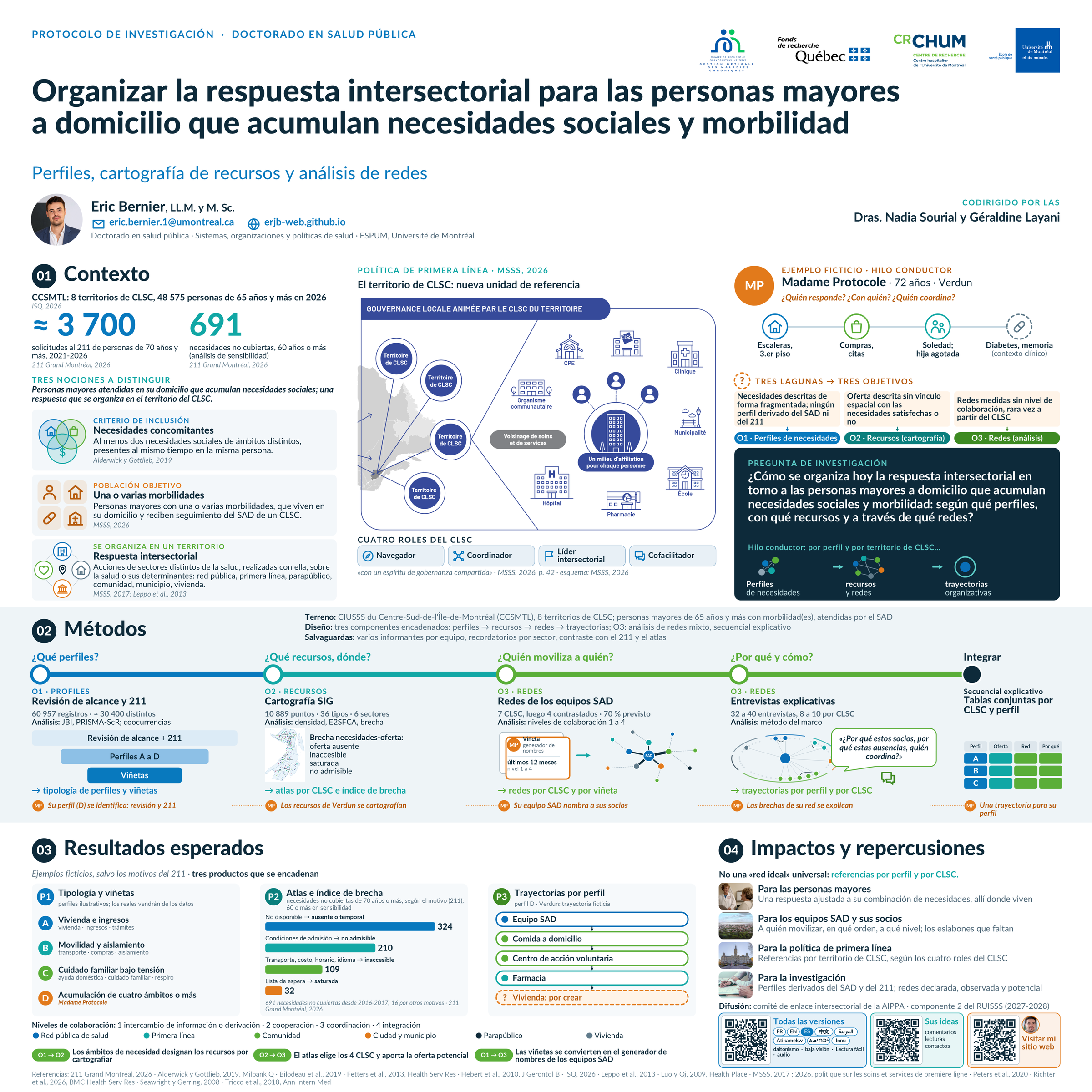
¿Cómo se organiza hoy la respuesta intersectorial en torno a las personas mayores en su domicilio que acumulan necesidades sociales y morbilidad: según qué perfiles, con qué recursos y mediante qué redes?
Diseño: métodos mixtos multifase (Creswell y Plano Clark, 2017), postura pragmática; O1 revisión de alcance (JBI, PRISMA-ScR) y análisis descriptivo del 211; O2 estudio cuantitativo observacional ecológico; O3 diseño mixto secuencial explicativo (QUAN → qual), análisis de redes egocentradas.
01Contexto
La pregunta de investigación
¿Cómo se organiza hoy la respuesta intersectorial en torno a las personas mayores en su domicilio que acumulan necesidades sociales y morbilidad: según qué perfiles, con qué recursos y mediante qué redes?
1. El problema: necesidades que superan la oferta
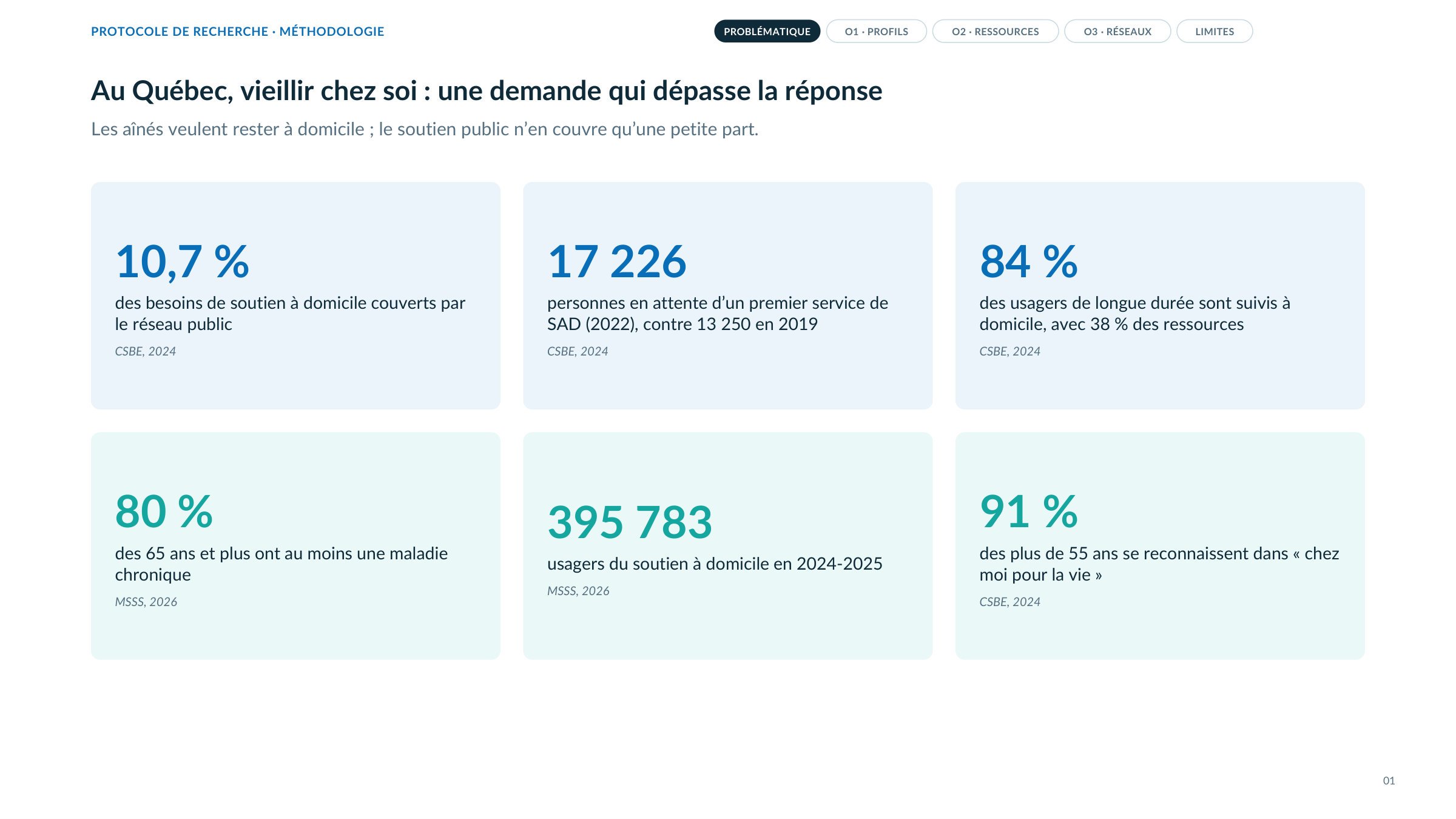
En Quebec, el apoyo a domicilio (SAD) agrupa los cuidados y servicios que la red pública ofrece en casa de la persona, sobre todo el equipo del CLSC (centro local de servicios comunitarios). En 2024-2025 atendió a 395 783 personas, con 37,2 millones de horas; 17 883 personas esperaban un primer servicio. Entre las personas de 65 años y más, el 80 % vive con al menos una enfermedad crónica y la mitad con varias (multimorbilidad) (MSSS, 2026a, p. 4 y 6).
Parte de las necesidades cubiertas por la red pública, 2023
Apoyo a domicilio10,7 %
RI-RTF68,8 %
CHSLD98,9 %
SAD: 25,4 de los 234,7 millones de horas requeridas (CSBE, 2024, p. 11).
Personas en espera de un primer servicio de SAD
31 de marzo de 201913 250
31 de marzo de 202217 226
Un aumento de alrededor del 30 % en tres años (CSBE, 2024, p. 2 y 96).
Usuarios y recursos de larga duración
Usuarios atendidos en el SAD84 %
Recursos del SAD38 %
El alojamiento recibe el 62 % de los fondos para el 16 % de los usuarios (CSBE, 2024, p. 7).
Salud de las personas de 65 años y más en Quebec
Al menos una enfermedad crónica80 %
Multimorbilidadla mitad
Y el 91 % de los mayores de 55 años se reconoce en «en casa de por vida» (CSBE, 2024, p. 7; MSSS, 2026a, p. 4).
Tras los cuatro tomos de Bien vieillir chez soi (2023-2024), el Comisionado de Salud y Bienestar (CSBE) concluye que el ecosistema de la atención domiciliaria es complejo, poco integrado y poco eficaz. En 2023, la red pública solo proporcionaba 25,4 de los 234,7 millones de horas requeridas en el domicilio: una tasa de respuesta del 10,7 %, frente al 98,9 % en los CHSLD. La atención domiciliaria recibe el 38 % de los recursos de larga duración para el 84 % de los usuarios, y las personas en espera de un primer servicio pasaron de 13 250 (2019) a 17 226 (2022). El resto depende de las personas cuidadoras, del sector comunitario y del privado, es decir, de sectores fuera de la red pública.
En el territorio estudiado (CCSMTL, 8 territorios de CLSC), 48 575 personas tienen 65 años o más en 2026 (ISQ). En 2021, el 28,6 % de ellas vivía por debajo del umbral de bajos ingresos, hasta el 41,8 % en Pointe-Saint-Charles y el 38,7 % en Centre-Sud; el 66,9 % de los hogares alquila (Statistique Canada). En el 211, las necesidades de las personas de 70 años y más se refieren primero al apoyo personal y comunitario (21,9 %) y a la vivienda (13,4 %), dos ámbitos donde sus necesidades quedan sin cubrir el doble de veces que en el conjunto de edades. Entre las personas de 60 años y más, el motivo más frecuente es «servicio no disponible» (324 necesidades), seguido de los requisitos de admisión (210) y la falta de transporte (66). Solo 44 solicitudes de personas de 60 años y más provienen de un CLSC.
Horas requeridas, horas proporcionadas y tasa de respuesta en cuidados de larga duración, Quebec, 2023: la red pública responde al 10,7 % de las necesidades en el domicilio. Captura: Commissaire à la santé et au bien-être (2024), Bien vieillir chez soi, tomo 4, resumen ejecutivo, p. 11 (proyecciones de Clavet et al., HEC Montréal, 2023).Las seis cifras clave del problema quebequense. Fuente: Bernier, E. (2026). Metodología de la tesis O1-O3 [presentación, en francés], diapositiva 2.
2. Cuando las necesidades se acumulan, la respuesta se complica
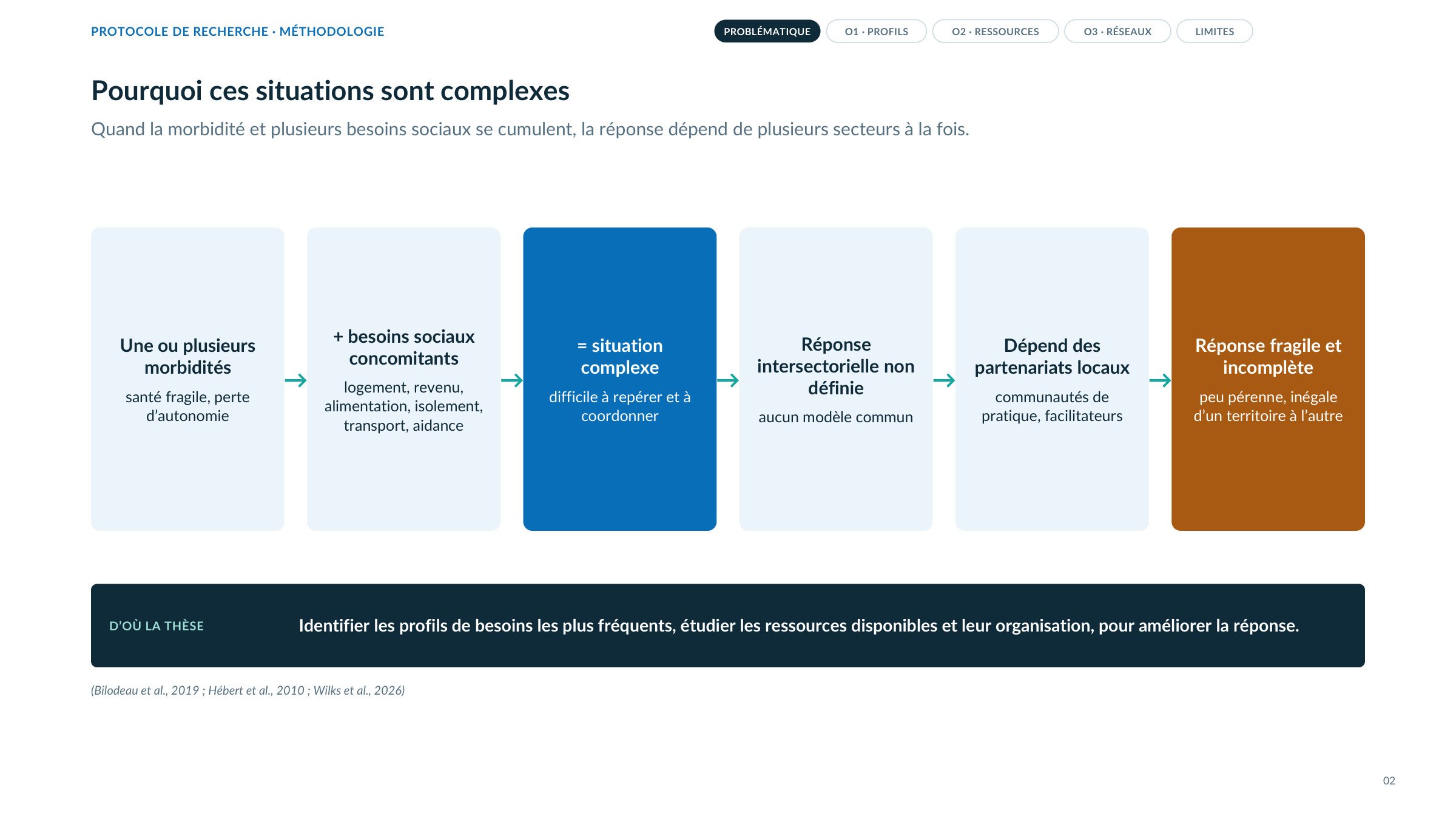
Una persona mayor puede vivir a la vez con una o varias morbilidades (problemas de salud, agudos o crónicos) y varias necesidades sociales: una vivienda poco adaptada, ingresos insuficientes, aislamiento, falta de transporte, un cuidador agotado. Se habla de necesidades sociales concomitantes. Juntas son factores de complejidad: cada una dificulta resolver las demás y el recorrido de la persona pierde fluidez (Safford et al., 2007; Grembowski et al., 2014; Schaink et al., 2012; Johnson y Bacsu, 2018). La política Mieux chez soi lo reconoce: cuando las necesidades abarcan varias esferas de la vida, varios profesionales deben trabajar juntos, y las enfermedades crónicas hacen más complejas e intensas las necesidades a domicilio (MSSS, 2026a, p. 4).
Estas situaciones son difíciles de detectar, porque ningún servicio ve por sí solo todas las necesidades de una persona. También son difíciles de coordinar: el Comisionado de Salud y Bienestar (CSBE) describe un ecosistema del SAD complejo, poco integrado y poco eficaz. No siempre se sabe organizar una respuesta común, adaptada y coordinada. Es plausible que, en un mismo territorio, las organizaciones no se conozcan o no trabajen juntas, y que falte un recurso sin que se sepa que otro, de otro sector, podría sustituirlo. Ningún estudio lo demuestra directamente: es una inferencia, sugerida por los trabajos sobre redes de servicios, sobre la capacidad de las organizaciones comunitarias y sobre la dificultad de encontrar la ayuda disponible (Lemieux-Charles et al., 2005; Varda et al., 2020; Hogg-Graham et al., 2021; Macleod et al., 2017). En el 211, el motivo más frecuente de las necesidades no cubiertas de las personas de 60 años y más es «servicio no disponible».
La cadena de la complejidad: una o varias morbilidades más necesidades sociales concomitantes dan una situación difícil de detectar y coordinar. Fuente: Bernier, E. (2026). Metodología de la tesis O1-O3 [presentación, en francés], diapositiva 3.
3. Varias puertas de entrada, no una sola
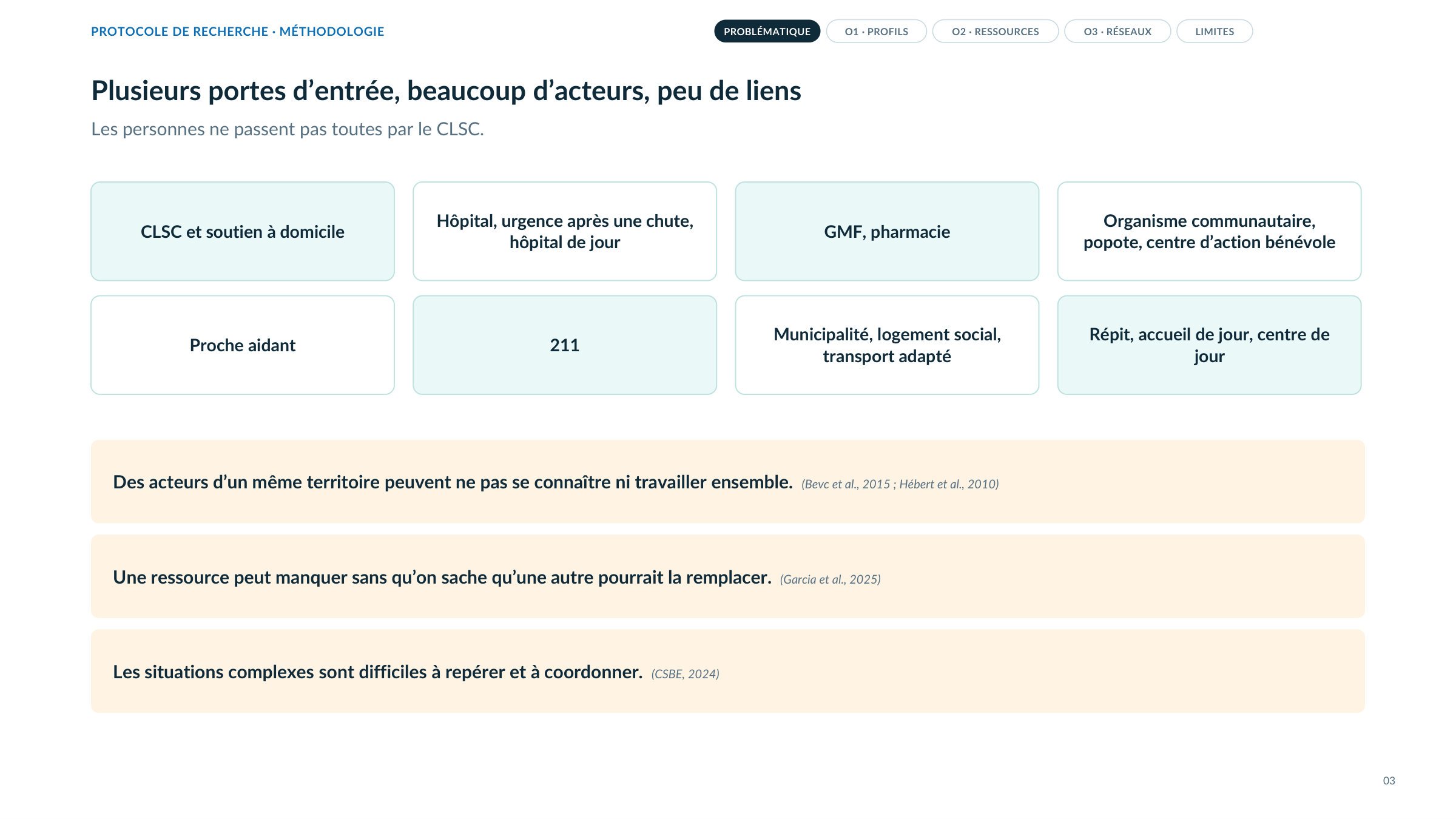
La política Mieux chez soi quiere que el CLSC sea la puerta de entrada principal (MSSS, 2026a, p. XII). En la práctica, una persona mayor entra en la red por muchas puertas: el equipo SAD del CLSC; el hospital de día; una hospitalización; urgencias tras una caída; los cuidados a domicilio del CISSS o del CIUSSS (los establecimientos regionales de salud y servicios sociales); el grupo de medicina familiar (GMF); la farmacia; el municipio; la vivienda social; el transporte adaptado; una organización comunitaria; un cuidador; el 211, servicio de información y derivación. Cada puerta ve una parte de la situación; ninguna garantiza que se tengan en cuenta todas las necesidades.
Doce puertas de entrada posibles; el CLSC, previsto como puerta principal (MSSS, 2026a, p. XII), es solo una. Ninguna ve por sí sola todas las necesidades.Las puertas de entrada y lo que las conecta mal. Fuente: Bernier, E. (2026). Metodología de la tesis O1-O3 [presentación, en francés], diapositiva 4.
4. Lo que ya existe en Quebec para integrar los servicios
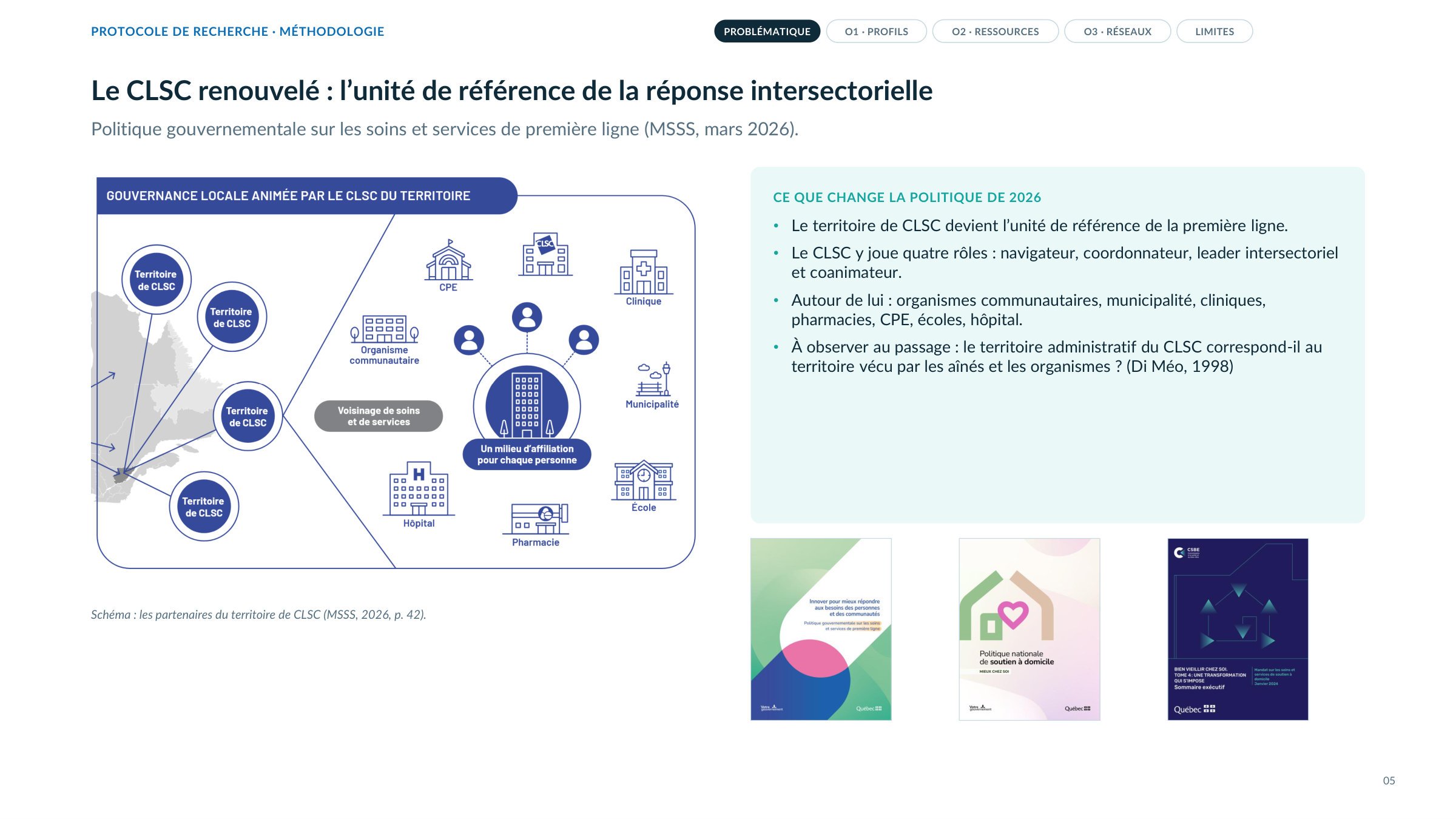
La política gubernamental de atención y servicios de primer nivel (MSSS, marzo de 2026) vincula a cada persona con un territorio de CLSC, que se convierte en la unidad de referencia para coordinar el primer nivel (p. 15). Confía al CLSC cuatro funciones: navegador, coordinador, líder intersectorial y coanimador (p. 42). Las orientaciones ministeriales que la acompañan constatan que el CLSC, concebido como eje territorial, ha quedado desvitalizado y alejado de su misión original (p. 1): se trata de devolverle ese papel.
Varios dispositivos ya acercan a los actores. PRISMA, un modelo quebequense de integración de servicios para personas mayores con pérdida de autonomía, reunió una ventanilla única, la gestión de casos, una herramienta de evaluación común y la concertación de los socios; su evaluación mostró menos deterioro funcional y menos necesidades no cubiertas (Hébert et al., 2003, 2010; Couturier et al., 2021). El Enfoque integrado de proximidad para las personas mayores (AIPPA) del MSSS (2024) se apoya en prácticas colaborativas y en la detección de las personas con necesidades (p. 8), en los trabajadores de calle del programa ITMAV y en los organizadores comunitarios de los establecimientos (p. 28), así como en comunidades de práctica (p. 59; Ranmuthugala et al., 2011). El organizador comunitario, adscrito al servicio de organización comunitaria del CISSS o del CIUSSS, es el enlace entre el establecimiento y las organizaciones del entorno (Bourque y Lachapelle, 2010).
La intersectorialidad no es nueva en Quebec: la política Chez soi : le premier choix (2003) ya la anunciaba, y el RUISSS de la Universidad de Montreal (2022) propuso un esquema de seis sectores (red pública, primer nivel, parapúblico, comunidad, ciudad, vivienda) y cuatro niveles de colaboración (intercambio de información, cooperación, coordinación, integración; según Bilodeau, Parent y Potvin, 2019). El enfoque AIPPA del MSSS y su comité de enlace intersectorial en el CCSMTL lo prolongan. Lo que falta es la manera de saber, territorio por territorio, qué sectores movilizar para qué combinaciones de necesidades.
El CLSC, unidad de gobernanza de proximidad, y sus cuatro funciones: navegador, coordinador, líder intersectorial y coanimador. Captura: MSSS (2026), Politique gouvernementale sur les soins et services de première ligne, p. 42.
Este esquema, junto con la literatura, sirvió para delimitar los sectores estudiados en la tesis (MSSS, 2026b, p. 42; Bilodeau et al., 2019).
Estos dispositivos son valiosos, pero la respuesta intersectorial sigue siendo poco visible. A menudo descansa en alianzas locales: una comunidad de práctica, una mesa de concertación, una persona que hace de facilitadora. Si esa persona se va o la financiación se acaba, la respuesta se debilita: es poco duradera y a menudo incompleta. Sobre todo, ninguno de estos dispositivos dice qué combinaciones de necesidades son las más frecuentes, qué recursos existen para cada una en un territorio, ni cómo se organiza hoy la red para responder. Eso es precisamente lo que busca la tesis.
Lo que cambia la Política de 2026 (MSSS, 2026b, p. 15 y 42). Fuente: Bernier, E. (2026). Metodología de la tesis O1-O3 [presentación, en francés], diapositiva 6.
5. Lo que la literatura ya ha intentado
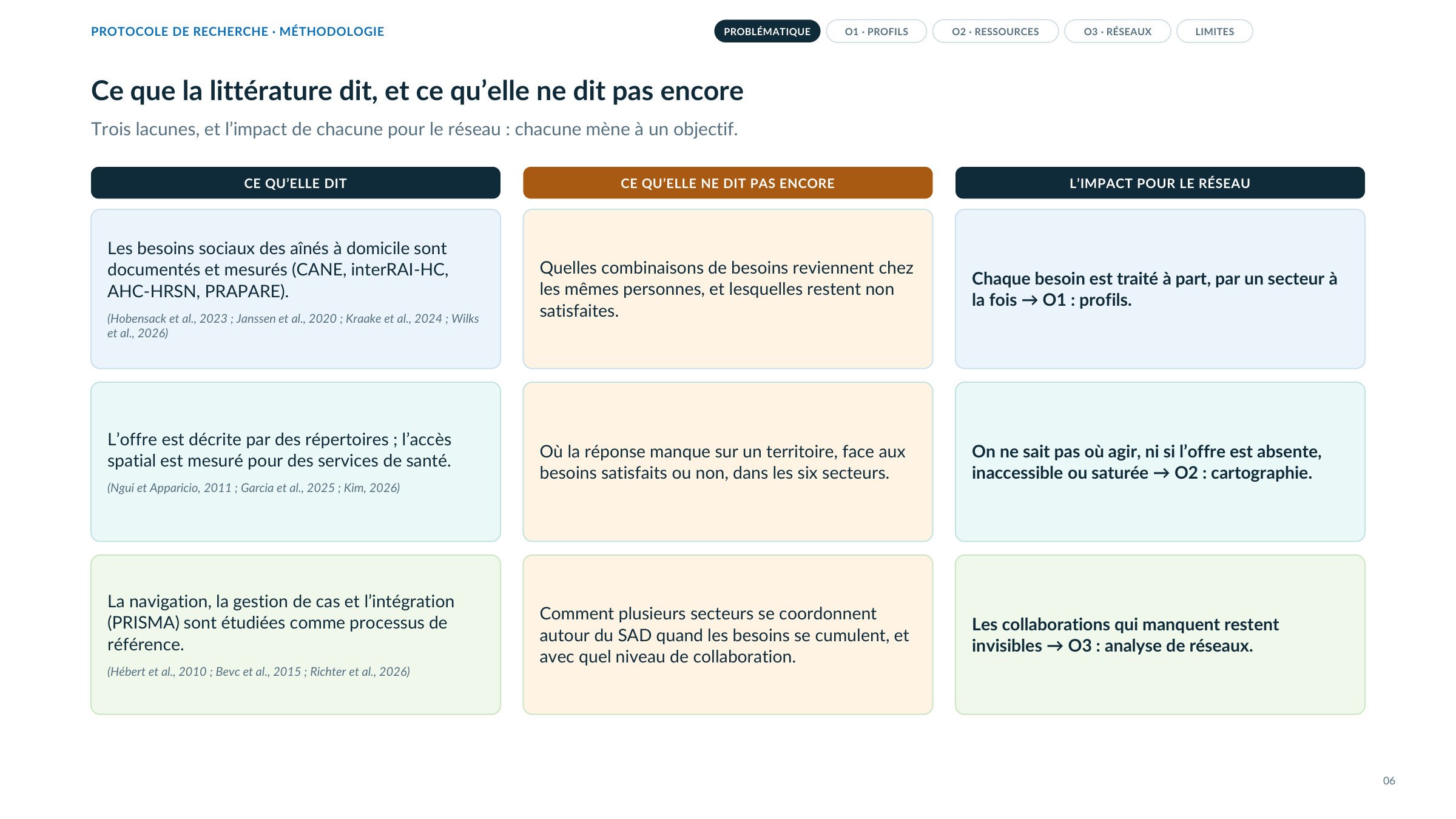
Dice que las necesidades sociales de las personas mayores en el domicilio son frecuentes y acumuladas (McManus et al., 2025; Tingvold et al., 2026), que se agrupan (Kreuter et al., 2021) y que existen perfiles de necesidades satisfechas o no, pero sobre todo a partir del CANE y del punto de vista de las personas cuidadoras (Janssen et al., 2020; Kraake et al., 2024). Documenta la derivación, la navegación y la prescripción social (Hébert et al., 2010; Percival et al., 2022) y la oferta de servicios cartografiada (Kim, 2026; Álvarez-Pérez et al., 2025).
Aún no dice qué combinaciones de necesidades se repiten entre las personas atendidas en el domicilio ni cuáles quedan sin satisfacer; rara vez relaciona, en un territorio, esas combinaciones con los recursos accesibles; y sus análisis de redes registran la presencia de un vínculo, rara vez su nivel de colaboración, casi nunca a partir de los equipos de atención domiciliaria de varios CLSC. La revisión de alcance de O1 parte de 60 957 registros de cuatro bases (MEDLINE, Embase, APA PsycInfo, PubMed): 8 938 anteriores a 2006 retirados, 52 021 importados en Covidence, 25 412 duplicados retirados, 26 609 estudios por cribar por dos evaluadores.
Algunos trabajos ya han cartografiado las necesidades y los recursos de las personas mayores: en Quebec, el estudio dirigido por Anne-Marie Séguin (INRS) para la Société d’habitation du Québec (2018) describió las necesidades cubiertas o no de las personas de 75 años y más según el tipo de entorno, y luego los recursos locales y las estrategias de las personas. Juliette Duc y sus colegas cartografiaron, con QGIS y R, la oferta y la demanda de servicios de las personas de 65 años y más en todo Quebec: menos servicios por persona mayor en el medio rural y una fuerte variabilidad local (Duc et al., 2026). Otros describieron perfiles de necesidades en personas con demencia que viven en su casa (Janssen et al., 2020) o analizaron redes de servicios mediante el análisis de redes sociales, SNA (Urbanoski et al., 2018). Ningún trabajo identificado vincula todavía las necesidades sociales concomitantes y la o las morbilidades como factores de complejidad, a escala de un territorio de CLSC.
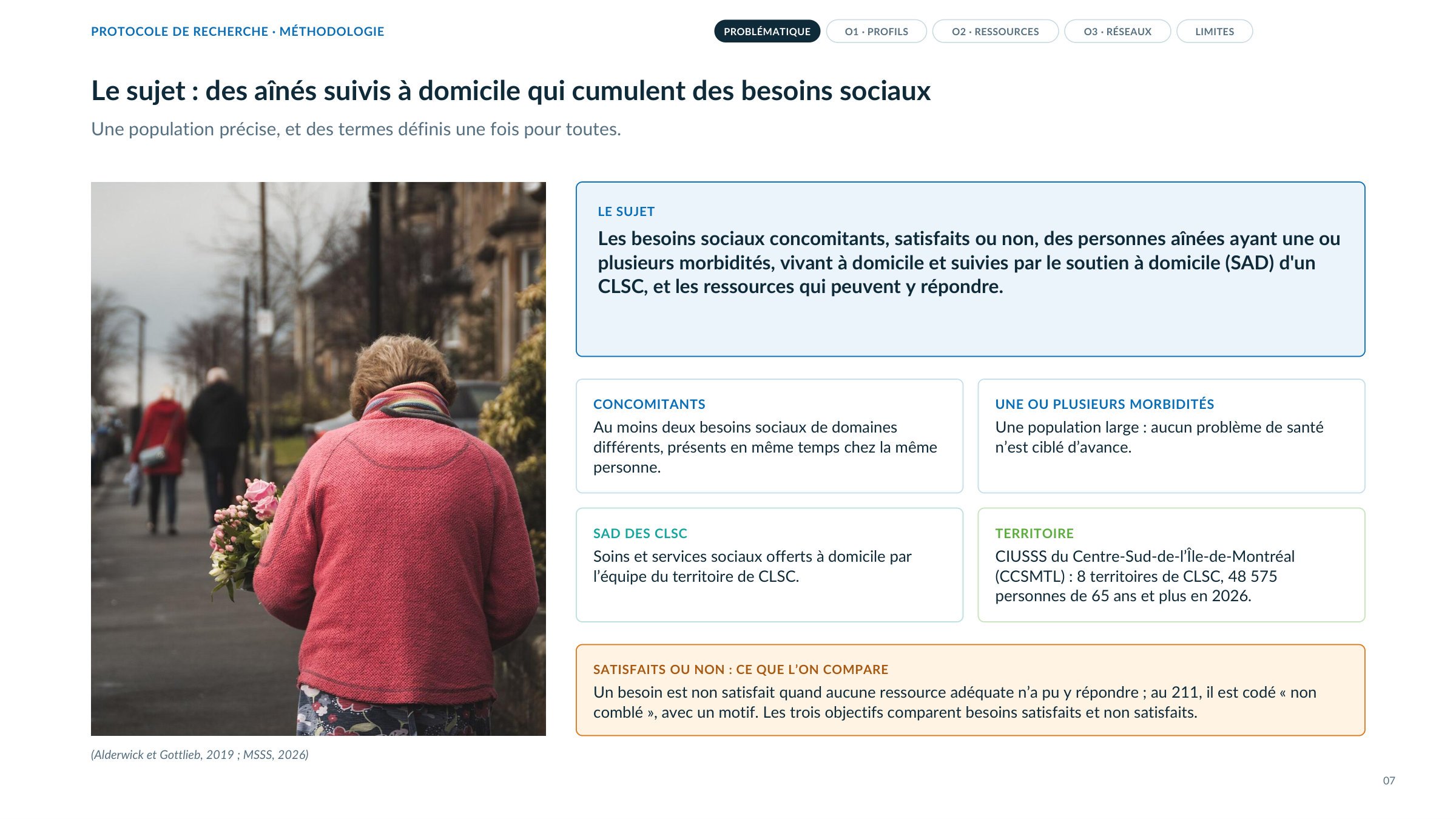
El vacío principal
La literatura no está vacía en cada uno de los componentes de la pregunta, ya se trate de la medición de las necesidades sociales múltiples, de su concurrencia, del deseo de ayuda de los pacientes o de los dispositivos de respuesta. Sin embargo, ninguna síntesis identificada reúne, en personas adultas en atención primaria, el carácter no satisfecho de las necesidades, su concurrencia, su priorización por los pacientes, sus interrelaciones, la red de respuesta y la trayectoria hasta su resolución. El vacío reside, por tanto, en la articulación entre la configuración de las necesidades y la de la respuesta intersectorial, así como en los mecanismos que explican por qué algunas necesidades persisten pese a haber sido identificadas.
Por rigor metodológico, la formulación adoptada es «ninguna síntesis identificada en las búsquedas realizadas en PubMed y Cairn» y no «no existe ninguna síntesis».
Tres vacíos, cada uno lleva a un objetivo. Fuente: Bernier, E. (2026). Metodología de la tesis O1-O3 [presentación, en francés], diapositiva 7.
6. Una respuesta intersectorial, no solo una intervención individual
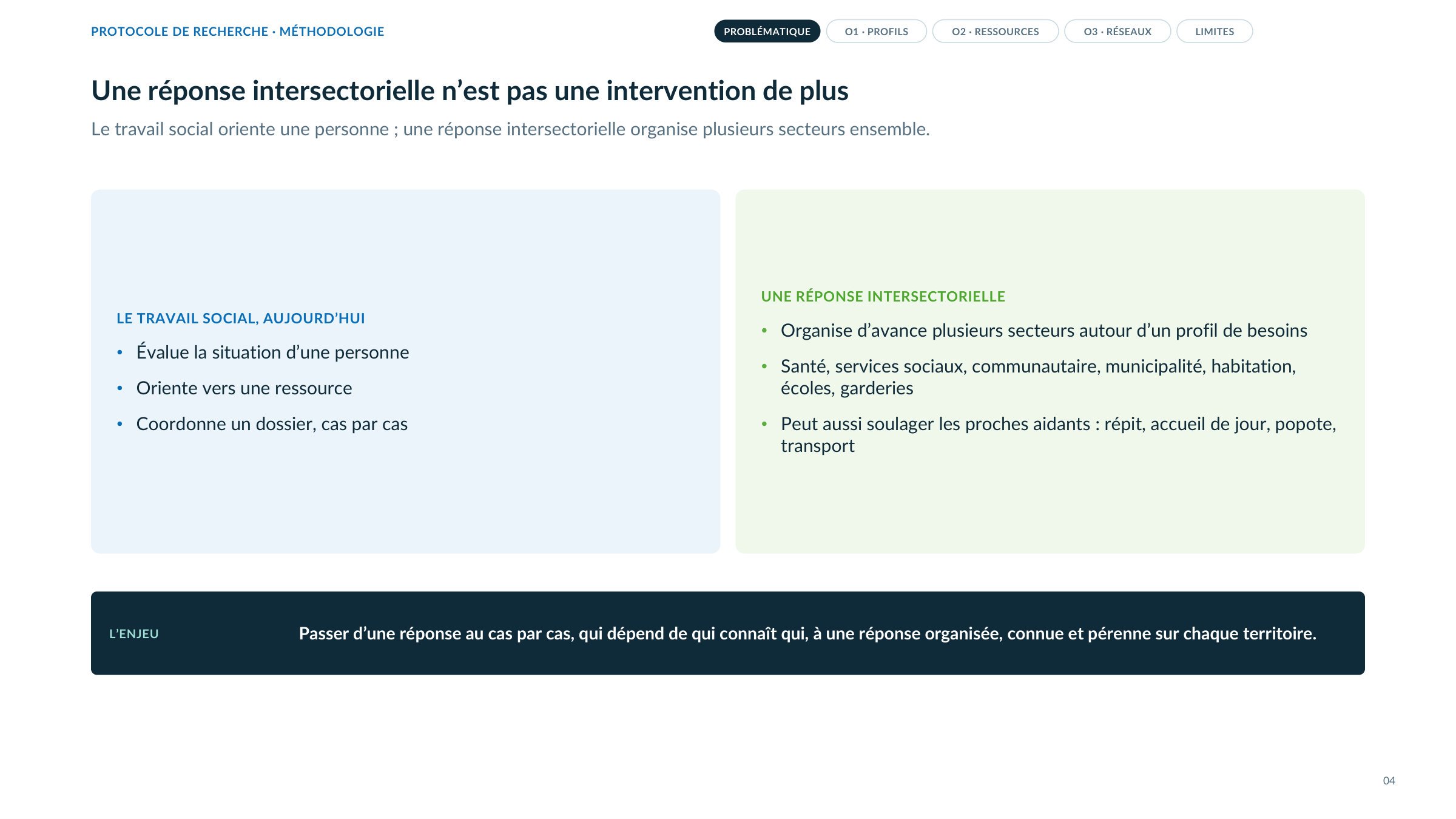
El trabajador social del SAD evalúa la situación de una persona, la orienta y la acompaña: es una intervención individual, esencial. Una respuesta intersectorial a las necesidades sociales concomitantes de una persona con una o varias morbilidades es otra cosa: es la organización, en un territorio, de varios sectores (salud, servicios sociales, comunitario, municipio, vivienda, transporte) que actúan juntos, de forma duradera, ante una misma combinación de necesidades. El reto actual no es la competencia de los profesionales, sino la falta de una organización común: cada profesional reconstruye, caso por caso, una red que podría conocerse de antemano. El trabajo social evalúa, orienta y coordina caso por caso; una respuesta intersectorial organiza de antemano varios sectores en torno a un perfil (Couturier et al., 2022; Bilodeau et al., 2019). El reto: pasar de «quién conoce a quién» a una respuesta organizada y duradera.
Trabajo social, hoy
Respuesta intersectorial buscada
Evalúa la situación de una persona
Organiza de antemano varios sectores en torno a un perfil de necesidades
También alivia a los cuidadores: respiro, centro de día, comidas a domicilio, transporte
Depende de «quién conoce a quién»
Organizada, conocida y duradera en cada territorio
Según Couturier et al. (2022) y Bilodeau et al. (2019).
Trabajo social y respuesta intersectorial. Fuente: Bernier, E. (2026). Metodología de la tesis O1-O3 [presentación, en francés], diapositiva 5.
7. Línea secundaria: territorio vivido y territorio administrativo
La Política de 2026 hace del territorio de CLSC la unidad de referencia. Sus Orientaciones precisan que ese territorio ya no es una simple división administrativa sino un espacio vivo, y que los 166 territorios actuales no son fines en sí mismos (MSSS, 2026, resumen y p. 4). Sin embargo, los territorios de CLSC se definieron primero para asignar una población a cada establecimiento (MSSS, recomendaciones sobre la gestión de datos territoriales); en Montreal, la salud pública dividió la isla en 101 vecindarios, más cercanos a las comunidades, y las unidades administrativas no siempre corresponden a los entornos vividos (Di Méo, 1998; Riva et al., 2008; Macé, 2010; Breton et al., 2009). En segundo plano, la tesis verificará si los recursos que las personas usan realmente siguen los límites del CLSC o los rebasan.
8. La idea de la tesis
De ahí la idea de partida: identificar los perfiles de necesidades sociales concomitantes más frecuentes en las personas mayores atendidas por el SAD; para cada perfil, localizar los recursos disponibles en cada territorio de CLSC; y comprender cómo se organiza hoy la respuesta, para mejorarla. La tesis trata de las personas mayores con una o varias morbilidades que viven en su domicilio y reciben el SAD de los ocho territorios de CLSC del CIUSSS du Centre-Sud-de-l’Île-de-Montréal (48 575 personas de 65 años y más en 2026).
El hilo conductor cabe en tres palabras: perfiles → recursos → red. O1 dice qué combinaciones de necesidades se repiten; O2 dice, territorio por territorio, qué existe para responder y qué falta; O3 dice quién ya trabaja junto y qué vínculos faltan. Cada etapa da a la siguiente lo que necesita.
9. Mi postura
Mi reflexión parte de mi trayectoria entre varios sectores y de mi observación de las políticas de mantenimiento en el domicilio, en las que trabajé en la ANAP. Como educador especializado, vi lo difícil que es organizar una respuesta común ante las situaciones más complejas, cuando varios servicios intervienen sin coordinarse. Esta tesis busca hacer visible, y por tanto organizable, lo que hoy descansa sobre todo en la buena voluntad de cada uno.
Fundamentos documentales
Los recursos siguientes apoyan la conceptualización. El título, la pregunta, el argumento de tesis y los objetivos de sus respectivas secciones constituyen el planteamiento actual del proyecto.
Conceptualizar el proyecto de investigación
Estoy en la etapa de conceptualización: un corpus de publicaciones priorizadas, las lagunas que revela y las lecturas de formación que lo respaldan.
222publicaciones seleccionadas
39lecturas prioritarias
83lecturas importantes
9dimensiones de vacíos examinadas
Distribución por prioridad
Prioridad 539
Prioridad 483
Prioridad 346
Prioridad 224
Prioridad 130
Procedencia de las publicaciones
222
PubMed112
Embase y MEDLINE (Ovid)95
Cairn15
El corpus se constituyó a partir de Ovid (Embase, MEDLINE), PubMed y Cairn, y a cada publicación se le asignó una prioridad según su pertinencia para la pregunta de tesis.
Lo que la literatura deja abierto
Para cada una de las nueve dimensiones examinadas, la tabla indica el estado de la literatura, la magnitud del vacío y algunas referencias clave.
Conceptualización
Importante
Presente pero no consolidada
Los estudios indexados en PubMed distinguen cada vez más entre riesgo social, necesidad social y deseo de asistencia. Los trabajos francófonos de Cairn añaden un vocabulario de la precariedad y la vulnerabilidad social, a menudo multidimensional, pero conceptualmente más amplio que la necesidad no satisfecha.
Gruß 2021; Tucher 2026; Tudrej 2019; Karran 2023
Medición
Importante
Abundante pero heterogénea
Los instrumentos difieren mucho en sus dominios, umbrales y modo de administración. Las puntuaciones multidimensionales de precariedad identificadas en Cairn, como EPICES y PRECAR, no equivalen a los cuestionarios de necesidades sociales no satisfechas.
Zein 2026; Karran 2023; Tudrej 2019; Rogers 2025
Caracterización y prevalencia
Moderada
Bien documentada para al menos una necesidad
Numerosos estudios describen la prevalencia por dominio y la carga acumulada, pero las estimaciones son difíciles de comparar cuando difieren la definición de necesidad y el instrumento.
Jih 2023; Bleacher 2020; Fiori 2021
Multiplicidad y concurrencia
Importante
Emergente pero ya demostrada
La coexistencia de varias necesidades o riesgos sociales es frecuente, y se han propuesto agrupaciones, clases y medidas de carga acumulada. Un estudio reciente muestra además que la multiplicidad de riesgos aumenta fuertemente la probabilidad de desear ayuda.
Vest 2025; Kreuter 2021; Zeng 2024; Tucher 2026
Priorización por los pacientes
Mayor
Algunos estudios directos, pero un campo aún poco desarrollado
La literatura mide sobre todo el deseo de ayuda, los objetivos negociados, la aceptabilidad o la prioridad relativa, y los trabajos recientes refuerzan la distinción entre riesgo detectado y ayuda deseada. Los trabajos de e-CARE muestran un acompañamiento ajustado al ritmo y a las prioridades del paciente, sin producir una jerarquía estandarizada de las necesidades.
Descritas sobre todo como concurrencia o complejidad global
Los análisis cuantitativos documentan sobre todo la concurrencia y los perfiles. Los trabajos cualitativos francófonos de Cairn describen el entrelazamiento de dificultades sociales, administrativas, económicas y de salud, pero rara vez su dirección, su secuencia o su mecanismo causal.
Vest 2025; Kreuter 2021; Marron-Delabre 2015; Ouanhnon 2022
Resolución y trayectoria
Mayor
Creciente pero dominada por indicadores intermedios
El campo distingue cada vez más entre cribado, derivación, conexión, recurso recibido y resolución. Los trabajos francófonos de e-CARE siguen además resultados concretos, como el acceso a derechos, a un médico de cabecera y a la vivienda o la autonomía en el recorrido asistencial, pero sin una medida estandarizada de la resolución de cada necesidad.
Literatura sustancial, pero a menudo separada de los datos de pacientes
PubMed documenta la navegación, los agentes comunitarios de salud, las alianzas médico-jurídicas y la derivación de circuito cerrado, y Cairn las unidades sociales en medicina general y las estructuras francesas de atención primaria y coordinación territorial (MSP, CPTS, DAC). Sin embargo, la configuración de la red rara vez se vincula con los perfiles de necesidades y su resolución.
No identificada en las auditorías de PubMed y Cairn
Ninguna síntesis localizada reúne, en personas adultas atendidas en atención primaria, el carácter no satisfecho de las necesidades, su medición multidominio, las configuraciones de concurrencia, la prioridad que les otorga el paciente, las interrelaciones entre necesidades, la configuración de la red movilizable y la trayectoria hasta su resolución.
Karran 2023; Vest 2025; Chang 2026; Tudrej 2019; Ouanhnon 2022
Rodriguez J.; Nafisi A.; Rob-Inson C.; Arteaga E.; Pierce L.D.; Sunn L.; Kim K.J. (2018) Social determinants of health screening and com-munity resource referral in a safety-net resident primary care clinic. Resumen de congreso
¿Cómo se organiza hoy la respuesta intersectorial en torno a las personas mayores en su domicilio que acumulan necesidades sociales y morbilidad: según qué perfiles, con qué recursos y mediante qué redes?
Problemática y objetivos
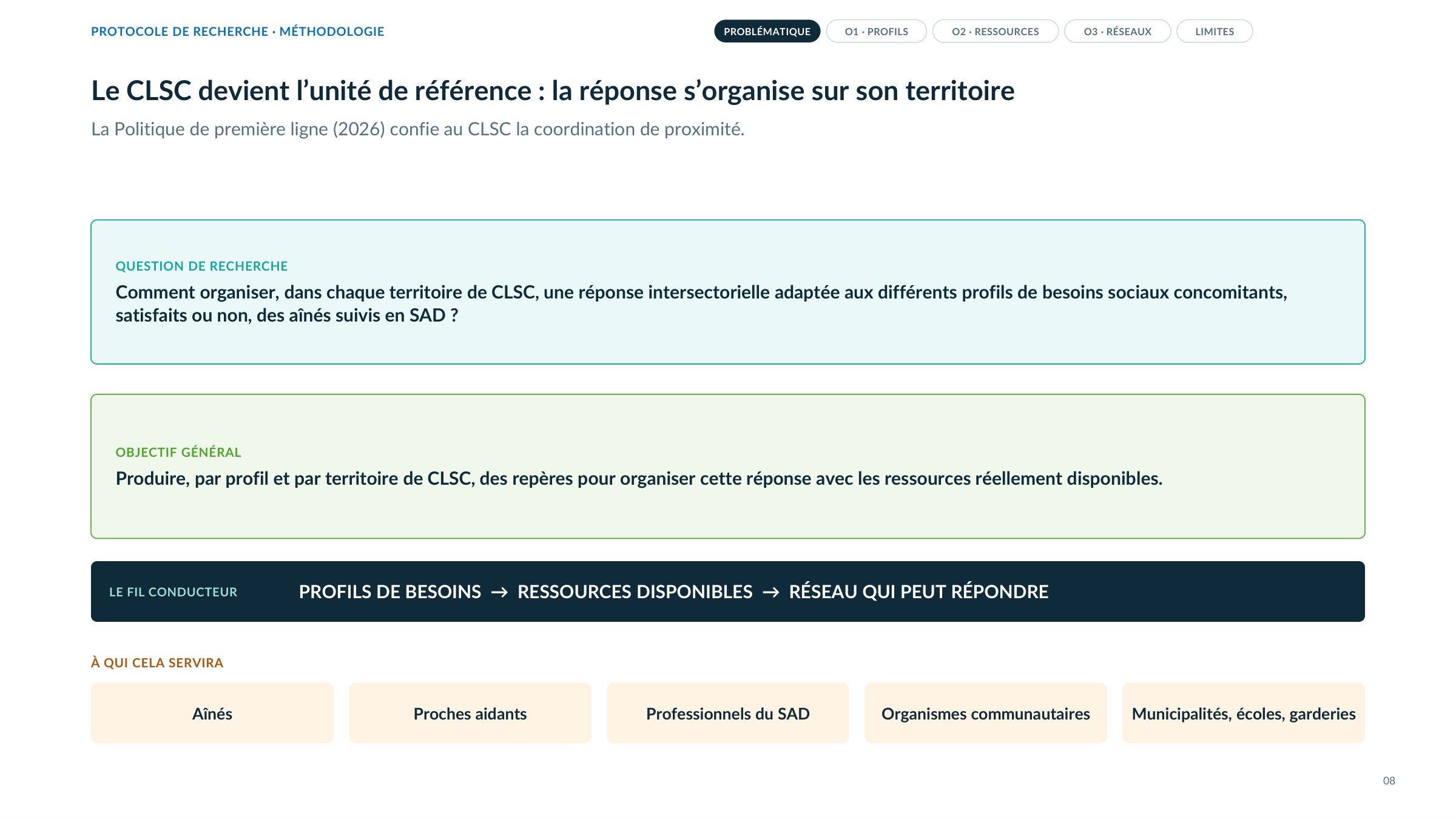
Pregunta de investigación
¿Cómo se organiza hoy la respuesta intersectorial en torno a las personas mayores en su domicilio que acumulan necesidades sociales y morbilidad: según qué perfiles, con qué recursos y mediante qué redes?
La pregunta, el objetivo general y a quién servirá (MSSS, 2026b, p. 15 y 42). Fuente: Bernier, E. (2026). Metodología de la tesis O1-O3 [presentación, en francés], diapositiva 9.
Planteamiento central de la tesis
En las personas mayores atendidas en apoyo a domicilio, la respuesta intersectorial no puede organizarse necesidad por necesidad: debe organizarse por perfil de necesidades concurrentes y por territorio de CLSC, a partir de los recursos realmente disponibles y de las redes realmente movilizadas en torno a los equipos de SAD.
Objetivo general
Producir, por perfil y por territorio de CLSC, puntos de referencia para organizar la respuesta intersectorial con los recursos realmente disponibles.
Objetivos específicos
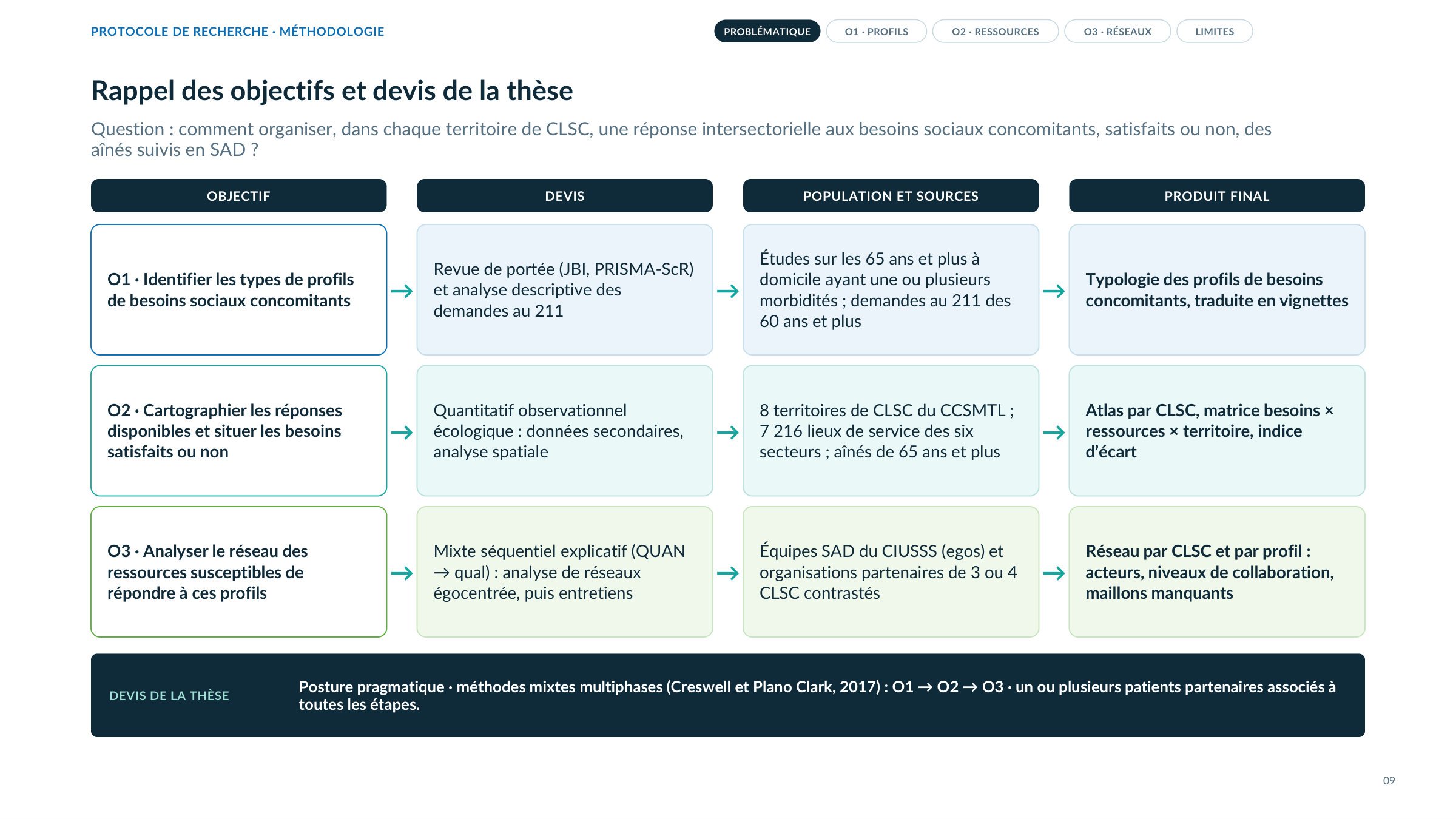
O1 Perfiles de necesidades
1 · Vacío
Las necesidades sociales concurrentes de las personas mayores a domicilio están documentadas, pero de forma fragmentada: las definiciones, las medidas y los perfiles varían. Ningún estudio localizado obtiene perfiles a partir de las evaluaciones del SAD (OEMC, interRAI-HC) ni de las solicitudes al 211 (Wilks y otros, 2026; Janssen y otros, 2020; Kraake y otros, 2024; Kreuter y otros, 2021).
2 · Objetivo
Identificar los distintos tipos de perfiles de necesidades sociales concurrentes en las personas mayores con factores de morbilidad o comorbilidad atendidas en los servicios a domicilio (CLSC).
3 · Producto final
Producto final: una tipología de perfiles de necesidades sociales concomitantes, cubiertas o no, traducida en viñetas. Qué nos aporta: saber qué combinaciones de necesidades son las más frecuentes para organizar la respuesta en torno a ellas.
O2 Recursos disponibles (cartografía)
1 · Vacío
Los análisis de la oferta parten de un repertorio fijado de antemano, sin cruzarlo, en el espacio, con las necesidades expresadas y no satisfechas. Los repertorios suelen ser inexactos; no se sabe dónde la oferta está ausente, es inaccesible o está saturada (Kim, 2026; Janda y otros, 2021; Garcia y otros, 2025).
2 · Objetivo
Cartografiar en el espacio los recursos de cada territorio de CLSC capaces de aportar una respuesta intersectorial a estas necesidades.
Seis sectores: red pública, primera línea, parapúblico, comunidad, municipio, vivienda.
3 · Producto final
Producto final: un atlas por territorio de CLSC, una matriz necesidades × recursos y un índice de brecha. Qué nos aporta: saber, para cada perfil, dónde existe la respuesta, dónde falta y por qué (ausente, inaccesible o saturada).
O3 Redes (análisis de redes)
1 · Vacío
Las respuestas a las necesidades sociales de las personas mayores se estudian sobre todo como procesos de derivación. Las redes interorganizativas se miden con mayor frecuencia sin nivel de colaboración y rara vez parten de varios CLSC (Hébert y otros, 2010; Bevc y otros, 2015; Richter y otros, 2026).
2 · Objetivo
Identificar las trayectorias organizativas de los recursos intersectoriales movilizados para responder a los distintos perfiles, en varios territorios de CLSC (SAD) contrastados.
Con los equipos de apoyo a domicilio del CIUSSS del Centre-Sud-de-l’Île-de-Montréal.
3 · Producto final
Producto final: el mapa de la red de cada CLSC y de cada perfil, con los eslabones que faltan. Qué nos aporta: saber quién ya trabaja junto, quién debería hacerlo y sobre qué vínculos actuar.
Cada objetivo, su diseño, su población y su producto final. Fuente: Bernier, E. (2026). Metodología de la tesis O1-O3 [presentación, en francés], diapositiva 10.
Cuatro nociones
Población: las personas de 65 años y más. Para el 211, el análisis principal abarca a las personas de 70 años y más, porque el 211 solo publica los tramos de 60-69 y de 70 años y más; las de 60 años y más sirven de análisis de sensibilidad.
Necesidades concurrentes
Al menos dos necesidades sociales de dominios distintos, presentes al mismo tiempo en la misma persona.
(Kreuter y otros, 2021)
Una o varias morbilidades
Cualquier problema de salud, agudo o crónico. La persona puede tener uno solo o varios.
El SAD de los CLSC
Los cuidados y servicios sociales que presta a domicilio el equipo del territorio de CLSC.
(MSSS, 2026)
Necesidad no satisfecha
En el 211, una necesidad no está satisfecha cuando no se ha podido proponer ningún recurso adecuado, con un motivo. Se mide; no se convierte en criterio de inclusión.
(Alderwick y Gottlieb, 2019)
«Cubiertas o no»: ¿de qué hablamos?
«No cubierta» cambia de sentido según la fuente. En el 211, una necesidad no está cubierta cuando no se pudo proponer ningún recurso adecuado, con un motivo; para Statistique Canada o el INSPQ, es una necesidad percibida sin servicio recibido; en el CANE, un problema sin ayuda adecuada según un evaluador. La tesis adopta la definición del 211 y compara, en los tres objetivos, las necesidades cubiertas y no cubiertas (Alderwick y Gottlieb, 2019).
El tema y sus términos, definidos de una vez por todas. Fuente: Bernier, E. (2026). Metodología de la tesis O1-O3 [presentación, en francés], diapositiva 8.
03Métodos
Métodos
Diseño general: postura pragmática; métodos mixtos multifase (Creswell y Plano Clark, 2017), O1 → O2 → O3, cada fase construye la siguiente. Las viñetas de O1 sirven de generador de nombres en O3; el atlas de O2 elige los CLSC de O3 y aporta la oferta potencial. Los actores de terreno participan en cada fase: personas mayores, cuidadores, profesionales, gestores y socios de todos los sectores, con uno o varios pacientes colaboradores.
O1 Perfiles
Diseño
Revisión de alcance (JBI, PRISMA-ScR), más el análisis descriptivo cuantitativo de las solicitudes al 211.
Población
Estudios sobre personas de 65 años y más que viven en su domicilio con una o varias morbilidades; solicitudes al 211 de personas de 60 años y más en el territorio del CCSMTL.
Muestreo
Ninguno: se examina toda la literatura identificada. Bases: MEDLINE, Embase, APA PsycInfo (Ovid) y PubMed; estrategia de 42 líneas en 7 bloques, validada con 6 artículos de referencia.
Recogida
60 957 registros → −8 938 (antes de 2006) → 52 021 en Covidence → −25 412 duplicados → 26 609 por cribar. Cribado por dos evaluadores independientes (títulos y resúmenes, luego textos), prueba piloto con 25 registros; extracción doble (definiciones, instrumentos, ámbitos, perfiles).
Análisis
Síntesis descriptiva en una cuadrícula de 10 a 14 ámbitos vinculada a la taxonomía del 211; necesidades satisfechas o no en el 211, con sus motivos.
Producto
Tipología de perfiles de necesidades concomitantes y viñetas.
¿Por qué perfiles de necesidades concomitantes y no 12 ámbitos separados?
Una persona mayor no vive sus necesidades una a una: la escalera, la compra, la soledad y los trámites se refuerzan. Mantener 12 ámbitos separados reproduce la fragmentación que el CSBE reprocha a la atención domiciliaria, donde cada servicio responde solo a su ámbito. El perfil describe la combinación y, por tanto, la respuesta que hay que organizar: a quién movilizar juntos. Integra una o varias morbilidades, porque cambian la naturaleza de la respuesta (la mitad de las personas de 65 años y más vive con varias morbilidades).
¿Por qué perfiles y no la persona?
Primero, la factibilidad: los datos individuales de la atención domiciliaria (OEMC, I-CLSC) exigen una autorización legal y al menos 2 000 usuarios; la simulación del protocolo muestra que por debajo no se recuperan los perfiles y que en el 211 (1,4 necesidades por solicitud) ningún tamaño basta. Luego, el nivel de decisión: un CLSC planifica para grupos de situaciones, no para un caso. Por último, la ética y la transferencia: un perfil convertido en viñeta (Madame Protocole) se presenta a todos los equipos sin exponer a nadie.
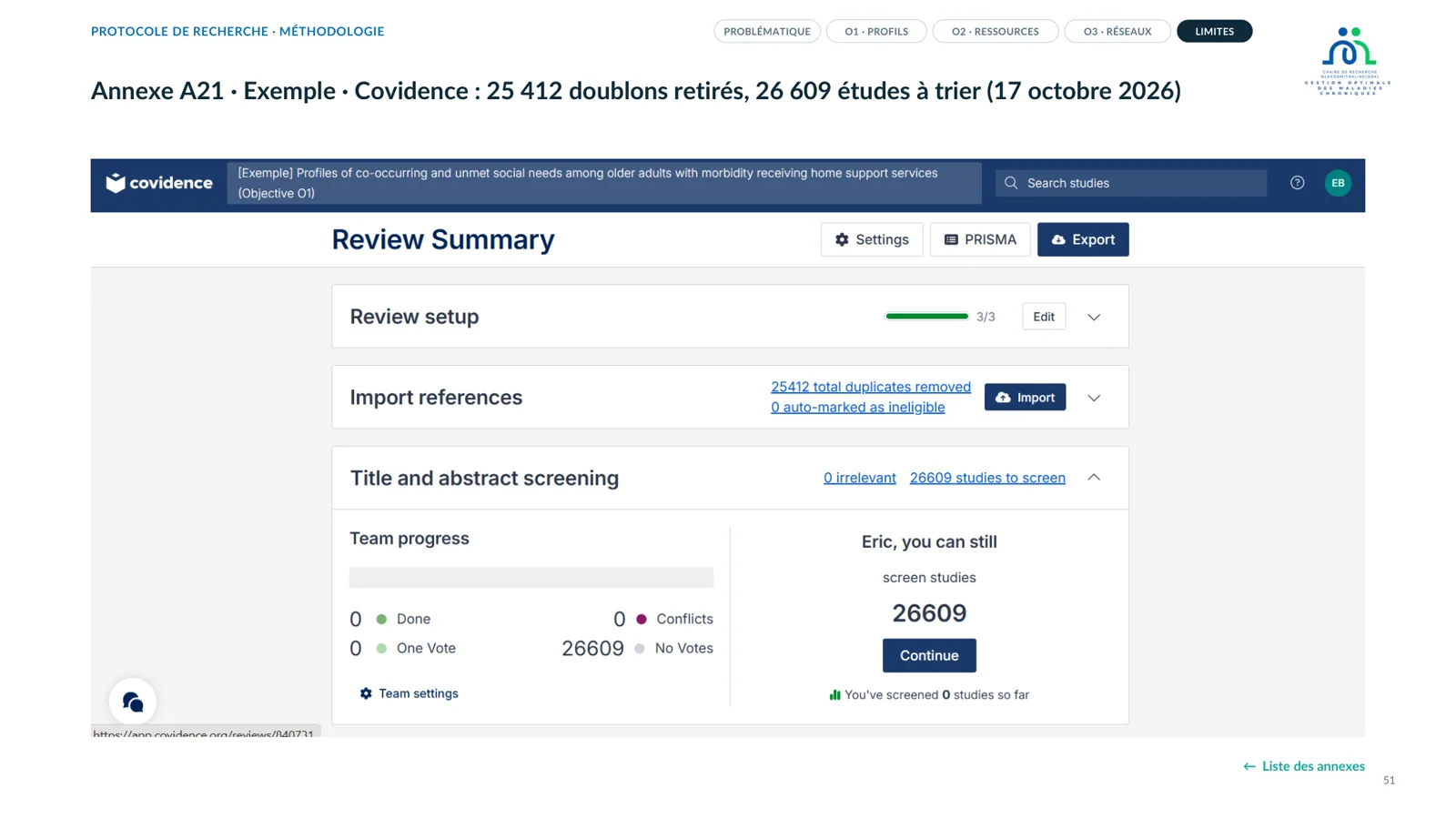
Cribado en curso en Covidence: 52 021 registros importados, 25 412 duplicados retirados, 26 609 estudios por cribar. Captura de pantalla: Covidence, revisión de alcance O1 de Eric Bernier, octubre de 2026.
O2 Respuestas disponibles
Diseño
Cuantitativo observacional ecológico, con datos secundarios.
Población
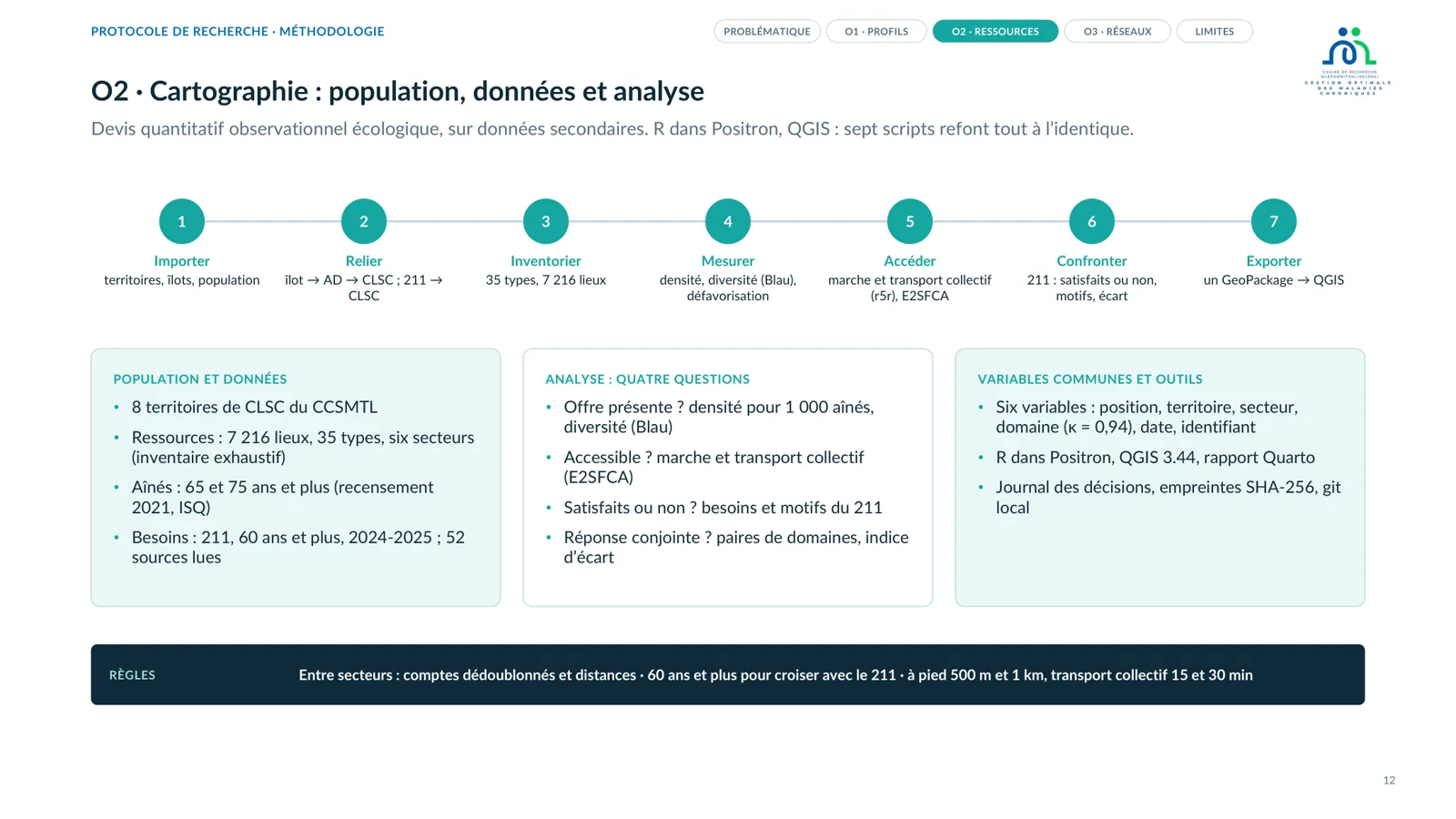
Los 8 territorios de CLSC del CCSMTL; todos los recursos de los seis sectores (7 216 lugares, 35 tipos); personas mayores de 65 y de 75 años y más (censo de 2021, ISQ); necesidades en el 211 de personas de 60 años y más (2024-2025).
Muestreo
Inventario exhaustivo, sin muestra; 52 fuentes inscritas en el registro.
Recogida
Seis variables comunes (posición, territorio, sector, ámbito de necesidad, fecha de la fuente, identificador construido); doble codificación, κ = 0,94.
Medidas
Densidad por 1 000 personas mayores; acceso a pie (500 m, 1 km) y en transporte público (15 y 30 min, E2SFCA); necesidades satisfechas o no (211); respuesta conjunta a dos ámbitos.
Análisis
R en Positron, mapas QGIS; índice de brecha (oferta ausente, inaccesible, saturada, no admisible); agrupaciones espaciales (I de Moran local). Los ejemplos son por ámbito de necesidad (14 categorías AIRS del 211), a la espera de O1.
Producto
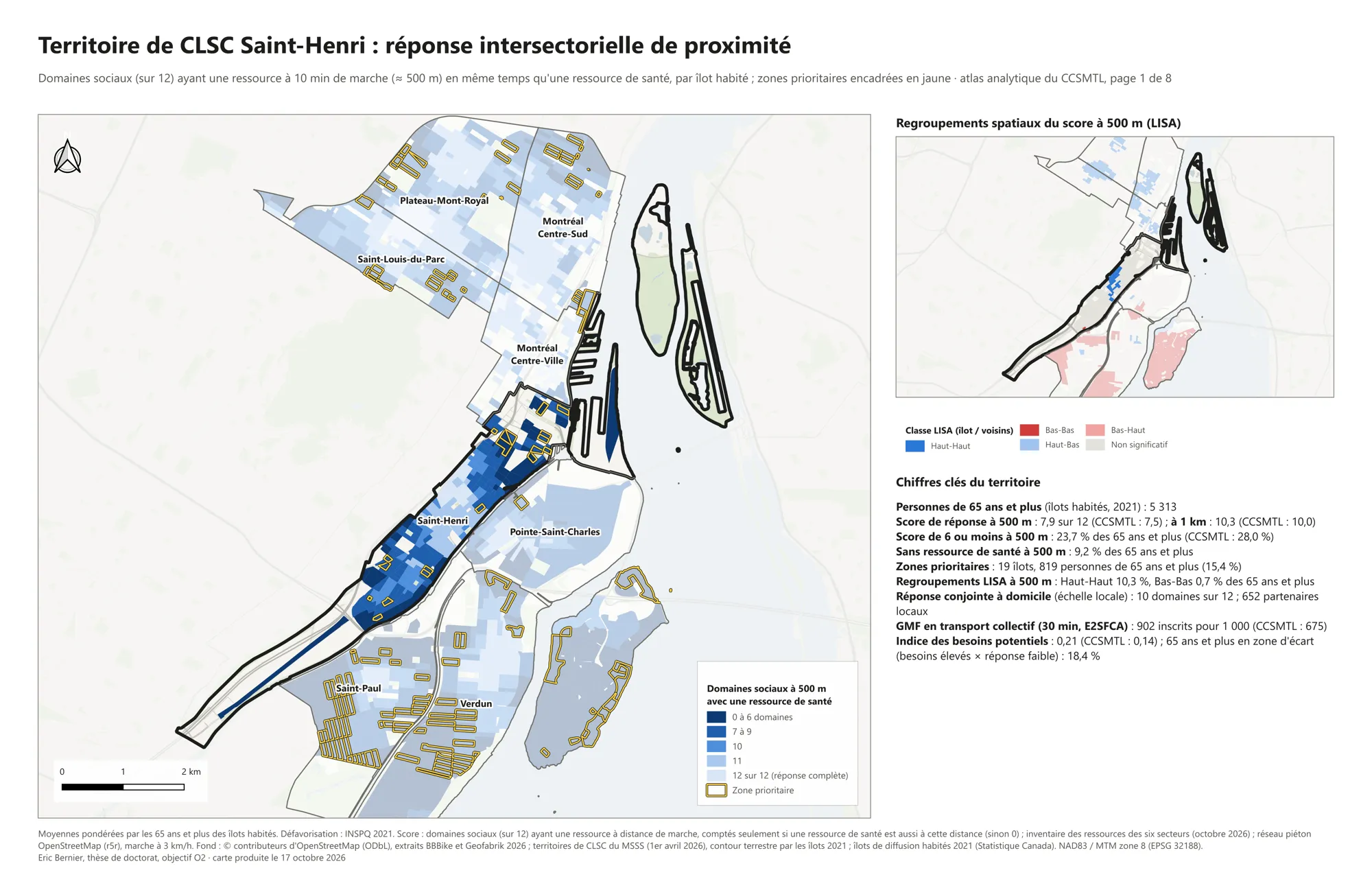
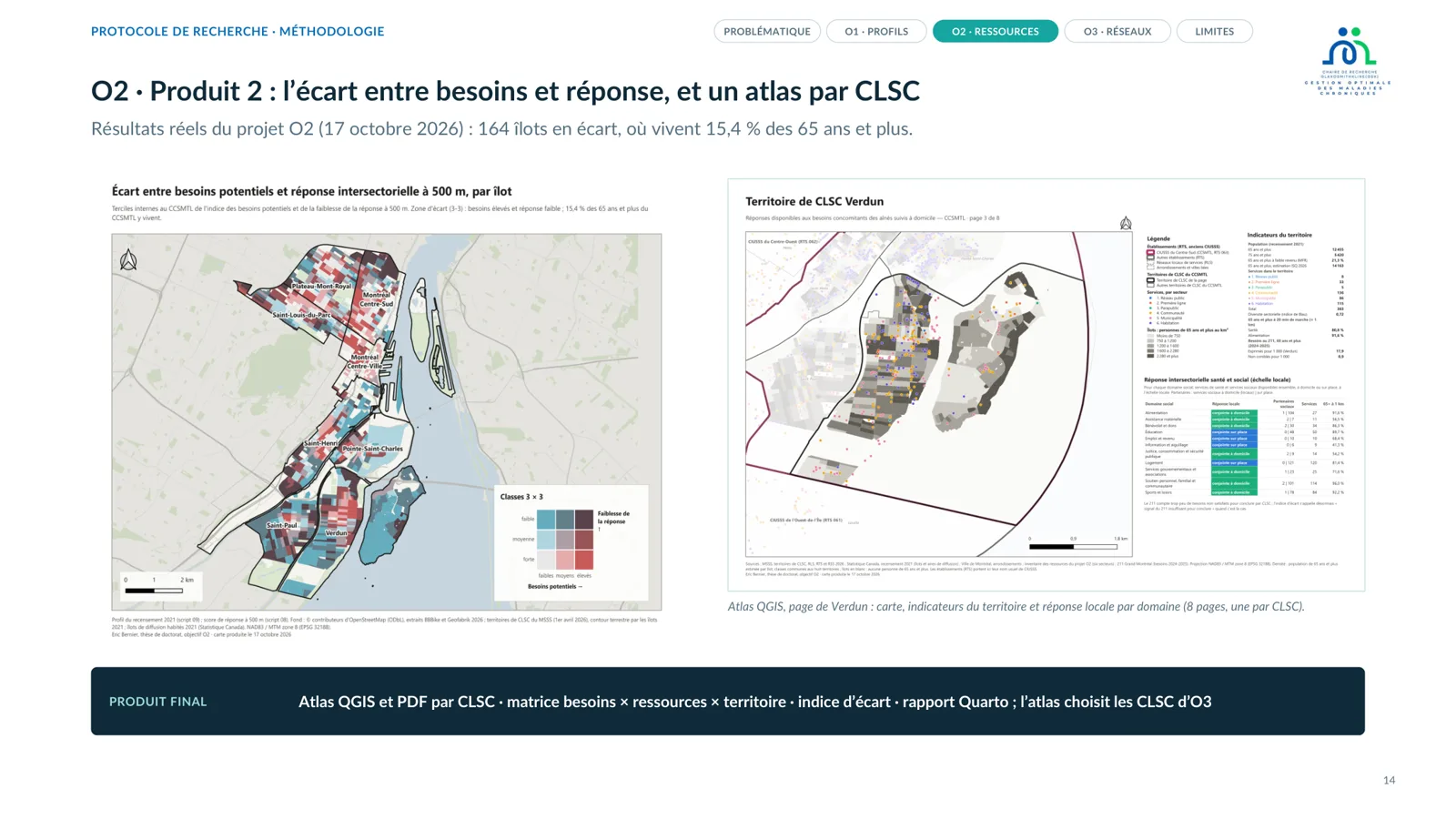
Atlas por CLSC, matriz necesidades × recursos × territorio, índice de brecha. Ejemplo: 164 manzanas con brecha, donde vive el 15,4 % de las personas de 65 años y más.
¿Por qué la cartografía?
Porque la política de 2026 convierte el territorio de CLSC en la unidad de referencia: la respuesta debe juzgarse donde vive la gente. El mapa sitúa las necesidades satisfechas o no frente a los recursos de los seis sectores, mide la accesibilidad a pie y en transporte público (E2SFCA) y distingue una oferta ausente, inaccesible o saturada. También elige, de forma transparente, los 3 o 4 CLSC contrastados de O3. R en Positron y QGIS permiten recalcular cada indicador.
Atlas analítico · Saint-HenriLos scripts R numerados del proyecto de cartografía, ejecutados en Positron: cada indicador se recalcula al actualizar las fuentes. Captura de pantalla: Positron, proyecto Cartografía O2 de Eric Bernier, octubre de 2026.La maquetación del atlas por territorio de CLSC en QGIS. Captura de pantalla: QGIS 3.44, proyecto Cartografía O2 de Eric Bernier, octubre de 2026.
O3 Red capaz de responder
Diseño
Mixto secuencial explicativo (CUAN → cual), análisis de redes egocéntricas.
Población
Equipos de atención domiciliaria del CIUSSS (egos) y organizaciones asociadas.
Muestreo
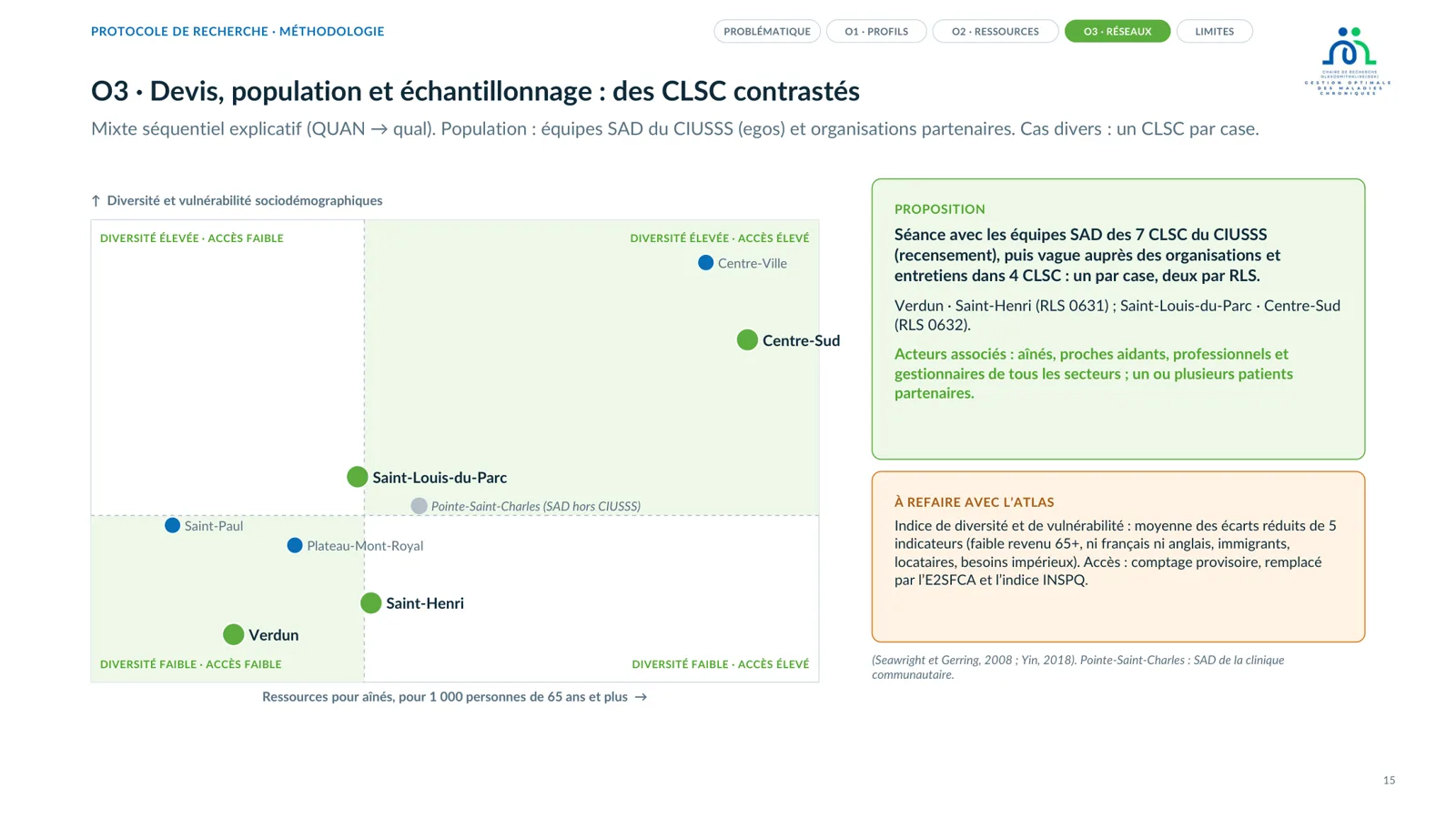
Intencional, casos diversos. 3 o 4 CLSC contrastados según la diversidad sociodemográfica y el acceso (propuestos: Verdun, Saint-Henri, Saint-Louis-du-Parc, Centre-Sud; Pointe-Saint-Charles excluido, porque su atención domiciliaria depende de una clínica comunitaria). Varios informantes por equipo; 8 a 10 entrevistas por CLSC, elegidas según la posición en la red.
Recogida, componente CUAN
(1) Red egocéntrica de cada equipo, con un generador de nombres por viñeta de O1 («¿hacia qué organizaciones la derivaron, o con cuáles colaboraron, en los últimos 12 meses?»); para cada vínculo: sector, nivel de colaboración 1 a 4, frecuencia. (2) Cuestionario a las organizaciones nombradas, para situar los vínculos de los últimos 12 meses; se busca un 70 % de respuesta.
Recogida, componente cual
(3) Reconstruir el recorrido de cada perfil mediante entrevistas centradas en el mapa de la red.
Análisis
Tamaño, diversidad de sectores (Blau), proporción de vínculos de nivel 3 o 4, agujeros estructurales; análisis temático, con doble codificación de una parte de las entrevistas.
Integración
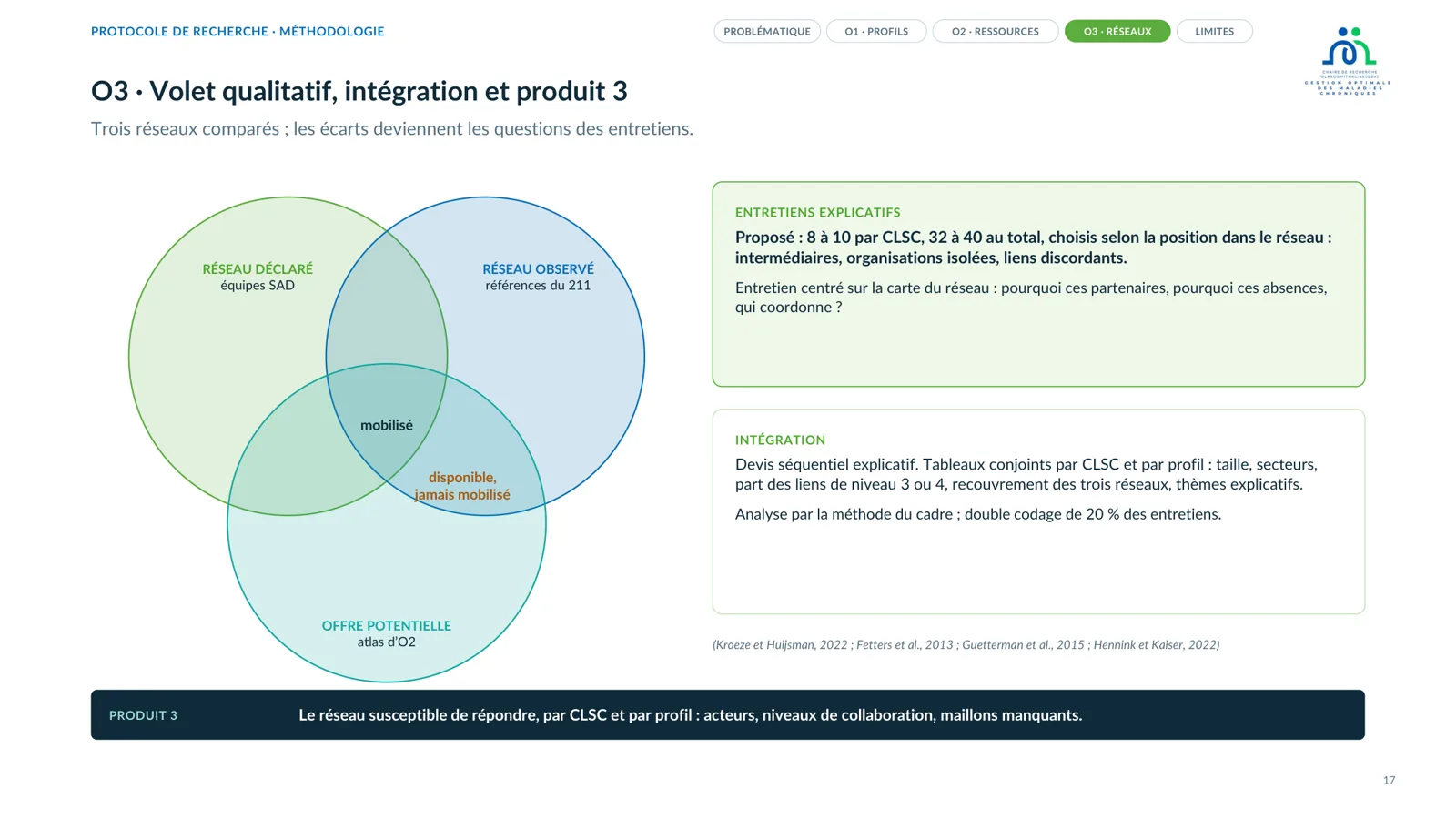
Tras el componente CUAN, las diferencias entre la red declarada, las derivaciones del 211 y la oferta del atlas se convierten en las preguntas de las entrevistas; tablas conjuntas por CLSC y por perfil.
Participación de los actores de terreno
El SNA da la palabra a los actores de terreno: los equipos SAD, las organizaciones de todos los sectores y sus gestores describen sus vínculos. Las entrevistas incluyen también a personas mayores, cuidadores y pacientes colaboradores, y los resultados se les presentan para su validación.
Producto
La red por CLSC y por perfil, con los eslabones que faltan. Ejemplo publicado: Urbanoski et al., 2018 (doi:10.1371/journal.pone.0206671).
¿Por qué el análisis de redes (SNA)?
Un recurso disponible en el mapa no siempre se moviliza. Solo el análisis de redes muestra quién trabaja realmente con el equipo de atención domiciliaria, con qué nivel de colaboración y dónde faltan eslabones. Ejemplos publicados: Contandriopoulos et al. (2016, Healthcare Policy) cartografiaron las colaboraciones entre organizaciones canadienses de prevención de enfermedades crónicas; Richter et al. (2026, BMC Health Services Research) analizaron con una red egocéntrica la coordinación de la promoción de la salud en municipios; Lemieux-Charles et al. (2005, The Gerontologist) estudiaron las redes comunitarias de atención a la demencia en Ontario.
El diseño del componente de redes
Red egocéntrica: el ego es el equipo de atención domiciliaria de cada CLSC. Para cada perfil (viñeta), un cuestionario pregunta a qué organizaciones derivó el equipo a una persona mayor, o con cuáles colaboró, en los últimos 12 meses, con el sector, el nivel de colaboración (1 a 4), la frecuencia y el plazo. El análisis SNA (tamaño, diversidad, proporción de vínculos de nivel 3 o 4) se contextualiza después con entrevistas a los actores, que reconstruyen el recorrido de cada perfil: quién interviene, en qué orden y dónde se rompe.
Esquema de principio de la tesis
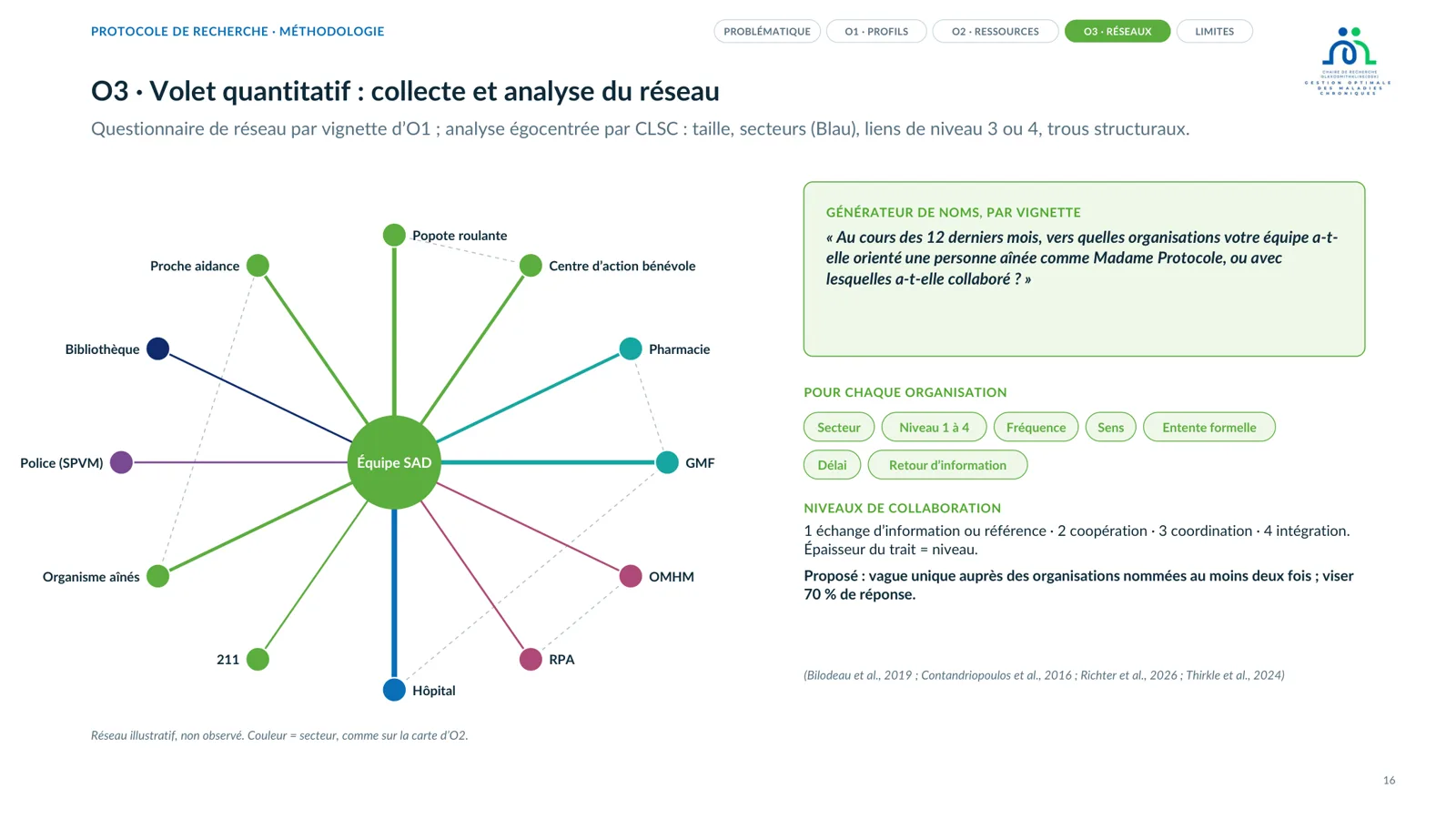
La red egocéntrica del equipo de SAD
En mi tesis, el análisis de redes parte del equipo de apoyo a domicilio de cada CLSC. Para cada viñeta, el equipo nombra las organizaciones a las que ha derivado a una persona mayor, o con las que ha colaborado, en los últimos 12 meses; el grosor del trazo indica el nivel de colaboración, de 1 a 4. Esta red declarada se compara con las derivaciones del 211 y con la oferta del atlas, y luego se explica en entrevistas. Red ilustrativa, no observada.
Limitaciones y salvaguardas
Una solicitud al 211 no es una persona : se analizan las necesidades reunidas en una misma solicitud.
El 211 publica por distrito : Verdun corresponde exactamente a su CLSC y se solicita el código postal.
Los directorios están incompletos : primero las fuentes oficiales, completitud medida.
Las redes declaradas dependen de la memoria : varios informantes y comparación con el 211 y el atlas.
3 o 4 casos no permiten inferencia estadística : comparación de casos, explicada por las entrevistas.
La oferta (octubre de 2026) y las necesidades (2024-2025) no son del mismo año : se muestra la diferencia.
04Viabilidad
Viabilidad
Una tesis es viable cuando se cumplen tres condiciones: los datos existen y son accesibles, los métodos están dominados y el calendario deja tiempo para aplicarlos. En este proyecto, las dos primeras ya se cumplen; el calendario, presentado al final, sitúa el trabajo realizado y el que queda por hacer.
La viabilidad está asegurada
Los datos son accesiblesSe cuenta con el acuerdo del 211; todo lo demás es público y está en línea.
O2 ya cuenta con las herramientasLos datos, la codificación y los programas (R en Positron, QGIS) están listos; ya se han producido mapas.
Una sola incertidumbre, ya previstaEl censo de 2026; en su defecto, el de 2021.
Una revisión consolidadaLa extracción se rehace con una bibliotecaria y varios evaluadores.
Un terreno que se abreSe está conversando una alianza con el CIUSSS du Centre-Sud para el análisis de redes.
1Los datos: ya disponibles o en línea
La tesis no se apoya en ninguna base de datos individuales de la red de salud. Trabaja con perfiles, a partir de fuentes públicas o agregadas, y con una recolección propia para el objetivo 3. Cada fuente tiene un estado conocido.
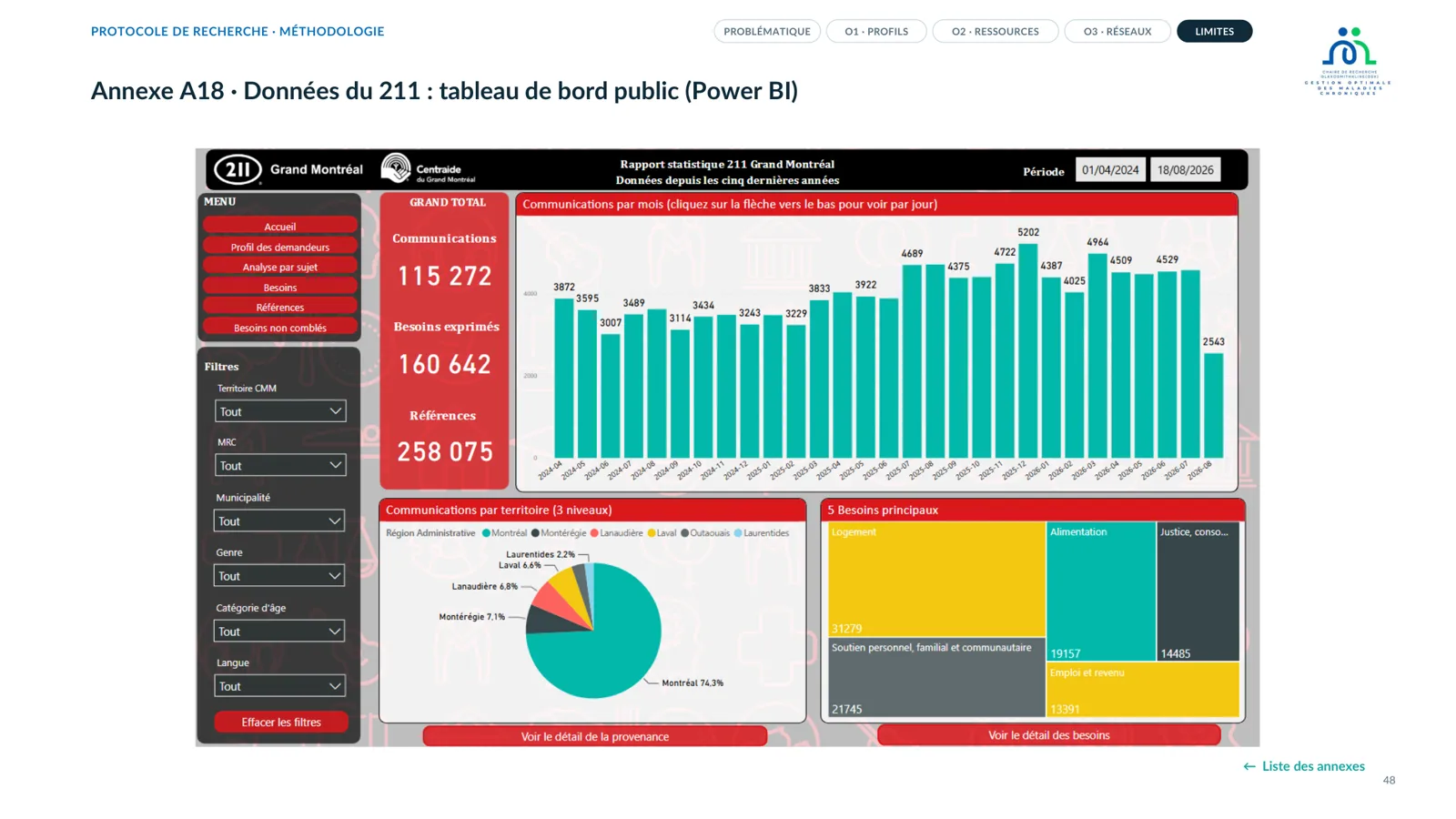
AcuerdoEl 211. Se cuenta con el acuerdo del 211. Sus datos son más completos en la Communauté métropolitaine de Montréal (CMM), donde el 211 Grand Montréal cubre Montréal y las regiones vecinas: de 2024 a 2026, su tablero público registra 115 272 comunicaciones, de las cuales el 74,3 % proceden de Montréal (211 Grand Montréal, 2026).
HechoLa literatura de la revisión O1. Cuatro bases consultadas el 17 de octubre de 2026 (MEDLINE, Embase, APA PsycInfo, PubMed): 60 957 registros, 26 609 estudios por cribar tras la eliminación de duplicados (Bernier, 2026).
HechoEl inventario de recursos de O2. 7 216 lugares de servicio de 35 tipos, en los seis sectores, georreferenciados en los 8 territorios de CLSC, a partir de 52 fuentes; doble codificación, con un acuerdo κ = 0,94 (Bernier, 2026).
En líneaPoblación y territorios. Censo de 2021, delimitaciones de los territorios de CLSC y directorios públicos de los seis sectores (Statistique Canada, 2022).
IncertidumbreEl censo de 2026. Se difundirá en 2027; véase la sección siguiente.
Por recopilarLa red de O3. Cuestionarios y entrevistas con los equipos SAD y sus socios, tras la aprobación ética.
La revisión de alcance, rehecha con varios evaluadores
La búsqueda documental ha concluido: los registros se han depurado de duplicados en Covidence. Para dar solidez a la revisión, la extracción realizada con la bibliotecaria se rehará con varios evaluadores. Cada estudio será cribado por dos personas independientes, primero por título y resumen y luego por texto completo, tras una prueba piloto con 25 registros; los datos se extraerán por duplicado (Bernier, 2026).
Este procedimiento sigue las normas de las revisiones de alcance: la guía del JBI para su conducción (Peters et al., 2020) y PRISMA-ScR para el informe (Tricco et al., 2018). Dos miradas independientes reducen el riesgo de descartar un estudio por error.
De los registros a los estudios por cribar, 17 de octubre de 2026 (Bernier, 2026).
Covidence, revisión de alcance O1: 25 412 duplicados eliminados, 26 609 estudios por cribar (Bernier, 2026).
El 211: solicitudes reales, fuera de la red pública
El 211 recibe las solicitudes de ayuda de las personas, de sus allegados y de los profesionales. Su tablero público ya describe, por distrito, las necesidades expresadas, las necesidades no cubiertas y sus motivos. Para las personas de 70 años y más del territorio, registra cerca de 3 700 solicitudes de 2021 a 2026, y 691 necesidades no cubiertas entre las de 60 años y más, todas con un motivo codificado (Bernier, 2026).
El acuerdo del 211 da acceso a una extracción más detallada. Como sus datos son más completos en la CMM, el acceso se facilita y la comparación con la red declarada por los equipos SAD, en O3, resulta más precisa.
Tablero público del 211 Grand Montréal, utilizado para O1 y O2 (211 Grand Montréal, 2026).
O2: datos, codificación y programas ya listos
Para el objetivo 2, el trabajo más largo ya está hecho. Siete scripts de R, ejecutados en Positron, importan los territorios, asocian cada manzana a su CLSC, inventarían los recursos, miden el acceso a pie y en transporte colectivo, y luego exportan las capas a QGIS. Cada decisión se anota en un diario y cada archivo leído recibe una huella: todo se recalcula de forma idéntica (Bernier, 2026).
A la espera de los perfiles de O1, los ejemplos se elaboran por ámbito de necesidad. La cartografía se rehará por perfil, con los mismos scripts.
7 216lugares de servicio georreferenciados
52fuentes inscritas en el registro
κ = 0,94acuerdo de la doble codificación
8páginas de atlas, una por CLSC
La cadena de procesamiento de O2, de la importación al atlas (Bernier, 2026).
Un primer resultado, ya medible
Los ejemplos de O2 ya dan un orden de magnitud: 164 manzanas presentan una brecha entre las necesidades potenciales y la respuesta de proximidad, y en ellas vive el 15,4 % de las personas de 65 años y más (Bernier, 2026). Esta cifra se recalculará por perfil; muestra que el método funciona con los datos reales del territorio.
Atlas QGIS, página de Verdun: 164 manzanas con brecha, 15,4 % de las personas de 65 años y más (Bernier, 2026).
2La única incertidumbre: el censo
Para O2, el proyecto depende de una sola fuente externa: el censo, que aporta el número de personas mayores por manzana y sus condiciones de vida. El de 2026 se difundirá por etapas, de febrero a diciembre de 2027: la población en febrero, la edad en mayo, los hogares y los ingresos en julio, el estado de salud general en octubre (Statistique Canada, 2026).
Difusiones del censo de 2026; en verde, las que O2 necesita en primer lugar (Statistique Canada, 2026).
La regla de decisión es sencilla. Si el análisis de O2 puede esperar al verano de 2027, se utilizará el censo de 2026. De lo contrario, se recurrirá al censo de 2021, ya disponible, complementado con las proyecciones demográficas de 2026 por territorio de CLSC (Bernier, 2026). En ambos casos se respeta el calendario de la tesis: la incertidumbre modifica la actualidad de los denominadores, no la viabilidad.
3O3 sobre el terreno
El tercer objetivo es el único que exige una recolección nueva. Se desarrolla a lo largo de 12 meses, en dos tiempos: primero un análisis de redes egocéntricas, que cartografía la red, y luego entrevistas que explican las interacciones observadas. Se trata de un diseño mixto secuencial explicativo: las cifras de la red plantean las preguntas y las entrevistas las responden (Creswell y Plano Clark, 2017; Fetters et al., 2013).
Cuestionario de redCada equipo SAD (el «ego») nombra, para cada viñeta de O1, las organizaciones con las que ha trabajado durante los últimos 12 meses.Sector, nivel de colaboración de 1 a 4, frecuencia.
Cartografía de la redSe invita a su vez a las organizaciones nombradas y se dibuja la red de cada CLSC.Tamaño, diversidad de sectores, proporción de vínculos de nivel 3 o 4.
EntrevistasEntrevistas centradas en el mapa de la red: ¿por qué estos socios?, ¿por qué estas ausencias?, ¿quién coordina?8 a 10 por CLSC (Bernier, 2026).
Comprensión de las interaccionesLa red declarada se confronta con las derivaciones del 211 y con el atlas de O2.Cuadros conjuntos por CLSC y por perfil.
El generador de nombres
La pregunta planteada a los equipos parte de una persona ficticia, construida a partir de los perfiles de O1: ¿hacia qué organizaciones la orientó, o con cuáles colaboró, durante los últimos 12 meses? Para cada vínculo, el cuestionario registra el nivel de colaboración, desde el intercambio de información (1) hasta la integración (4) (Bilodeau et al., 2019).
El uso de una viñeta protege la privacidad: no se describe a ninguna persona real, y todos los equipos responden a la misma situación.
Componente cuantitativo de O3: una red ilustrativa, no observada (Bernier, 2026).
Meta del 80 % de respuestas
El proyecto apunta a un 80 % de respuestas, en al menos dos CLSC contrastados. El umbral es alto porque una red es sensible a las ausencias: una organización que no responde hace desaparecer sus propios vínculos, y la red parece más pobre de lo que es. Para alcanzarlo, se solicita a varios informantes por equipo y se realizan recordatorios por sector (Bernier, 2026). La tasa del 80 % es una meta de planificación; se hará seguimiento del reclutamiento y de la no respuesta.
Meta de planificación para el componente de red de O3.
¿Por qué varios CLSC, y contrastados?
Con un solo CLSC no se puede saber si una red densa se debe al territorio (una población más favorecida, muchos recursos cercanos) o a la forma en que se organiza el equipo. Al comparar territorios que difieren en desventaja social, densidad de recursos y grado de urbanidad, se distingue lo que depende del territorio de lo que depende de la organización. Es la lógica de los casos diversos: elegir casos que cubran la variación, para que la comparación sea instructiva y los resultados transferibles (Seawright y Gerring, 2008; Yin, 2018).
Un mismo territorio, realidades muy distintas (Statistique Canada, 2022; compilación por territorio de CLSC: Bernier, 2026).
Contrastes reales en el territorio
Los 8 territorios de CLSC del CIUSSS son muy desiguales. La proporción de personas de 65 años y más con bajos ingresos casi se duplica, del 21,3 % en Verdun al 41,8 % en Pointe-Saint-Charles. Centre-Sud tiene la mayor proporción de inquilinos (74,2 %) y de necesidades apremiantes de vivienda (11,7 %); Verdun, el mayor número de personas mayores (12 535) (Statistique Canada, 2022; Bernier, 2026).
La propuesta actual retiene Verdun, Saint-Henri, Saint-Louis-du-Parc y Centre-Sud, dos por red local de servicios. Pointe-Saint-Charles queda excluido, pues su SAD depende de una clínica comunitaria. La elección definitiva se rehará con el atlas de O2 (Bernier, 2026).
La alianza con el CIUSSS du Centre-Sud
Para el análisis de redes, se está conversando una alianza con el CIUSSS du Centre-Sud, pues la institución tiene intereses en el tema. La Política de primera línea, por lo demás, convierte el territorio de CLSC en la unidad de referencia y señala que la oferta «sigue siendo a menudo desconocida» (Ministère de la Santé et des Services sociaux [MSSS], 2026, p. 25).
El análisis de redes con el Centre-Sud aporta lo que los datos por sí solos no dicen: una contextualización y una comprensión de los mecanismos de las respuestas posibles y de por qué se organizan actualmente así. Combinado con los datos del 211, más completos en la CMM, permite comparar con precisión la red declarada, la red observada y la oferta cartografiada.
Tres redes comparadas; sus diferencias se convierten en las preguntas de las entrevistas (Bernier, 2026).
4Asociar al terreno
Los actores del terreno participan en cada fase, y no solo como informantes. El análisis de redes les da la palabra: son los equipos y sus socios quienes describen los vínculos que existen y los que faltan. Los resultados se les presentan para su validación antes de ser publicados.
Personas mayoresDicen qué es lo importante y en qué orden se presentan sus necesidades.
Personas cuidadorasAportan gran parte del apoyo y conocen los rodeos del recorrido.
Pacientes colaboradoresSe reclutará a uno o varios pacientes colaboradores para acompañar el proyecto, de la viñeta a la interpretación.
Atención primariaMédicos y enfermeras de los GMF, farmacéuticos, trabajadores sociales, terapeutas ocupacionales y otros profesionales del SAD.
Organización comunitariaOrganizadores comunitarios del CIUSSS, facilitadores y mesas de concertación, incluidas las de personas mayores.
Organismos comunitarios y voluntariadoCentros de acción voluntaria, comidas a domicilio, bancos de alimentos, organismos de personas mayores y de cuidadores (respiro, centros de día).
Municipio y viviendaCargos electos y servicios municipales, OMHM y vivienda social, residencias privadas para mayores, transporte adaptado, bibliotecas, ocio.
Educación y primera infanciaEscuelas y centros de la primera infancia (CPE), que pueden ayudar o hacer de enlace, sobre todo con familias que también cuidan.
Seguridad y justiciaAgentes sociocomunitarios del SPVM, asistencia jurídica, lucha contra el maltrato.
Salud pública y responsablesDRSP, dirección SAPA del CIUSSS, MSSS, comité de enlace intersectorial de la AIPPA.
El 211 y las líneas de informaciónLos consejeros de derivación, que orientan las solicitudes de ayuda hacia los recursos.
Sector privado y economía socialFarmacias, empresas de economía social de ayuda a domicilio (EÉSAD), comercios de proximidad.
Comunidades culturales y religiosasLugares de culto y asociaciones de personas inmigrantes, a menudo el primer apoyo de las personas mayores aisladas.
GestoresDeciden la organización de los servicios y los acuerdos entre socios.
Investigadores y universidadesEl RUISSS de la Universidad de Montreal y los equipos de investigación del territorio.
Esta lista no está cerrada: con su enfoque inductivo, el análisis de redes podrá revelar otros actores y sectores, incluidos privados, que nadie había previsto.
CLSC elegidos con el terreno
La elección de los CLSC de O3 se presentará a los equipos SAD antes de la recolección: una sesión con los equipos de los 7 CLSC del CIUSSS, luego una ronda con las organizaciones y entrevistas en los CLSC seleccionados (Bernier, 2026). Las viñetas de O1, el atlas de O2 y el mapa de la red de O3 son otros tantos apoyos de discusión comprensibles para todos.
Antes de toda recolección, el proyecto obtendrá la aprobación de un comité de ética de la investigación y precisará el consentimiento, la protección de los datos y la difusión (Conseil de recherches en sciences humaines et al., 2022).
La elección de los CLSC contrastados, que se rehará con el atlas de O2 (Bernier, 2026; Seawright y Gerring, 2008).
5Calendario a 4 años
El doctorado está planificado en 16 trimestres, de abril de 2025 a marzo de 2029. Tras año y medio, los cursos y la preparación del protocolo concluyen, la búsqueda documental de O1 ha terminado y se han producido los primeros mapas de O2. La parte clara de cada barra indica lo que queda por hacer; la parte llena, lo que ya está hecho.
20252026202720282029
T2T3T4T1T2T3T4T1T2T3T4T1T2T3T4T1
Formación
Cursos, examen de síntesis y protocolopresentación el 27 oct. 2026
Éticaaprobación antes de toda recolección
O1 · Perfiles
Revisión de alcanceextracción rehecha entre varios
Análisis de las solicitudes al 211
O2 · Recursos
Cartografíaejemplos hechos, se rehará por perfil
Censo de 2026incertidumbre: difusión de feb. a dic. 2027
O3 · Redes (12 meses)
Recolección de la red egocéntricacuestionarios, cartografía
Entrevistascomprensión de las interacciones
Conjunto
Asociación del terrenoalianza, pacientes colaboradores
Análisis e integración O1-O2-O3
Redacción y depósitoartículos y luego tesis
Transferencia de conocimientosequipos, socios, público
Hoy · oct. 2026
hecho
por hacer
incertidumbre externa
hito
hoy
El orden sigue el diseño: O1 aporta las viñetas, O2 elige los CLSC y luego O3 se desarrolla a lo largo de 12 meses, del tercer trimestre de 2027 al segundo trimestre de 2028. Esta recolección única se alinea con el componente 2 del RUISSS, previsto para 2027-2028 (Bernier, 2026). El censo de 2026 no alarga el calendario: si sus datos llegan demasiado tarde para O2, el de 2021 toma el relevo.
En resumen, la viabilidad está asegurada porque los datos son accesibles: se cuenta con el acuerdo del 211 y el resto está en línea. Para O2, ya se dispone de los datos, la codificación y el dominio de los programas; solo se depende del censo, y se recurriría al de 2021 si fuera necesario. La extracción de la revisión, realizada con una bibliotecaria, se rehará con varios evaluadores. Para el análisis de redes, se está conversando una alianza con el Centre-Sud: aporta una contextualización y una comprensión de los mecanismos de las respuestas posibles y de por qué se organizan actualmente así.
211 Grand Montréal. (2026). Rapport statistique 211 Grand Montréal [Tablero de Power BI]. Consultado el 16 de octubre de 2026.
Bernier, E. (2026, 27 de octubre). Organiser la réponse intersectorielle aux besoins sociaux concomitants, satisfaits ou non, des personnes aînées vivant à domicile : profils, ressources et réseaux autour du soutien à domicile des CLSC [Presentación del protocolo de investigación]. École de santé publique, Université de Montréal.
Bilodeau, A., Parent, A.-A. y Potvin, L. (2019). Les collaborations intersectorielles et l’action en partenariat, comment ça marche ? Chaire de recherche du Canada CACIS.
Conseil de recherches en sciences humaines, Conseil de recherches en sciences naturelles et en génie et Instituts de recherche en santé du Canada. (2022). Énoncé de politique des trois conseils : Éthique de la recherche avec des êtres humains (EPTC 2). https://ethics.gc.ca/fra/policy-politique_tcps2-eptc2_2022.html
Creswell, J. W. y Plano Clark, V. L. (2017). Designing and conducting mixed methods research (3.a ed.). SAGE.
Fetters, M. D., Curry, L. A. y Creswell, J. W. (2013). Achieving integration in mixed methods designs: Principles and practices. Health Services Research, 48(6 Pt 2), 2134-2156.
Ministère de la Santé et des Services sociaux. (2026). Politique gouvernementale sur les soins et services de première ligne. Gouvernement du Québec.
Peters, M. D. J., Godfrey, C., McInerney, P., Munn, Z., Tricco, A. C. y Khalil, H. (2020). Chapter 11: Scoping reviews. En E. Aromataris y Z. Munn (Eds.), JBI Manual for Evidence Synthesis. JBI.
Seawright, J. y Gerring, J. (2008). Case selection techniques in case study research: A menu of qualitative and quantitative options. Political Research Quarterly, 61(2), 294-308.
Statistique Canada. (2022). Recensement de la population de 2021 [Tablas de datos por área de difusión]. Gouvernement du Canada.
Statistique Canada. (2026). Calendrier de diffusion du Recensement de la population de 2026 (GR-419-26). Gouvernement du Canada.
Tricco, A. C., Lillie, E., Zarin, W., O’Brien, K. K., Colquhoun, H., Levac, D. et al. (2018). PRISMA extension for scoping reviews (PRISMA-ScR): Checklist and explanation. Annals of Internal Medicine, 169(7), 467-473.
Yin, R. K. (2018). Case study research and applications: Design and methods (6.a ed.). SAGE.
05Repercusiones
Repercusiones
Las producciones siguientes son previstas. No se presentan como resultados observados ni como prueba de la eficacia de una intervención.
Productos previstos
P1 · Tipología y viñetas
Perfiles de necesidades sociales concurrentes, traducidos en viñetas reutilizadas en O2 y en O3.
P2 · Atlas e índice de brecha
Un atlas por territorio de CLSC, una matriz necesidades × recursos × territorio y un índice de brecha entre necesidades y oferta.
P3 · Modelos de trayectorias
Quién interviene, en qué orden, con qué nivel de colaboración y qué eslabones faltan, por perfil y por CLSC.
Repercusiones previstas
Para las personas : una respuesta ajustada a su combinación de necesidades.
Para los equipos de SAD y sus socios : puntos de referencia sobre a quién movilizar, en qué orden y con qué nivel de colaboración, y sobre los corredores que se han de crear.
Para el CIUSSS y la política de primera línea : puntos de referencia por territorio de CLSC, transmitidos al comité de enlace intersectorial de la AIPPA y al componente 2 del RUISSS (2027-2028).
Para la investigación : una cadena reproducible de los perfiles a los recursos y las redes, que se recalcula al actualizarse las fuentes.
¿Para quién?
Las personas mayores y sus cuidadores: una respuesta ajustada a su combinación de necesidades. Aliviar a los cuidadores forma parte de la respuesta, en particular mediante los servicios de respiro y los centros de día (Vandepitte et al., 2016).
Los profesionales de la salud, de los servicios sociales y del sector comunitario: saber de antemano a quién movilizar, para qué perfil, en su territorio.
Todos los sectores: municipal, administrativo, escolar, vivienda, transporte. Los centros de la primera infancia (CPE), las guarderías y las escuelas también pueden ayudar, por ejemplo cuando un cuidador tiene hijos pequeños (Garon et al., 2014; Peters et al., 2021).
Los gestores y los responsables de decisiones: referencias por CLSC para planificar la respuesta y hacerla duradera.
06Transferencia e implementación
Transferencia e implementación
Construir puntos de referencia con los actores
Los modelos de trayectorias, los mapas y las explicaciones de las entrevistas se presentan a los equipos de SAD, al comité de enlace intersectorial de la AIPPA y al componente 2 del RUISSS (2027-2028).
Preparar las condiciones de implementación
Definir con los entornos los roles de coordinación, los socios implicados, los corredores que se han de crear, los recursos y los obstáculos. Las propuestas deben examinarse en cuanto a su pertinencia, su aceptabilidad y su viabilidad local.
Difundir y evaluar el uso
Un atlas por CLSC, síntesis por perfil, devoluciones y comunicaciones científicas apoyarán el intercambio de los resultados. Si se contempla una implementación, sus modalidades, indicadores y condiciones de seguimiento serán objeto de un proceso distinto.
Pacientes colaboradores
Se reclutarán uno o varios pacientes colaboradores, personas mayores o cuidadores con experiencia del SAD, para participar en el proyecto: redacción de las viñetas, lectura de los mapas, interpretación de las redes y difusión de los resultados.
Marco institucional y financiación
ProgramaDoctorado en salud pública, opción sistemas, organizaciones y políticas de salud (SOPS) · 2.º añoPresentación del doctorado
InstituciónEscuela de Salud Pública de la Université de Montréal (ESPUM)Sitio de la ESPUM
CátedraCátedra de investigación GSK en gestión óptima de enfermedades crónicasCátedra en LinkedIn
Centro de investigaciónCentro de investigación del CHUM (CRCHUM) · investigador en prácticasSitio del CRCHUM
Hospitalizaciones evitablesExperiencia del pacienteAtención primaria
Epistemología y transferencia de conocimientos
Redactado · Trabajo suspendido
Epistemic return in public health governance: The road back from health to science
Bernier, É.
El impacto de la investigación suele pensarse en un solo sentido, del conocimiento hacia las políticas y las prácticas. El artículo propone una salud pública concebida como ciencia reflexiva de la gobernanza: precisa en qué condiciones las consecuencias observadas en el terreno y los saberes de las poblaciones afectadas pueden exigir que se reexaminen las categorías, los indicadores y las reglas de origen. El concepto se traduce en una auditoría documental, puesta a prueba en cuatro cadenas institucionales.
Retorno epistémicoGobernanza reflexivaImpacto de la investigación
Gobernanza y espacio público
Manuscrito en preparación
Prise de parole des médecins dans l’espace public québécois lors des débats entourant le projet de loi n° 2 : une analyse qualitative du discours critique
Bernier, É., Aïssi, F., Diene Faye, C., Boukari Abdo, S.
Voz pública de los médicosDebate públicoPolíticas de salud
Derecho de la salud
Manuscrito en preparación
Vieillir chez soi à l’épreuve du droit : l’effectivité du choix du lieu de vie en droit français et en droit québécois
Bernier, É. · artículo de doctrina
Derecho sanitarioEnvejecer en casaElección del lugar de vida
Pósteres de congresos
Comunicaciones científicas3
Junio de 2026
Premio al mejor póster · doctorado y posdoctorado
Intégration des soins et services de proximité pour soutenir l’autonomie domiciliaire des personnes aînées : une étude qualitative comparative
Bernier, É., Sourial, N., Layani, G. · Groupe francophone en soins primaires (GFSP), Montreal · póster
Atención integradaEnvejecimiento en casaFrancia–Quebec
Mayo de 2026
Póster
Integrating Care and Services to Support Aging at Home: A Comparative Analysis of Institutional, Organizational, and Professional Mechanisms in France and Quebec
Bernier, É., Sourial, N., Layani, G. · CAHSPR, Ottawa
Atención integradaEnvejecimiento en casaFrancia–Quebec
Abril de 2026
Póster y 180 segundos
Intégration des soins et services de proximité pour soutenir l’autonomie domiciliaire des personnes aînées : une étude qualitative comparative
Bernier, É., Sourial, N., Layani, G. · Red quebequense de investigación sobre el envejecimiento (RQRV), Sherbrooke · póster y divulgación en 180 segundos
Atención integradaEnvejecimiento en casaFrancia–Quebec
Presentaciones orales
Por el momento no hay presentaciones orales registradas.
Memorias y tesis
Memorias defendidas ante un jurado3
2025
Vieillir chez soi : réalités et mise en œuvre du virage domiciliaire. Une étude comparée France / Québec
Máster en Derecho · Université Paris Panthéon-Assas · dirección: Benoît Apollis
Envejecer en casaPolíticas públicasDerecho comparado
2024
La prise en charge des personnes en situation de handicap vieillissantes : comment les établissements d’hébergement pour personnes âgées dépendantes peuvent-ils adapter leurs structures et services à leurs besoins spécifiques ?
Maestría en dirección de establecimientos de salud · Université de Bretagne Occidentale · dirección: Michelle-Hentic Giliberto
Discapacidad y envejecimientoAdaptación institucionalAcompañamiento
2023
Parcours de vie et autodétermination : l’influence des pratiques éducatives sur le parcours de vie des personnes en situation de handicap en institution d’hébergement
Diploma de Estado de educador especializado · Académie de Rennes
El proyecto doctoral está presentado en « Mi tesis ». Ver mi tesis →
01.4Postura de investigaciónPostura pragmática y mirada pluridisciplinar
01.4 · Postura de investigación
Postura de investigación
Una investigación situada, crítica y reflexiva
Mi postura investigadora aborda cómo se plantean los problemas, se construyen las categorías de análisis y se producen conocimientos abiertos a la discusión y la revisión. Articula una lectura relacional de las situaciones de salud, el examen de las instituciones y la reflexividad del investigador.
01Posicionamiento del investigador
Situar la mirada, explicitar las decisiones
Concibo a las personas como seres singulares, inscritos en relaciones, una historia y entornos sociales, materiales y vivos de los que dependen. Cada persona puede tener aspiraciones propias; las posibilidades de realizarlas también se construyen mediante condiciones de vida, recursos y relaciones. Esta tensión entre singularidad e interdependencia atraviesa mi comprensión de la salud.
Mi lugar como investigador está en ese mismo mundo. Mi trayectoria junto a personas con discapacidad, en derecho, gestión y salud pública orienta los problemas que advierto. Asumo esta posición como un punto de partida que examinar: hacer visibles mis decisiones, acoger la contradicción y permitir que la investigación desplace mis categorías.
La reflexividad consiste en examinar cómo la pregunta planteada, las categorías elegidas, los actores incluidos y las condiciones de la investigación orientan el conocimiento producido. Explicito estas decisiones, las interpretaciones alternativas y los límites de las conclusiones para que el razonamiento pueda discutirse.
02Conocimiento y verdad
Un conocimiento situado, argumentado y revisable
Distingo lo que la investigación permite observar, las interpretaciones propuestas y las finalidades que defiendo. La solidez del conocimiento requiere evidencias examinables, argumentos explícitos y discusión de desacuerdos. Construimos conceptos y medidas para estudiar realidades cuyas consecuencias afectan a vidas.
La pregunta decide el método: métodos mixtos integrados.
Postura pragmática
Una postura que articula una lectura positivista (medir, estimar, poner a prueba hipótesis) y una lectura constructivista (comprender el sentido que los actores dan a sus prácticas). La pregunta decide el método.
Pluridisciplinariedad
Salud pública, derecho, gestión, ciencia política e intervención social: miradas que dialogan para analizar un mismo sistema.
Investigar en lugar de fijar certezas
El pragmatismo de Dewey relaciona la investigación con los problemas encontrados y sus consecuencias.
Para mi investigación
Privilegio preguntas precisas, conocimientos discutibles y conclusiones revisables. La utilidad de un resultado también se juzga por lo que permite comprender y sus efectos en una situación.
Foucault interroga los procesos mediante los cuales las personas se convierten en objetos de conocimiento y en sujetos.
Para mi investigación
Cuestiono cómo defino una necesidad, una población o una situación compleja. Mis categorías deben confrontarse con las experiencias que describen y con aquello que vuelven menos visible.
Fricker analiza injusticias que afectan a la credibilidad de una palabra y a los recursos para comprender experiencias.
Para mi investigación
Tomo en serio las condiciones que permiten narrar, ser escuchado y contribuir a la interpretación. Participar implica influir en preguntas y conclusiones.
Interrogar lo que clasifica, organiza y hace visibles ciertas vidas
Las instituciones posibilitan protección, cooperación y acceso a recursos. Sus reglas y categorías también distribuyen posibilidades de acción. Mi postura examina concretamente estos efectos, sus justificaciones y las posibilidades de discutirlos.
Foucault · El poder en las relaciones
El poder actúa sobre las posibilidades de acción; va más allá de una orden impuesta desde arriba.
Para mi investigación
En los servicios, cuestiono reglas de acceso, clasificaciones y funciones profesionales: ¿qué permiten, quién puede discutirlas y qué márgenes de autodeterminación dejan?
Fassin relaciona el valor proclamado de la vida con el trato desigual de las existencias.
Para mi investigación
Examino cómo decisiones aparentemente ordinarias distribuyen atención, protección, tiempo y recursos. Una mejora media también debe discutirse según a quién alcanza y a quién deja lejos.
Las desigualdades pueden afectar a la posibilidad de ser reconocido como alguien que sabe.
Para mi investigación
Me interesa el lugar de pacientes, familiares y actores comunitarios al definir problemas. Hacer con las personas exige poder modificar el marco de discusión y expresar desacuerdo.
Apoyar la capacidad de actuar en condiciones reales
La autonomía adquiere sentido en situaciones concretas, con relaciones de apoyo y posibilidades realmente accesibles. Esta orientación prolonga mi experiencia de acompañamiento: reconocer aspiraciones, discutir restricciones y trabajar las condiciones que hacen practicable una elección.
Hegel · Reconocimiento y contradicciones
En Hegel, la autoconciencia se desarrolla en relaciones con otros, atravesadas por reconocimiento y conflicto.
Para mi investigación
Considero las tensiones entre protección y autonomía, reglas comunes y situaciones singulares como objetos de investigación. Comprender una organización exige seguir su historia, relaciones y transformaciones.
El existencialismo sartreano vincula la responsabilidad con las decisiones que construyen una existencia.
Para mi investigación
Retengo la exigencia de explicitar mis elecciones. En salud pública, la confronto con restricciones sociales y recursos disponibles, pensando una responsabilidad situada en lugar de atribuir las dificultades exclusivamente a individuos.
El enfoque de capacidades examina libertades reales para vivir las vidas que las personas tienen razones para valorar.
Para mi investigación
Examino lo que una persona puede hacer efectivamente: acceder a un servicio, comprender una decisión, participar y perseguir sus propias aspiraciones. Los recursos disponibles y sus condiciones de uso permiten analizar las diferencias entre derechos formales y posibilidades reales.
Transformar con las personas, atendiendo a las consecuencias
Mi investigación busca conocimientos que entren en la deliberación colectiva. Recomendaciones e innovaciones implican decisiones sociales: quién se beneficia, qué cargas crea el cambio y cómo las personas afectadas pueden discutir sus efectos.
Camus · La rebelión y la medida
Camus examina una rebelión que afirma una dignidad común y cuestiona los límites de la acción y sus justificaciones.
Para mi investigación
Quiero combinar el rechazo de la injusticia con la atención a quienes puede afectar la transformación. Una finalidad deseable exige también examinar los medios y sus consecuencias.
Dewey relaciona la formación de un público con las consecuencias compartidas de actividades y su tratamiento colectivo.
Para mi investigación
De ahí mi atención a los actores afectados, la deliberación y el retorno del terreno al conocimiento. Los resultados deben poder discutirse, contextualizarse y revisarse cuando sus consecuencias lo exijan.
Ricœur articula la aspiración a una vida realizada, la atención a otros y la justicia institucional.
Para mi investigación
Relaciono la calidad del acompañamiento con las condiciones organizativas y políticas que lo posibilitan. Mi responsabilidad abarca tanto a la persona encontrada como a los marcos colectivos que mis trabajos ayudan a esclarecer.
Estas obras abren preguntas y nutren conexiones. Sus autores sostienen posiciones diferentes: los pongo en diálogo para precisar mi responsabilidad, sin presentarlos como una doctrina unificada. Las propuestas en primera persona expresan esta orientación investigadora.
01.5Métodos de investigaciónAnálisis, herramientas y referencias metodológicas
01.5 · Métodos de investigación
Métodos de investigación utilizados
De la pregunta a la observación: cada pregunta requiere sus datos, su método de análisis y su interpretación. Elijo los métodos según lo que haya que esclarecer, cruzando disciplinas.
Diseñar un estudio, recoger datos y elegir una estrategia analítica son decisiones vinculadas a la pregunta de investigación. Las siguientes aproximaciones precisan sus posibilidades, exigencias y límites.
Métodos mixtos
Análisis cuantitativos y cualitativos integrados: análisis de redes, regresiones, análisis temático, análisis documental y cartografía, reunidos en tablas de integración.
Caja de herramientas
Análisis de datos
Positron (R)PythonNVivoQGISExcel
Colaboración y animación
MiroKlaxoonCanva
Ofimática
Office 365
Análisis de redes sociales egocéntrico y sociocéntrico
El análisis de redes sociales describe las relaciones entre actores y no solo sus atributos. El enfoque sociocéntrico examina el conjunto de vínculos de una población delimitada; el enfoque egocéntrico parte de una persona encuestada (ego) y de los interlocutores que nombra (alters). En mi tesis, la red es egocéntrica y parte del equipo de apoyo a domicilio (SAD) de cada CLSC (centro local de servicios comunitarios). Para cada viñeta, el equipo nombra las organizaciones a las que ha derivado a una persona mayor, o con las que ha colaborado, en los últimos 12 meses. Precisa el nivel de colaboración, de 1 (intercambio de información o derivación) a 4 (integración). Esta red declarada se compara con las derivaciones del 211 y con el atlas de recursos, y luego se explica en entrevistas.
Perry, B. L., Pescosolido, B. A., & Borgatti, S. P. (2018). Egocentric network analysis: Foundations, methods, and models. Cambridge University Press. https://doi.org/10.1017/9781316443255
Provan, K. G., Veazie, M. A., Staten, L. K., & Teufel-Shone, N. I. (2005). The use of network analysis to strengthen community partnerships. Public Administration Review, 65(5), 603–613. https://doi.org/10.1111/j.1540-6210.2005.00487.x
Valente, T. W., Palinkas, L. A., Czaja, S., Chu, K.-H., & Brown, C. H. (2015). Social network analysis for program implementation. PLOS ONE, 10(6), Article e0131712. https://doi.org/10.1371/journal.pone.0131712
Red egocéntrica de coordinación en promoción de la salud municipal: el actor focal (ego) en el centro, vinculado a sus interlocutores (alters). Figura 1 de Richter, Mamontova y Kühne (2026), BMC Health Services Research, CC BY 4.0Red sociocéntrica de 27 organizaciones de salud mental y servicios sociales en Timor Oriental, según la frecuencia de contacto durante un año. Figura 2 de Hall et al. (2019), International Journal of Mental Health Systems, CC BY 4.0
Cartografía y sistemas de información geográfica
La cartografía y los sistemas de información geográfica (SIG) vinculan los datos con su localización para describir la distribución de los servicios, las necesidades y las poblaciones en un territorio. Las medidas de accesibilidad potencial, como el método de áreas de captación flotantes en dos etapas (2SFCA), relacionan la oferta de servicios, la demanda y la distancia que las separa. Adquirí sus fundamentos en un MOOC de la Universidad de Ginebra. En mi tesis, la cartografía es el objetivo O2: un atlas de recursos por territorio de CLSC, la accesibilidad E2SFCA a pie y en transporte colectivo, y un índice de brecha entre necesidades y oferta.
Guagliardo, M. F. (2004). Spatial accessibility of primary care: Concepts, methods and challenges. International Journal of Health Geographics, 3, Article 3. https://doi.org/10.1186/1476-072X-3-3
Luo, W., & Wang, F. (2003). Measures of spatial accessibility to health care in a GIS environment: Synthesis and a case study in the Chicago region. Environment and Planning B: Planning and Design, 30(6), 865–884. https://doi.org/10.1068/b29120
Ngui, A. N., & Apparicio, P. (2011). Optimizing the two-step floating catchment area method for measuring spatial accessibility to medical clinics in Montreal. BMC Health Services Research, 11, Article 166. https://doi.org/10.1186/1472-6963-11-166
Accesibilidad espacial a las clínicas médicas de Montreal según el método 2SFCA, versión convencional y versión optimizada. Figura 3 de Ngui y Apparicio (2011), BMC Health Services Research, CC BY 2.0Localización de los servicios de salud y servicios sociales del área metropolitana de Montreal en 2015, incluidos los CLSC (mapa d). Figura 4 de Apparicio et al. (2017), International Journal of Health Geographics, CC BY 4.0
Programación reproducible: R y Python en Positron, y el shell
La programación reproducible consiste en llevar a cabo cada etapa de un análisis, desde la importación de los datos hasta las figuras, en scripts que pueden volver a ejecutarse y verificarse. Programo en R y en Python en Positron, el entorno de desarrollo de Posit, y encadeno los procesos en línea de comandos en el shell. En R, el tidyverse estructura la preparación de los datos; igraph y statnet sirven para construir las redes y calcular centralidad, densidad y cohesión; sf gestiona los datos espaciales. Python completa esta cadena para la preparación y la automatización de los datos. Todo enlaza, en un mismo proyecto documentado, los datos de red, los datos territoriales y las figuras.
Handcock, M. S., Hunter, D. R., Butts, C. T., Goodreau, S. M., & Morris, M. (2008). statnet: Software tools for the representation, visualization, analysis and simulation of network data. Journal of Statistical Software, 24(1), 1–11. https://doi.org/10.18637/jss.v024.i01
Pebesma, E. (2018). Simple features for R: Standardized support for spatial vector data. The R Journal, 10(1), 439–446. https://doi.org/10.32614/RJ-2018-009
Wickham, H., Averick, M., Bryan, J., Chang, W., McGowan, L. D., François, R., Grolemund, G., Hayes, A., Henry, L., Hester, J., Kuhn, M., Pedersen, T. L., Miller, E., Bache, S. M., Müller, K., Ooms, J., Robinson, D., Seidel, D. P., Spinu, V., . . . Yutani, H. (2019). Welcome to the tidyverse. Journal of Open Source Software, 4(43), Article 1686. https://doi.org/10.21105/joss.01686
Red de organizaciones dedicadas a la prevención de zoonosis emergentes, coloreada por sector; análisis con igraph y statnet, figura producida en R con ggraph. Figura 2 de Clifford Astbury et al. (2024), Globalization and Health, CC BY 4.0Sociogramas de las interacciones entre organizaciones en Guinea y Sierra Leona (malaria y COVID-19), producidos en R con el tidyverse, tidygraph y ggraph. Figura 1 de Feddern et al. (2025), PLOS ONE, CC BY 4.0
Análisis cualitativo temático y de redes
El análisis temático identifica, organiza e interpreta regularidades de sentido en un corpus de entrevistas o documentos, mediante un proceso iterativo que va de la codificación inicial a la definición de los temas. Realizo esta codificación en NVivo, que permite documentar el árbol de códigos, los memos y las agrupaciones sucesivas. En mi tesis, las entrevistas explicativas se centran en el mapa de la red de cada equipo de SAD. La Framework Method combina códigos deductivos e inductivos en una matriz participantes × temas para comparar sectores, posiciones en la red y perfiles. Se prevén una doble codificación del 20 % del corpus, un diario reflexivo y una devolución a los participantes antes de integrar los componentes cuantitativo y cualitativo.
Hogan, B., Carrasco, J. A., & Wellman, B. (2007). Visualizing personal networks: Working with participant-aided sociograms. Field Methods, 19(2), 116–144. https://doi.org/10.1177/1525822X06298589
Hollstein, B. (2024). Qualitative and mixed methods. In J. McLevey, J. Scott, & P. J. Carrington (Eds.), The Sage handbook of social network analysis (2nd ed., pp. 562–574). Sage. https://doi.org/10.4135/9781529614695.n38
Mapa temático resultante de un análisis temático reflexivo de entrevistas codificadas en NVivo, sobre el acceso a la atención primaria. Figura 1 de Instone et al. (2026), BMC Primary Care, CC BY 4.0Mapa de red dibujado durante una entrevista y luego digitalizado, en un análisis cualitativo de una red intersectorial de promoción de la salud. Figura 1 de Fleuren, Thiel y Frahsa (2021), International Journal of Environmental Research and Public Health, CC BY 4.0
Análisis crítico del discurso
Realicé un análisis cualitativo del discurso crítico de los médicos quebequenses durante los debates sobre el proyecto de ley n.º 2. El corpus intencional reúne 42 documentos de prensa y comunicados (base Eureka, de mayo a diciembre de 2025), codificados cronológicamente hasta la estabilidad de la arquitectura de códigos. El análisis articula el modelo tridimensional de Fairclough (el texto, las prácticas de producción y circulación, el contexto sociopolítico), la teoría del encuadre y la atribución de roles narrativos: víctimas, responsables y protectores. Cada cita se rastrea hasta su fuente, y el análisis distingue lo que dicen los textos de su interpretación sociológica.
Fairclough, N. (1995). Critical discourse analysis: The critical study of language. Longman.
Hennink, M. M., Kaiser, B. N., & Marconi, V. C. (2017). Code saturation versus meaning saturation: How many interviews are enough? Qualitative Health Research, 27(4), 591–608. https://doi.org/10.1177/1049732316665344
Shanahan, E. A., Jones, M. D., & McBeth, M. K. (2018). How to conduct a Narrative Policy Framework study. The Social Science Journal, 55(3), 332–345. https://doi.org/10.1016/j.soscij.2017.12.002
Modelo tridimensional del análisis crítico del discurso Esquema según Fairclough (1995)
Estudios de caso: comprender organizaciones en contexto
El estudio de caso examina en profundidad un fenómeno situado: organización, territorio, política o dispositivo. Puede incluir un caso, varios o unidades integradas; su fortaleza reside en relacionar el fenómeno con su contexto.
Delimitar y seleccionar
Precisar la unidad de análisis, las fronteras temporales y organizativas y la selección: casos típicos, contrastantes o especialmente informativos.
Combinar materiales
Articular entrevistas, documentos, observaciones y datos cuantitativos. Analizar cada caso antes de realizar comparaciones transversales cuando el diseño incluye varios.
Alcance de las conclusiones
Mantener una cadena de evidencias, examinar explicaciones alternativas y describir el contexto. La transferibilidad se fundamenta en el razonamiento analítico, sin suponer representatividad estadística.
Crowe, S., Cresswell, K., Robertson, A., Huby, G., Avery, A., & Sheikh, A. (2011). The case study approach. BMC Medical Research Methodology, 11, Article 100. https://doi.org/10.1186/1471-2288-11-100
01Delimitar el caso
02Combinar fuentes
03Analizar mecanismos
04Discutir la transferibilidad
Investigación contextualizada, con unidades y lógica comparativa explícitas.
Entrevistas cualitativas: experiencias, prácticas y lógicas de acción
Las entrevistas, especialmente semiestructuradas, exploran el significado de experiencias, decisiones y prácticas. Una guía abierta organiza los temas y permite repreguntas, cuestiones inesperadas y contradicciones.
Muestreo intencional
Buscar perspectivas pertinentes y contrastantes. Ajustar el reclutamiento a la riqueza informativa, especificidad de la muestra y calidad del diálogo, sin fijar un tamaño universal.
Recogida y análisis
Preprobar la guía, obtener consentimiento y documentar las condiciones, transcripción y seudonimización. Vincular los códigos con fragmentos, por ejemplo mediante una matriz de Framework Method.
Reflexividad y transparencia
Explicitar la posición del investigador, las relaciones de investigación y las decisiones interpretativas. COREQ favorece informes transparentes; las entrevistas no permiten estimar prevalencias.
Malterud, K., Siersma, V. D., & Guassora, A. D. (2016). Sample size in qualitative interview studies: Guided by information power. Qualitative Health Research, 26(13), 1753–1760. https://doi.org/10.1177/1049732315617444
Gale, N. K., Heath, G., Cameron, E., Rashid, S., & Redwood, S. (2013). Using the framework method for the analysis of qualitative data in multi-disciplinary health research. BMC Medical Research Methodology, 13, Article 117. https://doi.org/10.1186/1471-2288-13-117
Tong, A., Sainsbury, P., & Craig, J. (2007). Consolidated criteria for reporting qualitative research (COREQ): A 32-item checklist for interviews and focus groups. International Journal for Quality in Health Care, 19(6), 349–357. https://doi.org/10.1093/intqhc/mzm042
01Elegir perspectivas
02Entrevistar y documentar
03Codificar e interpretar
04Discutir contraejemplos
El material surge de una interacción: contexto y reflexividad forman parte del análisis.
Diseño e implementación de cuestionarios
Una encuesta traduce una pregunta de investigación en medidas comparables. Articula población objetivo, estrategia de muestreo, selección de preguntas y modalidad de administración: en línea, telefónica o presencial.
Construir las medidas
Definir conceptos, elegir ítems adecuados y precisar periodos de referencia. Una escala nueva exige examinar validez de contenido, estructura y fiabilidad; no todo cuestionario es una escala psicométrica.
Preprobar y desplegar
Utilizar entrevistas cognitivas para explorar la interpretación de preguntas, seguidas de un piloto. Prever accesibilidad, idiomas, duración, consentimiento, confidencialidad y recordatorios adecuados.
Caracterizar las estimaciones
Documentar cobertura, participación, no respuesta y datos ausentes. Aplicar ponderaciones cuando el diseño lo requiera; un gran tamaño no corrige por sí solo el sesgo de selección.
Boateng, G. O., Neilands, T. B., Frongillo, E. A., Melgar-Quiñonez, H. R., & Young, S. L. (2018). Best practices for developing and validating scales for health, social, and behavioral research: A primer. Frontiers in Public Health, 6, Article 149. https://doi.org/10.3389/fpubh.2018.00149
La calidad se construye antes, durante y después de administrar el cuestionario.
Análisis de datos secundarios
El análisis secundario reutiliza encuestas, cohortes, datos administrativos o institucionales para responder a una pregunta definida. Exige comprender por qué, de quiénes y cómo se produjeron los datos.
Adecuación de los datos
Examinar población cubierta, unidades de observación, calendario, diccionarios de variables y comparabilidad. Distinguir indicadores administrativos de medidas directas de necesidades o experiencias.
Preparación reproducible
Documentar acceso autorizado, limpieza, recodificación, vinculación y exclusiones. Considerar el diseño de encuesta y los cambios de definición; registrar las transformaciones en scripts.
Sesgos y transparencia
Examinar errores de medida, datos ausentes, selección y confusión. RECORD orienta el informe sobre datos sanitarios rutinarios; su disponibilidad no garantiza representatividad ni identificación causal.
Cheng, H. G., & Phillips, M. R. (2014). Secondary analysis of existing data: Opportunities and implementation. Shanghai Archives of Psychiatry, 26(6), 371–375. https://pmc.ncbi.nlm.nih.gov/articles/PMC4311114/
Benchimol, E. I., Smeeth, L., Guttmann, A., Harron, K., Moher, D., Petersen, I., Sørensen, H. T., von Elm, E., Langan, S. M., & RECORD Working Committee. (2015). The REporting of studies Conducted using Observational Routinely-collected health Data (RECORD) Statement. PLOS Medicine, 12(10), Article e1001885. https://doi.org/10.1371/journal.pmed.1001885
01Evaluar la adecuación
02Documentar la procedencia
03Armonizar y analizar
04Evaluar la robustez
Partir de la pregunta y de la producción de los datos, explicitando las transformaciones.
Inferencia causal y evaluación cuasiexperimental
La inferencia causal estudia el efecto de una intervención o exposición frente a una alternativa definida. Distingue preguntas causales de asociaciones observadas y articula población, intervención, comparación, temporalidad y resultado.
Definir el efecto de interés
Precisar el estimando y el tiempo cero; explicitar las relaciones supuestas mediante un grafo causal (DAG). Cuando corresponda, definir el ensayo objetivo que podrían emular los datos.
Elegir la identificación
Examinar intercambiabilidad, positividad y consistencia. Estandarización, ponderación y otros ajustes dependen de los datos; diferencias en diferencias requiere, entre otras condiciones, tendencias paralelas plausibles.
Examinar alternativas
Las series temporales interrumpidas exigen examinar tendencia, estacionalidad, autocorrelación y acontecimientos concurrentes. La interpretación incluye análisis de sensibilidad y límites por confusión residual.
Lopez Bernal, J., Cummins, S., & Gasparrini, A. (2017). Interrupted time series regression for the evaluation of public health interventions: A tutorial. International Journal of Epidemiology, 46(1), 348–355. https://doi.org/10.1093/ije/dyw098
01Formular el efecto causal
02Explicitar supuestos
03Identificar y estimar
04Evaluar la sensibilidad
La estimación causal depende de un diseño y supuestos defendibles; el modelo estadístico opera en ese marco.
Análisis comparativo de sistemas de salud: MSSD y MDSD
La comparación relaciona gobernanza, financiación, recursos, organización de servicios y resultados. Carsten Anckar examina dos estrategias de selección: most similar systems design (MSSD) y most different systems design (MDSD).
MSSD · Sistemas más similares
Comparar sistemas próximos en dimensiones contextuales, pero con resultados diferentes, para examinar diferencias organizativas o políticas que podrían explicarlos.
MDSD · Sistemas más diferentes
Comparar sistemas contrastantes con un resultado común para explorar factores compartidos que podrían contribuir a él. Estas estrategias orientan la selección; no constituyen aleatorización.
Comparaciones pertinentes
Justificar países o territorios, armonizar conceptos, periodos e indicadores y analizar mecanismos y trayectorias. Considerar diferencias internas, historia de reformas y límites de inferir a partir de pocos sistemas.
Anckar, C. (2008). On the applicability of the most similar systems design and the most different systems design in comparative research. International Journal of Social Research Methodology, 11(5), 389–401. https://doi.org/10.1080/13645570701401552
World Health Organization & European Observatory on Health Systems and Policies. (2022). Health system performance assessment: A framework for policy analysis. World Health Organization. https://www.who.int/publications/i/item/9789240042476/
01Definir el resultado
02Justificar MSSD o MDSD
03Armonizar indicadores
04Comparar mecanismos
La selección intencional de sistemas responde a una pregunta explicativa, más allá de clasificaciones de rendimiento.
01.6IA, investigación y docenciaProgramación, PAIRR, salud pública y bioética
01.6 · Síntesis documental · 14 de octubre de 2026
IA: programar, producir conocimiento y pensar sus efectos en la sociedad
Esta sección reúne la programación asistida, la creación de herramientas y la reflexión sobre investigación, aprendizaje y salud pública. Se apoya en trabajos científicos sobre los beneficios, límites y transformaciones sociales de estas tecnologías.
01Programación y agentes
Dirigir un desarrollo asistido
Un asistente conversacional propone una respuesta; un agente puede encadenar lectura de archivos, modificaciones y ejecución de herramientas. Esto cambia la organización del trabajo: hay que delimitar sus acciones, conservar un registro y valorar la solución producida.
De la necesidad a la especificación
Definir usuarios, datos necesarios, funciones esperadas y restricciones de accesibilidad. Dividir los cambios en unidades comprensibles permite discutir una solución y retomar el trabajo sin perder su lógica.
Contexto del proyecto y arquitectura
La coherencia depende de archivos, dependencias, estructuras de datos y decisiones previas. Un código localmente plausible puede no encajar en el proyecto: el asistente necesita ese contexto.
Depuración, revisión y mantenimiento
Leer un error, reproducir el problema, explicar su causa y corregir la parte afectada. Importan tanto la mantenibilidad como el funcionamiento inmediato: nombres explícitos, documentación, versiones y posibilidad de revertir cambios.
Controlar la autonomía de los agentes
Adaptar permisos, acciones y puntos de decisión a lo que está en juego. Un agente que actúa sobre archivos, datos o servicios requiere más supervisión que una sugerencia textual.
Examinar unidades, datos ausentes, transformaciones e hipótesis. Ejemplos conocidos, controles específicos y reproducibilidad permiten valorar el comportamiento del programa y el significado científico de sus resultados.
Medir el valor producido
La productividad depende de la tarea, la experiencia y la herramienta. El estudio de METR de 2025 y su actualización metodológica de 2026 distinguen rapidez percibida, calidad y ganancias medidas.
El número de líneas generadas es un indicador pobre. Me interesa una herramienta útil, comprensible, accesible y que pueda evolucionar.
02Taller práctico
Taller práctico
Programar con IA y mantener el juicio científico
Los asistentes de IA generativa pueden apoyar la programación y el desarrollo de herramientas. Distingo código ejecutable, validez estadística y pertinencia de la pregunta. Explicitar población, estimando, temporalidad y datos ausentes. La responsabilidad humana abarca confidencialidad, justicia y posibilidad de impugnar resultados.
Una herramienta explica resultados a gestores y público. La delegación depende de la tarea.
Desarrollar
Razonamiento
Especificar entradas, salidas y casos límite; revisar cambios y utilizar datos sintéticos.
Producto útil
Especificación, versiones y ejemplo calculado independientemente.
Analizar
Razonamiento
Escribir pregunta e hipótesis; pedir alternativas y distinguir análisis previsto y exploración.
Producto útil
Registro de población, variables, estimando, datos ausentes y sensibilidad.
Aprender con PAIRR
Razonamiento
Razonar individualmente, discutir entre pares, consultar la IA y justificar revisiones.
Producto útil
Versiones sucesivas, reflexión y transferencia sin asistencia.
Fuentes y alcance
Experimentos, perspectivas conceptuales y guías responden a preguntas diferentes. Referencias hasta el 15 de octubre de 2026.
Messeri, L., & Crockett, M. J. (2024). Artificial intelligence and illusions of understanding in scientific research. Nature, 627, 49–58. https://doi.org/10.1038/s41586-024-07146-0 ↗
Car, J., Ke, Y., Jin, L., Ong, J. C. L., Thirunavukarasu, A. J., Cheung, C. Y., Tham, Y. C., Ting, D. S. W., Ong, M. E. H., Compton, S., Narayan, A., Keane, P. A., Wong, T. Y., Bates, D. W., Tan, P., & Liu, N. (2026). AI-induced never-skilling in medical education. Nature Medicine, 32, 1997–2006. https://doi.org/10.1038/s41591-026-04438-y ↗
Bastani, H., Bastani, O., Sungu, A., Ge, H., Kabakcı, Ö., & Mariman, R. (2025). Generative AI without guardrails can harm learning: Evidence from high school mathematics. Proceedings of the National Academy of Sciences, 122(26), Article e2422633122. https://doi.org/10.1073/pnas.2422633122 ↗
Kestin, G., Miller, K., Klales, A., Milbourne, T., & Ponti, G. (2025). AI tutoring outperforms in-class active learning: an RCT introducing a novel research-based design in an authentic educational setting. Scientific Reports, 15(1), Article 17458. https://doi.org/10.1038/s41598-025-97652-6 ↗
World Health Organization. (2024). Ethics and governance of artificial intelligence for health: Guidance on large multi-modal models. https://www.who.int/publications/b/70584 ↗
03PAIRR
PAIRR: apoyo entre pares, IA y reflexión
Peer and AI Review + Reflection (PAIRR) articula comentarios de los pares, de la IA y reflexión. El modelo de Sperber y sus colegas (2025) organiza la escritura mediante comparación crítica y responsabilidad del estudiante.
Producir un primer análisis y aclarar los objetivos antes de solicitar comentarios.
2 · Apoyo entre pares
Dar y recibir comentarios con criterios comunes; debatir comprensión, argumentos y mejoras.
3 · Comentarios de la IA
Solicitar comentarios sobre el mismo trabajo y rúbrica en un entorno autorizado; verificar las sugerencias.
4 · Reflexión comparativa
Comparar los comentarios humanos y de la IA. Justificar los consejos aceptados, discutidos o rechazados e identificar lo aprendido.
5 · Revisión justificada
Revisar el texto documentando decisiones y límites. El estudiante conserva la decisión final y su argumentación.
Actividad propuesta en salud pública: un texto sobre coordinación en torno a un CLSC, comentarios de pares y de la IA y una nota reflexiva. La prepublicación de Minnillo y sus colegas (2026) estudia alfabetización crítica e integridad en cursos de escritura; no valida el dispositivo en salud pública.
La IA interviene en la formulación de preguntas, exploración documental, programación, análisis y difusión. El reto científico es articular estas capacidades con métodos explícitos, pluralidad de saberes y una responsabilidad que sigue siendo humana.
Cuestionar el problema antes de automatizar
En mi tesis, la relación entre los perfiles de necesidades de las personas mayores, los recursos del territorio y las redes intersectoriales orienta los métodos. La IA puede ayudar a explorar formulaciones o preparar código; no determina el objeto, la frontera de la red ni la validez de un indicador.
Codificación e interpretación de materiales
Para un uso previsto con materiales cualitativos, distinguir categorías sugeridas, codificación documentada e interpretación. Los fragmentos, contraejemplos y memorandos deben seguir siendo examinables; cualquier transferencia de datos debe respetar autorizaciones y confidencialidad.
Hao y sus colegas (2026) asocian la adopción de IA con ventajas individuales y un estrechamiento colectivo de los temas. Este análisis observacional cuestiona la diversidad sin establecer una causalidad universal.
AlphaFold 3 predice estructuras de complejos biomoleculares. Ilustra un uso distinto del asistente conversacional: la contribución científica depende de una tarea definida y evaluaciones adecuadas, seguidas del contraste con el conocimiento experimental.
Leer las publicaciones citadas, comprobar referencias y distinguir hechos de propuestas. El ICMJE mantiene la responsabilidad humana y pide describir el uso de IA en los trabajos presentados.
Conservar scripts, versiones, parámetros y decisiones. Probar el código con ejemplos controlados y discutir las elecciones estadísticas y las interpretaciones, más allá de que el programa se ejecute.
Publicación y evaluación
La IA no cumple las responsabilidades de un autor. Confidencialidad, derechos de autor y transparencia también afectan a la revisión y al proceso editorial.
La perspectiva de Messeri y Crockett (2024) examina ilusiones de comprensión y uniformidad de las preguntas científicas. Mi atención se centra en explicar el análisis y conservar enfoques alternativos.
En mi tesis, la IA es objeto de reflexión; no sustituye el protocolo ni la validación metodológica del análisis de redes egocentrado en los equipos de SAD de los CLSC.
05Aprendizaje
Evaluar el aprendizaje, no solo el rendimiento asistido
Obtener una buena respuesta con ayuda y desarrollar una competencia duradera son objetivos distintos. El docente organiza actividades, explicita usos permitidos y hace observable el razonamiento.
Efectos según el diseño
Un ensayo de física universitaria observa beneficios de una tutoría diseñada pedagógicamente. Otro de matemáticas en secundaria documenta riesgos sin salvaguardas. No permiten una conclusión universal.
Combinar intentos sin ayuda, pistas graduales, discusión de errores y justificación oral. Evaluar la transferencia a problemas nuevos.
Equidad y educación en salud pública
Importan el acceso y los derechos del alumnado. ASPIRE (2026) propone un marco para salud pública; debe distinguirse un marco pedagógico de una prueba de eficacia generalizable.
Mi ambición pedagógica es desarrollar alfabetización crítica en IA: formular, verificar, cuestionar y decidir cuándo resulta útil la asistencia.
06Salud pública
Del instrumento individual a la salud mundial
Los trabajos de Pranav Rajpurkar, Eric Topol y otros equipos muestran la amplitud de posibilidades en medicina. La salud pública también examina la organización de servicios, los efectos poblacionales, la relación de cuidado y la distribución de beneficios.
Rendimiento técnico y equipo humano–IA
El ensayo de Goh y sus colegas (2024) no mostró una mejora significativa del razonamiento diagnóstico médico con el asistente. El rendimiento del modelo aislado no predice el del trabajo humano–IA.
Tu (2025) y Liévin (2026) evalúan el diálogo diagnóstico y el manejo clínico en consultas simuladas. Abren perspectivas sin demostrar beneficios clínicos para pacientes en la práctica habitual.
Moore y sus colegas (2025) documentan estigmatización y respuestas inadecuadas en los sistemas estudiados. Sus resultados cuestionan sustituir la relación terapéutica y la responsabilidad profesional por estos modelos.
Obermeyer y sus colegas (2019) muestran que un indicador de costes puede representar mal las necesidades de salud. La lección supera la IA generativa: la variable objetivo y el acceso previo condicionan los resultados.
El informe de la OMS de julio de 2026 examina desigualdades, distribución de beneficios y relaciones de poder en investigación ligada a la IA, con particular relevancia para países de ingresos bajos y medios.
¿Quién define el problema? ¿Qué idiomas y poblaciones están representados? ¿Quién puede cuestionar una recomendación? ¿Cómo articular innovación, autonomía profesional y participación?
Bienestar, equidad y salud planetaria
Mi perspectiva considera también las relaciones sociales, la distribución de recursos y el bienestar de las personas y del mundo vivo. Las lecturas propuestas iluminan estas finalidades.
Un enfoque de salud pública compara beneficios esperados, riesgos, costes y alternativas, incluida una solución sin IA.
07Bioética
Una mirada bioética a las decisiones técnicas
La bioética vincula innovación, dignidad, autonomía, vulnerabilidad, justicia y responsabilidad social. Permite interrogar los fines de la IA, además de su rendimiento.
Las personas deben comprender los usos que las afectan y conservar opciones. La asistencia debe apoyar el diálogo y evitar decisiones opacas.
Beneficencia y no maleficencia
¿Qué beneficios se buscan? ¿Qué errores pueden dañar? ¿Quién detecta un problema y puede detener o corregir el sistema?
Justicia y solidaridad
Examinar acceso, sesgos y distribución de beneficios y cargas. La responsabilidad social en salud supera la optimización de una herramienta.
Confidencialidad y responsabilidad
Limitar los datos a usos autorizados, escoger entornos apropiados y asignar responsabilidad humana. Los datos seudonimizados pueden seguir siendo sensibles.
Mi hilo conductor es debatir la innovación con las personas e instituciones implicadas, atendiendo a sus derechos, capacidades y consecuencias colectivas.
08Sociedad y gobernanza
¿Quién decide, quién se beneficia y quién puede cuestionar?
La IA también es infraestructura económica y política. Su desarrollo afecta al trabajo, los recursos, las lenguas, el acceso a servicios y la capacidad colectiva de elegir transformaciones deseables.
Trabajo: exposición y transformación
La OIT y NASK (2025) estudian la exposición de tareas a la IA generativa. La exposición potencial no equivale a pérdidas efectivas de empleo: organización, formación y reparto de beneficios siguen siendo decisivos.
¿Quién controla modelos, datos e infraestructuras? Me interesan las dependencias institucionales, la posibilidad de cambiar de proveedor y la participación de las personas afectadas en las decisiones de adopción.
La disponibilidad de datos y herramientas puede favorecer determinadas lenguas, disciplinas y poblaciones. La traducción automática no sustituye la consideración de contextos, experiencias vividas y desacuerdos.
El balance incluye energía, recursos y beneficios esperados. Vincular IA y bienestar colectivo exige preguntar qué usos merecen estos medios y cómo distribuir beneficios y cargas.
Mi hilo conductor es la equidad y la capacidad de actuar: diseñar y discutir las transformaciones con las personas, haciendo cuestionables las decisiones.
09Debates científicos actuales
Discutir los trabajos más allá de los anuncios
Relaciono ensayos, simulaciones, análisis observacionales e informes de síntesis. Responden a preguntas distintas: capacidad técnica, beneficio real, transformación laboral o gobernanza. Su naturaleza se indica en las referencias.
2026 · Bengio y la seguridad de sistemas avanzados
El informe internacional dirigido por Yoshua Bengio sintetiza capacidades, riesgos y salvaguardas. Invita a distinguir daños documentados, riesgos emergentes e incertidumbres, sin tratar todas las proyecciones como hechos establecidos.
El consenso de Singapur propone prioridades de investigación en seguridad. Esta prepublicación colectiva alimenta el debate sobre evaluación, supervisión y cooperación internacional; no resuelve los desacuerdos científicos.
2026 · ¿Más productividad, preguntas más estrechas?
Hao, Xu, Li y Evans prolongan las preguntas de Messeri y Crockett sobre uniformidad científica. Mi interés es preservar el terreno, la crítica y los problemas que resisten la estandarización.
2025–2026 · Contextualizar las ganancias de los agentes
METR observó una ralentización entre los desarrolladores estudiados en 2025; su actualización de 2026 señala efectos de selección. No permite deducir un efecto único para todo desarrollador y modelo.
2026 · La implementación sigue siendo una pregunta científica
Los estudios de AMIE en manejo simulado refuerzan el interés por los agentes en salud. El debate aborda su evaluación real, la responsabilidad, las desigualdades y las condiciones organizativas de uso.
Selección cerrada el 14 de octubre de 2026. Se distinguen propuestas personales, evidencia empírica y recomendaciones institucionales; las lecturas anteriores se mantienen en la bibliografía común.
10Referencias y lecturas
Bibliografía: IA, programación, investigación, salud y sociedad
Una selección sobre IA, investigación, aprendizaje, bioética, equidad y bienestar de las personas y del planeta.
Formación completadaMobilizeU, movilización de conocimientos · Research Impact Canada y York University, 2026 · Más información ↗
Cinco tiempos
Transferencia de conocimientos e implementaciónCinco tiempos
Construir la pregunta con los entornos de práctica
Todo comienza con la escucha: identificar con los entornos las necesidades y las decisiones a iluminar, luego precisar quién participa, en qué momento y con qué influencia. Los planes de transferencia suelen ignorar a menudo el conocimiento fino de los públicos (Tchameni Ngamo y al., 2016); la aplicación integrada del conocimiento, en cambio, incluye a los usuarios de los resultados desde la formulación de la pregunta (Jull y al., 2017). El respeto, la pertinencia, la reciprocidad y la responsabilidad guían esta primera reunión (Kirkness y Barnhardt, 1991).
NecesidadesParticipación
Contextualizar los saberes
Los conocimientos de la investigación no circulan solos: se encuentran con conocimientos de experiencia y contexto que deben ponerse en diálogo, en lugar de oponerse (Breton, 2025). El intercambio de conocimientos es un proceso social, compuesto por idas y vueltas, y no una simple transmisión (Ward y al., 2012). Adaptar el formato, el lenguaje y el contenido a los usos buscados pasa por resúmenes en lenguaje claro (Stoll y al., 2022) y, a menudo, por un intermediario de conocimientos que establece el vínculo (Lomas, 2007).
Saberes de experienciaFormatos adaptados
Discutir las opciones y las decisiones
Consultar recoge opiniones; coconstruir, es elaborar juntos; deliberar, es examinar argumentos y arbitrarios. El diálogo deliberativo transforma resultados en opciones discutidas por las personas involucradas (Boyko y al., 2012). Aún hay que documentar la influencia real de las contribuciones y reconocer los costos de la coproducción para todas las partes (Oliver y al., 2019), con el fin de evitar una participación de cara (Gainforth y al., 2021).
CoconstrucciónDeliberación
Acompañar la puesta en marcha
Una práctica prometedora no se implanta por sí sola: demostrar su eficacia no garantiza su adopción (Bauer y Kirchner, 2020). Es necesario examinar el contexto, los recursos y los obstáculos con marcos como el CFIR (Damschroder et al., 2022), luego elegir y describir las estrategias de acompañamiento en un vocabulario compartido (Powell et al., 2015). En Quebec, la implantación de un acompañamiento ciudadano junto a los adultos mayores ilumina los factores favorables, los obstáculos y las condiciones esenciales (Gobeil et al., 2023).
ImplementaciónCFIR
Distinguir producir, utilizar y cambiar
Un producto difundido es una producción; su adopción es un resultado de implementación; los cambios para los servicios y las personas son otros resultados, a documentar por separado (Proctor et al., 2011). En lugar de atribuir estos cambios solo a la investigación, se sigue su contribución plausible examinando las otras influencias (Mayne, 2012 ; Morton, 2015). Marco francófonos ayudan a hacer visibles estas repercusiones (Gervais et al., 2016).
EvaluaciónImpacto
Estos cinco tiempos se inspiran en el modelo del conocimiento a la acción (Graham et al., 2006) y en el marco de Ward (2017).
Cada eje vincula la literatura científica con mi práctica.
Ocho ejes de la movilización de conocimientosLiteratura científica
Hacer circular los saberes en ambos sentidos
Mobilizar, es hacer circular los conocimientos de la investigación hacia los entornos, pero también de los entornos y las personas hacia la investigación. El modelo de conocimientos a la acción distingue la creación de conocimientos y el ciclo de su puesta en práctica: identificar un problema, adaptar los conocimientos al contexto, detectar los obstáculos, apoyar y seguir el uso (Graham y al., 2006). Cinco preguntas organizan la démarche, qué transferir, a quién, por quién, cómo y con qué efecto, y se mobilizan primero conjuntos de evidencia en lugar de un estudio aislado (Grimshaw y al., 2012). El brokerage de conocimientos da un rostro a este trabajo de enlace (Munerol y al., 2013).
Graham et al. (2006)Grimshaw et al. (2012)Ward et al. (2012)Munerol et al. (2013)
Elegir un marco según la pregunta
Un marco hace explícitos los criterios: por qué movilizar, qué conocimientos, con quién y cómo (Ward, 2017). Las teorías, modelos y marcos se agrupan en familias según lo que se busca lograr: guiar un proceso, explicar lo que facilita o obstaculiza, o evaluar (Nilsen, 2015). Algunos colocan la facilitación en el centro de la implementación (Harvey y Kitson, 2016); otros abarcan todo el ciclo de aplicación del conocimiento (Esmail et al., 2020). Elegirlos según la pregunta y discutirlos en lugar de marcarlos como una lista, hace que el enfoque sea más fructuoso (Kislov et al., 2019).
Ward (2017)Nilsen (2015)Harvey y Kitson (2016)Esmail et al. (2020)
Planificar desde el diseño
Un plan de movilización precisa los públicos, los objetivos, los mensajes, las actividades, los recursos, el calendario y los indicadores (IRSC, 2012). Se construye con los socios desde la concepción del proyecto: concebir para la difusión y la sostenibilidad, es pensar temprano la adecuación entre los resultados y su contexto de adopción (Kwan y al., 2022). Los planes reales describen bien los socios y las estrategias, pero suelen olvidar a menudo la evaluación y los recursos (Tchameni Ngamo y al., 2016). Para empezar: conocer a sus públicos, rodearse, implicar a personas con experiencia vivida y sacar lecciones de cada ensayo (Diany y al., 2025 ; Dancause, 2023).
IRSC (2012)Tchameni Ngamo et al. (2016)Kwan et al. (2022)Diany et al. (2025)Dancause (2023)
Coproducir y compartir el poder
La coproducción y la aplicación integrada del conocimiento involucran a los usuarios de los resultados en cada etapa, desde la formulación hasta la difusión (Jull y al., 2017). Las aproximaciones de investigación en colaboración comparten principios, estrategias y resultados comunes, que un vocabulario compartido permite describir y comparar (Hoekstra y al., 2020). El compromiso se concibe en tres niveles: organización, valores y prácticas (Boaz y al., 2018), y se fundamenta en una interdependencia real y la co-creación (Skipper y Pepler, 2020). Requiere tiempo y recursos: sus costos deben ser reconocidos (Oliver y al., 2019).
Jull et al. (2017)Boaz et al. (2018)Hoekstra et al. (2020)Skipper y Pepler (2020)Oliver et al. (2019)
Quién es escuchado, quién participa, quién se beneficia
Una movilización inclusiva cuestiona el lugar de cada uno: quién es escuchado, quién participa, quién se beneficia (Georgalakis, 2023). Relacionar conocimientos y acción para la equidad implica redistribuir el poder y abordar las causas estructurales de las desigualdades (Plamondon y al., 2019). Los conocimientos de experiencia no son complementos: transforman las preguntas, los métodos y la interpretación (Breton, 2025). En salud indígena, las prácticas prometedoras respetan las formas de compartir conocimientos propias de las comunidades (Morton Ninomiya y al., 2022); en el campo del discapacidad, principios coconstruidos evitan la participación en la superficie (Gainforth y al., 2021).
Plamondon et al. (2019)Morton Ninomiya et al. (2022)Gainforth et al. (2021)Breton (2025)Georgalakis (2023)
Elegir el formato según el objetivo
El formato sigue el objetivo: co-crear (diálogo deliberativo, café del mundo, taller), difundir (exposición, webinario, mesa redonda) o implementar (formación, reunión de proyecto). La accesibilidad se concibe en todas sus formas, física, sensorial, financiera, cultural y lingüística: los públicos deben sentirse incluidos, no solo invitados. El modelo de Montreal reconoce los saberes experimentales de los pacientes como complementarios de los saberes profesionales (Pomey et al., 2015), y muchos marcos apoyan la participación de los pacientes y del público en la investigación (Greenhalgh et al., 2019). Los resúmenes en lenguaje claro (Stoll et al., 2022) y el arte visual coconstruido (Courcy et al., 2022) abren la investigación a otros públicos.
Pomey et al. (2015)Greenhalgh et al. (2019)Stoll et al. (2022)Courcy et al. (2022)
Buscar el uso tanto como la visibilidad
La comunicación estratégica y la aplicación de conocimientos se superponen sin coincidir: una apoya la visibilidad, la otra el uso (Barwick y al., 2014). El intermediario de conocimientos trabaja en un entretiempo, tejiendo enlaces entre investigadores y tomadores de decisiones en lugar de difundir productos (Lomas, 2007). En las políticas públicas, la pertinencia de los datos y los factores organizacionales pesan mucho (Oliver y al., 2026), mientras que los consejos dados a los investigadores rara vez se basan en evidencia y callan los costos del compromiso (Oliver y Cairney, 2019). Una intervención de intermediación en una agencia regional de salud muestra que las habilidades progresan más rápido que la influencia en las decisiones (Fillol y al., 2026).
Lomas (2007)Barwick et al. (2014)Oliver y Cairney (2019)Oliver et al. (2026)Fillol et al. (2026)
Seguir la contribución, no la atribución
Evaluar el impacto consiste en seguir la contribución de la investigación a los cambios sin atribuirle a ella sola: producciones, alcance, apropiación, usos documentados, así como efectos para los servicios y las personas (Morton, 2015). El análisis de contribución ofrece una metodología racionalizada cuando la atribución causal estricta resulta fuera de alcance (Mayne, 2012). Marco teóricos franceses hacen visibles los efectos del traslado (Gervais y al., 2016), y una revisión canadiense recopila los modelos utilizados para evaluar las estrategias de movilización (Ziam y al., 2024). Queda una pregunta abierta y discutida: en qué medida es posible evaluar el traslado (Plouffe, 2015)?
Mayne (2012)Morton (2015)Gervais et al. (2016)Ziam et al. (2024)Plouffe (2015)
En mi tesis: un plan de movilización de conocimientos
Por qué, qué, para quién, cómo
El marco de Ward estructura el plan en cuatro preguntas: precisar el qué, el porqué y el quién antes de elegir el cómo, los formatos y los canales.
(Ward, 2017)
Del conocimiento a la acción
El modelo del conocimiento a la acción enmarca la producción, la adaptación, la comunicación y el seguimiento de los conocimientos, sin pretender garantizar su adopción duradera.
(Graham et al., 2006)
Alianzas basadas en las 4R
Respeto, pertinencia, reciprocidad y responsabilidad guían las alianzas con los pacientes y los entornos de práctica, apoyándose en el marco de participación de pacientes de los IRSC.
(Kirkness y Barnhardt, 1991; IRSC, 2014; Bowen y Graham, 2013)
Un diálogo deliberativo
Un diálogo con los equipos de SAD y sus socios convierte los modelos de trayectorias y los mapas en puntos de referencia contextualizados, con un retorno a los participantes. La participación se informa según GRIPP2.
(Boyko et al., 2012; Lavis et al., 2009; Staniszewska et al., 2017)
Seguir la contribución, no la atribución
Cuatro indicadores (producción, alcance, apropiación, uso documentado) y un registro permiten valorar la contribución plausible de la investigación, sin atribuirle los cambios posteriores.
(Morton, 2015)
Referencias en ciencia de la implementación
CFIR 2.0
Examinar el contexto y los determinantes que facilitan o frenan la implementación.
(Damschroder et al., 2022)
Resultados de implementación
Distinguir aceptabilidad, adopción, pertinencia, factibilidad, fidelidad, costo, penetración y sostenibilidad.
(Proctor et al., 2011)
Impacto de la investigación
Los marcos de impacto cartografían sobre todo el camino de ida, de la investigación a la práctica; mis trabajos examinan también el camino de vuelta.
(Greenhalgh et al., 2016; Brownson et al., 2026)
Enfoque por contribuciones
Vincular las producciones con los usos y después con los cambios documentados, examinando otras influencias posibles.
(Morton, 2015; Bayley y Phipps, 2019)
Coproducción y traslación integrada
Los mecanismos de coproducción dependen de la infraestructura, de la claridad de los roles y del reparto del poder; sus costos también cuentan.
(Graham et al., 2019; Kothari et al., 2025; Oliver et al., 2019)
Una ciencia de la implementación crítica
Teorizar en lugar de aplicar los marcos como listas de verificación.
(Kislov et al., 2019)
Participación y deliberación
Diseñar y evaluar procesos de participación pública que dejen constancia de su influencia.
(Abelson et al., 2003; OCDE, 2022)
Por qué la implementación
Demostrar que una innovación es eficaz no basta para garantizar que será adoptada.
(Bauer y Kirchner, 2020)
Estrategias de implementación
La compilación ERIC ofrece un vocabulario común de 73 estrategias para describir, seleccionar e informar las estrategias empleadas.
(Powell et al., 2015)
Intervenciones complejas
La implementación se convierte en una fase por derecho propio, con el contexto, la teoría del programa y las partes interesadas en el centro.
(Skivington et al., 2021)
Implementar con las personas mayores
En Quebec, la implementación de un acompañamiento ciudadano para la participación social de las personas mayores arroja luz sobre las condiciones que importan.
(Gobeil et al., 2023)
Referencias (APA)
Abelson, J., Forest, P.-G., Eyles, J., Smith, P., Martin, E., & Gauvin, F.-P. (2003). Deliberations about deliberative methods: Issues in the design and evaluation of public participation processes. Social Science & Medicine, 57(2), 239–251. https://doi.org/10.1016/S0277-9536(02)00343-X
Barwick, M., Phipps, D., Myers, G., Johnny, M., & Coriandoli, R. (2014). Knowledge translation and strategic communications: Unpacking differences and similarities for scholarly and research communications. Scholarly and Research Communication, 5(3). https://doi.org/10.22230/src.2014v5n3a175
Boaz, A., Hanney, S., Borst, R., O’Shea, A., & Kok, M. (2018). How to engage stakeholders in research: Design principles to support improvement. Health Research Policy and Systems, 16, Article 60. https://doi.org/10.1186/s12961-018-0337-6
Bowen, S. J., & Graham, I. D. (2013). From knowledge translation to engaged scholarship: Promoting research relevance and utilization. Archives of Physical Medicine and Rehabilitation, 94(1 Suppl.), S3–S8. https://doi.org/10.1016/j.apmr.2012.04.037
Boyko, J. A., Lavis, J. N., Abelson, J., Dobbins, M., & Carter, N. (2012). Deliberative dialogues as a mechanism for knowledge translation and exchange in health systems decision-making. Social Science & Medicine, 75(11), 1938–1945. https://doi.org/10.1016/j.socscimed.2012.06.016
Breton, H. (2025). Savoirs expérientiels en santé : revue systématique de littérature. Santé Publique, 37(3), 241-251. https://doi.org/10.3917/spub.255.0241
Brownson, R. C., Iwelunmor, J., Odeny, T. A., Proctor, E. K., & Geng, E. H. (2026). So what? Elevating the impact of implementation science. Implementation Science Communications, 7, 2. https://doi.org/10.1186/s43058-025-00831-9
Centre de collaboration nationale des méthodes et outils. (2016, 4 juillet). CCNMO - Prise de décisions fondée sur des données probantes [Vidéo]. YouTube. https://www.youtube.com/watch?v=XrZjc3Flrz8
Courcy, I., Bureau, A., & Grenier, G. (2022). L’art visuel comme outil de pratique en mobilisation et transfert de connaissances : retour sur un projet de cocréation d’une murale alliant la recherche, l’art et des savoirs expérientiels. Revue francophone de recherche sur le transfert et l’utilisation des connaissances, 6(3). https://doi.org/10.18166/tuc.2022.6.3.25
Damschroder, L. J., Reardon, C. M., Widerquist, M. A. O., & Lowery, J. (2022). The updated Consolidated Framework for Implementation Research based on user feedback. Implementation Science, 17, 75. https://doi.org/10.1186/s13012-022-01245-0
Diany, R., Fitzgibbon-Collins, L. K., & Gagliano Taliun, S. A. (2025). Ten simple rules for getting started with knowledge mobilization. PLOS Computational Biology, 21(4), e1012888. https://doi.org/10.1371/journal.pcbi.1012888
Esmail, R., Hanson, H. M., Holroyd-Leduc, J., Brown, S., Strifler, L., Straus, S. E., Niven, D. J., & Clement, F. M. (2020). A scoping review of full-spectrum knowledge translation theories, models, and frameworks. Implementation Science, 15, Article 11. https://doi.org/10.1186/s13012-020-0964-5
Fillol, A., Traverson, L., Zitti, T., Bars, G., Minssieux, N., Hot, A., Dagenais, C., & Ridde, V. (2026). Évaluation d’une intervention de courtage de connaissances à l’Agence régionale de santé Île-de-France. Santé Publique, 38(1), 15-34. https://doi.org/10.3917/spub.261.0015
Gainforth, H. L., Hoekstra, F., McKay, R., McBride, C. B., Sweet, S. N., Martin Ginis, K. A., Anderson, K., Chernesky, J., Clarke, T., Forwell, S., Maffin, J., McPhail, L. T., Mortenson, W. B., Scarrow, G., Schaefer, L., Sibley, K. M., Athanasopoulos, P., & Willms, R. (2021). Integrated knowledge translation guiding principles for conducting and disseminating spinal cord injury research in partnership. Archives of Physical Medicine and Rehabilitation, 102(4), 656-663. https://doi.org/10.1016/j.apmr.2020.09.393
Gervais, M.-J., Souffez, K., & Ziam, S. (2016). Quel impact avons-nous ? Vers l’élaboration d’un cadre pour rendre visibles les retombées du transfert des connaissances. Revue francophone de recherche sur le transfert et l’utilisation des connaissances, 1(1). https://doi.org/10.18166/tuc.2016.1.1.5
Gobeil, J., Gaumond, V., Germain, S., Vézina, A., Duguay, A.-M., & Levasseur, M. (2023). Implantation de l’Accompagnement-citoyen personnalisé d’intégration communautaire (APIC) : vers l’optimisation de la mise en œuvre de cette approche novatrice visant la participation sociale des aînés. Canadian Journal on Aging / La Revue canadienne du vieillissement, 42(4), 551-564. https://doi.org/10.1017/S0714980823000132
Graham, I. D., Logan, J., Harrison, M. B., Straus, S. E., Tetroe, J., Caswell, W., & Robinson, N. (2006). Lost in knowledge translation: Time for a map? Journal of Continuing Education in the Health Professions, 26(1), 13–24. https://doi.org/10.1002/chp.47
Graham, I. D., McCutcheon, C., & Kothari, A. (2019). Exploring the frontiers of research co-production: The Integrated Knowledge Translation Research Network concept papers. Health Research Policy and Systems, 17, 88. https://doi.org/10.1186/s12961-019-0501-7
Greenhalgh, T., Hinton, L., Finlay, T., Macfarlane, A., Fahy, N., Clyde, B., & Chant, A. (2019). Frameworks for supporting patient and public involvement in research: Systematic review and co-design pilot. Health Expectations, 22(4), 785-801. https://doi.org/10.1111/hex.12888
Grimshaw, J. M., Eccles, M. P., Lavis, J. N., Hill, S. J., & Squires, J. E. (2012). Knowledge translation of research findings. Implementation Science, 7, Article 50. https://doi.org/10.1186/1748-5908-7-50
Harvey, G., & Kitson, A. (2016). PARIHS revisited: From heuristic to integrated framework for the successful implementation of knowledge into practice. Implementation Science, 11, Article 33. https://doi.org/10.1186/s13012-016-0398-2
Hoekstra, F., Mrklas, K. J., Khan, M., McKay, R. C., Vis-Dunbar, M., Sibley, K. M., Nguyen, T., Graham, I. D., SCI Guiding Principles Consensus Panel, & Gainforth, H. L. (2020). A review of reviews on principles, strategies, outcomes and impacts of research partnerships approaches: A first step in synthesising the research partnership literature. Health Research Policy and Systems, 18, Article 51. https://doi.org/10.1186/s12961-020-0544-9
Institut du Nouveau Monde. (2026, 31 mars). Quand l’expertise académique rencontre le vécu du terrain (Épisode 2) [Balado]. Dans Le Réverbère : mini-série sur la science citoyenne. YouTube. https://www.youtube.com/watch?v=J6gVGWA_yhc
Instituts de recherche en santé du Canada. (2012). Guide de planification de l’application des connaissances aux IRSC : approches intégrées et de fin de subvention. https://irsc-cihr.gc.ca/f/documents/kt_lm_ktplan-fr.pdf
Instituts de recherche en santé du Canada. (2014). Cadre d’engagement des patients de la Stratégie de recherche axée sur le patient. https://cihr-irsc.gc.ca/f/48413.html
Jull, J., Giles, A., & Graham, I. D. (2017). Community-based participatory research and integrated knowledge translation: Advancing the co-creation of knowledge. Implementation Science, 12, Article 150. https://doi.org/10.1186/s13012-017-0696-3
Kirkness, V. J., & Barnhardt, R. (1991). First Nations and higher education: The four R’s—Respect, relevance, reciprocity, responsibility. Journal of American Indian Education, 30(3), 1–15.
Kislov, R., Pope, C., Martin, G. P., & Wilson, P. M. (2019). Harnessing the power of theorising in implementation science. Implementation Science, 14, 103. https://doi.org/10.1186/s13012-019-0957-4
Kothari, A., Sibbald, S. L., McCutcheon, C., Berta, W., Urquhart, R., Horsley, T., Comer, L., & Graham, I. D. (2025). How does integrated knowledge translation work? A realist review. Health Research Policy and Systems, 23, 102. https://doi.org/10.1186/s12961-025-01374-0
Kwan, B. M., Brownson, R. C., Glasgow, R. E., Morrato, E. H., & Luke, D. A. (2022). Designing for dissemination and sustainability to promote equitable impacts on health. Annual Review of Public Health, 43, 331-353. https://doi.org/10.1146/annurev-publhealth-052220-112457
Lavis, J. N., Boyko, J. A., Oxman, A. D., Lewin, S., & Fretheim, A. (2009). SUPPORT Tools for evidence-informed health Policymaking (STP) 14: Organising and using policy dialogues to support evidence-informed policymaking. Health Research Policy and Systems, 7(Suppl. 1), S14. https://doi.org/10.1186/1478-4505-7-S1-S14
Lemire, N., Souffez, K., & Laurendeau, M.-C. (2009). Animer un processus de transfert des connaissances : bilan des connaissances et outil d’animation. Institut national de santé publique du Québec. https://www.inspq.qc.ca/publications/1012
Massuard, M. (2023). Guide pour accompagner l’implantation de pratiques prometteuses dans un établissement : soutien à l’implantation de pratiques prometteuses et au transfert de connaissances dans le réseau de la santé et des services sociaux (J. Lane, dir.). Ministère de la Santé et des Services sociaux. https://publications.msss.gouv.qc.ca/msss/fichiers/2023/23-516-04W.pdf
Morton Ninomiya, M. E., Maddox, R., Brascoupé, S., Robinson, N., Atkinson, D., Firestone, M., Ziegler, C., & Smylie, J. (2022). Knowledge translation approaches and practices in Indigenous health research: A systematic review. Social Science & Medicine, 301, Article 114898. https://doi.org/10.1016/j.socscimed.2022.114898
Morton, S. (2015). Progressing research impact assessment: A “contributions” approach. Research Evaluation, 24(4), 405–419. https://doi.org/10.1093/reseval/rvv016
Munerol, L., Cambon, L., & Alla, F. (2013). Le courtage en connaissances, définition et mise en œuvre : une revue de la littérature. Santé Publique, 25(5), 587-597. https://doi.org/10.3917/spub.135.0587
NCI Scientific Events and Resources. (2022, 23 février). TIDIRC: Introduction to dissemination & implementation science [Vidéo]. YouTube. https://www.youtube.com/watch?v=DO2tv7DqL3w
Nilsen, P. (2015). Making sense of implementation theories, models and frameworks. Implementation Science, 10, Article 53. https://doi.org/10.1186/s13012-015-0242-0
Oliver, K., & Cairney, P. (2019). The dos and don’ts of influencing policy: A systematic review of advice to academics. Palgrave Communications, 5, Article 21. https://doi.org/10.1057/s41599-019-0232-y
Oliver, K., Kothari, A., & Mays, N. (2019). The dark side of coproduction: Do the costs outweigh the benefits for health research? Health Research Policy and Systems, 17, 33. https://doi.org/10.1186/s12961-019-0432-3
Oliver, K., Malin, J., Akerlof, K. L., Day, E., Grant, S., McGill, E., Lorenc, T., Martin, P., Lam, J., Williamson, L. E., Mouthaan, M., Pleguezuelo, V. C., Iqbal, S., Jaques, L., Nyanchoka, M., Cesar Alejandre, J., Lane, L., Persson, E., Forde, H., . . . Falconer, J. (2026). What factors influence evidence use in policy? An updated systematic map. Humanities and Social Sciences Communications. Publication en ligne anticipée. https://doi.org/10.1057/s41599-026-08391-6
Plamondon, K. M., Caxaj, C. S., Graham, I. D., & Bottorff, J. L. (2019). Connecting knowledge with action for health equity: A critical interpretive synthesis of promising practices. International Journal for Equity in Health, 18, Article 202. https://doi.org/10.1186/s12939-019-1108-x
Pomey, M.-P., Flora, L., Karazivan, P., Dumez, V., Lebel, P., Vanier, M.-C., Débarges, B., Clavel, N., & Jouet, E. (2015). Le « Montreal model » : enjeux du partenariat relationnel entre patients et professionnels de la santé. Santé Publique, 27(1, suppl.), S41-S50. https://doi.org/10.3917/spub.150.0041
Powell, B. J., Waltz, T. J., Chinman, M. J., Damschroder, L. J., Smith, J. L., Matthieu, M. M., Proctor, E. K., & Kirchner, J. E. (2015). A refined compilation of implementation strategies: Results from the Expert Recommendations for Implementing Change (ERIC) project. Implementation Science, 10, Article 21. https://doi.org/10.1186/s13012-015-0209-1
Proctor, E., Silmere, H., Raghavan, R., Hovmand, P., Aarons, G., Bunger, A., Griffey, R., & Hensley, M. (2011). Outcomes for implementation research: Conceptual distinctions, measurement challenges, and research agenda. Administration and Policy in Mental Health and Mental Health Services Research, 38(2), 65–76. https://doi.org/10.1007/s10488-010-0319-7
Skipper, Y., & Pepler, D. J. (2020). Knowledge mobilization: Stepping into interdependent and relational space using co-creation. Action Research. Publication anticipée en ligne. https://doi.org/10.1177/1476750320960810
Skivington, K., Matthews, L., Simpson, S. A., Craig, P., Baird, J., Blazeby, J. M., Boyd, K. A., Craig, N., French, D. P., McIntosh, E., Petticrew, M., Rycroft-Malone, J., White, M., & Moore, L. (2021). A new framework for developing and evaluating complex interventions: Update of Medical Research Council guidance. BMJ, 374, Article n2061. https://doi.org/10.1136/bmj.n2061
Staniszewska, S., Brett, J., Simera, I., Seers, K., Mockford, C., Goodlad, S., Altman, D. G., Moher, D., Barber, R., Denegri, S., Entwistle, A., Littlejohns, P., Morris, C., Suleman, R., Thomas, V., & Tysall, C. (2017). GRIPP2 reporting checklists: Tools to improve reporting of patient and public involvement in research. BMJ, 358, j3453. https://doi.org/10.1136/bmj.j3453
Stoll, M., Kerwer, M., Lieb, K., & Chasiotis, A. (2022). Plain language summaries: A systematic review of theory, guidelines and empirical research. PLOS ONE, 17(6), Article e0268789. https://doi.org/10.1371/journal.pone.0268789
Tchameni Ngamo, S., Souffez, K., Lord, C., & Dagenais, C. (2016). Do knowledge translation (KT) plans help to structure KT practices? Health Research Policy and Systems, 14, Article 46. https://doi.org/10.1186/s12961-016-0118-z
Unité de soutien SSA Québec. (2025, 21 février). Expériences du midi: Recherche en partenariat avec une citoyenne-chercheuse [Vidéo]. YouTube. https://www.youtube.com/watch?v=TNwIcNyGjwY
Villeneuve, V., & Tousignant, C. (Animatrices). (2024, 30 septembre). Patient partenaire : des alliés pour la recherche (Épisode 23) [Balado]. Dans Des femmes comme vous. Les Radieuses Magazine. https://www.youtube.com/watch?v=27KRzWNoxAA
Ward, V., Smith, S., House, A., & Hamer, S. (2012). Exploring knowledge exchange: A useful framework for practice and policy. Social Science & Medicine, 74(3), 297-304. https://doi.org/10.1016/j.socscimed.2011.09.021
Ziam, S., Lanoue, S., McSween-Cadieux, E., Gervais, M.-J., Lane, J., Gaid, D., Chouinard, L. J., Dagenais, C., Ridde, V., Jean, E., Fleury, F. C., Hong, Q. N., & Prigent, O. (2024). A scoping review of theories, models and frameworks used or proposed to evaluate knowledge mobilization strategies. Health Research Policy and Systems, 22, Article 8. https://doi.org/10.1186/s12961-023-01090-7
02.2Nociones clavePersonas, saberes, sistemas y acción
02.2 · Transmisión
«Hacer con» y no «hacer por»
Dieciséis nociones para comprender los vínculos entre las personas, la producción de saberes y la transformación de los sistemas. Cada una se define, se relaciona con mi enfoque y se acompaña de referencias científicas o institucionales en formato APA.
01Personas y capacidad de actuar
Personas y capacidad de actuar
01
Autodeterminación
Ser protagonista de la propia vida: elegir, decidir y perseguir objetivos con sentido personal. Esto requiere oportunidades reales de elección, reconocimiento de las preferencias y apoyos adaptados a las capacidades y al contexto de la persona.
En mi enfoque
En el acompañamiento educativo y la reflexión sobre la elección del lugar de vida, apoyar las preferencias de la persona y su posibilidad de actuar.
Para precisar. El modelo funcional de Wehmeyer describe las conductas autodeterminadas; la teoría de Ryan y Deci aborda la motivación y las necesidades de autonomía, competencia y vinculación.
Referencias (APA)
Lachapelle, Y., Wehmeyer, M. L., Haelewyck, M.-C., Courbois, Y., Keith, K. D., Schalock, R., Verdugo, M. A., & Walsh, P. N. (2005). The relationship between quality of life and self-determination: An international study. Journal of Intellectual Disability Research, 49(10), 740–744. https://doi.org/10.1111/j.1365-2788.2005.00743.x
Ryan, R. M., & Deci, E. L. (2000). Self-determination theory and the facilitation of intrinsic motivation, social development, and well-being. American Psychologist, 55(1), 68–78. https://doi.org/10.1037/0003-066X.55.1.68
Wehmeyer, M. L. (2005). Self-determination and individuals with severe disabilities: Re-examining meanings and misinterpretations. Research and Practice for Persons with Severe Disabilities, 30(3), 113–120. https://doi.org/10.2511/rpsd.30.3.113
02
Poder de actuar (empoderamiento)
Desarrollar la posibilidad real de una persona o un colectivo de actuar sobre lo que considera importante. Este proceso articula competencias, recursos, derechos, reconocimiento y acceso a espacios de decisión.
En mi enfoque
Diseñar herramientas que preserven las elecciones de sus usuarios y examinar los obstáculos sociales y organizativos que las limitan.
Para precisar. El poder de actuar comprende dimensiones individuales, colectivas y estructurales; el acceso a los recursos cuenta junto a las disposiciones personales.
Referencias (APA)
Le Bossé, Y. (2003). De l’« habilitation » au « pouvoir d’agir » : vers une appréhension plus circonscrite de la notion d’empowerment. Nouvelles pratiques sociales, 16(2), 30–51. https://doi.org/10.7202/009841ar
Rappaport, J. (1987). Terms of empowerment/exemplars of prevention: Toward a theory for community psychology. American Journal of Community Psychology, 15(2), 121–148. https://doi.org/10.1007/BF00919275
03
Participación activa
Incluir a las personas en las preguntas y decisiones que las afectan, facilitando los medios para contribuir: información comprensible, tiempo, accesibilidad y reconocimiento. Su influencia puede abarcar necesidades, opciones, elecciones y evaluación.
En mi enfoque
En las iniciativas de colaboración, precisar quién participa, cuándo y cómo sus aportaciones influyen en las decisiones.
Para precisar. La consulta, la colaboración y la decisión compartida implican grados distintos de influencia. Explicitar esa influencia permite apreciar el alcance de la participación.
Carman, K. L., Dardess, P., Maurer, M., Sofaer, S., Adams, K., Bechtel, C., & Sweeney, J. (2013). Patient and family engagement: A framework for understanding the elements and developing interventions and policies. Health Affairs, 32(2), 223–231. https://doi.org/10.1377/hlthaff.2012.1133
04
Equidad
Crear condiciones más justas de acceso a los recursos, la participación y la salud, teniendo en cuenta las necesidades y los obstáculos. La equidad aborda desventajas evitables e injustas que frenan la realización de las capacidades y aspiraciones.
En mi enfoque
En mis valores y reflexiones en salud pública, considerar las condiciones sociales y los apoyos que hacen posibles elecciones reales.
Para precisar. Pueden necesitarse apoyos diferentes para que todas las personas ejerzan sus capacidades y concreten sus elecciones.
Referencias (APA)
Braveman, P., & Gruskin, S. (2003). Defining equity in health. Journal of Epidemiology & Community Health, 57(4), 254–258. https://doi.org/10.1136/jech.57.4.254
World Health Organization. (2024). Achieving well-being: A global framework for integrating well-being into public health utilizing a health promotion approach. https://iris.who.int/handle/10665/376200
02Cooperación y saberes
Cooperación y saberes
05
«Hacer con»
Construir el apoyo y la acción con la persona: relacionar lo que desea hacer, lo que puede hacer y los apoyos disponibles. El profesional aporta un marco, recursos y competencias que hacen posible su participación.
En mi enfoque
En la educación especializada y las herramientas de aprendizaje, construir propuestas que la persona pueda comprender, ajustar y hacer suyas.
Para precisar. El acompañamiento mantiene un marco profesional y se adapta a la autonomía, las responsabilidades y las limitaciones de la situación.
Referencias (APA)
Le Bossé, Y. (2003). De l’« habilitation » au « pouvoir d’agir » : vers une appréhension plus circonscrite de la notion d’empowerment. Nouvelles pratiques sociales, 16(2), 30–51. https://doi.org/10.7202/009841ar
Pomey, M.-P., Flora, L., Karazivan, P., Dumez, V., Lebel, P., Vanier, M.-C., Débarges, B., Clavel, N., & Jouet, E. (2015). Le « Montreal model » : enjeux du partenariat relationnel entre patients et professionnels de la santé. Santé Publique, S1(HS), 41–50. https://doi.org/10.3917/spub.150.0041
06
Coconstrucción
Concebir conjuntamente un proyecto, una herramienta o un saber, compartiendo varias etapas: definición del problema, selección de opciones, producción, interpretación y evaluación. La cooperación se beneficia de roles y reglas de decisión explícitos.
En mi enfoque
Un hilo conductor para desarrollar herramientas y preparar talleres de investigación a partir de las necesidades de las personas implicadas.
Para precisar. Su calidad depende del reparto del poder, del reconocimiento de las aportaciones y de los recursos necesarios para participar.
Referencias (APA)
Jull, J., Giles, A., & Graham, I. D. (2017). Community-based participatory research and integrated knowledge translation: Advancing the co-creation of knowledge. Implementation Science, 12, Article 150. https://doi.org/10.1186/s13012-017-0696-3
Redman, S., Greenhalgh, T., Adedokun, L., Staniszewska, S., & Denegri, S. (2021). Co-production of knowledge: The future. BMJ, 372, Article n434. https://doi.org/10.1136/bmj.n434
07
Saberes experienciales
Saberes construidos a partir de una experiencia vivida y de su interpretación: enfermedad, discapacidad, acompañamiento, vida cotidiana o uso de servicios. Aportan una comprensión situada de los usos, las dificultades y los efectos concretos de los dispositivos.
En mi enfoque
Reconocer la experiencia de las personas implicadas junto a los saberes profesionales y científicos en la atención, la enseñanza y la investigación.
Para precisar. Una experiencia singular ilumina un contexto; el diálogo colectivo y la combinación de saberes ayudan a precisar su alcance y sus límites.
Referencias (APA)
Borkman, T. (1976). Experiential knowledge: A new concept for the analysis of self-help groups. Social Service Review, 50(3), 445–456. https://doi.org/10.1086/643401
Pomey, M.-P., Flora, L., Karazivan, P., Dumez, V., Lebel, P., Vanier, M.-C., Débarges, B., Clavel, N., & Jouet, E. (2015). Le « Montreal model » : enjeux du partenariat relationnel entre patients et professionnels de la santé. Santé Publique, S1(HS), 41–50. https://doi.org/10.3917/spub.150.0041
08
Retorno epistémico
En mis trabajos en curso, este término designa el retorno de las experiencias y de las consecuencias de la acción hacia los marcos de conocimiento: el terreno puede llevar a revisar categorías, indicadores y reglas de decisión.
En mi enfoque
El manuscrito presentado en Ejes de investigación explora este movimiento del terreno hacia los saberes y la gobernanza de la salud pública.
Para precisar. Aquí se trata de una propuesta de investigación en desarrollo, distinta de la simple difusión o devolución de resultados. Las referencias siguientes aclaran sus fundamentos teóricos.
Fundamentos teóricos (APA)
Finlay, L. (2002). Negotiating the swamp: The opportunity and challenge of reflexivity in research practice. Qualitative Research, 2(2), 209–230. https://doi.org/10.1177/146879410200200205
Comprender los fenómenos mediante las interacciones entre personas, organizaciones, instituciones y entornos. Las interdependencias, la retroalimentación y los desfases temporales ayudan a entender cómo una acción local puede producir efectos a varias escalas.
En mi enfoque
En mi tesis, articular las necesidades sociales, las redes alrededor del SAD de los CLSC y las reglas que organizan las respuestas de los actores.
Para precisar. Una lectura sistémica conduce a formular hipótesis sobre los mecanismos y a documentar después los vínculos y los efectos esperados u observados.
Organizar la cooperación entre sectores distintos alrededor de necesidades y determinantes compartidos: salud, vivienda, servicios sociales, educación o acción comunitaria. Los objetivos comunes, los roles explícitos y las reglas de coordinación sostienen esta respuesta.
En mi enfoque
Un concepto central de mi tesis: estudiar cómo varios sectores responden a las necesidades sociales concurrentes de las personas mayores atendidas a domicilio por los CLSC.
Para precisar. Implica negociar prioridades, responsabilidades y recursos entre sectores, más allá de la mera proximidad entre profesionales.
Referencias (APA)
DeSalvo, K. B., Wang, Y. C., Harris, A., Auerbach, J., Koo, D., & O’Carroll, P. (2017). Public Health 3.0: A call to action for public health to meet the challenges of the 21st century. Preventing Chronic Disease, 14, Article E78. https://doi.org/10.5888/pcd14.170017
Articular las intervenciones de profesionales y organizaciones para ofrecer una trayectoria continua, comprensible y centrada en las necesidades. La integración comprende niveles clínicos, profesionales, organizativos y sistémicos.
En mi enfoque
Relacionar los servicios de proximidad, las transiciones entre organizaciones y las condiciones que favorecen la autonomía en el domicilio.
Para precisar. Los apoyos compartidos, como la información, los objetivos y los mecanismos de coordinación, conectan estos niveles de integración.
Referencias (APA)
Valentijn, P. P., Schepman, S. M., Opheij, W., & Bruijnzeels, M. A. (2013). Understanding integrated care: A comprehensive conceptual framework based on the integrative functions of primary care. International Journal of Integrated Care, 13, Article e010. https://doi.org/10.5334/ijic.886
12
Implementación
Organizar la puesta en práctica de un cambio en un contexto concreto, atendiendo a sus condiciones de adopción, adaptación, recursos disponibles y evaluación. El CFIR ayuda a examinar los factores que facilitan o dificultan la implementación.
En mi enfoque
Para las propuestas surgidas de la investigación, examinar los roles, los recursos y las limitaciones del entorno antes de considerar su despliegue.
Para precisar. Un marco de determinantes ayuda a comprender el contexto; una teoría, un modelo de proceso y un enfoque de evaluación tienen funciones distintas.
Referencias (APA)
Damschroder, L. J., Reardon, C. M., Widerquist, M. A. O., & Lowery, J. (2022). The updated Consolidated Framework for Implementation Research based on user feedback. Implementation Science, 17, Article 75. https://doi.org/10.1186/s13012-022-01245-0
Nilsen, P. (2015). Making sense of implementation theories, models and frameworks. Implementation Science, 10, Article 53. https://doi.org/10.1186/s13012-015-0242-0
04Aprendizaje y reflexividad
Aprendizaje y reflexividad
13
Resiliencia
Un proceso de adaptación y reconstrucción ante la adversidad, apoyado por recursos personales, relacionales, sociales e institucionales. Su forma depende de la historia de la persona, de su entorno y de las posibilidades de apoyo.
En mi enfoque
En mi trayectoria, transformar las dificultades en recursos reconociendo las condiciones colectivas que permiten reconstruirse.
Para precisar. La resiliencia varía según las situaciones y los recursos accesibles. No justifica dejar a cada persona la responsabilidad de compensar las desigualdades.
Ungar, M. (2011). The social ecology of resilience: Addressing contextual and cultural ambiguity of a nascent construct. American Journal of Orthopsychiatry, 81(1), 1–17. https://doi.org/10.1111/j.1939-0025.2010.01067.x
14
Reflexividad
Examinar cómo las posiciones, experiencias, valores y elecciones propias influyen en las preguntas, las relaciones y las interpretaciones. Esta práctica permite discutir esas influencias y revisar las decisiones durante el trabajo.
En mi enfoque
En la postura de investigación, el diario reflexivo previsto en el protocolo y la reflexión sobre el uso de la IA, especialmente en PAIRR.
Para precisar. Un diario reflexivo, intercambios críticos y el registro de decisiones dan una forma concreta a esta práctica.
Referencias (APA)
Finlay, L. (2002). Negotiating the swamp: The opportunity and challenge of reflexivity in research practice. Qualitative Research, 2(2), 209–230. https://doi.org/10.1177/146879410200200205
15
Pensamiento crítico
Examinar fuentes y argumentos, distinguir hechos, hipótesis e interpretaciones, valorar la calidad de las pruebas y ajustar el juicio. Combina capacidades de razonamiento con la disposición a cuestionar las propias convicciones.
En mi enfoque
En la lectura científica, la enseñanza y el uso de la IA, contrastar las explicaciones, sus fundamentos y sus límites.
Para precisar. Un juicio crítico está argumentado y considera también los elementos que contradicen las hipótesis iniciales.
Referencias (APA)
Facione, P. A. (1990). Critical thinking: A statement of expert consensus for purposes of educational assessment and instruction. Research findings and recommendations. American Philosophical Association. https://eric.ed.gov/?id=ED315423
16
Movilización del conocimiento
Compartir, adaptar y cocrear saberes para favorecer su uso en las prácticas y decisiones. El proceso vincula producción de conocimiento, necesidades de los usuarios, apropiación, implementación y aprendizaje a partir de los efectos observados.
En mi enfoque
Adaptar cursos, recursos de divulgación científica y herramientas a sus usos previstos, y atender después a lo que realmente se utiliza.
Para precisar. Los objetivos y formatos varían según los públicos: profesionales, estudiantes, ciudadanía o responsables de decisiones. Compartir saberes forma parte de una relación sostenida.
Referencias (APA)
Graham, I. D., Logan, J., Harrison, M. B., Straus, S. E., Tetroe, J., Caswell, W., & Robinson, N. (2006). Lost in knowledge translation: Time for a map? Journal of Continuing Education in the Health Professions, 26(1), 13–24. https://doi.org/10.1002/chp.47
Jull, J., Giles, A., & Graham, I. D. (2017). Community-based participatory research and integrated knowledge translation: Advancing the co-creation of knowledge. Implementation Science, 12, Article 150. https://doi.org/10.1186/s13012-017-0696-3
02.3DocenciaCarrera académica, experiencias y objetivos pedagógicos
02.3 · Docencia
Enseñar para comprender, ejercer el juicio y actuar con los demás
Mi proyecto académico prolonga una pregunta que atraviesa mi trayectoria como educador especializado: ¿cómo crear las condiciones para que una persona desarrolle sus capacidades, ejerza su juicio y participe en una acción colectiva? En salud pública, esta pregunta relaciona el dominio del conocimiento, la atención a las experiencias humanas y la responsabilidad de las decisiones. Quiero convertirla en el hilo conductor de mi enseñanza.
01Visión de la enseñanza
Formar a personas capaces de comprender una situación y participar en ella
El conocimiento como capacidad de comprensión y acción
Enseñar en la universidad implica más que organizar contenidos para su reproducción. Supone facilitar el acceso a conocimientos exigentes, a su historia y a los procedimientos que permiten discutirlos. Quiero que el alumnado pueda explicar cómo se ha producido una conclusión, qué permite afirmar y qué sigue siendo incierto. Un concepto adquiere valor formativo cuando transforma la lectura de una situación: reconocer un determinante social, hacer visible una decisión organizativa o comprender por qué una intervención produce efectos diferentes según las personas.
A partir de la distinción de Biesta entre cualificación, socialización y subjetivación, concibo tres responsabilidades complementarias: transmitir conocimientos y capacidades, facilitar la entrada en una comunidad de prácticas y favorecer que cada persona encuentre su posición como sujeto. Formar a profesionales competentes también requiere que puedan cuestionar las normas de su ámbito, argumentar un desacuerdo y responder por las consecuencias de su actuación.
Una autoridad pedagógica que hace accesible el razonamiento
Mi función sería organizar una progresión, nombrar las exigencias y explicitar los criterios de un razonamiento sólido. La participación del alumnado se apoya en ese marco. Un diálogo fecundo requiere conocimientos, preparación y reglas que permitan confrontar los argumentos respetando a las personas. Quiero explicar mis decisiones pedagógicas, acoger las objeciones y reconocer un límite o un error. La autoridad universitaria encuentra así su legitimidad en una responsabilidad asumida y en la posibilidad de discutir sus razones.
Freire y hooks ofrecen referencias para pensar una relación en la que cuenta la experiencia del alumnado y el aprendizaje compromete su relación con el mundo. Retengo una exigencia: dar espacio a la palabra y someter las afirmaciones a examen. Una experiencia vivida puede revelar una pregunta decisiva; una proposición empírica requiere después fuentes y métodos adecuados. Respetar a una persona y discutir la validez de una afirmación forman parte del mismo trabajo educativo.
Hacer con: continuidad ética y traducción pedagógica
En el acompañamiento a personas con discapacidad he trabajado en la evaluación de necesidades, la construcción conjunta de proyectos individualizados y la coordinación de intervenciones. Las estancias adaptadas y de respiro también me han confrontado con la diversidad de ritmos, formas de comunicación y condiciones prácticas de participación. Esta trayectoria orienta mi atención hacia lo que una persona quiere lograr, los recursos que moviliza y los obstáculos que restringen sus posibilidades.
Esta experiencia me invita a examinar también el entorno de aprendizaje: una instrucción implícita, un recurso inaccesible, una regla de participación o un calendario pueden crear obstáculos. El modelo MDH-PPH y el diseño universal para el aprendizaje ofrecen referencias para pensar la interacción entre la persona y su entorno. En la universidad, esta atención debe respetar la condición adulta del alumnado, su privacidad y su capacidad para definir sus necesidades. Requiere una relación pedagógica adaptada a ese contexto.
El puente que quiero construir se basa en la autodeterminación: apoyar la capacidad de elegir y actuar proporcionando los medios para hacerlo. Hacer con el alumnado implica objetivos comprensibles, retroalimentación, elecciones pedagógicas pertinentes y un acompañamiento que puede disminuir a medida que se desarrolla la autonomía. El colectivo aporta otro recurso: aprender a pedir ayuda, ofrecerla y reconocer las contribuciones de los demás.
01
Anclaje en el acompañamiento
Comprender una situación en su contexto
Traducción en mi proyecto pedagógico
Identificar conocimientos previos, limitaciones y obstáculos a la participación sin reducir a un estudiante a una dificultad.
02
Anclaje en el acompañamiento
Construir objetivos conjuntamente
Traducción en mi proyecto pedagógico
Explicitar los aprendizajes esperados y ofrecer opciones de tema o enfoque cuando sean compatibles con las exigencias del curso.
03
Anclaje en el acompañamiento
Ajustar el acompañamiento
Traducción en mi proyecto pedagógico
Proponer ejemplos guiados, etapas intermedias y retroalimentación; retirar gradualmente los apoyos que ya no sean necesarios.
04
Anclaje en el acompañamiento
Coordinar y hacer con otras personas
Traducción en mi proyecto pedagógico
Articular trabajo entre pares, mentoría, equipo docente y servicios universitarios respetando funciones y confidencialidad.
Una práctica en construcción, anclada en el acompañamiento
Mis cuatro nombramientos como auxiliar docente en la Université de Montréal constituyen una primera base de esta aspiración. El acompañamiento del alumnado y la corrección de exámenes escritos y orales, documentados para ASA 6754 en el invierno de 2026, ponen en el centro cómo se comprende una pregunta, se movilizan conocimientos y se hace visible el razonamiento. Estas responsabilidades se ejercen dentro del marco establecido por los responsables de los cursos.
Quiero desarrollar una retroalimentación que ayude a retomar el trabajo: identificar un logro concreto, señalar una dificultad prioritaria e indicar una acción posible. Cuando un estudiante describe correctamente una organización pero explica poco sus efectos, el comentario puede invitarle a explicitar el mecanismo, contrastar otra hipótesis y examinar a las personas afectadas. El propósito es que el comentario sea un recurso para razonamientos posteriores. Carless y Boud subrayan que utilizar la retroalimentación exige aprender a emitir juicios, gestionar la propia reacción y actuar.
La coordinación de la mentoría solidaria doctoral prolonga esta atención a las condiciones de aprendizaje. Entrar en un programa supone comprender sus expectativas, recursos y usos a veces implícitos. Aspiro a contribuir a un entorno en el que pedir ayuda sea compatible con la exigencia intelectual y la experiencia circule entre pares. El enfoque presentado aquí orienta mi desarrollo; no es el balance de un dispositivo docente cuyos efectos ya haya medido.
Mis experiencias de docencia universitaria
Otoño de 2026
Auxiliar docente · SPU 7001, ASA 6754 y ASA 6765
Université de Montréal.
Invierno de 2026
Auxiliar docente · ASA 6754
Sistema de salud y salud de las poblaciones, Université de Montréal: acompañamiento de estudiantes, corrección de exámenes escritos y orales.
Acompañamiento y mentoría doctoral
En curso
Coordinación de la mentoría solidaria · programa de doctorado en salud pública
De transmitir conocimientos a investigar colectivamente
Aspiro a diseñar enseñanzas en las que los conocimientos se apliquen a situaciones de salud pública y no solo se reproduzcan. No se trata de oponer clases expositivas y debate ni de confundir participación con aprendizaje: cada actividad debe desarrollar una capacidad identificable, emplear fuentes verificables y hacer visible el razonamiento.
Dispositivos propuestos, no resultados de una evaluación de mi docencia.
Conferencia e intercambio científico. Fotografía documental, no de mis propias clases.Photo : Miguel Henriques / Unsplash
Comprender
Aclarar conceptos, datos disponibles e incertidumbres.
Contrastar
Poner en diálogo métodos, actores y explicaciones alternativas.
Transferir
Elaborar una decisión justificada y revisarla en otro contexto.
01
Una sesión centrada en el razonamiento
Las etapas forman un ciclo: un nuevo hallazgo puede llevar a reformular la pregunta.
01
Situar
Un problema de salud, su contexto y las poblaciones afectadas.
02
Preguntar
Hipótesis, mecanismos e información ausente.
03
Investigar
Datos, literatura y métodos adecuados.
04
Deliberar
Alternativas, desacuerdos y criterios explícitos.
05
Justificar
Decisión, límites y posibilidades de revisión.
02
Una caja de herramientas, no un método único
El formato se elige según los objetivos de aprendizaje, el grupo, los recursos y las restricciones.
Dispositivo
Actividad estudiantil
Evidencia observable
Precaución
Exposición dialogada
Responder preguntas conceptuales y argumentar objeciones.
Mapa conceptual comentado o justificación breve.
La interacción no debe limitarse a comprobar la asistencia.
Estudio de caso
Analizar una situación contextualizada y comparar soluciones.
Nota de decisión con supuestos y límites.
Un caso simplificado no representa toda la realidad.
Taller de datos
Examinar indicadores, fuentes y posibles sesgos.
Gráfico explicado y comentario crítico.
Distinguir asociación, causalidad y datos faltantes.
Simulación de concertación
Defender propuestas con roles y restricciones definidos.
Matriz de compromisos y decisión colectiva razonada.
No atribuirse la voz de las personas implicadas.
Revisión entre pares
Valorar un trabajo con criterios compartidos.
Versión revisada con explicación de los cambios.
Enseñar a ofrecer y aprovechar la retroalimentación.
03
Explorar tres situaciones didácticas
Selecciona un ámbito y observa cómo un principio común genera problemas, actividades y resultados distintos. Casos ficticios.
Situación inicial
Una ciudad debe adaptar su plan ante olas de calor y riesgos distribuidos desigualmente.
Trabajo propuesto
Comparar mapas de vulnerabilidad, costes, necesidades y propuestas; debatir compromisos sin reducir la equidad a un indicador.
Producto esperado
Nota de decisión con dos opciones, consecuencias y datos faltantes.
Situación inicial
Un equipo de atención primaria quiere mejorar la continuidad tras visitas repetidas a urgencias.
Trabajo propuesto
Dibujar un itinerario ficticio, localizar rupturas y contrastar dos modelos con criterios de viabilidad.
Producto esperado
Esquema de coordinación y propuesta razonada con indicadores de seguimiento.
Situación inicial
Una comparación internacional revela una asociación inesperada entre experiencia declarada e ingresos evitables.
Trabajo propuesto
Revisar unidades de análisis, codificación, confusión y límites de inferencia ecológica.
Producto esperado
Plan de análisis de sensibilidad e interpretación prudente, sin atribución causal.
04
Qué permite afirmar la investigación
Un metaanálisis de 225 estudios universitarios de ciencias y tecnología (STEM) observó, en promedio, mejores resultados con aprendizaje activo que con clases magistrales tradicionales. No mide mis cursos ni garantiza los mismos efectos en toda enseñanza de salud pública.
225estudios analizados
≈ 6 %mejora media aproximada en los resultados de exámenes
≈ 1,5 ×riesgo relativo aproximado de suspender con enseñanza magistral frente al aprendizaje activo
Suspensos: comparación relativa en estudios STEM
Aprendizaje activo (referencia)
1,0
Clase magistral tradicional
1,5
Índice relativo, aprendizaje activo = 1; no son tasas absolutas de suspenso. Freeman et al. (2014). Freeman et al. (2014)
05
Tres marcos, sin receta universal
Alineamiento constructivo
Relacionar resultados de aprendizaje, actividades y evaluación; comprobar qué demuestra el alumnado.
Estos formatos expresan una orientación que quiero desarrollar. Las decisiones concretas dependerán de los objetivos, el equipo docente y el alumnado, y deberían examinarse mediante producciones y devoluciones documentadas.
06
De los hallazgos científicos a las decisiones docentes
Los estudios difieren en poblaciones y resultados. Quiero utilizarlos para diseñar, evaluar y ajustar, no como recetas universales.
Hacer visibles el razonamiento, la progresión y los criterios
Quiero partir de las capacidades buscadas para diseñar actividades y evaluación. Si el objetivo es analizar una política de salud, el alumnado debe practicar antes del examen: definir el problema, explicitar hipótesis, interpretar datos y discutir consecuencias. La alineación pedagógica da una dirección común a las actividades y a sus criterios.
El aprendizaje activo me interesa cuando implica un trabajo intelectual identificable: explicar, comparar, resolver, argumentar o revisar. El metaanálisis de Freeman y sus colegas se refiere a enseñanzas STEM de grado; respalda estos enfoques en ese ámbito, sin eximir de examinar su adaptación a otros contextos. Las preguntas de recuperación, el repaso espaciado y la corrección explicativa también pueden contribuir a consolidar conocimientos.
Quiero asimismo que la evaluación resulte comprensible y utilizable. Distinguir los momentos de práctica de las pruebas que certifican aprendizajes da una función clara al error y a la retroalimentación. Una rúbrica explícita puede considerar la definición del problema, la calidad de las fuentes, la coherencia argumentativa, el examen de alternativas y la atención a las consecuencias. El trabajo colectivo puede incluir una justificación individual para observar el aprendizaje de cada persona.
Una secuencia que quiero desarrollar en salud pública
Propuesta de diseño pedagógico: a partir de un caso ficticio de necesidades sociales concurrentes en atención primaria, examinar cómo organizar una respuesta entre un CLSC y sus colaboradores. Este ejemplo ilustra una aspiración formativa y no presenta resultados de mi tesis.
01
Situar el problema
Un primer análisis individual distingue necesidades, información faltante e hipótesis sobre los obstáculos a la respuesta.
02
Contrastar perspectivas
Los grupos comparan las perspectivas de pacientes, profesionales, organizaciones comunitarias y responsables de decisiones sin pretender hablar en su nombre.
03
Examinar las propuestas
Comparar escenarios mediante datos y fuentes; distinguir lo establecido de las hipótesis y las decisiones de valor.
04
Argumentar una decisión
Producir una recomendación, explicar las alternativas descartadas y discutir viabilidad, equidad y consecuencias organizativas.
05
Recibir y utilizar retroalimentación
Contrastar el trabajo con los criterios, las preguntas de los pares y los comentarios docentes; elegir una prioridad de revisión.
06
Revisar y explicar el progreso
Entregar una versión argumentada y una breve reflexión sobre los cambios realizados, las incertidumbres persistentes y los conocimientos que deben profundizarse.
Mi proyecto docente vincula exigencia intelectual, participación y autonomía. Partir de una capacidad, organizar su práctica y observar el razonamiento. Un entorno accesible permite diferentes vías hacia objetivos claros. La preparación individual, el diálogo entre pares y una explicación revisada permiten examinar lo aprendido.
Un equipo organiza una respuesta a necesidades sociales concurrentes en atención primaria a partir de un caso y datos ficticios.
Comprender
Razonamiento
Comparar explicaciones individuales y organizativas, definir conceptos y sus límites.
Producto útil
Mapa conceptual comentado, explicación individual y contraejemplo.
Interpretar datos
Razonamiento
Elegir el denominador, calcular y distinguir asociación, causalidad y valores.
Producto útil
Cálculo anotado, interpretación clara y limitación explícita.
Argumentar una decisión
Razonamiento
Comparar opciones, personas afectadas, cargas e incertidumbres; deliberar y revisar.
Producto útil
Nota de decisión con criterios, alternativas y objeción principal.
Fuentes y alcance
Los ensayos de Kestin y Bastani estudian contextos distintos. Debe observarse el aprendizaje sin asistencia. El riesgo de no adquirir competencias médicas discutido en 2026 sigue siendo una agenda de investigación.
Kestin, G., Miller, K., Klales, A., Milbourne, T., & Ponti, G. (2025). AI tutoring outperforms in-class active learning: an RCT introducing a novel research-based design in an authentic educational setting. Scientific Reports, 15(1), Article 17458. https://doi.org/10.1038/s41598-025-97652-6 ↗
Bastani, H., Bastani, O., Sungu, A., Ge, H., Kabakcı, Ö., & Mariman, R. (2025). Generative AI without guardrails can harm learning: Evidence from high school mathematics. Proceedings of the National Academy of Sciences, 122(26), Article e2422633122. https://doi.org/10.1073/pnas.2422633122 ↗
Car, J., Ke, Y., Jin, L., Ong, J. C. L., Thirunavukarasu, A. J., Cheung, C. Y., Tham, Y. C., Ting, D. S. W., Ong, M. E. H., Compton, S., Narayan, A., Keane, P. A., Wong, T. Y., Bates, D. W., Tan, P., & Liu, N. (2026). AI-induced never-skilling in medical education. Nature Medicine, 32, 1997–2006. https://doi.org/10.1038/s41591-026-04438-y ↗
07Formar para el mañana
¿Qué aprendizajes necesita una sociedad interdependiente e incierta?
La IA: conservar la responsabilidad del razonamiento
El auge de los asistentes de IA generativa alimenta una pregunta pedagógica: ¿qué sabe hacer realmente una persona cuando puede delegar parte del trabajo? Quiero enseñar a elegir las tareas que se confían a una herramienta, explicar sus límites, comprobar sus fuentes y examinar críticamente sus resultados. La calidad de un texto o programa producido con asistencia no basta para establecer la comprensión de su autor.
PAIRR (apoyo y revisión entre pares, asistencia de IA y después reflexión) ofrece una vía que quiero adaptar. Un razonamiento personal inicial, la discusión entre pares, la crítica de las sugerencias de la IA y la justificación de las revisiones pueden hacer visible el proceso. Según el objetivo, una explicación oral o una tarea sin asistencia pueden complementar la evaluación. Las reglas de uso deben ser explícitas, considerar las desigualdades de acceso y proteger los datos personales y los trabajos confidenciales.
La democracia: deliberar tomando en serio la evidencia
La salud pública lleva a debatir libertades, recursos limitados y riesgos distribuidos de manera desigual. La enseñanza debe preparar para reconocer conflictos de valores, distinguir una incertidumbre científica de un desacuerdo político y escuchar a personas con experiencias diferentes. Quiero formar para una deliberación argumentada: hacer accesibles las razones, examinar los efectos de las decisiones y dejar espacio al cuestionamiento. Esta capacidad compromete tanto la responsabilidad profesional como la vida democrática.
La salud y el mundo vivo: relacionar escalas y consecuencias
Los desafíos climáticos, las desigualdades y las transformaciones de los sistemas de salud exigen pensar las interdependencias. Una respuesta útil en un servicio puede desplazar una carga hacia las familias, otro sector o el medioambiente. Quiero emplear la comparación y el análisis de sistemas para reconocer esos desplazamientos, sus temporalidades y a las personas poco visibles en una decisión. El informe de la UNESCO sobre los futuros de la educación ofrece un marco para reflexionar sobre estas responsabilidades colectivas, en lugar de un modelo único de curso para reproducir.
La incertidumbre: aprender a seguir aprendiendo
Formar para el mañana exige conocimientos sólidos y capacidad para revisarlos. Barnett permite pensar la formación para un futuro que no podemos prever por completo: aprender a formular problemas, convivir con una incertidumbre razonada y cooperar con otras especialidades. Aspiro a que el alumnado sepa construir una respuesta provisional, indicar qué falta para reforzarla y determinar cuándo una nueva información justifica modificarla.
Esta aspiración compromete también a la institución: hacer accesible el acompañamiento, sostener el trabajo pedagógico y examinar las condiciones que favorecen o impiden participar. Quiero contribuir a una universidad que forme a personas capaces de actuar juntas, cuidar las relaciones y examinar las finalidades de lo que construyen.
Estas referencias apoyan dimensiones diferentes de mi reflexión. Freire, hooks, Biesta y Barnett ofrecen perspectivas filosóficas y teóricas; la UNESCO, CAST y el RIPPH aportan marcos de orientación. Los estudios sobre aprendizaje y retroalimentación deben leerse según sus métodos y contextos. Orientan mi enfoque sin demostrar, por sí solos, los efectos de mi práctica personal.
Biesta, G. (2009). Good education in an age of measurement: On the need to reconnect with the question of purpose in education. Educational Assessment, Evaluation and Accountability, 21, 33–46. https://doi.org/10.1007/s11092-008-9064-9
Carless, D., & Boud, D. (2018). The development of student feedback literacy: Enabling uptake of feedback. Assessment & Evaluation in Higher Education, 43(8), 1315–1325. https://doi.org/10.1080/02602938.2018.1463354
Cepeda, N. J., Pashler, H., Vul, E., Wixted, J. T., & Rohrer, D. (2006). Distributed practice in verbal recall tasks: A review and quantitative synthesis. Psychological Bulletin, 132(3), 354–380. https://doi.org/10.1037/0033-2909.132.3.354
Deslauriers, L., McCarty, L. S., Miller, K., Callaghan, K., & Kestin, G. (2019). Measuring actual learning versus feeling of learning in response to being actively engaged in the classroom. Proceedings of the National Academy of Sciences, 116(39), 19251–19257. https://doi.org/10.1073/pnas.1821936116
Dunlosky, J., Rawson, K. A., Marsh, E. J., Nathan, M. J., & Willingham, D. T. (2013). Improving students’ learning with effective learning techniques: Promising directions from cognitive and educational psychology. Psychological Science in the Public Interest, 14(1), 4–58. https://doi.org/10.1177/1529100612453266
Freeman, S., Eddy, S. L., McDonough, M., Smith, M. K., Okoroafor, N., Jordt, H., & Wenderoth, M. P. (2014). Active learning increases student performance in science, engineering, and mathematics. Proceedings of the National Academy of Sciences, 111(23), 8410–8415. https://doi.org/10.1073/pnas.1319030111
Mansoor, J., Abdul Hameed, A., Waqar Zaidi, T., Naeem, F. U. A., Mansoor, F., Bilal, M., & Kadir, M. M. (2026). Use of case-based, problem-based and team-based learning in public health education: A scoping review. BMJ Open, 16, e108317. https://doi.org/10.1136/bmjopen-2025-108317
Mensour, B., et al. (2025). Evaluating the outcomes of problem-based learning in postgraduate medical education: A systematic review and meta-analysis. Canadian Medical Education Journal, 16(1), 89–99. https://doi.org/10.36834/cmej.77394
Réseau international sur le Processus de production du handicap. (s. d.). Concepts-clés du Modèle de développement humain – Processus de production du handicap (MDH-PPH). https://ripph.qc.ca/modele-mdh-pph/concepts-cles/
Roediger, H. L., & Karpicke, J. D. (2006). Test-enhanced learning: Taking memory tests improves long-term retention. Psychological Science, 17(3), 249–255. https://doi.org/10.1111/j.1467-9280.2006.01693.x
Sperber, L., MacArthur, M., Minnillo, S., Stillman, N., & Whithaus, C. (2025). Peer and AI review + reflection (PAIRR): A human-centered approach to formative assessment. Computers and Composition, Article 102921. https://doi.org/10.1016/j.compcom.2025.102921
Theobald, E. J., et al. (2020). Active learning narrows achievement gaps for underrepresented students in undergraduate science, technology, engineering, and math. Proceedings of the National Academy of Sciences, 117(12), 6476–6483. https://doi.org/10.1073/pnas.1916903117
Wallar, L. E., & Papadopoulos, A. (2015). Collaboration, competencies and the classroom: A public health approach. The Canadian Journal for the Scholarship of Teaching and Learning, 6(1). https://doi.org/10.5206/cjsotl-rcacea.2015.1.6
02.4Divulgación científicaPúblico general, redes sociales, vídeos y pódcasts
02.4 · Divulgación científica
Compartir conocimientos, facilitar la comprensión y abrir el diálogo
Quiero que la divulgación científica sea un espacio para comprender una pregunta, examinar las razones de una afirmación y participar en la discusión. Mi trayectoria en educación especializada, derecho, gestión y salud pública alimenta una atención común: conectar conocimientos rigurosos con situaciones vividas, preservando la incertidumbre y la diversidad de perspectivas. Esta sección reúne una visión, explicaciones visuales, propuestas de formatos y recursos para la práctica.
Formatos complementarios con una misma exigencia
Carrusel: organizar una progresión visual
Vídeo: hacer visible un mecanismo
Pódcast: poner perspectivas en diálogo
01Visión y públicos
Una ciencia abierta a la discusión y útil para la vida colectiva
Comprender, orientarse y participar
Acceder a información no proporciona automáticamente los medios para interpretarla. Quiero explicar cómo se construye un conocimiento, qué cambia en la comprensión de un problema y qué queda abierto. Aspiro a que las personas puedan formular preguntas más precisas, reconocer una limitación y contextualizar una decisión. La curiosidad abre el encuentro; poder recuperar las fuentes y discutir las razones le da profundidad.
Hacer con los públicos
Mi experiencia como educador especializado me invita a partir de las capacidades, limitaciones y proyectos de las personas. Un cuidador familiar, un estudiante y una persona vinculada a una asociación pueden acercarse al mismo tema con preguntas diferentes. Quiero que sus experiencias orienten el punto de entrada y hagan visibles problemas que a veces oculta el lenguaje institucional. Este diálogo requiere tiempo, escucha y una respuesta sobre lo que se ha tenido en cuenta.
Responsabilidad al conectar perspectivas
Comunicar sobre salud implica datos, experiencias y decisiones colectivas. Quiero distinguir estos registros: un testimonio ilumina una experiencia situada; un estudio aborda una pregunta bajo ciertas condiciones; una decisión moviliza también valores y restricciones. Ponerlos en diálogo ayuda a comprender desacuerdos. Esto requiere precisar mi función, las fuentes y los posibles intereses implicados, y hacer visibles las correcciones necesarias.
Cuatro formas de relación con los públicos
→
Explicar
Poner un conocimiento a disposición.
Una cápsula explica qué son las necesidades sociales concurrentes.
↔
Dialogar
Intercambiar preguntas, conocimientos y objeciones.
Un encuentro revela dificultades al pasar entre servicios.
◇
Coconstruir
Compartir decisiones sobre el contenido o el proceso.
Las personas concernidas ayudan a elegir ejemplos y preguntas.
◎
Deliberar
Examinar conjuntamente opciones y consecuencias.
Un taller compara respuestas a un problema organizativo.
Estas formas responden a objetivos distintos y pueden combinarse. Invitar a comentar no equivale a compartir una decisión: hay que precisar qué está realmente abierto a la participación.
Antes de escribir un titular, hay que reconstruir el recorrido entre la pregunta estudiada y la conclusión propuesta. Este esquema es una guía de lectura, no una jerarquía automática de métodos.
01
Pregunta
¿Qué problema, población y contexto?
02
Método
¿Cómo se eligieron las personas, los datos y las comparaciones?
03
Resultados
¿Qué se observó, con qué magnitud e incertidumbre?
04
Interpretación
¿Qué podemos concluir aquí? ¿Qué falta examinar?
Indicar el estado del trabajo
Precisar si es un protocolo, una prepublicación, un artículo revisado o una síntesis. Ese estado informa sobre la producción del conocimiento, pero no sustituye el examen del contenido. En mi tesis, los objetivos y métodos describen un proyecto en curso, sin resultados disponibles.
Respetar lo que permite el método
Una asociación observada no basta para atribuir un efecto causal. Una entrevista puede profundizar en una experiencia y sus significados sin estimar su frecuencia en toda la población. Una síntesis hereda limitaciones de los estudios incluidos. El mensaje debe ser coherente con la pregunta y el diseño.
Hacer comprensible la incertidumbre
Explicar qué falta, qué varía y qué podría cambiar la conclusión. Una estimación, su intervalo de incertidumbre y su relevancia práctica responden a preguntas diferentes. Los experimentos de van der Bles y sus colegas iluminan algunas formulaciones de incertidumbre, sin garantizar confianza en todos los contextos.
Ejemplo totalmente ficticio: un evento se observa en 20 de cada 100 personas de un grupo y en 10 de cada 100 de otro durante el mismo periodo. Ninguna cifra procede de mi investigación.
Grupo A
20 de cada 100 personas
Grupo B
10 de cada 100 personas
Cada punto representa una persona; los puntos rellenos indican el evento.
Diferencia absoluta
10 puntos
20 % − 10 % = 10 puntos porcentuales: 10 eventos menos por cada 100 personas.
Diferencia relativa
50 %
(20 − 10) ÷ 20 = 50 % menos eventos con respecto al grupo A.
Base de comparación
100 personas
Mismo denominador, evento y duración: referencias necesarias para interpretar la comparación.
Ambas presentaciones describen la misma diferencia. No demuestran por qué difieren los grupos. Para interpretar un resultado real también hacen falta el reclutamiento, el diseño, la incertidumbre y los resultados importantes para las personas.
Del planteamiento inicial a los comentarios del público: seis claves para comunicar con claridad, accesibilidad y apertura al diálogo.
Definir el público y el objetivo
Precisar a quién se dirige la comunicación, sus preguntas y el resultado buscado: comprensión, discusión o apoyo a una decisión. Elegir después contenidos y canales adecuados.
Poner en práctica
Partir de las personas
Identificar preguntas, experiencias y vocabulario. Conversar con personas del público antes de cerrar el contenido.
Fijar un objetivo preciso
Definir qué debe permitir el contenido: comprender una idea, discutir un asunto o informar una decisión.
Adaptar la entrada
Elegir canal, extensión y detalle según los usos del público y formular una pregunta concreta.
Punto de atención
Un público reúne experiencias diversas. Las necesidades informativas y la confianza no se deducen únicamente del nivel de conocimientos.
Organizar el contenido alrededor de una idea principal. Explicar los términos, utilizar ejemplos pertinentes y facilitar el acceso a la información clave y las fuentes.
Poner en práctica
Presentar una idea central
Hacer visible el mensaje principal desde el inicio y organizar las explicaciones en torno a él.
Traducir conceptos
Explicar la jerga al introducirla. Utilizar ejemplos o esquemas cuando faciliten realmente la comprensión.
Dar contexto útil
Presentar cifras con su población y periodo, facilitar las fuentes y precisar el siguiente paso propuesto.
Punto de atención
Un título atractivo debe ser fiel al conocimiento disponible. El lenguaje sencillo puede conservar las distinciones necesarias.
Crear oportunidades para preguntar y compartir experiencias. Prever respuestas respetuosas, una moderación explícita y comentarios que orienten los próximos contenidos.
Poner en práctica
Plantear una pregunta real
Invitar a compartir experiencias o dudas y dejar espacio para responder.
Organizar el intercambio
Explicar las reglas de moderación, los límites de la respuesta y las modalidades de seguimiento.
Utilizar los comentarios
Agrupar preguntas recurrentes, aclarar desacuerdos y mostrar cómo los intercambios cambian los contenidos siguientes.
Punto de atención
Ofrecer un espacio respetuoso y evitar solicitar públicamente información sanitaria o detalles que identifiquen a alguien.
Distinguir resultados, interpretaciones e hipótesis; explicar las incertidumbres y el contexto de las cifras. La transparencia exige cuidar la formulación, sin prometer un efecto automático sobre la confianza.
Poner en práctica
Situar el conocimiento
Precisar qué se observó, qué es interpretación y qué sigue siendo hipótesis o proyecto.
Explicar la incertidumbre
Describir población, alcance y limitaciones importantes con palabras comprensibles.
Prever correcciones
Fechar el contenido, conservar las fuentes y hacer visibles las rectificaciones necesarias.
Punto de atención
Comunicar incertidumbre exige elegir lenguaje y contexto; su efecto sobre la confianza no puede garantizarse de antemano.
Incluir subtítulos revisados, transcripciones y descripciones de la información visual necesaria. Diseñar las alternativas desde el guion para ofrecer distintas formas de acceder al contenido.
Poner en práctica
Planificar alternativas pronto
Prever desde el guion lo que se dirá, mostrará y ofrecerá por escrito.
Cuidar cada soporte
Preparar subtítulos revisados, transcripción y descripciones útiles de lo visual; facilitar lectura y navegación.
Considerar usos reales
Pedir a personas destinatarias que lean o prueben el contenido, considerando móviles, idiomas y situaciones de escucha.
Punto de atención
Las necesidades dependen del medio. Subtítulos automáticos sin revisar o textos alternativos vagos pueden dejar inaccesible información esencial.
Distinguir difusión, comprensión y calidad del diálogo. Recoger preguntas y comentarios, comprobar lo comprendido y ajustar los formatos al objetivo perseguido.
Poner en práctica
Vincular indicador y objetivo
Distinguir alcance, comprensión, participación y utilidad percibida.
Observar la comprensión
Solicitar una reformulación breve y preguntas pendientes, sin basarse únicamente en visualizaciones o valoraciones.
Revisar y compartir los pasos siguientes
Identificar qué retomar, modificar formato o explicación y registrar las mejoras.
Punto de atención
Las visualizaciones describen difusión. Por sí solas no demuestran comprensión, confianza ni cambios de conducta.
Los comentarios del público alimentan los siguientes mensajes: el proceso se retoma y ajusta.
04Carruseles, vídeos y pódcast
Elegir una forma que ayude a pensar
Estas maquetas son propuestas editoriales por desarrollar. Muestran cómo explorar una pregunta sin fabricar resultados ni dar la impresión de que ya se ha publicado un episodio.
Ejemplo de diseño 01
Un carrusel que desarrolla una pregunta
Ejemplo: «¿Por qué una misma situación puede requerir varios servicios?». Cinco tarjetas pueden hacer visible el razonamiento y dejar un recurso consultable.
Hilo conductor
01
Una pregunta situada
Partir de una situación reconocible sin exponer a una persona real.
02
Una idea que comprender
Explicar la coexistencia de necesidades de vivienda, ingresos o acompañamiento.
03
Un esquema útil
Mostrar actores y relaciones necesarias, explicando qué simplifica el dibujo.
04
Un matiz esencial
Más actores no significan automáticamente mejor coordinación.
05
Una apertura documentada
Proponer una pregunta y dar acceso a la fuente y a su fecha.
Accesibilidad que debe preverse
Conservar el texto esencial en la publicación, describir el esquema, numerar las tarjetas y evitar información transmitida únicamente por el color.
Ejemplo: una entrevista sobre las condiciones de cooperación entre sectores. La preparación debe permitir comparar perspectivas y explicar términos sin escenificar un consenso artificial.
Hilo conductor
01
Situar la pregunta y las voces
Presentar a los interlocutores, sus funciones y su relación con el tema.
02
Partir de una experiencia
Invitar a un relato situado y aclarar las palabras importantes.
03
Contrastar explicaciones
Preguntar qué respalda una afirmación, qué se discute y qué voces faltan.
04
Ofrecer una síntesis abierta
Distinguir acuerdos, divergencias y preguntas pendientes.
Accesibilidad que debe preverse
Publicar una transcripción estructurada, referencias de escucha y notas con fuentes y limitaciones. Acordar las condiciones de grabación y difusión.
La calidad de una comunicación también depende de la relación que organiza: quién puede contribuir, quién permanece distante y qué ocurre con las aportaciones.
Acoger preguntas y hacer trabajable el desacuerdo
Quiero reformular una pregunta antes de responder, distinguir el cuestionamiento de un resultado de la crítica a una institución y reconocer una experiencia sin generalizarla. Unas reglas explícitas deben proteger a las personas y permitir discutir los argumentos. La consulta adquiere sentido cuando se explica qué puede modificar y se comunican sus consecuencias.
Responder a información engañosa con una explicación
Una corrección útil presenta el punto respaldado, identifica el problema concreto y explica las razones de la rectificación con una fuente accesible. Quiero evitar la humillación y la repetición espectacular de afirmaciones engañosas. En salud, una respuesta pública debe reconocer los límites de un intercambio en línea y preservar la confidencialidad.
IA, imágenes y responsabilidad editorial
La IA puede ayudar a preparar una estructura o explorar una ilustración; la responsabilidad de las afirmaciones, fuentes y edición sigue siendo del autor. Una imagen generada debe poder identificarse como ilustración si puede confundirse con una escena real. No deben inventarse voces, citas o testimonios para hacer más convincente un contenido. Quiero conservar la procedencia de los elementos y no confiar datos sensibles a una herramienta sin un marco apropiado.
Un ciclo de diálogo que deja constancia
01
Escuchar
Recoger preguntas sin solicitar detalles identificables.
02
Comprender
Agrupar necesidades, objeciones e incertidumbres.
03
Responder
Adaptar la explicación e indicar qué sigue abierto.
04
Devolver
Mostrar cambios, correcciones y próximos pasos.
Valorar la utilidad más allá de la visibilidad
01
Difusión
Una forma de documentarlo
Documentar las consultas cuando exista esa medida.
Qué no podemos concluir
Una consulta no demuestra lectura ni comprensión.
02
Comprensión
Una forma de documentarlo
Invitar a reformular o preguntar qué distinción se ha retenido.
Qué no podemos concluir
Una respuesta inmediata no establece una comprensión duradera.
03
Participación
Una forma de documentarlo
Examinar preguntas, diversidad de aportaciones y obstáculos señalados.
Qué no podemos concluir
Quienes responden no representan necesariamente a todo el público.
04
Utilidad
Una forma de documentarlo
Preguntar cómo ayudó el contenido a orientarse o continuar una gestión.
Qué no podemos concluir
La utilidad declarada no demuestra un efecto causal sobre la salud o las decisiones.
Las cifras de consulta describen el alcance de un contenido; no demuestran su comprensión, su utilidad ni un efecto sobre la salud.
Cada recurso se vincula a una tarea concreta. Artículos, informes y guías cumplen funciones diferentes; sus ejemplos requieren adaptación al público y al contexto.
Informe de investigación · EN
National Academies (2017)
Comprender objetivos, públicos y condiciones de la comunicación científica.
Cómo utilizarlo
Leer el capítulo 2 para aclarar qué pretende hacer posible un enfoque.
Alcance y limitaciones. Una agenda de investigación, sin receta que garantice adhesión.
National Academies of Sciences, Engineering, and Medicine. (2017). Communicating science effectively: A research agenda. The National Academies Press.
Examinar experimentalmente efectos de formular la incertidumbre sobre la confianza.
Cómo utilizarlo
Comparar formulaciones y contextos antes de extraer una regla.
Alcance y limitaciones. No garantiza efectos idénticos para cualquier público o tema.
van der Bles, A. M., van der Linden, S., Freeman, A. L. J., & Spiegelhalter, D. J. (2020). The effects of communicating uncertainty on public trust in facts and numbers. Proceedings of the National Academy of Sciences, 117(14), 7672–7683.
Consultar efectos absolutos y relativos para explicar una cifra.
Alcance y limitaciones. Centrado en síntesis de intervenciones; adaptar a otros diseños.
Schünemann, H. J., Vist, G. E., Higgins, J. P. T., Santesso, N., Deeks, J. J., Glasziou, P., Akl, E. A., & Guyatt, G. H. (2024). Chapter 15: Interpreting results and drawing conclusions. In J. P. T. Higgins, J. Thomas, J. Chandler, M. Cumpston, T. Li, M. J. Page, & V. A. Welch (Eds.), Cochrane handbook for systematic reviews of interventions (Version 6.5). Cochrane.
Siete idiomas, entre ellos el inuktitut y el innu-aimun (versiones preliminares), una versión de lectura fácil y versiones adaptadas al daltonismo y a la baja visión.
03.1BiografíaDe las experiencias humanas a las transformaciones colectivas
03.1 · Biografía
De las experiencias humanas a las transformaciones colectivas
Educador especializado, jurista, emprendedor y doctorando en salud pública, construí mi trayectoria en el encuentro de distintos mundos: el acompañamiento de las personas, la gestión de las organizaciones, el derecho, las políticas públicas y la investigación.
Detrás de esta diversidad hay una misma ambición: comprender los mecanismos que dan forma a las trayectorias individuales y colectivas, para contribuir a sociedades más justas, solidarias y capaces de reconocer las posibilidades de actuar de cada persona.
Mi camino, personal y profesional, alimenta una convicción: las realidades humanas no pueden separarse de los sistemas sociales, organizativos y políticos en los que se inscriben.
Sigue una dinámica ascendente: del acompañamiento de las personas hacia la transformación de las organizaciones y de las políticas de salud y de servicios sociales, con una orientación clara hacia el apoyo a la decisión pública.
Las realidades humanas no pueden separarse de los sistemas sociales, organizativos y políticos en los que se inscriben.
01
Construirse fuera de las trayectorias convencionales
Mi trayectoria comienza en Francia, en un medio popular, marcado en particular por una experiencia en la protección de la infancia y por el abandono de la escuela a los dieciséis años.
Lejos de un recorrido académico convencional, fui construyendo mi trayectoria a través del trabajo, la exploración de distintos entornos y la vuelta a los estudios.
Estas experiencias, al igual que mi neuroatipia, alimentaron mi independencia de pensamiento, mi capacidad de adaptación y mi interés por los mecanismos de reproducción social, de emancipación y de solidaridad. Hoy forman parte de mi mirada sobre las instituciones y sobre la diversidad de las experiencias humanas.
02
La creación, el encuentro y la ética del cuidado
Mi interés por la música me llevó a cursar una licenciatura en musicología, en paralelo a mis primeras experiencias en la animación sociocultural y, después, a la responsabilidad de estancias adaptadas para personas con discapacidad.
Más allá de sus diferencias, estos mundos me permitieron explorar las relaciones humanas en varias dimensiones: la expresión individual, la vida colectiva, el acompañamiento y la responsabilidad hacia los demás.
A lo largo de once años de compromiso junto a la vulnerabilidad humana, estas experiencias fueron dando un lugar central a la ética del cuidado, al reconocimiento de las capacidades individuales y a la importancia de un acompañamiento que favorezca la autonomía y no la dependencia. También me mostraron la fuerza de la solidaridad.
03
Del acompañamiento a la autodeterminación
Tras varios años de compromiso en el terreno, quise dar una nueva orientación a mi actividad profesional, guiado por una reflexión sobre la utilidad social y sobre el lugar que deseaba ocupar en la sociedad.
Así retomé los estudios en educación especializada para profundizar en los fundamentos teóricos, éticos y metodológicos del acompañamiento en los sectores social y sociosanitario, centrando mi práctica en la autodeterminación y en el «hacer con» las personas.
Mi memoria de práctica profesional, dedicada a la influencia de las prácticas educativas en la autodeterminación, marcó un punto de inflexión en mis preguntas: ¿cómo favorecer la libertad de elección de las personas cuando las condiciones de su acompañamiento dependen también del funcionamiento de las instituciones?
04
Comprender las organizaciones para transformar las prácticas
Esta pregunta me llevó a ampliar mi reflexión a las propias organizaciones.
Cursé una formación en dirección y gestión de establecimientos sanitarios y sociosanitarios, así como un diploma universitario en emprendimiento en el IAE de Brest, obtenido en 2024.
Allí profundicé en los retos de la gestión, la financiación, la coordinación, los recursos humanos y la conducción del cambio, y comprobé que las dificultades de las estructuras, desde la financiación hasta el trabajo en red y la contratación, dependían en gran medida de las políticas públicas de salud.
Sobre todo, busqué comprender las condiciones que permiten a los profesionales traducir sus intenciones en prácticas efectivas, y a las organizaciones conciliar sus limitaciones con las necesidades de las personas.
05
Del funcionamiento de las instituciones a la gobernanza de los sistemas de salud
El estudio de las organizaciones me llevó a explorar los mecanismos que orientan sus decisiones: los marcos jurídicos, las políticas públicas, la planificación, los mecanismos de financiación y las modalidades de gobernanza.
Continué esta reflexión en la Université Paris-Panthéon-Assas, en derecho público, sanitario y social, para superar los problemas de gestión y adoptar un enfoque multinivel del sistema de salud y de los instrumentos jurídicos de la solidaridad nacional, y después como encargado de proyectos en la Agencia nacional francesa de apoyo al desempeño (ANAP).
Esta experiencia me permitió trabajar en la articulación entre las orientaciones nacionales y las realidades operativas, traduciendo esas orientaciones en dispositivos concretos, en contacto con los retos de gestores, profesionales y usuarios del sistema de salud.
Reforzó mi interés por las dificultades de implementación de las políticas públicas, sobre todo cuando las respuestas exigen superar las fronteras entre organizaciones y sectores. Consolidada por una memoria de investigación, esta inmersión reveló las dificultades de implementación de los modelos de atención y servicios integrados, y la necesidad de un enfoque intersectorial e interdisciplinario frente a las prácticas en silos. Entonces me dirigí a varios investigadores quebequenses, presentándoles mis constataciones y un proyecto para contrastar los sistemas de salud, en busca de respuestas a las dificultades de implementación de la permanencia en el domicilio.
06
Producir conocimientos para esclarecer la acción colectiva
Hoy, mi doctorado en salud pública en la Université de Montréal, bajo la dirección de las Dras. N. Sourial y G. Layani, prolonga este camino.
Mis trabajos abordan la organización de los sistemas de salud y de servicios sociales, las necesidades sociales de las poblaciones, las colaboraciones intersectoriales y las condiciones de implementación de respuestas integradas, en particular en el apoyo a domicilio.
Mi enfoque es decididamente interdisciplinario y pragmático. Busca acercar las experiencias vividas, los conocimientos científicos y las realidades de la toma de decisiones para comprender mejor los fenómenos estudiados y contribuir a transformar las prácticas y las políticas públicas.
Presto una atención particular a las personas que pierden autonomía y a quienes están lejos de los servicios, a la investigación participativa que reconoce a los pacientes como productores de saberes, a la transferencia de conocimientos y a su movilización por las personas, los profesionales, las organizaciones y quienes toman las decisiones.
Esta voluntad de crear, experimentar y proponer se prolonga también en el emprendimiento, en particular con el desarrollo de OWNNIGHT, un proyecto en creación.
Una visión que une experiencias, saberes y acción
Creo que los saberes académicos, profesionales y experienciales ganan al confrontarse en lugar de jerarquizarse.
Mi trayectoria me ha permitido descubrir distintos estratos de la sociedad y del sistema de salud, ocupar en ellos posiciones diversas y observar sus interacciones. Esta pluralidad de perspectivas es hoy uno de los recursos de mi trabajo científico.
Para mí, la investigación es un instrumento de comprensión, pero también de emancipación humana, de justicia social y de apoyo a la decisión colectiva. Su valor reside tanto en el rigor de los conocimientos producidos como en su capacidad de alimentar el debate, esclarecer las decisiones y sostener su puesta en práctica.
Se inscribe en los Objetivos de Desarrollo Sostenible de las Naciones Unidas: mejorar el bienestar de las personas mayores, reducir las desigualdades ante la permanencia en el domicilio y consolidar instituciones inclusivas y responsables. A largo plazo, aspiro a ser un investigador autónomo, reconocido por su compromiso de articular datos probatorios, diálogo entre las partes interesadas y divulgación al gran público.
Curiosidad intelectual, resiliencia, autonomía, sentido crítico, coconstrucción y audacia para emprender son valores que atraviesan mi camino.
Deseo continuar esta exploración en la interfaz entre disciplinas y entornos, convencido de que las respuestas a los desafíos actuales de salud pública exigen hacer dialogar a las personas, los saberes y las instituciones.
Ad astra per aspera: a través de las dificultades hasta las estrellas.
03.2La trayectoriaFormación y experiencia
03.2 · La trayectoria
Formación y experiencia
Del terreno a las políticas de salud
De la educación especializada al doctorado: los títulos, los puestos y las formaciones que marcan la trayectoria.
Formación continua · 2026
Conducta responsable en la investigación · CRCHUM
Práctica de auxiliar de investigación · Université de Montréal
MobilizeU, movilización de conocimientos · Research Impact Canada y Universidad York
Títulos franceses evaluados por el MIFI (Quebec) y WES Canada.
En curso
Emprendimiento
Creación de OWNNIGHT · emprendedor
Aplicación Android de bienestar y educación sobre el sueño: plan personalizado, lecciones y sesiones guiadas.
Desde 2025
Formación
Doctorado en salud pública · ESPUM (Canadá)
École de santé publique de l’Université de Montréal (ESPUM), Canadá. Opción de sistemas, organizaciones y políticas sanitarias (SOPS); investigador en prácticas en el Centre de recherche du CHUM (CRCHUM), Canadá.
Promedio acumulado: 4,1
Otoño de 2026
Experiencia
Auxiliar docente · SPU 7001, ASA 6754 y ASA 6765
Université de Montréal.
Invierno de 2026
Experiencia
Auxiliar docente · ASA 6754
Sistema de salud y salud de las poblaciones, Université de Montréal: acompañamiento de estudiantes, corrección de exámenes escritos y orales.
2025
Formación
Máster en derecho público especializado en derecho de la salud y derecho social
Derecho público, derecho social y derecho de la salud · Université Paris Panthéon-Assas, mención especial del jurado.
2024–2025
Experiencia
Encargado de misión médico-social · ANAP (Francia)
Agence nationale d’appui à la performance (ANAP), París (Francia). Copilotaje de la red de expertos, seminarios web, análisis de datos y comunidades de práctica.
2024
Formación
Maestría en dirección de establecimientos de salud · UBO (Francia)
Université de Bretagne Occidentale (UBO), Francia, mención especial del jurado.
2024
Experiencia
Prácticas de dirección en EHPAD · Fondation Ildys
Fondation Ildys, Landerneau (Francia). Établissement d’hébergement pour personnes âgées dépendantes (EHPAD), residencia francesa para personas mayores dependientes, equivalente a un CHSLD (centro de cuidados de larga duración) en Quebec; prácticas de dirección.
2024
Formación
Diploma universitario en emprendimiento y gestión
IAE de Brest (Institut d’administration des entreprises), Francia, mención especial del jurado.
2023
Formación
Diploma de Estado de educador especializado
Académie de Rennes.
2020–2023
Experiencia
Educador especializado
Residencia, Adapei 35, Saint-Malo: evaluar las necesidades, coconstruir los proyectos individualizados, coordinar un equipo pluridisciplinario.
2016–2024
Experiencia
Responsable de vacaciones adaptadas y estancias de respiro
Vacaciones adaptadas y estancias de respiro para personas con discapacidad, Brest (Francia): proyectos pedagógicos, acompañamiento socioeducativo, dirección de equipos, presupuestos y logística.
03.3Experiencia jurídicaDerecho de la salud y derecho social
03.3 · Trayectoria
Jurista en derecho de la salud y derecho social
Formado en derecho sanitario y social en la Université Paris-Panthéon-Assas (máster, mención especial del jurado), analizo el entorno jurídico de los establecimientos, los profesionales y las políticas de salud, desde los derechos de las personas hasta el contencioso.
Derecho de la salud y de la protección social
Grandes retos del derecho de la salud
Economía y políticas de salud
Derechos de los pacientes y de las personas vulnerables
Derecho de la seguridad social
Derecho de la ayuda y la acción sociales
Derecho de la discapacidad y de la pérdida de autonomía
Regulación de establecimientos y servicios
Planificación y régimen de autorizaciones
Inspecciones y controles de establecimientos y servicios
Cooperaciones y contractualizaciones
Evaluaciones y modos de financiación
Gestión de establecimientos y servicios
Gobernanza de los establecimientos de salud
Gobernanza de los establecimientos y servicios sociales y médico-sociales
Tarificación, gestión financiera y contable
Derecho de las profesiones sanitarias
Gestión y estatutos del personal
Responsabilidades y contencioso
Contencioso de la seguridad social, de la ayuda y la acción sociales
Responsabilidad y contencioso administrativos
Responsabilidad y contencioso civiles
Responsabilidad y contencioso penales
Derecho laboral
Derecho laboral
Derecho laboral especial del sector social y médico-social
Gestión de recursos humanos y relaciones laborales
Trabajos jurídicos
Memoria: «Envejecer en casa: realidades y aplicación del giro domiciliario. Un estudio comparado Francia / Quebec», bajo la dirección de Benoît Apollis
Artículo doctrinal en preparación: «Envejecer en casa a prueba del derecho: la efectividad de la elección del lugar de vida en el derecho francés y quebequense»
03.4Capacidades de gestiónDirección y gestión de establecimientos
03.4 · Trayectoria
Gestor de establecimientos sociales y médico-sociales
Formado en dirección de estructuras médico-sociales y de servicios a las personas en la Universidad de Bretaña Occidental (máster, mención especial del jurado), he ejercido la gestión cotidiana como responsable de estancias adaptadas y en unas prácticas de dirección en una residencia para mayores.
Estrategia y proyectos
Planificación estratégica
Proyecto de establecimiento y proyecto de servicio
Dirección y gestión de proyectos
Gestión de la calidad y evaluación
Gestión y recursos humanos
Gestión de las organizaciones
Clínica de las organizaciones
Gestión de recursos humanos y de la masa salarial
Planificación del trabajo, conducción de reuniones y comunicación directiva
Finanzas y contabilidad
Gestión contable
Gestión presupuestaria y financiera (CPOM, EPRD)
Contabilidad pública y finanzas locales
Principios de tarificación
Financiación y alianzas
Búsqueda de financiación y filantropía
Cooperaciones y contractualizaciones
Políticas sociales
Conocimiento del sector
Tipología de los establecimientos y servicios sociales y médico-sociales
Discapacidad, personas mayores, servicios a domicilio y empleo protegido
Sujeto, vínculo social y vulnerabilidad
Experiencia
Responsable de estancias adaptadas (2016-2024): equipos, presupuesto, logística y proyectos de servicio
Prácticas de dirección en EHPAD, Fondation Ildys, Landerneau (Francia, 2024; equivalente a CHSLD en Quebec)
Encargado de misión en la ANAP (2024-2025)
03.5Educación especializadaAcompañamiento y autodeterminación
03.5 · Trayectoria
Educador especializado
Titulado por el Estado (Académie de Rennes, 2023), he acompañado a personas con discapacidad, entre ellas personas autistas, en un hogar residencial y en estancias adaptadas, con una convicción: apoyar su autodeterminación.
Relación educativa especializada
Acompañamiento socioeducativo cotidiano
Relación educativa que favorece la autonomía
Apoyo a la autodeterminación y al empoderamiento
Diseño y conducción de proyectos
Evaluación de necesidades y expectativas
Coconstrucción del proyecto personalizado
Coordinación y seguimiento de los proyectos
Trabajo en equipo y comunicación
Coordinación de un equipo multidisciplinar
Escritos profesionales y transmisiones
Trabajo con las familias y allegados
Alianzas y redes
Dinámicas interinstitucionales
Alianzas con los actores del territorio
Coordinación de los itinerarios
Saberes movilizados
Psicología del desarrollo y psicopatología
Discapacidad, autismo y envejecimiento
Sociología y derecho de la acción social
Experiencia
Educador especializado en un hogar residencial (Adapei 35, 2020-2023)
Responsable de estancias adaptadas (2016-2024)
Memoria: trayectoria vital y autodeterminación (2023)
Correspondencias profesionales en Quebec
La clasificación de un puesto depende de las funciones efectivamente desempeñadas y de la población atendida. En los servicios residenciales para personas con discapacidad, las tareas pueden combinar apoyo social cotidiano y aprendizajes educativos adaptados; estas dos fichas permiten precisar esas dimensiones.
CNP 42201 · Servicios sociales y comunitarios
Acompañamiento psicosocial, acceso a recursos, apoyo en la vida diaria y participación social. Esta categoría incluye funciones de educación especializada en servicios sociales y comunitarios, así como puestos en hogares de grupo.
Intervenciones educativas para personas con discapacidad centradas en la comunicación, el aprendizaje adaptado, las competencias sociales y prácticas, la autonomía y la rehabilitación.
Intervenir con personas que enfrentan diversas problemáticas (salud mental, adicciones, trastornos del lenguaje, regulación emocional)
Identificar los obstáculos cognitivos, sociales y afectivos
Elaborar un plan de intervención con objetivos y acciones concretas
Evaluar las limitaciones y capacidades para fijar objetivos de adaptación y rehabilitación
Ayudar a las personas a adquirir competencias sociales y prácticas
Colaborar con otros especialistas (consejeros de rehabilitación, logopedas, terapeutas ocupacionales)
03.6Producciones digitalesAplicaciones y programas
Producciones digitales
Aplicaciones para aprender y cuidarse
Dos proyectos digitales concebidos a partir de necesidades concretas: hacer que los conocimientos sean útiles, accesibles y aplicables en la vida cotidiana.
OWNNIGHT
La ciencia de tu sueño, en tus manos.
Proyecto emprendedor en curso · Android
Qué es
Una aplicación Android de bienestar y educación sobre el sueño, en francés y en inglés. Ofrece un plan individualizado que se ajusta a cada respuesta, lecciones breves, sesiones guiadas, herramientas para calmar la mente, un ritual nocturno e historias leídas en voz alta.
El objetivo
Dar a cada persona los medios para actuar sobre su sueño: autoevaluarse, comprender lo que ocurre por la noche y aprender a cuidarlo, gracias a una educación sobre el sueño basada en la terapia cognitivo-conductual del insomnio (TCC-I).
La carencia que cubre
El acompañamiento basado en la TCC-I, tratamiento de primera línea del insomnio, sigue siendo de difícil acceso, y muchas aplicaciones se limitan a medir el sueño sin ayudar a comprenderlo, mientras explotan los datos personales. OWNNIGHT apuesta por el empoderamiento: la persona aprende, se autoevalúa y se vuelve protagonista de su sueño. Todo queda en el teléfono, cifrado y sin cuenta.
Las Esferas
Episphère y Statosphère: comprender la epidemiología y la estadística a tu ritmo.
Ordenador, tableta y teléfono · sin conexión
Qué es
Dos aplicaciones de aprendizaje hermanas, una para la epidemiología y otra para la estadística. Funcionan sin conexión en ordenador, tableta y teléfono: lecciones explicadas paso a paso, diapositivas comentadas, fichas, preguntas de opción múltiple con retroalimentación, tarjetas para memorizar, ejercicios corregidos y seguimiento del progreso, con un tutor integrado, Sigma.
El objetivo
Ayudar a comprender los métodos en lugar de memorizarlos: cada fórmula se explica por lo que hace y luego se lee paso a paso, y cada persona organiza su repaso según sus necesidades.
La carencia que cubre
Los métodos cuantitativos suelen intimidar a quienes vienen de otras disciplinas, y los recursos están dispersos, a menudo en inglés o muy técnicos. Las Esferas lo reúnen todo en un solo lugar, en francés, con una progresión accesible y explicaciones en lenguaje claro.
Programas educativos
Comprender los métodos mediante la práctica
Dos entornos autónomos para leer, calcular, practicar y aprender de los errores. Las lecciones y los cuestionarios están en francés.
Statosphère
Estadística descriptiva, probabilidad, inferencia, regresión, grafos causales, experimentos y práctica de R.
Estas ediciones públicas son distintas de las aplicaciones personales. Incluyen conceptos, lecciones, fórmulas, tarjetas y cuestionarios; los ejercicios de cálculo utilizan nuevos datos ficticios. El progreso se conserva localmente en este navegador.
03.7ValoresLo que guía mi práctica
03.7 · Valores
Lo que guía mi práctica
Seis valores que orientan mi trabajo, del terreno a la investigación.
LemaAd astra per asperaA través de las dificultades hasta las estrellas
01
Pensamiento crítico
Explorar otras disciplinas y formas de pensar, contrastar ideas y cuestionar las evidencias, los datos y las instituciones, empezando por las propias convicciones.
02
Resiliencia
Hacer de las pruebas vividas un recurso para avanzar.
03
Autonomía
Pensar por uno mismo y sostener en cada persona la capacidad de elegir su vida.
04
Coconstruir por el bien colectivo
Hacer con las personas, y no por ellas: una investigación con impacto, realizada con y para la gente.
05
Audacia para innovar
Atreverse a proponer, innovar, crear y poner en práctica nuevas respuestas.
06
Equidad
Permitir, en la medida de lo posible, que todas las personas desarrollen plenamente sus capacidades y hagan realidad sus aspiraciones.
04.1Representación estudiantilCompromisos
04.1 · Compromisos
Representar, contribuir, comprometerse
Una presencia en la vida estudiantil y científica, en continuidad con la trayectoria.
Representación estudiantil7
Desde 2026 · En curso
Coordinador del doctorado en salud pública · AÉÉSPUM
Electo.
En curso
Coordinación de la mentoría solidaria · programa de doctorado en salud pública
ESPUM, Université de Montréal.
En curso
Representante estudiantil en el comité del programa de doctorado en salud pública
ESPUM, Université de Montréal.
Desde 2026 · En curso
Representante estudiantil del doctorado · DGEPS
Departamento de Gestión, Evaluación y Política de Salud, ESPUM.
Invierno de 2026
Embajador de la Université de Montréal
2022–2024
Representante electo en el consejo de administración del CROUS
Francia.
2021
Presidente de la oficina regional de estudiantes de trabajo social de Askoria
Francia.
04.2Comunidad científicaCompromisos
04.2 · Compromisos
Representar, contribuir, comprometerse
Miembro estudiante
Cátedra de investigación GSK en gestión óptima de enfermedades crónicasGroupe francophone en soins primaires (GFSP)Red quebequense de investigación sobre el envejecimiento (RQRV)Canadian Association for Health Services and Policy Research (CAHSPR)Centre de recherche en santé publique (CReSP)Centre de recherche du CISSS de Chaudière-AppalachesCentre interuniversitaire de recherche en analyse des organisations (CIRANO)
Comunidad científica2
En curso
Comité científico estudiantil del congreso de la AÉÉSPUM
Miembro.
Junio de 2026
Comité científico de la jornada de jóvenes investigadores del GFSP
Miembro estudiante.
04.3Becas y distincionesCompromisos
04.3 · Compromisos
Representar, contribuir, comprometerse
Becas y distinciones4
2026
Premio a la mejor presentación en póster, doctorado y posdoctorado
Jornada de jóvenes investigadores, Groupe francophone en soins primaires.
Estudios de posgrado y posdoctorado, Université de Montréal.
2023–2025
Tres menciones especiales del jurado
Excelencia académica.
04.4Compromiso ciudadanoCompromisos
04.4 · Compromisos
Representar, contribuir, comprometerse
Compromiso ciudadano2
2023
Bombero voluntario
Centro de bomberos y rescate de Dinard, Francia.
2013
Voluntariado y servicio cívico
Association de la fondation étudiante pour la ville (AFEV), Francia: coordinación de los estudiantes voluntarios y acompañamiento de una joven en su trayectoria escolar y cultural.
04.5Deportes y ocioCompromisos
04.5 · Compromisos
Representar, contribuir, comprometerse
Deportes y ocio8
DeportePráctica del maratónMaratón de París 2025 y 2026, maratón de Montreal 2026.Ilustración · ParísMúsicaPiano, composición musical y guitarraDeporteHockey sobre hieloProgramaciónDesarrollo de herramientas digitalesCulturaReflexión y divulgación científicaCiencias de la vida y de la Tierra, filosofía, geopolítica, ciencia política, física, astronomía.DeporteCanicrossCorrer con mi perra.IlustraciónEscrituraUna novela en proceso de escrituraUn intercambio epistolar, retrospectivo y reflexivo, entre un hombre de 2026 y una mujer de 2250. Su romance platónico explora y hace accesibles reflexiones sobre la condición humana, el pensamiento sistémico y las relaciones entre la humanidad y su entorno.CreaciónHerramientas de bienestar y relajaciónCreación de herramientas basadas en los principios de las terapias cognitivo-conductuales (TCC) y en la participación de los sentidos para favorecer el bienestar y la relajación.
05.1Programas educativosEstadística y epidemiología en el navegador
Recursos
05.1 · Programas educativos
Comprender los métodos mediante la práctica
Dos entornos autónomos para leer, calcular, practicar y aprender de los errores. Las lecciones y los cuestionarios están en francés.
Statosphère
Estadística descriptiva, probabilidad, inferencia, regresión, grafos causales, experimentos y práctica de R.
Estas ediciones públicas son distintas de las aplicaciones personales. Incluyen conceptos, lecciones, fórmulas, tarjetas y cuestionarios; los ejercicios de cálculo utilizan nuevos datos ficticios. El progreso se conserva localmente en este navegador.
Bibliografía
La biblioteca del conocimiento
Todas las referencias citadas en el sitio, en formato APA y orden alfabético.
1003 referencias · APA
1003 referencias
A
Aalikhani, R., Rasouli, M. R., Ghanbari, H., Fathian, M., & Aliahmadi, A. (2026). Exploring the role of fundamental factors on developing an effective network governance in healthcare systems: A structural equation modeling-based study. Journal of Health Organization and Management, 40(1), 71–91.https://doi.org/10.1108/jhom-08-2024-0355
Abelson, J., Forest, P.-G., Eyles, J., Smith, P., Martin, E., & Gauvin, F.-P. (2003). Deliberations about deliberative methods: Issues in the design and evaluation of public participation processes. Social Science & Medicine, 57(2), 239–251.https://doi.org/10.1016/S0277-9536(02)00343-X
ABIM Foundation, ACP–ASIM Foundation, & European Federation of Internal Medicine. (2002). Medical professionalism in the new millennium: A physician charter. Annals of Internal Medicine, 136(3), 243–246.https://doi.org/10.7326/0003-4819-136-3-200202050-00012
Abramson, J., Adler, J., Dunger, J., Evans, R., Green, T., Pritzel, A., Ronneberger, O., Willmore, L., Ballard, A. J., Bambrick, J., Bodenstein, S. W., Evans, D. A., Hung, C. C., O’Neill, M., Reiman, D., Tunyasuvunakool, K., Wu, Z., Žemgulytė, A., Arvaniti, E., …, Jumper, J. M. (2024). Accurate structure prediction of biomolecular interactions with AlphaFold 3. Nature, 630(8016), 493-500.https://doi.org/10.1038/s41586-024-07487-w
Adéquation des donnéesExaminer population couverte, unité d’observation, calendrier, dictionnaire de variables et comparabilité. Distinguer un indicateur administratif d’une mesure directe du besoin ou de l’expérience.Préparation reproductibleDocumenter accès autorisé, nettoyage, recodages, appariements et exclusions. Tenir compte du plan d’enquête et des changements de définition ; tracer les transformations dans des scripts.Biais et transparenceExaminer erreurs de mesure, données manquantes, sélection et confusion. RECORD précise le compte rendu des données de santé courantes ; leur disponibilité ne garantit ni représentativité ni identification causale.Cheng, H. G., & Phillips, M. R. (2014). Secondary analysis of existing data: Opportunities and implementation. Shanghai Archives of Psychiatry, 26(6), 371–375.https://pmc.ncbi.nlm.nih.gov/articles/PMC4311114/
Adi, S., Bosson-Rieutort, D., Breton, M., Smithman, M. A., Laberge, M., & Sourial, N. (2026). The use of centralized waiting lists for attachment to family physicians in Quebec, Canada: predictive factors and association with non-urgent emergency department use. BMC Health Services Research, 26(1), 192.https://doi.org/10.1186/s12913-025-13941-w
Agarwal, G., Pirrie, M., Edwards, D., Delleman, B., Crowe, S., Tye, H., & Mallin, J. (2024). Effect of a Legal Clinic Program Within an Urban Primary Health Care Center on Social Determinants of Health: A Program Evaluation. Journal of Primary Care & Community Health, 15, Article 21501319241245849.https://doi.org/10.1177/21501319241245849
Agarwal, G., Ziesmann, A., Paramalingam, A., Nair, K., Delleman, B., Edwards, D., Crowe, S., & Tye, H. (2025). Perceptions of primary care patients attending a legal health clinic: a qualitative descriptive study. BMC Health Services Research, 25(1), Article 1614.https://doi.org/10.1186/s12913-025-13759-6
Agence nationale d’appui à la performance. (s.d.). Domicile du futur [Programme thématique].
Akgün, F. E., & Akgün, M. (2026). Governing generative AI in healthcare: A normative conceptual framework for epistemic authority, trust, and the architecture of responsibility. Healthcare, 14(8), 1098.https://doi.org/10.3390/healthcare14081098
Akrich, M. et Rabeharisoa, V. (2012). L'expertise profane dans les associations de patients, un outil de démocratie sanitaire. Santé Publique, 24(1), 69–74.https://doi.org/10.3917/spub.121.0069
Alami, H., Fortin, J.-P., Gagnon, M.-P., Pollender, H., Têtu, B., & Tanguay, F. (2017). The challenges of a complex and innovative telehealth project: A qualitative evaluation of the Eastern Quebec Telepathology Network. International Journal of Health Policy and Management, 7(5), 421–432.https://doi.org/10.15171/ijhpm.2017.106
Alasia, A., Bédard, F., Bélanger, J., Guimond, E., & Penney, C. (2017). Measuring remoteness and accessibility: A set of indices for Canadian communities (Reports on Special Business Projects, Catalogue no. 18-001-X). Statistics Canada.
Alba, C. (2026). Sentiments and discourse surrounding the Make America Healthy Again (#MAHA) movement on social media. Journal of Epidemiology and Population Health, 74(1), 203167.https://doi.org/10.1016/j.jeph.2026.203167
Albert, S. M., McCracken, P., Bui, T., Hanmer, J., Fischer, G. S., Hariharan, J., & James, A. E. (2022). Do patients want clinicians to ask about social needs and include this information in their medical record?. BMC Health Services Research, 22(1), Article 1275.https://doi.org/10.1186/s12913-022-08652-5
Alderwick, H., & Gottlieb, L. M. (2019). Meanings and misunderstandings: A social determinants of health lexicon for health care systems. The Milbank Quarterly, 97(2), 407–419.https://doi.org/10.1111/1468-0009.12390
Alderwick, H., Hutchings, A., Briggs, A., & Mays, N. (2021). The impacts of collaboration between local health care and non-health care organizations and factors shaping how they work: A systematic review of reviews. BMC Public Health, 21(1), 753.https://doi.org/10.1186/s12889-021-10630-1
Alfrink, K., Keller, I., Kortuem, G., & Doorn, N. (2023). Contestable AI by design: Towards a framework. Minds and Machines, 33(4), 613–639.https://doi.org/10.1007/s11023-022-09611-z
Amri, M., Chatur, A., & O'Campo, P. (2022). An umbrella review of intersectoral and multisectoral approaches to health policy. Social Science & Medicine, 315, 115469.https://doi.org/10.1016/j.socscimed.2022.115469
Anaf, J., Baum, F., Freeman, T., Labonte, R., Javanparast, S., Jolley, G., Lawless, A., & Bentley, M. (2014). Factors shaping intersectoral action in primary health care services. Australian and New Zealand Journal of Public Health, 38(6), 553–559.https://doi.org/10.1111/1753-6405.12284
Anderson, W. (2006). Colonial pathologies: American tropical medicine, race, and hygiene in the Philippines. Duke University Press.https://doi.org/10.1215/9780822388081
Angrist, J. D., & Pischke, J.-S. (2015). Mastering ’metrics: The path from cause to effect. Princeton University Press.
Ansell, C., & Gash, A. (2008). Collaborative governance in theory and practice. Journal of Public Administration Research and Theory, 18(4), 543–571.https://doi.org/10.1093/jopart/mum032
Apparicio, P., Abdelmajid, M., Riva, M., & Shearmur, R. (2008). Comparing alternative approaches to measuring the geographical accessibility of urban health services: Distance types and aggregation-error issues. International Journal of Health Geographics, 7(1), 7.https://doi.org/10.1186/1476-072x-7-7
Arel-Bundock, V. (2021). Analyse causale et méthodes quantitatives : une introduction avec R, Stata et SPSS. Presses de l'Université de Montréal.https://doi.org/10.1515/9782760643222
Arel-Bundock, V. (2021). Analyse causale et méthodes quantitatives. Presses de l’Université de Montréal.
Arel-Bundock, V. (2026). Model to meaning: How to interpret statistical models with R and Python. CRC Press.
Argyris, C., & Schön, D. A. (1978). Organizational learning: A theory of action perspective. Addison-Wesley.
Arksey, H., & O'Malley, L. (2005). Scoping studies: Towards a methodological framework. International Journal of Social Research Methodology, 8(1), 19–32.https://doi.org/10.1080/1364557032000119616
Arpin, E., Gautier, L., & Quesnel-Vallée, A. (2025). Quebec: A health system profile. University of Toronto Press.https://doi.org/10.3138/9781487561123
Arrow, K. J. (1963). Uncertainty and the welfare economics of medical care. American Economic Review, 53(5), 941–973.
Arsenault-Lapierre, G., Bui, T., Godard-Sebillotte, C., Kang, N., Sourial, N., Rochette, L., Massamba, V., Quesnel-Vallée, A., & Vedel, I. (2024). Sex Differences in Healthcare Utilization in Persons Living with Dementia Between 2000 and 2017: A Population-Based Study in Quebec, Canada. Journal of Aging and Health, 37(3-4), 243–254.https://doi.org/10.1177/08982643241242512
Arxer, S. L. (2026). Differentiated trust: Navigating credibility landscapes in community-engaged research. Frontiers in Public Health, 14, 1846231.https://doi.org/10.3389/fpubh.2026.1846231
Asirvatham, R., Nelson, A., Northam, J., & Lucyk, K. (2024). Methods for evaluating intersectoral action partnerships to address the social determinants of health: A scoping review. Health Promotion and Chronic Disease Prevention in Canada, 44(10), 440–449.https://doi.org/10.24095/hpcdp.44.10.04
Aujla, N., Frost, H., Guthrie, B., Hanratty, B., Kaner, E., O'Donnell, A., Ogden, M. E., Pain, H. G., Shenkin, S. D., & Mercer, S. W. (2023). A comparative overview of health and social care policy for older people in England and Scotland, United Kingdom (UK). Health Policy, 132, 104814.https://doi.org/10.1016/j.healthpol.2023.104814
Barbazza, E., & Tello, J. E. (2014). A review of health governance: Definitions, dimensions and tools to govern. Health Policy, 116(1), 1–11.https://doi.org/10.1016/j.healthpol.2014.01.007
Bardsley, M., Blunt, I., Davies, S., & Dixon, J. (2013). Is secondary preventive care improving? Observational study of 10-year trends in emergency admissions for conditions amenable to ambulatory care. BMJ Open, 3(1), e002007.https://doi.org/10.1136/bmjopen-2012-002007
Barlet, M., Coldefy, M., Collin, C. et Lucas-Gabrielli, V. (2012). L'accessibilité potentielle localisée (APL) : une nouvelle mesure de l'accessibilité aux soins appliquée aux médecins généralistes libéraux en France (Document de travail no 51). Institut de recherche et documentation en économie de la santé.
Barré, R. (2015). Le contrat science-société : dynamiques politiques et sociales d'une refondation. Le cas de l'expertise scientifique. Dans J. Lesourne et D. Randet (dir.), La recherche et l'innovation en France (p. 287–322). Odile Jacob.https://doi.org/10.3917/oj.lesou.2015.01.0287
Barros, P. P., Brouwer, W. B. F., Thomson, S., & Varkevisser, M. (2016). Competition among health care providers: Helpful or harmful? The European Journal of Health Economics, 17(3), 229–233.https://doi.org/10.1007/s10198-015-0736-3
Bartsch, A., Neuberger, C., Stark, B., Karnowski, V., Maurer, M., Pentzold, C., Quandt, T., Quiring, O., & Schemer, C. (2025). Epistemic authority in the digital public sphere. An integrative conceptual framework and research agenda. Communication Theory, 35(1), 37–50.https://doi.org/10.1093/ct/qtae020
Barwick, M., Phipps, D., Myers, G., Johnny, M., & Coriandoli, R. (2014). Knowledge translation and strategic communications: Unpacking differences and similarities for scholarly and research communications. Scholarly and Research Communication, 5(3).https://doi.org/10.22230/src.2014v5n3a175
Bashford, A. (2004). Imperial hygiene: A critical history of colonialism, nationalism and public health. Palgrave Macmillan.https://doi.org/10.1057/9780230508187
Bassoli, E., Lefebvre, M., & Schoenmaeckers, J. (2025). Home vs. nursing care: Unpacking the impact on health and well-being. Social Science & Medicine, 385, 118533.https://doi.org/10.1016/j.socscimed.2025.118533
Bastani, H., Bastani, O., Sungu, A., Ge, H., Kabakcı, Ö., & Mariman, R. (2025). Generative AI without guardrails can harm learning: Evidence from high school mathematics. Proceedings of the National Academy of Sciences, 122(26), Article e2422633122. ↗.https://doi.org/10.1073/pnas.2422633122
Basu, S., Berkowitz, S. A., Davis, C., Drake, C., Phillips, R. L., & Landon, B. E. (2023). Estimated costs of intervening in health-related social needs detected in primary care. JAMA Internal Medicine, 183(8), 762–774.https://doi.org/10.1001/jamainternmed.2023.1964
Baugh Littlejohns, L. K., & Willis, C. D. (2018). Collaborative value creation framework: The potential for strengthening intersectoral partnerships in chronic disease prevention. Progress in Community Health Partnerships: Research, Education, and Action, 12(4), 463–472.https://doi.org/10.1353/cpr.2018.0071
Baum, F. (2008). The new public health (3rd ed.). Oxford University Press.
Baum, F., Delany-Crowe, T., MacDougall, C., Lawless, A., van Eyk, H., & Williams, C. (2017). Ideas, actors and institutions: Lessons from South Australian Health in All Policies on what encourages other sectors’ involvement. BMC Public Health, 17(1), 811.https://doi.org/10.1186/s12889-017-4821-7
Baum, F., Lawless, A., & Williams, C. (2013). Health in All Policies from international ideas to local implementation: Policies, systems, and organizations. In C. Clavier & E. de Leeuw (Eds.), Health promotion and the policy process (pp. 188–217). Oxford University Press.https://doi.org/10.1093/acprof:oso/9780199658039.003.0010
Becker, J., Rush, N., Barnes, E., & Rein, D. (2025). Measuring the impact of early-2025 AI on experienced open-source developer productivity [Preprint]. arXiv.https://doi.org/10.48550/arXiv.2507.09089
Beidler, L. B., Razon, N., Lang, H., & Fraze, T. K. (2022). “More than just giving them a piece of paper”: Interviews with Primary Care on Social Needs Referrals to Community-Based Organizations. Journal of General Internal Medicine, 37(16), 4160-4167.https://doi.org/10.1007/s11606-022-07531-3
Béland, F., Bergman, H., Lebel, P., Clarfield, A. M., Tousignant, P., Contandriopoulos, A.-P., & Dallaire, L. (2006). A system of integrated care for older persons with disabilities in Canada: Results from a randomized controlled trial. The Journals of Gerontology: Series A, 61(4), 367–373.https://doi.org/10.1093/gerona/61.4.367
Benchimol, E. I., Smeeth, L., Guttmann, A., Harron, K., Moher, D., Petersen, I., Sørensen, H. T., von Elm, E., Langan, S. M., & RECORD Working Committee. (2015). The REporting of studies Conducted using Observational Routinely-collected health Data (RECORD) Statement. PLOS Medicine, 12(10), Article e1001885.https://doi.org/10.1371/journal.pmed.1001885
Bengio, Y., Clare, S., Prunkl, C., Murray, M., Andriushchenko, M., Bucknall, B., Bommasani, R., Casper, S., Davidson, T., Douglas, R., Duvenaud, D., Fox, P., Gohar, U., Hadshar, R., Ho, A., Hu, T., Jones, C., Kapoor, S., Kasirzadeh, A., … Mindermann, S. (2026). International AI Safety Report 2026 (DSIT 2026/001). Department for Science, Innovation and Technology.https://internationalaisafetyreport.org/publication/international-ai-safety-report-2026
Benoit, M., & Marier, P. (2024). When hidden politics become visible: Administrative burden experiences of older adults and professionals in home care. International Journal of Social Welfare, 33(4), 832–845.https://doi.org/10.1111/ijsw.12664
Benson, J. K. (1977). Organizations: A dialectical view. Administrative Science Quarterly, 22(1), 1–21.https://doi.org/10.2307/2391741
Berger, P. L., & Luckmann, T. (1966). The social construction of reality: A treatise in the sociology of knowledge. Doubleday.
Bergholtz, J., Wolf, A., Crine, V., Cleeve, H., Santana, M.-J., & Björkman, I. (2024). Patient and public involvement in healthcare: A systematic mapping review of systematic reviews – identification of current research and possible directions for future research. BMJ Open, 14(9), e083215.https://doi.org/10.1136/bmjopen-2023-083215
Bevan, G., & Hood, C. (2006). What's measured is what matters: Targets and gaming in the English public health care system. Public Administration, 84(3), 517–538.https://doi.org/10.1111/j.1467-9299.2006.00600.x
Bickler, P. E., Feiner, J. R., & Severinghaus, J. W. (2005). Effects of skin pigmentation on pulse oximeter accuracy at low saturation. Anesthesiology, 102(4), 715–719.https://doi.org/10.1097/00000542-200504000-00004
Biesta, G. (2009). Good education in an age of measurement: On the need to reconnect with the question of purpose in education. Educational Assessment, Evaluation and Accountability, 21, 33–46.https://doi.org/10.1007/s11092-008-9064-9
Bilodeau, A., Chabot, C., Di Sante, M., Martin, N., & Potvin, L. (2023). Two strategies used by local intersectoral networks to create healthier environments: A cross-case analysis in the Montreal urban setting. Critical Public Health, 33(5), 672–682.https://doi.org/10.1080/09581596.2023.2260936
Bilodeau, A., Galarneau, M., Fournier, M. et Potvin, L. (2011). L’Outil diagnostique de l’action en partenariat : fondements, élaboration et validation. Canadian Journal of Public Health, 102(4), 298–302.https://doi.org/10.1007/bf03404054
Birk, H. O., Vrangbæk, K., Rudkjøbing, A., Krasnik, A., Eriksen, A., Richardson, E., & Jervelund, S. S. (2024). Denmark: Health system review. Health Systems in Transition, 26(1), i–152.
Birn, A.-E., Pillay, Y., & Holtz, T. H. (2017). Textbook of global health (4th ed.). Oxford University Press.
Bivand, R. S., & Wong, D. W. S. (2018). Comparing implementations of global and local indicators of spatial association. TEST, 27(3), 716–748.https://doi.org/10.1007/s11749-018-0599-x
Bleacher, H., English, A., Leblanc, W., & Dickinson, L. M. (2020). Associations Between Patients’ Unmet Social Needs and Self-Reported Health Confidence at One Primary Care Clinic. Journal of Primary Care & Community Health, 11, Article 2150132720921329.https://doi.org/10.1177/2150132720921329
Blondel, V. D., Guillaume, J.-L., Lambiotte, R. et Lefebvre, E. (2008). Fast unfolding of communities in large networks. Journal of Statistical Mechanics , P10008.https://arxiv.org/abs/0803.0476
Blumenthal, D. (2005). Reverse translation in health policy and management: From bedside to bench and beyond. Health Services Research, 40(1), 9–18.https://doi.org/10.1111/j.1475-6773.2005.00339.x
Blus-Kadosh, I., & Hartal, G. (2024). “We have knowledge that is unique”: Patient activism and the promotion of trans-inclusive primary care. Social Science & Medicine, 344, 116654.https://doi.org/10.1016/j.socscimed.2024.116654
Boaz, A., Hanney, S., Borst, R., O’Shea, A., & Kok, M. (2018). How to engage stakeholders in research: Design principles to support improvement. Health Research Policy and Systems, 16, Article 60.https://doi.org/10.1186/s12961-018-0337-6
Boch, S., Keedy, H., Chavez, L., Dolce, M., & Chisolm, D. (2020). An Integrative Review of Social Determinants of Health Screenings used in Primary Care Settings. Journal of Health Care for the Poor and Underserved, 31(2), 603-622.https://doi.org/10.1353/hpu.2020.0048
Bögenhold, D. (2020). History of economic thought as an analytic tool: Why past intellectual ideas must be acknowledged as lighthouses for the future. International Advances in Economic Research, 26(1), 73–87.https://doi.org/10.1007/s11294-020-09775-3
Böhm, K., Schmid, A., Götze, R., Landwehr, C., & Rothgang, H. (2013). Five types of OECD healthcare systems: Empirical results of a deductive classification. Health Policy, 113(3), 258–269.https://doi.org/10.1016/j.healthpol.2013.09.003
Bolen, S. D., Lever, J., Mundorf, C., Jenkins, A., Waitzman, R., Smith, S., Finley, M., Daprano, J., Johnson, E., Masotya, M., Joshi, S., Gunder, A., Lohr, M. E., Bar-Shain, D., Kaelber, D. C., Khaled, T., Sumerauer, D., Gullet, H., & Stange, K. C. (2025). The Impact of a Bidirectional Clinic to Community Social Care Referral Program. Medical Care, 63(6), 449-457.https://doi.org/10.1097/MLR.0000000000002144
Bollyky, T. J., Hulland, E. N., Barber, R. M., Collins, J. K., Kiernan, S., Moses, M., Pigott, D. M., Reiner Jr, R. C., Sorensen, R. J. D., Abbafati, C., Adolph, C., Allorant, A., Amlag, J. O., Aravkin, A. Y., Bang-Jensen, B., Carter, A., Castellano, R., Castro, E., Chakrabarti, S., . . . Dieleman, J. L. (2022). Pandemic preparedness and COVID-19: An exploratory analysis of infection and fatality rates, and contextual factors associated with preparedness in 177 countries, from Jan 1, 2020, to Sept 30, 2021. The Lancet, 399(10334), 1489–1512.https://doi.org/10.1016/s0140-6736(22)00172-6
Bolster-Foucault, C., Vedel, I., Busa, G., Hacker, G., Sourial, N., & Quesnel-Vallée, A. (2024). Social inequity in ageing in place among older adults in Organisation for Economic Cooperation and Development countries: A mixed studies systematic review. Age and Ageing, 53(8), afae166.https://doi.org/10.1093/ageing/afae166
Bonal, M., Padilla, C., Chevillard, G. et Lucas-Gabrielli, V. (2025). Une approche multiprofessionnelle de l'accessibilité aux soins de premier recours : des configurations territoriales très diverses (Document de travail no 93). Institut de recherche et documentation en économie de la santé.
Bonnan, D., Kröger, E., Maheu, A., Morin, M., Bélanger, L., Vedel, I., Wilchesky, M., Sirois, C., Dallaire, C., Durand, É., Couturier, Y., Sourial, N., & Guénette, L. (2026). Implementation of pharmacists' services into the care trajectory of older adults with neurocognitive disorder in multidisciplinary primary care clinics: A mixed-methods study. Exploratory Research in Clinical and Social Pharmacy, 23, 100786.https://doi.org/10.1016/j.rcsop.2026.100786
Bonnan, D., Kröger, E., Maheu, A., Morin, M., Bélanger, L., Vedel, I., Wilchesky, M., Sirois, C., Dallaire, C., Durand, É., Couturier, Y., Sourial, N., Audet, A. S., Coulombe, M., Audet, M., Archambault, P., & Guénette, L. (2026). Pharmacist-led interventions to optimize the pharmacotherapy of older adults under evaluation for or living with a neurocognitive disorder in the community: A quasi-experimental study. Journal of the American Pharmacists Association, 66(3), 103053.https://doi.org/10.1016/j.japh.2026.103053
Borkman, T. (1976). Experiential knowledge: A new concept for the analysis of self-help groups. Social Service Review, 50 (3), 445–456.https://doi.org/10.1086/643401
Boswell, C. (2009). The political uses of expert knowledge: Immigration policy and social research. Cambridge University Press.https://doi.org/10.1017/cbo9780511581120
Bouckaert, G. (2023). The neo-Weberian state: From ideal type model to reality? Max Weber Studies, 23(1), 13–59.https://doi.org/10.1353/max.2023.0002
Boulkedid, R., Abdoul, H., Loustau, M., Sibony, O., & Alberti, C. (2011). Using and reporting the Delphi method for selecting healthcare quality indicators: A systematic review. PLoS ONE, 6(6), e20476.https://doi.org/10.1371/journal.pone.0020476
Boulton, R., Sandall, J., & Sevdalis, N. (2020). The cultural politics of ‘implementation science’. Journal of Medical Humanities, 41(3), 379–394.https://doi.org/10.1007/s10912-020-09607-9
Bourdieu, P. (1975). The specificity of the scientific field and the social conditions of the progress of reason. Social Science Information, 14(6), 19–47.https://doi.org/10.1177/053901847501400602
Bourdieu, P. (1991). Language and symbolic power. Harvard University Press.
Bourdieu, P. (2001). Science de la science et réflexivité. Raisons d'agir.
Bowen, S. J., & Graham, I. D. (2013). From knowledge translation to engaged scholarship: Promoting research relevance and utilization. Archives of Physical Medicine and Rehabilitation, 94(1 Suppl.), S3–S8.https://doi.org/10.1016/j.apmr.2012.04.037
Boyko, J. A., Lavis, J. N., Abelson, J., Dobbins, M., & Carter, N. (2012). Deliberative dialogues as a mechanism for knowledge translation and exchange in health systems decision-making. Social Science & Medicine, 75(11), 1938–1945.https://doi.org/10.1016/j.socscimed.2012.06.016
Braveman, P., & Gruskin, S. (2003). Defining equity in health. Journal of Epidemiology & Community Health, 57 (4), 254–258.https://doi.org/10.1136/jech.57.4.254
Breton, H. (2025). Savoirs expérientiels en santé : revue systématique de littérature. Santé Publique, 37(3), 241-251.https://doi.org/10.3917/spub.255.0241
Breton, M., Denis, J.-L., & Lamothe, L. (2010). Incorporating public health more closely into local governance of health care delivery: Lessons from the Québec experience. Canadian Journal of Public Health, 101(4), 314–317.https://doi.org/10.1007/bf03405293
Breton, M., Maillet, L., Haggerty, J., & Vedel, I. (2014). Mandated local health networks across the province of Québec: A better collaboration with primary care working in the communities? London Journal of Primary Care, 6(4), 71–78.https://doi.org/10.1080/17571472.2014.11493420
Breton, M., Pineault, R., Levesque, J.-F., Roberge, D., Da Silva, R. B., & Prud’homme, A. (2013). Reforming healthcare systems on a locally integrated basis: Is there a potential for increasing collaborations in primary healthcare? BMC Health Services Research, 13(1), 262.https://doi.org/10.1186/1472-6963-13-262
Brière-Dulude, S., Melgares, L., Labourot, J., Deslauriers, T., Gélinas, I., Layani, G., & Vachon, B. (2023). [Sondage sur les pratiques des médecins de famille et sur la collaboration interprofessionnelle avec des ergothérapeutes en GMF quant au dépistage des conducteurs à risque]. Canadian Journal on Aging, 43(2), 266–274.https://doi.org/10.1017/S0714980823000673
Broaddus‐Shea, E. T., Fife Duarte, K., Jantz, K., Reno, J., Connelly, L., & Nederveld, A. (2022). Implementing health‐related social needs screening in western Colorado primary care practices: Qualitative research to inform improved communication with patients. Health & Social Care in the Community, 30(5).https://doi.org/10.1111/hsc.13752
Brown, P. (1992). Popular epidemiology and toxic waste contamination: Lay and professional ways of knowing. Journal of Health and Social Behavior, 33(3), 267–281.https://doi.org/10.2307/2137356
Brown, P., & Mikkelsen, E. J. (1990). No safe place: Toxic waste, leukemia, and community action. University of California Press.
Brownson, R. C., Fielding, J. E., & Maylahn, C. M. (2009). Evidence-based public health: A fundamental concept for public health practice. Annual Review of Public Health, 30(1), 175–201.https://doi.org/10.1146/annurev.publhealth.031308.100134
Brownson, R. C., Iwelunmor, J., Odeny, T. A., Proctor, E. K., & Geng, E. H. (2026). So what? Elevating the impact of implementation science. Implementation Science Communications, 7, 2.https://doi.org/10.1186/s43058-025-00831-9
Brownson, R. C., Kumanyika, S. K., Kreuter, M. W., & Haire-Joshu, D. (2021). Implementation science should give higher priority to health equity. Implementation Science, 16(1), 28.https://doi.org/10.1186/s13012-021-01097-0
Brugnara, L., Jaramillo, C., Olarte-Peña, M., Karl, L., Deckert, A., Marx, M., Horstick, O., Dambach, P., & Fehr, A. (2023). Strengthening national public health institutes: A systematic review on institution building in the public sector. Frontiers in Public Health, 11, 1146655.https://doi.org/10.3389/fpubh.2023.1146655
Buitron de la Vega, P., Losi, S., Sprague Martinez, L., Bovell-Ammon, A., Garg, A., James, T., Ewen, A. M., Stack, M., DeCarvalho, H., Sandel, M., Mishuris, R. G., Deych, S., Pelletier, P., & Kressin, N. R. (2019). Implementing an EHR-based Screening and Referral System to Address Social Determinants of Health in Primary Care. Medical Care, 57(Suppl 2), S133-S139.https://doi.org/10.1097/MLR.0000000000001029
Bujold, M., Pluye, P., Légaré, F., the Participatory Review Team, Hong, Q. N., Beaulieu, M.-C., Bush, P. L., Couturier, Y., El Sherif, R., Gagnon, J., Giguère, A., Gore, G., Goulet, S., Grad, R., Granikov, V., Hudon, C., Kröger, E., Kudrina, I., Loignon, C., … Wensin, M. (2022). Decision-making and related outcomes of patients with complex care needs in primary care settings: a systematic literature review with a case-based qualitative synthesis. BMC Primary Care, 23(1), Article 279.https://doi.org/10.1186/s12875-022-01879-5
Bull, C., Teede, H., Watson, D., & Callander, E. J. (2022). Selecting and implementing patient-reported outcome and experience measures to assess health system performance. JAMA Health Forum, 3(4), e220326.https://doi.org/10.1001/jamahealthforum.2022.0326
Bunton, R., & Macdonald, G. (Eds.). (2002). Health promotion: Disciplines, diversity and developments (2nd ed.). Routledge.
Burau, V., & Blank, R. H. (2006). Comparing health policy: An assessment of typologies of health systems. Journal of Comparative Policy Analysis: Research and Practice, 8(1), 63–76.https://doi.org/10.1080/13876980500513558
Burlacu, D., & Roescu, A. (2021). Public opinion on healthcare. In E. M. Immergut, K. M. Anderson, C. Devitt, & T. Popic (Eds.), Health politics in Europe: A handbook (pp. 49–68). Oxford University Press.https://doi.org/10.1093/oso/9780198860525.003.0003
Buxton, M., & Hanney, S. (1996). How can payback from health services research be assessed? Journal of Health Services Research & Policy, 1(1), 35–43.https://doi.org/10.1177/135581969600100107
C
Cacace, M., Ettelt, S., Mays, N., & Nolte, E. (2013). Assessing quality in cross-country comparisons of health systems and policies: Towards a set of generic quality criteria. Health Policy, 112(1-2), 156–162.https://doi.org/10.1016/j.healthpol.2013.03.020
Cairney, P., & Oliver, K. (2017). Evidence-based policymaking is not like evidence-based medicine, so how far should you go to bridge the divide between evidence and policy? Health Research Policy and Systems, 15(1), 35.https://doi.org/10.1186/s12961-017-0192-x
Callon, M., Lascoumes, P. et Barthe, Y. (2001). Agir dans un monde incertain : essai sur la démocratie technique. Seuil.
Calvó-Perxas, L., Vilalta-Franch, J., Litwin, H., Mira, P., & Garre-Olmo, J. (2021). A longitudinal study on public policy and the health of in-house caregivers in Europe. Health Policy, 125(4), 436–441.https://doi.org/10.1016/j.healthpol.2021.02.001
Canadian Institute for Health Information. (2025). Primary health care, 2025.
Canguilhem, G. (1966). Le normal et le pathologique. Presses universitaires de France.
Car, J., Ke, Y., Jin, L., Ong, J. C. L., Thirunavukarasu, A. J., Cheung, C. Y., Tham, Y. C., Ting, D. S. W., Ong, M. E. H., Compton, S., Narayan, A., Keane, P. A., Wong, T. Y., Bates, D. W., Tan, P., & Liu, N. (2026). AI-induced never-skilling in medical education. Nature Medicine, 32, 1997–2006. ↗.https://doi.org/10.1038/s41591-026-04438-y
Carless, D., & Boud, D. (2018). The development of student feedback literacy: Enabling uptake of feedback. Assessment & Evaluation in Higher Education, 43(8), 1315–1325.https://doi.org/10.1080/02602938.2018.1463354
Carman, K. L., Dardess, P., Maurer, M., Sofaer, S., Adams, K., Bechtel, C., & Sweeney, J. (2013). Patient and family engagement: A framework for understanding the elements and developing interventions and policies. Health Affairs, 32 (2), 223–231.https://doi.org/10.1377/hlthaff.2012.1133
Carnevale, C. R., Woldetsadik, M. A., Shiver, A., Gutierrez, M., Chhea, C., Ilori, E., Jani, I., MaCauley, J., Mukonka, V., Nsanzimana, S., Ospina, M. L., Raji, T., Spotts Whitney, E. A., & Bratton, S. (2023). Benefits and challenges of consolidating public health functions into a national public health institute: A policy analysis. Health Policy and Planning, 38(3), 342–350.https://doi.org/10.1093/heapol/czac102
Carroll, C., Booth, A., Leaviss, J., & Rick, J. (2013). “Best fit” framework synthesis: Refining the method. BMC Medical Research Methodology, 13(1), 37.https://doi.org/10.1186/1471-2288-13-37
Carroll, J. K., Fernald, D. H., Hall, T. L., Groves, H. M., Grant, G., Sherrill, A., Crispe, K., Brown, A., Lampe, S., & Perry Dickinson, W. (2023). A Unique Model and Workforce to Address Health-Related Social Needs and Health Equity: Regional Health Connectors in Colorado. Health Promotion Practice, 25(5), 885-894.https://doi.org/10.1177/15248399231173703
Cash, D. W., Clark, W. C., Alcock, F., Dickson, N. M., Eckley, N., Guston, D. H., Jäger, J., & Mitchell, R. B. (2003). Knowledge systems for sustainable development. Proceedings of the National Academy of Sciences, 100(14), 8086–8091.https://doi.org/10.1073/pnas.1231332100
Casper, S., Galeev, O., Bengio, Y., Kankanhalli, M., Sie, L. W., Maharaj, T., Meserole, C., Ong, L., Russell, S., Song, D., Tegmark, M., Tse, B., Lan, X., Yao, A., Ya-Qin, Z., Bowen, Z., Bello, I., Ng, K. Y., Wilfred, V., … Mindermann, S. (2026). The 2026 Singapore consensus on global AI safety research priorities [Preprint]. arXiv.https://doi.org/10.48550/arXiv.2608.14611
Castel, R. (1995). Les métamorphoses de la question sociale : une chronique du salariat. Fayard.
Celentano, D. D., Szklo, M., & Farag, Y. M. K. (2024). Gordis epidemiology (7th ed.). Elsevier.
Cené, C. W., Buys, E., Clark, J. W., Foley, K., True, V., Kiger, J., & Salter, A. S. (2022). Better Together: A Descriptive Analysis of a Medical-Legal Partnership in Western North Carolina. North Carolina Medical Journal, 83(5), 375-381.https://doi.org/10.18043/ncm.83.5.375
Centers for Disease Control and Prevention. (2012). Cartographic guidelines for public health.
Centre de collaboration nationale des méthodes et outils. (2016, 4 juillet). CCNMO - Prise de décisions fondée sur des données probantes [Vidéo]. YouTube.https://www.youtube.com/watch?v=XrZjc3Flrz8
Cepeda, N. J., Pashler, H., Vul, E., Wixted, J. T., & Rohrer, D. (2006). Distributed practice in verbal recall tasks: A review and quantitative synthesis. Psychological Bulletin, 132(3), 354–380.https://doi.org/10.1037/0033-2909.132.3.354
Cetin-Sahin, D., Godard-Sebillotte, C., Bronskill, S. E., Seitz, D., Morgan, D. G., Maclagan, L. C., Sourial, N., Quail, J., Gruneir, A., Wilchesky, M., Rochette, L., Massamba, V. K., Youngson, E., Diong, C., Smith, E. E., Arsenault-Lapierre, G., Le Berre, M., Maxwell, C. J., Kosteniuk, J., … Vedel, I. (2025). The COVID-19 Pandemic and Dementia: a Multijurisdictional Meta-Analysis of the Impact of the First Two Pandemic Waves on Acute Health-care Utilization and Mortality in Canada. Canadian Geriatrics Journal, 28(1), 16–30.https://doi.org/10.5770/cgj.28.776
Cetin-Sahin, D., Sourial, N., Bronskill, S. E., Seitz, D., Maclagan, L. C., Godard-Sebillotte, C., Massamba, V. K., Rochette, L., Wilchesky, M., Feldman, S., Gruneir, A., Smith, E. E., Beuscart, J. B., Montero-Odasso, M., Diong, C., Arsenault-Lapierre, G., Kosteniuk, J., Sivananthan, S., Bosson-Rieutort, D., … Vedel, I. (2025). Family physician and specialist care for persons with dementia living in the community: through thick and thin. Family Practice, 43(1).https://doi.org/10.1093/fampra/cmaf105
Chan, M.-p. S., & Albarracín, D. (2023). A meta-analysis of correction effects in science-relevant misinformation. Nature Human Behaviour, 7 , 1514–1525.https://doi.org/10.1038/s41562-023-01623-8
Chang, E., Guzman, I., Glowacki, N., & Khatib, R. (2026). Implementation of social needs screening and intervention in primary care: A systematic review of program-level determinants. Annals of Internal Medicine, 179(1), 95–106.https://doi.org/10.7326/annals-25-00308
Charles, A. (2022). Integrated care systems explained: Making sense of systems, places and neighbourhoods. The King's Fund.
Charmaz, K. (2014). Constructing grounded theory (2nd ed.). SAGE.
Chevreul, K., & Berg Brigham, K. (2013). Financing long-term care for frail elderly in France: The ghost reform. Health Policy, 111(3), 213–220.https://doi.org/10.1016/j.healthpol.2013.05.013
Chilvers, J., & Kearnes, M. (Eds.). (2016). Remaking participation: Science, environment and emergent publics. Routledge.https://doi.org/10.4324/9780203797693
Chircop, A., Bassett, R., & Taylor, E. (2015). Evidence on how to practice intersectoral collaboration for health equity: A scoping review. Critical Public Health, 25(2), 178–191.https://doi.org/10.1080/09581596.2014.887831
Clapp, J., Calvo-Friedman, A., Tan, Y. J., Kumar, S. L., Lupi, J., Conley, D., Perdomo, E., & Davis, N. J. (2024). Implementing and monitoring high-quality community health worker care in adult primary care at New York City Health + Hospitals. BMC Primary Care, 25(1), Article 320.https://doi.org/10.1186/s12875-024-02571-6
Cohen, A. J., Ross Anderson, H., Ostro, B., Pandey, K. D., Krzyzanowski, M., Künzli, N., Gutschmidt, K., Pope, A., Romieu, I., Samet, J. M., & Smith, K. (2005). The global burden of disease due to outdoor air pollution. Journal of Toxicology and Environmental Health, Part A, 68(13-14), 1301–1307.https://doi.org/10.1080/15287390590936166
Collin, S. et Lamothe, L. (2020). Le difficile pilotage d’une réforme d’un système de santé : cas du Nouveau-Brunswick (Canada). Santé Publique, 32(2), 211–219.https://doi.org/10.3917/spub.202.0211
Collins, H. M., & Evans, R. (2002). The third wave of science studies: Studies of expertise and experience. Social Studies of Science, 32(2), 235–296.https://doi.org/10.1177/0306312702032002003
Collins, H. M., & Evans, R. (2007). Rethinking expertise. University of Chicago Press.
Collonnaz, M., Riglea, T., Kalubi, J., O'Loughlin, J., Naud, A., Kestens, Y., Agrinier, N., & Minary, L. (2022). Social network analysis to study health behaviours in adolescents: A systematic review of methods. Social Science & Medicine, 315, 115519.https://doi.org/10.1016/j.socscimed.2022.115519
Cologna, V., Mede, N. G., Berger, S., Besley, J., Brick, C., Joubert, M., Maibach, E. W., Mihelj, S., Oreskes, N., Schäfer, M. S., van der Linden, S., Abdul Aziz, N. I., Abdulsalam, S., Shamsi, N. A., Aczel, B., Adinugroho, I., Alabrese, E., Aldoh, A., Alfano, M., . . . Zwaan, R. A. (2025). Trust in scientists and their role in society across 68 countries. Nature Human Behaviour, 9(4), 713–730.https://doi.org/10.1038/s41562-024-02090-5
Commissaire à la santé et au bien-être. (2023). Bien vieillir chez soi. Tome 3 : poser un diagnostic pour agir. Gouvernement du Québec.
Commissaire à la santé et au bien-être. (2024). Bien vieillir chez soi. Tome 4 : une transformation qui s'impose. Gouvernement du Québec.
Commissaire à la santé et au bien-être. (2025). La contribution de l'approche de santé populationnelle au développement d'un système de santé et de services sociaux axé sur la valeur. Gouvernement du Québec.
Commission d'enquête sur les services de santé et les services sociaux. (1988). Rapport de la Commission d'enquête sur les services de santé et les services sociaux. Les Publications du Québec.
Commission on Social Determinants of Health. (2008). Closing the gap in a generation: Health equity through action on the social determinants of health. World Health Organization.
Construire les mesuresDéfinir les concepts, privilégier des items adaptés et préciser les périodes de référence. Pour une échelle nouvelle, examiner validité de contenu, structure et fidélité ; un questionnaire n’est pas automatiquement une échelle psychométrique.Prétester puis déployerUtiliser des entretiens cognitifs pour comprendre l’interprétation des questions, puis un pilote. Prévoir accessibilité, langues, durée, consentement, confidentialité et relances adaptées.Qualifier les estimationsDocumenter couverture, participation, non-réponse et données manquantes. Appliquer les pondérations lorsque le plan l’exige ; un grand effectif ne corrige pas à lui seul un biais de sélection.Boateng, G. O., Neilands, T. B., Frongillo, E. A., Melgar-Quiñonez, H. R., & Young, S. L. (2018). Best practices for developing and validating scales for health, social, and behavioral research: A primer. Frontiers in Public Health, 6, Article 149.https://doi.org/10.3389/fpubh.2018.00149
Contandriopoulos, A.-P., Denis, J.-L., Touati, N. et Rodriguez, R. (2001). Intégration des soins : dimensions et mise en œuvre. Ruptures, revue transdisciplinaire en santé, 8(2), 38–52.
Contandriopoulos, D., & Law, M. R. (2021). Policy changes and physicians opting out from Medicare in Quebec: An interrupted time-series analysis. Canadian Medical Association Journal, 193(7), E237–E241.https://doi.org/10.1503/cmaj.201216
Contandriopoulos, D., Champagne, F., & Denis, J.-L. (2014). The multiple causal pathways between performance measures’ use and effects. Medical Care Research and Review, 71(1), 3–20.https://doi.org/10.1177/1077558713496320
Controller and Auditor-General. (2015). Whānau Ora: The first four years. Office of the Auditor-General.
Cook, N., Pisciotta, M., Larson, Z., Fein, H. L., Donovan, J., McGrath, B. M., Gunn, R., Owens‐Jasey, C., Templeton, A., Volk‐Britton, M., Nishiike, Y., Stowe, S., & Gold, R. (2025). Using a Modified Delphi Process to Develop an Intervention to Support Care Coordination of Patient Social Needs in Primary Care. Journal of Advanced Nursing, 82(4), 3779-3787.https://doi.org/10.1111/jan.70109
Corbière, M., & Larivière, N. (2020). Méthodes qualitatives, quantitatives et mixtes, 2e édition. Presses de l'Université du Québec.https://doi.org/10.2307/j.ctv1c29qz7
Corbin, J. H., Jones, J., & Barry, M. M. (2018). What makes intersectoral partnerships for health promotion work? A review of the international literature. Health Promotion International, 33(1), 4–26.https://doi.org/10.1093/heapro/daw061
Courcy, I., Bureau, A., & Grenier, G. (2022). L’art visuel comme outil de pratique en mobilisation et transfert de connaissances : retour sur un projet de cocréation d’une murale alliant la recherche, l’art et des savoirs expérientiels. Revue francophone de recherche sur le transfert et l’utilisation des connaissances, 6(3).https://doi.org/10.18166/tuc.2022.6.3.25
Couturier, Y., Bonin, L. et Belzile, L. (2016). L'intégration des services en santé : une approche populationnelle. Presses de l'Université de Montréal.https://doi.org/10.4000/books.pum.2767
Couturier, Y., Lanoue, S., Karam, M., Guillette, M., & Hudon, C. (2023). Social workers coordination in primary healthcare for patients with complex needs: A scoping review. International Journal of Care Coordination, 26(1), 5–25.https://doi.org/10.1177/20534345221122952
Crépault, J.-F., Russell, C., Watson, T. M., Strike, C., Bonato, S., & Rehm, J. (2023). What is a public health approach to substance use? A qualitative systematic review and thematic synthesis. International Journal of Drug Policy, 112, 103958.https://doi.org/10.1016/j.drugpo.2023.103958
Creswell, J. W. (2007). Qualitative inquiry and research design: Choosing among five approaches (2nd ed.). SAGE.
Creswell, J. W., & Creswell, J. D. (2023). Research design: Qualitative, quantitative, and mixed methods approaches (6th ed.). SAGE.
Creswell, J. W., & Plano Clark, V. L. (2017). Designing and conducting mixed methods research (3rd ed.). SAGE.
Culyer, A. J. (1985). A health economist on medical sociology: Reflections by an unreconstructed reductionist. Social Science & Medicine, 20(10), 1013–1021.https://doi.org/10.1016/0277-9536(85)90257-6
Culyer, A. J. (2007). Equity of what in healthcare? Why the traditional answers don't help policy—and what to do in the future. HealthcarePapers, 8(sp), 12–26.https://doi.org/10.12927/hcpap.2007.19216
Culyer, A. J., & Evans, R. G. (1996). Mark Pauly on welfare economics: Normative rabbits from positive hats. Journal of Health Economics, 15(2), 243–251.https://doi.org/10.1016/0167-6296(95)00040-2
Currie, G., Dingwall, R., Kitchener, M., & Waring, J. (2012). Let’s dance: Organization studies, medical sociology and health policy. Social Science & Medicine, 74(3), 273–280.https://doi.org/10.1016/j.socscimed.2011.11.002
Cutler, D. M., & Zeckhauser, R. J. (1998). Adverse selection in health insurance. Forum for Health Economics & Policy, 1(1).https://doi.org/10.2202/1558-9544.1056
D
da Silveira Fleck, A., Vachon, J., Buteau, S., Laouan-Sidi, E. A., Hatzopoulou, M., Weichenthal, S., & Smargiassi, A. (2022). Exposure to ultrafine particles and the incidence of asthma in children: A population-based cohort study in Montreal, Canada. Environmental Epidemiology, 7(1), e236.https://doi.org/10.1097/ee9.0000000000000236
Dahler-Larsen, P. (2014). Constitutive effects of performance indicators: Getting beyond unintended consequences. Public Management Review, 16(7), 969–986.https://doi.org/10.1080/14719037.2013.770058
Dahrouge, S., Gauthier, A. P., Durand, F., Lemonde, M., Timony, P., Saluja, K., Kendall, C. E., Premji, K., Chomienne, M.-H., Taljaard, M., Hoyles, J., Toal-Sullivan, D., James, K., Presseau, J., & Prud’homme, D. (2026). A randomized controlled trial of social prescribing: Comparing a comprehensive navigation model with signposting. The Annals of Family Medicine, 24(4), 301–310.https://doi.org/10.1370/afm.250265
Dale, E., Peacocke, E. F., Movik, E., Voorhoeve, A., Ottersen, T., Kurowski, C., Evans, D. B., Norheim, O. F., & Gopinathan, U. (2023). Criteria for the procedural fairness of health financing decisions: A scoping review. Health Policy and Planning, 38(Supplement_1), i13–i35.https://doi.org/10.1093/heapol/czad066
Dalmer, N. K. (2019). A logic of choice: Problematizing the documentary reality of Canadian aging in place policies. Journal of Aging Studies, 48, 40–49.https://doi.org/10.1016/j.jaging.2019.01.002
Dalsania, K. A., Ménard, A., Sundararaman, S., Rahgozar, A., de Lima, S., Lu, X., Al-Ali, A., Singh, K., Hakimjavadi, R., Yan, H., Sethuram, C., Bergman, H., LaPlante, J., McIsaac, D., Rahimi, S. A., Sourial, N., Thandi, M., Wong, S., Liddy, C., … Karunananthan, S. (2026). Use of Conventional Artificial Intelligence Methods in the Identification of Frailty: A Scoping Review. Journal of the American Geriatrics Society, 74(7), 2103–2114.https://doi.org/10.1111/jgs.70387
Dambha-Miller, H., Simpson, G., Hobson, L., Roderick, P., Little, P., Everitt, H., & Santer, M. (2021). Integrated primary care and social services for older adults with multimorbidity in England: a scoping review. BMC Geriatrics, 21(1), Article 674.https://doi.org/10.1186/s12877-021-02618-8
Damschroder, L. J., Reardon, C. M., Widerquist, M. A. O., & Lowery, J. (2022). The updated Consolidated Framework for Implementation Research based on user feedback. Implementation Science, 17 , Article 75.https://doi.org/10.1186/s13012-022-01245-0
Daniel, W. W., & Cross, C. L. (2013). Biostatistics: A foundation for analysis in the health sciences (10th ed.). Wiley.
Daniels, N., & Sabin, J. (1997). Limits to health care: Fair procedures, democratic deliberation, and the legitimacy problem for insurers. Philosophy & Public Affairs, 26(4), 303–350.https://doi.org/10.1111/j.1088-4963.1997.tb00082.x
Dassieu, L., Develay, E., Beauchet, O., Quesnel-Vallée, A., Godard-Sebillotte, C., Tchouaket, E., Puzhko, S., Karunananthan, S., Archambault, P., Launay, C., Holyoke, P., Sauriol, C., Galery, K., & Sourial, N. (2022). Implementing a Telehealth Support Tool for Community-Dwelling Older Adults During the COVID-19 Pandemic: A Qualitative Investigation of Provider Experiences. Journal of Aging & Social Policy, 36(6), 1200–1217.https://doi.org/10.1080/08959420.2022.2111166
Daston, L., & Galison, P. (2007). Objectivity. Zone Books.
Davies, T. M., Marshall, J. C., & Hazelton, M. L. (2018). Tutorial on kernel estimation of continuous spatial and spatiotemporal relative risk. Statistics in Medicine, 37(7), 1191–1221.https://doi.org/10.1002/sim.7577
De Bruycker, I., & Hanegraaff, M. (2024). The people versus the money: What drives interest group influence in the European Union? European Journal of Political Research, 63(1), 26–44.https://doi.org/10.1111/1475-6765.12582
de Leeuw, E. (2021). One Health(y) Cities: Cities are pandemic ecosystems and that’s where the action ought to happen. Cities & Health, 5(sup1), S26–S31.https://doi.org/10.1080/23748834.2020.1801114
De Leon, E., Panganamamula, S., & Schoenthaler, A. (2025). Health-related social needs discussions in primary care encounters in safety-net clinics: A qualitative analysis. JAMA Network Open, 8(3), e251997.https://doi.org/10.1001/jamanetworkopen.2025.1997
De Marchis, E. H., Alderwick, H., & Gottlieb, L. M. (2020). Do patients want help addressing social risks? The Journal of the American Board of Family Medicine, 33(2), 170–175.https://doi.org/10.3122/jabfm.2020.02.190309
De Marchis, E. H., Hessler, D., Fichtenberg, C., Fleegler, E. W., Huebschmann, A. G., Clark, C. R., Cohen, A. J., Byhoff, E., Ommerborn, M. J., Adler, N., & Gottlieb, L. M. (2020). Assessment of social risk factors and interest in receiving health care–based social assistance among adult patients and adult caregivers of pediatric patients. JAMA Network Open, 3(10), e2021201.https://doi.org/10.1001/jamanetworkopen.2020.21201
de Montigny, J. G., Desjardins, S., & Bouchard, L. (2019). The fundamentals of cross-sector collaboration for social change to promote population health. Global Health Promotion, 26(2), 41–50.https://doi.org/10.1177/1757975917714036
Défenseur des droits. (2021). Les droits fondamentaux des personnes âgées accueillies en EHPAD.
Degeling, C., Carter, S. M., & Rychetnik, L. (2015). Which public and why deliberate? – A scoping review of public deliberation in public health and health policy research. Social Science & Medicine, 131, 114–121.https://doi.org/10.1016/j.socscimed.2015.03.009
Degeling, C., Rychetnik, L., Street, J., Thomas, R., & Carter, S. M. (2017). Influencing health policy through public deliberation: Lessons learned from two decades of citizens'/community juries. Social Science & Medicine, 179, 166–171.https://doi.org/10.1016/j.socscimed.2017.03.003
Delamater, P. L. (2013). Spatial accessibility in suboptimally configured health care systems: A modified two-step floating catchment area (M2SFCA) metric. Health & Place, 24, 30–43.https://doi.org/10.1016/j.healthplace.2013.07.012
Délimiter et sélectionnerExpliciter l’unité d’analyse, les frontières temporelles et organisationnelles et la raison du choix des cas : cas typique, contrasté ou particulièrement informatif.Croiser les matériauxArticuler entretiens, documents, observations et données chiffrées. Construire une analyse de chaque cas, puis une comparaison transversale si le devis comporte plusieurs cas.Portée des conclusionsConserver une chaîne de preuves, examiner les explications rivales et décrire le contexte. La transférabilité repose sur le raisonnement analytique, sans présumer une représentativité statistique.Crowe, S., Cresswell, K., Robertson, A., Huby, G., Avery, A., & Sheikh, A. (2011). The case study approach. BMC Medical Research Methodology, 11, Article 100.https://doi.org/10.1186/1471-2288-11-100
Dell’Olio, M., Whybrow, P., & Reeve, J. (2023). Examining the knowledge work of person-centred care: Towards epistemic reciprocity. Patient Education and Counseling, 107, 107575.https://doi.org/10.1016/j.pec.2022.107575
Denis, J.-L. (2025). The big swing: Reforming governance authorities in Canadian health systems. HealthcarePapers, 23(2), 10–22.https://doi.org/10.12927/hcpap.2025.27705
Denis, J.-L., & Usher, S. (2017). Governance must dive into organizations to make a real difference: Comment on "Governance, government, and the search for new provider models". International Journal of Health Policy and Management, 6(1), 49–51.https://doi.org/10.15171/ijhpm.2016.89
DeSalvo, K. B., Wang, Y. C., Harris, A., Auerbach, J., Koo, D., & O’Carroll, P. (2017). Public Health 3.0: A call to action for public health to meet the challenges of the 21st century. Preventing Chronic Disease, 14 , Article E78.https://doi.org/10.5888/pcd14.170017
Desjeux, C. (2022). Droit de vote des aînés sous tutelle : variations d'interprétation de l'inclusion et droits de vote des personnes protégées. Gérontologie et société, 44(167), 99–116.https://doi.org/10.3917/gs1.167.0099
Deslauriers, L., McCarty, L. S., Miller, K., Callaghan, K., & Kestin, G. (2019). Measuring actual learning versus feeling of learning in response to being actively engaged in the classroom. Proceedings of the National Academy of Sciences, 116(39), 19251–19257.https://doi.org/10.1073/pnas.1821936116
Develay, É., Dassieu, L., Beauchet, O., Galery, K., Quesnel-Vallée, A., Karunananthan, S., Godard-Sebillotte, C., Archambault, P., Launay, C., Tchouaket, É., Puzhko, S., Holyoke, P., & Sourial, N. (2024). Prioritizing Protecting Oneself Over the COVID-19 Virus Versus Other Health and Social Needs Among Older Adults Living Alone: A Qualitative Study. The Gerontologist, 64(9).https://doi.org/10.1093/geront/gnae089
Diany, R., Fitzgibbon-Collins, L. K., & Gagliano Taliun, S. A. (2025). Ten simple rules for getting started with knowledge mobilization. PLOS Computational Biology, 21(4), e1012888.https://doi.org/10.1371/journal.pcbi.1012888
Dixon-Woods, M., Cavers, D., Agarwal, S., Annandale, E., Arthur, A., Harvey, J., Hsu, R., Katbamna, S., Olsen, R., Smith, L., Riley, R., & Sutton, A. J. (2006). Conducting a critical interpretive synthesis of the literature on access to healthcare by vulnerable groups. BMC Medical Research Methodology, 6(1), 35.https://doi.org/10.1186/1471-2288-6-35
Dobbins, M., & Buckeridge, D. (2020). Precision public health: Dream or reality? Canada Communicable Disease Report, 46(6), 160.https://doi.org/10.14745/ccdr.v46i06a01
dos Anjos Fonseca, A., Martufi, V., de Araújo, W. A., Pimenta, D. M., de Lima, A. M. P., de Faria, J. A. P., Dias, D. L. C., dos Anjos, E. F., Flores Quispe, M. D. P., Piloto, G. R., Lima, V. M. Q., Ferré, F., Sampaio, M. A. G. A., de Souza Lopes, E., de Mello, B. H., Daltro, D. C. T., de Almeida, M. R. S., Lima, R. T., Pinto Junior, E. P., . . . Ichihara, M. Y. T. (2025). Public engagement with science: An inclusive approach to innovate in health research with real-world data. BMC Medical Research Methodology, 25(1), 88.https://doi.org/10.1186/s12874-025-02530-4
Drake, C., Alfaro, J. M., Rader, A., Maciejewski, M. L., Lee, M. S., Xu, H., Wilson, L. E., Berkowitz, S. A., & Eisenson, H. (2024). Association of Patient-Reported Social Needs with Emergency Department Visits and Hospitalizations Among Federally Qualified Health Center Patients. Journal of General Internal Medicine, 39(11), 2069-2078.https://doi.org/10.1007/s11606-024-08774-y
Drake, C., Batchelder, H., Lian, T., Cannady, M., Weinberger, M., Eisenson, H., Esmaili, E., Lewinski, A., Zullig, L. L., Haley, A., Edelman, D., & Shea, C. M. (2021). Implementation of social needs screening in primary care: a qualitative study using the health equity implementation framework. BMC Health Services Research, 21(1), Article 975.https://doi.org/10.1186/s12913-021-06991-3
Dries, C., McDowell, M., Rebitschek, F. G., & Leuker, C. (2024). When evidence changes: Communicating uncertainty protects against a loss of trust. Public Understanding of Science, 33(6), 777–794.https://doi.org/10.1177/09636625241228449
Drulhe, M. (1996). Santé et société : le façonnement sociétal de la santé. Presses universitaires de France.
Dubuc, N., Dubois, M.-F., Raîche, M., Gueye, N. R., & Hébert, R. (2011). Meeting the home-care needs of disabled older persons living in the community: Does integrated services delivery make a difference? BMC Geriatrics, 11(1), 67.https://doi.org/10.1186/1471-2318-11-67
Dubuc, N., Hébert, R., Desrosiers, J., Buteau, M., & Trottier, L. (2006). Disability-based classification system for older people in integrated long-term care services: The Iso-SMAF profiles. Archives of Gerontology and Geriatrics, 42(2), 191–206.https://doi.org/10.1016/j.archger.2005.07.001
Duc, J., Veljanovic, N., Barbat-Artigas, S., Buckeridge, D. L., & Bosson-Rieutort, D. (2026). Spatial analysis of healthcare services availability and demand for people aged 65 and over in Québec. Research in Health Services & Regions, 5(1), Article 2.https://doi.org/10.1007/s43999-026-00085-5
Dudo, A. (2013). Toward a model of scientists’ public communication activity: The case of biomedical researchers. Science Communication, 35(4), 476–501.https://doi.org/10.1177/1075547012460845
Dumez, H. (2016). Méthodologie de la recherche qualitative : les 10 questions clés de la démarche compréhensive (2e éd.). Vuibert.
Duminy, L., Ress, V., & Wild, E.-M. (2022). Complex community health and social care interventions – Which features lead to reductions in hospitalizations for ambulatory care sensitive conditions? A systematic literature review. Health Policy, 126(12), 1206–1225.https://doi.org/10.1016/j.healthpol.2022.10.003
Duncan, E., O'Cathain, A., Rousseau, N., Croot, L., Sworn, K., Turner, K. M., Yardley, L., & Hoddinott, P. (2020). Guidance for reporting intervention development studies in health research (GUIDED): An evidence-based consensus study. BMJ Open, 10(4), e033516.https://doi.org/10.1136/bmjopen-2019-033516
Dunlosky, J., Rawson, K. A., Marsh, E. J., Nathan, M. J., & Willingham, D. T. (2013). Improving students’ learning with effective learning techniques: Promising directions from cognitive and educational psychology. Psychological Science in the Public Interest, 14(1), 4–58.https://doi.org/10.1177/1529100612453266
Durovich, C. J., & Roberts, P. W. (2018). Designing a community-based population health model. Population Health Management, 21(1), 13–19.https://doi.org/10.1089/pop.2017.0015
E
Eaton, D. L., & Gilbert, S. G. (2013). Principles of toxicology. In C. D. Klaassen (Ed.), Casarett and Doull's toxicology: The basic science of poisons (8th ed., pp. 13–48). McGraw-Hill.
Échantillonnage raisonnéRechercher des perspectives pertinentes et contrastées. Ajuster le recrutement à la richesse informative, à la spécificité de l’échantillon et à la qualité du dialogue, plutôt qu’à un effectif universel.Recueil et analysePrétester le guide, recueillir le consentement, documenter les conditions d’entretien et organiser transcription et pseudonymisation. Relier le codage aux extraits, par exemple dans une matrice de la Framework Method.Réflexivité et transparenceExpliciter la position du chercheur, les relations d’enquête et les choix interprétatifs. COREQ soutient la transparence du compte rendu ; un entretien ne permet pas d’estimer une prévalence.Malterud, K., Siersma, V. D., & Guassora, A. D. (2016). Sample size in qualitative interview studies: Guided by information power. Qualitative Health Research, 26(13), 1753–1760.https://doi.org/10.1177/1049732315617444
Ecker, U., Roozenbeek, J., van der Linden, S., Tay, L. Q., Cook, J., Oreskes, N., & Lewandowsky, S. (2024). Misinformation poses a bigger threat to democracy than you might think. Nature, 630(8015), 29–32.https://doi.org/10.1038/d41586-024-01587-3
Einav, L., & Finkelstein, A. (2018). Moral hazard in health insurance: What we know and how we know it. Journal of the European Economic Association, 16(4), 957–982.https://doi.org/10.1093/jeea/jvy017
Emerson, K., Nabatchi, T., & Balogh, S. (2012). An integrative framework for collaborative governance. Journal of Public Administration Research and Theory, 22(1), 1–29.https://doi.org/10.1093/jopart/mur011
Emmanuelli, J., Frossard, J.-B. et Vincent, B. (2024). Lieux de vie et accompagnement des personnes âgées en perte d’autonomie : les défis de la politique domiciliaire. Se sentir chez soi où que l’on soit (Rapport no 2023-014R). Inspection générale des affaires sociales.https://www.igas.gouv.fr/IMG/pdf/2023-014r_-_rapport-2.pdf
Epstein, S. (1995). The construction of lay expertise: AIDS activism and the forging of credibility in the reform of clinical trials. Science, Technology, & Human Values, 20(4), 408–437.https://doi.org/10.1177/016224399502000402
Epstein, S. (1996). Impure science: AIDS, activism, and the politics of knowledge. University of California Press.https://doi.org/10.1525/9780520921252
Esmail, R., Hanson, H. M., Holroyd-Leduc, J., Brown, S., Strifler, L., Straus, S. E., Niven, D. J., & Clement, F. M. (2020). A scoping review of full-spectrum knowledge translation theories, models, and frameworks. Implementation Science, 15, Article 11.https://doi.org/10.1186/s13012-020-0964-5
Espeland, W. N., & Sauder, M. (2007). Rankings and reactivity: How public measures recreate social worlds. American Journal of Sociology, 113(1), 1–40.https://doi.org/10.1086/517897
Ethier, A., Dubois, M.-F., Savaria, V., & Carrier, A. (2024). Tensions experienced by case managers working in home care for older adults in Quebec: First level analysis of an institutional ethnography. BMC Health Services Research, 24(1), 296.https://doi.org/10.1186/s12913-024-10709-6
Étude expérimentale multinationale. (2023). Psychological inoculation strategies to fight climate disinformation across 12 countries. Nature Human Behaviour.https://doi.org/10.1038/s41562-023-01736-0
Evans, R. G. (1984). Strained mercy: The economics of Canadian health care. Butterworths.
Evans, R. G. (2007). Economic myths and political realities: The inequality agenda and the sustainability of Medicare. In B. Campbell & G. P. Marchildon (Eds.), Medicare: Facts, myths, problems, promise (pp. 113–155). James Lorimer.
Evans, R. G. (2012). A new paradigm for health economics? We have three already! Nordic Journal of Health Economics, 1(1).https://doi.org/10.5617/njhe.199
Exley, J., Glover, R., McCarey, M., Reed, S., Ahmed, A., Vrijhoef, H., Manacorda, T., Vaccaro, C., Longo, F., Stewart, E., Mays, N., & Nolte, E. (2024). Governing integrated health and social care: An analysis of experiences in three European countries. International Journal of Integrated Care, 24, 9.https://doi.org/10.5334/ijic.7610
F
Facione, P. A. (1990). Critical thinking: A statement of expert consensus for purposes of educational assessment and instruction. Research findings and recommendations . American Philosophical Association.https://eric.ed.gov/?id=ED315423
Fafard, P., McNena, B., Suszek, A., & Hoffman, S. J. (2018). Contested roles of Canada’s chief medical officers of health. Canadian Journal of Public Health, 109(4), 585–589.https://doi.org/10.17269/s41997-018-0080-3
Fairclough, N. (1995). Critical discourse analysis: The critical study of language. Longman.
Fassin, D. (2018). Life: A critical user's manual. Polity Press.
Fassin, D. (2020). De l'inégalité des vies : leçon inaugurale prononcée au Collège de France le jeudi 16 janvier 2020. Collège de France.https://doi.org/10.4000/books.cdf.10093
Felder, M., Bal, R., Ree, E., Sogstad, M., Stoddart, S., Ellis, L. A., Tibu, F., Vola, F., Cantarelli, P., Delgado-Saborit, J. M., Aparicio, E., Lahti, M., Kankaanpää, E., Wiig, S., Wallenburg, I., & Lyng, H. B. (2026). Different systems, same challenges: A comparative analysis of long-term care resilience in Norway, Finland, the Netherlands, Romania, Spain, Italy and Australia. Health Policy, 163, 105484.https://doi.org/10.1016/j.healthpol.2025.105484
Fennelly, K. M., Calvo-Friedman, A., Clapp, J., Hyppolite, J., Massar, R., Kwok, L., Davis, N. J., & Berry, C. A. (2025). Comparison of the Performance of Three Health Related Social Needs Screening Tools. The Journal of the American Board of Family
Medicine, 38(5), 855-867.https://doi.org/10.3122/jabfm.2025.250008R1
Ferlie, E., & McGivern, G. (2014). Bringing Anglo-governmentality into public management scholarship: The case of evidence-based medicine in UK health care. Journal of Public Administration Research and Theory, 24(1), 59–83.https://doi.org/10.1093/jopart/mut002
Fernainy, P., Godard-Sebillotte, C., Lacasse, A., Layani, G., Longo, C., Kaczorowski, J., Rodriguez, M. A., Poitras, M. E., Breton, M., Lussier, M. T., Couturier, Y., Hudon, C., & Sourial, N. (2025). Causal mediation analysis: what is it and how can it be used to inform practice and policy?. Family Practice, 42(4).https://doi.org/10.1093/fampra/cmaf043
Fetters, M. D., Curry, L. A., & Creswell, J. W. (2013). Achieving integration in mixed methods designs—Principles and practices. Health Services Research, 48(6pt2), 2134–2156.https://doi.org/10.1111/1475-6773.12117
Fillol, A., Traverson, L., Zitti, T., Bars, G., Minssieux, N., Hot, A., Dagenais, C., & Ridde, V. (2026). Évaluation d’une intervention de courtage de connaissances à l’Agence régionale de santé Île-de-France. Santé Publique, 38(1), 15-34.https://doi.org/10.3917/spub.261.0015
Fineberg, H. V. (2013). Public health in a time of government austerity. American Journal of Public Health, 103(1), 47–49.https://doi.org/10.2105/ajph.2012.301019
Fineberg, H. V. (2013). The paradox of disease prevention: Celebrated in principle, resisted in practice. JAMA, 310(1), 85.https://doi.org/10.1001/jama.2013.7518
Finkelstein, A., Zhou, A., Taubman, S., & Doyle, J. (2020). Health care hotspotting — A randomized, controlled trial. New England Journal of Medicine, 382(2), 152–162.https://doi.org/10.1056/nejmsa1906848
Finlay, L. (2002). Negotiating the swamp: The opportunity and challenge of reflexivity in research practice. Qualitative Research, 2 (2), 209–230.https://doi.org/10.1177/146879410200200205
Fiori, K. P., Heller, C. G., Flattau, A., Harris-Hollingsworth, N. R., Parsons, A., Rinke, M. L., Chambers, E., Hodgson, S., Chodon, T., & Racine, A. D. (2021). Scaling-up social needs screening in practice: a retrospective, cross-sectional analysis of data from electronic health records from Bronx county, New York, USA. BMJ Open, 11(9), e053633.https://doi.org/10.1136/bmjopen-2021-053633
Fischer, B. (2023). The continuous opioid death crisis in Canada: Changing characteristics and implications for path options forward. The Lancet Regional Health - Americas, 19, 100437.https://doi.org/10.1016/j.lana.2023.100437
Fiset-Laniel, J., Guyon, A., Perreault, R., & Strumpf, E. C. (2020). Public health investments: Neglect or wilful omission? Historical trends in Quebec and implications for Canada. Canadian Journal of Public Health, 111(3), 383–388.https://doi.org/10.17269/s41997-020-00342-1
Fiske, S. T., & Dupree, C. (2014). Gaining trust as well as respect in communicating to motivated audiences about science topics. Proceedings of the National Academy of Sciences, 111(supplement_4), 13593–13597.https://doi.org/10.1073/pnas.1317505111
Fitch, K., Bernstein, S. J., Aguilar, M. D., Burnand, B., LaCalle, J. R., Lázaro, P., van het Loo, M., McDonnell, J., Vader, J. P., & Kahan, J. P. (2001). The RAND/UCLA appropriateness method user's manual. RAND.
FitzGerald, M., Gunja, M. Z., & Tikkanen, R. (2022). Primary care in high-income countries: How the United States compares. The Commonwealth Fund.https://doi.org/10.26099/xz8y-3042
Fleuren, T., Thiel, A., & Frahsa, A. (2021). Identification of Network Promoters in a Regional and Intersectoral Health Promotion Network: A Qualitative Social Network Analysis in Southern Germany. International Journal of Environmental Research and Public Health, 18(16), 8372.https://doi.org/10.3390/ijerph18168372
Flye Sainte Marie, C., Querrioux, I., Baumann, C., & Di Patrizio, P. (2015). Difficultés des médecins généralistes dans la prise en charge de leurs patients précaires. Santé Publique, Vol. 27(5), 679-690.https://doi.org/10.3917/spub.155.0679
Fontaine, G. (2020). Process tracing for comparative policy analysis: A realist approach. In B. G. Peters & G. Fontaine (Eds.), Handbook of research methods and applications in comparative policy analysis. Edward Elgar.https://doi.org/10.4337/9781788111195.00024
Forst, R. (2012). The right to justification: Elements of a constructivist theory of justice (J. Flynn, Trans.). Columbia University Press.
Foucault, M. (1976). Histoire de la sexualité : vol. 1. La volonté de savoir. Gallimard.
Foucault, M. (1997). « Il faut défendre la société » : cours au Collège de France (1975-1976). Gallimard et Seuil.
Foucault, M. (2000). Truth and juridical forms. In J. D. Faubion (Ed.), Power: Essential works of Foucault, 1954–1984 (Vol. 3, pp. 1–89). The New Press.
Foucault, M. (2004). Naissance de la biopolitique : cours au Collège de France (1978-1979). Gallimard et Seuil.
Foucault, M. (2004). Sécurité, territoire, population : cours au Collège de France (1977-1978). Gallimard et Seuil.
Fournier, P., Gauvin, L. et Chambaud, L. (2023). Environnement et santé publique. Dans Environnement et santé publique : fondements et pratiques (p. 39–68). Presses de l'EHESP.https://doi.org/10.3917/ehesp.goupi.2023.01.0039
Frahsa, A., Liwanag, H. J., Kobler Betancourt, C., Ipekci, A. M., Minder, B., & Schow, D. (2025). A scoping review of community participation in public health research and action during the COVID-19 pandemic: Exploring approaches on the continuum between utilitarianism and empowerment. Social Science & Medicine, 385, 118556.https://doi.org/10.1016/j.socscimed.2025.118556
Frank, P., & Ottoboni, M. A. (2011). The dose makes the poison: A plain-language guide to toxicology (3rd ed.). Wiley.https://doi.org/10.1002/9780470918449
Freeman, R., & Frisina, L. (2010). Health care systems and the problem of classification. Journal of Comparative Policy Analysis: Research and Practice, 12(1-2), 163–178.https://doi.org/10.1080/13876980903076278
Freeman, S., Eddy, S. L., McDonough, M., Smith, M. K., Okoroafor, N., Jordt, H., & Wenderoth, M. P. (2014). Active learning increases student performance in science, engineering, and mathematics. Proceedings of the National Academy of Sciences, 111(23), 8410–8415.https://doi.org/10.1073/pnas.1319030111
Freidson, E. (1970). Profession of medicine: A study of the sociology of applied knowledge. Dodd, Mead.
Freidson, E. (2001). Professionalism: The third logic. University of Chicago Press.
Freidson, E. (2007). Professional dominance: The social structure of medical care (2nd ed.). Aldine Transaction.
Frieden, T. R., & Koplan, J. P. (2010). Stronger national public health institutes for global health. The Lancet, 376(9754), 1721–1722.https://doi.org/10.1016/s0140-6736(10)62007-7
Frisina Doetter, L., Schmid, A., de Carvalho, G., & Rothgang, H. (2021). Comparing apples to oranges? Minimizing typological biases to better classify healthcare systems globally. Health Policy OPEN, 2, 100035.https://doi.org/10.1016/j.hpopen.2021.100035
Frohlich, K. L., & Potvin, L. (2008). Transcending the known in public health practice: The inequality paradox: The population approach and vulnerable populations. American Journal of Public Health, 98(2), 216–221.https://doi.org/10.2105/ajph.2007.114777
Frumkin, H. (Ed.). (2016). Environmental health: From global to local (3rd ed.). Jossey-Bass.
Gaid, D., Giasson, G., Gaboury, I., Houle, L., Layani, G., Menear, M., de Tilly, V. N., Pomey, M. P., & Vachon, B. (2024). Quality priorities related to the management of type 2 diabetes in primary care: results from the COMPAS + quality improvement collaborative. BMC Primary Care, 25(1), 397.https://doi.org/10.1186/s12875-024-02641-9
Gainforth, H. L., Hoekstra, F., McKay, R., McBride, C. B., Sweet, S. N., Martin Ginis, K. A., Anderson, K., Chernesky, J., Clarke, T., Forwell, S., Maffin, J., McPhail, L. T., Mortenson, W. B., Scarrow, G., Schaefer, L., Sibley, K. M., Athanasopoulos, P., & Willms, R. (2021). Integrated knowledge translation guiding principles for conducting and disseminating spinal cord injury research in partnership. Archives of Physical Medicine and Rehabilitation, 102(4), 656-663.https://doi.org/10.1016/j.apmr.2020.09.393
Gale, N. K., Heath, G., Cameron, E., Rashid, S., & Redwood, S. (2013). Using the framework method for the analysis of qualitative data in multi-disciplinary health research. BMC Medical Research Methodology, 13, Article 117.https://doi.org/10.1186/1471-2288-13-117
Galea, S., & Vaughan, R. D. (2019). The future of a public health of consequence: A public health of consequence, December 2019. American Journal of Public Health, 109(12), 1628–1629.https://doi.org/10.2105/ajph.2019.305381
Gartner, J. B., Benharbit, B., Layani, G., Sasseville, M., Lemaire, C., Bergeron, F., Wilhelmy, C., Menear, M., & Côté, A. (2023). Implementation model for a national learning health system (IMPLEMENT-National LHS): a concept analysis and systematic review protocol. BMJ Open, 13(10), e073767.https://doi.org/10.1136/bmjopen-2023-073767
Gautier, L., & Layani, G. (2026). Bridging the Gap in Social Prescribing: "Lived Territories" as Community Pivots for Proximity-Based Health Systems. HealthcarePapers, 23(4), 49–55.https://doi.org/10.12927/hcpap.2026.27927
GBD 2019 Acute and Chronic Care Collaborators. (2025). Characterising acute and chronic care needs: Insights from the Global Burden of Disease Study 2019. Nature Communications, 16(1), 4235.https://doi.org/10.1038/s41467-025-56910-x
Genet, N., Kroneman, M., & Boerma, W. G. W. (2013). Explaining governmental involvement in home care across Europe: An international comparative study. Health Policy, 110(1), 84–93.https://doi.org/10.1016/j.healthpol.2013.01.009
George, A. L., & Bennett, A. (2005). Case studies and theory development in the social sciences. MIT Press.
Germain, N., Jémus-Gonzalez, E., Couture, V., Côté, É., Morin, M., Toulouse-Fournier, A., Bert, L., Giguère, R., Sinha, S., Sourial, N., Chartier, L. B., Witteman, H. O., Légaré, F., Samb, R., Turcotte, S., Chandavong, S., Abrougui, L., Robitaille, J., & Archambault, P. M. (2024). Caregivers' burden of care during emergency department care transitions among older adults: a mixed methods cohort study. BMC Geriatrics, 24(1), 788.https://doi.org/10.1186/s12877-024-05388-1
Germain, N., Toulouse-Fournier, A., Samb, R., Côté, É., Couture, V., Turcotte, S., Morin, M., Couturier, Y., Chartier, L. B., Sourial, N., Sinha, S. K., Melady, D., Hardy, M. S., Fleet, R., Légaré, F., Roy, D. A., Witteman, H. O., Mercier, É., Rivard, J., … Archambault, P. M. (2025). Caregiver Burden and 30-Day Emergency Department Revisits. JAMA Network Open, 8(9), e2531166.https://doi.org/10.1001/jamanetworkopen.2025.31166
Gervais, M.-J., Souffez, K., & Ziam, S. (2016). Quel impact avons-nous ? Vers l’élaboration d’un cadre pour rendre visibles les retombées du transfert des connaissances. Revue francophone de recherche sur le transfert et l’utilisation des connaissances, 1(1).https://doi.org/10.18166/tuc.2016.1.1.5
Getzen, T. E. (2000). Health care is an individual necessity and a national luxury: Applying multilevel decision models to the analysis of health care expenditures. Journal of Health Economics, 19(2), 259–270.https://doi.org/10.1016/s0167-6296(99)00032-6
Gieryn, T. F. (1983). Boundary-work and the demarcation of science from non-science: Strains and interests in professional ideologies of scientists. American Sociological Review, 48(6), 781–795.https://doi.org/10.2307/2095325
Gilbert, J. L., Brooks, E. M., Funk, A., Webel, B., Britz, J., Kelly, C., Wilson, J., Lee, J. H., Sabo, R. T., Huebschmann, A., Glasglow, R. E., & Krist, A. H. (2024). Patient Preferences for Addressing Unhealthy Behaviors, Mental Health Challenges, and Social Needs in Primary Care. Journal of Primary Care & Community Health, 15, Article 21501319241307741.https://doi.org/10.1177/21501319241307741
Gillespie, T. (2014). The relevance of algorithms. In T. Gillespie, P. J. Boczkowski, & K. A. Foot (Eds.), Media technologies: Essays on communication, materiality, and society (pp. 167–194). MIT Press.https://doi.org/10.7551/mitpress/9042.003.0013
Gillespie, T. (2018). Custodians of the internet: Platforms, content moderation, and the hidden decisions that shape social media. Yale University Press.https://doi.org/10.12987/9780300235029
Gobeil, J., Gaumond, V., Germain, S., Vézina, A., Duguay, A.-M., & Levasseur, M. (2023). Implantation de l’Accompagnement-citoyen personnalisé d’intégration communautaire (APIC) : vers l’optimisation de la mise en œuvre de cette approche novatrice visant la participation sociale des aînés. Canadian Journal on Aging / La Revue canadienne du vieillissement, 42(4), 551-564.https://doi.org/10.1017/S0714980823000132
Godin, J., Theou, O., Black, K., McNeil, S. A., & Andrew, M. K. (2019). Long-term care admissions following hospitalization: The role of social vulnerability. Healthcare, 7(3), 91.https://doi.org/10.3390/healthcare7030091
Godin, K., Stapleton, J., Kirkpatrick, S. I., Hanning, R. M., & Leatherdale, S. T. (2015). Applying systematic review search methods to the grey literature: A case study examining guidelines for school-based breakfast programs in Canada. Systematic Reviews, 4(1), 138.https://doi.org/10.1186/s13643-015-0125-0
Goh, E., Gallo, R., Hom, J., Strong, E., Weng, Y., Kerman, H., Cool, J. A., Kanjee, Z., Parsons, A. S., Ahuja, N., Horvitz, E., Yang, D., Milstein, A., Olson, A. P. J., Rodman, A., & Chen, J. H. (2024). Large Language Model Influence on Diagnostic Reasoning. JAMA Network Open, 7(10), e2440969.https://doi.org/10.1001/jamanetworkopen.2024.40969
Gore, R., Engelberg, R. S., Johnson, D., Jebb, O., Schwartz, M. D., & Islam, N. (2023). Integrating Community Health Workers’ Dual Clinic-Community Role in Safety-Net Primary Care: Implementation Lessons from a Pragmatic Diabetes-Prevention Trial. Journal of General Internal Medicine, 39(5), 774-781.https://doi.org/10.1007/s11606-023-08512-w
Goria, S., Stempfelet, M. et de Crouy-Chanel, P. (2010). Introduction aux statistiques spatiales et aux systèmes d'information géographique en santé environnement : application aux études écologiques. Institut de veille sanitaire.
Gostin, L. O., Finch, A., & Lurie, P. (2025). Making America healthy again: Remedies for Robert F. Kennedy Jr.'s campaign against chronic disease. Hastings Center Report, 55(4), 2–8.https://doi.org/10.1002/hast.5020
Gottlieb, L. M., Wing, H., & Adler, N. E. (2017). A systematic review of interventions on patients’ social and economic needs. American Journal of Preventive Medicine, 53(5), 719–729.https://doi.org/10.1016/j.amepre.2017.05.011
Goudet, A., Doré, C., Hyppolite, S.-R., Lévesque, N., Joseph, J.-A., Maltais, D., Bourque, D., & Maillet, L. (2024). Integrated place-based primary interventions: Levers and tensions related to multilevel governance for community integrated pathways, a multiple case study. Health Services Insights, 17, 11786329241234997.https://doi.org/10.1177/11786329241234997
Graham, I. D., Logan, J., Harrison, M. B., Straus, S. E., Tetroe, J., Caswell, W., & Robinson, N. (2006). Lost in knowledge translation: Time for a map?. Journal of Continuing Education in the Health Professions, 26(1), 13–24.https://doi.org/10.1002/chp.47
Graham, I. D., McCutcheon, C., & Kothari, A. (2019). Exploring the frontiers of research co-production: The Integrated Knowledge Translation Research Network concept papers. Health Research Policy and Systems, 17, 88.https://doi.org/10.1186/s12961-019-0501-7
Graham, J. D., Kraschnewski, J. L., Allen, S. I., Makhlouf, M., Llavona-Ortiz, J., & Calo, W. A. (2026). Merging Law and Medicine: Patient Attitudes About and Experiences with Social Needs Screening and Medical-Legal Partnerships in Primary Care. Journal of Primary Care & Community Health, 17, Article 21501319251411488.https://doi.org/10.1177/21501319251411488
Graham, L., Brundle, C., Harrison, N., Andre, D., Clegg, A., Forster, A., & Spilsbury, K. (2024). What are the priorities for research of older people living in their own home, including those living with frailty? A systematic review and content analysis of studies reporting older people’s priorities and unmet needs. Age and Ageing, 53(1), afad232.https://doi.org/10.1093/ageing/afad232
Green, L. W., & Kreuter, M. W. (2005). Health program planning: An educational and ecological approach (4th ed.). McGraw-Hill.
Greenhalgh, T., & Fahy, N. (2015). Research impact in the community-based health sciences: An analysis of 162 case studies from the 2014 UK Research Excellence Framework. BMC Medicine, 13(1), 232.https://doi.org/10.1186/s12916-015-0467-4
Greenhalgh, T., & Papoutsi, C. (2018). Studying complexity in health services research: Desperately seeking an overdue paradigm shift. BMC Medicine, 16(1), 95.https://doi.org/10.1186/s12916-018-1089-4
Greenhalgh, T., Hinton, L., Finlay, T., Macfarlane, A., Fahy, N., Clyde, B., & Chant, A. (2019). Frameworks for supporting patient and public involvement in research: Systematic review and co-design pilot. Health Expectations, 22(4), 785-801.https://doi.org/10.1111/hex.12888
Greenhalgh, T., Raftery, J., Hanney, S., & Glover, M. (2016). Research impact: A narrative review. BMC Medicine, 14(1), 78.https://doi.org/10.1186/s12916-016-0620-8
Greenhalgh, T., Robert, G., Macfarlane, F., Bate, P., Kyriakidou, O., & Peacock, R. (2005). Storylines of research in diffusion of innovation: A meta-narrative approach to systematic review. Social Science & Medicine, 61(2), 417–430.https://doi.org/10.1016/j.socscimed.2004.12.001
Greenhalgh, T., Wherton, J., Sugarhood, P., Hinder, S., Procter, R., & Stones, R. (2013). What matters to older people with assisted living needs? A phenomenological analysis of the use and non-use of telehealth and telecare. Social Science & Medicine, 93, 86–94.https://doi.org/10.1016/j.socscimed.2013.05.036
Greer, S. L., Vasev, N., & Wismar, M. (2017). Fences and ambulances: Governance for intersectoral action on health. Health Policy, 121(11), 1101–1104.https://doi.org/10.1016/j.healthpol.2017.09.014
Greer, S. L., Vasev, N., Jarman, H., Wismar, M., & Figueras, J. (2019). It's the governance, stupid! TAPIC: A governance framework to strengthen decision making and implementation (Policy Brief 33). European Observatory on Health Systems and Policies.
Greer, S. L., Wismar, M., & Figueras, J. (Eds.). (2016). Strengthening health system governance: Better policies, stronger performance. Open University Press.
Grimes, D. R. (2025). “Make America Healthy Again” will make the world sicker: The public health policies of the US administration will have dire results for national and global health. EMBO Reports, 26(23), 5639–5643.https://doi.org/10.1038/s44319-025-00639-7
Grimshaw, J. M., Eccles, M. P., Lavis, J. N., Hill, S. J., & Squires, J. E. (2012). Knowledge translation of research findings. Implementation Science, 7, Article 50.https://doi.org/10.1186/1748-5908-7-50
Grootjans, S. J. M., Stijnen, M. M. N., Kroese, M. E. A. L., Ruwaard, D., & Jansen, M. W. J. (2022). Collaborative governance at the start of an integrated community approach: A case study. BMC Public Health, 22(1), 1013.https://doi.org/10.1186/s12889-022-13354-y
Grossman, M. (1972). On the concept of health capital and the demand for health. Journal of Political Economy, 80(2), 223–255.https://doi.org/10.1086/259880
Gruber, E., Grisham, R., Arem, H., Starling, C. M., Smith, M., Dortch, F., & Perman, C. (2025). Experiences of Maryland Primary Care Practices in Addressing Social Needs Through a Novel Value‐Based Payment. Health Services Research, 61(1), Article e70058.https://doi.org/10.1111/1475-6773.70058
Gruß, I., Varga, A., Brooks, N., Gold, R., & Banegas, M. P. (2021). Patient Interest in Receiving Assistance with Self-Reported Social Risks. The Journal of the American Board of Family Medicine, 34(5), 914-924.https://doi.org/10.3122/jabfm.2021.05.210069
Guagliardo, M. F. (2004). Spatial accessibility of primary care: Concepts, methods and challenges. International Journal of Health Geographics, 3, Article 3.https://doi.org/10.1186/1476-072X-3-3
Guerrero-Torres, L., Shroff, Z. C., Hanefeld, J., Lee, V. J., Lynes, S., Muvunyi, C., Namara, G., Raji, T., Zuber, A., Hersey, S., & Rasanathan, K. (2025). Governance and structure of national public health agencies: A critical foundation for strengthening public health security. BMJ Global Health, 10(5), e017724.https://doi.org/10.1136/bmjgh-2024-017724
Guglielmin, M., Muntaner, C., O’Campo, P., & Shankardass, K. (2018). A scoping review of the implementation of Health in All Policies at the local level. Health Policy, 122(3), 284–292.https://doi.org/10.1016/j.healthpol.2017.12.005
Guleid, F. H., Barasa, E., Abiiro, G. A., & Nzinga, J. (2025). Beyond evidence: How actor dynamics and power shape knowledge translation for health policy in Kenya. Health Policy and Planning, 40(8), 819–830.https://doi.org/10.1093/heapol/czaf050
Guleid, F. H., Barasa, E., Abiiro, G. A., & Nzinga, J. (2026). Reframing knowledge translation for health policy in Kenya: Actors, practices and the constitutive role of context. Health Research Policy and Systems, 24(1), 47.https://doi.org/10.1186/s12961-026-01482-5
H
Habermas, J. (1989). The structural transformation of the public sphere: An inquiry into a category of bourgeois society. MIT Press.
Habib, H. H., Zhang, C., Hill, K., Vaz, L. M. E., Rawlins, B., Tunçalp, Ö., Muzigaba, M., Brownwood, I., & Afulani, P. A. (2026). Global scoping review of key domains of patient-reported experience of care measures across life stages and healthcare technical areas. BMJ Open, 16(1), e103782.https://doi.org/10.1136/bmjopen-2025-103782
Haby, M. M., Reveiz, L., Thomas, R., & Jordan, H. (2025). An integrated framework to guide evidence-informed public health policymaking. Journal of Public Health Policy, 46(1), 193–210.https://doi.org/10.1057/s41271-024-00535-9
Hacker, J. S. (2004). Dismantling the health care state? Political institutions, public policies and the comparative politics of health reform. British Journal of Political Science, 34(4), 693–724.https://doi.org/10.1017/S0007123404000250
Haggerty, J. L., Reid, R. J., Freeman, G. K., Starfield, B. H., Adair, C. E., & McKendry, R. (2003). Continuity of care: A multidisciplinary review. BMJ, 327(7425), 1219–1221.https://doi.org/10.1136/bmj.327.7425.1219
Hall, P. A., & Lamont, M. (Eds.). (2009). Successful societies: How institutions and culture affect health. Cambridge University Press.https://doi.org/10.1017/cbo9780511816192
Handcock, M. S., Hunter, D. R., Butts, C. T., Goodreau, S. M., & Morris, M. (2008). statnet: Software tools for the representation, visualization, analysis and simulation of network data. Journal of Statistical Software, 24(1), 1–11.https://doi.org/10.18637/jss.v024.i01
Handley, M. A., Lyles, C. R., McCulloch, C., & Cattamanchi, A. (2018). Selecting and improving quasi-experimental designs in effectiveness and implementation research. Annual Review of Public Health, 39(1), 5–25.https://doi.org/10.1146/annurev-publhealth-040617-014128
Harrison, S., & Dowswell, G. (2002). Autonomy and bureaucratic accountability in primary care: What English general practitioners say. Sociology of Health & Illness, 24(2), 208–226.https://doi.org/10.1111/1467-9566.00291
Harvey, G., & Kitson, A. (2016). PARIHS revisited: From heuristic to integrated framework for the successful implementation of knowledge into practice. Implementation Science, 11, Article 33.https://doi.org/10.1186/s13012-016-0398-2
Hatef, E., Richards, T., Hail, S., Zhang, T., Topel, K., Kitchen, C., Shaw, K. C., & Weiner, J. P. (2025). An Electronic Health Record–Based Platform for Social Needs Assessment and Navigation Services: Preliminary Results of an RCT. AJPM Focus, 4(4), 100344.https://doi.org/10.1016/j.focus.2025.100344
Hausmann, L. R. M., Goodrich, D. E., Rodriguez, K. L., Beyer, N., Michaels, Z., Cantor, G., Armstrong, N., Eliacin, J., Gurewich, D. A., Cohen, A. J., & Mor, M. K. (2024). Participation of Veterans Affairs Medical Centers in veteran‐centric community‐based service navigation networks: A mixed methods study. Health Services Research, 59(3), Article e14286.https://doi.org/10.1111/1475-6773.14286
Hautea, S., Besley, J. C., & Choung, H. (2024). Communicating trust and trustworthiness through scientists’ biographies: Benevolence beliefs. Public Understanding of Science, 33(7), 872–883.https://doi.org/10.1177/09636625241228733
Hawe, P., Shiell, A., & Riley, T. (2004). Complex interventions: How “out of control” can a randomised controlled trial be? BMJ, 328(7455), 1561–1563.https://doi.org/10.1136/bmj.328.7455.1561
Hearld, L. R., & Alexander, J. A. (2012). Patient-centered care and emergency department utilization: A path analysis of the mediating effects of care coordination and delays in care. Medical Care Research and Review, 69(5), 560–580.https://doi.org/10.1177/1077558712453618
Hébert, R. (1997). Functional decline in old age. CMAJ, 157(8), 1037–1045.
Hébert, R., Durand, P. J., Dubuc, N., & Tourigny, A. (2003). Frail elderly patients: New model for integrated service delivery. Canadian Family Physician, 49, 992–997.
Hébert, R., Durand, P. J., Dubuc, N., & Tourigny, A. (2003). PRISMA: A new model of integrated service delivery for the frail older people in Canada. International Journal of Integrated Care, 3(1), e08.https://doi.org/10.5334/ijic.73
Hébert, R., Raîche, M., Dubois, M.-F., Gueye, N. R., Dubuc, N., Tousignant, M., & PRISMA Group. (2010). Impact of PRISMA, a coordination-type integrated service delivery system for frail older people in Quebec (Canada): A quasi-experimental study. The Journals of Gerontology: Series B, 65B(1), 107–118.https://doi.org/10.1093/geronb/gbp027
Heiss, R., Woloshin, S., Dave, S., Engel, E., Gell, S., & Willis, E. (2025). Responding to public health challenges of medical advice from social media influencers. BMJ, 391, e086061.https://doi.org/10.1136/bmj-2025-086061
Heller, C. G., Rehm, C. D., Parsons, A. H., Chambers, E. C., Hollingsworth, N. H., & Fiori, K. P. (2021). The association between social needs and chronic conditions in a large, urban primary care population. Preventive Medicine, 153, 106752.https://doi.org/10.1016/j.ypmed.2021.106752
Hendriks, F., Kienhues, D., & Bromme, R. (2016). Trust in science and the science of trust. In B. Blöbaum (Ed.), Trust and communication in a digitized world: Models and concepts of trust research (pp. 143–159). Springer.https://doi.org/10.1007/978-3-319-28059-2_8
Hennink, M. M., Kaiser, B. N., & Marconi, V. C. (2017). Code saturation versus meaning saturation: How many interviews are enough? Qualitative Health Research, 27(4), 591–608.https://doi.org/10.1177/1049732316665344
Hess, D. J. (2007). Alternative pathways in science and industry: Activism, innovation, and the environment in an era of globalization. MIT Press.
Hill, A. B. (1965). The environment and disease: Association or causation? Proceedings of the Royal Society of Medicine, 58(5), 295–300.https://doi.org/10.1177/003591576505800503
Hoekstra, F., Mrklas, K. J., Khan, M., McKay, R. C., Vis-Dunbar, M., Sibley, K. M., Nguyen, T., Graham, I. D., SCI Guiding Principles Consensus Panel, & Gainforth, H. L. (2020). A review of reviews on principles, strategies, outcomes and impacts of research partnerships approaches: A first step in synthesising the research partnership literature. Health Research Policy and Systems, 18, Article 51.https://doi.org/10.1186/s12961-020-0544-9
Hogan, B., Carrasco, J. A., & Wellman, B. (2007). Visualizing personal networks: Working with participant-aided sociograms. Field Methods, 19(2), 116–144.https://doi.org/10.1177/1525822X06298589
Hogg-Graham, R., Edwards, K., Ely, T., Mochizuki, M., & Varda, D. (2021). Exploring the capacity of community-based organisations to absorb health system patient referrals for unmet social needs. Health & Social Care in the Community, 29(2), 487–495.https://doi.org/10.1111/hsc.13109
Hogg, W., Rowan, M., Russell, G., Geneau, R., & Muldoon, L. (2008). Framework for primary care organizations: The importance of a structural domain. International Journal for Quality in Health Care, 20(5), 308–313.https://doi.org/10.1093/intqhc/mzm054
Holling, C. S. (Ed.). (1978). Adaptive environmental assessment and management. Wiley.
Hollstein, B. (2024). Qualitative and mixed methods. In J. McLevey, J. Scott, & P. J. Carrington (Eds.), The Sage handbook of social network analysis (2nd ed., pp. 562–574). Sage.https://doi.org/10.4135/9781529614695.n38
Holt-Lunstad, J. (2022). Social connection as a public health issue: The evidence and a systemic framework for prioritizing the “social” in social determinants of health. Annual Review of Public Health, 43(1), 193–213.https://doi.org/10.1146/annurev-publhealth-052020-110732
Holt-Lunstad, J., Smith, T. B., Baker, M., Harris, T., & Stephenson, D. (2015). Loneliness and social isolation as risk factors for mortality: A meta-analytic review. Perspectives on Psychological Science, 10(2), 227–237.https://doi.org/10.1177/1745691614568352
Hood, C. M., Gennuso, K. P., Swain, G. R., & Catlin, B. B. (2016). County health rankings: Relationships between determinant factors and health outcomes. American Journal of Preventive Medicine, 50(2), 129–135.https://doi.org/10.1016/j.amepre.2015.08.024
Hood, C., & Dixon, R. (2015). A government that worked better and cost less?: Evaluating three decades of reform and change in UK central government. Oxford University Press.https://doi.org/10.1093/acprof:oso/9780199687022.001.0001
Hsu, C., Hertel, E., Johnson, E., Cahill, C., Lozano, P., Ross, T. R., Ehrlich, K., Coleman, K., BlueSpruce, J., Cheadle, A., Matthys, J., Chapdelaine, M., Gray, M., Tufte, J., & Robbins, M. (2018). Evaluation of the Learning to Integrate Neighborhoods and Clinical Care Project: Findings from Implementing a New Lay Role into Primary Care Teams to Address Social Determinants of Health. The Permanente Journal, 22(4S), Article 18-101.https://doi.org/10.7812/TPP/18-101
Hudon, C., Bisson, M., Chouinard, M.-C., Moullec, G., del Barrio, L. R., Angrignon-Girouard, É., Pratte, M.-M., & Poirier, M.-D. (2024). Opportunities of integrated care to improve equity for adults with complex needs: A qualitative study of case management in primary care. BMC Primary Care, 25(1), 391.https://doi.org/10.1186/s12875-024-02643-7
Hudon, C., Lemay-Compagnat, A., Bisson, M., Chouinard, M.-C., Moullec, G., Rodriguez del Barrio, L., Angrignon-Girouard, É., Poirier, M.-D., & Pratte, M.-M. (2025). Planning the scale-up of integrated care programs: A qualitative multiple-case study of case management for adults with complex needs in Quebec, Canada. Health Policy, 160, 105321.https://doi.org/10.1016/j.healthpol.2025.105321
Hunter, D. J., Littlejohns, P., & Weale, A. (2022). Reforming the public health system in England. The Lancet Public Health, 7(9), e797–e800.https://doi.org/10.1016/s2468-2667(22)00199-2
Hurley, J. (2000). An overview of the normative economics of the health sector. In A. J. Culyer & J. P. Newhouse (Eds.), Handbook of health economics (Vol. 1A, pp. 55–118). Elsevier.https://doi.org/10.1016/S1574-0064(00)80161-4
Ienca, M., Gounder, C., & Emanuel, E. J. (2026). The paradox of trust in health care in the age of social media. The Lancet, 407(10531), 909–914.https://doi.org/10.1016/s0140-6736(25)02556-5
Immergut, E. M. (1992). Health politics: Interests and institutions in Western Europe. Cambridge University Press.
Initiative sur le partage des connaissances et le développement des compétences. (2012). Référentiel de compétences pour relever le défi de l'exercice de la responsabilité populationnelle à l'intention des CSSS et de leurs partenaires. Institut national de santé publique du Québec.
Inspection générale des affaires sociales. (2023). Soutenir les aidants en levant les freins au développement de solutions de répit.
Institut de la statistique du Québec. (2025). Les pratiques culturelles au Québec : entre tradition et transformation. Enquête québécoise sur les loisirs culturels et le divertissement, 2024. Présentation des résultats et accès au rapport .https://statistique.quebec.ca/fr/communique/pratiques-culturelles-au-quebec-2024
Institut du Nouveau Monde. (2026, 31 mars). Quand l’expertise académique rencontre le vécu du terrain (Épisode 2) [Balado]. Dans Le Réverbère : mini-série sur la science citoyenne. YouTube.https://www.youtube.com/watch?v=J6gVGWA_yhc
Institut national de santé publique du Québec. (2023). Légionellose : méthode de détection d'agrégats spatiotemporels. Synthèse méthodologique.
Institut national de santé publique du Québec. (s. d.). Inégalités sociales de santé (ISS).
Institute of Medicine. (2013). Best care at lower cost: The path to continuously learning health care in America. National Academies Press.https://doi.org/10.17226/13444
Instituts de recherche en santé du Canada. (2014). Cadre d’engagement des patients de la Stratégie de recherche axée sur le patient.https://cihr-irsc.gc.ca/f/48413.html
Irwin, A. (1995). Citizen science: A study of people, expertise and sustainable development. Routledge.
Israel, B. A., Schulz, A. J., Becker, A. B., Reyes, C. L., Parker, E. A., & Reyes, A. G. (2026). Community-based participatory research: Evolution and significant developments. Annual Review of Public Health, 47(1), 135–157.https://doi.org/10.1146/annurev-publhealth-082224-022223
Israel, B. A., Schulz, A. J., Parker, E. A., & Becker, A. B. (1998). Review of community-based research: Assessing partnership approaches to improve public health. Annual Review of Public Health, 19, 173–202.https://doi.org/10.1146/annurev.publhealth.19.1.173
Jacques, O., Arpin, E., Ammi, M., & Noël, A. (2023). The political and fiscal determinants of public health and curative care expenditures: Evidence from the Canadian provinces, 1980–2018. Canadian Journal of Public Health, 114(4), 584–592.https://doi.org/10.17269/s41997-023-00751-y
Jacques, O., Ben Jelili, E. et Arpin, E. (2024). Divergences et convergences idéologiques sur les dépenses sociales et de santé. Sociologie et sociétés, 56(1-2), 287–316.https://doi.org/10.7202/1121164ar
Jagosh, J., Macaulay, A. C., Pluye, P., Salsberg, J., Bush, P. L., Henderson, J., Sirett, E., Wong, G., Cargo, M., Herbert, C. P., Seifer, S. D., Green, L. W., & Greenhalgh, T. (2012). Uncovering the benefits of participatory research: Implications of a realist review for health research and practice. The Milbank Quarterly, 90(2), 311–346.https://doi.org/10.1111/j.1468-0009.2012.00665.x
Jaluzot, B. (2005). Méthodologie du droit comparé : bilan et prospective. Revue internationale de droit comparé, 57(1), 29–48.https://doi.org/10.3406/ridc.2005.19332
Jang, A., Lee, Y., & Choi, Y. (2026). A cross-national comparative study on the de-familialization in caring for older people: Focusing on the location of care. Journal of Applied Gerontology, 07334648261457770.https://doi.org/10.1177/07334648261457770
Janssen, N., Handels, R. L., Köhler, S., Gonçalves-Pereira, M., Marques, M. J., Irving, K., Hopper, L., Bieber, A., Orrell, M., Selbæk, G., Michelet, M., Wimo, A., Zanetti, O., Portolani, D. M., Woods, B., Jelley, H., Evers, S. M., & Verhey, F. R. (2020). Profiles of Met and Unmet Needs in People with Dementia According to Caregivers’ Perspective: Results from a European Multicenter Study. Journal of the American Medical Directors Association, 21(11), 1609-1616.e1.https://doi.org/10.1016/j.jamda.2020.05.009
Jara, K. T., Hernandez, J. I., Mouter, N., Brouwer, W., & van Exel, J. (2025). Preferences of citizens in Peru for school opening during a public-health crisis: A participatory value evaluation study. Social Science & Medicine, 365, 117581.https://doi.org/10.1016/j.socscimed.2024.117581
Jasanoff, S. (2005). Designs on nature: Science and democracy in Europe and the United States. Princeton University Press.https://doi.org/10.1515/9781400837311
Jatobá, A., Castro-Nunes, P., & Rodrigues de Carvalho, P. V. (2025). On the epistemology of resilience in public health: A novel perspective in a changing world. Frontiers in Health Services, 4, 1453006.https://doi.org/10.3389/frhs.2024.1453006
Javanparast, S., Baum, F., Ziersch, A., & Freeman, T. (2022). A framework to determine the extent to which regional primary healthcare organisations are comprehensive or selective in their approach. International Journal of Health Policy and Management, 11(4), 479–488.https://doi.org/10.34172/ijhpm.2020.182
Jenkins, E. L., Ilicic, J., Barklamb, A. M., & McCaffrey, T. A. (2020). Assessing the credibility and authenticity of social media content for applications in health communication: Scoping review. Journal of Medical Internet Research, 22(7), e17296.https://doi.org/10.2196/17296
Jennings, B., & Gostin, L. O. (2025). The crisis of public trust and legitimacy in public health: Being successful in a world in turmoil. Journal of Public Health, 47(Supplement_1), i5–i7.https://doi.org/10.1093/pubmed/fdaf099
Jensen, C., & Petersen, M. B. (2017). The deservingness heuristic and the politics of health care. American Journal of Political Science, 61(1), 68–83.https://doi.org/10.1111/ajps.12251
Jensen, P., Rouquier, J.-B., Kreimer, P., & Croissant, Y. (2008). Scientists who engage with society perform better academically. Science and Public Policy, 35(7), 527–541.https://doi.org/10.3152/030234208x329130
Jih, J., Nguyen, A., Cenzer, I., & Morrish, J. (2023). Burden of unmet health-related social needs in an academic adult primary care practice in San Francisco California. BMC Primary Care, 24(1), 166.https://doi.org/10.1186/s12875-023-02125-2
Johnson, S., & Bacsu, J. (2018). Understanding complex care for older adults within Canadian home care: a systematic literature review. Home Health Care Services Quarterly, 37(3), 232-246.https://doi.org/10.1080/01621424.2018.1456996
Johnston, K. J., Mittler, J., & Hockenberry, J. M. (2020). Patient social risk factors and continuity of care for Medicare beneficiaries. Health Services Research, 55(3), 445-456.https://doi.org/10.1111/1475-6773.13272
Jolley, G., Lawless, A., & Hurley, C. (2008). Framework and tools for planning and evaluating community participation, collaborative partnerships and equity in health promotion. Health Promotion Journal of Australia, 19(2), 152–157.https://doi.org/10.1071/he08152
Jones, K. G., Roth, S. E., & Vartanian, K. B. (2022). Health and Health Care Use Strongly Associated with Cumulative Burden of Social Determinants of Health. Population Health Management, 25(2), 218-226.https://doi.org/10.1089/pop.2021.0255
Jopling, S., Wodchis, W. P., Rayner, J., & Rudoler, D. (2022). Who gets access to an interprofessional team-based primary care programme for patients with complex health and social needs? A cross-sectional analysis. BMJ Open, 12(12), e065362.https://doi.org/10.1136/bmjopen-2022-065362
Jouzel, J.-N., Prete, G., Soutjis, B., & Demortain, D. (2026). Ask the dust: The rise of popular expology in pesticide activism in France. Science, Technology, & Human Values, 01622439261447071.https://doi.org/10.1177/01622439261447071
Joynt, K. E., Gawande, A. A., Orav, E. J., & Jha, A. K. (2013). Contribution of preventable acute care spending to total spending for high-cost Medicare patients. JAMA, 309(24), 2572–2578.https://doi.org/10.1001/jama.2013.7103
Jubran, A., & Tobin, M. J. (1990). Reliability of pulse oximetry in titrating supplemental oxygen therapy in ventilator-dependent patients. Chest, 97(6), 1420–1425.https://doi.org/10.1378/chest.97.6.1420
Jull, J., Giles, A., & Graham, I. D. (2017). Community-based participatory research and integrated knowledge translation: Advancing the co-creation of knowledge. Implementation Science, 12 , Article 150.https://doi.org/10.1186/s13012-017-0696-3
Jünger, S., Payne, S. A., Brine, J., Radbruch, L., & Brearley, S. G. (2017). Guidance on Conducting and REporting DElphi Studies (CREDES) in palliative care: Recommendations based on a methodological systematic review. Palliative Medicine, 31(8), 684–706.https://doi.org/10.1177/0269216317690685
K
Kangovi, S., Mitra, N., Grande, D., Long, J. A., & Asch, D. A. (2020). Evidence-based community health worker program addresses unmet social needs and generates positive return on investment. Health Affairs, 39(2), 207–213.https://doi.org/10.1377/hlthaff.2019.00981
Kao, Y.-H., Lin, W.-T., Chen, W.-H., Wu, S.-C., & Tseng, T.-S. (2019). Continuity of outpatient care and avoidable hospitalization: A systematic review. The American Journal of Managed Care, 25(4), e126–e134.
Karran, E. L., Cashin, A. G., Barker, T., Boyd, M. A., Chiarotto, A., Dewidar, O., Petkovic, J., Sharma, S., Tugwell, P., & Moseley, G. L. (2023). The 'what' and 'how' of screening for social needs in healthcare settings: A scoping review. PeerJ, 11, e15263.https://doi.org/10.7717/peerj.15263
Kelly-Irving, M., & Delpierre, C. (2021). Framework for understanding health inequalities over the life course: The embodiment dynamic and biological mechanisms of exogenous and endogenous origin. Journal of Epidemiology and Community Health, 75(12), 1181–1186.https://doi.org/10.1136/jech-2021-216430
Kent, C. (1998). Basics of toxicology. Wiley.
Kerasidou, A., & Kerasidou, C. X. (2026). Epistemic authority and medical AI: Epistemological differences and challenges in medical practice. Medicine, Health Care and Philosophy, 29(1), 89–95.https://doi.org/10.1007/s11019-025-10306-2
Kestin, G., Miller, K., Klales, A., Milbourne, T., & Ponti, G. (2025). AI tutoring outperforms in-class active learning: an RCT introducing a novel research-based design in an authentic educational setting. Scientific Reports, 15(1), Article 17458. ↗.https://doi.org/10.1038/s41598-025-97652-6
Khan, A. I., Harris, J. K., Barnsley, J., & Wodchis, W. (2022). Exploring Intra and Interorganizational Integration Efforts Involving the Primary Care Sector – A Case Study from Ontario. International Journal of Integrated Care, 22(3), 15.https://doi.org/10.5334/ijic.5541
Khatri, R. B., Erku, D., Endalamaw, A., Wolka, E., Nigatu, F., Zewdie, A., & Assefa, Y. (2023). Multisectoral actions in primary health care: A realist synthesis of scoping review. PLOS ONE, 18(8), e0289816.https://doi.org/10.1371/journal.pone.0289816
Kickbusch, I. (2014). Governance for health, wellbeing and sustainability—What is at stake. Global Health Promotion, 21(1 Suppl.), 83.https://doi.org/10.1177/1757975914521352
Kickbusch, I., & Gleicher, D. (2012). Governance for health in the 21st century. WHO Regional Office for Europe.
Kidd, M., Bates, S. M., & Greenfield, D. (2025). Improving primary care through multidisciplinary teamwork: Possibilities and challenges. International Journal for Quality in Health Care, 37(1), mzaf021.https://doi.org/10.1093/intqhc/mzaf021
Killian, L., & Coletti, M. (2017). The role of universal health literacy precautions in minimizing "medspeak" and promoting shared decision making. AMA Journal of Ethics, 19(3), 296–303.https://doi.org/10.1001/journalofethics.2017.19.3.pfor1-1703
Kingdon, J. W. (2011). Agendas, alternatives, and public policies (2nd ed., updated). Longman.
Kirkness, V. J., & Barnhardt, R. (1991). First Nations and higher education: The four R’s—Respect, relevance, reciprocity, responsibility. Journal of American Indian Education, 30(3), 1–15.
Kislov, R., Pope, C., Martin, G. P., & Wilson, P. M. (2019). Harnessing the power of theorising in implementation science. Implementation Science, 14(1), 103.https://doi.org/10.1186/s13012-019-0957-4
Klee, R. (1997). Introduction to the philosophy of science: Cutting nature at its seams. Oxford University Press.
Koetke, J., Schumann, K., Bowes, S. M., & Vaupotič, N. (2025). The effect of seeing scientists as intellectually humble on trust in scientists and their research. Nature Human Behaviour, 9(2), 331–344.https://doi.org/10.1038/s41562-024-02060-x
Kok, M. O., & Schuit, A. J. (2012). Contribution mapping: A method for mapping the contribution of research to enhance its impact. Health Research Policy and Systems, 10(1), 21.https://doi.org/10.1186/1478-4505-10-21
Kosowan, L., Katz, A., Howse, D., Adekoya, I., Delahunty-Pike, A., Seshie, A. Z., Marshall, E. G., Aubrey-Bassler, K., Abaga, E., Cooney, J., Robinson, M., Senior, D., Zsager, A., O’Rourke, J. J., Neudorf, C., Irwin, M., Muhajarine, N., & Pinto, A. D. (2025). Validation of a standardised approach to collect sociodemographic and social needs data in Canadian primary care: Cross-sectional study of the SPARK tool. BMJ Open, 15(9), e091318.https://doi.org/10.1136/bmjopen-2024-091318
Kosowan, L., O’Rourke, J. J., Howse, D., Williams, L., Adekoya, I., Seshie, A. Z., Delahunty-Pike, A., Smithman, M. A., Katz, A., Abaga, E., Zsager, A., Cooney, J., Robinson, M., Senior, D. M., Aubrey-Bassler, K., Marshall, E. G., Neudorf, C., Muhajarine, N., Fortuna, I., … Pinto, A. D. (2026). Implementing the screening for poverty and related social determinants and intervening to improve knowledge of and links to resources (SPARK) in primary care clinics across Canada. Family Practice, 43(3), Article cmaf109.https://doi.org/10.1093/fampra/cmaf109
Kothari, A., Sibbald, S. L., McCutcheon, C., Berta, W., Urquhart, R., Horsley, T., Comer, L., & Graham, I. D. (2025). How does integrated knowledge translation work? A realist review. Health Research Policy and Systems, 23(1), 102.https://doi.org/10.1186/s12961-025-01374-0
Kreuter, M. W., Garg, R., Li, L., McNulty, L., Thompson, T., McQueen, A., & Luke, A. A. (2021). How do social needs cluster among low-income individuals? Population Health Management, 24(3), 322–332.https://doi.org/10.1089/pop.2020.0107
Kreuter, M. W., Thompson, T., McQueen, A., & Garg, R. (2021). Addressing social needs in health care settings: Evidence, challenges, and opportunities for public health. Annual Review of Public Health, 42(1), 329–344.https://doi.org/10.1146/annurev-publhealth-090419-102204
Kreuter, M., Garg, R., Thompson, T., McQueen, A., Javed, I., Golla, B., Caburnay, C., & Greer, R. (2020). Assessing The Capacity Of Local Social Services Agencies To Respond To Referrals From Health Care Providers. Health Affairs, 39(4), 679-688.https://doi.org/10.1377/hlthaff.2019.01256
Kroneman, M., Boerma, W., van den Berg, M., Groenewegen, P., de Jong, J., & van Ginneken, E. (2016). Netherlands: Health system review. Health Systems in Transition, 18(2), 1–239.
Kuhlmann, E., Blank, R. H., Bourgeault, I. L., & Wendt, C. (Eds.). (2015). The Palgrave international handbook of healthcare policy and governance. Palgrave Macmillan.https://doi.org/10.1057/9781137384935
Kwan, B. M., Brownson, R. C., Glasgow, R. E., Morrato, E. H., & Luke, D. A. (2022). Designing for dissemination and sustainability to promote equitable impacts on health. Annual Review of Public Health, 43, 331-353.https://doi.org/10.1146/annurev-publhealth-052220-112457
Kwon, J.-Y., Mehdipour, A., Verdam, M., Moynihan, M., O'Rourke, J. J., Kosowan, L., Schick-Makaroff, K., & Sawatzky, R. (2026). Patterns of social determinants of health and their associations with health indicators: A latent class analysis. Journal of Clinical Epidemiology, 198, 112392.https://doi.org/10.1016/j.jclinepi.2026.112392
L
Laberge, M., Carrier, M., Breton, M., Boulanger, É., Gogovor, A., Layani, G., Landa, P., Poitras, M. E., Sourial, N., & Strumpf, E. (2026). Having or losing a family physician: a protocol for a survey-based study of patient's continuity of primary care experience in Quebec, Canada. BMJ Open, 16(7), e123562.https://doi.org/10.1136/bmjopen-2026-123562
Lachapelle, Y., Wehmeyer, M. L., Haelewyck, M.-C., Courbois, Y., Keith, K. D., Schalock, R., Verdugo, M. A., & Walsh, P. N. (2005). The relationship between quality of life and self-determination: An international study. Journal of Intellectual Disability Research, 49 (10), 740–744.https://doi.org/10.1111/j.1365-2788.2005.00743.x
Lalonde, M. (1974). Nouvelle perspective de la santé des Canadiens : un document de travail. Gouvernement du Canada.
Lamarche, P., & Maillet, L. (2016). The performance of primary health care organizations depends on interdependences with the local environment. Journal of Health Organization and Management, 30(6), 836–854.https://doi.org/10.1108/jhom-09-2015-0150
Lane, C., McCrabb, S., Turon, H., Bialek, C., Couper, L., Wilczynska, M., Gray, S., Barnes, C., Fee, M., Kuchenmüller, T., Marques Romao, D. M., & Wolfenden, L. (2026). Learning health system for implementation, scale-up, and sustainment: A systematic review to consolidate guidance for improvement. Implementation Science, 21. ↗.https://doi.org/10.1186/s13012-025-01482-z
Lang, T. (2015). Déterminants sociaux, santé et politiques publiques : mobiliser toutes les connaissances. Santé Publique, 27(5), 619–621.https://doi.org/10.3917/spub.155.0619
Latif, A. A., Lee, K. W., Phang, K., Rashid, A. A., Chan, N. N., Peh, S. C., Thilaganathan, T., & Ooi, P. B. (2022). Patient-related factors associated with medication adherence behavior in patients with end-stage renal disease: A systematic review. Tzu Chi Medical Journal, 34(4), 473–484.https://doi.org/10.4103/tcmj.tcmj_212_21
Lauwerys, R. (2007). Toxicologie industrielle et intoxications professionnelles (5e éd.). Elsevier Masson.
Lavis, J. N., Boyko, J. A., Oxman, A. D., Lewin, S., & Fretheim, A. (2009). SUPPORT Tools for evidence-informed health Policymaking (STP) 14: Organising and using policy dialogues to support evidence-informed policymaking. Health Research Policy and Systems, 7(Suppl. 1), S14.https://doi.org/10.1186/1478-4505-7-S1-S14
Layani, G., Schweitzer, A., Yapi, S. M., Balasingam, T., Berthelet, L., Pierre, M., Tremblay, A., Sourial, N., Boivin, A., Sasseville, M., Gartner, J. B., Côté, A., Bergeron, F., Lessard, L., & Vachon, B. (2025). Identifying characteristics of intersectoral health interventions between the primary care and community settings for people living with obesity: an environmental scan protocol. BMJ Open, 15(3), e091610.https://doi.org/10.1136/bmjopen-2024-091610
Layani, G., Tremblay, A., Lussier, M. T., Godbout, I., Bihan, H., Gosselin, C., Pierre, M., Motulsky, A., Brault, I., Rodrigues, I., Kaczorowski, J., Vanier, M. C., & Yapi, S. M. (2024). Cross-Sector Collaboration to Improve Access to Community Services for People Living With Diabetes: Contributions From Actor-Network Theory. Health Services Insights, 17, 11786329231222408.https://doi.org/10.1177/11786329231222408
Layani, G., Yapi, S. M., Schweitzer, A., Balasingam, T., Berthelet, L., Bergeron, F., Gartner, J.-B., L’Espérance, A., Sasseville, M., Lessard, L., Coté, A., Boivin, A., Vachon, B., Lentilhac, B., & Sourial, N. (2026). Intersectoral interventions for people living with obesity: A scoping review and bibliometric analysis. BMC Public Health, 26(1), 2249.https://doi.org/10.1186/s12889-026-27953-6
Le Bihan, B. (2012). The redefinition of the familialist home care model in France: The complex formalization of care through cash payment. Health & Social Care in the Community, 20(3), 238–246.https://doi.org/10.1111/j.1365-2524.2011.01051.x
Le Bihan, B., & Martin, C. (2010). Reforming long-term care policy in France: Private–public complementarities. Social Policy & Administration, 44(4), 392–410.https://doi.org/10.1111/j.1467-9515.2010.00720.x
Le Bossé, Y. (2003). De l’« habilitation » au « pouvoir d’agir » : vers une appréhension plus circonscrite de la notion d’empowerment. Nouvelles pratiques sociales, 16 (2), 30–51.https://doi.org/10.7202/009841ar
LeBeau, K., Bergner, E. M., Harris, J. W., Novak, L. L., Schlotterbeck, I., Kripalani, S., & Nelson, L. A. (2025). Optimizing the Collection, Integration, and Use of Health-Related Social Needs Data in the Primary Care Setting: Recommendations Derived From Key Interest-Holders. Journal of Primary Care & Community Health, 16, Article 21501319251398627.https://doi.org/10.1177/21501319251398627
Lee, D., Kim, S., Kwon, S., Yun, S., Kanda, M., Lee, S., Sutton, N., Ong, P., & Inder, A. (2025). Are long-term care systems aligned with person-centered integrated care? Evidence from the Western Pacific. Health Policy, 162, 105442.https://doi.org/10.1016/j.healthpol.2025.105442
Legrand, P. (2015). Le droit comparé (5e éd.). Presses universitaires de France.
Lehoux, P., Roncarolo, F., Rocha Oliveira, R., & Pacifico Silva, H. (2016). Medical innovation and the sustainability of health systems: A historical perspective on technological change in health. Health Services Management Research, 29(4), 115–123.https://doi.org/10.1177/0951484816670192
Lello, E., & Bertuzzi, N. (2025). From big farms to big pharma? Problematizing science-related populism. Public Understanding of Science, 34(4), 495–510.https://doi.org/10.1177/09636625251316727
Lemire, N., Souffez, K., & Laurendeau, M.-C. (2009). Animer un processus de transfert des connaissances : bilan des connaissances et outil d’animation. Institut national de santé publique du Québec.https://www.inspq.qc.ca/publications/1012
Lemoine, M. (2017). Introduction à la philosophie des sciences médicales. Hermann.
Leppin, A. L., Okamoto, J. M., Organick, P. W., Thota, A. D., Barrera-Flores, F. J., Wieland, M. L., McCoy, R. G., Bonacci, R. P., & Montori, V. M. (2018). Applying Social Network Analysis to Evaluate Implementation of a Multisector Population Health Collaborative That Uses a Bridging Hub Organization. Frontiers in Public Health, 6, Article 315.https://doi.org/10.3389/fpubh.2018.00315
Lessard, R. (2023). La prévention et l'acceptabilité sociale. Dans R. Dufour et R. Lessard (dir.), La santé publique (p. 283–302). Presses de l'Université de Montréal.https://doi.org/10.1515/9782760647121-025
Leung, C. W., Patel, M. R., Miller, M., Spring, E., Wang, Z., Wolfson, J. A., Cohen, A. J., Heisler, M., & Hao, W. (2024). Food Insecurity Prevalence and Risk Factors at a Large Academic Medical Center in Michigan. JAMA Network Open, 7(3), e243723.https://doi.org/10.1001/jamanetworkopen.2024.3723
Levac, D., Colquhoun, H., & O'Brien, K. K. (2010). Scoping studies: Advancing the methodology. Implementation Science, 5(1), 69.https://doi.org/10.1186/1748-5908-5-69
Levesque, J.-F., Harris, M. F., & Russell, G. (2013). Patient-centred access to health care: Conceptualising access at the interface of health systems and populations. International Journal for Equity in Health, 12(1), 18.https://doi.org/10.1186/1475-9276-12-18
Levesque, J.-F., Pineault, R., Hamel, M., Roberge, D., Kapetanakis, C., Simard, B., & Prud'homme, A. (2012). Emerging organisational models of primary healthcare and unmet needs for care: Insights from a population-based survey in Quebec province. BMC Family Practice, 13, 66.https://doi.org/10.1186/1471-2296-13-66
Lewis, C. C., Boyd, M. R., Walsh-Bailey, C., Lyon, A. R., Beidas, R., Mittman, B., Aarons, G. A., Weiner, B. J., & Chambers, D. A. (2020). A systematic review of empirical studies examining mechanisms of implementation in health. Implementation Science, 15(1), 21.https://doi.org/10.1186/s13012-020-00983-3
Lewis, C. C., Jones, S. M. W., Wellman, R., Sharp, A. L., Gottlieb, L. M., Banegas, M. P., De Marchis, E., & Steiner, J. F. (2022). Social risks and social needs in a health insurance exchange sample: A longitudinal evaluation of utilization. BMC Health Services Research, 22(1), 1430.https://doi.org/10.1186/s12913-022-08740-6
Lewis, C. C., Pullmann, M. D., Hsu, C., Norris, C., Mogk, J., Pardee, R., Walsh-Bailey, C., Westbrook, E., Lee, A., Ridpath, J., DeWitt, C., Mahmud, A., Coleman, K., & Lozano, P. (2025). Optimizing the community resource specialist to address social needs in primary care: results from a pragmatic quality improvement evaluation. BMC Primary Care, 26(1), Article 330.https://doi.org/10.1186/s12875-025-02922-x
Lian, T., Kutzer, K., Gautam, D., Eisenson, H., Crowder, J. C., Esmaili, E., Sandhu, S., Trachtman, L., Prvu Bettger, J., & Drake, C. (2021). Factors Associated with Patients’ Connection to Referred Social Needs Resources at a Federally Qualified Health Center. Journal of Primary Care & Community Health, 12, Article 21501327211024390.https://doi.org/10.1177/21501327211024390
Liévin, V., Palepu, A., Weng, W. H., Saab, K., Stutz, D., Cheng, Y., Kulkarni, K., Mahdavi, S. S., Barral, J., Webster, D. R., Chou, K., Hassidim, A., Matias, Y., Manyika, J., Tanno, R., Natarajan, V., Rodman, A., Tu, T., Karthikesalingam, A., & Schaekermann, M. (2026). Towards conversational artificial intelligence for disease management. Nature, 655(8125), 1292-1299.https://doi.org/10.1038/s41586-026-10764-5
Litvak, É. et Dufour, R. (2023). La typologie des interventions de santé publique. Dans R. Dufour et R. Lessard (dir.), La santé publique (p. 37–48). Presses de l'Université de Montréal.https://doi.org/10.1515/9782760647121-007
Liu, Y., Geng, X., Smargiassi, A., Fournier, M., Gamage, S. M., Zalzal, J., Yamanouchi, S., Torbatian, S., Minet, L., Hatzopoulou, M., Buteau, S., Laouan-Sidi, E.-A., & Liu, L. (2024). Changes in industrial air pollution and the onset of childhood asthma in Quebec, Canada. Environmental Research, 243, 117831.https://doi.org/10.1016/j.envres.2023.117831
Llamocca, E. N., Bossick, A. S., Perkins, D. W., Ahmedani, B. K., Behrendt, R., Bloemen, A., Murphy, A., Kulkarni, A., & Lockhart, E. (2025). Health-related social needs screening, reporting, and assistance in a large health system. Preventive Medicine, 190, 108182.https://doi.org/10.1016/j.ypmed.2024.108182
Loban, E., Scott, C., Lewis, V., & Haggerty, J. (2021). Measuring partnership synergy and functioning: Multi-stakeholder collaboration in primary health care. PLOS ONE, 16(5), e0252299.https://doi.org/10.1371/journal.pone.0252299
Loban, E., Scott, C., Lewis, V., Law, S., & Haggerty, J. (2021). Activating partnership assets to produce synergy in primary health care: A mixed methods study. Healthcare, 9(8), 1060.https://doi.org/10.3390/healthcare9081060
Loo, S. S., Ogden, S. N., Ospina, J., Khemraj, U. D., Cole, M. B., Gunn, C. M., Buitron de la Vega, P., & Clark, J. A. (2026). Experiences of Social Risk Screening in the Safety-Net Among Patients with Mental Health Needs. Journal of General Internal Medicine, 41(11), 3157-3165.https://doi.org/10.1007/s11606-025-10115-6
Lopez Bernal, J., Cummins, S., & Gasparrini, A. (2017). Interrupted time series regression for the evaluation of public health interventions: A tutorial. International Journal of Epidemiology, 46(1), 348–355.https://doi.org/10.1093/ije/dyw098
Lord, S., Negron-Poblete, P. et Després, M. (2017). Vieillir chez soi dans la diversité des formes urbaines et rurales du Québec, Canada : une exploration des enjeux d'aménagement des territoires vus par leurs habitants. Retraite et société, (76), 43–66.https://doi.org/10.3917/rs1.076.0043
Lorenzini, D. (2016). From counter-conduct to critical attitude: Michel Foucault and the art of not being governed quite so much. Foucault Studies, (21), 7–21.https://doi.org/10.22439/fs.v0i0.5011
Losi, L. (2026). Socio-economic status and authority deference: Understanding public (dis)engagement with science in Europe. Public Understanding of Science, 35(3), 313–332.https://doi.org/10.1177/09636625251374514
Lucas-Gabrielli, V., Mangeney, C., Duchaine, F., Com-Ruelle, L., Gueye, A. et Raynaud, D. (2022). Inégalités spatiales d'accessibilité aux médecins spécialistes : proposition de méthodologie pour trois spécialités (Document de travail no 87). Institut de recherche et documentation en économie de la santé.
Ludlow, N. C., de Grood, J., Yang, C., Murphy, S., Berg, S., Leischner, R., McBrien, K. A., Santana, M. J., Leslie, M., Clement, F., Cepoiu-Martin, M., Ghali, W. A., & McCaughey, D. (2022). A multi-step approach to developing a health system evaluation framework for community-based health care. BMC Health Services Research, 22(1), 889.https://doi.org/10.1186/s12913-022-08241-6
Luke, D. A., Malone, S., & Galea, S. (2026). The road from science to health: The importance of designing for, measuring, and communicating impact in public health. Annual Review of Public Health, 47(1), 439–457.https://doi.org/10.1146/annurev-publhealth-091624-015015
Luke, D. A., Sarli, C. C., Suiter, A. M., Carothers, B. J., Combs, T. B., Allen, J. L., Beers, C. E., & Evanoff, B. A. (2018). The translational science benefits model: A new framework for assessing the health and societal benefits of clinical and translational sciences. Clinical and Translational Science, 11(1), 77–84.https://doi.org/10.1111/cts.12495
Luo, W., & Qi, Y. (2009). An enhanced two-step floating catchment area (E2SFCA) method for measuring spatial accessibility to primary care physicians. Health & Place, 15(4), 1100–1107.https://doi.org/10.1016/j.healthplace.2009.06.002
Luo, W., & Wang, F. (2003). Measures of spatial accessibility to health care in a GIS environment: Synthesis and a case study in the Chicago region. Environment and Planning B: Planning and Design, 30(6), 865–884.https://doi.org/10.1068/b29120
M
MacAdam, M. (2015). PRISMA: Program of Research to Integrate the Services for the Maintenance of Autonomy. A system-level integration model in Quebec. International Journal of Integrated Care, 15(6).https://doi.org/10.5334/ijic.2246
Macinko, J., & Guanais, F. C. (2015). Population experiences of primary care in 11 Organization for Economic Cooperation and Development countries. International Journal for Quality in Health Care, 27(6), 443–450.https://doi.org/10.1093/intqhc/mzv074
Magurran, A. E. (2004). Measuring biological diversity. Blackwell.
Mahl, D., Schäfer, M. S., Voinea, S. A., Adib, K., Duncan, B., Salvi, C., & Novillo-Ortiz, D. (2025). Responsible artificial intelligence in public health: A Delphi study on risk communication, community engagement and infodemic management. BMJ Global Health, 10(5), e018545.https://doi.org/10.1136/bmjgh-2024-018545
Maillet, L., Lamarche, P. A., Lemire, M., & Roy, B. (2023). Journey through the fractalization of multilevel governance: Levers for adapt healthcare organizations toward migrant populations in Canada. Health Services Insights, 16, 11786329231163006.https://doi.org/10.1177/11786329231163006
Maillet, L., Thiebaut, G.-C., Goudet, A., & Marchand, J.-S. (2025). Promoting coevolution between healthcare organizations and communities as part of social and health pathways management in Quebec: Contributions of the complex adaptive systems approach. Health Services Insights, 18, 11786329251332797.https://doi.org/10.1177/11786329251332797
Maisonneuve, H., Besson, A., Fuentes, E., Layani, G., Lentilhac, B., Haller, D. M., & Tudrej, B. (2026). [Addressing social determinants in primary care : from office to community]. Revue Medicale Suisse, 22(961), 822–827.https://doi.org/10.53738/REVMED.2026.22.961.48636
Malpass, A., Le Poidevin, A., Bamford, A., Lowndes, S., Grant, G., & Selman, L. (2025). From trusted intruder to real collaborator: Mapping the ecosystem of stakeholders and community assets in a coastal region in England, with a focus on end-of-life care and bereavement support. Social Science & Medicine, 365, 117555.https://doi.org/10.1016/j.socscimed.2024.117555
Manian, N., Wagner, C., Placzek, H., Darby, B., Kaiser, T., & Rog, D. (2020). Relationship between intervention dosage and success of resource connections in a social needs intervention. Public Health, 185, 324-331.https://doi.org/10.1016/j.puhe.2020.05.058
Mannoubi, C., Kairy, D., Menezes, K. V., Desroches, S., Layani, G., & Vachon, B. (2024). The Key Digital Tool Features of Complex Telehealth Interventions Used for Type 2 Diabetes Self-Management and Monitoring With Health Professional Involvement: Scoping Review. JMIR Medical Informatics, 12, e46699.https://doi.org/10.2196/46699
Mansoor, J., Abdul Hameed, A., Waqar Zaidi, T., Naeem, F. U. A., Mansoor, F., Bilal, M., & Kadir, M. M. (2026). Use of case-based, problem-based and team-based learning in public health education: A scoping review. BMJ Open, 16, e108317.https://doi.org/10.1136/bmjopen-2025-108317
Marmot, M., Allen, J., Boyce, T., Goldblatt, P., & Morrison, J. (2020). Health equity in England: The Marmot review 10 years on. Institute of Health Equity.
Marmot, M., Allen, J., Goldblatt, P., Boyce, T., McNeish, D., Grady, M., & Geddes, I. (2010). Fair society, healthy lives: The Marmot review. The Marmot Review.
Marres, N. (2007). The issues deserve more credit: Pragmatist contributions to the study of public involvement in controversy. Social Studies of Science, 37(5), 759–780.https://doi.org/10.1177/0306312706077367
Marres, N. (2012). Material participation: Technology, the environment and everyday publics. Palgrave Macmillan.https://doi.org/10.1057/9781137029669
Marron-Delabre, A., Rivollier, E., & Bois, C. (2016). Relation médecin-patient en situation de précarité économique : point de vue des patients. Santé Publique, Vol. 27(6), 837-840.https://doi.org/10.3917/spub.156.0837
Marsh, K., IJzerman, M., Thokala, P., Baltussen, R., Boysen, M., Kaló, Z., Lönngren, T., Mussen, F., Peacock, S., Watkins, J., & Devlin, N. (2016). Multiple criteria decision analysis for health care decision making—Emerging good practices: Report 2 of the ISPOR MCDA Emerging Good Practices Task Force. Value in Health, 19(2), 125–137.https://doi.org/10.1016/j.jval.2015.12.016
Martin-Moreno, J. M., Harris, M., Jakubowski, E., & Kluge, H. (2016). Defining and assessing public health functions: A global analysis. Annual Review of Public Health, 37(1), 335–355.https://doi.org/10.1146/annurev-publhealth-032315-021429
Marwick, A. E. (2013). Status update: Celebrity, publicity, and branding in the social media age. Yale University Press.
Massé, R. (2003). Éthique et santé publique : enjeux, valeurs et normativité. Presses de l'Université Laval.
Massuard, M. (2023). Guide pour accompagner l’implantation de pratiques prometteuses dans un établissement : soutien à l’implantation de pratiques prometteuses et au transfert de connaissances dans le réseau de la santé et des services sociaux (J. Lane, dir.). Ministère de la Santé et des Services sociaux.https://publications.msss.gouv.qc.ca/msss/fichiers/2023/23-516-04W.pdf
May, C. (2013). Agency and implementation: Understanding the embedding of healthcare innovations in practice. Social Science & Medicine, 78, 26–33.https://doi.org/10.1016/j.socscimed.2012.11.021
Mazzucca, S., Arredondo, E. M., Hoelscher, D. M., Haire-Joshu, D., Tabak, R. G., Kumanyika, S. K., & Brownson, R. C. (2021). Expanding implementation research to prevent chronic diseases in community settings. Annual Review of Public Health, 42(1), 135–158.https://doi.org/10.1146/annurev-publhealth-090419-102547
McCutcheon, C., Graham, I. D., Kothari, A., & Rycroft-Malone, J. (2025). Reinforcing the research coproduction impact pathway: A response to recent commentaries. International Journal of Health Policy and Management, 14, 9302.https://doi.org/10.34172/ijhpm.9302
McDonald, K. M., Sundaram, V., Bravata, D. M., Lewis, R., Lin, N., Kraft, S. A., McKinnon, M., Paguntalan, H., & Owens, D. K. (2007). Closing the quality gap: A critical analysis of quality improvement strategies: Vol. 7. Care coordination (AHRQ Publication No. 04(07)-0051-7). Agency for Healthcare Research and Quality.
McGinnis, J. M., Williams-Russo, P., & Knickman, J. R. (2002). The case for more active policy attention to health promotion. Health Affairs, 21(2), 78–93.https://doi.org/10.1377/hlthaff.21.2.78
McGregor, J., Mercer, S. W., & Harris, F. M. (2016). Health benefits of primary care social work for adults with complex health and social needs: a systematic review. Health & Social Care in the Community, 26(1), 1-13.https://doi.org/10.1111/hsc.12337
McKay, A. M. (2022). Stealth lobbying: Interest group influence and health care reform. Cambridge University Press.https://doi.org/10.1017/9781009188937
McQueen, A., Kreuter, M. W., Herrick, C. J., Li, L., Brown, D. S., & Haire‐Joshu, D. (2021). Associations among social needs, health and healthcare utilization, and desire for navigation services among US Medicaid beneficiaries with type 2 diabetes. Health & Social Care in the Community, 30(3), 1035-1044.https://doi.org/10.1111/hsc.13296
McQueen, A., Li, L., Herrick, C. J., Verdecias, N., Brown, D. S., Broussard, D. J., Smith, R. E., & Kreuter, M. (2021). Social needs, chronic conditions, and health care utilization among Medicaid beneficiaries. Population Health Management, 24(6), 681–690.https://doi.org/10.1089/pop.2021.0065
McQueen, D. V., Kickbusch, I., Potvin, L., Pelikan, J. M., Balbo, L., & Abel, T. (2007). Health and modernity: The role of theory in health promotion. Springer.https://doi.org/10.1007/978-0-387-37759-9
McQueen, D. V., Wismar, M., Lin, V., Jones, C. M., & Davies, M. (Eds.). (2012). Intersectoral governance for health in all policies: Structures, actions and experiences (Observatory Studies Series 26). World Health Organization, on behalf of the European Observatory on Health Systems and Policies.
Mechanic, D. (1995). Emerging trends in the application of the social sciences to health and medicine. Social Science & Medicine, 40(11), 1491–1496.https://doi.org/10.1016/0277-9536(95)00024-2
Mede, N. G., & Schäfer, M. S. (2020). Science-related populism: Conceptualizing populist demands toward science. Public Understanding of Science, 29(5), 473–491.https://doi.org/10.1177/0963662520924259
Meek, M. E., & Hughes, K. (1995). Approach to health risk determination for metals and their compounds under the Canadian Environmental Protection Act. Regulatory Toxicology and Pharmacology, 22(3), 206–212.https://doi.org/10.1006/rtph.1995.0002
Melchinger, H., Omer, S. B., & Malik, A. A. (2025). Change in confidence in public health entities among US adults between 2020–2024. PLOS Global Public Health, 5(6), e0004747.https://doi.org/10.1371/journal.pgph.0004747
Meltzer, K. K., Rhodes, C. M., Morgan, A. U., Lautenbach, G. L., Shea, J. A., & Balasta, M. A. (2023). Insights Into Patients’ Perceptions of Health-Related Social Needs and the Role of the Adult Primary Care Clinic. Journal of Primary Care & Community Health, 14, Article 21501319231184380.https://doi.org/10.1177/21501319231184380
Mensour, E. A., Tran, C., Li, T., Mallawaarachchi, I., Shaw, J., & Blissett, S. (2025). Evaluating the outcomes of problem-based learning in postgraduate medical education: a systematic review and meta-analysis. Canadian Medical Education Journal.https://doi.org/10.36834/cmej.77394
Merton, R. K. (1973). The normative structure of science. In N. W. Storer (Ed.), The sociology of science: Theoretical and empirical investigations (pp. 267–278). University of Chicago Press.
Messeri, L., & Crockett, M. J. (2024). Artificial intelligence and illusions of understanding in scientific research. Nature, 627, 49–58. ↗.https://doi.org/10.1038/s41586-024-07146-0
Mettert, K., Lewis, C., Dorsey, C., Halko, H., & Weiner, B. (2020). Measuring implementation outcomes: An updated systematic review of measures’ psychometric properties. Implementation Research and Practice, 1, 2633489520936644.https://doi.org/10.1177/2633489520936644
Meyer, J. W. (2009). Reflections: Institutional theory and world society. In G. Krücken & G. S. Drori (Eds.), World society: The writings of John W. Meyer (pp. 36–63). Oxford University Press.
Michie, S., van Stralen, M. M., & West, R. (2011). The behaviour change wheel: A new method for characterising and designing behaviour change interventions. Implementation Science, 6(1), 42.https://doi.org/10.1186/1748-5908-6-42
Ministère de la Santé et des Services sociaux. (2013). L’autonomie pour tous : livre blanc sur la création d’une assurance autonomie. Gouvernement du Québec.
Ministère de la Santé et des Services sociaux. (2017). Le soutien à l'action intersectorielle favorable à la santé : stratégie ministérielle. Gouvernement du Québec.
Ministère de la Santé et des Services sociaux. (2023). Améliorer l'accès, la qualité et la continuité des services de proximité : cadre de référence. Gouvernement du Québec.
Ministère de la Santé et des Services sociaux. (2024). La fierté de vieillir : plan d'action gouvernemental 2024-2029. Gouvernement du Québec.
Ministère de la Santé et des Services sociaux. (2026). Innover pour mieux répondre aux besoins des personnes et des communautés : politique gouvernementale sur les soins et services de première ligne. Gouvernement du Québec.
Ministère de la Santé et des Services sociaux. (2026). Mieux chez soi : politique nationale de soutien à domicile. Gouvernement du Québec.
Minnillo, S., Ok, J., & Whithaus, C. (2026). Building Critical AI Literacy through PAIRR: Student Attitudes about Feedback and Academic Integrity. Preprint posted 6 April 2026, SSRN 6517041.https://papers.ssrn.com/sol3/papers.cfm?abstract_id=6517041
Mishra, J., Mishra, P., & Arora, N. K. (2021). Linkages between environmental issues and zoonotic diseases: With reference to COVID-19 pandemic. Environmental Sustainability, 4(3), 455–467.https://doi.org/10.1007/s42398-021-00165-x
Moffatt, F., Martin, P., & Timmons, S. (2014). Constructing notions of healthcare productivity: The call for a new professionalism? Sociology of Health & Illness, 36(5), 686–702.https://doi.org/10.1111/1467-9566.12093
Moon, S., Wu, Y., Doughty, J. B., Wieland, M. L., Philpot, L. M., Fan, J. W., & Njeru, J. W. (2024). Automated Identification of Patients’ Unmet Social Needs in Clinical Text Using Natural Language Processing. Mayo Clinic Proceedings: Digital Health, 2(3), 411-420.https://doi.org/10.1016/j.mcpdig.2024.06.008
Moore, J., Grabb, D., Agnew, W., Klyman, K., Chancellor, S., Ong, D. C., & Haber, N. (2025). Expressing stigma and inappropriate responses prevents LLMs from safely replacing mental health providers. Proceedings of the 2025 ACM Conference on Fairness, Accountability, and Transparency.https://doi.org/10.1145/3715275.3732039
Morin, E. (1990). Introduction à la pensée complexe. ESF.
Morton Ninomiya, M. E., Maddox, R., Brascoupé, S., Robinson, N., Atkinson, D., Firestone, M., Ziegler, C., & Smylie, J. (2022). Knowledge translation approaches and practices in Indigenous health research: A systematic review. Social Science & Medicine, 301, Article 114898.https://doi.org/10.1016/j.socscimed.2022.114898
Morton, S. (2015). Progressing research impact assessment: A “contributions” approach. Research Evaluation, 24(4), 405–419.https://doi.org/10.1093/reseval/rvv016
MSSD · Systèmes les plus similairesComparer des systèmes proches sur des dimensions de contexte, mais différents sur le résultat étudié, afin d’examiner les différences organisationnelles ou politiques susceptibles de l’éclairer.MDSD · Systèmes les plus différentsComparer des systèmes contrastés présentant un résultat commun pour explorer les facteurs partagés susceptibles d’y contribuer. Ces logiques orientent la sélection ; elles ne constituent pas une randomisation.Comparer ce qui est comparableJustifier les pays ou territoires, harmoniser concepts, périodes et indicateurs, puis analyser mécanismes et trajectoires. Prendre en compte les différences internes, l’histoire des réformes et les limites d’une inférence à partir d’un petit nombre de systèmes.Anckar, C. (2008). On the applicability of the most similar systems design and the most different systems design in comparative research. International Journal of Social Research Methodology, 11(5), 389–401.https://doi.org/10.1080/13645570701401552
Munerol, L., Cambon, L., & Alla, F. (2013). Le courtage en connaissances, définition et mise en œuvre : une revue de la littérature. Santé Publique, 25(5), 587-597.https://doi.org/10.3917/spub.135.0587
Murray, C. J. L., & Frenk, J. (2000). A framework for assessing the performance of health systems. Bulletin of the World Health Organization, 78(6), 717–731.
N
Napierala, H., Jeske, N., Roll, S., Köberlein-Neu, J., & Herrmann, W. J. (2025). Social prescribing to improve health and well-being of patients presenting with non-medical health related social needs in primary care: Study protocol of a multi-center randomized controlled pragmatic feasibility trial. PLOS One, 20(5), e0322372.https://doi.org/10.1371/journal.pone.0322372
National Academies of Sciences, Engineering, and Medicine. (2017). Communicating Science Effectively: A Research Agenda. National Academies Press. . Rapport de synthèse et programme de recherche.https://doi.org/10.17226/23674
National Academies of Sciences, Engineering, and Medicine. (2019). Integrating social care into the delivery of health care: Moving upstream to improve the nation's health. National Academies Press.https://doi.org/10.17226/25467
National Academies of Sciences, Engineering, and Medicine. (2020). Social isolation and loneliness in older adults: Opportunities for the health care system. National Academies Press.https://doi.org/10.17226/25663
National Research Council. (1993). The social impact of AIDS in the United States. National Academies Press.https://doi.org/10.17226/1881
Navani, S., Vedel, I., Arsenault-Lapierre, G., Sourial, N., Quesnel-Vallée, A., Rochette, L., Massamba, V., & Godard-Sebillotte, C. (2025). Incident dementia across neighbourhood material deprivation: Implications for underdiagnosis. Archives of Gerontology and Geriatrics, 136, 105905.https://doi.org/10.1016/j.archger.2025.105905
NCI Scientific Events and Resources. (2022, 23 février). TIDIRC: Introduction to dissemination & implementation science [Vidéo]. YouTube.https://www.youtube.com/watch?v=DO2tv7DqL3w
Nettleton, S., Burrows, R., & Watt, I. (2008). Regulating medical bodies? The consequences of the ‘modernisation’ of the NHS and the disembodiment of clinical knowledge. Sociology of Health & Illness, 30(3), 333–348.https://doi.org/10.1111/j.1467-9566.2007.01057.x
Newstead, N., Hobbs, K., Giunta, C., & Birkett, S. (2024). Active and public transportation spatial accessibility measures: Methodology and key results (Reports on Special Business Projects, Catalogue no. 18-001-X). Statistics Canada.
Ngo Bikoko Piemeu, C. S., Loignon, C., Dionne, É., Paré-Plante, A.-A., Haggerty, J., & Breton, M. (2021). Expectations and needs of socially vulnerable patients for navigational support of primary health care services. BMC Health Services Research, 21(1), 999.https://doi.org/10.1186/s12913-021-06811-8
Ngui, A. N., & Apparicio, P. (2011). Optimizing the two-step floating catchment area method for measuring spatial accessibility to medical clinics in Montreal. BMC Health Services Research, 11, Article 166.https://doi.org/10.1186/1472-6963-11-166
Nguyen, K. H., Trivedi, A. N., & Cole, M. B. (2021). Receipt of Social Needs Assistance and Health Center Patient Experience of Care. American Journal of Preventive Medicine, 60(3), e139-e147.https://doi.org/10.1016/j.amepre.2020.08.030
Nieuwenhuijsen, M. J. (Ed.). (2015). Exposure assessment in environmental epidemiology (2nd ed.). Oxford University Press.
Nilsen, P. (2015). Making sense of implementation theories, models and frameworks. Implementation Science, 10 , Article 53.https://doi.org/10.1186/s13012-015-0242-0
Noordegraaf, M. (2015). Hybrid professionalism and beyond: (New) forms of public professionalism in changing organizational and societal contexts. Journal of Professions and Organization, 2(2), 187–206.https://doi.org/10.1093/jpo/jov002
Norton, W. E., & Chambers, D. A. (2020). Unpacking the complexities of de-implementing inappropriate health interventions. Implementation Science, 15(1), 2.https://doi.org/10.1186/s13012-019-0960-9
Norwegian Ministry of Health and Care Services. (2009). The coordination reform: Proper treatment – at the right place and right time (Report No. 47 to the Storting, 2008–2009).
Numerato, D., Salvatore, D., & Fattore, G. (2012). The impact of management on medical professionalism: A review. Sociology of Health & Illness, 34(4), 626–644.https://doi.org/10.1111/j.1467-9566.2011.01393.x
O
O’Loughlin, K., Shadowen, H. M., Haley, A. D., Gilbert, J., Lail Kashiri, P., Webel, B., Huebschmann, A. G., & Krist, A. H. (2022). Patient preferences for discussing and acting on health-related needs in primary care. Journal of Primary Care & Community Health, 13, 21501319221115946.https://doi.org/10.1177/21501319221115946
Obermeyer, Z., Powers, B., Vogeli, C., & Mullainathan, S. (2019). Dissecting racial bias in an algorithm used to manage the health of populations. Science, 366(6464), 447–453.https://doi.org/10.1126/science.aax2342
Oleckno, W. A. (2008). Epidemiology: Concepts and methods. Waveland Press.
Oliver, K., & Cairney, P. (2019). The dos and don’ts of influencing policy: A systematic review of advice to academics. Palgrave Communications, 5, Article 21.https://doi.org/10.1057/s41599-019-0232-y
Oliver, K., Kothari, A., & Mays, N. (2019). The dark side of coproduction: Do the costs outweigh the benefits for health research? Health Research Policy and Systems, 17(1), 33.https://doi.org/10.1186/s12961-019-0432-3
Oliver, K., Malin, J., Akerlof, K. L., Day, E., Grant, S., McGill, E., Lorenc, T., Martin, P., Lam, J., Williamson, L. E., Mouthaan, M., Pleguezuelo, V. C., Iqbal, S., Jaques, L., Nyanchoka, M., Cesar Alejandre, J., Lane, L., Persson, E., Forde, H., . . . Falconer, J. (2026). What factors influence evidence use in policy? An updated systematic map. Humanities and Social Sciences Communications. Publication en ligne anticipée.https://doi.org/10.1057/s41599-026-08391-6
Olson, A. W., Allen, N., Elmayan, A., Green, K., Harry, M. L., Kempfert, J., Kuenstler, E., Maki, H., Nelson, S., Rapps, M., St. John, R., Witherspoon, S., Brown, S., Castaldo, A., Grimes, M., Jenkins, T., & Mosher, K. (2025). Getting Inside Closed‐Loop Referrals: Exploring the Patient Experience of Finding and Connecting to Social Care With a Community Resource Referral System Using a Community‐Based Participatory Approach. Health Services Research, 60(S3), Article e14451.https://doi.org/10.1111/1475-6773.14451
Omar, M., Sorin, V., Wieler, L. H., Charney, A. W., Kovatch, P., Horowitz, C. R., Korfiatis, P., Glicksberg, B. S., Freeman, R., Nadkarni, G. N., & Klang, E. (2026). Mapping the susceptibility of large language models to medical misinformation across clinical notes and social media: A cross-sectional benchmarking analysis. The Lancet Digital Health, 8(1), 100949.https://doi.org/10.1016/j.landig.2025.100949
Openshaw, S. (1984). The modifiable areal unit problem. Geo Books.
Oreskes, N., & Conway, E. M. (2010). Merchants of doubt: How a handful of scientists obscured the truth on issues from tobacco smoke to global warming. Bloomsbury Press.
Organisation mondiale de la Santé. (1986). Charte d'Ottawa pour la promotion de la santé.
Otero Varela, L., Doktorchik, C., Wiebe, N., Quan, H., & Eastwood, C. (2021). Exploring the differences in ICD and hospital morbidity data collection features across countries: An international survey. BMC Health Services Research, 21(1), 308.https://doi.org/10.1186/s12913-021-06302-w
Ottinger, G. (2010). Buckets of resistance: Standards and the effectiveness of citizen science. Science, Technology, & Human Values, 35(2), 244–270.https://doi.org/10.1177/0162243909337121
Ottinger, G. (2013). Refining expertise: How responsible engineers subvert environmental justice challenges. New York University Press.
Ouanhnon, L., Esquerre, B., Champrobert, K., Buerba, A. et Pariente, K. (2022). Projet e-CARE : un dispositif expérimental d'aide au parcours de soin pour les patients en situation de précarité. Bilan après deux ans. Médecine, 18(7), 304–310.https://doi.org/10.1684/med.2022.796
P
Page-Reeves, J., Kaufman, W., Bleecker, M., Norris, J., McCalmont, K., Ianakieva, V., Ianakieva, D., & Kaufman, A. (2016). Addressing Social Determinants of Health in a Clinic Setting: The WellRx Pilot in Albuquerque, New Mexico. The Journal of the American Board of Family Medicine, 29(3), 414-418.https://doi.org/10.3122/jabfm.2016.03.150272
Palakshappa, D., Benefield, A. J., Furgurson, K. F., Harley, M. G., Bundy, R., Moses, A., Taxter, A. J., Bensinger, A. S., Cao, X., Denizard-Thompson, N., Rosenthal, G. E., & Miller, D. P. (2021). Feasibility of Mobile Technology to Identify and Address Patients' Unmet Social Needs in a Primary Care Clinic. Population Health Management, 24(3), 385-392.https://doi.org/10.1089/pop.2020.0059
Palinkas, L. A., Horwitz, S. M., Green, C. A., Wisdom, J. P., Duan, N., & Hoagwood, K. (2015). Purposeful sampling for qualitative data collection and analysis in mixed method implementation research. Administration and Policy in Mental Health and Mental Health Services Research, 42(5), 533–544.https://doi.org/10.1007/s10488-013-0528-y
Palmer, A., & Gorman, S. (2025). Misinformation, trust, and health: The case for information environment as a major independent social determinant of health. Social Science & Medicine, 381, 118272.https://doi.org/10.1016/j.socscimed.2025.118272
Pampalon, R., Hamel, D., Gamache, P., & Raymond, G. (2009). A deprivation index for health planning in Canada. Chronic Diseases in Canada, 29(4), 178–191.https://doi.org/10.24095/hpcdp.29.4.05
Pan American Health Organization. (2025). Integrated health service delivery networks: Updated conceptual and operational framework for the Region of the Americas.https://doi.org/10.37774/9789275130834
Panel on Return on Investment in Health Research. (2009). Making an impact: A preferred framework and indicators to measure returns on investment in health research. Canadian Academy of Health Sciences.
Panteli, D., Adib, K., Buttigieg, S., Goiana-da-Silva, F., Ladewig, K., Azzopardi-Muscat, N., Figueras, J., Novillo-Ortiz, D., & McKee, M. (2025). Artificial intelligence in public health: Promises, challenges, and an agenda for policy makers and public health institutions. The Lancet Public Health, 10(5), e428–e432.https://doi.org/10.1016/s2468-2667(25)00036-2
Paraponaris, A., Davin, B., & Verger, P. (2012). Formal and informal care for disabled elderly living in the community: An appraisal of French care composition and costs. The European Journal of Health Economics, 13(3), 327–336.https://doi.org/10.1007/s10198-011-0305-3
Parchman, M. L., Stefanik-Guizlo, K., Penfold, R. B., Holden, E., & Shah, A. C. (2024). Improving Diabetes Control in a Medicaid Managed Care Population With Complex Needs. The Permanente Journal, 28(1), 62-67.https://doi.org/10.7812/TPP/23.106
Parkhurst, J. (2017). The politics of evidence: From evidence-based policy to the good governance of evidence. Routledge.https://doi.org/10.4324/9781315675008
Payne, R. A., Abel, G. A., Guthrie, B., & Mercer, S. W. (2013). The effect of physical multimorbidity, mental health conditions and socioeconomic deprivation on unplanned admissions to hospital: A retrospective cohort study. Canadian Medical Association Journal, 185(5), E221–E228.https://doi.org/10.1503/cmaj.121349
Pebesma, E. (2018). Simple features for R: Standardized support for spatial vector data. The R Journal, 10(1), 439–446.https://doi.org/10.32614/RJ-2018-009
Peng, R. D. (2014). R programming for data science. Leanpub.
Pereira Gray, D. J., Sidaway-Lee, K., White, E., Thorne, A., & Evans, P. H. (2018). Continuity of care with doctors—a matter of life and death? A systematic review of continuity of care and mortality. BMJ Open, 8(6), e021161.https://doi.org/10.1136/bmjopen-2017-021161
Pereira, R. H. M., Saraiva, M., Herszenhut, D., Braga, C. K. V., & Conway, M. W. (2021). r5r: Rapid realistic routing on multimodal transport networks with R5 in R. Findings.https://doi.org/10.32866/001c.21262
Peresman, A., Larsen, L. T., Mazepus, H., & Petersen, M. B. (2026). Do populists listen to expertise? A five-country study of authority, arguments, and expert sources. Political Studies, 74(1), 306–330.https://doi.org/10.1177/00323217251323402
Perry, B. L., Pescosolido, B. A., & Borgatti, S. P. (2018). Egocentric network analysis: Foundations, methods, and models. Cambridge University Press.https://doi.org/10.1017/9781316443255
Peters, M. D. J., Marnie, C., Tricco, A. C., Pollock, D., Munn, Z., Alexander, L., McInerney, P., Godfrey, C. M., & Khalil, H. (2020). Updated methodological guidance for the conduct of scoping reviews. JBI Evidence Synthesis, 18(10), 2119–2126.https://doi.org/10.11124/jbies-20-00167
Petersen, A., Schermuly, A. C., & Anderson, A. (2019). The shifting politics of patient activism: From bio-sociality to bio-digital citizenship. Health: An Interdisciplinary Journal for the Social Study of Health, Illness and Medicine, 23(4), 478–494.https://doi.org/10.1177/1363459318815944
Petryna, A. (2004). Biological citizenship: The science and politics of Chernobyl-exposed populations. Osiris, 19, 250–265.https://doi.org/10.1086/649405
Pham, J. C., Seth Trueger, N., Hilton, J., Khare, R. K., Smith, J. P., & Bernstein, S. L. (2011). Interventions to improve patient-centered care during times of emergency department crowding. Academic Emergency Medicine, 18(12), 1289–1294.https://doi.org/10.1111/j.1553-2712.2011.01224.x
Pickett, K. E., Costanza, R., De Vogli, R., Kubiszewski, I., McGlade, J., Mortensen, L. F., Ragnasdottir, K. V., Wallis, S., & Wilkinson, R. G. (2026). Wellbeing for people and the planet: how to value everyone and everything on a thriving planet beyond 2030. The Lancet Planetary Health, 10(6), 101475.https://www.thelancet.com/journals/lanplh/article/PIIS2542-5196(26)00048-3/fulltext
Pierson, P. (1998). Irresistible forces, immovable objects: Post-industrial welfare states confront permanent austerity. Journal of European Public Policy, 5(4), 539–560.https://doi.org/10.1080/13501769880000011
Pineault, R. (2012). Comprendre le système de santé pour mieux le gérer. Presses de l’Université de Montréal.
Piraux, A., Layani, G., Belche, J. L., Bourgueil, Y., Chapron, A., Cohidon, C., Dufour, I., Fiquet, L., Gautier, S., Hassenteufel, P., Lamoureux-Lamarche, C., Levaillant, M., Van Durme, T., Hudon, C., Breton, M., & Ramond-Roquin, A. (2026). [Politic(s) and primary care A retrospective on the 7symposium of the Francophone Primary Care Group]. Revue Medicale Suisse, 22(961), 1–4.https://doi.org/10.53738/REVMED.2026.22.961.e48307
Plamondon, K. M., & Shahram, S. Z. (2024). Defining equity, its determinants, and the foundations of equity science. Social Science & Medicine, 351, 116940.https://doi.org/10.1016/j.socscimed.2024.116940
Plamondon, K. M., Caxaj, C. S., Graham, I. D., & Bottorff, J. L. (2019). Connecting knowledge with action for health equity: A critical interpretive synthesis of promising practices. International Journal for Equity in Health, 18, Article 202.https://doi.org/10.1186/s12939-019-1108-x
Pola-Garcia, M., Enríquez Martín, N., Turón Lanuza, A., Méndez-López, F., Gasch-Gallén, Á., Lou Alcaine, M. L., & Benedé Azagra, C. B. (2025). Assessing the implementation and impact of a social prescribing protocol in primary care. BMC Primary Care, 26(1), Article 169.https://doi.org/10.1186/s12875-025-02862-6
Pomey, M.-P., Flora, L., Karazivan, P., Dumez, V., Lebel, P., Vanier, M.-C., Débarges, B., Clavel, N., & Jouet, E. (2015). Le « Montreal model » : enjeux du partenariat relationnel entre patients et professionnels de la santé. Santé Publique, 27(1, suppl.), S41-S50.https://doi.org/10.3917/spub.150.0041
Pommier, J. et Grimaud, O. (2007). Les fonctions essentielles de santé publique : histoire, définition et applications possibles. Santé Publique, 19(hs), 9–14.https://doi.org/10.3917/spub.070.0009
Popay, J., Kowarzik, U., Mallinson, S., Mackian, S., & Barker, J. (2007). Social problems, primary care and pathways to help and support: addressing health inequalities at the individual level. Part I: the GP perspective. Journal of Epidemiology and Community Health, 61(11), 966-971.https://doi.org/10.1136/jech.2007.061937
Porter, D. (1999). Health, civilization and the state: A history of public health from ancient to modern times. Routledge.
Porter, M. E., & Lee, T. H. (2013). The strategy that will fix health care. Harvard Business Review, 91(10), 50–70.
Porter, T. M. (1995). Trust in numbers: The pursuit of objectivity in science and public life. Princeton University Press.https://doi.org/10.1515/9781400821617
Poupart, J., Deslauriers, J.-P., Groulx, L.-H., Laperrière, A., Mayer, R. et Pires, A. P. (1997). La recherche qualitative : enjeux épistémologiques et méthodologiques. Gaëtan Morin.
Powell, B. J., Waltz, T. J., Chinman, M. J., Damschroder, L. J., Smith, J. L., Matthieu, M. M., Proctor, E. K., & Kirchner, J. E. (2015). A refined compilation of implementation strategies: Results from the Expert Recommendations for Implementing Change (ERIC) project. Implementation Science, 10, Article 21. ↗.https://doi.org/10.1186/s13012-015-0209-1
Power, M. (1997). The audit society: Rituals of verification. Oxford University Press.
Proctor, E., Silmere, H., Raghavan, R., Hovmand, P., Aarons, G., Bunger, A., Griffey, R., & Hensley, M. (2011). Outcomes for implementation research: Conceptual distinctions, measurement challenges, and research agenda. Administration and Policy in Mental Health and Mental Health Services Research, 38(2), 65–76.https://doi.org/10.1007/s10488-010-0319-7
Proctor, R. N. (2011). Golden holocaust: Origins of the cigarette catastrophe and the case for abolition. University of California Press.https://doi.org/10.1525/9780520950436
Proctor, R. N., & Schiebinger, L. (Eds.). (2008). Agnotology: The making and unmaking of ignorance. Stanford University Press.
Provan, K. G., & Kenis, P. (2008). Modes of network governance: Structure, management, and effectiveness. Journal of Public Administration Research and Theory, 18(2), 229–252.https://doi.org/10.1093/jopart/mum015
Provan, K. G., & Milward, H. B. (2001). Do networks really work? A framework for evaluating public-sector organizational networks. Public Administration Review, 61(4), 414–423.https://doi.org/10.1111/0033-3352.00045
Provan, K. G., Fish, A., & Sydow, J. (2007). Interorganizational networks at the network level: A review of the empirical literature on whole networks. Journal of Management, 33(3), 479–516.https://doi.org/10.1177/0149206307302554
Provan, K. G., Veazie, M. A., Staten, L. K., & Teufel-Shone, N. I. (2005). The use of network analysis to strengthen community partnerships. Public Administration Review, 65(5), 603–613.https://doi.org/10.1111/j.1540-6210.2005.00487.x
Rabeharisoa, V., Moreira, T., & Akrich, M. (2014). Evidence-based activism: Patients’, users’ and activists’ groups in knowledge society. BioSocieties, 9(2), 111–128.https://doi.org/10.1057/biosoc.2014.2
Rabinow, P. (1996). Artificiality and enlightenment: From sociobiology to biosociality. In P. Rabinow, Essays on the anthropology of reason (pp. 91–111). Princeton University Press.
Rafferty, M. A., & Limonik, E. (2013). Is shale gas drilling an energy solution or public health crisis? Public Health Nursing, 30(5), 454–462.https://doi.org/10.1111/phn.12036
Raîche, M., Hébert, R., & Dubois, M.-F. (2008). PRISMA-7: A case-finding tool to identify older adults with moderate to severe disabilities. Archives of Gerontology and Geriatrics, 47(1), 9–18.https://doi.org/10.1016/j.archger.2007.06.004
Ralston, J. D., Gleason, K. S., Bayliss, E. A., Estacio, K., Healy, L., Holden, E., McCloskey, J., Peterson, I., Shulman, L., Taylor-McPhail, T., Uratsu, C. S., & Grant, R. W. (2025). Outreach Assessment for Social Health Needs in Patients with Multiple Chronic Conditions: Qualitative Study of Patient Experience. Journal of General Internal Medicine, 41(2), 417-423.https://doi.org/10.1007/s11606-025-09650-z
Rappaport, J. (1987). Terms of empowerment/exemplars of prevention: Toward a theory for community psychology. American Journal of Community Psychology, 15 (2), 121–148.https://doi.org/10.1007/BF00919275
Redman, S., Greenhalgh, T., Adedokun, L., Staniszewska, S., & Denegri, S. (2021). Co-production of knowledge: The future. BMJ, 372 , Article n434.https://doi.org/10.1136/bmj.n434
Reibling, N., Ariaans, M., & Wendt, C. (2019). Worlds of healthcare: A healthcare system typology of OECD countries. Health Policy, 123(7), 611–620.https://doi.org/10.1016/j.healthpol.2019.05.001
Reid, R. J., Wodchis, W. P., Kuluski, K., Lee-Foon, N. K., Lavis, J. N., Rosella, L. C., & Desveaux, L. (2024). Actioning the learning health system: An applied framework for integrating research into health systems. SSM - Health Systems, 2, 100010.https://doi.org/10.1016/j.ssmhs.2024.100010
Reinhardt, U. E. (2001). Can efficiency in health care be left to the market? Journal of Health Politics, Policy and Law, 26(5), 967–992.https://doi.org/10.1215/03616878-26-5-967
Renaud, J., McClellan, S. R., DePriest, K., Witgert, K., O’Connor, S., Abowd Johnson, K., Barolin, N., Gottlieb, L. M., De Marchis, E. H., Rojas-Smith, L., & Haber, S. G. (2023). Addressing Health-Related Social Needs Via Community Resources: Lessons From Accountable Health Communities. Health Affairs, 42(6), 832-840.https://doi.org/10.1377/hlthaff.2022.01507
Réseau international sur le Processus de production du handicap. (s. d.). Concepts-clés du Modèle de développement humain – Processus de production du handicap (MDH-PPH).https://ripph.qc.ca/modele-mdh-pph/concepts-cles/
Reves, S. R., O’Neal, J. P., Gonzalez, M. M., McHenry, C., Favour, M., & Etz, R. S. (2019). A 60-Second Survey to Identify Patients’ Unmet Social Needs. The Annals of Family Medicine, 17(3), 274-274.https://doi.org/10.1370/afm.2391
Ricci, P. F., Rice, D., Ziagos, J., & Cox, L. A. (2003). Precaution, uncertainty and causation in environmental decisions. Environment International, 29(1), 1–19.https://doi.org/10.1016/s0160-4120(02)00191-5
Ridde, V., Alla, F., Cambon, L., Chouaïd, A. et Goudet, J.-M. (2025). L’efficacité des interventions de santé publique en France : un retour en arrière ? Santé Publique, 37(4), 119–122.https://doi.org/10.3917/spub.254.0119
Robertson, S. (2025). Blurred boundaries at the Intergovernmental Panel on Climate Change: The role of integrated assessment models in the science–society contract. Royal Society Open Science, 12(9), 250286.https://doi.org/10.1098/rsos.250286
Rocks, S., Berntson, D., Gil-Salmerón, A., Kadu, M., Ehrenberg, N., Stein, V., & Tsiachristas, A. (2020). Cost and effects of integrated care: A systematic literature review and meta-analysis. The European Journal of Health Economics, 21(8), 1211–1221.https://doi.org/10.1007/s10198-020-01217-5
Rod, N. H., Broadbent, A., Rod, M. H., Russo, F., Arah, O. A., & Stronks, K. (2023). Complexity in epidemiology and public health: Addressing complex health problems through a mix of epidemiologic methods and data. Epidemiology, 34(4), 505–514.https://doi.org/10.1097/EDE.0000000000001612
Rodrigues, L. P., de Oliveira Rezende, A. T., Delpino, F. M., Mendonça, C. R., Noll, M., Nunes, B. P., de Oliviera, C., & Silveira, E. A. (2022). Association between multimorbidity and hospitalization in older adults: Systematic review and meta-analysis. Age and Ageing, 51(7), afac155.https://doi.org/10.1093/ageing/afac155
Rodriguez-Duarte, M. A., Fernainy, P., Gauvin, L., Layani, G., Poitras, M. E., Breton, M., Godard-Sebillotte, C., Hudon, C., Kaczorowski, J., Couturier, Y., Lacasse, A., Lussier, M. T., Longo, C., & Sourial, N. (2024). Development of an organizational typology of interprofessional primary care teams in Quebec, Canada: A multivariate analysis. Health Policy (Amsterdam, Netherlands), 152, 105202.https://doi.org/10.1016/j.healthpol.2024.105202
Roediger, H. L., & Karpicke, J. D. (2006). Test-enhanced learning: Taking memory tests improves long-term retention. Psychological Science, 17(3), 249–255.https://doi.org/10.1111/j.1467-9280.2006.01693.x
Rogers, A. J., Hamity, C., Sharp, A. L., Jackson, A. H., & Schickedanz, A. B. (2020). Patients’ Attitudes and Perceptions Regarding Social Needs Screening and Navigation: Multi-site Survey in a Large Integrated Health System. Journal of General Internal Medicine, 35(5), 1389-1395.https://doi.org/10.1007/s11606-019-05588-1
Rojas-Rozo, L., Arsenault-Lapierre, G., Dumaresq, D., Trépanier, T., Lea, P., Myers Barnett, K., O'Connor, D., Fernandez Loughlin, R., Miskucza, K., Wighton, M. B., Godard-Sebillotte, C., Gruneir, A., Beuscart, J. B., Bronskill, S. E., Sourial, N., Smith, E. E., Bethell, J., & Vedel, I. (2024). Unlocking Engagement: Enhancing Participation in Research With Vulnerable Populations. International Journal of Public Health, 69, 1606705.https://doi.org/10.3389/ijph.2024.1606705
Rollins, N. C., Bhandari, N., Hajeebhoy, N., Horton, S., Lutter, C. K., Martines, J. C., Piwoz, E. G., Richter, L. M., & Victora, C. G. (2016). Why invest, and what it will take to improve breastfeeding practices? The Lancet, 387(10017), 491–504.https://doi.org/10.1016/s0140-6736(15)01044-2
Rootman, I., Pederson, A., Frohlich, K. L., & Dupéré, S. (Eds.). (2017). Health promotion in Canada: New perspectives on theory, practice, policy, and research (4th ed.). Canadian Scholars.
Roquebert, Q., & Tenand, M. (2017). Pay less, consume more? The price elasticity of home care for the disabled elderly in France. Health Economics, 26(9), 1162–1174.https://doi.org/10.1002/hec.3531
Rosano, A., Loha, C. A., Falvo, R., van der Zee, J., Ricciardi, W., Guasticchi, G., & de Belvis, A. G. (2013). The relationship between avoidable hospitalization and accessibility to primary care: A systematic review. European Journal of Public Health, 23(3), 356–360.https://doi.org/10.1093/eurpub/cks053
Rose, G. (1985). Sick individuals and sick populations. International Journal of Epidemiology, 14(1), 32–38.https://doi.org/10.1093/ije/14.1.32
Rose, N., & Novas, C. (2005). Biological citizenship. In A. Ong & S. J. Collier (Eds.), Global assemblages: Technology, politics, and ethics as anthropological problems (pp. 439–463). Blackwell.
Rothman, K. J. (2012). Epidemiology: An introduction (2nd ed.). Oxford University Press.
Rouleau, L. (2011). Théories des organisations : approches classiques, contemporaines et de l'avant-garde. Presses de l'Université du Québec.https://doi.org/10.1353/book15206
Rowe, G., & Frewer, L. J. (2005). A typology of public engagement mechanisms. Science, Technology, & Human Values, 30(2), 251–290.https://doi.org/10.1177/0162243904271724
Ruiz Escobar, E., Pathak, S., & Blanchard, C. M. (2021). Screening and referral care delivery services and unmet health-related social needs: A systematic review. Preventing Chronic Disease, 18, 200569.https://doi.org/10.5888/pcd18.200569
Rummery, K., Kröger, T., & Rodrigues, R. (2025). Ageing and care poverty: Theoretical and empirical challenges. KZfSS Kölner Zeitschrift für Soziologie und Sozialpsychologie, 77(4), 711–726.https://doi.org/10.1007/s11577-025-01011-2
Russell, L. E., Frank, D. A., Purkayastha, S., McCoy, J. L., Leder, S. M., Gordon, J. H., Lamba, S., Procario, G. T., Moy, E. M., & Hausmann, L. R. M. (2026). Racial, Ethnic, and Sex Differences in Social Risks and Social Needs Concordance Among Veterans. JAMA Network Open, 9(2), e2559892.https://doi.org/10.1001/jamanetworkopen.2025.59892
Ryan, R. M., & Deci, E. L. (2000). Self-determination theory and the facilitation of intrinsic motivation, social development, and well-being. American Psychologist, 55 (1), 68–78.https://doi.org/10.1037/0003-066X.55.1.68
Rydin, Y., Bleahu, A., Davies, M., Dávila, J. D., Friel, S., De Grandis, G., Groce, N., Hallal, P. C., Hamilton, I., Howden-Chapman, P., Lai, K.-M., Lim, C., Martins, J., Osrin, D., Ridley, I., Scott, I., Taylor, M., Wilkinson, P., & Wilson, J. (2012). Shaping cities for health: Complexity and the planning of urban environments in the 21st century. The Lancet, 379(9831), 2079–2108.https://doi.org/10.1016/s0140-6736(12)60435-8
S
Sabatino, M. J., Sullivan, K., Alcusky, M. J., & Nicholson, J. (2024). Identifying and addressing health-related social needs: a Medicaid member perspective. BMC Health Services Research, 24(1), Article 1203.https://doi.org/10.1186/s12913-024-11605-9
Sabel, C. F., & Zeitlin, J. (2008). Learning from difference: The new architecture of experimentalist governance in the EU. European Law Journal, 14(3), 271–327.https://doi.org/10.1111/j.1468-0386.2008.00415.x
Sahsuvaroglu, T., Jerrett, M., Sears, M. R., McConnell, R., Finkelstein, N., Arain, A., Newbold, B., & Burnett, R. (2009). Spatial analysis of air pollution and childhood asthma in Hamilton, Canada: Comparing exposure methods in sensitive subgroups. Environmental Health, 8(1), 14.https://doi.org/10.1186/1476-069x-8-14
Saikat, S., Seifeldin, R., Zhang, Y., Nweje, M., Shivji, S., Schmets, G., Squires, N., Viso, A.-C., & Selbie, D. (2025). Governance for public health across health and allied sectors: A scoping review. BMJ Public Health, 3(2), e003542.https://doi.org/10.1136/bmjph-2025-003542
Saltman, R. B., & Duran, A. (2016). Governance, government, and the search for new provider models. International Journal of Health Policy and Management, 5(1), 33–42.https://doi.org/10.15171/ijhpm.2015.198
Saluja, K., Mahbub, A., Gauthier, A. P., Lemonde, M., Timony, P., Durand, F., & Dahrouge, S. (2025). Understanding patient barriers and enablers to accessing community resources: A qualitative study to inform navigation service delivery. BMC Primary Care, 26(1), 322.https://doi.org/10.1186/s12875-025-03029-z
Sandhu, S., Lian, T., Smeltz, L., Drake, C., Eisenson, H., & Bettger, J. P. (2022). Patient Barriers to Accessing Referred Resources for Unmet Social Needs. The Journal of the American Board of Family
Medicine, 35(4), 793-802.https://doi.org/10.3122/jabfm.2022.04.210462
Sandhu, S., Xu, J., Eisenson, H., & Prvu Bettger, J. (2021). Workforce Models to Screen for and Address Patients’ Unmet Social Needs in the Clinic Setting: A Scoping Review. Journal of Primary Care & Community Health, 12, Article 21501327211021021.https://doi.org/10.1177/21501327211021021
Santo, E. C., Vo, M. T., Uratsu, C. S., & Grant, R. W. (2019). Patient-Defined Visit Priorities in Primary Care: Psychosocial Versus Medically-Related Concerns. The Journal of the American Board of Family
Medicine, 32(4), 513-520.https://doi.org/10.3122/jabfm.2019.04.180380
Sasie, S. D., Aragaw, F. M., Gebeyehu, T. A., Shikur, S. A., Fekadu, L., Ali, N. Z., & Argaw, Z. M. (2026). Building systems for preparedness: Global scoping studies on institutional governance and national public health agencies. PLOS Global Public Health, 6(2), e0005427.https://doi.org/10.1371/journal.pgph.0005427
Sasseville, M., Supper, W., Gartner, J. B., Layani, G., Amil, S., Sheffield, P., Gagnon, M. P., Hudon, C., Lambert, S., Attisso, E., Bureau Lagarde, V., Breton, M., Poitras, M. E., Pluye, P., Roux-Levy, P. H., Plaisimond, J., Bergeron, F., Ashcroft, R., Wong, S., … LeBlanc, A. (2023). Clinical Integration of Digital Patient-Reported Outcome Measures in Primary Health Care for Chronic Disease Management: Protocol for a Systematic Review. JMIR Research Protocols, 12, e48155.https://doi.org/10.2196/48155
Sasseville, M., Supper, W., Gartner, J. B., Layani, G., Amil, S., Sheffield, P., Gagnon, M. P., Hudon, C., Lambert, S., Attisso, E., Ouellet, S., Breton, M., Poitras, M. E., Roux-Lévy, P. H., Plaisimond, J., Bergeron, F., Ashcroft, R., Wong, S. T., Groulx, A., … LeBlanc, A. (2025). Electronic Implementation of Patient-Reported Outcome Measures in Primary Health Care: Mixed Methods Systematic Review. Journal of Medical Internet Research, 27, e63639.https://doi.org/10.2196/63639
Satterfield, J. M., Spring, B., Brownson, R. C., Mullen, E. J., Newhouse, R. P., Walker, B. B., & Whitlock, E. P. (2009). Toward a transdisciplinary model of evidence-based practice. The Milbank Quarterly, 87(2), 368–390.https://doi.org/10.1111/j.1468-0009.2009.00561.x
Schaink, A. K., Kuluski, K., Lyons, R. F., Fortin, M., Jadad, A. R., Upshur, R., & Wodchis, W. P. (2012). A scoping review and thematic classification of patient complexity: Offering a unifying framework. Journal of Comorbidity, 2(1), 1–9.https://doi.org/10.15256/joc.2012.2.15
Schneider, E. C., Shah, A., Doty, M. M., Tikkanen, R., Fields, K., & Williams, R. D., II. (2021). Mirror, mirror 2021: Reflecting poorly: Health care in the U.S. compared to other high-income countries. The Commonwealth Fund.https://doi.org/10.26099/01dv-h208
Schön, D. A. (1983). The reflective practitioner: How professionals think in action. Basic Books.
Schorderet, C., Bastiaenen, C. H. G., Verloo, H., de Bie, R. A., & Allet, L. (2022). A social network analysis to explore collaborative practice in home care: research protocol. BMC Health Services Research, 22(1), Article 1174.https://doi.org/10.1186/s12913-022-08548-4
Schrijvers, G., van Hoorn, A., & Huiskes, N. (2012). The care pathway: Concepts and theories: An introduction. International Journal of Integrated Care, 12(6), e192.https://doi.org/10.5334/ijic.812
Schünemann, H. J., Vist, G. E., Higgins, J. P. T., Santesso, N., Deeks, J. J., Glasziou, P., Akl, E. A., & Guyatt, G. H. (2024). Chapter 15: Interpreting results and drawing conclusions. In J. P. T. Higgins, J. Thomas, J. Chandler, M. Cumpston, T. Li, M. J. Page, & V. A. Welch (Eds.), Cochrane handbook for systematic reviews of interventions (Version 6.5). Cochrane.https://training.cochrane.org/handbook/current/chapter-15
Schuster, C., & Scheu, A. M. (2026). How communication of scientific uncertainty affects trust in science—A systematic review. Risk Analysis, 46(5), e70233.https://doi.org/10.1111/risa.70233
Scott, W. R. (1966). Some implications of organization theory for research on health services. The Milbank Memorial Fund Quarterly, 44(4), 35–64.https://doi.org/10.2307/3349059
Scott, W. R. (2014). Institutions and organizations: Ideas, interests, and identities (4th ed.). SAGE.
Shakhnovich, V. (2018). It's time to reverse our thinking: The reverse translation research paradigm. Clinical and Translational Science, 11(2), 98–99.https://doi.org/10.1111/cts.12538
Shanahan, E. A., Jones, M. D., & McBeth, M. K. (2018). How to conduct a Narrative Policy Framework study. The Social Science Journal, 55(3), 332–345.https://doi.org/10.1016/j.soscij.2017.12.002
Shankardass, K., Solar, O., Murphy, K., Greaves, L., & O’Campo, P. (2012). A scoping review of intersectoral action for health equity involving governments. International Journal of Public Health, 57(1), 25–33.https://doi.org/10.1007/s00038-011-0302-4
Shapiro, M. (1992). The giving reasons requirement. University of Chicago Legal Forum, 1992, 179–220.
Shi, C., Goodall, M., Dumville, J., Hill, J., Norman, G., Hamer, O., Clegg, A., Watkins, C. L., Georgiou, G., Hodkinson, A., Lightbody, C. E., Dark, P., & Cullum, N. (2022). The accuracy of pulse oximetry in measuring oxygen saturation by levels of skin pigmentation: A systematic review and meta-analysis. BMC Medicine, 20(1), 267.https://doi.org/10.1186/s12916-022-02452-8
Shi, M., Fiori, K., Kim, R. S., Gao, Q., Umanski, G., Thomas, I., Telzak, A., & Chambers, E. (2023). Social Needs Assessment and Linkage to Community Health Workers in a Large Urban Hospital System. Journal of Primary Care & Community Health, 14, Article 21501319231166918.https://doi.org/10.1177/21501319231166918
Shippee, N. D., Shah, N. D., May, C. R., Mair, F. S., & Montori, V. M. (2012). Cumulative complexity: A functional, patient-centered model of patient complexity can improve research and practice. Journal of Clinical Epidemiology, 65(10), 1041–1051.https://doi.org/10.1016/j.jclinepi.2012.05.005
Sicotte, C., Champagne, F., Contandriopoulos, A. P., Barnsley, J., Beland, F., Leggat, S. G., Denis, J. L., Bilodeau, H., Langley, A., Bremond, M., & Baker, G. R. (1998). A conceptual framework for the analysis of health care organizations' performance. Health Services Management Research, 11(1), 24–41.https://doi.org/10.1177/095148489801100106
Sidebottom, A. C., Martins, S., Vacquier, M. C., Dechaine, C., & Behrens, D. (2025). Health-Related Social Needs and Health Care Utilization in the Accountable Health Communities Model. JAMA Network Open, 8(12), e2548036.https://doi.org/10.1001/jamanetworkopen.2025.48036
Sidhu, K. S. (1991). Standard setting processes and regulations for environmental contaminants in drinking water: State versus federal needs and viewpoints. Regulatory Toxicology and Pharmacology, 13(3), 293–308.https://doi.org/10.1016/0273-2300(91)90069-8
Simis, M. J., Madden, H., Cacciatore, M. A., & Yeo, S. K. (2016). The lure of rationality: Why does the deficit model persist in science communication? Public Understanding of Science, 25(4), 400–414.https://doi.org/10.1177/0963662516629749
Simpson, G., Mutindi Kaluvu, L., Stokes, J., Roderick, P., Chapman, A., Akyea, R. K., Zaccardi, F., Santer, M., Farmer, A., & Dambha-Miller, H. (2022). Understanding social care need through primary care big data: a rapid scoping review. BJGP Open, 6(4), BJGPO.2022.0016.https://doi.org/10.3399/BJGPO.2022.0016
Sjoding, M. W., Dickson, R. P., Iwashyna, T. J., Gay, S. E., & Valley, T. S. (2020). Racial bias in pulse oximetry measurement. New England Journal of Medicine, 383(25), 2477–2478.https://doi.org/10.1056/nejmc2029240
Skipper, Y., & Pepler, D. J. (2020). Knowledge mobilization: Stepping into interdependent and relational space using co-creation. Action Research. Publication anticipée en ligne.https://doi.org/10.1177/1476750320960810
Skivington, K., Matthews, L., Simpson, S. A., Craig, P., Baird, J., Blazeby, J. M., Boyd, K. A., Craig, N., French, D. P., McIntosh, E., Petticrew, M., Rycroft-Malone, J., White, M., & Moore, L. (2021). A new framework for developing and evaluating complex interventions: Update of Medical Research Council guidance. BMJ, 374, Article n2061. ↗.https://doi.org/10.1136/bmj.n2061
Smith, A. K. J., Lancaster, K., Rhodes, T., & Holt, M. (2023). Understanding how PrEP is made successful: Implementation science needs an evidence-making approach. Global Public Health, 18(1), 2250426.https://doi.org/10.1080/17441692.2023.2250426
Smithman, M. A., Ogundele, O. J., Perrier, L., Komeiha, M., Artyukh, I., Kapoor, P., & Pinto, A. D. (2025). Collecting and using social needs data in health settings: A systematic review of the literature on health service utilization and costs. BMC Health Services Research, 25(1), 1258.https://doi.org/10.1186/s12913-025-13458-2
Snell-Rood, C., Jaramillo, E. T., Hamilton, A. B., Raskin, S. E., Nicosia, F. M., & Willging, C. (2021). Advancing health equity through a theoretically critical implementation science. Translational Behavioral Medicine, 11(8), 1617–1625.https://doi.org/10.1093/tbm/ibab008
Sosso, J. L., Fischer, K. M., Lampman, M. A., Garrison, G. M., Stacey, S. K., Bernard, M. E., Foss, R. M., Jegen, D. A., Allen, S. V., & Thacher, T. D. (2024). Relationship Between Social Risks and Diabetes Metrics in a US Health System. The Journal of the American Board of Family Medicine, 37(5), 939-947.https://doi.org/10.3122/jabfm.2023.230498R2
Sourial, N., Longo, C., Vedel, I., & Schuster, T. (2018). Daring to draw causal claims from non-randomized studies of primary care interventions. Family Practice, 35(5), 639–643.https://doi.org/10.1093/fampra/cmy005
Sperber, L., MacArthur, M., Minnillo, S., Stillman, N., & Whithaus, C. (2025). Peer and AI review + reflection (PAIRR): A human-centered approach to formative assessment. Computers and Composition, Article 102921.https://doi.org/10.1016/j.compcom.2025.102921
Squires, H., Chilcott, J., Akehurst, R., Burr, J., & Kelly, M. P. (2016). A framework for developing the structure of public health economic models. Value in Health, 19(5), 588–601.https://doi.org/10.1016/j.jval.2016.02.011
Staniszewska, S., Brett, J., Simera, I., Seers, K., Mockford, C., Goodlad, S., Altman, D. G., Moher, D., Barber, R., Denegri, S., Entwistle, A., Littlejohns, P., Morris, C., Suleman, R., Thomas, V., & Tysall, C. (2017). GRIPP2 reporting checklists: Tools to improve reporting of patient and public involvement in research. BMJ, 358, j3453.https://doi.org/10.1136/bmj.j3453
Steeves-Reece, A. L., Totten, A. M., Broadwell, K. D., Richardson, D. M., Nicolaidis, C., & Davis, M. M. (2022). Social needs resource connections: A systematic review of barriers, facilitators, and evaluation. American Journal of Preventive Medicine, 62(5), e303–e315.https://doi.org/10.1016/j.amepre.2021.12.002
Stengers, I. (1993). L'invention des sciences modernes. La Découverte.
Stengers, I. (2010). Cosmopolitics I (R. Bononno, Trans.). University of Minnesota Press.
Stilgoe, J., Owen, R., & Macnaghten, P. (2013). Developing a framework for responsible innovation. Research Policy, 42(9), 1568–1580.https://doi.org/10.1016/j.respol.2013.05.008
Stirling, A. (2008). “Opening up” and “closing down”: Power, participation, and pluralism in the social appraisal of technology. Science, Technology, & Human Values, 33(2), 262–294.https://doi.org/10.1177/0162243907311265
Stoll, M., Kerwer, M., Lieb, K., & Chasiotis, A. (2022). Plain language summaries: A systematic review of theory, guidelines and empirical research. PLOS ONE, 17(6), Article e0268789.https://doi.org/10.1371/journal.pone.0268789
Strauss, R. P., Sengupta, S., Quinn, S. C., Goeppinger, J., Spaulding, C., Kegeles, S. M., & Millett, G. (2001). The role of community advisory boards: Involving communities in the informed consent process. American Journal of Public Health, 91(12), 1938–1943.https://doi.org/10.2105/ajph.91.12.1938
Street, J., Duszynski, K., Krawczyk, S., & Braunack-Mayer, A. (2014). The use of citizens' juries in health policy decision-making: A systematic review. Social Science & Medicine, 109, 1–9.https://doi.org/10.1016/j.socscimed.2014.03.005
Stronks, K., Rod, M. H., Rutter, H., & Rod, N. H. (2025). Towards a complex systems model of evidence for public health. BMJ Global Health, 10(10), e021061.https://doi.org/10.1136/bmjgh-2025-021061
Such, E., Smith, K., Woods, H. B., & Meier, P. (2022). Governance of intersectoral collaborations for population health and to reduce health inequalities in high-income countries: A complexity-informed systematic review. International Journal of Health Policy and Management, 11(12), 2780–2792.https://doi.org/10.34172/ijhpm.2022.6550
Suchman, M. C. (1995). Managing legitimacy: Strategic and institutional approaches. The Academy of Management Review, 20(3), 571–611.https://doi.org/10.2307/258788
Sundar, K. R. (2018). Universal Screening for Social Needs in a Primary Care Clinic: A Quality Improvement Approach Using the Your Current Life Situation Survey. The Permanente Journal, 22(4S), Article 18-089.https://doi.org/10.7812/TPP/18-089
Szklo, M., & Nieto, F. J. (2018). Epidemiology: Beyond the basics (4.ª ed.). Jones & Bartlett Learning.
Szklo, M., & Nieto, F. J. (2018). Epidemiology: Beyond the basics (4e éd.). Jones & Bartlett Learning.
Szklo, M., & Nieto, F. J. (2018). Epidemiology: Beyond the basics (4th ed.). Jones & Bartlett Learning.
Szklo, M., & Nieto, F. J. (2018). Epidemiology: Beyond the basics (ط. 4). Jones & Bartlett Learning.
Szklo, M., & Nieto, F. J. (2019). Epidemiology: Beyond the basics (4th ed.). Jones & Bartlett Learning.
T
Tabachnick, B. G., & Fidell, L. S. (2019). Using multivariate statistics (7th ed.). Pearson.
Tandan, M., Dunlea, S., Cullen, W., & Bury, G. (2024). Teamwork and its impact on chronic disease clinical outcomes in primary care: A systematic review and meta-analysis. Public Health, 229, 88–115.https://doi.org/10.1016/j.puhe.2024.01.019
Tanzer, M., Campbell, C., Saunders, R., Booker, T., Luyten, P., & Fonagy, P. (2024). The role of epistemic trust and epistemic disruption in vaccine hesitancy, conspiracy thinking and the capacity to identify fake news. PLOS Global Public Health, 4(12), e0003941.https://doi.org/10.1371/journal.pgph.0003941
Tarasuk, V., Cheng, J., de Oliveira, C., Dachner, N., Gundersen, C., & Kurdyak, P. (2015). Association between household food insecurity and annual health care costs. Canadian Medical Association Journal, 187(14), E429–E436.https://doi.org/10.1503/cmaj.150234
Tchameni Ngamo, S., Souffez, K., Lord, C., & Dagenais, C. (2016). Do knowledge translation (KT) plans help to structure KT practices? Health Research Policy and Systems, 14, Article 46.https://doi.org/10.1186/s12961-016-0118-z
Teggart, K., Neil-Sztramko, S. E., Nadarajah, A., Wang, A., Moore, C., Carter, N., Adams, J., Jain, K., Petrie, P., Alshaikhahmed, A., Yugendranag, S., & Ganann, R. (2023). Effectiveness of system navigation programs linking primary care with community-based health and social services: A systematic review. BMC Health Services Research, 23(1), 450.https://doi.org/10.1186/s12913-023-09424-5
Tevaearai, M., Hangartner, E., Dory, É., Abelairas, H., Marion-Veyron, R., Pahud Vermeulen, B., Bodenmann, P., & Dory, É. (2022). Vulnérabilités, diversités et équité en santé. Vulnérabilités, diversités et équité en santé, 607-617.https://doi.org/10.3917/mh.boden.2022.01.0607
Theobald, E. J., Hill, M. J., Tran, E., Agrawal, S., Arroyo, E. N., Behling, S., Chambwe, N., Cintrón, D. L., Cooper, J. D., Dunster, G., Grummer, J. A., Hennessey, K., Hsiao, J., Iranon, N., Jones, L., Jordt, H., Keller, M., Lacey, M. E., Littlefield, C. E., …, Freeman, S. (2020). Active learning narrows achievement gaps for underrepresented students in undergraduate science, technology, engineering, and math. Proceedings of the National Academy of Sciences, 117(12), 6476-6483.https://doi.org/10.1073/pnas.1916903117
Thiam, Y., Allaire, J.-F., Morin, P., Hyppolite, S.-R., Doré, C., Zomahoun, H. T. V., & Garon, S. (2021). A conceptual framework for integrated community care. International Journal of Integrated Care, 21(1), 5.https://doi.org/10.5334/ijic.5555
Till, B., Niederkrotenthaler, T., & Naderer, B. (2025). Effects of a video of science rejection by a social media influencer and user comments: Randomized controlled trial. Journal of Medical Internet Research, 27, e79917.https://doi.org/10.2196/79917
Timmermans, S., & Epstein, S. (2010). A world of standards but not a standard world: Toward a sociology of standards and standardization. Annual Review of Sociology, 36(1), 69–89.https://doi.org/10.1146/annurev.soc.012809.102629
Toal-Sullivan, D., Dahrouge, S., Tesfaselassie, J., & Olejnik, L. (2024). Access to primary health care: Perspectives of primary care physicians and community stakeholders. BMC Primary Care, 25(1), 152.https://doi.org/10.1186/s12875-024-02312-9
Tong, A., Sainsbury, P., & Craig, J. (2007). Consolidated criteria for reporting qualitative research (COREQ): A 32-item checklist for interviews and focus groups. International Journal for Quality in Health Care, 19(6), 349–357.https://doi.org/10.1093/intqhc/mzm042
Touati, N., Maillet, L., Paquette, M.-A., Denis, J.-L., & Rodríguez, C. (2019). Understanding multilevel governance processes through complexity theory: An empirical case study of the Quebec health-care system. International Journal of Public Administration, 42(3), 205–217.https://doi.org/10.1080/01900692.2017.1423501
Tourigny, A., Durand, P., Bonin, L., Hébert, R., & Rochette, L. (2004). Quasi-experimental study of the effectiveness of an integrated service delivery network for the frail elderly. Canadian Journal on Aging, 23(3), 231–246.
Tricco, A. C., Lillie, E., Zarin, W., O'Brien, K. K., Colquhoun, H., Levac, D., Moher, D., Peters, M. D. J., Horsley, T., Weeks, L., Hempel, S., Akl, E. A., Chang, C., McGowan, J., Stewart, L., Hartling, L., Aldcroft, A., Wilson, M. G., Garritty, C., . . . Straus, S. E. (2018). PRISMA extension for scoping reviews (PRISMA-ScR): Checklist and explanation. Annals of Internal Medicine, 169(7), 467–473.https://doi.org/10.7326/m18-0850
Tsao, C. W., & Vasan, R. S. (2015). Cohort profile: The Framingham Heart Study (FHS): Overview of milestones in cardiovascular epidemiology. International Journal of Epidemiology, 44(6), 1800–1813.https://doi.org/10.1093/ije/dyv337
Tu, T., Schaekermann, M., Palepu, A., Saab, K., Freyberg, J., Tanno, R., Wang, A., Li, B., Amin, M., Cheng, Y., Vedadi, E., Tomasev, N., Azizi, S., Singhal, K., Hou, L., Webson, A., Kulkarni, K., Mahdavi, S. S., Semturs, C., …, Natarajan, V. (2025). Towards conversational diagnostic artificial intelligence. Nature, 642(8067), 442-450.https://doi.org/10.1038/s41586-025-08866-7
Tucher, E. L., Knox, M. J., Grant, R. W., & Brown, M. C. (2026). Factors Associated With Patients Wanting Assistance With Their Social Risks. American Journal of Preventive Medicine, 71(1), 108084.https://doi.org/10.1016/j.amepre.2025.108084
Tulchinsky, T. H., & Varavikova, E. A. (2009). The new public health (2nd ed.). Elsevier Academic Press.
Turcotte, P.-L., Larivière, N., Desrosiers, J., Voyer, P., Champoux, N., Carbonneau, H., Carrier, A., & Levasseur, M. (2015). Participation needs of older adults having disabilities and receiving home care: Met needs mainly concern daily activities, while unmet needs mostly involve social activities. BMC Geriatrics, 15(1), 95.https://doi.org/10.1186/s12877-015-0077-1
Turnhout, E., Metze, T., Wyborn, C., Klenk, N., & Louder, E. (2020). The politics of co-production: Participation, power, and transformation. Current Opinion in Environmental Sustainability, 42, 15–21.https://doi.org/10.1016/j.cosust.2019.11.009
Turnock, B. J. (2009). Public health: What it is and how it works (4th ed.). Jones and Bartlett.
Ungar, M. (2011). The social ecology of resilience: Addressing contextual and cultural ambiguity of a nascent construct. American Journal of Orthopsychiatry, 81 (1), 1–17.https://doi.org/10.1111/j.1939-0025.2010.01067.x
Unité de soutien SSA Québec. (2025, 21 février). Expériences du midi: Recherche en partenariat avec une citoyenne-chercheuse [Vidéo]. YouTube.https://www.youtube.com/watch?v=TNwIcNyGjwY
Urbanoski, K., Joordens, C., Kolla, G., & Milligan, K. (2018). Community networks of services for pregnant and parenting women with problematic substance use. PLOS ONE, 13(11), e0206671.https://doi.org/10.1371/journal.pone.0206671
V
Valente, T. W., Palinkas, L. A., Czaja, S., Chu, K.-H., & Brown, C. H. (2015). Social network analysis for program implementation. PLOS ONE, 10(6), Article e0131712.https://doi.org/10.1371/journal.pone.0131712
Valentijn, P. P., Schepman, S. M., Opheij, W., & Bruijnzeels, M. A. (2013). Understanding integrated care: A comprehensive conceptual framework based on the integrative functions of primary care. International Journal of Integrated Care, 13 , Article e010.https://doi.org/10.5334/ijic.886
Van de Vijver, F. J. R., & Leung, K. (1997). Methods and data analysis for cross-cultural research. SAGE.
van der Bles, A. M., van der Linden, S., Freeman, A. L. J., & Spiegelhalter, D. J. (2020). The effects of communicating uncertainty on public trust in facts and numbers. Proceedings of the National Academy of Sciences, 117 (14), 7672–7683. DOI . Figure reproduite sous CC BY 4.0.https://doi.org/10.1073/pnas.1913678117
van der Bles, A. M., van der Linden, S., Freeman, A. L. J., Mitchell, J., Galvao, A. B., Zaval, L., & Spiegelhalter, D. J. (2019). Communicating uncertainty about facts, numbers and science. Royal Society Open Science, 6(5), 181870.https://doi.org/10.1098/rsos.181870
van der Weert, G., Burzynska, K., & Knoben, J. (2022). An integrative perspective on interorganizational multilevel healthcare networks: A systematic literature review. BMC Health Services Research, 22(1), 923.https://doi.org/10.1186/s12913-022-08314-6
Van Durme, T., Cohidon, C., Jamart, H., Layani, G., Ramond-Roquin, A., Senn, N., Van Maele, L., & Breton, M. (2025). [Health Promotion in Primary Care: Lessons from the 6Francophone Primary Care Group symposium]. Revue Medicale Suisse, 21(917), 975–979.https://doi.org/10.53738/REVMED.2025.21.917.47195
van Loenen, T., van den Berg, M. J., Westert, G. P., & Faber, M. J. (2014). Organizational aspects of primary care related to avoidable hospitalization: A systematic review. Family Practice, 31(5), 502–516.https://doi.org/10.1093/fampra/cmu053
van Veenendaal, H., Chernova, G., Bouman, C. M., van Etten-Jamaludin, F. S., van Dieren, S., & Ubbink, D. T. (2023). Shared decision-making and the duration of medical consultations: A systematic review and meta-analysis. Patient Education and Counseling, 107, 107561.https://doi.org/10.1016/j.pec.2022.11.003
Vasan, A., Knowles, M., Flerchinger, S., Tandy, T. K., Mosen, D., Soltesz, J., Paradis, O., Friedman, N., Long, J. A., Ertz-Berger, B. L., & Kangovi, S. (2025). Effects of a Standardized Community Health Worker Intervention on Health Care Utilization Within an Integrated Delivery System. Journal of General Internal Medicine, 41(2), 383-390.https://doi.org/10.1007/s11606-025-09495-6
Većkalov, B., Geiger, S. J., Bartoš, F., White, M. P., Rutjens, B. T., van Harreveld, F., Stablum, F., Akın, B., Aldoh, A., Bai, J., Berglund, F., Bratina Zimic, A., Broyles, M., Catania, A., Chen, A., Chorzępa, M., Farahat, E., Götz, J., Hoter-Ishay, B., …, van der Linden, S. (2024). A 27-country test of communicating the scientific consensus on climate change. Nature Human Behaviour, 8(10), 1892-1905.https://doi.org/10.1038/s41562-024-01928-2
Verbakel, E., Glaser, K., Amzour, Y., Brandt, M., & van Groenou, M. B. (2023). Indicators of familialism and defamilialization in long-term care: A theoretical overview and introduction of macro-level indicators. Journal of European Social Policy, 33(1), 34–51.https://doi.org/10.1177/09589287221115669
Verhoest, K., Peters, B. G., Bouckaert, G., & Verschuere, B. (2004). The study of organisational autonomy: A conceptual review. Public Administration and Development, 24(2), 101–118.https://doi.org/10.1002/pad.316
Vest, J. R., Wu, W., & Conner, K. (2025). Clusters of health-related social needs among adult primary care patients. The Journal of the American Board of Family Medicine, 38(1), 119–124.https://doi.org/10.3122/jabfm.2024.240173r1
Vest, J. R., Wu, W., Gregory, M. E., Kasturi, S. N., Mendonca, E. A., Bian, J., Magoc, T., Grannis, S., McNamee, C., & Harle, C. A. (2025). Performance of 4 Methods to Assess Health-Related Social Needs. JAMA Network Open, 8(8), e2527426.https://doi.org/10.1001/jamanetworkopen.2025.27426
Vignon-Barrault, A. (2022). Les droits fondamentaux de la personne âgée. Journal du droit de la santé et de l'assurance maladie, (31), 8–17.https://doi.org/10.3917/jdsam.221.0008
Vijayasingham, L., Chopra, M., Mukantwari, E., Prawira, B., Shannan, E., Wako, J., O'Brien, M. D., & Barone, M. (2025). People with lived experience of chronic conditions are key epistemic authorities in global health. PLOS Global Public Health, 5(10), e0005317.https://doi.org/10.1371/journal.pgph.0005317
Voß, J.-P., Bauknecht, D., & Kemp, R. (Eds.). (2006). Reflexive governance for sustainable development. Edward Elgar.https://doi.org/10.4337/9781847200266
Vyas, D. A., Eisenstein, L. G., & Jones, D. S. (2020). Hidden in plain sight — Reconsidering the use of race correction in clinical algorithms. New England Journal of Medicine, 383(9), 874–882.https://doi.org/10.1056/nejmms2004740
W
Walker, R. J., Gebregziabher, M., Martin-Harris, B., & Egede, L. E. (2014). Independent effects of socioeconomic and psychological social determinants of health on self-care and outcomes in Type 2 diabetes. General Hospital Psychiatry, 36(6), 662–668.https://doi.org/10.1016/j.genhosppsych.2014.06.011
Walker, R. J., Williams, J. S., Linde, S., & Egede, L. E. (2024). Social Risk and Clinical Outcomes Among Adults With Type 2 Diabetes. JAMA Network Open, 7(8), e2425996.https://doi.org/10.1001/jamanetworkopen.2024.25996
Wallar, L. E., & Papadopoulos, A. (2015). Collaboration, competencies and the classroom: A public health approach. The Canadian Journal for the Scholarship of Teaching and Learning, 6(1).https://doi.org/10.5206/cjsotl-rcacea.2015.1.6
Wang, Z., Ma, X., Su, C., Zhang, Y., Zou, X., Balogun, M., Bergman, H., Liu, X., Sourial, N., & Vedel, I. (2026). Older adults' experiences of health seeking in rural areas in low- and middle-income countries: a systematic review of qualitative studies. Health Policy and Planning, 41(2), 299–313.https://doi.org/10.1093/heapol/czaf061
Ward, V., Smith, S., House, A., & Hamer, S. (2012). Exploring knowledge exchange: A useful framework for practice and policy. Social Science & Medicine, 74(3), 297-304.https://doi.org/10.1016/j.socscimed.2011.09.021
Weale, A., Hunter, D. J., Littlejohns, P., Khatun, T., & Johnson, J. (2023). Public health by organizational fix? Health Economics, Policy and Law, 18(3), 274–288.https://doi.org/10.1017/s1744133123000051
Webb, R. M., & Kurtz, L. (2022). Politics v. science: How President Trump's war on science impacted public health and environmental regulation. Progress in Molecular Biology and Translational Science, 188(1), 65–80.https://doi.org/10.1016/bs.pmbts.2021.11.006
Webster, P., & Neal, K. (2024). Leave no one behind–public health challenges for 2024. Journal of Public Health, 46(1), 1–2.https://doi.org/10.1093/pubmed/fdae026
Weed, D. L. (2004). Precaution, prevention, and public health ethics. The Journal of Medicine and Philosophy, 29(3), 313–332.https://doi.org/10.1080/03605310490500527
Wehmeyer, M. L. (2005). Self-determination and individuals with severe disabilities: Re-examining meanings and misinterpretations. Research and Practice for Persons with Severe Disabilities, 30 (3), 113–120.https://doi.org/10.2511/rpsd.30.3.113
Weingart, P. (1999). Scientific expertise and political accountability: Paradoxes of science in politics. Science and Public Policy, 26(3), 151–161.https://doi.org/10.3152/147154399781782437
Welbourne, D. J., & Grant, W. J. (2016). Science communication on YouTube: Factors that affect channel and video popularity. Public Understanding of Science, 25(6), 706–718.https://doi.org/10.1177/0963662515572068
Weld‐Blundell, I., Learmonth, Y. C., Klaic, M., Haartsen, J., Ayton, D., Kavanagh, A., Hawkins, M. R., & Marck, C. H. (2026). Social Needs Screening Tools for Clinical Populations in Australia and New Zealand: A Scoping Review and Critical Analysis. Health Expectations, 29(2), Article e70626.https://doi.org/10.1111/hex.70626
Wellcome Trust. (2026). Wellcome Global Monitor: Trust in Science Under Pressure. Rapport, données et tableaux ; DOI . Enquête 2025 : 140 pays, plus de 140 000 réponses ; avertissements de comparabilité pour les vagues historiques.https://wellcome.org/insights/reports/wellcome-global-monitor-2026
Wendt, C. (2009). Mapping European healthcare systems: A comparative analysis of financing, service provision and access to healthcare. Journal of European Social Policy, 19(5), 432–445.https://doi.org/10.1177/0958928709344247
Wendt, C., Frisina, L., & Rothgang, H. (2009). Healthcare system types: A conceptual framework for comparison. Social Policy & Administration, 43(1), 70–90.https://doi.org/10.1111/j.1467-9515.2008.00647.x
Whitford, D. L., & Chan, W.-S. (2007). A randomised controlled trial of a lengthened and multi-disciplinary consultation model in a socially deprived community: a study protocol. BMC Family Practice, 8(1), Article 38.https://doi.org/10.1186/1471-2296-8-38
WHO Regional Office for Europe. (2023). Guidance on intersectoral monitoring for health.
Wickham, H., Averick, M., Bryan, J., Chang, W., McGowan, L. D., François, R., Grolemund, G., Hayes, A., Henry, L., Hester, J., Kuhn, M., Pedersen, T. L., Miller, E., Bache, S. M., Müller, K., Ooms, J., Robinson, D., Seidel, D. P., Spinu, V., . . . Yutani, H. (2019). Welcome to the tidyverse. Journal of Open Source Software, 4(43), Article 1686.https://doi.org/10.21105/joss.01686
Wilkinson, D. J. C. (2021). Ethics and evidence: Learning lessons from pandemic triage. The Lancet Respiratory Medicine, 9(4), 328–330.https://doi.org/10.1016/s2213-2600(21)00132-6
Wiltsey Stirman, S., Baumann, A. A., & Miller, C. J. (2019). The FRAME: an expanded framework for reporting adaptations and modifications to evidence-based interventions. Implementation Science, 14(1), Article 58. ↗.https://doi.org/10.1186/s13012-019-0898-y
Wodak, R., & Meyer, M. (Eds.). (2009). Methods of critical discourse analysis (2nd ed.). SAGE.
World Health Organization & European Observatory on Health Systems and Policies. (2022). Health system performance assessment: A framework for policy analysis. World Health Organization.https://www.who.int/publications/i/item/9789240042476/
World Health Organization, & United Nations Children's Fund. (2018). Declaration of Astana: Global Conference on Primary Health Care.
World Health Organization, & United Nations Children's Fund. (2020). Operational framework for primary health care: Transforming vision into action. World Health Organization.
World Health Organization. (2010). Adelaide Statement on Health in All Policies: Moving towards a shared governance for health and well-being.
World Health Organization. (2015). World report on ageing and health.
World Health Organization. (2016). Framework on integrated, people-centred health services (Document A69/39). World Health Organization.
World Health Organization. (2019). WHO guideline: Recommendations on digital interventions for health system strengthening.
World Health Organization. (2021). Social isolation and loneliness among older people: Advocacy brief.
World Health Organization. (2024). Achieving well-being: A global framework for integrating well-being into public health utilizing a health promotion approach .https://iris.who.int/handle/10665/376200
World Health Organization. (2024). Operational framework for monitoring social determinants of health equity.
World Health Organization. (2025). Governance for public health across the health and allied sectors: A report to guide country-level institutional capacity for essential public health functions underpinning multisectoral approaches.
World Health Organization. (2025). World report on social determinants of health equity.
World Health Organization. (2026). Framework for health emergency preparedness and response capabilities for national public health agencies.https://doi.org/10.2471/B09726
World Wide Web Consortium, Web Accessibility Initiative. (n.d.). Making audio and video media accessible.https://www.w3.org/WAI/media/av/
Wright, T., Jenkinson, D. J., Yu, D., Tierney, S., Ford, J., Tatton, S., Yameen, F., Jinks, C., & Parry, E. (2026). Screening for social determinants of health in primary care: protocol for a feasibility study. BJGP Open, BJGPO.2026.0066.https://doi.org/10.3399/BJGPO.2026.0066
Wright, V., Nelson, S., & Metcalfe, K. (2026). Bridging governance and practice in cross-sector integrated care: Toward a continuum of collaboration. Frontiers in Political Science, 8, 1819648.https://doi.org/10.3389/fpos.2026.1819648
Wynne, B. (1992). Misunderstood misunderstanding: Social identities and public uptake of science. Public Understanding of Science, 1(3), 281–304.https://doi.org/10.1088/0963-6625/1/3/004
Wynne, B. (1996). May the sheep safely graze? A reflexive view of the expert–lay knowledge divide. In S. Lash, B. Szerszynski, & B. Wynne (Eds.), Risk, environment and modernity: Towards a new ecology (pp. 44–83). SAGE.
Y
Yan, A. F., Chen, Z., Wang, Y., Campbell, J. A., Xue, Q.-L., Williams, M. Y., Weinhardt, L. S., & Egede, L. E. (2022). Effectiveness of social needs screening and interventions in clinical settings on utilization, cost, and clinical outcomes: A systematic review. Health Equity, 6(1), 454–475.https://doi.org/10.1089/heq.2022.0010
Yang, D., Alkot, M., Faucher-Jabado, G., Kamyab, R., Quaiattini, A., Desmarais, P., Huang, Y. Q., Ahmad, S., Richer, C., Rouabhia, D., Pageau, F., Brown-Johnson, A., Tannou, T., Yilmaz, G., Couture, S., Morais, J., Layani, G., Chabot, J., Duque, G., & Godard-Sebillotte, C. (2026). Information Transfer Practices Between Hospitals and Primary Care for Older Adults: A Scoping Review. Journal of the American Medical Directors Association, 27(9), 106372.https://doi.org/10.1016/j.jamda.2026.106372
Yang, D., Alkot, M., Quaiattini, A., Lessard, S., Zaripova, A., Pavoni, C., Couture, S., Desmarais, P., Huang, Y. Q., McDonald, E. G., Richer, C., Chabot, J., Pageau, F., Tannou, T., Layani, G., Rouabhia, D., Calafiore, M., Fink, K., Yilmaz, G., … Godard-Sebillotte, C. (2024). Identifying practices of information transfer between the hospital and primary care for older adults: a scoping review protocol. BMJ Open, 14(11), e090764.https://doi.org/10.1136/bmjopen-2024-090764
Yapi, S. M., Boudrias, M., Tremblay, A., Belanger, G., Sourial, N., Boivin, A., Sasseville, M., Côté, A., Gartner, J.-B., Taleb, N., Lavoie, M.-E., Trépanier, E., Vachon, B., Labelle, M., & Layani, G. (2024). Intersectoral health interventions to improve the well-being of people living with type 2 diabetes: A scoping review protocol. BMJ Open, 14(5), e080659.https://doi.org/10.1136/bmjopen-2023-080659
Yapi, S. M., Poitras, M. E., Donnelly, C., Ashcroft, R., Greiver, M., Couturier, Y., Nikiema, J. N., Breton, M., Layani, G., Kaczorowski, J., Bergman, H., Lussier, M. T., Aggarwal, M., Fernainy, P., McGraw, M., Milius, D., Mehta, K., Samson, K., & Sourial, N. (2023). Identify and classify interprofessional primary care performance indicators: a scoping review protocol. BMJ Open, 13(5), e072186.https://doi.org/10.1136/bmjopen-2023-072186
Yashadhana, A., Jaques, K., Chaudhuri, A., Pry, J., & Harris, P. (2024). Intersectoral partnerships between local governments and health organisations in high-income contexts: A scoping review. International Journal of Health Policy and Management, 13, 7841.https://doi.org/10.34172/ijhpm.2024.7841
Yeh, R. W., Valsdottir, L. R., Yeh, M. W., Shen, C., Kramer, D. B., Strom, J. B., Secemsky, E. A., Healy, J. L., Domeier, R. M., Kazi, D. S., & Nallamothu, B. K. (2018). Parachute use to prevent death and major trauma when jumping from aircraft: Randomized controlled trial. BMJ, 363, k5094.https://doi.org/10.1136/bmj.k5094
Yin, R. K. (2018). Case study research and applications: Design and methods (6th ed.). SAGE.
Ylä-Anttila, T. (2018). Populist knowledge: ‘Post-truth’ repertoires of contesting epistemic authorities. European Journal of Cultural and Political Sociology, 5(4), 356–388.https://doi.org/10.1080/23254823.2017.1414620
Z
Zein, D., Gogia, K., Clapp, J., Calvo-Friedman, A., Davis, N. J., & Chang, J. E. (2026). Comparison of social needs identified through structured screeners and clinical assessments. American Journal of Preventive Medicine, 71(6), 108442.https://doi.org/10.1016/j.amepre.2026.108442
Zeng, C., Kaur, M. N., Malapati, S. H., Liu, J. B., Bryant, A. S., Meyers, P. M., Bates, D. W., McCleary, N. J., Pusic, A. L., & Edelen, M. O. (2024). Patterns of social needs predict quality-of-life and healthcare utilization outcomes in patients from a large hospital system. Journal of General Internal Medicine, 39(11), 2060–2068.https://doi.org/10.1007/s11606-024-08788-6
Zhang, A. L., & Lu, H. (2024). Behind the lab coat: How scientists’ self-disclosure on Twitter influences source perceptions, tweet engagement, and scientific attitudes through social presence. New Media & Society, 26(10), 5784–5801.https://doi.org/10.1177/14614448221141681
Zhang, W. J., & Fornili, K. (2023). Screening for Social Determinants of Health Among Medicare Beneficiaries in Primary Care During the Covid-19 Pandemic in Prince George’s County, Maryland. Journal of Community Health, 48(5), 903-911.https://doi.org/10.1007/s10900-023-01236-2
Zhang, W., Sun, H., & L'Heureux, J. (2021). Substitutes or complements between informal and formal home care in the Canadian Longitudinal Study on Aging: Functional impairment as an effect modifier. Health Policy, 125(9), 1267–1275.https://doi.org/10.1016/j.healthpol.2021.07.004
Ziam, S., Lanoue, S., McSween-Cadieux, E., Gervais, M.-J., Lane, J., Gaid, D., Chouinard, L. J., Dagenais, C., Ridde, V., Jean, E., Fleury, F. C., Hong, Q. N., & Prigent, O. (2024). A scoping review of theories, models and frameworks used or proposed to evaluate knowledge mobilization strategies. Health Research Policy and Systems, 22, Article 8.https://doi.org/10.1186/s12961-023-01090-7
Zimmerman, F. J. (2017). Public health autonomy: A critical reappraisal. Hastings Center Report, 47(6), 38–45.https://doi.org/10.1002/hast.784
Zinsstag, J., Kaiser-Grolimund, A., Heitz-Tokpa, K., Sreedharan, R., Lubroth, J., Caya, F., Stone, M., Brown, H., Bonfoh, B., Dobell, E., Morgan, D., Homaira, N., Kock, R., Hattendorf, J., Crump, L., Mauti, S., del Rio Vilas, V., Saikat, S., Zumla, A., . . . de la Rocque, S. (2023). Advancing One human–animal–environment Health for global health security: What does the evidence say? The Lancet, 401(10376), 591–604.https://doi.org/10.1016/s0140-6736(22)01595-1
Zorbas, C., Monaghan, J., Browne, J., Nagorcka-Smith, P., Brown, A. D., Jeyapalan, D., Allender, S., Peeters, A., Christidis, R., & Backholer, K. (2025). Informing equitable noncommunicable disease prevention policies through lived experience: A scoping review of research approaches. Health Research Policy and Systems, 23(1), 155.https://doi.org/10.1186/s12961-025-01348-2
Zuiderent-Jerak, T., Strating, M., Nieboer, A., & Bal, R. (2009). Sociological refigurations of patient safety; ontologies of improvement and ‘acting with’ quality collaboratives in healthcare. Social Science & Medicine, 69(12), 1713–1721.https://doi.org/10.1016/j.socscimed.2009.09.049
No hay referencias para esta búsqueda.
05.2Literatura científicaArtículos de acceso abierto y lecturas por tema
05.2 · Recursos
Artículos de acceso abierto y lecturas por tema
Una selección comentada para profundizar en la movilización del conocimiento y la ciencia de la implementación, en francés y en inglés.
Drulhe, M. (1996). Santé et société : le façonnement sociétal de la santé. Presses universitaires de France.
Lalonde, M. (1974). Nouvelle perspective de la santé des Canadiens : un document de travail. Gouvernement du Canada.
Lessard, R. (2023). La prévention et l'acceptabilité sociale. Dans R. Dufour et R. Lessard (dir.), La santé publique (p. 283–302). Presses de l'Université de Montréal. doi:10.1515/9782760647121-025
Litvak, É. et Dufour, R. (2023). La typologie des interventions de santé publique. Dans R. Dufour et R. Lessard (dir.), La santé publique (p. 37–48). Presses de l'Université de Montréal. doi:10.1515/9782760647121-007
Pommier, J. et Grimaud, O. (2007). Les fonctions essentielles de santé publique : histoire, définition et applications possibles. Santé Publique, 19(hs), 9–14. doi:10.3917/spub.070.0009
En inglés
Anderson, W. (2006). Colonial pathologies: American tropical medicine, race, and hygiene in the Philippines. Duke University Press. doi:10.1215/9780822388081
Azari, R., & Borisch, B. (2023). What is public health? A scoping review. Archives of Public Health, 81(1), 86. doi:10.1186/s13690-023-01091-6
Bashford, A. (2004). Imperial hygiene: A critical history of colonialism, nationalism and public health. Palgrave Macmillan. doi:10.1057/9780230508187
Baum, F. (2008). The new public health (3rd ed.). Oxford University Press.
Birn, A.-E., Pillay, Y., & Holtz, T. H. (2017). Textbook of global health (4th ed.). Oxford University Press.
Crépault, J.-F., Russell, C., Watson, T. M., Strike, C., Bonato, S., & Rehm, J. (2023). What is a public health approach to substance use? A qualitative systematic review and thematic synthesis. International Journal of Drug Policy, 112, 103958. doi:10.1016/j.drugpo.2023.103958
DeSalvo, K. B., Wang, Y. C., Harris, A., Auerbach, J., Koo, D., & O’Carroll, P. (2017). Public health 3.0: A call to action for public health to meet the challenges of the 21st century. Preventing Chronic Disease, 14, 170017. doi:10.5888/pcd14.170017
Dobbins, M., & Buckeridge, D. (2020). Precision public health: Dream or reality? Canada Communicable Disease Report, 46(6), 160. doi:10.14745/ccdr.v46i06a01
Fafard, P., McNena, B., Suszek, A., & Hoffman, S. J. (2018). Contested roles of Canada’s chief medical officers of health. Canadian Journal of Public Health, 109(4), 585–589. doi:10.17269/s41997-018-0080-3
Fineberg, H. V. (2013). Public health in a time of government austerity. American Journal of Public Health, 103(1), 47–49. doi:10.2105/ajph.2012.301019
Fischer, B. (2023). The continuous opioid death crisis in Canada: Changing characteristics and implications for path options forward. The Lancet Regional Health - Americas, 19, 100437. doi:10.1016/j.lana.2023.100437
Galea, S., & Vaughan, R. D. (2019). The future of a public health of consequence: A public health of consequence, December 2019. American Journal of Public Health, 109(12), 1628–1629. doi:10.2105/ajph.2019.305381
Martin-Moreno, J. M., Harris, M., Jakubowski, E., & Kluge, H. (2016). Defining and assessing public health functions: A global analysis. Annual Review of Public Health, 37(1), 335–355. doi:10.1146/annurev-publhealth-032315-021429
Porter, D. (1999). Health, civilization and the state: A history of public health from ancient to modern times. Routledge.
Rosen, G. (1993). A history of public health (Expanded ed.). Johns Hopkins University Press. doi:10.56021/9780801846458
Tulchinsky, T. H., & Varavikova, E. A. (2009). The new public health (2nd ed.). Elsevier Academic Press.
Turnock, B. J. (2009). Public health: What it is and how it works (4th ed.). Jones and Bartlett.
Zimmerman, F. J. (2017). Public health autonomy: A critical reappraisal. Hastings Center Report, 47(6), 38–45. doi:10.1002/hast.784
Epidemiología y causalidad18
En inglés
Berkman, L. F., Kawachi, I., & Glymour, M. M. (Eds.). (2014). Social epidemiology (2nd ed.). Oxford University Press. doi:10.1093/med/9780195377903.001.0001
Bollyky, T. J., Hulland, E. N., Barber, R. M., Collins, J. K., Kiernan, S., Moses, M., Pigott, D. M., Reiner Jr, R. C., Sorensen, R. J. D., Abbafati, C., Adolph, C., Allorant, A., Amlag, J. O., Aravkin, A. Y., Bang-Jensen, B., Carter, A., Castellano, R., Castro, E., Chakrabarti, S., . . . Dieleman, J. L. (2022). Pandemic preparedness and COVID-19: An exploratory analysis of infection and fatality rates, and contextual factors associated with preparedness in 177 countries, from Jan 1, 2020, to Sept 30, 2021. The Lancet, 399(10334), 1489–1512. doi:10.1016/s0140-6736(22)00172-6
Celentano, D. D., Szklo, M., & Farag, Y. M. K. (2024). Gordis epidemiology (7th ed.). Elsevier.
da Silveira Fleck, A., Vachon, J., Buteau, S., Laouan-Sidi, E. A., Hatzopoulou, M., Weichenthal, S., & Smargiassi, A. (2022). Exposure to ultrafine particles and the incidence of asthma in children: A population-based cohort study in Montreal, Canada. Environmental Epidemiology, 7(1), e236. doi:10.1097/ee9.0000000000000236
GBD 2019 Acute and Chronic Care Collaborators. (2025). Characterising acute and chronic care needs: Insights from the Global Burden of Disease Study 2019. Nature Communications, 16(1), 4235. doi:10.1038/s41467-025-56910-x
Hill, A. B. (1965). The environment and disease: Association or causation? Proceedings of the Royal Society of Medicine, 58(5), 295–300. doi:10.1177/003591576505800503
Infante-Rivard, C. (1993). Childhood asthma and indoor environmental risk factors. American Journal of Epidemiology, 137(8), 834–844. doi:10.1093/oxfordjournals.aje.a116745
Lash, T. L., VanderWeele, T. J., Haneuse, S., & Rothman, K. J. (2021). Modern epidemiology (4th ed.). Wolters Kluwer.
Liu, Y., Geng, X., Smargiassi, A., Fournier, M., Gamage, S. M., Zalzal, J., Yamanouchi, S., Torbatian, S., Minet, L., Hatzopoulou, M., Buteau, S., Laouan-Sidi, E.-A., & Liu, L. (2024). Changes in industrial air pollution and the onset of childhood asthma in Quebec, Canada. Environmental Research, 243, 117831. doi:10.1016/j.envres.2023.117831
Oleckno, W. A. (2008). Epidemiology: Concepts and methods. Waveland Press.
Otero Varela, L., Doktorchik, C., Wiebe, N., Quan, H., & Eastwood, C. (2021). Exploring the differences in ICD and hospital morbidity data collection features across countries: An international survey. BMC Health Services Research, 21(1), 308. doi:10.1186/s12913-021-06302-w
Rose, G. (1985). Sick individuals and sick populations. International Journal of Epidemiology, 14(1), 32–38. doi:10.1093/ije/14.1.32
Rothman, K. J. (2012). Epidemiology: An introduction (2nd ed.). Oxford University Press.
Sahsuvaroglu, T., Jerrett, M., Sears, M. R., McConnell, R., Finkelstein, N., Arain, A., Newbold, B., & Burnett, R. (2009). Spatial analysis of air pollution and childhood asthma in Hamilton, Canada: Comparing exposure methods in sensitive subgroups. Environmental Health, 8(1), 14. doi:10.1186/1476-069x-8-14
Szklo, M., & Nieto, F. J. (2019). Epidemiology: Beyond the basics (4th ed.). Jones & Bartlett Learning.
Tsao, C. W., & Vasan, R. S. (2015). Cohort profile: The Framingham Heart Study (FHS): Overview of milestones in cardiovascular epidemiology. International Journal of Epidemiology, 44(6), 1800–1813. doi:10.1093/ije/dyv337
Yeh, R. W., Valsdottir, L. R., Yeh, M. W., Shen, C., Kramer, D. B., Strom, J. B., Secemsky, E. A., Healy, J. L., Domeier, R. M., Kazi, D. S., & Nallamothu, B. K. (2018). Parachute use to prevent death and major trauma when jumping from aircraft: Randomized controlled trial. BMJ, 363, k5094. doi:10.1136/bmj.k5094
Bioestadística, métodos cuantitativos e inferencia causal12
En francés
Arel-Bundock, V. (2021). Analyse causale et méthodes quantitatives : une introduction avec R, Stata et SPSS. Presses de l'Université de Montréal. doi:10.1515/9782760643222
En inglés
Alexander, R. (2023). Telling stories with data: With applications in R. CRC Press. doi:10.1201/9781003229407
Angrist, J. D., & Pischke, J.-S. (2015). Mastering 'metrics: The path from cause to effect. Princeton University Press.
Arel-Bundock, V. (2026). Model to meaning: How to interpret statistical models with R and Python. CRC Press.
Daniel, W. W., & Cross, C. L. (2013). Biostatistics: A foundation for analysis in the health sciences (10th ed.). Wiley.
Everitt, B. S., Landau, S., Leese, M., & Stahl, D. (2011). Cluster analysis (5th ed.). Wiley. doi:10.1002/9780470977811
Kleinbaum, D. G., & Klein, M. (2010). Logistic regression: A self-learning text (3rd ed.). Springer. doi:10.1007/978-1-4419-1742-3
Kleinbaum, D. G., & Klein, M. (2012). Survival analysis: A self-learning text (3rd ed.). Springer. doi:10.1007/978-1-4419-6646-9
Magurran, A. E. (2004). Measuring biological diversity. Blackwell.
Peng, R. D. (2014). R programming for data science. Leanpub.
Sourial, N., Longo, C., Vedel, I., & Schuster, T. (2018). Daring to draw causal claims from non-randomized studies of primary care interventions. Family Practice, 35(5), 639–643. doi:10.1093/fampra/cmy005
Tabachnick, B. G., & Fidell, L. S. (2019). Using multivariate statistics (7th ed.). Pearson.
Métodos cualitativos y mixtos, y síntesis de la evidencia39
En francés
Corbière, M. et Larivière, N. (dir.). (2020). Méthodes qualitatives, quantitatives et mixtes dans la recherche en sciences humaines, sociales et de la santé (2e éd.). Presses de l'Université du Québec. doi:10.2307/j.ctv1c29qz7
Dumez, H. (2016). Méthodologie de la recherche qualitative : les 10 questions clés de la démarche compréhensive (2e éd.). Vuibert.
Paillé, P. et Mucchielli, A. (2012). L'analyse qualitative en sciences humaines et sociales. Armand Colin. doi:10.3917/arco.paill.2012.01
Poupart, J., Deslauriers, J.-P., Groulx, L.-H., Laperrière, A., Mayer, R. et Pires, A. P. (1997). La recherche qualitative : enjeux épistémologiques et méthodologiques. Gaëtan Morin.
En inglés
Anckar, C. (2008). On the applicability of the most similar systems design and the most different systems design in comparative research. International Journal of Social Research Methodology, 11(5), 389–401. doi:10.1080/13645570701401552
Arksey, H., & O'Malley, L. (2005). Scoping studies: Towards a methodological framework. International Journal of Social Research Methodology, 8(1), 19–32. doi:10.1080/1364557032000119616
Boulkedid, R., Abdoul, H., Loustau, M., Sibony, O., & Alberti, C. (2011). Using and reporting the Delphi method for selecting healthcare quality indicators: A systematic review. PLoS ONE, 6(6), e20476. doi:10.1371/journal.pone.0020476
Braun, V., & Clarke, V. (2006). Using thematic analysis in psychology. Qualitative Research in Psychology, 3(2), 77–101. doi:10.1191/1478088706qp063oa
Cacace, M., Ettelt, S., Mays, N., & Nolte, E. (2013). Assessing quality in cross-country comparisons of health systems and policies: Towards a set of generic quality criteria. Health Policy, 112(1-2), 156–162. doi:10.1016/j.healthpol.2013.03.020
Carroll, C., Booth, A., Leaviss, J., & Rick, J. (2013). “Best fit” framework synthesis: Refining the method. BMC Medical Research Methodology, 13(1), 37. doi:10.1186/1471-2288-13-37
Charmaz, K. (2014). Constructing grounded theory (2nd ed.). SAGE.
Creswell, J. W. (2007). Qualitative inquiry and research design: Choosing among five approaches (2nd ed.). SAGE.
Creswell, J. W., & Creswell, J. D. (2023). Research design: Qualitative, quantitative, and mixed methods approaches (6th ed.). SAGE.
Creswell, J. W., & Plano Clark, V. L. (2017). Designing and conducting mixed methods research (3rd ed.). SAGE.
Dixon-Woods, M., Cavers, D., Agarwal, S., Annandale, E., Arthur, A., Harvey, J., Hsu, R., Katbamna, S., Olsen, R., Smith, L., Riley, R., & Sutton, A. J. (2006). Conducting a critical interpretive synthesis of the literature on access to healthcare by vulnerable groups. BMC Medical Research Methodology, 6(1), 35. doi:10.1186/1471-2288-6-35
Duncan, E., O'Cathain, A., Rousseau, N., Croot, L., Sworn, K., Turner, K. M., Yardley, L., & Hoddinott, P. (2020). Guidance for reporting intervention development studies in health research (GUIDED): An evidence-based consensus study. BMJ Open, 10(4), e033516. doi:10.1136/bmjopen-2019-033516
Fairclough, N. (1995). Critical discourse analysis: The critical study of language. Longman.
Fetters, M. D., Curry, L. A., & Creswell, J. W. (2013). Achieving integration in mixed methods designs—Principles and practices. Health Services Research, 48(6pt2), 2134–2156. doi:10.1111/1475-6773.12117
Fitch, K., Bernstein, S. J., Aguilar, M. D., Burnand, B., LaCalle, J. R., Lázaro, P., van het Loo, M., McDonnell, J., Vader, J. P., & Kahan, J. P. (2001). The RAND/UCLA appropriateness method user's manual. RAND.
Fontaine, G. (2020). Process tracing for comparative policy analysis: A realist approach. In B. G. Peters & G. Fontaine (Eds.), Handbook of research methods and applications in comparative policy analysis. Edward Elgar. doi:10.4337/9781788111195.00024
George, A. L., & Bennett, A. (2005). Case studies and theory development in the social sciences. MIT Press.
Godin, K., Stapleton, J., Kirkpatrick, S. I., Hanning, R. M., & Leatherdale, S. T. (2015). Applying systematic review search methods to the grey literature: A case study examining guidelines for school-based breakfast programs in Canada. Systematic Reviews, 4(1), 138. doi:10.1186/s13643-015-0125-0
Greenhalgh, T., & Papoutsi, C. (2018). Studying complexity in health services research: Desperately seeking an overdue paradigm shift. BMC Medicine, 16(1), 95. doi:10.1186/s12916-018-1089-4
Greenhalgh, T., Robert, G., Macfarlane, F., Bate, P., Kyriakidou, O., & Peacock, R. (2005). Storylines of research in diffusion of innovation: A meta-narrative approach to systematic review. Social Science & Medicine, 61(2), 417–430. doi:10.1016/j.socscimed.2004.12.001
Hennink, M. M., Kaiser, B. N., & Marconi, V. C. (2017). Code saturation versus meaning saturation: How many interviews are enough? Qualitative Health Research, 27(4), 591–608. doi:10.1177/1049732316665344
Jaakkola, E. (2020). Designing conceptual articles: Four approaches. AMS Review, 10(1-2), 18–26. doi:10.1007/s13162-020-00161-0
Jünger, S., Payne, S. A., Brine, J., Radbruch, L., & Brearley, S. G. (2017). Guidance on Conducting and REporting DElphi Studies (CREDES) in palliative care: Recommendations based on a methodological systematic review. Palliative Medicine, 31(8), 684–706. doi:10.1177/0269216317690685
Levac, D., Colquhoun, H., & O'Brien, K. K. (2010). Scoping studies: Advancing the methodology. Implementation Science, 5(1), 69. doi:10.1186/1748-5908-5-69
Malterud, K., Siersma, V. D., & Guassora, A. D. (2016). Sample size in qualitative interview studies: Guided by information power. Qualitative Health Research, 26(13), 1753–1760. doi:10.1177/1049732315617444
Palinkas, L. A., Horwitz, S. M., Green, C. A., Wisdom, J. P., Duan, N., & Hoagwood, K. (2015). Purposeful sampling for qualitative data collection and analysis in mixed method implementation research. Administration and Policy in Mental Health and Mental Health Services Research, 42(5), 533–544. doi:10.1007/s10488-013-0528-y
Peters, M. D. J., Marnie, C., Tricco, A. C., Pollock, D., Munn, Z., Alexander, L., McInerney, P., Godfrey, C. M., & Khalil, H. (2020). Updated methodological guidance for the conduct of scoping reviews. JBI Evidence Synthesis, 18(10), 2119–2126. doi:10.11124/jbies-20-00167
Shanahan, E. A., Jones, M. D., & McBeth, M. K. (2018). How to conduct a narrative policy framework study. The Social Science Journal, 55(3), 332–345. doi:10.1016/j.soscij.2017.12.002
Tong, A., Sainsbury, P., & Craig, J. (2007). Consolidated criteria for reporting qualitative research (COREQ): A 32-item checklist for interviews and focus groups. International Journal for Quality in Health Care, 19(6), 349–357. doi:10.1093/intqhc/mzm042
Tricco, A. C., Lillie, E., Zarin, W., O'Brien, K. K., Colquhoun, H., Levac, D., Moher, D., Peters, M. D. J., Horsley, T., Weeks, L., Hempel, S., Akl, E. A., Chang, C., McGowan, J., Stewart, L., Hartling, L., Aldcroft, A., Wilson, M. G., Garritty, C., . . . Straus, S. E. (2018). PRISMA extension for scoping reviews (PRISMA-ScR): Checklist and explanation. Annals of Internal Medicine, 169(7), 467–473. doi:10.7326/m18-0850
Van de Vijver, F. J. R., & Leung, K. (1997). Methods and data analysis for cross-cultural research. SAGE.
van Dijk, T. A. (1993). Principles of critical discourse analysis. Discourse & Society, 4(2), 249–283. doi:10.1177/0957926593004002006
Willis, J. W. (2007). Foundations of qualitative research: Interpretive and critical approaches. SAGE. doi:10.4135/9781452230108
Wodak, R., & Meyer, M. (Eds.). (2009). Methods of critical discourse analysis (2nd ed.). SAGE.
Yin, R. K. (2018). Case study research and applications: Design and methods (6th ed.). SAGE.
Análisis espacial y accesibilidad geográfica20
En francés
Barlet, M., Coldefy, M., Collin, C. et Lucas-Gabrielli, V. (2012). L'accessibilité potentielle localisée (APL) : une nouvelle mesure de l'accessibilité aux soins appliquée aux médecins généralistes libéraux en France (Document de travail no 51). Institut de recherche et documentation en économie de la santé.
Bonal, M., Padilla, C., Chevillard, G. et Lucas-Gabrielli, V. (2025). Une approche multiprofessionnelle de l'accessibilité aux soins de premier recours : des configurations territoriales très diverses (Document de travail no 93). Institut de recherche et documentation en économie de la santé.
Goria, S., Stempfelet, M. et de Crouy-Chanel, P. (2010). Introduction aux statistiques spatiales et aux systèmes d'information géographique en santé environnement : application aux études écologiques. Institut de veille sanitaire.
Lucas-Gabrielli, V., Mangeney, C., Duchaine, F., Com-Ruelle, L., Gueye, A. et Raynaud, D. (2022). Inégalités spatiales d'accessibilité aux médecins spécialistes : proposition de méthodologie pour trois spécialités (Document de travail no 87). Institut de recherche et documentation en économie de la santé.
En inglés
Alasia, A., Bédard, F., Bélanger, J., Guimond, E., & Penney, C. (2017). Measuring remoteness and accessibility: A set of indices for Canadian communities (Reports on Special Business Projects, Catalogue no. 18-001-X). Statistics Canada.
Apparicio, P., Abdelmajid, M., Riva, M., & Shearmur, R. (2008). Comparing alternative approaches to measuring the geographical accessibility of urban health services: Distance types and aggregation-error issues. International Journal of Health Geographics, 7(1), 7. doi:10.1186/1476-072x-7-7
Bivand, R. S., & Wong, D. W. S. (2018). Comparing implementations of global and local indicators of spatial association. TEST, 27(3), 716–748. doi:10.1007/s11749-018-0599-x
Centers for Disease Control and Prevention. (2012). Cartographic guidelines for public health.
Davies, T. M., Marshall, J. C., & Hazelton, M. L. (2018). Tutorial on kernel estimation of continuous spatial and spatiotemporal relative risk. Statistics in Medicine, 37(7), 1191–1221. doi:10.1002/sim.7577
Delamater, P. L. (2013). Spatial accessibility in suboptimally configured health care systems: A modified two-step floating catchment area (M2SFCA) metric. Health & Place, 24, 30–43. doi:10.1016/j.healthplace.2013.07.012
Getis, A., & Ord, J. K. (1992). The analysis of spatial association by use of distance statistics. Geographical Analysis, 24(3), 189–206. doi:10.1111/j.1538-4632.1992.tb00261.x
Kwan, M.-P. (2012). The uncertain geographic context problem. Annals of the Association of American Geographers, 102(5), 958–968. doi:10.1080/00045608.2012.687349
Luo, W., & Qi, Y. (2009). An enhanced two-step floating catchment area (E2SFCA) method for measuring spatial accessibility to primary care physicians. Health & Place, 15(4), 1100–1107. doi:10.1016/j.healthplace.2009.06.002
Luo, W., & Wang, F. (2003). Measures of spatial accessibility to health care in a GIS environment: Synthesis and a case study in the Chicago region. Environment and Planning B: Planning and Design, 30(6), 865–884. doi:10.1068/b29120
Newstead, N., Hobbs, K., Giunta, C., & Birkett, S. (2024). Active and public transportation spatial accessibility measures: Methodology and key results (Reports on Special Business Projects, Catalogue no. 18-001-X). Statistics Canada.
Openshaw, S. (1984). The modifiable areal unit problem. Geo Books.
Pebesma, E. (2018). Simple features for R: Standardized support for spatial vector data. The R Journal, 10(1), 439–446. https://doi.org/10.32614/RJ-2018-009
Pereira, R. H. M., Saraiva, M., Herszenhut, D., Braga, C. K. V., & Conway, M. W. (2021). r5r: Rapid realistic routing on multimodal transport networks with R5 in R. Findings. doi:10.32866/001c.21262
Tennekes, M. (2018). tmap: Thematic maps in R. Journal of Statistical Software, 84(6), 1–39. doi:10.18637/jss.v084.i06
Análisis de redes8
En inglés
Aalikhani, R., Rasouli, M. R., Ghanbari, H., Fathian, M., & Aliahmadi, A. (2026). Exploring the role of fundamental factors on developing an effective network governance in healthcare systems: A structural equation modeling-based study. Journal of Health Organization and Management, 40(1), 71–91. doi:10.1108/jhom-08-2024-0355
Collonnaz, M., Riglea, T., Kalubi, J., O'Loughlin, J., Naud, A., Kestens, Y., Agrinier, N., & Minary, L. (2022). Social network analysis to study health behaviours in adolescents: A systematic review of methods. Social Science & Medicine, 315, 115519. doi:10.1016/j.socscimed.2022.115519
Provan, K. G., & Kenis, P. (2008). Modes of network governance: Structure, management, and effectiveness. Journal of Public Administration Research and Theory, 18(2), 229–252. doi:10.1093/jopart/mum015
Provan, K. G., & Milward, H. B. (2001). Do networks really work? A framework for evaluating public-sector organizational networks. Public Administration Review, 61(4), 414–423. doi:10.1111/0033-3352.00045
Provan, K. G., Fish, A., & Sydow, J. (2007). Interorganizational networks at the network level: A review of the empirical literature on whole networks. Journal of Management, 33(3), 479–516. doi:10.1177/0149206307302554
Valente, T. W., Palinkas, L. A., Czaja, S., Chu, K.-H., & Brown, C. H. (2015). Social network analysis for program implementation. PLOS ONE, 10(6), e0131712. doi:10.1371/journal.pone.0131712
van der Weert, G., Burzynska, K., & Knoben, J. (2022). An integrative perspective on interorganizational multilevel healthcare networks: A systematic literature review. BMC Health Services Research, 22(1), 923. doi:10.1186/s12913-022-08314-6
Determinantes sociales, desigualdades y necesidades sociales59
En francés
Bourdieu, P. (dir.). (1993). La misère du monde. Seuil.
Castel, R. (1995). Les métamorphoses de la question sociale : une chronique du salariat. Fayard.
Evans, R. G., Barer, M. L. et Marmor, T. R. (dir.). (1996). Être ou ne pas être en bonne santé : biologie et déterminants sociaux de la maladie. Presses de l'Université de Montréal.
Lang, T. (2015). Déterminants sociaux, santé et politiques publiques : mobiliser toutes les connaissances. Santé Publique, 27(5), 619–621. doi:10.3917/spub.155.0619
Ouanhnon, L., Esquerre, B., Champrobert, K., Buerba, A. et Pariente, K. (2022). Projet e-CARE : un dispositif expérimental d'aide au parcours de soin pour les patients en situation de précarité. Bilan après deux ans. Médecine, 18(7), 304–310. doi:10.1684/med.2022.796
En inglés
Alderwick, H., & Gottlieb, L. M. (2019). Meanings and misunderstandings: A social determinants of health lexicon for health care systems. The Milbank Quarterly, 97(2), 407–419. doi:10.1111/1468-0009.12390
Basu, S., Berkowitz, S. A., Davis, C., Drake, C., Phillips, R. L., & Landon, B. E. (2023). Estimated costs of intervening in health-related social needs detected in primary care. JAMA Internal Medicine, 183(8), 762–774. doi:10.1001/jamainternmed.2023.1964
Bickler, P. E., Feiner, J. R., & Severinghaus, J. W. (2005). Effects of skin pigmentation on pulse oximeter accuracy at low saturation. Anesthesiology, 102(4), 715–719. doi:10.1097/00000542-200504000-00004
Chang, E., Guzman, I., Glowacki, N., & Khatib, R. (2026). Implementation of social needs screening and intervention in primary care: A systematic review of program-level determinants. Annals of Internal Medicine, 179(1), 95–106. doi:10.7326/annals-25-00308
Culyer, A. J. (2007). Equity of what in healthcare? Why the traditional answers don't help policy—and what to do in the future. HealthcarePapers, 8(sp), 12–26. doi:10.12927/hcpap.2007.19216
Dahrouge, S., Gauthier, A. P., Durand, F., Lemonde, M., Timony, P., Saluja, K., Kendall, C. E., Premji, K., Chomienne, M.-H., Taljaard, M., Hoyles, J., Toal-Sullivan, D., James, K., Presseau, J., & Prud’homme, D. (2026). A randomized controlled trial of social prescribing: Comparing a comprehensive navigation model with signposting. The Annals of Family Medicine, 24(4), 301–310. doi:10.1370/afm.250265
De Leon, E., Panganamamula, S., & Schoenthaler, A. (2025). Health-related social needs discussions in primary care encounters in safety-net clinics: A qualitative analysis. JAMA Network Open, 8(3), e251997. doi:10.1001/jamanetworkopen.2025.1997
De Marchis, E. H., Alderwick, H., & Gottlieb, L. M. (2020). Do patients want help addressing social risks? The Journal of the American Board of Family Medicine, 33(2), 170–175. doi:10.3122/jabfm.2020.02.190309
De Marchis, E. H., Hessler, D., Fichtenberg, C., Fleegler, E. W., Huebschmann, A. G., Clark, C. R., Cohen, A. J., Byhoff, E., Ommerborn, M. J., Adler, N., & Gottlieb, L. M. (2020). Assessment of social risk factors and interest in receiving health care–based social assistance among adult patients and adult caregivers of pediatric patients. JAMA Network Open, 3(10), e2021201. doi:10.1001/jamanetworkopen.2020.21201
Evans, T., Whitehead, M., Diderichsen, F., Bhuiya, A., & Wirth, M. (Eds.). (2001). Challenging inequities in health: From ethics to action. Oxford University Press. doi:10.1093/acprof:oso/9780195137408.001.0001
Frohlich, K. L., & Potvin, L. (2008). Transcending the known in public health practice: The inequality paradox: The population approach and vulnerable populations. American Journal of Public Health, 98(2), 216–221. doi:10.2105/ajph.2007.114777
Gottlieb, L. M., Wing, H., & Adler, N. E. (2017). A systematic review of interventions on patients’ social and economic needs. American Journal of Preventive Medicine, 53(5), 719–729. doi:10.1016/j.amepre.2017.05.011
Hall, P. A., & Lamont, M. (Eds.). (2009). Successful societies: How institutions and culture affect health. Cambridge University Press. doi:10.1017/cbo9780511816192
Hertzman, C., & Boyce, T. (2010). How experience gets under the skin to create gradients in developmental health. Annual Review of Public Health, 31(1), 329–347. doi:10.1146/annurev.publhealth.012809.103538
Hogg-Graham, R., Edwards, K., Ely, T., Mochizuki, M., & Varda, D. (2021). Exploring the capacity of community-based organisations to absorb health system patient referrals for unmet social needs. Health & Social Care in the Community, 29(2), 487–495. doi:10.1111/hsc.13109
Holt-Lunstad, J. (2022). Social connection as a public health issue: The evidence and a systemic framework for prioritizing the “social” in social determinants of health. Annual Review of Public Health, 43(1), 193–213. doi:10.1146/annurev-publhealth-052020-110732
Holt-Lunstad, J., Smith, T. B., Baker, M., Harris, T., & Stephenson, D. (2015). Loneliness and social isolation as risk factors for mortality: A meta-analytic review. Perspectives on Psychological Science, 10(2), 227–237. doi:10.1177/1745691614568352
Hood, C. M., Gennuso, K. P., Swain, G. R., & Catlin, B. B. (2016). County health rankings: Relationships between determinant factors and health outcomes. American Journal of Preventive Medicine, 50(2), 129–135. doi:10.1016/j.amepre.2015.08.024
Hudon, C., Bisson, M., Chouinard, M.-C., Moullec, G., del Barrio, L. R., Angrignon-Girouard, É., Pratte, M.-M., & Poirier, M.-D. (2024). Opportunities of integrated care to improve equity for adults with complex needs: A qualitative study of case management in primary care. BMC Primary Care, 25(1), 391. doi:10.1186/s12875-024-02643-7
Jih, J., Nguyen, A., Cenzer, I., & Morrish, J. (2023). Burden of unmet health-related social needs in an academic adult primary care practice in San Francisco California. BMC Primary Care, 24(1), 166. doi:10.1186/s12875-023-02125-2
Jubran, A., & Tobin, M. J. (1990). Reliability of pulse oximetry in titrating supplemental oxygen therapy in ventilator-dependent patients. Chest, 97(6), 1420–1425. doi:10.1378/chest.97.6.1420
Kangovi, S., Mitra, N., Grande, D., Long, J. A., & Asch, D. A. (2020). Evidence-based community health worker program addresses unmet social needs and generates positive return on investment. Health Affairs, 39(2), 207–213. doi:10.1377/hlthaff.2019.00981
Karran, E. L., Cashin, A. G., Barker, T., Boyd, M. A., Chiarotto, A., Dewidar, O., Petkovic, J., Sharma, S., Tugwell, P., & Moseley, G. L. (2023). The 'what' and 'how' of screening for social needs in healthcare settings: A scoping review. PeerJ, 11, e15263. doi:10.7717/peerj.15263
Kelly-Irving, M., & Delpierre, C. (2021). Framework for understanding health inequalities over the life course: The embodiment dynamic and biological mechanisms of exogenous and endogenous origin. Journal of Epidemiology and Community Health, 75(12), 1181–1186. doi:10.1136/jech-2021-216430
Kosowan, L., Katz, A., Howse, D., Adekoya, I., Delahunty-Pike, A., Seshie, A. Z., Marshall, E. G., Aubrey-Bassler, K., Abaga, E., Cooney, J., Robinson, M., Senior, D., Zsager, A., O’Rourke, J. J., Neudorf, C., Irwin, M., Muhajarine, N., & Pinto, A. D. (2025). Validation of a standardised approach to collect sociodemographic and social needs data in Canadian primary care: Cross-sectional study of the SPARK tool. BMJ Open, 15(9), e091318. doi:10.1136/bmjopen-2024-091318
Kreuter, M. W., Garg, R., Li, L., McNulty, L., Thompson, T., McQueen, A., & Luke, A. A. (2021). How do social needs cluster among low-income individuals? Population Health Management, 24(3), 322–332. doi:10.1089/pop.2020.0107
Kreuter, M. W., Thompson, T., McQueen, A., & Garg, R. (2021). Addressing social needs in health care settings: Evidence, challenges, and opportunities for public health. Annual Review of Public Health, 42(1), 329–344. doi:10.1146/annurev-publhealth-090419-102204
Kwon, J.-Y., Mehdipour, A., Verdam, M., Moynihan, M., O'Rourke, J. J., Kosowan, L., Schick-Makaroff, K., & Sawatzky, R. (2026). Patterns of social determinants of health and their associations with health indicators: A latent class analysis. Journal of Clinical Epidemiology, 198, 112392. doi:10.1016/j.jclinepi.2026.112392
Labonté, R., & Ruckert, A. (2019). Health equity in a globalizing era: Past challenges, future prospects. Oxford University Press. doi:10.1093/oso/9780198835356.001.0001
Lewis, C. C., Jones, S. M. W., Wellman, R., Sharp, A. L., Gottlieb, L. M., Banegas, M. P., De Marchis, E., & Steiner, J. F. (2022). Social risks and social needs in a health insurance exchange sample: A longitudinal evaluation of utilization. BMC Health Services Research, 22(1), 1430. doi:10.1186/s12913-022-08740-6
Marmot, M. (2007). Achieving health equity: From root causes to fair outcomes. The Lancet, 370(9593), 1153–1163. doi:10.1016/s0140-6736(07)61385-3
Marmot, M., Allen, J., Boyce, T., Goldblatt, P., & Morrison, J. (2020). Health equity in England: The Marmot review 10 years on. Institute of Health Equity.
Marmot, M., Allen, J., Goldblatt, P., Boyce, T., McNeish, D., Grady, M., & Geddes, I. (2010). Fair society, healthy lives: The Marmot review. The Marmot Review.
McQueen, A., Li, L., Herrick, C. J., Verdecias, N., Brown, D. S., Broussard, D. J., Smith, R. E., & Kreuter, M. (2021). Social needs, chronic conditions, and health care utilization among Medicaid beneficiaries. Population Health Management, 24(6), 681–690. doi:10.1089/pop.2021.0065
Ngo Bikoko Piemeu, C. S., Loignon, C., Dionne, É., Paré-Plante, A.-A., Haggerty, J., & Breton, M. (2021). Expectations and needs of socially vulnerable patients for navigational support of primary health care services. BMC Health Services Research, 21(1), 999. doi:10.1186/s12913-021-06811-8
O’Loughlin, K., Shadowen, H. M., Haley, A. D., Gilbert, J., Lail Kashiri, P., Webel, B., Huebschmann, A. G., & Krist, A. H. (2022). Patient preferences for discussing and acting on health-related needs in primary care. Journal of Primary Care & Community Health, 13, 21501319221115946. doi:10.1177/21501319221115946
Pampalon, R., Hamel, D., Gamache, P., & Raymond, G. (2009). A deprivation index for health planning in Canada. Chronic Diseases in Canada, 29(4), 178–191. doi:10.24095/hpcdp.29.4.05
Plamondon, K. M., & Shahram, S. Z. (2024). Defining equity, its determinants, and the foundations of equity science. Social Science & Medicine, 351, 116940. doi:10.1016/j.socscimed.2024.116940
Ruiz Escobar, E., Pathak, S., & Blanchard, C. M. (2021). Screening and referral care delivery services and unmet health-related social needs: A systematic review. Preventing Chronic Disease, 18, 200569. doi:10.5888/pcd18.200569
Saluja, K., Mahbub, A., Gauthier, A. P., Lemonde, M., Timony, P., Durand, F., & Dahrouge, S. (2025). Understanding patient barriers and enablers to accessing community resources: A qualitative study to inform navigation service delivery. BMC Primary Care, 26(1), 322. doi:10.1186/s12875-025-03029-z
Schaink, A. K., Kuluski, K., Lyons, R. F., Fortin, M., Jadad, A. R., Upshur, R., & Wodchis, W. P. (2012). A scoping review and thematic classification of patient complexity: Offering a unifying framework. Journal of Comorbidity, 2(1), 1–9. doi:10.15256/joc.2012.2.15
Shi, C., Goodall, M., Dumville, J., Hill, J., Norman, G., Hamer, O., Clegg, A., Watkins, C. L., Georgiou, G., Hodkinson, A., Lightbody, C. E., Dark, P., & Cullum, N. (2022). The accuracy of pulse oximetry in measuring oxygen saturation by levels of skin pigmentation: A systematic review and meta-analysis. BMC Medicine, 20(1), 267. doi:10.1186/s12916-022-02452-8
Shippee, N. D., Shah, N. D., May, C. R., Mair, F. S., & Montori, V. M. (2012). Cumulative complexity: A functional, patient-centered model of patient complexity can improve research and practice. Journal of Clinical Epidemiology, 65(10), 1041–1051. doi:10.1016/j.jclinepi.2012.05.005
Sjoding, M. W., Dickson, R. P., Iwashyna, T. J., Gay, S. E., & Valley, T. S. (2020). Racial bias in pulse oximetry measurement. New England Journal of Medicine, 383(25), 2477–2478. doi:10.1056/nejmc2029240
Smithman, M. A., Ogundele, O. J., Perrier, L., Komeiha, M., Artyukh, I., Kapoor, P., & Pinto, A. D. (2025). Collecting and using social needs data in health settings: A systematic review of the literature on health service utilization and costs. BMC Health Services Research, 25(1), 1258. doi:10.1186/s12913-025-13458-2
Steeves-Reece, A. L., Totten, A. M., Broadwell, K. D., Richardson, D. M., Nicolaidis, C., & Davis, M. M. (2022). Social needs resource connections: A systematic review of barriers, facilitators, and evaluation. American Journal of Preventive Medicine, 62(5), e303–e315. doi:10.1016/j.amepre.2021.12.002
Tarasuk, V., Cheng, J., de Oliveira, C., Dachner, N., Gundersen, C., & Kurdyak, P. (2015). Association between household food insecurity and annual health care costs. Canadian Medical Association Journal, 187(14), E429–E436. doi:10.1503/cmaj.150234
Teggart, K., Neil-Sztramko, S. E., Nadarajah, A., Wang, A., Moore, C., Carter, N., Adams, J., Jain, K., Petrie, P., Alshaikhahmed, A., Yugendranag, S., & Ganann, R. (2023). Effectiveness of system navigation programs linking primary care with community-based health and social services: A systematic review. BMC Health Services Research, 23(1), 450. doi:10.1186/s12913-023-09424-5
Vest, J. R., Wu, W., & Conner, K. (2025). Clusters of health-related social needs among adult primary care patients. The Journal of the American Board of Family Medicine, 38(1), 119–124. doi:10.3122/jabfm.2024.240173r1
Vyas, D. A., Eisenstein, L. G., & Jones, D. S. (2020). Hidden in plain sight — Reconsidering the use of race correction in clinical algorithms. New England Journal of Medicine, 383(9), 874–882. doi:10.1056/nejmms2004740
Walker, R. J., Gebregziabher, M., Martin-Harris, B., & Egede, L. E. (2014). Independent effects of socioeconomic and psychological social determinants of health on self-care and outcomes in Type 2 diabetes. General Hospital Psychiatry, 36(6), 662–668. doi:10.1016/j.genhosppsych.2014.06.011
Yan, A. F., Chen, Z., Wang, Y., Campbell, J. A., Xue, Q.-L., Williams, M. Y., Weinhardt, L. S., & Egede, L. E. (2022). Effectiveness of social needs screening and interventions in clinical settings on utilization, cost, and clinical outcomes: A systematic review. Health Equity, 6(1), 454–475. doi:10.1089/heq.2022.0010
Zein, D., Gogia, K., Clapp, J., Calvo-Friedman, A., Davis, N. J., & Chang, J. E. (2026). Comparison of social needs identified through structured screeners and clinical assessments. American Journal of Preventive Medicine, 71(6), 108442. doi:10.1016/j.amepre.2026.108442
Zeng, C., Kaur, M. N., Malapati, S. H., Liu, J. B., Bryant, A. S., Meyers, P. M., Bates, D. W., McCleary, N. J., Pusic, A. L., & Edelen, M. O. (2024). Patterns of social needs predict quality-of-life and healthcare utilization outcomes in patients from a large hospital system. Journal of General Internal Medicine, 39(11), 2060–2068. doi:10.1007/s11606-024-08788-6
Fournier, P., Gauvin, L. et Chambaud, L. (2023). Environnement et santé publique. Dans Environnement et santé publique : fondements et pratiques (p. 39–68). Presses de l'EHESP. doi:10.3917/ehesp.goupi.2023.01.0039
Lauwerys, R. (2007). Toxicologie industrielle et intoxications professionnelles (5e éd.). Elsevier Masson.
En inglés
Aldridge, W. N. (1996). Mechanisms and concepts in toxicology. Taylor & Francis. doi:10.4324/9780203211212
Cohen, A. J., Ross Anderson, H., Ostro, B., Pandey, K. D., Krzyzanowski, M., Künzli, N., Gutschmidt, K., Pope, A., Romieu, I., Samet, J. M., & Smith, K. (2005). The global burden of disease due to outdoor air pollution. Journal of Toxicology and Environmental Health, Part A, 68(13-14), 1301–1307. doi:10.1080/15287390590936166
Coleman, M. D. (2005). Human drug metabolism: An introduction. Wiley. doi:10.1002/0470032669
de Leeuw, E. (2021). One Health(y) Cities: Cities are pandemic ecosystems and that’s where the action ought to happen. Cities & Health, 5(sup1), S26–S31. doi:10.1080/23748834.2020.1801114
Eaton, D. L., & Gilbert, S. G. (2013). Principles of toxicology. In C. D. Klaassen (Ed.), Casarett and Doull's toxicology: The basic science of poisons (8th ed., pp. 13–48). McGraw-Hill.
Folke, C., Hahn, T., Olsson, P., & Norberg, J. (2005). Adaptive governance of social-ecological systems. Annual Review of Environment and Resources, 30(1), 441–473. doi:10.1146/annurev.energy.30.050504.144511
Frank, P., & Ottoboni, M. A. (2011). The dose makes the poison: A plain-language guide to toxicology (3rd ed.). Wiley. doi:10.1002/9780470918449
Frumkin, H. (Ed.). (2016). Environmental health: From global to local (3rd ed.). Jossey-Bass.
Holling, C. S. (Ed.). (1978). Adaptive environmental assessment and management. Wiley.
Kent, C. (1998). Basics of toxicology. Wiley.
Meek, M. E., & Hughes, K. (1995). Approach to health risk determination for metals and their compounds under the Canadian Environmental Protection Act. Regulatory Toxicology and Pharmacology, 22(3), 206–212. doi:10.1006/rtph.1995.0002
Mishra, J., Mishra, P., & Arora, N. K. (2021). Linkages between environmental issues and zoonotic diseases: With reference to COVID-19 pandemic. Environmental Sustainability, 4(3), 455–467. doi:10.1007/s42398-021-00165-x
Nieuwenhuijsen, M. J. (Ed.). (2015). Exposure assessment in environmental epidemiology (2nd ed.). Oxford University Press.
Rabinowitz, P. M., & Conti, L. A. (2013). Links among human health, animal health, and ecosystem health. Annual Review of Public Health, 34, 189–204. doi:10.1146/annurev-publhealth-031912-114426
Rafferty, M. A., & Limonik, E. (2013). Is shale gas drilling an energy solution or public health crisis? Public Health Nursing, 30(5), 454–462. doi:10.1111/phn.12036
Ricci, P. F., Rice, D., Ziagos, J., & Cox, L. A. (2003). Precaution, uncertainty and causation in environmental decisions. Environment International, 29(1), 1–19. doi:10.1016/s0160-4120(02)00191-5
Rydin, Y., Bleahu, A., Davies, M., Dávila, J. D., Friel, S., De Grandis, G., Groce, N., Hallal, P. C., Hamilton, I., Howden-Chapman, P., Lai, K.-M., Lim, C., Martins, J., Osrin, D., Ridley, I., Scott, I., Taylor, M., Wilkinson, P., & Wilson, J. (2012). Shaping cities for health: Complexity and the planning of urban environments in the 21st century. The Lancet, 379(9831), 2079–2108. doi:10.1016/s0140-6736(12)60435-8
Sidhu, K. S. (1991). Standard setting processes and regulations for environmental contaminants in drinking water: State versus federal needs and viewpoints. Regulatory Toxicology and Pharmacology, 13(3), 293–308. doi:10.1016/0273-2300(91)90069-8
Stine, K. E., & Brown, T. M. (2015). Principles of toxicology (3rd ed.). CRC Press. doi:10.1201/b18343
Zinsstag, J., Kaiser-Grolimund, A., Heitz-Tokpa, K., Sreedharan, R., Lubroth, J., Caya, F., Stone, M., Brown, H., Bonfoh, B., Dobell, E., Morgan, D., Homaira, N., Kock, R., Hattendorf, J., Crump, L., Mauti, S., del Rio Vilas, V., Saikat, S., Zumla, A., . . . de la Rocque, S. (2023). Advancing One human–animal–environment Health for global health security: What does the evidence say? The Lancet, 401(10376), 591–604. doi:10.1016/s0140-6736(22)01595-1
Promoción de la salud y prevención10
En inglés
Bunton, R., & Macdonald, G. (Eds.). (2002). Health promotion: Disciplines, diversity and developments (2nd ed.). Routledge.
Fineberg, H. V. (2013). The paradox of disease prevention: Celebrated in principle, resisted in practice. JAMA, 310(1), 85. doi:10.1001/jama.2013.7518
Green, L. W., & Kreuter, M. W. (2005). Health program planning: An educational and ecological approach (4th ed.). McGraw-Hill.
Kickbusch, I. (2019). Health promotion 4.0. Health Promotion International, 34(2), 179–181. doi:10.1093/heapro/daz022
McGinnis, J. M., Williams-Russo, P., & Knickman, J. R. (2002). The case for more active policy attention to health promotion. Health Affairs, 21(2), 78–93. doi:10.1377/hlthaff.21.2.78
McQueen, D. V., Kickbusch, I., Potvin, L., Pelikan, J. M., Balbo, L., & Abel, T. (2007). Health and modernity: The role of theory in health promotion. Springer. doi:10.1007/978-0-387-37759-9
Rollins, N. C., Bhandari, N., Hajeebhoy, N., Horton, S., Lutter, C. K., Martines, J. C., Piwoz, E. G., Richter, L. M., & Victora, C. G. (2016). Why invest, and what it will take to improve breastfeeding practices? The Lancet, 387(10017), 491–504. doi:10.1016/s0140-6736(15)01044-2
Rootman, I., Pederson, A., Frohlich, K. L., & Dupéré, S. (Eds.). (2017). Health promotion in Canada: New perspectives on theory, practice, policy, and research (4th ed.). Canadian Scholars.
Intersectorialidad, salud en todas las políticas y gobernanza colaborativa37
En francés
Bilodeau, A., Galarneau, M., Fournier, M. et Potvin, L. (2011). L’Outil diagnostique de l’action en partenariat : fondements, élaboration et validation. Canadian Journal of Public Health, 102(4), 298–302. doi:10.1007/bf03404054
Initiative sur le partage des connaissances et le développement des compétences. (2012). Référentiel de compétences pour relever le défi de l'exercice de la responsabilité populationnelle à l'intention des CSSS et de leurs partenaires. Institut national de santé publique du Québec.
En inglés
Alderwick, H., Hutchings, A., Briggs, A., & Mays, N. (2021). The impacts of collaboration between local health care and non-health care organizations and factors shaping how they work: A systematic review of reviews. BMC Public Health, 21(1), 753. doi:10.1186/s12889-021-10630-1
Amri, M., Chatur, A., & O'Campo, P. (2022). An umbrella review of intersectoral and multisectoral approaches to health policy. Social Science & Medicine, 315, 115469. doi:10.1016/j.socscimed.2022.115469
Anaf, J., Baum, F., Freeman, T., Labonte, R., Javanparast, S., Jolley, G., Lawless, A., & Bentley, M. (2014). Factors shaping intersectoral action in primary health care services. Australian and New Zealand Journal of Public Health, 38(6), 553–559. doi:10.1111/1753-6405.12284
Ansell, C., & Gash, A. (2008). Collaborative governance in theory and practice. Journal of Public Administration Research and Theory, 18(4), 543–571. doi:10.1093/jopart/mum032
Asirvatham, R., Nelson, A., Northam, J., & Lucyk, K. (2024). Methods for evaluating intersectoral action partnerships to address the social determinants of health: A scoping review. Health Promotion and Chronic Disease Prevention in Canada, 44(10), 440–449. doi:10.24095/hpcdp.44.10.04
Baugh Littlejohns, L. K., & Willis, C. D. (2018). Collaborative value creation framework: The potential for strengthening intersectoral partnerships in chronic disease prevention. Progress in Community Health Partnerships: Research, Education, and Action, 12(4), 463–472. doi:10.1353/cpr.2018.0071
Baum, F., Delany-Crowe, T., MacDougall, C., Lawless, A., van Eyk, H., & Williams, C. (2017). Ideas, actors and institutions: Lessons from South Australian Health in All Policies on what encourages other sectors’ involvement. BMC Public Health, 17(1), 811. doi:10.1186/s12889-017-4821-7
Baum, F., Lawless, A., & Williams, C. (2013). Health in All Policies from international ideas to local implementation: Policies, systems, and organizations. In C. Clavier & E. de Leeuw (Eds.), Health promotion and the policy process (pp. 188–217). Oxford University Press. doi:10.1093/acprof:oso/9780199658039.003.0010
Bilodeau, A., Chabot, C., Di Sante, M., Martin, N., & Potvin, L. (2023). Two strategies used by local intersectoral networks to create healthier environments: A cross-case analysis in the Montreal urban setting. Critical Public Health, 33(5), 672–682. doi:10.1080/09581596.2023.2260936
Chircop, A., Bassett, R., & Taylor, E. (2015). Evidence on how to practice intersectoral collaboration for health equity: A scoping review. Critical Public Health, 25(2), 178–191. doi:10.1080/09581596.2014.887831
Controller and Auditor-General. (2015). Whānau Ora: The first four years. Office of the Auditor-General.
Corbin, J. H., Jones, J., & Barry, M. M. (2018). What makes intersectoral partnerships for health promotion work? A review of the international literature. Health Promotion International, 33(1), 4–26. doi:10.1093/heapro/daw061
de Leeuw, E. (2017). Engagement of sectors other than health in integrated health governance, policy, and action. Annual Review of Public Health, 38(1), 329–349. doi:10.1146/annurev-publhealth-031816-044309
de Montigny, J. G., Desjardins, S., & Bouchard, L. (2019). The fundamentals of cross-sector collaboration for social change to promote population health. Global Health Promotion, 26(2), 41–50. doi:10.1177/1757975917714036
Durovich, C. J., & Roberts, P. W. (2018). Designing a community-based population health model. Population Health Management, 21(1), 13–19. doi:10.1089/pop.2017.0015
Emerson, K., Nabatchi, T., & Balogh, S. (2012). An integrative framework for collaborative governance. Journal of Public Administration Research and Theory, 22(1), 1–29. doi:10.1093/jopart/mur011
Goudet, A., Doré, C., Hyppolite, S.-R., Lévesque, N., Joseph, J.-A., Maltais, D., Bourque, D., & Maillet, L. (2024). Integrated place-based primary interventions: Levers and tensions related to multilevel governance for community integrated pathways, a multiple case study. Health Services Insights, 17, 11786329241234997. doi:10.1177/11786329241234997
Greer, S. L., Vasev, N., & Wismar, M. (2017). Fences and ambulances: Governance for intersectoral action on health. Health Policy, 121(11), 1101–1104. doi:10.1016/j.healthpol.2017.09.014
Grootjans, S. J. M., Stijnen, M. M. N., Kroese, M. E. A. L., Ruwaard, D., & Jansen, M. W. J. (2022). Collaborative governance at the start of an integrated community approach: A case study. BMC Public Health, 22(1), 1013. doi:10.1186/s12889-022-13354-y
Guglielmin, M., Muntaner, C., O’Campo, P., & Shankardass, K. (2018). A scoping review of the implementation of Health in All Policies at the local level. Health Policy, 122(3), 284–292. doi:10.1016/j.healthpol.2017.12.005
Khatri, R. B., Erku, D., Endalamaw, A., Wolka, E., Nigatu, F., Zewdie, A., & Assefa, Y. (2023). Multisectoral actions in primary health care: A realist synthesis of scoping review. PLOS ONE, 18(8), e0289816. doi:10.1371/journal.pone.0289816
Kickbusch, I. (2014). Governance for health, wellbeing and sustainability—What is at stake. Global Health Promotion, 21(1 Suppl.), 83. doi:10.1177/1757975914521352
Kickbusch, I., & Gleicher, D. (2012). Governance for health in the 21st century. WHO Regional Office for Europe.
Layani, G., Yapi, S. M., Schweitzer, A., Balasingam, T., Berthelet, L., Bergeron, F., Gartner, J.-B., L’Espérance, A., Sasseville, M., Lessard, L., Coté, A., Boivin, A., Vachon, B., Lentilhac, B., & Sourial, N. (2026). Intersectoral interventions for people living with obesity: A scoping review and bibliometric analysis. BMC Public Health, 26(1), 2249. doi:10.1186/s12889-026-27953-6
Loban, E., Scott, C., Lewis, V., & Haggerty, J. (2021). Measuring partnership synergy and functioning: Multi-stakeholder collaboration in primary health care. PLOS ONE, 16(5), e0252299. doi:10.1371/journal.pone.0252299
Maillet, L., Lamarche, P. A., Lemire, M., & Roy, B. (2023). Journey through the fractalization of multilevel governance: Levers for adapt healthcare organizations toward migrant populations in Canada. Health Services Insights, 16, 11786329231163006. doi:10.1177/11786329231163006
Maillet, L., Thiebaut, G.-C., Goudet, A., & Marchand, J.-S. (2025). Promoting coevolution between healthcare organizations and communities as part of social and health pathways management in Quebec: Contributions of the complex adaptive systems approach. Health Services Insights, 18, 11786329251332797. doi:10.1177/11786329251332797
McQueen, D. V., Wismar, M., Lin, V., Jones, C. M., & Davies, M. (Eds.). (2012). Intersectoral governance for health in all policies: Structures, actions and experiences (Observatory Studies Series 26). World Health Organization, on behalf of the European Observatory on Health Systems and Policies.
Puska, P. (2014). Health in All Policies—From what to how. The European Journal of Public Health, 24(1), 1. doi:10.1093/eurpub/ckt133
Saikat, S., Seifeldin, R., Zhang, Y., Nweje, M., Shivji, S., Schmets, G., Squires, N., Viso, A.-C., & Selbie, D. (2025). Governance for public health across health and allied sectors: A scoping review. BMJ Public Health, 3(2), e003542. doi:10.1136/bmjph-2025-003542
Shankardass, K., Solar, O., Murphy, K., Greaves, L., & O’Campo, P. (2012). A scoping review of intersectoral action for health equity involving governments. International Journal of Public Health, 57(1), 25–33. doi:10.1007/s00038-011-0302-4
Such, E., Smith, K., Woods, H. B., & Meier, P. (2022). Governance of intersectoral collaborations for population health and to reduce health inequalities in high-income countries: A complexity-informed systematic review. International Journal of Health Policy and Management, 11(12), 2780–2792. doi:10.34172/ijhpm.2022.6550
WHO Regional Office for Europe. (2023). Guidance on intersectoral monitoring for health.
Yapi, S. M., Boudrias, M., Tremblay, A., Belanger, G., Sourial, N., Boivin, A., Sasseville, M., Côté, A., Gartner, J.-B., Taleb, N., Lavoie, M.-E., Trépanier, E., Vachon, B., Labelle, M., & Layani, G. (2024). Intersectoral health interventions to improve the well-being of people living with type 2 diabetes: A scoping review protocol. BMJ Open, 14(5), e080659. doi:10.1136/bmjopen-2023-080659
Yashadhana, A., Jaques, K., Chaudhuri, A., Pry, J., & Harris, P. (2024). Intersectoral partnerships between local governments and health organisations in high-income contexts: A scoping review. International Journal of Health Policy and Management, 13, 7841. doi:10.34172/ijhpm.2024.7841
Sistemas de salud, gobernanza y desempeño42
En francés
Collin, S. et Lamothe, L. (2020). Le difficile pilotage d’une réforme d’un système de santé : cas du Nouveau-Brunswick (Canada). Santé Publique, 32(2), 211–219. doi:10.3917/spub.202.0211
Pineault, R. (2012). Comprendre le système de santé pour mieux le gérer. Presses de l'Université de Montréal.
En inglés
Arpin, E., Gautier, L., & Quesnel-Vallée, A. (2025). Quebec: A health system profile. University of Toronto Press. doi:10.3138/9781487561123
Barbazza, E., & Tello, J. E. (2014). A review of health governance: Definitions, dimensions and tools to govern. Health Policy, 116(1), 1–11. doi:10.1016/j.healthpol.2014.01.007
Bevan, G., & Hood, C. (2006). What's measured is what matters: Targets and gaming in the English public health care system. Public Administration, 84(3), 517–538. doi:10.1111/j.1467-9299.2006.00600.x
Birk, H. O., Vrangbæk, K., Rudkjøbing, A., Krasnik, A., Eriksen, A., Richardson, E., & Jervelund, S. S. (2024). Denmark: Health system review. Health Systems in Transition, 26(1), i–152.
Böhm, K., Schmid, A., Götze, R., Landwehr, C., & Rothgang, H. (2013). Five types of OECD healthcare systems: Empirical results of a deductive classification. Health Policy, 113(3), 258–269. doi:10.1016/j.healthpol.2013.09.003
Breton, M., Denis, J.-L., & Lamothe, L. (2010). Incorporating public health more closely into local governance of health care delivery: Lessons from the Québec experience. Canadian Journal of Public Health, 101(4), 314–317. doi:10.1007/bf03405293
Brugnara, L., Jaramillo, C., Olarte-Peña, M., Karl, L., Deckert, A., Marx, M., Horstick, O., Dambach, P., & Fehr, A. (2023). Strengthening national public health institutes: A systematic review on institution building in the public sector. Frontiers in Public Health, 11, 1146655. doi:10.3389/fpubh.2023.1146655
Burau, V., & Blank, R. H. (2006). Comparing health policy: An assessment of typologies of health systems. Journal of Comparative Policy Analysis: Research and Practice, 8(1), 63–76. doi:10.1080/13876980500513558
Carnevale, C. R., Woldetsadik, M. A., Shiver, A., Gutierrez, M., Chhea, C., Ilori, E., Jani, I., MaCauley, J., Mukonka, V., Nsanzimana, S., Ospina, M. L., Raji, T., Spotts Whitney, E. A., & Bratton, S. (2023). Benefits and challenges of consolidating public health functions into a national public health institute: A policy analysis. Health Policy and Planning, 38(3), 342–350. doi:10.1093/heapol/czac102
Contandriopoulos, D., Champagne, F., & Denis, J.-L. (2014). The multiple causal pathways between performance measures’ use and effects. Medical Care Research and Review, 71(1), 3–20. doi:10.1177/1077558713496320
Dahler-Larsen, P. (2014). Constitutive effects of performance indicators: Getting beyond unintended consequences. Public Management Review, 16(7), 969–986. doi:10.1080/14719037.2013.770058
Denis, J.-L. (2025). The big swing: Reforming governance authorities in Canadian health systems. HealthcarePapers, 23(2), 10–22. doi:10.12927/hcpap.2025.27705
Denis, J.-L., & Usher, S. (2017). Governance must dive into organizations to make a real difference: Comment on "Governance, government, and the search for new provider models". International Journal of Health Policy and Management, 6(1), 49–51. doi:10.15171/ijhpm.2016.89
Freeman, R., & Frisina, L. (2010). Health care systems and the problem of classification. Journal of Comparative Policy Analysis: Research and Practice, 12(1-2), 163–178. doi:10.1080/13876980903076278
Frieden, T. R., & Koplan, J. P. (2010). Stronger national public health institutes for global health. The Lancet, 376(9754), 1721–1722. doi:10.1016/s0140-6736(10)62007-7
Frisina Doetter, L., Schmid, A., de Carvalho, G., & Rothgang, H. (2021). Comparing apples to oranges? Minimizing typological biases to better classify healthcare systems globally. Health Policy OPEN, 2, 100035. doi:10.1016/j.hpopen.2021.100035
Greer, S. L., Vasev, N., Jarman, H., Wismar, M., & Figueras, J. (2019). It's the governance, stupid! TAPIC: A governance framework to strengthen decision making and implementation (Policy Brief 33). European Observatory on Health Systems and Policies.
Greer, S. L., Wismar, M., & Figueras, J. (Eds.). (2016). Strengthening health system governance: Better policies, stronger performance. Open University Press.
Guerrero-Torres, L., Shroff, Z. C., Hanefeld, J., Lee, V. J., Lynes, S., Muvunyi, C., Namara, G., Raji, T., Zuber, A., Hersey, S., & Rasanathan, K. (2025). Governance and structure of national public health agencies: A critical foundation for strengthening public health security. BMJ Global Health, 10(5), e017724. doi:10.1136/bmjgh-2024-017724
Hunter, D. J., Littlejohns, P., & Weale, A. (2022). Reforming the public health system in England. The Lancet Public Health, 7(9), e797–e800. doi:10.1016/s2468-2667(22)00199-2
Kroneman, M., Boerma, W., van den Berg, M., Groenewegen, P., de Jong, J., & van Ginneken, E. (2016). Netherlands: Health system review. Health Systems in Transition, 18(2), 1–239.
Kuhlmann, E., Blank, R. H., Bourgeault, I. L., & Wendt, C. (Eds.). (2015). The Palgrave international handbook of healthcare policy and governance. Palgrave Macmillan. doi:10.1057/9781137384935
Lehoux, P., Roncarolo, F., Rocha Oliveira, R., & Pacifico Silva, H. (2016). Medical innovation and the sustainability of health systems: A historical perspective on technological change in health. Health Services Management Research, 29(4), 115–123. doi:10.1177/0951484816670192
Ludlow, N. C., de Grood, J., Yang, C., Murphy, S., Berg, S., Leischner, R., McBrien, K. A., Santana, M. J., Leslie, M., Clement, F., Cepoiu-Martin, M., Ghali, W. A., & McCaughey, D. (2022). A multi-step approach to developing a health system evaluation framework for community-based health care. BMC Health Services Research, 22(1), 889. doi:10.1186/s12913-022-08241-6
Murray, C. J. L., & Frenk, J. (2000). A framework for assessing the performance of health systems. Bulletin of the World Health Organization, 78(6), 717–731.
Papanicolas, I., Rajan, D., Karanikolos, M., Soucat, A., & Figueras, J. (Eds.). (2022). Health system performance assessment: A framework for policy analysis. World Health Organization.
Porter, M. E. (2010). What is value in health care? New England Journal of Medicine, 363(26), 2477–2481. doi:10.1056/nejmp1011024
Porter, M. E., & Lee, T. H. (2013). The strategy that will fix health care. Harvard Business Review, 91(10), 50–70.
Reibling, N., Ariaans, M., & Wendt, C. (2019). Worlds of healthcare: A healthcare system typology of OECD countries. Health Policy, 123(7), 611–620. doi:10.1016/j.healthpol.2019.05.001
Saltman, R. B., & Duran, A. (2016). Governance, government, and the search for new provider models. International Journal of Health Policy and Management, 5(1), 33–42. doi:10.15171/ijhpm.2015.198
Sasie, S. D., Aragaw, F. M., Gebeyehu, T. A., Shikur, S. A., Fekadu, L., Ali, N. Z., & Argaw, Z. M. (2026). Building systems for preparedness: Global scoping studies on institutional governance and national public health agencies. PLOS Global Public Health, 6(2), e0005427. doi:10.1371/journal.pgph.0005427
Schneider, E. C., Shah, A., Doty, M. M., Tikkanen, R., Fields, K., & Williams, R. D., II. (2021). Mirror, mirror 2021: Reflecting poorly: Health care in the U.S. compared to other high-income countries. The Commonwealth Fund. doi:10.26099/01dv-h208
Sicotte, C., Champagne, F., Contandriopoulos, A. P., Barnsley, J., Beland, F., Leggat, S. G., Denis, J. L., Bilodeau, H., Langley, A., Bremond, M., & Baker, G. R. (1998). A conceptual framework for the analysis of health care organizations' performance. Health Services Management Research, 11(1), 24–41. doi:10.1177/095148489801100106
Touati, N., Maillet, L., Paquette, M.-A., Denis, J.-L., & Rodríguez, C. (2019). Understanding multilevel governance processes through complexity theory: An empirical case study of the Quebec health-care system. International Journal of Public Administration, 42(3), 205–217. doi:10.1080/01900692.2017.1423501
Weale, A., Hunter, D. J., Littlejohns, P., Khatun, T., & Johnson, J. (2023). Public health by organizational fix? Health Economics, Policy and Law, 18(3), 274–288. doi:10.1017/s1744133123000051
Wendt, C. (2009). Mapping European healthcare systems: A comparative analysis of financing, service provision and access to healthcare. Journal of European Social Policy, 19(5), 432–445. doi:10.1177/0958928709344247
Wendt, C. (2014). Changing healthcare system types. Social Policy & Administration, 48(7), 864–882. doi:10.1111/spol.12061
Wendt, C., Frisina, L., & Rothgang, H. (2009). Healthcare system types: A conceptual framework for comparison. Social Policy & Administration, 43(1), 70–90. doi:10.1111/j.1467-9515.2008.00647.x
Ciencia política y análisis de políticas de salud16
En francés
Lascoumes, P. et Le Galès, P. (dir.). (2005). Gouverner par les instruments. Presses de Sciences Po. doi:10.3917/scpo.lasco.2005.01
En inglés
Burlacu, D., & Roescu, A. (2021). Public opinion on healthcare. In E. M. Immergut, K. M. Anderson, C. Devitt, & T. Popic (Eds.), Health politics in Europe: A handbook (pp. 49–68). Oxford University Press. doi:10.1093/oso/9780198860525.003.0003
Contandriopoulos, D., & Law, M. R. (2021). Policy changes and physicians opting out from Medicare in Quebec: An interrupted time-series analysis. Canadian Medical Association Journal, 193(7), E237–E241. doi:10.1503/cmaj.201216
De Bruycker, I., & Hanegraaff, M. (2024). The people versus the money: What drives interest group influence in the European Union? European Journal of Political Research, 63(1), 26–44. doi:10.1111/1475-6765.12582
Entman, R. M. (1993). Framing: Toward clarification of a fractured paradigm. Journal of Communication, 43(4), 51–58. doi:10.1111/j.1460-2466.1993.tb01304.x
Green-Pedersen, C., & Jensen, C. (2019). Electoral competition and the welfare state. West European Politics, 42(4), 803–823. doi:10.1080/01402382.2019.1565736
Hacker, J. S. (2004). Dismantling the health care state? Political institutions, public policies and the comparative politics of health reform. British Journal of Political Science, 34(4), 693–724. https://doi.org/10.1017/S0007123404000250
Immergut, E. M. (1992). Health politics: Interests and institutions in Western Europe. Cambridge University Press.
Jensen, C., & Petersen, M. B. (2017). The deservingness heuristic and the politics of health care. American Journal of Political Science, 61(1), 68–83. doi:10.1111/ajps.12251
Kingdon, J. W. (2011). Agendas, alternatives, and public policies (2nd ed., updated). Longman.
Mackenbach, J. P. (2014). Political determinants of health. The European Journal of Public Health, 24(1), 2. doi:10.1093/eurpub/ckt183
McKay, A. M. (2022). Stealth lobbying: Interest group influence and health care reform. Cambridge University Press. doi:10.1017/9781009188937
Pierson, P. (1998). Irresistible forces, immovable objects: Post-industrial welfare states confront permanent austerity. Journal of European Public Policy, 5(4), 539–560. doi:10.1080/13501769880000011
Sabel, C. F., & Zeitlin, J. (2008). Learning from difference: The new architecture of experimentalist governance in the EU. European Law Journal, 14(3), 271–327. doi:10.1111/j.1468-0386.2008.00415.x
Schmidt, V. A. (2008). Discursive institutionalism: The explanatory power of ideas and discourse. Annual Review of Political Science, 11(1), 303–326. doi:10.1146/annurev.polisci.11.060606.135342
Atención primaria, integración de servicios y hospitalizaciones evitables78
En francés
Brière-Dulude, S., Melgares, L., Labourot, J., Deslauriers, T., Gélinas, I., Layani, G., & Vachon, B. (2023). [Sondage sur les pratiques des médecins de famille et sur la collaboration interprofessionnelle avec des ergothérapeutes en GMF quant au dépistage des conducteurs à risque]. Canadian Journal on Aging, 43(2), 266–274. doi:10.1017/S0714980823000673
Contandriopoulos, A.-P., Denis, J.-L., Touati, N. et Rodriguez, R. (2001). Intégration des soins : dimensions et mise en œuvre. Ruptures, revue transdisciplinaire en santé, 8(2), 38–52.
Couturier, Y., Bonin, L. et Belzile, L. (2016). L'intégration des services en santé : une approche populationnelle. Presses de l'Université de Montréal. doi:10.4000/books.pum.2767
Maisonneuve, H., Besson, A., Fuentes, E., Layani, G., Lentilhac, B., Haller, D. M., & Tudrej, B. (2026). [Addressing social determinants in primary care : from office to community]. Revue Medicale Suisse, 22(961), 822–827. doi:10.53738/REVMED.2026.22.961.48636
Piraux, A., Layani, G., Belche, J. L., Bourgueil, Y., Chapron, A., Cohidon, C., Dufour, I., Fiquet, L., Gautier, S., Hassenteufel, P., Lamoureux-Lamarche, C., Levaillant, M., Van Durme, T., Hudon, C., Breton, M., & Ramond-Roquin, A. (2026). [Politic(s) and primary care A retrospective on the 7symposium of the Francophone Primary Care Group]. Revue Medicale Suisse, 22(961), 1–4. doi:10.53738/REVMED.2026.22.961.e48307
Van Durme, T., Cohidon, C., Jamart, H., Layani, G., Ramond-Roquin, A., Senn, N., Van Maele, L., & Breton, M. (2025). [Health Promotion in Primary Care: Lessons from the 6Francophone Primary Care Group symposium]. Revue Medicale Suisse, 21(917), 975–979. doi:10.53738/REVMED.2025.21.917.47195
En inglés
Adi, S., Bosson-Rieutort, D., Breton, M., Smithman, M. A., Laberge, M., & Sourial, N. (2026). The use of centralized waiting lists for attachment to family physicians in Quebec, Canada: predictive factors and association with non-urgent emergency department use. BMC Health Services Research, 26(1), 192. doi:10.1186/s12913-025-13941-w
Arsenault-Lapierre, G., Bui, T., Godard-Sebillotte, C., Kang, N., Sourial, N., Rochette, L., Massamba, V., Quesnel-Vallée, A., & Vedel, I. (2024). Sex Differences in Healthcare Utilization in Persons Living with Dementia Between 2000 and 2017: A Population-Based Study in Quebec, Canada. Journal of Aging and Health, 37(3-4), 243–254. doi:10.1177/08982643241242512
Bardsley, M., Blunt, I., Davies, S., & Dixon, J. (2013). Is secondary preventive care improving? Observational study of 10-year trends in emergency admissions for conditions amenable to ambulatory care. BMJ Open, 3(1), e002007. doi:10.1136/bmjopen-2012-002007
Bonnan, D., Kröger, E., Maheu, A., Morin, M., Bélanger, L., Vedel, I., Wilchesky, M., Sirois, C., Dallaire, C., Durand, É., Couturier, Y., Sourial, N., & Guénette, L. (2026). Implementation of pharmacists' services into the care trajectory of older adults with neurocognitive disorder in multidisciplinary primary care clinics: A mixed-methods study. Exploratory Research in Clinical and Social Pharmacy, 23, 100786. doi:10.1016/j.rcsop.2026.100786
Bonnan, D., Kröger, E., Maheu, A., Morin, M., Bélanger, L., Vedel, I., Wilchesky, M., Sirois, C., Dallaire, C., Durand, É., Couturier, Y., Sourial, N., Audet, A. S., Coulombe, M., Audet, M., Archambault, P., & Guénette, L. (2026). Pharmacist-led interventions to optimize the pharmacotherapy of older adults under evaluation for or living with a neurocognitive disorder in the community: A quasi-experimental study. Journal of the American Pharmacists Association, 66(3), 103053. doi:10.1016/j.japh.2026.103053
Breton, M., Maillet, L., Haggerty, J., & Vedel, I. (2014). Mandated local health networks across the province of Québec: A better collaboration with primary care working in the communities? London Journal of Primary Care, 6(4), 71–78. doi:10.1080/17571472.2014.11493420
Breton, M., Pineault, R., Levesque, J.-F., Roberge, D., Da Silva, R. B., & Prud’homme, A. (2013). Reforming healthcare systems on a locally integrated basis: Is there a potential for increasing collaborations in primary healthcare? BMC Health Services Research, 13(1), 262. doi:10.1186/1472-6963-13-262
Cetin-Sahin, D., Godard-Sebillotte, C., Bronskill, S. E., Seitz, D., Morgan, D. G., Maclagan, L. C., Sourial, N., Quail, J., Gruneir, A., Wilchesky, M., Rochette, L., Massamba, V. K., Youngson, E., Diong, C., Smith, E. E., Arsenault-Lapierre, G., Le Berre, M., Maxwell, C. J., Kosteniuk, J., … Vedel, I. (2025). The COVID-19 Pandemic and Dementia: a Multijurisdictional Meta-Analysis of the Impact of the First Two Pandemic Waves on Acute Health-care Utilization and Mortality in Canada. Canadian Geriatrics Journal, 28(1), 16–30. doi:10.5770/cgj.28.776
Cetin-Sahin, D., Sourial, N., Bronskill, S. E., Seitz, D., Maclagan, L. C., Godard-Sebillotte, C., Massamba, V. K., Rochette, L., Wilchesky, M., Feldman, S., Gruneir, A., Smith, E. E., Beuscart, J. B., Montero-Odasso, M., Diong, C., Arsenault-Lapierre, G., Kosteniuk, J., Sivananthan, S., Bosson-Rieutort, D., … Vedel, I. (2025). Family physician and specialist care for persons with dementia living in the community: through thick and thin. Family Practice, 43(1). doi:10.1093/fampra/cmaf105
Charles, A. (2022). Integrated care systems explained: Making sense of systems, places and neighbourhoods. The King's Fund.
Couturier, Y., Lanoue, S., Karam, M., Guillette, M., & Hudon, C. (2023). Social workers coordination in primary healthcare for patients with complex needs: A scoping review. International Journal of Care Coordination, 26(1), 5–25. doi:10.1177/20534345221122952
Dalsania, K. A., Ménard, A., Sundararaman, S., Rahgozar, A., de Lima, S., Lu, X., Al-Ali, A., Singh, K., Hakimjavadi, R., Yan, H., Sethuram, C., Bergman, H., LaPlante, J., McIsaac, D., Rahimi, S. A., Sourial, N., Thandi, M., Wong, S., Liddy, C., … Karunananthan, S. (2026). Use of Conventional Artificial Intelligence Methods in the Identification of Frailty: A Scoping Review. Journal of the American Geriatrics Society, 74(7), 2103–2114. doi:10.1111/jgs.70387
Dassieu, L., Develay, E., Beauchet, O., Quesnel-Vallée, A., Godard-Sebillotte, C., Tchouaket, E., Puzhko, S., Karunananthan, S., Archambault, P., Launay, C., Holyoke, P., Sauriol, C., Galery, K., & Sourial, N. (2022). Implementing a Telehealth Support Tool for Community-Dwelling Older Adults During the COVID-19 Pandemic: A Qualitative Investigation of Provider Experiences. Journal of Aging & Social Policy, 36(6), 1200–1217. doi:10.1080/08959420.2022.2111166
Develay, É., Dassieu, L., Beauchet, O., Galery, K., Quesnel-Vallée, A., Karunananthan, S., Godard-Sebillotte, C., Archambault, P., Launay, C., Tchouaket, É., Puzhko, S., Holyoke, P., & Sourial, N. (2024). Prioritizing Protecting Oneself Over the COVID-19 Virus Versus Other Health and Social Needs Among Older Adults Living Alone: A Qualitative Study. The Gerontologist, 64(9). doi:10.1093/geront/gnae089
Dubuc, N., Hébert, R., Desrosiers, J., Buteau, M., & Trottier, L. (2006). Disability-based classification system for older people in integrated long-term care services: The Iso-SMAF profiles. Archives of Gerontology and Geriatrics, 42(2), 191–206. doi:10.1016/j.archger.2005.07.001
Duminy, L., Ress, V., & Wild, E.-M. (2022). Complex community health and social care interventions – Which features lead to reductions in hospitalizations for ambulatory care sensitive conditions? A systematic literature review. Health Policy, 126(12), 1206–1225. doi:10.1016/j.healthpol.2022.10.003
Exley, J., Glover, R., McCarey, M., Reed, S., Ahmed, A., Vrijhoef, H., Manacorda, T., Vaccaro, C., Longo, F., Stewart, E., Mays, N., & Nolte, E. (2024). Governing integrated health and social care: An analysis of experiences in three European countries. International Journal of Integrated Care, 24, 9. doi:10.5334/ijic.7610
Fernainy, P., Godard-Sebillotte, C., Lacasse, A., Layani, G., Longo, C., Kaczorowski, J., Rodriguez, M. A., Poitras, M. E., Breton, M., Lussier, M. T., Couturier, Y., Hudon, C., & Sourial, N. (2025). Causal mediation analysis: what is it and how can it be used to inform practice and policy?. Family Practice, 42(4). doi:10.1093/fampra/cmaf043
Finkelstein, A., Zhou, A., Taubman, S., & Doyle, J. (2020). Health care hotspotting — A randomized, controlled trial. New England Journal of Medicine, 382(2), 152–162. doi:10.1056/nejmsa1906848
FitzGerald, M., Gunja, M. Z., & Tikkanen, R. (2022). Primary care in high-income countries: How the United States compares. The Commonwealth Fund. doi:10.26099/xz8y-3042
Gaid, D., Giasson, G., Gaboury, I., Houle, L., Layani, G., Menear, M., de Tilly, V. N., Pomey, M. P., & Vachon, B. (2024). Quality priorities related to the management of type 2 diabetes in primary care: results from the COMPAS + quality improvement collaborative. BMC Primary Care, 25(1), 397. doi:10.1186/s12875-024-02641-9
Gartner, J. B., Benharbit, B., Layani, G., Sasseville, M., Lemaire, C., Bergeron, F., Wilhelmy, C., Menear, M., & Côté, A. (2023). Implementation model for a national learning health system (IMPLEMENT-National LHS): a concept analysis and systematic review protocol. BMJ Open, 13(10), e073767. doi:10.1136/bmjopen-2023-073767
Gautier, L., & Layani, G. (2026). Bridging the Gap in Social Prescribing: "Lived Territories" as Community Pivots for Proximity-Based Health Systems. HealthcarePapers, 23(4), 49–55. doi:10.12927/hcpap.2026.27927
Germain, N., Jémus-Gonzalez, E., Couture, V., Côté, É., Morin, M., Toulouse-Fournier, A., Bert, L., Giguère, R., Sinha, S., Sourial, N., Chartier, L. B., Witteman, H. O., Légaré, F., Samb, R., Turcotte, S., Chandavong, S., Abrougui, L., Robitaille, J., & Archambault, P. M. (2024). Caregivers' burden of care during emergency department care transitions among older adults: a mixed methods cohort study. BMC Geriatrics, 24(1), 788. doi:10.1186/s12877-024-05388-1
Germain, N., Toulouse-Fournier, A., Samb, R., Côté, É., Couture, V., Turcotte, S., Morin, M., Couturier, Y., Chartier, L. B., Sourial, N., Sinha, S. K., Melady, D., Hardy, M. S., Fleet, R., Légaré, F., Roy, D. A., Witteman, H. O., Mercier, É., Rivard, J., … Archambault, P. M. (2025). Caregiver Burden and 30-Day Emergency Department Revisits. JAMA Network Open, 8(9), e2531166. doi:10.1001/jamanetworkopen.2025.31166
Habib, H. H., Zhang, C., Hill, K., Vaz, L. M. E., Rawlins, B., Tunçalp, Ö., Muzigaba, M., Brownwood, I., & Afulani, P. A. (2026). Global scoping review of key domains of patient-reported experience of care measures across life stages and healthcare technical areas. BMJ Open, 16(1), e103782. doi:10.1136/bmjopen-2025-103782
Haggerty, J. L., Reid, R. J., Freeman, G. K., Starfield, B. H., Adair, C. E., & McKendry, R. (2003). Continuity of care: A multidisciplinary review. BMJ, 327(7425), 1219–1221. doi:10.1136/bmj.327.7425.1219
Hearld, L. R., & Alexander, J. A. (2012). Patient-centered care and emergency department utilization: A path analysis of the mediating effects of care coordination and delays in care. Medical Care Research and Review, 69(5), 560–580. doi:10.1177/1077558712453618
Hébert, R. (1997). Functional decline in old age. CMAJ, 157(8), 1037–1045.
Hébert, R., Durand, P. J., Dubuc, N., & Tourigny, A. (2003). Frail elderly patients: New model for integrated service delivery. Canadian Family Physician, 49, 992–997.
Hogg, W., Rowan, M., Russell, G., Geneau, R., & Muldoon, L. (2008). Framework for primary care organizations: The importance of a structural domain. International Journal for Quality in Health Care, 20(5), 308–313. doi:10.1093/intqhc/mzm054
Javanparast, S., Baum, F., Ziersch, A., & Freeman, T. (2022). A framework to determine the extent to which regional primary healthcare organisations are comprehensive or selective in their approach. International Journal of Health Policy and Management, 11(4), 479–488. doi:10.34172/ijhpm.2020.182
Kao, Y.-H., Lin, W.-T., Chen, W.-H., Wu, S.-C., & Tseng, T.-S. (2019). Continuity of outpatient care and avoidable hospitalization: A systematic review. The American Journal of Managed Care, 25(4), e126–e134.
Kidd, M., Bates, S. M., & Greenfield, D. (2025). Improving primary care through multidisciplinary teamwork: Possibilities and challenges. International Journal for Quality in Health Care, 37(1), mzaf021. doi:10.1093/intqhc/mzaf021
Killian, L., & Coletti, M. (2017). The role of universal health literacy precautions in minimizing "medspeak" and promoting shared decision making. AMA Journal of Ethics, 19(3), 296–303. doi:10.1001/journalofethics.2017.19.3.pfor1-1703
Laberge, M., Carrier, M., Breton, M., Boulanger, É., Gogovor, A., Layani, G., Landa, P., Poitras, M. E., Sourial, N., & Strumpf, E. (2026). Having or losing a family physician: a protocol for a survey-based study of patient's continuity of primary care experience in Quebec, Canada. BMJ Open, 16(7), e123562. doi:10.1136/bmjopen-2026-123562
Lamarche, P., & Maillet, L. (2016). The performance of primary health care organizations depends on interdependences with the local environment. Journal of Health Organization and Management, 30(6), 836–854. doi:10.1108/jhom-09-2015-0150
Latif, A. A., Lee, K. W., Phang, K., Rashid, A. A., Chan, N. N., Peh, S. C., Thilaganathan, T., & Ooi, P. B. (2022). Patient-related factors associated with medication adherence behavior in patients with end-stage renal disease: A systematic review. Tzu Chi Medical Journal, 34(4), 473–484. doi:10.4103/tcmj.tcmj_212_21
Layani, G., Schweitzer, A., Yapi, S. M., Balasingam, T., Berthelet, L., Pierre, M., Tremblay, A., Sourial, N., Boivin, A., Sasseville, M., Gartner, J. B., Côté, A., Bergeron, F., Lessard, L., & Vachon, B. (2025). Identifying characteristics of intersectoral health interventions between the primary care and community settings for people living with obesity: an environmental scan protocol. BMJ Open, 15(3), e091610. doi:10.1136/bmjopen-2024-091610
Layani, G., Tremblay, A., Lussier, M. T., Godbout, I., Bihan, H., Gosselin, C., Pierre, M., Motulsky, A., Brault, I., Rodrigues, I., Kaczorowski, J., Vanier, M. C., & Yapi, S. M. (2024). Cross-Sector Collaboration to Improve Access to Community Services for People Living With Diabetes: Contributions From Actor-Network Theory. Health Services Insights, 17, 11786329231222408. doi:10.1177/11786329231222408
Levesque, J.-F., Harris, M. F., & Russell, G. (2013). Patient-centred access to health care: Conceptualising access at the interface of health systems and populations. International Journal for Equity in Health, 12(1), 18. doi:10.1186/1475-9276-12-18
Levesque, J.-F., Pineault, R., Hamel, M., Roberge, D., Kapetanakis, C., Simard, B., & Prud'homme, A. (2012). Emerging organisational models of primary healthcare and unmet needs for care: Insights from a population-based survey in Quebec province. BMC Family Practice, 13, 66. doi:10.1186/1471-2296-13-66
Loban, E., Scott, C., Lewis, V., Law, S., & Haggerty, J. (2021). Activating partnership assets to produce synergy in primary health care: A mixed methods study. Healthcare, 9(8), 1060. doi:10.3390/healthcare9081060
Macinko, J., & Guanais, F. C. (2015). Population experiences of primary care in 11 Organization for Economic Cooperation and Development countries. International Journal for Quality in Health Care, 27(6), 443–450. doi:10.1093/intqhc/mzv074
Mannoubi, C., Kairy, D., Menezes, K. V., Desroches, S., Layani, G., & Vachon, B. (2024). The Key Digital Tool Features of Complex Telehealth Interventions Used for Type 2 Diabetes Self-Management and Monitoring With Health Professional Involvement: Scoping Review. JMIR Medical Informatics, 12, e46699. doi:10.2196/46699
McDonald, K. M., Sundaram, V., Bravata, D. M., Lewis, R., Lin, N., Kraft, S. A., McKinnon, M., Paguntalan, H., & Owens, D. K. (2007). Closing the quality gap: A critical analysis of quality improvement strategies: Vol. 7. Care coordination (AHRQ Publication No. 04(07)-0051-7). Agency for Healthcare Research and Quality.
Navani, S., Vedel, I., Arsenault-Lapierre, G., Sourial, N., Quesnel-Vallée, A., Rochette, L., Massamba, V., & Godard-Sebillotte, C. (2025). Incident dementia across neighbourhood material deprivation: Implications for underdiagnosis. Archives of Gerontology and Geriatrics, 136, 105905. doi:10.1016/j.archger.2025.105905
Norwegian Ministry of Health and Care Services. (2009). The coordination reform: Proper treatment – at the right place and right time (Report No. 47 to the Storting, 2008–2009).
Pan American Health Organization. (2025). Integrated health service delivery networks: Updated conceptual and operational framework for the Region of the Americas. doi:10.37774/9789275130834
Payne, R. A., Abel, G. A., Guthrie, B., & Mercer, S. W. (2013). The effect of physical multimorbidity, mental health conditions and socioeconomic deprivation on unplanned admissions to hospital: A retrospective cohort study. Canadian Medical Association Journal, 185(5), E221–E228. doi:10.1503/cmaj.121349
Pereira Gray, D. J., Sidaway-Lee, K., White, E., Thorne, A., & Evans, P. H. (2018). Continuity of care with doctors—a matter of life and death? A systematic review of continuity of care and mortality. BMJ Open, 8(6), e021161. doi:10.1136/bmjopen-2017-021161
Pham, J. C., Seth Trueger, N., Hilton, J., Khare, R. K., Smith, J. P., & Bernstein, S. L. (2011). Interventions to improve patient-centered care during times of emergency department crowding. Academic Emergency Medicine, 18(12), 1289–1294. doi:10.1111/j.1553-2712.2011.01224.x
Raîche, M., Hébert, R., & Dubois, M.-F. (2008). PRISMA-7: A case-finding tool to identify older adults with moderate to severe disabilities. Archives of Gerontology and Geriatrics, 47(1), 9–18. doi:10.1016/j.archger.2007.06.004
Rocks, S., Berntson, D., Gil-Salmerón, A., Kadu, M., Ehrenberg, N., Stein, V., & Tsiachristas, A. (2020). Cost and effects of integrated care: A systematic literature review and meta-analysis. The European Journal of Health Economics, 21(8), 1211–1221. doi:10.1007/s10198-020-01217-5
Rodriguez-Duarte, M. A., Fernainy, P., Gauvin, L., Layani, G., Poitras, M. E., Breton, M., Godard-Sebillotte, C., Hudon, C., Kaczorowski, J., Couturier, Y., Lacasse, A., Lussier, M. T., Longo, C., & Sourial, N. (2024). Development of an organizational typology of interprofessional primary care teams in Quebec, Canada: A multivariate analysis. Health Policy (Amsterdam, Netherlands), 152, 105202. doi:10.1016/j.healthpol.2024.105202
Rojas-Rozo, L., Arsenault-Lapierre, G., Dumaresq, D., Trépanier, T., Lea, P., Myers Barnett, K., O'Connor, D., Fernandez Loughlin, R., Miskucza, K., Wighton, M. B., Godard-Sebillotte, C., Gruneir, A., Beuscart, J. B., Bronskill, S. E., Sourial, N., Smith, E. E., Bethell, J., & Vedel, I. (2024). Unlocking Engagement: Enhancing Participation in Research With Vulnerable Populations. International Journal of Public Health, 69, 1606705. doi:10.3389/ijph.2024.1606705
Rosano, A., Loha, C. A., Falvo, R., van der Zee, J., Ricciardi, W., Guasticchi, G., & de Belvis, A. G. (2013). The relationship between avoidable hospitalization and accessibility to primary care: A systematic review. European Journal of Public Health, 23(3), 356–360. doi:10.1093/eurpub/cks053
Sasseville, M., Supper, W., Gartner, J. B., Layani, G., Amil, S., Sheffield, P., Gagnon, M. P., Hudon, C., Lambert, S., Attisso, E., Bureau Lagarde, V., Breton, M., Poitras, M. E., Pluye, P., Roux-Levy, P. H., Plaisimond, J., Bergeron, F., Ashcroft, R., Wong, S., … LeBlanc, A. (2023). Clinical Integration of Digital Patient-Reported Outcome Measures in Primary Health Care for Chronic Disease Management: Protocol for a Systematic Review. JMIR Research Protocols, 12, e48155. doi:10.2196/48155
Sasseville, M., Supper, W., Gartner, J. B., Layani, G., Amil, S., Sheffield, P., Gagnon, M. P., Hudon, C., Lambert, S., Attisso, E., Ouellet, S., Breton, M., Poitras, M. E., Roux-Lévy, P. H., Plaisimond, J., Bergeron, F., Ashcroft, R., Wong, S. T., Groulx, A., … LeBlanc, A. (2025). Electronic Implementation of Patient-Reported Outcome Measures in Primary Health Care: Mixed Methods Systematic Review. Journal of Medical Internet Research, 27, e63639. doi:10.2196/63639
Schrijvers, G., van Hoorn, A., & Huiskes, N. (2012). The care pathway: Concepts and theories: An introduction. International Journal of Integrated Care, 12(6), e192. doi:10.5334/ijic.812
Tandan, M., Dunlea, S., Cullen, W., & Bury, G. (2024). Teamwork and its impact on chronic disease clinical outcomes in primary care: A systematic review and meta-analysis. Public Health, 229, 88–115. doi:10.1016/j.puhe.2024.01.019
Thiam, Y., Allaire, J.-F., Morin, P., Hyppolite, S.-R., Doré, C., Zomahoun, H. T. V., & Garon, S. (2021). A conceptual framework for integrated community care. International Journal of Integrated Care, 21(1), 5. doi:10.5334/ijic.5555
Toal-Sullivan, D., Dahrouge, S., Tesfaselassie, J., & Olejnik, L. (2024). Access to primary health care: Perspectives of primary care physicians and community stakeholders. BMC Primary Care, 25(1), 152. doi:10.1186/s12875-024-02312-9
Tourigny, A., Durand, P., Bonin, L., Hébert, R., & Rochette, L. (2004). Quasi-experimental study of the effectiveness of an integrated service delivery network for the frail elderly. Canadian Journal on Aging, 23(3), 231–246.
Valentijn, P. P., Schepman, S. M., Opheij, W., & Bruijnzeels, M. A. (2013). Understanding integrated care: A comprehensive conceptual framework based on the integrative functions of primary care. International Journal of Integrated Care, 13(1), e010. doi:10.5334/ijic.886
van Loenen, T., van den Berg, M. J., Westert, G. P., & Faber, M. J. (2014). Organizational aspects of primary care related to avoidable hospitalization: A systematic review. Family Practice, 31(5), 502–516. doi:10.1093/fampra/cmu053
van Veenendaal, H., Chernova, G., Bouman, C. M., van Etten-Jamaludin, F. S., van Dieren, S., & Ubbink, D. T. (2023). Shared decision-making and the duration of medical consultations: A systematic review and meta-analysis. Patient Education and Counseling, 107, 107561. doi:10.1016/j.pec.2022.11.003
Wang, Z., Ma, X., Su, C., Zhang, Y., Zou, X., Balogun, M., Bergman, H., Liu, X., Sourial, N., & Vedel, I. (2026). Older adults' experiences of health seeking in rural areas in low- and middle-income countries: a systematic review of qualitative studies. Health Policy and Planning, 41(2), 299–313. doi:10.1093/heapol/czaf061
Wright, V., Nelson, S., & Metcalfe, K. (2026). Bridging governance and practice in cross-sector integrated care: Toward a continuum of collaboration. Frontiers in Political Science, 8, 1819648. doi:10.3389/fpos.2026.1819648
Yang, D., Alkot, M., Faucher-Jabado, G., Kamyab, R., Quaiattini, A., Desmarais, P., Huang, Y. Q., Ahmad, S., Richer, C., Rouabhia, D., Pageau, F., Brown-Johnson, A., Tannou, T., Yilmaz, G., Couture, S., Morais, J., Layani, G., Chabot, J., Duque, G., & Godard-Sebillotte, C. (2026). Information Transfer Practices Between Hospitals and Primary Care for Older Adults: A Scoping Review. Journal of the American Medical Directors Association, 27(9), 106372. doi:10.1016/j.jamda.2026.106372
Yang, D., Alkot, M., Quaiattini, A., Lessard, S., Zaripova, A., Pavoni, C., Couture, S., Desmarais, P., Huang, Y. Q., McDonald, E. G., Richer, C., Chabot, J., Pageau, F., Tannou, T., Layani, G., Rouabhia, D., Calafiore, M., Fink, K., Yilmaz, G., … Godard-Sebillotte, C. (2024). Identifying practices of information transfer between the hospital and primary care for older adults: a scoping review protocol. BMJ Open, 14(11), e090764. doi:10.1136/bmjopen-2024-090764
Yapi, S. M., Poitras, M. E., Donnelly, C., Ashcroft, R., Greiver, M., Couturier, Y., Nikiema, J. N., Breton, M., Layani, G., Kaczorowski, J., Bergman, H., Lussier, M. T., Aggarwal, M., Fernainy, P., McGraw, M., Milius, D., Mehta, K., Samson, K., & Sourial, N. (2023). Identify and classify interprofessional primary care performance indicators: a scoping review protocol. BMJ Open, 13(5), e072186. doi:10.1136/bmjopen-2023-072186
Envejecimiento, atención domiciliaria y autonomía36
En francés
Défenseur des droits. (2021). Les droits fondamentaux des personnes âgées accueillies en EHPAD.
Desjeux, C. (2022). Droit de vote des aînés sous tutelle : variations d'interprétation de l'inclusion et droits de vote des personnes protégées. Gérontologie et société, 44(167), 99–116. doi:10.3917/gs1.167.0099
Lord, S., Negron-Poblete, P. et Després, M. (2017). Vieillir chez soi dans la diversité des formes urbaines et rurales du Québec, Canada : une exploration des enjeux d'aménagement des territoires vus par leurs habitants. Retraite et société, (76), 43–66. doi:10.3917/rs1.076.0043
En inglés
Ariaans, M., Linden, P., & Wendt, C. (2021). Worlds of long-term care: A typology of OECD countries. Health Policy, 125(5), 609–617. doi:10.1016/j.healthpol.2021.02.009
Aujla, N., Frost, H., Guthrie, B., Hanratty, B., Kaner, E., O'Donnell, A., Ogden, M. E., Pain, H. G., Shenkin, S. D., & Mercer, S. W. (2023). A comparative overview of health and social care policy for older people in England and Scotland, United Kingdom (UK). Health Policy, 132, 104814. doi:10.1016/j.healthpol.2023.104814
Bassoli, E., Lefebvre, M., & Schoenmaeckers, J. (2025). Home vs. nursing care: Unpacking the impact on health and well-being. Social Science & Medicine, 385, 118533. doi:10.1016/j.socscimed.2025.118533
Béland, F., Bergman, H., Lebel, P., Clarfield, A. M., Tousignant, P., Contandriopoulos, A.-P., & Dallaire, L. (2006). A system of integrated care for older persons with disabilities in Canada: Results from a randomized controlled trial. The Journals of Gerontology: Series A, 61(4), 367–373. doi:10.1093/gerona/61.4.367
Benoit, M., & Marier, P. (2024). When hidden politics become visible: Administrative burden experiences of older adults and professionals in home care. International Journal of Social Welfare, 33(4), 832–845. doi:10.1111/ijsw.12664
Bolster-Foucault, C., Vedel, I., Busa, G., Hacker, G., Sourial, N., & Quesnel-Vallée, A. (2024). Social inequity in ageing in place among older adults in Organisation for Economic Cooperation and Development countries: A mixed studies systematic review. Age and Ageing, 53(8), afae166. doi:10.1093/ageing/afae166
Calvó-Perxas, L., Vilalta-Franch, J., Litwin, H., Mira, P., & Garre-Olmo, J. (2021). A longitudinal study on public policy and the health of in-house caregivers in Europe. Health Policy, 125(4), 436–441. doi:10.1016/j.healthpol.2021.02.001
Charette, A. (2026). Autonomy and the governance of ‘ageing in place’. Social Policy and Society, 25(4), 827–840. doi:10.1017/s1474746425000260
Chevreul, K., & Berg Brigham, K. (2013). Financing long-term care for frail elderly in France: The ghost reform. Health Policy, 111(3), 213–220. doi:10.1016/j.healthpol.2013.05.013
Dalmer, N. K. (2019). A logic of choice: Problematizing the documentary reality of Canadian aging in place policies. Journal of Aging Studies, 48, 40–49. doi:10.1016/j.jaging.2019.01.002
Dubuc, N., Dubois, M.-F., Raîche, M., Gueye, N. R., & Hébert, R. (2011). Meeting the home-care needs of disabled older persons living in the community: Does integrated services delivery make a difference? BMC Geriatrics, 11(1), 67. doi:10.1186/1471-2318-11-67
Ethier, A., Dubois, M.-F., Savaria, V., & Carrier, A. (2024). Tensions experienced by case managers working in home care for older adults in Quebec: First level analysis of an institutional ethnography. BMC Health Services Research, 24(1), 296. doi:10.1186/s12913-024-10709-6
Felder, M., Bal, R., Ree, E., Sogstad, M., Stoddart, S., Ellis, L. A., Tibu, F., Vola, F., Cantarelli, P., Delgado-Saborit, J. M., Aparicio, E., Lahti, M., Kankaanpää, E., Wiig, S., Wallenburg, I., & Lyng, H. B. (2026). Different systems, same challenges: A comparative analysis of long-term care resilience in Norway, Finland, the Netherlands, Romania, Spain, Italy and Australia. Health Policy, 163, 105484. doi:10.1016/j.healthpol.2025.105484
Genet, N., Kroneman, M., & Boerma, W. G. W. (2013). Explaining governmental involvement in home care across Europe: An international comparative study. Health Policy, 110(1), 84–93. doi:10.1016/j.healthpol.2013.01.009
Godin, J., Theou, O., Black, K., McNeil, S. A., & Andrew, M. K. (2019). Long-term care admissions following hospitalization: The role of social vulnerability. Healthcare, 7(3), 91. doi:10.3390/healthcare7030091
Graham, L., Brundle, C., Harrison, N., Andre, D., Clegg, A., Forster, A., & Spilsbury, K. (2024). What are the priorities for research of older people living in their own home, including those living with frailty? A systematic review and content analysis of studies reporting older people’s priorities and unmet needs. Age and Ageing, 53(1), afad232. doi:10.1093/ageing/afad232
Greenhalgh, T., Wherton, J., Sugarhood, P., Hinder, S., Procter, R., & Stones, R. (2013). What matters to older people with assisted living needs? A phenomenological analysis of the use and non-use of telehealth and telecare. Social Science & Medicine, 93, 86–94. doi:10.1016/j.socscimed.2013.05.036
Hébert, R. (2009). Home care: From adequate funding to integration of services. HealthcarePapers, 10(1), 58–64. doi:10.12927/hcpap.2009.21224
Hébert, R., Durand, P. J., Dubuc, N., & Tourigny, A. (2003). PRISMA: A new model of integrated service delivery for the frail older people in Canada. International Journal of Integrated Care, 3(1), e08. doi:10.5334/ijic.73
Hébert, R., Raîche, M., Dubois, M.-F., Gueye, N. R., Dubuc, N., Tousignant, M., & PRISMA Group. (2010). Impact of PRISMA, a coordination-type integrated service delivery system for frail older people in Quebec (Canada): A quasi-experimental study. The Journals of Gerontology: Series B, 65B(1), 107–118. doi:10.1093/geronb/gbp027
Jang, A., Lee, Y., & Choi, Y. (2026). A cross-national comparative study on the de-familialization in caring for older people: Focusing on the location of care. Journal of Applied Gerontology, 07334648261457770. doi:10.1177/07334648261457770
Le Bihan, B. (2012). The redefinition of the familialist home care model in France: The complex formalization of care through cash payment. Health & Social Care in the Community, 20(3), 238–246. doi:10.1111/j.1365-2524.2011.01051.x
Le Bihan, B., & Martin, C. (2010). Reforming long-term care policy in France: Private–public complementarities. Social Policy & Administration, 44(4), 392–410. doi:10.1111/j.1467-9515.2010.00720.x
Lee, D., Kim, S., Kwon, S., Yun, S., Kanda, M., Lee, S., Sutton, N., Ong, P., & Inder, A. (2025). Are long-term care systems aligned with person-centered integrated care? Evidence from the Western Pacific. Health Policy, 162, 105442. doi:10.1016/j.healthpol.2025.105442
MacAdam, M. (2015). PRISMA: Program of Research to Integrate the Services for the Maintenance of Autonomy. A system-level integration model in Quebec. International Journal of Integrated Care, 15(6). doi:10.5334/ijic.2246
Paraponaris, A., Davin, B., & Verger, P. (2012). Formal and informal care for disabled elderly living in the community: An appraisal of French care composition and costs. The European Journal of Health Economics, 13(3), 327–336. doi:10.1007/s10198-011-0305-3
Rodrigues, L. P., de Oliveira Rezende, A. T., Delpino, F. M., Mendonça, C. R., Noll, M., Nunes, B. P., de Oliviera, C., & Silveira, E. A. (2022). Association between multimorbidity and hospitalization in older adults: Systematic review and meta-analysis. Age and Ageing, 51(7), afac155. doi:10.1093/ageing/afac155
Roquebert, Q., & Tenand, M. (2017). Pay less, consume more? The price elasticity of home care for the disabled elderly in France. Health Economics, 26(9), 1162–1174. doi:10.1002/hec.3531
Rummery, K., Kröger, T., & Rodrigues, R. (2025). Ageing and care poverty: Theoretical and empirical challenges. KZfSS Kölner Zeitschrift für Soziologie und Sozialpsychologie, 77(4), 711–726. doi:10.1007/s11577-025-01011-2
Turcotte, P.-L., Larivière, N., Desrosiers, J., Voyer, P., Champoux, N., Carbonneau, H., Carrier, A., & Levasseur, M. (2015). Participation needs of older adults having disabilities and receiving home care: Met needs mainly concern daily activities, while unmet needs mostly involve social activities. BMC Geriatrics, 15(1), 95. doi:10.1186/s12877-015-0077-1
Verbakel, E., Glaser, K., Amzour, Y., Brandt, M., & van Groenou, M. B. (2023). Indicators of familialism and defamilialization in long-term care: A theoretical overview and introduction of macro-level indicators. Journal of European Social Policy, 33(1), 34–51. doi:10.1177/09589287221115669
Zhang, W., Sun, H., & L'Heureux, J. (2021). Substitutes or complements between informal and formal home care in the Canadian Longitudinal Study on Aging: Functional impairment as an effect modifier. Health Policy, 125(9), 1267–1275. doi:10.1016/j.healthpol.2021.07.004
Derecho y ética de la salud10
En francés
Jaluzot, B. (2005). Méthodologie du droit comparé : bilan et prospective. Revue internationale de droit comparé, 57(1), 29–48. doi:10.3406/ridc.2005.19332
Legrand, P. (2015). Le droit comparé (5e éd.). Presses universitaires de France.
Massé, R. (2003). Éthique et santé publique : enjeux, valeurs et normativité. Presses de l'Université Laval.
Vignon-Barrault, A. (2022). Les droits fondamentaux de la personne âgée. Journal du droit de la santé et de l'assurance maladie, (31), 8–17. doi:10.3917/jdsam.221.0008
En inglés
Daniels, N., & Sabin, J. (1997). Limits to health care: Fair procedures, democratic deliberation, and the legitimacy problem for insurers. Philosophy & Public Affairs, 26(4), 303–350. doi:10.1111/j.1088-4963.1997.tb00082.x
Forst, R. (2012). The right to justification: Elements of a constructivist theory of justice (J. Flynn, Trans.). Columbia University Press.
Kass, N. E. (2001). An ethics framework for public health. American Journal of Public Health, 91(11), 1776–1782. doi:10.2105/ajph.91.11.1776
Shapiro, M. (1992). The giving reasons requirement. University of Chicago Legal Forum, 1992, 179–220.
Weed, D. L. (2004). Precaution, prevention, and public health ethics. The Journal of Medicine and Philosophy, 29(3), 313–332. doi:10.1080/03605310490500527
Wilkinson, D. J. C. (2021). Ethics and evidence: Learning lessons from pandemic triage. The Lancet Respiratory Medicine, 9(4), 328–330. doi:10.1016/s2213-2600(21)00132-6
Economía de la salud25
En francés
Jacques, O., Ben Jelili, E. et Arpin, E. (2024). Divergences et convergences idéologiques sur les dépenses sociales et de santé. Sociologie et sociétés, 56(1-2), 287–316. doi:10.7202/1121164ar
En inglés
Arrow, K. J. (1963). Uncertainty and the welfare economics of medical care. American Economic Review, 53(5), 941–973.
Barros, P. P., Brouwer, W. B. F., Thomson, S., & Varkevisser, M. (2016). Competition among health care providers: Helpful or harmful? The European Journal of Health Economics, 17(3), 229–233. doi:10.1007/s10198-015-0736-3
Bögenhold, D. (2020). History of economic thought as an analytic tool: Why past intellectual ideas must be acknowledged as lighthouses for the future. International Advances in Economic Research, 26(1), 73–87. doi:10.1007/s11294-020-09775-3
Culyer, A. J. (1985). A health economist on medical sociology: Reflections by an unreconstructed reductionist. Social Science & Medicine, 20(10), 1013–1021. doi:10.1016/0277-9536(85)90257-6
Culyer, A. J., & Evans, R. G. (1996). Mark Pauly on welfare economics: Normative rabbits from positive hats. Journal of Health Economics, 15(2), 243–251. doi:10.1016/0167-6296(95)00040-2
Cutler, D. M., & Zeckhauser, R. J. (1998). Adverse selection in health insurance. Forum for Health Economics & Policy, 1(1). doi:10.2202/1558-9544.1056
Dale, E., Peacocke, E. F., Movik, E., Voorhoeve, A., Ottersen, T., Kurowski, C., Evans, D. B., Norheim, O. F., & Gopinathan, U. (2023). Criteria for the procedural fairness of health financing decisions: A scoping review. Health Policy and Planning, 38(Supplement_1), i13–i35. doi:10.1093/heapol/czad066
Einav, L., & Finkelstein, A. (2018). Moral hazard in health insurance: What we know and how we know it. Journal of the European Economic Association, 16(4), 957–982. doi:10.1093/jeea/jvy017
Evans, R. G. (1984). Strained mercy: The economics of Canadian health care. Butterworths.
Evans, R. G. (2007). Economic myths and political realities: The inequality agenda and the sustainability of Medicare. In B. Campbell & G. P. Marchildon (Eds.), Medicare: Facts, myths, problems, promise (pp. 113–155). James Lorimer.
Evans, R. G. (2012). A new paradigm for health economics? We have three already! Nordic Journal of Health Economics, 1(1). doi:10.5617/njhe.199
Fiset-Laniel, J., Guyon, A., Perreault, R., & Strumpf, E. C. (2020). Public health investments: Neglect or wilful omission? Historical trends in Quebec and implications for Canada. Canadian Journal of Public Health, 111(3), 383–388. doi:10.17269/s41997-020-00342-1
Getzen, T. E. (2000). Health care is an individual necessity and a national luxury: Applying multilevel decision models to the analysis of health care expenditures. Journal of Health Economics, 19(2), 259–270. doi:10.1016/s0167-6296(99)00032-6
Grossman, M. (1972). On the concept of health capital and the demand for health. Journal of Political Economy, 80(2), 223–255. doi:10.1086/259880
Hurley, J. (2000). An overview of the normative economics of the health sector. In A. J. Culyer & J. P. Newhouse (Eds.), Handbook of health economics (Vol. 1A, pp. 55–118). Elsevier. doi:10.1016/S1574-0064(00)80161-4
Jacques, O., & Noël, A. (2022). The politics of public health investments. Social Science & Medicine, 309, 115272. doi:10.1016/j.socscimed.2022.115272
Jacques, O., Arpin, E., Ammi, M., & Noël, A. (2023). The political and fiscal determinants of public health and curative care expenditures: Evidence from the Canadian provinces, 1980–2018. Canadian Journal of Public Health, 114(4), 584–592. doi:10.17269/s41997-023-00751-y
Joynt, K. E., Gawande, A. A., Orav, E. J., & Jha, A. K. (2013). Contribution of preventable acute care spending to total spending for high-cost Medicare patients. JAMA, 309(24), 2572–2578. doi:10.1001/jama.2013.7103
Klein, R. (1993). Dimensions of rationing: Who should do what? BMJ, 307(6899), 309–311. doi:10.1136/bmj.307.6899.309
Marsh, K., IJzerman, M., Thokala, P., Baltussen, R., Boysen, M., Kaló, Z., Lönngren, T., Mussen, F., Peacock, S., Watkins, J., & Devlin, N. (2016). Multiple criteria decision analysis for health care decision making—Emerging good practices: Report 2 of the ISPOR MCDA Emerging Good Practices Task Force. Value in Health, 19(2), 125–137. doi:10.1016/j.jval.2015.12.016
Reinhardt, U. E. (2001). Can efficiency in health care be left to the market? Journal of Health Politics, Policy and Law, 26(5), 967–992. doi:10.1215/03616878-26-5-967
Sen, A. K. (1977). Rational fools: A critique of the behavioral foundations of economic theory. Philosophy & Public Affairs, 6(4), 317–344.
Squires, H., Chilcott, J., Akehurst, R., Burr, J., & Kelly, M. P. (2016). A framework for developing the structure of public health economic models. Value in Health, 19(5), 588–601. doi:10.1016/j.jval.2016.02.011
Varian, H. R. (2016). How to build an economic model in your spare time. The American Economist, 61(1), 81–90. doi:10.1177/0569434515627089
Sociología, profesiones y teoría de las organizaciones31
En francés
Rouleau, L. (2011). Théories des organisations : approches classiques, contemporaines et de l'avant-garde. Presses de l'Université du Québec. doi:10.1353/book15206
ABIM Foundation, ACP–ASIM Foundation, & European Federation of Internal Medicine. (2002). Medical professionalism in the new millennium: A physician charter. Annals of Internal Medicine, 136(3), 243–246. doi:10.7326/0003-4819-136-3-200202050-00012
Alami, H., Fortin, J.-P., Gagnon, M.-P., Pollender, H., Têtu, B., & Tanguay, F. (2017). The challenges of a complex and innovative telehealth project: A qualitative evaluation of the Eastern Quebec Telepathology Network. International Journal of Health Policy and Management, 7(5), 421–432. doi:10.15171/ijhpm.2017.106
Argyris, C., & Schön, D. A. (1978). Organizational learning: A theory of action perspective. Addison-Wesley.
Benson, J. K. (1977). Organizations: A dialectical view. Administrative Science Quarterly, 22(1), 1–21. doi:10.2307/2391741
Bouckaert, G. (2023). The neo-Weberian state: From ideal type model to reality? Max Weber Studies, 23(1), 13–59. doi:10.1353/max.2023.0002
Bourdieu, P. (1991). Language and symbolic power. Harvard University Press.
Bovens, M. (2007). Analysing and assessing accountability: A conceptual framework. European Law Journal, 13(4), 447–468. doi:10.1111/j.1468-0386.2007.00378.x
Currie, G., Dingwall, R., Kitchener, M., & Waring, J. (2012). Let’s dance: Organization studies, medical sociology and health policy. Social Science & Medicine, 74(3), 273–280. doi:10.1016/j.socscimed.2011.11.002
Evetts, J. (2011). A new professionalism? Challenges and opportunities. Current Sociology, 59(4), 406–422. doi:10.1177/0011392111402585
Ferlie, E., & McGivern, G. (2014). Bringing Anglo-governmentality into public management scholarship: The case of evidence-based medicine in UK health care. Journal of Public Administration Research and Theory, 24(1), 59–83. doi:10.1093/jopart/mut002
Freidson, E. (1970). Profession of medicine: A study of the sociology of applied knowledge. Dodd, Mead.
Freidson, E. (2001). Professionalism: The third logic. University of Chicago Press.
Freidson, E. (2007). Professional dominance: The social structure of medical care (2nd ed.). Aldine Transaction.
Harrison, S., & Dowswell, G. (2002). Autonomy and bureaucratic accountability in primary care: What English general practitioners say. Sociology of Health & Illness, 24(2), 208–226. doi:10.1111/1467-9566.00291
Hood, C., & Dixon, R. (2015). A government that worked better and cost less?: Evaluating three decades of reform and change in UK central government. Oxford University Press. doi:10.1093/acprof:oso/9780199687022.001.0001
Larson, M. S. (1977). The rise of professionalism: A sociological analysis. University of California Press. doi:10.1525/9780520323070
Mechanic, D. (1995). Emerging trends in the application of the social sciences to health and medicine. Social Science & Medicine, 40(11), 1491–1496. doi:10.1016/0277-9536(95)00024-2
Meyer, J. W. (2009). Reflections: Institutional theory and world society. In G. Krücken & G. S. Drori (Eds.), World society: The writings of John W. Meyer (pp. 36–63). Oxford University Press.
Moffatt, F., Martin, P., & Timmons, S. (2014). Constructing notions of healthcare productivity: The call for a new professionalism? Sociology of Health & Illness, 36(5), 686–702. doi:10.1111/1467-9566.12093
Nettleton, S., Burrows, R., & Watt, I. (2008). Regulating medical bodies? The consequences of the ‘modernisation’ of the NHS and the disembodiment of clinical knowledge. Sociology of Health & Illness, 30(3), 333–348. doi:10.1111/j.1467-9566.2007.01057.x
Noordegraaf, M. (2015). Hybrid professionalism and beyond: (New) forms of public professionalism in changing organizational and societal contexts. Journal of Professions and Organization, 2(2), 187–206. doi:10.1093/jpo/jov002
Numerato, D., Salvatore, D., & Fattore, G. (2012). The impact of management on medical professionalism: A review. Sociology of Health & Illness, 34(4), 626–644. doi:10.1111/j.1467-9566.2011.01393.x
Power, M. (1997). The audit society: Rituals of verification. Oxford University Press.
Schön, D. A. (1983). The reflective practitioner: How professionals think in action. Basic Books.
Scott, W. R. (1966). Some implications of organization theory for research on health services. The Milbank Memorial Fund Quarterly, 44(4), 35–64. doi:10.2307/3349059
Scott, W. R. (2014). Institutions and organizations: Ideas, interests, and identities (4th ed.). SAGE.
Suchman, M. C. (1995). Managing legitimacy: Strategic and institutional approaches. The Academy of Management Review, 20(3), 571–611. doi:10.2307/258788
Verhoest, K., Peters, B. G., Bouckaert, G., & Verschuere, B. (2004). The study of organisational autonomy: A conceptual review. Public Administration and Development, 24(2), 101–118. doi:10.1002/pad.316
Zuiderent-Jerak, T., Strating, M., Nieboer, A., & Bal, R. (2009). Sociological refigurations of patient safety; ontologies of improvement and ‘acting with’ quality collaboratives in healthcare. Social Science & Medicine, 69(12), 1713–1721. doi:10.1016/j.socscimed.2009.09.049
Ciencia, pericia, confianza y sociedad105
En francés
Barré, R. (2015). Le contrat science-société : dynamiques politiques et sociales d'une refondation. Le cas de l'expertise scientifique. Dans J. Lesourne et D. Randet (dir.), La recherche et l'innovation en France (p. 287–322). Odile Jacob. doi:10.3917/oj.lesou.2015.01.0287
Bourdieu, P. (2001). Science de la science et réflexivité. Raisons d'agir.
Callon, M., Lascoumes, P. et Barthe, Y. (2001). Agir dans un monde incertain : essai sur la démocratie technique. Seuil.
Stengers, I. (1993). L'invention des sciences modernes. La Découverte.
En inglés
Abidin, C. (2018). Internet celebrity: Understanding fame online. Emerald Publishing. doi:10.1108/9781787560765
Akgün, F. E., & Akgün, M. (2026). Governing generative AI in healthcare: A normative conceptual framework for epistemic authority, trust, and the architecture of responsibility. Healthcare, 14(8), 1098. doi:10.3390/healthcare14081098
Alba, C. (2026). Sentiments and discourse surrounding the Make America Healthy Again (#MAHA) movement on social media. Journal of Epidemiology and Population Health, 74(1), 203167. doi:10.1016/j.jeph.2026.203167
Alfrink, K., Keller, I., Kortuem, G., & Doorn, N. (2023). Contestable AI by design: Towards a framework. Minds and Machines, 33(4), 613–639. doi:10.1007/s11023-022-09611-z
Arxer, S. L. (2026). Differentiated trust: Navigating credibility landscapes in community-engaged research. Frontiers in Public Health, 14, 1846231. doi:10.3389/fpubh.2026.1846231
Bartsch, A., Neuberger, C., Stark, B., Karnowski, V., Maurer, M., Pentzold, C., Quandt, T., Quiring, O., & Schemer, C. (2025). Epistemic authority in the digital public sphere. An integrative conceptual framework and research agenda. Communication Theory, 35(1), 37–50. doi:10.1093/ct/qtae020
Beer, D. (2017). The social power of algorithms. Information, Communication & Society, 20(1), 1–13. doi:10.1080/1369118x.2016.1216147
Boswell, C. (2009). The political uses of expert knowledge: Immigration policy and social research. Cambridge University Press. doi:10.1017/cbo9780511581120
Bourdieu, P. (1975). The specificity of the scientific field and the social conditions of the progress of reason. Social Science Information, 14(6), 19–47. doi:10.1177/053901847501400602
Bowker, G. C., & Star, S. L. (1999). Sorting things out: Classification and its consequences. The MIT Press. doi:10.7551/mitpress/6352.001.0001
Brown, P. (1992). Popular epidemiology and toxic waste contamination: Lay and professional ways of knowing. Journal of Health and Social Behavior, 33(3), 267–281. doi:10.2307/2137356
Cash, D. W., Clark, W. C., Alcock, F., Dickson, N. M., Eckley, N., Guston, D. H., Jäger, J., & Mitchell, R. B. (2003). Knowledge systems for sustainable development. Proceedings of the National Academy of Sciences, 100(14), 8086–8091. doi:10.1073/pnas.1231332100
Collins, H. M., & Evans, R. (2002). The third wave of science studies: Studies of expertise and experience. Social Studies of Science, 32(2), 235–296. doi:10.1177/0306312702032002003
Collins, H. M., & Evans, R. (2007). Rethinking expertise. University of Chicago Press.
Cologna, V., Mede, N. G., Berger, S., Besley, J., Brick, C., Joubert, M., Maibach, E. W., Mihelj, S., Oreskes, N., Schäfer, M. S., van der Linden, S., Abdul Aziz, N. I., Abdulsalam, S., Shamsi, N. A., Aczel, B., Adinugroho, I., Alabrese, E., Aldoh, A., Alfano, M., . . . Zwaan, R. A. (2025). Trust in scientists and their role in society across 68 countries. Nature Human Behaviour, 9(4), 713–730. doi:10.1038/s41562-024-02090-5
Corburn, J. (2005). Street science: Community knowledge and environmental health justice. The MIT Press. doi:10.7551/mitpress/6494.001.0001
Daston, L., & Galison, P. (2007). Objectivity. Zone Books.
Dell’Olio, M., Whybrow, P., & Reeve, J. (2023). Examining the knowledge work of person-centred care: Towards epistemic reciprocity. Patient Education and Counseling, 107, 107575. doi:10.1016/j.pec.2022.107575
Dries, C., McDowell, M., Rebitschek, F. G., & Leuker, C. (2024). When evidence changes: Communicating uncertainty protects against a loss of trust. Public Understanding of Science, 33(6), 777–794. doi:10.1177/09636625241228449
Dudo, A. (2013). Toward a model of scientists’ public communication activity: The case of biomedical researchers. Science Communication, 35(4), 476–501. doi:10.1177/1075547012460845
Ecker, U., Roozenbeek, J., van der Linden, S., Tay, L. Q., Cook, J., Oreskes, N., & Lewandowsky, S. (2024). Misinformation poses a bigger threat to democracy than you might think. Nature, 630(8015), 29–32. doi:10.1038/d41586-024-01587-3
Epstein, S. (1996). Impure science: AIDS, activism, and the politics of knowledge. University of California Press. doi:10.1525/9780520921252
Espeland, W. N., & Sauder, M. (2007). Rankings and reactivity: How public measures recreate social worlds. American Journal of Sociology, 113(1), 1–40. doi:10.1086/517897
Espeland, W. N., & Stevens, M. L. (2008). A sociology of quantification. European Journal of Sociology, 49(3), 401–436. doi:10.1017/s0003975609000150
Fiske, S. T., & Dupree, C. (2014). Gaining trust as well as respect in communicating to motivated audiences about science topics. Proceedings of the National Academy of Sciences, 111(supplement_4), 13593–13597. doi:10.1073/pnas.1317505111
Funtowicz, S. O., & Ravetz, J. R. (1993). Science for the post-normal age. Futures, 25(7), 739–755. doi:10.1016/0016-3287(93)90022-l
Gieryn, T. F. (1983). Boundary-work and the demarcation of science from non-science: Strains and interests in professional ideologies of scientists. American Sociological Review, 48(6), 781–795. doi:10.2307/2095325
Gillespie, T. (2014). The relevance of algorithms. In T. Gillespie, P. J. Boczkowski, & K. A. Foot (Eds.), Media technologies: Essays on communication, materiality, and society (pp. 167–194). MIT Press. doi:10.7551/mitpress/9042.003.0013
Gillespie, T. (2018). Custodians of the internet: Platforms, content moderation, and the hidden decisions that shape social media. Yale University Press. doi:10.12987/9780300235029
Glavovic, B. C., Smith, T. F., & White, I. (2022). The tragedy of climate change science. Climate and Development, 14(9), 829–833. doi:10.1080/17565529.2021.2008855
Gostin, L. O., Finch, A., & Lurie, P. (2025). Making America healthy again: Remedies for Robert F. Kennedy Jr.'s campaign against chronic disease. Hastings Center Report, 55(4), 2–8. doi:10.1002/hast.5020
Grimes, D. R. (2025). “Make America Healthy Again” will make the world sicker: The public health policies of the US administration will have dire results for national and global health. EMBO Reports, 26(23), 5639–5643. doi:10.1038/s44319-025-00639-7
Hautea, S., Besley, J. C., & Choung, H. (2024). Communicating trust and trustworthiness through scientists’ biographies: Benevolence beliefs. Public Understanding of Science, 33(7), 872–883. doi:10.1177/09636625241228733
Heiss, R., Woloshin, S., Dave, S., Engel, E., Gell, S., & Willis, E. (2025). Responding to public health challenges of medical advice from social media influencers. BMJ, 391, e086061. doi:10.1136/bmj-2025-086061
Hendriks, F., Kienhues, D., & Bromme, R. (2016). Trust in science and the science of trust. In B. Blöbaum (Ed.), Trust and communication in a digitized world: Models and concepts of trust research (pp. 143–159). Springer. doi:10.1007/978-3-319-28059-2_8
Hess, D. J. (2007). Alternative pathways in science and industry: Activism, innovation, and the environment in an era of globalization. MIT Press.
Ienca, M., Gounder, C., & Emanuel, E. J. (2026). The paradox of trust in health care in the age of social media. The Lancet, 407(10531), 909–914. doi:10.1016/s0140-6736(25)02556-5
Irwin, A. (1995). Citizen science: A study of people, expertise and sustainable development. Routledge.
Jasanoff, S. (2005). Designs on nature: Science and democracy in Europe and the United States. Princeton University Press. doi:10.1515/9781400837311
Jenkins, E. L., Ilicic, J., Barklamb, A. M., & McCaffrey, T. A. (2020). Assessing the credibility and authenticity of social media content for applications in health communication: Scoping review. Journal of Medical Internet Research, 22(7), e17296. doi:10.2196/17296
Jennings, B., & Gostin, L. O. (2025). The crisis of public trust and legitimacy in public health: Being successful in a world in turmoil. Journal of Public Health, 47(Supplement_1), i5–i7. doi:10.1093/pubmed/fdaf099
Jensen, P., Rouquier, J.-B., Kreimer, P., & Croissant, Y. (2008). Scientists who engage with society perform better academically. Science and Public Policy, 35(7), 527–541. doi:10.3152/030234208x329130
Jouzel, J.-N., Prete, G., Soutjis, B., & Demortain, D. (2026). Ask the dust: The rise of popular expology in pesticide activism in France. Science, Technology, & Human Values, 01622439261447071. doi:10.1177/01622439261447071
Kerasidou, A., & Kerasidou, C. X. (2026). Epistemic authority and medical AI: Epistemological differences and challenges in medical practice. Medicine, Health Care and Philosophy, 29(1), 89–95. doi:10.1007/s11019-025-10306-2
Knorr Cetina, K. (1999). Epistemic cultures: How the sciences make knowledge. Harvard University Press. doi:10.4159/9780674039681
Koetke, J., Schumann, K., Bowes, S. M., & Vaupotič, N. (2025). The effect of seeing scientists as intellectually humble on trust in scientists and their research. Nature Human Behaviour, 9(2), 331–344. doi:10.1038/s41562-024-02060-x
Lello, E., & Bertuzzi, N. (2025). From big farms to big pharma? Problematizing science-related populism. Public Understanding of Science, 34(4), 495–510. doi:10.1177/09636625251316727
Longino, H. E. (1990). Science as social knowledge: Values and objectivity in scientific inquiry. Princeton University Press.
Losi, L. (2026). Socio-economic status and authority deference: Understanding public (dis)engagement with science in Europe. Public Understanding of Science, 35(3), 313–332. doi:10.1177/09636625251374514
Mahl, D., Schäfer, M. S., Voinea, S. A., Adib, K., Duncan, B., Salvi, C., & Novillo-Ortiz, D. (2025). Responsible artificial intelligence in public health: A Delphi study on risk communication, community engagement and infodemic management. BMJ Global Health, 10(5), e018545. doi:10.1136/bmjgh-2024-018545
Marres, N. (2007). The issues deserve more credit: Pragmatist contributions to the study of public involvement in controversy. Social Studies of Science, 37(5), 759–780. doi:10.1177/0306312706077367
Marwick, A. E. (2013). Status update: Celebrity, publicity, and branding in the social media age. Yale University Press.
Mede, N. G., & Schäfer, M. S. (2020). Science-related populism: Conceptualizing populist demands toward science. Public Understanding of Science, 29(5), 473–491. doi:10.1177/0963662520924259
Melchinger, H., Omer, S. B., & Malik, A. A. (2025). Change in confidence in public health entities among US adults between 2020–2024. PLOS Global Public Health, 5(6), e0004747. doi:10.1371/journal.pgph.0004747
Merry, S. E. (2016). The seductions of quantification: Measuring human rights, gender violence, and sex trafficking. University of Chicago Press. doi:10.7208/chicago/9780226261317.001.0001
Merton, R. K. (1973). The normative structure of science. In N. W. Storer (Ed.), The sociology of science: Theoretical and empirical investigations (pp. 267–278). University of Chicago Press.
National Research Council. (1993). The social impact of AIDS in the United States. National Academies Press. doi:10.17226/1881
O’Neill, O. (2018). Linking trust to trustworthiness. International Journal of Philosophical Studies, 26(2), 293–300. doi:10.1080/09672559.2018.1454637
Omar, M., Sorin, V., Wieler, L. H., Charney, A. W., Kovatch, P., Horowitz, C. R., Korfiatis, P., Glicksberg, B. S., Freeman, R., Nadkarni, G. N., & Klang, E. (2026). Mapping the susceptibility of large language models to medical misinformation across clinical notes and social media: A cross-sectional benchmarking analysis. The Lancet Digital Health, 8(1), 100949. doi:10.1016/j.landig.2025.100949
Oreskes, N., & Conway, E. M. (2010). Merchants of doubt: How a handful of scientists obscured the truth on issues from tobacco smoke to global warming. Bloomsbury Press.
Ottinger, G. (2010). Buckets of resistance: Standards and the effectiveness of citizen science. Science, Technology, & Human Values, 35(2), 244–270. doi:10.1177/0162243909337121
Ottinger, G. (2013). Refining expertise: How responsible engineers subvert environmental justice challenges. New York University Press.
Palmer, A., & Gorman, S. (2025). Misinformation, trust, and health: The case for information environment as a major independent social determinant of health. Social Science & Medicine, 381, 118272. doi:10.1016/j.socscimed.2025.118272
Panteli, D., Adib, K., Buttigieg, S., Goiana-da-Silva, F., Ladewig, K., Azzopardi-Muscat, N., Figueras, J., Novillo-Ortiz, D., & McKee, M. (2025). Artificial intelligence in public health: Promises, challenges, and an agenda for policy makers and public health institutions. The Lancet Public Health, 10(5), e428–e432. doi:10.1016/s2468-2667(25)00036-2
Peresman, A., Larsen, L. T., Mazepus, H., & Petersen, M. B. (2026). Do populists listen to expertise? A five-country study of authority, arguments, and expert sources. Political Studies, 74(1), 306–330. doi:10.1177/00323217251323402
Petryna, A. (2004). Biological citizenship: The science and politics of Chernobyl-exposed populations. Osiris, 19, 250–265. doi:10.1086/649405
Porter, T. M. (1995). Trust in numbers: The pursuit of objectivity in science and public life. Princeton University Press. doi:10.1515/9781400821617
Proctor, R. N. (2011). Golden holocaust: Origins of the cigarette catastrophe and the case for abolition. University of California Press. doi:10.1525/9780520950436
Proctor, R. N., & Schiebinger, L. (Eds.). (2008). Agnotology: The making and unmaking of ignorance. Stanford University Press.
Rabeharisoa, V., Moreira, T., & Akrich, M. (2014). Evidence-based activism: Patients’, users’ and activists’ groups in knowledge society. BioSocieties, 9(2), 111–128. doi:10.1057/biosoc.2014.2
Robertson, S. (2025). Blurred boundaries at the Intergovernmental Panel on Climate Change: The role of integrated assessment models in the science–society contract. Royal Society Open Science, 12(9), 250286. doi:10.1098/rsos.250286
Sarewitz, D. (2004). How science makes environmental controversies worse. Environmental Science & Policy, 7(5), 385–403. doi:10.1016/j.envsci.2004.06.001
Schuster, C., & Scheu, A. M. (2026). How communication of scientific uncertainty affects trust in science—A systematic review. Risk Analysis, 46(5), e70233. doi:10.1111/risa.70233
Seyd, B. (2026). What is trust (in science and scientists) and is it in crisis? Current Opinion in Psychology, 67, 102201. doi:10.1016/j.copsyc.2025.102201
Shapin, S. (1994). A social history of truth: Civility and science in seventeenth-century England. University of Chicago Press. doi:10.7208/chicago/9780226148847.001.0001
Simis, M. J., Madden, H., Cacciatore, M. A., & Yeo, S. K. (2016). The lure of rationality: Why does the deficit model persist in science communication? Public Understanding of Science, 25(4), 400–414. doi:10.1177/0963662516629749
Stengers, I. (2010). Cosmopolitics I (R. Bononno, Trans.). University of Minnesota Press.
Stilgoe, J., Owen, R., & Macnaghten, P. (2013). Developing a framework for responsible innovation. Research Policy, 42(9), 1568–1580. doi:10.1016/j.respol.2013.05.008
Tanzer, M., Campbell, C., Saunders, R., Booker, T., Luyten, P., & Fonagy, P. (2024). The role of epistemic trust and epistemic disruption in vaccine hesitancy, conspiracy thinking and the capacity to identify fake news. PLOS Global Public Health, 4(12), e0003941. doi:10.1371/journal.pgph.0003941
Till, B., Niederkrotenthaler, T., & Naderer, B. (2025). Effects of a video of science rejection by a social media influencer and user comments: Randomized controlled trial. Journal of Medical Internet Research, 27, e79917. doi:10.2196/79917
Timmermans, S., & Epstein, S. (2010). A world of standards but not a standard world: Toward a sociology of standards and standardization. Annual Review of Sociology, 36(1), 69–89. doi:10.1146/annurev.soc.012809.102629
Turnhout, E., Metze, T., Wyborn, C., Klenk, N., & Louder, E. (2020). The politics of co-production: Participation, power, and transformation. Current Opinion in Environmental Sustainability, 42, 15–21. doi:10.1016/j.cosust.2019.11.009
van der Bles, A. M., van der Linden, S., Freeman, A. L. J., Mitchell, J., Galvao, A. B., Zaval, L., & Spiegelhalter, D. J. (2019). Communicating uncertainty about facts, numbers and science. Royal Society Open Science, 6(5), 181870. doi:10.1098/rsos.181870
van der Meer, T. G. L. A., & Hameleers, M. (2026). Science and the crisis of trust. Current Opinion in Psychology, 67, 102202. doi:10.1016/j.copsyc.2025.102202
Voß, J.-P., Bauknecht, D., & Kemp, R. (Eds.). (2006). Reflexive governance for sustainable development. Edward Elgar. doi:10.4337/9781847200266
Webb, R. M., & Kurtz, L. (2022). Politics v. science: How President Trump's war on science impacted public health and environmental regulation. Progress in Molecular Biology and Translational Science, 188(1), 65–80. doi:10.1016/bs.pmbts.2021.11.006
Weingart, P. (1999). Scientific expertise and political accountability: Paradoxes of science in politics. Science and Public Policy, 26(3), 151–161. doi:10.3152/147154399781782437
Welbourne, D. J., & Grant, W. J. (2016). Science communication on YouTube: Factors that affect channel and video popularity. Public Understanding of Science, 25(6), 706–718. doi:10.1177/0963662515572068
Wynne, B. (1992). Misunderstood misunderstanding: Social identities and public uptake of science. Public Understanding of Science, 1(3), 281–304. doi:10.1088/0963-6625/1/3/004
Wynne, B. (1996). May the sheep safely graze? A reflexive view of the expert–lay knowledge divide. In S. Lash, B. Szerszynski, & B. Wynne (Eds.), Risk, environment and modernity: Towards a new ecology (pp. 44–83). SAGE.
Ylä-Anttila, T. (2018). Populist knowledge: ‘Post-truth’ repertoires of contesting epistemic authorities. European Journal of Cultural and Political Sociology, 5(4), 356–388. doi:10.1080/23254823.2017.1414620
Zhang, A. L., & Lu, H. (2024). Behind the lab coat: How scientists’ self-disclosure on Twitter influences source perceptions, tweet engagement, and scientific attitudes through social presence. New Media & Society, 26(10), 5784–5801. doi:10.1177/14614448221141681
Movilización del conocimiento, implementación y evidencia47
En francés
Ridde, V., Alla, F., Cambon, L., Chouaïd, A. et Goudet, J.-M. (2025). L’efficacité des interventions de santé publique en France : un retour en arrière ? Santé Publique, 37(4), 119–122. doi:10.3917/spub.254.0119
En inglés
Blumenthal, D. (2005). Reverse translation in health policy and management: From bedside to bench and beyond. Health Services Research, 40(1), 9–18. doi:10.1111/j.1475-6773.2005.00339.x
Boulton, R., Sandall, J., & Sevdalis, N. (2020). The cultural politics of ‘implementation science’. Journal of Medical Humanities, 41(3), 379–394. doi:10.1007/s10912-020-09607-9
Bowen, S. J., & Graham, I. D. (2013). From knowledge translation to engaged scholarship: Promoting research relevance and utilization. Archives of Physical Medicine and Rehabilitation, 94(1), S3–S8. doi:10.1016/j.apmr.2012.04.037
Brownson, R. C., Fielding, J. E., & Maylahn, C. M. (2009). Evidence-based public health: A fundamental concept for public health practice. Annual Review of Public Health, 30(1), 175–201. doi:10.1146/annurev.publhealth.031308.100134
Brownson, R. C., Kumanyika, S. K., Kreuter, M. W., & Haire-Joshu, D. (2021). Implementation science should give higher priority to health equity. Implementation Science, 16(1), 28. doi:10.1186/s13012-021-01097-0
Bull, C., Teede, H., Watson, D., & Callander, E. J. (2022). Selecting and implementing patient-reported outcome and experience measures to assess health system performance. JAMA Health Forum, 3(4), e220326. doi:10.1001/jamahealthforum.2022.0326
Buxton, M., & Hanney, S. (1996). How can payback from health services research be assessed? Journal of Health Services Research & Policy, 1(1), 35–43. doi:10.1177/135581969600100107
Cairney, P., & Oliver, K. (2017). Evidence-based policymaking is not like evidence-based medicine, so how far should you go to bridge the divide between evidence and policy? Health Research Policy and Systems, 15(1), 35. doi:10.1186/s12961-017-0192-x
Campbell, D. T. (1979). Assessing the impact of planned social change. Evaluation and Program Planning, 2(1), 67–90. doi:10.1016/0149-7189(79)90048-x
Eccles, M. P., & Mittman, B. S. (2006). Welcome to implementation science. Implementation Science, 1(1), 1. doi:10.1186/1748-5908-1-1
Graham, I. D., Logan, J., Harrison, M. B., Straus, S. E., Tetroe, J., Caswell, W., & Robinson, N. (2006). Lost in knowledge translation: Time for a map? Journal of Continuing Education in the Health Professions, 26(1), 13–24. doi:10.1002/chp.47
Greenhalgh, T., & Fahy, N. (2015). Research impact in the community-based health sciences: An analysis of 162 case studies from the 2014 UK Research Excellence Framework. BMC Medicine, 13(1), 232. doi:10.1186/s12916-015-0467-4
Greenhalgh, T., Raftery, J., Hanney, S., & Glover, M. (2016). Research impact: A narrative review. BMC Medicine, 14(1), 78. doi:10.1186/s12916-016-0620-8
Guleid, F. H., Barasa, E., Abiiro, G. A., & Nzinga, J. (2025). Beyond evidence: How actor dynamics and power shape knowledge translation for health policy in Kenya. Health Policy and Planning, 40(8), 819–830. doi:10.1093/heapol/czaf050
Guleid, F. H., Barasa, E., Abiiro, G. A., & Nzinga, J. (2026). Reframing knowledge translation for health policy in Kenya: Actors, practices and the constitutive role of context. Health Research Policy and Systems, 24(1), 47. doi:10.1186/s12961-026-01482-5
Haby, M. M., Reveiz, L., Thomas, R., & Jordan, H. (2025). An integrated framework to guide evidence-informed public health policymaking. Journal of Public Health Policy, 46(1), 193–210. doi:10.1057/s41271-024-00535-9
Handley, M. A., Lyles, C. R., McCulloch, C., & Cattamanchi, A. (2018). Selecting and improving quasi-experimental designs in effectiveness and implementation research. Annual Review of Public Health, 39(1), 5–25. doi:10.1146/annurev-publhealth-040617-014128
Hawe, P., Shiell, A., & Riley, T. (2004). Complex interventions: How “out of control” can a randomised controlled trial be? BMJ, 328(7455), 1561–1563. doi:10.1136/bmj.328.7455.1561
Jasanoff, S. (Ed.). (2004). States of knowledge: The co-production of science and social order. Routledge. doi:10.4324/9780203413845
Kislov, R., Pope, C., Martin, G. P., & Wilson, P. M. (2019). Harnessing the power of theorising in implementation science. Implementation Science, 14(1), 103. doi:10.1186/s13012-019-0957-4
Kok, M. O., & Schuit, A. J. (2012). Contribution mapping: A method for mapping the contribution of research to enhance its impact. Health Research Policy and Systems, 10(1), 21. doi:10.1186/1478-4505-10-21
Kothari, A., Sibbald, S. L., McCutcheon, C., Berta, W., Urquhart, R., Horsley, T., Comer, L., & Graham, I. D. (2025). How does integrated knowledge translation work? A realist review. Health Research Policy and Systems, 23(1), 102. doi:10.1186/s12961-025-01374-0
Lewis, C. C., Boyd, M. R., Walsh-Bailey, C., Lyon, A. R., Beidas, R., Mittman, B., Aarons, G. A., Weiner, B. J., & Chambers, D. A. (2020). A systematic review of empirical studies examining mechanisms of implementation in health. Implementation Science, 15(1), 21. doi:10.1186/s13012-020-00983-3
Luke, D. A., Malone, S., & Galea, S. (2026). The road from science to health: The importance of designing for, measuring, and communicating impact in public health. Annual Review of Public Health, 47(1), 439–457. doi:10.1146/annurev-publhealth-091624-015015
Luke, D. A., Sarli, C. C., Suiter, A. M., Carothers, B. J., Combs, T. B., Allen, J. L., Beers, C. E., & Evanoff, B. A. (2018). The translational science benefits model: A new framework for assessing the health and societal benefits of clinical and translational sciences. Clinical and Translational Science, 11(1), 77–84. doi:10.1111/cts.12495
May, C. (2013). Agency and implementation: Understanding the embedding of healthcare innovations in practice. Social Science & Medicine, 78, 26–33. doi:10.1016/j.socscimed.2012.11.021
Mazzucca, S., Arredondo, E. M., Hoelscher, D. M., Haire-Joshu, D., Tabak, R. G., Kumanyika, S. K., & Brownson, R. C. (2021). Expanding implementation research to prevent chronic diseases in community settings. Annual Review of Public Health, 42(1), 135–158. doi:10.1146/annurev-publhealth-090419-102547
McCutcheon, C., Graham, I. D., Kothari, A., & Rycroft-Malone, J. (2025). Reinforcing the research coproduction impact pathway: A response to recent commentaries. International Journal of Health Policy and Management, 14, 9302. doi:10.34172/ijhpm.9302
Mettert, K., Lewis, C., Dorsey, C., Halko, H., & Weiner, B. (2020). Measuring implementation outcomes: An updated systematic review of measures’ psychometric properties. Implementation Research and Practice, 1, 2633489520936644. doi:10.1177/2633489520936644
Michie, S., van Stralen, M. M., & West, R. (2011). The behaviour change wheel: A new method for characterising and designing behaviour change interventions. Implementation Science, 6(1), 42. doi:10.1186/1748-5908-6-42
Norton, W. E., & Chambers, D. A. (2020). Unpacking the complexities of de-implementing inappropriate health interventions. Implementation Science, 15(1), 2. doi:10.1186/s13012-019-0960-9
Oliver, K., Kothari, A., & Mays, N. (2019). The dark side of coproduction: Do the costs outweigh the benefits for health research? Health Research Policy and Systems, 17(1), 33. doi:10.1186/s12961-019-0432-3
Panel on Return on Investment in Health Research. (2009). Making an impact: A preferred framework and indicators to measure returns on investment in health research. Canadian Academy of Health Sciences.
Parkhurst, J. (2017). The politics of evidence: From evidence-based policy to the good governance of evidence. Routledge. doi:10.4324/9781315675008
Proctor, E., Silmere, H., Raghavan, R., Hovmand, P., Aarons, G., Bunger, A., Griffey, R., & Hensley, M. (2011). Outcomes for implementation research: Conceptual distinctions, measurement challenges, and research agenda. Administration and Policy in Mental Health and Mental Health Services Research, 38(2), 65–76. doi:10.1007/s10488-010-0319-7
Reid, R. J., Wodchis, W. P., Kuluski, K., Lee-Foon, N. K., Lavis, J. N., Rosella, L. C., & Desveaux, L. (2024). Actioning the learning health system: An applied framework for integrating research into health systems. SSM - Health Systems, 2, 100010. doi:10.1016/j.ssmhs.2024.100010
Rhodes, T., & Lancaster, K. (2019). Evidence-making interventions in health: A conceptual framing. Social Science & Medicine, 238, 112488. doi:10.1016/j.socscimed.2019.112488
Saltelli, A., & Giampietro, M. (2017). What is wrong with evidence based policy, and how can it be improved? Futures, 91, 62–71. doi:10.1016/j.futures.2016.11.012
Satterfield, J. M., Spring, B., Brownson, R. C., Mullen, E. J., Newhouse, R. P., Walker, B. B., & Whitlock, E. P. (2009). Toward a transdisciplinary model of evidence-based practice. The Milbank Quarterly, 87(2), 368–390. doi:10.1111/j.1468-0009.2009.00561.x
Shakhnovich, V. (2018). It's time to reverse our thinking: The reverse translation research paradigm. Clinical and Translational Science, 11(2), 98–99. doi:10.1111/cts.12538
Skivington, K., Matthews, L., Simpson, S. A., Craig, P., Baird, J., Blazeby, J. M., Boyd, K. A., Craig, N., French, D. P., McIntosh, E., Petticrew, M., Rycroft-Malone, J., White, M., & Moore, L. (2021). A new framework for developing and evaluating complex interventions: Update of Medical Research Council guidance. BMJ, 374, n2061. doi:10.1136/bmj.n2061
Smith, A. K. J., Lancaster, K., Rhodes, T., & Holt, M. (2023). Understanding how PrEP is made successful: Implementation science needs an evidence-making approach. Global Public Health, 18(1), 2250426. doi:10.1080/17441692.2023.2250426
Smith, K. (2013). Beyond evidence-based policy in public health. Palgrave Macmillan. doi:10.1057/9781137026583
Snell-Rood, C., Jaramillo, E. T., Hamilton, A. B., Raskin, S. E., Nicosia, F. M., & Willging, C. (2021). Advancing health equity through a theoretically critical implementation science. Translational Behavioral Medicine, 11(8), 1617–1625. doi:10.1093/tbm/ibab008
Ward, V. (2017). Why, whose, what and how? A framework for knowledge mobilisers. Evidence and Policy, 13(3), 477–497. doi:10.1332/174426416x14634763278725
Participación ciudadana e investigación colaborativa29
En francés
Akrich, M. et Rabeharisoa, V. (2012). L'expertise profane dans les associations de patients, un outil de démocratie sanitaire. Santé Publique, 24(1), 69–74. doi:10.3917/spub.121.0069
En inglés
Abelson, J., Forest, P.-G., Eyles, J., Smith, P., Martin, E., & Gauvin, F.-P. (2003). Deliberations about deliberative methods: Issues in the design and evaluation of public participation processes. Social Science & Medicine, 57(2), 239–251. doi:10.1016/s0277-9536(02)00343-x
Bergholtz, J., Wolf, A., Crine, V., Cleeve, H., Santana, M.-J., & Björkman, I. (2024). Patient and public involvement in healthcare: A systematic mapping review of systematic reviews – identification of current research and possible directions for future research. BMJ Open, 14(9), e083215. doi:10.1136/bmjopen-2023-083215
Blus-Kadosh, I., & Hartal, G. (2024). “We have knowledge that is unique”: Patient activism and the promotion of trans-inclusive primary care. Social Science & Medicine, 344, 116654. doi:10.1016/j.socscimed.2024.116654
Chilvers, J., & Kearnes, M. (Eds.). (2016). Remaking participation: Science, environment and emergent publics. Routledge. doi:10.4324/9780203797693
Degeling, C., Carter, S. M., & Rychetnik, L. (2015). Which public and why deliberate? – A scoping review of public deliberation in public health and health policy research. Social Science & Medicine, 131, 114–121. doi:10.1016/j.socscimed.2015.03.009
Degeling, C., Rychetnik, L., Street, J., Thomas, R., & Carter, S. M. (2017). Influencing health policy through public deliberation: Lessons learned from two decades of citizens'/community juries. Social Science & Medicine, 179, 166–171. doi:10.1016/j.socscimed.2017.03.003
Dewey, J. (1927). The public and its problems. Henry Holt.
dos Anjos Fonseca, A., Martufi, V., de Araújo, W. A., Pimenta, D. M., de Lima, A. M. P., de Faria, J. A. P., Dias, D. L. C., dos Anjos, E. F., Flores Quispe, M. D. P., Piloto, G. R., Lima, V. M. Q., Ferré, F., Sampaio, M. A. G. A., de Souza Lopes, E., de Mello, B. H., Daltro, D. C. T., de Almeida, M. R. S., Lima, R. T., Pinto Junior, E. P., . . . Ichihara, M. Y. T. (2025). Public engagement with science: An inclusive approach to innovate in health research with real-world data. BMC Medical Research Methodology, 25(1), 88. doi:10.1186/s12874-025-02530-4
Epstein, S. (1995). The construction of lay expertise: AIDS activism and the forging of credibility in the reform of clinical trials. Science, Technology, & Human Values, 20(4), 408–437. doi:10.1177/016224399502000402
Frahsa, A., Liwanag, H. J., Kobler Betancourt, C., Ipekci, A. M., Minder, B., & Schow, D. (2025). A scoping review of community participation in public health research and action during the COVID-19 pandemic: Exploring approaches on the continuum between utilitarianism and empowerment. Social Science & Medicine, 385, 118556. doi:10.1016/j.socscimed.2025.118556
Fung, A. (2006). Varieties of participation in complex governance. Public Administration Review, 66(s1), 66–75. doi:10.1111/j.1540-6210.2006.00667.x
Habermas, J. (1989). The structural transformation of the public sphere: An inquiry into a category of bourgeois society. MIT Press.
Israel, B. A., Schulz, A. J., Becker, A. B., Reyes, C. L., Parker, E. A., & Reyes, A. G. (2026). Community-based participatory research: Evolution and significant developments. Annual Review of Public Health, 47(1), 135–157. doi:10.1146/annurev-publhealth-082224-022223
Israel, B. A., Schulz, A. J., Parker, E. A., & Becker, A. B. (1998). Review of community-based research: Assessing partnership approaches to improve public health. Annual Review of Public Health, 19, 173–202. doi:10.1146/annurev.publhealth.19.1.173
Jagosh, J., Macaulay, A. C., Pluye, P., Salsberg, J., Bush, P. L., Henderson, J., Sirett, E., Wong, G., Cargo, M., Herbert, C. P., Seifer, S. D., Green, L. W., & Greenhalgh, T. (2012). Uncovering the benefits of participatory research: Implications of a realist review for health research and practice. The Milbank Quarterly, 90(2), 311–346. doi:10.1111/j.1468-0009.2012.00665.x
Jara, K. T., Hernandez, J. I., Mouter, N., Brouwer, W., & van Exel, J. (2025). Preferences of citizens in Peru for school opening during a public-health crisis: A participatory value evaluation study. Social Science & Medicine, 365, 117581. doi:10.1016/j.socscimed.2024.117581
Jasanoff, S. (2003). Technologies of humility: Citizen participation in governing science. Minerva, 41(3), 223–244. doi:10.1023/a:1025557512320
Jolley, G., Lawless, A., & Hurley, C. (2008). Framework and tools for planning and evaluating community participation, collaborative partnerships and equity in health promotion. Health Promotion Journal of Australia, 19(2), 152–157. doi:10.1071/he08152
Kirkness, V. J., & Barnhardt, R. (1991). First Nations and higher education: The four R's—Respect, relevance, reciprocity, responsibility. Journal of American Indian Education, 30(3), 1–15.
Malpass, A., Le Poidevin, A., Bamford, A., Lowndes, S., Grant, G., & Selman, L. (2025). From trusted intruder to real collaborator: Mapping the ecosystem of stakeholders and community assets in a coastal region in England, with a focus on end-of-life care and bereavement support. Social Science & Medicine, 365, 117555. doi:10.1016/j.socscimed.2024.117555
Marres, N. (2012). Material participation: Technology, the environment and everyday publics. Palgrave Macmillan. doi:10.1057/9781137029669
Petersen, A., Schermuly, A. C., & Anderson, A. (2019). The shifting politics of patient activism: From bio-sociality to bio-digital citizenship. Health: An Interdisciplinary Journal for the Social Study of Health, Illness and Medicine, 23(4), 478–494. doi:10.1177/1363459318815944
Rowe, G., & Frewer, L. J. (2005). A typology of public engagement mechanisms. Science, Technology, & Human Values, 30(2), 251–290. doi:10.1177/0162243904271724
Stirling, A. (2008). “Opening up” and “closing down”: Power, participation, and pluralism in the social appraisal of technology. Science, Technology, & Human Values, 33(2), 262–294. doi:10.1177/0162243907311265
Strauss, R. P., Sengupta, S., Quinn, S. C., Goeppinger, J., Spaulding, C., Kegeles, S. M., & Millett, G. (2001). The role of community advisory boards: Involving communities in the informed consent process. American Journal of Public Health, 91(12), 1938–1943. doi:10.2105/ajph.91.12.1938
Street, J., Duszynski, K., Krawczyk, S., & Braunack-Mayer, A. (2014). The use of citizens' juries in health policy decision-making: A systematic review. Social Science & Medicine, 109, 1–9. doi:10.1016/j.socscimed.2014.03.005
Vijayasingham, L., Chopra, M., Mukantwari, E., Prawira, B., Shannan, E., Wako, J., O'Brien, M. D., & Barone, M. (2025). People with lived experience of chronic conditions are key epistemic authorities in global health. PLOS Global Public Health, 5(10), e0005317. doi:10.1371/journal.pgph.0005317
Zorbas, C., Monaghan, J., Browne, J., Nagorcka-Smith, P., Brown, A. D., Jeyapalan, D., Allender, S., Peeters, A., Christidis, R., & Backholer, K. (2025). Informing equitable noncommunicable disease prevention policies through lived experience: A scoping review of research approaches. Health Research Policy and Systems, 23(1), 155. doi:10.1186/s12961-025-01348-2
Filosofía, epistemología y biopolítica23
En francés
Canguilhem, G. (1966). Le normal et le pathologique. Presses universitaires de France.
Fassin, D. (2009). Les économies morales revisitées. Annales. Histoire, Sciences Sociales, 64(6), 1235–1266. doi:10.1017/s0395264900027499
Fassin, D. (2020). De l'inégalité des vies : leçon inaugurale prononcée au Collège de France le jeudi 16 janvier 2020. Collège de France. doi:10.4000/books.cdf.10093
Foucault, M. (1976). Histoire de la sexualité : vol. 1. La volonté de savoir. Gallimard.
Foucault, M. (1997). « Il faut défendre la société » : cours au Collège de France (1975-1976). Gallimard et Seuil.
Foucault, M. (2004). Naissance de la biopolitique : cours au Collège de France (1978-1979). Gallimard et Seuil.
Foucault, M. (2004). Sécurité, territoire, population : cours au Collège de France (1977-1978). Gallimard et Seuil.
Lemoine, M. (2017). Introduction à la philosophie des sciences médicales. Hermann.
Morin, E. (1990). Introduction à la pensée complexe. ESF.
En inglés
Berger, P. L., & Luckmann, T. (1966). The social construction of reality: A treatise in the sociology of knowledge. Doubleday.
Biehl, J. (2016). Patient-citizen-consumers: Judicialization of health and metamorphosis of biopolitics. Lua Nova, (98), 77–105. doi:10.1590/0102-6445077-105/98
Fassin, D. (2018). Life: A critical user's manual. Polity Press.
Foucault, M. (2000). Truth and juridical forms. In J. D. Faubion (Ed.), Power: Essential works of Foucault, 1954–1984 (Vol. 3, pp. 1–89). The New Press.
Jatobá, A., Castro-Nunes, P., & Rodrigues de Carvalho, P. V. (2025). On the epistemology of resilience in public health: A novel perspective in a changing world. Frontiers in Health Services, 4, 1453006. doi:10.3389/frhs.2024.1453006
Klee, R. (1997). Introduction to the philosophy of science: Cutting nature at its seams. Oxford University Press.
Klemke, E. D., Hollinger, R., & Rudge, D. W. (Eds.). (1998). Introductory readings in the philosophy of science (3rd ed.). Prometheus Books.
Lorenzini, D. (2016). From counter-conduct to critical attitude: Michel Foucault and the art of not being governed quite so much. Foucault Studies, (21), 7–21. doi:10.22439/fs.v0i0.5011
Rabinow, P. (1996). Artificiality and enlightenment: From sociobiology to biosociality. In P. Rabinow, Essays on the anthropology of reason (pp. 91–111). Princeton University Press.
Rod, N. H., Broadbent, A., Rod, M. H., Russo, F., Arah, O. A., & Stronks, K. (2023). Complexity in epidemiology and public health: Addressing complex health problems through a mix of epidemiologic methods and data. Epidemiology, 34(4), 505–514. https://doi.org/10.1097/EDE.0000000000001612
Rose, N., & Novas, C. (2005). Biological citizenship. In A. Ong & S. J. Collier (Eds.), Global assemblages: Technology, politics, and ethics as anthropological problems (pp. 439–463). Blackwell.
Stronks, K., Rod, M. H., Rutter, H., & Rod, N. H. (2025). Towards a complex systems model of evidence for public health. BMJ Global Health, 10(10), e021061. doi:10.1136/bmjgh-2025-021061
05.3Literatura grisInformes, políticas, guías y herramientas
Agence nationale d’appui à la performance. (s.d.). Domicile du futur [Programme thématique].
Commissaire à la santé et au bien-être. (2023). Bien vieillir chez soi. Tome 1 : comprendre l'écosystème. Gouvernement du Québec.
Commissaire à la santé et au bien-être. (2023). Bien vieillir chez soi. Tome 2 : chiffrer la performance. Gouvernement du Québec.
Commissaire à la santé et au bien-être. (2023). Bien vieillir chez soi. Tome 3 : poser un diagnostic pour agir. Gouvernement du Québec.
Commissaire à la santé et au bien-être. (2024). Bien vieillir chez soi. Tome 4 : une transformation qui s'impose. Gouvernement du Québec.
Commissaire à la santé et au bien-être. (2025). La contribution de l'approche de santé populationnelle au développement d'un système de santé et de services sociaux axé sur la valeur. Gouvernement du Québec.
Commission d'enquête sur les services de santé et les services sociaux. (1988). Rapport de la Commission d'enquête sur les services de santé et les services sociaux. Les Publications du Québec.
Emmanuelli, J., Frossard, J.-B. et Vincent, B. (2024). Lieux de vie et accompagnement des personnes âgées en perte d’autonomie : les défis de la politique domiciliaire. Se sentir chez soi où que l’on soit (Rapport no 2023-014R). Inspection générale des affaires sociales. https://www.igas.gouv.fr/IMG/pdf/2023-014r_-_rapport-2.pdf
Inspection générale des affaires sociales. (2023). Soutenir les aidants en levant les freins au développement de solutions de répit.
Institut national de santé publique du Québec. (2023). Légionellose : méthode de détection d'agrégats spatiotemporels. Synthèse méthodologique.
Ministère de la Santé et des Services sociaux. (2013). L’autonomie pour tous : livre blanc sur la création d’une assurance autonomie. Gouvernement du Québec.
Ministère de la Santé et des Services sociaux. (2017). Le soutien à l'action intersectorielle favorable à la santé : stratégie ministérielle. Gouvernement du Québec.
Ministère de la Santé et des Services sociaux. (2023). Améliorer l'accès, la qualité et la continuité des services de proximité : cadre de référence. Gouvernement du Québec.
Ministère de la Santé et des Services sociaux. (2024). La fierté de vieillir : plan d'action gouvernemental 2024-2029. Gouvernement du Québec.
Ministère de la Santé et des Services sociaux. (2026). Innover pour mieux répondre aux besoins des personnes et des communautés : politique gouvernementale sur les soins et services de première ligne. Gouvernement du Québec.
Ministère de la Santé et des Services sociaux. (2026). Mieux chez soi : politique nationale de soutien à domicile. Gouvernement du Québec.
Organisation mondiale de la Santé. (1986). Charte d'Ottawa pour la promotion de la santé.
Commission on Social Determinants of Health. (2008). Closing the gap in a generation: Health equity through action on the social determinants of health. World Health Organization.
Institute of Medicine. (2013). Best care at lower cost: The path to continuously learning health care in America. National Academies Press. doi:10.17226/13444
National Academies of Sciences, Engineering, and Medicine. (2019). Integrating social care into the delivery of health care: Moving upstream to improve the nation's health. National Academies Press. doi:10.17226/25467
National Academies of Sciences, Engineering, and Medicine. (2020). Social isolation and loneliness in older adults: Opportunities for the health care system. National Academies Press. doi:10.17226/25663
OECD. (2021). Health at a glance 2021: OECD indicators. OECD Publishing. doi:10.1787/ae3016b9-en
OECD. (2023). Health at a glance 2023: OECD indicators. OECD Publishing. doi:10.1787/7a7afb35-en
World Health Organization, & United Nations Children's Fund. (2018). Declaration of Astana: Global Conference on Primary Health Care.
World Health Organization, & United Nations Children's Fund. (2020). Operational framework for primary health care: Transforming vision into action. World Health Organization.
World Health Organization. (2010). Adelaide Statement on Health in All Policies: Moving towards a shared governance for health and well-being.
World Health Organization. (2014). Health in All Policies: Helsinki statement. Framework for country action.
World Health Organization. (2015). World report on ageing and health.
World Health Organization. (2016). Framework on integrated, people-centred health services (Document A69/39). World Health Organization.
World Health Organization. (2019). WHO guideline: Recommendations on digital interventions for health system strengthening.
World Health Organization. (2021). Social isolation and loneliness among older people: Advocacy brief.
World Health Organization. (2024). Operational framework for monitoring social determinants of health equity.
World Health Organization. (2025). Governance for public health across the health and allied sectors: A report to guide country-level institutional capacity for essential public health functions underpinning multisectoral approaches.
World Health Organization. (2026). Framework for health emergency preparedness and response capabilities for national public health agencies. https://doi.org/10.2471/B09726
05.4Prensa y revistasArtículos de prensa y revistas
05.5Cápsulas de vídeoVídeos en francés y en inglés
05.5 · Recursos
Vídeos en francés y en inglés
Cápsulas de vídeo7
En francés
Ancrage historique et évolution du courtage de connaissancesÉquipe RENARD, presentación de Christian Dagenais y Saliha Ziam en el coloquio 31 del 90.º congreso de la Acfas, 2023 (en francés)
Una breve presentación que repasa de dónde viene la intermediación de conocimientos y cómo ha evolucionado esta función, a modo de introducción al papel del intermediario.
Les compétences clés pour agir en courtage de connaissancesÉquipe RENARD, presentación de Esther McSween-Cadieux en el coloquio 31 del 90.º congreso de la Acfas, 2023 (en francés)
Hace balance de las competencias que necesita una persona para ejercer la intermediación de conocimientos, un complemento práctico a los textos sobre el papel del intermediario.
Expériences du midi: Recherche en partenariat avec une citoyenne-chercheuseUnité de soutien SSA Québec, seminario web con Julie Coulombe y Marie-Hélène Morin, 2025 (en francés)
Un caso concreto de investigación realizada con una ciudadana investigadora sobre el apoyo entre pares para familias en salud mental, que muestra lo que la ciencia participativa cambia en la conducción de un proyecto.
CCNMO - Prise de décisions fondée sur des données probantesCentre de collaboration nationale des méthodes et outils (CCNMO), 2016 (en francés)
Presenta en ocho minutos el modelo del CCNMO, que muestra cómo los datos de investigación, el contexto local, las preferencias de la población y los recursos se combinan en una decisión de salud pública.
Quand l’expertise académique rencontre le vécu du terrain (Le Réverbère, mini-série sur la science citoyenne, épisode 2)Le Réverbère, Institut du Nouveau Monde con el Fonds de recherche du Québec, 2026 (en francés)
Dúos de ciudadano e investigador cuentan cómo se reparten los roles en un proyecto de investigación surgido de una pregunta ciudadana, sin que ninguno de los dos pierda su propia experticia.
Ép. 23 - Patient Partenaire: des alliés pour la rechercheDes femmes comme vous, Les Radieuses Magazine, con Catherine Wilhelmy, 2024 (en francés)
Una paciente que llegó a ser responsable de la colaboración con pacientes en un centro de investigación explica al público general qué es el movimiento del paciente colaborador y por qué la experiencia vivida de los pacientes debe nutrir la investigación y la atención.
TIDIRC: Introduction to Dissemination & Implementation ScienceNational Cancer Institute (TIDIRC OpenAccess), conferencia de David Chambers, 2022 (en inglés)
Una conferencia introductoria que distingue la investigación sobre la difusión, la difusión de la investigación, la investigación sobre la implementación y la investigación pragmática, y presenta los conceptos básicos del campo.
Le pont entre la recherche et le terrainLes humains derrière la recherche en soins palliatifs, con Chantal Verdon (UQO), 2025 (en francés)
Una investigadora en ciencias de enfermería explica cómo tendió un puente entre la investigación y la práctica, en particular mediante comunidades de práctica con enfermeras y enfermeros.
Season 2, Ep 1: David ChambersThat Implementation Science Podcast, presentado por Mike Pullmann y Kevin King, 2024 (en inglés)
El director adjunto de ciencia de la implementación del National Cancer Institute repasa la historia del campo, el carácter colectivo de la ciencia y lo que hace eficaz a un equipo de investigación.
SCCM Pod-520: Implementation Science: From Evidence to PracticeSCCM Podcast (Society of Critical Care Medicine), presentado por Marilyn N. Bulloch con Anne E. Sales, 2024 (en inglés)
Una introducción accesible en la que una investigadora presenta la ciencia de la implementación como el estudio del cambio planificado de comportamientos dentro de las limitaciones de las organizaciones, con ejemplos clínicos.
¿Y si ayudaras a Éric a defender su protocolo de tesis? Recorre un campus en 3D, enfréntate a la dirección de tesis, resuelve retos metodológicos, organiza tu tiempo y sobrevive al revisor 2. Tus decisiones tienen consecuencias reales, incluso la derrota.
✦ Mundo 3D◈ Tres historias▣ Retos científicos⚔ Defensa final