Аспирант (PhD, 2-й год) · Юрист · Предприниматель · Социальный педагог
От опыта людей к государственной политике: целостный взгляд на системы здравоохранения
От сопровождения людей до исследований в области общественного здравоохранения я изучал разные уровни системы здравоохранения: индивидуальные жизненные обстоятельства, организации, государственную политику и управление.
Этот опыт на пересечении практики, управления, права и исследований укрепил убеждение: преобразование систем здравоохранения требует диалога между человеческим опытом, научными знаниями, коллективными процессами и решениями в области государственной политики.
Моя цель — открывать двери между сферами, которые сосуществуют, но не всегда понимают друг друга, преодолевать границы между подходами и сближать исследования с действием, чтобы поддерживать самоопределение, обосновывать коллективные решения и содействовать более справедливому и здоровому обществу.
Перетаскивайте, чтобы осмотретьсяНажмите на дверь, чтобы войтиЛистайте двериКоснитесь, чтобы войти
6 дверей
Перетаскивайте мышью для обзора влево и вправо или подведите курсор к краю. Для входа нажмите на дверь или раздел.
Листайте двери или выберите номер. Нажмите на дверь или раздел, чтобы войти.
Перетаскивайте, чтобы осмотретьсяЛистайте двери
Нажмите на дверь, чтобы открыть раздел
Профессиональный путь: главное
С 2025 годаДокторантура по общественному здравоохранению, École de santé publique de l’Université de Montréal (ESPUM) и Centre de recherche du CHUM (CRCHUM), Канада
2025Магистратура по публичному праву (медицинское и социальное право), Paris-Panthéon-Assas (Франция)
2024–2025Специалист по медико-социальным проектам, Agence nationale de la performance sanitaire et médico-sociale (ANAP, Франция)
2024Магистратура по управлению медико-социальными учреждениями, Университет Западной Бретани (UBO, Франция)Университетский диплом по предпринимательству и менеджменту, IAE de Brest (Франция)Стажировка в руководстве EHPAD, Fondation Ildys, Ландерно (Франция); дом для пожилых с утратой самостоятельности, аналог CHSLD в Квебеке
2020–2023Специалист по социально-педагогическому сопровождению, Adapei 35 (Франция)
2016–2024Руководитель адаптированных отпускных программ и поездок для временного отдыха (Франция)
Профессиональный путь в цифрах
Поддержка людей с инвалидностью
лет сопровождения людей с инвалидностью
10
адаптированных программ отдыха под руководством
100+
человек, отдохнувших вне учреждений
≈1 000
семьи и специалисты, которых касается временная разгрузкаОценка круга поддержки сопровождаемых людей
≈1 000
Образование и преподавание
университетские квалификации второго цикла
4
назначения ассистентом преподавателяМонреальский университет
4
особые отметки жюри
3
награда за лучший постерGFSP 2026 · докторантура
1
Сети и участие
представленных студентов
3 000
экспертов медико-социальной сетиУчастие в организации работы сети
30
участий в вебинарах и сообществах практики суммарноРуководители и специалисты здравоохранения
2 000+
студентов в региональном исследовании психического здоровьяРазработка и руководство исследованием
1 000
Пояснения к показателям
Поддержка людей с инвалидностью и временная разгрузка: приблизительные оценки за весь профессиональный путь. Разгрузка касается семей и сопровождающих специалистов. Две оценки описывают связанные группы; их нельзя складывать, и они не являются проверенным индивидуальным подсчётом.
Преподавание: Монреальский университет.
Лучший постер: GFSP, 2026, категория докторантов и постдоков.
Медико-социальная сеть: участие в организации работы экспертной сети.
Вебинары и сообщества практики: ведение и модерация; совокупные участия руководителей и специалистов здравоохранения.
Психическое здоровье: разработка и руководство региональным исследованием среди студентов.
01.1Моя диссертацияДокторский исследовательский проект
Диссертация в работе · Тема формируется и может существенно измениться
Предварительное название
Организация межсекторального ответа пожилым людям дома, у которых сочетаются социальные потребности и заболеваемость: профили, картирование ресурсов и анализ сетей
Совместное руководство : Д-р Nadia Sourial (Ph. D.) · Д-р Géraldine Layani (M.D., M. Sc.)École de santé publique de l’Université de Montréal (ESPUM)Аспирантура в области общественного здравоохранения, специализация «Системы, организации и политика здравоохранения» (SOPS) · 2-й годИсследовательская кафедра GSK по оптимальному ведению хронических заболеванийFonds de recherche du Québec, стипендия для обучения в аспирантуре (B2)
Исследовательский вопрос
Как сегодня организуется межсекторальный ответ пожилым людям дома, у которых сочетаются социальные потребности и заболеваемость: по каким профилям, с какими ресурсами и через какие сети?
Дизайн: многофазные смешанные методы (Creswell & Plano Clark, 2017), прагматическая позиция — O1 обзорный обзор (JBI, PRISMA-ScR) и описательный анализ данных 211; O2 количественное наблюдательное экологическое исследование; O3 объяснительный последовательный смешанный дизайн (QUAN → qual), эгоцентрический сетевой анализ.
01Контекст
Исследовательский вопрос
Как сегодня организуется межсекторальный ответ пожилым людям дома, у которых сочетаются социальные потребности и заболеваемость: по каким профилям, с какими ресурсами и через какие сети?
1. Проблема: потребности превышают предложение
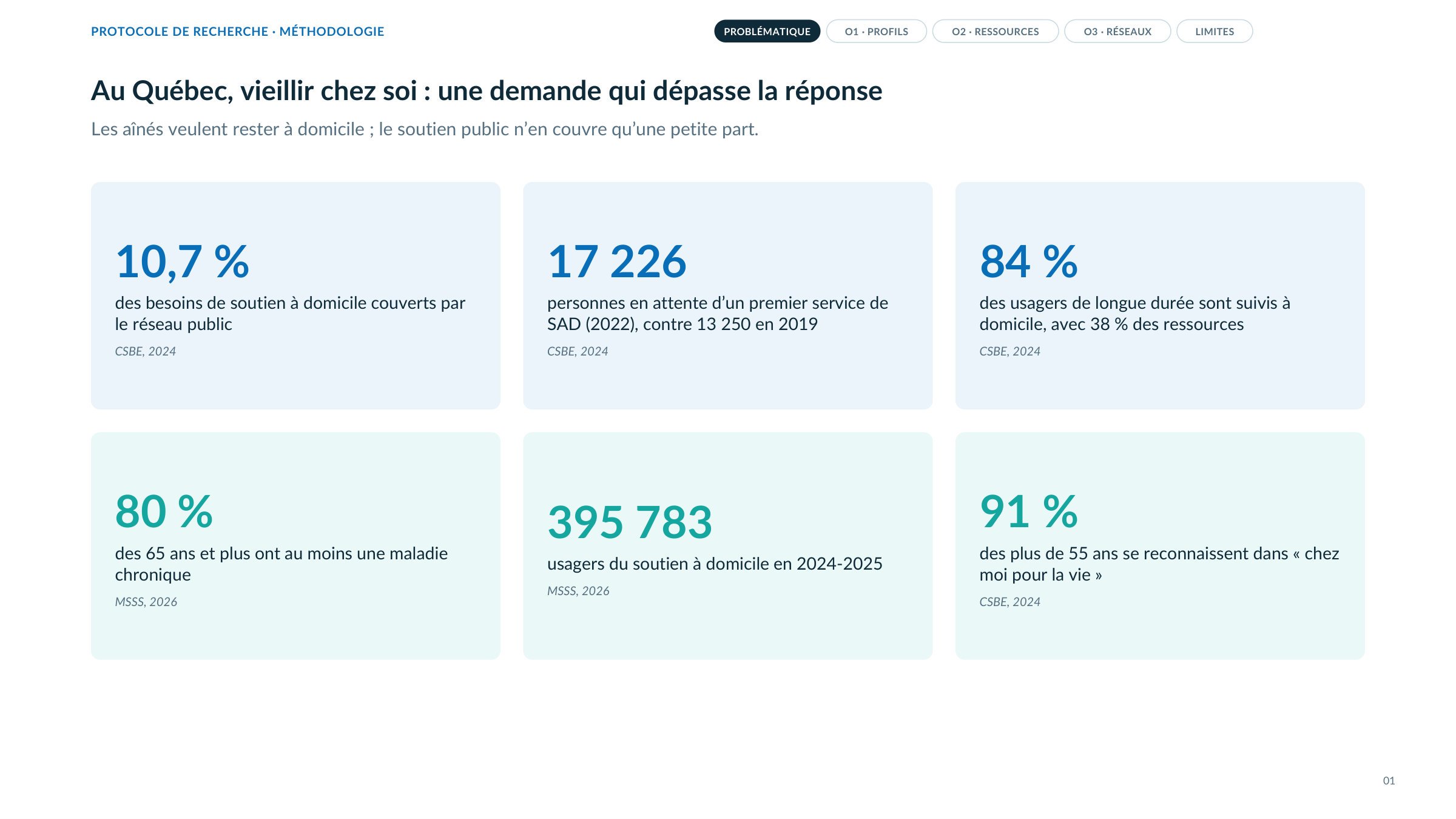
В Квебеке поддержка на дому (SAD) — это уход и услуги, которые государственная сеть оказывает у человека дома, прежде всего команда CLSC (местного центра общественных услуг). В 2024-2025 годах ею воспользовались 395 783 человека, всего 37,2 млн часов; 17 883 человека ждали первой услуги. Среди людей 65 лет и старше 80 % живут хотя бы с одним хроническим заболеванием, а половина — с несколькими (мультиморбидность) (MSSS, Mieux chez soi, 2026, с. 4 и 6).
Доля потребностей, покрытых государственной сетью, 2023
Поддержка на дому10,7 %
RI-RTF68,8 %
CHSLD98,9 %
SAD: 25,4 из 234,7 млн требуемых часов (CSBE, 2024, с. 11).
Ожидают первой услуги SAD
31 марта 201913 250
31 марта 202217 226
Рост примерно на 30 % за три года (CSBE, 2024, с. 2 и 96).
Пользователи и ресурсы долговременного ухода
Пользователи на дому84 %
Ресурсы SAD38 %
Стационарное размещение получает 62 % средств на 16 % пользователей (CSBE, 2024, с. 7).
Здоровье людей 65 лет и старше в Квебеке
Хотя бы одно хроническое заболевание80 %
Мультиморбидностьполовина
И 91 % людей старше 55 лет согласны с «дома на всю жизнь» (CSBE, 2024, с. 7; MSSS, 2026a, с. 4).
По итогам четырёх томов доклада Bien vieillir chez soi (2023-2024) Уполномоченный по здоровью и благополучию (CSBE) заключает, что система помощи на дому сложна, плохо интегрирована и малоэффективна. В 2023 году государственная сеть предоставила лишь 25,4 из 234,7 млн часов, необходимых на дому: уровень ответа 10,7 % против 98,9 % в CHSLD. Помощь на дому получает 38 % ресурсов долгосрочного ухода на 84 % пользователей, а число ожидающих первой услуги выросло с 13 250 (2019) до 17 226 (2022). Остальное ложится на близких, общественные организации и частный сектор, то есть на секторы вне государственной сети.
На изучаемой территории (CCSMTL, 8 территорий CLSC) в 2026 году проживают 48 575 человек в возрасте 65 лет и старше (ISQ). В 2021 году 28,6 % из них жили ниже порога низкого дохода, до 41,8 % в Pointe-Saint-Charles и 38,7 % в Centre-Sud; 66,9 % домохозяйств арендуют жильё (Статистическое управление Канады). В службе 211 потребности людей 70 лет и старше касаются прежде всего личной и общественной поддержки (21,9 %) и жилья (13,4 %) — двух областей, где их потребности остаются неудовлетворёнными вдвое чаще, чем у всех возрастов. У людей 60 лет и старше самая частая причина — «услуга недоступна» (324 потребности), затем условия допуска (210) и отсутствие транспорта (66). Лишь 44 обращения людей 60 лет и старше поступили из CLSC.
Требуемые и предоставленные часы и уровень ответа в долгосрочном уходе, Квебек, 2023: государственная сеть удовлетворяет 10,7 % потребностей на дому. Снимок: Commissaire à la santé et au bien-être (2024), Bien vieillir chez soi, том 4, краткое резюме, с. 11 (прогнозы Clavet et al., HEC Montréal, 2023).Шесть ключевых цифр квебекской проблемы. Источник: Bernier, E. (2026). Методология диссертации O1-O3 [презентация, на французском], слайд 2.
2. Когда потребности накапливаются, ответ усложняется
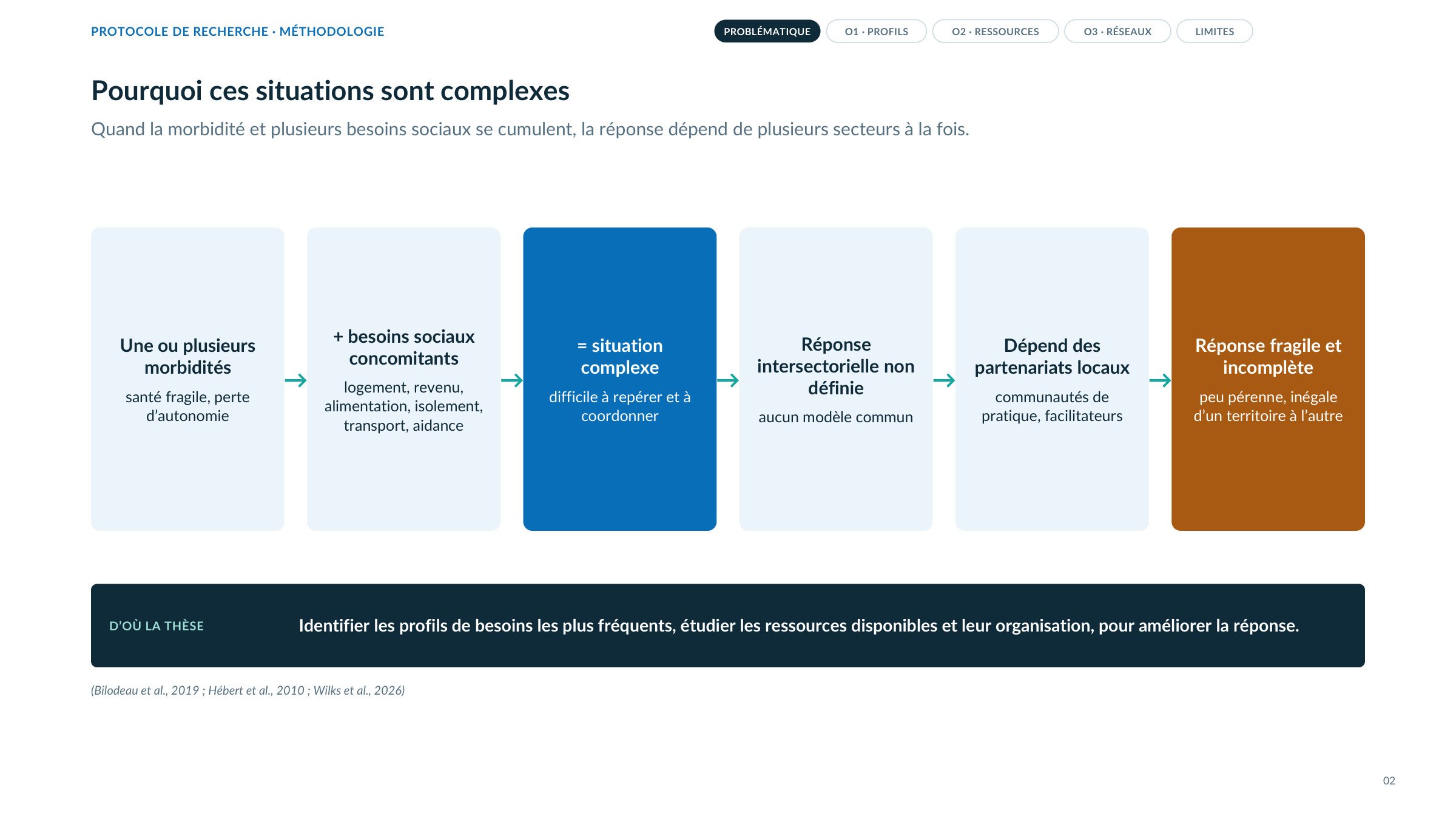
Пожилой человек может одновременно жить с одним или несколькими заболеваниями (острыми или хроническими проблемами здоровья) и с несколькими социальными потребностями: неподходящее жильё, слишком низкий доход, изоляция, отсутствие транспорта, измотанный ухаживающий близкий. Это называют сопутствующими социальными потребностями. Вместе они становятся факторами сложности: каждая затрудняет решение остальных, и путь человека в системе теряет плавность (Safford et al., 2007; Grembowski et al., 2014; Schaink et al., 2012; Johnson & Bacsu, 2018). Политика Mieux chez soi это признаёт: когда потребности затрагивают несколько сфер жизни, нескольким специалистам приходится работать вместе, а хронические болезни делают потребности на дому сложнее и интенсивнее (MSSS, 2026a, с. 4).
Такие ситуации трудно выявить, потому что ни одна служба в одиночку не видит всех потребностей человека. Их трудно и координировать: Уполномоченный по здоровью и благополучию (CSBE) описывает систему поддержки на дому как сложную, слабо интегрированную и малоэффективную. Организовать общий, адаптированный и скоординированный ответ удаётся не всегда. Вероятно, на одной территории организации могут не знать друг друга или не работать вместе, а какого-то ресурса может не хватать, хотя никто не знает, что его мог бы заменить ресурс другого сектора. Прямо это не доказано ни одним исследованием: это вывод, который подсказывают работы о сетях услуг, о возможностях общественных организаций и о том, как трудно найти доступную помощь (Lemieux-Charles et al., 2005; Varda et al., 2020; Hogg-Graham et al., 2021; Macleod et al., 2017). В службе 211 самая частая причина неудовлетворённых потребностей людей 60 лет и старше — «услуга недоступна».
Цепочка сложности: одно или несколько заболеваний плюс сопутствующие социальные потребности делают ситуацию трудной для выявления и координации. Источник: Bernier, E. (2026). Методология диссертации O1-O3 [презентация, на французском], слайд 3.
3. Много входов, а не один
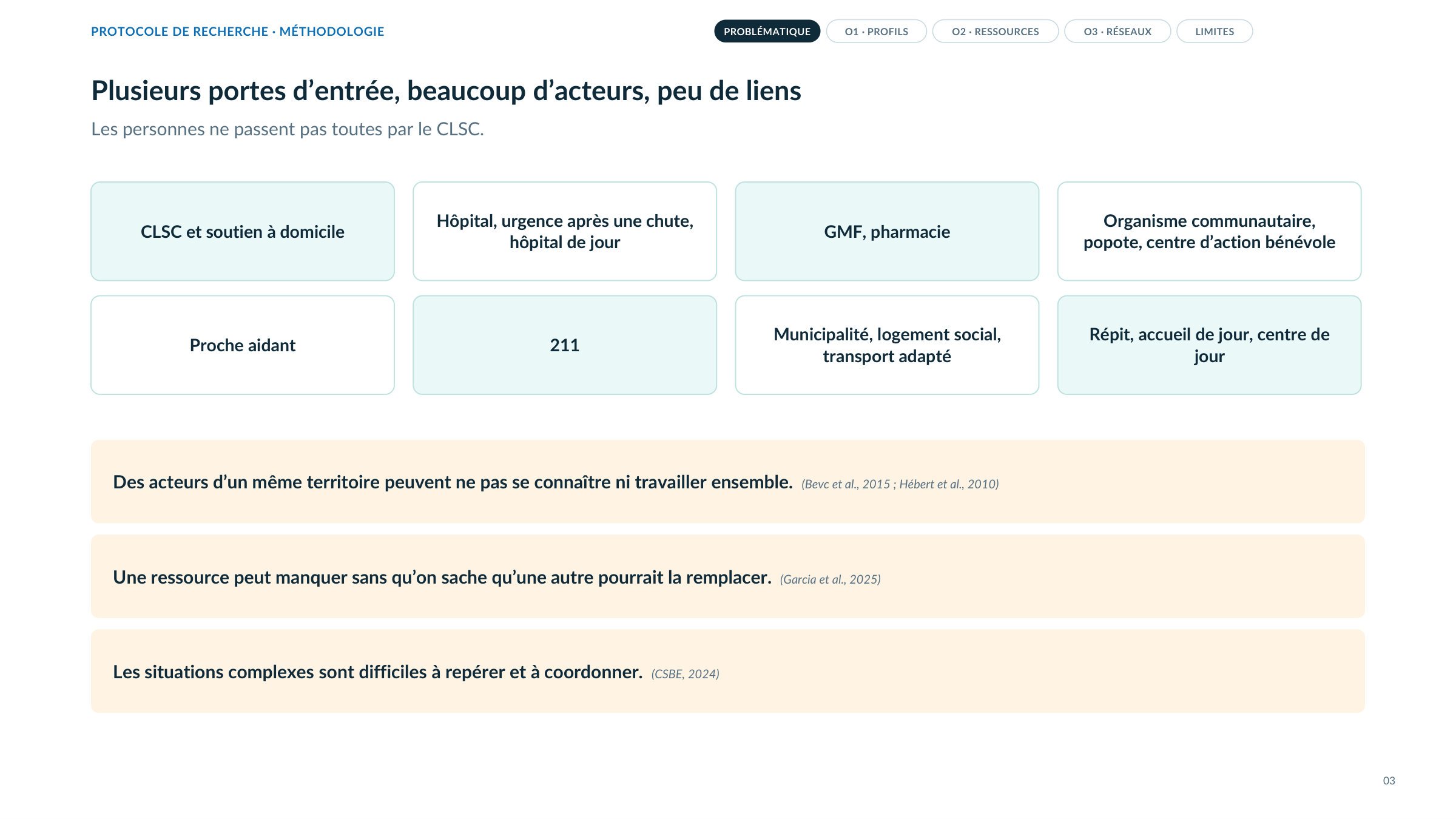
Политика Mieux chez soi хочет сделать CLSC главным входом (MSSS, 2026a, с. XII). На деле пожилой человек попадает в сеть через многие двери: команду SAD в CLSC; дневной стационар; госпитализацию; отделение неотложной помощи после падения; уход на дому от CISSS или CIUSSS (региональных учреждений здравоохранения и социальных услуг); группу семейной медицины (GMF); аптеку; муниципалитет; социальное жильё; адаптированный транспорт; общественную организацию; ухаживающего близкого; 211 — службу информации и направления. Каждая дверь видит часть ситуации; ни одна не гарантирует, что будут учтены все потребности.
Двенадцать возможных входов; CLSC, задуманный как главный вход (MSSS, 2026a, с. XII), — лишь один из них. Ни один в одиночку не видит всех потребностей.Входы и слабые связи между ними. Источник: Bernier, E. (2026). Методология диссертации O1-O3 [презентация, на французском], слайд 4.
4. Что уже существует в Квебеке для интеграции услуг
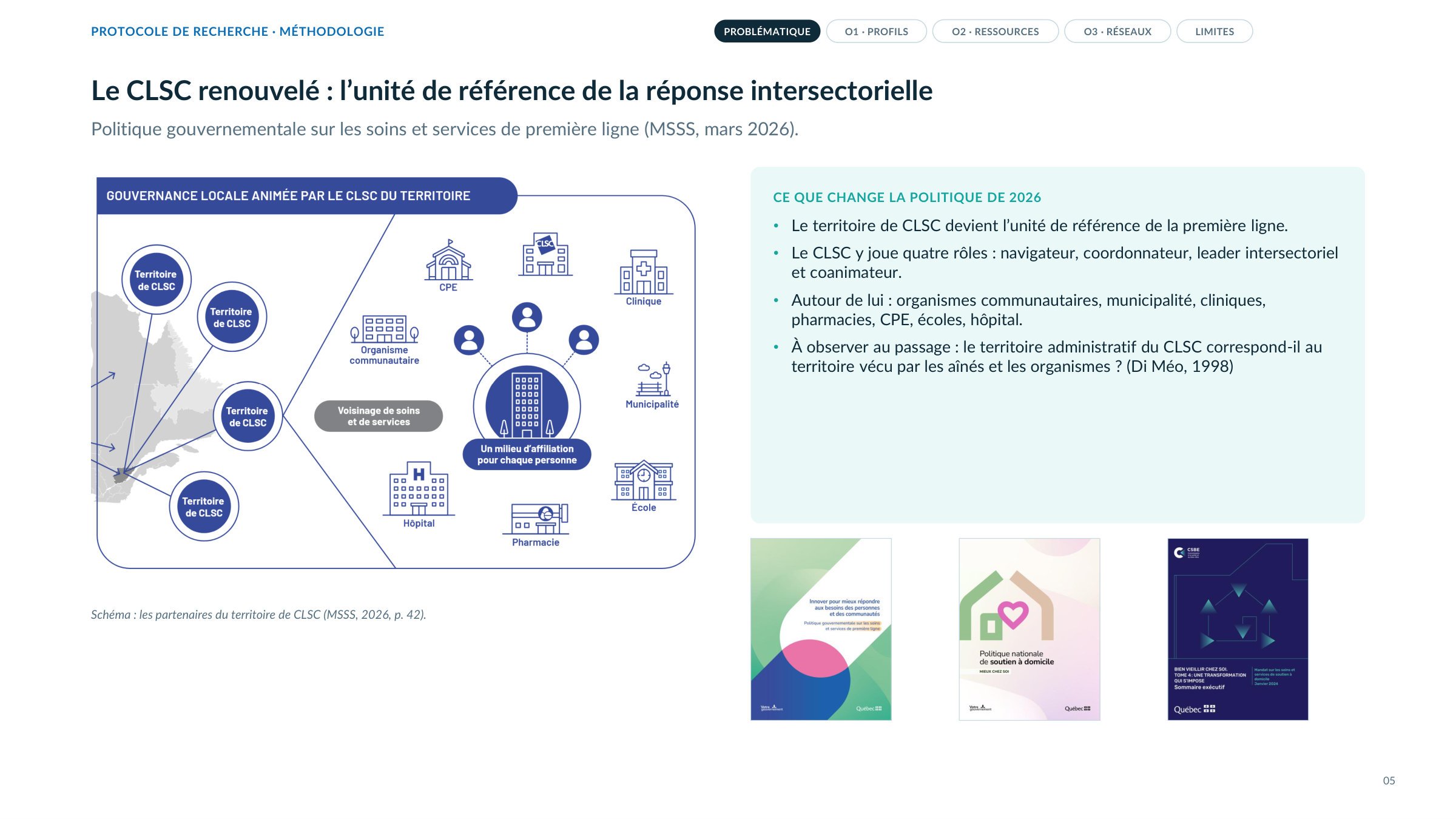
Правительственная политика в области первичной медико-социальной помощи (MSSS, март 2026) прикрепляет каждого человека к территории CLSC, которая становится базовой единицей координации первичного звена (с. 15). Она поручает CLSC четыре роли: навигатор, координатор, межсекторальный лидер и соорганизатор (с. 42). Сопутствующие министерские ориентиры констатируют, что CLSC, задуманный как территориальный центр, утратил жизнеспособность и оторвался от своей исходной миссии (с. 1): задача — вернуть ему эту роль.
Несколько механизмов уже сближают участников. PRISMA — квебекская модель интеграции услуг для пожилых людей с утратой самостоятельности — объединила единое окно, ведение случая, общий инструмент оценки и согласование партнёров; её оценка показала меньшее функциональное снижение и меньше неудовлетворённых потребностей (Hébert et al., 2003, 2010; Couturier et al., 2021). Интегрированный подход по месту жительства для пожилых людей (AIPPA) MSSS (2024) опирается на совместные практики и выявление людей с потребностями (с. 8), на уличных работников программы ITMAV и общественных организаторов учреждений (с. 28), а также на сообщества практики (с. 59; Ranmuthugala et al., 2011). Общественный организатор, работающий в службе общественной организации CISSS или CIUSSS, связывает учреждение с местными организациями (Bourque & Lachapelle, 2010).
Межсекторальность не нова для Квебека: её провозглашала ещё политика Chez soi : le premier choix (2003), а RUISSS Монреальского университета (2022) предложил схему из шести секторов (государственная сеть, первичное звено, парагосударственный сектор, сообщество, город, жильё) и четырёх уровней сотрудничества (обмен информацией, кооперация, координация, интеграция; по Bilodeau, Parent и Potvin, 2019). Подход AIPPA MSSS и его межсекторальный комитет связи в CCSMTL продолжают эту работу. Недостаёт способа понять, территория за территорией, какие секторы мобилизовать для каких сочетаний потребностей.
CLSC как единица управления на местах и его четыре роли: навигатор, координатор, межсекторальный лидер и соорганизатор. Снимок: MSSS (2026), Politique gouvernementale sur les soins et services de première ligne, с. 42.
Эта схема вместе с литературой послужила для определения секторов, изучаемых в диссертации (MSSS, 2026b, с. 42; Bilodeau et al., 2019).
Эти механизмы ценны, но межсекторальный ответ остаётся малозаметным. Он часто держится на местных партнёрствах: сообществе практики, круглом столе, человеке в роли фасилитатора. Если этот человек уходит или финансирование прекращается, ответ ослабевает: он недолговечен и часто неполон. Главное — ни один из этих механизмов не говорит, какие сочетания потребностей встречаются чаще всего, какие ресурсы есть для каждого на территории и как сеть сегодня организуется, чтобы ответить. Именно на это направлена диссертация.
Что меняет политика 2026 года (MSSS, 2026b, с. 15 и 42). Источник: Bernier, E. (2026). Методология диссертации O1-O3 [презентация, на французском], слайд 6.
5. Что уже пробовали в литературе
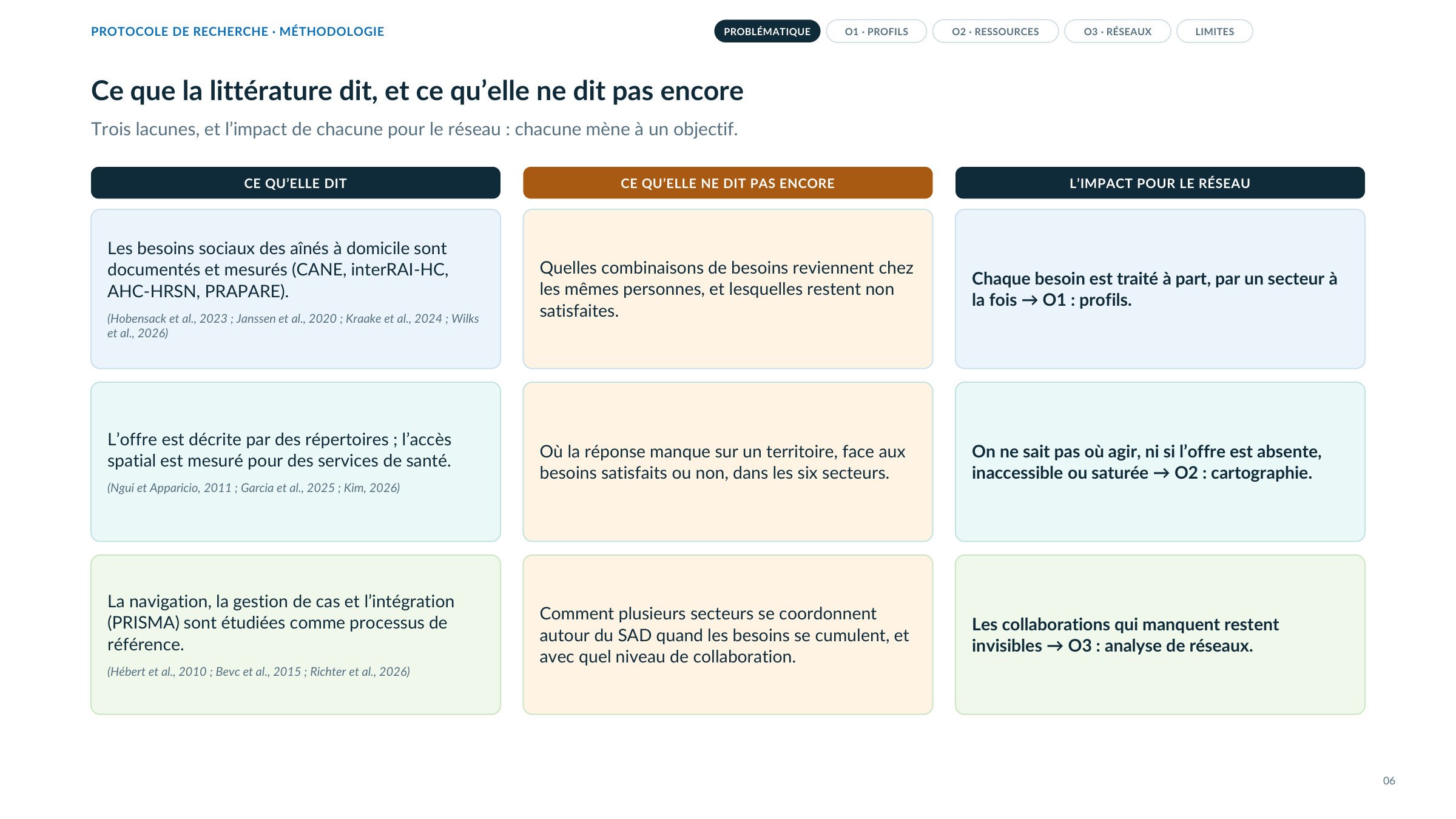
Она показывает, что социальные потребности пожилых людей, живущих дома, часты и накапливаются (McManus et al., 2025; Tingvold et al., 2026), что они образуют кластеры (Kreuter et al., 2021) и что существуют профили удовлетворённых и неудовлетворённых потребностей, но в основном на основе CANE и с точки зрения ухаживающих (Janssen et al., 2020; Kraake et al., 2024). Она описывает направление, навигацию и социальное назначение (Hébert et al., 2010; Percival et al., 2022) и картирование предложения услуг (Kim, 2026; Álvarez-Pérez et al., 2025).
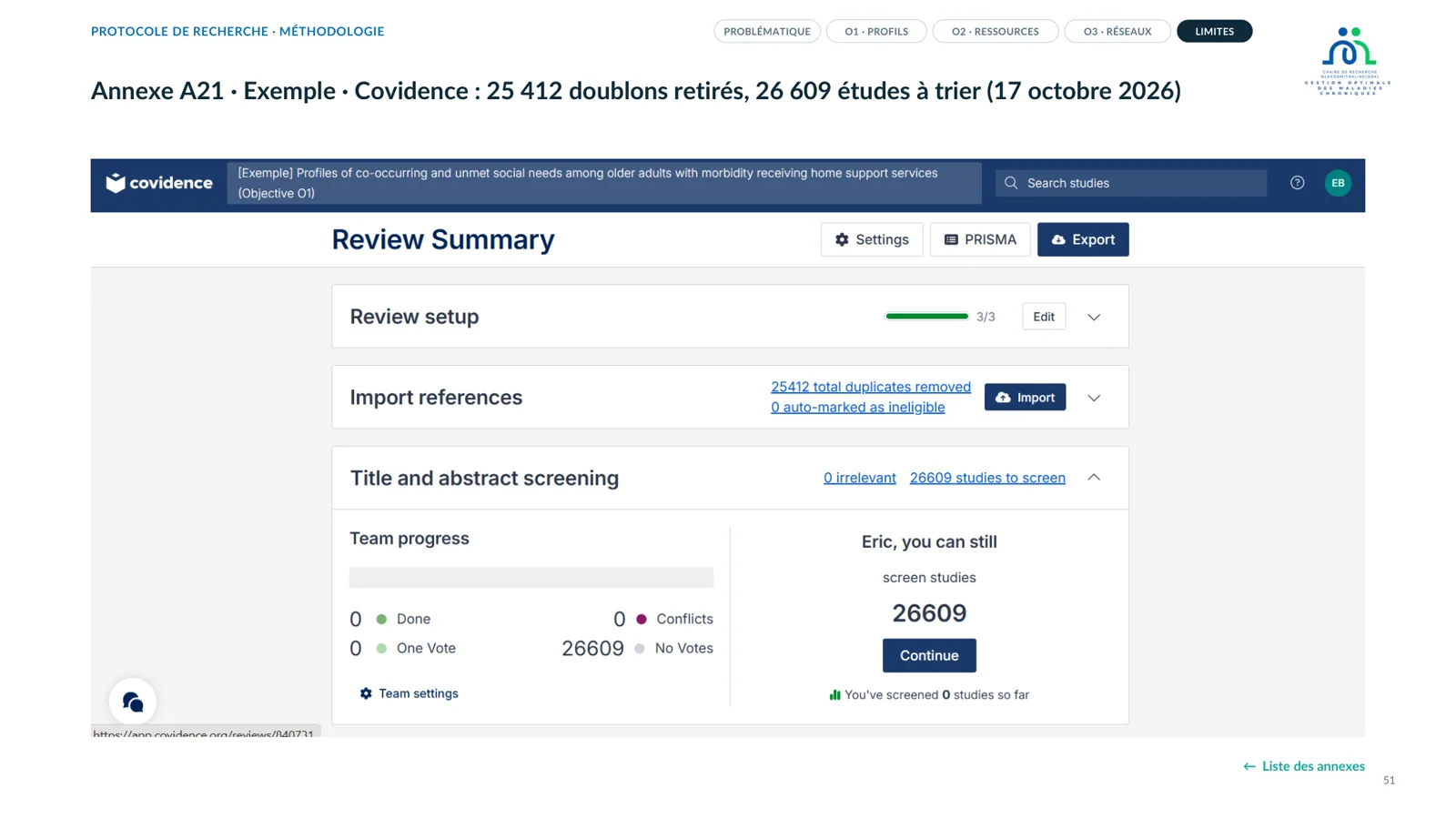
Она ещё не говорит, какие сочетания потребностей повторяются у людей, получающих помощь на дому, и какие остаются неудовлетворёнными; редко связывает эти сочетания на территории с доступными ресурсами; а её сетевые анализы фиксируют наличие связи, редко её уровень сотрудничества и почти никогда не исходят от команд помощи на дому нескольких CLSC. Обзор охвата для O1 начинается с 60 957 записей из четырёх баз (MEDLINE, Embase, APA PsycInfo, PubMed): 8 938 записей до 2006 года исключены, 52 021 импортирована в Covidence, 25 412 дубликатов удалены, 26 609 исследований подлежат отбору двумя экспертами.
Ряд работ уже картировал потребности и ресурсы пожилых: в Квебеке исследование под руководством Anne-Marie Séguin (INRS) для Société d’habitation du Québec (2018) описало удовлетворённые и неудовлетворённые потребности людей 75 лет и старше по типу среды, а затем местные ресурсы и стратегии людей. Juliette Duc и коллеги с помощью QGIS и R картировали предложение услуг и спрос на них для людей 65 лет и старше по всему Квебеку: меньше услуг на одного пожилого в сельской местности и сильная местная вариативность (Duc et al., 2026). Другие описали профили потребностей у людей с деменцией, живущих дома (Janssen et al., 2020), или анализировали сети услуг методом анализа социальных сетей, SNA (Urbanoski et al., 2018). Ни одна найденная работа пока не связывает сопутствующие социальные потребности и одно или несколько заболеваний как факторы сложности на уровне территории CLSC.
Главный пробел
Литература освещает отдельные компоненты вопроса: измерение множественных социальных потребностей, их одновременное наличие, желание пациентов получить помощь и механизмы реагирования. Однако среди выявленных обзоров ни один не объединяет для взрослых в первичной медицинской помощи неудовлетворённость потребностей, их одновременное наличие, приоритеты пациентов, взаимосвязи, сеть помощи и путь к удовлетворению потребностей. Пробел касается связи между конфигурацией потребностей и конфигурацией межсекторального взаимодействия, а также механизмов, объясняющих, почему некоторые потребности остаются неудовлетворёнными после их выявления.
Для соблюдения методологической строгости используется формулировка «в проведённых поисках в PubMed и Cairn не выявлено ни одного обзора», а не «таких обзоров не существует».
Три пробела, каждый ведёт к цели. Источник: Bernier, E. (2026). Методология диссертации O1-O3 [презентация, на французском], слайд 7.
6. Межсекторальный ответ, а не только индивидуальное вмешательство
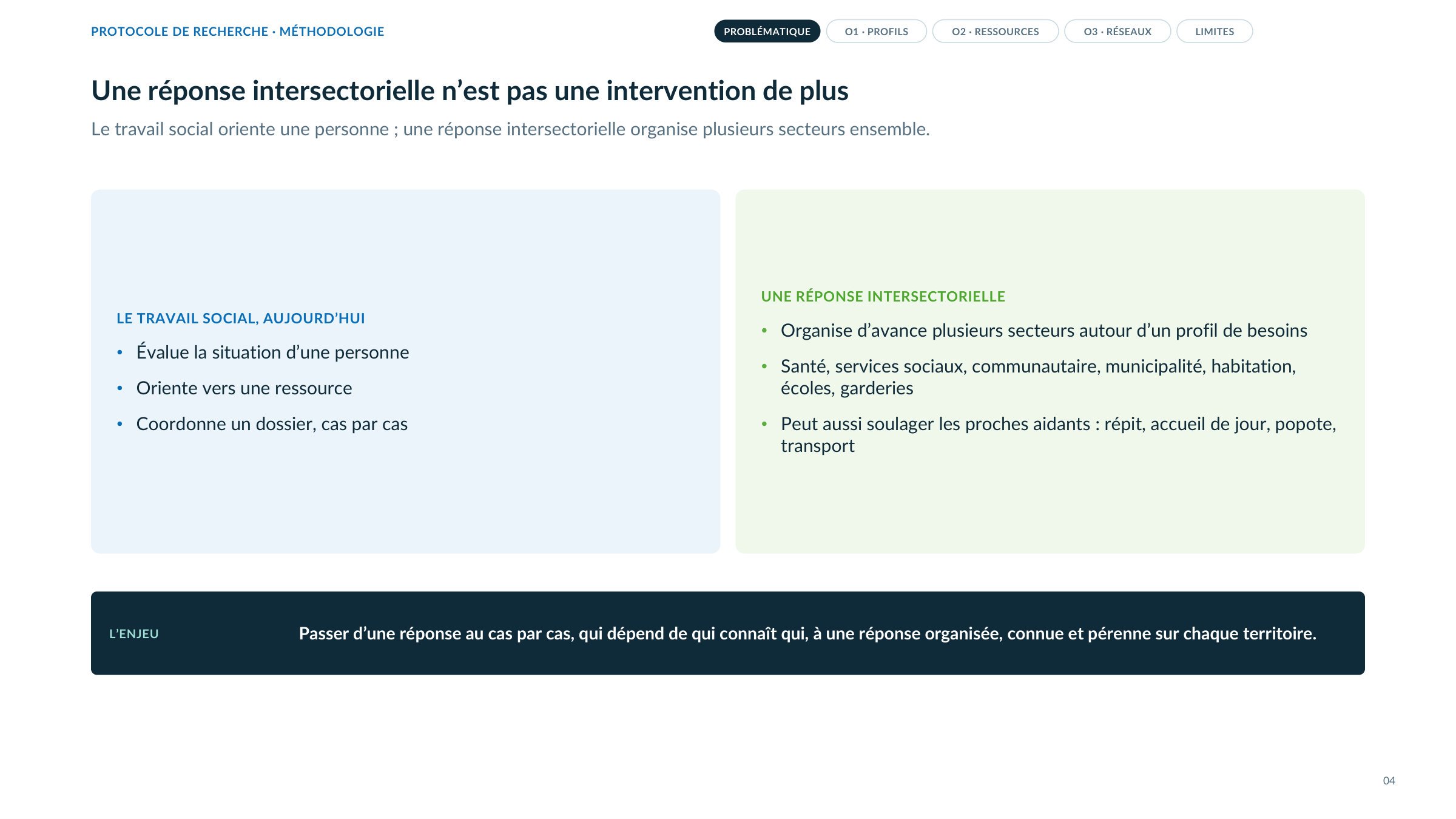
Социальный работник SAD оценивает ситуацию человека, направляет и сопровождает его: это индивидуальное вмешательство, и оно необходимо. Межсекторальный ответ на сопутствующие социальные потребности человека с одним или несколькими заболеваниями — это другое: это организация на территории нескольких секторов (здравоохранение, социальные услуги, общественные организации, муниципалитет, жильё, транспорт), которые действуют вместе и надолго ради одного сочетания потребностей. Сегодня дело не в умениях специалистов, а в отсутствии общей организации: каждый специалист заново, случай за случаем, выстраивает сеть, которую можно было бы знать заранее. Социальная работа оценивает, направляет и координирует случай за случаем; межсекторальный ответ заранее организует несколько секторов вокруг профиля (Couturier et al., 2022; Bilodeau et al., 2019). Задача — перейти от «кто кого знает» к организованному и устойчивому ответу.
Социальная работа сегодня
Искомый межсекторальный ответ
Оценивает ситуацию одного человека
Заранее организует несколько секторов вокруг профиля потребностей
Направляет к ресурсу
Здравоохранение, соцуслуги, общественный сектор, муниципалитет, жильё, школы, ясли
Координирует дело, случай за случаем
Также разгружает ухаживающих: передышка, дневной центр, доставка еды, транспорт
Зависит от «кто кого знает»
Организованный, известный и устойчивый на каждой территории
По Couturier et al. (2022) и Bilodeau et al. (2019).
Социальная работа и межсекторальный ответ. Источник: Bernier, E. (2026). Методология диссертации O1-O3 [презентация, на французском], слайд 5.
7. Второстепенное направление: проживаемая и административная территория
Политика 2026 года делает территорию CLSC опорной единицей. Сопровождающие её Ориентиры уточняют, что эта территория уже не просто административное деление, а живое пространство, и что нынешние 166 территорий не являются самоцелью (MSSS, 2026, резюме и с. 4). Однако территории CLSC изначально задавались, чтобы закрепить население за каждым учреждением (MSSS, рекомендации по управлению территориальными данными); в Монреале служба общественного здравоохранения разделила остров на 101 микрорайон, ближе к сообществам, а административные единицы не всегда совпадают с проживаемой средой (Di Méo, 1998; Riva et al., 2008; Macé, 2010; Breton et al., 2009). Во вторую очередь диссертация проверит, следуют ли ресурсы, которыми люди реально пользуются, границам CLSC или выходят за них.
8. Замысел диссертации
Отсюда исходная идея: выявить самые частые профили сопутствующих социальных потребностей у пожилых, получающих SAD; для каждого профиля найти ресурсы, доступные на каждой территории CLSC; затем понять, как ответ организован сегодня, чтобы его улучшить. Диссертация касается пожилых людей с одним или несколькими заболеваниями, живущих дома и получающих SAD на восьми территориях CLSC CIUSSS du Centre-Sud-de-l’Île-de-Montréal (48 575 человек 65 лет и старше в 2026 году).
Основная линия укладывается в три слова: профили → ресурсы → сеть. O1 показывает, какие сочетания потребностей повторяются; O2 — по каждой территории, что есть для ответа и чего не хватает; O3 — кто уже работает вместе и каких связей нет. Каждый этап даёт следующему то, что ему нужно.
9. Моя позиция
Мои размышления исходят из моего пути между несколькими секторами и из наблюдения за политикой поддержки жизни на дому, над которой я работал в ANAP. Как специализированный воспитатель я видел, как трудно организовать общий ответ на самые сложные ситуации, когда несколько служб вмешиваются без координации. Эта диссертация стремится сделать видимым, а значит организуемым, то, что сегодня держится в основном на доброй воле каждого.
Документальная основа
Приведённые ниже материалы поддерживают концептуализацию. Название, исследовательский вопрос, основной тезис и задачи в соответствующих разделах составляют актуальную основу проекта.
Концептуальная разработка исследовательского проекта
Сейчас я нахожусь на этапе концептуальной разработки: формирую корпус публикаций с установленными приоритетами, выявляю пробелы в литературе и изучаю материалы, составляющие теоретическую основу проекта.
222избранные публикации
39публикаций для первоочередного чтения
83важных публикаций для чтения
9областей пробелов в исследованиях
Распределение по приоритетам
Приоритет 539
Приоритет 483
Приоритет 346
Приоритет 224
Приоритет 130
Источники публикаций
222
PubMed112
Embase и MEDLINE (Ovid)95
Cairn15
Корпус сформирован на основе Ovid (Embase, MEDLINE), PubMed и Cairn. Каждой публикации присвоен приоритет в соответствии с её значимостью для вопроса диссертации.
Вопросы, остающиеся открытыми в литературе
Для каждой из девяти рассмотренных областей таблица показывает состояние литературы, значимость пробела и несколько библиографических ориентиров.
Концептуальная модель
Значительный пробел
Понятия представлены, но ещё не устоялись
Исследования, индексируемые в PubMed, всё чаще различают социальный риск, социальную потребность и желание получить помощь. Франкоязычные работы в Cairn добавляют понятия нестабильности условий жизни и социальной уязвимости — часто многомерные, но концептуально более широкие, чем неудовлетворённая потребность.
Gruß 2021; Tucher 2026; Tudrej 2019; Karran 2023
Измерение
Значительный пробел
Многочисленные, но неоднородные подходы
Инструменты существенно различаются по охватываемым областям, пороговым значениям и способам применения. Найденные в Cairn многомерные шкалы социальной уязвимости, например EPICES и PRECAR, не эквивалентны опросникам неудовлетворённых социальных потребностей.
Zein 2026; Karran 2023; Tudrej 2019; Rogers 2025
Характеристика/распространенность
Умеренный пробел
Хорошо документировано по крайней мере для одной потребности.
Многие исследования описывают распространённость потребностей по отдельным областям и их совокупную нагрузку. Однако оценки трудно сопоставлять, если определения потребности и используемые инструменты различаются.
Jih 2023; Bleacher 2020; Fiori 2021
Множественность и одновременное наличие потребностей
Значительный пробел
Развивающееся, но уже подтверждённое направление
Одновременное наличие нескольких социальных потребностей или рисков встречается часто. Предложены кластеры, классы и показатели совокупной нагрузки. Кроме того, недавнее исследование показывает, что множественность рисков существенно повышает вероятность желания получить помощь.
Vest 2025; Kreuter 2021; Zeng 2024; Tucher 2026
Определение приоритетов самими пациентами
Существенный пробел
Некоторые прямые исследования, но область все еще недостаточно развита.
Литература преимущественно измеряет желание получить помощь, согласованные цели, приемлемость или относительную приоритетность. Новые работы подчёркивают различие между выявленным риском и желаемой помощью. Исследования e-CARE показывают сопровождение с учётом темпа и приоритетов пациента, но не предлагают стандартизированной иерархии потребностей.
Описываются преимущественно как одновременное наличие потребностей или общая комплексность
Количественный анализ преимущественно описывает одновременное наличие потребностей и их профили. Франкоязычные качественные исследования в Cairn показывают переплетение социальных, административных, экономических и медицинских трудностей, но редко устанавливают направление, последовательность или причинный механизм их связей.
Vest 2025; Kreuter 2021; Marron-Delabre 2015; Ouanhnon 2022
Удовлетворение потребностей и траектория помощи
Существенный пробел
Число исследований растёт, но преобладают промежуточные показатели
Исследования всё чаще различают скрининг, направление к службам, установление контакта, получение ресурсов и удовлетворение потребности. Франкоязычные работы e-CARE также отслеживают конкретные результаты: оформление прав, доступ к лечащему врачу, жильё и самостоятельность в получении помощи. Однако стандартизированной оценки удовлетворения каждой отдельной потребности они не предлагают.
Обширная литература, но часто отделенная от данных пациентов.
PubMed описывает помощь в навигации по услугам, работников общественного здравоохранения, медико-правовые партнёрства и замкнутые циклы направления с обратной связью. Cairn — социальные подразделения в общей медицинской практике, MSP, CPTS, DAC и территориальную координацию. При этом конфигурация сети редко связывается с профилями потребностей и их удовлетворением.
Среди найденных обзоров ни один не объединяет для взрослых, обращающихся за первичной медицинской помощью, неудовлетворённость потребностей, их измерение в нескольких областях, конфигурации их одновременного наличия, приоритеты пациента, взаимосвязи потребностей, конфигурацию доступной сети и путь к их удовлетворению.
Karran 2023; Vest 2025; Chang 2026; Tudrej 2019; Ouanhnon 2022
Rodriguez J.; Nafisi A.; Rob-Inson C.; Arteaga E.; Pierce L.D.; Sunn L.; Kim K.J. (2018) Social determinants of health screening and com-munity resource referral in a safety-net resident primary care clinic. Тезисы конференции
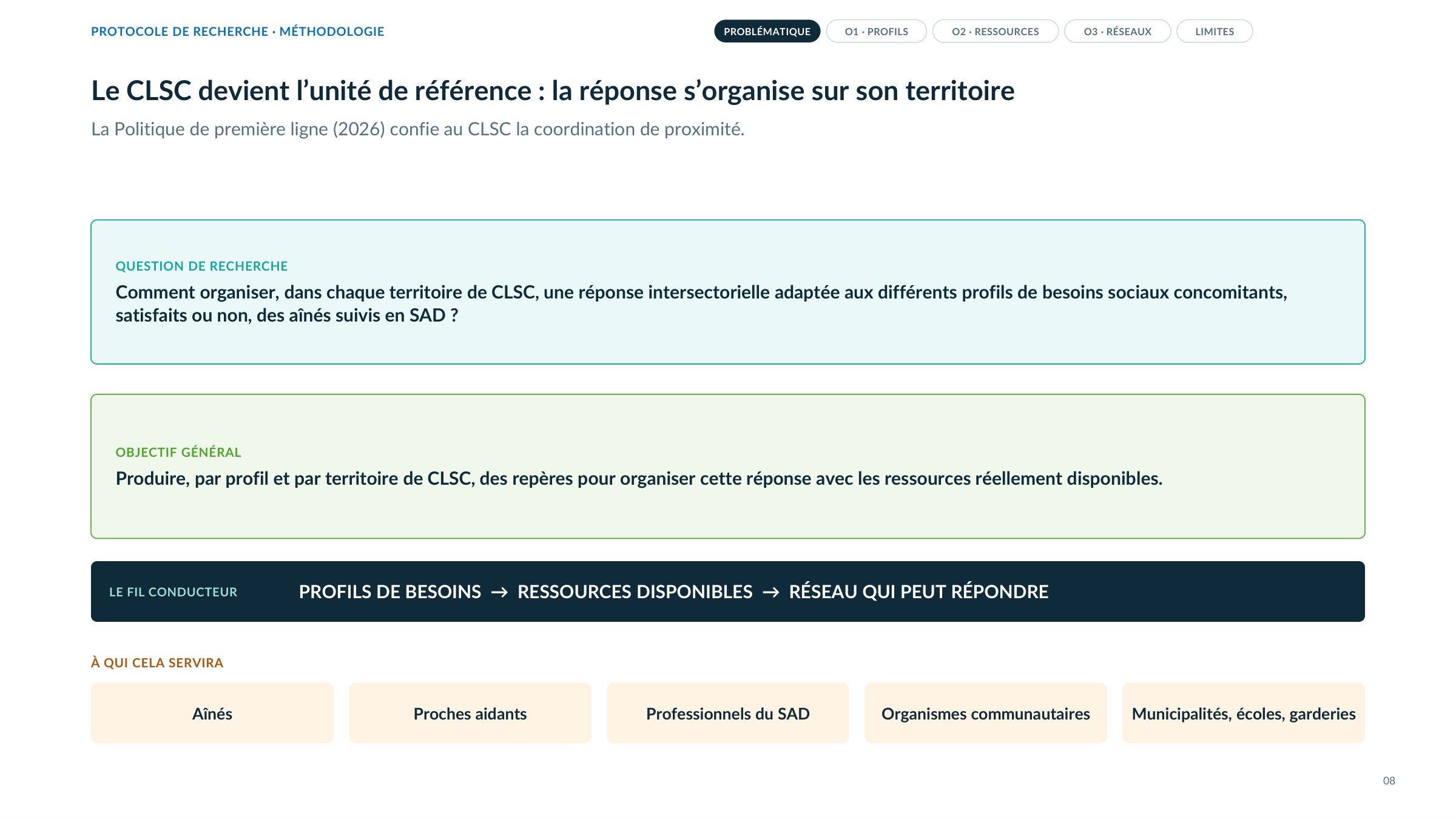
Как сегодня организуется межсекторальный ответ пожилым людям дома, у которых сочетаются социальные потребности и заболеваемость: по каким профилям, с какими ресурсами и через какие сети?
Проблема и цели
Исследовательский вопрос
Как сегодня организуется межсекторальный ответ пожилым людям дома, у которых сочетаются социальные потребности и заболеваемость: по каким профилям, с какими ресурсами и через какие сети?
Вопрос, общая цель и для кого это (MSSS, 2026b, с. 15 и 42). Источник: Bernier, E. (2026). Методология диссертации O1-O3 [презентация, на французском], слайд 9.
Тезис диссертации
Для пожилых людей, получающих помощь на дому, межсекторальный ответ нельзя организовывать потребность за потребностью: его следует выстраивать по профилям одновременных потребностей и по территориям CLSC, исходя из реально доступных ресурсов и реально задействованных сетей вокруг команд SAD.
Общая цель
Разработать для каждого профиля и каждой территории CLSC ориентиры для организации межсекторального ответа на основе реально доступных ресурсов.
Конкретные цели
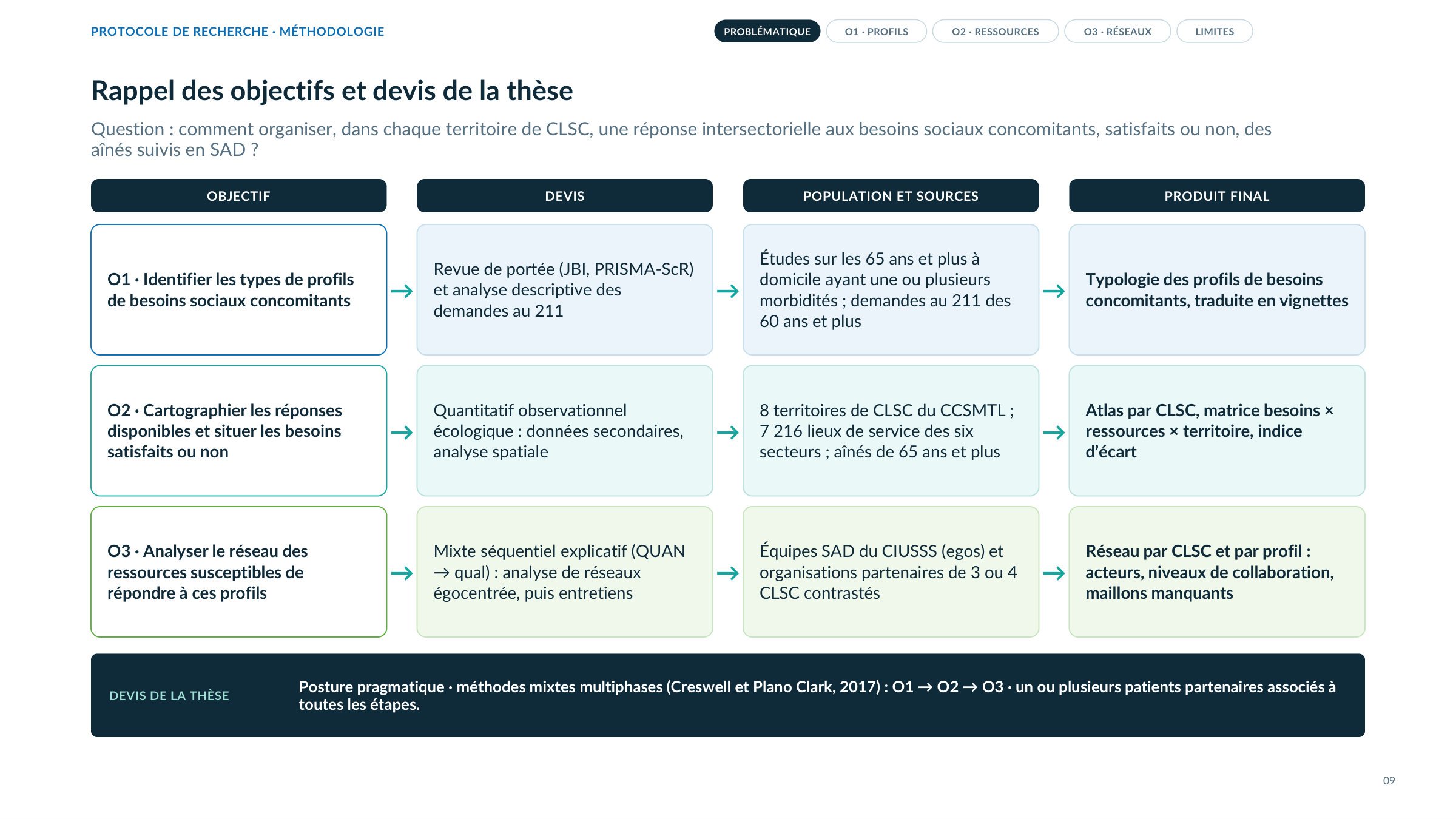
O1 Профили потребностей
1 · Пробел
Одновременные социальные потребности пожилых людей, живущих дома, документированы, но фрагментарно: определения, показатели и профили различаются. Ни одно найденное исследование не выделяет профили по оценкам SAD (OEMC, interRAI-HC) или по обращениям в 211 (Wilks et al., 2026 ; Janssen et al., 2020 ; Kraake et al., 2024 ; Kreuter et al., 2021).
2 · Цель
Выявить различные типы профилей одновременных социальных потребностей у пожилых людей с факторами заболеваемости или коморбидности, которым оказывается помощь в службах помощи на дому (CLSC).
3 · Итоговый продукт
Итоговый продукт: типология профилей сопутствующих социальных потребностей, удовлетворённых или нет, переведённая в виньетки. Что это даёт: знать, какие сочетания потребностей встречаются чаще всего, чтобы организовать ответ вокруг них.
O2 Доступные ресурсы (картирование)
1 · Пробел
Анализ предложения исходит из заранее заданного перечня и не сопоставляет его в пространстве с выраженными и неудовлетворёнными потребностями. Перечни часто неточны; неизвестно, где предложение отсутствует, недоступно или перегружено (Kim, 2026 ; Janda et al., 2021 ; Garcia et al., 2025).
2 · Цель
Нанести на карту ресурсы каждой территории CLSC, способные обеспечить межсекторальный ответ на эти потребности.
Шесть секторов: государственная сеть, первичное звено, окологосударственный сектор, общественные организации, муниципалитет, жильё.
3 · Итоговый продукт
Итоговый продукт: атлас по территориям CLSC, матрица потребности × ресурсы и индекс разрыва. Что это даёт: знать для каждого профиля, где ответ есть, где его нет и почему (отсутствует, недоступен или перегружен).
O3 Сети (сетевой анализ)
1 · Пробел
Ответы на социальные потребности пожилых людей изучаются преимущественно как процессы направления. Межорганизационные сети чаще всего измеряют без учёта уровня сотрудничества, и редко на материале нескольких CLSC (Hébert et al., 2010 ; Bevc et al., 2015 ; Richter et al., 2026).
2 · Цель
Выявить организационные траектории межсекторальных ресурсов, задействуемых для ответа на различные профили, на нескольких контрастных территориях CLSC (SAD).
Совместно с командами помощи на дому CIUSSS du Centre-Sud-de-l’Île-de-Montréal.
3 · Итоговый продукт
Итоговый продукт: карта сети каждого CLSC и каждого профиля с недостающими звеньями. Что это даёт: знать, кто уже работает вместе, кто должен бы, и на какие связи воздействовать.
Каждая цель, её дизайн, совокупность и итоговый продукт. Источник: Bernier, E. (2026). Методология диссертации O1-O3 [презентация, на французском], слайд 10.
Четыре понятия
Совокупность: люди 65 лет и старше. Для данных 211 основной анализ охватывает людей 70 лет и старше, поскольку 211 публикует только группы 60–69 и 70+; группа 60+ служит анализом чувствительности.
Одновременные потребности
Не менее двух социальных потребностей из разных областей, присутствующих одновременно у одного и того же человека.
(Kreuter et al., 2021)
Одно или несколько заболеваний
Любая проблема со здоровьем, острая или хроническая. У человека может быть одна или несколько.
SAD в CLSC
Медицинская и социальная помощь, оказываемая на дому командой территории CLSC.
(MSSS, 2026)
Неудовлетворённая потребность
В 211 потребность считается неудовлетворённой, если не удалось предложить подходящий ресурс, и указана причина. Её измеряют, но не делают критерием включения.
(Alderwick et Gottlieb, 2019)
«Удовлетворённые или нет»: о чём речь?
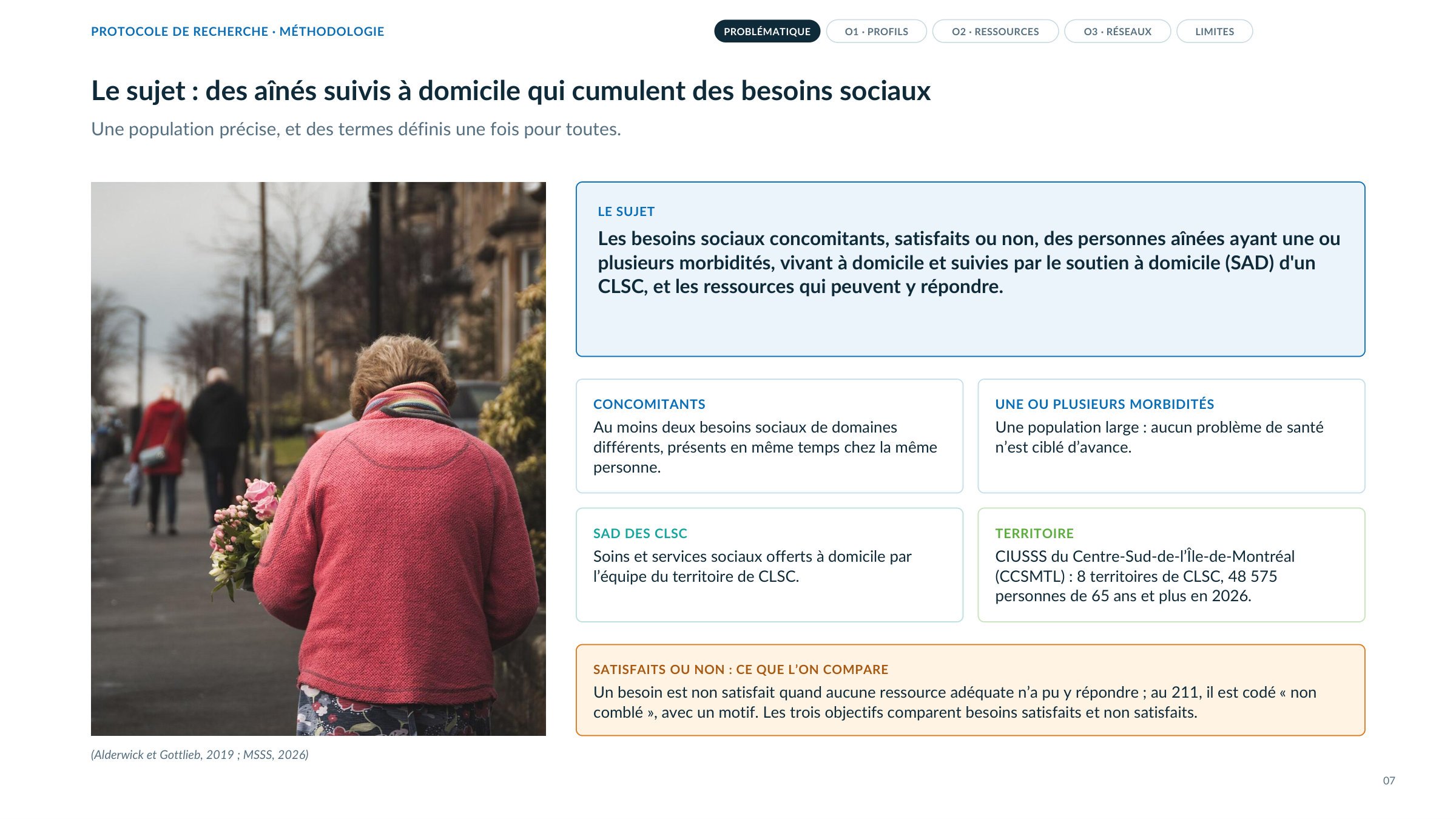
Смысл слова «неудовлетворённая» зависит от источника. В 211 потребность не удовлетворена, если не удалось предложить подходящий ресурс, с указанием причины; для Статистического управления Канады или INSPQ это осознанная потребность без полученной услуги; в CANE — проблема без адекватной помощи по оценке специалиста. Диссертация берёт определение 211 и во всех трёх целях сравнивает удовлетворённые и неудовлетворённые потребности (Alderwick & Gottlieb, 2019).
Тема и её термины, определённые раз и навсегда. Источник: Bernier, E. (2026). Методология диссертации O1-O3 [презентация, на французском], слайд 8.
03Методы
Методы
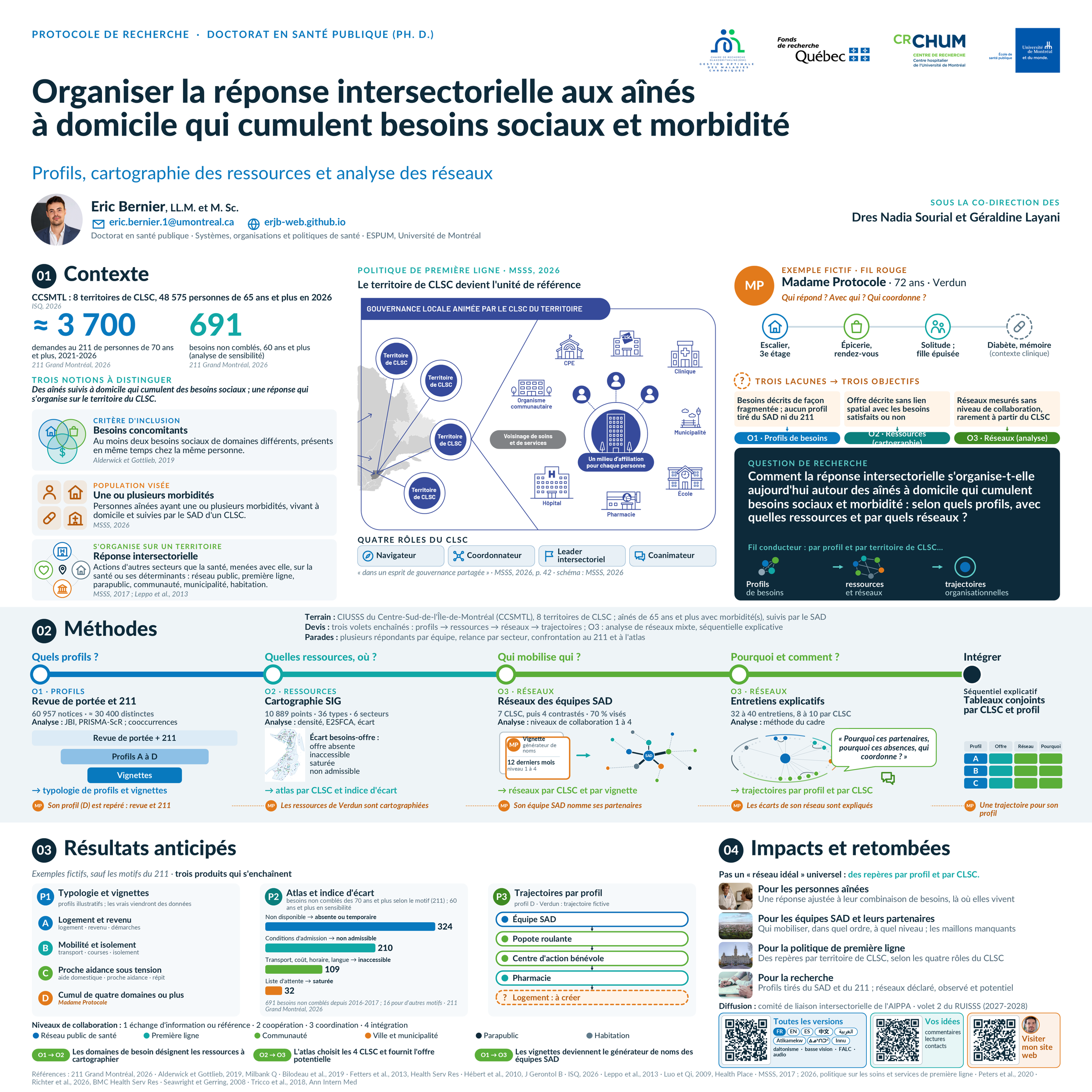
Общий дизайн: прагматическая позиция; многофазные смешанные методы (Creswell и Plano Clark, 2017), O1 → O2 → O3, каждая фаза строит следующую. Виньетки O1 служат генератором имён в O3; атлас O2 выбирает CLSC для O3 и даёт потенциальное предложение. Участники на местах вовлечены в каждую фазу: пожилые люди, ухаживающие близкие, специалисты, руководители и партнёры всех секторов, а также один или несколько пациентов-партнёров.
O1 Профили
Дизайн
Обзор охвата (JBI, PRISMA-ScR) и количественный описательный анализ обращений в 211.
Совокупность
Исследования людей 65 лет и старше, живущих дома, с одним или несколькими заболеваниями; обращения в 211 людей 60 лет и старше на территории CCSMTL.
Выборка
Нет: изучается вся найденная литература. Базы: MEDLINE, Embase, APA PsycInfo (Ovid) и PubMed; стратегия из 42 строк в 7 блоках, проверенная на 6 эталонных статьях.
Сбор данных
60 957 записей → −8 938 (до 2006) → 52 021 в Covidence → −25 412 дубликатов → 26 609 к отбору. Отбор двумя независимыми экспертами (заголовки и аннотации, затем полные тексты), пилот на 25 записях; двойное извлечение (определения, инструменты, области, профили).
Анализ
Описательный синтез в сетку из 10–14 областей, связанную с таксономией 211; удовлетворённые и неудовлетворённые потребности в 211 с их причинами.
Результат
Типология профилей сопутствующих потребностей и виньетки.
Почему профили сопутствующих потребностей, а не 12 отдельных областей?
Пожилой человек не переживает потребности по одной: лестница, покупки, одиночество и формуляры усиливают друг друга. Сохранение 12 отдельных областей воспроизводит раздробленность, которую CSBE ставит в упрёк помощи на дому, где каждая услуга отвечает только за свою область. Профиль описывает сочетание, а значит и ответ, который нужно организовать: кого мобилизовать вместе. Он учитывает одно или несколько заболеваний, поскольку они меняют характер ответа (половина людей 65 лет и старше живёт с несколькими заболеваниями).
Почему профили, а не отдельный человек?
Во-первых, осуществимость: индивидуальные данные помощи на дому (OEMC, I-CLSC) требуют законного разрешения и не менее 2 000 пользователей; моделирование в протоколе показывает, что при меньшем числе профили не восстанавливаются, а в данных 211 (1,4 потребности на обращение) не хватит никакого объёма. Во-вторых, уровень решений: CLSC планирует для групп ситуаций, а не для одного случая. Наконец, этика и передача знаний: профиль, превращённый в виньетку (Madame Protocole), можно предложить всем командам, никого не раскрывая.
Отбор в Covidence: импортировано 52 021 запись, удалено 25 412 дубликатов, к отбору 26 609 исследований. Снимок экрана: Covidence, обзор охвата O1 Эрика Бернье, октябрь 2026.
O2 Доступные ответы
Дизайн
Количественное наблюдательное экологическое исследование на вторичных данных.
Совокупность
8 территорий CLSC в CCSMTL; все ресурсы шести секторов (7 216 мест, 35 типов); пожилые 65 и 75 лет и старше (перепись 2021, ISQ); потребности в 211 людей 60 лет и старше (2024-2025).
Выборка
Сплошная инвентаризация без выборки; 52 источника внесены в реестр.
Сбор данных
Шесть общих переменных (местоположение, территория, сектор, область потребности, дата источника, построенный идентификатор); двойное кодирование, κ = 0,94.
Показатели
Плотность на 1 000 пожилых; доступность пешком (500 м, 1 км) и на общественном транспорте (15 и 30 мин, E2SFCA); удовлетворённые или нет потребности (211); совместный ответ на две области.
Анализ
R в Positron, карты QGIS; индекс разрыва (предложение отсутствует, недоступно, перегружено, нет права доступа); пространственные кластеры (локальный I Морана). Примеры даны по областям потребностей (14 категорий AIRS в 211) до появления O1.
Результат
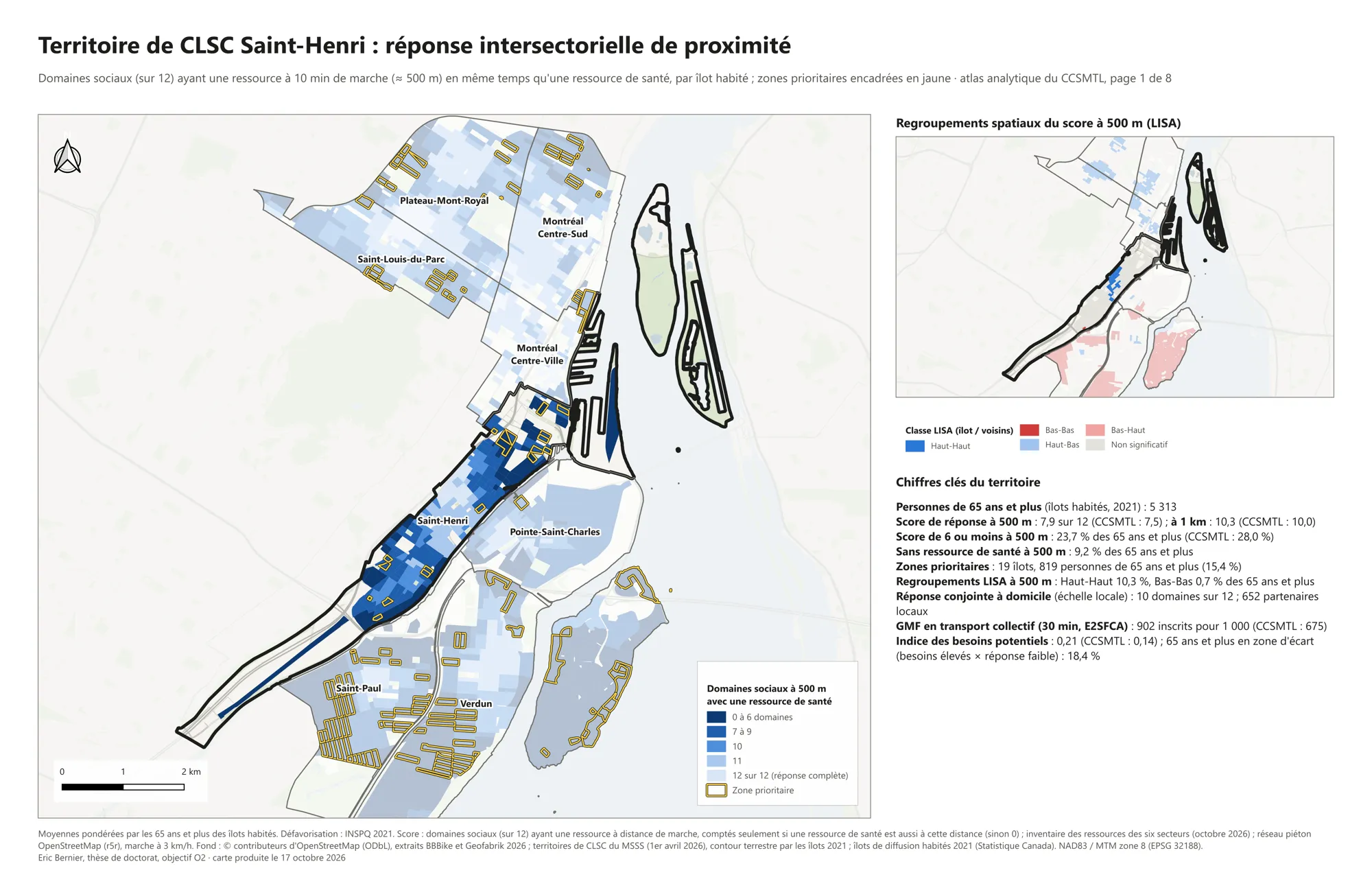
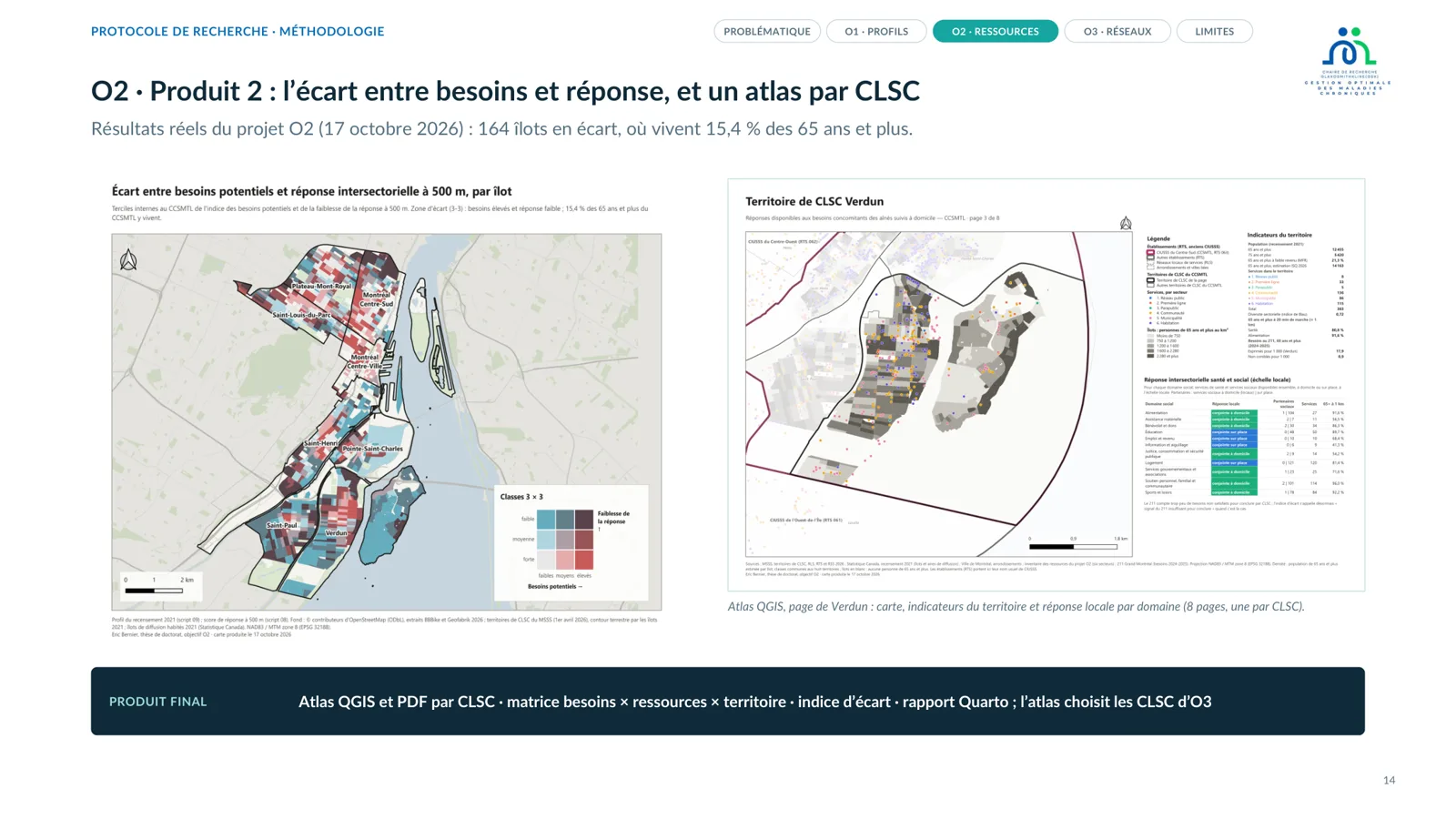
Атлас по CLSC, матрица потребности × ресурсы × территория, индекс разрыва. Пример: 164 квартала с разрывом, где живут 15,4 % людей 65 лет и старше.
Почему картирование?
Потому что политика 2026 года делает территорию CLSC базовой единицей: ответ нужно оценивать там, где живут люди. Карта сопоставляет удовлетворённые и неудовлетворённые потребности с ресурсами шести секторов, измеряет доступность пешком и на общественном транспорте (E2SFCA) и различает отсутствующее, недоступное или перегруженное предложение. Она также прозрачно отбирает 3 или 4 контрастных CLSC для O3. R в Positron и QGIS позволяют пересчитать каждый показатель.
Аналитический атлас · Saint-HenriПронумерованные R-скрипты проекта картирования, выполняемые в Positron: каждый показатель пересчитывается при обновлении источников. Снимок экрана: Positron, проект картирования O2 Эрика Бернье, октябрь 2026.Макет атласа по территориям CLSC в QGIS. Снимок экрана: QGIS 3.44, проект картирования O2 Эрика Бернье, октябрь 2026.
Команды помощи на дому CIUSSS (эго) и организации-партнёры.
Выборка
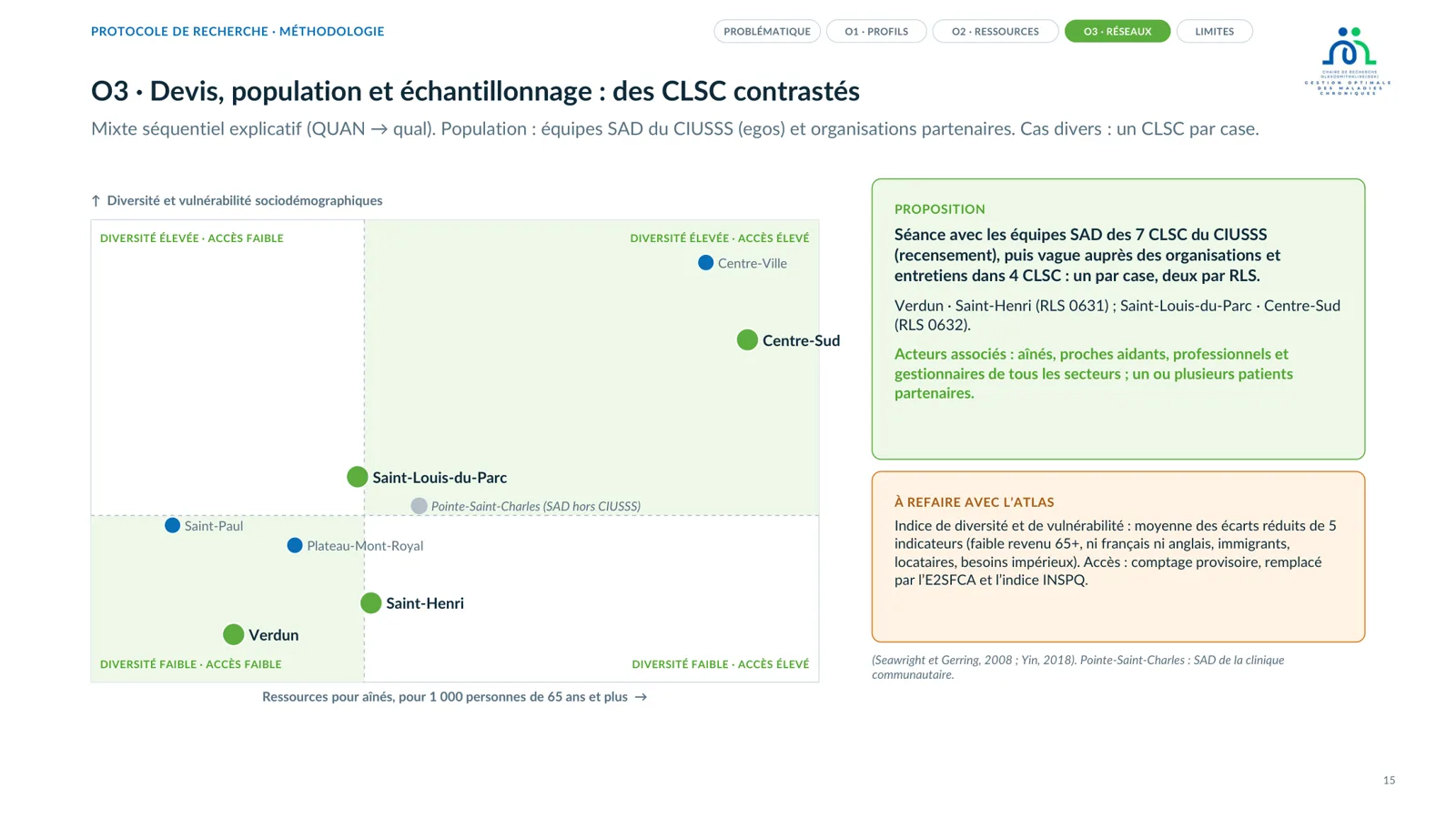
Целевая, разнообразные случаи. 3 или 4 CLSC, контрастные по социально-демографическому разнообразию и доступности (предложены: Verdun, Saint-Henri, Saint-Louis-du-Parc, Centre-Sud; Pointe-Saint-Charles исключён, так как его помощь на дому ведёт общественная клиника). Несколько респондентов на команду; 8–10 интервью на CLSC, выбранных по положению в сети.
Сбор данных, компонент QUAN
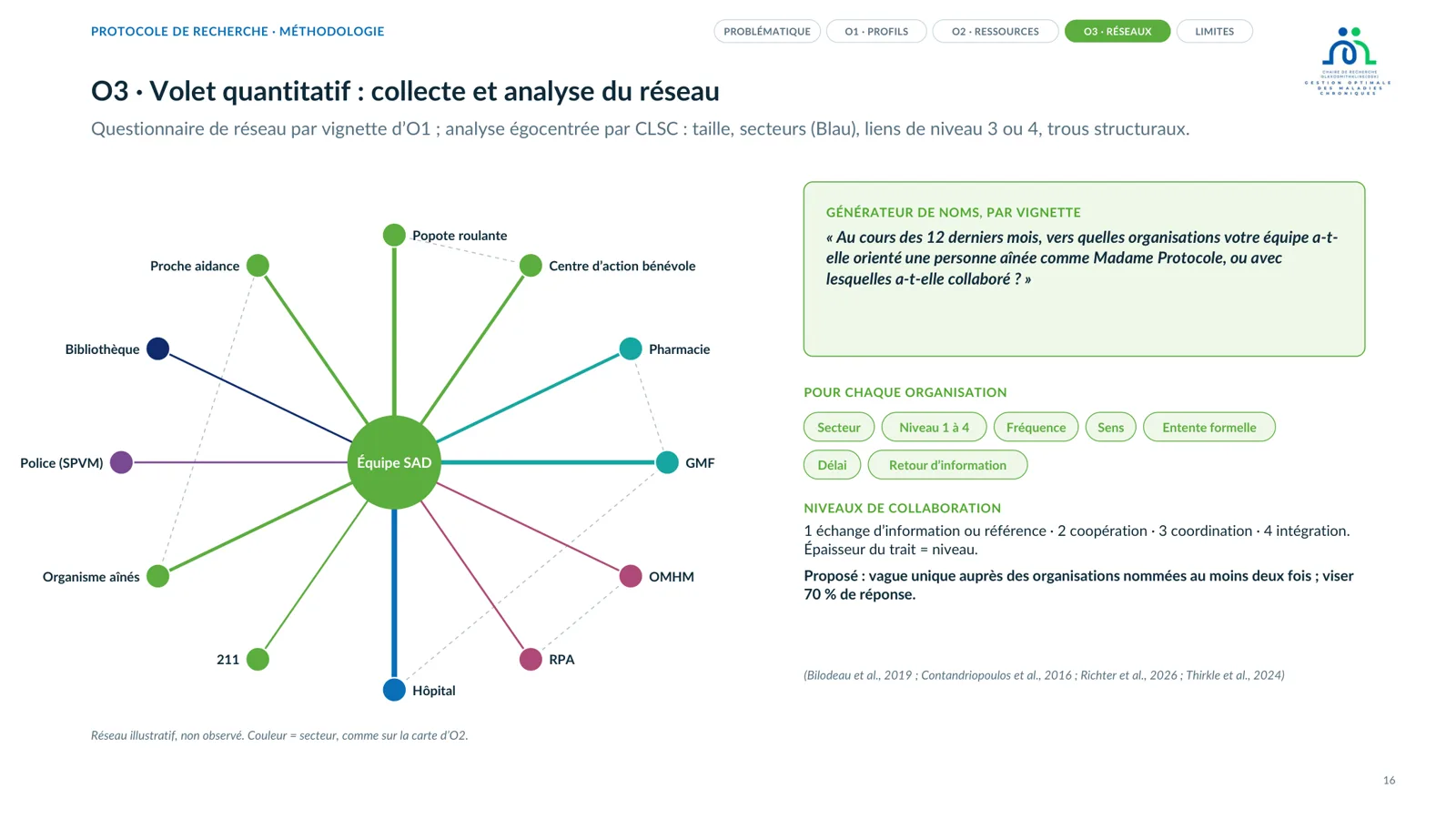
(1) Эгоцентрическая сеть каждой команды с генератором имён по каждой виньетке O1 («в какие организации вы её направили или с какими сотрудничали за последние 12 месяцев?»); для каждой связи: сектор, уровень сотрудничества 1–4, частота. (2) Анкета для названных организаций, чтобы уточнить связи за последние 12 месяцев; целевой отклик 70 %.
Сбор данных, компонент qual
(3) Восстановить путь каждого профиля в интервью, построенных вокруг карты сети.
Анализ
Размер, разнообразие секторов (Blau), доля связей уровня 3 или 4, структурные дыры; тематический анализ с двойным кодированием части интервью.
Интеграция
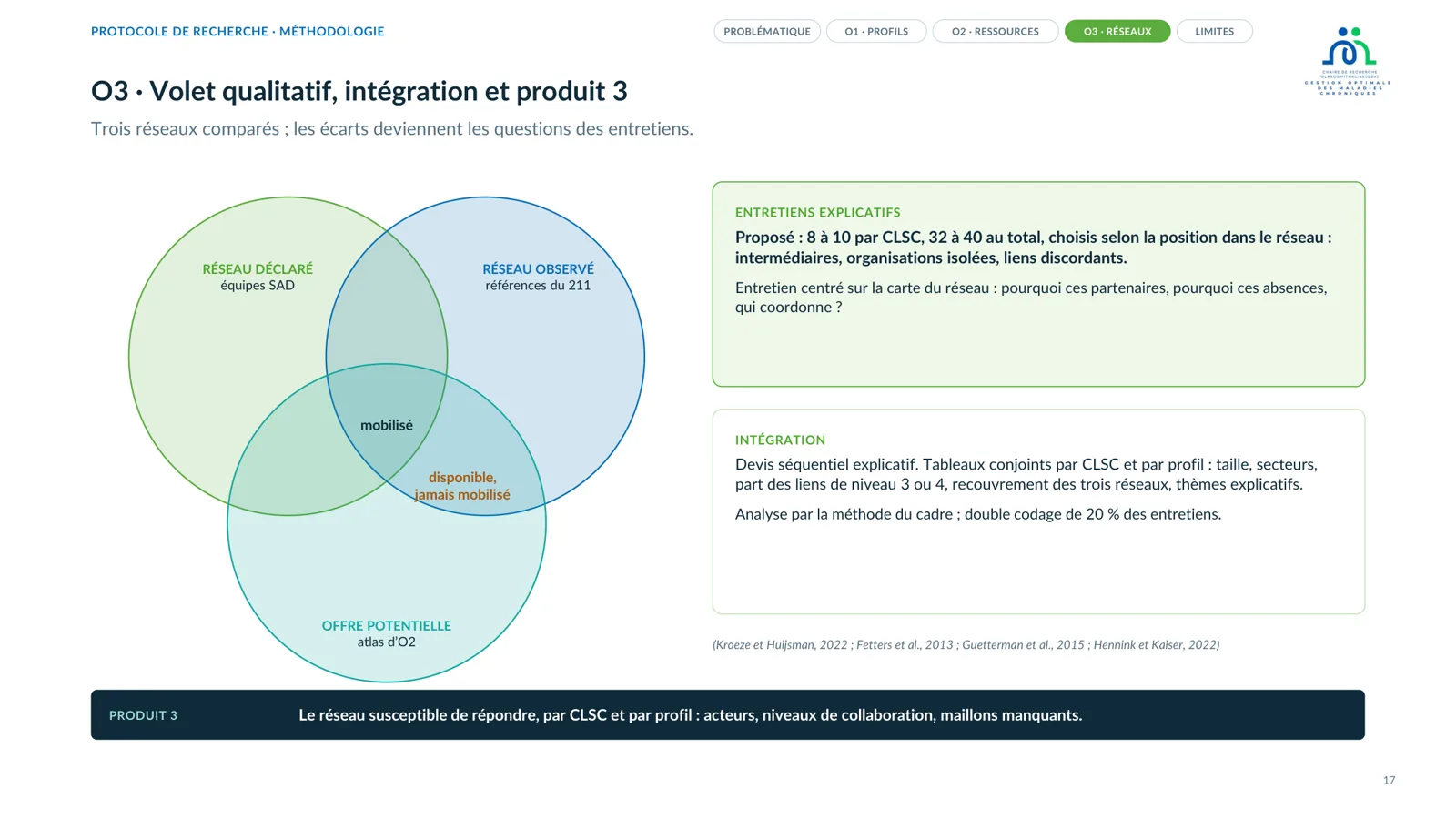
После компонента QUAN расхождения между заявленной сетью, направлениями 211 и предложением атласа становятся вопросами интервью; совместные таблицы по CLSC и по профилю.
Вовлечение участников на местах
SNA даёт слово участникам на местах: команды SAD, организации всех секторов и их руководители описывают свои связи. В интервью участвуют также пожилые люди, ухаживающие близкие и пациенты-партнёры, а результаты представляются им для проверки.
Результат
Сеть по CLSC и по профилю с недостающими звеньями. Опубликованный пример: Urbanoski et al., 2018 (doi:10.1371/journal.pone.0206671).
Почему анализ социальных сетей (SNA)?
Ресурс, доступный на карте, не обязательно мобилизуется. Только сетевой анализ показывает, кто реально работает с командой помощи на дому, на каком уровне сотрудничества и где недостающие звенья. Опубликованные примеры: Contandriopoulos et al. (2016, Healthcare Policy) картировали сотрудничество канадских организаций по профилактике хронических заболеваний; Richter et al. (2026, BMC Health Services Research) с помощью эгоцентрической сети проанализировали координацию укрепления здоровья в муниципалитетах; Lemieux-Charles et al. (2005, The Gerontologist) изучили общественные сети помощи при деменции в Онтарио.
Дизайн сетевого компонента
Эгоцентрическая сеть: эго — команда помощи на дому каждого CLSC. Для каждого профиля (виньетки) анкета спрашивает, в какие организации команда направляла пожилого человека или с какими сотрудничала за последние 12 месяцев, с указанием сектора, уровня сотрудничества (1–4), частоты и сроков. Затем результаты SNA (размер, разнообразие, доля связей уровня 3 или 4) контекстуализируются в интервью с участниками, которые восстанавливают путь каждого профиля: кто вмешивается, в каком порядке и где он прерывается.
Принципиальная схема диссертации
Эгоцентрированная сеть команды SAD
В моей диссертации анализ сети исходит из команды помощи на дому каждого CLSC. По каждой виньетке команда называет организации, в которые она направляла пожилого человека или с которыми сотрудничала за последние 12 месяцев; толщина линии показывает уровень сотрудничества от 1 до 4. Эта заявленная сеть сопоставляется с направлениями 211 и с предложением атласа, а затем объясняется в интервью. Иллюстративная сеть, не наблюдаемая.
Ограничения и меры
Обращение в 211 — это не человек : анализируются потребности, собранные в одном обращении.
211 публикует данные по округам : Verdun точно совпадает со своим CLSC, почтовый индекс запрошен.
Справочники неполны : сначала официальные источники, полнота измеряется.
Заявленные сети зависят от памяти : несколько респондентов и сравнение с 211 и атласом.
3 или 4 случая не допускают статистического вывода : сравнение случаев, объяснённое интервью.
Предложение (октябрь 2026) и потребности (2024-2025) относятся к разным годам : разрыв показан.
04Осуществимость
Осуществимость
Диссертация осуществима, когда выполнены три условия: данные существуют и доступны, методы освоены, а календарный план оставляет время на их применение. В этом проекте первые два условия уже выполнены; календарный план, приведённый в конце, показывает, что сделано и что осталось.
Осуществимость обеспечена
Данные доступныСогласие службы 211 получено; всё остальное находится в открытом доступе в интернете.
Для O2 всё уже подготовленоДанные, кодирование и программы (R в Positron, QGIS) готовы; карты уже созданы.
Единственный риск уже учтёнПерепись 2026 года; если её данных не будет, используется перепись 2021 года.
Усиленный обзорИзвлечение данных повторяется с участием библиотекаря и нескольких оценщиков.
Открывается возможность полевой работыОбсуждается партнёрство с CIUSSS du Centre-Sud для анализа сетей.
1Данные: уже в наличии или в открытом доступе
Диссертация не опирается ни на одну базу индивидуальных данных системы здравоохранения. Она работает с профилями, на основе публичных или агрегированных источников, и с собственным сбором данных для цели 3. Статус каждого источника известен.
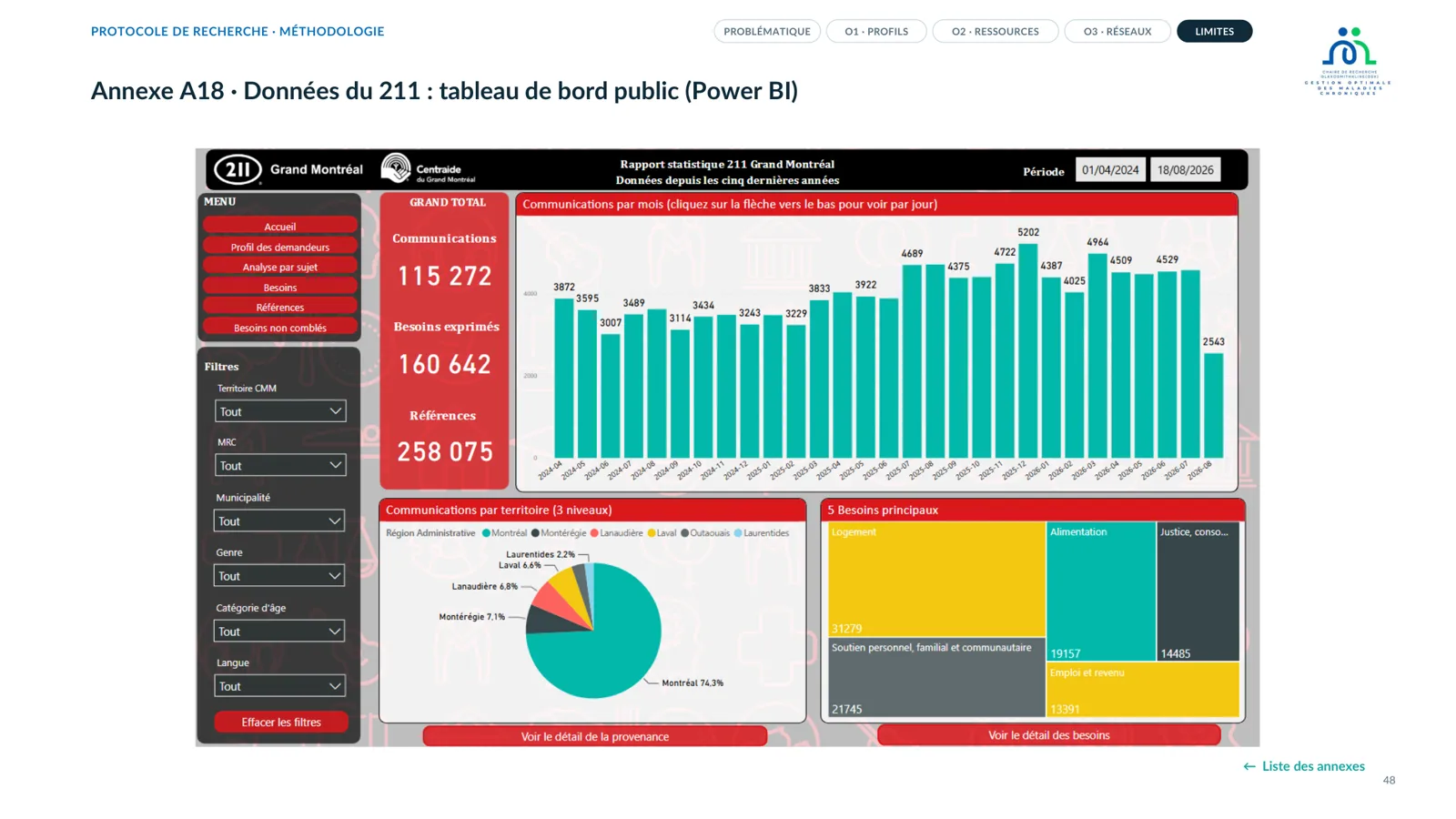
СогласиеСлужба 211. Согласие службы 211 получено. Её данные полнее в Столичном метрополитенском сообществе Монреаля (CMM), где 211 Grand Montréal охватывает Монреаль и соседние регионы: с 2024 по 2026 год в её публичной панели учтено 115 272 обращения, из них 74,3 % приходится на Монреаль (211 Grand Montréal, 2026).
СделаноЛитература для обзора O1. Четыре базы, запрошенные 17 октября 2026 года (MEDLINE, Embase, APA PsycInfo, PubMed): 60 957 записей, 26 609 исследований к отбору после удаления дубликатов (Bernier, 2026).
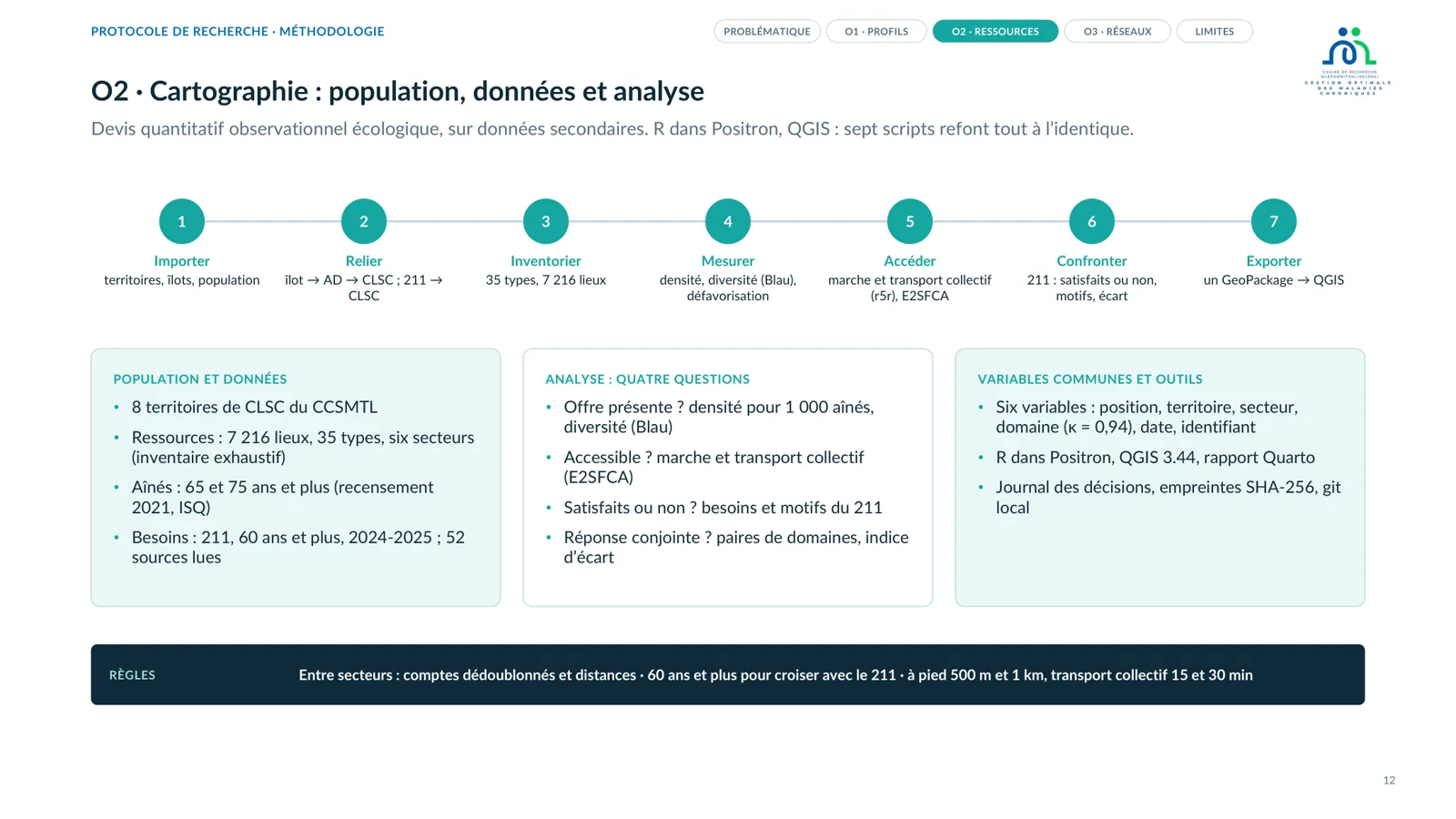
СделаноИнвентаризация ресурсов O2. 7 216 мест оказания услуг 35 типов во всех шести секторах, геолокализованных на 8 территориях CLSC, на основе 52 источников; двойное кодирование с согласованностью κ = 0,94 (Bernier, 2026).
В сетиНаселение и территории. Перепись 2021 года, границы территорий CLSC и публичные реестры шести секторов (Statistique Canada, 2022).
РискПерепись 2026 года. Будет опубликована в 2027 году; см. следующий раздел.
Предстоит собратьСеть O3. Анкеты и интервью с командами SAD и их партнёрами после одобрения этической комиссии.
Обзор охвата, повторённый с несколькими оценщиками
Поиск литературы завершён: записи очищены от дубликатов в Covidence. Для надёжности обзора извлечение данных, проведённое вместе с библиотекарем, будет повторено с несколькими оценщиками. Каждое исследование будет отбираться двумя независимыми лицами, сначала по заглавию и резюме, затем по полному тексту, после пилотного теста на 25 записях; данные будут извлекаться в двойном порядке (Bernier, 2026).
Такой порядок соответствует стандартам обзоров охвата: руководство JBI по проведению (Peters et al., 2020) и PRISMA-ScR по описанию результатов (Tricco et al., 2018). Два независимых взгляда снижают риск ошибочно отвергнуть исследование.
От записей к исследованиям для отбора, 17 октября 2026 года (Bernier, 2026).
Covidence, обзор охвата O1: удалено 25 412 дубликатов, 26 609 исследований к отбору (Bernier, 2026).
Служба 211: реальные обращения вне государственной системы
Служба 211 принимает обращения за помощью от людей, их близких и специалистов. Её публичная панель уже описывает по районам заявленные потребности, неудовлетворённые потребности и их причины. По жителям территории в возрасте 70 лет и старше зарегистрировано около 3 700 обращений с 2021 по 2026 год, а по лицам 60 лет и старше — 691 неудовлетворённая потребность, у каждой есть закодированная причина (Bernier, 2026).
Согласие службы 211 даёт доступ к более детальной выгрузке. Поскольку её данные полнее в CMM, доступ облегчается, а сравнение с сетью, заявленной командами SAD в O3, становится точнее.
Публичная панель 211 Grand Montréal, используемая для O1 и O2 (211 Grand Montréal, 2026).
O2: данные, кодирование и программы уже готовы
Для цели 2 самая трудоёмкая работа выполнена. Семь скриптов R, запускаемых в Positron, импортируют территории, привязывают каждый городской квартал к его CLSC, инвентаризируют ресурсы, измеряют доступность пешком и на общественном транспорте, а затем экспортируют слои в QGIS. Каждое решение фиксируется в журнале, а каждый прочитанный файл получает отпечаток: всё пересчитывается идентично (Bernier, 2026).
В ожидании профилей O1 примеры составлены по областям потребностей. Картографирование будет повторено по профилям с теми же скриптами.
7 216геолокализованных мест оказания услуг
52источника внесены в реестр
κ = 0,94согласованность двойного кодирования
8страниц атласа, по одной на каждый CLSC
Цепочка обработки O2, от импорта до атласа (Bernier, 2026).
Первый результат, который уже можно измерить
Примеры O2 уже дают порядок величины: 164 городских квартала находятся в разрыве между потенциальными потребностями и ответом на местном уровне, и в них проживает 15,4 % людей в возрасте 65 лет и старше (Bernier, 2026). Эта цифра будет пересчитана по профилям; она показывает, что метод работает на реальных данных территории.
Атлас QGIS, страница Verdun: 164 квартала в разрыве, 15,4 % людей 65 лет и старше (Bernier, 2026).
2Единственный риск: перепись
Для O2 проект зависит лишь от одного внешнего источника — переписи, которая даёт число пожилых людей по городским кварталам и условия их жизни. Данные переписи 2026 года будут публиковаться поэтапно с февраля по декабрь 2027 года: население — в феврале, возраст — в мае, домохозяйства и доход — в июле, общее состояние здоровья — в октябре (Statistique Canada, 2026).
Публикации данных переписи 2026 года; зелёным выделены те, что O2 нужны в первую очередь (Statistique Canada, 2026).
Правило принятия решения простое. Если анализ O2 может подождать до лета 2027 года, будет использована перепись 2026 года. В противном случае будет взята перепись 2021 года, уже имеющаяся, с дополнением демографическими прогнозами 2026 года по территориям CLSC (Bernier, 2026). В обоих случаях сроки диссертации соблюдены: риск влияет на свежесть знаменателей, но не на осуществимость.
3O3 в полевых условиях
Третья цель — единственная, требующая нового сбора данных. Она проходит в течение 12 месяцев в два этапа: сначала эгоцентрированный анализ сетей, который картографирует сеть, затем интервью, объясняющие наблюдаемые взаимодействия. Это последовательный объяснительный смешанный дизайн: цифры по сети ставят вопросы, интервью на них отвечают (Creswell и Plano Clark, 2017 ; Fetters et al., 2013).
Анкета о сетиКаждая команда SAD («эго») называет по каждой виньетке O1 организации, с которыми она работала за последние 12 месяцев.Сектор, уровень сотрудничества от 1 до 4, частота.
Картографирование сетиНазванные организации в свою очередь приглашаются к участию; составляется сеть каждого CLSC.Размер, разнообразие секторов, доля связей 3-го или 4-го уровня.
ИнтервьюИнтервью строятся вокруг карты сети: почему именно эти партнёры, почему нет других, кто координирует?От 8 до 10 на каждый CLSC (Bernier, 2026).
Понимание взаимодействийЗаявленная сеть сопоставляется с направлениями 211 и с атласом O2.Сводные таблицы по CLSC и по профилям.
Генератор имён
Вопрос командам исходит от вымышленного человека, построенного на основе профилей O1: к каким организациям вы его направляли или с какими сотрудничали за последние 12 месяцев? Для каждой связи анкета фиксирует уровень сотрудничества — от обмена информацией (1) до интеграции (4) (Bilodeau et al., 2019).
Использование виньетки защищает частную жизнь: не описывается ни один реальный человек, и все команды отвечают об одной и той же ситуации.
Количественный компонент O3: иллюстративная сеть, не наблюдаемая (Bernier, 2026).
Целевой показатель ответов — 80 %
Проект нацелен на 80 % ответов как минимум в двух контрастных CLSC. Порог высокий, потому что сеть чувствительна к пропускам: организация, не ответившая на опрос, стирает собственные связи, и сеть выглядит беднее, чем есть на самом деле. Чтобы его достичь, в каждой команде опрашивается несколько респондентов, а по секторам проводятся повторные обращения (Bernier, 2026). Показатель 80 % — плановая цель; набор участников и неответы будут отслеживаться.
Плановая цель для сетевого компонента O3.
Почему несколько CLSC, и притом контрастных?
При одном CLSC невозможно понять, чем объясняется плотная сеть: территорией (более благополучное население, много ресурсов поблизости) или тем, как организована команда. Сравнивая территории, различающиеся по уровню депривации, плотности ресурсов и урбанизации, можно отделить то, что связано с территорией, от того, что связано с организацией. Таково обоснование выбора разнообразных случаев: отбирать случаи, охватывающие вариацию, чтобы сравнение было содержательным, а результаты — переносимыми (Seawright и Gerring, 2008 ; Yin, 2018).
Одна территория — очень разные реалии (Statistique Canada, 2022 ; расчёт по территориям CLSC: Bernier, 2026).
Реальные контрасты на территории
8 территорий CLSC в составе CIUSSS весьма неоднородны. Доля людей 65 лет и старше с низким доходом различается почти вдвое: от 21,3 % в Verdun до 41,8 % в Pointe-Saint-Charles. В Centre-Sud больше всего арендаторов (74,2 %) и острой нужды в жилье (11,7 %); в Verdun — наибольшее число пожилых людей (12 535) (Statistique Canada, 2022 ; Bernier, 2026).
В нынешнем предложении выбраны Verdun, Saint-Henri, Saint-Louis-du-Parc и Centre-Sud, по два на каждую местную сеть услуг. Pointe-Saint-Charles исключён, так как его SAD относится к общинной клинике. Окончательный выбор будет уточнён с помощью атласа O2 (Bernier, 2026).
Партнёрство с CIUSSS du Centre-Sud
Для анализа сетей ведётся обсуждение партнёрства с CIUSSS du Centre-Sud, так как у учреждения есть актуальные задачи в этой области. Политика первичной помощи, кстати, делает территорию CLSC опорной единицей и отмечает, что предложение «зачастую остаётся малоизвестным» (Ministère de la Santé et des Services sociaux [MSSS], 2026, p. 25).
Анализ сетей с Centre-Sud добавляет то, о чём одни данные не говорят: контекстуализацию, понимание механизмов возможных ответов и причин, по которым они сейчас организованы именно так. В сочетании с данными 211, более полными в CMM, он позволяет точно сравнить заявленную сеть, наблюдаемую сеть и картографированное предложение.
Сравнение трёх сетей; их расхождения становятся вопросами интервью (Bernier, 2026).
4Вовлечение участников из практики
Участники из практики вовлечены на каждом этапе, и не только как респонденты. Анализ сетей даёт им слово: именно команды и их партнёры описывают существующие и недостающие связи. Результаты представляются им для проверки до публикации.
Пожилые людиОни говорят, что для них важно и в каком порядке возникают их потребности.
Ухаживающие родственникиОни обеспечивают значительную часть поддержки и знают все изгибы пути.
Пациенты-партнёрыБудут привлечены один или несколько пациентов-партнёров для сопровождения проекта — от виньеток до интерпретации.
Первичная помощьВрачи и медсёстры групп семейной медицины (GMF), фармацевты, социальные работники, эрготерапевты и другие специалисты SAD.
Общественная организацияОбщественные организаторы CIUSSS, фасилитаторы и площадки согласования, в том числе для пожилых.
Общественные организации и волонтёрыВолонтёрские центры, доставка питания, продовольственные банки, организации пожилых и ухаживающих (передышка, дневные центры).
Муниципалитет и жильёВыборные лица и муниципальные службы, OMHM и социальное жильё, частные резиденции для пожилых, адаптированный транспорт, библиотеки, досуг.
Образование и раннее детствоШколы и детские центры (CPE), которые могут помочь или передать информацию, особенно семьям, которые сами ухаживают за близкими.
Безопасность и правосудиеОбщественные агенты полиции SPVM, юридическая помощь, борьба с жестоким обращением.
Общественное здравоохранение и лица, принимающие решенияDRSP, дирекция SAPA в CIUSSS, MSSS, межсекторальный комитет связи AIPPA.
Служба 211 и информационные линииКонсультанты по направлению, которые ориентируют обращения за помощью к ресурсам.
Частный сектор и социальная экономикаАптеки, предприятия социальной экономики по помощи на дому (EÉSAD), местные магазины.
Культурные и религиозные общиныМеста отправления культа и ассоциации иммигрантов, часто первая опора для одиноких пожилых.
РуководителиОни определяют организацию услуг и соглашения между партнёрами.
Исследователи и университетыRUISSS Монреальского университета и исследовательские группы территории.
Этот список не закрыт: благодаря индуктивному подходу анализ сетей может выявить других участников и другие секторы, в том числе частные, которых никто не предусматривал.
CLSC, выбранные вместе с практиками
Выбор CLSC для O3 будет представлен командам SAD до сбора данных: встреча с командами 7 CLSC в составе CIUSSS, затем опрос организаций и интервью в отобранных CLSC (Bernier, 2026). Виньетки O1, атлас O2 и карта сети O3 — это опоры для обсуждения, понятные всем.
До начала любого сбора данных проект получит одобрение комитета по этике исследований и уточнит порядок согласия, защиты данных и распространения результатов (Conseil de recherches en sciences humaines et al., 2022).
Выбор контрастных CLSC, подлежащий уточнению с помощью атласа O2 (Bernier, 2026 ; Seawright и Gerring, 2008).
5Календарный план на 4 года
Докторская программа рассчитана на 16 триместров, с апреля 2025 по март 2029 года. Спустя полтора года курсы и подготовка протокола завершаются, поиск литературы для O1 закончен, а первые карты O2 созданы. Светлая часть каждой полосы показывает, что осталось сделать; сплошная — что уже сделано.
20252026202720282029
T2T3T4T1T2T3T4T1T2T3T4T1T2T3T4T1
Обучение
Курсы, комплексный экзамен и протоколпрезентация 27 окт. 2026
Этикаодобрение до любого сбора данных
O1 · Профили
Обзор охватаизвлечение данных повторяется несколькими оценщиками
Анализ обращений в 211
O2 · Ресурсы
Картографированиепримеры готовы, будет повторено по профилям
Перепись 2026 годариск: публикация с февр. по дек. 2027
O3 · Сети (12 месяцев)
Сбор данных эгоцентрированной сетианкеты, картографирование
Порядок следует дизайну: O1 поставляет виньетки, O2 выбирает CLSC, затем O3 проходит в течение 12 месяцев, с третьего триместра 2027 года по второй триместр 2028 года. Этот единый сбор данных согласуется с компонентом 2 RUISSS, запланированным на 2027-2028 годы (Bernier, 2026). Перепись 2026 года не затягивает календарный план: если её данные поступят для O2 слишком поздно, их заменит перепись 2021 года.
Итак, осуществимость обеспечена, потому что данные доступны: согласие службы 211 получено, а остальное находится в открытом доступе. Для O2 уже есть данные, кодирование и владение программами; проект зависит только от переписи, и при необходимости будет использована перепись 2021 года. Извлечение данных для обзора, проведённое вместе с библиотекарем, будет повторено с несколькими оценщиками. Для анализа сетей ведётся обсуждение партнёрства с Centre-Sud: оно добавляет контекстуализацию и понимание механизмов возможных ответов и причин, по которым они сейчас организованы именно так.
211 Grand Montréal. (2026). Rapport statistique 211 Grand Montréal [Панель Power BI]. Дата обращения: 16 октября 2026 г.
Bernier, E. (2026, 27 октября). Organiser la réponse intersectorielle aux besoins sociaux concomitants, satisfaits ou non, des personnes aînées vivant à domicile : profils, ressources et réseaux autour du soutien à domicile des CLSC [Презентация исследовательского протокола]. École de santé publique, Université de Montréal.
Bilodeau, A., Parent, A.-A. и Potvin, L. (2019). Les collaborations intersectorielles et l’action en partenariat, comment ça marche ? Chaire de recherche du Canada CACIS.
Conseil de recherches en sciences humaines, Conseil de recherches en sciences naturelles et en génie и Instituts de recherche en santé du Canada. (2022). Énoncé de politique des trois conseils : Éthique de la recherche avec des êtres humains (EPTC 2). https://ethics.gc.ca/fra/policy-politique_tcps2-eptc2_2022.html
Creswell, J. W. и Plano Clark, V. L. (2017). Designing and conducting mixed methods research (3-е изд.). SAGE.
Fetters, M. D., Curry, L. A. и Creswell, J. W. (2013). Achieving integration in mixed methods designs: Principles and practices. Health Services Research, 48(6 Pt 2), 2134-2156.
Ministère de la Santé et des Services sociaux. (2026). Politique gouvernementale sur les soins et services de première ligne. Gouvernement du Québec.
Peters, M. D. J., Godfrey, C., McInerney, P., Munn, Z., Tricco, A. C. и Khalil, H. (2020). Chapter 11: Scoping reviews. В E. Aromataris и Z. Munn (ред.), JBI Manual for Evidence Synthesis. JBI.
Seawright, J. и Gerring, J. (2008). Case selection techniques in case study research: A menu of qualitative and quantitative options. Political Research Quarterly, 61(2), 294-308.
Statistique Canada. (2022). Recensement de la population de 2021 [Таблицы данных по зонам распространения]. Gouvernement du Canada.
Statistique Canada. (2026). Calendrier de diffusion du Recensement de la population de 2026 (GR-419-26). Gouvernement du Canada.
Tricco, A. C., Lillie, E., Zarin, W., O’Brien, K. K., Colquhoun, H., Levac, D. и др. (2018). PRISMA extension for scoping reviews (PRISMA-ScR): Checklist and explanation. Annals of Internal Medicine, 169(7), 467-473.
Yin, R. K. (2018). Case study research and applications: Design and methods (6-е изд.). SAGE.
05Отдача
Отдача
Продукты, перечисленные ниже, являются ожидаемыми. Они не представлены ни как наблюдаемые результаты, ни как доказательство эффективности какого-либо вмешательства.
Ожидаемые продукты
P1 · Типология и виньетки
Профили одновременных социальных потребностей, оформленные в виде виньеток, которые используются повторно в O2 и O3.
P2 · Атлас и индекс разрыва
Атлас по каждой территории CLSC, матрица «потребности × ресурсы × территория» и индекс разрыва между потребностями и предложением.
P3 · Модели траекторий
Кто вмешивается, в каком порядке, с каким уровнем сотрудничества и каких звеньев не хватает, по профилям и по CLSC.
Ожидаемая отдача
Для людей : ответ, подобранный к их сочетанию потребностей.
Для команд SAD и их партнёров : ориентиры о том, кого привлекать, в каком порядке и с каким уровнем сотрудничества, а также о коридорах, которые предстоит создать.
Для CIUSSS и политики первичного звена : ориентиры по территориям CLSC, передаваемые в межсекторальный координационный комитет AIPPA и во второй блок RUISSS (2027–2028).
Для исследований : воспроизводимая цепочка от профилей к ресурсам и сетям, пересчитываемая при обновлении источников.
Для кого?
Пожилые люди и ухаживающие близкие: ответ, подобранный под их сочетание потребностей. Облегчить нагрузку на ухаживающих — тоже часть ответа, в частности через услуги временной передышки и дневные центры (Vandepitte et al., 2016).
Специалисты здравоохранения, социальных услуг и общественного сектора: заранее знать, кого привлекать, для какого профиля, на своей территории.
Все секторы: муниципальный, административный, школьный, жилищный, транспортный. Центры раннего детства (CPE), ясли и школы тоже могут помочь, например когда у ухаживающего близкого маленькие дети (Garon et al., 2014; Peters et al., 2021).
Руководители и лица, принимающие решения: ориентиры по CLSC, чтобы планировать ответ и сделать его устойчивым.
06Передача знаний и внедрение
Передача знаний и внедрение
Разрабатывать ориентиры вместе с участниками
Модели траекторий, карты и объяснения из интервью представляются командам SAD, межсекторальному координационному комитету AIPPA и второму блоку RUISSS (2027–2028).
Подготовить условия реализации
Определить вместе с сообществами роли в координации, задействованных партнёров, коридоры, которые предстоит создать, ресурсы и препятствия. Предложения должны быть рассмотрены с точки зрения их актуальности, приемлемости и местной осуществимости.
Распространять результаты и оценивать их использование
Атлас по каждому CLSC, обобщения по профилям, презентации результатов и научные публикации будут способствовать обмену результатами. Если будет предусмотрено внедрение, его порядок, показатели и условия наблюдения станут предметом отдельной работы.
Пациенты-партнёры
В проект будут привлечены один или несколько пациентов-партнёров — пожилых людей или ухаживающих близких с опытом SAD: для составления виньеток, чтения карт, интерпретации сетей и распространения результатов.
Институциональная среда и финансирование
ПрограммаАспирантура в области общественного здравоохранения, специализация «Системы, организации и политика здравоохранения» (SOPS) · 2-й годО программе PhD
Учебное заведениеÉcole de santé publique de l’Université de Montréal (ESPUM)Сайт ESPUM
Исследовательская кафедраИсследовательская кафедра GSK по оптимальному ведению хронических заболеванийКафедра GSK в LinkedIn
Исследовательский центрCentre de recherche du CHUM (CRCHUM) · стажёр-исследовательСайт CRCHUM
ФинансированиеFonds de recherche du Québec, стипендия для обучения в аспирантуре (B2)Сайт FRQDOI 10.69777/2009461
Предотвратимые госпитализацииОпыт пациентовПервичная помощь
Эпистемология и передача знаний
Рукопись написана · Работа приостановлена
Epistemic return in public health governance: The road back from health to science
Bernier, É.
Влияние исследований обычно рассматривают в одном направлении — от знаний к политике и практике. Статья предлагает понимать общественное здравоохранение как рефлексивную науку управления: она уточняет, при каких условиях наблюдаемые практические последствия и знания затронутых групп населения требуют пересмотра исходных категорий, показателей и правил. Концепция воплощена в документальном аудите, апробированном на четырёх институциональных цепочках.
Эпистемическое возвращениеРефлексивное управлениеВлияние исследований
Управление и общественное пространство
Рукопись в подготовке
Prise de parole des médecins dans l’espace public québécois lors des débats entourant le projet de loi n° 2 : une analyse qualitative du discours critique
Bernier, É., Aïssi, F., Diene Faye, C., Boukari Abdo, S.
Публичные выступления врачейОбщественные дебатыПолитика здравоохранения
Медицинское право
Рукопись в подготовке
Vieillir chez soi à l’épreuve du droit : l’effectivité du choix du lieu de vie en droit français et en droit québécois
Bernier, É. · доктринальная статья
Медицинское правоСтарение домаВыбор места проживания
Конференционные постеры
Научные доклады3
Июнь 2026
Награда за лучший плакат · 3-й цикл и постдокторантура
Intégration des soins et services de proximité pour soutenir l’autonomie domiciliaire des personnes aînées : une étude qualitative comparative
Бернье Э., Суриал Н., Лаяни Г. · Groupe francophone en soins primaires (GFSP), Монреаль · стендовая презентация
Интеграция помощиСтарение домаФранция и Квебек
Май 2026
Плакат
Integrating Care and Services to Support Aging at Home: A Comparative Analysis of Institutional, Organizational, and Professional Mechanisms in France and Quebec
Бернье Э., Суриал Н., Лаяни Г. · CAHSPR, Оттава
Интеграция помощиСтарение домаФранция и Квебек
Апрель 2026
Шоу и 180 секунд
Intégration des soins et services de proximité pour soutenir l’autonomie domiciliaire des personnes aînées : une étude qualitative comparative
Бернье Э., Суриал Н., Лаяни Г. · Квебекская исследовательская сеть по проблемам старения (RQRV), Шербрук · плакат и популяризация за 180 секунд
Интеграция помощиСтарение домаФранция и Квебек
Устные доклады
Устные доклады пока не указаны.
Дипломные работы и диссертация
Работы, защищённые перед комиссией3
2025
Vieillir chez soi : réalités et mise en œuvre du virage domiciliaire. Une étude comparée France / Québec
Магистр права · Université Paris Panthéon-Assas · направление: Benoît Apollis
Старение домаГосударственная политикаСравнительное право
2024
La prise en charge des personnes en situation de handicap vieillissantes : comment les établissements d’hébergement pour personnes âgées dépendantes peuvent-ils adapter leurs structures et services à leurs besoins spécifiques ?
Степень магистра в области управления предприятиями · Université de Bretagne Occidentale · менеджмент: Michelle-Hentic Giliberto
Инвалидность и старениеАдаптация учрежденийПоддержка
2023
Parcours de vie et autodétermination : l’influence des pratiques éducatives sur le parcours de vie des personnes en situation de handicap en institution d’hébergement
Государственный диплом педагога-специалиста · Académie de Rennes
СамоопределениеПедагогические практикиЖизненный путь
Докторский проект представлен отдельно в разделе «Моя диссертация». Посмотреть проект →
01.4Исследовательская позицияПрагматическая позиция и междисциплинарный взгляд
01.4 · Исследовательская позиция
Исследовательская позиция
Контекстуальное, критическое и рефлексивное исследование
Моя исследовательская позиция касается постановки проблем, построения аналитических категорий и производства знания, открытого для обсуждения и пересмотра. Она объединяет анализ отношений в сфере здоровья, изучение институтов и рефлексивность исследователя.
01Позиция исследователя
Обозначать перспективу и объяснять исследовательские решения
Я понимаю людей как уникальных существ, включённых в отношения, историю и социальную, материальную и живую среду, от которой они зависят. Каждый может иметь собственные стремления; возможности их осуществить формируются также условиями жизни, ресурсами и отношениями. Напряжение между индивидуальностью и взаимозависимостью проходит через моё понимание здоровья.
Моё место исследователя находится в том же мире. Опыт сопровождения людей с инвалидностью, права, управления и общественного здравоохранения направляет внимание к определённым проблемам. Я рассматриваю эту позицию как отправную точку для анализа: раскрывать свои решения, принимать возражения и позволять исследованию изменять мои категории.
Рефлексивность предполагает изучение того, как поставленный вопрос, выбранные категории, включённые участники и условия исследования определяют получаемое знание. Я раскрываю эти решения, альтернативные интерпретации и границы выводов, чтобы ход рассуждений можно было обсуждать.
02Знание и истина
Контекстуальное, аргументированное и пересматриваемое знание
Я различаю наблюдаемое в исследовании, предлагаемые интерпретации и защищаемые цели. Надёжность знания требует проверяемых свидетельств, явных аргументов и обсуждения разногласий. Понятия и измерения создаются для изучения реальностей, последствия которых затрагивают жизни.
Вопрос определяет метод: интегрированные смешанные методы.
Прагматичный подход
Подход, объединяющий позитивистскую перспективу — измерения, оценки и проверку гипотез — с конструктивистской: пониманием смысла, который участники придают своим практикам. Исследовательский вопрос определяет выбор метода.
Междисциплинарность
Общественное здравоохранение, право, менеджмент, политология и социальная работа: взаимодополняющие взгляды на одну систему.
Исследовать, сохраняя открытость
Прагматизм Дьюи связывает исследование с возникающими проблемами и их последствиями.
Для моего исследования
Я предпочитаю точные вопросы, открытое обсуждению знание и пересматриваемые выводы. Полезность результата зависит также от того, что он помогает понять, и его последствий в конкретной ситуации.
Фуко исследует процессы, в которых люди становятся объектами знания и субъектами.
Для моего исследования
Я спрашиваю, как определяю потребность, популяцию или сложную ситуацию. Мои категории должны сопоставляться с описываемым опытом и с тем, что они делают менее видимым.
Фрикер анализирует несправедливость, затрагивающую доверие к высказыванию и ресурсы понимания опыта.
Для моего исследования
Я серьёзно отношусь к условиям, позволяющим рассказать о себе, быть услышанным и участвовать в интерпретации. Участие предполагает влияние на вопросы и выводы.
Исследовать классификацию, организацию и видимость жизней
Институты обеспечивают защиту, сотрудничество и доступ к ресурсам. Их правила и категории также распределяют возможности действия. Моя позиция — конкретно изучать эти последствия, их обоснования и возможности обсуждения.
Фуко · Власть в отношениях
Власть действует через возможности человеческого действия и не сводится к приказу сверху.
Для моего исследования
В услугах я рассматриваю правила доступа, классификации и профессиональные роли: что они позволяют, кто может их оспорить и какие возможности самоопределения они оставляют?
Фассен соотносит провозглашаемую ценность жизни с неравным обращением с человеческими жизнями.
Для моего исследования
Я исследую, как повседневные решения распределяют внимание, защиту, время и ресурсы. Среднее улучшение следует обсуждать с учётом тех, кого оно достигает, и тех, кто остаётся в стороне.
Неравенство может влиять на признание человека носителем знания.
Для моего исследования
Меня интересует роль пациентов, близких и представителей сообществ в определении проблем. Работа вместе с людьми предполагает возможность менять рамку обсуждения и выражать несогласие.
Поддерживать способность действовать в реальных условиях
Автономия приобретает смысл в конкретных ситуациях, отношениях поддержки и действительно доступных возможностях. Это продолжает мой опыт сопровождения: признавать стремления, обсуждать ограничения и создавать условия осуществимого выбора.
Гегель · Признание и противоречия
У Гегеля самосознание развивается в отношениях с другими, проходящих через признание и конфликт.
Для моего исследования
Я рассматриваю напряжения между защитой и автономией, общими правилами и единичными ситуациями как предметы исследования. Понимание организации требует проследить её историю, отношения и изменения.
Сартровский экзистенциализм связывает ответственность с выборами, формирующими существование.
Для моего исследования
Отсюда я принимаю требование объяснять свои решения. В общественном здравоохранении я сопоставляю его с социальными ограничениями и ресурсами, понимая ответственность ситуативно и не возлагая трудности исключительно на индивидов.
Подход возможностей рассматривает реальную свободу вести жизнь, которую люди обоснованно ценят.
Для моего исследования
Я изучаю, что человек действительно может сделать: получить услугу, понять решение, участвовать и следовать собственным стремлениям. Доступные ресурсы и условия их использования позволяют анализировать различия между формальными правами и реальными возможностями.
Преобразовывать вместе с людьми, учитывая последствия
Моё исследование стремится к знанию, входящему в коллективное обсуждение. Рекомендации и инновации предполагают общественные решения: кто выигрывает, какие издержки возникают и как затронутые люди могут обсуждать последствия.
Камю · Бунт и мера
Камю рассматривает бунт, утверждающий общее достоинство и исследующий пределы действия и его оправданий.
Для моего исследования
Я стремлюсь соединить неприятие несправедливости с вниманием к людям, которых затрагивает преобразование. Желаемая цель требует также изучать применяемые средства и их последствия.
Дьюи · Исследовать с затронутыми общественными группами
Дьюи связывает формирование общественности с общими последствиями деятельности и коллективным обращением с ними.
Для моего исследования
Отсюда моё внимание к затронутым участникам, обсуждению и обратному движению от практики к знанию. Результаты должны быть открыты обсуждению, контекстуализации и пересмотру, когда этого требуют последствия.
Рикёр соединяет стремление к осуществлённой жизни, внимание к другим и справедливость институтов.
Для моего исследования
Я связываю качество сопровождения с организационными и политическими условиями, которые его обеспечивают. Моя ответственность касается и встреченного человека, и коллективных рамок, пониманию которых способствует моя работа.
Эти труды открывают вопросы и помогают устанавливать связи. Их авторы защищают разные позиции: я обращаюсь к их диалогу, чтобы уточнить собственную ответственность, не представляя их единой доктриной. Высказывания от первого лица выражают эту исследовательскую ориентацию.
01.5Методы исследованияАнализ, инструменты и методологические источники
01.5 · Методы исследования
Применяемые методы исследования
От вопроса к наблюдению: для каждого вопроса нужны соответствующие данные, способ анализа и интерпретация. Я выбираю методы в зависимости от того, что необходимо понять, сочетая разные дисциплины.
Выбор дизайна исследования, сбор данных и аналитическая стратегия связаны с исследовательским вопросом. Представленные подходы раскрывают их возможности, требования и ограничения.
Смешанные методы
Интеграция количественного и качественного анализа: анализ сетей, регрессии, тематический и документальный анализ, картография. Результаты объединяются в интеграционные таблицы.
Исследовательские инструменты
Анализ данных
Positron (R)PythonNVivoQGISExcel
Совместная работа и проведение встреч
MiroKlaxoonCanva
Офисные программы
Office 365
Эгоцентрированный и социоцентрированный анализ социальных сетей
Анализ социальных сетей описывает отношения между участниками, а не только их индивидуальные характеристики. Социоцентрированный подход рассматривает все связи в пределах заданной совокупности; эгоцентрированный — начинается с респондента (ego) и названных им партнёров (alters). В диссертации сеть эгоцентрирована на команде помощи на дому (SAD) каждого CLSC. По каждой виньетке команда называет организации, в которые она направляла пожилого человека или с которыми сотрудничала за последние 12 месяцев. Она указывает уровень сотрудничества — от 1 (обмен информацией или направление) до 4 (интеграция). Эта заявленная сеть сопоставляется с направлениями 211 и с атласом ресурсов, а затем объясняется в интервью.
Perry, B. L., Pescosolido, B. A., & Borgatti, S. P. (2018). Egocentric network analysis: Foundations, methods, and models. Cambridge University Press. https://doi.org/10.1017/9781316443255
Provan, K. G., Veazie, M. A., Staten, L. K., & Teufel-Shone, N. I. (2005). The use of network analysis to strengthen community partnerships. Public Administration Review, 65(5), 603–613. https://doi.org/10.1111/j.1540-6210.2005.00487.x
Valente, T. W., Palinkas, L. A., Czaja, S., Chu, K.-H., & Brown, C. H. (2015). Social network analysis for program implementation. PLOS ONE, 10(6), Article e0131712. https://doi.org/10.1371/journal.pone.0131712
Эгоцентрированная сеть координации укрепления здоровья на муниципальном уровне: центральный участник (ego) связан со своими партнёрами (alters). Рисунок 1 — Richter, Mamontova et Kühne (2026), BMC Health Services Research, CC BY 4.0Социоцентрированная сеть 27 организаций психического здоровья и социальных услуг в Тиморе-Лешти, по частоте контактов за год. Рисунок 2 — Hall et al. (2019), International Journal of Mental Health Systems, CC BY 4.0
Картография и геоинформационные системы
Картография и географические информационные системы (ГИС) связывают данные с их местоположением, позволяя описывать распределение услуг, потребностей и населения на территории. Показатели потенциальной доступности, например двухэтапный метод плавающих зон обслуживания (2SFCA), сопоставляют предложение услуг, спрос и расстояние между ними. Я изучил основы этого подхода на массовом открытом онлайн-курсе Université de Genève. В диссертации картография — это цель O2: атлас ресурсов по каждой территории CLSC, доступность E2SFCA пешком и на общественном транспорте и индекс разрыва между потребностями и предложением.
Guagliardo, M. F. (2004). Spatial accessibility of primary care: Concepts, methods and challenges. International Journal of Health Geographics, 3, Article 3. https://doi.org/10.1186/1476-072X-3-3
Luo, W., & Wang, F. (2003). Measures of spatial accessibility to health care in a GIS environment: Synthesis and a case study in the Chicago region. Environment and Planning B: Planning and Design, 30(6), 865–884. https://doi.org/10.1068/b29120
Ngui, A. N., & Apparicio, P. (2011). Optimizing the two-step floating catchment area method for measuring spatial accessibility to medical clinics in Montreal. BMC Health Services Research, 11, Article 166. https://doi.org/10.1186/1472-6963-11-166
Пространственная доступность медицинских клиник Монреаля по методу 2SFCA: классическая и оптимизированная версии. Рисунок 3 — Ngui et Apparicio (2011), BMC Health Services Research, CC BY 2.0Расположение медицинских и социальных служб агломерации Монреаля в 2015 году, включая CLSC (карта d). Рисунок 4 — Apparicio et al. (2017), International Journal of Health Geographics, CC BY 4.0
Воспроизводимое программирование: R и Python в Positron и командная оболочка
Воспроизводимое программирование означает, что каждый этап анализа — от импорта данных до создания графиков — выполняется с помощью скриптов, которые можно повторно запустить и проверить. Я пишу код на R и Python в Positron, среде разработки Posit, и связываю операции обработки через командную оболочку. В R tidyverse организует подготовку данных; igraph и statnet используются для построения сетей и расчёта центральности, плотности и связности; sf работает с пространственными данными. Python дополняет этот процесс при подготовке данных и автоматизации. Всё объединяется в одном документированном проекте: сетевые и территориальные данные, а также визуализации.
Handcock, M. S., Hunter, D. R., Butts, C. T., Goodreau, S. M., & Morris, M. (2008). statnet: Software tools for the representation, visualization, analysis and simulation of network data. Journal of Statistical Software, 24(1), 1–11. https://doi.org/10.18637/jss.v024.i01
Pebesma, E. (2018). Simple features for R: Standardized support for spatial vector data. The R Journal, 10(1), 439–446. https://doi.org/10.32614/RJ-2018-009
Wickham, H., Averick, M., Bryan, J., Chang, W., McGowan, L. D., François, R., Grolemund, G., Hayes, A., Henry, L., Hester, J., Kuhn, M., Pedersen, T. L., Miller, E., Bache, S. M., Müller, K., Ooms, J., Robinson, D., Seidel, D. P., Spinu, V., . . . Yutani, H. (2019). Welcome to the tidyverse. Journal of Open Source Software, 4(43), Article 1686. https://doi.org/10.21105/joss.01686
Сеть организаций, участвующих в профилактике новых зоонозов, с цветовой маркировкой секторов; анализ в igraph и statnet, визуализация в R с помощью ggraph. Рисунок 2 — Clifford Astbury et al. (2024), Globalization and Health, CC BY 4.0Социограммы взаимодействий между организациями Гвинеи и Сьерра-Леоне по вопросам малярии и COVID-19, созданные в R с помощью tidyverse, tidygraph и ggraph. Рисунок 1 — Feddern et al. (2025), PLOS ONE, CC BY 4.0
Качественный тематический и сетевой анализ
Тематический анализ выявляет, систематизирует и интерпретирует повторяющиеся смысловые закономерности в интервью или документах. Это итеративный процесс от первоначального кодирования до определения тем. Я выполняю кодирование в NVivo, где можно документировать дерево кодов, аналитические заметки и последовательные группировки. В диссертации объяснительные интервью строятся вокруг карты сети каждой команды SAD. Framework Method сочетает дедуктивные и индуктивные коды в матрице участники × темы для сравнения секторов, позиций в сети и профилей. До интеграции количественной и качественной частей предусмотрены двойное кодирование 20% материала, рефлексивный дневник и обратная связь с участниками.
Hogan, B., Carrasco, J. A., & Wellman, B. (2007). Visualizing personal networks: Working with participant-aided sociograms. Field Methods, 19(2), 116–144. https://doi.org/10.1177/1525822X06298589
Hollstein, B. (2024). Qualitative and mixed methods. In J. McLevey, J. Scott, & P. J. Carrington (Eds.), The Sage handbook of social network analysis (2nd ed., pp. 562–574). Sage. https://doi.org/10.4135/9781529614695.n38
Тематическая карта рефлексивного тематического анализа интервью о доступе к первичной медицинской помощи, закодированных в NVivo. Рисунок 1 — Instone et al. (2026), BMC Primary Care, CC BY 4.0Карта сети, нарисованная во время интервью и затем оцифрованная, в качественном анализе межсекторальной сети укрепления здоровья. Рисунок 1 — Fleuren, Thiel et Frahsa (2021), International Journal of Environmental Research and Public Health, CC BY 4.0
Критический анализ дискурса
Я провёл качественный анализ критических высказываний врачей Квебека в ходе обсуждения законопроекта № 2. Целенаправленно сформированный корпус включает 42 материала прессы и пресс-релиза (база Eureka, май–декабрь 2025 года), закодированных в хронологическом порядке до стабилизации структуры кодов. Анализ объединяет трёхмерную модель Fairclough — текст, практики его создания и распространения, социально-политический контекст — с теорией фрейминга и распределением нарративных ролей: пострадавшие, ответственные лица, защитники. Каждая цитата прослеживается до источника; анализ различает содержание текстов и его социологическую интерпретацию.
Fairclough, N. (1995). Critical discourse analysis: The critical study of language. Longman.
Hennink, M. M., Kaiser, B. N., & Marconi, V. C. (2017). Code saturation versus meaning saturation: How many interviews are enough? Qualitative Health Research, 27(4), 591–608. https://doi.org/10.1177/1049732316665344
Shanahan, E. A., Jones, M. D., & McBeth, M. K. (2018). How to conduct a Narrative Policy Framework study. The Social Science Journal, 55(3), 332–345. https://doi.org/10.1016/j.soscij.2017.12.002
Трёхмерная модель критического анализа дискурса Схема по Fairclough (1995)
Исследования случаев: организация в её контексте
Исследование случая глубоко изучает конкретное явление: организацию, территорию, политику или инициативу. Дизайн может включать один случай, несколько случаев или вложенные единицы; его сила — в связи явления с контекстом.
Границы и выбор
Определить единицу анализа, временные и организационные границы, обосновать выбор типичных, контрастных или особенно информативных случаев.
Сочетание материалов
Соединить интервью, документы, наблюдения и количественные данные. Сначала анализировать каждый случай, затем проводить межслучайное сравнение, если дизайн включает несколько случаев.
Границы выводов
Сохранять цепочку доказательств, рассматривать альтернативные объяснения и описывать контекст. Переносимость выводов опирается на аналитическое рассуждение, без предположения статистической репрезентативности.
Crowe, S., Cresswell, K., Robertson, A., Huby, G., Avery, A., & Sheikh, A. (2011). The case study approach. BMC Medical Research Methodology, 11, Article 100. https://doi.org/10.1186/1471-2288-11-100
01Ограничить случай
02Соединить источники
03Изучить механизмы
04Обсудить переносимость
Контекстное исследование с явными единицами и логикой сравнения.
Качественные интервью: опыт, практики и логика действий
Интервью, особенно полуструктурированные, изучают смысл опыта, решений и практик. Открытый гайд организует темы, оставляя место уточнениям, неожиданным вопросам и противоречиям.
Целенаправленная выборка
Искать релевантные и контрастные перспективы. Корректировать набор с учётом информативности, специфики выборки и качества диалога, а не универсального числа участников.
Сбор и анализ
Апробировать гайд, получить согласие, документировать условия интервью, транскрибирование и псевдонимизацию. Связывать коды с фрагментами, например через матрицу Framework Method.
Рефлексивность и прозрачность
Объяснять позицию исследователя, отношения с участниками и интерпретационные решения. COREQ поддерживает прозрачность отчётности; интервью не позволяют оценивать распространённость.
Malterud, K., Siersma, V. D., & Guassora, A. D. (2016). Sample size in qualitative interview studies: Guided by information power. Qualitative Health Research, 26(13), 1753–1760. https://doi.org/10.1177/1049732315617444
Gale, N. K., Heath, G., Cameron, E., Rashid, S., & Redwood, S. (2013). Using the framework method for the analysis of qualitative data in multi-disciplinary health research. BMC Medical Research Methodology, 13, Article 117. https://doi.org/10.1186/1471-2288-13-117
Tong, A., Sainsbury, P., & Craig, J. (2007). Consolidated criteria for reporting qualitative research (COREQ): A 32-item checklist for interviews and focus groups. International Journal for Quality in Health Care, 19(6), 349–357. https://doi.org/10.1093/intqhc/mzm042
01Выбрать перспективы
02Провести и документировать
03Кодировать и интерпретировать
04Обсудить контрпримеры
Материал возникает во взаимодействии: контекст и рефлексивность входят в анализ.
Разработка и проведение анкетных опросов
Анкетный опрос переводит исследовательский вопрос в сопоставимые измерения. Он связывает целевую популяцию, выборочную стратегию, содержание вопросов и способ проведения: онлайн, по телефону или очно.
Построение измерений
Определить понятия, подобрать подходящие вопросы и периоды отсчёта. Для новой шкалы оценить содержательную валидность, структуру и надёжность; анкета не обязательно является психометрической шкалой.
Апробация и проведение
Когнитивные интервью помогают понять интерпретацию вопросов; затем проводится пилотирование. Предусмотреть доступность, языки, длительность, согласие, конфиденциальность и подходящие напоминания.
Характеристика оценок
Документировать охват, участие, неответы и пропуски. Применять веса, когда этого требует дизайн; большой объём сам по себе не устраняет смещение отбора.
Boateng, G. O., Neilands, T. B., Frongillo, E. A., Melgar-Quiñonez, H. R., & Young, S. L. (2018). Best practices for developing and validating scales for health, social, and behavioral research: A primer. Frontiers in Public Health, 6, Article 149. https://doi.org/10.3389/fpubh.2018.00149
Качество формируется до, во время и после проведения опроса.
Анализ вторичных данных
Вторичный анализ использует существующие опросы, когорты, административные или институциональные данные для определённого вопроса. Необходимо понимать, почему, у кого и каким образом эти данные были получены.
Пригодность данных
Изучить охват популяции, единицы наблюдения, сроки, словари переменных и сопоставимость. Отличать административный показатель от прямого измерения потребности или опыта.
Воспроизводимая подготовка
Документировать разрешённый доступ, очистку, перекодирование, связывание и исключения. Учитывать выборочный дизайн и изменения определений; фиксировать преобразования в скриптах.
Смещения и прозрачность
Рассматривать ошибки измерения, пропуски, отбор и смешение. RECORD уточняет отчётность по рутинным данным здравоохранения; доступность не гарантирует репрезентативности или причинной идентификации.
Cheng, H. G., & Phillips, M. R. (2014). Secondary analysis of existing data: Opportunities and implementation. Shanghai Archives of Psychiatry, 26(6), 371–375. https://pmc.ncbi.nlm.nih.gov/articles/PMC4311114/
Benchimol, E. I., Smeeth, L., Guttmann, A., Harron, K., Moher, D., Petersen, I., Sørensen, H. T., von Elm, E., Langan, S. M., & RECORD Working Committee. (2015). The REporting of studies Conducted using Observational Routinely-collected health Data (RECORD) Statement. PLOS Medicine, 12(10), Article e1001885. https://doi.org/10.1371/journal.pmed.1001885
01Оценить пригодность
02Описать происхождение
03Гармонизировать и анализировать
04Проверить устойчивость
Отталкиваться от вопроса и условий получения данных, явно описывая преобразования.
Причинный вывод и квазиэкспериментальная оценка
Причинный вывод изучает эффект вмешательства или воздействия относительно определённой альтернативы. Он отличает причинный вопрос от наблюдаемой связи и объединяет популяцию, вмешательство, сравнение, время и исход.
Определение целевого эффекта
Указать оцениваемый причинный параметр и нулевой момент; отразить предполагаемые связи на причинном графе (DAG). При необходимости определить целевое испытание, которое могут эмулировать данные.
Стратегия идентификации
Рассмотреть обменность, позитивность и согласованность. Стандартизация, взвешивание и другие корректировки зависят от данных; метод разностей разностей требует, в частности, правдоподобных параллельных трендов.
Альтернативные объяснения
Прерванные временные ряды требуют учёта тренда, сезонности, автокорреляции и одновременных событий. Интерпретация сопровождается анализом чувствительности и обсуждением остаточного смешения.
Lopez Bernal, J., Cummins, S., & Gasparrini, A. (2017). Interrupted time series regression for the evaluation of public health interventions: A tutorial. International Journal of Epidemiology, 46(1), 348–355. https://doi.org/10.1093/ije/dyw098
01Задать причинный эффект
02Сформулировать допущения
03Идентифицировать и оценить
04Изучить чувствительность
Причинная оценка опирается на обоснованный дизайн и допущения; статистическая модель работает в этих рамках.
Сравнительный анализ систем здравоохранения: MSSD и MDSD
Сравнение связывает управление, финансирование, ресурсы, организацию услуг и результаты. Работы Carsten Anckar раскрывают две логики отбора: most similar systems design (MSSD) и most different systems design (MDSD).
MSSD · Наиболее сходные системы
Сравнивать системы со сходными характеристиками контекста, но разными исходами, изучая организационные или политические различия, способные их объяснить.
MDSD · Наиболее различные системы
Сравнивать контрастные системы с общим исходом, исследуя разделяемые факторы, которые могут ему способствовать. Эти подходы направляют отбор, но не являются рандомизацией.
Содержательная сопоставимость
Обосновать страны или территории, согласовать понятия, периоды и показатели, затем изучить механизмы и траектории. Учитывать внутренние различия, историю реформ и ограничения выводов по немногим системам.
Anckar, C. (2008). On the applicability of the most similar systems design and the most different systems design in comparative research. International Journal of Social Research Methodology, 11(5), 389–401. https://doi.org/10.1080/13645570701401552
World Health Organization & European Observatory on Health Systems and Policies. (2022). Health system performance assessment: A framework for policy analysis. World Health Organization. https://www.who.int/publications/i/item/9789240042476/
01Определить исход
02Обосновать MSSD или MDSD
03Гармонизировать показатели
04Сравнить механизмы
Целенаправленный выбор систем служит объяснительному вопросу, выходя за рамки рейтингов эффективности.
01.6ИИ, исследования и преподаваниеПрограммирование, PAIRR, общественное здравоохранение и биоэтика
01.6 · Обзор источников · 14 октября 2026 года
ИИ: программирование, производство знаний и влияние на общество
Этот раздел объединяет программирование с поддержкой ИИ, создание инструментов и осмысление исследований, обучения и общественного здравоохранения. Он опирается на научные работы о преимуществах, ограничениях и социальных преобразованиях, связанных с этими технологиями.
01Программирование и агенты
Управление разработкой с поддержкой ИИ
Диалоговый ассистент предлагает ответ; агент способен последовательно читать файлы, вносить изменения и запускать инструменты. Это меняет организацию труда: необходимо определять допустимые действия, сохранять их историю и оценивать полученное решение.
От потребности к спецификации
Определить пользователей, необходимые данные, ожидаемые функции и требования доступности. Разбиение изменений на понятные части позволяет обсуждать решение и возобновлять работу, сохраняя её логику.
Контекст проекта и архитектура
Согласованность инструмента зависит от файлов, зависимостей, структур данных и прежних решений. Локально правдоподобный код может не соответствовать проекту в целом: ассистенту необходим этот контекст.
Отладка, доработка и сопровождение
Прочитать ошибку, воспроизвести проблему, объяснить причину и исправить нужный участок. Сопровождаемость важна наряду с работоспособностью: понятные имена, документация, версии и возможность отменить изменение.
Контроль автономии агентов
Соотносить права доступа, действия и точки принятия решений с рисками задачи. Агент, работающий с файлами, данными или сервисами, требует большего надзора, чем текстовая подсказка.
Проверять единицы, пропуски, преобразования и допущения. Известные примеры, целевые проверки и воспроизводимость помогают оценивать поведение программы и научный смысл её результатов.
Измерение создаваемой ценности
Производительность зависит от задачи, опыта и инструмента. Исследование METR 2025 года и методологическое обновление 2026 года предлагают различать ощущение скорости, качество и измеренный выигрыш.
Количество сгенерированных строк — слабый показатель. Меня интересуют полезность, понятность, доступность и возможность развития инструмента.
02Практическая мастерская
Практическая мастерская
Программировать с ИИ, сохраняя научное суждение
Генеративные ИИ-ассистенты могут поддерживать программирование и разработку инструментов. Исполняемый код, статистическая валидность и соответствие исследовательскому вопросу — разные требования. Нужно определить популяцию, целевую величину, время и допущения о пропусках. Ответственность включает конфиденциальность, справедливость и оспоримость результата.
Инструмент для объяснения результатов управленцам и публике требует кода, анализа и коммуникации. Степень делегирования зависит от задачи.
Разработать инструмент
Ход рассуждения
Определить входы, выходы и крайние случаи; изучить изменения и при необходимости использовать синтетические данные.
Полезный результат
Спецификация, история версий и независимо рассчитанный пример.
Анализировать
Ход рассуждения
Сначала записать вопрос и допущения, запросить альтернативы, отделить плановый анализ от поиска.
Полезный результат
Журнал популяции, переменных, целевой величины, пропусков и чувствительности.
Учиться с PAIRR
Ход рассуждения
Личный разбор, обсуждение с коллегой, критика ИИ и обоснование принятых и отклонённых советов.
Полезный результат
Последовательные версии, рефлексивная записка и перенос без помощи.
Источники и границы выводов
Эксперименты, концептуальные аргументы и рекомендации отвечают на разные вопросы. Литература по 15 октября 2026 года.
Messeri, L., & Crockett, M. J. (2024). Artificial intelligence and illusions of understanding in scientific research. Nature, 627, 49–58. https://doi.org/10.1038/s41586-024-07146-0 ↗
Car, J., Ke, Y., Jin, L., Ong, J. C. L., Thirunavukarasu, A. J., Cheung, C. Y., Tham, Y. C., Ting, D. S. W., Ong, M. E. H., Compton, S., Narayan, A., Keane, P. A., Wong, T. Y., Bates, D. W., Tan, P., & Liu, N. (2026). AI-induced never-skilling in medical education. Nature Medicine, 32, 1997–2006. https://doi.org/10.1038/s41591-026-04438-y ↗
Bastani, H., Bastani, O., Sungu, A., Ge, H., Kabakcı, Ö., & Mariman, R. (2025). Generative AI without guardrails can harm learning: Evidence from high school mathematics. Proceedings of the National Academy of Sciences, 122(26), Article e2422633122. https://doi.org/10.1073/pnas.2422633122 ↗
Kestin, G., Miller, K., Klales, A., Milbourne, T., & Ponti, G. (2025). AI tutoring outperforms in-class active learning: an RCT introducing a novel research-based design in an authentic educational setting. Scientific Reports, 15(1), Article 17458. https://doi.org/10.1038/s41598-025-97652-6 ↗
World Health Organization. (2024). Ethics and governance of artificial intelligence for health: Guidance on large multi-modal models. https://www.who.int/publications/b/70584 ↗
03PAIRR
PAIRR: поддержка коллег, ИИ и рефлексия
Peer and AI Review + Reflection (PAIRR) сочетает обратную связь от коллег, от ИИ и рефлексию. Модель Sperber и соавторов (2025) организует работу над текстом через критическое сопоставление отзывов и ответственность учащегося.
Подготовить первоначальный анализ и уточнить цели до запроса обратной связи.
2 · Взаимная поддержка
Дать и получить отзывы по общим критериям; обсудить понимание, аргументы и направления улучшения.
3 · Отзыв ИИ
Запросить отзыв на тот же текст с той же оценочной рубрикой в разрешённой среде; проверить уместность предложений.
4 · Сравнительная рефлексия
Сопоставить человеческие отзывы и отзыв ИИ. Обосновать принятые, оспоренные и отклонённые советы и определить, чему научило сравнение.
5 · Обоснованная доработка
Доработать текст с записью решений и ограничений. Окончательный выбор и аргументация остаются за учащимся.
Предлагаемое задание по общественному здравоохранению: короткий текст о координации вокруг CLSC, отзывы коллег и ИИ, затем рефлексивная записка. Препринт Minnillo и соавторов (2026) изучает критическую ИИ-грамотность и добросовестность на курсах письма; он не валидирует подход для общественного здравоохранения.
Поддерживать исследования, сохраняя ответственность за доказательства
ИИ участвует в формулировании вопросов, поиске литературы, программировании, анализе и распространении результатов. Научная задача — связать эти возможности с явными методами, многообразием знаний и ответственностью человека.
Осмыслить проблему до автоматизации
В моей диссертации связь профилей потребностей пожилых людей с ресурсами территории и межсекторальными сетями определяет методы. ИИ может помочь уточнить формулировку или подготовить код; он не определяет предмет, границу сети или валидность показателя.
Кодирование и интерпретация материалов
При планируемом использовании качественных материалов необходимо различать предложенные категории, документированное кодирование и интерпретацию. Фрагменты, контрпримеры и аналитические заметки должны оставаться проверяемыми; передача данных требует разрешений и соблюдения конфиденциальности.
Hao и коллеги (2026) связывают использование ИИ с индивидуальными преимуществами и коллективным сужением тем исследований. Этот наблюдательный анализ ставит вопрос о разнообразии, не устанавливая универсальной причинности.
AlphaFold 3 предсказывает структуры биомолекулярных комплексов. Это другой тип применения, чем диалоговый ассистент: научный вклад зависит от определённой задачи и подходящей оценки с последующим сопоставлением с экспериментальными знаниями.
Читать цитируемые публикации, проверять ссылки и отличать факты от предложений. ICMJE сохраняет человеческую ответственность и требует описывать применение ИИ в подаваемых работах.
Сохранять скрипты, версии, параметры и решения. Проверять код на контролируемых примерах и обсуждать статистические решения и интерпретации, а не только успешное выполнение программы.
Публикация и рецензирование
ИИ не может выполнять обязанности автора. Конфиденциальность рукописей, авторское право и прозрачность относятся также к рецензированию и редакционным процедурам.
Статья-перспектива Messeri и Crockett (2024) рассматривает иллюзии понимания и однообразие научных вопросов. Для меня важно объяснить анализ и сохранять альтернативные подходы.
В диссертации ИИ служит предметом размышления; этот раздел не заменяет протокол и методологическую проверку эгоцентрированного анализа сетей с командами SAD в CLSC в центре.
05Обучение
Оценивать обучение, а не только результат с помощью ИИ
Хороший ответ с ассистентом и устойчивый навык — разные цели. Преподаватель организует задания, разъясняет разрешённые применения и делает ход рассуждения наблюдаемым.
Эффекты зависят от дизайна
Эксперимент по университетской физике показывает пользу педагогически спроектированного тьютора. Эксперимент по школьной математике выявляет риски без ограничителей. Эти контексты не дают универсального вывода.
Сочетать самостоятельные попытки, постепенные подсказки, обсуждение ошибок и устное обоснование. Проверять перенос рассуждения на новую задачу.
Равенство и образование в общественном здравоохранении
Важны доступ к инструментам и права учащихся. ASPIRE (2026) предлагает педагогическую рамку; её следует отличать от обобщаемых доказательств эффективности.
Моя педагогическая цель — критическая ИИ-грамотность: формулировать, проверять, оспаривать и решать, когда помощь полезна.
06Общественное здравоохранение
От индивидуального инструмента к глобальному здоровью
Работы Pranav Rajpurkar, Eric Topol и других команд показывают широту возможностей ИИ в медицине. Общественное здравоохранение также рассматривает организацию услуг, популяционные эффекты, отношения заботы и распределение выгод.
Технические показатели и команда человек–ИИ
Испытание Goh и коллег (2024) не выявило значимого улучшения диагностического рассуждения врачей с ассистентом. Показатели модели отдельно поэтому не предсказывают результат совместной работы человека и ИИ.
Tu (2025) и Liévin (2026) оценивают диагностический диалог и ведение заболеваний в смоделированных консультациях. Они открывают перспективы, но не доказывают клиническую пользу для пациентов в обычной практике.
Moore и коллеги (2025) документируют стигматизацию и неуместные ответы изученных систем. Результаты ставят под вопрос замену такими моделями терапевтических отношений и профессиональной ответственности.
Obermeyer и коллеги (2019) показывают, что показатель расходов может неверно представлять потребности здоровья. Этот урок шире генеративного ИИ: выбранная цель и прежняя доступность помощи влияют на результаты.
Генеративным моделям нужны проверка для конкретного применения и человеческий контроль. Создание информации само по себе не доказывает улучшения здоровья.
Доклад ВОЗ от июля 2026 года рассматривает неравенство, распределение выгод и властные отношения в исследованиях, связанных с ИИ, особенно для стран с низким и средним доходом.
Кто определяет проблему? Какие языки и группы представлены? Кто может оспорить рекомендацию? Как соединить инновацию, профессиональную автономию и участие заинтересованных людей?
Благополучие, справедливость и планетарное здоровье
Я оцениваю инновацию также по влиянию на социальные связи, распределение ресурсов и благополучие людей и живого мира. Предлагаемые тексты помогают осмыслить эти цели.
Подход общественного здравоохранения сравнивает ожидаемые выгоды, риски, затраты и альтернативы, включая решение без ИИ.
07Биоэтика
Биоэтический взгляд на технические решения
Биоэтика связывает инновации с достоинством, автономией, уязвимостью, справедливостью и социальной ответственностью. Она рассматривает цели ИИ наряду с его эффективностью.
Люди должны понимать применения, которые их затрагивают, и сохранять возможность выбора. Помощь должна поддерживать диалог, а не делать решения непрозрачными.
Благодеяние и непричинение вреда
Какая конкретная польза ожидается? Какие ошибки опасны? Кто выявляет проблему и может остановить или исправить систему?
Справедливость и солидарность
Оценивать доступ, предвзятость и распределение выгод и бремени. Социальная ответственность в здравоохранении выходит за рамки оптимизации инструмента.
Конфиденциальность и ответственность
Использовать данные только разрешённым образом, выбирать подходящую среду и определять человеческую ответственность. Псевдонимизированные данные могут оставаться чувствительными.
Мой принцип — обсуждать инновации с затронутыми людьми и учреждениями, учитывая их права, возможности и коллективные последствия.
08Общество и управление
Кто решает, кто получает выгоду и кто может оспорить?
ИИ — также экономическая и политическая инфраструктура. Его развитие затрагивает труд, ресурсы, языки, доступ к услугам и коллективную способность выбирать желательные преобразования.
Труд: подверженность и преобразование
МОТ и NASK (2025) изучают подверженность задач генеративному ИИ. Потенциальная подверженность не означает фактического исчезновения рабочих мест: организация, обучение и распределение выигрыша остаются определяющими.
Кто контролирует модели, данные и инфраструктуру? Меня интересуют зависимости учреждений, возможность сменить поставщика и участие затронутых людей в решениях о внедрении.
Доступность данных и инструментов может отдавать преимущество отдельным языкам, дисциплинам и группам. Автоматический перевод не заменяет учёт контекста, жизненного опыта и разногласий.
Оценка должна учитывать энергию, ресурсы и ожидаемую пользу. Связь ИИ с коллективным благополучием требует обсуждать, какие применения заслуживают этих средств и как распределять выгоды и издержки.
Мой ориентир — справедливость и способность действовать: проектировать и обсуждать преобразования с людьми, оставляя решения открытыми для оспаривания.
09Актуальные научные дискуссии
Обсуждать исследования, выходя за рамки анонсов
Я сопоставляю испытания, симуляции, наблюдательные анализы и обзорные доклады. Они отвечают на разные вопросы: технические возможности, реальная польза, преобразование труда или управление. Их статус указан в источниках.
2026 · Bengio и безопасность передовых систем
Международный доклад под руководством Yoshua Bengio обобщает возможности, риски и защитные меры. Он предлагает различать документированный вред, возникающие риски и неопределённость, не принимая все прогнозы за установленные факты.
Сингапурский консенсус предлагает приоритеты исследований безопасности. Этот коллективный препринт способствует обсуждению оценки, надзора и международного сотрудничества, но не устраняет научных разногласий.
Hao, Xu, Li и Evans развивают вопросы Messeri и Crockett о научном единообразии. Для меня важно сохранить место полевого опыта, критики и проблем, не поддающихся стандартизации.
METR наблюдал замедление у изученных разработчиков в 2025 году; обновление 2026 года подчёркивает эффекты отбора. Отсюда нельзя вывести единый эффект для любого разработчика и модели.
2026 · Практическое внедрение остаётся научным вопросом
Исследования AMIE в смоделированном ведении заболеваний усиливают интерес к агентам в здравоохранении. Обсуждаются реальная оценка, ответственность, неравенство и организационные условия применения.
Подборка по состоянию на 14 октября 2026 года. Личные предложения, эмпирические данные и институциональные рекомендации различаются; прежние работы сохранены в общей библиографии.
10Источники и литература
Библиография: ИИ, программирование, исследования, здоровье и общество
Подборка об ИИ, исследованиях, обучении, биоэтике, справедливости и благополучии людей и планеты.
Обеспечивать обмен знаниями между людьми, профессиональными сообществами и исследованием, а затем изучать, какие изменения этот обмен действительно позволяет осуществить.
02Передача знаний и внедрение
03 · Внедрение
Передача знаний и внедрение
Обеспечивать обмен знаниями между людьми, профессиональными сообществами и исследованием, а затем изучать, какие изменения этот обмен действительно позволяет осуществить.
В моей диссертации применение и обмен знаниями сопровождают исследование: сама диссертация не является исследованием внедрения или оценкой политики.
Обучение завершеноMobilizeU, применение и обмен знаниями · Research Impact Canada и Université York, 2026 · Узнать больше ↗
Пять этапов
Передача знаний и внедрениеПять этапов
Сформулировать вопрос совместно с участниками
Всё начинается с внимательного слушания: вместе с профессиональными сообществами определить потребности и решения, требующие обоснования, затем уточнить, кто участвует, на каком этапе и с каким влиянием. Планы передачи знаний часто не учитывают подробное понимание аудитории (Tchameni Ngamo et al., 2016); интегрированное применение знаний вовлекает будущих пользователей результатов уже при формулировании вопроса (Jull et al., 2017). Уважение, значимость, взаимность и ответственность направляют эту первую встречу (Kirkness et Barnhardt, 1991).
ПотребностиУчастие
Учитывать контекст знаний
Исследовательские знания не распространяются изолированно: они взаимодействуют со знаниями из личного опыта и пониманием контекста, которые следует объединять в диалоге, а не противопоставлять друг другу (Breton, 2025). Обмен знаниями — социальный процесс взаимного взаимодействия, а не простая передача информации (Ward et al., 2012). Адаптировать формат, язык и содержание к предполагаемому использованию помогают резюме на понятном языке (Stoll et al., 2022), а нередко и посредник по обмену знаниями, связывающий участников (Lomas, 2007).
Знания из личного опытаАдаптированные форматы
Обсуждать варианты и решения
Консультация позволяет собрать мнения; совместное создание означает разработку решений вместе; обсуждение предполагает рассмотрение аргументов и компромиссов. Совещательный диалог превращает результаты исследования в варианты, которые обсуждают заинтересованные люди (Boyko et al., 2012). При этом необходимо документировать реальное влияние участников и учитывать затраты совместной работы для всех сторон (Oliver et al., 2019), чтобы избежать формального участия без реального влияния (Gainforth et al., 2021).
Совместное создание знанийСовместное обсуждение
Сопровождать реализацию
Перспективная практика не внедряется сама: доказательство её эффективности не гарантирует принятия (Bauer et Kirchner, 2020). Нужно изучать контекст, ресурсы и препятствия с помощью моделей, например CFIR (Damschroder et al., 2022), а затем выбирать и описывать стратегии сопровождения с использованием общего словаря (Powell et al., 2015). В Квебеке внедрение добровольческого сопровождения пожилых людей выявляет благоприятные факторы, препятствия и необходимые условия (Gobeil et al., 2023).
ВнедрениеCFIR
Различать создание, использование и изменения
Распространённый инструмент — созданный результат; его принятие — результат внедрения; изменения для служб и людей — другие результаты, которые следует документировать отдельно (Proctor et al., 2011). Вместо того чтобы приписывать их исключительно исследованию, оценивается его вероятный вклад с учётом других влияний (Mayne, 2012 ; Morton, 2015). Франкоязычные концептуальные модели помогают сделать эти результаты видимыми (Gervais et al., 2016).
ОценкаВлияние
Эти пять этапов основаны на модели «От знаний к действию» (Graham et al., 2006) и модели Ward (2017).
Каждый проект связывает научную литературу с моей практикой.
Восемь направлений применения и обмена знаниямиНаучная литература
Обеспечивать движение знаний в обоих направлениях
Применение и обмен знаниями означают движение научных знаний к профессиональным сообществам, а знаний сообществ и людей — к исследованию. Модель «От знаний к действию» различает создание знаний и цикл их применения: определение проблемы, адаптацию к контексту, выявление препятствий, поддержку и мониторинг использования (Graham et al., 2006). Процесс организуют пять вопросов: что передать, кому, кем, как и с каким эффектом. В первую очередь используются совокупности доказательств, а не отдельное исследование (Grimshaw et al., 2012). Посредничество в обмене знаниями придаёт этому связующему процессу конкретную форму (Munerol et al., 2013).
Graham et al. (2006)Grimshaw et al. (2012)Ward et al. (2012)Munerol et al. (2013)
Выбирать модель в зависимости от вопроса
Модель делает выбор явным: зачем применять знания, какие именно, вместе с кем и каким образом (Ward, 2017). Теории и модели объединяются в группы в зависимости от задачи: направлять процесс, объяснять способствующие и препятствующие факторы или оценивать (Nilsen, 2015). Одни помещают в центр внедрения сопровождение и содействие (Harvey et Kitson, 2016), другие охватывают весь цикл применения знаний (Esmail et al., 2020). Выбор моделей по исследовательскому вопросу и их критическое обсуждение, вместо механического использования контрольного списка, делают подход более плодотворным (Kislov et al., 2019).
Ward (2017)Nilsen (2015)Harvey et Kitson (2016)Esmail et al. (2020)
Планировать с этапа разработки
План применения и обмена знаниями определяет аудитории, цели, сообщения, мероприятия, ресурсы, график и показатели (IRSC, 2012). Он разрабатывается с партнёрами с самого начала проекта: планирование распространения и устойчивости требует заранее учитывать соответствие результатов контексту их принятия (Kwan et al., 2022). Реальные планы подробно описывают партнёров и стратегии, но нередко упускают оценку и ресурсы (Tchameni Ngamo et al., 2016). Начать стоит с понимания своей аудитории, формирования команды, участия людей с личным опытом и извлечения уроков из каждой попытки (Diany et al., 2025 ; Dancause, 2023).
IRSC (2012)Tchameni Ngamo et al. (2016)Kwan et al. (2022)Diany et al. (2025)Dancause (2023)
Совместно создавать и распределять полномочия
Совместное создание и интегрированное применение знаний вовлекают пользователей результатов на каждом этапе — от постановки вопроса до распространения (Jull et al., 2017). Партнёрские исследовательские подходы имеют общие принципы, стратегии и результаты, которые общий словарь позволяет описывать и сравнивать (Hoekstra et al., 2020). Вовлечение рассматривается на трёх уровнях: организации, ценностей и практик (Boaz et al., 2018), и основывается на реальной взаимозависимости и совместном творчестве (Skipper et Pepler, 2020). Для этого нужны время и ресурсы; затраты необходимо признавать (Oliver et al., 2019).
Jull et al. (2017)Boaz et al. (2018)Hoekstra et al. (2020)Skipper et Pepler (2020)Oliver et al. (2019)
Кого слышат, кто участвует и кто получает пользу
Инклюзивное применение и обмен знаниями ставят вопрос о месте каждого: кого слышат, кто участвует и кто получает пользу (Georgalakis, 2023). Объединение знаний и действий ради справедливости требует перераспределения полномочий и воздействия на структурные причины неравенства (Plamondon et al., 2019). Знания из личного опыта — не просто дополнение: они меняют вопросы, методы и интерпретацию (Breton, 2025). В сфере здоровья коренных народов перспективные практики уважают способы обмена знаниями, характерные для сообществ (Morton Ninomiya et al., 2022); в сфере инвалидности совместно разработанные принципы помогают избежать формального участия без влияния (Gainforth et al., 2021).
Plamondon et al. (2019)Morton Ninomiya et al. (2022)Gainforth et al. (2021)Breton (2025)Georgalakis (2023)
Выбирать формат в соответствии с целью
Формат определяется целью: совместно создавать — через совещательный диалог, «мировое кафе» или семинар; распространять — через выставку, вебинар или круглый стол; внедрять — через обучение или проектное совещание. Доступность рассматривается во всех измерениях: физическом, сенсорном, финансовом, культурном и языковом. Аудитории должны чувствовать себя включёнными, а не только приглашёнными. Монреальская модель признаёт знания пациентов, основанные на личном опыте, как дополнение к профессиональным знаниям (Pomey et al., 2015); многочисленные модели поддерживают участие пациентов и общественности в исследованиях (Greenhalgh et al., 2019). Резюме на понятном языке (Stoll et al., 2022) и совместное визуальное творчество (Courcy et al., 2022) открывают исследования для других аудиторий.
Pomey et al. (2015)Greenhalgh et al. (2019)Stoll et al. (2022)Courcy et al. (2022)
Стремиться к использованию знаний наряду с их заметностью
Стратегическая коммуникация и применение знаний пересекаются, но не совпадают: первая поддерживает заметность, второе — использование (Barwick et al., 2014). Посредник по обмену знаниями работает на их пересечении, выстраивая связи между исследователями и лицами, принимающими решения, а не только распространяя материалы (Lomas, 2007). В государственной политике важную роль играют релевантность данных и организационные факторы (Oliver et al., 2026), тогда как советы исследователям редко опираются на доказательства и часто умалчивают о затратах на участие (Oliver et Cairney, 2019). Посредническое вмешательство в региональном агентстве здравоохранения показывает, что компетенции развиваются быстрее, чем влияние на решения (Fillol et al., 2026).
Lomas (2007)Barwick et al. (2014)Oliver et Cairney (2019)Oliver et al. (2026)Fillol et al. (2026)
Отслеживать вклад, не приписывая все изменения исследованию
Оценка влияния отслеживает вклад исследования в изменения, не приписывая их только ему: созданные материалы, охват, освоение знаний, документированное использование, затем результаты для служб и людей (Morton, 2015). Анализ вклада предлагает обоснованный подход, когда строгая причинная атрибуция недостижима (Mayne, 2012). Франкоязычные концептуальные модели делают результаты передачи знаний видимыми (Gervais et al., 2016), а обзор из Квебека систематизирует модели оценки стратегий применения и обмена знаниями (Ziam et al., 2024). Остаётся открытым и обсуждаемым вопрос: в какой мере возможна оценка передачи знаний (Plouffe, 2015)?
Mayne (2012)Morton (2015)Gervais et al. (2016)Ziam et al. (2024)Plouffe (2015)
В моей диссертации: план применения и обмена знаниями
Зачем, что, для кого и как
Модель Ward организует план вокруг четырёх вопросов: определить, что, зачем и для кого, прежде чем выбирать способы, форматы и каналы.
(Ward, 2017)
От знаний к действию
Модель «От знаний к действию» направляет создание, адаптацию, передачу и мониторинг знаний, не предполагая, что сама по себе гарантирует их устойчивое применение.
(Graham et al., 2006)
Партнёрства на основе принципов 4R
Уважение, значимость, взаимность и ответственность направляют партнёрства с пациентами и профессиональными сообществами на основе модели вовлечения пациентов IRSC.
(Kirkness et Barnhardt, 1991 ; IRSC, 2014 ; Bowen et Graham, 2013)
Совещательный диалог
Диалог с командами SAD и их партнёрами превращает модели траекторий и карты в ориентиры, учитывающие контекст, с обратной связью участникам. Участие описывается в соответствии с GRIPP2.
(Boyko et al., 2012 ; Lavis et al., 2009 ; Staniszewska et al., 2017)
Отслеживать вклад исследования, не приписывая ему все изменения
Четыре показателя — создание материалов, охват, освоение знаний и документированное использование — вместе с реестром позволяют оценивать вероятный вклад исследования, не приписывая ему все последующие изменения.
(Morton, 2015)
Ориентиры в науке о внедрении
CFIR 2.0
Изучать контекст и факторы, способствующие внедрению или препятствующие ему.
Модели влияния преимущественно описывают путь от исследования к практике; мои работы также рассматривают обратное направление.
(Greenhalgh et al., 2016 ; Brownson et al., 2026)
Подход, основанный на оценке вклада
Связывать созданные материалы с их использованием и документированными изменениями, учитывая другие возможные влияния.
(Morton, 2015 ; Bayley et Phipps, 2019)
Совместное создание и интегрированное применение знаний
Механизмы совместного создания знаний зависят от инфраструктуры, ясности ролей и распределения полномочий; их затраты также необходимо учитывать.
(Graham et al., 2019 ; Kothari et al., 2025 ; Oliver et al., 2019)
Критический подход к науке о внедрении
Развивать теоретическое осмысление, а не применять концептуальные модели как контрольные списки.
(Kislov et al., 2019)
Участие и совместное обсуждение
Разрабатывать и оценивать процессы общественного участия, документируя их влияние.
(Abelson et al., 2003 ; OCDE, 2022)
Зачем изучать внедрение
Доказанная эффективность новшества сама по себе не гарантирует его принятия.
(Bauer et Kirchner, 2020)
Стратегии внедрения
Свод ERIC предлагает общий словарь из 73 стратегий для описания, выбора и представления используемых стратегий.
(Powell et al., 2015)
Комплексные вмешательства
Внедрение становится отдельным полноценным этапом, в центре которого — контекст, теория программы и заинтересованные стороны.
(Skivington et al., 2021)
Внедрение практик помощи пожилым людям
В Квебеке внедрение добровольческого сопровождения для социальной активности пожилых людей помогает понять значимые условия.
(Gobeil et al., 2023)
Библиография (APA)
Abelson, J., Forest, P.-G., Eyles, J., Smith, P., Martin, E., & Gauvin, F.-P. (2003). Deliberations about deliberative methods: Issues in the design and evaluation of public participation processes. Social Science & Medicine, 57(2), 239–251. https://doi.org/10.1016/S0277-9536(02)00343-X
Barwick, M., Phipps, D., Myers, G., Johnny, M., & Coriandoli, R. (2014). Knowledge translation and strategic communications: Unpacking differences and similarities for scholarly and research communications. Scholarly and Research Communication, 5(3). https://doi.org/10.22230/src.2014v5n3a175
Boaz, A., Hanney, S., Borst, R., O’Shea, A., & Kok, M. (2018). How to engage stakeholders in research: Design principles to support improvement. Health Research Policy and Systems, 16, Article 60. https://doi.org/10.1186/s12961-018-0337-6
Bowen, S. J., & Graham, I. D. (2013). From knowledge translation to engaged scholarship: Promoting research relevance and utilization. Archives of Physical Medicine and Rehabilitation, 94(1 Suppl.), S3–S8. https://doi.org/10.1016/j.apmr.2012.04.037
Boyko, J. A., Lavis, J. N., Abelson, J., Dobbins, M., & Carter, N. (2012). Deliberative dialogues as a mechanism for knowledge translation and exchange in health systems decision-making. Social Science & Medicine, 75(11), 1938–1945. https://doi.org/10.1016/j.socscimed.2012.06.016
Breton, H. (2025). Savoirs expérientiels en santé : revue systématique de littérature. Santé Publique, 37(3), 241-251. https://doi.org/10.3917/spub.255.0241
Brownson, R. C., Iwelunmor, J., Odeny, T. A., Proctor, E. K., & Geng, E. H. (2026). So what? Elevating the impact of implementation science. Implementation Science Communications, 7, 2. https://doi.org/10.1186/s43058-025-00831-9
Centre de collaboration nationale des méthodes et outils. (2016, 4 juillet). CCNMO - Prise de décisions fondée sur des données probantes [Vidéo]. YouTube. https://www.youtube.com/watch?v=XrZjc3Flrz8
Courcy, I., Bureau, A., & Grenier, G. (2022). L’art visuel comme outil de pratique en mobilisation et transfert de connaissances : retour sur un projet de cocréation d’une murale alliant la recherche, l’art et des savoirs expérientiels. Revue francophone de recherche sur le transfert et l’utilisation des connaissances, 6(3). https://doi.org/10.18166/tuc.2022.6.3.25
Damschroder, L. J., Reardon, C. M., Widerquist, M. A. O., & Lowery, J. (2022). The updated Consolidated Framework for Implementation Research based on user feedback. Implementation Science, 17, 75. https://doi.org/10.1186/s13012-022-01245-0
Diany, R., Fitzgibbon-Collins, L. K., & Gagliano Taliun, S. A. (2025). Ten simple rules for getting started with knowledge mobilization. PLOS Computational Biology, 21(4), e1012888. https://doi.org/10.1371/journal.pcbi.1012888
Esmail, R., Hanson, H. M., Holroyd-Leduc, J., Brown, S., Strifler, L., Straus, S. E., Niven, D. J., & Clement, F. M. (2020). A scoping review of full-spectrum knowledge translation theories, models, and frameworks. Implementation Science, 15, Article 11. https://doi.org/10.1186/s13012-020-0964-5
Fillol, A., Traverson, L., Zitti, T., Bars, G., Minssieux, N., Hot, A., Dagenais, C., & Ridde, V. (2026). Évaluation d’une intervention de courtage de connaissances à l’Agence régionale de santé Île-de-France. Santé Publique, 38(1), 15-34. https://doi.org/10.3917/spub.261.0015
Gainforth, H. L., Hoekstra, F., McKay, R., McBride, C. B., Sweet, S. N., Martin Ginis, K. A., Anderson, K., Chernesky, J., Clarke, T., Forwell, S., Maffin, J., McPhail, L. T., Mortenson, W. B., Scarrow, G., Schaefer, L., Sibley, K. M., Athanasopoulos, P., & Willms, R. (2021). Integrated knowledge translation guiding principles for conducting and disseminating spinal cord injury research in partnership. Archives of Physical Medicine and Rehabilitation, 102(4), 656-663. https://doi.org/10.1016/j.apmr.2020.09.393
Gervais, M.-J., Souffez, K., & Ziam, S. (2016). Quel impact avons-nous ? Vers l’élaboration d’un cadre pour rendre visibles les retombées du transfert des connaissances. Revue francophone de recherche sur le transfert et l’utilisation des connaissances, 1(1). https://doi.org/10.18166/tuc.2016.1.1.5
Gobeil, J., Gaumond, V., Germain, S., Vézina, A., Duguay, A.-M., & Levasseur, M. (2023). Implantation de l’Accompagnement-citoyen personnalisé d’intégration communautaire (APIC) : vers l’optimisation de la mise en œuvre de cette approche novatrice visant la participation sociale des aînés. Canadian Journal on Aging / La Revue canadienne du vieillissement, 42(4), 551-564. https://doi.org/10.1017/S0714980823000132
Graham, I. D., Logan, J., Harrison, M. B., Straus, S. E., Tetroe, J., Caswell, W., & Robinson, N. (2006). Lost in knowledge translation: Time for a map? Journal of Continuing Education in the Health Professions, 26(1), 13–24. https://doi.org/10.1002/chp.47
Graham, I. D., McCutcheon, C., & Kothari, A. (2019). Exploring the frontiers of research co-production: The Integrated Knowledge Translation Research Network concept papers. Health Research Policy and Systems, 17, 88. https://doi.org/10.1186/s12961-019-0501-7
Greenhalgh, T., Hinton, L., Finlay, T., Macfarlane, A., Fahy, N., Clyde, B., & Chant, A. (2019). Frameworks for supporting patient and public involvement in research: Systematic review and co-design pilot. Health Expectations, 22(4), 785-801. https://doi.org/10.1111/hex.12888
Grimshaw, J. M., Eccles, M. P., Lavis, J. N., Hill, S. J., & Squires, J. E. (2012). Knowledge translation of research findings. Implementation Science, 7, Article 50. https://doi.org/10.1186/1748-5908-7-50
Harvey, G., & Kitson, A. (2016). PARIHS revisited: From heuristic to integrated framework for the successful implementation of knowledge into practice. Implementation Science, 11, Article 33. https://doi.org/10.1186/s13012-016-0398-2
Hoekstra, F., Mrklas, K. J., Khan, M., McKay, R. C., Vis-Dunbar, M., Sibley, K. M., Nguyen, T., Graham, I. D., SCI Guiding Principles Consensus Panel, & Gainforth, H. L. (2020). A review of reviews on principles, strategies, outcomes and impacts of research partnerships approaches: A first step in synthesising the research partnership literature. Health Research Policy and Systems, 18, Article 51. https://doi.org/10.1186/s12961-020-0544-9
Institut du Nouveau Monde. (2026, 31 mars). Quand l’expertise académique rencontre le vécu du terrain (Épisode 2) [Balado]. Dans Le Réverbère : mini-série sur la science citoyenne. YouTube. https://www.youtube.com/watch?v=J6gVGWA_yhc
Instituts de recherche en santé du Canada. (2012). Guide de planification de l’application des connaissances aux IRSC : approches intégrées et de fin de subvention. https://irsc-cihr.gc.ca/f/documents/kt_lm_ktplan-fr.pdf
Instituts de recherche en santé du Canada. (2014). Cadre d’engagement des patients de la Stratégie de recherche axée sur le patient. https://cihr-irsc.gc.ca/f/48413.html
Jull, J., Giles, A., & Graham, I. D. (2017). Community-based participatory research and integrated knowledge translation: Advancing the co-creation of knowledge. Implementation Science, 12, Article 150. https://doi.org/10.1186/s13012-017-0696-3
Kirkness, V. J., & Barnhardt, R. (1991). First Nations and higher education: The four R’s—Respect, relevance, reciprocity, responsibility. Journal of American Indian Education, 30(3), 1–15.
Kislov, R., Pope, C., Martin, G. P., & Wilson, P. M. (2019). Harnessing the power of theorising in implementation science. Implementation Science, 14, 103. https://doi.org/10.1186/s13012-019-0957-4
Kothari, A., Sibbald, S. L., McCutcheon, C., Berta, W., Urquhart, R., Horsley, T., Comer, L., & Graham, I. D. (2025). How does integrated knowledge translation work? A realist review. Health Research Policy and Systems, 23, 102. https://doi.org/10.1186/s12961-025-01374-0
Kwan, B. M., Brownson, R. C., Glasgow, R. E., Morrato, E. H., & Luke, D. A. (2022). Designing for dissemination and sustainability to promote equitable impacts on health. Annual Review of Public Health, 43, 331-353. https://doi.org/10.1146/annurev-publhealth-052220-112457
Lavis, J. N., Boyko, J. A., Oxman, A. D., Lewin, S., & Fretheim, A. (2009). SUPPORT Tools for evidence-informed health Policymaking (STP) 14: Organising and using policy dialogues to support evidence-informed policymaking. Health Research Policy and Systems, 7(Suppl. 1), S14. https://doi.org/10.1186/1478-4505-7-S1-S14
Lemire, N., Souffez, K., & Laurendeau, M.-C. (2009). Animer un processus de transfert des connaissances : bilan des connaissances et outil d’animation. Institut national de santé publique du Québec. https://www.inspq.qc.ca/publications/1012
Massuard, M. (2023). Guide pour accompagner l’implantation de pratiques prometteuses dans un établissement : soutien à l’implantation de pratiques prometteuses et au transfert de connaissances dans le réseau de la santé et des services sociaux (J. Lane, dir.). Ministère de la Santé et des Services sociaux. https://publications.msss.gouv.qc.ca/msss/fichiers/2023/23-516-04W.pdf
Morton Ninomiya, M. E., Maddox, R., Brascoupé, S., Robinson, N., Atkinson, D., Firestone, M., Ziegler, C., & Smylie, J. (2022). Knowledge translation approaches and practices in Indigenous health research: A systematic review. Social Science & Medicine, 301, Article 114898. https://doi.org/10.1016/j.socscimed.2022.114898
Morton, S. (2015). Progressing research impact assessment: A “contributions” approach. Research Evaluation, 24(4), 405–419. https://doi.org/10.1093/reseval/rvv016
Munerol, L., Cambon, L., & Alla, F. (2013). Le courtage en connaissances, définition et mise en œuvre : une revue de la littérature. Santé Publique, 25(5), 587-597. https://doi.org/10.3917/spub.135.0587
NCI Scientific Events and Resources. (2022, 23 février). TIDIRC: Introduction to dissemination & implementation science [Vidéo]. YouTube. https://www.youtube.com/watch?v=DO2tv7DqL3w
Nilsen, P. (2015). Making sense of implementation theories, models and frameworks. Implementation Science, 10, Article 53. https://doi.org/10.1186/s13012-015-0242-0
Oliver, K., & Cairney, P. (2019). The dos and don’ts of influencing policy: A systematic review of advice to academics. Palgrave Communications, 5, Article 21. https://doi.org/10.1057/s41599-019-0232-y
Oliver, K., Kothari, A., & Mays, N. (2019). The dark side of coproduction: Do the costs outweigh the benefits for health research? Health Research Policy and Systems, 17, 33. https://doi.org/10.1186/s12961-019-0432-3
Oliver, K., Malin, J., Akerlof, K. L., Day, E., Grant, S., McGill, E., Lorenc, T., Martin, P., Lam, J., Williamson, L. E., Mouthaan, M., Pleguezuelo, V. C., Iqbal, S., Jaques, L., Nyanchoka, M., Cesar Alejandre, J., Lane, L., Persson, E., Forde, H., . . . Falconer, J. (2026). What factors influence evidence use in policy? An updated systematic map. Humanities and Social Sciences Communications. Publication en ligne anticipée. https://doi.org/10.1057/s41599-026-08391-6
Plamondon, K. M., Caxaj, C. S., Graham, I. D., & Bottorff, J. L. (2019). Connecting knowledge with action for health equity: A critical interpretive synthesis of promising practices. International Journal for Equity in Health, 18, Article 202. https://doi.org/10.1186/s12939-019-1108-x
Pomey, M.-P., Flora, L., Karazivan, P., Dumez, V., Lebel, P., Vanier, M.-C., Débarges, B., Clavel, N., & Jouet, E. (2015). Le « Montreal model » : enjeux du partenariat relationnel entre patients et professionnels de la santé. Santé Publique, 27(1, suppl.), S41-S50. https://doi.org/10.3917/spub.150.0041
Powell, B. J., Waltz, T. J., Chinman, M. J., Damschroder, L. J., Smith, J. L., Matthieu, M. M., Proctor, E. K., & Kirchner, J. E. (2015). A refined compilation of implementation strategies: Results from the Expert Recommendations for Implementing Change (ERIC) project. Implementation Science, 10, Article 21. https://doi.org/10.1186/s13012-015-0209-1
Proctor, E., Silmere, H., Raghavan, R., Hovmand, P., Aarons, G., Bunger, A., Griffey, R., & Hensley, M. (2011). Outcomes for implementation research: Conceptual distinctions, measurement challenges, and research agenda. Administration and Policy in Mental Health and Mental Health Services Research, 38(2), 65–76. https://doi.org/10.1007/s10488-010-0319-7
Skipper, Y., & Pepler, D. J. (2020). Knowledge mobilization: Stepping into interdependent and relational space using co-creation. Action Research. Publication anticipée en ligne. https://doi.org/10.1177/1476750320960810
Skivington, K., Matthews, L., Simpson, S. A., Craig, P., Baird, J., Blazeby, J. M., Boyd, K. A., Craig, N., French, D. P., McIntosh, E., Petticrew, M., Rycroft-Malone, J., White, M., & Moore, L. (2021). A new framework for developing and evaluating complex interventions: Update of Medical Research Council guidance. BMJ, 374, Article n2061. https://doi.org/10.1136/bmj.n2061
Staniszewska, S., Brett, J., Simera, I., Seers, K., Mockford, C., Goodlad, S., Altman, D. G., Moher, D., Barber, R., Denegri, S., Entwistle, A., Littlejohns, P., Morris, C., Suleman, R., Thomas, V., & Tysall, C. (2017). GRIPP2 reporting checklists: Tools to improve reporting of patient and public involvement in research. BMJ, 358, j3453. https://doi.org/10.1136/bmj.j3453
Stoll, M., Kerwer, M., Lieb, K., & Chasiotis, A. (2022). Plain language summaries: A systematic review of theory, guidelines and empirical research. PLOS ONE, 17(6), Article e0268789. https://doi.org/10.1371/journal.pone.0268789
Tchameni Ngamo, S., Souffez, K., Lord, C., & Dagenais, C. (2016). Do knowledge translation (KT) plans help to structure KT practices? Health Research Policy and Systems, 14, Article 46. https://doi.org/10.1186/s12961-016-0118-z
Unité de soutien SSA Québec. (2025, 21 février). Expériences du midi: Recherche en partenariat avec une citoyenne-chercheuse [Vidéo]. YouTube. https://www.youtube.com/watch?v=TNwIcNyGjwY
Villeneuve, V., & Tousignant, C. (Animatrices). (2024, 30 septembre). Patient partenaire : des alliés pour la recherche (Épisode 23) [Balado]. Dans Des femmes comme vous. Les Radieuses Magazine. https://www.youtube.com/watch?v=27KRzWNoxAA
Ward, V., Smith, S., House, A., & Hamer, S. (2012). Exploring knowledge exchange: A useful framework for practice and policy. Social Science & Medicine, 74(3), 297-304. https://doi.org/10.1016/j.socscimed.2011.09.021
Ziam, S., Lanoue, S., McSween-Cadieux, E., Gervais, M.-J., Lane, J., Gaid, D., Chouinard, L. J., Dagenais, C., Ridde, V., Jean, E., Fleury, F. C., Hong, Q. N., & Prigent, O. (2024). A scoping review of theories, models and frameworks used or proposed to evaluate knowledge mobilization strategies. Health Research Policy and Systems, 22, Article 8. https://doi.org/10.1186/s12961-023-01090-7
02.2Ключевые понятияЛюди, знания, системы и действие
02.2 · Передача знаний
«Делать вместе с людьми», а не «делать за них»
Шестнадцать понятий, связывающих людей, производство знаний и преобразование систем. Для каждого приведены определение, связь с моим подходом и научные или институциональные источники в формате APA.
01Люди и возможности действовать
Люди и возможности действовать
01
Самоопределение
Быть субъектом собственной жизни: выбирать, принимать решения и стремиться к значимым для себя целям. Это предполагает реальные возможности выбора, признание предпочтений и поддержку, соответствующую способностям и обстоятельствам человека.
В моём подходе
В педагогической поддержке и размышлениях о выборе места проживания — поддерживать предпочтения человека и его возможность действовать.
Важное уточнение. Функциональная модель Уэмейера описывает самоопределяемое поведение; теория Райана и Деси рассматривает мотивацию и потребности в автономии, компетентности и связи с другими.
Источники (APA)
Lachapelle, Y., Wehmeyer, M. L., Haelewyck, M.-C., Courbois, Y., Keith, K. D., Schalock, R., Verdugo, M. A., & Walsh, P. N. (2005). The relationship between quality of life and self-determination: An international study. Journal of Intellectual Disability Research, 49(10), 740–744. https://doi.org/10.1111/j.1365-2788.2005.00743.x
Ryan, R. M., & Deci, E. L. (2000). Self-determination theory and the facilitation of intrinsic motivation, social development, and well-being. American Psychologist, 55(1), 68–78. https://doi.org/10.1037/0003-066X.55.1.68
Wehmeyer, M. L. (2005). Self-determination and individuals with severe disabilities: Re-examining meanings and misinterpretations. Research and Practice for Persons with Severe Disabilities, 30(3), 113–120. https://doi.org/10.2511/rpsd.30.3.113
02
Расширение возможностей действовать
Развитие реальной возможности человека или группы влиять на то, что для них важно. Этот процесс соединяет навыки, ресурсы, права, признание и доступ к участию в принятии решений.
В моём подходе
Создавать инструменты, сохраняющие выбор пользователей, и рассматривать социальные и организационные препятствия, ограничивающие этот выбор.
Важное уточнение. Возможности действовать имеют индивидуальное, коллективное и структурное измерения; доступ к ресурсам важен наряду с личными качествами.
Источники (APA)
Le Bossé, Y. (2003). De l’« habilitation » au « pouvoir d’agir » : vers une appréhension plus circonscrite de la notion d’empowerment. Nouvelles pratiques sociales, 16(2), 30–51. https://doi.org/10.7202/009841ar
Rappaport, J. (1987). Terms of empowerment/exemplars of prevention: Toward a theory for community psychology. American Journal of Community Psychology, 15(2), 121–148. https://doi.org/10.1007/BF00919275
03
Активное участие
Включение людей в обсуждение вопросов и принятие решений, которые их касаются, с необходимыми условиями для вклада: понятной информацией, временем, доступностью и признанием. Их влияние может распространяться на потребности, варианты действий, выбор и оценку.
В моём подходе
В партнёрской работе — уточнять, кто участвует, когда и как вклад участников влияет на решения.
Важное уточнение. Консультация, сотрудничество и совместное принятие решений предполагают разные степени влияния. Их явное обозначение помогает понять реальный масштаб участия.
Carman, K. L., Dardess, P., Maurer, M., Sofaer, S., Adams, K., Bechtel, C., & Sweeney, J. (2013). Patient and family engagement: A framework for understanding the elements and developing interventions and policies. Health Affairs, 32(2), 223–231. https://doi.org/10.1377/hlthaff.2012.1133
04
Справедливость
Создание более справедливых условий доступа к ресурсам, участию и здоровью с учётом потребностей и препятствий. Этот принцип направлен на устранение предотвратимых и несправедливых ограничений, мешающих реализации способностей и намерений.
В моём подходе
В моих ценностях и размышлениях об общественном здравоохранении — учитывать социальные условия и поддержку, которые делают выбор реально возможным.
Важное уточнение. Разным людям могут требоваться разные формы поддержки для реализации своих способностей и выбора.
Источники (APA)
Braveman, P., & Gruskin, S. (2003). Defining equity in health. Journal of Epidemiology & Community Health, 57(4), 254–258. https://doi.org/10.1136/jech.57.4.254
World Health Organization. (2024). Achieving well-being: A global framework for integrating well-being into public health utilizing a health promotion approach. https://iris.who.int/handle/10665/376200
02Сотрудничество и знания
Сотрудничество и знания
05
«Делать вместе с человеком»
Разрабатывать поддержку и действия вместе с человеком: связывать то, чего он хочет, что может и какая помощь доступна. Специалист предоставляет профессиональные рамки, ресурсы и компетенции, позволяющие участвовать.
В моём подходе
В специализированной педагогической поддержке и учебных инструментах — создавать подходы, которые человек может понять, скорректировать и освоить.
Важное уточнение. Сопровождение сохраняет профессиональные рамки и учитывает самостоятельность, ответственность и ограничения конкретной ситуации.
Источники (APA)
Le Bossé, Y. (2003). De l’« habilitation » au « pouvoir d’agir » : vers une appréhension plus circonscrite de la notion d’empowerment. Nouvelles pratiques sociales, 16(2), 30–51. https://doi.org/10.7202/009841ar
Pomey, M.-P., Flora, L., Karazivan, P., Dumez, V., Lebel, P., Vanier, M.-C., Débarges, B., Clavel, N., & Jouet, E. (2015). Le « Montreal model » : enjeux du partenariat relationnel entre patients et professionnels de la santé. Santé Publique, S1(HS), 41–50. https://doi.org/10.3917/spub.150.0041
06
Совместное создание
Совместная разработка проекта, инструмента или знания на нескольких этапах: определение проблемы, выбор вариантов, производство, интерпретация и оценка. Сотрудничеству помогают явные роли и правила принятия решений.
В моём подходе
Ориентир для разработки инструментов и подготовки исследовательских семинаров, исходя из потребностей людей, которых они касаются.
Важное уточнение. Качество зависит от распределения власти, признания вкладов и ресурсов, необходимых для участия.
Источники (APA)
Jull, J., Giles, A., & Graham, I. D. (2017). Community-based participatory research and integrated knowledge translation: Advancing the co-creation of knowledge. Implementation Science, 12, Article 150. https://doi.org/10.1186/s13012-017-0696-3
Redman, S., Greenhalgh, T., Adedokun, L., Staniszewska, S., & Denegri, S. (2021). Co-production of knowledge: The future. BMJ, 372, Article n434. https://doi.org/10.1136/bmj.n434
07
Знания из жизненного опыта
Знания, возникающие из пережитого опыта и его осмысления: болезни, инвалидности, сопровождения, повседневной жизни или использования услуг. Они раскрывают конкретные способы использования, трудности и реальные последствия организационных решений.
В моём подходе
Признавать экспертный вклад людей с соответствующим опытом наряду с профессиональными и научными знаниями в помощи, обучении и исследованиях.
Важное уточнение. Отдельный опыт помогает понять конкретный контекст; коллективное обсуждение и сопоставление знаний уточняют его применимость и ограничения.
Источники (APA)
Borkman, T. (1976). Experiential knowledge: A new concept for the analysis of self-help groups. Social Service Review, 50(3), 445–456. https://doi.org/10.1086/643401
Pomey, M.-P., Flora, L., Karazivan, P., Dumez, V., Lebel, P., Vanier, M.-C., Débarges, B., Clavel, N., & Jouet, E. (2015). Le « Montreal model » : enjeux du partenariat relationnel entre patients et professionnels de la santé. Santé Publique, S1(HS), 41–50. https://doi.org/10.3917/spub.150.0041
08
Эпистемический возврат
В моих текущих работах этот термин обозначает возвращение опыта и последствий действий к основаниям знания: практика может побуждать пересматривать категории, показатели и правила принятия решений.
В моём подходе
Рукопись, представленная в разделе «Направления исследований», рассматривает этот переход от практики к знаниям и управлению общественным здравоохранением.
Важное уточнение. Здесь речь об исследовательском предложении в разработке, отличном от простого распространения или возвращения результатов участникам. Источники ниже раскрывают его теоретические основания.
Теоретические основания (APA)
Finlay, L. (2002). Negotiating the swamp: The opportunity and challenge of reflexivity in research practice. Qualitative Research, 2(2), 209–230. https://doi.org/10.1177/146879410200200205
Понимание явлений через взаимодействия между людьми, организациями, институтами и средой. Взаимозависимость, обратные связи и временные задержки помогают объяснить, как локальное действие может давать последствия на нескольких уровнях.
В моём подходе
В моей диссертации — связывать социальные потребности, сети вокруг помощи на дому в CLSC и правила, организующие ответы разных участников.
Важное уточнение. Системный подход ведёт к гипотезам о механизмах, а затем к документированию связей и ожидаемых или наблюдаемых последствий.
Организация сотрудничества разных секторов вокруг общих потребностей и факторов: здравоохранения, жилья, социальных услуг, образования и общественных инициатив. Общие цели, явные роли и правила координации поддерживают такой ответ.
В моём подходе
Центральное понятие моей диссертации: изучать, как разные секторы отвечают на одновременно возникающие социальные потребности пожилых людей, получающих помощь на дому от CLSC.
Важное уточнение. Оно предполагает согласование приоритетов, ответственности и ресурсов между секторами, выходя за рамки простого соседства специалистов.
Источники (APA)
DeSalvo, K. B., Wang, Y. C., Harris, A., Auerbach, J., Koo, D., & O’Carroll, P. (2017). Public Health 3.0: A call to action for public health to meet the challenges of the 21st century. Preventing Chronic Disease, 14, Article E78. https://doi.org/10.5888/pcd14.170017
Согласование действий специалистов и организаций для непрерывного, понятного маршрута, ориентированного на потребности человека. Интеграция охватывает клинический, профессиональный, организационный и системный уровни.
В моём подходе
Связывать местные услуги, переходы между организациями и условия, поддерживающие самостоятельную жизнь дома.
Важное уточнение. Общие механизмы поддержки, включая информацию, цели и координацию, соединяют эти уровни интеграции.
Источники (APA)
Valentijn, P. P., Schepman, S. M., Opheij, W., & Bruijnzeels, M. A. (2013). Understanding integrated care: A comprehensive conceptual framework based on the integrative functions of primary care. International Journal of Integrated Care, 13, Article e010. https://doi.org/10.5334/ijic.886
12
Внедрение
Организация изменений в конкретном контексте с учётом условий принятия, адаптации, доступных ресурсов и оценки. CFIR помогает анализировать факторы, которые облегчают или затрудняют внедрение.
В моём подходе
Для предложений, возникающих из исследований, — изучать роли, ресурсы и местные ограничения до рассмотрения их внедрения.
Важное уточнение. Модель факторов помогает понять контекст; теория, модель процесса и подход к оценке выполняют разные функции.
Источники (APA)
Damschroder, L. J., Reardon, C. M., Widerquist, M. A. O., & Lowery, J. (2022). The updated Consolidated Framework for Implementation Research based on user feedback. Implementation Science, 17, Article 75. https://doi.org/10.1186/s13012-022-01245-0
Nilsen, P. (2015). Making sense of implementation theories, models and frameworks. Implementation Science, 10, Article 53. https://doi.org/10.1186/s13012-015-0242-0
04Обучение и рефлексивность
Обучение и рефлексивность
13
Устойчивость к невзгодам (резильентность)
Процесс адаптации и восстановления перед лицом трудностей, поддерживаемый личными, межличностными, социальными и институциональными ресурсами. Его форма зависит от жизненной истории, среды и возможностей получить поддержку.
В моём подходе
В моём пути — превращать трудности в ресурсы, признавая коллективные условия, которые делают восстановление возможным.
Важное уточнение. Резильентность зависит от ситуации и доступных ресурсов. Она не оправдывает возложение на отдельного человека обязанности компенсировать неравенство.
Ungar, M. (2011). The social ecology of resilience: Addressing contextual and cultural ambiguity of a nascent construct. American Journal of Orthopsychiatry, 81(1), 1–17. https://doi.org/10.1111/j.1939-0025.2010.01067.x
14
Рефлексивность
Рассмотрение того, как собственная позиция, опыт, ценности и выбор влияют на вопросы, отношения и интерпретации. Этот подход делает влияния предметом обсуждения и позволяет пересматривать решения по мере работы.
В моём подходе
В исследовательской позиции, рефлексивном дневнике, предусмотренном протоколом, и размышлениях об использовании ИИ, особенно в PAIRR.
Важное уточнение. Рефлексивный дневник, критические обсуждения и запись решений придают этому подходу конкретную форму.
Источники (APA)
Finlay, L. (2002). Negotiating the swamp: The opportunity and challenge of reflexivity in research practice. Qualitative Research, 2(2), 209–230. https://doi.org/10.1177/146879410200200205
15
Критическое мышление
Изучение источников и аргументов, различение фактов, гипотез и интерпретаций, оценка качества доказательств и пересмотр суждений. Оно соединяет навыки рассуждения с готовностью ставить под вопрос собственные убеждения.
В моём подходе
В чтении научных работ, преподавании и использовании ИИ — сопоставлять объяснения, их основания и ограничения.
Важное уточнение. Критическое суждение аргументировано и учитывает также данные, противоречащие первоначальным гипотезам.
Источники (APA)
Facione, P. A. (1990). Critical thinking: A statement of expert consensus for purposes of educational assessment and instruction. Research findings and recommendations. American Philosophical Association. https://eric.ed.gov/?id=ED315423
16
Мобилизация знаний
Распространение, адаптация и совместное производство знаний для их использования в практике и решениях. Процесс связывает производство знания, потребности пользователей, освоение, внедрение и обучение на основе наблюдаемых последствий.
В моём подходе
Адаптировать курсы, материалы научной коммуникации с широкой публикой и инструменты к предполагаемому использованию, затем учитывать то, что реально применяется.
Важное уточнение. Цели и форматы различаются для специалистов, студентов, граждан и лиц, принимающих решения. Обмен знаниями составляет часть продолжающихся отношений.
Источники (APA)
Graham, I. D., Logan, J., Harrison, M. B., Straus, S. E., Tetroe, J., Caswell, W., & Robinson, N. (2006). Lost in knowledge translation: Time for a map? Journal of Continuing Education in the Health Professions, 26(1), 13–24. https://doi.org/10.1002/chp.47
Jull, J., Giles, A., & Graham, I. D. (2017). Community-based participatory research and integrated knowledge translation: Advancing the co-creation of knowledge. Implementation Science, 12, Article 150. https://doi.org/10.1186/s13012-017-0696-3
02.3ПреподаваниеАкадемическая карьера, опыт и педагогические цели
02.3 · Преподавание
Учить понимать, самостоятельно судить и действовать вместе с другими
Мои академические устремления продолжают вопрос, проходящий через мой опыт специального педагога: как создать условия, в которых человек развивает свои способности, выносит собственные суждения и участвует в совместном действии? В общественном здравоохранении этот вопрос связывает владение знаниями, внимание к человеческому опыту и ответственность за решения. Я хочу сделать его основой своего преподавания.
01Видение преподавания
Готовить людей, способных осмысливать ситуацию и участвовать в её изменении
Знание как способность понимать и действовать
Университетское преподавание предполагает больше, чем организацию материала для воспроизведения. Оно открывает доступ к серьёзным знаниям, их истории и способам их обсуждения. Я хочу, чтобы студенты могли объяснить, как получен вывод, что он позволяет утверждать и что остаётся неопределённым. Понятие приобретает образовательную ценность, когда меняет понимание ситуации: помогает распознать социальный детерминант, увидеть организационный выбор или понять, почему одно вмешательство по-разному влияет на людей.
Опираясь на различение квалификации, социализации и становления субъекта у Биесты, я вижу три взаимосвязанные задачи: передавать знания и развивать способности, помогать войти в профессиональное сообщество и поддерживать возможность занять в нём собственную позицию. Подготовка компетентного специалиста предполагает также способность ставить под вопрос нормы своей области, обосновывать несогласие и отвечать за последствия действий.
Моя роль состояла бы в организации постепенного продвижения, обозначении требований и разъяснении критериев убедительного рассуждения. На эту основу опирается участие студентов. Плодотворный диалог требует знаний, подготовки и правил, позволяющих обсуждать аргументы с уважением к людям. Я хочу объяснять свои педагогические решения, принимать возражения и признавать ограниченность знания или ошибку. Легитимность университетского авторитета связана с принятой ответственностью и возможностью обсуждать основания его решений.
Фрейре и bell hooks помогают осмыслить отношения, в которых опыт студентов имеет значение, а обучение затрагивает их связь с миром. Я беру отсюда требование давать место высказыванию и одновременно проверять его основания. Пережитый опыт может выявить решающий вопрос; эмпирическое утверждение затем требует подходящих источников и методов. Уважение к человеку и обсуждение обоснованности его утверждения принадлежат одной образовательной работе.
Делать вместе: этическая преемственность и педагогическое воплощение
В сопровождении людей с инвалидностью я занимался оценкой потребностей, совместной разработкой индивидуальных планов и координацией вмешательств. Адаптированные поездки и программы временного отдыха также познакомили меня с разнообразием темпов, способов общения и практических условий участия. Этот опыт направляет моё внимание на то, чего человек стремится достичь, какими ресурсами располагает и какие препятствия ограничивают его возможности.
Он побуждает анализировать и образовательную среду: неявная инструкция, недоступный материал, правило участия или расписание могут создавать барьеры. Модель развития человека — процесса формирования инвалидности MDH-PPH и универсальный дизайн обучения помогают осмыслить взаимодействие человека и среды. В университете такое внимание должно уважать взрослый статус студентов, их частную жизнь и способность определять собственные потребности. Оно требует педагогических отношений, соответствующих этому контексту.
Связь, которую я хочу выстроить, основана на самоопределении: поддерживать способность выбирать и действовать, обеспечивая доступ к необходимым средствам. Совместная работа со студентами выражается в понятных целях, обратной связи, содержательных возможностях выбора и поддержке, которую можно сокращать по мере развития самостоятельности. Коллектив даёт ещё один ресурс: учиться просить о помощи, предлагать её и признавать вклад других.
01
Основание в сопровождении
Понимать ситуацию в её контексте
Воплощение в моём педагогическом проекте
Выявлять исходные знания, ограничения и барьеры участия, не сводя студента к испытываемой им трудности.
02
Основание в сопровождении
Совместно определять цели
Воплощение в моём педагогическом проекте
Разъяснять ожидаемые результаты обучения и предоставлять выбор темы или подхода, совместимый с требованиями курса.
03
Основание в сопровождении
Адаптировать сопровождение
Воплощение в моём педагогическом проекте
Предлагать разобранные примеры, промежуточные этапы и обратную связь; постепенно снимать уже ненужную поддержку.
04
Основание в сопровождении
Координировать и действовать вместе
Воплощение в моём педагогическом проекте
Связывать взаимное обучение, наставничество, преподавательскую команду и университетские службы, соблюдая распределение ролей и конфиденциальность.
Развивающаяся практика, опирающаяся на сопровождение студентов
Четыре назначения ассистентом преподавателя в Монреальском университете составляют первоначальную основу этих устремлений. Сопровождение студентов и проверка письменных и устных экзаменов, документированные для ASA 6754 зимой 2026 года, обращают внимание на то, как человек понимает вопрос, использует знания и делает рассуждение явным. Эти обязанности выполняются в рамках, определённых ответственными преподавателями курсов.
Я хочу развивать обратную связь, помогающую вернуться к работе: выделить конкретное достижение, назвать приоритетную трудность и предложить возможное действие. Если студент точно описывает организацию, но недостаточно объясняет её эффекты, комментарий может предложить раскрыть механизм, рассмотреть другую гипотезу и проанализировать, кого затрагивает решение. Цель — сделать комментарий ресурсом для последующего рассуждения. Карлесс и Бауд подчёркивают, что использование обратной связи требует учиться оценивать, управлять собственной реакцией и действовать.
Координация программы взаимопомощи и наставничества докторантов продолжает это внимание к условиям обучения. Входя в программу, нужно понять её ожидания, ресурсы и иногда неявные правила. Я стремлюсь способствовать среде, где обращение за помощью совместимо с интеллектуальной требовательностью, а опыт передаётся между коллегами. Представленный здесь подход направляет моё развитие; он не является отчётом об эффективности уже оценённой мной модели курса.
Мой опыт университетского преподавания
Осень 2026 года
Ассистент преподавателя · SPU 7001, ASA 6754 и ASA 6765
Université de Montréal.
Зима 2026 года
Ассистент преподавателя · ASA 6754
Курс «Система здравоохранения и здоровье населения», Université de Montréal: сопровождение студентов, оценивание письменных и устных экзаменов.
Поддержка и наставничество в аспирантуре
В процессе
Координация программы взаимной поддержки и наставничества · аспирантура по общественному здравоохранению
Я хочу строить занятия так, чтобы студенты применяли знания к ситуациям общественного здравоохранения, а не просто воспроизводили материал. Речь не о замене лекций обсуждениями и не о приравнивании участия к обучению: каждое задание должно развивать понятный навык, опираться на проверяемые источники и делать ход рассуждений видимым.
Планируемые подходы, а не результаты оценки моего преподавания.
Научная конференция и обсуждение. Документальное фото, не с моих занятий.Photo : Miguel Henriques / Unsplash
Понять
Уточнить понятия, данные и неопределённости.
Сопоставить
Обсудить методы, позиции участников и альтернативные объяснения.
Перенести
Принять обоснованное решение и проверить его в новом контексте.
01
Занятие, выстроенное вокруг рассуждения
Этапы образуют цикл: новые результаты могут заставить пересмотреть исходный вопрос.
01
Определить контекст
Проблема здоровья, условия и затронутые группы.
02
Поставить вопрос
Гипотезы, механизмы и пробелы в информации.
03
Исследовать
Данные, литература и подходящие методы.
04
Обсудить
Альтернативы, разногласия и ясные критерии.
05
Обосновать
Решение, ограничения и возможности пересмотра.
02
Набор инструментов вместо одного метода
Формат зависит от целей обучения, группы, ресурсов и реальных ограничений.
Формат
Действие студента
Наблюдаемый результат
На что обратить внимание
Диалогическая лекция
Отвечать на концептуальные вопросы и обосновывать возражения.
Карта понятий с пояснениями или короткое обоснование.
Интерактивность — не просто проверка присутствия.
Разбор случая
Анализировать ситуацию в контексте и сравнивать ответы.
Записка с вариантами решений, допущениями и ограничениями.
Упрощённый случай не равен всей реальности.
Работа с данными
Изучать показатель, источники и возможные смещения.
График с пояснением и критическим комментарием.
Различать связь, причинность и пропущенные данные.
Имитация совещания
Сравнивать предложения при заданных ролях и ограничениях.
Матрица компромиссов и обоснованное коллективное решение.
Нельзя выдавать учебную роль за голос реальных людей.
Взаимная рецензия
Оценивать работу по общим критериям.
Исправленный вариант с объяснением изменений.
Учить давать и применять обратную связь.
03
Три учебные ситуации
Выберите область, чтобы увидеть, как общий подход порождает разные задачи и результаты. Все случаи вымышлены.
Исходная ситуация
Город должен скорректировать план защиты от жары при неравномерном распределении рисков.
Предлагаемая работа
Сравнить карты уязвимости, затраты, потребности и предложения; обсудить вопросы справедливости.
Ожидаемый результат
Записка с двумя вариантами, их последствиями и пробелами в данных.
Исходная ситуация
Команда первичной помощи хочет улучшить непрерывность после повторных обращений в неотложную помощь.
Предлагаемая работа
Нанести на схему вымышленный маршрут пациента, найти разрывы и сравнить два решения по осуществимости.
Ожидаемый результат
Схема координации и обоснованное предложение с показателями мониторинга.
Исходная ситуация
Международное сравнение показывает неожиданную связь опыта пациентов с потенциально предотвратимыми госпитализациями.
Предлагаемая работа
Проверить единицу анализа, кодирование, смешивающие факторы и ограничения экологического вывода.
Ожидаемый результат
План анализа чувствительности и осторожная интерпретация без причинного вывода.
04
Что позволяют утверждать исследования
Метаанализ 225 исследований бакалаврских курсов STEM показал в среднем более высокие результаты активного обучения по сравнению с традиционными лекциями. Это не оценка моей работы и не гарантия аналогичного эффекта во всех курсах общественного здравоохранения.
225исследований в метаанализе
≈ 6 %примерный средний прирост экзаменационных результатов
≈ 1,5 ×примерный относительный риск неуспеха при традиционной лекции по сравнению с активным обучением
Неуспех: относительное сравнение в исследованиях STEM
Активное обучение (эталон)
1,0
Традиционная лекция
1,5
Относительный индекс: активное обучение = 1; это не абсолютные частоты неуспеха. Freeman et al. (2014). Freeman et al. (2014)
05
Три рамки, а не универсальный рецепт
Конструктивное согласование
Соотносить цели, учебные задания и оценивание; проверять, что студент действительно показывает.
Это направления, которые я намерен развивать. Конкретные решения зависят от целей курса, преподавательской команды и студентов; их пользу следует проверять по результатам работы и документированной обратной связи.
06
От результатов исследований к преподавательским решениям
Исследования различаются участниками, дизайном и показателями. Я хочу использовать их для проектирования и проверки занятий, а не как универсальные предписания.
Я хочу исходить из развиваемых способностей при построении учебной деятельности и оценивания. Если цель — анализ политики здравоохранения, студенты должны упражняться до экзамена: определять проблему, раскрывать предположения, интерпретировать данные и обсуждать последствия. Согласование целей, деятельности и оценивания задаёт этим занятиям и критериям общее направление.
Активное обучение интересно мне тогда, когда включает определимую интеллектуальную работу: объяснение, сравнение, решение проблемы, аргументацию или пересмотр. Метаанализ Фримена и коллег касается преподавания STEM на уровне бакалавриата; он поддерживает такие подходы в этих пределах, сохраняя необходимость анализировать их адаптацию к другим условиям. Вопросы на воспроизведение по памяти, распределённое повторение и объясняющая коррекция также могут помогать закреплять знания.
Я также хочу делать оценивание понятным и пригодным для дальнейшей работы. Различение тренировочных этапов и испытаний, подтверждающих освоение материала, проясняет роль ошибки и обратной связи. Явные критерии могут охватывать определение проблемы, качество источников, связность аргументов, рассмотрение альтернатив и внимание к последствиям. Групповую работу можно дополнить индивидуальным обоснованием, чтобы увидеть обучение каждого.
Учебная последовательность по общественному здравоохранению, которую я хотел бы разработать
Пример предлагаемого педагогического проекта: на основе вымышленной ситуации сочетанных социальных потребностей в первичной помощи рассмотреть организацию взаимодействия CLSC и партнёров. Пример иллюстрирует образовательное намерение и не представляет результатов моей диссертации.
01
Определить контекст проблемы
Первичный индивидуальный анализ различает потребности, недостающую информацию и гипотезы о препятствиях для ответа.
02
Сопоставить перспективы
Группы сравнивают позиции пациентов, специалистов, общественных организаций и принимающих решения лиц, не претендуя говорить от их имени.
03
Проверить предложения
Сопоставить сценарии на основе данных и источников; отделить установленное от гипотез и ценностного выбора.
04
Обосновать решение
Подготовить рекомендацию, объяснить отклонённые альтернативы и обсудить осуществимость, справедливость и организационные последствия.
05
Получить и использовать обратную связь
Соотнести работу с критериями, вопросами коллег и отзывом преподавательской команды; выбрать приоритет пересмотра.
06
Пересмотреть и объяснить продвижение
Представить обоснованную новую версию и краткую рефлексию об изменениях, сохраняющейся неопределённости и знаниях, требующих углубления.
Мой педагогический замысел соединяет требовательность к знаниям, участие и самостоятельность. Сначала определить способность, затем организовать практику и увидеть рассуждение. Доступная среда допускает разные пути к ясным целям. Личная подготовка, обсуждение с коллегами и переработанное объяснение помогают отличить участие от усвоения.
Команда предлагает ответ на сочетанные социальные потребности в первичной помощи на основе вымышленных данных и ситуации.
Понять понятие
Ход рассуждения
Сравнить индивидуальное и организационное объяснения, определить понятия и ограничения.
Полезный результат
Карта понятий с комментариями, личное объяснение и контрпример.
Интерпретировать данные
Ход рассуждения
Выбрать знаменатель, рассчитать показатель и различить связь, причинную гипотезу и ценности.
Полезный результат
Расчёт с пояснениями, понятная интерпретация и ограничение.
Обосновать решение
Ход рассуждения
Сравнить варианты, затронутые группы, перенос нагрузки и неопределённость; обсудить и пересмотреть лично.
Полезный результат
Записка с критериями, альтернативами и основным возражением.
Источники и границы выводов
Испытания Kestin и Bastani относятся к разным условиям. Важно оценивать обучение без помощи. Риск неосвоения медицинских навыков, обсуждаемый в 2026 году, остаётся исследовательской гипотезой с ограниченными прямыми данными.
Kestin, G., Miller, K., Klales, A., Milbourne, T., & Ponti, G. (2025). AI tutoring outperforms in-class active learning: an RCT introducing a novel research-based design in an authentic educational setting. Scientific Reports, 15(1), Article 17458. https://doi.org/10.1038/s41598-025-97652-6 ↗
Bastani, H., Bastani, O., Sungu, A., Ge, H., Kabakcı, Ö., & Mariman, R. (2025). Generative AI without guardrails can harm learning: Evidence from high school mathematics. Proceedings of the National Academy of Sciences, 122(26), Article e2422633122. https://doi.org/10.1073/pnas.2422633122 ↗
Car, J., Ke, Y., Jin, L., Ong, J. C. L., Thirunavukarasu, A. J., Cheung, C. Y., Tham, Y. C., Ting, D. S. W., Ong, M. E. H., Compton, S., Narayan, A., Keane, P. A., Wong, T. Y., Bates, D. W., Tan, P., & Liu, N. (2026). AI-induced never-skilling in medical education. Nature Medicine, 32, 1997–2006. https://doi.org/10.1038/s41591-026-04438-y ↗
07Образование для будущего
Какое обучение нужно взаимозависимому и неопределённому обществу?
ИИ: сохранять ответственность за собственное рассуждение
Распространение генеративных ИИ-ассистентов ставит педагогический вопрос: что человек действительно умеет, когда часть работы можно делегировать? Я хочу учить выбирать задачи для инструмента, объяснять его ограничения, проверять источники и критически рассматривать результаты. Качество текста или программы, созданных с помощью инструмента, недостаточно для установления понимания автора.
PAIRR — взаимопомощь и рецензирование коллегами, помощь ИИ, затем рефлексия — предлагает подход, который я хочу адаптировать. Первоначальное самостоятельное рассуждение, обсуждение с коллегами, критика предложений ИИ и обоснование правок могут сделать процесс видимым. В зависимости от цели оценивание можно дополнить устным объяснением или заданием без помощи. Правила использования должны быть явными, учитывать неравенство доступа и защищать персональные данные и конфиденциальные материалы.
Демократия: обсуждать, сохраняя требовательность к доказательствам
Общественное здравоохранение предполагает обсуждение свобод, ограниченных ресурсов и неравномерно распределённых рисков. Преподавание должно готовить к распознаванию конфликта ценностей, различению научной неопределённости и политического разногласия, вниманию к людям с другим опытом. Я хочу развивать аргументированное обсуждение: делать основания понятными, анализировать последствия решений и сохранять возможность оспаривания. Это касается профессиональной ответственности и демократической жизни.
Здоровье и живой мир: связывать масштабы и последствия
Климатические вызовы, неравенство и преобразования систем здравоохранения требуют мышления во взаимосвязях. Полезное решение на уровне одной службы может перенести нагрузку на семьи, другой сектор или окружающую среду. Я хочу использовать сравнение ситуаций и системный анализ, чтобы учить замечать такие переносы, их временные горизонты и людей, остающихся незаметными при принятии решений. Доклад ЮНЕСКО о будущем образования даёт рамку для размышления об этой коллективной ответственности, а не единственную модель курса для воспроизведения.
Неопределённость: учиться продолжать учиться
Образование для будущего требует прочных знаний и способности пересматривать их. Барнетт помогает осмыслить подготовку к будущему, которое невозможно полностью предсказать: учиться ставить проблемы, работать с обоснованной неопределённостью и сотрудничать с другими специалистами. Я хочу, чтобы студенты могли выстроить предварительный ответ, объяснить, чего не хватает для его усиления, и определить, когда новая информация требует его изменить.
Это устремление относится и к университету: делать сопровождение доступным, поддерживать педагогическую работу и анализировать условия, облегчающие или затрудняющие участие. Я хочу вносить вклад в университет, который готовит людей действовать совместно, заботиться об отношениях и исследовать цели того, что они создают.
Эти источники поддерживают разные стороны моего размышления. Фрейре, hooks, Биеста и Барнетт предлагают философские и теоретические перспективы; ЮНЕСКО, CAST и RIPPH — ориентирующие рамки. Исследования обучения и обратной связи нужно читать с учётом методов и контекста. Они направляют мой подход, но сами по себе не доказывают эффектов моей личной практики.
Biesta, G. (2009). Good education in an age of measurement: On the need to reconnect with the question of purpose in education. Educational Assessment, Evaluation and Accountability, 21, 33–46. https://doi.org/10.1007/s11092-008-9064-9
Carless, D., & Boud, D. (2018). The development of student feedback literacy: Enabling uptake of feedback. Assessment & Evaluation in Higher Education, 43(8), 1315–1325. https://doi.org/10.1080/02602938.2018.1463354
Cepeda, N. J., Pashler, H., Vul, E., Wixted, J. T., & Rohrer, D. (2006). Distributed practice in verbal recall tasks: A review and quantitative synthesis. Psychological Bulletin, 132(3), 354–380. https://doi.org/10.1037/0033-2909.132.3.354
Deslauriers, L., McCarty, L. S., Miller, K., Callaghan, K., & Kestin, G. (2019). Measuring actual learning versus feeling of learning in response to being actively engaged in the classroom. Proceedings of the National Academy of Sciences, 116(39), 19251–19257. https://doi.org/10.1073/pnas.1821936116
Dunlosky, J., Rawson, K. A., Marsh, E. J., Nathan, M. J., & Willingham, D. T. (2013). Improving students’ learning with effective learning techniques: Promising directions from cognitive and educational psychology. Psychological Science in the Public Interest, 14(1), 4–58. https://doi.org/10.1177/1529100612453266
Freeman, S., Eddy, S. L., McDonough, M., Smith, M. K., Okoroafor, N., Jordt, H., & Wenderoth, M. P. (2014). Active learning increases student performance in science, engineering, and mathematics. Proceedings of the National Academy of Sciences, 111(23), 8410–8415. https://doi.org/10.1073/pnas.1319030111
Mansoor, J., Abdul Hameed, A., Waqar Zaidi, T., Naeem, F. U. A., Mansoor, F., Bilal, M., & Kadir, M. M. (2026). Use of case-based, problem-based and team-based learning in public health education: A scoping review. BMJ Open, 16, e108317. https://doi.org/10.1136/bmjopen-2025-108317
Mensour, B., et al. (2025). Evaluating the outcomes of problem-based learning in postgraduate medical education: A systematic review and meta-analysis. Canadian Medical Education Journal, 16(1), 89–99. https://doi.org/10.36834/cmej.77394
Réseau international sur le Processus de production du handicap. (s. d.). Concepts-clés du Modèle de développement humain – Processus de production du handicap (MDH-PPH). https://ripph.qc.ca/modele-mdh-pph/concepts-cles/
Roediger, H. L., & Karpicke, J. D. (2006). Test-enhanced learning: Taking memory tests improves long-term retention. Psychological Science, 17(3), 249–255. https://doi.org/10.1111/j.1467-9280.2006.01693.x
Sperber, L., MacArthur, M., Minnillo, S., Stillman, N., & Whithaus, C. (2025). Peer and AI review + reflection (PAIRR): A human-centered approach to formative assessment. Computers and Composition, Article 102921. https://doi.org/10.1016/j.compcom.2025.102921
Theobald, E. J., et al. (2020). Active learning narrows achievement gaps for underrepresented students in undergraduate science, technology, engineering, and math. Proceedings of the National Academy of Sciences, 117(12), 6476–6483. https://doi.org/10.1073/pnas.1916903117
Wallar, L. E., & Papadopoulos, A. (2015). Collaboration, competencies and the classroom: A public health approach. The Canadian Journal for the Scholarship of Teaching and Learning, 6(1). https://doi.org/10.5206/cjsotl-rcacea.2015.1.6
02.4Популяризация наукиШирокая аудитория, социальные сети, видео и подкасты
02.4 · Популяризация науки
Делиться знаниями, помогать понимать и открывать диалог
Я хочу, чтобы научная коммуникация была пространством, где каждый может понять вопрос, рассмотреть основания утверждения и присоединиться к обсуждению. Мой опыт специального педагога, юриста, управленца и исследователя общественного здравоохранения объединяет одно стремление: связывать серьёзные знания с жизненными ситуациями, сохраняя неопределённость и разнообразие перспектив. Здесь собраны подход, наглядные объяснения, примеры форматов и ресурсы для практики.
Взаимодополняющие форматы, общая требовательность
Карусель: наглядная последовательность
Видео: показать механизм
Подкаст: диалог перспектив
01Видение и аудитории
Делать науку открытой для обсуждения и полезной для совместной жизни
Понимать, ориентироваться и участвовать
Доступ к информации не даёт автоматически средств для её интерпретации. Я хочу объяснять, как производится знание, что оно меняет в понимании проблемы и что оставляет открытым. Моя цель — помочь людям точнее задавать вопросы, видеть ограничения и помещать решение в контекст. Любопытство открывает встречу; возможность найти источники и обсудить основания придаёт ей глубину.
Работать вместе с аудиториями
Опыт специального педагога побуждает меня исходить из способностей, ограничений и замыслов людей. Семейный ухаживающий, студент и участник общественной организации могут подходить к одной теме с разными вопросами. Я хочу учитывать этот опыт при выборе точки входа и выявлять проблемы, иногда скрытые институциональным языком. Такой диалог требует времени, внимания и объяснения, какие предложения были учтены.
Ответственность за связь перспектив
Коммуникация о здоровье включает данные, опыт и коллективный выбор. Я хочу различать эти уровни: свидетельство раскрывает конкретный опыт; исследование отвечает на вопрос в определённых условиях; решение также связано с ценностями и ограничениями. Диалог между ними помогает понять разногласия. Нужно обозначать свою роль, источники и возможные интересы, а при необходимости делать исправления видимыми.
Четыре формы отношений с аудиториями
→
Объяснять
Делать знание доступным.
Короткий материал объясняет сочетанные социальные потребности.
↔
Обсуждать
Обмениваться вопросами, знаниями и возражениями.
Разговор выявляет трудности перехода между службами.
◇
Создавать совместно
Разделять выбор содержания или процесса.
Затронутые люди помогают выбирать примеры и вопросы.
◎
Совместно рассматривать решения
Вместе изучать варианты и последствия.
На встрече сравнивают ответы на организационную проблему.
Эти формы служат разным целям и могут сочетаться. Приглашение к комментариям само по себе не означает совместного принятия решений: пределы участия должны быть ясны.
Прежде чем написать заголовок, нужно восстановить путь от исследуемого вопроса к предлагаемому выводу. Схема — ориентир для чтения, а не автоматическая иерархия методов.
01
Вопрос
Какая проблема, население и контекст?
02
Метод
Как выбирали участников, данные и сравнения?
03
Результаты
Что наблюдали, какова величина и неопределённость?
04
Интерпретация
Что можно заключить здесь? Что ещё нужно изучить?
Указать статус работы
Сообщить, идёт ли речь о протоколе, препринте, рецензируемой статье или синтезе данных. Статус характеризует процесс производства знания, но не заменяет изучения содержания. В моей диссертации цели и методы описывают текущий проект, результаты которого пока недоступны.
Уважать возможности метода
Наблюдаемой связи недостаточно для установления причинного эффекта. Интервью может углубить понимание опыта и его смыслов, не оценивая частоту во всём населении. Синтез наследует ограничения включённых работ. Формулировка сообщения должна соответствовать вопросу и дизайну.
Делать неопределённость понятной
Объяснять, чего не хватает, что меняется и что может изменить вывод. Оценка, её диапазон неопределённости и практическая значимость отвечают на разные вопросы. Эксперименты ван дер Блес и коллег проясняют некоторые способы выражения неопределённости, но не гарантируют доверия во всех контекстах.
Полностью вымышленный пример: событие наблюдалось у 20 из 100 человек в одной группе и у 10 из 100 в другой за одинаковый период. Эти числа не относятся к моему исследованию.
Группа A
20 из 100 человек
Группа B
10 из 100 человек
Каждая точка — один человек; закрашенные точки обозначают событие.
Абсолютная разница
10 пунктов
20% − 10% = 10 процентных пунктов: на 10 событий меньше на 100 человек.
Относительная разница
50%
(20 − 10) ÷ 20 = на 50% меньше событий относительно группы A.
Основа сравнения
100 человек
Одинаковые знаменатель, событие и период позволяют интерпретировать сравнение.
Оба способа описывают одну разницу. Они не устанавливают причины различий групп. Для реального результата нужны также сведения о наборе участников, дизайне, неопределённости и значимых для людей исходах.
От первоначальной постановки задачи до обратной связи: шесть ориентиров ясной, доступной коммуникации, открытой диалогу.
Определять аудиторию и цель
Уточнить, к кому обращён материал, какие вопросы волнуют людей и какова цель: понимание, обсуждение или поддержка решения. Затем выбрать подходящие содержание и канал.
Практические действия
Начать с людей
Определить их вопросы, опыт и привычные слова. До завершения материала поговорить с представителями аудитории.
Задать точную цель
Определить, что должен позволить материал: понять идею, обсудить проблему или обосновать решение.
Выбрать точку входа
Согласовать канал, объём и детализацию с практиками аудитории и сформулировать конкретный вопрос.
На что обратить внимание
Одна аудитория объединяет разный опыт. Потребности в информации и доверие нельзя определять только по уровню знаний.
Создавать возможности задавать вопросы и делиться опытом. Предусмотреть уважительные ответы, ясные правила модерации и обратную связь для следующих материалов.
Практические действия
Задать настоящий вопрос
Предложить поделиться опытом или сомнениями и оставить место ответам.
Организовать обсуждение
Объяснить правила модерации, границы предлагаемого ответа и дальнейшее сопровождение.
Использовать обратную связь
Собрать повторяющиеся вопросы, уточнить разногласия и показать, как обсуждение меняет следующие материалы.
На что обратить внимание
Создать уважительное пространство и не запрашивать публично сведения о здоровье или детали, позволяющие установить личность.
Различать результаты, интерпретации и гипотезы; объяснять неопределённость и контекст чисел. Прозрачность требует точных формулировок и не гарантирует автоматического повышения доверия.
Практические действия
Обозначить статус знания
Различать наблюдаемое, интерпретацию, гипотезу и запланированный проект.
Объяснить неопределённость
Понятно описать изученную популяцию, область применимости и важные ограничения.
Предусмотреть исправления
Датировать материалы, сохранять источники и делать необходимые исправления заметными.
На что обратить внимание
Сообщение неопределённости зависит от формулировки и контекста; его влияние на доверие нельзя гарантировать заранее.
Добавлять проверенные субтитры, текстовые расшифровки и описание необходимой визуальной информации. Продумывать альтернативы на этапе сценария, предоставляя разные способы доступа к материалу.
Практические действия
Заранее продумать альтернативы
На этапе сценария определить, что будет сказано, показано и представлено текстом.
Подготовить каждый формат
Предусмотреть проверенные субтитры, расшифровку и полезные описания изображений; обеспечить ясность чтения и навигации.
Учитывать реальные условия
Предложить целевой аудитории прочитать или попробовать материал, учитывая мобильный доступ, языки и условия прослушивания.
На что обратить внимание
Потребности зависят от формата. Непроверенные автоматические субтитры или расплывчатое описание могут оставить главное недоступным.
Обратная связь аудитории помогает создавать следующие сообщения: процесс повторяется и корректируется.
04Карусели, видео и подкасты
Выбирать форму, которая помогает думать
Эти макеты — редакционные предложения для дальнейшей разработки. Они показывают, как раскрыть вопрос, не выдумывая результаты и не создавая впечатления уже опубликованного выпуска.
Пример замысла 01
Карусель, развивающая вопрос
Пример: «Почему одна ситуация может требовать нескольких служб?» Пять карточек делают рассуждение видимым и создают материал, к которому можно вернуться.
План
01
Вопрос в контексте
Начать с узнаваемой ситуации, не раскрывая реального человека.
02
Идея для понимания
Объяснить сочетание потребностей в жилье, доходе или сопровождении.
03
Полезная схема
Показать участников и нужные связи, пояснив упрощения.
04
Важная оговорка
Больше участников не означает автоматически лучшую координацию.
05
Открытый вопрос с источником
Предложить вопрос и дать источник с датой.
Доступность, которую нужно предусмотреть
Сохранить основной текст в публикации, описать схему, пронумеровать карточки и не передавать информацию только цветом.
Качество коммуникации зависит и от создаваемых отношений: кто может участвовать, кто остаётся на расстоянии и что происходит с предложениями.
Принимать вопросы и делать разногласия обсуждаемыми
Я хочу уточнять вопрос перед ответом, отличать оспаривание результата от критики учреждения и признавать опыт без необоснованного обобщения. Ясные правила обсуждения должны защищать людей и позволять исследовать аргументы. Консультация приобретает смысл, когда объяснено, что она может изменить, и участникам сообщают о последующих действиях.
Отвечать на вводящую в заблуждение информацию объяснением
Полезное исправление формулирует подтверждённый тезис, точно указывает проблему и объясняет основания со ссылкой на доступный источник. Я хочу избегать унижения и сенсационного повторения ошибочного утверждения. В сфере здоровья публичный ответ также должен признавать пределы онлайн-обсуждения и сохранять конфиденциальность.
ИИ, изображения и редакционная ответственность
ИИ может помочь подготовить структуру или найти иллюстративное решение; ответственность за утверждения, источники и монтаж остаётся за автором. Сгенерированное изображение должно распознаваться как иллюстрация, если его можно принять за реальную сцену. Нельзя выдумывать голоса, цитаты или свидетельства ради убедительности. Я хочу сохранять происхождение материалов и не передавать чувствительные данные инструменту без надлежащих условий.
Цикл диалога с видимой обратной связью
01
Слушать
Собирать вопросы без запроса идентифицирующих деталей.
02
Понимать
Группировать потребности, возражения и неопределённости.
03
Отвечать
Адаптировать объяснение и обозначать открытые вопросы.
04
Возвращаться к участникам
Показывать изменения, исправления и следующие шаги.
Оценивать полезность за пределами видимости
01
Охват
Один из способов документировать
Документировать число обращений там, где такая мера существует.
Чего нельзя заключить
Посещение не доказывает чтения или понимания.
02
Понимание
Один из способов документировать
Предложить пересказ или спросить, какое различие запомнилось.
Чего нельзя заключить
Немедленный ответ не устанавливает устойчивого понимания.
03
Участие
Один из способов документировать
Рассмотреть вопросы, разнообразие вкладов и отмеченные барьеры.
Чего нельзя заключить
Ответившие не обязательно представляют всю аудиторию.
04
Полезность
Один из способов документировать
Спросить, как материал помог сориентироваться или продолжить действие.
Чего нельзя заключить
Заявленная полезность не доказывает причинного влияния на здоровье или решения.
Число просмотров характеризует охват материала, но не доказывает его понимание, полезность или влияние на здоровье.
Каждый ресурс связан с конкретной задачей. Исследовательские статьи, отчёты и руководства выполняют разные функции; примеры требуют адаптации к аудитории и контексту.
Исследовательский отчёт · EN
National Academies (2017)
Понять цели, аудитории и условия научной коммуникации.
Как использовать
Прочитать главу 2, чтобы уточнить назначение подхода.
Область применения и ограничения. Исследовательская повестка, а не рецепт гарантированного согласия.
National Academies of Sciences, Engineering, and Medicine. (2017). Communicating science effectively: A research agenda. The National Academies Press.
Экспериментально рассмотреть эффекты формулировок неопределённости для доверия.
Как использовать
Сравнить формулировки и контексты до вывода общего правила.
Область применения и ограничения. Не гарантирует одинаковых эффектов для любой темы и аудитории.
van der Bles, A. M., van der Linden, S., Freeman, A. L. J., & Spiegelhalter, D. J. (2020). The effects of communicating uncertainty on public trust in facts and numbers. Proceedings of the National Academy of Sciences, 117(14), 7672–7683.
Интерпретировать величину эффектов и неопределённость.
Как использовать
Обратиться к абсолютным и относительным эффектам для объяснения числа.
Область применения и ограничения. Ориентировано на обзоры вмешательств; для других дизайнов нужна адаптация.
Schünemann, H. J., Vist, G. E., Higgins, J. P. T., Santesso, N., Deeks, J. J., Glasziou, P., Akl, E. A., & Guyatt, G. H. (2024). Chapter 15: Interpreting results and drawing conclusions. In J. P. T. Higgins, J. Thomas, J. Chandler, M. Cumpston, T. Li, M. J. Page, & V. A. Welch (Eds.), Cochrane handbook for systematic reviews of interventions (Version 6.5). Cochrane.
На семи языках, включая инуктитут и инну-аймун (предварительные версии), в формате лёгкого чтения и понимания (FALC), а также в версиях для людей с нарушениями цветового восприятия и слабовидящих.
03.1БиографияОт человеческого опыта к общественным преобразованиям
03.1 · Биография
От человеческого опыта к общественным преобразованиям
Специалист по социально-педагогическому сопровождению, юрист, предприниматель и аспирант в области общественного здравоохранения — мой путь складывался на пересечении сопровождения людей, управления организациями, права, государственной политики и исследований.
За этим разнообразием стоит единая цель: понять механизмы, формирующие индивидуальные и коллективные жизненные пути, чтобы содействовать более справедливому и солидарному обществу, признающему способность каждого человека действовать.
Мой личный и профессиональный опыт укрепил убеждение: человеческую жизнь нельзя рассматривать в отрыве от социальных, организационных и политических систем, в которых она протекает.
Этот путь ведёт от непосредственного сопровождения людей к преобразованию организаций и политики здравоохранения и социальных услуг, с ясной ориентацией на поддержку принятия государственных решений.
Человеческую жизнь нельзя рассматривать в отрыве от социальных, организационных и политических систем, в которых она протекает.
01
Путь за пределами привычных траекторий
Мой путь начался во Франции, в небогатой среде. Его определили, в частности, личный опыт взаимодействия с системой защиты детства и прекращение школьного обучения в шестнадцать лет.
Вместо традиционной академической траектории я постепенно выстраивал свой путь через работу, знакомство с различными сферами и возвращение к учёбе.
Этот опыт, как и моя нейроотличность, развил независимость мышления, способность адаптироваться и интерес к механизмам социального воспроизводства, освобождения от ограничений и солидарности. Сегодня он влияет на мой взгляд на институты и разнообразие человеческого опыта.
02
Творчество, встречи и этика заботы
Интерес к музыке привёл меня к началу обучения по программе бакалавриата музыковедения, параллельно с первым опытом организации досуга, а затем — к руководству адаптированными поездками для людей с инвалидностью.
Несмотря на различия, эти сферы позволили мне исследовать человеческие отношения с нескольких сторон: индивидуальное самовыражение, коллективная жизнь, сопровождение и ответственность перед другими.
За одиннадцать лет работы с людьми в уязвимом положении центральное место в моём подходе постепенно заняли этика заботы, признание индивидуальных возможностей и сопровождение, развивающее самостоятельность вместо зависимости. Этот опыт также показал мне силу механизмов солидарности.
03
От сопровождения к самоопределению
После нескольких лет практической работы я решил изменить направление профессиональной деятельности, размышляя о её общественной пользе и о месте, которое хотел бы занимать в обществе.
Я вернулся к учёбе в области социально-педагогического сопровождения, чтобы углубить теоретические, этические и методологические основы сопровождения в социальном и медико-социальном секторе. В центре моей практики оказались самоопределение и работа «вместе с» людьми.
Дипломная работа о влиянии педагогических практик на самоопределение стала поворотным моментом в моих размышлениях: как поддержать свободу выбора человека, если условия его сопровождения определяются также устройством институтов?
04
Понимать организации, чтобы менять практику
Этот вопрос побудил меня расширить исследовательский интерес до самих организаций.
Я продолжил обучение руководству и управлению медицинскими и медико-социальными учреждениями, а также получил в 2024 году университетский диплом по предпринимательству в IAE de Brest.
Я углубил знания в области менеджмента, финансирования, координации, управления персоналом и проведения изменений. Я увидел, что трудности учреждений — от финансирования до партнёрской работы и подбора персонала — во многом обусловлены государственной политикой здравоохранения.
Прежде всего я стремился понять условия, при которых специалисты могут воплотить свои намерения в действенные практики, а организации — согласовать собственные ограничения с потребностями людей.
05
От работы учреждений к управлению системами здравоохранения
Изучение организаций привело меня к механизмам, направляющим их решения: правовым основам, государственной политике, планированию, системам финансирования и моделям управления.
Я продолжил эти размышления в Université Paris-Panthéon-Assas, изучая публичное, медицинское и социальное право. Это позволило выйти за пределы управленческих задач и рассматривать систему здравоохранения и правовые инструменты национальной солидарности на нескольких уровнях. Затем я работал координатором проектов в Agence nationale d’appui à la performance (ANAP).
Этот опыт дал мне возможность связывать национальные приоритеты с практическими реалиями, превращая их в конкретные механизмы и работая с задачами, с которыми сталкиваются руководители, специалисты и пользователи системы здравоохранения.
Он укрепил мой интерес к трудностям реализации государственной политики, особенно когда необходимые решения требуют выхода за границы организаций и секторов. Практическая работа, подкреплённая исследовательской магистерской работой, выявила сложности внедрения моделей интегрированной медицинской помощи и услуг, а также необходимость межсекторального и междисциплинарного подхода в условиях разобщённых практик. Я обратился к нескольким исследователям из Квебека, представив наблюдения и проект сопоставления систем здравоохранения, чтобы найти решения трудностей организации поддержки на дому.
06
Создавать знания для обоснования коллективных действий
Сегодня этот путь продолжается в аспирантуре по общественному здравоохранению в Université de Montréal под руководством докторов N. Sourial и G. Layani.
Мои исследования посвящены организации систем здравоохранения и социальных услуг, социальным потребностям населения, межсекторальному сотрудничеству и условиям внедрения комплексных решений, в частности в сфере поддержки на дому.
Мой подход последовательно междисциплинарный и прагматичный. Он объединяет жизненный опыт, научные знания и реалии принятия решений, чтобы лучше понимать изучаемые явления и содействовать преобразованию практик и государственной политики.
Особое внимание я уделяю людям, теряющим самостоятельность или испытывающим трудности с доступом к услугам; партнёрским исследованиям, в которых пациенты участвуют в создании знаний; передаче знаний и их применению людьми, специалистами, организациями и лицами, принимающими решения.
Стремление создавать, экспериментировать и предлагать решения проявляется также в предпринимательстве, в частности в разработке OWNNIGHT — проекта, который сейчас находится в процессе создания.
Взгляд, объединяющий опыт, знания и действие
Я считаю, что академические, профессиональные и основанные на личном опыте знания обогащаются через сопоставление, а не через установление иерархии.
Мой путь позволил познакомиться с различными уровнями общества и системы здравоохранения, занимать разные позиции и наблюдать за их взаимодействием. Сегодня это разнообразие перспектив — один из ресурсов моего научного подхода.
Для меня исследование — инструмент понимания, а также расширения человеческих возможностей, социальной справедливости и поддержки коллективного принятия решений. Его ценность определяется как строгостью полученных знаний, так и их способностью питать дискуссию, обосновывать выбор и поддерживать его реализацию.
Этот подход связан с Целями устойчивого развития ООН: улучшением благополучия пожилых людей, сокращением неравенства в возможностях продолжать жить дома и укреплением инклюзивных и ответственных институтов. В перспективе я стремлюсь стать самостоятельным исследователем, известным своей работой по объединению научных доказательств, диалога между заинтересованными сторонами и популяризации науки для широкой аудитории.
Интеллектуальное любопытство, устойчивость, самостоятельность, критическое мышление, совместная разработка решений и предпринимательская смелость — ценности, сопровождающие мой путь.
Я хочу продолжать исследования на пересечении дисциплин и профессиональных сфер, убеждённый, что ответы на современные вызовы общественного здравоохранения требуют диалога между людьми, знаниями и институтами.
Ad astra per aspera: через трудности к звёздам.
03.2Образование и опытОбразование и опыт работы
03.2 · Образование и опыт
Образование и опыт работы
От практической работы к политике здравоохранения
От социально-педагогического сопровождения до аспирантуры: дипломы, должности и обучение, определившие мой путь.
Непрерывное образование · 2026
Ответственное проведение исследований · CRCHUM
Подготовка ассистента-исследователя · Université de Montréal
MobilizeU, применение и обмен знаниями · Research Impact Canada и Université York
Французские дипломы прошли оценку MIFI (Квебек) и WES Canada.
В процессе
Предпринимательство
Создание OWNNIGHT · предприниматель
Android-приложение для благополучия и обучения здоровому сну: индивидуальный план, уроки и занятия с сопровождением.
С 2025 года
Образование
Докторантура по общественному здравоохранению · ESPUM (Канада)
École de santé publique de l’Université de Montréal (ESPUM), Канада; стажёр-исследователь в Centre de recherche du CHUM (CRCHUM), Канада, по темам первичной помощи и межсекторального взаимодействия.
Средний балл за весь период обучения: 4,1
Осень 2026 года
Опыт работы
Ассистент преподавателя · SPU 7001, ASA 6754 и ASA 6765
Université de Montréal.
Зима 2026 года
Опыт работы
Ассистент преподавателя · ASA 6754
Курс «Система здравоохранения и здоровье населения», Université de Montréal: сопровождение студентов, оценивание письменных и устных экзаменов.
2025
Образование
Магистратура по публичному праву со специализацией в медицинском и социальном праве
Публичное, социальное и медицинское право · Université Paris Panthéon-Assas, особое признание комиссии.
2024–2025
Опыт работы
Специалист по медико-социальным проектам · ANAP (Франция)
Agence nationale d’appui à la performance (ANAP), Париж (Франция): экспертная сеть, вебинары, сбор и анализ данных, сообщества практики.
2024
Образование
Магистратура по управлению медицинскими и социальными учреждениями · UBO (Франция)
Université de Bretagne Occidentale (UBO), Франция, особое признание комиссии.
2024
Опыт работы
Управленческая стажировка в EHPAD · Fondation Ildys
Фонд Fondation Ildys, Ландерно (Франция). EHPAD (établissement d’hébergement pour personnes âgées dépendantes) — дом для пожилых с утратой самостоятельности, аналог учреждения длительного ухода CHSLD в Квебеке; стажировка в руководстве.
2024
Образование
Университетский диплом по предпринимательству и менеджменту
IAE de Brest (Institut d’administration des entreprises), Франция, особое признание комиссии.
2023
Образование
Государственный диплом специалиста по социально-педагогическому сопровождению (DEES, Франция)
Académie de Rennes.
2020–2023
Опыт работы
Специалист по социально-педагогическому сопровождению
Учреждение проживания, Adapei 35, Сен-Мало: оценка потребностей, совместная разработка индивидуальных проектов, координация многопрофильной команды.
2016–2024
Опыт работы
Руководитель адаптированных отпускных программ и поездок для временного отдыха
Брест (Франция): адаптированные каникулы и временная передышка для людей с инвалидностью; образовательные программы, команды, бюджеты и логистика.
03.3Юридическая экспертизаМедицинское и социальное право
03.3 · Профессиональный путь
Юрист в области медицинского и социального права
Получив образование в области медицинского и социального права в Université Paris-Panthéon-Assas (магистратура, особое признание комиссии), я анализирую правовую среду учреждений, профессиональной деятельности и политики здравоохранения — от прав человека до судебных споров.
Медицинское право и социальная защита
Основные вопросы медицинского права
Экономика и политика здравоохранения
Права пациентов и уязвимых групп
Право социального обеспечения
Правовое регулирование социальной помощи и социальной работы
Правовые вопросы инвалидности и утраты самостоятельности
Регулирование деятельности учреждений и служб
Планирование и разрешительный режим
Инспекции и контроль учреждений и служб
Сотрудничество и договорные отношения
Оценка деятельности и модели финансирования
Управление учреждениями и службами
Управление учреждениями здравоохранения
Управление социальными и медико-социальными учреждениями и службами
Тарифы, финансовое управление и бухгалтерский учёт
Правовое регулирование медицинских профессий
Управление персоналом и его правовой статус
Ответственность и судебные споры
Споры в сфере социального обеспечения, социальной помощи и социальной работы
Административная ответственность и административные споры
Гражданская ответственность и гражданские споры
Уголовная ответственность и уголовное судопроизводство
Трудовое право
Трудовое право
Специальные нормы трудового права в социальном и медико-социальном секторе
Управление персоналом и трудовые отношения
Юридические исследования
Магистерская работа: « Vieillir chez soi : réalités et mise en œuvre du virage domiciliaire. Une étude comparée France / Québec », научный руководитель — Benoît Apollis
Доктринальная статья в подготовке: « Vieillir chez soi à l’épreuve du droit : l’effectivité du choix du lieu de vie en droit français et en droit québécois »
03.4Управленческие компетенцииРуководство и управление учреждениями
03.4 · Профессиональный путь
Руководитель социальных и медико-социальных учреждений
Обучаясь руководству медико-социальными учреждениями и службами помощи людям в Université de Bretagne Occidentale (магистратура, особое признание комиссии), я приобрёл практический управленческий опыт как руководитель адаптированных поездок, а затем во время стажировки в администрации EHPAD.
Стратегия и проекты
Стратегическое планирование
Стратегия развития учреждения и проект службы
Руководство проектами и управление ими
Управление качеством и оценка деятельности
Менеджмент и персонал
Управление организациями
Клинический анализ организационных процессов
Управление персоналом и фондом оплаты труда
Рабочие графики, проведение совещаний и управленческая коммуникация
Финансы и бухгалтерский учёт
Организация бухгалтерского учёта
Бюджетное и финансовое управление (CPOM, EPRD)
Государственный бухгалтерский учёт и местные финансы
Принципы формирования тарифов
Финансирование и партнёрства
Поиск финансирования и благотворительная деятельность
Сотрудничество и договорные отношения
Социальная политика
Знание отрасли
Типология социальных и медико-социальных учреждений и служб
Инвалидность, пожилые люди, помощь на дому и ESAT
Личность, социальные связи и уязвимость
Опыт работы
Руководитель адаптированных поездок (2016–2024): команды, бюджет, логистика и проекты службы
Управленческая стажировка в EHPAD, Fondation Ildys, Ландерно (Франция, 2024; аналог CHSLD в Квебеке)
Координатор проектов в ANAP (2024–2025)
03.5Специальная педагогикаСопровождение и самоопределение
03.5 · Профессиональный путь
Специалист по специальной педагогике
Получив государственный диплом (Académie de Rennes, 2023), я сопровождал людей с инвалидностью, в том числе аутичных людей, в учреждениях проживания и во время адаптированных поездок. В основе моей работы — поддержка их права самостоятельно определять свою жизнь.
Социология и правовое регулирование социальной работы
Опыт работы
Специалист по специальной педагогике в учреждении проживания (Adapei 35, 2020–2023)
Руководитель адаптированных поездок (2016–2024)
Дипломная работа: жизненные пути и самоопределение (2023)
Соответствующие профессиональные категории в Квебеке
Классификация должности зависит от фактических обязанностей и группы людей, которым оказывается поддержка. В учреждениях проживания для людей с инвалидностью работа может сочетать повседневную социальную поддержку и адаптированное обучение; эти два профессиональных профиля помогают разграничить данные направления.
CNP 42201 · Социальные и общественные службы
Психосоциальная поддержка, помощь в доступе к ресурсам, сопровождение в повседневной жизни и содействие социальному участию. Категория включает специализированные педагогические функции в социальных и общественных службах и работу в учреждениях группового проживания.
CNP 42203 · Адаптированное обучение и реабилитация
Педагогическая поддержка людей с инвалидностью с акцентом на коммуникацию, адаптированное обучение, социальные и практические навыки, самостоятельность и реабилитацию.
Сопровождение людей с различными трудностями: психическое здоровье, зависимости, нарушения речи и эмоциональная регуляция
Выявление когнитивных, социальных и эмоциональных препятствий
Разработка плана сопровождения с конкретными целями и действиями
Оценка ограничений и возможностей для определения целей адаптации и реабилитации
Помощь в приобретении социальных и практических навыков
Сотрудничество с другими специалистами: консультантами по реабилитации, логопедами и эрготерапевтами
03.6Цифровые проектыПриложения и программы
Цифровые проекты
Приложения для обучения и заботы о себе
Два цифровых проекта, созданных на основе конкретных потребностей: сделать знания полезными, доступными и применимыми в повседневной жизни.
OWNNIGHT
Наука о твоём сне — в твоих руках.
Предпринимательский проект в разработке · Android
Что это
Приложение для Android, посвящённое благополучию и знаниям о сне, на французском и английском языках. Оно предлагает индивидуальный план, который адаптируется к ответам пользователя, короткие уроки, занятия с пошаговым сопровождением, инструменты для успокоения ума, вечерний ритуал и истории с озвучиванием.
Цель
Дать каждому возможность улучшать свой сон: самостоятельно оценивать его, понимать ночные процессы и учиться заботиться о нём благодаря обучению на основе когнитивно-поведенческой терапии бессонницы (КПТ-Б).
Какой пробел восполняет
Помощь на основе КПТ-Б, терапии первой линии при бессоннице, остаётся труднодоступной. Многие приложения лишь измеряют сон, не помогая его понять, и при этом используют персональные данные. OWNNIGHT делает ставку на расширение возможностей: пользователь учится, оценивает свой сон и активно влияет на него. Все данные остаются на телефоне в зашифрованном виде, без создания учётной записи.
Sphères
Épisphère и Statosphère: понимать эпидемиологию и статистику в своём темпе.
Компьютер, планшет и телефон · без интернета
Что это
Два родственных учебных приложения: одно по эпидемиологии, другое по статистике. Они работают без интернета на компьютере, планшете и телефоне и включают пошаговые уроки, слайды с пояснениями, краткие справочные материалы, вопросы с выбором ответа и обратной связью, карточки для запоминания, задания с решениями и отслеживание прогресса. Встроенный наставник Sigma помогает в обучении.
Цель
Помогать понимать методы, а не заучивать их: сначала объясняется назначение каждой формулы, затем она разбирается шаг за шагом. Каждый организует повторение материала в соответствии со своими потребностями.
Какой пробел восполняет
Количественные методы часто вызывают затруднения у людей из других дисциплин, а учебные ресурсы разрозненны, нередко доступны только на английском языке или чрезмерно технические. Sphères объединяет всё в одном месте на французском языке, с последовательным обучением и понятными объяснениями.
Учебные приложения
Понимать методы через практику
Две самостоятельные среды для чтения, расчётов, упражнений и работы над ошибками. Уроки и тесты пока доступны на французском языке.
Statosphère
Описательная статистика, вероятность, вывод, регрессия, причинные графы, эксперименты и практика R.
Публичные версии отделены от личных приложений. Они содержат понятия, уроки, формулы, карточки и тесты; в расчётных заданиях используются новые вымышленные данные. Прогресс хранится локально в этом браузере.
03.7ЦенностиЧем я руководствуюсь в своей практике
03.7 · Ценности
Чем я руководствуюсь в своей практике
Шесть ценностей, направляющих мою работу — от практики до исследований.
ДевизAd astra per asperaЧерез трудности к звёздам
01
Критическое мышление
Изучать другие дисциплины и способы мышления, сопоставлять идеи и критически рассматривать очевидное, данные и институты, начиная с собственных убеждений.
02
Устойчивость
Превращать пережитые трудности в ресурс для движения вперёд.
03
Самостоятельность
Мыслить независимо и поддерживать право каждого выбирать собственный жизненный путь.
04
Совместное создание ради общего блага
Работать вместе с людьми, а не вместо них: исследования, приносящие пользу и проводимые вместе с людьми и для людей.
05
Смелость внедрять новое
Смело предлагать, находить новые подходы, создавать и воплощать новые решения.
06
Справедливость
По возможности создавать условия, в которых каждый человек может полностью раскрыть свои способности и осуществить собственные намерения.
04.1Студенческое представительствоОбщественная деятельность
04.1 · Общественная деятельность
Представлять, вносить вклад, вовлекать
Участие в студенческой и научной жизни, продолжающее мой профессиональный путь.
Студенческое представительство7
С 2026 года · По настоящее время
Координатор аспирантов по общественному здравоохранению · AÉÉSPUM
Избранный представитель.
В процессе
Координация программы взаимной поддержки и наставничества · аспирантура по общественному здравоохранению
ESPUM, Université de Montréal.
В процессе
Представитель аспирантов в комитете программы PhD по общественному здравоохранению
ESPUM, Université de Montréal.
С 2026 года · По настоящее время
Представитель аспирантов · DGEPS
Департамент управления, оценки и политики здравоохранения, ESPUM.
Зима 2026 года
Амбассадор Université de Montréal
2022–2024
Избранный представитель в совете директоров CROUS
Франция.
2021
Председатель регионального бюро студентов социальной работы Askoria
Франция.
04.2Научное сообществоОбщественная деятельность
04.2 · Общественная деятельность
Представлять, вносить вклад, вовлекать
Студенческое членство
Chaire de recherche GSK en gestion optimale des maladies chroniquesGroupe francophone en soins primaires (GFSP)Réseau québécois de recherche sur le vieillissement (RQRV)Canadian Association for Health Services and Policy Research (CAHSPR)Centre de recherche en santé publique (CReSP)Centre de recherche du CISSS de Chaudière-AppalachesCentre interuniversitaire de recherche en analyse des organisations (CIRANO)
Научное сообщество2
В процессе
Студенческий научный комитет конгресса AÉÉSPUM
Участник.
Июнь 2026
Научный комитет Дня молодых исследователей GFSP
Студенческий член комитета.
04.3Стипендии и наградыОбщественная деятельность
04.3 · Общественная деятельность
Представлять, вносить вклад, вовлекать
Стипендии и награды4
2026
Награда за лучший постерный доклад среди аспирантов и постдокторантов
День молодых исследователей, Groupe francophone en soins primaires.
Аспирантура и постдокторантура, Université de Montréal.
2023–2025
Три особых признания экзаменационной комиссии
Академическая успеваемость.
04.4Гражданское участиеОбщественная деятельность
04.4 · Общественная деятельность
Представлять, вносить вклад, вовлекать
Гражданское участие2
2023
Добровольный пожарный
Пожарно-спасательный центр Динар, Франция.
2013
Волонтерство и гражданская служба
Association de la fondation étudiante pour la ville (AFEV), Франция: координация студентов-волонтёров и сопровождение девушки в её школьном и культурном развитии.
04.5Спорт и досугОбщественная деятельность
04.5 · Общественная деятельность
Представлять, вносить вклад, вовлекать
Спорт и досуг8
СпортМарафонский бегПарижские марафоны 2025 и 2026 годов, Монреальский марафон 2026 года.Иллюстрация · ПарижМузыкаФортепиано, сочинение музыки и гитара.СпортХоккей с шайбойПрограммированиеРазработка цифровых инструментовКультураНаучные размышления и популяризацияНауки о жизни и Земле, философия, геополитика, политология, физика, астрономия.СпортКаникроссБег с моей собакой.ИллюстрацияПисательствоРоман в процессе написанияРетроспективная и рефлексивная переписка между мужчиной из 2026 года и женщиной из 2250 года. Их платонический роман в доступной форме раскрывает размышления о человеческом существовании, системном мышлении и отношениях человечества с окружающей средой.Творческие проектыИнструменты для благополучия и расслабленияСоздание инструментов на основе принципов когнитивно-поведенческой терапии (КПТ) и задействования органов чувств для поддержки благополучия и расслабления.
05.1Учебные приложенияСтатистика и эпидемиология в браузере
Ресурсы
05.1 · Учебные приложения
Понимать методы через практику
Две самостоятельные среды для чтения, расчётов, упражнений и работы над ошибками. Уроки и тесты пока доступны на французском языке.
Statosphère
Описательная статистика, вероятность, вывод, регрессия, причинные графы, эксперименты и практика R.
Публичные версии отделены от личных приложений. Они содержат понятия, уроки, формулы, карточки и тесты; в расчётных заданиях используются новые вымышленные данные. Прогресс хранится локально в этом браузере.
Библиография
Библиотека знаний
Все источники сайта в формате APA, в алфавитном порядке.
1 003 источников · APA
1003 источников
A
Aalikhani, R., Rasouli, M. R., Ghanbari, H., Fathian, M., & Aliahmadi, A. (2026). Exploring the role of fundamental factors on developing an effective network governance in healthcare systems: A structural equation modeling-based study. Journal of Health Organization and Management, 40(1), 71–91.https://doi.org/10.1108/jhom-08-2024-0355
Abelson, J., Forest, P.-G., Eyles, J., Smith, P., Martin, E., & Gauvin, F.-P. (2003). Deliberations about deliberative methods: Issues in the design and evaluation of public participation processes. Social Science & Medicine, 57(2), 239–251.https://doi.org/10.1016/S0277-9536(02)00343-X
ABIM Foundation, ACP–ASIM Foundation, & European Federation of Internal Medicine. (2002). Medical professionalism in the new millennium: A physician charter. Annals of Internal Medicine, 136(3), 243–246.https://doi.org/10.7326/0003-4819-136-3-200202050-00012
Abramson, J., Adler, J., Dunger, J., Evans, R., Green, T., Pritzel, A., Ronneberger, O., Willmore, L., Ballard, A. J., Bambrick, J., Bodenstein, S. W., Evans, D. A., Hung, C. C., O’Neill, M., Reiman, D., Tunyasuvunakool, K., Wu, Z., Žemgulytė, A., Arvaniti, E., …, Jumper, J. M. (2024). Accurate structure prediction of biomolecular interactions with AlphaFold 3. Nature, 630(8016), 493-500.https://doi.org/10.1038/s41586-024-07487-w
Adéquation des donnéesExaminer population couverte, unité d’observation, calendrier, dictionnaire de variables et comparabilité. Distinguer un indicateur administratif d’une mesure directe du besoin ou de l’expérience.Préparation reproductibleDocumenter accès autorisé, nettoyage, recodages, appariements et exclusions. Tenir compte du plan d’enquête et des changements de définition ; tracer les transformations dans des scripts.Biais et transparenceExaminer erreurs de mesure, données manquantes, sélection et confusion. RECORD précise le compte rendu des données de santé courantes ; leur disponibilité ne garantit ni représentativité ni identification causale.Cheng, H. G., & Phillips, M. R. (2014). Secondary analysis of existing data: Opportunities and implementation. Shanghai Archives of Psychiatry, 26(6), 371–375.https://pmc.ncbi.nlm.nih.gov/articles/PMC4311114/
Adi, S., Bosson-Rieutort, D., Breton, M., Smithman, M. A., Laberge, M., & Sourial, N. (2026). The use of centralized waiting lists for attachment to family physicians in Quebec, Canada: predictive factors and association with non-urgent emergency department use. BMC Health Services Research, 26(1), 192.https://doi.org/10.1186/s12913-025-13941-w
Agarwal, G., Pirrie, M., Edwards, D., Delleman, B., Crowe, S., Tye, H., & Mallin, J. (2024). Effect of a Legal Clinic Program Within an Urban Primary Health Care Center on Social Determinants of Health: A Program Evaluation. Journal of Primary Care & Community Health, 15, Article 21501319241245849.https://doi.org/10.1177/21501319241245849
Agarwal, G., Ziesmann, A., Paramalingam, A., Nair, K., Delleman, B., Edwards, D., Crowe, S., & Tye, H. (2025). Perceptions of primary care patients attending a legal health clinic: a qualitative descriptive study. BMC Health Services Research, 25(1), Article 1614.https://doi.org/10.1186/s12913-025-13759-6
Agence nationale d’appui à la performance. (s.d.). Domicile du futur [Programme thématique].
Akgün, F. E., & Akgün, M. (2026). Governing generative AI in healthcare: A normative conceptual framework for epistemic authority, trust, and the architecture of responsibility. Healthcare, 14(8), 1098.https://doi.org/10.3390/healthcare14081098
Akrich, M. et Rabeharisoa, V. (2012). L'expertise profane dans les associations de patients, un outil de démocratie sanitaire. Santé Publique, 24(1), 69–74.https://doi.org/10.3917/spub.121.0069
Alami, H., Fortin, J.-P., Gagnon, M.-P., Pollender, H., Têtu, B., & Tanguay, F. (2017). The challenges of a complex and innovative telehealth project: A qualitative evaluation of the Eastern Quebec Telepathology Network. International Journal of Health Policy and Management, 7(5), 421–432.https://doi.org/10.15171/ijhpm.2017.106
Alasia, A., Bédard, F., Bélanger, J., Guimond, E., & Penney, C. (2017). Measuring remoteness and accessibility: A set of indices for Canadian communities (Reports on Special Business Projects, Catalogue no. 18-001-X). Statistics Canada.
Alba, C. (2026). Sentiments and discourse surrounding the Make America Healthy Again (#MAHA) movement on social media. Journal of Epidemiology and Population Health, 74(1), 203167.https://doi.org/10.1016/j.jeph.2026.203167
Albert, S. M., McCracken, P., Bui, T., Hanmer, J., Fischer, G. S., Hariharan, J., & James, A. E. (2022). Do patients want clinicians to ask about social needs and include this information in their medical record?. BMC Health Services Research, 22(1), Article 1275.https://doi.org/10.1186/s12913-022-08652-5
Alderwick, H., & Gottlieb, L. M. (2019). Meanings and misunderstandings: A social determinants of health lexicon for health care systems. The Milbank Quarterly, 97(2), 407–419.https://doi.org/10.1111/1468-0009.12390
Alderwick, H., Hutchings, A., Briggs, A., & Mays, N. (2021). The impacts of collaboration between local health care and non-health care organizations and factors shaping how they work: A systematic review of reviews. BMC Public Health, 21(1), 753.https://doi.org/10.1186/s12889-021-10630-1
Alfrink, K., Keller, I., Kortuem, G., & Doorn, N. (2023). Contestable AI by design: Towards a framework. Minds and Machines, 33(4), 613–639.https://doi.org/10.1007/s11023-022-09611-z
Amri, M., Chatur, A., & O'Campo, P. (2022). An umbrella review of intersectoral and multisectoral approaches to health policy. Social Science & Medicine, 315, 115469.https://doi.org/10.1016/j.socscimed.2022.115469
Anaf, J., Baum, F., Freeman, T., Labonte, R., Javanparast, S., Jolley, G., Lawless, A., & Bentley, M. (2014). Factors shaping intersectoral action in primary health care services. Australian and New Zealand Journal of Public Health, 38(6), 553–559.https://doi.org/10.1111/1753-6405.12284
Anderson, W. (2006). Colonial pathologies: American tropical medicine, race, and hygiene in the Philippines. Duke University Press.https://doi.org/10.1215/9780822388081
Angrist, J. D., & Pischke, J.-S. (2015). Mastering ’metrics: The path from cause to effect. Princeton University Press.
Ansell, C., & Gash, A. (2008). Collaborative governance in theory and practice. Journal of Public Administration Research and Theory, 18(4), 543–571.https://doi.org/10.1093/jopart/mum032
Apparicio, P., Abdelmajid, M., Riva, M., & Shearmur, R. (2008). Comparing alternative approaches to measuring the geographical accessibility of urban health services: Distance types and aggregation-error issues. International Journal of Health Geographics, 7(1), 7.https://doi.org/10.1186/1476-072x-7-7
Arel-Bundock, V. (2021). Analyse causale et méthodes quantitatives : une introduction avec R, Stata et SPSS. Presses de l'Université de Montréal.https://doi.org/10.1515/9782760643222
Arel-Bundock, V. (2021). Analyse causale et méthodes quantitatives. Presses de l’Université de Montréal.
Arel-Bundock, V. (2026). Model to meaning: How to interpret statistical models with R and Python. CRC Press.
Argyris, C., & Schön, D. A. (1978). Organizational learning: A theory of action perspective. Addison-Wesley.
Arksey, H., & O'Malley, L. (2005). Scoping studies: Towards a methodological framework. International Journal of Social Research Methodology, 8(1), 19–32.https://doi.org/10.1080/1364557032000119616
Arpin, E., Gautier, L., & Quesnel-Vallée, A. (2025). Quebec: A health system profile. University of Toronto Press.https://doi.org/10.3138/9781487561123
Arrow, K. J. (1963). Uncertainty and the welfare economics of medical care. American Economic Review, 53(5), 941–973.
Arsenault-Lapierre, G., Bui, T., Godard-Sebillotte, C., Kang, N., Sourial, N., Rochette, L., Massamba, V., Quesnel-Vallée, A., & Vedel, I. (2024). Sex Differences in Healthcare Utilization in Persons Living with Dementia Between 2000 and 2017: A Population-Based Study in Quebec, Canada. Journal of Aging and Health, 37(3-4), 243–254.https://doi.org/10.1177/08982643241242512
Arxer, S. L. (2026). Differentiated trust: Navigating credibility landscapes in community-engaged research. Frontiers in Public Health, 14, 1846231.https://doi.org/10.3389/fpubh.2026.1846231
Asirvatham, R., Nelson, A., Northam, J., & Lucyk, K. (2024). Methods for evaluating intersectoral action partnerships to address the social determinants of health: A scoping review. Health Promotion and Chronic Disease Prevention in Canada, 44(10), 440–449.https://doi.org/10.24095/hpcdp.44.10.04
Aujla, N., Frost, H., Guthrie, B., Hanratty, B., Kaner, E., O'Donnell, A., Ogden, M. E., Pain, H. G., Shenkin, S. D., & Mercer, S. W. (2023). A comparative overview of health and social care policy for older people in England and Scotland, United Kingdom (UK). Health Policy, 132, 104814.https://doi.org/10.1016/j.healthpol.2023.104814
Barbazza, E., & Tello, J. E. (2014). A review of health governance: Definitions, dimensions and tools to govern. Health Policy, 116(1), 1–11.https://doi.org/10.1016/j.healthpol.2014.01.007
Bardsley, M., Blunt, I., Davies, S., & Dixon, J. (2013). Is secondary preventive care improving? Observational study of 10-year trends in emergency admissions for conditions amenable to ambulatory care. BMJ Open, 3(1), e002007.https://doi.org/10.1136/bmjopen-2012-002007
Barlet, M., Coldefy, M., Collin, C. et Lucas-Gabrielli, V. (2012). L'accessibilité potentielle localisée (APL) : une nouvelle mesure de l'accessibilité aux soins appliquée aux médecins généralistes libéraux en France (Document de travail no 51). Institut de recherche et documentation en économie de la santé.
Barré, R. (2015). Le contrat science-société : dynamiques politiques et sociales d'une refondation. Le cas de l'expertise scientifique. Dans J. Lesourne et D. Randet (dir.), La recherche et l'innovation en France (p. 287–322). Odile Jacob.https://doi.org/10.3917/oj.lesou.2015.01.0287
Barros, P. P., Brouwer, W. B. F., Thomson, S., & Varkevisser, M. (2016). Competition among health care providers: Helpful or harmful? The European Journal of Health Economics, 17(3), 229–233.https://doi.org/10.1007/s10198-015-0736-3
Bartsch, A., Neuberger, C., Stark, B., Karnowski, V., Maurer, M., Pentzold, C., Quandt, T., Quiring, O., & Schemer, C. (2025). Epistemic authority in the digital public sphere. An integrative conceptual framework and research agenda. Communication Theory, 35(1), 37–50.https://doi.org/10.1093/ct/qtae020
Barwick, M., Phipps, D., Myers, G., Johnny, M., & Coriandoli, R. (2014). Knowledge translation and strategic communications: Unpacking differences and similarities for scholarly and research communications. Scholarly and Research Communication, 5(3).https://doi.org/10.22230/src.2014v5n3a175
Bashford, A. (2004). Imperial hygiene: A critical history of colonialism, nationalism and public health. Palgrave Macmillan.https://doi.org/10.1057/9780230508187
Bassoli, E., Lefebvre, M., & Schoenmaeckers, J. (2025). Home vs. nursing care: Unpacking the impact on health and well-being. Social Science & Medicine, 385, 118533.https://doi.org/10.1016/j.socscimed.2025.118533
Bastani, H., Bastani, O., Sungu, A., Ge, H., Kabakcı, Ö., & Mariman, R. (2025). Generative AI without guardrails can harm learning: Evidence from high school mathematics. Proceedings of the National Academy of Sciences, 122(26), Article e2422633122. ↗.https://doi.org/10.1073/pnas.2422633122
Basu, S., Berkowitz, S. A., Davis, C., Drake, C., Phillips, R. L., & Landon, B. E. (2023). Estimated costs of intervening in health-related social needs detected in primary care. JAMA Internal Medicine, 183(8), 762–774.https://doi.org/10.1001/jamainternmed.2023.1964
Baugh Littlejohns, L. K., & Willis, C. D. (2018). Collaborative value creation framework: The potential for strengthening intersectoral partnerships in chronic disease prevention. Progress in Community Health Partnerships: Research, Education, and Action, 12(4), 463–472.https://doi.org/10.1353/cpr.2018.0071
Baum, F. (2008). The new public health (3rd ed.). Oxford University Press.
Baum, F., Delany-Crowe, T., MacDougall, C., Lawless, A., van Eyk, H., & Williams, C. (2017). Ideas, actors and institutions: Lessons from South Australian Health in All Policies on what encourages other sectors’ involvement. BMC Public Health, 17(1), 811.https://doi.org/10.1186/s12889-017-4821-7
Baum, F., Lawless, A., & Williams, C. (2013). Health in All Policies from international ideas to local implementation: Policies, systems, and organizations. In C. Clavier & E. de Leeuw (Eds.), Health promotion and the policy process (pp. 188–217). Oxford University Press.https://doi.org/10.1093/acprof:oso/9780199658039.003.0010
Becker, J., Rush, N., Barnes, E., & Rein, D. (2025). Measuring the impact of early-2025 AI on experienced open-source developer productivity [Preprint]. arXiv.https://doi.org/10.48550/arXiv.2507.09089
Beidler, L. B., Razon, N., Lang, H., & Fraze, T. K. (2022). “More than just giving them a piece of paper”: Interviews with Primary Care on Social Needs Referrals to Community-Based Organizations. Journal of General Internal Medicine, 37(16), 4160-4167.https://doi.org/10.1007/s11606-022-07531-3
Béland, F., Bergman, H., Lebel, P., Clarfield, A. M., Tousignant, P., Contandriopoulos, A.-P., & Dallaire, L. (2006). A system of integrated care for older persons with disabilities in Canada: Results from a randomized controlled trial. The Journals of Gerontology: Series A, 61(4), 367–373.https://doi.org/10.1093/gerona/61.4.367
Benchimol, E. I., Smeeth, L., Guttmann, A., Harron, K., Moher, D., Petersen, I., Sørensen, H. T., von Elm, E., Langan, S. M., & RECORD Working Committee. (2015). The REporting of studies Conducted using Observational Routinely-collected health Data (RECORD) Statement. PLOS Medicine, 12(10), Article e1001885.https://doi.org/10.1371/journal.pmed.1001885
Bengio, Y., Clare, S., Prunkl, C., Murray, M., Andriushchenko, M., Bucknall, B., Bommasani, R., Casper, S., Davidson, T., Douglas, R., Duvenaud, D., Fox, P., Gohar, U., Hadshar, R., Ho, A., Hu, T., Jones, C., Kapoor, S., Kasirzadeh, A., … Mindermann, S. (2026). International AI Safety Report 2026 (DSIT 2026/001). Department for Science, Innovation and Technology.https://internationalaisafetyreport.org/publication/international-ai-safety-report-2026
Benoit, M., & Marier, P. (2024). When hidden politics become visible: Administrative burden experiences of older adults and professionals in home care. International Journal of Social Welfare, 33(4), 832–845.https://doi.org/10.1111/ijsw.12664
Benson, J. K. (1977). Organizations: A dialectical view. Administrative Science Quarterly, 22(1), 1–21.https://doi.org/10.2307/2391741
Berger, P. L., & Luckmann, T. (1966). The social construction of reality: A treatise in the sociology of knowledge. Doubleday.
Bergholtz, J., Wolf, A., Crine, V., Cleeve, H., Santana, M.-J., & Björkman, I. (2024). Patient and public involvement in healthcare: A systematic mapping review of systematic reviews – identification of current research and possible directions for future research. BMJ Open, 14(9), e083215.https://doi.org/10.1136/bmjopen-2023-083215
Bevan, G., & Hood, C. (2006). What's measured is what matters: Targets and gaming in the English public health care system. Public Administration, 84(3), 517–538.https://doi.org/10.1111/j.1467-9299.2006.00600.x
Bickler, P. E., Feiner, J. R., & Severinghaus, J. W. (2005). Effects of skin pigmentation on pulse oximeter accuracy at low saturation. Anesthesiology, 102(4), 715–719.https://doi.org/10.1097/00000542-200504000-00004
Biesta, G. (2009). Good education in an age of measurement: On the need to reconnect with the question of purpose in education. Educational Assessment, Evaluation and Accountability, 21, 33–46.https://doi.org/10.1007/s11092-008-9064-9
Bilodeau, A., Chabot, C., Di Sante, M., Martin, N., & Potvin, L. (2023). Two strategies used by local intersectoral networks to create healthier environments: A cross-case analysis in the Montreal urban setting. Critical Public Health, 33(5), 672–682.https://doi.org/10.1080/09581596.2023.2260936
Bilodeau, A., Galarneau, M., Fournier, M. et Potvin, L. (2011). L’Outil diagnostique de l’action en partenariat : fondements, élaboration et validation. Canadian Journal of Public Health, 102(4), 298–302.https://doi.org/10.1007/bf03404054
Birk, H. O., Vrangbæk, K., Rudkjøbing, A., Krasnik, A., Eriksen, A., Richardson, E., & Jervelund, S. S. (2024). Denmark: Health system review. Health Systems in Transition, 26(1), i–152.
Birn, A.-E., Pillay, Y., & Holtz, T. H. (2017). Textbook of global health (4th ed.). Oxford University Press.
Bivand, R. S., & Wong, D. W. S. (2018). Comparing implementations of global and local indicators of spatial association. TEST, 27(3), 716–748.https://doi.org/10.1007/s11749-018-0599-x
Bleacher, H., English, A., Leblanc, W., & Dickinson, L. M. (2020). Associations Between Patients’ Unmet Social Needs and Self-Reported Health Confidence at One Primary Care Clinic. Journal of Primary Care & Community Health, 11, Article 2150132720921329.https://doi.org/10.1177/2150132720921329
Blondel, V. D., Guillaume, J.-L., Lambiotte, R. et Lefebvre, E. (2008). Fast unfolding of communities in large networks. Journal of Statistical Mechanics , P10008.https://arxiv.org/abs/0803.0476
Blumenthal, D. (2005). Reverse translation in health policy and management: From bedside to bench and beyond. Health Services Research, 40(1), 9–18.https://doi.org/10.1111/j.1475-6773.2005.00339.x
Blus-Kadosh, I., & Hartal, G. (2024). “We have knowledge that is unique”: Patient activism and the promotion of trans-inclusive primary care. Social Science & Medicine, 344, 116654.https://doi.org/10.1016/j.socscimed.2024.116654
Boaz, A., Hanney, S., Borst, R., O’Shea, A., & Kok, M. (2018). How to engage stakeholders in research: Design principles to support improvement. Health Research Policy and Systems, 16, Article 60.https://doi.org/10.1186/s12961-018-0337-6
Boch, S., Keedy, H., Chavez, L., Dolce, M., & Chisolm, D. (2020). An Integrative Review of Social Determinants of Health Screenings used in Primary Care Settings. Journal of Health Care for the Poor and Underserved, 31(2), 603-622.https://doi.org/10.1353/hpu.2020.0048
Bögenhold, D. (2020). History of economic thought as an analytic tool: Why past intellectual ideas must be acknowledged as lighthouses for the future. International Advances in Economic Research, 26(1), 73–87.https://doi.org/10.1007/s11294-020-09775-3
Böhm, K., Schmid, A., Götze, R., Landwehr, C., & Rothgang, H. (2013). Five types of OECD healthcare systems: Empirical results of a deductive classification. Health Policy, 113(3), 258–269.https://doi.org/10.1016/j.healthpol.2013.09.003
Bolen, S. D., Lever, J., Mundorf, C., Jenkins, A., Waitzman, R., Smith, S., Finley, M., Daprano, J., Johnson, E., Masotya, M., Joshi, S., Gunder, A., Lohr, M. E., Bar-Shain, D., Kaelber, D. C., Khaled, T., Sumerauer, D., Gullet, H., & Stange, K. C. (2025). The Impact of a Bidirectional Clinic to Community Social Care Referral Program. Medical Care, 63(6), 449-457.https://doi.org/10.1097/MLR.0000000000002144
Bollyky, T. J., Hulland, E. N., Barber, R. M., Collins, J. K., Kiernan, S., Moses, M., Pigott, D. M., Reiner Jr, R. C., Sorensen, R. J. D., Abbafati, C., Adolph, C., Allorant, A., Amlag, J. O., Aravkin, A. Y., Bang-Jensen, B., Carter, A., Castellano, R., Castro, E., Chakrabarti, S., . . . Dieleman, J. L. (2022). Pandemic preparedness and COVID-19: An exploratory analysis of infection and fatality rates, and contextual factors associated with preparedness in 177 countries, from Jan 1, 2020, to Sept 30, 2021. The Lancet, 399(10334), 1489–1512.https://doi.org/10.1016/s0140-6736(22)00172-6
Bolster-Foucault, C., Vedel, I., Busa, G., Hacker, G., Sourial, N., & Quesnel-Vallée, A. (2024). Social inequity in ageing in place among older adults in Organisation for Economic Cooperation and Development countries: A mixed studies systematic review. Age and Ageing, 53(8), afae166.https://doi.org/10.1093/ageing/afae166
Bonal, M., Padilla, C., Chevillard, G. et Lucas-Gabrielli, V. (2025). Une approche multiprofessionnelle de l'accessibilité aux soins de premier recours : des configurations territoriales très diverses (Document de travail no 93). Institut de recherche et documentation en économie de la santé.
Bonnan, D., Kröger, E., Maheu, A., Morin, M., Bélanger, L., Vedel, I., Wilchesky, M., Sirois, C., Dallaire, C., Durand, É., Couturier, Y., Sourial, N., & Guénette, L. (2026). Implementation of pharmacists' services into the care trajectory of older adults with neurocognitive disorder in multidisciplinary primary care clinics: A mixed-methods study. Exploratory Research in Clinical and Social Pharmacy, 23, 100786.https://doi.org/10.1016/j.rcsop.2026.100786
Bonnan, D., Kröger, E., Maheu, A., Morin, M., Bélanger, L., Vedel, I., Wilchesky, M., Sirois, C., Dallaire, C., Durand, É., Couturier, Y., Sourial, N., Audet, A. S., Coulombe, M., Audet, M., Archambault, P., & Guénette, L. (2026). Pharmacist-led interventions to optimize the pharmacotherapy of older adults under evaluation for or living with a neurocognitive disorder in the community: A quasi-experimental study. Journal of the American Pharmacists Association, 66(3), 103053.https://doi.org/10.1016/j.japh.2026.103053
Borkman, T. (1976). Experiential knowledge: A new concept for the analysis of self-help groups. Social Service Review, 50 (3), 445–456.https://doi.org/10.1086/643401
Boswell, C. (2009). The political uses of expert knowledge: Immigration policy and social research. Cambridge University Press.https://doi.org/10.1017/cbo9780511581120
Bouckaert, G. (2023). The neo-Weberian state: From ideal type model to reality? Max Weber Studies, 23(1), 13–59.https://doi.org/10.1353/max.2023.0002
Boulkedid, R., Abdoul, H., Loustau, M., Sibony, O., & Alberti, C. (2011). Using and reporting the Delphi method for selecting healthcare quality indicators: A systematic review. PLoS ONE, 6(6), e20476.https://doi.org/10.1371/journal.pone.0020476
Boulton, R., Sandall, J., & Sevdalis, N. (2020). The cultural politics of ‘implementation science’. Journal of Medical Humanities, 41(3), 379–394.https://doi.org/10.1007/s10912-020-09607-9
Bourdieu, P. (1975). The specificity of the scientific field and the social conditions of the progress of reason. Social Science Information, 14(6), 19–47.https://doi.org/10.1177/053901847501400602
Bourdieu, P. (1991). Language and symbolic power. Harvard University Press.
Bourdieu, P. (2001). Science de la science et réflexivité. Raisons d'agir.
Bowen, S. J., & Graham, I. D. (2013). From knowledge translation to engaged scholarship: Promoting research relevance and utilization. Archives of Physical Medicine and Rehabilitation, 94(1 Suppl.), S3–S8.https://doi.org/10.1016/j.apmr.2012.04.037
Boyko, J. A., Lavis, J. N., Abelson, J., Dobbins, M., & Carter, N. (2012). Deliberative dialogues as a mechanism for knowledge translation and exchange in health systems decision-making. Social Science & Medicine, 75(11), 1938–1945.https://doi.org/10.1016/j.socscimed.2012.06.016
Braveman, P., & Gruskin, S. (2003). Defining equity in health. Journal of Epidemiology & Community Health, 57 (4), 254–258.https://doi.org/10.1136/jech.57.4.254
Breton, H. (2025). Savoirs expérientiels en santé : revue systématique de littérature. Santé Publique, 37(3), 241-251.https://doi.org/10.3917/spub.255.0241
Breton, M., Denis, J.-L., & Lamothe, L. (2010). Incorporating public health more closely into local governance of health care delivery: Lessons from the Québec experience. Canadian Journal of Public Health, 101(4), 314–317.https://doi.org/10.1007/bf03405293
Breton, M., Maillet, L., Haggerty, J., & Vedel, I. (2014). Mandated local health networks across the province of Québec: A better collaboration with primary care working in the communities? London Journal of Primary Care, 6(4), 71–78.https://doi.org/10.1080/17571472.2014.11493420
Breton, M., Pineault, R., Levesque, J.-F., Roberge, D., Da Silva, R. B., & Prud’homme, A. (2013). Reforming healthcare systems on a locally integrated basis: Is there a potential for increasing collaborations in primary healthcare? BMC Health Services Research, 13(1), 262.https://doi.org/10.1186/1472-6963-13-262
Brière-Dulude, S., Melgares, L., Labourot, J., Deslauriers, T., Gélinas, I., Layani, G., & Vachon, B. (2023). [Sondage sur les pratiques des médecins de famille et sur la collaboration interprofessionnelle avec des ergothérapeutes en GMF quant au dépistage des conducteurs à risque]. Canadian Journal on Aging, 43(2), 266–274.https://doi.org/10.1017/S0714980823000673
Broaddus‐Shea, E. T., Fife Duarte, K., Jantz, K., Reno, J., Connelly, L., & Nederveld, A. (2022). Implementing health‐related social needs screening in western Colorado primary care practices: Qualitative research to inform improved communication with patients. Health & Social Care in the Community, 30(5).https://doi.org/10.1111/hsc.13752
Brown, P. (1992). Popular epidemiology and toxic waste contamination: Lay and professional ways of knowing. Journal of Health and Social Behavior, 33(3), 267–281.https://doi.org/10.2307/2137356
Brown, P., & Mikkelsen, E. J. (1990). No safe place: Toxic waste, leukemia, and community action. University of California Press.
Brownson, R. C., Fielding, J. E., & Maylahn, C. M. (2009). Evidence-based public health: A fundamental concept for public health practice. Annual Review of Public Health, 30(1), 175–201.https://doi.org/10.1146/annurev.publhealth.031308.100134
Brownson, R. C., Iwelunmor, J., Odeny, T. A., Proctor, E. K., & Geng, E. H. (2026). So what? Elevating the impact of implementation science. Implementation Science Communications, 7, 2.https://doi.org/10.1186/s43058-025-00831-9
Brownson, R. C., Kumanyika, S. K., Kreuter, M. W., & Haire-Joshu, D. (2021). Implementation science should give higher priority to health equity. Implementation Science, 16(1), 28.https://doi.org/10.1186/s13012-021-01097-0
Brugnara, L., Jaramillo, C., Olarte-Peña, M., Karl, L., Deckert, A., Marx, M., Horstick, O., Dambach, P., & Fehr, A. (2023). Strengthening national public health institutes: A systematic review on institution building in the public sector. Frontiers in Public Health, 11, 1146655.https://doi.org/10.3389/fpubh.2023.1146655
Buitron de la Vega, P., Losi, S., Sprague Martinez, L., Bovell-Ammon, A., Garg, A., James, T., Ewen, A. M., Stack, M., DeCarvalho, H., Sandel, M., Mishuris, R. G., Deych, S., Pelletier, P., & Kressin, N. R. (2019). Implementing an EHR-based Screening and Referral System to Address Social Determinants of Health in Primary Care. Medical Care, 57(Suppl 2), S133-S139.https://doi.org/10.1097/MLR.0000000000001029
Bujold, M., Pluye, P., Légaré, F., the Participatory Review Team, Hong, Q. N., Beaulieu, M.-C., Bush, P. L., Couturier, Y., El Sherif, R., Gagnon, J., Giguère, A., Gore, G., Goulet, S., Grad, R., Granikov, V., Hudon, C., Kröger, E., Kudrina, I., Loignon, C., … Wensin, M. (2022). Decision-making and related outcomes of patients with complex care needs in primary care settings: a systematic literature review with a case-based qualitative synthesis. BMC Primary Care, 23(1), Article 279.https://doi.org/10.1186/s12875-022-01879-5
Bull, C., Teede, H., Watson, D., & Callander, E. J. (2022). Selecting and implementing patient-reported outcome and experience measures to assess health system performance. JAMA Health Forum, 3(4), e220326.https://doi.org/10.1001/jamahealthforum.2022.0326
Bunton, R., & Macdonald, G. (Eds.). (2002). Health promotion: Disciplines, diversity and developments (2nd ed.). Routledge.
Burau, V., & Blank, R. H. (2006). Comparing health policy: An assessment of typologies of health systems. Journal of Comparative Policy Analysis: Research and Practice, 8(1), 63–76.https://doi.org/10.1080/13876980500513558
Burlacu, D., & Roescu, A. (2021). Public opinion on healthcare. In E. M. Immergut, K. M. Anderson, C. Devitt, & T. Popic (Eds.), Health politics in Europe: A handbook (pp. 49–68). Oxford University Press.https://doi.org/10.1093/oso/9780198860525.003.0003
Buxton, M., & Hanney, S. (1996). How can payback from health services research be assessed? Journal of Health Services Research & Policy, 1(1), 35–43.https://doi.org/10.1177/135581969600100107
C
Cacace, M., Ettelt, S., Mays, N., & Nolte, E. (2013). Assessing quality in cross-country comparisons of health systems and policies: Towards a set of generic quality criteria. Health Policy, 112(1-2), 156–162.https://doi.org/10.1016/j.healthpol.2013.03.020
Cairney, P., & Oliver, K. (2017). Evidence-based policymaking is not like evidence-based medicine, so how far should you go to bridge the divide between evidence and policy? Health Research Policy and Systems, 15(1), 35.https://doi.org/10.1186/s12961-017-0192-x
Callon, M., Lascoumes, P. et Barthe, Y. (2001). Agir dans un monde incertain : essai sur la démocratie technique. Seuil.
Calvó-Perxas, L., Vilalta-Franch, J., Litwin, H., Mira, P., & Garre-Olmo, J. (2021). A longitudinal study on public policy and the health of in-house caregivers in Europe. Health Policy, 125(4), 436–441.https://doi.org/10.1016/j.healthpol.2021.02.001
Canadian Institute for Health Information. (2025). Primary health care, 2025.
Canguilhem, G. (1966). Le normal et le pathologique. Presses universitaires de France.
Car, J., Ke, Y., Jin, L., Ong, J. C. L., Thirunavukarasu, A. J., Cheung, C. Y., Tham, Y. C., Ting, D. S. W., Ong, M. E. H., Compton, S., Narayan, A., Keane, P. A., Wong, T. Y., Bates, D. W., Tan, P., & Liu, N. (2026). AI-induced never-skilling in medical education. Nature Medicine, 32, 1997–2006. ↗.https://doi.org/10.1038/s41591-026-04438-y
Carless, D., & Boud, D. (2018). The development of student feedback literacy: Enabling uptake of feedback. Assessment & Evaluation in Higher Education, 43(8), 1315–1325.https://doi.org/10.1080/02602938.2018.1463354
Carman, K. L., Dardess, P., Maurer, M., Sofaer, S., Adams, K., Bechtel, C., & Sweeney, J. (2013). Patient and family engagement: A framework for understanding the elements and developing interventions and policies. Health Affairs, 32 (2), 223–231.https://doi.org/10.1377/hlthaff.2012.1133
Carnevale, C. R., Woldetsadik, M. A., Shiver, A., Gutierrez, M., Chhea, C., Ilori, E., Jani, I., MaCauley, J., Mukonka, V., Nsanzimana, S., Ospina, M. L., Raji, T., Spotts Whitney, E. A., & Bratton, S. (2023). Benefits and challenges of consolidating public health functions into a national public health institute: A policy analysis. Health Policy and Planning, 38(3), 342–350.https://doi.org/10.1093/heapol/czac102
Carroll, C., Booth, A., Leaviss, J., & Rick, J. (2013). “Best fit” framework synthesis: Refining the method. BMC Medical Research Methodology, 13(1), 37.https://doi.org/10.1186/1471-2288-13-37
Carroll, J. K., Fernald, D. H., Hall, T. L., Groves, H. M., Grant, G., Sherrill, A., Crispe, K., Brown, A., Lampe, S., & Perry Dickinson, W. (2023). A Unique Model and Workforce to Address Health-Related Social Needs and Health Equity: Regional Health Connectors in Colorado. Health Promotion Practice, 25(5), 885-894.https://doi.org/10.1177/15248399231173703
Cash, D. W., Clark, W. C., Alcock, F., Dickson, N. M., Eckley, N., Guston, D. H., Jäger, J., & Mitchell, R. B. (2003). Knowledge systems for sustainable development. Proceedings of the National Academy of Sciences, 100(14), 8086–8091.https://doi.org/10.1073/pnas.1231332100
Casper, S., Galeev, O., Bengio, Y., Kankanhalli, M., Sie, L. W., Maharaj, T., Meserole, C., Ong, L., Russell, S., Song, D., Tegmark, M., Tse, B., Lan, X., Yao, A., Ya-Qin, Z., Bowen, Z., Bello, I., Ng, K. Y., Wilfred, V., … Mindermann, S. (2026). The 2026 Singapore consensus on global AI safety research priorities [Preprint]. arXiv.https://doi.org/10.48550/arXiv.2608.14611
Castel, R. (1995). Les métamorphoses de la question sociale : une chronique du salariat. Fayard.
Celentano, D. D., Szklo, M., & Farag, Y. M. K. (2024). Gordis epidemiology (7th ed.). Elsevier.
Cené, C. W., Buys, E., Clark, J. W., Foley, K., True, V., Kiger, J., & Salter, A. S. (2022). Better Together: A Descriptive Analysis of a Medical-Legal Partnership in Western North Carolina. North Carolina Medical Journal, 83(5), 375-381.https://doi.org/10.18043/ncm.83.5.375
Centers for Disease Control and Prevention. (2012). Cartographic guidelines for public health.
Centre de collaboration nationale des méthodes et outils. (2016, 4 juillet). CCNMO - Prise de décisions fondée sur des données probantes [Vidéo]. YouTube.https://www.youtube.com/watch?v=XrZjc3Flrz8
Cepeda, N. J., Pashler, H., Vul, E., Wixted, J. T., & Rohrer, D. (2006). Distributed practice in verbal recall tasks: A review and quantitative synthesis. Psychological Bulletin, 132(3), 354–380.https://doi.org/10.1037/0033-2909.132.3.354
Cetin-Sahin, D., Godard-Sebillotte, C., Bronskill, S. E., Seitz, D., Morgan, D. G., Maclagan, L. C., Sourial, N., Quail, J., Gruneir, A., Wilchesky, M., Rochette, L., Massamba, V. K., Youngson, E., Diong, C., Smith, E. E., Arsenault-Lapierre, G., Le Berre, M., Maxwell, C. J., Kosteniuk, J., … Vedel, I. (2025). The COVID-19 Pandemic and Dementia: a Multijurisdictional Meta-Analysis of the Impact of the First Two Pandemic Waves on Acute Health-care Utilization and Mortality in Canada. Canadian Geriatrics Journal, 28(1), 16–30.https://doi.org/10.5770/cgj.28.776
Cetin-Sahin, D., Sourial, N., Bronskill, S. E., Seitz, D., Maclagan, L. C., Godard-Sebillotte, C., Massamba, V. K., Rochette, L., Wilchesky, M., Feldman, S., Gruneir, A., Smith, E. E., Beuscart, J. B., Montero-Odasso, M., Diong, C., Arsenault-Lapierre, G., Kosteniuk, J., Sivananthan, S., Bosson-Rieutort, D., … Vedel, I. (2025). Family physician and specialist care for persons with dementia living in the community: through thick and thin. Family Practice, 43(1).https://doi.org/10.1093/fampra/cmaf105
Chan, M.-p. S., & Albarracín, D. (2023). A meta-analysis of correction effects in science-relevant misinformation. Nature Human Behaviour, 7 , 1514–1525.https://doi.org/10.1038/s41562-023-01623-8
Chang, E., Guzman, I., Glowacki, N., & Khatib, R. (2026). Implementation of social needs screening and intervention in primary care: A systematic review of program-level determinants. Annals of Internal Medicine, 179(1), 95–106.https://doi.org/10.7326/annals-25-00308
Charles, A. (2022). Integrated care systems explained: Making sense of systems, places and neighbourhoods. The King's Fund.
Charmaz, K. (2014). Constructing grounded theory (2nd ed.). SAGE.
Chevreul, K., & Berg Brigham, K. (2013). Financing long-term care for frail elderly in France: The ghost reform. Health Policy, 111(3), 213–220.https://doi.org/10.1016/j.healthpol.2013.05.013
Chilvers, J., & Kearnes, M. (Eds.). (2016). Remaking participation: Science, environment and emergent publics. Routledge.https://doi.org/10.4324/9780203797693
Chircop, A., Bassett, R., & Taylor, E. (2015). Evidence on how to practice intersectoral collaboration for health equity: A scoping review. Critical Public Health, 25(2), 178–191.https://doi.org/10.1080/09581596.2014.887831
Clapp, J., Calvo-Friedman, A., Tan, Y. J., Kumar, S. L., Lupi, J., Conley, D., Perdomo, E., & Davis, N. J. (2024). Implementing and monitoring high-quality community health worker care in adult primary care at New York City Health + Hospitals. BMC Primary Care, 25(1), Article 320.https://doi.org/10.1186/s12875-024-02571-6
Cohen, A. J., Ross Anderson, H., Ostro, B., Pandey, K. D., Krzyzanowski, M., Künzli, N., Gutschmidt, K., Pope, A., Romieu, I., Samet, J. M., & Smith, K. (2005). The global burden of disease due to outdoor air pollution. Journal of Toxicology and Environmental Health, Part A, 68(13-14), 1301–1307.https://doi.org/10.1080/15287390590936166
Collin, S. et Lamothe, L. (2020). Le difficile pilotage d’une réforme d’un système de santé : cas du Nouveau-Brunswick (Canada). Santé Publique, 32(2), 211–219.https://doi.org/10.3917/spub.202.0211
Collins, H. M., & Evans, R. (2002). The third wave of science studies: Studies of expertise and experience. Social Studies of Science, 32(2), 235–296.https://doi.org/10.1177/0306312702032002003
Collins, H. M., & Evans, R. (2007). Rethinking expertise. University of Chicago Press.
Collonnaz, M., Riglea, T., Kalubi, J., O'Loughlin, J., Naud, A., Kestens, Y., Agrinier, N., & Minary, L. (2022). Social network analysis to study health behaviours in adolescents: A systematic review of methods. Social Science & Medicine, 315, 115519.https://doi.org/10.1016/j.socscimed.2022.115519
Cologna, V., Mede, N. G., Berger, S., Besley, J., Brick, C., Joubert, M., Maibach, E. W., Mihelj, S., Oreskes, N., Schäfer, M. S., van der Linden, S., Abdul Aziz, N. I., Abdulsalam, S., Shamsi, N. A., Aczel, B., Adinugroho, I., Alabrese, E., Aldoh, A., Alfano, M., . . . Zwaan, R. A. (2025). Trust in scientists and their role in society across 68 countries. Nature Human Behaviour, 9(4), 713–730.https://doi.org/10.1038/s41562-024-02090-5
Commissaire à la santé et au bien-être. (2023). Bien vieillir chez soi. Tome 3 : poser un diagnostic pour agir. Gouvernement du Québec.
Commissaire à la santé et au bien-être. (2024). Bien vieillir chez soi. Tome 4 : une transformation qui s'impose. Gouvernement du Québec.
Commissaire à la santé et au bien-être. (2025). La contribution de l'approche de santé populationnelle au développement d'un système de santé et de services sociaux axé sur la valeur. Gouvernement du Québec.
Commission d'enquête sur les services de santé et les services sociaux. (1988). Rapport de la Commission d'enquête sur les services de santé et les services sociaux. Les Publications du Québec.
Commission on Social Determinants of Health. (2008). Closing the gap in a generation: Health equity through action on the social determinants of health. World Health Organization.
Construire les mesuresDéfinir les concepts, privilégier des items adaptés et préciser les périodes de référence. Pour une échelle nouvelle, examiner validité de contenu, structure et fidélité ; un questionnaire n’est pas automatiquement une échelle psychométrique.Prétester puis déployerUtiliser des entretiens cognitifs pour comprendre l’interprétation des questions, puis un pilote. Prévoir accessibilité, langues, durée, consentement, confidentialité et relances adaptées.Qualifier les estimationsDocumenter couverture, participation, non-réponse et données manquantes. Appliquer les pondérations lorsque le plan l’exige ; un grand effectif ne corrige pas à lui seul un biais de sélection.Boateng, G. O., Neilands, T. B., Frongillo, E. A., Melgar-Quiñonez, H. R., & Young, S. L. (2018). Best practices for developing and validating scales for health, social, and behavioral research: A primer. Frontiers in Public Health, 6, Article 149.https://doi.org/10.3389/fpubh.2018.00149
Contandriopoulos, A.-P., Denis, J.-L., Touati, N. et Rodriguez, R. (2001). Intégration des soins : dimensions et mise en œuvre. Ruptures, revue transdisciplinaire en santé, 8(2), 38–52.
Contandriopoulos, D., & Law, M. R. (2021). Policy changes and physicians opting out from Medicare in Quebec: An interrupted time-series analysis. Canadian Medical Association Journal, 193(7), E237–E241.https://doi.org/10.1503/cmaj.201216
Contandriopoulos, D., Champagne, F., & Denis, J.-L. (2014). The multiple causal pathways between performance measures’ use and effects. Medical Care Research and Review, 71(1), 3–20.https://doi.org/10.1177/1077558713496320
Controller and Auditor-General. (2015). Whānau Ora: The first four years. Office of the Auditor-General.
Cook, N., Pisciotta, M., Larson, Z., Fein, H. L., Donovan, J., McGrath, B. M., Gunn, R., Owens‐Jasey, C., Templeton, A., Volk‐Britton, M., Nishiike, Y., Stowe, S., & Gold, R. (2025). Using a Modified Delphi Process to Develop an Intervention to Support Care Coordination of Patient Social Needs in Primary Care. Journal of Advanced Nursing, 82(4), 3779-3787.https://doi.org/10.1111/jan.70109
Corbière, M., & Larivière, N. (2020). Méthodes qualitatives, quantitatives et mixtes, 2e édition. Presses de l'Université du Québec.https://doi.org/10.2307/j.ctv1c29qz7
Corbin, J. H., Jones, J., & Barry, M. M. (2018). What makes intersectoral partnerships for health promotion work? A review of the international literature. Health Promotion International, 33(1), 4–26.https://doi.org/10.1093/heapro/daw061
Courcy, I., Bureau, A., & Grenier, G. (2022). L’art visuel comme outil de pratique en mobilisation et transfert de connaissances : retour sur un projet de cocréation d’une murale alliant la recherche, l’art et des savoirs expérientiels. Revue francophone de recherche sur le transfert et l’utilisation des connaissances, 6(3).https://doi.org/10.18166/tuc.2022.6.3.25
Couturier, Y., Bonin, L. et Belzile, L. (2016). L'intégration des services en santé : une approche populationnelle. Presses de l'Université de Montréal.https://doi.org/10.4000/books.pum.2767
Couturier, Y., Lanoue, S., Karam, M., Guillette, M., & Hudon, C. (2023). Social workers coordination in primary healthcare for patients with complex needs: A scoping review. International Journal of Care Coordination, 26(1), 5–25.https://doi.org/10.1177/20534345221122952
Crépault, J.-F., Russell, C., Watson, T. M., Strike, C., Bonato, S., & Rehm, J. (2023). What is a public health approach to substance use? A qualitative systematic review and thematic synthesis. International Journal of Drug Policy, 112, 103958.https://doi.org/10.1016/j.drugpo.2023.103958
Creswell, J. W. (2007). Qualitative inquiry and research design: Choosing among five approaches (2nd ed.). SAGE.
Creswell, J. W., & Creswell, J. D. (2023). Research design: Qualitative, quantitative, and mixed methods approaches (6th ed.). SAGE.
Creswell, J. W., & Plano Clark, V. L. (2017). Designing and conducting mixed methods research (3rd ed.). SAGE.
Culyer, A. J. (1985). A health economist on medical sociology: Reflections by an unreconstructed reductionist. Social Science & Medicine, 20(10), 1013–1021.https://doi.org/10.1016/0277-9536(85)90257-6
Culyer, A. J. (2007). Equity of what in healthcare? Why the traditional answers don't help policy—and what to do in the future. HealthcarePapers, 8(sp), 12–26.https://doi.org/10.12927/hcpap.2007.19216
Culyer, A. J., & Evans, R. G. (1996). Mark Pauly on welfare economics: Normative rabbits from positive hats. Journal of Health Economics, 15(2), 243–251.https://doi.org/10.1016/0167-6296(95)00040-2
Currie, G., Dingwall, R., Kitchener, M., & Waring, J. (2012). Let’s dance: Organization studies, medical sociology and health policy. Social Science & Medicine, 74(3), 273–280.https://doi.org/10.1016/j.socscimed.2011.11.002
Cutler, D. M., & Zeckhauser, R. J. (1998). Adverse selection in health insurance. Forum for Health Economics & Policy, 1(1).https://doi.org/10.2202/1558-9544.1056
D
da Silveira Fleck, A., Vachon, J., Buteau, S., Laouan-Sidi, E. A., Hatzopoulou, M., Weichenthal, S., & Smargiassi, A. (2022). Exposure to ultrafine particles and the incidence of asthma in children: A population-based cohort study in Montreal, Canada. Environmental Epidemiology, 7(1), e236.https://doi.org/10.1097/ee9.0000000000000236
Dahler-Larsen, P. (2014). Constitutive effects of performance indicators: Getting beyond unintended consequences. Public Management Review, 16(7), 969–986.https://doi.org/10.1080/14719037.2013.770058
Dahrouge, S., Gauthier, A. P., Durand, F., Lemonde, M., Timony, P., Saluja, K., Kendall, C. E., Premji, K., Chomienne, M.-H., Taljaard, M., Hoyles, J., Toal-Sullivan, D., James, K., Presseau, J., & Prud’homme, D. (2026). A randomized controlled trial of social prescribing: Comparing a comprehensive navigation model with signposting. The Annals of Family Medicine, 24(4), 301–310.https://doi.org/10.1370/afm.250265
Dale, E., Peacocke, E. F., Movik, E., Voorhoeve, A., Ottersen, T., Kurowski, C., Evans, D. B., Norheim, O. F., & Gopinathan, U. (2023). Criteria for the procedural fairness of health financing decisions: A scoping review. Health Policy and Planning, 38(Supplement_1), i13–i35.https://doi.org/10.1093/heapol/czad066
Dalmer, N. K. (2019). A logic of choice: Problematizing the documentary reality of Canadian aging in place policies. Journal of Aging Studies, 48, 40–49.https://doi.org/10.1016/j.jaging.2019.01.002
Dalsania, K. A., Ménard, A., Sundararaman, S., Rahgozar, A., de Lima, S., Lu, X., Al-Ali, A., Singh, K., Hakimjavadi, R., Yan, H., Sethuram, C., Bergman, H., LaPlante, J., McIsaac, D., Rahimi, S. A., Sourial, N., Thandi, M., Wong, S., Liddy, C., … Karunananthan, S. (2026). Use of Conventional Artificial Intelligence Methods in the Identification of Frailty: A Scoping Review. Journal of the American Geriatrics Society, 74(7), 2103–2114.https://doi.org/10.1111/jgs.70387
Dambha-Miller, H., Simpson, G., Hobson, L., Roderick, P., Little, P., Everitt, H., & Santer, M. (2021). Integrated primary care and social services for older adults with multimorbidity in England: a scoping review. BMC Geriatrics, 21(1), Article 674.https://doi.org/10.1186/s12877-021-02618-8
Damschroder, L. J., Reardon, C. M., Widerquist, M. A. O., & Lowery, J. (2022). The updated Consolidated Framework for Implementation Research based on user feedback. Implementation Science, 17 , Article 75.https://doi.org/10.1186/s13012-022-01245-0
Daniel, W. W., & Cross, C. L. (2013). Biostatistics: A foundation for analysis in the health sciences (10th ed.). Wiley.
Daniels, N., & Sabin, J. (1997). Limits to health care: Fair procedures, democratic deliberation, and the legitimacy problem for insurers. Philosophy & Public Affairs, 26(4), 303–350.https://doi.org/10.1111/j.1088-4963.1997.tb00082.x
Dassieu, L., Develay, E., Beauchet, O., Quesnel-Vallée, A., Godard-Sebillotte, C., Tchouaket, E., Puzhko, S., Karunananthan, S., Archambault, P., Launay, C., Holyoke, P., Sauriol, C., Galery, K., & Sourial, N. (2022). Implementing a Telehealth Support Tool for Community-Dwelling Older Adults During the COVID-19 Pandemic: A Qualitative Investigation of Provider Experiences. Journal of Aging & Social Policy, 36(6), 1200–1217.https://doi.org/10.1080/08959420.2022.2111166
Daston, L., & Galison, P. (2007). Objectivity. Zone Books.
Davies, T. M., Marshall, J. C., & Hazelton, M. L. (2018). Tutorial on kernel estimation of continuous spatial and spatiotemporal relative risk. Statistics in Medicine, 37(7), 1191–1221.https://doi.org/10.1002/sim.7577
De Bruycker, I., & Hanegraaff, M. (2024). The people versus the money: What drives interest group influence in the European Union? European Journal of Political Research, 63(1), 26–44.https://doi.org/10.1111/1475-6765.12582
de Leeuw, E. (2021). One Health(y) Cities: Cities are pandemic ecosystems and that’s where the action ought to happen. Cities & Health, 5(sup1), S26–S31.https://doi.org/10.1080/23748834.2020.1801114
De Leon, E., Panganamamula, S., & Schoenthaler, A. (2025). Health-related social needs discussions in primary care encounters in safety-net clinics: A qualitative analysis. JAMA Network Open, 8(3), e251997.https://doi.org/10.1001/jamanetworkopen.2025.1997
De Marchis, E. H., Alderwick, H., & Gottlieb, L. M. (2020). Do patients want help addressing social risks? The Journal of the American Board of Family Medicine, 33(2), 170–175.https://doi.org/10.3122/jabfm.2020.02.190309
De Marchis, E. H., Hessler, D., Fichtenberg, C., Fleegler, E. W., Huebschmann, A. G., Clark, C. R., Cohen, A. J., Byhoff, E., Ommerborn, M. J., Adler, N., & Gottlieb, L. M. (2020). Assessment of social risk factors and interest in receiving health care–based social assistance among adult patients and adult caregivers of pediatric patients. JAMA Network Open, 3(10), e2021201.https://doi.org/10.1001/jamanetworkopen.2020.21201
de Montigny, J. G., Desjardins, S., & Bouchard, L. (2019). The fundamentals of cross-sector collaboration for social change to promote population health. Global Health Promotion, 26(2), 41–50.https://doi.org/10.1177/1757975917714036
Défenseur des droits. (2021). Les droits fondamentaux des personnes âgées accueillies en EHPAD.
Degeling, C., Carter, S. M., & Rychetnik, L. (2015). Which public and why deliberate? – A scoping review of public deliberation in public health and health policy research. Social Science & Medicine, 131, 114–121.https://doi.org/10.1016/j.socscimed.2015.03.009
Degeling, C., Rychetnik, L., Street, J., Thomas, R., & Carter, S. M. (2017). Influencing health policy through public deliberation: Lessons learned from two decades of citizens'/community juries. Social Science & Medicine, 179, 166–171.https://doi.org/10.1016/j.socscimed.2017.03.003
Delamater, P. L. (2013). Spatial accessibility in suboptimally configured health care systems: A modified two-step floating catchment area (M2SFCA) metric. Health & Place, 24, 30–43.https://doi.org/10.1016/j.healthplace.2013.07.012
Délimiter et sélectionnerExpliciter l’unité d’analyse, les frontières temporelles et organisationnelles et la raison du choix des cas : cas typique, contrasté ou particulièrement informatif.Croiser les matériauxArticuler entretiens, documents, observations et données chiffrées. Construire une analyse de chaque cas, puis une comparaison transversale si le devis comporte plusieurs cas.Portée des conclusionsConserver une chaîne de preuves, examiner les explications rivales et décrire le contexte. La transférabilité repose sur le raisonnement analytique, sans présumer une représentativité statistique.Crowe, S., Cresswell, K., Robertson, A., Huby, G., Avery, A., & Sheikh, A. (2011). The case study approach. BMC Medical Research Methodology, 11, Article 100.https://doi.org/10.1186/1471-2288-11-100
Dell’Olio, M., Whybrow, P., & Reeve, J. (2023). Examining the knowledge work of person-centred care: Towards epistemic reciprocity. Patient Education and Counseling, 107, 107575.https://doi.org/10.1016/j.pec.2022.107575
Denis, J.-L. (2025). The big swing: Reforming governance authorities in Canadian health systems. HealthcarePapers, 23(2), 10–22.https://doi.org/10.12927/hcpap.2025.27705
Denis, J.-L., & Usher, S. (2017). Governance must dive into organizations to make a real difference: Comment on "Governance, government, and the search for new provider models". International Journal of Health Policy and Management, 6(1), 49–51.https://doi.org/10.15171/ijhpm.2016.89
DeSalvo, K. B., Wang, Y. C., Harris, A., Auerbach, J., Koo, D., & O’Carroll, P. (2017). Public Health 3.0: A call to action for public health to meet the challenges of the 21st century. Preventing Chronic Disease, 14 , Article E78.https://doi.org/10.5888/pcd14.170017
Desjeux, C. (2022). Droit de vote des aînés sous tutelle : variations d'interprétation de l'inclusion et droits de vote des personnes protégées. Gérontologie et société, 44(167), 99–116.https://doi.org/10.3917/gs1.167.0099
Deslauriers, L., McCarty, L. S., Miller, K., Callaghan, K., & Kestin, G. (2019). Measuring actual learning versus feeling of learning in response to being actively engaged in the classroom. Proceedings of the National Academy of Sciences, 116(39), 19251–19257.https://doi.org/10.1073/pnas.1821936116
Develay, É., Dassieu, L., Beauchet, O., Galery, K., Quesnel-Vallée, A., Karunananthan, S., Godard-Sebillotte, C., Archambault, P., Launay, C., Tchouaket, É., Puzhko, S., Holyoke, P., & Sourial, N. (2024). Prioritizing Protecting Oneself Over the COVID-19 Virus Versus Other Health and Social Needs Among Older Adults Living Alone: A Qualitative Study. The Gerontologist, 64(9).https://doi.org/10.1093/geront/gnae089
Diany, R., Fitzgibbon-Collins, L. K., & Gagliano Taliun, S. A. (2025). Ten simple rules for getting started with knowledge mobilization. PLOS Computational Biology, 21(4), e1012888.https://doi.org/10.1371/journal.pcbi.1012888
Dixon-Woods, M., Cavers, D., Agarwal, S., Annandale, E., Arthur, A., Harvey, J., Hsu, R., Katbamna, S., Olsen, R., Smith, L., Riley, R., & Sutton, A. J. (2006). Conducting a critical interpretive synthesis of the literature on access to healthcare by vulnerable groups. BMC Medical Research Methodology, 6(1), 35.https://doi.org/10.1186/1471-2288-6-35
Dobbins, M., & Buckeridge, D. (2020). Precision public health: Dream or reality? Canada Communicable Disease Report, 46(6), 160.https://doi.org/10.14745/ccdr.v46i06a01
dos Anjos Fonseca, A., Martufi, V., de Araújo, W. A., Pimenta, D. M., de Lima, A. M. P., de Faria, J. A. P., Dias, D. L. C., dos Anjos, E. F., Flores Quispe, M. D. P., Piloto, G. R., Lima, V. M. Q., Ferré, F., Sampaio, M. A. G. A., de Souza Lopes, E., de Mello, B. H., Daltro, D. C. T., de Almeida, M. R. S., Lima, R. T., Pinto Junior, E. P., . . . Ichihara, M. Y. T. (2025). Public engagement with science: An inclusive approach to innovate in health research with real-world data. BMC Medical Research Methodology, 25(1), 88.https://doi.org/10.1186/s12874-025-02530-4
Drake, C., Alfaro, J. M., Rader, A., Maciejewski, M. L., Lee, M. S., Xu, H., Wilson, L. E., Berkowitz, S. A., & Eisenson, H. (2024). Association of Patient-Reported Social Needs with Emergency Department Visits and Hospitalizations Among Federally Qualified Health Center Patients. Journal of General Internal Medicine, 39(11), 2069-2078.https://doi.org/10.1007/s11606-024-08774-y
Drake, C., Batchelder, H., Lian, T., Cannady, M., Weinberger, M., Eisenson, H., Esmaili, E., Lewinski, A., Zullig, L. L., Haley, A., Edelman, D., & Shea, C. M. (2021). Implementation of social needs screening in primary care: a qualitative study using the health equity implementation framework. BMC Health Services Research, 21(1), Article 975.https://doi.org/10.1186/s12913-021-06991-3
Dries, C., McDowell, M., Rebitschek, F. G., & Leuker, C. (2024). When evidence changes: Communicating uncertainty protects against a loss of trust. Public Understanding of Science, 33(6), 777–794.https://doi.org/10.1177/09636625241228449
Drulhe, M. (1996). Santé et société : le façonnement sociétal de la santé. Presses universitaires de France.
Dubuc, N., Dubois, M.-F., Raîche, M., Gueye, N. R., & Hébert, R. (2011). Meeting the home-care needs of disabled older persons living in the community: Does integrated services delivery make a difference? BMC Geriatrics, 11(1), 67.https://doi.org/10.1186/1471-2318-11-67
Dubuc, N., Hébert, R., Desrosiers, J., Buteau, M., & Trottier, L. (2006). Disability-based classification system for older people in integrated long-term care services: The Iso-SMAF profiles. Archives of Gerontology and Geriatrics, 42(2), 191–206.https://doi.org/10.1016/j.archger.2005.07.001
Duc, J., Veljanovic, N., Barbat-Artigas, S., Buckeridge, D. L., & Bosson-Rieutort, D. (2026). Spatial analysis of healthcare services availability and demand for people aged 65 and over in Québec. Research in Health Services & Regions, 5(1), Article 2.https://doi.org/10.1007/s43999-026-00085-5
Dudo, A. (2013). Toward a model of scientists’ public communication activity: The case of biomedical researchers. Science Communication, 35(4), 476–501.https://doi.org/10.1177/1075547012460845
Dumez, H. (2016). Méthodologie de la recherche qualitative : les 10 questions clés de la démarche compréhensive (2e éd.). Vuibert.
Duminy, L., Ress, V., & Wild, E.-M. (2022). Complex community health and social care interventions – Which features lead to reductions in hospitalizations for ambulatory care sensitive conditions? A systematic literature review. Health Policy, 126(12), 1206–1225.https://doi.org/10.1016/j.healthpol.2022.10.003
Duncan, E., O'Cathain, A., Rousseau, N., Croot, L., Sworn, K., Turner, K. M., Yardley, L., & Hoddinott, P. (2020). Guidance for reporting intervention development studies in health research (GUIDED): An evidence-based consensus study. BMJ Open, 10(4), e033516.https://doi.org/10.1136/bmjopen-2019-033516
Dunlosky, J., Rawson, K. A., Marsh, E. J., Nathan, M. J., & Willingham, D. T. (2013). Improving students’ learning with effective learning techniques: Promising directions from cognitive and educational psychology. Psychological Science in the Public Interest, 14(1), 4–58.https://doi.org/10.1177/1529100612453266
Durovich, C. J., & Roberts, P. W. (2018). Designing a community-based population health model. Population Health Management, 21(1), 13–19.https://doi.org/10.1089/pop.2017.0015
E
Eaton, D. L., & Gilbert, S. G. (2013). Principles of toxicology. In C. D. Klaassen (Ed.), Casarett and Doull's toxicology: The basic science of poisons (8th ed., pp. 13–48). McGraw-Hill.
Échantillonnage raisonnéRechercher des perspectives pertinentes et contrastées. Ajuster le recrutement à la richesse informative, à la spécificité de l’échantillon et à la qualité du dialogue, plutôt qu’à un effectif universel.Recueil et analysePrétester le guide, recueillir le consentement, documenter les conditions d’entretien et organiser transcription et pseudonymisation. Relier le codage aux extraits, par exemple dans une matrice de la Framework Method.Réflexivité et transparenceExpliciter la position du chercheur, les relations d’enquête et les choix interprétatifs. COREQ soutient la transparence du compte rendu ; un entretien ne permet pas d’estimer une prévalence.Malterud, K., Siersma, V. D., & Guassora, A. D. (2016). Sample size in qualitative interview studies: Guided by information power. Qualitative Health Research, 26(13), 1753–1760.https://doi.org/10.1177/1049732315617444
Ecker, U., Roozenbeek, J., van der Linden, S., Tay, L. Q., Cook, J., Oreskes, N., & Lewandowsky, S. (2024). Misinformation poses a bigger threat to democracy than you might think. Nature, 630(8015), 29–32.https://doi.org/10.1038/d41586-024-01587-3
Einav, L., & Finkelstein, A. (2018). Moral hazard in health insurance: What we know and how we know it. Journal of the European Economic Association, 16(4), 957–982.https://doi.org/10.1093/jeea/jvy017
Emerson, K., Nabatchi, T., & Balogh, S. (2012). An integrative framework for collaborative governance. Journal of Public Administration Research and Theory, 22(1), 1–29.https://doi.org/10.1093/jopart/mur011
Emmanuelli, J., Frossard, J.-B. et Vincent, B. (2024). Lieux de vie et accompagnement des personnes âgées en perte d’autonomie : les défis de la politique domiciliaire. Se sentir chez soi où que l’on soit (Rapport no 2023-014R). Inspection générale des affaires sociales.https://www.igas.gouv.fr/IMG/pdf/2023-014r_-_rapport-2.pdf
Epstein, S. (1995). The construction of lay expertise: AIDS activism and the forging of credibility in the reform of clinical trials. Science, Technology, & Human Values, 20(4), 408–437.https://doi.org/10.1177/016224399502000402
Epstein, S. (1996). Impure science: AIDS, activism, and the politics of knowledge. University of California Press.https://doi.org/10.1525/9780520921252
Esmail, R., Hanson, H. M., Holroyd-Leduc, J., Brown, S., Strifler, L., Straus, S. E., Niven, D. J., & Clement, F. M. (2020). A scoping review of full-spectrum knowledge translation theories, models, and frameworks. Implementation Science, 15, Article 11.https://doi.org/10.1186/s13012-020-0964-5
Espeland, W. N., & Sauder, M. (2007). Rankings and reactivity: How public measures recreate social worlds. American Journal of Sociology, 113(1), 1–40.https://doi.org/10.1086/517897
Ethier, A., Dubois, M.-F., Savaria, V., & Carrier, A. (2024). Tensions experienced by case managers working in home care for older adults in Quebec: First level analysis of an institutional ethnography. BMC Health Services Research, 24(1), 296.https://doi.org/10.1186/s12913-024-10709-6
Étude expérimentale multinationale. (2023). Psychological inoculation strategies to fight climate disinformation across 12 countries. Nature Human Behaviour.https://doi.org/10.1038/s41562-023-01736-0
Evans, R. G. (1984). Strained mercy: The economics of Canadian health care. Butterworths.
Evans, R. G. (2007). Economic myths and political realities: The inequality agenda and the sustainability of Medicare. In B. Campbell & G. P. Marchildon (Eds.), Medicare: Facts, myths, problems, promise (pp. 113–155). James Lorimer.
Evans, R. G. (2012). A new paradigm for health economics? We have three already! Nordic Journal of Health Economics, 1(1).https://doi.org/10.5617/njhe.199
Exley, J., Glover, R., McCarey, M., Reed, S., Ahmed, A., Vrijhoef, H., Manacorda, T., Vaccaro, C., Longo, F., Stewart, E., Mays, N., & Nolte, E. (2024). Governing integrated health and social care: An analysis of experiences in three European countries. International Journal of Integrated Care, 24, 9.https://doi.org/10.5334/ijic.7610
F
Facione, P. A. (1990). Critical thinking: A statement of expert consensus for purposes of educational assessment and instruction. Research findings and recommendations . American Philosophical Association.https://eric.ed.gov/?id=ED315423
Fafard, P., McNena, B., Suszek, A., & Hoffman, S. J. (2018). Contested roles of Canada’s chief medical officers of health. Canadian Journal of Public Health, 109(4), 585–589.https://doi.org/10.17269/s41997-018-0080-3
Fairclough, N. (1995). Critical discourse analysis: The critical study of language. Longman.
Fassin, D. (2018). Life: A critical user's manual. Polity Press.
Fassin, D. (2020). De l'inégalité des vies : leçon inaugurale prononcée au Collège de France le jeudi 16 janvier 2020. Collège de France.https://doi.org/10.4000/books.cdf.10093
Felder, M., Bal, R., Ree, E., Sogstad, M., Stoddart, S., Ellis, L. A., Tibu, F., Vola, F., Cantarelli, P., Delgado-Saborit, J. M., Aparicio, E., Lahti, M., Kankaanpää, E., Wiig, S., Wallenburg, I., & Lyng, H. B. (2026). Different systems, same challenges: A comparative analysis of long-term care resilience in Norway, Finland, the Netherlands, Romania, Spain, Italy and Australia. Health Policy, 163, 105484.https://doi.org/10.1016/j.healthpol.2025.105484
Fennelly, K. M., Calvo-Friedman, A., Clapp, J., Hyppolite, J., Massar, R., Kwok, L., Davis, N. J., & Berry, C. A. (2025). Comparison of the Performance of Three Health Related Social Needs Screening Tools. The Journal of the American Board of Family
Medicine, 38(5), 855-867.https://doi.org/10.3122/jabfm.2025.250008R1
Ferlie, E., & McGivern, G. (2014). Bringing Anglo-governmentality into public management scholarship: The case of evidence-based medicine in UK health care. Journal of Public Administration Research and Theory, 24(1), 59–83.https://doi.org/10.1093/jopart/mut002
Fernainy, P., Godard-Sebillotte, C., Lacasse, A., Layani, G., Longo, C., Kaczorowski, J., Rodriguez, M. A., Poitras, M. E., Breton, M., Lussier, M. T., Couturier, Y., Hudon, C., & Sourial, N. (2025). Causal mediation analysis: what is it and how can it be used to inform practice and policy?. Family Practice, 42(4).https://doi.org/10.1093/fampra/cmaf043
Fetters, M. D., Curry, L. A., & Creswell, J. W. (2013). Achieving integration in mixed methods designs—Principles and practices. Health Services Research, 48(6pt2), 2134–2156.https://doi.org/10.1111/1475-6773.12117
Fillol, A., Traverson, L., Zitti, T., Bars, G., Minssieux, N., Hot, A., Dagenais, C., & Ridde, V. (2026). Évaluation d’une intervention de courtage de connaissances à l’Agence régionale de santé Île-de-France. Santé Publique, 38(1), 15-34.https://doi.org/10.3917/spub.261.0015
Fineberg, H. V. (2013). Public health in a time of government austerity. American Journal of Public Health, 103(1), 47–49.https://doi.org/10.2105/ajph.2012.301019
Fineberg, H. V. (2013). The paradox of disease prevention: Celebrated in principle, resisted in practice. JAMA, 310(1), 85.https://doi.org/10.1001/jama.2013.7518
Finkelstein, A., Zhou, A., Taubman, S., & Doyle, J. (2020). Health care hotspotting — A randomized, controlled trial. New England Journal of Medicine, 382(2), 152–162.https://doi.org/10.1056/nejmsa1906848
Finlay, L. (2002). Negotiating the swamp: The opportunity and challenge of reflexivity in research practice. Qualitative Research, 2 (2), 209–230.https://doi.org/10.1177/146879410200200205
Fiori, K. P., Heller, C. G., Flattau, A., Harris-Hollingsworth, N. R., Parsons, A., Rinke, M. L., Chambers, E., Hodgson, S., Chodon, T., & Racine, A. D. (2021). Scaling-up social needs screening in practice: a retrospective, cross-sectional analysis of data from electronic health records from Bronx county, New York, USA. BMJ Open, 11(9), e053633.https://doi.org/10.1136/bmjopen-2021-053633
Fischer, B. (2023). The continuous opioid death crisis in Canada: Changing characteristics and implications for path options forward. The Lancet Regional Health - Americas, 19, 100437.https://doi.org/10.1016/j.lana.2023.100437
Fiset-Laniel, J., Guyon, A., Perreault, R., & Strumpf, E. C. (2020). Public health investments: Neglect or wilful omission? Historical trends in Quebec and implications for Canada. Canadian Journal of Public Health, 111(3), 383–388.https://doi.org/10.17269/s41997-020-00342-1
Fiske, S. T., & Dupree, C. (2014). Gaining trust as well as respect in communicating to motivated audiences about science topics. Proceedings of the National Academy of Sciences, 111(supplement_4), 13593–13597.https://doi.org/10.1073/pnas.1317505111
Fitch, K., Bernstein, S. J., Aguilar, M. D., Burnand, B., LaCalle, J. R., Lázaro, P., van het Loo, M., McDonnell, J., Vader, J. P., & Kahan, J. P. (2001). The RAND/UCLA appropriateness method user's manual. RAND.
FitzGerald, M., Gunja, M. Z., & Tikkanen, R. (2022). Primary care in high-income countries: How the United States compares. The Commonwealth Fund.https://doi.org/10.26099/xz8y-3042
Fleuren, T., Thiel, A., & Frahsa, A. (2021). Identification of Network Promoters in a Regional and Intersectoral Health Promotion Network: A Qualitative Social Network Analysis in Southern Germany. International Journal of Environmental Research and Public Health, 18(16), 8372.https://doi.org/10.3390/ijerph18168372
Flye Sainte Marie, C., Querrioux, I., Baumann, C., & Di Patrizio, P. (2015). Difficultés des médecins généralistes dans la prise en charge de leurs patients précaires. Santé Publique, Vol. 27(5), 679-690.https://doi.org/10.3917/spub.155.0679
Fontaine, G. (2020). Process tracing for comparative policy analysis: A realist approach. In B. G. Peters & G. Fontaine (Eds.), Handbook of research methods and applications in comparative policy analysis. Edward Elgar.https://doi.org/10.4337/9781788111195.00024
Forst, R. (2012). The right to justification: Elements of a constructivist theory of justice (J. Flynn, Trans.). Columbia University Press.
Foucault, M. (1976). Histoire de la sexualité : vol. 1. La volonté de savoir. Gallimard.
Foucault, M. (1997). « Il faut défendre la société » : cours au Collège de France (1975-1976). Gallimard et Seuil.
Foucault, M. (2000). Truth and juridical forms. In J. D. Faubion (Ed.), Power: Essential works of Foucault, 1954–1984 (Vol. 3, pp. 1–89). The New Press.
Foucault, M. (2004). Naissance de la biopolitique : cours au Collège de France (1978-1979). Gallimard et Seuil.
Foucault, M. (2004). Sécurité, territoire, population : cours au Collège de France (1977-1978). Gallimard et Seuil.
Fournier, P., Gauvin, L. et Chambaud, L. (2023). Environnement et santé publique. Dans Environnement et santé publique : fondements et pratiques (p. 39–68). Presses de l'EHESP.https://doi.org/10.3917/ehesp.goupi.2023.01.0039
Frahsa, A., Liwanag, H. J., Kobler Betancourt, C., Ipekci, A. M., Minder, B., & Schow, D. (2025). A scoping review of community participation in public health research and action during the COVID-19 pandemic: Exploring approaches on the continuum between utilitarianism and empowerment. Social Science & Medicine, 385, 118556.https://doi.org/10.1016/j.socscimed.2025.118556
Frank, P., & Ottoboni, M. A. (2011). The dose makes the poison: A plain-language guide to toxicology (3rd ed.). Wiley.https://doi.org/10.1002/9780470918449
Freeman, R., & Frisina, L. (2010). Health care systems and the problem of classification. Journal of Comparative Policy Analysis: Research and Practice, 12(1-2), 163–178.https://doi.org/10.1080/13876980903076278
Freeman, S., Eddy, S. L., McDonough, M., Smith, M. K., Okoroafor, N., Jordt, H., & Wenderoth, M. P. (2014). Active learning increases student performance in science, engineering, and mathematics. Proceedings of the National Academy of Sciences, 111(23), 8410–8415.https://doi.org/10.1073/pnas.1319030111
Freidson, E. (1970). Profession of medicine: A study of the sociology of applied knowledge. Dodd, Mead.
Freidson, E. (2001). Professionalism: The third logic. University of Chicago Press.
Freidson, E. (2007). Professional dominance: The social structure of medical care (2nd ed.). Aldine Transaction.
Frieden, T. R., & Koplan, J. P. (2010). Stronger national public health institutes for global health. The Lancet, 376(9754), 1721–1722.https://doi.org/10.1016/s0140-6736(10)62007-7
Frisina Doetter, L., Schmid, A., de Carvalho, G., & Rothgang, H. (2021). Comparing apples to oranges? Minimizing typological biases to better classify healthcare systems globally. Health Policy OPEN, 2, 100035.https://doi.org/10.1016/j.hpopen.2021.100035
Frohlich, K. L., & Potvin, L. (2008). Transcending the known in public health practice: The inequality paradox: The population approach and vulnerable populations. American Journal of Public Health, 98(2), 216–221.https://doi.org/10.2105/ajph.2007.114777
Frumkin, H. (Ed.). (2016). Environmental health: From global to local (3rd ed.). Jossey-Bass.
Gaid, D., Giasson, G., Gaboury, I., Houle, L., Layani, G., Menear, M., de Tilly, V. N., Pomey, M. P., & Vachon, B. (2024). Quality priorities related to the management of type 2 diabetes in primary care: results from the COMPAS + quality improvement collaborative. BMC Primary Care, 25(1), 397.https://doi.org/10.1186/s12875-024-02641-9
Gainforth, H. L., Hoekstra, F., McKay, R., McBride, C. B., Sweet, S. N., Martin Ginis, K. A., Anderson, K., Chernesky, J., Clarke, T., Forwell, S., Maffin, J., McPhail, L. T., Mortenson, W. B., Scarrow, G., Schaefer, L., Sibley, K. M., Athanasopoulos, P., & Willms, R. (2021). Integrated knowledge translation guiding principles for conducting and disseminating spinal cord injury research in partnership. Archives of Physical Medicine and Rehabilitation, 102(4), 656-663.https://doi.org/10.1016/j.apmr.2020.09.393
Gale, N. K., Heath, G., Cameron, E., Rashid, S., & Redwood, S. (2013). Using the framework method for the analysis of qualitative data in multi-disciplinary health research. BMC Medical Research Methodology, 13, Article 117.https://doi.org/10.1186/1471-2288-13-117
Galea, S., & Vaughan, R. D. (2019). The future of a public health of consequence: A public health of consequence, December 2019. American Journal of Public Health, 109(12), 1628–1629.https://doi.org/10.2105/ajph.2019.305381
Gartner, J. B., Benharbit, B., Layani, G., Sasseville, M., Lemaire, C., Bergeron, F., Wilhelmy, C., Menear, M., & Côté, A. (2023). Implementation model for a national learning health system (IMPLEMENT-National LHS): a concept analysis and systematic review protocol. BMJ Open, 13(10), e073767.https://doi.org/10.1136/bmjopen-2023-073767
Gautier, L., & Layani, G. (2026). Bridging the Gap in Social Prescribing: "Lived Territories" as Community Pivots for Proximity-Based Health Systems. HealthcarePapers, 23(4), 49–55.https://doi.org/10.12927/hcpap.2026.27927
GBD 2019 Acute and Chronic Care Collaborators. (2025). Characterising acute and chronic care needs: Insights from the Global Burden of Disease Study 2019. Nature Communications, 16(1), 4235.https://doi.org/10.1038/s41467-025-56910-x
Genet, N., Kroneman, M., & Boerma, W. G. W. (2013). Explaining governmental involvement in home care across Europe: An international comparative study. Health Policy, 110(1), 84–93.https://doi.org/10.1016/j.healthpol.2013.01.009
George, A. L., & Bennett, A. (2005). Case studies and theory development in the social sciences. MIT Press.
Germain, N., Jémus-Gonzalez, E., Couture, V., Côté, É., Morin, M., Toulouse-Fournier, A., Bert, L., Giguère, R., Sinha, S., Sourial, N., Chartier, L. B., Witteman, H. O., Légaré, F., Samb, R., Turcotte, S., Chandavong, S., Abrougui, L., Robitaille, J., & Archambault, P. M. (2024). Caregivers' burden of care during emergency department care transitions among older adults: a mixed methods cohort study. BMC Geriatrics, 24(1), 788.https://doi.org/10.1186/s12877-024-05388-1
Germain, N., Toulouse-Fournier, A., Samb, R., Côté, É., Couture, V., Turcotte, S., Morin, M., Couturier, Y., Chartier, L. B., Sourial, N., Sinha, S. K., Melady, D., Hardy, M. S., Fleet, R., Légaré, F., Roy, D. A., Witteman, H. O., Mercier, É., Rivard, J., … Archambault, P. M. (2025). Caregiver Burden and 30-Day Emergency Department Revisits. JAMA Network Open, 8(9), e2531166.https://doi.org/10.1001/jamanetworkopen.2025.31166
Gervais, M.-J., Souffez, K., & Ziam, S. (2016). Quel impact avons-nous ? Vers l’élaboration d’un cadre pour rendre visibles les retombées du transfert des connaissances. Revue francophone de recherche sur le transfert et l’utilisation des connaissances, 1(1).https://doi.org/10.18166/tuc.2016.1.1.5
Getzen, T. E. (2000). Health care is an individual necessity and a national luxury: Applying multilevel decision models to the analysis of health care expenditures. Journal of Health Economics, 19(2), 259–270.https://doi.org/10.1016/s0167-6296(99)00032-6
Gieryn, T. F. (1983). Boundary-work and the demarcation of science from non-science: Strains and interests in professional ideologies of scientists. American Sociological Review, 48(6), 781–795.https://doi.org/10.2307/2095325
Gilbert, J. L., Brooks, E. M., Funk, A., Webel, B., Britz, J., Kelly, C., Wilson, J., Lee, J. H., Sabo, R. T., Huebschmann, A., Glasglow, R. E., & Krist, A. H. (2024). Patient Preferences for Addressing Unhealthy Behaviors, Mental Health Challenges, and Social Needs in Primary Care. Journal of Primary Care & Community Health, 15, Article 21501319241307741.https://doi.org/10.1177/21501319241307741
Gillespie, T. (2014). The relevance of algorithms. In T. Gillespie, P. J. Boczkowski, & K. A. Foot (Eds.), Media technologies: Essays on communication, materiality, and society (pp. 167–194). MIT Press.https://doi.org/10.7551/mitpress/9042.003.0013
Gillespie, T. (2018). Custodians of the internet: Platforms, content moderation, and the hidden decisions that shape social media. Yale University Press.https://doi.org/10.12987/9780300235029
Gobeil, J., Gaumond, V., Germain, S., Vézina, A., Duguay, A.-M., & Levasseur, M. (2023). Implantation de l’Accompagnement-citoyen personnalisé d’intégration communautaire (APIC) : vers l’optimisation de la mise en œuvre de cette approche novatrice visant la participation sociale des aînés. Canadian Journal on Aging / La Revue canadienne du vieillissement, 42(4), 551-564.https://doi.org/10.1017/S0714980823000132
Godin, J., Theou, O., Black, K., McNeil, S. A., & Andrew, M. K. (2019). Long-term care admissions following hospitalization: The role of social vulnerability. Healthcare, 7(3), 91.https://doi.org/10.3390/healthcare7030091
Godin, K., Stapleton, J., Kirkpatrick, S. I., Hanning, R. M., & Leatherdale, S. T. (2015). Applying systematic review search methods to the grey literature: A case study examining guidelines for school-based breakfast programs in Canada. Systematic Reviews, 4(1), 138.https://doi.org/10.1186/s13643-015-0125-0
Goh, E., Gallo, R., Hom, J., Strong, E., Weng, Y., Kerman, H., Cool, J. A., Kanjee, Z., Parsons, A. S., Ahuja, N., Horvitz, E., Yang, D., Milstein, A., Olson, A. P. J., Rodman, A., & Chen, J. H. (2024). Large Language Model Influence on Diagnostic Reasoning. JAMA Network Open, 7(10), e2440969.https://doi.org/10.1001/jamanetworkopen.2024.40969
Gore, R., Engelberg, R. S., Johnson, D., Jebb, O., Schwartz, M. D., & Islam, N. (2023). Integrating Community Health Workers’ Dual Clinic-Community Role in Safety-Net Primary Care: Implementation Lessons from a Pragmatic Diabetes-Prevention Trial. Journal of General Internal Medicine, 39(5), 774-781.https://doi.org/10.1007/s11606-023-08512-w
Goria, S., Stempfelet, M. et de Crouy-Chanel, P. (2010). Introduction aux statistiques spatiales et aux systèmes d'information géographique en santé environnement : application aux études écologiques. Institut de veille sanitaire.
Gostin, L. O., Finch, A., & Lurie, P. (2025). Making America healthy again: Remedies for Robert F. Kennedy Jr.'s campaign against chronic disease. Hastings Center Report, 55(4), 2–8.https://doi.org/10.1002/hast.5020
Gottlieb, L. M., Wing, H., & Adler, N. E. (2017). A systematic review of interventions on patients’ social and economic needs. American Journal of Preventive Medicine, 53(5), 719–729.https://doi.org/10.1016/j.amepre.2017.05.011
Goudet, A., Doré, C., Hyppolite, S.-R., Lévesque, N., Joseph, J.-A., Maltais, D., Bourque, D., & Maillet, L. (2024). Integrated place-based primary interventions: Levers and tensions related to multilevel governance for community integrated pathways, a multiple case study. Health Services Insights, 17, 11786329241234997.https://doi.org/10.1177/11786329241234997
Graham, I. D., Logan, J., Harrison, M. B., Straus, S. E., Tetroe, J., Caswell, W., & Robinson, N. (2006). Lost in knowledge translation: Time for a map?. Journal of Continuing Education in the Health Professions, 26(1), 13–24.https://doi.org/10.1002/chp.47
Graham, I. D., McCutcheon, C., & Kothari, A. (2019). Exploring the frontiers of research co-production: The Integrated Knowledge Translation Research Network concept papers. Health Research Policy and Systems, 17, 88.https://doi.org/10.1186/s12961-019-0501-7
Graham, J. D., Kraschnewski, J. L., Allen, S. I., Makhlouf, M., Llavona-Ortiz, J., & Calo, W. A. (2026). Merging Law and Medicine: Patient Attitudes About and Experiences with Social Needs Screening and Medical-Legal Partnerships in Primary Care. Journal of Primary Care & Community Health, 17, Article 21501319251411488.https://doi.org/10.1177/21501319251411488
Graham, L., Brundle, C., Harrison, N., Andre, D., Clegg, A., Forster, A., & Spilsbury, K. (2024). What are the priorities for research of older people living in their own home, including those living with frailty? A systematic review and content analysis of studies reporting older people’s priorities and unmet needs. Age and Ageing, 53(1), afad232.https://doi.org/10.1093/ageing/afad232
Green, L. W., & Kreuter, M. W. (2005). Health program planning: An educational and ecological approach (4th ed.). McGraw-Hill.
Greenhalgh, T., & Fahy, N. (2015). Research impact in the community-based health sciences: An analysis of 162 case studies from the 2014 UK Research Excellence Framework. BMC Medicine, 13(1), 232.https://doi.org/10.1186/s12916-015-0467-4
Greenhalgh, T., & Papoutsi, C. (2018). Studying complexity in health services research: Desperately seeking an overdue paradigm shift. BMC Medicine, 16(1), 95.https://doi.org/10.1186/s12916-018-1089-4
Greenhalgh, T., Hinton, L., Finlay, T., Macfarlane, A., Fahy, N., Clyde, B., & Chant, A. (2019). Frameworks for supporting patient and public involvement in research: Systematic review and co-design pilot. Health Expectations, 22(4), 785-801.https://doi.org/10.1111/hex.12888
Greenhalgh, T., Raftery, J., Hanney, S., & Glover, M. (2016). Research impact: A narrative review. BMC Medicine, 14(1), 78.https://doi.org/10.1186/s12916-016-0620-8
Greenhalgh, T., Robert, G., Macfarlane, F., Bate, P., Kyriakidou, O., & Peacock, R. (2005). Storylines of research in diffusion of innovation: A meta-narrative approach to systematic review. Social Science & Medicine, 61(2), 417–430.https://doi.org/10.1016/j.socscimed.2004.12.001
Greenhalgh, T., Wherton, J., Sugarhood, P., Hinder, S., Procter, R., & Stones, R. (2013). What matters to older people with assisted living needs? A phenomenological analysis of the use and non-use of telehealth and telecare. Social Science & Medicine, 93, 86–94.https://doi.org/10.1016/j.socscimed.2013.05.036
Greer, S. L., Vasev, N., & Wismar, M. (2017). Fences and ambulances: Governance for intersectoral action on health. Health Policy, 121(11), 1101–1104.https://doi.org/10.1016/j.healthpol.2017.09.014
Greer, S. L., Vasev, N., Jarman, H., Wismar, M., & Figueras, J. (2019). It's the governance, stupid! TAPIC: A governance framework to strengthen decision making and implementation (Policy Brief 33). European Observatory on Health Systems and Policies.
Greer, S. L., Wismar, M., & Figueras, J. (Eds.). (2016). Strengthening health system governance: Better policies, stronger performance. Open University Press.
Grimes, D. R. (2025). “Make America Healthy Again” will make the world sicker: The public health policies of the US administration will have dire results for national and global health. EMBO Reports, 26(23), 5639–5643.https://doi.org/10.1038/s44319-025-00639-7
Grimshaw, J. M., Eccles, M. P., Lavis, J. N., Hill, S. J., & Squires, J. E. (2012). Knowledge translation of research findings. Implementation Science, 7, Article 50.https://doi.org/10.1186/1748-5908-7-50
Grootjans, S. J. M., Stijnen, M. M. N., Kroese, M. E. A. L., Ruwaard, D., & Jansen, M. W. J. (2022). Collaborative governance at the start of an integrated community approach: A case study. BMC Public Health, 22(1), 1013.https://doi.org/10.1186/s12889-022-13354-y
Grossman, M. (1972). On the concept of health capital and the demand for health. Journal of Political Economy, 80(2), 223–255.https://doi.org/10.1086/259880
Gruber, E., Grisham, R., Arem, H., Starling, C. M., Smith, M., Dortch, F., & Perman, C. (2025). Experiences of Maryland Primary Care Practices in Addressing Social Needs Through a Novel Value‐Based Payment. Health Services Research, 61(1), Article e70058.https://doi.org/10.1111/1475-6773.70058
Gruß, I., Varga, A., Brooks, N., Gold, R., & Banegas, M. P. (2021). Patient Interest in Receiving Assistance with Self-Reported Social Risks. The Journal of the American Board of Family Medicine, 34(5), 914-924.https://doi.org/10.3122/jabfm.2021.05.210069
Guagliardo, M. F. (2004). Spatial accessibility of primary care: Concepts, methods and challenges. International Journal of Health Geographics, 3, Article 3.https://doi.org/10.1186/1476-072X-3-3
Guerrero-Torres, L., Shroff, Z. C., Hanefeld, J., Lee, V. J., Lynes, S., Muvunyi, C., Namara, G., Raji, T., Zuber, A., Hersey, S., & Rasanathan, K. (2025). Governance and structure of national public health agencies: A critical foundation for strengthening public health security. BMJ Global Health, 10(5), e017724.https://doi.org/10.1136/bmjgh-2024-017724
Guglielmin, M., Muntaner, C., O’Campo, P., & Shankardass, K. (2018). A scoping review of the implementation of Health in All Policies at the local level. Health Policy, 122(3), 284–292.https://doi.org/10.1016/j.healthpol.2017.12.005
Guleid, F. H., Barasa, E., Abiiro, G. A., & Nzinga, J. (2025). Beyond evidence: How actor dynamics and power shape knowledge translation for health policy in Kenya. Health Policy and Planning, 40(8), 819–830.https://doi.org/10.1093/heapol/czaf050
Guleid, F. H., Barasa, E., Abiiro, G. A., & Nzinga, J. (2026). Reframing knowledge translation for health policy in Kenya: Actors, practices and the constitutive role of context. Health Research Policy and Systems, 24(1), 47.https://doi.org/10.1186/s12961-026-01482-5
H
Habermas, J. (1989). The structural transformation of the public sphere: An inquiry into a category of bourgeois society. MIT Press.
Habib, H. H., Zhang, C., Hill, K., Vaz, L. M. E., Rawlins, B., Tunçalp, Ö., Muzigaba, M., Brownwood, I., & Afulani, P. A. (2026). Global scoping review of key domains of patient-reported experience of care measures across life stages and healthcare technical areas. BMJ Open, 16(1), e103782.https://doi.org/10.1136/bmjopen-2025-103782
Haby, M. M., Reveiz, L., Thomas, R., & Jordan, H. (2025). An integrated framework to guide evidence-informed public health policymaking. Journal of Public Health Policy, 46(1), 193–210.https://doi.org/10.1057/s41271-024-00535-9
Hacker, J. S. (2004). Dismantling the health care state? Political institutions, public policies and the comparative politics of health reform. British Journal of Political Science, 34(4), 693–724.https://doi.org/10.1017/S0007123404000250
Haggerty, J. L., Reid, R. J., Freeman, G. K., Starfield, B. H., Adair, C. E., & McKendry, R. (2003). Continuity of care: A multidisciplinary review. BMJ, 327(7425), 1219–1221.https://doi.org/10.1136/bmj.327.7425.1219
Hall, P. A., & Lamont, M. (Eds.). (2009). Successful societies: How institutions and culture affect health. Cambridge University Press.https://doi.org/10.1017/cbo9780511816192
Handcock, M. S., Hunter, D. R., Butts, C. T., Goodreau, S. M., & Morris, M. (2008). statnet: Software tools for the representation, visualization, analysis and simulation of network data. Journal of Statistical Software, 24(1), 1–11.https://doi.org/10.18637/jss.v024.i01
Handley, M. A., Lyles, C. R., McCulloch, C., & Cattamanchi, A. (2018). Selecting and improving quasi-experimental designs in effectiveness and implementation research. Annual Review of Public Health, 39(1), 5–25.https://doi.org/10.1146/annurev-publhealth-040617-014128
Harrison, S., & Dowswell, G. (2002). Autonomy and bureaucratic accountability in primary care: What English general practitioners say. Sociology of Health & Illness, 24(2), 208–226.https://doi.org/10.1111/1467-9566.00291
Harvey, G., & Kitson, A. (2016). PARIHS revisited: From heuristic to integrated framework for the successful implementation of knowledge into practice. Implementation Science, 11, Article 33.https://doi.org/10.1186/s13012-016-0398-2
Hatef, E., Richards, T., Hail, S., Zhang, T., Topel, K., Kitchen, C., Shaw, K. C., & Weiner, J. P. (2025). An Electronic Health Record–Based Platform for Social Needs Assessment and Navigation Services: Preliminary Results of an RCT. AJPM Focus, 4(4), 100344.https://doi.org/10.1016/j.focus.2025.100344
Hausmann, L. R. M., Goodrich, D. E., Rodriguez, K. L., Beyer, N., Michaels, Z., Cantor, G., Armstrong, N., Eliacin, J., Gurewich, D. A., Cohen, A. J., & Mor, M. K. (2024). Participation of Veterans Affairs Medical Centers in veteran‐centric community‐based service navigation networks: A mixed methods study. Health Services Research, 59(3), Article e14286.https://doi.org/10.1111/1475-6773.14286
Hautea, S., Besley, J. C., & Choung, H. (2024). Communicating trust and trustworthiness through scientists’ biographies: Benevolence beliefs. Public Understanding of Science, 33(7), 872–883.https://doi.org/10.1177/09636625241228733
Hawe, P., Shiell, A., & Riley, T. (2004). Complex interventions: How “out of control” can a randomised controlled trial be? BMJ, 328(7455), 1561–1563.https://doi.org/10.1136/bmj.328.7455.1561
Hearld, L. R., & Alexander, J. A. (2012). Patient-centered care and emergency department utilization: A path analysis of the mediating effects of care coordination and delays in care. Medical Care Research and Review, 69(5), 560–580.https://doi.org/10.1177/1077558712453618
Hébert, R. (1997). Functional decline in old age. CMAJ, 157(8), 1037–1045.
Hébert, R., Durand, P. J., Dubuc, N., & Tourigny, A. (2003). Frail elderly patients: New model for integrated service delivery. Canadian Family Physician, 49, 992–997.
Hébert, R., Durand, P. J., Dubuc, N., & Tourigny, A. (2003). PRISMA: A new model of integrated service delivery for the frail older people in Canada. International Journal of Integrated Care, 3(1), e08.https://doi.org/10.5334/ijic.73
Hébert, R., Raîche, M., Dubois, M.-F., Gueye, N. R., Dubuc, N., Tousignant, M., & PRISMA Group. (2010). Impact of PRISMA, a coordination-type integrated service delivery system for frail older people in Quebec (Canada): A quasi-experimental study. The Journals of Gerontology: Series B, 65B(1), 107–118.https://doi.org/10.1093/geronb/gbp027
Heiss, R., Woloshin, S., Dave, S., Engel, E., Gell, S., & Willis, E. (2025). Responding to public health challenges of medical advice from social media influencers. BMJ, 391, e086061.https://doi.org/10.1136/bmj-2025-086061
Heller, C. G., Rehm, C. D., Parsons, A. H., Chambers, E. C., Hollingsworth, N. H., & Fiori, K. P. (2021). The association between social needs and chronic conditions in a large, urban primary care population. Preventive Medicine, 153, 106752.https://doi.org/10.1016/j.ypmed.2021.106752
Hendriks, F., Kienhues, D., & Bromme, R. (2016). Trust in science and the science of trust. In B. Blöbaum (Ed.), Trust and communication in a digitized world: Models and concepts of trust research (pp. 143–159). Springer.https://doi.org/10.1007/978-3-319-28059-2_8
Hennink, M. M., Kaiser, B. N., & Marconi, V. C. (2017). Code saturation versus meaning saturation: How many interviews are enough? Qualitative Health Research, 27(4), 591–608.https://doi.org/10.1177/1049732316665344
Hess, D. J. (2007). Alternative pathways in science and industry: Activism, innovation, and the environment in an era of globalization. MIT Press.
Hill, A. B. (1965). The environment and disease: Association or causation? Proceedings of the Royal Society of Medicine, 58(5), 295–300.https://doi.org/10.1177/003591576505800503
Hoekstra, F., Mrklas, K. J., Khan, M., McKay, R. C., Vis-Dunbar, M., Sibley, K. M., Nguyen, T., Graham, I. D., SCI Guiding Principles Consensus Panel, & Gainforth, H. L. (2020). A review of reviews on principles, strategies, outcomes and impacts of research partnerships approaches: A first step in synthesising the research partnership literature. Health Research Policy and Systems, 18, Article 51.https://doi.org/10.1186/s12961-020-0544-9
Hogan, B., Carrasco, J. A., & Wellman, B. (2007). Visualizing personal networks: Working with participant-aided sociograms. Field Methods, 19(2), 116–144.https://doi.org/10.1177/1525822X06298589
Hogg-Graham, R., Edwards, K., Ely, T., Mochizuki, M., & Varda, D. (2021). Exploring the capacity of community-based organisations to absorb health system patient referrals for unmet social needs. Health & Social Care in the Community, 29(2), 487–495.https://doi.org/10.1111/hsc.13109
Hogg, W., Rowan, M., Russell, G., Geneau, R., & Muldoon, L. (2008). Framework for primary care organizations: The importance of a structural domain. International Journal for Quality in Health Care, 20(5), 308–313.https://doi.org/10.1093/intqhc/mzm054
Holling, C. S. (Ed.). (1978). Adaptive environmental assessment and management. Wiley.
Hollstein, B. (2024). Qualitative and mixed methods. In J. McLevey, J. Scott, & P. J. Carrington (Eds.), The Sage handbook of social network analysis (2nd ed., pp. 562–574). Sage.https://doi.org/10.4135/9781529614695.n38
Holt-Lunstad, J. (2022). Social connection as a public health issue: The evidence and a systemic framework for prioritizing the “social” in social determinants of health. Annual Review of Public Health, 43(1), 193–213.https://doi.org/10.1146/annurev-publhealth-052020-110732
Holt-Lunstad, J., Smith, T. B., Baker, M., Harris, T., & Stephenson, D. (2015). Loneliness and social isolation as risk factors for mortality: A meta-analytic review. Perspectives on Psychological Science, 10(2), 227–237.https://doi.org/10.1177/1745691614568352
Hood, C. M., Gennuso, K. P., Swain, G. R., & Catlin, B. B. (2016). County health rankings: Relationships between determinant factors and health outcomes. American Journal of Preventive Medicine, 50(2), 129–135.https://doi.org/10.1016/j.amepre.2015.08.024
Hood, C., & Dixon, R. (2015). A government that worked better and cost less?: Evaluating three decades of reform and change in UK central government. Oxford University Press.https://doi.org/10.1093/acprof:oso/9780199687022.001.0001
Hsu, C., Hertel, E., Johnson, E., Cahill, C., Lozano, P., Ross, T. R., Ehrlich, K., Coleman, K., BlueSpruce, J., Cheadle, A., Matthys, J., Chapdelaine, M., Gray, M., Tufte, J., & Robbins, M. (2018). Evaluation of the Learning to Integrate Neighborhoods and Clinical Care Project: Findings from Implementing a New Lay Role into Primary Care Teams to Address Social Determinants of Health. The Permanente Journal, 22(4S), Article 18-101.https://doi.org/10.7812/TPP/18-101
Hudon, C., Bisson, M., Chouinard, M.-C., Moullec, G., del Barrio, L. R., Angrignon-Girouard, É., Pratte, M.-M., & Poirier, M.-D. (2024). Opportunities of integrated care to improve equity for adults with complex needs: A qualitative study of case management in primary care. BMC Primary Care, 25(1), 391.https://doi.org/10.1186/s12875-024-02643-7
Hudon, C., Lemay-Compagnat, A., Bisson, M., Chouinard, M.-C., Moullec, G., Rodriguez del Barrio, L., Angrignon-Girouard, É., Poirier, M.-D., & Pratte, M.-M. (2025). Planning the scale-up of integrated care programs: A qualitative multiple-case study of case management for adults with complex needs in Quebec, Canada. Health Policy, 160, 105321.https://doi.org/10.1016/j.healthpol.2025.105321
Hunter, D. J., Littlejohns, P., & Weale, A. (2022). Reforming the public health system in England. The Lancet Public Health, 7(9), e797–e800.https://doi.org/10.1016/s2468-2667(22)00199-2
Hurley, J. (2000). An overview of the normative economics of the health sector. In A. J. Culyer & J. P. Newhouse (Eds.), Handbook of health economics (Vol. 1A, pp. 55–118). Elsevier.https://doi.org/10.1016/S1574-0064(00)80161-4
Ienca, M., Gounder, C., & Emanuel, E. J. (2026). The paradox of trust in health care in the age of social media. The Lancet, 407(10531), 909–914.https://doi.org/10.1016/s0140-6736(25)02556-5
Immergut, E. M. (1992). Health politics: Interests and institutions in Western Europe. Cambridge University Press.
Initiative sur le partage des connaissances et le développement des compétences. (2012). Référentiel de compétences pour relever le défi de l'exercice de la responsabilité populationnelle à l'intention des CSSS et de leurs partenaires. Institut national de santé publique du Québec.
Inspection générale des affaires sociales. (2023). Soutenir les aidants en levant les freins au développement de solutions de répit.
Institut de la statistique du Québec. (2025). Les pratiques culturelles au Québec : entre tradition et transformation. Enquête québécoise sur les loisirs culturels et le divertissement, 2024. Présentation des résultats et accès au rapport .https://statistique.quebec.ca/fr/communique/pratiques-culturelles-au-quebec-2024
Institut du Nouveau Monde. (2026, 31 mars). Quand l’expertise académique rencontre le vécu du terrain (Épisode 2) [Balado]. Dans Le Réverbère : mini-série sur la science citoyenne. YouTube.https://www.youtube.com/watch?v=J6gVGWA_yhc
Institut national de santé publique du Québec. (2023). Légionellose : méthode de détection d'agrégats spatiotemporels. Synthèse méthodologique.
Institut national de santé publique du Québec. (s. d.). Inégalités sociales de santé (ISS).
Institute of Medicine. (2013). Best care at lower cost: The path to continuously learning health care in America. National Academies Press.https://doi.org/10.17226/13444
Instituts de recherche en santé du Canada. (2014). Cadre d’engagement des patients de la Stratégie de recherche axée sur le patient.https://cihr-irsc.gc.ca/f/48413.html
Irwin, A. (1995). Citizen science: A study of people, expertise and sustainable development. Routledge.
Israel, B. A., Schulz, A. J., Becker, A. B., Reyes, C. L., Parker, E. A., & Reyes, A. G. (2026). Community-based participatory research: Evolution and significant developments. Annual Review of Public Health, 47(1), 135–157.https://doi.org/10.1146/annurev-publhealth-082224-022223
Israel, B. A., Schulz, A. J., Parker, E. A., & Becker, A. B. (1998). Review of community-based research: Assessing partnership approaches to improve public health. Annual Review of Public Health, 19, 173–202.https://doi.org/10.1146/annurev.publhealth.19.1.173
Jacques, O., Arpin, E., Ammi, M., & Noël, A. (2023). The political and fiscal determinants of public health and curative care expenditures: Evidence from the Canadian provinces, 1980–2018. Canadian Journal of Public Health, 114(4), 584–592.https://doi.org/10.17269/s41997-023-00751-y
Jacques, O., Ben Jelili, E. et Arpin, E. (2024). Divergences et convergences idéologiques sur les dépenses sociales et de santé. Sociologie et sociétés, 56(1-2), 287–316.https://doi.org/10.7202/1121164ar
Jagosh, J., Macaulay, A. C., Pluye, P., Salsberg, J., Bush, P. L., Henderson, J., Sirett, E., Wong, G., Cargo, M., Herbert, C. P., Seifer, S. D., Green, L. W., & Greenhalgh, T. (2012). Uncovering the benefits of participatory research: Implications of a realist review for health research and practice. The Milbank Quarterly, 90(2), 311–346.https://doi.org/10.1111/j.1468-0009.2012.00665.x
Jaluzot, B. (2005). Méthodologie du droit comparé : bilan et prospective. Revue internationale de droit comparé, 57(1), 29–48.https://doi.org/10.3406/ridc.2005.19332
Jang, A., Lee, Y., & Choi, Y. (2026). A cross-national comparative study on the de-familialization in caring for older people: Focusing on the location of care. Journal of Applied Gerontology, 07334648261457770.https://doi.org/10.1177/07334648261457770
Janssen, N., Handels, R. L., Köhler, S., Gonçalves-Pereira, M., Marques, M. J., Irving, K., Hopper, L., Bieber, A., Orrell, M., Selbæk, G., Michelet, M., Wimo, A., Zanetti, O., Portolani, D. M., Woods, B., Jelley, H., Evers, S. M., & Verhey, F. R. (2020). Profiles of Met and Unmet Needs in People with Dementia According to Caregivers’ Perspective: Results from a European Multicenter Study. Journal of the American Medical Directors Association, 21(11), 1609-1616.e1.https://doi.org/10.1016/j.jamda.2020.05.009
Jara, K. T., Hernandez, J. I., Mouter, N., Brouwer, W., & van Exel, J. (2025). Preferences of citizens in Peru for school opening during a public-health crisis: A participatory value evaluation study. Social Science & Medicine, 365, 117581.https://doi.org/10.1016/j.socscimed.2024.117581
Jasanoff, S. (2005). Designs on nature: Science and democracy in Europe and the United States. Princeton University Press.https://doi.org/10.1515/9781400837311
Jatobá, A., Castro-Nunes, P., & Rodrigues de Carvalho, P. V. (2025). On the epistemology of resilience in public health: A novel perspective in a changing world. Frontiers in Health Services, 4, 1453006.https://doi.org/10.3389/frhs.2024.1453006
Javanparast, S., Baum, F., Ziersch, A., & Freeman, T. (2022). A framework to determine the extent to which regional primary healthcare organisations are comprehensive or selective in their approach. International Journal of Health Policy and Management, 11(4), 479–488.https://doi.org/10.34172/ijhpm.2020.182
Jenkins, E. L., Ilicic, J., Barklamb, A. M., & McCaffrey, T. A. (2020). Assessing the credibility and authenticity of social media content for applications in health communication: Scoping review. Journal of Medical Internet Research, 22(7), e17296.https://doi.org/10.2196/17296
Jennings, B., & Gostin, L. O. (2025). The crisis of public trust and legitimacy in public health: Being successful in a world in turmoil. Journal of Public Health, 47(Supplement_1), i5–i7.https://doi.org/10.1093/pubmed/fdaf099
Jensen, C., & Petersen, M. B. (2017). The deservingness heuristic and the politics of health care. American Journal of Political Science, 61(1), 68–83.https://doi.org/10.1111/ajps.12251
Jensen, P., Rouquier, J.-B., Kreimer, P., & Croissant, Y. (2008). Scientists who engage with society perform better academically. Science and Public Policy, 35(7), 527–541.https://doi.org/10.3152/030234208x329130
Jih, J., Nguyen, A., Cenzer, I., & Morrish, J. (2023). Burden of unmet health-related social needs in an academic adult primary care practice in San Francisco California. BMC Primary Care, 24(1), 166.https://doi.org/10.1186/s12875-023-02125-2
Johnson, S., & Bacsu, J. (2018). Understanding complex care for older adults within Canadian home care: a systematic literature review. Home Health Care Services Quarterly, 37(3), 232-246.https://doi.org/10.1080/01621424.2018.1456996
Johnston, K. J., Mittler, J., & Hockenberry, J. M. (2020). Patient social risk factors and continuity of care for Medicare beneficiaries. Health Services Research, 55(3), 445-456.https://doi.org/10.1111/1475-6773.13272
Jolley, G., Lawless, A., & Hurley, C. (2008). Framework and tools for planning and evaluating community participation, collaborative partnerships and equity in health promotion. Health Promotion Journal of Australia, 19(2), 152–157.https://doi.org/10.1071/he08152
Jones, K. G., Roth, S. E., & Vartanian, K. B. (2022). Health and Health Care Use Strongly Associated with Cumulative Burden of Social Determinants of Health. Population Health Management, 25(2), 218-226.https://doi.org/10.1089/pop.2021.0255
Jopling, S., Wodchis, W. P., Rayner, J., & Rudoler, D. (2022). Who gets access to an interprofessional team-based primary care programme for patients with complex health and social needs? A cross-sectional analysis. BMJ Open, 12(12), e065362.https://doi.org/10.1136/bmjopen-2022-065362
Jouzel, J.-N., Prete, G., Soutjis, B., & Demortain, D. (2026). Ask the dust: The rise of popular expology in pesticide activism in France. Science, Technology, & Human Values, 01622439261447071.https://doi.org/10.1177/01622439261447071
Joynt, K. E., Gawande, A. A., Orav, E. J., & Jha, A. K. (2013). Contribution of preventable acute care spending to total spending for high-cost Medicare patients. JAMA, 309(24), 2572–2578.https://doi.org/10.1001/jama.2013.7103
Jubran, A., & Tobin, M. J. (1990). Reliability of pulse oximetry in titrating supplemental oxygen therapy in ventilator-dependent patients. Chest, 97(6), 1420–1425.https://doi.org/10.1378/chest.97.6.1420
Jull, J., Giles, A., & Graham, I. D. (2017). Community-based participatory research and integrated knowledge translation: Advancing the co-creation of knowledge. Implementation Science, 12 , Article 150.https://doi.org/10.1186/s13012-017-0696-3
Jünger, S., Payne, S. A., Brine, J., Radbruch, L., & Brearley, S. G. (2017). Guidance on Conducting and REporting DElphi Studies (CREDES) in palliative care: Recommendations based on a methodological systematic review. Palliative Medicine, 31(8), 684–706.https://doi.org/10.1177/0269216317690685
K
Kangovi, S., Mitra, N., Grande, D., Long, J. A., & Asch, D. A. (2020). Evidence-based community health worker program addresses unmet social needs and generates positive return on investment. Health Affairs, 39(2), 207–213.https://doi.org/10.1377/hlthaff.2019.00981
Kao, Y.-H., Lin, W.-T., Chen, W.-H., Wu, S.-C., & Tseng, T.-S. (2019). Continuity of outpatient care and avoidable hospitalization: A systematic review. The American Journal of Managed Care, 25(4), e126–e134.
Karran, E. L., Cashin, A. G., Barker, T., Boyd, M. A., Chiarotto, A., Dewidar, O., Petkovic, J., Sharma, S., Tugwell, P., & Moseley, G. L. (2023). The 'what' and 'how' of screening for social needs in healthcare settings: A scoping review. PeerJ, 11, e15263.https://doi.org/10.7717/peerj.15263
Kelly-Irving, M., & Delpierre, C. (2021). Framework for understanding health inequalities over the life course: The embodiment dynamic and biological mechanisms of exogenous and endogenous origin. Journal of Epidemiology and Community Health, 75(12), 1181–1186.https://doi.org/10.1136/jech-2021-216430
Kent, C. (1998). Basics of toxicology. Wiley.
Kerasidou, A., & Kerasidou, C. X. (2026). Epistemic authority and medical AI: Epistemological differences and challenges in medical practice. Medicine, Health Care and Philosophy, 29(1), 89–95.https://doi.org/10.1007/s11019-025-10306-2
Kestin, G., Miller, K., Klales, A., Milbourne, T., & Ponti, G. (2025). AI tutoring outperforms in-class active learning: an RCT introducing a novel research-based design in an authentic educational setting. Scientific Reports, 15(1), Article 17458. ↗.https://doi.org/10.1038/s41598-025-97652-6
Khan, A. I., Harris, J. K., Barnsley, J., & Wodchis, W. (2022). Exploring Intra and Interorganizational Integration Efforts Involving the Primary Care Sector – A Case Study from Ontario. International Journal of Integrated Care, 22(3), 15.https://doi.org/10.5334/ijic.5541
Khatri, R. B., Erku, D., Endalamaw, A., Wolka, E., Nigatu, F., Zewdie, A., & Assefa, Y. (2023). Multisectoral actions in primary health care: A realist synthesis of scoping review. PLOS ONE, 18(8), e0289816.https://doi.org/10.1371/journal.pone.0289816
Kickbusch, I. (2014). Governance for health, wellbeing and sustainability—What is at stake. Global Health Promotion, 21(1 Suppl.), 83.https://doi.org/10.1177/1757975914521352
Kickbusch, I., & Gleicher, D. (2012). Governance for health in the 21st century. WHO Regional Office for Europe.
Kidd, M., Bates, S. M., & Greenfield, D. (2025). Improving primary care through multidisciplinary teamwork: Possibilities and challenges. International Journal for Quality in Health Care, 37(1), mzaf021.https://doi.org/10.1093/intqhc/mzaf021
Killian, L., & Coletti, M. (2017). The role of universal health literacy precautions in minimizing "medspeak" and promoting shared decision making. AMA Journal of Ethics, 19(3), 296–303.https://doi.org/10.1001/journalofethics.2017.19.3.pfor1-1703
Kingdon, J. W. (2011). Agendas, alternatives, and public policies (2nd ed., updated). Longman.
Kirkness, V. J., & Barnhardt, R. (1991). First Nations and higher education: The four R’s—Respect, relevance, reciprocity, responsibility. Journal of American Indian Education, 30(3), 1–15.
Kislov, R., Pope, C., Martin, G. P., & Wilson, P. M. (2019). Harnessing the power of theorising in implementation science. Implementation Science, 14(1), 103.https://doi.org/10.1186/s13012-019-0957-4
Klee, R. (1997). Introduction to the philosophy of science: Cutting nature at its seams. Oxford University Press.
Koetke, J., Schumann, K., Bowes, S. M., & Vaupotič, N. (2025). The effect of seeing scientists as intellectually humble on trust in scientists and their research. Nature Human Behaviour, 9(2), 331–344.https://doi.org/10.1038/s41562-024-02060-x
Kok, M. O., & Schuit, A. J. (2012). Contribution mapping: A method for mapping the contribution of research to enhance its impact. Health Research Policy and Systems, 10(1), 21.https://doi.org/10.1186/1478-4505-10-21
Kosowan, L., Katz, A., Howse, D., Adekoya, I., Delahunty-Pike, A., Seshie, A. Z., Marshall, E. G., Aubrey-Bassler, K., Abaga, E., Cooney, J., Robinson, M., Senior, D., Zsager, A., O’Rourke, J. J., Neudorf, C., Irwin, M., Muhajarine, N., & Pinto, A. D. (2025). Validation of a standardised approach to collect sociodemographic and social needs data in Canadian primary care: Cross-sectional study of the SPARK tool. BMJ Open, 15(9), e091318.https://doi.org/10.1136/bmjopen-2024-091318
Kosowan, L., O’Rourke, J. J., Howse, D., Williams, L., Adekoya, I., Seshie, A. Z., Delahunty-Pike, A., Smithman, M. A., Katz, A., Abaga, E., Zsager, A., Cooney, J., Robinson, M., Senior, D. M., Aubrey-Bassler, K., Marshall, E. G., Neudorf, C., Muhajarine, N., Fortuna, I., … Pinto, A. D. (2026). Implementing the screening for poverty and related social determinants and intervening to improve knowledge of and links to resources (SPARK) in primary care clinics across Canada. Family Practice, 43(3), Article cmaf109.https://doi.org/10.1093/fampra/cmaf109
Kothari, A., Sibbald, S. L., McCutcheon, C., Berta, W., Urquhart, R., Horsley, T., Comer, L., & Graham, I. D. (2025). How does integrated knowledge translation work? A realist review. Health Research Policy and Systems, 23(1), 102.https://doi.org/10.1186/s12961-025-01374-0
Kreuter, M. W., Garg, R., Li, L., McNulty, L., Thompson, T., McQueen, A., & Luke, A. A. (2021). How do social needs cluster among low-income individuals? Population Health Management, 24(3), 322–332.https://doi.org/10.1089/pop.2020.0107
Kreuter, M. W., Thompson, T., McQueen, A., & Garg, R. (2021). Addressing social needs in health care settings: Evidence, challenges, and opportunities for public health. Annual Review of Public Health, 42(1), 329–344.https://doi.org/10.1146/annurev-publhealth-090419-102204
Kreuter, M., Garg, R., Thompson, T., McQueen, A., Javed, I., Golla, B., Caburnay, C., & Greer, R. (2020). Assessing The Capacity Of Local Social Services Agencies To Respond To Referrals From Health Care Providers. Health Affairs, 39(4), 679-688.https://doi.org/10.1377/hlthaff.2019.01256
Kroneman, M., Boerma, W., van den Berg, M., Groenewegen, P., de Jong, J., & van Ginneken, E. (2016). Netherlands: Health system review. Health Systems in Transition, 18(2), 1–239.
Kuhlmann, E., Blank, R. H., Bourgeault, I. L., & Wendt, C. (Eds.). (2015). The Palgrave international handbook of healthcare policy and governance. Palgrave Macmillan.https://doi.org/10.1057/9781137384935
Kwan, B. M., Brownson, R. C., Glasgow, R. E., Morrato, E. H., & Luke, D. A. (2022). Designing for dissemination and sustainability to promote equitable impacts on health. Annual Review of Public Health, 43, 331-353.https://doi.org/10.1146/annurev-publhealth-052220-112457
Kwon, J.-Y., Mehdipour, A., Verdam, M., Moynihan, M., O'Rourke, J. J., Kosowan, L., Schick-Makaroff, K., & Sawatzky, R. (2026). Patterns of social determinants of health and their associations with health indicators: A latent class analysis. Journal of Clinical Epidemiology, 198, 112392.https://doi.org/10.1016/j.jclinepi.2026.112392
L
Laberge, M., Carrier, M., Breton, M., Boulanger, É., Gogovor, A., Layani, G., Landa, P., Poitras, M. E., Sourial, N., & Strumpf, E. (2026). Having or losing a family physician: a protocol for a survey-based study of patient's continuity of primary care experience in Quebec, Canada. BMJ Open, 16(7), e123562.https://doi.org/10.1136/bmjopen-2026-123562
Lachapelle, Y., Wehmeyer, M. L., Haelewyck, M.-C., Courbois, Y., Keith, K. D., Schalock, R., Verdugo, M. A., & Walsh, P. N. (2005). The relationship between quality of life and self-determination: An international study. Journal of Intellectual Disability Research, 49 (10), 740–744.https://doi.org/10.1111/j.1365-2788.2005.00743.x
Lalonde, M. (1974). Nouvelle perspective de la santé des Canadiens : un document de travail. Gouvernement du Canada.
Lamarche, P., & Maillet, L. (2016). The performance of primary health care organizations depends on interdependences with the local environment. Journal of Health Organization and Management, 30(6), 836–854.https://doi.org/10.1108/jhom-09-2015-0150
Lane, C., McCrabb, S., Turon, H., Bialek, C., Couper, L., Wilczynska, M., Gray, S., Barnes, C., Fee, M., Kuchenmüller, T., Marques Romao, D. M., & Wolfenden, L. (2026). Learning health system for implementation, scale-up, and sustainment: A systematic review to consolidate guidance for improvement. Implementation Science, 21. ↗.https://doi.org/10.1186/s13012-025-01482-z
Lang, T. (2015). Déterminants sociaux, santé et politiques publiques : mobiliser toutes les connaissances. Santé Publique, 27(5), 619–621.https://doi.org/10.3917/spub.155.0619
Latif, A. A., Lee, K. W., Phang, K., Rashid, A. A., Chan, N. N., Peh, S. C., Thilaganathan, T., & Ooi, P. B. (2022). Patient-related factors associated with medication adherence behavior in patients with end-stage renal disease: A systematic review. Tzu Chi Medical Journal, 34(4), 473–484.https://doi.org/10.4103/tcmj.tcmj_212_21
Lauwerys, R. (2007). Toxicologie industrielle et intoxications professionnelles (5e éd.). Elsevier Masson.
Lavis, J. N., Boyko, J. A., Oxman, A. D., Lewin, S., & Fretheim, A. (2009). SUPPORT Tools for evidence-informed health Policymaking (STP) 14: Organising and using policy dialogues to support evidence-informed policymaking. Health Research Policy and Systems, 7(Suppl. 1), S14.https://doi.org/10.1186/1478-4505-7-S1-S14
Layani, G., Schweitzer, A., Yapi, S. M., Balasingam, T., Berthelet, L., Pierre, M., Tremblay, A., Sourial, N., Boivin, A., Sasseville, M., Gartner, J. B., Côté, A., Bergeron, F., Lessard, L., & Vachon, B. (2025). Identifying characteristics of intersectoral health interventions between the primary care and community settings for people living with obesity: an environmental scan protocol. BMJ Open, 15(3), e091610.https://doi.org/10.1136/bmjopen-2024-091610
Layani, G., Tremblay, A., Lussier, M. T., Godbout, I., Bihan, H., Gosselin, C., Pierre, M., Motulsky, A., Brault, I., Rodrigues, I., Kaczorowski, J., Vanier, M. C., & Yapi, S. M. (2024). Cross-Sector Collaboration to Improve Access to Community Services for People Living With Diabetes: Contributions From Actor-Network Theory. Health Services Insights, 17, 11786329231222408.https://doi.org/10.1177/11786329231222408
Layani, G., Yapi, S. M., Schweitzer, A., Balasingam, T., Berthelet, L., Bergeron, F., Gartner, J.-B., L’Espérance, A., Sasseville, M., Lessard, L., Coté, A., Boivin, A., Vachon, B., Lentilhac, B., & Sourial, N. (2026). Intersectoral interventions for people living with obesity: A scoping review and bibliometric analysis. BMC Public Health, 26(1), 2249.https://doi.org/10.1186/s12889-026-27953-6
Le Bihan, B. (2012). The redefinition of the familialist home care model in France: The complex formalization of care through cash payment. Health & Social Care in the Community, 20(3), 238–246.https://doi.org/10.1111/j.1365-2524.2011.01051.x
Le Bihan, B., & Martin, C. (2010). Reforming long-term care policy in France: Private–public complementarities. Social Policy & Administration, 44(4), 392–410.https://doi.org/10.1111/j.1467-9515.2010.00720.x
Le Bossé, Y. (2003). De l’« habilitation » au « pouvoir d’agir » : vers une appréhension plus circonscrite de la notion d’empowerment. Nouvelles pratiques sociales, 16 (2), 30–51.https://doi.org/10.7202/009841ar
LeBeau, K., Bergner, E. M., Harris, J. W., Novak, L. L., Schlotterbeck, I., Kripalani, S., & Nelson, L. A. (2025). Optimizing the Collection, Integration, and Use of Health-Related Social Needs Data in the Primary Care Setting: Recommendations Derived From Key Interest-Holders. Journal of Primary Care & Community Health, 16, Article 21501319251398627.https://doi.org/10.1177/21501319251398627
Lee, D., Kim, S., Kwon, S., Yun, S., Kanda, M., Lee, S., Sutton, N., Ong, P., & Inder, A. (2025). Are long-term care systems aligned with person-centered integrated care? Evidence from the Western Pacific. Health Policy, 162, 105442.https://doi.org/10.1016/j.healthpol.2025.105442
Legrand, P. (2015). Le droit comparé (5e éd.). Presses universitaires de France.
Lehoux, P., Roncarolo, F., Rocha Oliveira, R., & Pacifico Silva, H. (2016). Medical innovation and the sustainability of health systems: A historical perspective on technological change in health. Health Services Management Research, 29(4), 115–123.https://doi.org/10.1177/0951484816670192
Lello, E., & Bertuzzi, N. (2025). From big farms to big pharma? Problematizing science-related populism. Public Understanding of Science, 34(4), 495–510.https://doi.org/10.1177/09636625251316727
Lemire, N., Souffez, K., & Laurendeau, M.-C. (2009). Animer un processus de transfert des connaissances : bilan des connaissances et outil d’animation. Institut national de santé publique du Québec.https://www.inspq.qc.ca/publications/1012
Lemoine, M. (2017). Introduction à la philosophie des sciences médicales. Hermann.
Leppin, A. L., Okamoto, J. M., Organick, P. W., Thota, A. D., Barrera-Flores, F. J., Wieland, M. L., McCoy, R. G., Bonacci, R. P., & Montori, V. M. (2018). Applying Social Network Analysis to Evaluate Implementation of a Multisector Population Health Collaborative That Uses a Bridging Hub Organization. Frontiers in Public Health, 6, Article 315.https://doi.org/10.3389/fpubh.2018.00315
Lessard, R. (2023). La prévention et l'acceptabilité sociale. Dans R. Dufour et R. Lessard (dir.), La santé publique (p. 283–302). Presses de l'Université de Montréal.https://doi.org/10.1515/9782760647121-025
Leung, C. W., Patel, M. R., Miller, M., Spring, E., Wang, Z., Wolfson, J. A., Cohen, A. J., Heisler, M., & Hao, W. (2024). Food Insecurity Prevalence and Risk Factors at a Large Academic Medical Center in Michigan. JAMA Network Open, 7(3), e243723.https://doi.org/10.1001/jamanetworkopen.2024.3723
Levac, D., Colquhoun, H., & O'Brien, K. K. (2010). Scoping studies: Advancing the methodology. Implementation Science, 5(1), 69.https://doi.org/10.1186/1748-5908-5-69
Levesque, J.-F., Harris, M. F., & Russell, G. (2013). Patient-centred access to health care: Conceptualising access at the interface of health systems and populations. International Journal for Equity in Health, 12(1), 18.https://doi.org/10.1186/1475-9276-12-18
Levesque, J.-F., Pineault, R., Hamel, M., Roberge, D., Kapetanakis, C., Simard, B., & Prud'homme, A. (2012). Emerging organisational models of primary healthcare and unmet needs for care: Insights from a population-based survey in Quebec province. BMC Family Practice, 13, 66.https://doi.org/10.1186/1471-2296-13-66
Lewis, C. C., Boyd, M. R., Walsh-Bailey, C., Lyon, A. R., Beidas, R., Mittman, B., Aarons, G. A., Weiner, B. J., & Chambers, D. A. (2020). A systematic review of empirical studies examining mechanisms of implementation in health. Implementation Science, 15(1), 21.https://doi.org/10.1186/s13012-020-00983-3
Lewis, C. C., Jones, S. M. W., Wellman, R., Sharp, A. L., Gottlieb, L. M., Banegas, M. P., De Marchis, E., & Steiner, J. F. (2022). Social risks and social needs in a health insurance exchange sample: A longitudinal evaluation of utilization. BMC Health Services Research, 22(1), 1430.https://doi.org/10.1186/s12913-022-08740-6
Lewis, C. C., Pullmann, M. D., Hsu, C., Norris, C., Mogk, J., Pardee, R., Walsh-Bailey, C., Westbrook, E., Lee, A., Ridpath, J., DeWitt, C., Mahmud, A., Coleman, K., & Lozano, P. (2025). Optimizing the community resource specialist to address social needs in primary care: results from a pragmatic quality improvement evaluation. BMC Primary Care, 26(1), Article 330.https://doi.org/10.1186/s12875-025-02922-x
Lian, T., Kutzer, K., Gautam, D., Eisenson, H., Crowder, J. C., Esmaili, E., Sandhu, S., Trachtman, L., Prvu Bettger, J., & Drake, C. (2021). Factors Associated with Patients’ Connection to Referred Social Needs Resources at a Federally Qualified Health Center. Journal of Primary Care & Community Health, 12, Article 21501327211024390.https://doi.org/10.1177/21501327211024390
Liévin, V., Palepu, A., Weng, W. H., Saab, K., Stutz, D., Cheng, Y., Kulkarni, K., Mahdavi, S. S., Barral, J., Webster, D. R., Chou, K., Hassidim, A., Matias, Y., Manyika, J., Tanno, R., Natarajan, V., Rodman, A., Tu, T., Karthikesalingam, A., & Schaekermann, M. (2026). Towards conversational artificial intelligence for disease management. Nature, 655(8125), 1292-1299.https://doi.org/10.1038/s41586-026-10764-5
Litvak, É. et Dufour, R. (2023). La typologie des interventions de santé publique. Dans R. Dufour et R. Lessard (dir.), La santé publique (p. 37–48). Presses de l'Université de Montréal.https://doi.org/10.1515/9782760647121-007
Liu, Y., Geng, X., Smargiassi, A., Fournier, M., Gamage, S. M., Zalzal, J., Yamanouchi, S., Torbatian, S., Minet, L., Hatzopoulou, M., Buteau, S., Laouan-Sidi, E.-A., & Liu, L. (2024). Changes in industrial air pollution and the onset of childhood asthma in Quebec, Canada. Environmental Research, 243, 117831.https://doi.org/10.1016/j.envres.2023.117831
Llamocca, E. N., Bossick, A. S., Perkins, D. W., Ahmedani, B. K., Behrendt, R., Bloemen, A., Murphy, A., Kulkarni, A., & Lockhart, E. (2025). Health-related social needs screening, reporting, and assistance in a large health system. Preventive Medicine, 190, 108182.https://doi.org/10.1016/j.ypmed.2024.108182
Loban, E., Scott, C., Lewis, V., & Haggerty, J. (2021). Measuring partnership synergy and functioning: Multi-stakeholder collaboration in primary health care. PLOS ONE, 16(5), e0252299.https://doi.org/10.1371/journal.pone.0252299
Loban, E., Scott, C., Lewis, V., Law, S., & Haggerty, J. (2021). Activating partnership assets to produce synergy in primary health care: A mixed methods study. Healthcare, 9(8), 1060.https://doi.org/10.3390/healthcare9081060
Loo, S. S., Ogden, S. N., Ospina, J., Khemraj, U. D., Cole, M. B., Gunn, C. M., Buitron de la Vega, P., & Clark, J. A. (2026). Experiences of Social Risk Screening in the Safety-Net Among Patients with Mental Health Needs. Journal of General Internal Medicine, 41(11), 3157-3165.https://doi.org/10.1007/s11606-025-10115-6
Lopez Bernal, J., Cummins, S., & Gasparrini, A. (2017). Interrupted time series regression for the evaluation of public health interventions: A tutorial. International Journal of Epidemiology, 46(1), 348–355.https://doi.org/10.1093/ije/dyw098
Lord, S., Negron-Poblete, P. et Després, M. (2017). Vieillir chez soi dans la diversité des formes urbaines et rurales du Québec, Canada : une exploration des enjeux d'aménagement des territoires vus par leurs habitants. Retraite et société, (76), 43–66.https://doi.org/10.3917/rs1.076.0043
Lorenzini, D. (2016). From counter-conduct to critical attitude: Michel Foucault and the art of not being governed quite so much. Foucault Studies, (21), 7–21.https://doi.org/10.22439/fs.v0i0.5011
Losi, L. (2026). Socio-economic status and authority deference: Understanding public (dis)engagement with science in Europe. Public Understanding of Science, 35(3), 313–332.https://doi.org/10.1177/09636625251374514
Lucas-Gabrielli, V., Mangeney, C., Duchaine, F., Com-Ruelle, L., Gueye, A. et Raynaud, D. (2022). Inégalités spatiales d'accessibilité aux médecins spécialistes : proposition de méthodologie pour trois spécialités (Document de travail no 87). Institut de recherche et documentation en économie de la santé.
Ludlow, N. C., de Grood, J., Yang, C., Murphy, S., Berg, S., Leischner, R., McBrien, K. A., Santana, M. J., Leslie, M., Clement, F., Cepoiu-Martin, M., Ghali, W. A., & McCaughey, D. (2022). A multi-step approach to developing a health system evaluation framework for community-based health care. BMC Health Services Research, 22(1), 889.https://doi.org/10.1186/s12913-022-08241-6
Luke, D. A., Malone, S., & Galea, S. (2026). The road from science to health: The importance of designing for, measuring, and communicating impact in public health. Annual Review of Public Health, 47(1), 439–457.https://doi.org/10.1146/annurev-publhealth-091624-015015
Luke, D. A., Sarli, C. C., Suiter, A. M., Carothers, B. J., Combs, T. B., Allen, J. L., Beers, C. E., & Evanoff, B. A. (2018). The translational science benefits model: A new framework for assessing the health and societal benefits of clinical and translational sciences. Clinical and Translational Science, 11(1), 77–84.https://doi.org/10.1111/cts.12495
Luo, W., & Qi, Y. (2009). An enhanced two-step floating catchment area (E2SFCA) method for measuring spatial accessibility to primary care physicians. Health & Place, 15(4), 1100–1107.https://doi.org/10.1016/j.healthplace.2009.06.002
Luo, W., & Wang, F. (2003). Measures of spatial accessibility to health care in a GIS environment: Synthesis and a case study in the Chicago region. Environment and Planning B: Planning and Design, 30(6), 865–884.https://doi.org/10.1068/b29120
M
MacAdam, M. (2015). PRISMA: Program of Research to Integrate the Services for the Maintenance of Autonomy. A system-level integration model in Quebec. International Journal of Integrated Care, 15(6).https://doi.org/10.5334/ijic.2246
Macinko, J., & Guanais, F. C. (2015). Population experiences of primary care in 11 Organization for Economic Cooperation and Development countries. International Journal for Quality in Health Care, 27(6), 443–450.https://doi.org/10.1093/intqhc/mzv074
Magurran, A. E. (2004). Measuring biological diversity. Blackwell.
Mahl, D., Schäfer, M. S., Voinea, S. A., Adib, K., Duncan, B., Salvi, C., & Novillo-Ortiz, D. (2025). Responsible artificial intelligence in public health: A Delphi study on risk communication, community engagement and infodemic management. BMJ Global Health, 10(5), e018545.https://doi.org/10.1136/bmjgh-2024-018545
Maillet, L., Lamarche, P. A., Lemire, M., & Roy, B. (2023). Journey through the fractalization of multilevel governance: Levers for adapt healthcare organizations toward migrant populations in Canada. Health Services Insights, 16, 11786329231163006.https://doi.org/10.1177/11786329231163006
Maillet, L., Thiebaut, G.-C., Goudet, A., & Marchand, J.-S. (2025). Promoting coevolution between healthcare organizations and communities as part of social and health pathways management in Quebec: Contributions of the complex adaptive systems approach. Health Services Insights, 18, 11786329251332797.https://doi.org/10.1177/11786329251332797
Maisonneuve, H., Besson, A., Fuentes, E., Layani, G., Lentilhac, B., Haller, D. M., & Tudrej, B. (2026). [Addressing social determinants in primary care : from office to community]. Revue Medicale Suisse, 22(961), 822–827.https://doi.org/10.53738/REVMED.2026.22.961.48636
Malpass, A., Le Poidevin, A., Bamford, A., Lowndes, S., Grant, G., & Selman, L. (2025). From trusted intruder to real collaborator: Mapping the ecosystem of stakeholders and community assets in a coastal region in England, with a focus on end-of-life care and bereavement support. Social Science & Medicine, 365, 117555.https://doi.org/10.1016/j.socscimed.2024.117555
Manian, N., Wagner, C., Placzek, H., Darby, B., Kaiser, T., & Rog, D. (2020). Relationship between intervention dosage and success of resource connections in a social needs intervention. Public Health, 185, 324-331.https://doi.org/10.1016/j.puhe.2020.05.058
Mannoubi, C., Kairy, D., Menezes, K. V., Desroches, S., Layani, G., & Vachon, B. (2024). The Key Digital Tool Features of Complex Telehealth Interventions Used for Type 2 Diabetes Self-Management and Monitoring With Health Professional Involvement: Scoping Review. JMIR Medical Informatics, 12, e46699.https://doi.org/10.2196/46699
Mansoor, J., Abdul Hameed, A., Waqar Zaidi, T., Naeem, F. U. A., Mansoor, F., Bilal, M., & Kadir, M. M. (2026). Use of case-based, problem-based and team-based learning in public health education: A scoping review. BMJ Open, 16, e108317.https://doi.org/10.1136/bmjopen-2025-108317
Marmot, M., Allen, J., Boyce, T., Goldblatt, P., & Morrison, J. (2020). Health equity in England: The Marmot review 10 years on. Institute of Health Equity.
Marmot, M., Allen, J., Goldblatt, P., Boyce, T., McNeish, D., Grady, M., & Geddes, I. (2010). Fair society, healthy lives: The Marmot review. The Marmot Review.
Marres, N. (2007). The issues deserve more credit: Pragmatist contributions to the study of public involvement in controversy. Social Studies of Science, 37(5), 759–780.https://doi.org/10.1177/0306312706077367
Marres, N. (2012). Material participation: Technology, the environment and everyday publics. Palgrave Macmillan.https://doi.org/10.1057/9781137029669
Marron-Delabre, A., Rivollier, E., & Bois, C. (2016). Relation médecin-patient en situation de précarité économique : point de vue des patients. Santé Publique, Vol. 27(6), 837-840.https://doi.org/10.3917/spub.156.0837
Marsh, K., IJzerman, M., Thokala, P., Baltussen, R., Boysen, M., Kaló, Z., Lönngren, T., Mussen, F., Peacock, S., Watkins, J., & Devlin, N. (2016). Multiple criteria decision analysis for health care decision making—Emerging good practices: Report 2 of the ISPOR MCDA Emerging Good Practices Task Force. Value in Health, 19(2), 125–137.https://doi.org/10.1016/j.jval.2015.12.016
Martin-Moreno, J. M., Harris, M., Jakubowski, E., & Kluge, H. (2016). Defining and assessing public health functions: A global analysis. Annual Review of Public Health, 37(1), 335–355.https://doi.org/10.1146/annurev-publhealth-032315-021429
Marwick, A. E. (2013). Status update: Celebrity, publicity, and branding in the social media age. Yale University Press.
Massé, R. (2003). Éthique et santé publique : enjeux, valeurs et normativité. Presses de l'Université Laval.
Massuard, M. (2023). Guide pour accompagner l’implantation de pratiques prometteuses dans un établissement : soutien à l’implantation de pratiques prometteuses et au transfert de connaissances dans le réseau de la santé et des services sociaux (J. Lane, dir.). Ministère de la Santé et des Services sociaux.https://publications.msss.gouv.qc.ca/msss/fichiers/2023/23-516-04W.pdf
May, C. (2013). Agency and implementation: Understanding the embedding of healthcare innovations in practice. Social Science & Medicine, 78, 26–33.https://doi.org/10.1016/j.socscimed.2012.11.021
Mazzucca, S., Arredondo, E. M., Hoelscher, D. M., Haire-Joshu, D., Tabak, R. G., Kumanyika, S. K., & Brownson, R. C. (2021). Expanding implementation research to prevent chronic diseases in community settings. Annual Review of Public Health, 42(1), 135–158.https://doi.org/10.1146/annurev-publhealth-090419-102547
McCutcheon, C., Graham, I. D., Kothari, A., & Rycroft-Malone, J. (2025). Reinforcing the research coproduction impact pathway: A response to recent commentaries. International Journal of Health Policy and Management, 14, 9302.https://doi.org/10.34172/ijhpm.9302
McDonald, K. M., Sundaram, V., Bravata, D. M., Lewis, R., Lin, N., Kraft, S. A., McKinnon, M., Paguntalan, H., & Owens, D. K. (2007). Closing the quality gap: A critical analysis of quality improvement strategies: Vol. 7. Care coordination (AHRQ Publication No. 04(07)-0051-7). Agency for Healthcare Research and Quality.
McGinnis, J. M., Williams-Russo, P., & Knickman, J. R. (2002). The case for more active policy attention to health promotion. Health Affairs, 21(2), 78–93.https://doi.org/10.1377/hlthaff.21.2.78
McGregor, J., Mercer, S. W., & Harris, F. M. (2016). Health benefits of primary care social work for adults with complex health and social needs: a systematic review. Health & Social Care in the Community, 26(1), 1-13.https://doi.org/10.1111/hsc.12337
McKay, A. M. (2022). Stealth lobbying: Interest group influence and health care reform. Cambridge University Press.https://doi.org/10.1017/9781009188937
McQueen, A., Kreuter, M. W., Herrick, C. J., Li, L., Brown, D. S., & Haire‐Joshu, D. (2021). Associations among social needs, health and healthcare utilization, and desire for navigation services among US Medicaid beneficiaries with type 2 diabetes. Health & Social Care in the Community, 30(3), 1035-1044.https://doi.org/10.1111/hsc.13296
McQueen, A., Li, L., Herrick, C. J., Verdecias, N., Brown, D. S., Broussard, D. J., Smith, R. E., & Kreuter, M. (2021). Social needs, chronic conditions, and health care utilization among Medicaid beneficiaries. Population Health Management, 24(6), 681–690.https://doi.org/10.1089/pop.2021.0065
McQueen, D. V., Kickbusch, I., Potvin, L., Pelikan, J. M., Balbo, L., & Abel, T. (2007). Health and modernity: The role of theory in health promotion. Springer.https://doi.org/10.1007/978-0-387-37759-9
McQueen, D. V., Wismar, M., Lin, V., Jones, C. M., & Davies, M. (Eds.). (2012). Intersectoral governance for health in all policies: Structures, actions and experiences (Observatory Studies Series 26). World Health Organization, on behalf of the European Observatory on Health Systems and Policies.
Mechanic, D. (1995). Emerging trends in the application of the social sciences to health and medicine. Social Science & Medicine, 40(11), 1491–1496.https://doi.org/10.1016/0277-9536(95)00024-2
Mede, N. G., & Schäfer, M. S. (2020). Science-related populism: Conceptualizing populist demands toward science. Public Understanding of Science, 29(5), 473–491.https://doi.org/10.1177/0963662520924259
Meek, M. E., & Hughes, K. (1995). Approach to health risk determination for metals and their compounds under the Canadian Environmental Protection Act. Regulatory Toxicology and Pharmacology, 22(3), 206–212.https://doi.org/10.1006/rtph.1995.0002
Melchinger, H., Omer, S. B., & Malik, A. A. (2025). Change in confidence in public health entities among US adults between 2020–2024. PLOS Global Public Health, 5(6), e0004747.https://doi.org/10.1371/journal.pgph.0004747
Meltzer, K. K., Rhodes, C. M., Morgan, A. U., Lautenbach, G. L., Shea, J. A., & Balasta, M. A. (2023). Insights Into Patients’ Perceptions of Health-Related Social Needs and the Role of the Adult Primary Care Clinic. Journal of Primary Care & Community Health, 14, Article 21501319231184380.https://doi.org/10.1177/21501319231184380
Mensour, E. A., Tran, C., Li, T., Mallawaarachchi, I., Shaw, J., & Blissett, S. (2025). Evaluating the outcomes of problem-based learning in postgraduate medical education: a systematic review and meta-analysis. Canadian Medical Education Journal.https://doi.org/10.36834/cmej.77394
Merton, R. K. (1973). The normative structure of science. In N. W. Storer (Ed.), The sociology of science: Theoretical and empirical investigations (pp. 267–278). University of Chicago Press.
Messeri, L., & Crockett, M. J. (2024). Artificial intelligence and illusions of understanding in scientific research. Nature, 627, 49–58. ↗.https://doi.org/10.1038/s41586-024-07146-0
Mettert, K., Lewis, C., Dorsey, C., Halko, H., & Weiner, B. (2020). Measuring implementation outcomes: An updated systematic review of measures’ psychometric properties. Implementation Research and Practice, 1, 2633489520936644.https://doi.org/10.1177/2633489520936644
Meyer, J. W. (2009). Reflections: Institutional theory and world society. In G. Krücken & G. S. Drori (Eds.), World society: The writings of John W. Meyer (pp. 36–63). Oxford University Press.
Michie, S., van Stralen, M. M., & West, R. (2011). The behaviour change wheel: A new method for characterising and designing behaviour change interventions. Implementation Science, 6(1), 42.https://doi.org/10.1186/1748-5908-6-42
Ministère de la Santé et des Services sociaux. (2013). L’autonomie pour tous : livre blanc sur la création d’une assurance autonomie. Gouvernement du Québec.
Ministère de la Santé et des Services sociaux. (2017). Le soutien à l'action intersectorielle favorable à la santé : stratégie ministérielle. Gouvernement du Québec.
Ministère de la Santé et des Services sociaux. (2023). Améliorer l'accès, la qualité et la continuité des services de proximité : cadre de référence. Gouvernement du Québec.
Ministère de la Santé et des Services sociaux. (2024). La fierté de vieillir : plan d'action gouvernemental 2024-2029. Gouvernement du Québec.
Ministère de la Santé et des Services sociaux. (2026). Innover pour mieux répondre aux besoins des personnes et des communautés : politique gouvernementale sur les soins et services de première ligne. Gouvernement du Québec.
Ministère de la Santé et des Services sociaux. (2026). Mieux chez soi : politique nationale de soutien à domicile. Gouvernement du Québec.
Minnillo, S., Ok, J., & Whithaus, C. (2026). Building Critical AI Literacy through PAIRR: Student Attitudes about Feedback and Academic Integrity. Preprint posted 6 April 2026, SSRN 6517041.https://papers.ssrn.com/sol3/papers.cfm?abstract_id=6517041
Mishra, J., Mishra, P., & Arora, N. K. (2021). Linkages between environmental issues and zoonotic diseases: With reference to COVID-19 pandemic. Environmental Sustainability, 4(3), 455–467.https://doi.org/10.1007/s42398-021-00165-x
Moffatt, F., Martin, P., & Timmons, S. (2014). Constructing notions of healthcare productivity: The call for a new professionalism? Sociology of Health & Illness, 36(5), 686–702.https://doi.org/10.1111/1467-9566.12093
Moon, S., Wu, Y., Doughty, J. B., Wieland, M. L., Philpot, L. M., Fan, J. W., & Njeru, J. W. (2024). Automated Identification of Patients’ Unmet Social Needs in Clinical Text Using Natural Language Processing. Mayo Clinic Proceedings: Digital Health, 2(3), 411-420.https://doi.org/10.1016/j.mcpdig.2024.06.008
Moore, J., Grabb, D., Agnew, W., Klyman, K., Chancellor, S., Ong, D. C., & Haber, N. (2025). Expressing stigma and inappropriate responses prevents LLMs from safely replacing mental health providers. Proceedings of the 2025 ACM Conference on Fairness, Accountability, and Transparency.https://doi.org/10.1145/3715275.3732039
Morin, E. (1990). Introduction à la pensée complexe. ESF.
Morton Ninomiya, M. E., Maddox, R., Brascoupé, S., Robinson, N., Atkinson, D., Firestone, M., Ziegler, C., & Smylie, J. (2022). Knowledge translation approaches and practices in Indigenous health research: A systematic review. Social Science & Medicine, 301, Article 114898.https://doi.org/10.1016/j.socscimed.2022.114898
Morton, S. (2015). Progressing research impact assessment: A “contributions” approach. Research Evaluation, 24(4), 405–419.https://doi.org/10.1093/reseval/rvv016
MSSD · Systèmes les plus similairesComparer des systèmes proches sur des dimensions de contexte, mais différents sur le résultat étudié, afin d’examiner les différences organisationnelles ou politiques susceptibles de l’éclairer.MDSD · Systèmes les plus différentsComparer des systèmes contrastés présentant un résultat commun pour explorer les facteurs partagés susceptibles d’y contribuer. Ces logiques orientent la sélection ; elles ne constituent pas une randomisation.Comparer ce qui est comparableJustifier les pays ou territoires, harmoniser concepts, périodes et indicateurs, puis analyser mécanismes et trajectoires. Prendre en compte les différences internes, l’histoire des réformes et les limites d’une inférence à partir d’un petit nombre de systèmes.Anckar, C. (2008). On the applicability of the most similar systems design and the most different systems design in comparative research. International Journal of Social Research Methodology, 11(5), 389–401.https://doi.org/10.1080/13645570701401552
Munerol, L., Cambon, L., & Alla, F. (2013). Le courtage en connaissances, définition et mise en œuvre : une revue de la littérature. Santé Publique, 25(5), 587-597.https://doi.org/10.3917/spub.135.0587
Murray, C. J. L., & Frenk, J. (2000). A framework for assessing the performance of health systems. Bulletin of the World Health Organization, 78(6), 717–731.
N
Napierala, H., Jeske, N., Roll, S., Köberlein-Neu, J., & Herrmann, W. J. (2025). Social prescribing to improve health and well-being of patients presenting with non-medical health related social needs in primary care: Study protocol of a multi-center randomized controlled pragmatic feasibility trial. PLOS One, 20(5), e0322372.https://doi.org/10.1371/journal.pone.0322372
National Academies of Sciences, Engineering, and Medicine. (2017). Communicating Science Effectively: A Research Agenda. National Academies Press. . Rapport de synthèse et programme de recherche.https://doi.org/10.17226/23674
National Academies of Sciences, Engineering, and Medicine. (2019). Integrating social care into the delivery of health care: Moving upstream to improve the nation's health. National Academies Press.https://doi.org/10.17226/25467
National Academies of Sciences, Engineering, and Medicine. (2020). Social isolation and loneliness in older adults: Opportunities for the health care system. National Academies Press.https://doi.org/10.17226/25663
National Research Council. (1993). The social impact of AIDS in the United States. National Academies Press.https://doi.org/10.17226/1881
Navani, S., Vedel, I., Arsenault-Lapierre, G., Sourial, N., Quesnel-Vallée, A., Rochette, L., Massamba, V., & Godard-Sebillotte, C. (2025). Incident dementia across neighbourhood material deprivation: Implications for underdiagnosis. Archives of Gerontology and Geriatrics, 136, 105905.https://doi.org/10.1016/j.archger.2025.105905
NCI Scientific Events and Resources. (2022, 23 février). TIDIRC: Introduction to dissemination & implementation science [Vidéo]. YouTube.https://www.youtube.com/watch?v=DO2tv7DqL3w
Nettleton, S., Burrows, R., & Watt, I. (2008). Regulating medical bodies? The consequences of the ‘modernisation’ of the NHS and the disembodiment of clinical knowledge. Sociology of Health & Illness, 30(3), 333–348.https://doi.org/10.1111/j.1467-9566.2007.01057.x
Newstead, N., Hobbs, K., Giunta, C., & Birkett, S. (2024). Active and public transportation spatial accessibility measures: Methodology and key results (Reports on Special Business Projects, Catalogue no. 18-001-X). Statistics Canada.
Ngo Bikoko Piemeu, C. S., Loignon, C., Dionne, É., Paré-Plante, A.-A., Haggerty, J., & Breton, M. (2021). Expectations and needs of socially vulnerable patients for navigational support of primary health care services. BMC Health Services Research, 21(1), 999.https://doi.org/10.1186/s12913-021-06811-8
Ngui, A. N., & Apparicio, P. (2011). Optimizing the two-step floating catchment area method for measuring spatial accessibility to medical clinics in Montreal. BMC Health Services Research, 11, Article 166.https://doi.org/10.1186/1472-6963-11-166
Nguyen, K. H., Trivedi, A. N., & Cole, M. B. (2021). Receipt of Social Needs Assistance and Health Center Patient Experience of Care. American Journal of Preventive Medicine, 60(3), e139-e147.https://doi.org/10.1016/j.amepre.2020.08.030
Nieuwenhuijsen, M. J. (Ed.). (2015). Exposure assessment in environmental epidemiology (2nd ed.). Oxford University Press.
Nilsen, P. (2015). Making sense of implementation theories, models and frameworks. Implementation Science, 10 , Article 53.https://doi.org/10.1186/s13012-015-0242-0
Noordegraaf, M. (2015). Hybrid professionalism and beyond: (New) forms of public professionalism in changing organizational and societal contexts. Journal of Professions and Organization, 2(2), 187–206.https://doi.org/10.1093/jpo/jov002
Norton, W. E., & Chambers, D. A. (2020). Unpacking the complexities of de-implementing inappropriate health interventions. Implementation Science, 15(1), 2.https://doi.org/10.1186/s13012-019-0960-9
Norwegian Ministry of Health and Care Services. (2009). The coordination reform: Proper treatment – at the right place and right time (Report No. 47 to the Storting, 2008–2009).
Numerato, D., Salvatore, D., & Fattore, G. (2012). The impact of management on medical professionalism: A review. Sociology of Health & Illness, 34(4), 626–644.https://doi.org/10.1111/j.1467-9566.2011.01393.x
O
O’Loughlin, K., Shadowen, H. M., Haley, A. D., Gilbert, J., Lail Kashiri, P., Webel, B., Huebschmann, A. G., & Krist, A. H. (2022). Patient preferences for discussing and acting on health-related needs in primary care. Journal of Primary Care & Community Health, 13, 21501319221115946.https://doi.org/10.1177/21501319221115946
Obermeyer, Z., Powers, B., Vogeli, C., & Mullainathan, S. (2019). Dissecting racial bias in an algorithm used to manage the health of populations. Science, 366(6464), 447–453.https://doi.org/10.1126/science.aax2342
Oleckno, W. A. (2008). Epidemiology: Concepts and methods. Waveland Press.
Oliver, K., & Cairney, P. (2019). The dos and don’ts of influencing policy: A systematic review of advice to academics. Palgrave Communications, 5, Article 21.https://doi.org/10.1057/s41599-019-0232-y
Oliver, K., Kothari, A., & Mays, N. (2019). The dark side of coproduction: Do the costs outweigh the benefits for health research? Health Research Policy and Systems, 17(1), 33.https://doi.org/10.1186/s12961-019-0432-3
Oliver, K., Malin, J., Akerlof, K. L., Day, E., Grant, S., McGill, E., Lorenc, T., Martin, P., Lam, J., Williamson, L. E., Mouthaan, M., Pleguezuelo, V. C., Iqbal, S., Jaques, L., Nyanchoka, M., Cesar Alejandre, J., Lane, L., Persson, E., Forde, H., . . . Falconer, J. (2026). What factors influence evidence use in policy? An updated systematic map. Humanities and Social Sciences Communications. Publication en ligne anticipée.https://doi.org/10.1057/s41599-026-08391-6
Olson, A. W., Allen, N., Elmayan, A., Green, K., Harry, M. L., Kempfert, J., Kuenstler, E., Maki, H., Nelson, S., Rapps, M., St. John, R., Witherspoon, S., Brown, S., Castaldo, A., Grimes, M., Jenkins, T., & Mosher, K. (2025). Getting Inside Closed‐Loop Referrals: Exploring the Patient Experience of Finding and Connecting to Social Care With a Community Resource Referral System Using a Community‐Based Participatory Approach. Health Services Research, 60(S3), Article e14451.https://doi.org/10.1111/1475-6773.14451
Omar, M., Sorin, V., Wieler, L. H., Charney, A. W., Kovatch, P., Horowitz, C. R., Korfiatis, P., Glicksberg, B. S., Freeman, R., Nadkarni, G. N., & Klang, E. (2026). Mapping the susceptibility of large language models to medical misinformation across clinical notes and social media: A cross-sectional benchmarking analysis. The Lancet Digital Health, 8(1), 100949.https://doi.org/10.1016/j.landig.2025.100949
Openshaw, S. (1984). The modifiable areal unit problem. Geo Books.
Oreskes, N., & Conway, E. M. (2010). Merchants of doubt: How a handful of scientists obscured the truth on issues from tobacco smoke to global warming. Bloomsbury Press.
Organisation mondiale de la Santé. (1986). Charte d'Ottawa pour la promotion de la santé.
Otero Varela, L., Doktorchik, C., Wiebe, N., Quan, H., & Eastwood, C. (2021). Exploring the differences in ICD and hospital morbidity data collection features across countries: An international survey. BMC Health Services Research, 21(1), 308.https://doi.org/10.1186/s12913-021-06302-w
Ottinger, G. (2010). Buckets of resistance: Standards and the effectiveness of citizen science. Science, Technology, & Human Values, 35(2), 244–270.https://doi.org/10.1177/0162243909337121
Ottinger, G. (2013). Refining expertise: How responsible engineers subvert environmental justice challenges. New York University Press.
Ouanhnon, L., Esquerre, B., Champrobert, K., Buerba, A. et Pariente, K. (2022). Projet e-CARE : un dispositif expérimental d'aide au parcours de soin pour les patients en situation de précarité. Bilan après deux ans. Médecine, 18(7), 304–310.https://doi.org/10.1684/med.2022.796
P
Page-Reeves, J., Kaufman, W., Bleecker, M., Norris, J., McCalmont, K., Ianakieva, V., Ianakieva, D., & Kaufman, A. (2016). Addressing Social Determinants of Health in a Clinic Setting: The WellRx Pilot in Albuquerque, New Mexico. The Journal of the American Board of Family Medicine, 29(3), 414-418.https://doi.org/10.3122/jabfm.2016.03.150272
Palakshappa, D., Benefield, A. J., Furgurson, K. F., Harley, M. G., Bundy, R., Moses, A., Taxter, A. J., Bensinger, A. S., Cao, X., Denizard-Thompson, N., Rosenthal, G. E., & Miller, D. P. (2021). Feasibility of Mobile Technology to Identify and Address Patients' Unmet Social Needs in a Primary Care Clinic. Population Health Management, 24(3), 385-392.https://doi.org/10.1089/pop.2020.0059
Palinkas, L. A., Horwitz, S. M., Green, C. A., Wisdom, J. P., Duan, N., & Hoagwood, K. (2015). Purposeful sampling for qualitative data collection and analysis in mixed method implementation research. Administration and Policy in Mental Health and Mental Health Services Research, 42(5), 533–544.https://doi.org/10.1007/s10488-013-0528-y
Palmer, A., & Gorman, S. (2025). Misinformation, trust, and health: The case for information environment as a major independent social determinant of health. Social Science & Medicine, 381, 118272.https://doi.org/10.1016/j.socscimed.2025.118272
Pampalon, R., Hamel, D., Gamache, P., & Raymond, G. (2009). A deprivation index for health planning in Canada. Chronic Diseases in Canada, 29(4), 178–191.https://doi.org/10.24095/hpcdp.29.4.05
Pan American Health Organization. (2025). Integrated health service delivery networks: Updated conceptual and operational framework for the Region of the Americas.https://doi.org/10.37774/9789275130834
Panel on Return on Investment in Health Research. (2009). Making an impact: A preferred framework and indicators to measure returns on investment in health research. Canadian Academy of Health Sciences.
Panteli, D., Adib, K., Buttigieg, S., Goiana-da-Silva, F., Ladewig, K., Azzopardi-Muscat, N., Figueras, J., Novillo-Ortiz, D., & McKee, M. (2025). Artificial intelligence in public health: Promises, challenges, and an agenda for policy makers and public health institutions. The Lancet Public Health, 10(5), e428–e432.https://doi.org/10.1016/s2468-2667(25)00036-2
Paraponaris, A., Davin, B., & Verger, P. (2012). Formal and informal care for disabled elderly living in the community: An appraisal of French care composition and costs. The European Journal of Health Economics, 13(3), 327–336.https://doi.org/10.1007/s10198-011-0305-3
Parchman, M. L., Stefanik-Guizlo, K., Penfold, R. B., Holden, E., & Shah, A. C. (2024). Improving Diabetes Control in a Medicaid Managed Care Population With Complex Needs. The Permanente Journal, 28(1), 62-67.https://doi.org/10.7812/TPP/23.106
Parkhurst, J. (2017). The politics of evidence: From evidence-based policy to the good governance of evidence. Routledge.https://doi.org/10.4324/9781315675008
Payne, R. A., Abel, G. A., Guthrie, B., & Mercer, S. W. (2013). The effect of physical multimorbidity, mental health conditions and socioeconomic deprivation on unplanned admissions to hospital: A retrospective cohort study. Canadian Medical Association Journal, 185(5), E221–E228.https://doi.org/10.1503/cmaj.121349
Pebesma, E. (2018). Simple features for R: Standardized support for spatial vector data. The R Journal, 10(1), 439–446.https://doi.org/10.32614/RJ-2018-009
Peng, R. D. (2014). R programming for data science. Leanpub.
Pereira Gray, D. J., Sidaway-Lee, K., White, E., Thorne, A., & Evans, P. H. (2018). Continuity of care with doctors—a matter of life and death? A systematic review of continuity of care and mortality. BMJ Open, 8(6), e021161.https://doi.org/10.1136/bmjopen-2017-021161
Pereira, R. H. M., Saraiva, M., Herszenhut, D., Braga, C. K. V., & Conway, M. W. (2021). r5r: Rapid realistic routing on multimodal transport networks with R5 in R. Findings.https://doi.org/10.32866/001c.21262
Peresman, A., Larsen, L. T., Mazepus, H., & Petersen, M. B. (2026). Do populists listen to expertise? A five-country study of authority, arguments, and expert sources. Political Studies, 74(1), 306–330.https://doi.org/10.1177/00323217251323402
Perry, B. L., Pescosolido, B. A., & Borgatti, S. P. (2018). Egocentric network analysis: Foundations, methods, and models. Cambridge University Press.https://doi.org/10.1017/9781316443255
Peters, M. D. J., Marnie, C., Tricco, A. C., Pollock, D., Munn, Z., Alexander, L., McInerney, P., Godfrey, C. M., & Khalil, H. (2020). Updated methodological guidance for the conduct of scoping reviews. JBI Evidence Synthesis, 18(10), 2119–2126.https://doi.org/10.11124/jbies-20-00167
Petersen, A., Schermuly, A. C., & Anderson, A. (2019). The shifting politics of patient activism: From bio-sociality to bio-digital citizenship. Health: An Interdisciplinary Journal for the Social Study of Health, Illness and Medicine, 23(4), 478–494.https://doi.org/10.1177/1363459318815944
Petryna, A. (2004). Biological citizenship: The science and politics of Chernobyl-exposed populations. Osiris, 19, 250–265.https://doi.org/10.1086/649405
Pham, J. C., Seth Trueger, N., Hilton, J., Khare, R. K., Smith, J. P., & Bernstein, S. L. (2011). Interventions to improve patient-centered care during times of emergency department crowding. Academic Emergency Medicine, 18(12), 1289–1294.https://doi.org/10.1111/j.1553-2712.2011.01224.x
Pickett, K. E., Costanza, R., De Vogli, R., Kubiszewski, I., McGlade, J., Mortensen, L. F., Ragnasdottir, K. V., Wallis, S., & Wilkinson, R. G. (2026). Wellbeing for people and the planet: how to value everyone and everything on a thriving planet beyond 2030. The Lancet Planetary Health, 10(6), 101475.https://www.thelancet.com/journals/lanplh/article/PIIS2542-5196(26)00048-3/fulltext
Pierson, P. (1998). Irresistible forces, immovable objects: Post-industrial welfare states confront permanent austerity. Journal of European Public Policy, 5(4), 539–560.https://doi.org/10.1080/13501769880000011
Pineault, R. (2012). Comprendre le système de santé pour mieux le gérer. Presses de l’Université de Montréal.
Piraux, A., Layani, G., Belche, J. L., Bourgueil, Y., Chapron, A., Cohidon, C., Dufour, I., Fiquet, L., Gautier, S., Hassenteufel, P., Lamoureux-Lamarche, C., Levaillant, M., Van Durme, T., Hudon, C., Breton, M., & Ramond-Roquin, A. (2026). [Politic(s) and primary care A retrospective on the 7symposium of the Francophone Primary Care Group]. Revue Medicale Suisse, 22(961), 1–4.https://doi.org/10.53738/REVMED.2026.22.961.e48307
Plamondon, K. M., & Shahram, S. Z. (2024). Defining equity, its determinants, and the foundations of equity science. Social Science & Medicine, 351, 116940.https://doi.org/10.1016/j.socscimed.2024.116940
Plamondon, K. M., Caxaj, C. S., Graham, I. D., & Bottorff, J. L. (2019). Connecting knowledge with action for health equity: A critical interpretive synthesis of promising practices. International Journal for Equity in Health, 18, Article 202.https://doi.org/10.1186/s12939-019-1108-x
Pola-Garcia, M., Enríquez Martín, N., Turón Lanuza, A., Méndez-López, F., Gasch-Gallén, Á., Lou Alcaine, M. L., & Benedé Azagra, C. B. (2025). Assessing the implementation and impact of a social prescribing protocol in primary care. BMC Primary Care, 26(1), Article 169.https://doi.org/10.1186/s12875-025-02862-6
Pomey, M.-P., Flora, L., Karazivan, P., Dumez, V., Lebel, P., Vanier, M.-C., Débarges, B., Clavel, N., & Jouet, E. (2015). Le « Montreal model » : enjeux du partenariat relationnel entre patients et professionnels de la santé. Santé Publique, 27(1, suppl.), S41-S50.https://doi.org/10.3917/spub.150.0041
Pommier, J. et Grimaud, O. (2007). Les fonctions essentielles de santé publique : histoire, définition et applications possibles. Santé Publique, 19(hs), 9–14.https://doi.org/10.3917/spub.070.0009
Popay, J., Kowarzik, U., Mallinson, S., Mackian, S., & Barker, J. (2007). Social problems, primary care and pathways to help and support: addressing health inequalities at the individual level. Part I: the GP perspective. Journal of Epidemiology and Community Health, 61(11), 966-971.https://doi.org/10.1136/jech.2007.061937
Porter, D. (1999). Health, civilization and the state: A history of public health from ancient to modern times. Routledge.
Porter, M. E., & Lee, T. H. (2013). The strategy that will fix health care. Harvard Business Review, 91(10), 50–70.
Porter, T. M. (1995). Trust in numbers: The pursuit of objectivity in science and public life. Princeton University Press.https://doi.org/10.1515/9781400821617
Poupart, J., Deslauriers, J.-P., Groulx, L.-H., Laperrière, A., Mayer, R. et Pires, A. P. (1997). La recherche qualitative : enjeux épistémologiques et méthodologiques. Gaëtan Morin.
Powell, B. J., Waltz, T. J., Chinman, M. J., Damschroder, L. J., Smith, J. L., Matthieu, M. M., Proctor, E. K., & Kirchner, J. E. (2015). A refined compilation of implementation strategies: Results from the Expert Recommendations for Implementing Change (ERIC) project. Implementation Science, 10, Article 21. ↗.https://doi.org/10.1186/s13012-015-0209-1
Power, M. (1997). The audit society: Rituals of verification. Oxford University Press.
Proctor, E., Silmere, H., Raghavan, R., Hovmand, P., Aarons, G., Bunger, A., Griffey, R., & Hensley, M. (2011). Outcomes for implementation research: Conceptual distinctions, measurement challenges, and research agenda. Administration and Policy in Mental Health and Mental Health Services Research, 38(2), 65–76.https://doi.org/10.1007/s10488-010-0319-7
Proctor, R. N. (2011). Golden holocaust: Origins of the cigarette catastrophe and the case for abolition. University of California Press.https://doi.org/10.1525/9780520950436
Proctor, R. N., & Schiebinger, L. (Eds.). (2008). Agnotology: The making and unmaking of ignorance. Stanford University Press.
Provan, K. G., & Kenis, P. (2008). Modes of network governance: Structure, management, and effectiveness. Journal of Public Administration Research and Theory, 18(2), 229–252.https://doi.org/10.1093/jopart/mum015
Provan, K. G., & Milward, H. B. (2001). Do networks really work? A framework for evaluating public-sector organizational networks. Public Administration Review, 61(4), 414–423.https://doi.org/10.1111/0033-3352.00045
Provan, K. G., Fish, A., & Sydow, J. (2007). Interorganizational networks at the network level: A review of the empirical literature on whole networks. Journal of Management, 33(3), 479–516.https://doi.org/10.1177/0149206307302554
Provan, K. G., Veazie, M. A., Staten, L. K., & Teufel-Shone, N. I. (2005). The use of network analysis to strengthen community partnerships. Public Administration Review, 65(5), 603–613.https://doi.org/10.1111/j.1540-6210.2005.00487.x
Rabeharisoa, V., Moreira, T., & Akrich, M. (2014). Evidence-based activism: Patients’, users’ and activists’ groups in knowledge society. BioSocieties, 9(2), 111–128.https://doi.org/10.1057/biosoc.2014.2
Rabinow, P. (1996). Artificiality and enlightenment: From sociobiology to biosociality. In P. Rabinow, Essays on the anthropology of reason (pp. 91–111). Princeton University Press.
Rafferty, M. A., & Limonik, E. (2013). Is shale gas drilling an energy solution or public health crisis? Public Health Nursing, 30(5), 454–462.https://doi.org/10.1111/phn.12036
Raîche, M., Hébert, R., & Dubois, M.-F. (2008). PRISMA-7: A case-finding tool to identify older adults with moderate to severe disabilities. Archives of Gerontology and Geriatrics, 47(1), 9–18.https://doi.org/10.1016/j.archger.2007.06.004
Ralston, J. D., Gleason, K. S., Bayliss, E. A., Estacio, K., Healy, L., Holden, E., McCloskey, J., Peterson, I., Shulman, L., Taylor-McPhail, T., Uratsu, C. S., & Grant, R. W. (2025). Outreach Assessment for Social Health Needs in Patients with Multiple Chronic Conditions: Qualitative Study of Patient Experience. Journal of General Internal Medicine, 41(2), 417-423.https://doi.org/10.1007/s11606-025-09650-z
Rappaport, J. (1987). Terms of empowerment/exemplars of prevention: Toward a theory for community psychology. American Journal of Community Psychology, 15 (2), 121–148.https://doi.org/10.1007/BF00919275
Redman, S., Greenhalgh, T., Adedokun, L., Staniszewska, S., & Denegri, S. (2021). Co-production of knowledge: The future. BMJ, 372 , Article n434.https://doi.org/10.1136/bmj.n434
Reibling, N., Ariaans, M., & Wendt, C. (2019). Worlds of healthcare: A healthcare system typology of OECD countries. Health Policy, 123(7), 611–620.https://doi.org/10.1016/j.healthpol.2019.05.001
Reid, R. J., Wodchis, W. P., Kuluski, K., Lee-Foon, N. K., Lavis, J. N., Rosella, L. C., & Desveaux, L. (2024). Actioning the learning health system: An applied framework for integrating research into health systems. SSM - Health Systems, 2, 100010.https://doi.org/10.1016/j.ssmhs.2024.100010
Reinhardt, U. E. (2001). Can efficiency in health care be left to the market? Journal of Health Politics, Policy and Law, 26(5), 967–992.https://doi.org/10.1215/03616878-26-5-967
Renaud, J., McClellan, S. R., DePriest, K., Witgert, K., O’Connor, S., Abowd Johnson, K., Barolin, N., Gottlieb, L. M., De Marchis, E. H., Rojas-Smith, L., & Haber, S. G. (2023). Addressing Health-Related Social Needs Via Community Resources: Lessons From Accountable Health Communities. Health Affairs, 42(6), 832-840.https://doi.org/10.1377/hlthaff.2022.01507
Réseau international sur le Processus de production du handicap. (s. d.). Concepts-clés du Modèle de développement humain – Processus de production du handicap (MDH-PPH).https://ripph.qc.ca/modele-mdh-pph/concepts-cles/
Reves, S. R., O’Neal, J. P., Gonzalez, M. M., McHenry, C., Favour, M., & Etz, R. S. (2019). A 60-Second Survey to Identify Patients’ Unmet Social Needs. The Annals of Family Medicine, 17(3), 274-274.https://doi.org/10.1370/afm.2391
Ricci, P. F., Rice, D., Ziagos, J., & Cox, L. A. (2003). Precaution, uncertainty and causation in environmental decisions. Environment International, 29(1), 1–19.https://doi.org/10.1016/s0160-4120(02)00191-5
Ridde, V., Alla, F., Cambon, L., Chouaïd, A. et Goudet, J.-M. (2025). L’efficacité des interventions de santé publique en France : un retour en arrière ? Santé Publique, 37(4), 119–122.https://doi.org/10.3917/spub.254.0119
Robertson, S. (2025). Blurred boundaries at the Intergovernmental Panel on Climate Change: The role of integrated assessment models in the science–society contract. Royal Society Open Science, 12(9), 250286.https://doi.org/10.1098/rsos.250286
Rocks, S., Berntson, D., Gil-Salmerón, A., Kadu, M., Ehrenberg, N., Stein, V., & Tsiachristas, A. (2020). Cost and effects of integrated care: A systematic literature review and meta-analysis. The European Journal of Health Economics, 21(8), 1211–1221.https://doi.org/10.1007/s10198-020-01217-5
Rod, N. H., Broadbent, A., Rod, M. H., Russo, F., Arah, O. A., & Stronks, K. (2023). Complexity in epidemiology and public health: Addressing complex health problems through a mix of epidemiologic methods and data. Epidemiology, 34(4), 505–514.https://doi.org/10.1097/EDE.0000000000001612
Rodrigues, L. P., de Oliveira Rezende, A. T., Delpino, F. M., Mendonça, C. R., Noll, M., Nunes, B. P., de Oliviera, C., & Silveira, E. A. (2022). Association between multimorbidity and hospitalization in older adults: Systematic review and meta-analysis. Age and Ageing, 51(7), afac155.https://doi.org/10.1093/ageing/afac155
Rodriguez-Duarte, M. A., Fernainy, P., Gauvin, L., Layani, G., Poitras, M. E., Breton, M., Godard-Sebillotte, C., Hudon, C., Kaczorowski, J., Couturier, Y., Lacasse, A., Lussier, M. T., Longo, C., & Sourial, N. (2024). Development of an organizational typology of interprofessional primary care teams in Quebec, Canada: A multivariate analysis. Health Policy (Amsterdam, Netherlands), 152, 105202.https://doi.org/10.1016/j.healthpol.2024.105202
Roediger, H. L., & Karpicke, J. D. (2006). Test-enhanced learning: Taking memory tests improves long-term retention. Psychological Science, 17(3), 249–255.https://doi.org/10.1111/j.1467-9280.2006.01693.x
Rogers, A. J., Hamity, C., Sharp, A. L., Jackson, A. H., & Schickedanz, A. B. (2020). Patients’ Attitudes and Perceptions Regarding Social Needs Screening and Navigation: Multi-site Survey in a Large Integrated Health System. Journal of General Internal Medicine, 35(5), 1389-1395.https://doi.org/10.1007/s11606-019-05588-1
Rojas-Rozo, L., Arsenault-Lapierre, G., Dumaresq, D., Trépanier, T., Lea, P., Myers Barnett, K., O'Connor, D., Fernandez Loughlin, R., Miskucza, K., Wighton, M. B., Godard-Sebillotte, C., Gruneir, A., Beuscart, J. B., Bronskill, S. E., Sourial, N., Smith, E. E., Bethell, J., & Vedel, I. (2024). Unlocking Engagement: Enhancing Participation in Research With Vulnerable Populations. International Journal of Public Health, 69, 1606705.https://doi.org/10.3389/ijph.2024.1606705
Rollins, N. C., Bhandari, N., Hajeebhoy, N., Horton, S., Lutter, C. K., Martines, J. C., Piwoz, E. G., Richter, L. M., & Victora, C. G. (2016). Why invest, and what it will take to improve breastfeeding practices? The Lancet, 387(10017), 491–504.https://doi.org/10.1016/s0140-6736(15)01044-2
Rootman, I., Pederson, A., Frohlich, K. L., & Dupéré, S. (Eds.). (2017). Health promotion in Canada: New perspectives on theory, practice, policy, and research (4th ed.). Canadian Scholars.
Roquebert, Q., & Tenand, M. (2017). Pay less, consume more? The price elasticity of home care for the disabled elderly in France. Health Economics, 26(9), 1162–1174.https://doi.org/10.1002/hec.3531
Rosano, A., Loha, C. A., Falvo, R., van der Zee, J., Ricciardi, W., Guasticchi, G., & de Belvis, A. G. (2013). The relationship between avoidable hospitalization and accessibility to primary care: A systematic review. European Journal of Public Health, 23(3), 356–360.https://doi.org/10.1093/eurpub/cks053
Rose, G. (1985). Sick individuals and sick populations. International Journal of Epidemiology, 14(1), 32–38.https://doi.org/10.1093/ije/14.1.32
Rose, N., & Novas, C. (2005). Biological citizenship. In A. Ong & S. J. Collier (Eds.), Global assemblages: Technology, politics, and ethics as anthropological problems (pp. 439–463). Blackwell.
Rothman, K. J. (2012). Epidemiology: An introduction (2nd ed.). Oxford University Press.
Rouleau, L. (2011). Théories des organisations : approches classiques, contemporaines et de l'avant-garde. Presses de l'Université du Québec.https://doi.org/10.1353/book15206
Rowe, G., & Frewer, L. J. (2005). A typology of public engagement mechanisms. Science, Technology, & Human Values, 30(2), 251–290.https://doi.org/10.1177/0162243904271724
Ruiz Escobar, E., Pathak, S., & Blanchard, C. M. (2021). Screening and referral care delivery services and unmet health-related social needs: A systematic review. Preventing Chronic Disease, 18, 200569.https://doi.org/10.5888/pcd18.200569
Rummery, K., Kröger, T., & Rodrigues, R. (2025). Ageing and care poverty: Theoretical and empirical challenges. KZfSS Kölner Zeitschrift für Soziologie und Sozialpsychologie, 77(4), 711–726.https://doi.org/10.1007/s11577-025-01011-2
Russell, L. E., Frank, D. A., Purkayastha, S., McCoy, J. L., Leder, S. M., Gordon, J. H., Lamba, S., Procario, G. T., Moy, E. M., & Hausmann, L. R. M. (2026). Racial, Ethnic, and Sex Differences in Social Risks and Social Needs Concordance Among Veterans. JAMA Network Open, 9(2), e2559892.https://doi.org/10.1001/jamanetworkopen.2025.59892
Ryan, R. M., & Deci, E. L. (2000). Self-determination theory and the facilitation of intrinsic motivation, social development, and well-being. American Psychologist, 55 (1), 68–78.https://doi.org/10.1037/0003-066X.55.1.68
Rydin, Y., Bleahu, A., Davies, M., Dávila, J. D., Friel, S., De Grandis, G., Groce, N., Hallal, P. C., Hamilton, I., Howden-Chapman, P., Lai, K.-M., Lim, C., Martins, J., Osrin, D., Ridley, I., Scott, I., Taylor, M., Wilkinson, P., & Wilson, J. (2012). Shaping cities for health: Complexity and the planning of urban environments in the 21st century. The Lancet, 379(9831), 2079–2108.https://doi.org/10.1016/s0140-6736(12)60435-8
S
Sabatino, M. J., Sullivan, K., Alcusky, M. J., & Nicholson, J. (2024). Identifying and addressing health-related social needs: a Medicaid member perspective. BMC Health Services Research, 24(1), Article 1203.https://doi.org/10.1186/s12913-024-11605-9
Sabel, C. F., & Zeitlin, J. (2008). Learning from difference: The new architecture of experimentalist governance in the EU. European Law Journal, 14(3), 271–327.https://doi.org/10.1111/j.1468-0386.2008.00415.x
Sahsuvaroglu, T., Jerrett, M., Sears, M. R., McConnell, R., Finkelstein, N., Arain, A., Newbold, B., & Burnett, R. (2009). Spatial analysis of air pollution and childhood asthma in Hamilton, Canada: Comparing exposure methods in sensitive subgroups. Environmental Health, 8(1), 14.https://doi.org/10.1186/1476-069x-8-14
Saikat, S., Seifeldin, R., Zhang, Y., Nweje, M., Shivji, S., Schmets, G., Squires, N., Viso, A.-C., & Selbie, D. (2025). Governance for public health across health and allied sectors: A scoping review. BMJ Public Health, 3(2), e003542.https://doi.org/10.1136/bmjph-2025-003542
Saltman, R. B., & Duran, A. (2016). Governance, government, and the search for new provider models. International Journal of Health Policy and Management, 5(1), 33–42.https://doi.org/10.15171/ijhpm.2015.198
Saluja, K., Mahbub, A., Gauthier, A. P., Lemonde, M., Timony, P., Durand, F., & Dahrouge, S. (2025). Understanding patient barriers and enablers to accessing community resources: A qualitative study to inform navigation service delivery. BMC Primary Care, 26(1), 322.https://doi.org/10.1186/s12875-025-03029-z
Sandhu, S., Lian, T., Smeltz, L., Drake, C., Eisenson, H., & Bettger, J. P. (2022). Patient Barriers to Accessing Referred Resources for Unmet Social Needs. The Journal of the American Board of Family
Medicine, 35(4), 793-802.https://doi.org/10.3122/jabfm.2022.04.210462
Sandhu, S., Xu, J., Eisenson, H., & Prvu Bettger, J. (2021). Workforce Models to Screen for and Address Patients’ Unmet Social Needs in the Clinic Setting: A Scoping Review. Journal of Primary Care & Community Health, 12, Article 21501327211021021.https://doi.org/10.1177/21501327211021021
Santo, E. C., Vo, M. T., Uratsu, C. S., & Grant, R. W. (2019). Patient-Defined Visit Priorities in Primary Care: Psychosocial Versus Medically-Related Concerns. The Journal of the American Board of Family
Medicine, 32(4), 513-520.https://doi.org/10.3122/jabfm.2019.04.180380
Sasie, S. D., Aragaw, F. M., Gebeyehu, T. A., Shikur, S. A., Fekadu, L., Ali, N. Z., & Argaw, Z. M. (2026). Building systems for preparedness: Global scoping studies on institutional governance and national public health agencies. PLOS Global Public Health, 6(2), e0005427.https://doi.org/10.1371/journal.pgph.0005427
Sasseville, M., Supper, W., Gartner, J. B., Layani, G., Amil, S., Sheffield, P., Gagnon, M. P., Hudon, C., Lambert, S., Attisso, E., Bureau Lagarde, V., Breton, M., Poitras, M. E., Pluye, P., Roux-Levy, P. H., Plaisimond, J., Bergeron, F., Ashcroft, R., Wong, S., … LeBlanc, A. (2023). Clinical Integration of Digital Patient-Reported Outcome Measures in Primary Health Care for Chronic Disease Management: Protocol for a Systematic Review. JMIR Research Protocols, 12, e48155.https://doi.org/10.2196/48155
Sasseville, M., Supper, W., Gartner, J. B., Layani, G., Amil, S., Sheffield, P., Gagnon, M. P., Hudon, C., Lambert, S., Attisso, E., Ouellet, S., Breton, M., Poitras, M. E., Roux-Lévy, P. H., Plaisimond, J., Bergeron, F., Ashcroft, R., Wong, S. T., Groulx, A., … LeBlanc, A. (2025). Electronic Implementation of Patient-Reported Outcome Measures in Primary Health Care: Mixed Methods Systematic Review. Journal of Medical Internet Research, 27, e63639.https://doi.org/10.2196/63639
Satterfield, J. M., Spring, B., Brownson, R. C., Mullen, E. J., Newhouse, R. P., Walker, B. B., & Whitlock, E. P. (2009). Toward a transdisciplinary model of evidence-based practice. The Milbank Quarterly, 87(2), 368–390.https://doi.org/10.1111/j.1468-0009.2009.00561.x
Schaink, A. K., Kuluski, K., Lyons, R. F., Fortin, M., Jadad, A. R., Upshur, R., & Wodchis, W. P. (2012). A scoping review and thematic classification of patient complexity: Offering a unifying framework. Journal of Comorbidity, 2(1), 1–9.https://doi.org/10.15256/joc.2012.2.15
Schneider, E. C., Shah, A., Doty, M. M., Tikkanen, R., Fields, K., & Williams, R. D., II. (2021). Mirror, mirror 2021: Reflecting poorly: Health care in the U.S. compared to other high-income countries. The Commonwealth Fund.https://doi.org/10.26099/01dv-h208
Schön, D. A. (1983). The reflective practitioner: How professionals think in action. Basic Books.
Schorderet, C., Bastiaenen, C. H. G., Verloo, H., de Bie, R. A., & Allet, L. (2022). A social network analysis to explore collaborative practice in home care: research protocol. BMC Health Services Research, 22(1), Article 1174.https://doi.org/10.1186/s12913-022-08548-4
Schrijvers, G., van Hoorn, A., & Huiskes, N. (2012). The care pathway: Concepts and theories: An introduction. International Journal of Integrated Care, 12(6), e192.https://doi.org/10.5334/ijic.812
Schünemann, H. J., Vist, G. E., Higgins, J. P. T., Santesso, N., Deeks, J. J., Glasziou, P., Akl, E. A., & Guyatt, G. H. (2024). Chapter 15: Interpreting results and drawing conclusions. In J. P. T. Higgins, J. Thomas, J. Chandler, M. Cumpston, T. Li, M. J. Page, & V. A. Welch (Eds.), Cochrane handbook for systematic reviews of interventions (Version 6.5). Cochrane.https://training.cochrane.org/handbook/current/chapter-15
Schuster, C., & Scheu, A. M. (2026). How communication of scientific uncertainty affects trust in science—A systematic review. Risk Analysis, 46(5), e70233.https://doi.org/10.1111/risa.70233
Scott, W. R. (1966). Some implications of organization theory for research on health services. The Milbank Memorial Fund Quarterly, 44(4), 35–64.https://doi.org/10.2307/3349059
Scott, W. R. (2014). Institutions and organizations: Ideas, interests, and identities (4th ed.). SAGE.
Shakhnovich, V. (2018). It's time to reverse our thinking: The reverse translation research paradigm. Clinical and Translational Science, 11(2), 98–99.https://doi.org/10.1111/cts.12538
Shanahan, E. A., Jones, M. D., & McBeth, M. K. (2018). How to conduct a Narrative Policy Framework study. The Social Science Journal, 55(3), 332–345.https://doi.org/10.1016/j.soscij.2017.12.002
Shankardass, K., Solar, O., Murphy, K., Greaves, L., & O’Campo, P. (2012). A scoping review of intersectoral action for health equity involving governments. International Journal of Public Health, 57(1), 25–33.https://doi.org/10.1007/s00038-011-0302-4
Shapiro, M. (1992). The giving reasons requirement. University of Chicago Legal Forum, 1992, 179–220.
Shi, C., Goodall, M., Dumville, J., Hill, J., Norman, G., Hamer, O., Clegg, A., Watkins, C. L., Georgiou, G., Hodkinson, A., Lightbody, C. E., Dark, P., & Cullum, N. (2022). The accuracy of pulse oximetry in measuring oxygen saturation by levels of skin pigmentation: A systematic review and meta-analysis. BMC Medicine, 20(1), 267.https://doi.org/10.1186/s12916-022-02452-8
Shi, M., Fiori, K., Kim, R. S., Gao, Q., Umanski, G., Thomas, I., Telzak, A., & Chambers, E. (2023). Social Needs Assessment and Linkage to Community Health Workers in a Large Urban Hospital System. Journal of Primary Care & Community Health, 14, Article 21501319231166918.https://doi.org/10.1177/21501319231166918
Shippee, N. D., Shah, N. D., May, C. R., Mair, F. S., & Montori, V. M. (2012). Cumulative complexity: A functional, patient-centered model of patient complexity can improve research and practice. Journal of Clinical Epidemiology, 65(10), 1041–1051.https://doi.org/10.1016/j.jclinepi.2012.05.005
Sicotte, C., Champagne, F., Contandriopoulos, A. P., Barnsley, J., Beland, F., Leggat, S. G., Denis, J. L., Bilodeau, H., Langley, A., Bremond, M., & Baker, G. R. (1998). A conceptual framework for the analysis of health care organizations' performance. Health Services Management Research, 11(1), 24–41.https://doi.org/10.1177/095148489801100106
Sidebottom, A. C., Martins, S., Vacquier, M. C., Dechaine, C., & Behrens, D. (2025). Health-Related Social Needs and Health Care Utilization in the Accountable Health Communities Model. JAMA Network Open, 8(12), e2548036.https://doi.org/10.1001/jamanetworkopen.2025.48036
Sidhu, K. S. (1991). Standard setting processes and regulations for environmental contaminants in drinking water: State versus federal needs and viewpoints. Regulatory Toxicology and Pharmacology, 13(3), 293–308.https://doi.org/10.1016/0273-2300(91)90069-8
Simis, M. J., Madden, H., Cacciatore, M. A., & Yeo, S. K. (2016). The lure of rationality: Why does the deficit model persist in science communication? Public Understanding of Science, 25(4), 400–414.https://doi.org/10.1177/0963662516629749
Simpson, G., Mutindi Kaluvu, L., Stokes, J., Roderick, P., Chapman, A., Akyea, R. K., Zaccardi, F., Santer, M., Farmer, A., & Dambha-Miller, H. (2022). Understanding social care need through primary care big data: a rapid scoping review. BJGP Open, 6(4), BJGPO.2022.0016.https://doi.org/10.3399/BJGPO.2022.0016
Sjoding, M. W., Dickson, R. P., Iwashyna, T. J., Gay, S. E., & Valley, T. S. (2020). Racial bias in pulse oximetry measurement. New England Journal of Medicine, 383(25), 2477–2478.https://doi.org/10.1056/nejmc2029240
Skipper, Y., & Pepler, D. J. (2020). Knowledge mobilization: Stepping into interdependent and relational space using co-creation. Action Research. Publication anticipée en ligne.https://doi.org/10.1177/1476750320960810
Skivington, K., Matthews, L., Simpson, S. A., Craig, P., Baird, J., Blazeby, J. M., Boyd, K. A., Craig, N., French, D. P., McIntosh, E., Petticrew, M., Rycroft-Malone, J., White, M., & Moore, L. (2021). A new framework for developing and evaluating complex interventions: Update of Medical Research Council guidance. BMJ, 374, Article n2061. ↗.https://doi.org/10.1136/bmj.n2061
Smith, A. K. J., Lancaster, K., Rhodes, T., & Holt, M. (2023). Understanding how PrEP is made successful: Implementation science needs an evidence-making approach. Global Public Health, 18(1), 2250426.https://doi.org/10.1080/17441692.2023.2250426
Smithman, M. A., Ogundele, O. J., Perrier, L., Komeiha, M., Artyukh, I., Kapoor, P., & Pinto, A. D. (2025). Collecting and using social needs data in health settings: A systematic review of the literature on health service utilization and costs. BMC Health Services Research, 25(1), 1258.https://doi.org/10.1186/s12913-025-13458-2
Snell-Rood, C., Jaramillo, E. T., Hamilton, A. B., Raskin, S. E., Nicosia, F. M., & Willging, C. (2021). Advancing health equity through a theoretically critical implementation science. Translational Behavioral Medicine, 11(8), 1617–1625.https://doi.org/10.1093/tbm/ibab008
Sosso, J. L., Fischer, K. M., Lampman, M. A., Garrison, G. M., Stacey, S. K., Bernard, M. E., Foss, R. M., Jegen, D. A., Allen, S. V., & Thacher, T. D. (2024). Relationship Between Social Risks and Diabetes Metrics in a US Health System. The Journal of the American Board of Family Medicine, 37(5), 939-947.https://doi.org/10.3122/jabfm.2023.230498R2
Sourial, N., Longo, C., Vedel, I., & Schuster, T. (2018). Daring to draw causal claims from non-randomized studies of primary care interventions. Family Practice, 35(5), 639–643.https://doi.org/10.1093/fampra/cmy005
Sperber, L., MacArthur, M., Minnillo, S., Stillman, N., & Whithaus, C. (2025). Peer and AI review + reflection (PAIRR): A human-centered approach to formative assessment. Computers and Composition, Article 102921.https://doi.org/10.1016/j.compcom.2025.102921
Squires, H., Chilcott, J., Akehurst, R., Burr, J., & Kelly, M. P. (2016). A framework for developing the structure of public health economic models. Value in Health, 19(5), 588–601.https://doi.org/10.1016/j.jval.2016.02.011
Staniszewska, S., Brett, J., Simera, I., Seers, K., Mockford, C., Goodlad, S., Altman, D. G., Moher, D., Barber, R., Denegri, S., Entwistle, A., Littlejohns, P., Morris, C., Suleman, R., Thomas, V., & Tysall, C. (2017). GRIPP2 reporting checklists: Tools to improve reporting of patient and public involvement in research. BMJ, 358, j3453.https://doi.org/10.1136/bmj.j3453
Steeves-Reece, A. L., Totten, A. M., Broadwell, K. D., Richardson, D. M., Nicolaidis, C., & Davis, M. M. (2022). Social needs resource connections: A systematic review of barriers, facilitators, and evaluation. American Journal of Preventive Medicine, 62(5), e303–e315.https://doi.org/10.1016/j.amepre.2021.12.002
Stengers, I. (1993). L'invention des sciences modernes. La Découverte.
Stengers, I. (2010). Cosmopolitics I (R. Bononno, Trans.). University of Minnesota Press.
Stilgoe, J., Owen, R., & Macnaghten, P. (2013). Developing a framework for responsible innovation. Research Policy, 42(9), 1568–1580.https://doi.org/10.1016/j.respol.2013.05.008
Stirling, A. (2008). “Opening up” and “closing down”: Power, participation, and pluralism in the social appraisal of technology. Science, Technology, & Human Values, 33(2), 262–294.https://doi.org/10.1177/0162243907311265
Stoll, M., Kerwer, M., Lieb, K., & Chasiotis, A. (2022). Plain language summaries: A systematic review of theory, guidelines and empirical research. PLOS ONE, 17(6), Article e0268789.https://doi.org/10.1371/journal.pone.0268789
Strauss, R. P., Sengupta, S., Quinn, S. C., Goeppinger, J., Spaulding, C., Kegeles, S. M., & Millett, G. (2001). The role of community advisory boards: Involving communities in the informed consent process. American Journal of Public Health, 91(12), 1938–1943.https://doi.org/10.2105/ajph.91.12.1938
Street, J., Duszynski, K., Krawczyk, S., & Braunack-Mayer, A. (2014). The use of citizens' juries in health policy decision-making: A systematic review. Social Science & Medicine, 109, 1–9.https://doi.org/10.1016/j.socscimed.2014.03.005
Stronks, K., Rod, M. H., Rutter, H., & Rod, N. H. (2025). Towards a complex systems model of evidence for public health. BMJ Global Health, 10(10), e021061.https://doi.org/10.1136/bmjgh-2025-021061
Such, E., Smith, K., Woods, H. B., & Meier, P. (2022). Governance of intersectoral collaborations for population health and to reduce health inequalities in high-income countries: A complexity-informed systematic review. International Journal of Health Policy and Management, 11(12), 2780–2792.https://doi.org/10.34172/ijhpm.2022.6550
Suchman, M. C. (1995). Managing legitimacy: Strategic and institutional approaches. The Academy of Management Review, 20(3), 571–611.https://doi.org/10.2307/258788
Sundar, K. R. (2018). Universal Screening for Social Needs in a Primary Care Clinic: A Quality Improvement Approach Using the Your Current Life Situation Survey. The Permanente Journal, 22(4S), Article 18-089.https://doi.org/10.7812/TPP/18-089
Szklo, M., & Nieto, F. J. (2018). Epidemiology: Beyond the basics (4.ª ed.). Jones & Bartlett Learning.
Szklo, M., & Nieto, F. J. (2018). Epidemiology: Beyond the basics (4e éd.). Jones & Bartlett Learning.
Szklo, M., & Nieto, F. J. (2018). Epidemiology: Beyond the basics (4th ed.). Jones & Bartlett Learning.
Szklo, M., & Nieto, F. J. (2018). Epidemiology: Beyond the basics (ط. 4). Jones & Bartlett Learning.
Szklo, M., & Nieto, F. J. (2019). Epidemiology: Beyond the basics (4th ed.). Jones & Bartlett Learning.
T
Tabachnick, B. G., & Fidell, L. S. (2019). Using multivariate statistics (7th ed.). Pearson.
Tandan, M., Dunlea, S., Cullen, W., & Bury, G. (2024). Teamwork and its impact on chronic disease clinical outcomes in primary care: A systematic review and meta-analysis. Public Health, 229, 88–115.https://doi.org/10.1016/j.puhe.2024.01.019
Tanzer, M., Campbell, C., Saunders, R., Booker, T., Luyten, P., & Fonagy, P. (2024). The role of epistemic trust and epistemic disruption in vaccine hesitancy, conspiracy thinking and the capacity to identify fake news. PLOS Global Public Health, 4(12), e0003941.https://doi.org/10.1371/journal.pgph.0003941
Tarasuk, V., Cheng, J., de Oliveira, C., Dachner, N., Gundersen, C., & Kurdyak, P. (2015). Association between household food insecurity and annual health care costs. Canadian Medical Association Journal, 187(14), E429–E436.https://doi.org/10.1503/cmaj.150234
Tchameni Ngamo, S., Souffez, K., Lord, C., & Dagenais, C. (2016). Do knowledge translation (KT) plans help to structure KT practices? Health Research Policy and Systems, 14, Article 46.https://doi.org/10.1186/s12961-016-0118-z
Teggart, K., Neil-Sztramko, S. E., Nadarajah, A., Wang, A., Moore, C., Carter, N., Adams, J., Jain, K., Petrie, P., Alshaikhahmed, A., Yugendranag, S., & Ganann, R. (2023). Effectiveness of system navigation programs linking primary care with community-based health and social services: A systematic review. BMC Health Services Research, 23(1), 450.https://doi.org/10.1186/s12913-023-09424-5
Tevaearai, M., Hangartner, E., Dory, É., Abelairas, H., Marion-Veyron, R., Pahud Vermeulen, B., Bodenmann, P., & Dory, É. (2022). Vulnérabilités, diversités et équité en santé. Vulnérabilités, diversités et équité en santé, 607-617.https://doi.org/10.3917/mh.boden.2022.01.0607
Theobald, E. J., Hill, M. J., Tran, E., Agrawal, S., Arroyo, E. N., Behling, S., Chambwe, N., Cintrón, D. L., Cooper, J. D., Dunster, G., Grummer, J. A., Hennessey, K., Hsiao, J., Iranon, N., Jones, L., Jordt, H., Keller, M., Lacey, M. E., Littlefield, C. E., …, Freeman, S. (2020). Active learning narrows achievement gaps for underrepresented students in undergraduate science, technology, engineering, and math. Proceedings of the National Academy of Sciences, 117(12), 6476-6483.https://doi.org/10.1073/pnas.1916903117
Thiam, Y., Allaire, J.-F., Morin, P., Hyppolite, S.-R., Doré, C., Zomahoun, H. T. V., & Garon, S. (2021). A conceptual framework for integrated community care. International Journal of Integrated Care, 21(1), 5.https://doi.org/10.5334/ijic.5555
Till, B., Niederkrotenthaler, T., & Naderer, B. (2025). Effects of a video of science rejection by a social media influencer and user comments: Randomized controlled trial. Journal of Medical Internet Research, 27, e79917.https://doi.org/10.2196/79917
Timmermans, S., & Epstein, S. (2010). A world of standards but not a standard world: Toward a sociology of standards and standardization. Annual Review of Sociology, 36(1), 69–89.https://doi.org/10.1146/annurev.soc.012809.102629
Toal-Sullivan, D., Dahrouge, S., Tesfaselassie, J., & Olejnik, L. (2024). Access to primary health care: Perspectives of primary care physicians and community stakeholders. BMC Primary Care, 25(1), 152.https://doi.org/10.1186/s12875-024-02312-9
Tong, A., Sainsbury, P., & Craig, J. (2007). Consolidated criteria for reporting qualitative research (COREQ): A 32-item checklist for interviews and focus groups. International Journal for Quality in Health Care, 19(6), 349–357.https://doi.org/10.1093/intqhc/mzm042
Touati, N., Maillet, L., Paquette, M.-A., Denis, J.-L., & Rodríguez, C. (2019). Understanding multilevel governance processes through complexity theory: An empirical case study of the Quebec health-care system. International Journal of Public Administration, 42(3), 205–217.https://doi.org/10.1080/01900692.2017.1423501
Tourigny, A., Durand, P., Bonin, L., Hébert, R., & Rochette, L. (2004). Quasi-experimental study of the effectiveness of an integrated service delivery network for the frail elderly. Canadian Journal on Aging, 23(3), 231–246.
Tricco, A. C., Lillie, E., Zarin, W., O'Brien, K. K., Colquhoun, H., Levac, D., Moher, D., Peters, M. D. J., Horsley, T., Weeks, L., Hempel, S., Akl, E. A., Chang, C., McGowan, J., Stewart, L., Hartling, L., Aldcroft, A., Wilson, M. G., Garritty, C., . . . Straus, S. E. (2018). PRISMA extension for scoping reviews (PRISMA-ScR): Checklist and explanation. Annals of Internal Medicine, 169(7), 467–473.https://doi.org/10.7326/m18-0850
Tsao, C. W., & Vasan, R. S. (2015). Cohort profile: The Framingham Heart Study (FHS): Overview of milestones in cardiovascular epidemiology. International Journal of Epidemiology, 44(6), 1800–1813.https://doi.org/10.1093/ije/dyv337
Tu, T., Schaekermann, M., Palepu, A., Saab, K., Freyberg, J., Tanno, R., Wang, A., Li, B., Amin, M., Cheng, Y., Vedadi, E., Tomasev, N., Azizi, S., Singhal, K., Hou, L., Webson, A., Kulkarni, K., Mahdavi, S. S., Semturs, C., …, Natarajan, V. (2025). Towards conversational diagnostic artificial intelligence. Nature, 642(8067), 442-450.https://doi.org/10.1038/s41586-025-08866-7
Tucher, E. L., Knox, M. J., Grant, R. W., & Brown, M. C. (2026). Factors Associated With Patients Wanting Assistance With Their Social Risks. American Journal of Preventive Medicine, 71(1), 108084.https://doi.org/10.1016/j.amepre.2025.108084
Tulchinsky, T. H., & Varavikova, E. A. (2009). The new public health (2nd ed.). Elsevier Academic Press.
Turcotte, P.-L., Larivière, N., Desrosiers, J., Voyer, P., Champoux, N., Carbonneau, H., Carrier, A., & Levasseur, M. (2015). Participation needs of older adults having disabilities and receiving home care: Met needs mainly concern daily activities, while unmet needs mostly involve social activities. BMC Geriatrics, 15(1), 95.https://doi.org/10.1186/s12877-015-0077-1
Turnhout, E., Metze, T., Wyborn, C., Klenk, N., & Louder, E. (2020). The politics of co-production: Participation, power, and transformation. Current Opinion in Environmental Sustainability, 42, 15–21.https://doi.org/10.1016/j.cosust.2019.11.009
Turnock, B. J. (2009). Public health: What it is and how it works (4th ed.). Jones and Bartlett.
Ungar, M. (2011). The social ecology of resilience: Addressing contextual and cultural ambiguity of a nascent construct. American Journal of Orthopsychiatry, 81 (1), 1–17.https://doi.org/10.1111/j.1939-0025.2010.01067.x
Unité de soutien SSA Québec. (2025, 21 février). Expériences du midi: Recherche en partenariat avec une citoyenne-chercheuse [Vidéo]. YouTube.https://www.youtube.com/watch?v=TNwIcNyGjwY
Urbanoski, K., Joordens, C., Kolla, G., & Milligan, K. (2018). Community networks of services for pregnant and parenting women with problematic substance use. PLOS ONE, 13(11), e0206671.https://doi.org/10.1371/journal.pone.0206671
V
Valente, T. W., Palinkas, L. A., Czaja, S., Chu, K.-H., & Brown, C. H. (2015). Social network analysis for program implementation. PLOS ONE, 10(6), Article e0131712.https://doi.org/10.1371/journal.pone.0131712
Valentijn, P. P., Schepman, S. M., Opheij, W., & Bruijnzeels, M. A. (2013). Understanding integrated care: A comprehensive conceptual framework based on the integrative functions of primary care. International Journal of Integrated Care, 13 , Article e010.https://doi.org/10.5334/ijic.886
Van de Vijver, F. J. R., & Leung, K. (1997). Methods and data analysis for cross-cultural research. SAGE.
van der Bles, A. M., van der Linden, S., Freeman, A. L. J., & Spiegelhalter, D. J. (2020). The effects of communicating uncertainty on public trust in facts and numbers. Proceedings of the National Academy of Sciences, 117 (14), 7672–7683. DOI . Figure reproduite sous CC BY 4.0.https://doi.org/10.1073/pnas.1913678117
van der Bles, A. M., van der Linden, S., Freeman, A. L. J., Mitchell, J., Galvao, A. B., Zaval, L., & Spiegelhalter, D. J. (2019). Communicating uncertainty about facts, numbers and science. Royal Society Open Science, 6(5), 181870.https://doi.org/10.1098/rsos.181870
van der Weert, G., Burzynska, K., & Knoben, J. (2022). An integrative perspective on interorganizational multilevel healthcare networks: A systematic literature review. BMC Health Services Research, 22(1), 923.https://doi.org/10.1186/s12913-022-08314-6
Van Durme, T., Cohidon, C., Jamart, H., Layani, G., Ramond-Roquin, A., Senn, N., Van Maele, L., & Breton, M. (2025). [Health Promotion in Primary Care: Lessons from the 6Francophone Primary Care Group symposium]. Revue Medicale Suisse, 21(917), 975–979.https://doi.org/10.53738/REVMED.2025.21.917.47195
van Loenen, T., van den Berg, M. J., Westert, G. P., & Faber, M. J. (2014). Organizational aspects of primary care related to avoidable hospitalization: A systematic review. Family Practice, 31(5), 502–516.https://doi.org/10.1093/fampra/cmu053
van Veenendaal, H., Chernova, G., Bouman, C. M., van Etten-Jamaludin, F. S., van Dieren, S., & Ubbink, D. T. (2023). Shared decision-making and the duration of medical consultations: A systematic review and meta-analysis. Patient Education and Counseling, 107, 107561.https://doi.org/10.1016/j.pec.2022.11.003
Vasan, A., Knowles, M., Flerchinger, S., Tandy, T. K., Mosen, D., Soltesz, J., Paradis, O., Friedman, N., Long, J. A., Ertz-Berger, B. L., & Kangovi, S. (2025). Effects of a Standardized Community Health Worker Intervention on Health Care Utilization Within an Integrated Delivery System. Journal of General Internal Medicine, 41(2), 383-390.https://doi.org/10.1007/s11606-025-09495-6
Većkalov, B., Geiger, S. J., Bartoš, F., White, M. P., Rutjens, B. T., van Harreveld, F., Stablum, F., Akın, B., Aldoh, A., Bai, J., Berglund, F., Bratina Zimic, A., Broyles, M., Catania, A., Chen, A., Chorzępa, M., Farahat, E., Götz, J., Hoter-Ishay, B., …, van der Linden, S. (2024). A 27-country test of communicating the scientific consensus on climate change. Nature Human Behaviour, 8(10), 1892-1905.https://doi.org/10.1038/s41562-024-01928-2
Verbakel, E., Glaser, K., Amzour, Y., Brandt, M., & van Groenou, M. B. (2023). Indicators of familialism and defamilialization in long-term care: A theoretical overview and introduction of macro-level indicators. Journal of European Social Policy, 33(1), 34–51.https://doi.org/10.1177/09589287221115669
Verhoest, K., Peters, B. G., Bouckaert, G., & Verschuere, B. (2004). The study of organisational autonomy: A conceptual review. Public Administration and Development, 24(2), 101–118.https://doi.org/10.1002/pad.316
Vest, J. R., Wu, W., & Conner, K. (2025). Clusters of health-related social needs among adult primary care patients. The Journal of the American Board of Family Medicine, 38(1), 119–124.https://doi.org/10.3122/jabfm.2024.240173r1
Vest, J. R., Wu, W., Gregory, M. E., Kasturi, S. N., Mendonca, E. A., Bian, J., Magoc, T., Grannis, S., McNamee, C., & Harle, C. A. (2025). Performance of 4 Methods to Assess Health-Related Social Needs. JAMA Network Open, 8(8), e2527426.https://doi.org/10.1001/jamanetworkopen.2025.27426
Vignon-Barrault, A. (2022). Les droits fondamentaux de la personne âgée. Journal du droit de la santé et de l'assurance maladie, (31), 8–17.https://doi.org/10.3917/jdsam.221.0008
Vijayasingham, L., Chopra, M., Mukantwari, E., Prawira, B., Shannan, E., Wako, J., O'Brien, M. D., & Barone, M. (2025). People with lived experience of chronic conditions are key epistemic authorities in global health. PLOS Global Public Health, 5(10), e0005317.https://doi.org/10.1371/journal.pgph.0005317
Voß, J.-P., Bauknecht, D., & Kemp, R. (Eds.). (2006). Reflexive governance for sustainable development. Edward Elgar.https://doi.org/10.4337/9781847200266
Vyas, D. A., Eisenstein, L. G., & Jones, D. S. (2020). Hidden in plain sight — Reconsidering the use of race correction in clinical algorithms. New England Journal of Medicine, 383(9), 874–882.https://doi.org/10.1056/nejmms2004740
W
Walker, R. J., Gebregziabher, M., Martin-Harris, B., & Egede, L. E. (2014). Independent effects of socioeconomic and psychological social determinants of health on self-care and outcomes in Type 2 diabetes. General Hospital Psychiatry, 36(6), 662–668.https://doi.org/10.1016/j.genhosppsych.2014.06.011
Walker, R. J., Williams, J. S., Linde, S., & Egede, L. E. (2024). Social Risk and Clinical Outcomes Among Adults With Type 2 Diabetes. JAMA Network Open, 7(8), e2425996.https://doi.org/10.1001/jamanetworkopen.2024.25996
Wallar, L. E., & Papadopoulos, A. (2015). Collaboration, competencies and the classroom: A public health approach. The Canadian Journal for the Scholarship of Teaching and Learning, 6(1).https://doi.org/10.5206/cjsotl-rcacea.2015.1.6
Wang, Z., Ma, X., Su, C., Zhang, Y., Zou, X., Balogun, M., Bergman, H., Liu, X., Sourial, N., & Vedel, I. (2026). Older adults' experiences of health seeking in rural areas in low- and middle-income countries: a systematic review of qualitative studies. Health Policy and Planning, 41(2), 299–313.https://doi.org/10.1093/heapol/czaf061
Ward, V., Smith, S., House, A., & Hamer, S. (2012). Exploring knowledge exchange: A useful framework for practice and policy. Social Science & Medicine, 74(3), 297-304.https://doi.org/10.1016/j.socscimed.2011.09.021
Weale, A., Hunter, D. J., Littlejohns, P., Khatun, T., & Johnson, J. (2023). Public health by organizational fix? Health Economics, Policy and Law, 18(3), 274–288.https://doi.org/10.1017/s1744133123000051
Webb, R. M., & Kurtz, L. (2022). Politics v. science: How President Trump's war on science impacted public health and environmental regulation. Progress in Molecular Biology and Translational Science, 188(1), 65–80.https://doi.org/10.1016/bs.pmbts.2021.11.006
Webster, P., & Neal, K. (2024). Leave no one behind–public health challenges for 2024. Journal of Public Health, 46(1), 1–2.https://doi.org/10.1093/pubmed/fdae026
Weed, D. L. (2004). Precaution, prevention, and public health ethics. The Journal of Medicine and Philosophy, 29(3), 313–332.https://doi.org/10.1080/03605310490500527
Wehmeyer, M. L. (2005). Self-determination and individuals with severe disabilities: Re-examining meanings and misinterpretations. Research and Practice for Persons with Severe Disabilities, 30 (3), 113–120.https://doi.org/10.2511/rpsd.30.3.113
Weingart, P. (1999). Scientific expertise and political accountability: Paradoxes of science in politics. Science and Public Policy, 26(3), 151–161.https://doi.org/10.3152/147154399781782437
Welbourne, D. J., & Grant, W. J. (2016). Science communication on YouTube: Factors that affect channel and video popularity. Public Understanding of Science, 25(6), 706–718.https://doi.org/10.1177/0963662515572068
Weld‐Blundell, I., Learmonth, Y. C., Klaic, M., Haartsen, J., Ayton, D., Kavanagh, A., Hawkins, M. R., & Marck, C. H. (2026). Social Needs Screening Tools for Clinical Populations in Australia and New Zealand: A Scoping Review and Critical Analysis. Health Expectations, 29(2), Article e70626.https://doi.org/10.1111/hex.70626
Wellcome Trust. (2026). Wellcome Global Monitor: Trust in Science Under Pressure. Rapport, données et tableaux ; DOI . Enquête 2025 : 140 pays, plus de 140 000 réponses ; avertissements de comparabilité pour les vagues historiques.https://wellcome.org/insights/reports/wellcome-global-monitor-2026
Wendt, C. (2009). Mapping European healthcare systems: A comparative analysis of financing, service provision and access to healthcare. Journal of European Social Policy, 19(5), 432–445.https://doi.org/10.1177/0958928709344247
Wendt, C., Frisina, L., & Rothgang, H. (2009). Healthcare system types: A conceptual framework for comparison. Social Policy & Administration, 43(1), 70–90.https://doi.org/10.1111/j.1467-9515.2008.00647.x
Whitford, D. L., & Chan, W.-S. (2007). A randomised controlled trial of a lengthened and multi-disciplinary consultation model in a socially deprived community: a study protocol. BMC Family Practice, 8(1), Article 38.https://doi.org/10.1186/1471-2296-8-38
WHO Regional Office for Europe. (2023). Guidance on intersectoral monitoring for health.
Wickham, H., Averick, M., Bryan, J., Chang, W., McGowan, L. D., François, R., Grolemund, G., Hayes, A., Henry, L., Hester, J., Kuhn, M., Pedersen, T. L., Miller, E., Bache, S. M., Müller, K., Ooms, J., Robinson, D., Seidel, D. P., Spinu, V., . . . Yutani, H. (2019). Welcome to the tidyverse. Journal of Open Source Software, 4(43), Article 1686.https://doi.org/10.21105/joss.01686
Wilkinson, D. J. C. (2021). Ethics and evidence: Learning lessons from pandemic triage. The Lancet Respiratory Medicine, 9(4), 328–330.https://doi.org/10.1016/s2213-2600(21)00132-6
Wiltsey Stirman, S., Baumann, A. A., & Miller, C. J. (2019). The FRAME: an expanded framework for reporting adaptations and modifications to evidence-based interventions. Implementation Science, 14(1), Article 58. ↗.https://doi.org/10.1186/s13012-019-0898-y
Wodak, R., & Meyer, M. (Eds.). (2009). Methods of critical discourse analysis (2nd ed.). SAGE.
World Health Organization & European Observatory on Health Systems and Policies. (2022). Health system performance assessment: A framework for policy analysis. World Health Organization.https://www.who.int/publications/i/item/9789240042476/
World Health Organization, & United Nations Children's Fund. (2018). Declaration of Astana: Global Conference on Primary Health Care.
World Health Organization, & United Nations Children's Fund. (2020). Operational framework for primary health care: Transforming vision into action. World Health Organization.
World Health Organization. (2010). Adelaide Statement on Health in All Policies: Moving towards a shared governance for health and well-being.
World Health Organization. (2015). World report on ageing and health.
World Health Organization. (2016). Framework on integrated, people-centred health services (Document A69/39). World Health Organization.
World Health Organization. (2019). WHO guideline: Recommendations on digital interventions for health system strengthening.
World Health Organization. (2021). Social isolation and loneliness among older people: Advocacy brief.
World Health Organization. (2024). Achieving well-being: A global framework for integrating well-being into public health utilizing a health promotion approach .https://iris.who.int/handle/10665/376200
World Health Organization. (2024). Operational framework for monitoring social determinants of health equity.
World Health Organization. (2025). Governance for public health across the health and allied sectors: A report to guide country-level institutional capacity for essential public health functions underpinning multisectoral approaches.
World Health Organization. (2025). World report on social determinants of health equity.
World Health Organization. (2026). Framework for health emergency preparedness and response capabilities for national public health agencies.https://doi.org/10.2471/B09726
World Wide Web Consortium, Web Accessibility Initiative. (n.d.). Making audio and video media accessible.https://www.w3.org/WAI/media/av/
Wright, T., Jenkinson, D. J., Yu, D., Tierney, S., Ford, J., Tatton, S., Yameen, F., Jinks, C., & Parry, E. (2026). Screening for social determinants of health in primary care: protocol for a feasibility study. BJGP Open, BJGPO.2026.0066.https://doi.org/10.3399/BJGPO.2026.0066
Wright, V., Nelson, S., & Metcalfe, K. (2026). Bridging governance and practice in cross-sector integrated care: Toward a continuum of collaboration. Frontiers in Political Science, 8, 1819648.https://doi.org/10.3389/fpos.2026.1819648
Wynne, B. (1992). Misunderstood misunderstanding: Social identities and public uptake of science. Public Understanding of Science, 1(3), 281–304.https://doi.org/10.1088/0963-6625/1/3/004
Wynne, B. (1996). May the sheep safely graze? A reflexive view of the expert–lay knowledge divide. In S. Lash, B. Szerszynski, & B. Wynne (Eds.), Risk, environment and modernity: Towards a new ecology (pp. 44–83). SAGE.
Y
Yan, A. F., Chen, Z., Wang, Y., Campbell, J. A., Xue, Q.-L., Williams, M. Y., Weinhardt, L. S., & Egede, L. E. (2022). Effectiveness of social needs screening and interventions in clinical settings on utilization, cost, and clinical outcomes: A systematic review. Health Equity, 6(1), 454–475.https://doi.org/10.1089/heq.2022.0010
Yang, D., Alkot, M., Faucher-Jabado, G., Kamyab, R., Quaiattini, A., Desmarais, P., Huang, Y. Q., Ahmad, S., Richer, C., Rouabhia, D., Pageau, F., Brown-Johnson, A., Tannou, T., Yilmaz, G., Couture, S., Morais, J., Layani, G., Chabot, J., Duque, G., & Godard-Sebillotte, C. (2026). Information Transfer Practices Between Hospitals and Primary Care for Older Adults: A Scoping Review. Journal of the American Medical Directors Association, 27(9), 106372.https://doi.org/10.1016/j.jamda.2026.106372
Yang, D., Alkot, M., Quaiattini, A., Lessard, S., Zaripova, A., Pavoni, C., Couture, S., Desmarais, P., Huang, Y. Q., McDonald, E. G., Richer, C., Chabot, J., Pageau, F., Tannou, T., Layani, G., Rouabhia, D., Calafiore, M., Fink, K., Yilmaz, G., … Godard-Sebillotte, C. (2024). Identifying practices of information transfer between the hospital and primary care for older adults: a scoping review protocol. BMJ Open, 14(11), e090764.https://doi.org/10.1136/bmjopen-2024-090764
Yapi, S. M., Boudrias, M., Tremblay, A., Belanger, G., Sourial, N., Boivin, A., Sasseville, M., Côté, A., Gartner, J.-B., Taleb, N., Lavoie, M.-E., Trépanier, E., Vachon, B., Labelle, M., & Layani, G. (2024). Intersectoral health interventions to improve the well-being of people living with type 2 diabetes: A scoping review protocol. BMJ Open, 14(5), e080659.https://doi.org/10.1136/bmjopen-2023-080659
Yapi, S. M., Poitras, M. E., Donnelly, C., Ashcroft, R., Greiver, M., Couturier, Y., Nikiema, J. N., Breton, M., Layani, G., Kaczorowski, J., Bergman, H., Lussier, M. T., Aggarwal, M., Fernainy, P., McGraw, M., Milius, D., Mehta, K., Samson, K., & Sourial, N. (2023). Identify and classify interprofessional primary care performance indicators: a scoping review protocol. BMJ Open, 13(5), e072186.https://doi.org/10.1136/bmjopen-2023-072186
Yashadhana, A., Jaques, K., Chaudhuri, A., Pry, J., & Harris, P. (2024). Intersectoral partnerships between local governments and health organisations in high-income contexts: A scoping review. International Journal of Health Policy and Management, 13, 7841.https://doi.org/10.34172/ijhpm.2024.7841
Yeh, R. W., Valsdottir, L. R., Yeh, M. W., Shen, C., Kramer, D. B., Strom, J. B., Secemsky, E. A., Healy, J. L., Domeier, R. M., Kazi, D. S., & Nallamothu, B. K. (2018). Parachute use to prevent death and major trauma when jumping from aircraft: Randomized controlled trial. BMJ, 363, k5094.https://doi.org/10.1136/bmj.k5094
Yin, R. K. (2018). Case study research and applications: Design and methods (6th ed.). SAGE.
Ylä-Anttila, T. (2018). Populist knowledge: ‘Post-truth’ repertoires of contesting epistemic authorities. European Journal of Cultural and Political Sociology, 5(4), 356–388.https://doi.org/10.1080/23254823.2017.1414620
Z
Zein, D., Gogia, K., Clapp, J., Calvo-Friedman, A., Davis, N. J., & Chang, J. E. (2026). Comparison of social needs identified through structured screeners and clinical assessments. American Journal of Preventive Medicine, 71(6), 108442.https://doi.org/10.1016/j.amepre.2026.108442
Zeng, C., Kaur, M. N., Malapati, S. H., Liu, J. B., Bryant, A. S., Meyers, P. M., Bates, D. W., McCleary, N. J., Pusic, A. L., & Edelen, M. O. (2024). Patterns of social needs predict quality-of-life and healthcare utilization outcomes in patients from a large hospital system. Journal of General Internal Medicine, 39(11), 2060–2068.https://doi.org/10.1007/s11606-024-08788-6
Zhang, A. L., & Lu, H. (2024). Behind the lab coat: How scientists’ self-disclosure on Twitter influences source perceptions, tweet engagement, and scientific attitudes through social presence. New Media & Society, 26(10), 5784–5801.https://doi.org/10.1177/14614448221141681
Zhang, W. J., & Fornili, K. (2023). Screening for Social Determinants of Health Among Medicare Beneficiaries in Primary Care During the Covid-19 Pandemic in Prince George’s County, Maryland. Journal of Community Health, 48(5), 903-911.https://doi.org/10.1007/s10900-023-01236-2
Zhang, W., Sun, H., & L'Heureux, J. (2021). Substitutes or complements between informal and formal home care in the Canadian Longitudinal Study on Aging: Functional impairment as an effect modifier. Health Policy, 125(9), 1267–1275.https://doi.org/10.1016/j.healthpol.2021.07.004
Ziam, S., Lanoue, S., McSween-Cadieux, E., Gervais, M.-J., Lane, J., Gaid, D., Chouinard, L. J., Dagenais, C., Ridde, V., Jean, E., Fleury, F. C., Hong, Q. N., & Prigent, O. (2024). A scoping review of theories, models and frameworks used or proposed to evaluate knowledge mobilization strategies. Health Research Policy and Systems, 22, Article 8.https://doi.org/10.1186/s12961-023-01090-7
Zimmerman, F. J. (2017). Public health autonomy: A critical reappraisal. Hastings Center Report, 47(6), 38–45.https://doi.org/10.1002/hast.784
Zinsstag, J., Kaiser-Grolimund, A., Heitz-Tokpa, K., Sreedharan, R., Lubroth, J., Caya, F., Stone, M., Brown, H., Bonfoh, B., Dobell, E., Morgan, D., Homaira, N., Kock, R., Hattendorf, J., Crump, L., Mauti, S., del Rio Vilas, V., Saikat, S., Zumla, A., . . . de la Rocque, S. (2023). Advancing One human–animal–environment Health for global health security: What does the evidence say? The Lancet, 401(10376), 591–604.https://doi.org/10.1016/s0140-6736(22)01595-1
Zorbas, C., Monaghan, J., Browne, J., Nagorcka-Smith, P., Brown, A. D., Jeyapalan, D., Allender, S., Peeters, A., Christidis, R., & Backholer, K. (2025). Informing equitable noncommunicable disease prevention policies through lived experience: A scoping review of research approaches. Health Research Policy and Systems, 23(1), 155.https://doi.org/10.1186/s12961-025-01348-2
Zuiderent-Jerak, T., Strating, M., Nieboer, A., & Bal, R. (2009). Sociological refigurations of patient safety; ontologies of improvement and ‘acting with’ quality collaboratives in healthcare. Social Science & Medicine, 69(12), 1713–1721.https://doi.org/10.1016/j.socscimed.2009.09.049
Источники не найдены.
05.2Научная литератураСтатьи в открытом доступе и тематические подборки литературы
05.2 · Ресурсы
Статьи в открытом доступе и тематические подборки литературы
Подборка материалов с комментариями для углублённого изучения применения и обмена знаниями и науки о внедрении на французском и английском языках.
Общественное здоровье: основы, история и практика24
На французском языке
Drulhe, M. (1996). Santé et société : le façonnement sociétal de la santé. Presses universitaires de France.
Lalonde, M. (1974). Nouvelle perspective de la santé des Canadiens : un document de travail. Gouvernement du Canada.
Lessard, R. (2023). La prévention et l'acceptabilité sociale. Dans R. Dufour et R. Lessard (dir.), La santé publique (p. 283–302). Presses de l'Université de Montréal. doi:10.1515/9782760647121-025
Litvak, É. et Dufour, R. (2023). La typologie des interventions de santé publique. Dans R. Dufour et R. Lessard (dir.), La santé publique (p. 37–48). Presses de l'Université de Montréal. doi:10.1515/9782760647121-007
Pommier, J. et Grimaud, O. (2007). Les fonctions essentielles de santé publique : histoire, définition et applications possibles. Santé Publique, 19(hs), 9–14. doi:10.3917/spub.070.0009
На английском языке
Anderson, W. (2006). Colonial pathologies: American tropical medicine, race, and hygiene in the Philippines. Duke University Press. doi:10.1215/9780822388081
Azari, R., & Borisch, B. (2023). What is public health? A scoping review. Archives of Public Health, 81(1), 86. doi:10.1186/s13690-023-01091-6
Bashford, A. (2004). Imperial hygiene: A critical history of colonialism, nationalism and public health. Palgrave Macmillan. doi:10.1057/9780230508187
Baum, F. (2008). The new public health (3rd ed.). Oxford University Press.
Birn, A.-E., Pillay, Y., & Holtz, T. H. (2017). Textbook of global health (4th ed.). Oxford University Press.
Crépault, J.-F., Russell, C., Watson, T. M., Strike, C., Bonato, S., & Rehm, J. (2023). What is a public health approach to substance use? A qualitative systematic review and thematic synthesis. International Journal of Drug Policy, 112, 103958. doi:10.1016/j.drugpo.2023.103958
DeSalvo, K. B., Wang, Y. C., Harris, A., Auerbach, J., Koo, D., & O’Carroll, P. (2017). Public health 3.0: A call to action for public health to meet the challenges of the 21st century. Preventing Chronic Disease, 14, 170017. doi:10.5888/pcd14.170017
Dobbins, M., & Buckeridge, D. (2020). Precision public health: Dream or reality? Canada Communicable Disease Report, 46(6), 160. doi:10.14745/ccdr.v46i06a01
Fafard, P., McNena, B., Suszek, A., & Hoffman, S. J. (2018). Contested roles of Canada’s chief medical officers of health. Canadian Journal of Public Health, 109(4), 585–589. doi:10.17269/s41997-018-0080-3
Fineberg, H. V. (2013). Public health in a time of government austerity. American Journal of Public Health, 103(1), 47–49. doi:10.2105/ajph.2012.301019
Fischer, B. (2023). The continuous opioid death crisis in Canada: Changing characteristics and implications for path options forward. The Lancet Regional Health - Americas, 19, 100437. doi:10.1016/j.lana.2023.100437
Galea, S., & Vaughan, R. D. (2019). The future of a public health of consequence: A public health of consequence, December 2019. American Journal of Public Health, 109(12), 1628–1629. doi:10.2105/ajph.2019.305381
Martin-Moreno, J. M., Harris, M., Jakubowski, E., & Kluge, H. (2016). Defining and assessing public health functions: A global analysis. Annual Review of Public Health, 37(1), 335–355. doi:10.1146/annurev-publhealth-032315-021429
Porter, D. (1999). Health, civilization and the state: A history of public health from ancient to modern times. Routledge.
Rosen, G. (1993). A history of public health (Expanded ed.). Johns Hopkins University Press. doi:10.56021/9780801846458
Tulchinsky, T. H., & Varavikova, E. A. (2009). The new public health (2nd ed.). Elsevier Academic Press.
Turnock, B. J. (2009). Public health: What it is and how it works (4th ed.). Jones and Bartlett.
Zimmerman, F. J. (2017). Public health autonomy: A critical reappraisal. Hastings Center Report, 47(6), 38–45. doi:10.1002/hast.784
Эпидемиология и причинность18
На английском языке
Berkman, L. F., Kawachi, I., & Glymour, M. M. (Eds.). (2014). Social epidemiology (2nd ed.). Oxford University Press. doi:10.1093/med/9780195377903.001.0001
Bollyky, T. J., Hulland, E. N., Barber, R. M., Collins, J. K., Kiernan, S., Moses, M., Pigott, D. M., Reiner Jr, R. C., Sorensen, R. J. D., Abbafati, C., Adolph, C., Allorant, A., Amlag, J. O., Aravkin, A. Y., Bang-Jensen, B., Carter, A., Castellano, R., Castro, E., Chakrabarti, S., . . . Dieleman, J. L. (2022). Pandemic preparedness and COVID-19: An exploratory analysis of infection and fatality rates, and contextual factors associated with preparedness in 177 countries, from Jan 1, 2020, to Sept 30, 2021. The Lancet, 399(10334), 1489–1512. doi:10.1016/s0140-6736(22)00172-6
Celentano, D. D., Szklo, M., & Farag, Y. M. K. (2024). Gordis epidemiology (7th ed.). Elsevier.
da Silveira Fleck, A., Vachon, J., Buteau, S., Laouan-Sidi, E. A., Hatzopoulou, M., Weichenthal, S., & Smargiassi, A. (2022). Exposure to ultrafine particles and the incidence of asthma in children: A population-based cohort study in Montreal, Canada. Environmental Epidemiology, 7(1), e236. doi:10.1097/ee9.0000000000000236
GBD 2019 Acute and Chronic Care Collaborators. (2025). Characterising acute and chronic care needs: Insights from the Global Burden of Disease Study 2019. Nature Communications, 16(1), 4235. doi:10.1038/s41467-025-56910-x
Hill, A. B. (1965). The environment and disease: Association or causation? Proceedings of the Royal Society of Medicine, 58(5), 295–300. doi:10.1177/003591576505800503
Infante-Rivard, C. (1993). Childhood asthma and indoor environmental risk factors. American Journal of Epidemiology, 137(8), 834–844. doi:10.1093/oxfordjournals.aje.a116745
Lash, T. L., VanderWeele, T. J., Haneuse, S., & Rothman, K. J. (2021). Modern epidemiology (4th ed.). Wolters Kluwer.
Liu, Y., Geng, X., Smargiassi, A., Fournier, M., Gamage, S. M., Zalzal, J., Yamanouchi, S., Torbatian, S., Minet, L., Hatzopoulou, M., Buteau, S., Laouan-Sidi, E.-A., & Liu, L. (2024). Changes in industrial air pollution and the onset of childhood asthma in Quebec, Canada. Environmental Research, 243, 117831. doi:10.1016/j.envres.2023.117831
Oleckno, W. A. (2008). Epidemiology: Concepts and methods. Waveland Press.
Otero Varela, L., Doktorchik, C., Wiebe, N., Quan, H., & Eastwood, C. (2021). Exploring the differences in ICD and hospital morbidity data collection features across countries: An international survey. BMC Health Services Research, 21(1), 308. doi:10.1186/s12913-021-06302-w
Rose, G. (1985). Sick individuals and sick populations. International Journal of Epidemiology, 14(1), 32–38. doi:10.1093/ije/14.1.32
Rothman, K. J. (2012). Epidemiology: An introduction (2nd ed.). Oxford University Press.
Sahsuvaroglu, T., Jerrett, M., Sears, M. R., McConnell, R., Finkelstein, N., Arain, A., Newbold, B., & Burnett, R. (2009). Spatial analysis of air pollution and childhood asthma in Hamilton, Canada: Comparing exposure methods in sensitive subgroups. Environmental Health, 8(1), 14. doi:10.1186/1476-069x-8-14
Szklo, M., & Nieto, F. J. (2019). Epidemiology: Beyond the basics (4th ed.). Jones & Bartlett Learning.
Tsao, C. W., & Vasan, R. S. (2015). Cohort profile: The Framingham Heart Study (FHS): Overview of milestones in cardiovascular epidemiology. International Journal of Epidemiology, 44(6), 1800–1813. doi:10.1093/ije/dyv337
Yeh, R. W., Valsdottir, L. R., Yeh, M. W., Shen, C., Kramer, D. B., Strom, J. B., Secemsky, E. A., Healy, J. L., Domeier, R. M., Kazi, D. S., & Nallamothu, B. K. (2018). Parachute use to prevent death and major trauma when jumping from aircraft: Randomized controlled trial. BMJ, 363, k5094. doi:10.1136/bmj.k5094
Биостатистика, количественные методы и причинный вывод12
На французском языке
Arel-Bundock, V. (2021). Analyse causale et méthodes quantitatives : une introduction avec R, Stata et SPSS. Presses de l'Université de Montréal. doi:10.1515/9782760643222
На английском языке
Alexander, R. (2023). Telling stories with data: With applications in R. CRC Press. doi:10.1201/9781003229407
Angrist, J. D., & Pischke, J.-S. (2015). Mastering 'metrics: The path from cause to effect. Princeton University Press.
Arel-Bundock, V. (2026). Model to meaning: How to interpret statistical models with R and Python. CRC Press.
Daniel, W. W., & Cross, C. L. (2013). Biostatistics: A foundation for analysis in the health sciences (10th ed.). Wiley.
Everitt, B. S., Landau, S., Leese, M., & Stahl, D. (2011). Cluster analysis (5th ed.). Wiley. doi:10.1002/9780470977811
Kleinbaum, D. G., & Klein, M. (2010). Logistic regression: A self-learning text (3rd ed.). Springer. doi:10.1007/978-1-4419-1742-3
Kleinbaum, D. G., & Klein, M. (2012). Survival analysis: A self-learning text (3rd ed.). Springer. doi:10.1007/978-1-4419-6646-9
Magurran, A. E. (2004). Measuring biological diversity. Blackwell.
Peng, R. D. (2014). R programming for data science. Leanpub.
Sourial, N., Longo, C., Vedel, I., & Schuster, T. (2018). Daring to draw causal claims from non-randomized studies of primary care interventions. Family Practice, 35(5), 639–643. doi:10.1093/fampra/cmy005
Tabachnick, B. G., & Fidell, L. S. (2019). Using multivariate statistics (7th ed.). Pearson.
Качественные и смешанные методы, синтез знаний39
На французском языке
Corbière, M. et Larivière, N. (dir.). (2020). Méthodes qualitatives, quantitatives et mixtes dans la recherche en sciences humaines, sociales et de la santé (2e éd.). Presses de l'Université du Québec. doi:10.2307/j.ctv1c29qz7
Dumez, H. (2016). Méthodologie de la recherche qualitative : les 10 questions clés de la démarche compréhensive (2e éd.). Vuibert.
Paillé, P. et Mucchielli, A. (2012). L'analyse qualitative en sciences humaines et sociales. Armand Colin. doi:10.3917/arco.paill.2012.01
Poupart, J., Deslauriers, J.-P., Groulx, L.-H., Laperrière, A., Mayer, R. et Pires, A. P. (1997). La recherche qualitative : enjeux épistémologiques et méthodologiques. Gaëtan Morin.
На английском языке
Anckar, C. (2008). On the applicability of the most similar systems design and the most different systems design in comparative research. International Journal of Social Research Methodology, 11(5), 389–401. doi:10.1080/13645570701401552
Arksey, H., & O'Malley, L. (2005). Scoping studies: Towards a methodological framework. International Journal of Social Research Methodology, 8(1), 19–32. doi:10.1080/1364557032000119616
Boulkedid, R., Abdoul, H., Loustau, M., Sibony, O., & Alberti, C. (2011). Using and reporting the Delphi method for selecting healthcare quality indicators: A systematic review. PLoS ONE, 6(6), e20476. doi:10.1371/journal.pone.0020476
Braun, V., & Clarke, V. (2006). Using thematic analysis in psychology. Qualitative Research in Psychology, 3(2), 77–101. doi:10.1191/1478088706qp063oa
Cacace, M., Ettelt, S., Mays, N., & Nolte, E. (2013). Assessing quality in cross-country comparisons of health systems and policies: Towards a set of generic quality criteria. Health Policy, 112(1-2), 156–162. doi:10.1016/j.healthpol.2013.03.020
Carroll, C., Booth, A., Leaviss, J., & Rick, J. (2013). “Best fit” framework synthesis: Refining the method. BMC Medical Research Methodology, 13(1), 37. doi:10.1186/1471-2288-13-37
Charmaz, K. (2014). Constructing grounded theory (2nd ed.). SAGE.
Creswell, J. W. (2007). Qualitative inquiry and research design: Choosing among five approaches (2nd ed.). SAGE.
Creswell, J. W., & Creswell, J. D. (2023). Research design: Qualitative, quantitative, and mixed methods approaches (6th ed.). SAGE.
Creswell, J. W., & Plano Clark, V. L. (2017). Designing and conducting mixed methods research (3rd ed.). SAGE.
Dixon-Woods, M., Cavers, D., Agarwal, S., Annandale, E., Arthur, A., Harvey, J., Hsu, R., Katbamna, S., Olsen, R., Smith, L., Riley, R., & Sutton, A. J. (2006). Conducting a critical interpretive synthesis of the literature on access to healthcare by vulnerable groups. BMC Medical Research Methodology, 6(1), 35. doi:10.1186/1471-2288-6-35
Duncan, E., O'Cathain, A., Rousseau, N., Croot, L., Sworn, K., Turner, K. M., Yardley, L., & Hoddinott, P. (2020). Guidance for reporting intervention development studies in health research (GUIDED): An evidence-based consensus study. BMJ Open, 10(4), e033516. doi:10.1136/bmjopen-2019-033516
Fairclough, N. (1995). Critical discourse analysis: The critical study of language. Longman.
Fetters, M. D., Curry, L. A., & Creswell, J. W. (2013). Achieving integration in mixed methods designs—Principles and practices. Health Services Research, 48(6pt2), 2134–2156. doi:10.1111/1475-6773.12117
Fitch, K., Bernstein, S. J., Aguilar, M. D., Burnand, B., LaCalle, J. R., Lázaro, P., van het Loo, M., McDonnell, J., Vader, J. P., & Kahan, J. P. (2001). The RAND/UCLA appropriateness method user's manual. RAND.
Fontaine, G. (2020). Process tracing for comparative policy analysis: A realist approach. In B. G. Peters & G. Fontaine (Eds.), Handbook of research methods and applications in comparative policy analysis. Edward Elgar. doi:10.4337/9781788111195.00024
George, A. L., & Bennett, A. (2005). Case studies and theory development in the social sciences. MIT Press.
Godin, K., Stapleton, J., Kirkpatrick, S. I., Hanning, R. M., & Leatherdale, S. T. (2015). Applying systematic review search methods to the grey literature: A case study examining guidelines for school-based breakfast programs in Canada. Systematic Reviews, 4(1), 138. doi:10.1186/s13643-015-0125-0
Greenhalgh, T., & Papoutsi, C. (2018). Studying complexity in health services research: Desperately seeking an overdue paradigm shift. BMC Medicine, 16(1), 95. doi:10.1186/s12916-018-1089-4
Greenhalgh, T., Robert, G., Macfarlane, F., Bate, P., Kyriakidou, O., & Peacock, R. (2005). Storylines of research in diffusion of innovation: A meta-narrative approach to systematic review. Social Science & Medicine, 61(2), 417–430. doi:10.1016/j.socscimed.2004.12.001
Hennink, M. M., Kaiser, B. N., & Marconi, V. C. (2017). Code saturation versus meaning saturation: How many interviews are enough? Qualitative Health Research, 27(4), 591–608. doi:10.1177/1049732316665344
Jaakkola, E. (2020). Designing conceptual articles: Four approaches. AMS Review, 10(1-2), 18–26. doi:10.1007/s13162-020-00161-0
Jünger, S., Payne, S. A., Brine, J., Radbruch, L., & Brearley, S. G. (2017). Guidance on Conducting and REporting DElphi Studies (CREDES) in palliative care: Recommendations based on a methodological systematic review. Palliative Medicine, 31(8), 684–706. doi:10.1177/0269216317690685
Levac, D., Colquhoun, H., & O'Brien, K. K. (2010). Scoping studies: Advancing the methodology. Implementation Science, 5(1), 69. doi:10.1186/1748-5908-5-69
Malterud, K., Siersma, V. D., & Guassora, A. D. (2016). Sample size in qualitative interview studies: Guided by information power. Qualitative Health Research, 26(13), 1753–1760. doi:10.1177/1049732315617444
Palinkas, L. A., Horwitz, S. M., Green, C. A., Wisdom, J. P., Duan, N., & Hoagwood, K. (2015). Purposeful sampling for qualitative data collection and analysis in mixed method implementation research. Administration and Policy in Mental Health and Mental Health Services Research, 42(5), 533–544. doi:10.1007/s10488-013-0528-y
Peters, M. D. J., Marnie, C., Tricco, A. C., Pollock, D., Munn, Z., Alexander, L., McInerney, P., Godfrey, C. M., & Khalil, H. (2020). Updated methodological guidance for the conduct of scoping reviews. JBI Evidence Synthesis, 18(10), 2119–2126. doi:10.11124/jbies-20-00167
Shanahan, E. A., Jones, M. D., & McBeth, M. K. (2018). How to conduct a narrative policy framework study. The Social Science Journal, 55(3), 332–345. doi:10.1016/j.soscij.2017.12.002
Tong, A., Sainsbury, P., & Craig, J. (2007). Consolidated criteria for reporting qualitative research (COREQ): A 32-item checklist for interviews and focus groups. International Journal for Quality in Health Care, 19(6), 349–357. doi:10.1093/intqhc/mzm042
Tricco, A. C., Lillie, E., Zarin, W., O'Brien, K. K., Colquhoun, H., Levac, D., Moher, D., Peters, M. D. J., Horsley, T., Weeks, L., Hempel, S., Akl, E. A., Chang, C., McGowan, J., Stewart, L., Hartling, L., Aldcroft, A., Wilson, M. G., Garritty, C., . . . Straus, S. E. (2018). PRISMA extension for scoping reviews (PRISMA-ScR): Checklist and explanation. Annals of Internal Medicine, 169(7), 467–473. doi:10.7326/m18-0850
Van de Vijver, F. J. R., & Leung, K. (1997). Methods and data analysis for cross-cultural research. SAGE.
van Dijk, T. A. (1993). Principles of critical discourse analysis. Discourse & Society, 4(2), 249–283. doi:10.1177/0957926593004002006
Willis, J. W. (2007). Foundations of qualitative research: Interpretive and critical approaches. SAGE. doi:10.4135/9781452230108
Wodak, R., & Meyer, M. (Eds.). (2009). Methods of critical discourse analysis (2nd ed.). SAGE.
Yin, R. K. (2018). Case study research and applications: Design and methods (6th ed.). SAGE.
Пространственный анализ и географическая доступность20
На французском языке
Barlet, M., Coldefy, M., Collin, C. et Lucas-Gabrielli, V. (2012). L'accessibilité potentielle localisée (APL) : une nouvelle mesure de l'accessibilité aux soins appliquée aux médecins généralistes libéraux en France (Document de travail no 51). Institut de recherche et documentation en économie de la santé.
Bonal, M., Padilla, C., Chevillard, G. et Lucas-Gabrielli, V. (2025). Une approche multiprofessionnelle de l'accessibilité aux soins de premier recours : des configurations territoriales très diverses (Document de travail no 93). Institut de recherche et documentation en économie de la santé.
Goria, S., Stempfelet, M. et de Crouy-Chanel, P. (2010). Introduction aux statistiques spatiales et aux systèmes d'information géographique en santé environnement : application aux études écologiques. Institut de veille sanitaire.
Lucas-Gabrielli, V., Mangeney, C., Duchaine, F., Com-Ruelle, L., Gueye, A. et Raynaud, D. (2022). Inégalités spatiales d'accessibilité aux médecins spécialistes : proposition de méthodologie pour trois spécialités (Document de travail no 87). Institut de recherche et documentation en économie de la santé.
На английском языке
Alasia, A., Bédard, F., Bélanger, J., Guimond, E., & Penney, C. (2017). Measuring remoteness and accessibility: A set of indices for Canadian communities (Reports on Special Business Projects, Catalogue no. 18-001-X). Statistics Canada.
Apparicio, P., Abdelmajid, M., Riva, M., & Shearmur, R. (2008). Comparing alternative approaches to measuring the geographical accessibility of urban health services: Distance types and aggregation-error issues. International Journal of Health Geographics, 7(1), 7. doi:10.1186/1476-072x-7-7
Bivand, R. S., & Wong, D. W. S. (2018). Comparing implementations of global and local indicators of spatial association. TEST, 27(3), 716–748. doi:10.1007/s11749-018-0599-x
Centers for Disease Control and Prevention. (2012). Cartographic guidelines for public health.
Davies, T. M., Marshall, J. C., & Hazelton, M. L. (2018). Tutorial on kernel estimation of continuous spatial and spatiotemporal relative risk. Statistics in Medicine, 37(7), 1191–1221. doi:10.1002/sim.7577
Delamater, P. L. (2013). Spatial accessibility in suboptimally configured health care systems: A modified two-step floating catchment area (M2SFCA) metric. Health & Place, 24, 30–43. doi:10.1016/j.healthplace.2013.07.012
Getis, A., & Ord, J. K. (1992). The analysis of spatial association by use of distance statistics. Geographical Analysis, 24(3), 189–206. doi:10.1111/j.1538-4632.1992.tb00261.x
Kwan, M.-P. (2012). The uncertain geographic context problem. Annals of the Association of American Geographers, 102(5), 958–968. doi:10.1080/00045608.2012.687349
Luo, W., & Qi, Y. (2009). An enhanced two-step floating catchment area (E2SFCA) method for measuring spatial accessibility to primary care physicians. Health & Place, 15(4), 1100–1107. doi:10.1016/j.healthplace.2009.06.002
Luo, W., & Wang, F. (2003). Measures of spatial accessibility to health care in a GIS environment: Synthesis and a case study in the Chicago region. Environment and Planning B: Planning and Design, 30(6), 865–884. doi:10.1068/b29120
Newstead, N., Hobbs, K., Giunta, C., & Birkett, S. (2024). Active and public transportation spatial accessibility measures: Methodology and key results (Reports on Special Business Projects, Catalogue no. 18-001-X). Statistics Canada.
Openshaw, S. (1984). The modifiable areal unit problem. Geo Books.
Pebesma, E. (2018). Simple features for R: Standardized support for spatial vector data. The R Journal, 10(1), 439–446. https://doi.org/10.32614/RJ-2018-009
Pereira, R. H. M., Saraiva, M., Herszenhut, D., Braga, C. K. V., & Conway, M. W. (2021). r5r: Rapid realistic routing on multimodal transport networks with R5 in R. Findings. doi:10.32866/001c.21262
Tennekes, M. (2018). tmap: Thematic maps in R. Journal of Statistical Software, 84(6), 1–39. doi:10.18637/jss.v084.i06
Анализ сетей8
На английском языке
Aalikhani, R., Rasouli, M. R., Ghanbari, H., Fathian, M., & Aliahmadi, A. (2026). Exploring the role of fundamental factors on developing an effective network governance in healthcare systems: A structural equation modeling-based study. Journal of Health Organization and Management, 40(1), 71–91. doi:10.1108/jhom-08-2024-0355
Collonnaz, M., Riglea, T., Kalubi, J., O'Loughlin, J., Naud, A., Kestens, Y., Agrinier, N., & Minary, L. (2022). Social network analysis to study health behaviours in adolescents: A systematic review of methods. Social Science & Medicine, 315, 115519. doi:10.1016/j.socscimed.2022.115519
Provan, K. G., & Kenis, P. (2008). Modes of network governance: Structure, management, and effectiveness. Journal of Public Administration Research and Theory, 18(2), 229–252. doi:10.1093/jopart/mum015
Provan, K. G., & Milward, H. B. (2001). Do networks really work? A framework for evaluating public-sector organizational networks. Public Administration Review, 61(4), 414–423. doi:10.1111/0033-3352.00045
Provan, K. G., Fish, A., & Sydow, J. (2007). Interorganizational networks at the network level: A review of the empirical literature on whole networks. Journal of Management, 33(3), 479–516. doi:10.1177/0149206307302554
Valente, T. W., Palinkas, L. A., Czaja, S., Chu, K.-H., & Brown, C. H. (2015). Social network analysis for program implementation. PLOS ONE, 10(6), e0131712. doi:10.1371/journal.pone.0131712
van der Weert, G., Burzynska, K., & Knoben, J. (2022). An integrative perspective on interorganizational multilevel healthcare networks: A systematic literature review. BMC Health Services Research, 22(1), 923. doi:10.1186/s12913-022-08314-6
Социальные детерминанты, неравенства и социальные потребности59
На французском языке
Bourdieu, P. (dir.). (1993). La misère du monde. Seuil.
Castel, R. (1995). Les métamorphoses de la question sociale : une chronique du salariat. Fayard.
Evans, R. G., Barer, M. L. et Marmor, T. R. (dir.). (1996). Être ou ne pas être en bonne santé : biologie et déterminants sociaux de la maladie. Presses de l'Université de Montréal.
Lang, T. (2015). Déterminants sociaux, santé et politiques publiques : mobiliser toutes les connaissances. Santé Publique, 27(5), 619–621. doi:10.3917/spub.155.0619
Ouanhnon, L., Esquerre, B., Champrobert, K., Buerba, A. et Pariente, K. (2022). Projet e-CARE : un dispositif expérimental d'aide au parcours de soin pour les patients en situation de précarité. Bilan après deux ans. Médecine, 18(7), 304–310. doi:10.1684/med.2022.796
На английском языке
Alderwick, H., & Gottlieb, L. M. (2019). Meanings and misunderstandings: A social determinants of health lexicon for health care systems. The Milbank Quarterly, 97(2), 407–419. doi:10.1111/1468-0009.12390
Basu, S., Berkowitz, S. A., Davis, C., Drake, C., Phillips, R. L., & Landon, B. E. (2023). Estimated costs of intervening in health-related social needs detected in primary care. JAMA Internal Medicine, 183(8), 762–774. doi:10.1001/jamainternmed.2023.1964
Bickler, P. E., Feiner, J. R., & Severinghaus, J. W. (2005). Effects of skin pigmentation on pulse oximeter accuracy at low saturation. Anesthesiology, 102(4), 715–719. doi:10.1097/00000542-200504000-00004
Chang, E., Guzman, I., Glowacki, N., & Khatib, R. (2026). Implementation of social needs screening and intervention in primary care: A systematic review of program-level determinants. Annals of Internal Medicine, 179(1), 95–106. doi:10.7326/annals-25-00308
Culyer, A. J. (2007). Equity of what in healthcare? Why the traditional answers don't help policy—and what to do in the future. HealthcarePapers, 8(sp), 12–26. doi:10.12927/hcpap.2007.19216
Dahrouge, S., Gauthier, A. P., Durand, F., Lemonde, M., Timony, P., Saluja, K., Kendall, C. E., Premji, K., Chomienne, M.-H., Taljaard, M., Hoyles, J., Toal-Sullivan, D., James, K., Presseau, J., & Prud’homme, D. (2026). A randomized controlled trial of social prescribing: Comparing a comprehensive navigation model with signposting. The Annals of Family Medicine, 24(4), 301–310. doi:10.1370/afm.250265
De Leon, E., Panganamamula, S., & Schoenthaler, A. (2025). Health-related social needs discussions in primary care encounters in safety-net clinics: A qualitative analysis. JAMA Network Open, 8(3), e251997. doi:10.1001/jamanetworkopen.2025.1997
De Marchis, E. H., Alderwick, H., & Gottlieb, L. M. (2020). Do patients want help addressing social risks? The Journal of the American Board of Family Medicine, 33(2), 170–175. doi:10.3122/jabfm.2020.02.190309
De Marchis, E. H., Hessler, D., Fichtenberg, C., Fleegler, E. W., Huebschmann, A. G., Clark, C. R., Cohen, A. J., Byhoff, E., Ommerborn, M. J., Adler, N., & Gottlieb, L. M. (2020). Assessment of social risk factors and interest in receiving health care–based social assistance among adult patients and adult caregivers of pediatric patients. JAMA Network Open, 3(10), e2021201. doi:10.1001/jamanetworkopen.2020.21201
Evans, T., Whitehead, M., Diderichsen, F., Bhuiya, A., & Wirth, M. (Eds.). (2001). Challenging inequities in health: From ethics to action. Oxford University Press. doi:10.1093/acprof:oso/9780195137408.001.0001
Frohlich, K. L., & Potvin, L. (2008). Transcending the known in public health practice: The inequality paradox: The population approach and vulnerable populations. American Journal of Public Health, 98(2), 216–221. doi:10.2105/ajph.2007.114777
Gottlieb, L. M., Wing, H., & Adler, N. E. (2017). A systematic review of interventions on patients’ social and economic needs. American Journal of Preventive Medicine, 53(5), 719–729. doi:10.1016/j.amepre.2017.05.011
Hall, P. A., & Lamont, M. (Eds.). (2009). Successful societies: How institutions and culture affect health. Cambridge University Press. doi:10.1017/cbo9780511816192
Hertzman, C., & Boyce, T. (2010). How experience gets under the skin to create gradients in developmental health. Annual Review of Public Health, 31(1), 329–347. doi:10.1146/annurev.publhealth.012809.103538
Hogg-Graham, R., Edwards, K., Ely, T., Mochizuki, M., & Varda, D. (2021). Exploring the capacity of community-based organisations to absorb health system patient referrals for unmet social needs. Health & Social Care in the Community, 29(2), 487–495. doi:10.1111/hsc.13109
Holt-Lunstad, J. (2022). Social connection as a public health issue: The evidence and a systemic framework for prioritizing the “social” in social determinants of health. Annual Review of Public Health, 43(1), 193–213. doi:10.1146/annurev-publhealth-052020-110732
Holt-Lunstad, J., Smith, T. B., Baker, M., Harris, T., & Stephenson, D. (2015). Loneliness and social isolation as risk factors for mortality: A meta-analytic review. Perspectives on Psychological Science, 10(2), 227–237. doi:10.1177/1745691614568352
Hood, C. M., Gennuso, K. P., Swain, G. R., & Catlin, B. B. (2016). County health rankings: Relationships between determinant factors and health outcomes. American Journal of Preventive Medicine, 50(2), 129–135. doi:10.1016/j.amepre.2015.08.024
Hudon, C., Bisson, M., Chouinard, M.-C., Moullec, G., del Barrio, L. R., Angrignon-Girouard, É., Pratte, M.-M., & Poirier, M.-D. (2024). Opportunities of integrated care to improve equity for adults with complex needs: A qualitative study of case management in primary care. BMC Primary Care, 25(1), 391. doi:10.1186/s12875-024-02643-7
Jih, J., Nguyen, A., Cenzer, I., & Morrish, J. (2023). Burden of unmet health-related social needs in an academic adult primary care practice in San Francisco California. BMC Primary Care, 24(1), 166. doi:10.1186/s12875-023-02125-2
Jubran, A., & Tobin, M. J. (1990). Reliability of pulse oximetry in titrating supplemental oxygen therapy in ventilator-dependent patients. Chest, 97(6), 1420–1425. doi:10.1378/chest.97.6.1420
Kangovi, S., Mitra, N., Grande, D., Long, J. A., & Asch, D. A. (2020). Evidence-based community health worker program addresses unmet social needs and generates positive return on investment. Health Affairs, 39(2), 207–213. doi:10.1377/hlthaff.2019.00981
Karran, E. L., Cashin, A. G., Barker, T., Boyd, M. A., Chiarotto, A., Dewidar, O., Petkovic, J., Sharma, S., Tugwell, P., & Moseley, G. L. (2023). The 'what' and 'how' of screening for social needs in healthcare settings: A scoping review. PeerJ, 11, e15263. doi:10.7717/peerj.15263
Kelly-Irving, M., & Delpierre, C. (2021). Framework for understanding health inequalities over the life course: The embodiment dynamic and biological mechanisms of exogenous and endogenous origin. Journal of Epidemiology and Community Health, 75(12), 1181–1186. doi:10.1136/jech-2021-216430
Kosowan, L., Katz, A., Howse, D., Adekoya, I., Delahunty-Pike, A., Seshie, A. Z., Marshall, E. G., Aubrey-Bassler, K., Abaga, E., Cooney, J., Robinson, M., Senior, D., Zsager, A., O’Rourke, J. J., Neudorf, C., Irwin, M., Muhajarine, N., & Pinto, A. D. (2025). Validation of a standardised approach to collect sociodemographic and social needs data in Canadian primary care: Cross-sectional study of the SPARK tool. BMJ Open, 15(9), e091318. doi:10.1136/bmjopen-2024-091318
Kreuter, M. W., Garg, R., Li, L., McNulty, L., Thompson, T., McQueen, A., & Luke, A. A. (2021). How do social needs cluster among low-income individuals? Population Health Management, 24(3), 322–332. doi:10.1089/pop.2020.0107
Kreuter, M. W., Thompson, T., McQueen, A., & Garg, R. (2021). Addressing social needs in health care settings: Evidence, challenges, and opportunities for public health. Annual Review of Public Health, 42(1), 329–344. doi:10.1146/annurev-publhealth-090419-102204
Kwon, J.-Y., Mehdipour, A., Verdam, M., Moynihan, M., O'Rourke, J. J., Kosowan, L., Schick-Makaroff, K., & Sawatzky, R. (2026). Patterns of social determinants of health and their associations with health indicators: A latent class analysis. Journal of Clinical Epidemiology, 198, 112392. doi:10.1016/j.jclinepi.2026.112392
Labonté, R., & Ruckert, A. (2019). Health equity in a globalizing era: Past challenges, future prospects. Oxford University Press. doi:10.1093/oso/9780198835356.001.0001
Lewis, C. C., Jones, S. M. W., Wellman, R., Sharp, A. L., Gottlieb, L. M., Banegas, M. P., De Marchis, E., & Steiner, J. F. (2022). Social risks and social needs in a health insurance exchange sample: A longitudinal evaluation of utilization. BMC Health Services Research, 22(1), 1430. doi:10.1186/s12913-022-08740-6
Marmot, M. (2007). Achieving health equity: From root causes to fair outcomes. The Lancet, 370(9593), 1153–1163. doi:10.1016/s0140-6736(07)61385-3
Marmot, M., Allen, J., Boyce, T., Goldblatt, P., & Morrison, J. (2020). Health equity in England: The Marmot review 10 years on. Institute of Health Equity.
Marmot, M., Allen, J., Goldblatt, P., Boyce, T., McNeish, D., Grady, M., & Geddes, I. (2010). Fair society, healthy lives: The Marmot review. The Marmot Review.
McQueen, A., Li, L., Herrick, C. J., Verdecias, N., Brown, D. S., Broussard, D. J., Smith, R. E., & Kreuter, M. (2021). Social needs, chronic conditions, and health care utilization among Medicaid beneficiaries. Population Health Management, 24(6), 681–690. doi:10.1089/pop.2021.0065
Ngo Bikoko Piemeu, C. S., Loignon, C., Dionne, É., Paré-Plante, A.-A., Haggerty, J., & Breton, M. (2021). Expectations and needs of socially vulnerable patients for navigational support of primary health care services. BMC Health Services Research, 21(1), 999. doi:10.1186/s12913-021-06811-8
O’Loughlin, K., Shadowen, H. M., Haley, A. D., Gilbert, J., Lail Kashiri, P., Webel, B., Huebschmann, A. G., & Krist, A. H. (2022). Patient preferences for discussing and acting on health-related needs in primary care. Journal of Primary Care & Community Health, 13, 21501319221115946. doi:10.1177/21501319221115946
Pampalon, R., Hamel, D., Gamache, P., & Raymond, G. (2009). A deprivation index for health planning in Canada. Chronic Diseases in Canada, 29(4), 178–191. doi:10.24095/hpcdp.29.4.05
Plamondon, K. M., & Shahram, S. Z. (2024). Defining equity, its determinants, and the foundations of equity science. Social Science & Medicine, 351, 116940. doi:10.1016/j.socscimed.2024.116940
Ruiz Escobar, E., Pathak, S., & Blanchard, C. M. (2021). Screening and referral care delivery services and unmet health-related social needs: A systematic review. Preventing Chronic Disease, 18, 200569. doi:10.5888/pcd18.200569
Saluja, K., Mahbub, A., Gauthier, A. P., Lemonde, M., Timony, P., Durand, F., & Dahrouge, S. (2025). Understanding patient barriers and enablers to accessing community resources: A qualitative study to inform navigation service delivery. BMC Primary Care, 26(1), 322. doi:10.1186/s12875-025-03029-z
Schaink, A. K., Kuluski, K., Lyons, R. F., Fortin, M., Jadad, A. R., Upshur, R., & Wodchis, W. P. (2012). A scoping review and thematic classification of patient complexity: Offering a unifying framework. Journal of Comorbidity, 2(1), 1–9. doi:10.15256/joc.2012.2.15
Shi, C., Goodall, M., Dumville, J., Hill, J., Norman, G., Hamer, O., Clegg, A., Watkins, C. L., Georgiou, G., Hodkinson, A., Lightbody, C. E., Dark, P., & Cullum, N. (2022). The accuracy of pulse oximetry in measuring oxygen saturation by levels of skin pigmentation: A systematic review and meta-analysis. BMC Medicine, 20(1), 267. doi:10.1186/s12916-022-02452-8
Shippee, N. D., Shah, N. D., May, C. R., Mair, F. S., & Montori, V. M. (2012). Cumulative complexity: A functional, patient-centered model of patient complexity can improve research and practice. Journal of Clinical Epidemiology, 65(10), 1041–1051. doi:10.1016/j.jclinepi.2012.05.005
Sjoding, M. W., Dickson, R. P., Iwashyna, T. J., Gay, S. E., & Valley, T. S. (2020). Racial bias in pulse oximetry measurement. New England Journal of Medicine, 383(25), 2477–2478. doi:10.1056/nejmc2029240
Smithman, M. A., Ogundele, O. J., Perrier, L., Komeiha, M., Artyukh, I., Kapoor, P., & Pinto, A. D. (2025). Collecting and using social needs data in health settings: A systematic review of the literature on health service utilization and costs. BMC Health Services Research, 25(1), 1258. doi:10.1186/s12913-025-13458-2
Steeves-Reece, A. L., Totten, A. M., Broadwell, K. D., Richardson, D. M., Nicolaidis, C., & Davis, M. M. (2022). Social needs resource connections: A systematic review of barriers, facilitators, and evaluation. American Journal of Preventive Medicine, 62(5), e303–e315. doi:10.1016/j.amepre.2021.12.002
Tarasuk, V., Cheng, J., de Oliveira, C., Dachner, N., Gundersen, C., & Kurdyak, P. (2015). Association between household food insecurity and annual health care costs. Canadian Medical Association Journal, 187(14), E429–E436. doi:10.1503/cmaj.150234
Teggart, K., Neil-Sztramko, S. E., Nadarajah, A., Wang, A., Moore, C., Carter, N., Adams, J., Jain, K., Petrie, P., Alshaikhahmed, A., Yugendranag, S., & Ganann, R. (2023). Effectiveness of system navigation programs linking primary care with community-based health and social services: A systematic review. BMC Health Services Research, 23(1), 450. doi:10.1186/s12913-023-09424-5
Vest, J. R., Wu, W., & Conner, K. (2025). Clusters of health-related social needs among adult primary care patients. The Journal of the American Board of Family Medicine, 38(1), 119–124. doi:10.3122/jabfm.2024.240173r1
Vyas, D. A., Eisenstein, L. G., & Jones, D. S. (2020). Hidden in plain sight — Reconsidering the use of race correction in clinical algorithms. New England Journal of Medicine, 383(9), 874–882. doi:10.1056/nejmms2004740
Walker, R. J., Gebregziabher, M., Martin-Harris, B., & Egede, L. E. (2014). Independent effects of socioeconomic and psychological social determinants of health on self-care and outcomes in Type 2 diabetes. General Hospital Psychiatry, 36(6), 662–668. doi:10.1016/j.genhosppsych.2014.06.011
Yan, A. F., Chen, Z., Wang, Y., Campbell, J. A., Xue, Q.-L., Williams, M. Y., Weinhardt, L. S., & Egede, L. E. (2022). Effectiveness of social needs screening and interventions in clinical settings on utilization, cost, and clinical outcomes: A systematic review. Health Equity, 6(1), 454–475. doi:10.1089/heq.2022.0010
Zein, D., Gogia, K., Clapp, J., Calvo-Friedman, A., Davis, N. J., & Chang, J. E. (2026). Comparison of social needs identified through structured screeners and clinical assessments. American Journal of Preventive Medicine, 71(6), 108442. doi:10.1016/j.amepre.2026.108442
Zeng, C., Kaur, M. N., Malapati, S. H., Liu, J. B., Bryant, A. S., Meyers, P. M., Bates, D. W., McCleary, N. J., Pusic, A. L., & Edelen, M. O. (2024). Patterns of social needs predict quality-of-life and healthcare utilization outcomes in patients from a large hospital system. Journal of General Internal Medicine, 39(11), 2060–2068. doi:10.1007/s11606-024-08788-6
Здоровье окружающей среды, «Единое здоровье» и токсикология23
Fournier, P., Gauvin, L. et Chambaud, L. (2023). Environnement et santé publique. Dans Environnement et santé publique : fondements et pratiques (p. 39–68). Presses de l'EHESP. doi:10.3917/ehesp.goupi.2023.01.0039
Lauwerys, R. (2007). Toxicologie industrielle et intoxications professionnelles (5e éd.). Elsevier Masson.
На английском языке
Aldridge, W. N. (1996). Mechanisms and concepts in toxicology. Taylor & Francis. doi:10.4324/9780203211212
Cohen, A. J., Ross Anderson, H., Ostro, B., Pandey, K. D., Krzyzanowski, M., Künzli, N., Gutschmidt, K., Pope, A., Romieu, I., Samet, J. M., & Smith, K. (2005). The global burden of disease due to outdoor air pollution. Journal of Toxicology and Environmental Health, Part A, 68(13-14), 1301–1307. doi:10.1080/15287390590936166
Coleman, M. D. (2005). Human drug metabolism: An introduction. Wiley. doi:10.1002/0470032669
de Leeuw, E. (2021). One Health(y) Cities: Cities are pandemic ecosystems and that’s where the action ought to happen. Cities & Health, 5(sup1), S26–S31. doi:10.1080/23748834.2020.1801114
Eaton, D. L., & Gilbert, S. G. (2013). Principles of toxicology. In C. D. Klaassen (Ed.), Casarett and Doull's toxicology: The basic science of poisons (8th ed., pp. 13–48). McGraw-Hill.
Folke, C., Hahn, T., Olsson, P., & Norberg, J. (2005). Adaptive governance of social-ecological systems. Annual Review of Environment and Resources, 30(1), 441–473. doi:10.1146/annurev.energy.30.050504.144511
Frank, P., & Ottoboni, M. A. (2011). The dose makes the poison: A plain-language guide to toxicology (3rd ed.). Wiley. doi:10.1002/9780470918449
Frumkin, H. (Ed.). (2016). Environmental health: From global to local (3rd ed.). Jossey-Bass.
Holling, C. S. (Ed.). (1978). Adaptive environmental assessment and management. Wiley.
Kent, C. (1998). Basics of toxicology. Wiley.
Meek, M. E., & Hughes, K. (1995). Approach to health risk determination for metals and their compounds under the Canadian Environmental Protection Act. Regulatory Toxicology and Pharmacology, 22(3), 206–212. doi:10.1006/rtph.1995.0002
Mishra, J., Mishra, P., & Arora, N. K. (2021). Linkages between environmental issues and zoonotic diseases: With reference to COVID-19 pandemic. Environmental Sustainability, 4(3), 455–467. doi:10.1007/s42398-021-00165-x
Nieuwenhuijsen, M. J. (Ed.). (2015). Exposure assessment in environmental epidemiology (2nd ed.). Oxford University Press.
Rabinowitz, P. M., & Conti, L. A. (2013). Links among human health, animal health, and ecosystem health. Annual Review of Public Health, 34, 189–204. doi:10.1146/annurev-publhealth-031912-114426
Rafferty, M. A., & Limonik, E. (2013). Is shale gas drilling an energy solution or public health crisis? Public Health Nursing, 30(5), 454–462. doi:10.1111/phn.12036
Ricci, P. F., Rice, D., Ziagos, J., & Cox, L. A. (2003). Precaution, uncertainty and causation in environmental decisions. Environment International, 29(1), 1–19. doi:10.1016/s0160-4120(02)00191-5
Rydin, Y., Bleahu, A., Davies, M., Dávila, J. D., Friel, S., De Grandis, G., Groce, N., Hallal, P. C., Hamilton, I., Howden-Chapman, P., Lai, K.-M., Lim, C., Martins, J., Osrin, D., Ridley, I., Scott, I., Taylor, M., Wilkinson, P., & Wilson, J. (2012). Shaping cities for health: Complexity and the planning of urban environments in the 21st century. The Lancet, 379(9831), 2079–2108. doi:10.1016/s0140-6736(12)60435-8
Sidhu, K. S. (1991). Standard setting processes and regulations for environmental contaminants in drinking water: State versus federal needs and viewpoints. Regulatory Toxicology and Pharmacology, 13(3), 293–308. doi:10.1016/0273-2300(91)90069-8
Stine, K. E., & Brown, T. M. (2015). Principles of toxicology (3rd ed.). CRC Press. doi:10.1201/b18343
Zinsstag, J., Kaiser-Grolimund, A., Heitz-Tokpa, K., Sreedharan, R., Lubroth, J., Caya, F., Stone, M., Brown, H., Bonfoh, B., Dobell, E., Morgan, D., Homaira, N., Kock, R., Hattendorf, J., Crump, L., Mauti, S., del Rio Vilas, V., Saikat, S., Zumla, A., . . . de la Rocque, S. (2023). Advancing One human–animal–environment Health for global health security: What does the evidence say? The Lancet, 401(10376), 591–604. doi:10.1016/s0140-6736(22)01595-1
Укрепление здоровья и профилактика10
На английском языке
Bunton, R., & Macdonald, G. (Eds.). (2002). Health promotion: Disciplines, diversity and developments (2nd ed.). Routledge.
Fineberg, H. V. (2013). The paradox of disease prevention: Celebrated in principle, resisted in practice. JAMA, 310(1), 85. doi:10.1001/jama.2013.7518
Green, L. W., & Kreuter, M. W. (2005). Health program planning: An educational and ecological approach (4th ed.). McGraw-Hill.
Kickbusch, I. (2019). Health promotion 4.0. Health Promotion International, 34(2), 179–181. doi:10.1093/heapro/daz022
McGinnis, J. M., Williams-Russo, P., & Knickman, J. R. (2002). The case for more active policy attention to health promotion. Health Affairs, 21(2), 78–93. doi:10.1377/hlthaff.21.2.78
McQueen, D. V., Kickbusch, I., Potvin, L., Pelikan, J. M., Balbo, L., & Abel, T. (2007). Health and modernity: The role of theory in health promotion. Springer. doi:10.1007/978-0-387-37759-9
Rollins, N. C., Bhandari, N., Hajeebhoy, N., Horton, S., Lutter, C. K., Martines, J. C., Piwoz, E. G., Richter, L. M., & Victora, C. G. (2016). Why invest, and what it will take to improve breastfeeding practices? The Lancet, 387(10017), 491–504. doi:10.1016/s0140-6736(15)01044-2
Rootman, I., Pederson, A., Frohlich, K. L., & Dupéré, S. (Eds.). (2017). Health promotion in Canada: New perspectives on theory, practice, policy, and research (4th ed.). Canadian Scholars.
Межсекторальное взаимодействие, здоровье во всех политиках и совместное управление37
На французском языке
Bilodeau, A., Galarneau, M., Fournier, M. et Potvin, L. (2011). L’Outil diagnostique de l’action en partenariat : fondements, élaboration et validation. Canadian Journal of Public Health, 102(4), 298–302. doi:10.1007/bf03404054
Initiative sur le partage des connaissances et le développement des compétences. (2012). Référentiel de compétences pour relever le défi de l'exercice de la responsabilité populationnelle à l'intention des CSSS et de leurs partenaires. Institut national de santé publique du Québec.
На английском языке
Alderwick, H., Hutchings, A., Briggs, A., & Mays, N. (2021). The impacts of collaboration between local health care and non-health care organizations and factors shaping how they work: A systematic review of reviews. BMC Public Health, 21(1), 753. doi:10.1186/s12889-021-10630-1
Amri, M., Chatur, A., & O'Campo, P. (2022). An umbrella review of intersectoral and multisectoral approaches to health policy. Social Science & Medicine, 315, 115469. doi:10.1016/j.socscimed.2022.115469
Anaf, J., Baum, F., Freeman, T., Labonte, R., Javanparast, S., Jolley, G., Lawless, A., & Bentley, M. (2014). Factors shaping intersectoral action in primary health care services. Australian and New Zealand Journal of Public Health, 38(6), 553–559. doi:10.1111/1753-6405.12284
Ansell, C., & Gash, A. (2008). Collaborative governance in theory and practice. Journal of Public Administration Research and Theory, 18(4), 543–571. doi:10.1093/jopart/mum032
Asirvatham, R., Nelson, A., Northam, J., & Lucyk, K. (2024). Methods for evaluating intersectoral action partnerships to address the social determinants of health: A scoping review. Health Promotion and Chronic Disease Prevention in Canada, 44(10), 440–449. doi:10.24095/hpcdp.44.10.04
Baugh Littlejohns, L. K., & Willis, C. D. (2018). Collaborative value creation framework: The potential for strengthening intersectoral partnerships in chronic disease prevention. Progress in Community Health Partnerships: Research, Education, and Action, 12(4), 463–472. doi:10.1353/cpr.2018.0071
Baum, F., Delany-Crowe, T., MacDougall, C., Lawless, A., van Eyk, H., & Williams, C. (2017). Ideas, actors and institutions: Lessons from South Australian Health in All Policies on what encourages other sectors’ involvement. BMC Public Health, 17(1), 811. doi:10.1186/s12889-017-4821-7
Baum, F., Lawless, A., & Williams, C. (2013). Health in All Policies from international ideas to local implementation: Policies, systems, and organizations. In C. Clavier & E. de Leeuw (Eds.), Health promotion and the policy process (pp. 188–217). Oxford University Press. doi:10.1093/acprof:oso/9780199658039.003.0010
Bilodeau, A., Chabot, C., Di Sante, M., Martin, N., & Potvin, L. (2023). Two strategies used by local intersectoral networks to create healthier environments: A cross-case analysis in the Montreal urban setting. Critical Public Health, 33(5), 672–682. doi:10.1080/09581596.2023.2260936
Chircop, A., Bassett, R., & Taylor, E. (2015). Evidence on how to practice intersectoral collaboration for health equity: A scoping review. Critical Public Health, 25(2), 178–191. doi:10.1080/09581596.2014.887831
Controller and Auditor-General. (2015). Whānau Ora: The first four years. Office of the Auditor-General.
Corbin, J. H., Jones, J., & Barry, M. M. (2018). What makes intersectoral partnerships for health promotion work? A review of the international literature. Health Promotion International, 33(1), 4–26. doi:10.1093/heapro/daw061
de Leeuw, E. (2017). Engagement of sectors other than health in integrated health governance, policy, and action. Annual Review of Public Health, 38(1), 329–349. doi:10.1146/annurev-publhealth-031816-044309
de Montigny, J. G., Desjardins, S., & Bouchard, L. (2019). The fundamentals of cross-sector collaboration for social change to promote population health. Global Health Promotion, 26(2), 41–50. doi:10.1177/1757975917714036
Durovich, C. J., & Roberts, P. W. (2018). Designing a community-based population health model. Population Health Management, 21(1), 13–19. doi:10.1089/pop.2017.0015
Emerson, K., Nabatchi, T., & Balogh, S. (2012). An integrative framework for collaborative governance. Journal of Public Administration Research and Theory, 22(1), 1–29. doi:10.1093/jopart/mur011
Goudet, A., Doré, C., Hyppolite, S.-R., Lévesque, N., Joseph, J.-A., Maltais, D., Bourque, D., & Maillet, L. (2024). Integrated place-based primary interventions: Levers and tensions related to multilevel governance for community integrated pathways, a multiple case study. Health Services Insights, 17, 11786329241234997. doi:10.1177/11786329241234997
Greer, S. L., Vasev, N., & Wismar, M. (2017). Fences and ambulances: Governance for intersectoral action on health. Health Policy, 121(11), 1101–1104. doi:10.1016/j.healthpol.2017.09.014
Grootjans, S. J. M., Stijnen, M. M. N., Kroese, M. E. A. L., Ruwaard, D., & Jansen, M. W. J. (2022). Collaborative governance at the start of an integrated community approach: A case study. BMC Public Health, 22(1), 1013. doi:10.1186/s12889-022-13354-y
Guglielmin, M., Muntaner, C., O’Campo, P., & Shankardass, K. (2018). A scoping review of the implementation of Health in All Policies at the local level. Health Policy, 122(3), 284–292. doi:10.1016/j.healthpol.2017.12.005
Khatri, R. B., Erku, D., Endalamaw, A., Wolka, E., Nigatu, F., Zewdie, A., & Assefa, Y. (2023). Multisectoral actions in primary health care: A realist synthesis of scoping review. PLOS ONE, 18(8), e0289816. doi:10.1371/journal.pone.0289816
Kickbusch, I. (2014). Governance for health, wellbeing and sustainability—What is at stake. Global Health Promotion, 21(1 Suppl.), 83. doi:10.1177/1757975914521352
Kickbusch, I., & Gleicher, D. (2012). Governance for health in the 21st century. WHO Regional Office for Europe.
Layani, G., Yapi, S. M., Schweitzer, A., Balasingam, T., Berthelet, L., Bergeron, F., Gartner, J.-B., L’Espérance, A., Sasseville, M., Lessard, L., Coté, A., Boivin, A., Vachon, B., Lentilhac, B., & Sourial, N. (2026). Intersectoral interventions for people living with obesity: A scoping review and bibliometric analysis. BMC Public Health, 26(1), 2249. doi:10.1186/s12889-026-27953-6
Loban, E., Scott, C., Lewis, V., & Haggerty, J. (2021). Measuring partnership synergy and functioning: Multi-stakeholder collaboration in primary health care. PLOS ONE, 16(5), e0252299. doi:10.1371/journal.pone.0252299
Maillet, L., Lamarche, P. A., Lemire, M., & Roy, B. (2023). Journey through the fractalization of multilevel governance: Levers for adapt healthcare organizations toward migrant populations in Canada. Health Services Insights, 16, 11786329231163006. doi:10.1177/11786329231163006
Maillet, L., Thiebaut, G.-C., Goudet, A., & Marchand, J.-S. (2025). Promoting coevolution between healthcare organizations and communities as part of social and health pathways management in Quebec: Contributions of the complex adaptive systems approach. Health Services Insights, 18, 11786329251332797. doi:10.1177/11786329251332797
McQueen, D. V., Wismar, M., Lin, V., Jones, C. M., & Davies, M. (Eds.). (2012). Intersectoral governance for health in all policies: Structures, actions and experiences (Observatory Studies Series 26). World Health Organization, on behalf of the European Observatory on Health Systems and Policies.
Puska, P. (2014). Health in All Policies—From what to how. The European Journal of Public Health, 24(1), 1. doi:10.1093/eurpub/ckt133
Saikat, S., Seifeldin, R., Zhang, Y., Nweje, M., Shivji, S., Schmets, G., Squires, N., Viso, A.-C., & Selbie, D. (2025). Governance for public health across health and allied sectors: A scoping review. BMJ Public Health, 3(2), e003542. doi:10.1136/bmjph-2025-003542
Shankardass, K., Solar, O., Murphy, K., Greaves, L., & O’Campo, P. (2012). A scoping review of intersectoral action for health equity involving governments. International Journal of Public Health, 57(1), 25–33. doi:10.1007/s00038-011-0302-4
Such, E., Smith, K., Woods, H. B., & Meier, P. (2022). Governance of intersectoral collaborations for population health and to reduce health inequalities in high-income countries: A complexity-informed systematic review. International Journal of Health Policy and Management, 11(12), 2780–2792. doi:10.34172/ijhpm.2022.6550
WHO Regional Office for Europe. (2023). Guidance on intersectoral monitoring for health.
Yapi, S. M., Boudrias, M., Tremblay, A., Belanger, G., Sourial, N., Boivin, A., Sasseville, M., Côté, A., Gartner, J.-B., Taleb, N., Lavoie, M.-E., Trépanier, E., Vachon, B., Labelle, M., & Layani, G. (2024). Intersectoral health interventions to improve the well-being of people living with type 2 diabetes: A scoping review protocol. BMJ Open, 14(5), e080659. doi:10.1136/bmjopen-2023-080659
Yashadhana, A., Jaques, K., Chaudhuri, A., Pry, J., & Harris, P. (2024). Intersectoral partnerships between local governments and health organisations in high-income contexts: A scoping review. International Journal of Health Policy and Management, 13, 7841. doi:10.34172/ijhpm.2024.7841
Системы здравоохранения, управление и результативность42
На французском языке
Collin, S. et Lamothe, L. (2020). Le difficile pilotage d’une réforme d’un système de santé : cas du Nouveau-Brunswick (Canada). Santé Publique, 32(2), 211–219. doi:10.3917/spub.202.0211
Pineault, R. (2012). Comprendre le système de santé pour mieux le gérer. Presses de l'Université de Montréal.
На английском языке
Arpin, E., Gautier, L., & Quesnel-Vallée, A. (2025). Quebec: A health system profile. University of Toronto Press. doi:10.3138/9781487561123
Barbazza, E., & Tello, J. E. (2014). A review of health governance: Definitions, dimensions and tools to govern. Health Policy, 116(1), 1–11. doi:10.1016/j.healthpol.2014.01.007
Bevan, G., & Hood, C. (2006). What's measured is what matters: Targets and gaming in the English public health care system. Public Administration, 84(3), 517–538. doi:10.1111/j.1467-9299.2006.00600.x
Birk, H. O., Vrangbæk, K., Rudkjøbing, A., Krasnik, A., Eriksen, A., Richardson, E., & Jervelund, S. S. (2024). Denmark: Health system review. Health Systems in Transition, 26(1), i–152.
Böhm, K., Schmid, A., Götze, R., Landwehr, C., & Rothgang, H. (2013). Five types of OECD healthcare systems: Empirical results of a deductive classification. Health Policy, 113(3), 258–269. doi:10.1016/j.healthpol.2013.09.003
Breton, M., Denis, J.-L., & Lamothe, L. (2010). Incorporating public health more closely into local governance of health care delivery: Lessons from the Québec experience. Canadian Journal of Public Health, 101(4), 314–317. doi:10.1007/bf03405293
Brugnara, L., Jaramillo, C., Olarte-Peña, M., Karl, L., Deckert, A., Marx, M., Horstick, O., Dambach, P., & Fehr, A. (2023). Strengthening national public health institutes: A systematic review on institution building in the public sector. Frontiers in Public Health, 11, 1146655. doi:10.3389/fpubh.2023.1146655
Burau, V., & Blank, R. H. (2006). Comparing health policy: An assessment of typologies of health systems. Journal of Comparative Policy Analysis: Research and Practice, 8(1), 63–76. doi:10.1080/13876980500513558
Carnevale, C. R., Woldetsadik, M. A., Shiver, A., Gutierrez, M., Chhea, C., Ilori, E., Jani, I., MaCauley, J., Mukonka, V., Nsanzimana, S., Ospina, M. L., Raji, T., Spotts Whitney, E. A., & Bratton, S. (2023). Benefits and challenges of consolidating public health functions into a national public health institute: A policy analysis. Health Policy and Planning, 38(3), 342–350. doi:10.1093/heapol/czac102
Contandriopoulos, D., Champagne, F., & Denis, J.-L. (2014). The multiple causal pathways between performance measures’ use and effects. Medical Care Research and Review, 71(1), 3–20. doi:10.1177/1077558713496320
Dahler-Larsen, P. (2014). Constitutive effects of performance indicators: Getting beyond unintended consequences. Public Management Review, 16(7), 969–986. doi:10.1080/14719037.2013.770058
Denis, J.-L. (2025). The big swing: Reforming governance authorities in Canadian health systems. HealthcarePapers, 23(2), 10–22. doi:10.12927/hcpap.2025.27705
Denis, J.-L., & Usher, S. (2017). Governance must dive into organizations to make a real difference: Comment on "Governance, government, and the search for new provider models". International Journal of Health Policy and Management, 6(1), 49–51. doi:10.15171/ijhpm.2016.89
Freeman, R., & Frisina, L. (2010). Health care systems and the problem of classification. Journal of Comparative Policy Analysis: Research and Practice, 12(1-2), 163–178. doi:10.1080/13876980903076278
Frieden, T. R., & Koplan, J. P. (2010). Stronger national public health institutes for global health. The Lancet, 376(9754), 1721–1722. doi:10.1016/s0140-6736(10)62007-7
Frisina Doetter, L., Schmid, A., de Carvalho, G., & Rothgang, H. (2021). Comparing apples to oranges? Minimizing typological biases to better classify healthcare systems globally. Health Policy OPEN, 2, 100035. doi:10.1016/j.hpopen.2021.100035
Greer, S. L., Vasev, N., Jarman, H., Wismar, M., & Figueras, J. (2019). It's the governance, stupid! TAPIC: A governance framework to strengthen decision making and implementation (Policy Brief 33). European Observatory on Health Systems and Policies.
Greer, S. L., Wismar, M., & Figueras, J. (Eds.). (2016). Strengthening health system governance: Better policies, stronger performance. Open University Press.
Guerrero-Torres, L., Shroff, Z. C., Hanefeld, J., Lee, V. J., Lynes, S., Muvunyi, C., Namara, G., Raji, T., Zuber, A., Hersey, S., & Rasanathan, K. (2025). Governance and structure of national public health agencies: A critical foundation for strengthening public health security. BMJ Global Health, 10(5), e017724. doi:10.1136/bmjgh-2024-017724
Hunter, D. J., Littlejohns, P., & Weale, A. (2022). Reforming the public health system in England. The Lancet Public Health, 7(9), e797–e800. doi:10.1016/s2468-2667(22)00199-2
Kroneman, M., Boerma, W., van den Berg, M., Groenewegen, P., de Jong, J., & van Ginneken, E. (2016). Netherlands: Health system review. Health Systems in Transition, 18(2), 1–239.
Kuhlmann, E., Blank, R. H., Bourgeault, I. L., & Wendt, C. (Eds.). (2015). The Palgrave international handbook of healthcare policy and governance. Palgrave Macmillan. doi:10.1057/9781137384935
Lehoux, P., Roncarolo, F., Rocha Oliveira, R., & Pacifico Silva, H. (2016). Medical innovation and the sustainability of health systems: A historical perspective on technological change in health. Health Services Management Research, 29(4), 115–123. doi:10.1177/0951484816670192
Ludlow, N. C., de Grood, J., Yang, C., Murphy, S., Berg, S., Leischner, R., McBrien, K. A., Santana, M. J., Leslie, M., Clement, F., Cepoiu-Martin, M., Ghali, W. A., & McCaughey, D. (2022). A multi-step approach to developing a health system evaluation framework for community-based health care. BMC Health Services Research, 22(1), 889. doi:10.1186/s12913-022-08241-6
Murray, C. J. L., & Frenk, J. (2000). A framework for assessing the performance of health systems. Bulletin of the World Health Organization, 78(6), 717–731.
Papanicolas, I., Rajan, D., Karanikolos, M., Soucat, A., & Figueras, J. (Eds.). (2022). Health system performance assessment: A framework for policy analysis. World Health Organization.
Porter, M. E. (2010). What is value in health care? New England Journal of Medicine, 363(26), 2477–2481. doi:10.1056/nejmp1011024
Porter, M. E., & Lee, T. H. (2013). The strategy that will fix health care. Harvard Business Review, 91(10), 50–70.
Reibling, N., Ariaans, M., & Wendt, C. (2019). Worlds of healthcare: A healthcare system typology of OECD countries. Health Policy, 123(7), 611–620. doi:10.1016/j.healthpol.2019.05.001
Saltman, R. B., & Duran, A. (2016). Governance, government, and the search for new provider models. International Journal of Health Policy and Management, 5(1), 33–42. doi:10.15171/ijhpm.2015.198
Sasie, S. D., Aragaw, F. M., Gebeyehu, T. A., Shikur, S. A., Fekadu, L., Ali, N. Z., & Argaw, Z. M. (2026). Building systems for preparedness: Global scoping studies on institutional governance and national public health agencies. PLOS Global Public Health, 6(2), e0005427. doi:10.1371/journal.pgph.0005427
Schneider, E. C., Shah, A., Doty, M. M., Tikkanen, R., Fields, K., & Williams, R. D., II. (2021). Mirror, mirror 2021: Reflecting poorly: Health care in the U.S. compared to other high-income countries. The Commonwealth Fund. doi:10.26099/01dv-h208
Sicotte, C., Champagne, F., Contandriopoulos, A. P., Barnsley, J., Beland, F., Leggat, S. G., Denis, J. L., Bilodeau, H., Langley, A., Bremond, M., & Baker, G. R. (1998). A conceptual framework for the analysis of health care organizations' performance. Health Services Management Research, 11(1), 24–41. doi:10.1177/095148489801100106
Touati, N., Maillet, L., Paquette, M.-A., Denis, J.-L., & Rodríguez, C. (2019). Understanding multilevel governance processes through complexity theory: An empirical case study of the Quebec health-care system. International Journal of Public Administration, 42(3), 205–217. doi:10.1080/01900692.2017.1423501
Weale, A., Hunter, D. J., Littlejohns, P., Khatun, T., & Johnson, J. (2023). Public health by organizational fix? Health Economics, Policy and Law, 18(3), 274–288. doi:10.1017/s1744133123000051
Wendt, C. (2009). Mapping European healthcare systems: A comparative analysis of financing, service provision and access to healthcare. Journal of European Social Policy, 19(5), 432–445. doi:10.1177/0958928709344247
Wendt, C. (2014). Changing healthcare system types. Social Policy & Administration, 48(7), 864–882. doi:10.1111/spol.12061
Wendt, C., Frisina, L., & Rothgang, H. (2009). Healthcare system types: A conceptual framework for comparison. Social Policy & Administration, 43(1), 70–90. doi:10.1111/j.1467-9515.2008.00647.x
Политология и анализ политики здравоохранения16
На французском языке
Lascoumes, P. et Le Galès, P. (dir.). (2005). Gouverner par les instruments. Presses de Sciences Po. doi:10.3917/scpo.lasco.2005.01
На английском языке
Burlacu, D., & Roescu, A. (2021). Public opinion on healthcare. In E. M. Immergut, K. M. Anderson, C. Devitt, & T. Popic (Eds.), Health politics in Europe: A handbook (pp. 49–68). Oxford University Press. doi:10.1093/oso/9780198860525.003.0003
Contandriopoulos, D., & Law, M. R. (2021). Policy changes and physicians opting out from Medicare in Quebec: An interrupted time-series analysis. Canadian Medical Association Journal, 193(7), E237–E241. doi:10.1503/cmaj.201216
De Bruycker, I., & Hanegraaff, M. (2024). The people versus the money: What drives interest group influence in the European Union? European Journal of Political Research, 63(1), 26–44. doi:10.1111/1475-6765.12582
Entman, R. M. (1993). Framing: Toward clarification of a fractured paradigm. Journal of Communication, 43(4), 51–58. doi:10.1111/j.1460-2466.1993.tb01304.x
Green-Pedersen, C., & Jensen, C. (2019). Electoral competition and the welfare state. West European Politics, 42(4), 803–823. doi:10.1080/01402382.2019.1565736
Hacker, J. S. (2004). Dismantling the health care state? Political institutions, public policies and the comparative politics of health reform. British Journal of Political Science, 34(4), 693–724. https://doi.org/10.1017/S0007123404000250
Immergut, E. M. (1992). Health politics: Interests and institutions in Western Europe. Cambridge University Press.
Jensen, C., & Petersen, M. B. (2017). The deservingness heuristic and the politics of health care. American Journal of Political Science, 61(1), 68–83. doi:10.1111/ajps.12251
Kingdon, J. W. (2011). Agendas, alternatives, and public policies (2nd ed., updated). Longman.
Mackenbach, J. P. (2014). Political determinants of health. The European Journal of Public Health, 24(1), 2. doi:10.1093/eurpub/ckt183
McKay, A. M. (2022). Stealth lobbying: Interest group influence and health care reform. Cambridge University Press. doi:10.1017/9781009188937
Pierson, P. (1998). Irresistible forces, immovable objects: Post-industrial welfare states confront permanent austerity. Journal of European Public Policy, 5(4), 539–560. doi:10.1080/13501769880000011
Sabel, C. F., & Zeitlin, J. (2008). Learning from difference: The new architecture of experimentalist governance in the EU. European Law Journal, 14(3), 271–327. doi:10.1111/j.1468-0386.2008.00415.x
Schmidt, V. A. (2008). Discursive institutionalism: The explanatory power of ideas and discourse. Annual Review of Political Science, 11(1), 303–326. doi:10.1146/annurev.polisci.11.060606.135342
Первичная помощь, интеграция услуг и предотвратимые госпитализации78
На французском языке
Brière-Dulude, S., Melgares, L., Labourot, J., Deslauriers, T., Gélinas, I., Layani, G., & Vachon, B. (2023). [Sondage sur les pratiques des médecins de famille et sur la collaboration interprofessionnelle avec des ergothérapeutes en GMF quant au dépistage des conducteurs à risque]. Canadian Journal on Aging, 43(2), 266–274. doi:10.1017/S0714980823000673
Contandriopoulos, A.-P., Denis, J.-L., Touati, N. et Rodriguez, R. (2001). Intégration des soins : dimensions et mise en œuvre. Ruptures, revue transdisciplinaire en santé, 8(2), 38–52.
Couturier, Y., Bonin, L. et Belzile, L. (2016). L'intégration des services en santé : une approche populationnelle. Presses de l'Université de Montréal. doi:10.4000/books.pum.2767
Maisonneuve, H., Besson, A., Fuentes, E., Layani, G., Lentilhac, B., Haller, D. M., & Tudrej, B. (2026). [Addressing social determinants in primary care : from office to community]. Revue Medicale Suisse, 22(961), 822–827. doi:10.53738/REVMED.2026.22.961.48636
Piraux, A., Layani, G., Belche, J. L., Bourgueil, Y., Chapron, A., Cohidon, C., Dufour, I., Fiquet, L., Gautier, S., Hassenteufel, P., Lamoureux-Lamarche, C., Levaillant, M., Van Durme, T., Hudon, C., Breton, M., & Ramond-Roquin, A. (2026). [Politic(s) and primary care A retrospective on the 7symposium of the Francophone Primary Care Group]. Revue Medicale Suisse, 22(961), 1–4. doi:10.53738/REVMED.2026.22.961.e48307
Van Durme, T., Cohidon, C., Jamart, H., Layani, G., Ramond-Roquin, A., Senn, N., Van Maele, L., & Breton, M. (2025). [Health Promotion in Primary Care: Lessons from the 6Francophone Primary Care Group symposium]. Revue Medicale Suisse, 21(917), 975–979. doi:10.53738/REVMED.2025.21.917.47195
На английском языке
Adi, S., Bosson-Rieutort, D., Breton, M., Smithman, M. A., Laberge, M., & Sourial, N. (2026). The use of centralized waiting lists for attachment to family physicians in Quebec, Canada: predictive factors and association with non-urgent emergency department use. BMC Health Services Research, 26(1), 192. doi:10.1186/s12913-025-13941-w
Arsenault-Lapierre, G., Bui, T., Godard-Sebillotte, C., Kang, N., Sourial, N., Rochette, L., Massamba, V., Quesnel-Vallée, A., & Vedel, I. (2024). Sex Differences in Healthcare Utilization in Persons Living with Dementia Between 2000 and 2017: A Population-Based Study in Quebec, Canada. Journal of Aging and Health, 37(3-4), 243–254. doi:10.1177/08982643241242512
Bardsley, M., Blunt, I., Davies, S., & Dixon, J. (2013). Is secondary preventive care improving? Observational study of 10-year trends in emergency admissions for conditions amenable to ambulatory care. BMJ Open, 3(1), e002007. doi:10.1136/bmjopen-2012-002007
Bonnan, D., Kröger, E., Maheu, A., Morin, M., Bélanger, L., Vedel, I., Wilchesky, M., Sirois, C., Dallaire, C., Durand, É., Couturier, Y., Sourial, N., & Guénette, L. (2026). Implementation of pharmacists' services into the care trajectory of older adults with neurocognitive disorder in multidisciplinary primary care clinics: A mixed-methods study. Exploratory Research in Clinical and Social Pharmacy, 23, 100786. doi:10.1016/j.rcsop.2026.100786
Bonnan, D., Kröger, E., Maheu, A., Morin, M., Bélanger, L., Vedel, I., Wilchesky, M., Sirois, C., Dallaire, C., Durand, É., Couturier, Y., Sourial, N., Audet, A. S., Coulombe, M., Audet, M., Archambault, P., & Guénette, L. (2026). Pharmacist-led interventions to optimize the pharmacotherapy of older adults under evaluation for or living with a neurocognitive disorder in the community: A quasi-experimental study. Journal of the American Pharmacists Association, 66(3), 103053. doi:10.1016/j.japh.2026.103053
Breton, M., Maillet, L., Haggerty, J., & Vedel, I. (2014). Mandated local health networks across the province of Québec: A better collaboration with primary care working in the communities? London Journal of Primary Care, 6(4), 71–78. doi:10.1080/17571472.2014.11493420
Breton, M., Pineault, R., Levesque, J.-F., Roberge, D., Da Silva, R. B., & Prud’homme, A. (2013). Reforming healthcare systems on a locally integrated basis: Is there a potential for increasing collaborations in primary healthcare? BMC Health Services Research, 13(1), 262. doi:10.1186/1472-6963-13-262
Cetin-Sahin, D., Godard-Sebillotte, C., Bronskill, S. E., Seitz, D., Morgan, D. G., Maclagan, L. C., Sourial, N., Quail, J., Gruneir, A., Wilchesky, M., Rochette, L., Massamba, V. K., Youngson, E., Diong, C., Smith, E. E., Arsenault-Lapierre, G., Le Berre, M., Maxwell, C. J., Kosteniuk, J., … Vedel, I. (2025). The COVID-19 Pandemic and Dementia: a Multijurisdictional Meta-Analysis of the Impact of the First Two Pandemic Waves on Acute Health-care Utilization and Mortality in Canada. Canadian Geriatrics Journal, 28(1), 16–30. doi:10.5770/cgj.28.776
Cetin-Sahin, D., Sourial, N., Bronskill, S. E., Seitz, D., Maclagan, L. C., Godard-Sebillotte, C., Massamba, V. K., Rochette, L., Wilchesky, M., Feldman, S., Gruneir, A., Smith, E. E., Beuscart, J. B., Montero-Odasso, M., Diong, C., Arsenault-Lapierre, G., Kosteniuk, J., Sivananthan, S., Bosson-Rieutort, D., … Vedel, I. (2025). Family physician and specialist care for persons with dementia living in the community: through thick and thin. Family Practice, 43(1). doi:10.1093/fampra/cmaf105
Charles, A. (2022). Integrated care systems explained: Making sense of systems, places and neighbourhoods. The King's Fund.
Couturier, Y., Lanoue, S., Karam, M., Guillette, M., & Hudon, C. (2023). Social workers coordination in primary healthcare for patients with complex needs: A scoping review. International Journal of Care Coordination, 26(1), 5–25. doi:10.1177/20534345221122952
Dalsania, K. A., Ménard, A., Sundararaman, S., Rahgozar, A., de Lima, S., Lu, X., Al-Ali, A., Singh, K., Hakimjavadi, R., Yan, H., Sethuram, C., Bergman, H., LaPlante, J., McIsaac, D., Rahimi, S. A., Sourial, N., Thandi, M., Wong, S., Liddy, C., … Karunananthan, S. (2026). Use of Conventional Artificial Intelligence Methods in the Identification of Frailty: A Scoping Review. Journal of the American Geriatrics Society, 74(7), 2103–2114. doi:10.1111/jgs.70387
Dassieu, L., Develay, E., Beauchet, O., Quesnel-Vallée, A., Godard-Sebillotte, C., Tchouaket, E., Puzhko, S., Karunananthan, S., Archambault, P., Launay, C., Holyoke, P., Sauriol, C., Galery, K., & Sourial, N. (2022). Implementing a Telehealth Support Tool for Community-Dwelling Older Adults During the COVID-19 Pandemic: A Qualitative Investigation of Provider Experiences. Journal of Aging & Social Policy, 36(6), 1200–1217. doi:10.1080/08959420.2022.2111166
Develay, É., Dassieu, L., Beauchet, O., Galery, K., Quesnel-Vallée, A., Karunananthan, S., Godard-Sebillotte, C., Archambault, P., Launay, C., Tchouaket, É., Puzhko, S., Holyoke, P., & Sourial, N. (2024). Prioritizing Protecting Oneself Over the COVID-19 Virus Versus Other Health and Social Needs Among Older Adults Living Alone: A Qualitative Study. The Gerontologist, 64(9). doi:10.1093/geront/gnae089
Dubuc, N., Hébert, R., Desrosiers, J., Buteau, M., & Trottier, L. (2006). Disability-based classification system for older people in integrated long-term care services: The Iso-SMAF profiles. Archives of Gerontology and Geriatrics, 42(2), 191–206. doi:10.1016/j.archger.2005.07.001
Duminy, L., Ress, V., & Wild, E.-M. (2022). Complex community health and social care interventions – Which features lead to reductions in hospitalizations for ambulatory care sensitive conditions? A systematic literature review. Health Policy, 126(12), 1206–1225. doi:10.1016/j.healthpol.2022.10.003
Exley, J., Glover, R., McCarey, M., Reed, S., Ahmed, A., Vrijhoef, H., Manacorda, T., Vaccaro, C., Longo, F., Stewart, E., Mays, N., & Nolte, E. (2024). Governing integrated health and social care: An analysis of experiences in three European countries. International Journal of Integrated Care, 24, 9. doi:10.5334/ijic.7610
Fernainy, P., Godard-Sebillotte, C., Lacasse, A., Layani, G., Longo, C., Kaczorowski, J., Rodriguez, M. A., Poitras, M. E., Breton, M., Lussier, M. T., Couturier, Y., Hudon, C., & Sourial, N. (2025). Causal mediation analysis: what is it and how can it be used to inform practice and policy?. Family Practice, 42(4). doi:10.1093/fampra/cmaf043
Finkelstein, A., Zhou, A., Taubman, S., & Doyle, J. (2020). Health care hotspotting — A randomized, controlled trial. New England Journal of Medicine, 382(2), 152–162. doi:10.1056/nejmsa1906848
FitzGerald, M., Gunja, M. Z., & Tikkanen, R. (2022). Primary care in high-income countries: How the United States compares. The Commonwealth Fund. doi:10.26099/xz8y-3042
Gaid, D., Giasson, G., Gaboury, I., Houle, L., Layani, G., Menear, M., de Tilly, V. N., Pomey, M. P., & Vachon, B. (2024). Quality priorities related to the management of type 2 diabetes in primary care: results from the COMPAS + quality improvement collaborative. BMC Primary Care, 25(1), 397. doi:10.1186/s12875-024-02641-9
Gartner, J. B., Benharbit, B., Layani, G., Sasseville, M., Lemaire, C., Bergeron, F., Wilhelmy, C., Menear, M., & Côté, A. (2023). Implementation model for a national learning health system (IMPLEMENT-National LHS): a concept analysis and systematic review protocol. BMJ Open, 13(10), e073767. doi:10.1136/bmjopen-2023-073767
Gautier, L., & Layani, G. (2026). Bridging the Gap in Social Prescribing: "Lived Territories" as Community Pivots for Proximity-Based Health Systems. HealthcarePapers, 23(4), 49–55. doi:10.12927/hcpap.2026.27927
Germain, N., Jémus-Gonzalez, E., Couture, V., Côté, É., Morin, M., Toulouse-Fournier, A., Bert, L., Giguère, R., Sinha, S., Sourial, N., Chartier, L. B., Witteman, H. O., Légaré, F., Samb, R., Turcotte, S., Chandavong, S., Abrougui, L., Robitaille, J., & Archambault, P. M. (2024). Caregivers' burden of care during emergency department care transitions among older adults: a mixed methods cohort study. BMC Geriatrics, 24(1), 788. doi:10.1186/s12877-024-05388-1
Germain, N., Toulouse-Fournier, A., Samb, R., Côté, É., Couture, V., Turcotte, S., Morin, M., Couturier, Y., Chartier, L. B., Sourial, N., Sinha, S. K., Melady, D., Hardy, M. S., Fleet, R., Légaré, F., Roy, D. A., Witteman, H. O., Mercier, É., Rivard, J., … Archambault, P. M. (2025). Caregiver Burden and 30-Day Emergency Department Revisits. JAMA Network Open, 8(9), e2531166. doi:10.1001/jamanetworkopen.2025.31166
Habib, H. H., Zhang, C., Hill, K., Vaz, L. M. E., Rawlins, B., Tunçalp, Ö., Muzigaba, M., Brownwood, I., & Afulani, P. A. (2026). Global scoping review of key domains of patient-reported experience of care measures across life stages and healthcare technical areas. BMJ Open, 16(1), e103782. doi:10.1136/bmjopen-2025-103782
Haggerty, J. L., Reid, R. J., Freeman, G. K., Starfield, B. H., Adair, C. E., & McKendry, R. (2003). Continuity of care: A multidisciplinary review. BMJ, 327(7425), 1219–1221. doi:10.1136/bmj.327.7425.1219
Hearld, L. R., & Alexander, J. A. (2012). Patient-centered care and emergency department utilization: A path analysis of the mediating effects of care coordination and delays in care. Medical Care Research and Review, 69(5), 560–580. doi:10.1177/1077558712453618
Hébert, R. (1997). Functional decline in old age. CMAJ, 157(8), 1037–1045.
Hébert, R., Durand, P. J., Dubuc, N., & Tourigny, A. (2003). Frail elderly patients: New model for integrated service delivery. Canadian Family Physician, 49, 992–997.
Hogg, W., Rowan, M., Russell, G., Geneau, R., & Muldoon, L. (2008). Framework for primary care organizations: The importance of a structural domain. International Journal for Quality in Health Care, 20(5), 308–313. doi:10.1093/intqhc/mzm054
Javanparast, S., Baum, F., Ziersch, A., & Freeman, T. (2022). A framework to determine the extent to which regional primary healthcare organisations are comprehensive or selective in their approach. International Journal of Health Policy and Management, 11(4), 479–488. doi:10.34172/ijhpm.2020.182
Kao, Y.-H., Lin, W.-T., Chen, W.-H., Wu, S.-C., & Tseng, T.-S. (2019). Continuity of outpatient care and avoidable hospitalization: A systematic review. The American Journal of Managed Care, 25(4), e126–e134.
Kidd, M., Bates, S. M., & Greenfield, D. (2025). Improving primary care through multidisciplinary teamwork: Possibilities and challenges. International Journal for Quality in Health Care, 37(1), mzaf021. doi:10.1093/intqhc/mzaf021
Killian, L., & Coletti, M. (2017). The role of universal health literacy precautions in minimizing "medspeak" and promoting shared decision making. AMA Journal of Ethics, 19(3), 296–303. doi:10.1001/journalofethics.2017.19.3.pfor1-1703
Laberge, M., Carrier, M., Breton, M., Boulanger, É., Gogovor, A., Layani, G., Landa, P., Poitras, M. E., Sourial, N., & Strumpf, E. (2026). Having or losing a family physician: a protocol for a survey-based study of patient's continuity of primary care experience in Quebec, Canada. BMJ Open, 16(7), e123562. doi:10.1136/bmjopen-2026-123562
Lamarche, P., & Maillet, L. (2016). The performance of primary health care organizations depends on interdependences with the local environment. Journal of Health Organization and Management, 30(6), 836–854. doi:10.1108/jhom-09-2015-0150
Latif, A. A., Lee, K. W., Phang, K., Rashid, A. A., Chan, N. N., Peh, S. C., Thilaganathan, T., & Ooi, P. B. (2022). Patient-related factors associated with medication adherence behavior in patients with end-stage renal disease: A systematic review. Tzu Chi Medical Journal, 34(4), 473–484. doi:10.4103/tcmj.tcmj_212_21
Layani, G., Schweitzer, A., Yapi, S. M., Balasingam, T., Berthelet, L., Pierre, M., Tremblay, A., Sourial, N., Boivin, A., Sasseville, M., Gartner, J. B., Côté, A., Bergeron, F., Lessard, L., & Vachon, B. (2025). Identifying characteristics of intersectoral health interventions between the primary care and community settings for people living with obesity: an environmental scan protocol. BMJ Open, 15(3), e091610. doi:10.1136/bmjopen-2024-091610
Layani, G., Tremblay, A., Lussier, M. T., Godbout, I., Bihan, H., Gosselin, C., Pierre, M., Motulsky, A., Brault, I., Rodrigues, I., Kaczorowski, J., Vanier, M. C., & Yapi, S. M. (2024). Cross-Sector Collaboration to Improve Access to Community Services for People Living With Diabetes: Contributions From Actor-Network Theory. Health Services Insights, 17, 11786329231222408. doi:10.1177/11786329231222408
Levesque, J.-F., Harris, M. F., & Russell, G. (2013). Patient-centred access to health care: Conceptualising access at the interface of health systems and populations. International Journal for Equity in Health, 12(1), 18. doi:10.1186/1475-9276-12-18
Levesque, J.-F., Pineault, R., Hamel, M., Roberge, D., Kapetanakis, C., Simard, B., & Prud'homme, A. (2012). Emerging organisational models of primary healthcare and unmet needs for care: Insights from a population-based survey in Quebec province. BMC Family Practice, 13, 66. doi:10.1186/1471-2296-13-66
Loban, E., Scott, C., Lewis, V., Law, S., & Haggerty, J. (2021). Activating partnership assets to produce synergy in primary health care: A mixed methods study. Healthcare, 9(8), 1060. doi:10.3390/healthcare9081060
Macinko, J., & Guanais, F. C. (2015). Population experiences of primary care in 11 Organization for Economic Cooperation and Development countries. International Journal for Quality in Health Care, 27(6), 443–450. doi:10.1093/intqhc/mzv074
Mannoubi, C., Kairy, D., Menezes, K. V., Desroches, S., Layani, G., & Vachon, B. (2024). The Key Digital Tool Features of Complex Telehealth Interventions Used for Type 2 Diabetes Self-Management and Monitoring With Health Professional Involvement: Scoping Review. JMIR Medical Informatics, 12, e46699. doi:10.2196/46699
McDonald, K. M., Sundaram, V., Bravata, D. M., Lewis, R., Lin, N., Kraft, S. A., McKinnon, M., Paguntalan, H., & Owens, D. K. (2007). Closing the quality gap: A critical analysis of quality improvement strategies: Vol. 7. Care coordination (AHRQ Publication No. 04(07)-0051-7). Agency for Healthcare Research and Quality.
Navani, S., Vedel, I., Arsenault-Lapierre, G., Sourial, N., Quesnel-Vallée, A., Rochette, L., Massamba, V., & Godard-Sebillotte, C. (2025). Incident dementia across neighbourhood material deprivation: Implications for underdiagnosis. Archives of Gerontology and Geriatrics, 136, 105905. doi:10.1016/j.archger.2025.105905
Norwegian Ministry of Health and Care Services. (2009). The coordination reform: Proper treatment – at the right place and right time (Report No. 47 to the Storting, 2008–2009).
Pan American Health Organization. (2025). Integrated health service delivery networks: Updated conceptual and operational framework for the Region of the Americas. doi:10.37774/9789275130834
Payne, R. A., Abel, G. A., Guthrie, B., & Mercer, S. W. (2013). The effect of physical multimorbidity, mental health conditions and socioeconomic deprivation on unplanned admissions to hospital: A retrospective cohort study. Canadian Medical Association Journal, 185(5), E221–E228. doi:10.1503/cmaj.121349
Pereira Gray, D. J., Sidaway-Lee, K., White, E., Thorne, A., & Evans, P. H. (2018). Continuity of care with doctors—a matter of life and death? A systematic review of continuity of care and mortality. BMJ Open, 8(6), e021161. doi:10.1136/bmjopen-2017-021161
Pham, J. C., Seth Trueger, N., Hilton, J., Khare, R. K., Smith, J. P., & Bernstein, S. L. (2011). Interventions to improve patient-centered care during times of emergency department crowding. Academic Emergency Medicine, 18(12), 1289–1294. doi:10.1111/j.1553-2712.2011.01224.x
Raîche, M., Hébert, R., & Dubois, M.-F. (2008). PRISMA-7: A case-finding tool to identify older adults with moderate to severe disabilities. Archives of Gerontology and Geriatrics, 47(1), 9–18. doi:10.1016/j.archger.2007.06.004
Rocks, S., Berntson, D., Gil-Salmerón, A., Kadu, M., Ehrenberg, N., Stein, V., & Tsiachristas, A. (2020). Cost and effects of integrated care: A systematic literature review and meta-analysis. The European Journal of Health Economics, 21(8), 1211–1221. doi:10.1007/s10198-020-01217-5
Rodriguez-Duarte, M. A., Fernainy, P., Gauvin, L., Layani, G., Poitras, M. E., Breton, M., Godard-Sebillotte, C., Hudon, C., Kaczorowski, J., Couturier, Y., Lacasse, A., Lussier, M. T., Longo, C., & Sourial, N. (2024). Development of an organizational typology of interprofessional primary care teams in Quebec, Canada: A multivariate analysis. Health Policy (Amsterdam, Netherlands), 152, 105202. doi:10.1016/j.healthpol.2024.105202
Rojas-Rozo, L., Arsenault-Lapierre, G., Dumaresq, D., Trépanier, T., Lea, P., Myers Barnett, K., O'Connor, D., Fernandez Loughlin, R., Miskucza, K., Wighton, M. B., Godard-Sebillotte, C., Gruneir, A., Beuscart, J. B., Bronskill, S. E., Sourial, N., Smith, E. E., Bethell, J., & Vedel, I. (2024). Unlocking Engagement: Enhancing Participation in Research With Vulnerable Populations. International Journal of Public Health, 69, 1606705. doi:10.3389/ijph.2024.1606705
Rosano, A., Loha, C. A., Falvo, R., van der Zee, J., Ricciardi, W., Guasticchi, G., & de Belvis, A. G. (2013). The relationship between avoidable hospitalization and accessibility to primary care: A systematic review. European Journal of Public Health, 23(3), 356–360. doi:10.1093/eurpub/cks053
Sasseville, M., Supper, W., Gartner, J. B., Layani, G., Amil, S., Sheffield, P., Gagnon, M. P., Hudon, C., Lambert, S., Attisso, E., Bureau Lagarde, V., Breton, M., Poitras, M. E., Pluye, P., Roux-Levy, P. H., Plaisimond, J., Bergeron, F., Ashcroft, R., Wong, S., … LeBlanc, A. (2023). Clinical Integration of Digital Patient-Reported Outcome Measures in Primary Health Care for Chronic Disease Management: Protocol for a Systematic Review. JMIR Research Protocols, 12, e48155. doi:10.2196/48155
Sasseville, M., Supper, W., Gartner, J. B., Layani, G., Amil, S., Sheffield, P., Gagnon, M. P., Hudon, C., Lambert, S., Attisso, E., Ouellet, S., Breton, M., Poitras, M. E., Roux-Lévy, P. H., Plaisimond, J., Bergeron, F., Ashcroft, R., Wong, S. T., Groulx, A., … LeBlanc, A. (2025). Electronic Implementation of Patient-Reported Outcome Measures in Primary Health Care: Mixed Methods Systematic Review. Journal of Medical Internet Research, 27, e63639. doi:10.2196/63639
Schrijvers, G., van Hoorn, A., & Huiskes, N. (2012). The care pathway: Concepts and theories: An introduction. International Journal of Integrated Care, 12(6), e192. doi:10.5334/ijic.812
Tandan, M., Dunlea, S., Cullen, W., & Bury, G. (2024). Teamwork and its impact on chronic disease clinical outcomes in primary care: A systematic review and meta-analysis. Public Health, 229, 88–115. doi:10.1016/j.puhe.2024.01.019
Thiam, Y., Allaire, J.-F., Morin, P., Hyppolite, S.-R., Doré, C., Zomahoun, H. T. V., & Garon, S. (2021). A conceptual framework for integrated community care. International Journal of Integrated Care, 21(1), 5. doi:10.5334/ijic.5555
Toal-Sullivan, D., Dahrouge, S., Tesfaselassie, J., & Olejnik, L. (2024). Access to primary health care: Perspectives of primary care physicians and community stakeholders. BMC Primary Care, 25(1), 152. doi:10.1186/s12875-024-02312-9
Tourigny, A., Durand, P., Bonin, L., Hébert, R., & Rochette, L. (2004). Quasi-experimental study of the effectiveness of an integrated service delivery network for the frail elderly. Canadian Journal on Aging, 23(3), 231–246.
Valentijn, P. P., Schepman, S. M., Opheij, W., & Bruijnzeels, M. A. (2013). Understanding integrated care: A comprehensive conceptual framework based on the integrative functions of primary care. International Journal of Integrated Care, 13(1), e010. doi:10.5334/ijic.886
van Loenen, T., van den Berg, M. J., Westert, G. P., & Faber, M. J. (2014). Organizational aspects of primary care related to avoidable hospitalization: A systematic review. Family Practice, 31(5), 502–516. doi:10.1093/fampra/cmu053
van Veenendaal, H., Chernova, G., Bouman, C. M., van Etten-Jamaludin, F. S., van Dieren, S., & Ubbink, D. T. (2023). Shared decision-making and the duration of medical consultations: A systematic review and meta-analysis. Patient Education and Counseling, 107, 107561. doi:10.1016/j.pec.2022.11.003
Wang, Z., Ma, X., Su, C., Zhang, Y., Zou, X., Balogun, M., Bergman, H., Liu, X., Sourial, N., & Vedel, I. (2026). Older adults' experiences of health seeking in rural areas in low- and middle-income countries: a systematic review of qualitative studies. Health Policy and Planning, 41(2), 299–313. doi:10.1093/heapol/czaf061
Wright, V., Nelson, S., & Metcalfe, K. (2026). Bridging governance and practice in cross-sector integrated care: Toward a continuum of collaboration. Frontiers in Political Science, 8, 1819648. doi:10.3389/fpos.2026.1819648
Yang, D., Alkot, M., Faucher-Jabado, G., Kamyab, R., Quaiattini, A., Desmarais, P., Huang, Y. Q., Ahmad, S., Richer, C., Rouabhia, D., Pageau, F., Brown-Johnson, A., Tannou, T., Yilmaz, G., Couture, S., Morais, J., Layani, G., Chabot, J., Duque, G., & Godard-Sebillotte, C. (2026). Information Transfer Practices Between Hospitals and Primary Care for Older Adults: A Scoping Review. Journal of the American Medical Directors Association, 27(9), 106372. doi:10.1016/j.jamda.2026.106372
Yang, D., Alkot, M., Quaiattini, A., Lessard, S., Zaripova, A., Pavoni, C., Couture, S., Desmarais, P., Huang, Y. Q., McDonald, E. G., Richer, C., Chabot, J., Pageau, F., Tannou, T., Layani, G., Rouabhia, D., Calafiore, M., Fink, K., Yilmaz, G., … Godard-Sebillotte, C. (2024). Identifying practices of information transfer between the hospital and primary care for older adults: a scoping review protocol. BMJ Open, 14(11), e090764. doi:10.1136/bmjopen-2024-090764
Yapi, S. M., Poitras, M. E., Donnelly, C., Ashcroft, R., Greiver, M., Couturier, Y., Nikiema, J. N., Breton, M., Layani, G., Kaczorowski, J., Bergman, H., Lussier, M. T., Aggarwal, M., Fernainy, P., McGraw, M., Milius, D., Mehta, K., Samson, K., & Sourial, N. (2023). Identify and classify interprofessional primary care performance indicators: a scoping review protocol. BMJ Open, 13(5), e072186. doi:10.1136/bmjopen-2023-072186
Старение, поддержка на дому и самостоятельность36
На французском языке
Défenseur des droits. (2021). Les droits fondamentaux des personnes âgées accueillies en EHPAD.
Desjeux, C. (2022). Droit de vote des aînés sous tutelle : variations d'interprétation de l'inclusion et droits de vote des personnes protégées. Gérontologie et société, 44(167), 99–116. doi:10.3917/gs1.167.0099
Lord, S., Negron-Poblete, P. et Després, M. (2017). Vieillir chez soi dans la diversité des formes urbaines et rurales du Québec, Canada : une exploration des enjeux d'aménagement des territoires vus par leurs habitants. Retraite et société, (76), 43–66. doi:10.3917/rs1.076.0043
На английском языке
Ariaans, M., Linden, P., & Wendt, C. (2021). Worlds of long-term care: A typology of OECD countries. Health Policy, 125(5), 609–617. doi:10.1016/j.healthpol.2021.02.009
Aujla, N., Frost, H., Guthrie, B., Hanratty, B., Kaner, E., O'Donnell, A., Ogden, M. E., Pain, H. G., Shenkin, S. D., & Mercer, S. W. (2023). A comparative overview of health and social care policy for older people in England and Scotland, United Kingdom (UK). Health Policy, 132, 104814. doi:10.1016/j.healthpol.2023.104814
Bassoli, E., Lefebvre, M., & Schoenmaeckers, J. (2025). Home vs. nursing care: Unpacking the impact on health and well-being. Social Science & Medicine, 385, 118533. doi:10.1016/j.socscimed.2025.118533
Béland, F., Bergman, H., Lebel, P., Clarfield, A. M., Tousignant, P., Contandriopoulos, A.-P., & Dallaire, L. (2006). A system of integrated care for older persons with disabilities in Canada: Results from a randomized controlled trial. The Journals of Gerontology: Series A, 61(4), 367–373. doi:10.1093/gerona/61.4.367
Benoit, M., & Marier, P. (2024). When hidden politics become visible: Administrative burden experiences of older adults and professionals in home care. International Journal of Social Welfare, 33(4), 832–845. doi:10.1111/ijsw.12664
Bolster-Foucault, C., Vedel, I., Busa, G., Hacker, G., Sourial, N., & Quesnel-Vallée, A. (2024). Social inequity in ageing in place among older adults in Organisation for Economic Cooperation and Development countries: A mixed studies systematic review. Age and Ageing, 53(8), afae166. doi:10.1093/ageing/afae166
Calvó-Perxas, L., Vilalta-Franch, J., Litwin, H., Mira, P., & Garre-Olmo, J. (2021). A longitudinal study on public policy and the health of in-house caregivers in Europe. Health Policy, 125(4), 436–441. doi:10.1016/j.healthpol.2021.02.001
Charette, A. (2026). Autonomy and the governance of ‘ageing in place’. Social Policy and Society, 25(4), 827–840. doi:10.1017/s1474746425000260
Chevreul, K., & Berg Brigham, K. (2013). Financing long-term care for frail elderly in France: The ghost reform. Health Policy, 111(3), 213–220. doi:10.1016/j.healthpol.2013.05.013
Dalmer, N. K. (2019). A logic of choice: Problematizing the documentary reality of Canadian aging in place policies. Journal of Aging Studies, 48, 40–49. doi:10.1016/j.jaging.2019.01.002
Dubuc, N., Dubois, M.-F., Raîche, M., Gueye, N. R., & Hébert, R. (2011). Meeting the home-care needs of disabled older persons living in the community: Does integrated services delivery make a difference? BMC Geriatrics, 11(1), 67. doi:10.1186/1471-2318-11-67
Ethier, A., Dubois, M.-F., Savaria, V., & Carrier, A. (2024). Tensions experienced by case managers working in home care for older adults in Quebec: First level analysis of an institutional ethnography. BMC Health Services Research, 24(1), 296. doi:10.1186/s12913-024-10709-6
Felder, M., Bal, R., Ree, E., Sogstad, M., Stoddart, S., Ellis, L. A., Tibu, F., Vola, F., Cantarelli, P., Delgado-Saborit, J. M., Aparicio, E., Lahti, M., Kankaanpää, E., Wiig, S., Wallenburg, I., & Lyng, H. B. (2026). Different systems, same challenges: A comparative analysis of long-term care resilience in Norway, Finland, the Netherlands, Romania, Spain, Italy and Australia. Health Policy, 163, 105484. doi:10.1016/j.healthpol.2025.105484
Genet, N., Kroneman, M., & Boerma, W. G. W. (2013). Explaining governmental involvement in home care across Europe: An international comparative study. Health Policy, 110(1), 84–93. doi:10.1016/j.healthpol.2013.01.009
Godin, J., Theou, O., Black, K., McNeil, S. A., & Andrew, M. K. (2019). Long-term care admissions following hospitalization: The role of social vulnerability. Healthcare, 7(3), 91. doi:10.3390/healthcare7030091
Graham, L., Brundle, C., Harrison, N., Andre, D., Clegg, A., Forster, A., & Spilsbury, K. (2024). What are the priorities for research of older people living in their own home, including those living with frailty? A systematic review and content analysis of studies reporting older people’s priorities and unmet needs. Age and Ageing, 53(1), afad232. doi:10.1093/ageing/afad232
Greenhalgh, T., Wherton, J., Sugarhood, P., Hinder, S., Procter, R., & Stones, R. (2013). What matters to older people with assisted living needs? A phenomenological analysis of the use and non-use of telehealth and telecare. Social Science & Medicine, 93, 86–94. doi:10.1016/j.socscimed.2013.05.036
Hébert, R. (2009). Home care: From adequate funding to integration of services. HealthcarePapers, 10(1), 58–64. doi:10.12927/hcpap.2009.21224
Hébert, R., Durand, P. J., Dubuc, N., & Tourigny, A. (2003). PRISMA: A new model of integrated service delivery for the frail older people in Canada. International Journal of Integrated Care, 3(1), e08. doi:10.5334/ijic.73
Hébert, R., Raîche, M., Dubois, M.-F., Gueye, N. R., Dubuc, N., Tousignant, M., & PRISMA Group. (2010). Impact of PRISMA, a coordination-type integrated service delivery system for frail older people in Quebec (Canada): A quasi-experimental study. The Journals of Gerontology: Series B, 65B(1), 107–118. doi:10.1093/geronb/gbp027
Jang, A., Lee, Y., & Choi, Y. (2026). A cross-national comparative study on the de-familialization in caring for older people: Focusing on the location of care. Journal of Applied Gerontology, 07334648261457770. doi:10.1177/07334648261457770
Le Bihan, B. (2012). The redefinition of the familialist home care model in France: The complex formalization of care through cash payment. Health & Social Care in the Community, 20(3), 238–246. doi:10.1111/j.1365-2524.2011.01051.x
Le Bihan, B., & Martin, C. (2010). Reforming long-term care policy in France: Private–public complementarities. Social Policy & Administration, 44(4), 392–410. doi:10.1111/j.1467-9515.2010.00720.x
Lee, D., Kim, S., Kwon, S., Yun, S., Kanda, M., Lee, S., Sutton, N., Ong, P., & Inder, A. (2025). Are long-term care systems aligned with person-centered integrated care? Evidence from the Western Pacific. Health Policy, 162, 105442. doi:10.1016/j.healthpol.2025.105442
MacAdam, M. (2015). PRISMA: Program of Research to Integrate the Services for the Maintenance of Autonomy. A system-level integration model in Quebec. International Journal of Integrated Care, 15(6). doi:10.5334/ijic.2246
Paraponaris, A., Davin, B., & Verger, P. (2012). Formal and informal care for disabled elderly living in the community: An appraisal of French care composition and costs. The European Journal of Health Economics, 13(3), 327–336. doi:10.1007/s10198-011-0305-3
Rodrigues, L. P., de Oliveira Rezende, A. T., Delpino, F. M., Mendonça, C. R., Noll, M., Nunes, B. P., de Oliviera, C., & Silveira, E. A. (2022). Association between multimorbidity and hospitalization in older adults: Systematic review and meta-analysis. Age and Ageing, 51(7), afac155. doi:10.1093/ageing/afac155
Roquebert, Q., & Tenand, M. (2017). Pay less, consume more? The price elasticity of home care for the disabled elderly in France. Health Economics, 26(9), 1162–1174. doi:10.1002/hec.3531
Rummery, K., Kröger, T., & Rodrigues, R. (2025). Ageing and care poverty: Theoretical and empirical challenges. KZfSS Kölner Zeitschrift für Soziologie und Sozialpsychologie, 77(4), 711–726. doi:10.1007/s11577-025-01011-2
Turcotte, P.-L., Larivière, N., Desrosiers, J., Voyer, P., Champoux, N., Carbonneau, H., Carrier, A., & Levasseur, M. (2015). Participation needs of older adults having disabilities and receiving home care: Met needs mainly concern daily activities, while unmet needs mostly involve social activities. BMC Geriatrics, 15(1), 95. doi:10.1186/s12877-015-0077-1
Verbakel, E., Glaser, K., Amzour, Y., Brandt, M., & van Groenou, M. B. (2023). Indicators of familialism and defamilialization in long-term care: A theoretical overview and introduction of macro-level indicators. Journal of European Social Policy, 33(1), 34–51. doi:10.1177/09589287221115669
Zhang, W., Sun, H., & L'Heureux, J. (2021). Substitutes or complements between informal and formal home care in the Canadian Longitudinal Study on Aging: Functional impairment as an effect modifier. Health Policy, 125(9), 1267–1275. doi:10.1016/j.healthpol.2021.07.004
Право и этика в здравоохранении10
На французском языке
Jaluzot, B. (2005). Méthodologie du droit comparé : bilan et prospective. Revue internationale de droit comparé, 57(1), 29–48. doi:10.3406/ridc.2005.19332
Legrand, P. (2015). Le droit comparé (5e éd.). Presses universitaires de France.
Massé, R. (2003). Éthique et santé publique : enjeux, valeurs et normativité. Presses de l'Université Laval.
Vignon-Barrault, A. (2022). Les droits fondamentaux de la personne âgée. Journal du droit de la santé et de l'assurance maladie, (31), 8–17. doi:10.3917/jdsam.221.0008
На английском языке
Daniels, N., & Sabin, J. (1997). Limits to health care: Fair procedures, democratic deliberation, and the legitimacy problem for insurers. Philosophy & Public Affairs, 26(4), 303–350. doi:10.1111/j.1088-4963.1997.tb00082.x
Forst, R. (2012). The right to justification: Elements of a constructivist theory of justice (J. Flynn, Trans.). Columbia University Press.
Kass, N. E. (2001). An ethics framework for public health. American Journal of Public Health, 91(11), 1776–1782. doi:10.2105/ajph.91.11.1776
Shapiro, M. (1992). The giving reasons requirement. University of Chicago Legal Forum, 1992, 179–220.
Weed, D. L. (2004). Precaution, prevention, and public health ethics. The Journal of Medicine and Philosophy, 29(3), 313–332. doi:10.1080/03605310490500527
Wilkinson, D. J. C. (2021). Ethics and evidence: Learning lessons from pandemic triage. The Lancet Respiratory Medicine, 9(4), 328–330. doi:10.1016/s2213-2600(21)00132-6
Экономика здравоохранения25
На французском языке
Jacques, O., Ben Jelili, E. et Arpin, E. (2024). Divergences et convergences idéologiques sur les dépenses sociales et de santé. Sociologie et sociétés, 56(1-2), 287–316. doi:10.7202/1121164ar
На английском языке
Arrow, K. J. (1963). Uncertainty and the welfare economics of medical care. American Economic Review, 53(5), 941–973.
Barros, P. P., Brouwer, W. B. F., Thomson, S., & Varkevisser, M. (2016). Competition among health care providers: Helpful or harmful? The European Journal of Health Economics, 17(3), 229–233. doi:10.1007/s10198-015-0736-3
Bögenhold, D. (2020). History of economic thought as an analytic tool: Why past intellectual ideas must be acknowledged as lighthouses for the future. International Advances in Economic Research, 26(1), 73–87. doi:10.1007/s11294-020-09775-3
Culyer, A. J. (1985). A health economist on medical sociology: Reflections by an unreconstructed reductionist. Social Science & Medicine, 20(10), 1013–1021. doi:10.1016/0277-9536(85)90257-6
Culyer, A. J., & Evans, R. G. (1996). Mark Pauly on welfare economics: Normative rabbits from positive hats. Journal of Health Economics, 15(2), 243–251. doi:10.1016/0167-6296(95)00040-2
Cutler, D. M., & Zeckhauser, R. J. (1998). Adverse selection in health insurance. Forum for Health Economics & Policy, 1(1). doi:10.2202/1558-9544.1056
Dale, E., Peacocke, E. F., Movik, E., Voorhoeve, A., Ottersen, T., Kurowski, C., Evans, D. B., Norheim, O. F., & Gopinathan, U. (2023). Criteria for the procedural fairness of health financing decisions: A scoping review. Health Policy and Planning, 38(Supplement_1), i13–i35. doi:10.1093/heapol/czad066
Einav, L., & Finkelstein, A. (2018). Moral hazard in health insurance: What we know and how we know it. Journal of the European Economic Association, 16(4), 957–982. doi:10.1093/jeea/jvy017
Evans, R. G. (1984). Strained mercy: The economics of Canadian health care. Butterworths.
Evans, R. G. (2007). Economic myths and political realities: The inequality agenda and the sustainability of Medicare. In B. Campbell & G. P. Marchildon (Eds.), Medicare: Facts, myths, problems, promise (pp. 113–155). James Lorimer.
Evans, R. G. (2012). A new paradigm for health economics? We have three already! Nordic Journal of Health Economics, 1(1). doi:10.5617/njhe.199
Fiset-Laniel, J., Guyon, A., Perreault, R., & Strumpf, E. C. (2020). Public health investments: Neglect or wilful omission? Historical trends in Quebec and implications for Canada. Canadian Journal of Public Health, 111(3), 383–388. doi:10.17269/s41997-020-00342-1
Getzen, T. E. (2000). Health care is an individual necessity and a national luxury: Applying multilevel decision models to the analysis of health care expenditures. Journal of Health Economics, 19(2), 259–270. doi:10.1016/s0167-6296(99)00032-6
Grossman, M. (1972). On the concept of health capital and the demand for health. Journal of Political Economy, 80(2), 223–255. doi:10.1086/259880
Hurley, J. (2000). An overview of the normative economics of the health sector. In A. J. Culyer & J. P. Newhouse (Eds.), Handbook of health economics (Vol. 1A, pp. 55–118). Elsevier. doi:10.1016/S1574-0064(00)80161-4
Jacques, O., & Noël, A. (2022). The politics of public health investments. Social Science & Medicine, 309, 115272. doi:10.1016/j.socscimed.2022.115272
Jacques, O., Arpin, E., Ammi, M., & Noël, A. (2023). The political and fiscal determinants of public health and curative care expenditures: Evidence from the Canadian provinces, 1980–2018. Canadian Journal of Public Health, 114(4), 584–592. doi:10.17269/s41997-023-00751-y
Joynt, K. E., Gawande, A. A., Orav, E. J., & Jha, A. K. (2013). Contribution of preventable acute care spending to total spending for high-cost Medicare patients. JAMA, 309(24), 2572–2578. doi:10.1001/jama.2013.7103
Klein, R. (1993). Dimensions of rationing: Who should do what? BMJ, 307(6899), 309–311. doi:10.1136/bmj.307.6899.309
Marsh, K., IJzerman, M., Thokala, P., Baltussen, R., Boysen, M., Kaló, Z., Lönngren, T., Mussen, F., Peacock, S., Watkins, J., & Devlin, N. (2016). Multiple criteria decision analysis for health care decision making—Emerging good practices: Report 2 of the ISPOR MCDA Emerging Good Practices Task Force. Value in Health, 19(2), 125–137. doi:10.1016/j.jval.2015.12.016
Reinhardt, U. E. (2001). Can efficiency in health care be left to the market? Journal of Health Politics, Policy and Law, 26(5), 967–992. doi:10.1215/03616878-26-5-967
Sen, A. K. (1977). Rational fools: A critique of the behavioral foundations of economic theory. Philosophy & Public Affairs, 6(4), 317–344.
Squires, H., Chilcott, J., Akehurst, R., Burr, J., & Kelly, M. P. (2016). A framework for developing the structure of public health economic models. Value in Health, 19(5), 588–601. doi:10.1016/j.jval.2016.02.011
Varian, H. R. (2016). How to build an economic model in your spare time. The American Economist, 61(1), 81–90. doi:10.1177/0569434515627089
Социология, профессии и теория организаций31
На французском языке
Rouleau, L. (2011). Théories des organisations : approches classiques, contemporaines et de l'avant-garde. Presses de l'Université du Québec. doi:10.1353/book15206
ABIM Foundation, ACP–ASIM Foundation, & European Federation of Internal Medicine. (2002). Medical professionalism in the new millennium: A physician charter. Annals of Internal Medicine, 136(3), 243–246. doi:10.7326/0003-4819-136-3-200202050-00012
Alami, H., Fortin, J.-P., Gagnon, M.-P., Pollender, H., Têtu, B., & Tanguay, F. (2017). The challenges of a complex and innovative telehealth project: A qualitative evaluation of the Eastern Quebec Telepathology Network. International Journal of Health Policy and Management, 7(5), 421–432. doi:10.15171/ijhpm.2017.106
Argyris, C., & Schön, D. A. (1978). Organizational learning: A theory of action perspective. Addison-Wesley.
Benson, J. K. (1977). Organizations: A dialectical view. Administrative Science Quarterly, 22(1), 1–21. doi:10.2307/2391741
Bouckaert, G. (2023). The neo-Weberian state: From ideal type model to reality? Max Weber Studies, 23(1), 13–59. doi:10.1353/max.2023.0002
Bourdieu, P. (1991). Language and symbolic power. Harvard University Press.
Bovens, M. (2007). Analysing and assessing accountability: A conceptual framework. European Law Journal, 13(4), 447–468. doi:10.1111/j.1468-0386.2007.00378.x
Currie, G., Dingwall, R., Kitchener, M., & Waring, J. (2012). Let’s dance: Organization studies, medical sociology and health policy. Social Science & Medicine, 74(3), 273–280. doi:10.1016/j.socscimed.2011.11.002
Evetts, J. (2011). A new professionalism? Challenges and opportunities. Current Sociology, 59(4), 406–422. doi:10.1177/0011392111402585
Ferlie, E., & McGivern, G. (2014). Bringing Anglo-governmentality into public management scholarship: The case of evidence-based medicine in UK health care. Journal of Public Administration Research and Theory, 24(1), 59–83. doi:10.1093/jopart/mut002
Freidson, E. (1970). Profession of medicine: A study of the sociology of applied knowledge. Dodd, Mead.
Freidson, E. (2001). Professionalism: The third logic. University of Chicago Press.
Freidson, E. (2007). Professional dominance: The social structure of medical care (2nd ed.). Aldine Transaction.
Harrison, S., & Dowswell, G. (2002). Autonomy and bureaucratic accountability in primary care: What English general practitioners say. Sociology of Health & Illness, 24(2), 208–226. doi:10.1111/1467-9566.00291
Hood, C., & Dixon, R. (2015). A government that worked better and cost less?: Evaluating three decades of reform and change in UK central government. Oxford University Press. doi:10.1093/acprof:oso/9780199687022.001.0001
Larson, M. S. (1977). The rise of professionalism: A sociological analysis. University of California Press. doi:10.1525/9780520323070
Mechanic, D. (1995). Emerging trends in the application of the social sciences to health and medicine. Social Science & Medicine, 40(11), 1491–1496. doi:10.1016/0277-9536(95)00024-2
Meyer, J. W. (2009). Reflections: Institutional theory and world society. In G. Krücken & G. S. Drori (Eds.), World society: The writings of John W. Meyer (pp. 36–63). Oxford University Press.
Moffatt, F., Martin, P., & Timmons, S. (2014). Constructing notions of healthcare productivity: The call for a new professionalism? Sociology of Health & Illness, 36(5), 686–702. doi:10.1111/1467-9566.12093
Nettleton, S., Burrows, R., & Watt, I. (2008). Regulating medical bodies? The consequences of the ‘modernisation’ of the NHS and the disembodiment of clinical knowledge. Sociology of Health & Illness, 30(3), 333–348. doi:10.1111/j.1467-9566.2007.01057.x
Noordegraaf, M. (2015). Hybrid professionalism and beyond: (New) forms of public professionalism in changing organizational and societal contexts. Journal of Professions and Organization, 2(2), 187–206. doi:10.1093/jpo/jov002
Numerato, D., Salvatore, D., & Fattore, G. (2012). The impact of management on medical professionalism: A review. Sociology of Health & Illness, 34(4), 626–644. doi:10.1111/j.1467-9566.2011.01393.x
Power, M. (1997). The audit society: Rituals of verification. Oxford University Press.
Schön, D. A. (1983). The reflective practitioner: How professionals think in action. Basic Books.
Scott, W. R. (1966). Some implications of organization theory for research on health services. The Milbank Memorial Fund Quarterly, 44(4), 35–64. doi:10.2307/3349059
Scott, W. R. (2014). Institutions and organizations: Ideas, interests, and identities (4th ed.). SAGE.
Suchman, M. C. (1995). Managing legitimacy: Strategic and institutional approaches. The Academy of Management Review, 20(3), 571–611. doi:10.2307/258788
Verhoest, K., Peters, B. G., Bouckaert, G., & Verschuere, B. (2004). The study of organisational autonomy: A conceptual review. Public Administration and Development, 24(2), 101–118. doi:10.1002/pad.316
Zuiderent-Jerak, T., Strating, M., Nieboer, A., & Bal, R. (2009). Sociological refigurations of patient safety; ontologies of improvement and ‘acting with’ quality collaboratives in healthcare. Social Science & Medicine, 69(12), 1713–1721. doi:10.1016/j.socscimed.2009.09.049
Наука, экспертное знание, доверие и общество105
На французском языке
Barré, R. (2015). Le contrat science-société : dynamiques politiques et sociales d'une refondation. Le cas de l'expertise scientifique. Dans J. Lesourne et D. Randet (dir.), La recherche et l'innovation en France (p. 287–322). Odile Jacob. doi:10.3917/oj.lesou.2015.01.0287
Bourdieu, P. (2001). Science de la science et réflexivité. Raisons d'agir.
Callon, M., Lascoumes, P. et Barthe, Y. (2001). Agir dans un monde incertain : essai sur la démocratie technique. Seuil.
Stengers, I. (1993). L'invention des sciences modernes. La Découverte.
На английском языке
Abidin, C. (2018). Internet celebrity: Understanding fame online. Emerald Publishing. doi:10.1108/9781787560765
Akgün, F. E., & Akgün, M. (2026). Governing generative AI in healthcare: A normative conceptual framework for epistemic authority, trust, and the architecture of responsibility. Healthcare, 14(8), 1098. doi:10.3390/healthcare14081098
Alba, C. (2026). Sentiments and discourse surrounding the Make America Healthy Again (#MAHA) movement on social media. Journal of Epidemiology and Population Health, 74(1), 203167. doi:10.1016/j.jeph.2026.203167
Alfrink, K., Keller, I., Kortuem, G., & Doorn, N. (2023). Contestable AI by design: Towards a framework. Minds and Machines, 33(4), 613–639. doi:10.1007/s11023-022-09611-z
Arxer, S. L. (2026). Differentiated trust: Navigating credibility landscapes in community-engaged research. Frontiers in Public Health, 14, 1846231. doi:10.3389/fpubh.2026.1846231
Bartsch, A., Neuberger, C., Stark, B., Karnowski, V., Maurer, M., Pentzold, C., Quandt, T., Quiring, O., & Schemer, C. (2025). Epistemic authority in the digital public sphere. An integrative conceptual framework and research agenda. Communication Theory, 35(1), 37–50. doi:10.1093/ct/qtae020
Beer, D. (2017). The social power of algorithms. Information, Communication & Society, 20(1), 1–13. doi:10.1080/1369118x.2016.1216147
Boswell, C. (2009). The political uses of expert knowledge: Immigration policy and social research. Cambridge University Press. doi:10.1017/cbo9780511581120
Bourdieu, P. (1975). The specificity of the scientific field and the social conditions of the progress of reason. Social Science Information, 14(6), 19–47. doi:10.1177/053901847501400602
Bowker, G. C., & Star, S. L. (1999). Sorting things out: Classification and its consequences. The MIT Press. doi:10.7551/mitpress/6352.001.0001
Brown, P. (1992). Popular epidemiology and toxic waste contamination: Lay and professional ways of knowing. Journal of Health and Social Behavior, 33(3), 267–281. doi:10.2307/2137356
Cash, D. W., Clark, W. C., Alcock, F., Dickson, N. M., Eckley, N., Guston, D. H., Jäger, J., & Mitchell, R. B. (2003). Knowledge systems for sustainable development. Proceedings of the National Academy of Sciences, 100(14), 8086–8091. doi:10.1073/pnas.1231332100
Collins, H. M., & Evans, R. (2002). The third wave of science studies: Studies of expertise and experience. Social Studies of Science, 32(2), 235–296. doi:10.1177/0306312702032002003
Collins, H. M., & Evans, R. (2007). Rethinking expertise. University of Chicago Press.
Cologna, V., Mede, N. G., Berger, S., Besley, J., Brick, C., Joubert, M., Maibach, E. W., Mihelj, S., Oreskes, N., Schäfer, M. S., van der Linden, S., Abdul Aziz, N. I., Abdulsalam, S., Shamsi, N. A., Aczel, B., Adinugroho, I., Alabrese, E., Aldoh, A., Alfano, M., . . . Zwaan, R. A. (2025). Trust in scientists and their role in society across 68 countries. Nature Human Behaviour, 9(4), 713–730. doi:10.1038/s41562-024-02090-5
Corburn, J. (2005). Street science: Community knowledge and environmental health justice. The MIT Press. doi:10.7551/mitpress/6494.001.0001
Daston, L., & Galison, P. (2007). Objectivity. Zone Books.
Dell’Olio, M., Whybrow, P., & Reeve, J. (2023). Examining the knowledge work of person-centred care: Towards epistemic reciprocity. Patient Education and Counseling, 107, 107575. doi:10.1016/j.pec.2022.107575
Dries, C., McDowell, M., Rebitschek, F. G., & Leuker, C. (2024). When evidence changes: Communicating uncertainty protects against a loss of trust. Public Understanding of Science, 33(6), 777–794. doi:10.1177/09636625241228449
Dudo, A. (2013). Toward a model of scientists’ public communication activity: The case of biomedical researchers. Science Communication, 35(4), 476–501. doi:10.1177/1075547012460845
Ecker, U., Roozenbeek, J., van der Linden, S., Tay, L. Q., Cook, J., Oreskes, N., & Lewandowsky, S. (2024). Misinformation poses a bigger threat to democracy than you might think. Nature, 630(8015), 29–32. doi:10.1038/d41586-024-01587-3
Epstein, S. (1996). Impure science: AIDS, activism, and the politics of knowledge. University of California Press. doi:10.1525/9780520921252
Espeland, W. N., & Sauder, M. (2007). Rankings and reactivity: How public measures recreate social worlds. American Journal of Sociology, 113(1), 1–40. doi:10.1086/517897
Espeland, W. N., & Stevens, M. L. (2008). A sociology of quantification. European Journal of Sociology, 49(3), 401–436. doi:10.1017/s0003975609000150
Fiske, S. T., & Dupree, C. (2014). Gaining trust as well as respect in communicating to motivated audiences about science topics. Proceedings of the National Academy of Sciences, 111(supplement_4), 13593–13597. doi:10.1073/pnas.1317505111
Funtowicz, S. O., & Ravetz, J. R. (1993). Science for the post-normal age. Futures, 25(7), 739–755. doi:10.1016/0016-3287(93)90022-l
Gieryn, T. F. (1983). Boundary-work and the demarcation of science from non-science: Strains and interests in professional ideologies of scientists. American Sociological Review, 48(6), 781–795. doi:10.2307/2095325
Gillespie, T. (2014). The relevance of algorithms. In T. Gillespie, P. J. Boczkowski, & K. A. Foot (Eds.), Media technologies: Essays on communication, materiality, and society (pp. 167–194). MIT Press. doi:10.7551/mitpress/9042.003.0013
Gillespie, T. (2018). Custodians of the internet: Platforms, content moderation, and the hidden decisions that shape social media. Yale University Press. doi:10.12987/9780300235029
Glavovic, B. C., Smith, T. F., & White, I. (2022). The tragedy of climate change science. Climate and Development, 14(9), 829–833. doi:10.1080/17565529.2021.2008855
Gostin, L. O., Finch, A., & Lurie, P. (2025). Making America healthy again: Remedies for Robert F. Kennedy Jr.'s campaign against chronic disease. Hastings Center Report, 55(4), 2–8. doi:10.1002/hast.5020
Grimes, D. R. (2025). “Make America Healthy Again” will make the world sicker: The public health policies of the US administration will have dire results for national and global health. EMBO Reports, 26(23), 5639–5643. doi:10.1038/s44319-025-00639-7
Hautea, S., Besley, J. C., & Choung, H. (2024). Communicating trust and trustworthiness through scientists’ biographies: Benevolence beliefs. Public Understanding of Science, 33(7), 872–883. doi:10.1177/09636625241228733
Heiss, R., Woloshin, S., Dave, S., Engel, E., Gell, S., & Willis, E. (2025). Responding to public health challenges of medical advice from social media influencers. BMJ, 391, e086061. doi:10.1136/bmj-2025-086061
Hendriks, F., Kienhues, D., & Bromme, R. (2016). Trust in science and the science of trust. In B. Blöbaum (Ed.), Trust and communication in a digitized world: Models and concepts of trust research (pp. 143–159). Springer. doi:10.1007/978-3-319-28059-2_8
Hess, D. J. (2007). Alternative pathways in science and industry: Activism, innovation, and the environment in an era of globalization. MIT Press.
Ienca, M., Gounder, C., & Emanuel, E. J. (2026). The paradox of trust in health care in the age of social media. The Lancet, 407(10531), 909–914. doi:10.1016/s0140-6736(25)02556-5
Irwin, A. (1995). Citizen science: A study of people, expertise and sustainable development. Routledge.
Jasanoff, S. (2005). Designs on nature: Science and democracy in Europe and the United States. Princeton University Press. doi:10.1515/9781400837311
Jenkins, E. L., Ilicic, J., Barklamb, A. M., & McCaffrey, T. A. (2020). Assessing the credibility and authenticity of social media content for applications in health communication: Scoping review. Journal of Medical Internet Research, 22(7), e17296. doi:10.2196/17296
Jennings, B., & Gostin, L. O. (2025). The crisis of public trust and legitimacy in public health: Being successful in a world in turmoil. Journal of Public Health, 47(Supplement_1), i5–i7. doi:10.1093/pubmed/fdaf099
Jensen, P., Rouquier, J.-B., Kreimer, P., & Croissant, Y. (2008). Scientists who engage with society perform better academically. Science and Public Policy, 35(7), 527–541. doi:10.3152/030234208x329130
Jouzel, J.-N., Prete, G., Soutjis, B., & Demortain, D. (2026). Ask the dust: The rise of popular expology in pesticide activism in France. Science, Technology, & Human Values, 01622439261447071. doi:10.1177/01622439261447071
Kerasidou, A., & Kerasidou, C. X. (2026). Epistemic authority and medical AI: Epistemological differences and challenges in medical practice. Medicine, Health Care and Philosophy, 29(1), 89–95. doi:10.1007/s11019-025-10306-2
Knorr Cetina, K. (1999). Epistemic cultures: How the sciences make knowledge. Harvard University Press. doi:10.4159/9780674039681
Koetke, J., Schumann, K., Bowes, S. M., & Vaupotič, N. (2025). The effect of seeing scientists as intellectually humble on trust in scientists and their research. Nature Human Behaviour, 9(2), 331–344. doi:10.1038/s41562-024-02060-x
Lello, E., & Bertuzzi, N. (2025). From big farms to big pharma? Problematizing science-related populism. Public Understanding of Science, 34(4), 495–510. doi:10.1177/09636625251316727
Longino, H. E. (1990). Science as social knowledge: Values and objectivity in scientific inquiry. Princeton University Press.
Losi, L. (2026). Socio-economic status and authority deference: Understanding public (dis)engagement with science in Europe. Public Understanding of Science, 35(3), 313–332. doi:10.1177/09636625251374514
Mahl, D., Schäfer, M. S., Voinea, S. A., Adib, K., Duncan, B., Salvi, C., & Novillo-Ortiz, D. (2025). Responsible artificial intelligence in public health: A Delphi study on risk communication, community engagement and infodemic management. BMJ Global Health, 10(5), e018545. doi:10.1136/bmjgh-2024-018545
Marres, N. (2007). The issues deserve more credit: Pragmatist contributions to the study of public involvement in controversy. Social Studies of Science, 37(5), 759–780. doi:10.1177/0306312706077367
Marwick, A. E. (2013). Status update: Celebrity, publicity, and branding in the social media age. Yale University Press.
Mede, N. G., & Schäfer, M. S. (2020). Science-related populism: Conceptualizing populist demands toward science. Public Understanding of Science, 29(5), 473–491. doi:10.1177/0963662520924259
Melchinger, H., Omer, S. B., & Malik, A. A. (2025). Change in confidence in public health entities among US adults between 2020–2024. PLOS Global Public Health, 5(6), e0004747. doi:10.1371/journal.pgph.0004747
Merry, S. E. (2016). The seductions of quantification: Measuring human rights, gender violence, and sex trafficking. University of Chicago Press. doi:10.7208/chicago/9780226261317.001.0001
Merton, R. K. (1973). The normative structure of science. In N. W. Storer (Ed.), The sociology of science: Theoretical and empirical investigations (pp. 267–278). University of Chicago Press.
National Research Council. (1993). The social impact of AIDS in the United States. National Academies Press. doi:10.17226/1881
O’Neill, O. (2018). Linking trust to trustworthiness. International Journal of Philosophical Studies, 26(2), 293–300. doi:10.1080/09672559.2018.1454637
Omar, M., Sorin, V., Wieler, L. H., Charney, A. W., Kovatch, P., Horowitz, C. R., Korfiatis, P., Glicksberg, B. S., Freeman, R., Nadkarni, G. N., & Klang, E. (2026). Mapping the susceptibility of large language models to medical misinformation across clinical notes and social media: A cross-sectional benchmarking analysis. The Lancet Digital Health, 8(1), 100949. doi:10.1016/j.landig.2025.100949
Oreskes, N., & Conway, E. M. (2010). Merchants of doubt: How a handful of scientists obscured the truth on issues from tobacco smoke to global warming. Bloomsbury Press.
Ottinger, G. (2010). Buckets of resistance: Standards and the effectiveness of citizen science. Science, Technology, & Human Values, 35(2), 244–270. doi:10.1177/0162243909337121
Ottinger, G. (2013). Refining expertise: How responsible engineers subvert environmental justice challenges. New York University Press.
Palmer, A., & Gorman, S. (2025). Misinformation, trust, and health: The case for information environment as a major independent social determinant of health. Social Science & Medicine, 381, 118272. doi:10.1016/j.socscimed.2025.118272
Panteli, D., Adib, K., Buttigieg, S., Goiana-da-Silva, F., Ladewig, K., Azzopardi-Muscat, N., Figueras, J., Novillo-Ortiz, D., & McKee, M. (2025). Artificial intelligence in public health: Promises, challenges, and an agenda for policy makers and public health institutions. The Lancet Public Health, 10(5), e428–e432. doi:10.1016/s2468-2667(25)00036-2
Peresman, A., Larsen, L. T., Mazepus, H., & Petersen, M. B. (2026). Do populists listen to expertise? A five-country study of authority, arguments, and expert sources. Political Studies, 74(1), 306–330. doi:10.1177/00323217251323402
Petryna, A. (2004). Biological citizenship: The science and politics of Chernobyl-exposed populations. Osiris, 19, 250–265. doi:10.1086/649405
Porter, T. M. (1995). Trust in numbers: The pursuit of objectivity in science and public life. Princeton University Press. doi:10.1515/9781400821617
Proctor, R. N. (2011). Golden holocaust: Origins of the cigarette catastrophe and the case for abolition. University of California Press. doi:10.1525/9780520950436
Proctor, R. N., & Schiebinger, L. (Eds.). (2008). Agnotology: The making and unmaking of ignorance. Stanford University Press.
Rabeharisoa, V., Moreira, T., & Akrich, M. (2014). Evidence-based activism: Patients’, users’ and activists’ groups in knowledge society. BioSocieties, 9(2), 111–128. doi:10.1057/biosoc.2014.2
Robertson, S. (2025). Blurred boundaries at the Intergovernmental Panel on Climate Change: The role of integrated assessment models in the science–society contract. Royal Society Open Science, 12(9), 250286. doi:10.1098/rsos.250286
Sarewitz, D. (2004). How science makes environmental controversies worse. Environmental Science & Policy, 7(5), 385–403. doi:10.1016/j.envsci.2004.06.001
Schuster, C., & Scheu, A. M. (2026). How communication of scientific uncertainty affects trust in science—A systematic review. Risk Analysis, 46(5), e70233. doi:10.1111/risa.70233
Seyd, B. (2026). What is trust (in science and scientists) and is it in crisis? Current Opinion in Psychology, 67, 102201. doi:10.1016/j.copsyc.2025.102201
Shapin, S. (1994). A social history of truth: Civility and science in seventeenth-century England. University of Chicago Press. doi:10.7208/chicago/9780226148847.001.0001
Simis, M. J., Madden, H., Cacciatore, M. A., & Yeo, S. K. (2016). The lure of rationality: Why does the deficit model persist in science communication? Public Understanding of Science, 25(4), 400–414. doi:10.1177/0963662516629749
Stengers, I. (2010). Cosmopolitics I (R. Bononno, Trans.). University of Minnesota Press.
Stilgoe, J., Owen, R., & Macnaghten, P. (2013). Developing a framework for responsible innovation. Research Policy, 42(9), 1568–1580. doi:10.1016/j.respol.2013.05.008
Tanzer, M., Campbell, C., Saunders, R., Booker, T., Luyten, P., & Fonagy, P. (2024). The role of epistemic trust and epistemic disruption in vaccine hesitancy, conspiracy thinking and the capacity to identify fake news. PLOS Global Public Health, 4(12), e0003941. doi:10.1371/journal.pgph.0003941
Till, B., Niederkrotenthaler, T., & Naderer, B. (2025). Effects of a video of science rejection by a social media influencer and user comments: Randomized controlled trial. Journal of Medical Internet Research, 27, e79917. doi:10.2196/79917
Timmermans, S., & Epstein, S. (2010). A world of standards but not a standard world: Toward a sociology of standards and standardization. Annual Review of Sociology, 36(1), 69–89. doi:10.1146/annurev.soc.012809.102629
Turnhout, E., Metze, T., Wyborn, C., Klenk, N., & Louder, E. (2020). The politics of co-production: Participation, power, and transformation. Current Opinion in Environmental Sustainability, 42, 15–21. doi:10.1016/j.cosust.2019.11.009
van der Bles, A. M., van der Linden, S., Freeman, A. L. J., Mitchell, J., Galvao, A. B., Zaval, L., & Spiegelhalter, D. J. (2019). Communicating uncertainty about facts, numbers and science. Royal Society Open Science, 6(5), 181870. doi:10.1098/rsos.181870
van der Meer, T. G. L. A., & Hameleers, M. (2026). Science and the crisis of trust. Current Opinion in Psychology, 67, 102202. doi:10.1016/j.copsyc.2025.102202
Voß, J.-P., Bauknecht, D., & Kemp, R. (Eds.). (2006). Reflexive governance for sustainable development. Edward Elgar. doi:10.4337/9781847200266
Webb, R. M., & Kurtz, L. (2022). Politics v. science: How President Trump's war on science impacted public health and environmental regulation. Progress in Molecular Biology and Translational Science, 188(1), 65–80. doi:10.1016/bs.pmbts.2021.11.006
Weingart, P. (1999). Scientific expertise and political accountability: Paradoxes of science in politics. Science and Public Policy, 26(3), 151–161. doi:10.3152/147154399781782437
Welbourne, D. J., & Grant, W. J. (2016). Science communication on YouTube: Factors that affect channel and video popularity. Public Understanding of Science, 25(6), 706–718. doi:10.1177/0963662515572068
Wynne, B. (1992). Misunderstood misunderstanding: Social identities and public uptake of science. Public Understanding of Science, 1(3), 281–304. doi:10.1088/0963-6625/1/3/004
Wynne, B. (1996). May the sheep safely graze? A reflexive view of the expert–lay knowledge divide. In S. Lash, B. Szerszynski, & B. Wynne (Eds.), Risk, environment and modernity: Towards a new ecology (pp. 44–83). SAGE.
Ylä-Anttila, T. (2018). Populist knowledge: ‘Post-truth’ repertoires of contesting epistemic authorities. European Journal of Cultural and Political Sociology, 5(4), 356–388. doi:10.1080/23254823.2017.1414620
Zhang, A. L., & Lu, H. (2024). Behind the lab coat: How scientists’ self-disclosure on Twitter influences source perceptions, tweet engagement, and scientific attitudes through social presence. New Media & Society, 26(10), 5784–5801. doi:10.1177/14614448221141681
Применение знаний, внедрение и научные доказательства47
На французском языке
Ridde, V., Alla, F., Cambon, L., Chouaïd, A. et Goudet, J.-M. (2025). L’efficacité des interventions de santé publique en France : un retour en arrière ? Santé Publique, 37(4), 119–122. doi:10.3917/spub.254.0119
На английском языке
Blumenthal, D. (2005). Reverse translation in health policy and management: From bedside to bench and beyond. Health Services Research, 40(1), 9–18. doi:10.1111/j.1475-6773.2005.00339.x
Boulton, R., Sandall, J., & Sevdalis, N. (2020). The cultural politics of ‘implementation science’. Journal of Medical Humanities, 41(3), 379–394. doi:10.1007/s10912-020-09607-9
Bowen, S. J., & Graham, I. D. (2013). From knowledge translation to engaged scholarship: Promoting research relevance and utilization. Archives of Physical Medicine and Rehabilitation, 94(1), S3–S8. doi:10.1016/j.apmr.2012.04.037
Brownson, R. C., Fielding, J. E., & Maylahn, C. M. (2009). Evidence-based public health: A fundamental concept for public health practice. Annual Review of Public Health, 30(1), 175–201. doi:10.1146/annurev.publhealth.031308.100134
Brownson, R. C., Kumanyika, S. K., Kreuter, M. W., & Haire-Joshu, D. (2021). Implementation science should give higher priority to health equity. Implementation Science, 16(1), 28. doi:10.1186/s13012-021-01097-0
Bull, C., Teede, H., Watson, D., & Callander, E. J. (2022). Selecting and implementing patient-reported outcome and experience measures to assess health system performance. JAMA Health Forum, 3(4), e220326. doi:10.1001/jamahealthforum.2022.0326
Buxton, M., & Hanney, S. (1996). How can payback from health services research be assessed? Journal of Health Services Research & Policy, 1(1), 35–43. doi:10.1177/135581969600100107
Cairney, P., & Oliver, K. (2017). Evidence-based policymaking is not like evidence-based medicine, so how far should you go to bridge the divide between evidence and policy? Health Research Policy and Systems, 15(1), 35. doi:10.1186/s12961-017-0192-x
Campbell, D. T. (1979). Assessing the impact of planned social change. Evaluation and Program Planning, 2(1), 67–90. doi:10.1016/0149-7189(79)90048-x
Eccles, M. P., & Mittman, B. S. (2006). Welcome to implementation science. Implementation Science, 1(1), 1. doi:10.1186/1748-5908-1-1
Graham, I. D., Logan, J., Harrison, M. B., Straus, S. E., Tetroe, J., Caswell, W., & Robinson, N. (2006). Lost in knowledge translation: Time for a map? Journal of Continuing Education in the Health Professions, 26(1), 13–24. doi:10.1002/chp.47
Greenhalgh, T., & Fahy, N. (2015). Research impact in the community-based health sciences: An analysis of 162 case studies from the 2014 UK Research Excellence Framework. BMC Medicine, 13(1), 232. doi:10.1186/s12916-015-0467-4
Greenhalgh, T., Raftery, J., Hanney, S., & Glover, M. (2016). Research impact: A narrative review. BMC Medicine, 14(1), 78. doi:10.1186/s12916-016-0620-8
Guleid, F. H., Barasa, E., Abiiro, G. A., & Nzinga, J. (2025). Beyond evidence: How actor dynamics and power shape knowledge translation for health policy in Kenya. Health Policy and Planning, 40(8), 819–830. doi:10.1093/heapol/czaf050
Guleid, F. H., Barasa, E., Abiiro, G. A., & Nzinga, J. (2026). Reframing knowledge translation for health policy in Kenya: Actors, practices and the constitutive role of context. Health Research Policy and Systems, 24(1), 47. doi:10.1186/s12961-026-01482-5
Haby, M. M., Reveiz, L., Thomas, R., & Jordan, H. (2025). An integrated framework to guide evidence-informed public health policymaking. Journal of Public Health Policy, 46(1), 193–210. doi:10.1057/s41271-024-00535-9
Handley, M. A., Lyles, C. R., McCulloch, C., & Cattamanchi, A. (2018). Selecting and improving quasi-experimental designs in effectiveness and implementation research. Annual Review of Public Health, 39(1), 5–25. doi:10.1146/annurev-publhealth-040617-014128
Hawe, P., Shiell, A., & Riley, T. (2004). Complex interventions: How “out of control” can a randomised controlled trial be? BMJ, 328(7455), 1561–1563. doi:10.1136/bmj.328.7455.1561
Jasanoff, S. (Ed.). (2004). States of knowledge: The co-production of science and social order. Routledge. doi:10.4324/9780203413845
Kislov, R., Pope, C., Martin, G. P., & Wilson, P. M. (2019). Harnessing the power of theorising in implementation science. Implementation Science, 14(1), 103. doi:10.1186/s13012-019-0957-4
Kok, M. O., & Schuit, A. J. (2012). Contribution mapping: A method for mapping the contribution of research to enhance its impact. Health Research Policy and Systems, 10(1), 21. doi:10.1186/1478-4505-10-21
Kothari, A., Sibbald, S. L., McCutcheon, C., Berta, W., Urquhart, R., Horsley, T., Comer, L., & Graham, I. D. (2025). How does integrated knowledge translation work? A realist review. Health Research Policy and Systems, 23(1), 102. doi:10.1186/s12961-025-01374-0
Lewis, C. C., Boyd, M. R., Walsh-Bailey, C., Lyon, A. R., Beidas, R., Mittman, B., Aarons, G. A., Weiner, B. J., & Chambers, D. A. (2020). A systematic review of empirical studies examining mechanisms of implementation in health. Implementation Science, 15(1), 21. doi:10.1186/s13012-020-00983-3
Luke, D. A., Malone, S., & Galea, S. (2026). The road from science to health: The importance of designing for, measuring, and communicating impact in public health. Annual Review of Public Health, 47(1), 439–457. doi:10.1146/annurev-publhealth-091624-015015
Luke, D. A., Sarli, C. C., Suiter, A. M., Carothers, B. J., Combs, T. B., Allen, J. L., Beers, C. E., & Evanoff, B. A. (2018). The translational science benefits model: A new framework for assessing the health and societal benefits of clinical and translational sciences. Clinical and Translational Science, 11(1), 77–84. doi:10.1111/cts.12495
May, C. (2013). Agency and implementation: Understanding the embedding of healthcare innovations in practice. Social Science & Medicine, 78, 26–33. doi:10.1016/j.socscimed.2012.11.021
Mazzucca, S., Arredondo, E. M., Hoelscher, D. M., Haire-Joshu, D., Tabak, R. G., Kumanyika, S. K., & Brownson, R. C. (2021). Expanding implementation research to prevent chronic diseases in community settings. Annual Review of Public Health, 42(1), 135–158. doi:10.1146/annurev-publhealth-090419-102547
McCutcheon, C., Graham, I. D., Kothari, A., & Rycroft-Malone, J. (2025). Reinforcing the research coproduction impact pathway: A response to recent commentaries. International Journal of Health Policy and Management, 14, 9302. doi:10.34172/ijhpm.9302
Mettert, K., Lewis, C., Dorsey, C., Halko, H., & Weiner, B. (2020). Measuring implementation outcomes: An updated systematic review of measures’ psychometric properties. Implementation Research and Practice, 1, 2633489520936644. doi:10.1177/2633489520936644
Michie, S., van Stralen, M. M., & West, R. (2011). The behaviour change wheel: A new method for characterising and designing behaviour change interventions. Implementation Science, 6(1), 42. doi:10.1186/1748-5908-6-42
Norton, W. E., & Chambers, D. A. (2020). Unpacking the complexities of de-implementing inappropriate health interventions. Implementation Science, 15(1), 2. doi:10.1186/s13012-019-0960-9
Oliver, K., Kothari, A., & Mays, N. (2019). The dark side of coproduction: Do the costs outweigh the benefits for health research? Health Research Policy and Systems, 17(1), 33. doi:10.1186/s12961-019-0432-3
Panel on Return on Investment in Health Research. (2009). Making an impact: A preferred framework and indicators to measure returns on investment in health research. Canadian Academy of Health Sciences.
Parkhurst, J. (2017). The politics of evidence: From evidence-based policy to the good governance of evidence. Routledge. doi:10.4324/9781315675008
Proctor, E., Silmere, H., Raghavan, R., Hovmand, P., Aarons, G., Bunger, A., Griffey, R., & Hensley, M. (2011). Outcomes for implementation research: Conceptual distinctions, measurement challenges, and research agenda. Administration and Policy in Mental Health and Mental Health Services Research, 38(2), 65–76. doi:10.1007/s10488-010-0319-7
Reid, R. J., Wodchis, W. P., Kuluski, K., Lee-Foon, N. K., Lavis, J. N., Rosella, L. C., & Desveaux, L. (2024). Actioning the learning health system: An applied framework for integrating research into health systems. SSM - Health Systems, 2, 100010. doi:10.1016/j.ssmhs.2024.100010
Rhodes, T., & Lancaster, K. (2019). Evidence-making interventions in health: A conceptual framing. Social Science & Medicine, 238, 112488. doi:10.1016/j.socscimed.2019.112488
Saltelli, A., & Giampietro, M. (2017). What is wrong with evidence based policy, and how can it be improved? Futures, 91, 62–71. doi:10.1016/j.futures.2016.11.012
Satterfield, J. M., Spring, B., Brownson, R. C., Mullen, E. J., Newhouse, R. P., Walker, B. B., & Whitlock, E. P. (2009). Toward a transdisciplinary model of evidence-based practice. The Milbank Quarterly, 87(2), 368–390. doi:10.1111/j.1468-0009.2009.00561.x
Shakhnovich, V. (2018). It's time to reverse our thinking: The reverse translation research paradigm. Clinical and Translational Science, 11(2), 98–99. doi:10.1111/cts.12538
Skivington, K., Matthews, L., Simpson, S. A., Craig, P., Baird, J., Blazeby, J. M., Boyd, K. A., Craig, N., French, D. P., McIntosh, E., Petticrew, M., Rycroft-Malone, J., White, M., & Moore, L. (2021). A new framework for developing and evaluating complex interventions: Update of Medical Research Council guidance. BMJ, 374, n2061. doi:10.1136/bmj.n2061
Smith, A. K. J., Lancaster, K., Rhodes, T., & Holt, M. (2023). Understanding how PrEP is made successful: Implementation science needs an evidence-making approach. Global Public Health, 18(1), 2250426. doi:10.1080/17441692.2023.2250426
Smith, K. (2013). Beyond evidence-based policy in public health. Palgrave Macmillan. doi:10.1057/9781137026583
Snell-Rood, C., Jaramillo, E. T., Hamilton, A. B., Raskin, S. E., Nicosia, F. M., & Willging, C. (2021). Advancing health equity through a theoretically critical implementation science. Translational Behavioral Medicine, 11(8), 1617–1625. doi:10.1093/tbm/ibab008
Ward, V. (2017). Why, whose, what and how? A framework for knowledge mobilisers. Evidence and Policy, 13(3), 477–497. doi:10.1332/174426416x14634763278725
Гражданское участие и партнёрские исследования29
На французском языке
Akrich, M. et Rabeharisoa, V. (2012). L'expertise profane dans les associations de patients, un outil de démocratie sanitaire. Santé Publique, 24(1), 69–74. doi:10.3917/spub.121.0069
На английском языке
Abelson, J., Forest, P.-G., Eyles, J., Smith, P., Martin, E., & Gauvin, F.-P. (2003). Deliberations about deliberative methods: Issues in the design and evaluation of public participation processes. Social Science & Medicine, 57(2), 239–251. doi:10.1016/s0277-9536(02)00343-x
Bergholtz, J., Wolf, A., Crine, V., Cleeve, H., Santana, M.-J., & Björkman, I. (2024). Patient and public involvement in healthcare: A systematic mapping review of systematic reviews – identification of current research and possible directions for future research. BMJ Open, 14(9), e083215. doi:10.1136/bmjopen-2023-083215
Blus-Kadosh, I., & Hartal, G. (2024). “We have knowledge that is unique”: Patient activism and the promotion of trans-inclusive primary care. Social Science & Medicine, 344, 116654. doi:10.1016/j.socscimed.2024.116654
Chilvers, J., & Kearnes, M. (Eds.). (2016). Remaking participation: Science, environment and emergent publics. Routledge. doi:10.4324/9780203797693
Degeling, C., Carter, S. M., & Rychetnik, L. (2015). Which public and why deliberate? – A scoping review of public deliberation in public health and health policy research. Social Science & Medicine, 131, 114–121. doi:10.1016/j.socscimed.2015.03.009
Degeling, C., Rychetnik, L., Street, J., Thomas, R., & Carter, S. M. (2017). Influencing health policy through public deliberation: Lessons learned from two decades of citizens'/community juries. Social Science & Medicine, 179, 166–171. doi:10.1016/j.socscimed.2017.03.003
Dewey, J. (1927). The public and its problems. Henry Holt.
dos Anjos Fonseca, A., Martufi, V., de Araújo, W. A., Pimenta, D. M., de Lima, A. M. P., de Faria, J. A. P., Dias, D. L. C., dos Anjos, E. F., Flores Quispe, M. D. P., Piloto, G. R., Lima, V. M. Q., Ferré, F., Sampaio, M. A. G. A., de Souza Lopes, E., de Mello, B. H., Daltro, D. C. T., de Almeida, M. R. S., Lima, R. T., Pinto Junior, E. P., . . . Ichihara, M. Y. T. (2025). Public engagement with science: An inclusive approach to innovate in health research with real-world data. BMC Medical Research Methodology, 25(1), 88. doi:10.1186/s12874-025-02530-4
Epstein, S. (1995). The construction of lay expertise: AIDS activism and the forging of credibility in the reform of clinical trials. Science, Technology, & Human Values, 20(4), 408–437. doi:10.1177/016224399502000402
Frahsa, A., Liwanag, H. J., Kobler Betancourt, C., Ipekci, A. M., Minder, B., & Schow, D. (2025). A scoping review of community participation in public health research and action during the COVID-19 pandemic: Exploring approaches on the continuum between utilitarianism and empowerment. Social Science & Medicine, 385, 118556. doi:10.1016/j.socscimed.2025.118556
Fung, A. (2006). Varieties of participation in complex governance. Public Administration Review, 66(s1), 66–75. doi:10.1111/j.1540-6210.2006.00667.x
Habermas, J. (1989). The structural transformation of the public sphere: An inquiry into a category of bourgeois society. MIT Press.
Israel, B. A., Schulz, A. J., Becker, A. B., Reyes, C. L., Parker, E. A., & Reyes, A. G. (2026). Community-based participatory research: Evolution and significant developments. Annual Review of Public Health, 47(1), 135–157. doi:10.1146/annurev-publhealth-082224-022223
Israel, B. A., Schulz, A. J., Parker, E. A., & Becker, A. B. (1998). Review of community-based research: Assessing partnership approaches to improve public health. Annual Review of Public Health, 19, 173–202. doi:10.1146/annurev.publhealth.19.1.173
Jagosh, J., Macaulay, A. C., Pluye, P., Salsberg, J., Bush, P. L., Henderson, J., Sirett, E., Wong, G., Cargo, M., Herbert, C. P., Seifer, S. D., Green, L. W., & Greenhalgh, T. (2012). Uncovering the benefits of participatory research: Implications of a realist review for health research and practice. The Milbank Quarterly, 90(2), 311–346. doi:10.1111/j.1468-0009.2012.00665.x
Jara, K. T., Hernandez, J. I., Mouter, N., Brouwer, W., & van Exel, J. (2025). Preferences of citizens in Peru for school opening during a public-health crisis: A participatory value evaluation study. Social Science & Medicine, 365, 117581. doi:10.1016/j.socscimed.2024.117581
Jasanoff, S. (2003). Technologies of humility: Citizen participation in governing science. Minerva, 41(3), 223–244. doi:10.1023/a:1025557512320
Jolley, G., Lawless, A., & Hurley, C. (2008). Framework and tools for planning and evaluating community participation, collaborative partnerships and equity in health promotion. Health Promotion Journal of Australia, 19(2), 152–157. doi:10.1071/he08152
Kirkness, V. J., & Barnhardt, R. (1991). First Nations and higher education: The four R's—Respect, relevance, reciprocity, responsibility. Journal of American Indian Education, 30(3), 1–15.
Malpass, A., Le Poidevin, A., Bamford, A., Lowndes, S., Grant, G., & Selman, L. (2025). From trusted intruder to real collaborator: Mapping the ecosystem of stakeholders and community assets in a coastal region in England, with a focus on end-of-life care and bereavement support. Social Science & Medicine, 365, 117555. doi:10.1016/j.socscimed.2024.117555
Marres, N. (2012). Material participation: Technology, the environment and everyday publics. Palgrave Macmillan. doi:10.1057/9781137029669
Petersen, A., Schermuly, A. C., & Anderson, A. (2019). The shifting politics of patient activism: From bio-sociality to bio-digital citizenship. Health: An Interdisciplinary Journal for the Social Study of Health, Illness and Medicine, 23(4), 478–494. doi:10.1177/1363459318815944
Rowe, G., & Frewer, L. J. (2005). A typology of public engagement mechanisms. Science, Technology, & Human Values, 30(2), 251–290. doi:10.1177/0162243904271724
Stirling, A. (2008). “Opening up” and “closing down”: Power, participation, and pluralism in the social appraisal of technology. Science, Technology, & Human Values, 33(2), 262–294. doi:10.1177/0162243907311265
Strauss, R. P., Sengupta, S., Quinn, S. C., Goeppinger, J., Spaulding, C., Kegeles, S. M., & Millett, G. (2001). The role of community advisory boards: Involving communities in the informed consent process. American Journal of Public Health, 91(12), 1938–1943. doi:10.2105/ajph.91.12.1938
Street, J., Duszynski, K., Krawczyk, S., & Braunack-Mayer, A. (2014). The use of citizens' juries in health policy decision-making: A systematic review. Social Science & Medicine, 109, 1–9. doi:10.1016/j.socscimed.2014.03.005
Vijayasingham, L., Chopra, M., Mukantwari, E., Prawira, B., Shannan, E., Wako, J., O'Brien, M. D., & Barone, M. (2025). People with lived experience of chronic conditions are key epistemic authorities in global health. PLOS Global Public Health, 5(10), e0005317. doi:10.1371/journal.pgph.0005317
Zorbas, C., Monaghan, J., Browne, J., Nagorcka-Smith, P., Brown, A. D., Jeyapalan, D., Allender, S., Peeters, A., Christidis, R., & Backholer, K. (2025). Informing equitable noncommunicable disease prevention policies through lived experience: A scoping review of research approaches. Health Research Policy and Systems, 23(1), 155. doi:10.1186/s12961-025-01348-2
Философия, эпистемология и биополитика23
На французском языке
Canguilhem, G. (1966). Le normal et le pathologique. Presses universitaires de France.
Fassin, D. (2009). Les économies morales revisitées. Annales. Histoire, Sciences Sociales, 64(6), 1235–1266. doi:10.1017/s0395264900027499
Fassin, D. (2020). De l'inégalité des vies : leçon inaugurale prononcée au Collège de France le jeudi 16 janvier 2020. Collège de France. doi:10.4000/books.cdf.10093
Foucault, M. (1976). Histoire de la sexualité : vol. 1. La volonté de savoir. Gallimard.
Foucault, M. (1997). « Il faut défendre la société » : cours au Collège de France (1975-1976). Gallimard et Seuil.
Foucault, M. (2004). Naissance de la biopolitique : cours au Collège de France (1978-1979). Gallimard et Seuil.
Foucault, M. (2004). Sécurité, territoire, population : cours au Collège de France (1977-1978). Gallimard et Seuil.
Lemoine, M. (2017). Introduction à la philosophie des sciences médicales. Hermann.
Morin, E. (1990). Introduction à la pensée complexe. ESF.
На английском языке
Berger, P. L., & Luckmann, T. (1966). The social construction of reality: A treatise in the sociology of knowledge. Doubleday.
Biehl, J. (2016). Patient-citizen-consumers: Judicialization of health and metamorphosis of biopolitics. Lua Nova, (98), 77–105. doi:10.1590/0102-6445077-105/98
Fassin, D. (2018). Life: A critical user's manual. Polity Press.
Foucault, M. (2000). Truth and juridical forms. In J. D. Faubion (Ed.), Power: Essential works of Foucault, 1954–1984 (Vol. 3, pp. 1–89). The New Press.
Jatobá, A., Castro-Nunes, P., & Rodrigues de Carvalho, P. V. (2025). On the epistemology of resilience in public health: A novel perspective in a changing world. Frontiers in Health Services, 4, 1453006. doi:10.3389/frhs.2024.1453006
Klee, R. (1997). Introduction to the philosophy of science: Cutting nature at its seams. Oxford University Press.
Klemke, E. D., Hollinger, R., & Rudge, D. W. (Eds.). (1998). Introductory readings in the philosophy of science (3rd ed.). Prometheus Books.
Lorenzini, D. (2016). From counter-conduct to critical attitude: Michel Foucault and the art of not being governed quite so much. Foucault Studies, (21), 7–21. doi:10.22439/fs.v0i0.5011
Rabinow, P. (1996). Artificiality and enlightenment: From sociobiology to biosociality. In P. Rabinow, Essays on the anthropology of reason (pp. 91–111). Princeton University Press.
Rod, N. H., Broadbent, A., Rod, M. H., Russo, F., Arah, O. A., & Stronks, K. (2023). Complexity in epidemiology and public health: Addressing complex health problems through a mix of epidemiologic methods and data. Epidemiology, 34(4), 505–514. https://doi.org/10.1097/EDE.0000000000001612
Rose, N., & Novas, C. (2005). Biological citizenship. In A. Ong & S. J. Collier (Eds.), Global assemblages: Technology, politics, and ethics as anthropological problems (pp. 439–463). Blackwell.
Stronks, K., Rod, M. H., Rutter, H., & Rod, N. H. (2025). Towards a complex systems model of evidence for public health. BMJ Global Health, 10(10), e021061. doi:10.1136/bmjgh-2025-021061
05.3Серая литератураОтчёты, политики, руководства и инструменты
Agence nationale d’appui à la performance. (s.d.). Domicile du futur [Programme thématique].
Commissaire à la santé et au bien-être. (2023). Bien vieillir chez soi. Tome 1 : comprendre l'écosystème. Gouvernement du Québec.
Commissaire à la santé et au bien-être. (2023). Bien vieillir chez soi. Tome 2 : chiffrer la performance. Gouvernement du Québec.
Commissaire à la santé et au bien-être. (2023). Bien vieillir chez soi. Tome 3 : poser un diagnostic pour agir. Gouvernement du Québec.
Commissaire à la santé et au bien-être. (2024). Bien vieillir chez soi. Tome 4 : une transformation qui s'impose. Gouvernement du Québec.
Commissaire à la santé et au bien-être. (2025). La contribution de l'approche de santé populationnelle au développement d'un système de santé et de services sociaux axé sur la valeur. Gouvernement du Québec.
Commission d'enquête sur les services de santé et les services sociaux. (1988). Rapport de la Commission d'enquête sur les services de santé et les services sociaux. Les Publications du Québec.
Emmanuelli, J., Frossard, J.-B. et Vincent, B. (2024). Lieux de vie et accompagnement des personnes âgées en perte d’autonomie : les défis de la politique domiciliaire. Se sentir chez soi où que l’on soit (Rapport no 2023-014R). Inspection générale des affaires sociales. https://www.igas.gouv.fr/IMG/pdf/2023-014r_-_rapport-2.pdf
Inspection générale des affaires sociales. (2023). Soutenir les aidants en levant les freins au développement de solutions de répit.
Institut national de santé publique du Québec. (2023). Légionellose : méthode de détection d'agrégats spatiotemporels. Synthèse méthodologique.
Ministère de la Santé et des Services sociaux. (2013). L’autonomie pour tous : livre blanc sur la création d’une assurance autonomie. Gouvernement du Québec.
Ministère de la Santé et des Services sociaux. (2017). Le soutien à l'action intersectorielle favorable à la santé : stratégie ministérielle. Gouvernement du Québec.
Ministère de la Santé et des Services sociaux. (2023). Améliorer l'accès, la qualité et la continuité des services de proximité : cadre de référence. Gouvernement du Québec.
Ministère de la Santé et des Services sociaux. (2024). La fierté de vieillir : plan d'action gouvernemental 2024-2029. Gouvernement du Québec.
Ministère de la Santé et des Services sociaux. (2026). Innover pour mieux répondre aux besoins des personnes et des communautés : politique gouvernementale sur les soins et services de première ligne. Gouvernement du Québec.
Ministère de la Santé et des Services sociaux. (2026). Mieux chez soi : politique nationale de soutien à domicile. Gouvernement du Québec.
Organisation mondiale de la Santé. (1986). Charte d'Ottawa pour la promotion de la santé.
Commission on Social Determinants of Health. (2008). Closing the gap in a generation: Health equity through action on the social determinants of health. World Health Organization.
Institute of Medicine. (2013). Best care at lower cost: The path to continuously learning health care in America. National Academies Press. doi:10.17226/13444
National Academies of Sciences, Engineering, and Medicine. (2019). Integrating social care into the delivery of health care: Moving upstream to improve the nation's health. National Academies Press. doi:10.17226/25467
National Academies of Sciences, Engineering, and Medicine. (2020). Social isolation and loneliness in older adults: Opportunities for the health care system. National Academies Press. doi:10.17226/25663
OECD. (2021). Health at a glance 2021: OECD indicators. OECD Publishing. doi:10.1787/ae3016b9-en
OECD. (2023). Health at a glance 2023: OECD indicators. OECD Publishing. doi:10.1787/7a7afb35-en
World Health Organization, & United Nations Children's Fund. (2018). Declaration of Astana: Global Conference on Primary Health Care.
World Health Organization, & United Nations Children's Fund. (2020). Operational framework for primary health care: Transforming vision into action. World Health Organization.
World Health Organization. (2010). Adelaide Statement on Health in All Policies: Moving towards a shared governance for health and well-being.
World Health Organization. (2014). Health in All Policies: Helsinki statement. Framework for country action.
World Health Organization. (2015). World report on ageing and health.
World Health Organization. (2016). Framework on integrated, people-centred health services (Document A69/39). World Health Organization.
World Health Organization. (2019). WHO guideline: Recommendations on digital interventions for health system strengthening.
World Health Organization. (2021). Social isolation and loneliness among older people: Advocacy brief.
World Health Organization. (2024). Operational framework for monitoring social determinants of health equity.
World Health Organization. (2025). Governance for public health across the health and allied sectors: A report to guide country-level institutional capacity for essential public health functions underpinning multisectoral approaches.
World Health Organization. (2026). Framework for health emergency preparedness and response capabilities for national public health agencies. https://doi.org/10.2471/B09726
05.5ВидеоматериалыВидео на французском и английском языках
05.5 · Ресурсы
Видео на французском и английском языках
Видеоматериалы7
На французском языке
Ancrage historique et évolution du courtage de connaissancesÉquipe RENARD, доклад Christian Dagenais и Saliha Ziam на коллоквиуме 31, 90-й конгресс Acfas, 2023
Краткая история возникновения и развития посредничества в обмене знаниями, служащая введением в роль посредника.
Expériences du midi: Recherche en partenariat avec une citoyenne-chercheuseUnité de soutien SSA Québec, вебинар с Julie Coulombe и Marie-Hélène Morin, 2025
Конкретный пример совместного исследования с гражданкой-исследовательницей о взаимопомощи семей в сфере психического здоровья. Показывает, как участие граждан меняет проведение проекта.
CCNMO - Prise de décisions fondée sur des données probantesCentre de collaboration nationale des méthodes et outils (CCNMO), 2016
За восемь минут представляет модель CCNMO: как исследовательские данные, местный контекст, предпочтения населения и ресурсы объединяются при принятии решения в общественном здравоохранении.
Quand l’expertise académique rencontre le vécu du terrain (Le Réverbère, mini-série sur la science citoyenne, épisode 2)Le Réverbère, Institut du Nouveau Monde совместно с Fonds de recherche du Québec, 2026
Пары граждан и исследователей рассказывают о распределении ролей в проектах, возникших из вопросов граждан, при сохранении собственной компетенции каждого участника.
Ép. 23 - Patient Partenaire: des alliés pour la rechercheDes femmes comme vous, Les Radieuses Magazine, с участием Catherine Wilhelmy, 2024
Пациентка, ставшая ответственной за партнёрство в исследовательском центре, объясняет широкой аудитории движение пациентов-партнёров и значение личного опыта пациентов для исследований и медицинской помощи.
TIDIRC: Introduction to Dissemination & Implementation ScienceNational Cancer Institute (TIDIRC OpenAccess), лекция David Chambers, 2022 (на английском языке)
Вводная лекция различает исследование распространения знаний, распространение самих исследований, исследование внедрения и прагматические исследования, а также представляет основные понятия направления.
05.6ПодкастыПодкасты на французском и английском языках
05.6 · Ресурсы
Подкасты на французском и английском языках
Подкасты3
На французском языке
Le pont entre la recherche et le terrainLes humains derrière la recherche en soins palliatifs, с участием Chantal Verdon (UQO), 2025
Исследовательница сестринского дела рассказывает, как связала исследование и практику, в частности через сообщества практики с участием медицинских сестёр и братьев.
Season 2, Ep 1: David ChambersThat Implementation Science Podcast, ведущие Mike Pullmann и Kevin King, 2024 (на английском языке)
Заместитель директора по науке о внедрении National Cancer Institute обсуждает историю направления, коллективный характер науки и условия эффективности исследовательской команды.
SCCM Pod-520: Implementation Science: From Evidence to PracticeSCCM Podcast (Society of Critical Care Medicine), ведущая Marilyn N. Bulloch, участница Anne E. Sales, 2024 (на английском языке)
Доступное введение: исследовательница представляет науку о внедрении как изучение планируемого изменения поведения с учётом организационных ограничений и приводит клинические примеры.
Помогите Эрику подготовить и защитить исследовательский протокол! Исследуйте трёхмерный кампус, отвечайте научным руководителям, решайте настоящие методологические задачи, распределяйте время и переживите рецензента № 2. Ваши решения влияют на сюжет и могут привести к поражению.
✦ Мир в 3D◈ Три сюжетные линии▣ Научные испытания⚔ Финальная защита
Играть на весь экран ↗Без регистрации · Локальное сохранение · Игра на французском и английском
ЭРИК · ИГРОВОЙ ПЕРСОНАЖЭнергия: кофе и надежда
✦ Играть прямо на этой странице ⌄
Видеоруководство по сайту
Этот сайт отражает эту цель: холл, шесть дверей и залы, которые можно исследовать. Вот как его посетить.
Контакты
Обменяться идеями и опытом
Есть идея, интересная публикация, опыт или проект, которыми вы хотели бы поделиться? Буду рад общению.