طالب دكتوراه في الصحة العامة (السنة الثانية) · قانوني · رائد أعمال · مربٍّ متخصص
من الأفراد إلى السياسات: قراءة متكاملة للنظم الصحية
من مرافقة الأشخاص إلى البحث في الصحة العامة، قادني مساري إلى استكشاف المستويات المختلفة للنظام الصحي: من الواقع الفردي إلى المؤسسات، وصولًا إلى السياسات العامة والحوكمة.
وقد رسّخت هذه التجارب، الواقعة عند ملتقى الميدان والإدارة والقانون والبحث، قناعةً لديّ: إن تحويل النظم الصحية يقتضي إقامة حوار بين التجارب الإنسانية والمعارف العلمية والديناميات الجماعية والخيارات السياسية.
وطموحي هو فتح الأبواب بين هذه العوالم التي تتجاور دون أن تتفاهم دائمًا، وكسر الحواجز بين وجهات النظر، وتقريب البحث من العمل، من أجل تعزيز تقرير المصير، وإنارة القرارات الجماعية، والإسهام في مجتمع أكثر عدلًا وصحة.
اسحب للاستكشافانقر على باب للدخولاسحب الأبوابالمس للدخول
6 أبواب
اسحب للنظر يمينًا أو يسارًا، أو حرّك المؤشر نحو الحواف. انقر على باب أو قسم للدخول.
اسحب لتصفّح الأبواب أو اختر رقماً. المس باباً أو قسماً للدخول.
اسحب للاستكشافاسحب الأبواب
انقر على باب للدخول
المسار في لمحة
منذ 2025دكتوراه في الصحة العامة، كلية الصحة العامة بجامعة مونتريال (ESPUM) ومركز أبحاث مستشفى جامعة مونتريال (CRCHUM)، كندا
2025ماجستير في القانون العام، قانون الصحة والقانون الاجتماعي، باريس-بانتيون-أساس (فرنسا)
2024–2025مكلّف بمهمة طبية اجتماعية في الوكالة الوطنية لدعم الأداء (ANAP، فرنسا)
2024ماجستير مهني في إدارة المؤسسات الطبية الاجتماعية، جامعة بريتاني الغربية (UBO، فرنسا)دبلوم جامعي في ريادة الأعمال والإدارة، IAE de Brest (فرنسا)مؤسسة Fondation Ildys، لانديرنو (فرنسا): تدريب إداري في EHPAD لرعاية المسنين (المعادل الكيبيكي: CHSLD)
2020–2023فرنسا: مربٍّ متخصص، Adapei 35
2016–2024فرنسا: مسؤول عن عطلات مكيّفة وإقامات راحة للأشخاص ذوي الإعاقة
الصحة النفسية: تصميم مسح إقليمي بين الطلاب وقيادته.
01.1أطروحتيمشروع الدكتوراه
أطروحة قيد الإنجاز · موضوع قيد البناء وقابل لتغييرات كبيرة
عنوان مؤقت
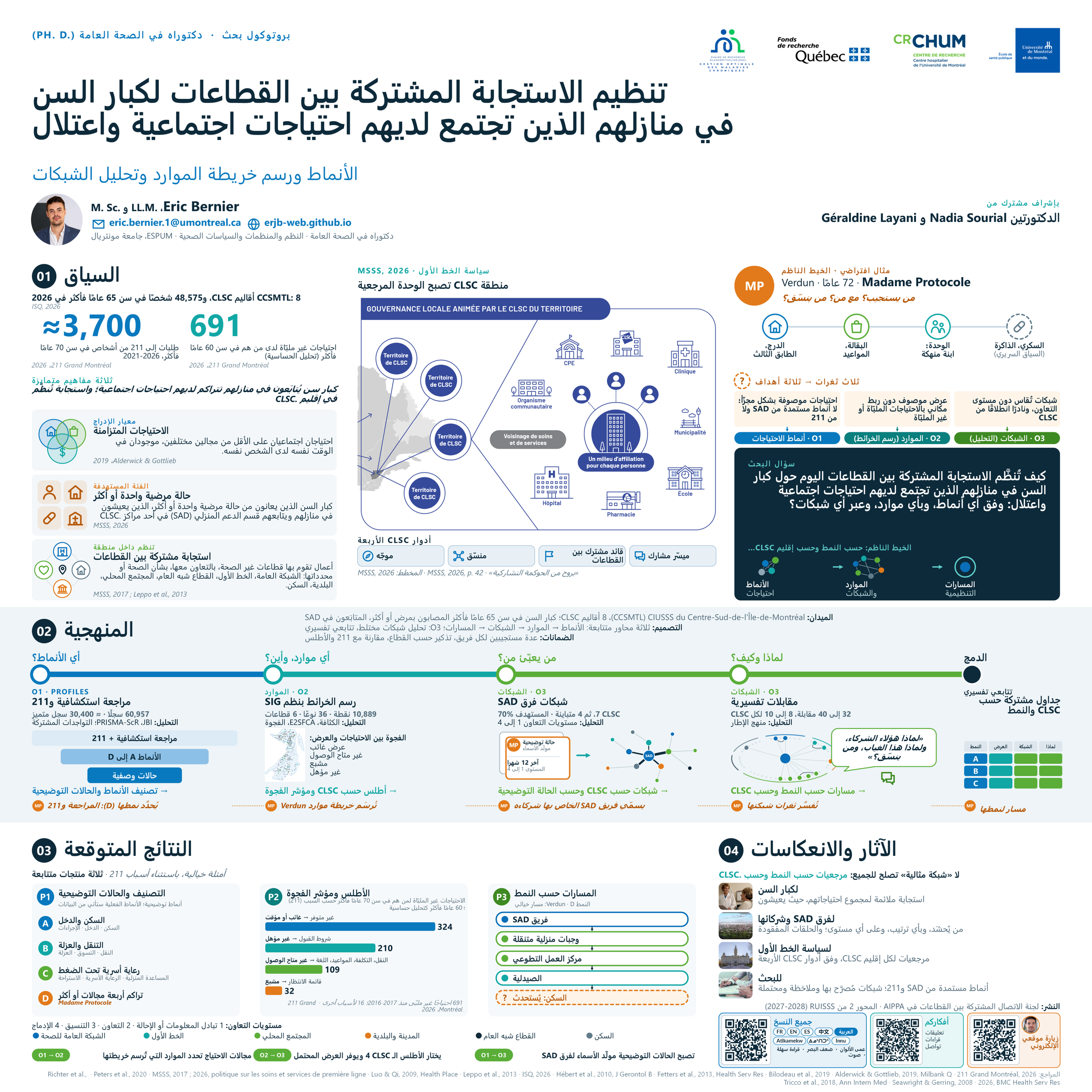
تنظيم الاستجابة بين القطاعات لكبار السن في منازلهم الذين تجتمع لديهم احتياجات اجتماعية ومراضة: الأنماط ورسم خرائط الموارد وتحليل الشبكات
الإشراف المشترك : الدكتورة Nadia Sourial (Ph. D.) · الدكتورة Géraldine Layani (M.D., M. Sc.)École de santé publique de l’Université de Montréal (كلية الصحة العامة بجامعة مونتريال، ESPUM)دكتوراه في الصحة العامة، تخصص الأنظمة والمنظمات والسياسات الصحية (SOPS) · السنة الثانيةChaire de recherche GSK en gestion optimale des maladies chroniques (كرسي GSK للبحث في الإدارة المثلى للأمراض المزمنة)Fonds de recherche du Québec (صناديق البحث في كيبيك)، منحة دكتوراه (B2)
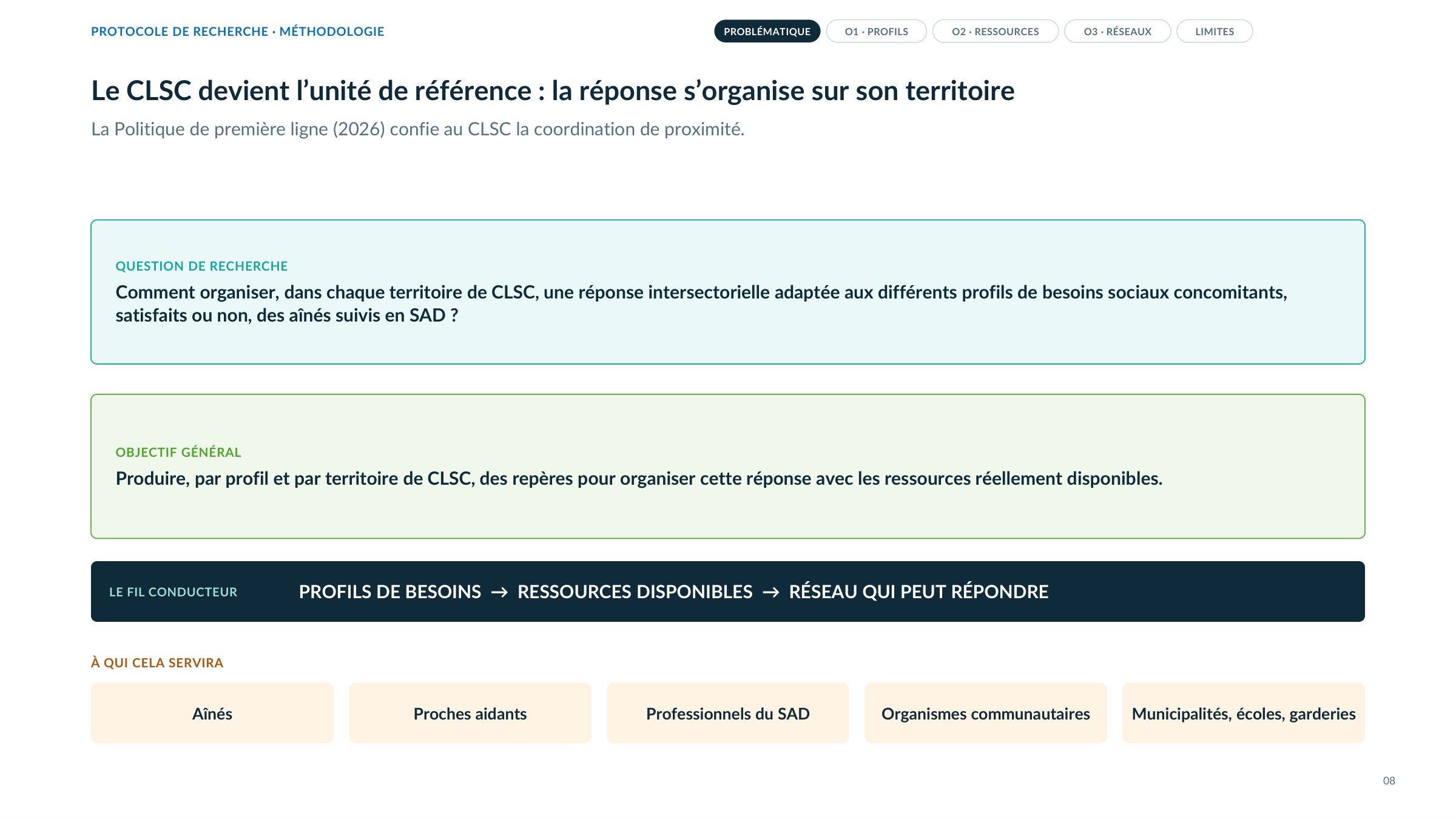
سؤال البحث
كيف تنتظم اليوم الاستجابة بين القطاعات حول كبار السن في منازلهم الذين تجتمع لديهم احتياجات اجتماعية ومراضة: وفق أي أنماط، وبأي موارد، وعبر أي شبكات؟
التصميم: مناهج مختلطة متعددة المراحل (Creswell & Plano Clark, 2017)، موقف براغماتي — O1 مراجعة نطاقية (JBI, PRISMA-ScR) وتحليل وصفي لبيانات 211؛ O2 دراسة كمية رصدية بيئية؛ O3 تصميم مختلط تتابعي تفسيري (QUAN → qual)، تحليل شبكات متمركزة حول الذات.
01السياق
سؤال البحث
كيف تنتظم اليوم الاستجابة بين القطاعات حول كبار السن في منازلهم الذين تجتمع لديهم احتياجات اجتماعية ومراضة: وفق أي أنماط، وبأي موارد، وعبر أي شبكات؟
1. المشكلة: احتياجات تفوق العرض
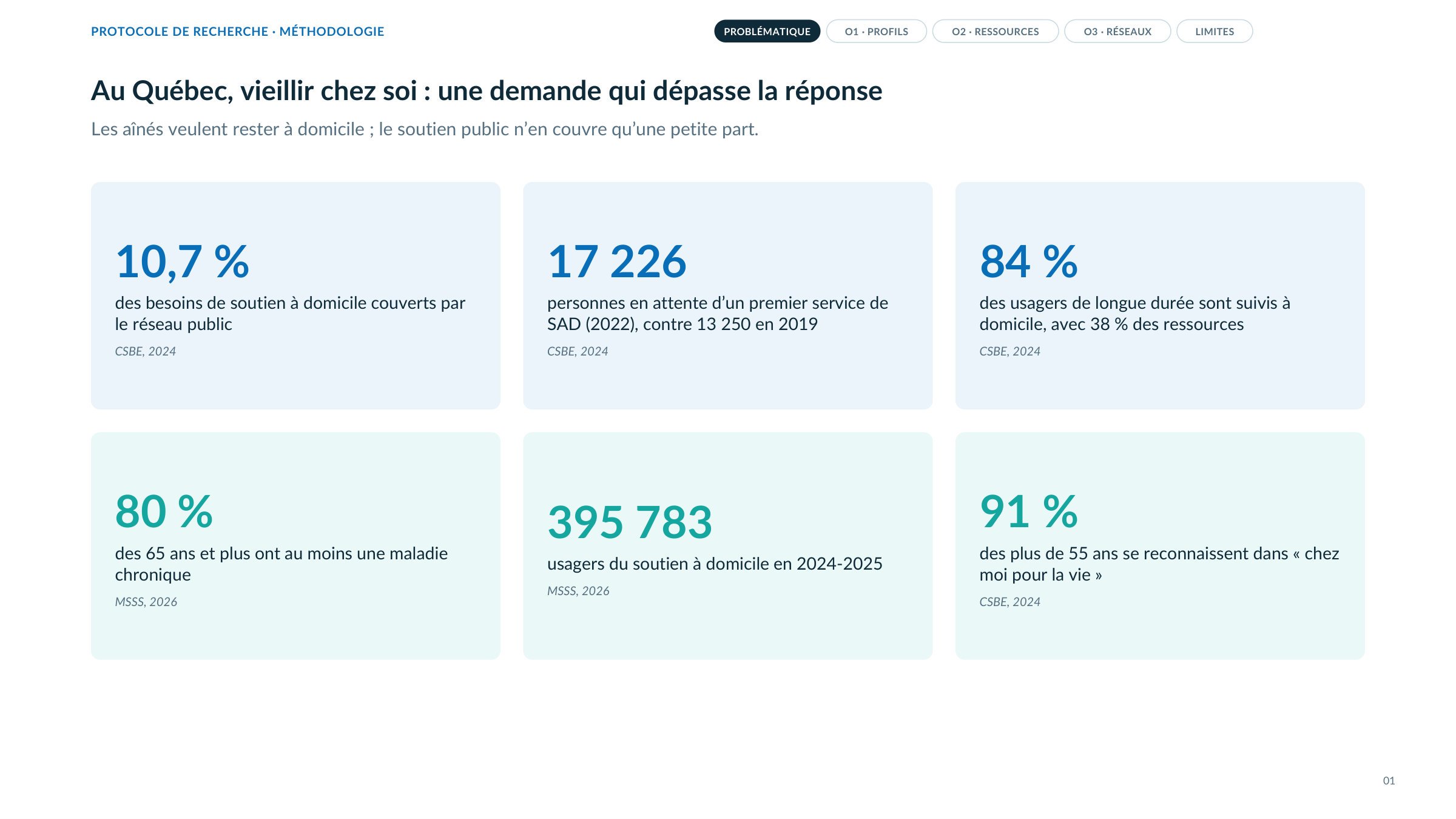
في كيبيك، يضم الدعم المنزلي (SAD) الرعاية والخدمات التي تقدمها الشبكة العامة في منزل الشخص، ولا سيما فريق الـCLSC (المركز المحلي للخدمات المجتمعية). في 2024-2025 خدم 395 783 شخصًا بما مجموعه 37,2 مليون ساعة، وكان 17 883 شخصًا ينتظرون خدمة أولى. ومن بين من بلغوا 65 عامًا فأكثر، يعيش 80 % مع مرض مزمن واحد على الأقل، والنصف مع عدة أمراض (تعدد الأمراض) (MSSS، Mieux chez soi، 2026، ص 4 و6).
نسبة الاحتياجات التي تغطيها الشبكة العامة، 2023
الدعم المنزلي10,7 %
RI-RTF68,8 %
CHSLD98,9 %
الدعم المنزلي: 25,4 من أصل 234,7 مليون ساعة مطلوبة (CSBE، 2024، ص 11).
الأشخاص في انتظار خدمة أولى في الدعم المنزلي
31 مارس 201913 250
31 مارس 202217 226
زيادة بنحو 30 % في ثلاث سنوات (CSBE، 2024، ص 2 و96).
مستخدمو الرعاية الطويلة ومواردها
المستخدمون المتابَعون في المنزل84 %
موارد الدعم المنزلي38 %
يتلقى الإيواء 62 % من الأموال لـ16 % من المستخدمين (CSBE، 2024، ص 7).
صحة من بلغوا 65 عامًا فأكثر في كيبيك
مرض مزمن واحد على الأقل80 %
تعدد الأمراضالنصف
و91 % ممن تجاوزوا 55 عامًا يتبنون «في منزلي مدى الحياة» (CSBE، 2024، ص 7؛ MSSS، 2026a، ص 4).
خلص مفوض الصحة والرفاه (CSBE)، بعد الأجزاء الأربعة من تقرير Bien vieillir chez soi (2023-2024)، إلى أن منظومة الدعم المنزلي معقدة وضعيفة التكامل وضعيفة الأداء. في 2023 لم توفر الشبكة العامة سوى 25,4 مليون ساعة من أصل 234,7 مليون ساعة مطلوبة في المنزل: أي معدل استجابة 10,7 %، مقابل 98,9 % في مراكز الرعاية الطويلة (CHSLD). ويتلقى الدعم المنزلي 38 % من موارد الرعاية الطويلة لـ84 % من المستخدمين، وارتفع عدد المنتظرين لخدمة أولى من 13 250 (2019) إلى 17 226 (2022). ويقع الباقي على عاتق مقدمي الرعاية من الأقارب والقطاع المجتمعي والقطاع الخاص، أي على قطاعات خارج الشبكة العامة.
في منطقة الدراسة (CCSMTL، 8 أقاليم CLSC) يبلغ عدد من هم في سن 65 فأكثر 48 575 شخصًا في 2026 (ISQ). في 2021 كان 28,6 % منهم يعيشون تحت عتبة الدخل المنخفض، وتصل النسبة إلى 41,8 % في Pointe-Saint-Charles و38,7 % في Centre-Sud؛ و66,9 % من الأسر مستأجِرة (هيئة الإحصاء الكندية). وفي خط 211، تتعلق احتياجات من هم في سن 70 فأكثر أولًا بالدعم الشخصي والمجتمعي (21,9 %) والسكن (13,4 %)، وهما مجالان تبقى فيهما احتياجاتهم غير ملبّاة ضعف ما هو عليه لدى جميع الأعمار. ولدى من هم في سن 60 فأكثر، السبب الأكثر تكرارًا هو «خدمة غير متاحة» (324 حاجة)، ثم شروط القبول (210) وغياب وسيلة النقل (66). ولا يأتي من CLSC سوى 44 طلبًا لمن هم في سن 60 فأكثر.
الساعات المطلوبة والمقدمة ومعدل الاستجابة في الرعاية الطويلة، كيبيك، 2023: تستجيب الشبكة العامة لـ10,7 % من الاحتياجات في المنزل. لقطة: Commissaire à la santé et au bien-être (2024)، Bien vieillir chez soi، الجزء 4، الملخص التنفيذي، ص 11 (توقعات Clavet وآخرين، HEC Montréal، 2023).الأرقام الستة الأساسية للمشكلة في كيبيك. المصدر: Bernier, E. (2026). منهجية الأطروحة O1-O3 [عرض تقديمي بالفرنسية]، الشريحة 2.
2. حين تتراكم الاحتياجات تتعقد الاستجابة
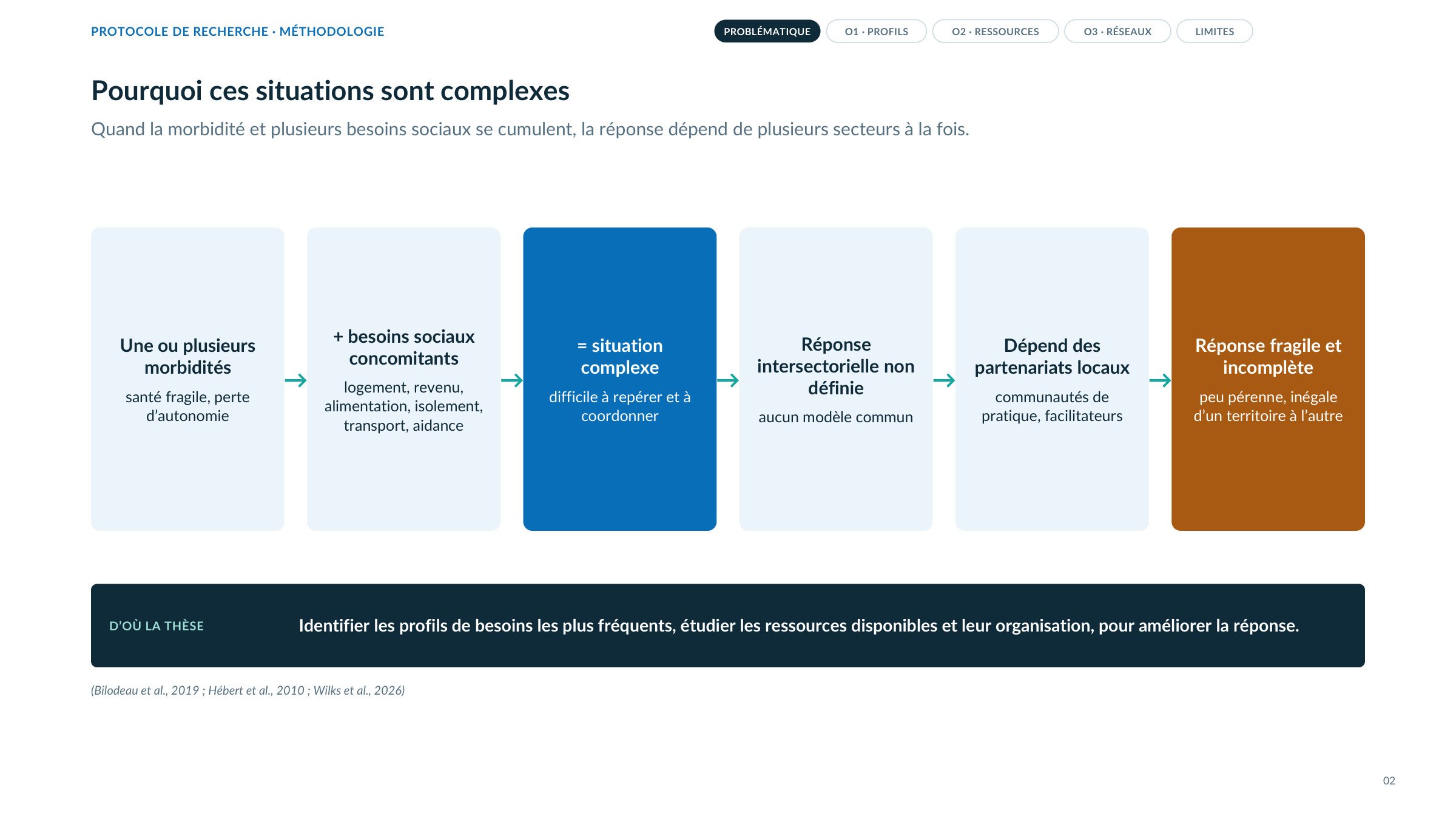
قد يعيش الشخص المسن في آن واحد مع مرض واحد أو أكثر (مشكلات صحية حادة أو مزمنة) ومع عدة احتياجات اجتماعية: سكن غير ملائم، دخل ضعيف، عزلة، غياب وسيلة نقل، مُعين قريب منهك. نتحدث هنا عن احتياجات اجتماعية متزامنة. وهي معًا عوامل تعقيد: كل منها يجعل حل الأخرى أصعب، ويفقد مسار الشخص سلاسته (Safford et al., 2007; Grembowski et al., 2014; Schaink et al., 2012; Johnson & Bacsu, 2018). وتقر سياسة Mieux chez soi بذلك: حين تمس الاحتياجات عدة جوانب من الحياة، يجب أن يعمل عدة متدخلين معًا، والأمراض المزمنة تزيد احتياجات المنزل تعقيدًا وكثافة (MSSS، 2026a، ص 4).
يصعب رصد هذه الحالات لأن أي خدمة وحدها لا ترى مجمل احتياجات الشخص، ويصعب تنسيقها أيضًا: إذ يصف مفوض الصحة والرفاه (CSBE) منظومة الدعم المنزلي بأنها معقدة وضعيفة التكامل وضعيفة الأداء. ولا نعرف دائمًا كيف ننظم استجابة مشتركة وملائمة ومنسقة. ومن المرجح أنه في الإقليم نفسه قد لا تعرف المنظمات بعضها أو لا تعمل معًا، وقد ينقص مورد دون أن يُعرف أن موردًا آخر من قطاع آخر يمكن أن يحل محله. لا تثبت أي دراسة ذلك مباشرة: إنه استنتاج توحي به الأعمال حول شبكات الخدمات وقدرة المنظمات المجتمعية وصعوبة العثور على المساعدة المتاحة (Lemieux-Charles et al., 2005; Varda et al., 2020; Hogg-Graham et al., 2021; Macleod et al., 2017). وفي خدمة 211، السبب الأكثر شيوعًا لعدم تلبية احتياجات من بلغوا 60 عامًا فأكثر هو «الخدمة غير متاحة».
سلسلة التعقيد: مرض واحد أو أكثر مع احتياجات اجتماعية متزامنة يجعل الوضع صعب الرصد والتنسيق. المصدر: Bernier, E. (2026). منهجية الأطروحة O1-O3 [عرض تقديمي بالفرنسية]، الشريحة 3.
3. أبواب دخول متعددة لا باب واحد
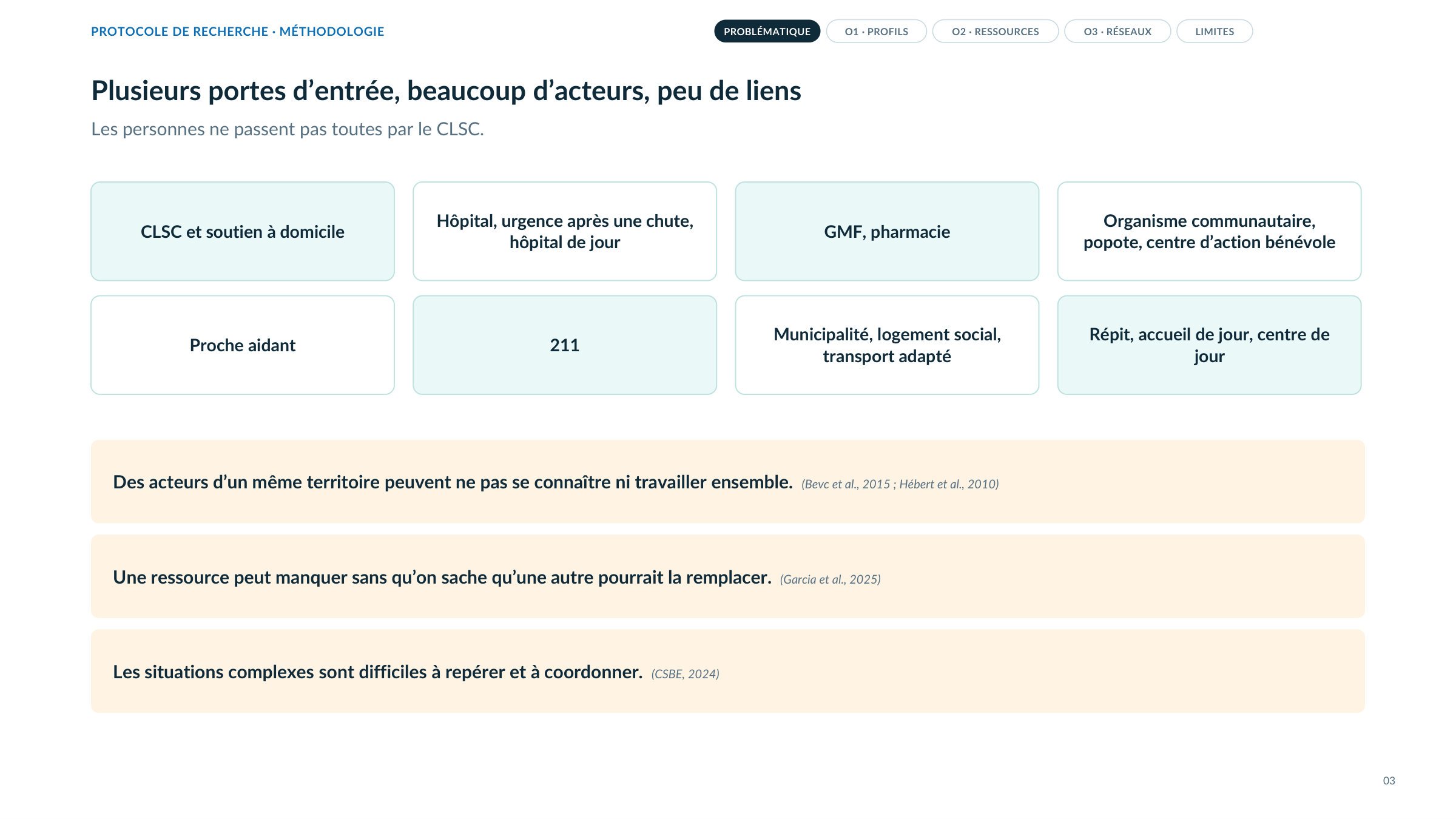
تريد سياسة Mieux chez soi أن يكون الـCLSC باب الدخول الرئيسي (MSSS، 2026a، ص XII). أما في الواقع فيدخل الشخص المسن الشبكة من أبواب كثيرة: فريق الدعم المنزلي في الـCLSC؛ مستشفى النهار؛ الاستشفاء؛ الطوارئ بعد سقوط؛ الرعاية المنزلية في الـCISSS أو الـCIUSSS (المؤسسات الجهوية للصحة والخدمات الاجتماعية)؛ مجموعة طب الأسرة (GMF)؛ الصيدلية؛ البلدية؛ السكن الاجتماعي؛ النقل المكيَّف؛ منظمة مجتمعية؛ مُعين قريب؛ خدمة 211 للمعلومات والإحالة. كل باب يرى جزءًا من الوضع، ولا يضمن أي منها أخذ كل الاحتياجات في الحسبان.
اثنا عشر باب دخول ممكنًا؛ والـCLSC، المرادُ بابًا رئيسيًا (MSSS، 2026a، ص XII)، ليس إلا واحدًا منها. ولا يرى أي باب وحده كل الاحتياجات.أبواب الدخول وضعف الروابط بينها. المصدر: Bernier, E. (2026). منهجية الأطروحة O1-O3 [عرض تقديمي بالفرنسية]، الشريحة 4.
4. ما هو قائم في كيبيك لتكامل الخدمات
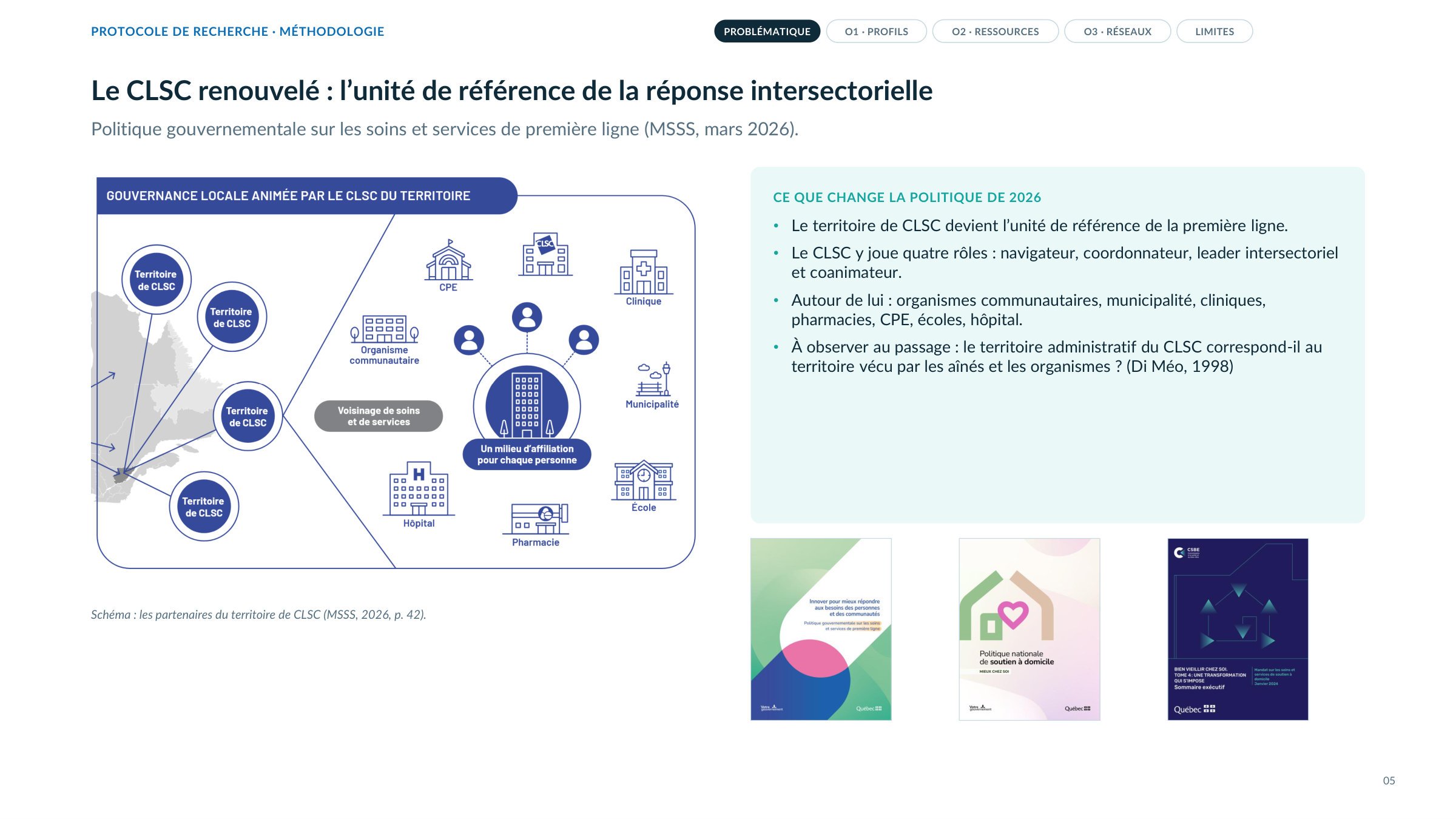
تربط السياسة الحكومية لخدمات الخط الأول الصحية والاجتماعية (MSSS، مارس 2026) كل شخص بإقليم CLSC يصبح وحدة المرجع لتنسيق الخط الأول (ص 15). وتسند إلى الـCLSC أربعة أدوار: الموجِّه، والمنسِّق، والقائد بين القطاعات، والمُيسِّر المشارك (ص 42). وتلاحظ التوجيهات الوزارية المرافقة أن الـCLSC، الذي صُمم محورًا إقليميًا، فقد حيويته وانفصل عن رسالته الأصلية (ص 1): والهدف هو إعادة هذا الدور إليه.
تقرّب عدة آليات بين الفاعلين. فـPRISMA، وهو نموذج كيبيكي لتكامل الخدمات لكبار السن الفاقدين لاستقلاليتهم، جمع شباكًا موحدًا وإدارة الحالات وأداة تقييم مشتركة وتشاور الشركاء، وأظهر تقييمه تراجعًا وظيفيًا أقل واحتياجات غير ملبّاة أقل (Hébert et al., 2003, 2010; Couturier et al., 2021). وتعتمد مقاربة القرب المتكاملة لكبار السن (AIPPA) التابعة لـMSSS (2024) على ممارسات تعاونية ورصد الأشخاص ذوي الاحتياجات (ص 8)، وعلى عمّال الميدان في برنامج ITMAV والمنظمين المجتمعيين في المؤسسات (ص 28)، وعلى مجتمعات الممارسة (ص 59؛ Ranmuthugala et al., 2011). والمنظم المجتمعي، التابع لخدمة التنظيم المجتمعي في الـCISSS أو الـCIUSSS، هو حلقة الوصل بين المؤسسة ومنظمات المحيط (Bourque & Lachapelle, 2010).
ليس العمل بين القطاعات جديدًا في كيبيك: فقد دعت إليه سياسة Chez soi : le premier choix (2003)، واقترح RUISSS جامعة مونتريال (2022) مخططًا من ستة قطاعات (الشبكة العامة، الخط الأول، شبه العام، المجتمع، المدينة، السكن) وأربعة مستويات للتعاون (تبادل المعلومات، التعاون، التنسيق، الاندماج؛ استنادًا إلى Bilodeau وParent وPotvin، 2019). ويمتد هذا العمل في نهج AIPPA التابع لـMSSS ولجنته للربط بين القطاعات في CCSMTL. وما ينقص هو وسيلة لمعرفة، إقليمًا بإقليم، أي القطاعات يجب حشدها لأي تركيبات من الاحتياجات.
الـCLSC، وحدة الحوكمة القريبة، وأدواره الأربعة: الموجِّه والمنسِّق والقائد بين القطاعات والمُيسِّر المشارك. لقطة: MSSS (2026)، Politique gouvernementale sur les soins et services de première ligne، ص 42.
استُخدم هذا المخطط، مع الأدبيات، لتحديد القطاعات المدروسة في الأطروحة (MSSS، 2026b، ص 42؛ Bilodeau et al., 2019).
هذه الآليات ثمينة، لكن الاستجابة بين القطاعات تبقى قليلة الوضوح. فهي تقوم غالبًا على شراكات محلية: مجتمع ممارسة، طاولة تشاور، شخص يؤدي دور الميسّر. وإذا غادر هذا الشخص أو توقف التمويل، ضعفت الاستجابة: فهي قليلة الاستدامة وغالبًا ناقصة. والأهم أن أيًا من هذه الآليات لا يبيّن أي توليفات الاحتياجات هي الأكثر تكرارًا، وما الموارد المتاحة لكل منها في الإقليم، ولا كيف تنتظم الشبكة اليوم للاستجابة. وهذا تحديدًا ما تستهدفه الأطروحة.
ما تغيّره سياسة 2026 (MSSS، 2026b، ص 15 و42). المصدر: Bernier, E. (2026). منهجية الأطروحة O1-O3 [عرض تقديمي بالفرنسية]، الشريحة 6.
5. ما حاولته الأدبيات
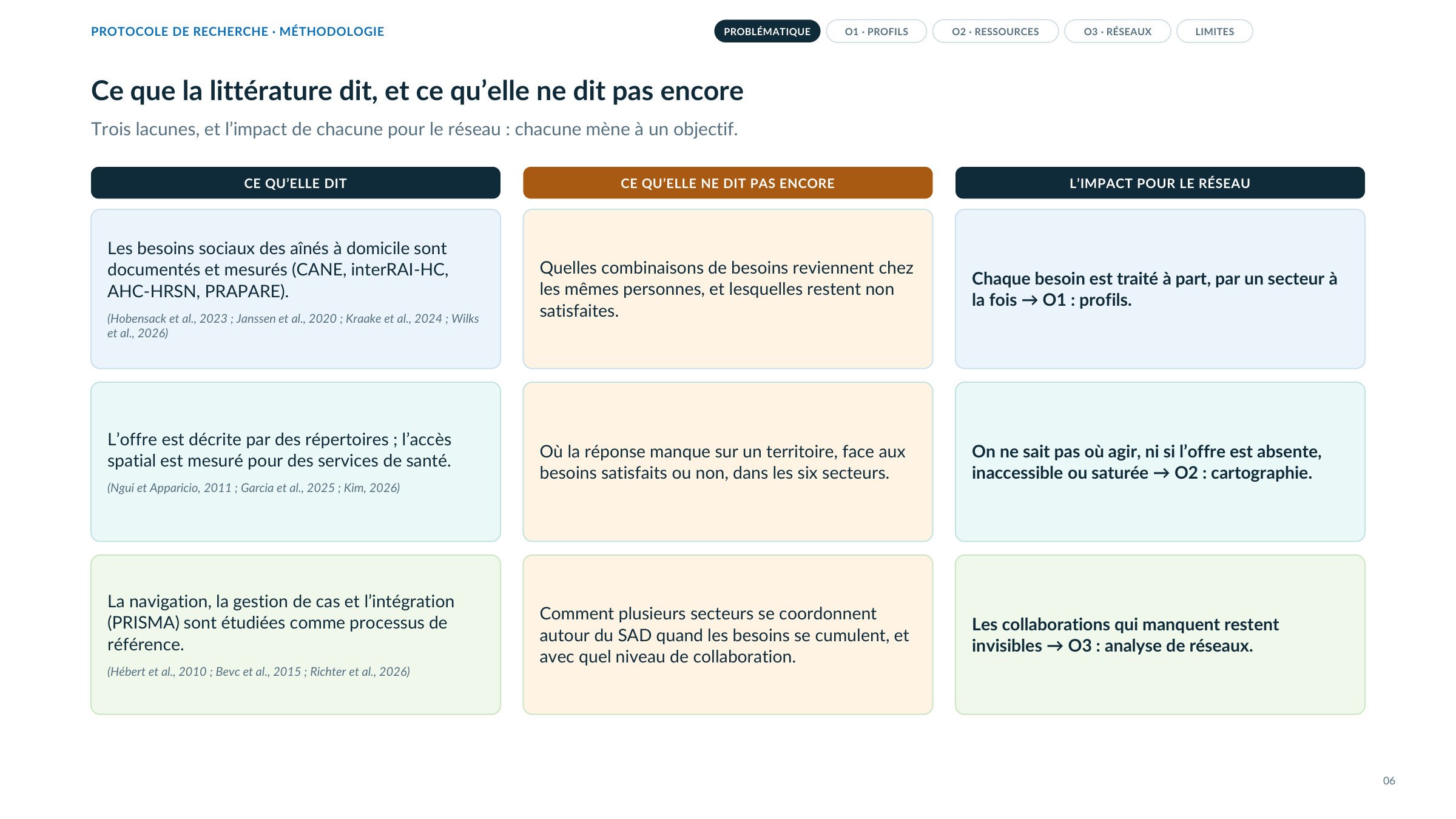
تقول إن الاحتياجات الاجتماعية لكبار السن في منازلهم شائعة ومتراكمة (McManus وآخرون، 2025؛ Tingvold وآخرون، 2026)، وإنها تتجمع في عناقيد (Kreuter وآخرون، 2021)، وإن هناك ملامح لاحتياجات ملبّاة أو غير ملبّاة، لكنها مبنية غالبًا على أداة CANE ووجهة نظر مقدمي الرعاية (Janssen وآخرون، 2020؛ Kraake وآخرون، 2024). وتوثّق الإحالة والتوجيه والوصفة الاجتماعية (Hébert وآخرون، 2010؛ Percival وآخرون، 2022) وخرائط عرض الخدمات (Kim، 2026؛ Álvarez-Pérez وآخرون، 2025).
لم تقل بعد أي تركيبات من الاحتياجات تتكرر لدى المستفيدين من الدعم المنزلي، ولا أيها يبقى غير ملبّى؛ ونادرًا ما تربط هذه التركيبات، في إقليم ما، بالموارد المتاحة؛ وتسجل تحليلاتها للشبكات وجود الرابط، ونادرًا مستوى التعاون، ولا تنطلق تقريبًا أبدًا من فرق الدعم المنزلي في عدة CLSC. تنطلق مراجعة النطاق الخاصة بـO1 من 60 957 سجلًا من أربع قواعد بيانات (MEDLINE وEmbase وAPA PsycInfo وPubMed): حُذف 8 938 سجلًا سابقًا لعام 2006، واستُورد 52 021 إلى Covidence، وحُذف 25 412 تكرارًا، وبقيت 26 609 دراسة للفرز من قبل مقيّمَين.
رسمت أعمال سابقة خرائط لاحتياجات كبار السن ومواردهم: ففي كيبيك، وصفت الدراسة التي أدارتها Anne-Marie Séguin (INRS) لصالح شركة الإسكان في كيبيك (2018) الاحتياجات الملبّاة وغير الملبّاة لمن بلغوا 75 عامًا فأكثر حسب نوع الوسط، ثم الموارد المحلية واستراتيجيات الأشخاص. ورسمت Juliette Duc وزملاؤها، باستعمال QGIS وR، خرائط عرض الخدمات والطلب عليها لمن بلغوا 65 عامًا فأكثر في كيبيك كلها: خدمات أقل لكل مسن في الوسط الريفي وتباين محلي كبير (Duc et al., 2026). ووصفت أعمال أخرى أنماط احتياجات المصابين بالخرف المقيمين في منازلهم (Janssen وآخرون، 2020)، أو حللت شبكات الخدمات بتحليل الشبكات الاجتماعية SNA (Urbanoski وآخرون، 2018). ولم يُرصد بعد أي عمل يربط الاحتياجات الاجتماعية المتزامنة والمرض الواحد أو الأمراض المتعددة بوصفها عوامل تعقيد على مستوى إقليم CLSC.
الفجوة الرئيسية
ليست الأدبيات خالية فيما يخص كل مكوّن من مكوّنات السؤال، سواء تعلّق الأمر بقياس الاحتياجات الاجتماعية المتعددة أو بتزامنها أو برغبة المرضى في المساعدة أو بآليات الاستجابة. غير أنه لم يُحدَّد أي توليف يجمع، لدى البالغين في الرعاية الأولية، بين الطابع غير الملبّى للاحتياجات وتزامنها وترتيب المرضى لأولوياتها والعلاقات المتبادلة بينها وشبكة الاستجابة والمسار حتى حلّها. ومن ثمّ تكمن الفجوة في الربط بين تشكيل الاحتياجات وتشكيل الاستجابة بين القطاعات، وفي الآليات التي تفسّر استمرار بعض الاحتياجات رغم تحديدها.
حرصًا على الدقة المنهجية، تُعتمد صيغة «لم يُحدَّد أي توليف في عمليات البحث المُجراة في PubMed و Cairn» بدلًا من «لا يوجد أي توليف».
ثلاث ثغرات، تقود كل منها إلى هدف. المصدر: Bernier, E. (2026). منهجية الأطروحة O1-O3 [عرض تقديمي بالفرنسية]، الشريحة 7.
6. استجابة بين القطاعات، لا مجرد تدخل فردي
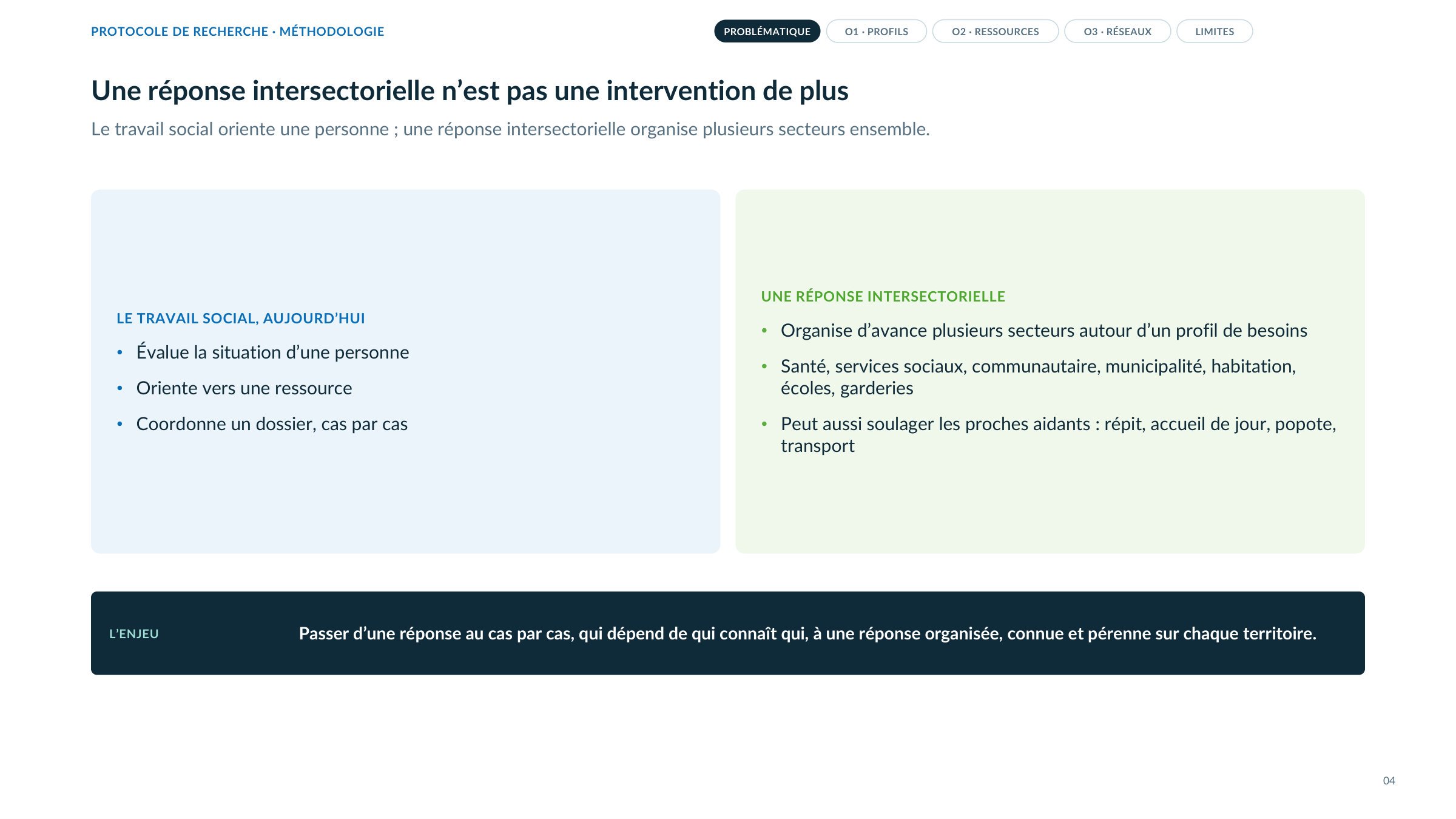
يقيّم الأخصائي الاجتماعي في الدعم المنزلي وضع الشخص ويوجهه ويرافقه: إنه تدخل فردي أساسي. أما الاستجابة بين القطاعات للاحتياجات الاجتماعية المتزامنة لدى شخص مصاب بمرض واحد أو أكثر فشيء آخر: إنها تنظيم عدة قطاعات في إقليم واحد (الصحة، الخدمات الاجتماعية، المجتمع المحلي، البلدية، السكن، النقل) تعمل معًا وبشكل دائم من أجل توليفة الاحتياجات نفسها. والرهان اليوم ليس في كفاءة المتدخلين بل في غياب تنظيم مشترك: فكل متدخل يعيد بناء شبكة، حالة بحالة، كان يمكن معرفتها مسبقًا. فالعمل الاجتماعي يقيّم ويوجه وينسق حالة بحالة، أما الاستجابة بين القطاعات فتنظم مسبقًا عدة قطاعات حول نمط ما (Couturier et al., 2022; Bilodeau et al., 2019). والرهان: الانتقال من «من يعرف من» إلى استجابة منظمة ودائمة.
العمل الاجتماعي اليوم
الاستجابة بين القطاعات المنشودة
يقيّم وضع شخص واحد
ينظم مسبقًا عدة قطاعات حول نمط احتياجات
يوجه نحو مورد
الصحة والخدمات الاجتماعية والمجتمع المحلي والبلدية والسكن والمدارس ودور الحضانة
ينسق ملفًا حالةً بحالة
يخفف أيضًا عن المُعينين: استراحة، استقبال نهاري، وجبات، نقل
يعتمد على «من يعرف من»
منظمة ومعروفة ودائمة في كل إقليم
استنادًا إلى Couturier وآخرين (2022) وBilodeau وآخرين (2019).
العمل الاجتماعي والاستجابة بين القطاعات. المصدر: Bernier, E. (2026). منهجية الأطروحة O1-O3 [عرض تقديمي بالفرنسية]، الشريحة 5.
7. محور ثانوي: الإقليم المَعيش والإقليم الإداري
تجعل سياسة 2026 إقليم الـCLSC وحدة المرجع. وتوضح التوجهات المرافقة لها أن هذا الإقليم لم يعد مجرد تقسيم إداري بل فضاء حيّ، وأن الأقاليم الـ166 الحالية ليست غايات في ذاتها (MSSS، 2026، الملخص وص 4). غير أن أقاليم الـCLSC حُددت أولًا لإسناد سكان إلى كل مؤسسة (MSSS، توصيات حول إدارة البيانات الإقليمية)؛ وفي مونتريال قسّمت الصحة العامة الجزيرة إلى 101 حيّ أقرب إلى المجتمعات، ولا تطابق الوحدات الإدارية دائمًا الأوساط المَعيشة (Di Méo, 1998; Riva et al., 2008; Macé, 2010; Breton et al., 2009). وفي المقام الثاني ستتحقق الأطروحة مما إذا كانت الموارد التي يستعملها الناس فعلًا تتبع حدود الـCLSC أم تتجاوزها.
8. فكرة الأطروحة
ومن هنا فكرة الانطلاق: تحديد أكثر أنماط الاحتياجات الاجتماعية المتزامنة تكرارًا لدى كبار السن المتابَعين في الدعم المنزلي؛ ولكل نمط، رصد الموارد المتاحة في كل إقليم CLSC؛ ثم فهم كيف تنتظم الاستجابة اليوم من أجل تحسينها. وتتناول الأطروحة كبار السن المصابين بمرض واحد أو أكثر، المقيمين في منازلهم والمتابَعين في الدعم المنزلي في أقاليم الـCLSC الثمانية التابعة لـCIUSSS du Centre-Sud-de-l’Île-de-Montréal (48 575 شخصًا في سن 65 فأكثر في 2026).
يُختصر الخيط الناظم في ثلاث كلمات: الأنماط ← الموارد ← الشبكة. يبين O1 أي توليفات الاحتياجات تتكرر؛ ويبين O2 إقليمًا بإقليم ما يوجد للاستجابة وما ينقص؛ ويبين O3 من يعمل معًا أصلًا وأي الروابط تنقص. وكل مرحلة تمنح التالية ما تحتاج إليه.
9. موقعي
ينطلق تفكيري من مساري بين عدة قطاعات ومن ملاحظتي لسياسات البقاء في المنزل التي عملت عليها في ANAP. وبصفتي مربيًا متخصصًا، رأيت كم يصعب تنظيم استجابة مشتركة لأشد الحالات تعقيدًا حين تتدخل عدة خدمات دون تنسيق. تسعى هذه الأطروحة إلى جعل ما يقوم اليوم أساسًا على حسن نية كل طرف مرئيًا، ومن ثم قابلًا للتنظيم.
الأسس الوثائقية
تدعم الموارد الآتية البناء المفاهيمي. ويمثّل العنوان وسؤال البحث وأطروحة المشروع وأهدافه، الواردة في أقسامها المخصّصة، الإطار الحالي للمشروع.
بلورة مشروع البحث
أنا في مرحلة بلورة المشروع: مدوّنة منشورات مرتّبة حسب الأولوية، والفجوات التي تكشفها، وقراءات التكوين التي تدعمها.
222المنشورات المعتمدة
39القراءات ذات الأولوية
83القراءات المهمة
9أبعاد الفجوات المدروسة
التوزيع حسب الأولوية
الأولوية 539
الأولوية 483
الأولوية 346
الأولوية 224
الأولوية 130
مصادر المنشورات
222
PubMed112
Embase و MEDLINE (Ovid)95
Cairn15
جرى تكوين المدوّنة انطلاقًا من Ovid (Embase و MEDLINE) و PubMed و Cairn، ومُنح كل منشور أولويةً بحسب صلته بسؤال الأطروحة.
ما تتركه الأدبيات مفتوحًا
يبيّن الجدول، لكل بُعد من الأبعاد التسعة المدروسة، حالة الأدبيات وأهمية الفجوة وبعض المراجع الأساسية.
بناء المفهوم
كبيرة
قائمة لكنها غير مستقرة
تميّز الدراسات المفهرسة في PubMed بشكل متزايد بين الخطر الاجتماعي والحاجة الاجتماعية والرغبة في المساعدة. وتضيف الأعمال الفرنكوفونية في Cairn مفردات الهشاشة والضعف الاجتماعي، وهي غالبًا متعددة الأبعاد لكنها أوسع مفهوميًا من الحاجة غير الملبّاة.
Gruß 2021; Tucher 2026; Tudrej 2019; Karran 2023
القياس
كبيرة
وفيرة لكنها غير متجانسة
تختلف الأدوات اختلافًا كبيرًا في مجالاتها وعتباتها وطريقة تطبيقها. ولا تعادل مقاييس الهشاشة متعددة الأبعاد الواردة في Cairn، مثل EPICES و PRECAR، استبيانات الاحتياجات الاجتماعية غير الملبّاة.
Zein 2026; Karran 2023; Tudrej 2019; Rogers 2025
التوصيف والانتشار
متوسطة
موثّقة جيدًا لحاجة واحدة على الأقل
تصف دراسات عديدة الانتشار حسب المجال والعبء التراكمي، لكن مقارنة التقديرات تصعب عندما يختلف تعريف الحاجة والأداة المستخدمة.
Jih 2023; Bleacher 2020; Fiori 2021
التعدد والتزامن
كبيرة
ناشئة لكنها مُثبتة الآن
إن تعايش عدة احتياجات أو مخاطر اجتماعية أمر شائع، وقد اقتُرحت عناقيد وفئات ومقاييس للعبء التراكمي. وتُظهر دراسة حديثة كذلك أن تعدد المخاطر يزيد بقوة من احتمال الرغبة في الحصول على المساعدة.
Vest 2025; Kreuter 2021; Zeng 2024; Tucher 2026
ترتيب الأولويات من قِبل المرضى
جوهرية
بعض الدراسات المباشرة، لكن المجال لا يزال قليل التطور
تقيس الأدبيات أساسًا الرغبة في المساعدة والأهداف المتفاوض عليها والمقبولية أو الأولوية النسبية، وتعزّز الأعمال الحديثة التمييز بين الخطر المكتشف والمساعدة المرغوبة. وتُظهر أعمال e-CARE مرافقةً مكيّفة مع إيقاع المريض وأولوياته، من دون إنتاج ترتيب معياري للاحتياجات.
توثّق التحليلات الكمية أساسًا تزامن الاحتياجات وأنماطها. وتصف الأعمال النوعية الفرنكوفونية في Cairn تشابك الصعوبات الاجتماعية والإدارية والاقتصادية والصحية، لكنها نادرًا ما تتناول اتجاهها أو تسلسلها أو آليتها السببية.
Vest 2025; Kreuter 2021; Marron-Delabre 2015; Ouanhnon 2022
الحلّ والمسار
جوهرية
متنامية لكن تهيمن عليها مؤشرات وسيطة
يميّز المجال تدريجيًا بين الفحص والإحالة والربط وتلقّي المورد والحلّ. وتتابع أعمال e-CARE الفرنكوفونية كذلك نتائج ملموسة مثل فتح الحقوق والوصول إلى طبيب معالج والسكن والاستقلالية في المسار، لكن من دون قياس معياري لحلّ كل حاجة.
توثّق دراسات PubMed التوجيه داخل منظومة الرعاية والعاملين الصحيين المجتمعيين والشراكات الطبية القانونية والإحالة ذات الحلقة المغلقة، فيما توثّق أعمال Cairn الوحدات الاجتماعية في الطب العام وهياكل الرعاية الأولية والتنسيق الإقليمي الفرنسية (MSP و CPTS و DAC). غير أن تشكيل الشبكة نادرًا ما يُربط بأنماط الاحتياجات وبحلّها.
لم يُعثر على أي توليف يجمع، لدى البالغين المراجعين للرعاية الأولية، بين الطابع غير الملبّى للاحتياجات وقياسها متعدد المجالات وأنماط تزامنها والأولوية التي يمنحها لها المريض والعلاقات المتبادلة بينها وتشكيل الشبكة القابلة للتعبئة والمسار حتى حلّها.
Karran 2023; Vest 2025; Chang 2026; Tudrej 2019; Ouanhnon 2022
Rodriguez J.; Nafisi A.; Rob-Inson C.; Arteaga E.; Pierce L.D.; Sunn L.; Kim K.J. (2018) Social determinants of health screening and com-munity resource referral in a safety-net resident primary care clinic. ملخص مؤتمر
لدى كبار السن المتابَعين في الدعم المنزلي، لا يمكن تنظيم الاستجابة المشتركة بين القطاعات احتياجاً بعد احتياج، بل بحسب نمط الاحتياجات المتزامنة وبحسب إقليم CLSC، انطلاقاً من الموارد المتاحة فعلاً والشبكات المعبَّأة فعلاً حول فرق SAD.
الهدف العام
إنتاج معالم، بحسب النمط وبحسب إقليم CLSC، لتنظيم الاستجابة المشتركة بين القطاعات بالموارد المتاحة فعلاً.
الأهداف النوعية
O1 أنماط الاحتياجات
1 · الثغرة
الاحتياجات الاجتماعية المتزامنة لكبار السن في المنزل موثَّقة، لكن بصورة مجزأة: فالتعريفات والمقاييس والأنماط تختلف. ولم تستخلص أي دراسة تم رصدها أنماطاً من تقييمات SAD (OEMC، interRAI-HC) ولا من الطلبات الموجهة إلى 211 (Wilks et al., 2026 ; Janssen et al., 2020 ; Kraake et al., 2024 ; Kreuter et al., 2021).
2 · الهدف
تحديد مختلف أنماط الاحتياجات الاجتماعية المتزامنة لدى كبار السن ذوي عوامل المراضة أو الأمراض المصاحبة الذين تتكفل بهم الخدمات المنزلية (CLSC).
3 · المنتَج النهائي
المنتَج النهائي: تصنيف لأنماط الاحتياجات الاجتماعية المتزامنة، الملبّاة أو غير الملبّاة، مترجم إلى حالات نموذجية. ما الذي يقدمه: معرفة أي توليفات الاحتياجات أكثر تكرارًا لتنظيم الاستجابة حولها.
O2 الموارد المتاحة (رسم الخرائط)
1 · الثغرة
تنطلق تحليلات العرض من دليل محدَّد سلفاً، دون مقاطعته مكانياً مع الاحتياجات المعبَّر عنها وغير الملباة. والأدلة غالباً غير دقيقة؛ ولا يُعرف أين يغيب العرض أو يتعذر الوصول إليه أو يبلغ حد التشبع (Kim, 2026 ; Janda et al., 2021 ; Garcia et al., 2025).
2 · الهدف
رسم خريطة مكانية لموارد كل إقليم من أقاليم CLSC التي يمكن أن توفر استجابة مشتركة بين القطاعات لهذه الاحتياجات.
ستة قطاعات: الشبكة العامة، والخط الأول، وشبه العام، والمجتمع، والبلدية، والسكن.
3 · المنتَج النهائي
المنتَج النهائي: أطلس لكل إقليم CLSC، ومصفوفة احتياجات × موارد، ومؤشر فجوة. ما الذي يقدمه: معرفة أين توجد الاستجابة لكل نمط وأين تنقص ولماذا (غائبة أو غير متاحة أو مشبعة).
O3 الشبكات (تحليل الشبكات)
1 · الثغرة
تُدرس الاستجابات لاحتياجات كبار السن الاجتماعية غالباً بوصفها عمليات إحالة. وتُقاس الشبكات بين المنظمات في الغالب دون مستوى التعاون، ونادراً ما تنطلق من عدة مراكز CLSC (Hébert et al., 2010 ; Bevc et al., 2015 ; Richter et al., 2026).
2 · الهدف
تحديد المسارات التنظيمية للموارد المشتركة بين القطاعات التي تُعبَّأ للاستجابة لمختلف الأنماط، في عدة أقاليم متباينة من أقاليم CLSC (SAD).
بالتعاون مع فرق الدعم المنزلي في CIUSSS du Centre-Sud-de-l’Île-de-Montréal.
3 · المنتَج النهائي
المنتَج النهائي: خريطة شبكة كل CLSC ولكل نمط، مع الحلقات الناقصة. ما الذي يقدمه: معرفة من يعمل معًا أصلًا، ومن ينبغي أن يفعل، وعلى أي روابط ينبغي التحرك.
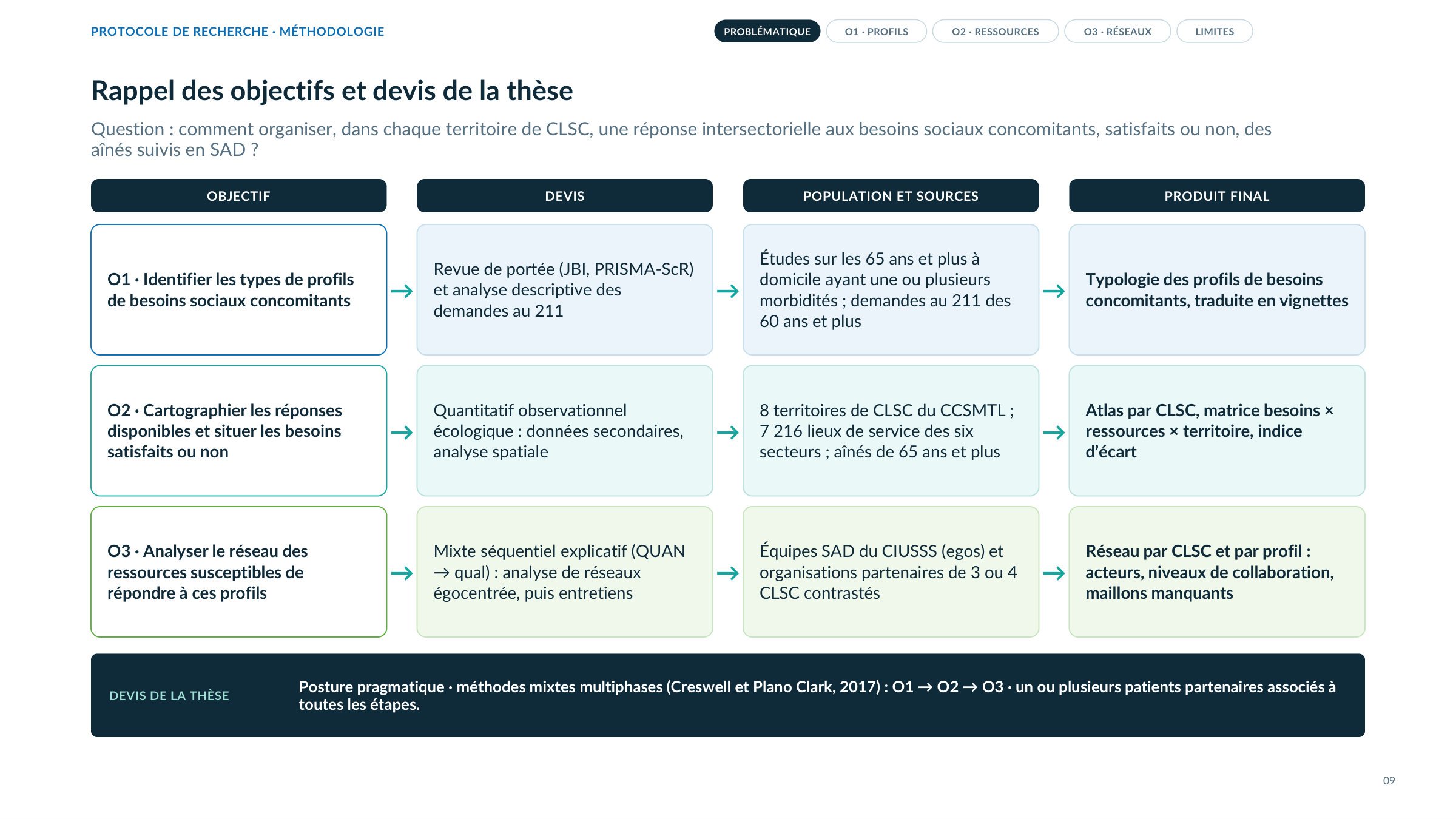
كل هدف وتصميمه وسكانه ومنتَجه النهائي. المصدر: Bernier, E. (2026). منهجية الأطروحة O1-O3 [عرض تقديمي بالفرنسية]، الشريحة 10.
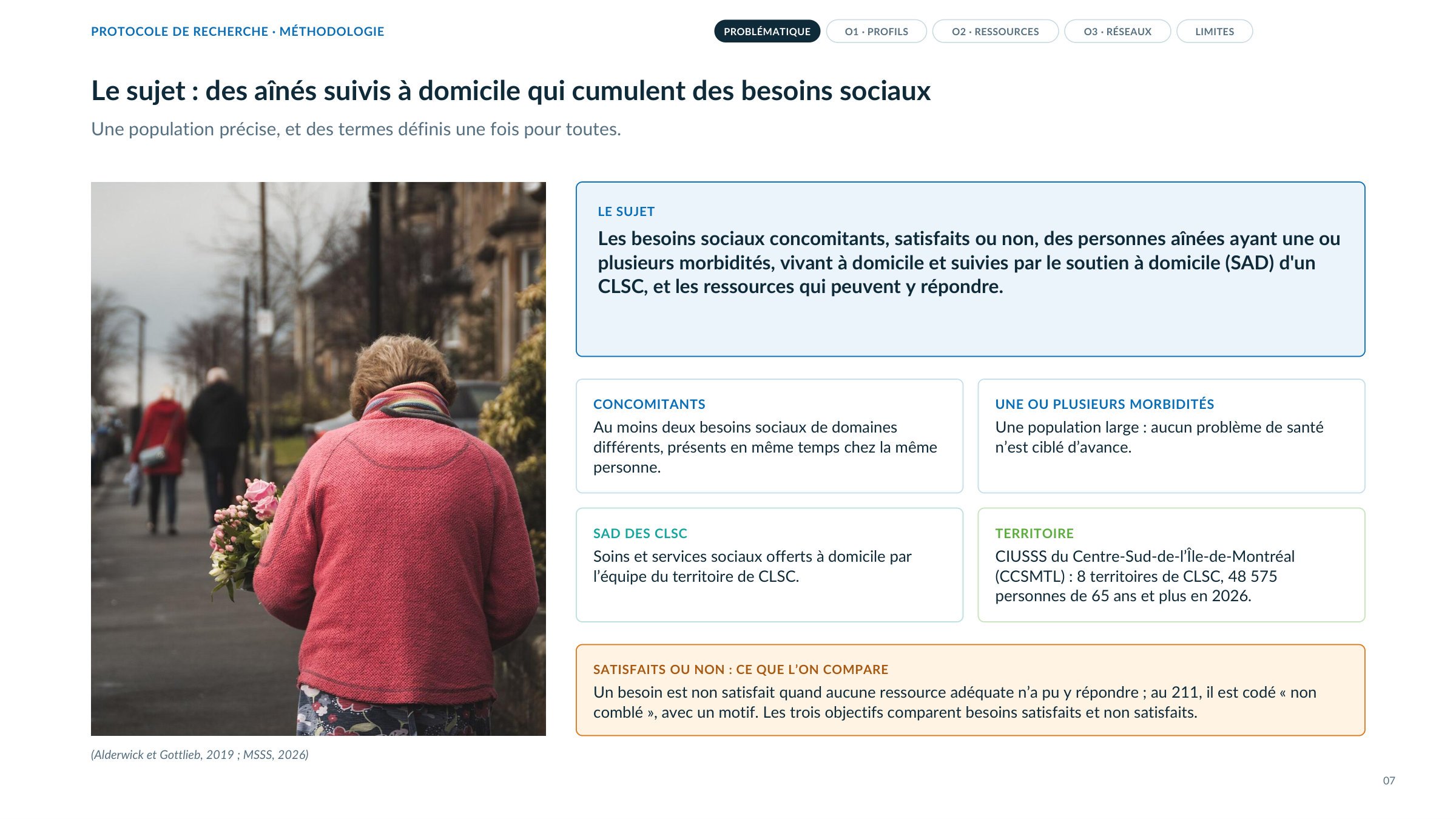
أربعة مفاهيم
السكان: الأشخاص في سن 65 فأكثر. أما بيانات 211 فيشمل التحليل الرئيسي من بلغوا 70 عامًا فأكثر، لأن 211 لا ينشر إلا فئتي 60-69 و70 فأكثر؛ ويُستعمل من بلغوا 60 فأكثر لتحليل الحساسية.
الاحتياجات المتزامنة
احتياجان اجتماعيان على الأقل من مجالين مختلفين، حاضران في الوقت نفسه لدى الشخص نفسه.
(Kreuter et al., 2021)
مرض واحد أو أكثر
أي مشكلة صحية، حادة كانت أو مزمنة. قد تكون لدى الشخص مشكلة واحدة أو عدة مشكلات.
SAD في مراكز CLSC
الرعاية والخدمات الاجتماعية التي يقدمها فريق إقليم CLSC في المنزل.
(MSSS, 2026)
احتياج غير ملبّى
لدى 211، يكون الاحتياج غير ملبّى عندما يتعذر اقتراح مورد ملائم، مع ذكر السبب. يُقاس هذا الاحتياج ولا يُجعل معيار إدراج.
(Alderwick et Gottlieb, 2019)
«ملبّاة أو غير ملبّاة»: عمّ نتحدث؟
يتغير معنى «غير ملبّاة» بحسب المصدر. ففي 211 تكون الحاجة غير ملبّاة حين يتعذر اقتراح مورد ملائم، مع ذكر السبب؛ ولدى هيئة الإحصاء الكندية أو INSPQ هي حاجة مُدرَكة بلا خدمة؛ وفي CANE مشكلة بلا مساعدة كافية في نظر مقيِّم. تعتمد الأطروحة تعريف 211 وتقارن في الأهداف الثلاثة بين الاحتياجات الملبّاة وغير الملبّاة (Alderwick & Gottlieb، 2019).
الموضوع ومصطلحاته معرَّفة مرة واحدة. المصدر: Bernier, E. (2026). منهجية الأطروحة O1-O3 [عرض تقديمي بالفرنسية]، الشريحة 8.
03المنهجية
المنهجية
التصميم العام: موقف براغماتي؛ مناهج مختلطة متعددة المراحل (Creswell وPlano Clark، 2017)، O1 ← O2 ← O3، وكل مرحلة تبني التالية. تُستخدم القصص التوضيحية لـO1 مولِّدًا للأسماء في O3؛ ويختار أطلس O2 أقاليم CLSC الخاصة بـO3 ويوفر العرض المحتمل. يُشرَك الفاعلون الميدانيون في كل مرحلة: كبار السن، والمُعينون القريبون، والمهنيون، والمسيرون، وشركاء من كل القطاعات، مع شريك مريض واحد أو أكثر.
O1 الملامح
التصميم
مراجعة نطاق (JBI، PRISMA-ScR)، إضافة إلى تحليل وصفي كمي لطلبات 211.
السكان
دراسات حول من تبلغ أعمارهم 65 عامًا فأكثر ويعيشون في منازلهم مع مرض واحد أو أكثر؛ طلبات 211 لمن هم في سن 60 فأكثر في إقليم CCSMTL.
المعاينة
لا توجد: تُفحص كل الأدبيات المحددة. القواعد: MEDLINE وEmbase وAPA PsycInfo (Ovid) وPubMed؛ استراتيجية من 42 سطرًا في 7 كتل، جرى التحقق منها على 6 مقالات مرجعية.
جمع البيانات
60 957 سجلًا ← −8 938 (قبل 2006) ← 52 021 في Covidence ← −25 412 تكرارًا ← 26 609 للفرز. فرز من قبل مقيّمَين مستقلين (العناوين والملخصات ثم النصوص)، واختبار تجريبي على 25 سجلًا؛ استخراج مزدوج (التعاريف والأدوات والمجالات والملامح).
التحليل
توليف وصفي في جدول من 10 إلى 14 مجالًا مرتبط بتصنيف 211؛ الاحتياجات الملبّاة أو غير الملبّاة في 211 مع أسبابها.
لا يعيش الشخص المسن احتياجاته واحدة تلو الأخرى: الدرج والتسوق والوحدة والاستمارات يعزز بعضها بعضًا. إن إبقاء 12 مجالًا منفصلًا يعيد إنتاج التجزئة التي ينتقدها CSBE في الدعم المنزلي، حيث تستجيب كل خدمة لمجالها وحده. أما الملمح فيصف التركيبة، أي الاستجابة الواجب تنظيمها: من يجب حشده معًا. ويشمل مرضًا واحدًا أو أكثر، لأن ذلك يغيّر طبيعة الاستجابة (نصف من هم في سن 65 فأكثر يعيشون مع عدة أمراض).
لماذا الملامح لا الفرد؟
أولًا الجدوى: البيانات الفردية للدعم المنزلي (OEMC وI-CLSC) تتطلب إذنًا قانونيًا و2 000 مستخدم على الأقل؛ وتُظهر محاكاة البروتوكول أنه دون ذلك لا يمكن استخراج الملامح، وأنه في 211 (1,4 حاجة لكل طلب) لا يكفي أي حجم. ثانيًا مستوى القرار: يخطط الـCLSC لمجموعات من الحالات لا لحالة واحدة. وأخيرًا الأخلاقيات ونقل المعرفة: الملمح المحوَّل إلى قصة توضيحية (Madame Protocole) يُعرض على جميع الفرق دون كشف أي شخص.
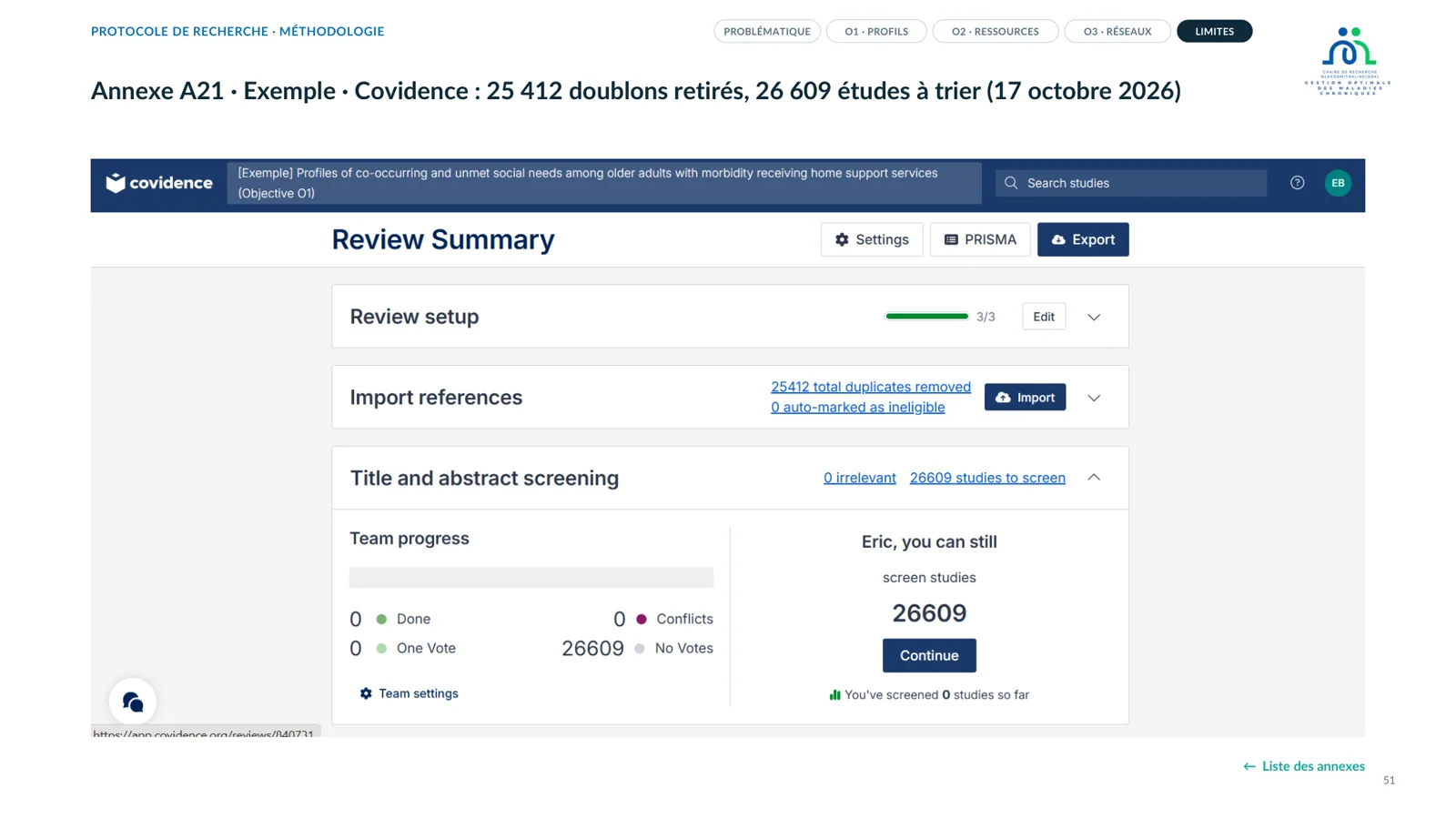
الفرز جارٍ في Covidence: استيراد 52 021 سجلًا، وحذف 25 412 تكرارًا، و26 609 دراسة للفرز. لقطة شاشة: Covidence، مراجعة النطاق O1 لإريك برنييه، أكتوبر 2026.
O2 الاستجابات المتاحة
التصميم
دراسة كمية رصدية بيئية على بيانات ثانوية.
السكان
أقاليم CLSC الثمانية في CCSMTL؛ جميع موارد القطاعات الستة (7 216 موقعًا، 35 نوعًا)؛ كبار السن في سن 65 و75 فأكثر (تعداد 2021، ISQ)؛ احتياجات من هم في سن 60 فأكثر في 211 (2024-2025).
المعاينة
جرد شامل دون عينة؛ 52 مصدرًا مسجلًا في السجل.
جمع البيانات
ستة متغيرات مشتركة (الموقع، الإقليم، القطاع، مجال الحاجة، تاريخ المصدر، المعرّف المُنشأ)؛ ترميز مزدوج، κ = 0,94.
القياسات
الكثافة لكل 1 000 مسن؛ الوصول سيرًا (500 م، 1 كم) وبالنقل العام (15 و30 دقيقة، E2SFCA)؛ الاحتياجات الملبّاة أو غير الملبّاة (211)؛ الاستجابة المشتركة لمجالين.
التحليل
R في Positron وخرائط QGIS؛ مؤشر الفجوة (عرض غائب، غير متاح، مشبع، غير مؤهل)؛ التجمعات المكانية (مؤشر موران المحلي). الأمثلة حسب مجال الحاجة (14 فئة AIRS في 211) بانتظار O1.
المُنتَج
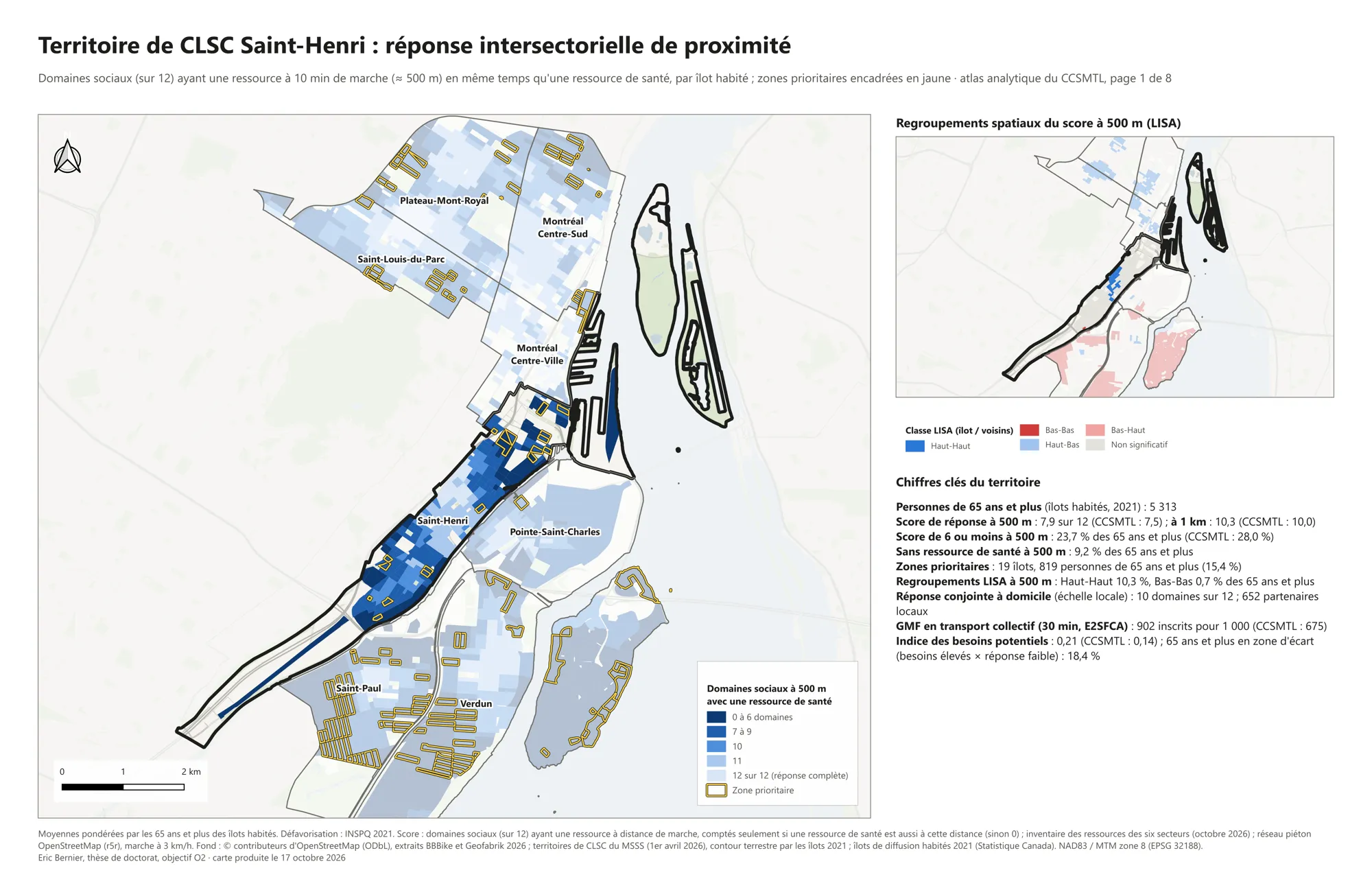
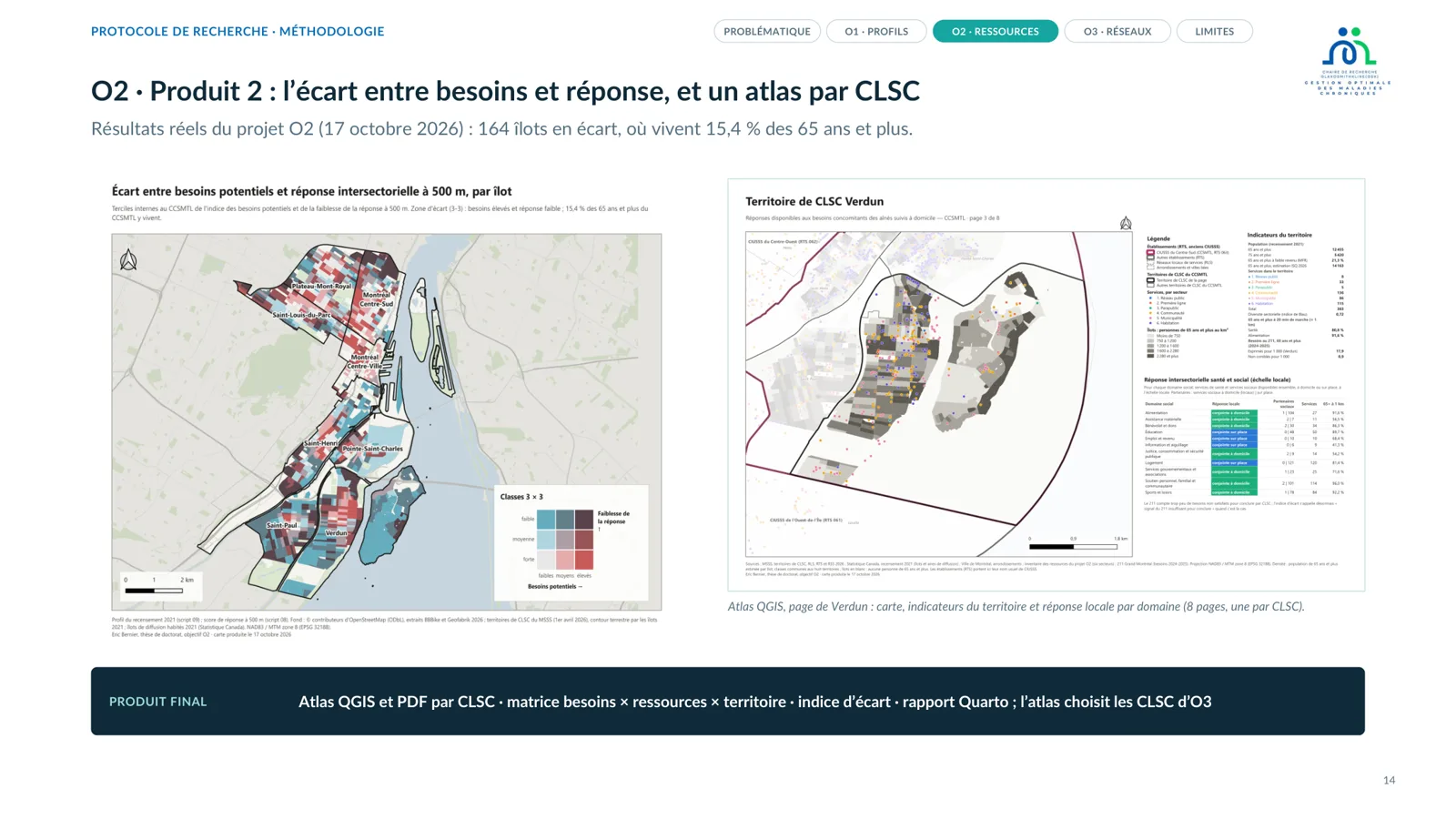
أطلس لكل CLSC، ومصفوفة الاحتياجات × الموارد × الإقليم، ومؤشر الفجوة. مثال: 164 مربعًا سكنيًا فيه فجوة، يعيش فيها 15,4 % ممن هم في سن 65 فأكثر.
لماذا رسم الخرائط؟
لأن سياسة 2026 تجعل إقليم الـCLSC وحدة المرجع: يجب الحكم على الاستجابة حيث يعيش الناس. تضع الخريطة الاحتياجات الملبّاة وغير الملبّاة في مقابل موارد القطاعات الستة، وتقيس إمكانية الوصول سيرًا وبالنقل العام (E2SFCA)، وتميّز بين عرض غائب أو غير متاح أو مشبع. كما تختار بشفافية 3 أو 4 أقاليم CLSC متباينة لـO3. ويجعل R في Positron وQGIS كل مؤشر قابلًا لإعادة الحساب.
الأطلس التحليلي · Saint-Henriسكربتات R المرقمة لمشروع رسم الخرائط، تُشغَّل في Positron: يُعاد حساب كل مؤشر عند تحديث المصادر. لقطة شاشة: Positron، مشروع رسم الخرائط O2 لإريك برنييه، أكتوبر 2026.تخطيط الأطلس حسب إقليم CLSC في QGIS. لقطة شاشة: QGIS 3.44، مشروع رسم الخرائط O2 لإريك برنييه، أكتوبر 2026.
O3 الشبكة القادرة على الاستجابة
التصميم
مختلط تتابعي تفسيري (كمي ← نوعي)، تحليل شبكات متمركزة حول الذات.
السكان
فرق الدعم المنزلي في CIUSSS («الذوات») والمنظمات الشريكة.
المعاينة
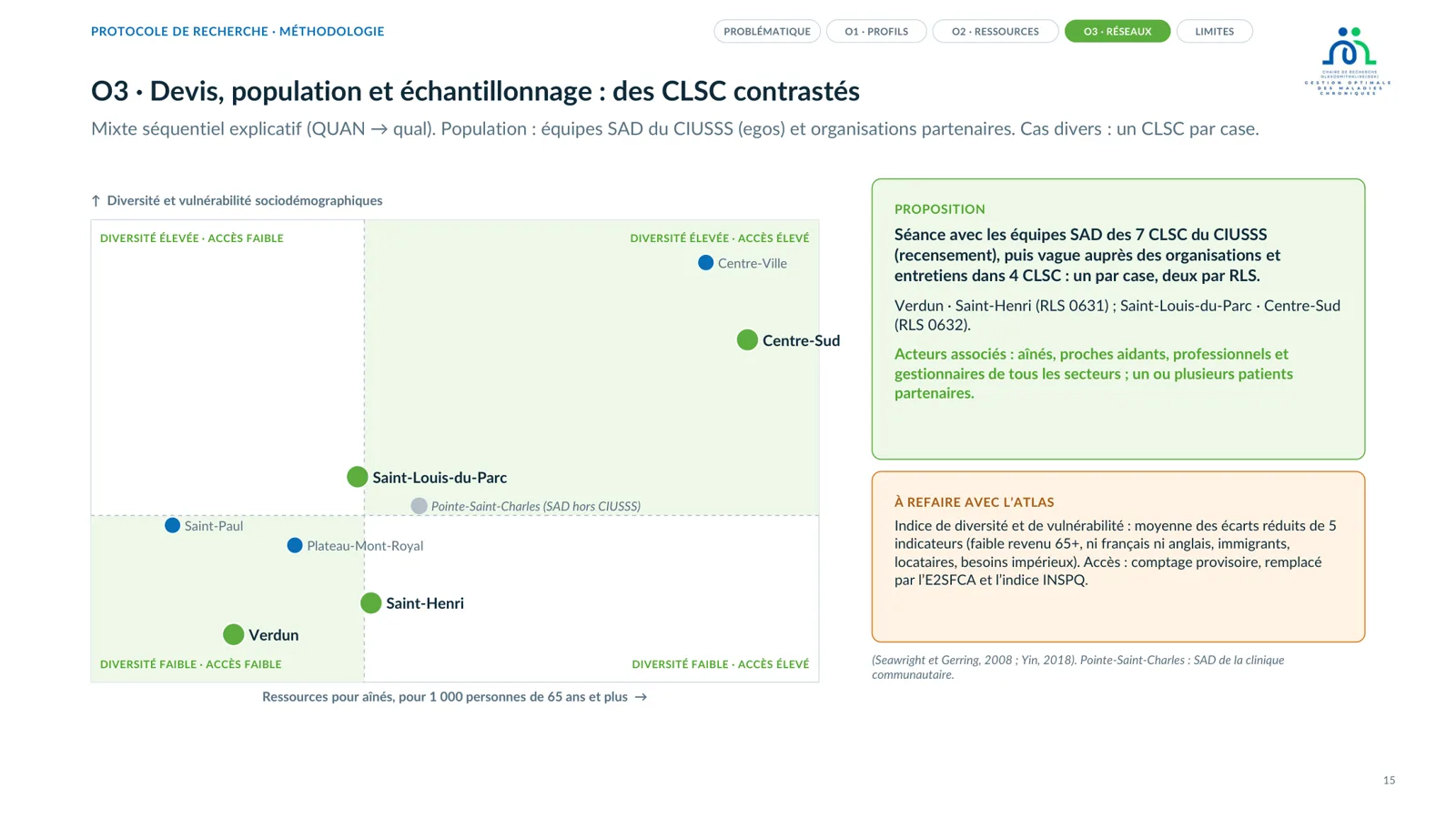
قصدية، حالات متنوعة. 3 أو 4 أقاليم CLSC متباينة حسب التنوع الاجتماعي الديموغرافي والوصول (المقترحة: Verdun وSaint-Henri وSaint-Louis-du-Parc وCentre-Sud؛ مع استبعاد Pointe-Saint-Charles لأن دعمه المنزلي تابع لعيادة مجتمعية). عدة مستجيبين لكل فريق؛ 8 إلى 10 مقابلات لكل CLSC، تُختار حسب الموقع في الشبكة.
جمع البيانات، الشق الكمي
(1) الشبكة المتمركزة حول كل فريق دعم منزلي، مع مولِّد أسماء لكل قصة توضيحية من O1 («إلى أي المنظمات أحلتموها، أو مع أيها تعاونتم، خلال الأشهر الاثني عشر الماضية؟»)؛ لكل رابط: القطاع، ومستوى التعاون من 1 إلى 4، والتكرار. (2) استبيان للمنظمات المذكورة لتحديد روابط الأشهر الاثني عشر الماضية؛ مع استهداف نسبة استجابة 70 %.
جمع البيانات، الشق النوعي
(3) إعادة تتبع مسار كل ملمح عبر مقابلات تتمحور حول خريطة الشبكة.
التحليل
الحجم، وتنوع القطاعات (Blau)، ونسبة روابط المستوى 3 أو 4، والثغرات البنيوية؛ تحليل موضوعاتي مع ترميز مزدوج لجزء من المقابلات.
الدمج
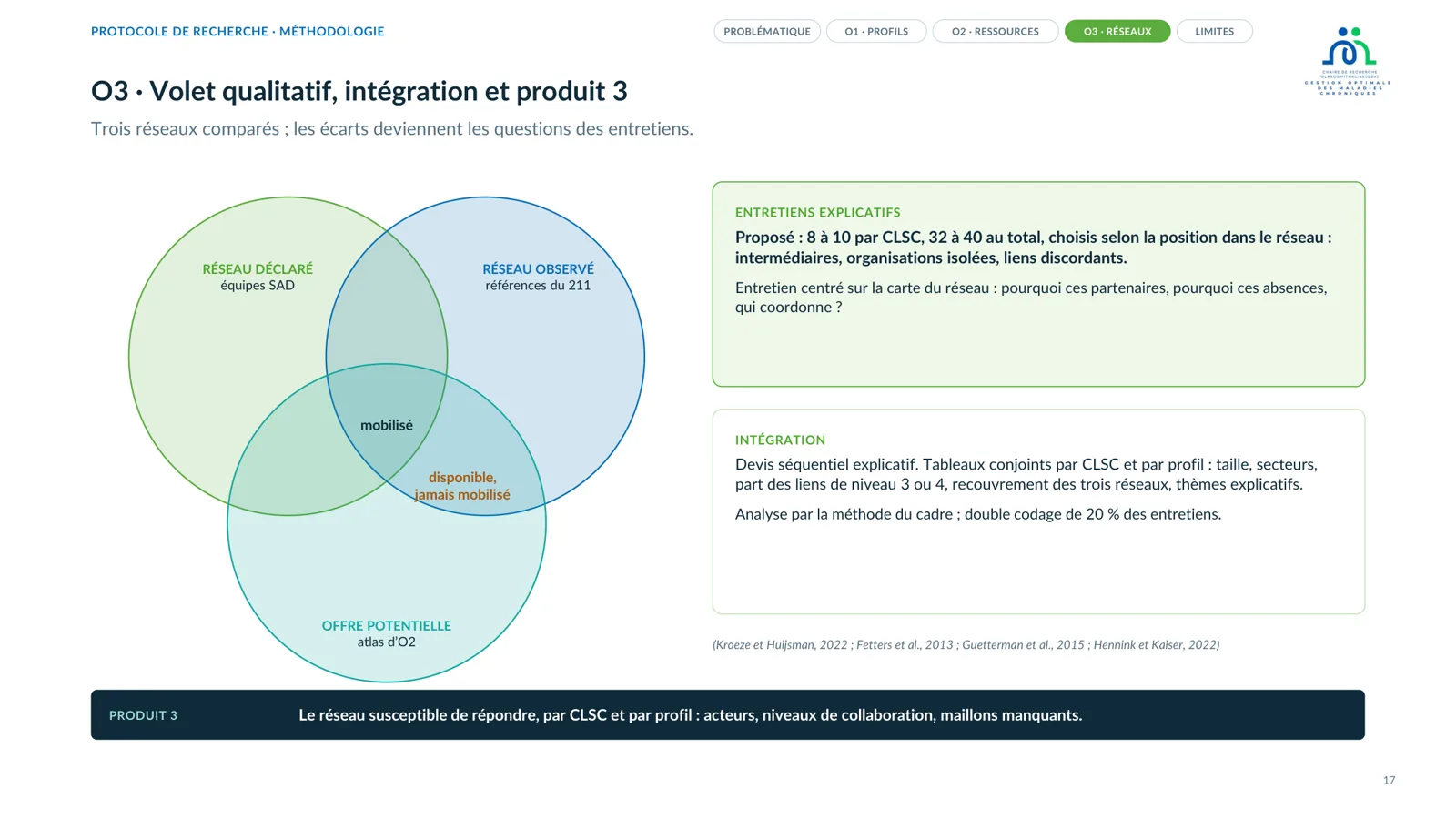
بعد الشق الكمي، تصبح الفجوات بين الشبكة المصرَّح بها وإحالات 211 وعرض الأطلس أسئلةَ المقابلات؛ جداول مشتركة لكل CLSC ولكل ملمح.
إشراك الفاعلين الميدانيين
يمنح تحليل الشبكات SNA الكلمة للفاعلين الميدانيين: تصف فرق الدعم المنزلي ومنظمات كل القطاعات ومسيروها روابطهم. وتشمل المقابلات أيضًا كبار السن والمُعينين القريبين والشركاء المرضى، وتُعرض النتائج عليهم للمصادقة.
المُنتَج
الشبكة لكل CLSC ولكل ملمح مع الحلقات المفقودة. مثال منشور: Urbanoski وآخرون، 2018 (doi:10.1371/journal.pone.0206671).
لماذا تحليل الشبكات الاجتماعية (SNA)؟
المورد المتاح على الخريطة لا يُحشد بالضرورة. وحده تحليل الشبكات يُظهر من يعمل فعلًا مع فريق الدعم المنزلي، وبأي مستوى تعاون، وأين الحلقات المفقودة. أمثلة منشورة: رسم Contandriopoulos وآخرون (2016، Healthcare Policy) خريطة التعاون بين المنظمات الكندية للوقاية من الأمراض المزمنة؛ وحلل Richter وآخرون (2026، BMC Health Services Research) بشبكة متمركزة حول الذات تنسيق تعزيز الصحة في البلديات؛ ودرس Lemieux-Charles وآخرون (2005، The Gerontologist) الشبكات المجتمعية لرعاية الخرف في أونتاريو.
تصميم شق الشبكات
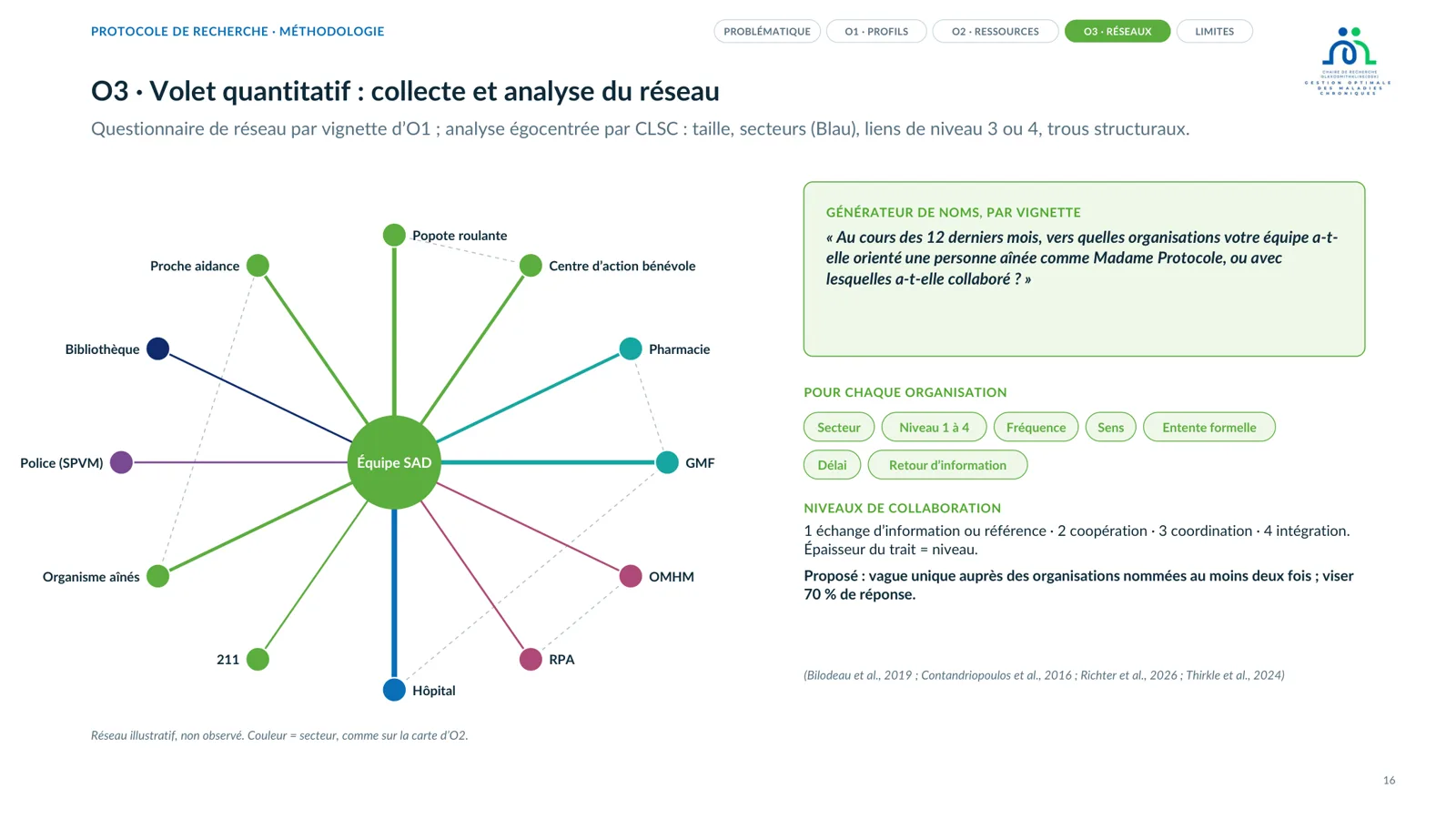
شبكة متمركزة حول الذات: «الذات» هي فريق الدعم المنزلي في كل CLSC. لكل ملمح (قصة توضيحية) يسأل استبيان عن المنظمات التي أحال إليها الفريق شخصًا مسنًا أو تعاون معها خلال الأشهر الاثني عشر الماضية، مع القطاع ومستوى التعاون (1 إلى 4) والتكرار والمهلة. ثم يوضع تحليل SNA (الحجم والتنوع ونسبة الروابط من المستوى 3 أو 4) في سياقه عبر مقابلات مع الفاعلين، يعيدون فيها تتبع مسار كل ملمح: من يتدخل، وبأي ترتيب، وأين ينقطع.
مخطط مبدئي للأطروحة
الشبكة المتمحورة حول فريق SAD
في أطروحتي، ينطلق تحليل الشبكة من فريق الدعم المنزلي في كل CLSC. وبالنسبة إلى كل حالة نموذجية، يسمّي الفريق المنظمات التي وجّه إليها شخصاً مسنّاً، أو التي تعاون معها، خلال الأشهر الاثني عشر الماضية؛ ويدل سُمك الخط على مستوى التعاون، من 1 إلى 4. وتُقارن هذه الشبكة المصرَّح بها بإحالات 211 وبعرض الأطلس، ثم تُفسَّر في المقابلات. شبكة توضيحية، غير مرصودة.
الحدود وطرق معالجتها
طلب 211 ليس شخصًا : نحلل الاحتياجات المجتمعة في الطلب نفسه.
ينشر 211 على مستوى الدائرة البلدية : يتطابق Verdun تمامًا مع الـCLSC الخاص به، ويُطلب الرمز البريدي.
الأدلة غير مكتملة : المصادر الرسمية أولًا، مع قياس الاكتمال.
الشبكات المصرَّح بها تعتمد على الذاكرة : عدة مستجيبين ومقارنة مع 211 والأطلس.
3 أو 4 حالات لا تسمح بالاستدلال الإحصائي : مقارنة الحالات وتفسيرها بالمقابلات.
العرض (أكتوبر 2026) والاحتياجات (2024-2025) ليسا من السنة نفسها : يُعرض الفارق.
04الجدوى
الجدوى
تكون الأطروحة قابلة للإنجاز حين تتوافر ثلاثة شروط: أن تكون البيانات موجودة ويمكن الوصول إليها، وأن تكون المناهج متقنة، وأن يتيح الجدول الزمني الوقت اللازم لتنفيذها. وفي هذا المشروع يتحقق الشرطان الأولان بالفعل؛ أما الجدول الزمني، المعروض في الختام، فيبيّن ما أُنجز وما بقي من العمل.
الجدوى مضمونة
البيانات متاحةتم الحصول على موافقة 211؛ وكل ما عدا ذلك عام ومتاح على الإنترنت.
الهدف الثاني (O2) مجهّز بالفعلالبيانات والترميز والبرمجيات (R في Positron، وQGIS) جاهزة؛ وقد أُنتجت خرائط بالفعل.
عامل غير مؤكد واحد، جرى تدبّرهتعداد 2026؛ وإن تعذّر ذلك فتعداد 2021.
مراجعة معزَّزةيُعاد الاستخراج بمشاركة أمينة مكتبة وعدة مقيِّمين.
ميدان ينفتحتجري مناقشة شراكة مع CIUSSS du Centre-Sud من أجل تحليل الشبكات.
1البيانات: في المتناول أو على الإنترنت
لا تعتمد الأطروحة على أي قاعدة بيانات فردية تابعة لشبكة الصحة. إنها تعمل على أنماط (profils) انطلاقاً من مصادر عامة أو مجمَّعة، وعلى جمع بيانات خاص بالهدف الثالث. ولكل مصدر وضع معروف.
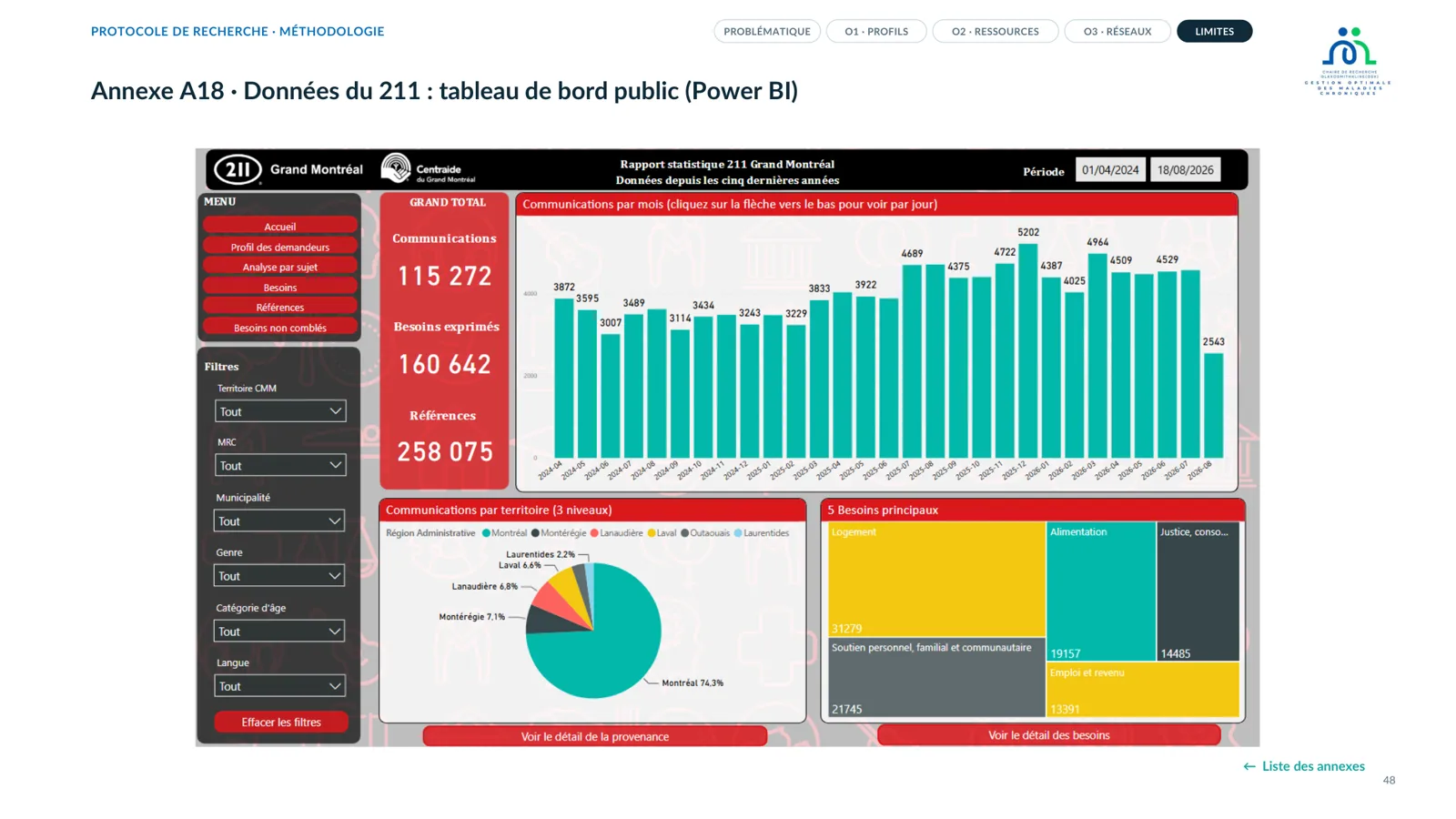
موافقةخط 211. تم الحصول على موافقة 211. وبياناته أكثر اكتمالاً في الجماعة الحضرية لمونتريال (CMM)، حيث يغطي 211 Grand Montréal مونتريال والمناطق المجاورة: فمن 2024 إلى 2026، تسجّل لوحة المعلومات العامة الخاصة به 115 272 اتصالاً، منها 74,3 % من مونتريال (211 Grand Montréal, 2026).
أُنجزأدبيات مراجعة O1. أربع قواعد بيانات جرى الاستعلام عنها في 17 أكتوبر 2026 (MEDLINE وEmbase وAPA PsycInfo وPubMed): 60 957 سجلاً، و26 609 دراسة للفرز بعد حذف التكرارات (Bernier, 2026).
أُنجزجرد موارد O2. 7 216 موقع خدمة من 35 نوعاً، في القطاعات الستة، محدَّدة جغرافياً في أقاليم CLSC الثمانية، انطلاقاً من 52 مصدراً؛ ترميز مزدوج بدرجة اتفاق κ = 0,94 (Bernier, 2026).
متاح على الإنترنتالسكان والأقاليم. تعداد 2021، وحدود أقاليم CLSC، والأدلة العامة للقطاعات الستة (Statistique Canada, 2022).
عامل غير مؤكدتعداد 2026. يُنشر في 2027؛ انظر القسم التالي.
يُجمع لاحقاًشبكة O3. استبيانات ومقابلات مع فرق SAD وشركائها، بعد الحصول على الموافقة الأخلاقية.
مراجعة النطاق، يُعاد إجراؤها بمشاركة عدة مقيِّمين
انتهى البحث في الأدبيات: فقد حُذفت التكرارات من السجلات في Covidence. ولتعزيز متانة المراجعة، سيُعاد الاستخراج الذي أُجري مع أمينة المكتبة بمشاركة عدة مقيِّمين. وستُفرز كل دراسة على يد شخصين مستقلين، أولاً بحسب العنوان والملخص ثم بحسب النص الكامل، بعد اختبار تجريبي على 25 سجلاً؛ وستُستخرج البيانات بالتكرار المزدوج (Bernier, 2026).
يتّبع هذا الأسلوب معايير مراجعات النطاق: دليل JBI للإجراء (Peters et al., 2020) وPRISMA-ScR للإبلاغ (Tricco et al., 2018). ويحدّ النظران المستقلان من خطر استبعاد دراسة عن غير حق.
من السجلات إلى الدراسات المطلوب فرزها، 17 أكتوبر 2026 (Bernier, 2026).
يتلقى 211 طلبات المساعدة من الأشخاص وذويهم والمتدخلين. وتصف لوحة معلوماته العامة بالفعل، بحسب الحي الإداري، الاحتياجات المعبَّر عنها والاحتياجات غير الملباة وأسبابها. وبالنسبة إلى من بلغوا 70 عاماً فأكثر في الإقليم، يسجّل نحو 3 700 طلب من 2021 إلى 2026، و691 حاجة غير ملباة لدى من بلغوا 60 عاماً فأكثر، وكلها مقترنة بسبب مرمَّز (Bernier, 2026).
تتيح موافقة 211 الوصول إلى استخراج أدق. ولما كانت بياناته أكثر اكتمالاً في CMM، فإن الوصول ميسَّر، وتصبح المقارنة مع الشبكة التي تصرّح بها فرق SAD، في O3، أكثر دقة.
لوحة المعلومات العامة لـ 211 Grand Montréal، المستخدمة في O1 وO2 (211 Grand Montréal, 2026).
O2: بيانات وترميز وبرمجيات جاهزة بالفعل
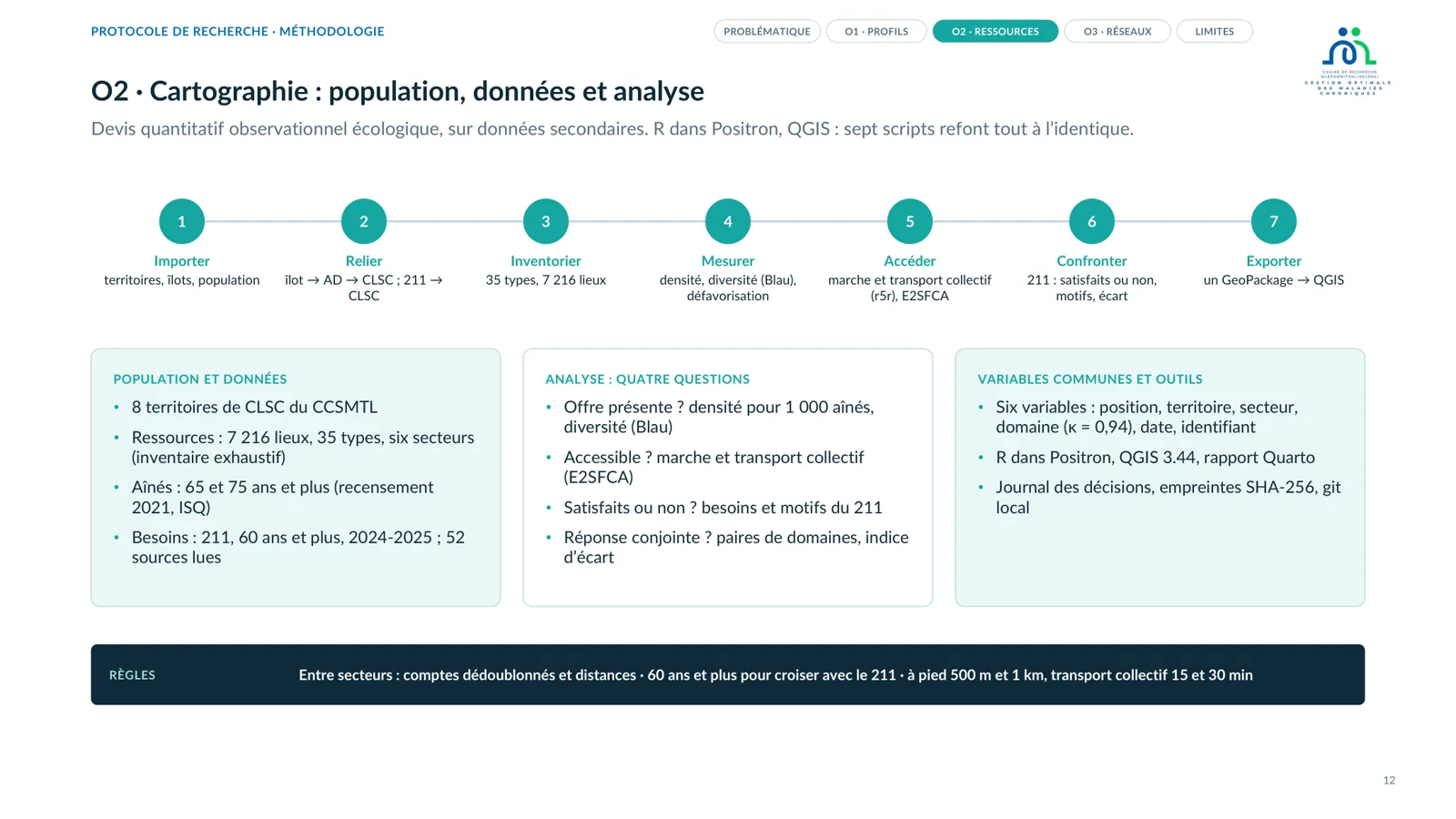
بالنسبة إلى الهدف الثاني، أُنجز الجزء الأطول من العمل. فسبعة سكربتات R، تُشغَّل في Positron، تستورد الأقاليم، وتربط كل كتلة سكنية بمركز CLSC التابعة له، وتجرد الموارد، وتقيس إمكانية الوصول سيراً على الأقدام وبالنقل العام، ثم تصدّر الطبقات إلى QGIS. وكل قرار يُدوَّن في سجل، وكل ملف مقروء يحصل على بصمة: فيُعاد الحساب بالنتائج نفسها تماماً (Bernier, 2026).
وريثما تتوافر أنماط O1، تُنجز الأمثلة بحسب مجال الحاجة. وسيُعاد رسم الخرائط بحسب النمط، بالسكربتات نفسها.
7 216موقع خدمة محدَّد جغرافياً
52مصدراً مدرجاً في السجل
κ = 0,94اتفاق الترميز المزدوج
8صفحات في الأطلس، صفحة لكل CLSC
سلسلة المعالجة في O2، من الاستيراد إلى الأطلس (Bernier, 2026).
نتيجة أولى، قابلة للقياس بالفعل
تعطي أمثلة O2 بالفعل رتبة قدر: فهناك 164 كتلة سكنية تشهد فجوة بين الاحتياجات المحتملة والاستجابة القريبة، ويعيش فيها 15,4 % ممن بلغوا 65 عاماً فأكثر (Bernier, 2026). وسيُعاد حساب هذا الرقم بحسب النمط؛ وهو يبيّن أن المنهج يعمل على البيانات الحقيقية للإقليم.
أطلس QGIS، صفحة Verdun: 164 كتلة سكنية في فجوة، و15,4 % ممن بلغوا 65 عاماً فأكثر (Bernier, 2026).
2العامل غير المؤكد الوحيد: التعداد
بالنسبة إلى O2، لا يعتمد المشروع إلا على مصدر خارجي واحد: التعداد، الذي يوفّر عدد كبار السن في كل كتلة سكنية وظروف عيشهم. وسيُنشر تعداد 2026 على مراحل، من فبراير إلى ديسمبر 2027: السكان في فبراير، والعمر في مايو، والأسر والدخل في يوليو، والحالة الصحية العامة في أكتوبر (Statistique Canada, 2026).
مواعيد نشر تعداد 2026؛ وباللون الأخضر ما يحتاجه O2 أولاً (Statistique Canada, 2026).
قاعدة القرار بسيطة. فإن كان بوسع تحليل O2 أن ينتظر صيف 2027، فسيستخدم تعداد 2026. وإلا فسيعتمد تعداد 2021، المتوافر بالفعل، مستكملاً بالإسقاطات الديموغرافية لعام 2026 بحسب إقليم CLSC (Bernier, 2026). وفي الحالتين يُحترم الجدول الزمني للأطروحة: فالعامل غير المؤكد يغيّر حداثة المقامات، لا جدوى المشروع.
3O3 في الميدان
الهدف الثالث هو الوحيد الذي يتطلب جمع بيانات جديدة. ويمتد على 12 شهراً، على مرحلتين: أولاً تحليل شبكات متمحورة حول الذات (égocentrée) يرسم خريطة الشبكة، ثم مقابلات تفسّر التفاعلات الملحوظة. وهو تصميم مختلط تتابعي تفسيري: تطرح أرقام الشبكة الأسئلة، وتجيب عنها المقابلات (Creswell et Plano Clark, 2017 ; Fetters et al., 2013).
استبيان الشبكةيسمّي كل فريق SAD («الذات» ego)، بالنسبة إلى كل حالة نموذجية من O1، المنظمات التي عمل معها خلال الأشهر الاثني عشر الماضية.القطاع، ومستوى التعاون من 1 إلى 4، والتكرار.
رسم خريطة الشبكةتُدعى المنظمات المسمّاة بدورها؛ وتُرسم شبكة كل CLSC.الحجم، وتنوع القطاعات، وحصة الروابط من المستوى 3 أو 4.
المقابلاتمقابلات تتمحور حول خريطة الشبكة: لماذا هؤلاء الشركاء، ولماذا هذه الغيابات، ومن ينسّق؟من 8 إلى 10 لكل CLSC (Bernier, 2026).
فهم التفاعلاتتُقابَل الشبكة المصرَّح بها مع إحالات 211 ومع أطلس O2.جداول مشتركة بحسب CLSC وبحسب النمط.
مولّد الأسماء
ينطلق السؤال الموجَّه إلى الفرق من شخص افتراضي، بُني انطلاقاً من أنماط O1: إلى أي منظمات وجّهتموه، أو مع أي منظمات تعاونتم، خلال الأشهر الاثني عشر الماضية؟ ويسجّل الاستبيان، لكل رابطة، مستوى التعاون، من تبادل المعلومات (1) إلى التكامل (4) (Bilodeau et al., 2019).
ويحمي اللجوء إلى الحالة النموذجية الخصوصية: فلا يوصف أي شخص حقيقي، وتجيب جميع الفرق عن الوضع نفسه.
المحور الكمي في O3: شبكة توضيحية، غير مرصودة (Bernier, 2026).
استهداف نسبة استجابة 80 %
يستهدف المشروع نسبة استجابة 80 %، في CLSC اثنين على الأقل متباينين. والعتبة مرتفعة لأن الشبكة حساسة للغيابات: فالمنظمة التي لا تجيب تُسقط روابطها هي، فتبدو الشبكة أفقر مما هي عليه. وللوصول إلى ذلك، يُستطلع عدة مجيبين في كل فريق وتُجرى متابعات بحسب القطاع (Bernier, 2026). ونسبة 80 % هدف تخطيطي؛ وسيُتابَع التجنيد وعدم الاستجابة.
هدف تخطيطي للمحور الشبكي في O3.
لماذا عدة CLSC، ولماذا متباينة؟
مع CLSC واحد لا يمكن معرفة ما إذا كانت كثافة الشبكة ترجع إلى الإقليم (سكان أوفر حظاً، وموارد كثيرة في الجوار) أم إلى طريقة تنظيم الفريق. وبمقارنة أقاليم تختلف في الحرمان والكثافة المواردية والطابع الحضري، نميّز ما يعود إلى الإقليم مما يعود إلى التنظيم. وهذا هو منطق الحالات المتنوعة: اختيار حالات تغطي مدى التباين، لتكون المقارنة مفيدة والنتائج قابلة للنقل (Seawright et Gerring, 2008 ; Yin, 2018).
إقليم واحد، وواقع شديد التباين (Statistique Canada, 2022 ؛ التجميع بحسب إقليم CLSC: Bernier, 2026).
فروق حقيقية داخل الإقليم
تتفاوت أقاليم CLSC الثمانية التابعة لـ CIUSSS تفاوتاً كبيراً. فحصة من بلغوا 65 عاماً فأكثر ممن لديهم دخل منخفض تكاد تتضاعف، من 21,3 % في Verdun إلى 41,8 % في Pointe-Saint-Charles. ويضم Centre-Sud أكبر عدد من المستأجرين (74,2 %) ومن الحاجات الملحّة إلى السكن (11,7 %)؛ ويضم Verdun أكبر عدد من كبار السن (12 535) (Statistique Canada, 2022 ; Bernier, 2026).
يختار المقترح الحالي Verdun وSaint-Henri وSaint-Louis-du-Parc وCentre-Sud، اثنين لكل شبكة خدمات محلية. ويُستبعد Pointe-Saint-Charles لأن SAD فيه يتبع عيادة مجتمعية. وسيُعاد الاختيار النهائي بالاستناد إلى أطلس O2 (Bernier, 2026).
الشراكة مع CIUSSS du Centre-Sud
من أجل تحليل الشبكات، تجري مناقشة شراكة مع CIUSSS du Centre-Sud، لأن للمؤسسة اهتمامات في هذا الموضوع. كما أن سياسة الخط الأول تجعل إقليم CLSC وحدة المرجع، وتلاحظ أن العرض «يظل في كثير من الأحيان غير معروف» (Ministère de la Santé et des Services sociaux [MSSS], 2026, p. 25).
ويضيف تحليل الشبكات مع Centre-Sud ما لا تقوله البيانات وحدها: وضع الأمور في سياقها، وفهماً لآليات الاستجابات الممكنة ولسبب تنظيمها على هذا النحو حالياً. وعند ربطه ببيانات 211، الأكثر اكتمالاً في CMM، يتيح مقارنة دقيقة بين الشبكة المصرَّح بها والشبكة المرصودة والعرض المرسوم على الخريطة.
ثلاث شبكات متقارنة؛ وتصبح فروقها أسئلة المقابلات (Bernier, 2026).
4إشراك الميدان
يُشرك الفاعلون الميدانيون في كل مرحلة، وليس بوصفهم مجيبين فحسب. فتحليل الشبكات يمنحهم الكلمة: إذ الفرق وشركاؤها هم من يصفون الروابط القائمة وتلك الناقصة. وتُعرض عليهم النتائج للتحقق منها قبل نشرها.
كبار السنيقولون ما يهمهم وبأي ترتيب تظهر احتياجاتهم.
مقدمو الرعاية من الأقاربيقدّمون جزءًا كبيرًا من الدعم ويعرفون منعطفات المسار.
شركاء من المرضىسيُستقطب شريك أو أكثر من المرضى لمرافقة المشروع، من الحالة النموذجية إلى التفسير.
الرعاية الأوليةأطباء وممرضات مجموعات طب الأسرة (GMF)، والصيادلة، والأخصائيون الاجتماعيون، وأخصائيو العلاج الوظيفي، وسائر مهنيي SAD.
التنظيم المجتمعيالمنظمون المجتمعيون في CIUSSS، والميسّرون، وطاولات التشاور، ومنها طاولات كبار السن.
المنظمات المجتمعية والمتطوعونمراكز العمل التطوعي، وتوصيل الوجبات، وبنوك الطعام، ومنظمات كبار السن ومقدمي الرعاية (الاستراحة، الرعاية النهارية).
البلدية والسكنالمنتخبون والخدمات البلدية، وOMHM والسكن الاجتماعي، ومساكن كبار السن الخاصة، والنقل المكيّف، والمكتبات، والترفيه.
التعليم والطفولة المبكرةالمدارس ومراكز الطفولة المبكرة (CPE)، التي يمكنها المساعدة أو نقل المعلومة، ولا سيما للأسر التي ترعى أقاربها.
الأمن والعدالةأعوان الشرطة المجتمعيون في SPVM، والمساعدة القانونية، ومكافحة سوء المعاملة.
الصحة العامة وصنّاع القرارDRSP، ومديرية SAPA في CIUSSS، وMSSS، ولجنة الربط بين القطاعات في AIPPA.
خدمة 211 وخطوط المعلوماتمستشارو الإحالة الذين يوجّهون طلبات المساعدة نحو الموارد.
القطاع الخاص والاقتصاد الاجتماعيالصيدليات، ومؤسسات الاقتصاد الاجتماعي للمساعدة المنزلية (EÉSAD)، والمتاجر القريبة.
المجتمعات الثقافية والدينيةدور العبادة وجمعيات المهاجرين، وهي غالبًا أول سند لكبار السن المعزولين.
المسيّرونيقرّرون تنظيم الخدمات والاتفاقات بين الشركاء.
الباحثون والجامعاتشبكة RUISSS في جامعة مونتريال وفرق البحث في الإقليم.
هذه القائمة ليست مغلقة: فبفضل مقاربته الاستقرائية، قد يكشف تحليل الشبكات عن فاعلين وقطاعات أخرى، منها الخاصة، لم يتوقعها أحد.
مراكز CLSC المختارة مع الميدان
سيُعرض اختيار مراكز CLSC الخاصة بـ O3 على فرق SAD قبل جمع البيانات: جلسة مع فرق مراكز CLSC السبعة التابعة لـ CIUSSS، ثم موجة لدى المنظمات ومقابلات في مراكز CLSC المختارة (Bernier, 2026). وتشكّل حالات O1 المنموذجة وأطلس O2 وخريطة شبكة O3 دعائم للنقاش مفهومة من الجميع.
وقبل أي جمع للبيانات، سيحصل المشروع على موافقة لجنة أخلاقيات البحث، وسيحدد الموافقة والمعلومة المستنيرة وحماية البيانات والنشر (Conseil de recherches en sciences humaines et al., 2022).
اختيار مراكز CLSC المتباينة، يُعاد بالاستناد إلى أطلس O2 (Bernier, 2026 ; Seawright et Gerring, 2008).
5جدول زمني على 4 سنوات
خُطط للدكتوراه على 16 ربعاً سنوياً، من أبريل 2025 إلى مارس 2029. وبعد سنة ونصف، تنتهي المقررات وإعداد البروتوكول، ويكتمل البحث في الأدبيات الخاص بـ O1، وتُنتج أولى خرائط O2. ويدل الجزء الفاتح من كل شريط على ما بقي، والجزء الممتلئ على ما أُنجز.
20252026202720282029
ر2ر3ر4ر1ر2ر3ر4ر1ر2ر3ر4ر1ر2ر3ر4ر1
التكوين
المقررات والامتحان الشامل والبروتوكولالعرض في 27 أكتوبر 2026
الأخلاقياتالموافقة قبل أي جمع للبيانات
O1 · الأنماط
مراجعة النطاقإعادة الاستخراج بمشاركة عدة مقيِّمين
تحليل طلبات 211
O2 · الموارد
رسم الخرائطالأمثلة منجزة، وتُعاد بحسب النمط
تعداد 2026عامل غير مؤكد: يُنشر من فبراير إلى ديسمبر 2027
O3 · الشبكات (12 شهراً)
جمع بيانات الشبكة المتمحورة حول الذاتاستبيانات، رسم الخرائط
المقابلاتفهم التفاعلات
المشروع ككل
إشراك الميدانالشراكة، الشركاء المرضى
تحليل O1-O2-O3 وتكاملها
الكتابة والإيداعمقالات، ثم الأطروحة
نقل المعارفالفرق، الشركاء، الجمهور
اليوم · أكتوبر 2026
أُنجز
قيد الإنجاز لاحقاً
عامل خارجي غير مؤكد
محطة
اليوم
يتبع الترتيب التصميم: يوفّر O1 الحالات النموذجية، ويختار O2 مراكز CLSC، ثم يجري O3 على مدى 12 شهراً، من الربع الثالث من 2027 إلى الربع الثاني من 2028. ويتوافق جمع البيانات الوحيد هذا مع المحور 2 من RUISSS، المقرر في 2027-2028 (Bernier, 2026). ولا يطيل تعداد 2026 الجدول الزمني: فإن وصلت بياناته متأخرة جداً عن O2، حلّ محله تعداد 2021.
خلاصة القول، الجدوى مضمونة لأن البيانات متاحة: فقد تم الحصول على موافقة 211 وما عداه متاح على الإنترنت. وبالنسبة إلى O2، لدينا بالفعل البيانات والترميز وإتقان البرمجيات؛ ولا نعتمد إلا على التعداد، وسنأخذ تعداد 2021 عند الضرورة. أما استخراج المراجعة الذي أُجري مع أمينة المكتبة فسيُعاد بمشاركة عدة مقيِّمين. وبالنسبة إلى تحليل الشبكات، تجري مناقشة شراكة مع Centre-Sud: وهي تضيف وضع الأمور في سياقها وفهماً لآليات الاستجابات الممكنة ولسبب تنظيمها على هذا النحو حالياً.
211 Grand Montréal. (2026). Rapport statistique 211 Grand Montréal [Tableau de bord Power BI]. Consulté le 16 octobre 2026.
Bernier, E. (2026, 27 octobre). Organiser la réponse intersectorielle aux besoins sociaux concomitants, satisfaits ou non, des personnes aînées vivant à domicile : profils, ressources et réseaux autour du soutien à domicile des CLSC [Présentation du protocole de recherche]. École de santé publique, Université de Montréal.
Bilodeau, A., Parent, A.-A. et Potvin, L. (2019). Les collaborations intersectorielles et l’action en partenariat, comment ça marche ? Chaire de recherche du Canada CACIS.
Conseil de recherches en sciences humaines, Conseil de recherches en sciences naturelles et en génie et Instituts de recherche en santé du Canada. (2022). Énoncé de politique des trois conseils : Éthique de la recherche avec des êtres humains (EPTC 2). https://ethics.gc.ca/fra/policy-politique_tcps2-eptc2_2022.html
Creswell, J. W. et Plano Clark, V. L. (2017). Designing and conducting mixed methods research (3e éd.). SAGE.
Fetters, M. D., Curry, L. A. et Creswell, J. W. (2013). Achieving integration in mixed methods designs: Principles and practices. Health Services Research, 48(6 Pt 2), 2134-2156.
Ministère de la Santé et des Services sociaux. (2026). Politique gouvernementale sur les soins et services de première ligne. Gouvernement du Québec.
Peters, M. D. J., Godfrey, C., McInerney, P., Munn, Z., Tricco, A. C. et Khalil, H. (2020). Chapter 11: Scoping reviews. Dans E. Aromataris et Z. Munn (dir.), JBI Manual for Evidence Synthesis. JBI.
Seawright, J. et Gerring, J. (2008). Case selection techniques in case study research: A menu of qualitative and quantitative options. Political Research Quarterly, 61(2), 294-308.
Statistique Canada. (2022). Recensement de la population de 2021 [Tableaux de données par aire de diffusion]. Gouvernement du Canada.
Statistique Canada. (2026). Calendrier de diffusion du Recensement de la population de 2026 (GR-419-26). Gouvernement du Canada.
Tricco, A. C., Lillie, E., Zarin, W., O’Brien, K. K., Colquhoun, H., Levac, D. et al. (2018). PRISMA extension for scoping reviews (PRISMA-ScR): Checklist and explanation. Annals of Internal Medicine, 169(7), 467-473.
Yin, R. K. (2018). Case study research and applications: Design and methods (6e éd.). SAGE.
05الفوائد
الفوائد
الإنتاجات التالية متوقعة. ولا تُعرض بوصفها نتائج مرصودة ولا دليلاً على فعالية تدخل ما.
المخرجات المنتظرة
P1 · التصنيف والحالات النموذجية
أنماط من الاحتياجات الاجتماعية المتزامنة، تُترجم إلى حالات نموذجية تُعاد الاستفادة منها في O2 وO3.
P2 · الأطلس ومؤشر الفجوة
أطلس لكل إقليم من أقاليم CLSC، ومصفوفة الاحتياجات × الموارد × الإقليم، ومؤشر للفجوة بين الاحتياجات والعرض.
P3 · نماذج المسارات
من يتدخل، وبأي ترتيب، وبأي مستوى من التعاون، وما الحلقات المفقودة، بحسب النمط وبحسب CLSC.
الفوائد المنتظرة
بالنسبة إلى الأشخاص : استجابة متكيفة مع تركيبة احتياجاتهم.
بالنسبة إلى فرق SAD وشركائها : معالم حول من يجب تعبئته، وبأي ترتيب، وبأي مستوى من التعاون، وحول الممرات الواجب إنشاؤها.
بالنسبة إلى CIUSSS وسياسة الخط الأول : معالم بحسب إقليم CLSC، تُرفع إلى لجنة الاتصال المشتركة بين القطاعات في AIPPA وإلى المحور 2 من RUISSS (2027-2028).
بالنسبة إلى البحث : سلسلة قابلة للتكرار من الأنماط إلى الموارد والشبكات، يُعاد حسابها عند تحديث المصادر.
لمن؟
كبار السن والمُعينون القريبون: استجابة ملائمة لتوليفة احتياجاتهم. وتخفيف العبء عن المُعينين جزء من الاستجابة، ولا سيما عبر خدمات الاستراحة والاستقبال النهاري (Vandepitte et al., 2016).
مهنيو الصحة والخدمات الاجتماعية والقطاع المجتمعي: معرفة من يجب حشده مسبقًا ولأي نمط في إقليمهم.
كل القطاعات: البلدي والإداري والمدرسي والسكن والنقل. ويمكن لمراكز الطفولة المبكرة (CPE) ودور الحضانة والمدارس أن تساعد أيضًا، مثلًا حين يكون للمُعين أطفال صغار (Garon et al., 2014; Peters et al., 2021).
المسيرون وصناع القرار: معالم لكل CLSC لتخطيط الاستجابة وجعلها مستدامة.
06نقل المعرفة والتنفيذ
نقل المعرفة والتنفيذ
بناء المعالم مع الفاعلين
تُعرض نماذج المسارات والخرائط وتفسيرات المقابلات على فرق SAD، وعلى لجنة الاتصال المشتركة بين القطاعات في AIPPA، وعلى المحور 2 من RUISSS (2027-2028).
تهيئة شروط التنفيذ
تحديد أدوار التنسيق مع الأوساط المعنية، والشركاء المعنيين، والممرات الواجب إنشاؤها، والموارد والعوائق. ويجب فحص المقترحات من حيث ملاءمتها وقبولها وجدواها محلياً.
النشر وتقييم الاستخدام
سيدعم مشاركة النتائج أطلس لكل CLSC، وملخصات بحسب النمط، وجلسات إعادة العرض، ومداخلات علمية. وإذا كان التنفيذ مزمعاً، فستكون صيغه ومؤشراته وشروط متابعته موضوع مسار مستقل.
الشركاء المرضى
سيُستقطب شريك مريض واحد أو أكثر، من كبار السن أو المُعينين القريبين ذوي الخبرة في الدعم المنزلي، للمشاركة في المشروع: صياغة الحالات النموذجية، وقراءة الخرائط، وتفسير الشبكات، ونشر النتائج.
الإطار المؤسسي والتمويل
البرنامجدكتوراه في الصحة العامة، تخصص الأنظمة والمنظمات والسياسات الصحية (SOPS) · السنة الثانيةالتعريف ببرنامج الدكتوراه
المؤسسةÉcole de santé publique de l’Université de Montréal (كلية الصحة العامة بجامعة مونتريال، ESPUM)موقع ESPUM
الكرسيChaire de recherche GSK en gestion optimale des maladies chroniques (كرسي GSK للبحث في الإدارة المثلى للأمراض المزمنة)الكرسي البحثي على LinkedIn
مركز البحثCentre de recherche du CHUM (مركز البحث التابع للمركز الاستشفائي الجامعي لمونتريال، CRCHUM) · متدرّب بحثيموقع CRCHUM
أستاذة مشاركة، Département de gestion, d’évaluation et de politique de santé (قسم الإدارة والتقييم والسياسات الصحية)، École de santé publique، Université de Montréal
باحثة منتظمة في CRCHUM، Carrefour de l’innovation (ملتقى الابتكار)
شاغلة مشاركة لكرسي Chaire de recherche GSK en gestion optimale des maladies chroniques
الاستشفاء الممكن تجنّبهتجربة المرضىالرعاية الأولية
الإبستمولوجيا ونقل المعارف
تمت صياغة المخطوطة · العمل معلّق
Epistemic return in public health governance: The road back from health to science
Bernier, É.
يُتصوَّر أثر البحث عادةً في اتجاه واحد، من المعرفة نحو السياسات والممارسات. ويقترح هذا المقال تصوّر الصحة العامة بوصفها علمًا انعكاسيًا للحوكمة: إذ يحدّد الشروط التي يمكن فيها للنتائج الملاحظة في الميدان ولمعارف الفئات السكانية المعنية أن تستوجب إعادة النظر في الفئات والمؤشرات والقواعد في المراحل السابقة. ويُترجَم هذا المفهوم إلى تدقيق وثائقي جرى اختباره على أربع سلاسل مؤسسية.
العودة المعرفيةالحوكمة الانعكاسيةأثر البحث
الحوكمة والفضاء العام
مخطوطة قيد الإعداد
Prise de parole des médecins dans l’espace public québécois lors des débats entourant le projet de loi n° 2 : une analyse qualitative du discours critique
Bernier, É., Aïssi, F., Diene Faye, C., Boukari Abdo, S.
صوت الأطباء في المجال العامالنقاش العامالسياسات الصحية
قانون الصحة
مخطوطة قيد الإعداد
Vieillir chez soi à l’épreuve du droit : l’effectivité du choix du lieu de vie en droit français et en droit québécois
Bernier, É. · مقالة فقهية قانونية
القانون الصحيالشيخوخة في المنزلاختيار مكان العيش
ملصقات المؤتمرات
العروض العلمية3
يونيو 2026
جائزة أفضل ملصق · الدكتوراه وما بعد الدكتوراه
Intégration des soins et services de proximité pour soutenir l’autonomie domiciliaire des personnes aînées : une étude qualitative comparative
Bernier, É., Sourial, N., Layani, G. · Groupe francophone en soins primaires (المجموعة الفرنكوفونية للرعاية الأولية، GFSP)، مونتريال · عرض بملصق
تكامل الرعايةالشيخوخة في المنزلفرنسا وكيبيك
مايو 2026
ملصق
Integrating Care and Services to Support Aging at Home: A Comparative Analysis of Institutional, Organizational, and Professional Mechanisms in France and Quebec
Bernier, É., Sourial, N., Layani, G. · CAHSPR، أوتاوا
تكامل الرعايةالشيخوخة في المنزلفرنسا وكيبيك
أبريل 2026
ملصق وعرض في 180 ثانية
Intégration des soins et services de proximité pour soutenir l’autonomie domiciliaire des personnes aînées : une étude qualitative comparative
Bernier, É., Sourial, N., Layani, G. · Réseau québécois de recherche sur le vieillissement (الشبكة الكيبيكية لأبحاث الشيخوخة، RQRV)، شيربروك · ملصق وتبسيط علمي في 180 ثانية
تكامل الرعايةالشيخوخة في المنزلفرنسا وكيبيك
العروض الشفوية
لا توجد عروض شفوية مدرجة حالياً.
المذكرات وأطروحة الدكتوراه
رسائل جامعية نوقشت أمام لجنة3
2025
Vieillir chez soi : réalités et mise en œuvre du virage domiciliaire. Une étude comparée France / Québec
ماستر في القانون · Université Paris-Panthéon-Assas (جامعة باريس بانتيون أساس) · إشراف: Benoît Apollis
الشيخوخة في المنزلالسياسات العامةالقانون المقارن
2024
La prise en charge des personnes en situation de handicap vieillissantes : comment les établissements d’hébergement pour personnes âgées dépendantes peuvent-ils adapter leurs structures et services à leurs besoins spécifiques ?
ماجستير في إدارة المؤسسات · Université de Bretagne Occidentale (جامعة بريتاني الغربية) · إشراف: Michelle-Hentic Giliberto
الإعاقة والتقدم في السنتكييف المؤسساتالدعم والمرافقة
2023
Parcours de vie et autodétermination : l’influence des pratiques éducatives sur le parcours de vie des personnes en situation de handicap en institution d’hébergement
دبلوم الدولة للمربي المتخصص · Académie de Rennes (الأكاديمية التعليمية لرين)
تقرير المصيرالممارسات التربويةمسار الحياة
يمكن الاطلاع على مشروع الدكتوراه الجاري في قسم «أطروحتي». عرض المشروع →
01.4الموقف البحثيموقف براغماتي ونظرة متعددة التخصصات
01.4 · الموقف البحثي
الموقف البحثي
بحث سياقي ونقدي وتأملي
يتناول موقفي البحثي كيفية صياغة المشكلات وبناء فئات التحليل وإنتاج معارف قابلة للنقاش والمراجعة. ويجمع بين فهم علائقي للأوضاع الصحية وفحص المؤسسات والتأمل الانعكاسي لدى الباحث.
01تموضع الباحث
تحديد زاوية النظر وتوضيح الاختيارات
أفهم الأشخاص بوصفهم كائنات متفرّدة تنخرط في علاقات وتاريخ وأوساط اجتماعية ومادية وحيّة تعتمد عليها. ويمكن لكل شخص أن تكون له تطلعاته الخاصة؛ وتتشكّل إمكانات تحقيقها أيضاً ضمن ظروف العيش والموارد والعلاقات. ويعبر هذا التوتر بين التفرّد والاعتماد المتبادل فهمي للصحة.
يوجد موقعي كباحث داخل هذا العالم نفسه. وتوجّه تجربتي مع الأشخاص ذوي الإعاقة وفي القانون والإدارة والصحة العامة المشكلات التي أنتبه إليها. وأتعامل مع هذا الموقع كنقطة انطلاق تستحق الفحص: إظهار اختياراتي وتقبّل الاعتراض والسماح للبحث بتغيير فئاتي المفاهيمية.
يقتضي التأمل الانعكاسي فحص كيفية تأثير السؤال المطروح والفئات المختارة والجهات المشمولة وظروف البحث في المعرفة المنتجة. أوضّح هذه الاختيارات والتفسيرات البديلة وحدود الاستنتاجات حتى يكون الاستدلال قابلاً للنقاش.
02المعرفة والحقيقة
معرفة سياقية ومعلّلة وقابلة للمراجعة
أميّز ما يتيح البحث ملاحظته والتفسيرات المقترحة والغايات التي أدافع عنها. وتتطلب متانة المعرفة أدلة قابلة للفحص وحججاً واضحة وإمكانية مناقشة الخلافات. وتُبنى المفاهيم والقياسات لدراسة وقائع تؤثر نتائجها في حيوات الناس.
السؤال هو الذي يحدّد المنهج: مناهج مختلطة متكاملة.
موقف براغماتي
موقف يجمع بين قراءة وضعية (القياس والتقدير واختبار الفرضيات) وقراءة بنائية (فهم المعنى الذي يمنحه الفاعلون لممارساتهم). السؤال هو الذي يحدد المنهج.
تعدد التخصصات
الصحة العامة والقانون والإدارة والعلوم السياسية والتدخل الاجتماعي: رؤى يكمّل بعضها بعضًا لتحليل نظام واحد.
الاستقصاء بدلاً من تثبيت اليقين
تربط براغماتية ديوي الاستقصاء بالمشكلات التي نصادفها وبنتائجها.
بالنسبة إلى بحثي
أفضّل أسئلة دقيقة ومعارف قابلة للنقاش واستنتاجات قابلة للمراجعة. وتُقاس فائدة النتيجة أيضاً بما تساعد على فهمه وبآثارها في وضع محدد.
تتيح المؤسسات الحماية والتعاون والوصول إلى الموارد. وتوزّع قواعدها وفئاتها أيضاً إمكانات الفعل. وموقفي هو فحص هذه الآثار وتبريراتها وإمكانات مناقشتها بصورة ملموسة.
فوكو · السلطة في العلاقات
تعمل السلطة على إمكانات أفعال الأشخاص، وتتجاوز الأمر المفروض من أعلى.
بالنسبة إلى بحثي
أتساءل في الخدمات عن قواعد الوصول والتصنيفات والأدوار المهنية: ماذا تتيح، ومن يمكنه مناقشتها، وما هو هامش تقرير المصير الذي تتركه؟
تكتسب الاستقلالية معناها في أوضاع ملموسة وعلاقات دعم وإمكانات متاحة فعلياً. ويواصل هذا التوجّه خبرتي في المرافقة: الاعتراف بالتطلعات ومناقشة القيود والعمل على الشروط التي تجعل الاختيار قابلاً للتطبيق.
هيغل · الاعتراف والتناقضات
يتطور الوعي بالذات عند هيغل في علاقات مع الآخرين تخترقها ديناميات الاعتراف والصراع.
بالنسبة إلى بحثي
أتعامل مع التوترات بين الحماية والاستقلالية والقواعد المشتركة والأوضاع المتفرّدة بوصفها موضوعات للبحث. ويتطلب فهم المنظمة تتبّع تاريخها وعلاقاتها وتحولاتها.
تربط الوجودية السارترية المسؤولية بالاختيارات التي يتشكّل عبرها الوجود.
بالنسبة إلى بحثي
أحتفظ منها بمطلب توضيح اختياراتي. وأواجهه في الصحة العامة بالقيود الاجتماعية والموارد المتاحة، للتفكير في مسؤولية مرتبطة بالسياق بدلاً من إرجاع الصعوبات إلى الأفراد وحدهم.
يفحص نهج القدرات الحريات الواقعية لعيش الحيوات التي يملك الأشخاص أسباباً لتقديرها.
بالنسبة إلى بحثي
أفحص ما يستطيع الشخص فعله فعلياً: الوصول إلى خدمة وفهم قرار والمشاركة والسعي إلى تحقيق تطلعاته. وتتيح الموارد المتاحة وشروط استخدامها تحليل الفجوات بين الحقوق الرسمية والإمكانات الفعلية.
يستهدف بحثي معارف يمكن أن تدخل في مداولة جماعية. وتنطوي التوصيات والابتكارات على اختيارات مجتمعية: من يستفيد من التغيير، وما الأعباء التي يخلقها، وكيف يمكن للمعنيين مناقشة آثاره.
كامو · التمرّد والاعتدال
يفحص كامو تمرّداً يؤكد كرامة مشتركة ويسائل حدود الفعل وتبريراته.
بالنسبة إلى بحثي
أرغب في الجمع بين رفض الأوضاع الظالمة والانتباه إلى من قد يتأثر بالتغيير. وتقتضي الغاية المرغوبة أيضاً فحص الوسائل المستخدمة وعواقبها.
يربط ديوي تشكّل الجمهور بالنتائج المشتركة للأنشطة والتعامل الجماعي معها.
بالنسبة إلى بحثي
أستخلص اهتماماً بالجهات المعنية والمداولة وعودة الميدان إلى المعرفة. ويجب أن تبقى النتائج قابلة للنقاش والوضع في السياق والمراجعة عندما تستدعي آثارها ذلك.
يربط ريكور التطلع إلى حياة مكتملة والاهتمام بالآخرين وعدالة المؤسسات.
بالنسبة إلى بحثي
أصل جودة علاقة المرافقة بالشروط التنظيمية والسياسية التي تجعلها ممكنة. وتتعلق مسؤوليتي بالشخص الذي ألتقيه وبالأطر الجماعية التي تساعد أعمالي على إيضاحها.
تفتح هذه المؤلفات أسئلة وتغذّي روابط فكرية. ويدافع أصحابها عن مواقف مختلفة؛ أضعها في حوار لتوضيح مسؤوليتي دون تقديمها مذهباً موحداً. وتعبّر الصياغات بضمير المتكلم عن هذا التوجّه البحثي.
من السؤال إلى الملاحظة: لكل سؤال بياناته ومنهج تحليله وتأويله. أختار المناهج وفق ما ينبغي إيضاحه، مع المزاوجة بين التخصصات.
يرتبط بناء التصميم وجمع البيانات واختيار استراتيجية التحليل بسؤال البحث. وتوضح المقاربات التالية إمكاناتها ومتطلباتها وحدودها.
مناهج مختلطة
تحليلات كمية ونوعية متكاملة: تحليل الشبكات، والانحدار، والتحليل الموضوعاتي، والتحليل الوثائقي، ورسم الخرائط، تجتمع كلها في جداول تكاملية.
صندوق الأدوات
تحليل البيانات
Positron (R)PythonNVivoQGISExcel
التعاون والتنشيط
MiroKlaxoonCanva
البرمجيات المكتبية
Office 365
تحليل الشبكات الاجتماعية المتمركز حول الذات والمتمركز حول المجتمع
يصف تحليل الشبكات الاجتماعية العلاقات بين الفاعلين بدلًا من الاقتصار على خصائصهم. يدرس المنهج المتمركز حول المجتمع مجموع الروابط داخل جماعة محددة، بينما ينطلق المنهج المتمركز حول الذات من مستجيب (الأنا) ومن المحاورين الذين يسمّيهم (الآخرون). في أطروحتي، تتمحور الشبكة حول فريق الدعم المنزلي (SAD) في كل مركز للخدمات المجتمعية المحلية (CLSC). وبالنسبة إلى كل حالة نموذجية، يسمّي الفريق المنظمات التي وجّه إليها شخصاً مسنّاً، أو التي تعاون معها، خلال الأشهر الاثني عشر الماضية. ويحدّد مستوى التعاون، من 1 (تبادل المعلومات أو الإحالة) إلى 4 (التكامل). وتُقارن هذه الشبكة المصرَّح بها بإحالات 211 وبأطلس الموارد، ثم تُفسَّر في المقابلات.
Perry, B. L., Pescosolido, B. A., & Borgatti, S. P. (2018). Egocentric network analysis: Foundations, methods, and models. Cambridge University Press. https://doi.org/10.1017/9781316443255
Provan, K. G., Veazie, M. A., Staten, L. K., & Teufel-Shone, N. I. (2005). The use of network analysis to strengthen community partnerships. Public Administration Review, 65(5), 603–613. https://doi.org/10.1111/j.1540-6210.2005.00487.x
Valente, T. W., Palinkas, L. A., Czaja, S., Chu, K.-H., & Brown, C. H. (2015). Social network analysis for program implementation. PLOS ONE, 10(6), Article e0131712. https://doi.org/10.1371/journal.pone.0131712
شبكة متمركزة حول الذات للتنسيق في تعزيز الصحة على المستوى البلدي: الفاعل المحوري (الأنا) في المركز، مرتبط بمحاوريه (الآخرون). الشكل 1 من Richter وMamontova وKühne (2026)، BMC Health Services Research، رخصة CC BY 4.0شبكة متمركزة حول المجتمع تضم 27 منظمة للصحة النفسية والخدمات الاجتماعية في تيمور الشرقية، بحسب تواتر الاتصال خلال سنة. الشكل 2 من Hall وآخرين (2019)، International Journal of Mental Health Systems، رخصة CC BY 4.0
رسم الخرائط ونظم المعلومات الجغرافية
تربط الخرائط ونظم المعلومات الجغرافية البيانات بمواقعها لوصف توزيع الخدمات والاحتياجات والسكان على إقليم ما. وتربط مقاييس إمكانية الوصول المحتملة، مثل طريقة منطقة الاستقطاب العائمة على مرحلتين (2SFCA)، بين عرض الخدمات والطلب عليها والمسافة الفاصلة بينهما. اكتسبتُ أسس هذا المنهج من خلال مساق إلكتروني مفتوح (MOOC) من جامعة جنيف. وفي أطروحتي، رسم الخرائط هو الهدف O2: أطلس للموارد لكل إقليم من أقاليم CLSC، وإمكانية الوصول E2SFCA سيراً على الأقدام وبالنقل الجماعي، ومؤشر للفجوة بين الاحتياجات والعرض.
Guagliardo, M. F. (2004). Spatial accessibility of primary care: Concepts, methods and challenges. International Journal of Health Geographics, 3, Article 3. https://doi.org/10.1186/1476-072X-3-3
Luo, W., & Wang, F. (2003). Measures of spatial accessibility to health care in a GIS environment: Synthesis and a case study in the Chicago region. Environment and Planning B: Planning and Design, 30(6), 865–884. https://doi.org/10.1068/b29120
Ngui, A. N., & Apparicio, P. (2011). Optimizing the two-step floating catchment area method for measuring spatial accessibility to medical clinics in Montreal. BMC Health Services Research, 11, Article 166. https://doi.org/10.1186/1472-6963-11-166
إمكانية الوصول المكاني إلى العيادات الطبية في مونتريال وفق طريقة 2SFCA، بنسختيها التقليدية والمحسّنة. الشكل 3 من Ngui وApparicio (2011)، BMC Health Services Research، رخصة CC BY 2.0مواقع الخدمات الصحية والاجتماعية في منطقة مونتريال الحضرية الكبرى سنة 2015، ومنها مراكز CLSC (الخريطة d). الشكل 4 من Apparicio وآخرين (2017)، International Journal of Health Geographics، رخصة CC BY 4.0
البرمجة القابلة لإعادة الإنتاج: R وPython في Positron، وسطر الأوامر
تعني البرمجة القابلة لإعادة الإنتاج إنجازَ كل مرحلة من مراحل التحليل، من استيراد البيانات إلى إعداد الأشكال، ضمن نصوص برمجية يمكن إعادة تشغيلها والتحقق منها. أبرمج بلغتي R وPython في Positron، بيئة التطوير التابعة لـ Posit، وأسلسل المعالجات عبر سطر الأوامر (shell). في R، تنظّم حزمة tidyverse إعداد البيانات، وتُستخدم igraph وstatnet لبناء الشبكات وحساب المركزية والكثافة والتماسك، وتتولى sf البيانات المكانية. ويُكمل Python هذه السلسلة في إعداد البيانات وأتمتتها. ويربط كل ذلك، ضمن مشروع واحد موثّق، بيانات الشبكات والبيانات الإقليمية والأشكال.
Handcock, M. S., Hunter, D. R., Butts, C. T., Goodreau, S. M., & Morris, M. (2008). statnet: Software tools for the representation, visualization, analysis and simulation of network data. Journal of Statistical Software, 24(1), 1–11. https://doi.org/10.18637/jss.v024.i01
Pebesma, E. (2018). Simple features for R: Standardized support for spatial vector data. The R Journal, 10(1), 439–446. https://doi.org/10.32614/RJ-2018-009
Wickham, H., Averick, M., Bryan, J., Chang, W., McGowan, L. D., François, R., Grolemund, G., Hayes, A., Henry, L., Hester, J., Kuhn, M., Pedersen, T. L., Miller, E., Bache, S. M., Müller, K., Ooms, J., Robinson, D., Seidel, D. P., Spinu, V., . . . Yutani, H. (2019). Welcome to the tidyverse. Journal of Open Source Software, 4(43), Article 1686. https://doi.org/10.21105/joss.01686
شبكة المنظمات المعنية بالوقاية من الأمراض الحيوانية المنشأ المستجدة، ملوّنة بحسب القطاع؛ حُلّلت باستخدام igraph وstatnet ورُسمت في R باستخدام ggraph. الشكل 2 من Clifford Astbury وآخرين (2024)، Globalization and Health، رخصة CC BY 4.0مخططات اجتماعية للتفاعلات بين المنظمات في غينيا وسيراليون (الملاريا وكوفيد-19)، أُعدّت في R باستخدام tidyverse وtidygraph وggraph. الشكل 1 من Feddern وآخرين (2025)، PLOS ONE، رخصة CC BY 4.0
التحليل النوعي الموضوعاتي وتحليل الشبكات
يحدّد التحليل الموضوعاتي أنماط المعنى في مجموعة من المقابلات أو الوثائق وينظّمها ويفسّرها، عبر عملية تكرارية تمتد من الترميز الأولي إلى تعريف الموضوعات. أُجري هذا الترميز باستخدام NVivo، الذي يتيح توثيق شجرة الرموز والمذكرات والتجميعات المتتالية. في أطروحتي، تتمحور المقابلات التفسيرية حول خريطة شبكة كل فريق SAD. يجمع Framework Method بين الرموز الاستنباطية والاستقرائية في مصفوفة مشاركين × موضوعات لمقارنة القطاعات والمواقع في الشبكة والأنماط. يُخطط لترميز مزدوج لـ20٪ من المادة ودفتر تأملي وإعادة عرض النتائج على المشاركين قبل دمج الشقين الكمي والنوعي.
Hogan, B., Carrasco, J. A., & Wellman, B. (2007). Visualizing personal networks: Working with participant-aided sociograms. Field Methods, 19(2), 116–144. https://doi.org/10.1177/1525822X06298589
Hollstein, B. (2024). Qualitative and mixed methods. In J. McLevey, J. Scott, & P. J. Carrington (Eds.), The Sage handbook of social network analysis (2nd ed., pp. 562–574). Sage. https://doi.org/10.4135/9781529614695.n38
خريطة موضوعاتية ناتجة عن تحليل موضوعاتي تأملي لمقابلات رُمّزت في NVivo، حول الوصول إلى الرعاية الأولية. الشكل 1 من Instone وآخرين (2026)، BMC Primary Care، رخصة CC BY 4.0خريطة شبكة رُسمت أثناء مقابلة ثم رُقمنت، ضمن تحليل نوعي لشبكة مشتركة بين القطاعات لتعزيز الصحة. الشكل 1 من Fleuren وThiel وFrahsa (2021)، International Journal of Environmental Research and Public Health، رخصة CC BY 4.0
التحليل النقدي للخطاب
أجريتُ تحليلًا نوعيًا للخطاب النقدي لأطباء كيبيك خلال النقاشات حول مشروع القانون رقم 2. وتضم المدوّنة المختارة قصدًا 42 وثيقة صحفية وبيانًا (قاعدة Eureka، من مايو إلى ديسمبر 2025)، رُمّزت زمنيًا حتى استقرار بنية الرموز. ويجمع التحليل بين النموذج الثلاثي الأبعاد لـ Fairclough (النص، وممارسات الإنتاج والتداول، والسياق الاجتماعي السياسي)، ونظرية التأطير، وإسناد الأدوار السردية: الضحايا، والمسؤولون، والحُماة. وتُتتبَّع كل اقتباسة حتى مصدرها، ويميّز التحليل بين ما تقوله النصوص وتأويلها السوسيولوجي.
Fairclough, N. (1995). Critical discourse analysis: The critical study of language. Longman.
Hennink, M. M., Kaiser, B. N., & Marconi, V. C. (2017). Code saturation versus meaning saturation: How many interviews are enough? Qualitative Health Research, 27(4), 591–608. https://doi.org/10.1177/1049732316665344
Shanahan, E. A., Jones, M. D., & McBeth, M. K. (2018). How to conduct a Narrative Policy Framework study. The Social Science Journal, 55(3), 332–345. https://doi.org/10.1016/j.soscij.2017.12.002
النموذج الثلاثي الأبعاد للتحليل النقدي للخطاب رسم تخطيطي وفق Fairclough (1995)
دراسات الحالة: فهم المنظمة في سياقها
تدرس مقاربة الحالة ظاهرة محددة بعمق: منظمة أو إقليماً أو سياسة أو برنامجاً. وقد يشمل التصميم حالة واحدة أو حالات متعددة أو وحدات متداخلة؛ وتكمن قوته في ربط الظاهرة بسياقها.
التحديد والاختيار
توضيح وحدة التحليل والحدود الزمنية والتنظيمية وسبب اختيار الحالات: نمطية أو متباينة أو غنية بالمعلومات.
الجمع بين المواد
ربط المقابلات والوثائق والملاحظات والبيانات الكمية. تحليل كل حالة ثم المقارنة العابرة للحالات إذا شمل التصميم حالات متعددة.
نطاق الاستنتاجات
حفظ سلسلة الأدلة وفحص التفسيرات البديلة ووصف السياق. تستند قابلية النقل إلى الاستدلال التحليلي دون افتراض تمثيل إحصائي.
Crowe, S., Cresswell, K., Robertson, A., Huby, G., Avery, A., & Sheikh, A. (2011). The case study approach. BMC Medical Research Methodology, 11, Article 100. https://doi.org/10.1186/1471-2288-11-100
01تحديد الحالة
02الجمع بين المصادر
03تحليل الآليات
04مناقشة قابلية النقل
دراسة سياقية بوحدات ومنطق مقارنة واضحين.
المقابلات النوعية: الخبرات والممارسات ومنطق الفعل
تستكشف المقابلات، ولا سيما شبه الموجّهة، معنى الخبرات والقرارات والممارسات. وينظّم دليل مفتوح الموضوعات مع إتاحة الاستيضاح والمستجدات والتناقضات.
الاختيار القصدي
البحث عن وجهات نظر ذات صلة ومتباينة. تكييف الاستقطاب مع غنى المعلومات وخصوصية العينة وجودة الحوار، بدلاً من عدد موحّد للمشاركين.
الجمع والتحليل
اختبار الدليل أولياً وجمع الموافقة وتوثيق ظروف المقابلة والتفريغ واستخدام المعرّفات المستعارة. ربط الترميز بالمقتطفات، مثلاً في مصفوفة Framework Method.
التأملية والشفافية
توضيح موقع الباحث وعلاقات البحث والاختيارات التفسيرية. تدعم COREQ شفافية التقرير؛ ولا تتيح المقابلة تقدير الانتشار.
Malterud, K., Siersma, V. D., & Guassora, A. D. (2016). Sample size in qualitative interview studies: Guided by information power. Qualitative Health Research, 26(13), 1753–1760. https://doi.org/10.1177/1049732315617444
Gale, N. K., Heath, G., Cameron, E., Rashid, S., & Redwood, S. (2013). Using the framework method for the analysis of qualitative data in multi-disciplinary health research. BMC Medical Research Methodology, 13, Article 117. https://doi.org/10.1186/1471-2288-13-117
Tong, A., Sainsbury, P., & Craig, J. (2007). Consolidated criteria for reporting qualitative research (COREQ): A 32-item checklist for interviews and focus groups. International Journal for Quality in Health Care, 19(6), 349–357. https://doi.org/10.1093/intqhc/mzm042
01اختيار المنظورات
02الإجراء والتوثيق
03الترميز والتفسير
04مناقشة الأمثلة المضادة
تُنتَج المادة في تفاعل؛ ويشكّل السياق والتأملية جزءاً من التحليل.
تصميم الاستبيانات وتنفيذها
يترجم المسح بالاستبيان سؤال البحث إلى قياسات قابلة للمقارنة. ويربط المجتمع المستهدف واستراتيجية المعاينة واختيار الأسئلة وطريقة التطبيق، إلكترونياً أو هاتفياً أو حضورياً.
بناء القياسات
تحديد المفاهيم واختيار البنود الملائمة والفترات المرجعية. يتطلب المقياس الجديد فحص صدق المحتوى والبنية والثبات؛ وليس كل استبيان مقياساً سيكومترياً.
الاختبار والنشر
استخدام مقابلات معرفية لفهم تفسير الأسئلة، ثم تجربة أولية. التخطيط لإمكانية الوصول واللغات والمدة والموافقة والسرية والتذكيرات المناسبة.
توصيف التقديرات
توثيق التغطية والمشاركة وعدم الاستجابة والبيانات المفقودة. تطبيق الأوزان عندما يتطلبها التصميم؛ فالحجم الكبير لا يصحّح بمفرده تحيّز الاختيار.
Boateng, G. O., Neilands, T. B., Frongillo, E. A., Melgar-Quiñonez, H. R., & Young, S. L. (2018). Best practices for developing and validating scales for health, social, and behavioral research: A primer. Frontiers in Public Health, 6, Article 149. https://doi.org/10.3389/fpubh.2018.00149
يعيد التحليل الثانوي استخدام بيانات قائمة، مثل المسوح والأتراب والبيانات الإدارية والمؤسسية، للإجابة عن سؤال محدد. ويتطلب فهم سبب إنتاجها ومصادرها وطريقة جمعها.
ملاءمة البيانات
فحص المجتمع المغطّى ووحدة الملاحظة والتوقيت وقاموس المتغيرات وقابلية المقارنة. التمييز بين المؤشر الإداري والقياس المباشر للحاجة أو الخبرة.
إعداد قابل لإعادة الإنتاج
توثيق الوصول المصرّح والتنظيف وإعادة الترميز والربط والاستبعادات. مراعاة تصميم المسح وتغير التعريفات وتتبّع التحويلات في الشيفرة.
التحيّز والشفافية
فحص أخطاء القياس والبيانات المفقودة والاختيار والإرباك. توضّح RECORD إعداد تقارير البيانات الصحية الروتينية؛ ولا يضمن توافر البيانات تمثيل المجتمع أو تحديد الأثر السببي.
Cheng, H. G., & Phillips, M. R. (2014). Secondary analysis of existing data: Opportunities and implementation. Shanghai Archives of Psychiatry, 26(6), 371–375. https://pmc.ncbi.nlm.nih.gov/articles/PMC4311114/
Benchimol, E. I., Smeeth, L., Guttmann, A., Harron, K., Moher, D., Petersen, I., Sørensen, H. T., von Elm, E., Langan, S. M., & RECORD Working Committee. (2015). The REporting of studies Conducted using Observational Routinely-collected health Data (RECORD) Statement. PLOS Medicine, 12(10), Article e1001885. https://doi.org/10.1371/journal.pmed.1001885
01تقييم الملاءمة
02توثيق المصدر
03المواءمة والتحليل
04اختبار المتانة
الانطلاق من السؤال وظروف إنتاج البيانات ثم توضيح التحويلات.
الاستدلال السببي والتقييم شبه التجريبي
يدرس الاستدلال السببي أثر تدخل أو تعرّض مقارنة ببديل محدد. ويميّز السؤال السببي من الارتباط المرصود ويربط المجتمع والتدخل والمقارنة والزمن والنتيجة.
تحديد الأثر المستهدف
تحديد الكمية المراد تقديرها ولحظة البداية، وتوضيح العلاقات المفترضة في رسم سببي (DAG). وعند الاقتضاء، تعريف التجربة المستهدفة التي يمكن للبيانات محاكاتها.
اختيار استراتيجية التحديد
مناقشة قابلية التبادل والإيجابية والاتساق. تعتمد المعيارية والترجيح والتعديلات الأخرى على البيانات؛ ويتطلب فرق الفروق، خصوصاً، معقولية الاتجاهات المتوازية.
Lopez Bernal, J., Cummins, S., & Gasparrini, A. (2017). Interrupted time series regression for the evaluation of public health interventions: A tutorial. International Journal of Epidemiology, 46(1), 348–355. https://doi.org/10.1093/ije/dyw098
01صياغة الأثر السببي
02توضيح الافتراضات
03التحديد والتقدير
04فحص الحساسية
يعتمد التقدير السببي على تصميم وافتراضات قابلة للدفاع؛ ويعمل النموذج الإحصائي ضمن هذا الإطار.
التحليل المقارن للنظم الصحية: MSSD وMDSD
تربط المقارنة الحوكمة والتمويل والموارد وتنظيم الخدمات والنتائج. وتوضح أعمال Carsten Anckar منطقين للاختيار: تصميم النظم الأكثر تشابهاً (MSSD) وتصميم النظم الأكثر اختلافاً (MDSD).
MSSD · النظم الأكثر تشابهاً
مقارنة نظم متقاربة في أبعاد السياق لكنها مختلفة في النتيجة، لفحص الاختلافات التنظيمية أو السياسية التي قد تفسّرها.
MDSD · النظم الأكثر اختلافاً
مقارنة نظم متباينة تشترك في نتيجة لاستكشاف العوامل المشتركة التي قد تسهم فيها. يوجّه المنطقان الاختيار، ولا يشكّلان توزيعاً عشوائياً.
ضمان معنى المقارنة
تبرير البلدان أو الأقاليم ومواءمة المفاهيم والفترات والمؤشرات ثم تحليل الآليات والمسارات. مراعاة الاختلافات الداخلية وتاريخ الإصلاحات وحدود الاستدلال من عدد قليل من النظم.
Anckar, C. (2008). On the applicability of the most similar systems design and the most different systems design in comparative research. International Journal of Social Research Methodology, 11(5), 389–401. https://doi.org/10.1080/13645570701401552
World Health Organization & European Observatory on Health Systems and Policies. (2022). Health system performance assessment: A framework for policy analysis. World Health Organization. https://www.who.int/publications/i/item/9789240042476/
01تحديد النتيجة
02تبرير MSSD أو MDSD
03مواءمة المؤشرات
04مقارنة الآليات
يخدم الاختيار القصدي للنظم سؤالاً تفسيرياً يتجاوز ترتيب الأداء.
01.6الذكاء الاصطناعي والبحث والتدريسالبرمجة وPAIRR والصحة العامة وأخلاقيات البيولوجيا
01.6 · خلاصة وثائقية · 14 أكتوبر 2026
الذكاء الاصطناعي: البرمجة وإنتاج المعرفة والتفكير في آثاره المجتمعية
يجمع هذا القسم بين البرمجة بمساعدة الذكاء الاصطناعي وإنشاء الأدوات والتفكير في البحث والتعلّم والصحة العامة، ويستند إلى الأعمال العلمية حول فوائد هذه التقنيات وحدودها والتحولات الاجتماعية المرتبطة بها.
01البرمجة والوكلاء
توجيه التطوير بمساعدة الذكاء الاصطناعي
يقترح المساعد الحواري إجابة، بينما يستطيع الوكيل تسلسل قراءة الملفات وتعديلها وتشغيل الأدوات. وتغيّر هذه القدرة تنظيم العمل: يجب تحديد الأفعال المسموحة وحفظ سجلّ وتقييم الحل الناتج.
من الحاجة إلى المواصفات
تحديد المستخدمين والبيانات اللازمة والوظائف المتوقعة ومتطلبات إمكانية الوصول. وتقسيم التعديلات إلى وحدات مفهومة يتيح مناقشة الحل واستئناف العمل دون فقدان منطقه.
سياق المشروع وبنيته
يعتمد اتساق الأداة على الملفات والتبعيات وبنية البيانات والقرارات السابقة. وقد تكون الشيفرة مقنعة محلياً لكنها غير ملائمة لبقية المشروع؛ لذلك يحتاج المساعد إلى هذا السياق.
تصحيح الأخطاء والمراجعة والصيانة
قراءة الخطأ وإعادة إنتاج المشكلة وتفسير سببها وتصحيح الجزء المعني. وتهمّ قابلية الصيانة بقدر التشغيل الفوري: أسماء واضحة وتوثيق وإصدارات وإمكانية التراجع عن التعديل.
ضبط استقلالية الوكلاء
مواءمة صلاحيات الوصول والأفعال ونقاط القرار مع أهمية المهمة. فالوكيل الذي يتصرف في ملفات أو بيانات أو خدمات يحتاج إلى إشراف أكبر من مجرد اقتراح نصي.
فحص الوحدات والقيم المفقودة والتحويلات والافتراضات. وتساعد الأمثلة المعروفة والفحوص المستهدفة وقابلية إعادة الإنتاج على تقييم سلوك البرنامج والمعنى العلمي لمخرجاته.
قياس القيمة المنتجة
تختلف الإنتاجية باختلاف المهمة والخبرة والأداة. وتدعو دراسة METR لعام 2025 وتحديثها المنهجي في 2026 إلى التمييز بين الإحساس بالسرعة والجودة والمكاسب المقاسة.
عدد أسطر الشيفرة المولّدة مؤشر ضعيف. ما يهمّني هو أداة مفيدة ومفهومة وميسّرة وقابلة للتطوير.
02ورشة تطبيقية
ورشة تطبيقية
البرمجة بالذكاء الاصطناعي مع الاحتفاظ بالحكم العلمي
يمكن لمساعدات الذكاء الاصطناعي التوليدي أن تدعم البرمجة وتطوير الأدوات. أميّز الكود القابل للتنفيذ وصلاحية التحليل وملاءمة سؤال البحث. يجب تحديد السكان والكمية المستهدفة والزمن والبيانات المفقودة. تشمل المسؤولية البشرية السرية والإنصاف وإمكان الاعتراض.
تحتاج أداة تشرح بحثًا للمديرين والجمهور إلى برمجة وتحليل وتواصل؛ يختلف التفويض باختلاف المهمة.
تطوير أداة
التفكير
تحديد المدخلات والمخرجات والحالات الحدية ومراجعة التغييرات واستخدام بيانات اصطناعية عند الملاءمة.
نتاج مفيد
مواصفات وسجل نسخ ومثال محسوب مستقلًا.
تحليل وتفسير
التفكير
كتابة السؤال والافتراضات أولًا وطلب بدائل وتمييز التحليل المخطط من الاستكشاف.
نتاج مفيد
سجل للسكان والمتغيرات والكمية المستهدفة والمفقود وتحليلات الحساسية.
التعلم مع PAIRR
التفكير
تفكير فردي ثم نقاش الأقران ثم نقد بالذكاء الاصطناعي وتبرير المراجعات.
نتاج مفيد
نسخ متتابعة وتأمل ومهمة نقل دون مساعدة.
المصادر وحدودها
تجيب التجارب والحجج المفاهيمية وإرشادات الحوكمة عن أسئلة مختلفة. المراجع حتى 15 أكتوبر 2026.
Messeri, L., & Crockett, M. J. (2024). Artificial intelligence and illusions of understanding in scientific research. Nature, 627, 49–58. https://doi.org/10.1038/s41586-024-07146-0 ↗
Car, J., Ke, Y., Jin, L., Ong, J. C. L., Thirunavukarasu, A. J., Cheung, C. Y., Tham, Y. C., Ting, D. S. W., Ong, M. E. H., Compton, S., Narayan, A., Keane, P. A., Wong, T. Y., Bates, D. W., Tan, P., & Liu, N. (2026). AI-induced never-skilling in medical education. Nature Medicine, 32, 1997–2006. https://doi.org/10.1038/s41591-026-04438-y ↗
Bastani, H., Bastani, O., Sungu, A., Ge, H., Kabakcı, Ö., & Mariman, R. (2025). Generative AI without guardrails can harm learning: Evidence from high school mathematics. Proceedings of the National Academy of Sciences, 122(26), Article e2422633122. https://doi.org/10.1073/pnas.2422633122 ↗
Kestin, G., Miller, K., Klales, A., Milbourne, T., & Ponti, G. (2025). AI tutoring outperforms in-class active learning: an RCT introducing a novel research-based design in an authentic educational setting. Scientific Reports, 15(1), Article 17458. https://doi.org/10.1038/s41598-025-97652-6 ↗
World Health Organization. (2024). Ethics and governance of artificial intelligence for health: Guidance on large multi-modal models. https://www.who.int/publications/b/70584 ↗
03PAIRR
PAIRR: مساندة الأقران والذكاء الاصطناعي والتأمل
يجمع Peer and AI Review + Reflection (PAIRR) بين تعليقات الأقران وتعليقات الذكاء الاصطناعي والتأمل. ينظم نموذج Sperber وزملائه (2025) الكتابة عبر المقارنة النقدية ومسؤولية المتعلم.
إنتاج تحليل أولي وتوضيح أهدافه قبل طلب التغذية الراجعة.
2 · مساندة الأقران
تقديم وتلقي تعليقات وفق معايير مشتركة، ومناقشة الفهم والحجج ومجالات التحسين.
3 · تعليقات الذكاء الاصطناعي
طلب تعليقات على العمل نفسه ومعايير التقييم نفسها في بيئة مصرح بها، والتحقق من ملاءمة الاقتراحات.
4 · تأمل مقارن
مقارنة التعليقات البشرية والآلية وتبرير ما تم قبوله أو مناقشته أو رفضه، وتحديد ما نتعلمه من المقارنة.
5 · مراجعة مبررة
تعديل العمل مع توثيق الاختيارات والحدود. يبقى القرار النهائي وتبريره من مسؤولية المتعلم.
نشاط مقترح في الصحة العامة: نص قصير عن التنسيق حول مركز CLSC، وتعليقات الأقران والذكاء الاصطناعي، ثم مذكرة تأملية. تبحث مسودة Minnillo وزملائه لعام 2026 في الثقافة النقدية والنزاهة في مقررات الكتابة؛ ولا تثبت صلاحية النموذج للصحة العامة.
يدخل الذكاء الاصطناعي في صياغة الأسئلة واستكشاف الأدبيات والبرمجة والتحليل والنشر. والتحدي العلمي هو ربط هذه القدرات بمناهج واضحة وتعدد المعارف ومسؤولية تبقى بشرية.
مساءلة المشكلة قبل أتمتتها
في أطروحتي، توجّه العلاقة بين أنماط احتياجات كبار السن وموارد الإقليم والشبكات المشتركة بين القطاعات اختيار المناهج. وقد يساعد الذكاء الاصطناعي في استكشاف صياغة أو إعداد شيفرة، لكنه لا يحدّد موضوع البحث أو حدود الشبكة أو صلاحية المؤشر.
ترميز المواد وتفسيرها
في الاستخدام المتوقع للمواد النوعية، يجب التمييز بين اقتراح الفئات والترميز الموثّق والتفسير. وينبغي أن تبقى المقتطفات والأمثلة المضادة والمذكرات قابلة للفحص، وأن يحترم نقل البيانات التصاريح والسرية.
يتنبأ AlphaFold 3 ببنية المعقّدات الجزيئية الحيوية. ويمثّل استخداماً مختلفاً عن المساعد الحواري: تتوقف المساهمة العلمية على مهمة محددة وتقييم ملائم، ثم المقارنة بالمعارف التجريبية.
قراءة المنشورات المستشهد بها وفحص المراجع والتمييز بين الوقائع والمقترحات. تؤكد توصيات ICMJE المسؤولية البشرية وضرورة وصف استخدام الذكاء الاصطناعي في الأعمال المقدمة.
في أطروحتي، الذكاء الاصطناعي موضوع للتفكير؛ لا يحل محل البروتوكول أو التحقق المنهجي من تحليل الشبكات المتمحور حول فرق SAD في مراكز CLSC.
05التعلم
تقييم التعلم وليس الأداء بمساعدة الأداة فقط
إنتاج إجابة جيدة بمساعدة أداة واكتساب مهارة مستدامة هدفان مختلفان. ينظم المدرس الأنشطة ويوضح الاستخدامات المسموحة ويجعل الاستدلال قابلًا للملاحظة.
آثار تعتمد على التصميم
تجد تجربة في الفيزياء الجامعية فائدة لمساعد تعليمي مصمم تربويًا، بينما توثق تجربة في الرياضيات الثانوية مخاطر دون ضوابط. لا تتيح هذه السياقات استنتاجًا عامًا.
طموحي التربوي هو تنمية ثقافة نقدية: صياغة الأسئلة والتحقق والاعتراض وتحديد متى تكون المساعدة مفيدة.
06الصحة العامة
من الأداة الفردية إلى قضايا الصحة العالمية
تُظهر أعمال Pranav Rajpurkar وEric Topol وفرق أخرى اتساع الإمكانات في الطب. وتنظر الصحة العامة أيضاً في تنظيم الخدمات وآثارها السكانية وعلاقة الرعاية وتوزيع المنافع.
الأداء التقني وفائدة الفريق البشري–الآلي
لم تُظهر تجربة Goh وزملائه (2024) تحسناً معنوياً في الاستدلال التشخيصي للأطباء مع المساعد. لذلك لا يتنبأ أداء النموذج منفرداً بأداء العمل البشري–الآلي.
تقيّم أعمال Tu (2025) وLiévin (2026) الحوار التشخيصي وتدبير المرض في استشارات محاكاة. وهي تفتح آفاقاً دون إثبات منفعة سريرية للمرضى في الممارسة الاعتيادية.
يوثّق Moore وزملاؤه (2025) الوصم والاستجابات غير الملائمة في الأنظمة المدروسة. وتشكّك النتائج في استخدام هذه النماذج بديلاً عن العلاقة العلاجية والمسؤولية المهنية.
يبيّن Obermeyer وزملاؤه (2019) أن مؤشر التكلفة قد يمثّل الاحتياجات الصحية بصورة خاطئة. ويتجاوز الدرس الذكاء الاصطناعي التوليدي: فالهدف المختار وإمكانية الوصول السابقة للرعاية يؤثران في النتائج.
يناقش تقرير منظمة الصحة العالمية في يوليو 2026 أوجه اللامساواة وتقاسم المنافع وعلاقات القوة في البحث المتعلق بالذكاء الاصطناعي، خصوصًا في البلدان منخفضة ومتوسطة الدخل.
ينبغي للأشخاص فهم الاستخدامات المؤثرة عليهم والاحتفاظ بإمكانية الاختيار. على المساعدة دعم الحوار وتجنب غموض القرارات.
الإحسان وعدم الإضرار
ما المنافع الملموسة المطلوبة؟ ما الأخطاء الضارة؟ من يكشف المشكلة ويستطيع إيقاف النظام أو تصحيحه؟
العدالة والتضامن
فحص الوصول والتحيزات وتوزيع المنافع والأعباء. تتجاوز المسؤولية الاجتماعية في الصحة تحسين أداة واحدة.
السرية والمسؤولية
حصر البيانات بالاستخدامات المصرح بها واختيار بيئات مناسبة وتحديد مسؤولية بشرية واضحة. قد تبقى البيانات المستعارة الأسماء حساسة.
مبدئي الناظم هو مناقشة الابتكار مع الأشخاص والمؤسسات المعنية، مع مراعاة حقوقهم وقدراتهم والنتائج الجماعية.
08المجتمع والحوكمة
من يقرّر ومن يستفيد ومن يستطيع الاعتراض؟
الذكاء الاصطناعي بنية اقتصادية وسياسية أيضاً. ويتعلق تطويره بالعمل والموارد واللغات والوصول إلى الخدمات والقدرة الجماعية على اختيار التحولات المرغوبة.
العمل: التعرّض والتحول
تدرس منظمة العمل الدولية وNASK (2025) تعرّض المهام للذكاء الاصطناعي التوليدي. ولا يعني التعرض المحتمل فقدان وظائف فعلياً؛ إذ يظل التنظيم والتدريب وتقاسم المكاسب عوامل حاسمة.
ينبغي أن يشمل التقييم الطاقة والموارد والمنافع المتوقعة. وربط الذكاء الاصطناعي بالرفاه الجماعي يقتضي مناقشة الاستخدامات التي تستحق هذه الوسائل وكيفية توزيع المنافع والأعباء.
خيط تفكيري هو الإنصاف والقدرة على الفعل: تصميم التحولات ومناقشتها مع الناس، مع إتاحة الاعتراض على القرارات.
09النقاشات العلمية الراهنة
مناقشة الأبحاث بما يتجاوز الإعلانات
أقارن التجارب ودراسات المحاكاة والتحليلات الرصدية والتقارير التركيبية. فهي تجيب عن أسئلة مختلفة: القدرة التقنية أو المنفعة الفعلية أو تحول العمل أو الحوكمة. ويُشار إلى طبيعتها في المراجع.
2026 · Bengio وسلامة الأنظمة المتقدمة
يلخّص التقرير الدولي بقيادة Yoshua Bengio القدرات والمخاطر وتدابير السلامة. ويدعو إلى التمييز بين الأضرار الموثّقة والمخاطر الناشئة وعدم اليقين، بدلاً من اعتبار جميع التوقعات حقائق ثابتة.
تكوين مكتملMobilizeU، تعبئة المعارف · Research Impact Canada وYork University (جامعة يورك)، 2026 · اعرف المزيد ↗
خمس مراحل
نقل المعارف والتنفيذخمس مراحل
بناء السؤال مع الأوساط المعنية
تبدأ كل شيء بالاستماع: تحديد احتياجات الأطراف والقرارات التي يجب إضاءتها مع هذه الأطراف، ثم تحديد من يشارك، متى، وبما يحمل من تأثير. تتجاهل خطط النقل غالبًا معرفة الجمهور الدقيقة (Tchameni Ngamo et al., 2016)؛ بينما تدمج تطبيق المعرفة المتكاملة المستخدمين للنتائج منذ صياغة السؤال (Jull et al., 2017). يوجه هذا اللقاء الأول الاحترام والملاءمة والتكافؤ والمسؤولية (Kirkness & ; Barnhardt, 1991).
الاحتياجاتالمشاركة
وضع المعارف في سياقها
لا ينتقل المعرفة البحثية بمفردها: فهي تلتقي مع معرفة التجربة والسياق، ويجب أن تُعرض في حوار وليس في مواجهة (Breton، 2025). هو تبادل المعرفة عملية اجتماعية، تتكون من مراجعات متعددة، وليس مجرد نقل (Ward et al.، 2012). تعديل التنسيق واللغة والمحتوى حسب الاستخدامات المرجوة يتطلب ملخصات بلغة واضحة (Stoll et al.، 2022)، وغالبًا ما يتطلب وسيطًا للمعرفة يقوم بالربط (Lomas، 2007).
معارف التجربةصيغ مكيّفة
مناقشة الخيارات والقرارات
تُجمع الآراء من خلال الاستشارة؛ والمشاركة المشتركة هي إعداد شيء معًا؛ والمناقشة هي تحليل الأدلة والقرارات. يحول الحوار النقدي النتائج إلى خيارات تُناقش من قبل الأشخاص المعنيين (Boyko et al., 2012). كما يجب تسجيل التأثير الحقيقي للمساهمات واعتراف تكاليف إنتاج المشتركة للجميع (Oliver et al., 2019)، لتجنب المشاركة الظاهرية (Gainforth et al., 2021).
البناء المشتركالتداول
مرافقة التطبيق
ممارسة واعدة لا تُطبق نفسها: إثبات فعاليتها لا يضمن اعتمادها (بauer & ; كيرchner، 2020). يجب دراسة السياق والموارد والعيوب باستخدام الإطارات مثل CFIR (دامشرودر وآخرون، 2022)، ثم اختيار ووصف استراتيجيات الدعم في لغة مشتركة (بوفل وآخرون، 2015). في كيبيك، تُظهر تطبيق دعم مدني auprès من كبار السن عواملها المواتية والعقبات والظروف الأساسية (غوبيل وآخرون، 2023).
التنفيذCFIR
التمييز بين الإنتاج والاستخدام والتغيير
أداة مُوزَّعة هي إنتاج؛ وتبنيها هو نتيجة للاستعمال؛ والنتائج الأخرى هي التغييرات التي تحدث في الخدمات والأشخاص، وهي يجب أن تُوثَّق بشكل منفصل (Proctor et al., 2011). بدلًا من تحميل هذه التغييرات على البحث فقط، نتبع مساهمته المحتملة من خلال دراسة المؤثرات الأخرى (Mayne, 2012 ; Morton, 2015). تساعد الإطارات الفرنسية على جعل هذه النتائج مرئية (Gervais et al., 2016).
التقييمالأثر
تستلهم هذه المراحل الخمس نموذجَ «من المعرفة إلى العمل» (Graham et al., 2006) وإطارَ Ward (2017).
يربط كل محور الأدبياتِ العلمية بممارستي.
ثمانية محاور لتعبئة المعارفالأدبيات العلمية
تداول المعارف في الاتجاهين
تُمكين المعرفة، يعني إحداث تدفق للمعرفة من البحث إلى البيئات، كما من البيئات والأشخاص إلى البحث. يميز نموذج المعرفة إلى العمل بين إنشاء المعرفة ودورها في التطبيق: تحديد المشكلة، وإعداد المعرفة للسياق، وتحديد العقبات، ودعم ثم متابعة استخدامها (Graham et al., 2006). خمسة أسئلة تنظيمية تُنظم هذه العملية، أي ما يجب نقله، من قبل من، إلى من، كيف، وما هو التأثير، ونبدأ أولاً بجمع مجموعات من الأدلة بدل دراسة منفصلة (Grimshaw et al., 2012). يمنح توسط المعرفة هذا العمل الوجه الذي له (Munerol et al., 2013).
Graham et al. (2006)Grimshaw et al. (2012)Ward et al. (2012)Munerol et al. (2013)
اختيار الإطار وفق السؤال
إطار يُظهر الخيارات بشكل صريح: لماذا تُحرك المعرفة، وما نوع المعرفة، مع من، وكيف (Ward، 2017). تُصنف النظريات والأساليب والاطارات حسب ما يهدف إليه: إرشاد عملية، أو تفسير ما يسهل أو يعيق، أو تقييم (Nilsen، 2015). البعض يضع التسهيل في مركز التطبيق (Harvey & ; Kitson، 2016)؛ وبعض الآخرين يغطي كل دورة تطبيق المعرفة (Esmail et al.، 2020). اختيارها حسب السؤال، ونقاشها بدلًا من اختيارها كقائمة، يجعل العملية أكثر إنتاجية (Kislov et al.، 2019).
Ward (2017)Nilsen (2015)Harvey & Kitson (2016)Esmail et al. (2020)
التخطيط منذ مرحلة التصميم
يُعد خطة تفعيل المعرفة وثيقة تحدد الجمهور، والأهداف، والرسائل، والأنشطة، والموارد، والتقويم، والمؤشرات (IRSC، 2012). وتُبنى هذه الخطة مع الشركاء منذ تصميم المشروع: تصميم للاستفادة والاستمرارية، يعني التفكير مبكرًا في التوافق بين النتائج وسياق اعتمادها (Kwan et al.، 2022). وتُصف الخطة الواقعية بشكل جيد الشركاء والстратегيات، لكنها تنسى غالبًا التقييم والموارد (Tchameni Ngamo et al.، 2016). للبدء: معرفة الجمهور، التحاط بالشركاء، إشراك أشخاص لديهم خبرة عملية، واستخلاص الدروس من كل اختبار (Diany et al.، 2025 ; Dancause، 2023).
IRSC (2012)Tchameni Ngamo et al. (2016)Kwan et al. (2022)Diany et al. (2025)Dancause (2023)
الإنتاج المشترك وتقاسم السلطة
تشارك إنتاج المعرفة وتطبيقها المتكامل المستخدمين في نتائجها في كل مرحلة، من التساؤل إلى التوزيع (Jull et al., 2017). تشارك النهج البحثية بالشراكة في مبادئ واستراتيجيات ونتائج مشتركة، يمكن وصفها ومقارنتها بوساطة لغة مشتركة (Hoekstra et al., 2020). يُفهم التفاعل على ثلاثة مستويات، هي التنظيم والقيم والمهارات (Boaz et al., 2018)، ويستند إلى اعتماد حقيقي ومشاركة إنتاجية (Skipper & ; Pepler, 2020). ويحتاج إلى وقت وموارد، ويجب أن تُعترف تكاليفه (Oliver et al., 2019).
Jull et al. (2017)Boaz et al. (2018)Hoekstra et al. (2020)Skipper & Pepler (2020)Oliver et al. (2019)
مَن يُسمَع صوته، ومَن يشارك، ومَن يستفيد
تُعَدّ المُobilisation الشاملة مُستفسرة عن مكان كل فرد : من هو الذي يُستمع إليه، من هو الذي يشارك، ومن هو الذي يستفيد (جورغاليكاس، 2023). ربط المعرفة بالعمل من أجل العدالة يتطلب إعادة توزيع السلطة ومواجهة أسباب عدم المساواة الهيكلية (بلاموندون & ; آخرون، 2019). المعرفة المُستندة إلى التجربة ليست إضافات : إنها تُغير الأسئلة والطرق والتأويل (برتون، 2025). في الصحة الأصلية، تُحترم الممارسات المُشجعة طريقة مجموعات المجتمعات في مشاركة المعرفة (مورتون نينوميا & ; آخرون، 2022)؛ وفي مجال الإعاقة، تُجنب المبادئ المشتركة التدخلات المُجرّدة (غينفرث & ; آخرون، 2021).
Plamondon et al. (2019)Morton Ninomiya et al. (2022)Gainforth et al. (2021)Breton (2025)Georgalakis (2023)
اختيار الصيغة وفق الهدف
يتم الالتزام بالهدف: تعاونية (حوار مقصود، كافيه دو موند، ورشة عمل)، نشر (عرض، ويبينار، جلسة نقاش)، أو تطبيق (تدريب، اجتماع مشروع). يُنظر إلى الوصول من جميع الجوانب، الجسدية، والحسية، والمالية، والثقافية واللغوية: يجب أن يشعر الجمهور بأنه مُشمول، وليس فقط مدعو. يعترف نموذج مونتريال بالمعارف العملية للمرضى كمكملة للمعارف المهنية (Pomey et al., 2015)، ويدعم العديد من الإطارات مشاركة المرضى والجمهور في البحث (Greenhalgh et al., 2019). وتُفتح الدراسات للجمهور الآخرين من خلال الملخصات بلغة واضحة (Stoll et al., 2022) والفن البصري المشترك (Courcy et al., 2022).
Pomey et al. (2015)Greenhalgh et al. (2019)Stoll et al. (2022)Courcy et al. (2022)
استهداف الاستخدام بقدر الظهور
تداخل الاستراتيجية في التواصل وتطبيق المعرفة دون أن يتطابقان: الأولى تدعم الوضوح والثانية الاستخدام (Barwick et al., 2014). يعمل الوسيط في المعرفة في نطاق وسطي، من خلال بناء الروابط بين الباحثين والقادة بدلاً من نشر المنتجات (Lomas, 2007). في السياسات العامة، تؤثر صلة البيانات بالواقع وعوامل التنظيم بشكل كبير (Oliver & ; Cairney, 2019)، بينما تقدم النصائح المقدمة للباحثين نادراً ما مدعومة بالدلائل وتتجاهل تكاليف المشاركة (Oliver et al., 2026). تظهر تدخلات الوسيط في إدارة الصحة الإقليمية أن المهارات تتطور أسرع من التأثير على القرارات (Fillol et al., 2026).
Lomas (2007)Barwick et al. (2014)Oliver & Cairney (2019)Oliver et al. (2026)Fillol et al. (2026)
تتبّع الإسهام لا الإسناد
تقييم التأثير يعني متابعة مساهمة البحث في التغيير دون تخصيص هذا التغيير لها وحدها: الإنتاج، والتأثير، والاقتناء، واستخدامات موثقة، ثم النتائج بالنسبة للخدمات والأشخاص (Morton, 2015). تقدم تحليل المساهمة منهجية منطقية عندما يكون التخصيص السببي الصارم خارج نطاق القدرة (Mayne, 2012). تُظهر الإطارات الفرنسية بشكل واضح النتائج الناشئة عن النقل (Gervais et al., 2016)، وتحصّل مراجعة كندية على النماذج المستخدمة لتقييم استراتيجيات التحريك (Ziam et al., 2024). تبقى سؤال مفتوح ومحادثة: في مدى إمكانية تقييم النقل (Plouffe, 2015)؟
Mayne (2012)Morton (2015)Gervais et al. (2016)Ziam et al. (2024)Plouffe (2015)
في أطروحتي: خطة لتعبئة المعارف
لماذا، وماذا، ولِمَن، وكيف
يبني إطار Ward الخطة حول أربعة أسئلة: تحديد «ماذا» و«لماذا» و«مَن» قبل اختيار «كيف»، والصيغ، والقنوات.
(Ward, 2017)
من المعارف إلى العمل
يؤطّر نموذج «من المعرفة إلى العمل» إنتاجَ المعارف وتكييفها وإيصالها ومتابعتها، دون الادعاء بضمان تبنّيها المستدام.
(Graham et al., 2006)
شراكات قائمة على المبادئ الأربعة (4R)
يوجّه الاحترامُ والملاءمةُ والمعاملةُ بالمثل والمسؤوليةُ الشراكاتِ مع المرضى والأوساط المعنية، استنادًا إلى إطار إشراك المرضى الصادر عن IRSC (المعاهد الكندية لأبحاث الصحة).
يحوّل حوارٌ مع فرق SAD وشركائها نماذجَ المسارات والخرائطَ إلى معالم مكيّفة مع السياق، مع إعادة النتائج إلى المشاركين. ويُبلَّغ عن المشاركة وفق قائمة GRIPP2.
(Boyko et al., 2012 ; Lavis et al., 2009 ; Staniszewska et al., 2017)
تتبّع الإسهام لا الإسناد
تتيح أربعة مؤشرات (الإنتاج، والانتشار، والتملّك، والاستخدام الموثّق) وسجلٌّ للمتابعة تقديرَ الإسهام المعقول للبحث، دون أن تُنسَب إليه التغييرات اللاحقة.
(Morton, 2015)
مرجعيات في علم التنفيذ
CFIR 2.0
فحص السياق والمحددات التي تيسّر التنفيذ أو تعيقه.
(Damschroder et al., 2022)
نتائج التنفيذ
التمييز بين القبول، والتبنّي، والملاءمة، والجدوى، والأمانة، والكلفة، والانتشار، والاستدامة.
(Proctor et al., 2011)
أثر البحث
ترسم أطر الأثر في الغالب طريق الذهاب، من البحث نحو الممارسة؛ وتتساءل أعمالي أيضًا عن طريق العودة.
(Greenhalgh et al., 2016 ; Brownson et al., 2026)
مقاربة الإسهامات
ربط المخرجات بالاستخدامات، ثم بالتغييرات الموثّقة، مع فحص التأثيرات الأخرى الممكنة.
(Morton, 2015 ; Bayley & Phipps, 2019)
الإنتاج المشترك والتطبيق المتكامل
تتوقف آليات الإنتاج المشترك على البنية التحتية ووضوح الأدوار وتقاسم السلطة؛ ولتكاليفها أيضًا وزنها.
(Graham et al., 2019 ; Kothari et al., 2025 ; Oliver et al., 2019)
علم تنفيذ نقدي
التنظير بدلًا من تطبيق الأطر كما لو كانت قوائم تحقق.
(Kislov et al., 2019)
المشاركة والتداول
تصميم عمليات المشاركة العامة وتقييمها بحيث تترك أثرًا يدل على تأثيرها.
(Abelson et al., 2003 ; OCDE, 2022)
لماذا التنفيذ
إثبات فعالية ابتكارٍ ما لا يكفي لضمان تبنّيه.
(Bauer & Kirchner, 2020)
استراتيجيات التنفيذ
تقدّم مجموعة ERIC مفردات مشتركة تضم 73 استراتيجية لوصف الاستراتيجيات المعتمدة واختيارها والإبلاغ عنها.
(Powell et al., 2015)
التدخلات المعقّدة
يصبح التنفيذ مرحلة قائمة بذاتها، يتوسّطها السياق ونظرية البرنامج والأطراف المعنية.
(Skivington et al., 2021)
التنفيذ لدى كبار السن
في كيبيك، يُلقي تنفيذُ مرافقةٍ مواطنية لدعم المشاركة الاجتماعية لكبار السن الضوءَ على الشروط الحاسمة.
(Gobeil et al., 2023)
المراجع (APA)
Abelson, J., Forest, P.-G., Eyles, J., Smith, P., Martin, E., & Gauvin, F.-P. (2003). Deliberations about deliberative methods: Issues in the design and evaluation of public participation processes. Social Science & Medicine, 57(2), 239–251. https://doi.org/10.1016/S0277-9536(02)00343-X
Barwick, M., Phipps, D., Myers, G., Johnny, M., & Coriandoli, R. (2014). Knowledge translation and strategic communications: Unpacking differences and similarities for scholarly and research communications. Scholarly and Research Communication, 5(3). https://doi.org/10.22230/src.2014v5n3a175
Boaz, A., Hanney, S., Borst, R., O’Shea, A., & Kok, M. (2018). How to engage stakeholders in research: Design principles to support improvement. Health Research Policy and Systems, 16, Article 60. https://doi.org/10.1186/s12961-018-0337-6
Bowen, S. J., & Graham, I. D. (2013). From knowledge translation to engaged scholarship: Promoting research relevance and utilization. Archives of Physical Medicine and Rehabilitation, 94(1 Suppl.), S3–S8. https://doi.org/10.1016/j.apmr.2012.04.037
Boyko, J. A., Lavis, J. N., Abelson, J., Dobbins, M., & Carter, N. (2012). Deliberative dialogues as a mechanism for knowledge translation and exchange in health systems decision-making. Social Science & Medicine, 75(11), 1938–1945. https://doi.org/10.1016/j.socscimed.2012.06.016
Breton, H. (2025). Savoirs expérientiels en santé : revue systématique de littérature. Santé Publique, 37(3), 241-251. https://doi.org/10.3917/spub.255.0241
Brownson, R. C., Iwelunmor, J., Odeny, T. A., Proctor, E. K., & Geng, E. H. (2026). So what? Elevating the impact of implementation science. Implementation Science Communications, 7, 2. https://doi.org/10.1186/s43058-025-00831-9
Centre de collaboration nationale des méthodes et outils. (2016, 4 juillet). CCNMO - Prise de décisions fondée sur des données probantes [Vidéo]. YouTube. https://www.youtube.com/watch?v=XrZjc3Flrz8
Courcy, I., Bureau, A., & Grenier, G. (2022). L’art visuel comme outil de pratique en mobilisation et transfert de connaissances : retour sur un projet de cocréation d’une murale alliant la recherche, l’art et des savoirs expérientiels. Revue francophone de recherche sur le transfert et l’utilisation des connaissances, 6(3). https://doi.org/10.18166/tuc.2022.6.3.25
Damschroder, L. J., Reardon, C. M., Widerquist, M. A. O., & Lowery, J. (2022). The updated Consolidated Framework for Implementation Research based on user feedback. Implementation Science, 17, 75. https://doi.org/10.1186/s13012-022-01245-0
Diany, R., Fitzgibbon-Collins, L. K., & Gagliano Taliun, S. A. (2025). Ten simple rules for getting started with knowledge mobilization. PLOS Computational Biology, 21(4), e1012888. https://doi.org/10.1371/journal.pcbi.1012888
Esmail, R., Hanson, H. M., Holroyd-Leduc, J., Brown, S., Strifler, L., Straus, S. E., Niven, D. J., & Clement, F. M. (2020). A scoping review of full-spectrum knowledge translation theories, models, and frameworks. Implementation Science, 15, Article 11. https://doi.org/10.1186/s13012-020-0964-5
Fillol, A., Traverson, L., Zitti, T., Bars, G., Minssieux, N., Hot, A., Dagenais, C., & Ridde, V. (2026). Évaluation d’une intervention de courtage de connaissances à l’Agence régionale de santé Île-de-France. Santé Publique, 38(1), 15-34. https://doi.org/10.3917/spub.261.0015
Gainforth, H. L., Hoekstra, F., McKay, R., McBride, C. B., Sweet, S. N., Martin Ginis, K. A., Anderson, K., Chernesky, J., Clarke, T., Forwell, S., Maffin, J., McPhail, L. T., Mortenson, W. B., Scarrow, G., Schaefer, L., Sibley, K. M., Athanasopoulos, P., & Willms, R. (2021). Integrated knowledge translation guiding principles for conducting and disseminating spinal cord injury research in partnership. Archives of Physical Medicine and Rehabilitation, 102(4), 656-663. https://doi.org/10.1016/j.apmr.2020.09.393
Gervais, M.-J., Souffez, K., & Ziam, S. (2016). Quel impact avons-nous ? Vers l’élaboration d’un cadre pour rendre visibles les retombées du transfert des connaissances. Revue francophone de recherche sur le transfert et l’utilisation des connaissances, 1(1). https://doi.org/10.18166/tuc.2016.1.1.5
Gobeil, J., Gaumond, V., Germain, S., Vézina, A., Duguay, A.-M., & Levasseur, M. (2023). Implantation de l’Accompagnement-citoyen personnalisé d’intégration communautaire (APIC) : vers l’optimisation de la mise en œuvre de cette approche novatrice visant la participation sociale des aînés. Canadian Journal on Aging / La Revue canadienne du vieillissement, 42(4), 551-564. https://doi.org/10.1017/S0714980823000132
Graham, I. D., Logan, J., Harrison, M. B., Straus, S. E., Tetroe, J., Caswell, W., & Robinson, N. (2006). Lost in knowledge translation: Time for a map? Journal of Continuing Education in the Health Professions, 26(1), 13–24. https://doi.org/10.1002/chp.47
Graham, I. D., McCutcheon, C., & Kothari, A. (2019). Exploring the frontiers of research co-production: The Integrated Knowledge Translation Research Network concept papers. Health Research Policy and Systems, 17, 88. https://doi.org/10.1186/s12961-019-0501-7
Greenhalgh, T., Hinton, L., Finlay, T., Macfarlane, A., Fahy, N., Clyde, B., & Chant, A. (2019). Frameworks for supporting patient and public involvement in research: Systematic review and co-design pilot. Health Expectations, 22(4), 785-801. https://doi.org/10.1111/hex.12888
Grimshaw, J. M., Eccles, M. P., Lavis, J. N., Hill, S. J., & Squires, J. E. (2012). Knowledge translation of research findings. Implementation Science, 7, Article 50. https://doi.org/10.1186/1748-5908-7-50
Harvey, G., & Kitson, A. (2016). PARIHS revisited: From heuristic to integrated framework for the successful implementation of knowledge into practice. Implementation Science, 11, Article 33. https://doi.org/10.1186/s13012-016-0398-2
Hoekstra, F., Mrklas, K. J., Khan, M., McKay, R. C., Vis-Dunbar, M., Sibley, K. M., Nguyen, T., Graham, I. D., SCI Guiding Principles Consensus Panel, & Gainforth, H. L. (2020). A review of reviews on principles, strategies, outcomes and impacts of research partnerships approaches: A first step in synthesising the research partnership literature. Health Research Policy and Systems, 18, Article 51. https://doi.org/10.1186/s12961-020-0544-9
Institut du Nouveau Monde. (2026, 31 mars). Quand l’expertise académique rencontre le vécu du terrain (Épisode 2) [Balado]. Dans Le Réverbère : mini-série sur la science citoyenne. YouTube. https://www.youtube.com/watch?v=J6gVGWA_yhc
Instituts de recherche en santé du Canada. (2012). Guide de planification de l’application des connaissances aux IRSC : approches intégrées et de fin de subvention. https://irsc-cihr.gc.ca/f/documents/kt_lm_ktplan-fr.pdf
Instituts de recherche en santé du Canada. (2014). Cadre d’engagement des patients de la Stratégie de recherche axée sur le patient. https://cihr-irsc.gc.ca/f/48413.html
Jull, J., Giles, A., & Graham, I. D. (2017). Community-based participatory research and integrated knowledge translation: Advancing the co-creation of knowledge. Implementation Science, 12, Article 150. https://doi.org/10.1186/s13012-017-0696-3
Kirkness, V. J., & Barnhardt, R. (1991). First Nations and higher education: The four R’s—Respect, relevance, reciprocity, responsibility. Journal of American Indian Education, 30(3), 1–15.
Kislov, R., Pope, C., Martin, G. P., & Wilson, P. M. (2019). Harnessing the power of theorising in implementation science. Implementation Science, 14, 103. https://doi.org/10.1186/s13012-019-0957-4
Kothari, A., Sibbald, S. L., McCutcheon, C., Berta, W., Urquhart, R., Horsley, T., Comer, L., & Graham, I. D. (2025). How does integrated knowledge translation work? A realist review. Health Research Policy and Systems, 23, 102. https://doi.org/10.1186/s12961-025-01374-0
Kwan, B. M., Brownson, R. C., Glasgow, R. E., Morrato, E. H., & Luke, D. A. (2022). Designing for dissemination and sustainability to promote equitable impacts on health. Annual Review of Public Health, 43, 331-353. https://doi.org/10.1146/annurev-publhealth-052220-112457
Lavis, J. N., Boyko, J. A., Oxman, A. D., Lewin, S., & Fretheim, A. (2009). SUPPORT Tools for evidence-informed health Policymaking (STP) 14: Organising and using policy dialogues to support evidence-informed policymaking. Health Research Policy and Systems, 7(Suppl. 1), S14. https://doi.org/10.1186/1478-4505-7-S1-S14
Lemire, N., Souffez, K., & Laurendeau, M.-C. (2009). Animer un processus de transfert des connaissances : bilan des connaissances et outil d’animation. Institut national de santé publique du Québec. https://www.inspq.qc.ca/publications/1012
Massuard, M. (2023). Guide pour accompagner l’implantation de pratiques prometteuses dans un établissement : soutien à l’implantation de pratiques prometteuses et au transfert de connaissances dans le réseau de la santé et des services sociaux (J. Lane, dir.). Ministère de la Santé et des Services sociaux. https://publications.msss.gouv.qc.ca/msss/fichiers/2023/23-516-04W.pdf
Morton Ninomiya, M. E., Maddox, R., Brascoupé, S., Robinson, N., Atkinson, D., Firestone, M., Ziegler, C., & Smylie, J. (2022). Knowledge translation approaches and practices in Indigenous health research: A systematic review. Social Science & Medicine, 301, Article 114898. https://doi.org/10.1016/j.socscimed.2022.114898
Morton, S. (2015). Progressing research impact assessment: A “contributions” approach. Research Evaluation, 24(4), 405–419. https://doi.org/10.1093/reseval/rvv016
Munerol, L., Cambon, L., & Alla, F. (2013). Le courtage en connaissances, définition et mise en œuvre : une revue de la littérature. Santé Publique, 25(5), 587-597. https://doi.org/10.3917/spub.135.0587
NCI Scientific Events and Resources. (2022, 23 février). TIDIRC: Introduction to dissemination & implementation science [Vidéo]. YouTube. https://www.youtube.com/watch?v=DO2tv7DqL3w
Nilsen, P. (2015). Making sense of implementation theories, models and frameworks. Implementation Science, 10, Article 53. https://doi.org/10.1186/s13012-015-0242-0
Oliver, K., & Cairney, P. (2019). The dos and don’ts of influencing policy: A systematic review of advice to academics. Palgrave Communications, 5, Article 21. https://doi.org/10.1057/s41599-019-0232-y
Oliver, K., Kothari, A., & Mays, N. (2019). The dark side of coproduction: Do the costs outweigh the benefits for health research? Health Research Policy and Systems, 17, 33. https://doi.org/10.1186/s12961-019-0432-3
Oliver, K., Malin, J., Akerlof, K. L., Day, E., Grant, S., McGill, E., Lorenc, T., Martin, P., Lam, J., Williamson, L. E., Mouthaan, M., Pleguezuelo, V. C., Iqbal, S., Jaques, L., Nyanchoka, M., Cesar Alejandre, J., Lane, L., Persson, E., Forde, H., . . . Falconer, J. (2026). What factors influence evidence use in policy? An updated systematic map. Humanities and Social Sciences Communications. Publication en ligne anticipée. https://doi.org/10.1057/s41599-026-08391-6
Plamondon, K. M., Caxaj, C. S., Graham, I. D., & Bottorff, J. L. (2019). Connecting knowledge with action for health equity: A critical interpretive synthesis of promising practices. International Journal for Equity in Health, 18, Article 202. https://doi.org/10.1186/s12939-019-1108-x
Pomey, M.-P., Flora, L., Karazivan, P., Dumez, V., Lebel, P., Vanier, M.-C., Débarges, B., Clavel, N., & Jouet, E. (2015). Le « Montreal model » : enjeux du partenariat relationnel entre patients et professionnels de la santé. Santé Publique, 27(1, suppl.), S41-S50. https://doi.org/10.3917/spub.150.0041
Powell, B. J., Waltz, T. J., Chinman, M. J., Damschroder, L. J., Smith, J. L., Matthieu, M. M., Proctor, E. K., & Kirchner, J. E. (2015). A refined compilation of implementation strategies: Results from the Expert Recommendations for Implementing Change (ERIC) project. Implementation Science, 10, Article 21. https://doi.org/10.1186/s13012-015-0209-1
Proctor, E., Silmere, H., Raghavan, R., Hovmand, P., Aarons, G., Bunger, A., Griffey, R., & Hensley, M. (2011). Outcomes for implementation research: Conceptual distinctions, measurement challenges, and research agenda. Administration and Policy in Mental Health and Mental Health Services Research, 38(2), 65–76. https://doi.org/10.1007/s10488-010-0319-7
Skipper, Y., & Pepler, D. J. (2020). Knowledge mobilization: Stepping into interdependent and relational space using co-creation. Action Research. Publication anticipée en ligne. https://doi.org/10.1177/1476750320960810
Skivington, K., Matthews, L., Simpson, S. A., Craig, P., Baird, J., Blazeby, J. M., Boyd, K. A., Craig, N., French, D. P., McIntosh, E., Petticrew, M., Rycroft-Malone, J., White, M., & Moore, L. (2021). A new framework for developing and evaluating complex interventions: Update of Medical Research Council guidance. BMJ, 374, Article n2061. https://doi.org/10.1136/bmj.n2061
Staniszewska, S., Brett, J., Simera, I., Seers, K., Mockford, C., Goodlad, S., Altman, D. G., Moher, D., Barber, R., Denegri, S., Entwistle, A., Littlejohns, P., Morris, C., Suleman, R., Thomas, V., & Tysall, C. (2017). GRIPP2 reporting checklists: Tools to improve reporting of patient and public involvement in research. BMJ, 358, j3453. https://doi.org/10.1136/bmj.j3453
Stoll, M., Kerwer, M., Lieb, K., & Chasiotis, A. (2022). Plain language summaries: A systematic review of theory, guidelines and empirical research. PLOS ONE, 17(6), Article e0268789. https://doi.org/10.1371/journal.pone.0268789
Tchameni Ngamo, S., Souffez, K., Lord, C., & Dagenais, C. (2016). Do knowledge translation (KT) plans help to structure KT practices? Health Research Policy and Systems, 14, Article 46. https://doi.org/10.1186/s12961-016-0118-z
Unité de soutien SSA Québec. (2025, 21 février). Expériences du midi: Recherche en partenariat avec une citoyenne-chercheuse [Vidéo]. YouTube. https://www.youtube.com/watch?v=TNwIcNyGjwY
Villeneuve, V., & Tousignant, C. (Animatrices). (2024, 30 septembre). Patient partenaire : des alliés pour la recherche (Épisode 23) [Balado]. Dans Des femmes comme vous. Les Radieuses Magazine. https://www.youtube.com/watch?v=27KRzWNoxAA
Ward, V., Smith, S., House, A., & Hamer, S. (2012). Exploring knowledge exchange: A useful framework for practice and policy. Social Science & Medicine, 74(3), 297-304. https://doi.org/10.1016/j.socscimed.2011.09.021
Ziam, S., Lanoue, S., McSween-Cadieux, E., Gervais, M.-J., Lane, J., Gaid, D., Chouinard, L. J., Dagenais, C., Ridde, V., Jean, E., Fleury, F. C., Hong, Q. N., & Prigent, O. (2024). A scoping review of theories, models and frameworks used or proposed to evaluate knowledge mobilization strategies. Health Research Policy and Systems, 22, Article 8. https://doi.org/10.1186/s12961-023-01090-7
02.2مفاهيم أساسيةالأشخاص والمعارف والأنظمة والعمل
02.2 · نقل المعرفة
«العمل مع الناس» لا «العمل من أجلهم»
ستة عشر مفهومًا لفهم الروابط بين الأشخاص وإنتاج المعارف وتحويل الأنظمة. يُعرَّف كل مفهوم، ويُربط بمقاربتي، ويُدعَم بمراجع علمية أو مؤسسية وفق تنسيق APA.
01الأشخاص والقدرة على الفعل
الأشخاص والقدرة على الفعل
01
تقرير المصير
أن يكون الشخص فاعلًا في حياته: يختار ويقرر ويسعى إلى أهداف ذات معنى بالنسبة إليه. ويتطلب ذلك فرصًا فعلية للاختيار، والاعتراف بالتفضيلات، ودعمًا ملائمًا لقدرات الشخص وسياقه.
في مقاربتي
في المساندة التربوية والتفكير في اختيار مكان العيش، دعم تفضيلات الشخص وإمكاناته للفعل.
للتوضيح. يصف نموذج ويمير الوظيفي السلوك المحدَّد ذاتيًا؛ أما نظرية رايان وديسي فتتناول الدافعية وحاجات الاستقلالية والكفاءة والانتماء.
المراجع (APA)
Lachapelle, Y., Wehmeyer, M. L., Haelewyck, M.-C., Courbois, Y., Keith, K. D., Schalock, R., Verdugo, M. A., & Walsh, P. N. (2005). The relationship between quality of life and self-determination: An international study. Journal of Intellectual Disability Research, 49(10), 740–744. https://doi.org/10.1111/j.1365-2788.2005.00743.x
Ryan, R. M., & Deci, E. L. (2000). Self-determination theory and the facilitation of intrinsic motivation, social development, and well-being. American Psychologist, 55(1), 68–78. https://doi.org/10.1037/0003-066X.55.1.68
Wehmeyer, M. L. (2005). Self-determination and individuals with severe disabilities: Re-examining meanings and misinterpretations. Research and Practice for Persons with Severe Disabilities, 30(3), 113–120. https://doi.org/10.2511/rpsd.30.3.113
02
التمكين والقدرة على الفعل
تنمية الإمكان الفعلي للشخص أو الجماعة للتأثير فيما يهمّهم. يربط هذا المسار بين المهارات والموارد والحقوق والاعتراف والوصول إلى مساحات اتخاذ القرار.
في مقاربتي
تصميم أدوات تحافظ على خيارات المستخدمين، وفحص العوائق الاجتماعية والتنظيمية التي تحدّ منها.
للتوضيح. للتمكين أبعاد فردية وجماعية وبنيوية؛ ويهمّ الوصول إلى الموارد إلى جانب الاستعدادات الشخصية.
المراجع (APA)
Le Bossé, Y. (2003). De l’« habilitation » au « pouvoir d’agir » : vers une appréhension plus circonscrite de la notion d’empowerment. Nouvelles pratiques sociales, 16(2), 30–51. https://doi.org/10.7202/009841ar
Rappaport, J. (1987). Terms of empowerment/exemplars of prevention: Toward a theory for community psychology. American Journal of Community Psychology, 15(2), 121–148. https://doi.org/10.1007/BF00919275
03
المشاركة الفاعلة
إشراك الأشخاص في الأسئلة والقرارات التي تخصّهم، وتوفير وسائل مساهمتهم: معلومات مفهومة، ووقت، وإتاحة، واعتراف بالمساهمات. وقد يشمل تأثيرهم تحديد الاحتياجات والبدائل والخيارات والتقييم.
في مقاربتي
في العمل بالشراكة، توضيح من يشارك ومتى، وكيف تؤثر المساهمات في القرارات.
للتوضيح. تختلف درجات التأثير بين الاستشارة والتعاون واتخاذ القرار المشترك. ويساعد توضيح هذا التأثير على تقدير نطاق المشاركة.
Carman, K. L., Dardess, P., Maurer, M., Sofaer, S., Adams, K., Bechtel, C., & Sweeney, J. (2013). Patient and family engagement: A framework for understanding the elements and developing interventions and policies. Health Affairs, 32(2), 223–231. https://doi.org/10.1377/hlthaff.2012.1133
04
الإنصاف
إيجاد شروط أكثر عدلًا للوصول إلى الموارد والمشاركة والصحة، مع مراعاة الاحتياجات والعوائق. يعالج الإنصاف أوجه الحرمان القابلة للتجنب وغير العادلة التي تحدّ من تحقيق القدرات والإرادة.
في مقاربتي
في قيمي وتأملاتي في الصحة العامة، مراعاة الظروف الاجتماعية وأشكال الدعم التي تجعل الخيارات فعلية.
للتوضيح. قد تلزم أشكال مختلفة من الدعم حتى يتمكن الجميع من ممارسة قدراتهم وتجسيد خياراتهم.
المراجع (APA)
Braveman, P., & Gruskin, S. (2003). Defining equity in health. Journal of Epidemiology & Community Health, 57(4), 254–258. https://doi.org/10.1136/jech.57.4.254
World Health Organization. (2024). Achieving well-being: A global framework for integrating well-being into public health utilizing a health promotion approach. https://iris.who.int/handle/10665/376200
02التعاون والمعارف
التعاون والمعارف
05
«العمل مع الشخص»
بناء الدعم والعمل مع الشخص: الربط بين ما يريد فعله وما يستطيع فعله والدعم المتاح. ويقدّم المهني إطارًا وموارد ومهارات تتيح مشاركته.
في مقاربتي
في التربية المتخصصة وأدوات التعلّم، بناء مقاربات يستطيع الشخص فهمها وتعديلها وتملّكها.
للتوضيح. يحافظ الدعم على إطار مهني، ويتكيّف مع مستوى الاستقلالية والمسؤوليات وقيود الموقف.
المراجع (APA)
Le Bossé, Y. (2003). De l’« habilitation » au « pouvoir d’agir » : vers une appréhension plus circonscrite de la notion d’empowerment. Nouvelles pratiques sociales, 16(2), 30–51. https://doi.org/10.7202/009841ar
Pomey, M.-P., Flora, L., Karazivan, P., Dumez, V., Lebel, P., Vanier, M.-C., Débarges, B., Clavel, N., & Jouet, E. (2015). Le « Montreal model » : enjeux du partenariat relationnel entre patients et professionnels de la santé. Santé Publique, S1(HS), 41–50. https://doi.org/10.3917/spub.150.0041
06
البناء المشترك
تصميم مشروع أو أداة أو معرفة معًا، عبر مشاركة مراحل متعددة: تحديد المشكلة، واختيار البدائل، والإنتاج، والتفسير والتقييم. ويستفيد التعاون من توضيح الأدوار وقواعد اتخاذ القرار.
في مقاربتي
مبدأ موجّه لتطوير الأدوات وإعداد ورشات البحث انطلاقًا من احتياجات الأشخاص المعنيين.
للتوضيح. تعتمد جودة البناء المشترك على تقاسم السلطة والاعتراف بالمساهمات والموارد اللازمة للمشاركة.
المراجع (APA)
Jull, J., Giles, A., & Graham, I. D. (2017). Community-based participatory research and integrated knowledge translation: Advancing the co-creation of knowledge. Implementation Science, 12, Article 150. https://doi.org/10.1186/s13012-017-0696-3
Redman, S., Greenhalgh, T., Adedokun, L., Staniszewska, S., & Denegri, S. (2021). Co-production of knowledge: The future. BMJ, 372, Article n434. https://doi.org/10.1136/bmj.n434
07
معارف الخبرة المعاشة
معارف تُبنى من التجربة المعيشة وفهم معناها: المرض أو الإعاقة أو الدعم أو الحياة اليومية أو استخدام الخدمات. وتوفّر فهمًا مرتبطًا بالسياق للاستخدامات والصعوبات والآثار الفعلية للترتيبات.
في مقاربتي
الاعتراف بخبرة الأشخاص المعنيين إلى جانب المعارف المهنية والعلمية، في الرعاية والتعليم والبحث.
للتوضيح. تضيء التجربة الفردية سياقًا معينًا؛ ويساعد النقاش الجماعي والجمع بين المعارف على توضيح نطاقها وحدودها.
المراجع (APA)
Borkman, T. (1976). Experiential knowledge: A new concept for the analysis of self-help groups. Social Service Review, 50(3), 445–456. https://doi.org/10.1086/643401
Pomey, M.-P., Flora, L., Karazivan, P., Dumez, V., Lebel, P., Vanier, M.-C., Débarges, B., Clavel, N., & Jouet, E. (2015). Le « Montreal model » : enjeux du partenariat relationnel entre patients et professionnels de la santé. Santé Publique, S1(HS), 41–50. https://doi.org/10.3917/spub.150.0041
08
التغذية الراجعة المعرفية
في أعمالي الجارية، يشير هذا المصطلح إلى عودة التجارب ونتائج الفعل إلى أطر المعرفة: فقد يدفع الواقع الميداني إلى إعادة النظر في الفئات والمؤشرات وقواعد القرار.
في مقاربتي
تستكشف المخطوطة المعروضة في محاور البحث هذا المسار من الميدان إلى المعارف وحوكمة الصحة العامة.
للتوضيح. المقصود هنا اقتراح بحثي قيد التطوير، متميز عن مجرد نشر النتائج أو إعادتها للمشاركين. وتوضح المراجع أدناه أسسه النظرية.
الأسس النظرية (APA)
Finlay, L. (2002). Negotiating the swamp: The opportunity and challenge of reflexivity in research practice. Qualitative Research, 2(2), 209–230. https://doi.org/10.1177/146879410200200205
فهم الظواهر عبر التفاعلات بين الأشخاص والمنظمات والمؤسسات والبيئات. ويساعد الاعتماد المتبادل والتغذية الراجعة والفواصل الزمنية على فهم كيف يمكن لفعل محلي أن ينتج آثارًا على مستويات متعددة.
في مقاربتي
في أطروحتي، الربط بين الاحتياجات الاجتماعية والشبكات المحيطة بالدعم المنزلي في مراكز CLSC والقواعد التي تنظّم استجابات الفاعلين.
للتوضيح. يقود المنظور المنظومي إلى فرضيات حول الآليات، ثم إلى توثيق الروابط والآثار المتوقعة أو الملحوظة.
تنظيم التعاون بين قطاعات مختلفة حول احتياجات ومحددات مشتركة: الصحة أو السكن أو الخدمات الاجتماعية أو التعليم أو العمل المجتمعي. وتدعم الاستجابة أهداف مشتركة وأدوار واضحة وقواعد للتنسيق.
في مقاربتي
مفهوم مركزي في أطروحتي: دراسة استجابة قطاعات متعددة للاحتياجات الاجتماعية المتزامنة لدى كبار السن المتابَعين في منازلهم عبر مراكز CLSC.
للتوضيح. يشمل التفاوض على الأولويات والمسؤوليات والموارد بين القطاعات، متجاوزًا مجرد قرب المهنيين بعضهم من بعض.
المراجع (APA)
DeSalvo, K. B., Wang, Y. C., Harris, A., Auerbach, J., Koo, D., & O’Carroll, P. (2017). Public Health 3.0: A call to action for public health to meet the challenges of the 21st century. Preventing Chronic Disease, 14, Article E78. https://doi.org/10.5888/pcd14.170017
تنسيق تدخلات المهنيين والمنظمات في مسار متصل ومفهوم ومتمحور حول الاحتياجات. ويشمل التكامل مستويات سريرية ومهنية وتنظيمية ومنظومية.
في مقاربتي
الربط بين الخدمات المحلية والانتقال بين المنظمات والشروط الداعمة للاستقلالية في المنزل.
للتوضيح. تصل بين هذه المستويات عناصر دعم مشتركة، مثل المعلومات والأهداف وآليات التنسيق.
المراجع (APA)
Valentijn, P. P., Schepman, S. M., Opheij, W., & Bruijnzeels, M. A. (2013). Understanding integrated care: A comprehensive conceptual framework based on the integrative functions of primary care. International Journal of Integrated Care, 13, Article e010. https://doi.org/10.5334/ijic.886
12
التنفيذ
تنظيم تطبيق تغيير في سياق محدد، عبر العمل على شروط تبنّيه وتكييفه والموارد المتاحة وتقييمه. ويساعد إطار CFIR على فحص العوامل التي تيسّر التنفيذ أو تعوقه.
في مقاربتي
بالنسبة إلى المقترحات الناتجة عن البحث، فحص الأدوار والموارد وقيود البيئة قبل النظر في تطبيقها.
للتوضيح. يساعد إطار المحددات على فهم السياق؛ بينما تؤدي النظرية ونموذج المسار ومنهج التقييم وظائف مختلفة.
المراجع (APA)
Damschroder, L. J., Reardon, C. M., Widerquist, M. A. O., & Lowery, J. (2022). The updated Consolidated Framework for Implementation Research based on user feedback. Implementation Science, 17, Article 75. https://doi.org/10.1186/s13012-022-01245-0
Nilsen, P. (2015). Making sense of implementation theories, models and frameworks. Implementation Science, 10, Article 53. https://doi.org/10.1186/s13012-015-0242-0
04التعلّم والتأمل النقدي
التعلّم والتأمل النقدي
13
الصمود والتعافي
مسار للتكيّف وإعادة البناء في مواجهة الشدائد، تدعمه موارد شخصية وعلاقية واجتماعية ومؤسسية. وتتحدد صورته بتاريخ الشخص وبيئته وفرص حصوله على الدعم.
في مقاربتي
في مساري، تحويل المحن إلى موارد مع الاعتراف بالشروط الجماعية التي تتيح إعادة البناء.
للتوضيح. يتغير الصمود بحسب المواقف والموارد المتاحة، ولا يبرر تحميل الفرد وحده مسؤولية تعويض أوجه عدم المساواة.
Ungar, M. (2011). The social ecology of resilience: Addressing contextual and cultural ambiguity of a nascent construct. American Journal of Orthopsychiatry, 81(1), 1–17. https://doi.org/10.1111/j.1939-0025.2010.01067.x
14
التأمل النقدي في الذات والممارسة
فحص تأثير المواقع والخبرات والقيم والخيارات الشخصية في الأسئلة والعلاقات والتفسيرات. يجعل هذا المسار تلك التأثيرات قابلة للنقاش، ويتيح مراجعة الخيارات أثناء العمل.
في مقاربتي
في موقفي البحثي، واليوميات التأملية المخطط لها في البروتوكول، والتفكير في استخدام الذكاء الاصطناعي، خصوصًا في PAIRR.
Finlay, L. (2002). Negotiating the swamp: The opportunity and challenge of reflexivity in research practice. Qualitative Research, 2(2), 209–230. https://doi.org/10.1177/146879410200200205
15
التفكير النقدي
فحص المصادر والحجج، والتمييز بين الوقائع والفرضيات والتفسيرات، وتقدير جودة الأدلة وتعديل الحكم. يجمع بين قدرات الاستدلال والاستعداد لمساءلة القناعات الشخصية.
في مقاربتي
في القراءة العلمية والتعليم واستخدام الذكاء الاصطناعي، مقارنة التفسيرات وأسسها وحدودها.
للتوضيح. الحكم النقدي معلَّل، ويراعي أيضًا الأدلة التي تتعارض مع الفرضيات الأولى.
المراجع (APA)
Facione, P. A. (1990). Critical thinking: A statement of expert consensus for purposes of educational assessment and instruction. Research findings and recommendations. American Philosophical Association. https://eric.ed.gov/?id=ED315423
16
تعبئة المعارف
تداول المعارف وتكييفها وإنتاجها بالشراكة لدعم استخدامها في الممارسات والقرارات. يربط المسار بين إنتاج المعرفة واحتياجات المستخدمين وتملّكها وتنفيذها والتعلّم من الآثار الملحوظة.
في مقاربتي
تكييف الدروس وموارد التواصل العلمي مع الجمهور والأدوات مع الاستخدامات المقصودة، ثم الاهتمام بما يُستخدم فعليًا.
للتوضيح. تختلف الأهداف والأشكال بحسب الجمهور: المهنيون أو الطلاب أو المواطنون أو صنّاع القرار. ويندرج تقاسم المعارف ضمن علاقة مستمرة.
المراجع (APA)
Graham, I. D., Logan, J., Harrison, M. B., Straus, S. E., Tetroe, J., Caswell, W., & Robinson, N. (2006). Lost in knowledge translation: Time for a map? Journal of Continuing Education in the Health Professions, 26(1), 13–24. https://doi.org/10.1002/chp.47
Jull, J., Giles, A., & Graham, I. D. (2017). Community-based participatory research and integrated knowledge translation: Advancing the co-creation of knowledge. Implementation Science, 12, Article 150. https://doi.org/10.1186/s13012-017-0696-3
التدريس من أجل الفهم والحكم المستقل والعمل مع الآخرين
يمتد طموحي الأكاديمي من سؤال يرافق مساري في التربية المتخصصة: كيف نهيئ الظروف التي تمكّن الإنسان من تنمية قدراته وممارسة حكمه والمشاركة في عمل جماعي؟ في الصحة العامة، يربط هذا السؤال بين التمكن من المعرفة والانتباه إلى الخبرات الإنسانية وتحمل مسؤولية القرارات. وأرغب في جعله خيطًا ناظمًا لتدريسي.
01رؤية التدريس
تكوين أشخاص قادرين على فهم المواقف والمشاركة فيها
المعرفة قدرة على الفهم والفعل
يتجاوز التدريس الجامعي تنظيم محتوى يُطلب من الطلبة استعادته. فهو يتيح الوصول إلى معرفة متينة وتاريخها والمناهج التي تسمح بمناقشتها. أريد أن يتمكن الطلبة من شرح كيفية التوصل إلى استنتاج، وما يتيح تأكيده، وما يبقى غير يقيني. ويكتسب المفهوم قيمة تعليمية عندما يغيّر قراءة موقف: مثل التعرف إلى محدد اجتماعي، أو إظهار خيار تنظيمي، أو فهم اختلاف آثار تدخل ما باختلاف الأشخاص.
استنادًا إلى تمييز بيستا بين التأهيل والتنشئة الاجتماعية وتكوين الذات، أرى ثلاث مسؤوليات متكاملة: نقل المعارف والقدرات، وتيسير الدخول إلى جماعة ممارسة، ودعم قدرة الشخص على تحديد موقعه فيها بوصفه فاعلًا مستقلًا. وتكوين مهني كفء يقتضي أيضًا تمكينه من مساءلة معايير مجاله، وتعليل اختلافه، وتحمل تبعات فعله.
سلطة تربوية تجعل الاستدلال مفهومًا
يتمثل دوري المنشود في تنظيم التدرج وتوضيح المتطلبات والتصريح بمعايير الاستدلال المتين. وتستند مشاركة الطلبة إلى هذا الإطار. فالحوار المثمر يحتاج إلى معرفة وتحضير وقواعد تسمح بمناقشة الحجج مع احترام الأشخاص. أريد شرح اختياراتي التربوية، واستقبال الاعتراضات، والاعتراف بحدود معرفتي أو بخطأ. وتستمد السلطة الجامعية مشروعيتها من مسؤولية معلنة وإمكان مناقشة أسباب قراراتها.
يقدم فريري وbell hooks مداخل لفهم علاقة تحتل فيها خبرة الطلبة مكانًا ويشمل التعلم علاقتهم بالعالم. وأستخلص منهما ضرورة إفساح المجال للتعبير مع إخضاع الادعاءات للفحص. فقد تكشف تجربة معيشة سؤالًا حاسمًا؛ لكن الادعاء التجريبي يحتاج بعد ذلك إلى مصادر ومناهج مناسبة. احترام الشخص ومناقشة صلاحية مقولته جزءان من العمل التربوي نفسه.
في مرافقة الأشخاص ذوي الإعاقة، عملت على تقييم الاحتياجات والبناء المشترك للمشروعات الفردية وتنسيق التدخلات. كما عرّفتني برامج الإقامة والعطلات المكيّفة وخدمات الإراحة بتنوع الإيقاعات وطرق التواصل والشروط العملية للمشاركة. ويغذي هذا المسار انتباهي إلى ما يريد الشخص تحقيقه، والموارد التي يستند إليها، والعوائق التي تحد من إمكاناته.
وتدعوني هذه الخبرة إلى فحص بيئة التعلم أيضًا: فقد تخلق تعليمة ضمنية أو مادة غير ميسّرة أو قاعدة مشاركة أو جدول زمني عوائق. ويقدم نموذج التنمية البشرية–عملية إنتاج الإعاقة MDH-PPH والتصميم الشامل للتعلم مداخل لفهم التفاعل بين الشخص وبيئته. وفي الجامعة، يجب أن يحترم هذا الانتباه كون الطلبة راشدين وخصوصيتهم وقدرتهم على تحديد احتياجاتهم. وهو يستدعي علاقة تربوية مناسبة لهذا السياق.
يقوم الجسر الذي أريد بناءه على تقرير المصير: دعم القدرة على الاختيار والفعل بإتاحة الوسائل اللازمة. ويتجسد العمل مع الطلبة في أهداف مفهومة وتغذية راجعة واختيارات تربوية ذات معنى ومرافقة يمكن تخفيفها كلما تطورت الاستقلالية. وتضيف الجماعة موردًا آخر: تعلم طلب المساعدة وتقديمها والاعتراف بمساهمات الآخرين.
01
المرتكز في عمل المرافقة
فهم الموقف في سياقه
ترجمته في مشروعي التربوي
تحديد المعارف السابقة والقيود وعوائق المشاركة، دون اختزال الطالب في صعوبة يواجهها.
02
المرتكز في عمل المرافقة
بناء الأهداف بصورة مشتركة
ترجمته في مشروعي التربوي
توضيح التعلمات المنتظرة وإتاحة خيارات في الموضوع أو المنهج عندما تنسجم مع متطلبات المقرر.
03
المرتكز في عمل المرافقة
تكييف المرافقة
ترجمته في مشروعي التربوي
تقديم أمثلة موجهة ومراحل وسيطة وتغذية راجعة، ثم سحب أشكال الدعم التي لم تعد ضرورية تدريجيًا.
04
المرتكز في عمل المرافقة
التنسيق والعمل مع الآخرين
ترجمته في مشروعي التربوي
الربط بين تعلم الأقران والإرشاد والفريق التدريسي والخدمات الجامعية، مع احترام الأدوار والسرية.
تشكل تكليفاتي الأربعة مساعدًا للتدريس في جامعة مونتريال مرتكزًا أوليًا لهذا الطموح. فمرافقة الطلبة وتصحيح الامتحانات الكتابية والشفوية، الموثقتان في مقرر ASA 6754 خلال شتاء 2026، تضعان في المركز كيفية فهم السؤال وتوظيف المعرفة وإظهار الاستدلال. وتمارس هذه المسؤوليات ضمن الإطار الذي يحدده المسؤولون عن المقررات.
أريد تطوير تغذية راجعة تساعد على استئناف العمل: تحديد مكتسب واضح وتسمية صعوبة ذات أولوية واقتراح خطوة قابلة للتنفيذ. فإذا وصف طالب تنظيمًا بدقة دون تفسير آثاره بما يكفي، يمكن للتعليق أن يدعوه إلى شرح الآلية ومقارنة فرضية أخرى وفحص الأشخاص المعنيين. والهدف أن يصبح التعليق موردًا لاستدلال لاحق. ويؤكد كارلس وبود أن استخدام التغذية الراجعة يستلزم تعلم إصدار الحكم والتعامل مع الاستجابة الشخصية والانتقال إلى الفعل.
ويواصل تنسيق الإرشاد التضامني لطلبة الدكتوراه هذا الاهتمام بظروف التعلم. فالدخول إلى برنامج يقتضي فهم توقعاته وموارده وأعرافه التي قد تكون ضمنية. وأطمح إلى المساهمة في بيئة ينسجم فيها طلب المساعدة مع الصرامة الفكرية وتتداول فيها الخبرات بين الأقران. والمنهج المعروض هنا يوجه تطوري؛ ولا يقدم حصيلة مقرر سبق أن قست آثاره.
خبراتي في التدريس الجامعي
خريف 2026
مساعد تدريس · SPU 7001 وASA 6754 وASA 6765
Université de Montréal.
شتاء 2026
مساعد تدريس · ASA 6754
النظام الصحي وصحة السكان، Université de Montréal: مرافقة الطلاب، وتصحيح الامتحانات الكتابية والشفوية.
المرافقة والإرشاد لطلاب الدكتوراه
جارٍ
تنسيق برنامج الإرشاد التضامني · برنامج الدكتوراه في الصحة العامة
أطمح إلى تصميم تعليم يستخدم فيه الطلبة المعرفة لتحليل أوضاع الصحة العامة، بدل الاكتفاء باسترجاعها. لا يتعلق الأمر بإلغاء المحاضرة لصالح النقاش أو باعتبار المشاركة تعلمًا بحد ذاتها؛ بل ينبغي أن تنمي كل نشاط قدرة واضحة، وأن يستند إلى مصادر قابلة للتحقق، وأن يُظهر مسار الاستدلال.
توضيح المفاهيم والبيانات المتاحة ومواطن عدم اليقين.
المقارنة
مناقشة المناهج والفاعلين والتفسيرات المتنافسة.
نقل التعلم
صياغة قرار مبرر وإعادة اختباره في سياق آخر.
01
بناء الحصة حول الاستدلال
تشكل المراحل حلقة؛ فقد تدفع نتيجة جديدة إلى إعادة صياغة السؤال.
01
تحديد السياق
مشكلة صحية وظروفها والفئات المعنية.
02
طرح الأسئلة
الفرضيات والآليات والمعلومات الناقصة.
03
التحري
البيانات والأدبيات والمنهج المناسب.
04
التداول
البدائل والخلافات والمعايير الواضحة.
05
التبرير
القرار والحدود وإمكانات المراجعة.
02
مجموعة أدوات لا طريقة تدريس واحدة
يُختار النشاط بحسب أهداف التعلم والطلبة والموارد والقيود الفعلية.
الصيغة
نشاط الطلبة
دليل التعلم
نقطة انتباه
محاضرة تفاعلية
الإجابة عن أسئلة مفاهيمية وتفسير الاعتراضات.
خريطة مفاهيم مشروحة أو تعليل قصير.
لا تختزل التفاعلية في تسجيل الحضور.
دراسة حالة
تحليل وضع في سياقه ومقارنة حلول.
مذكرة قرار توضح الفرضيات والحدود.
الحالة المبسطة لا تمثل الواقع كله.
ورشة بيانات
فحص مؤشر ومصادره وانحيازاته المحتملة.
رسم بياني مشروح وتحليل نقدي.
التمييز بين الارتباط والسببية والبيانات الناقصة.
محاكاة تشاور
مقارنة مقترحات ضمن أدوار وقيود واضحة.
مصفوفة مفاضلات وقرار جماعي معلل.
عدم الادعاء بالتحدث باسم المعنيين.
مراجعة الأقران
تقييم إنتاج وفق معايير مشتركة.
نسخة منقحة مع أسباب التعديل.
تعليم كيفية تقديم الملاحظات واستخدامها.
03
استكشاف ثلاث حالات تعليمية
اختر مجالًا لترى كيف يقود المبدأ نفسه إلى مسائل وأنشطة ومخرجات مختلفة. الحالات افتراضية.
الوضع الأولي
تحتاج مدينة إلى تعديل خطة الوقاية من الحر الشديد في ظل تفاوت المخاطر.
العمل المقترح
مقارنة خرائط الهشاشة والتكاليف والاحتياجات والمقترحات، ومناقشة المفاضلات.
المخرج المتوقع
مذكرة سياسات تقارن خيارين وآثارهما ونواقص الأدلة.
الوضع الأولي
يريد فريق رعاية أولية تحسين الاستمرارية بعد زيارات متكررة للطوارئ.
العمل المقترح
رسم مسار رعاية افتراضي وتحديد نقاط الانقطاع ومقارنة نموذجين من حيث الجدوى.
المخرج المتوقع
مخطط للتنسيق ومقترح تحسين معلل مع مؤشرات متابعة.
الوضع الأولي
تُظهر مقارنة دولية علاقة غير متوقعة بين تجربة المرضى والدخول القابل للتجنب للمستشفى.
العمل المقترح
فحص وحدة التحليل والترميز والعوامل المربكة وحدود الاستدلال البيئي.
المخرج المتوقع
خطة لتحليلات الحساسية وتفسير حذر بلا استنتاج سببي.
04
ما الذي تسمح الأدلة باستنتاجه؟
وجد تحليل تلوي شمل 225 دراسة في تخصصات العلوم والتكنولوجيا والهندسة والرياضيات الجامعية نتائج أفضل في المتوسط للتعلم النشط مقارنة بالمحاضرات التقليدية. لا تقيس هذه النتيجة تدريسي ولا تضمن انتقالها إلى كل مقررات الصحة العامة.
225دراسة شملها التحليل
≈ 6 %تحسن متوسط تقريبي في درجات الامتحانات
≈ 1,5 ×نسبة احتمال الرسوب مع المحاضرات التقليدية مقارنة بالتعلم النشط (تقريبًا)
الرسوب: مقارنة نسبية في دراسات STEM
التعلم النشط (مرجع)
1,0
المحاضرة التقليدية
1,5
مؤشر نسبي، التعلم النشط = 1؛ ليست نسب رسوب مطلقة. Freeman وآخرون (2014). Freeman et al. (2014)
05
ثلاثة أطر، لا وصفة شاملة
المواءمة البنائية
ربط نواتج التعلم بالأنشطة والتقييم وملاحظة ما يستطيع الطلبة إظهاره.
أريد الانطلاق من القدرات المستهدفة لبناء الأنشطة والتقييم. فإذا كان الهدف تحليل سياسة صحية، ينبغي أن يتمكن الطلبة من ممارسة الاستدلال قبل الاختبار: تعريف المشكلة وتوضيح الفرضيات وتفسير البيانات ومناقشة النتائج. وتمنح المواءمة التربوية هذه الأنشطة ومعاييرها اتجاهًا مشتركًا.
يهمني التعلم النشط عندما يتضمن عملًا فكريًا محددًا: الشرح أو المقارنة أو الحل أو المحاججة أو المراجعة. ويتناول التحليل التلوي لفريمان وزملائه تعليم البكالوريوس في تخصصات العلوم والتكنولوجيا والهندسة والرياضيات؛ وهو يدعم هذه الأساليب ضمن نطاقه، مع بقاء ضرورة بحث ملاءمتها لسياقات أخرى. ويمكن لأسئلة الاسترجاع والمراجعة المتباعدة والتصحيح التفسيري أن تسهم أيضًا في ترسيخ المعرفة.
وأرغب كذلك في أن يكون التقييم مفهومًا وقابلًا للاستخدام. فالتمييز بين التدريب والاختبارات التي تصادق على التعلم يوضح موقع الخطأ والتغذية الراجعة. ويمكن لشبكة معايير صريحة أن تشمل تعريف المشكلة وجودة المصادر واتساق الحجج وفحص البدائل والانتباه إلى النتائج. وقد يرافق العمل الجماعي تعليل فردي لإظهار تعلم كل شخص.
تسلسل تعليمي أود تطويره في الصحة العامة
مثال لتصميم تربوي مقترح: الانطلاق من حالة افتراضية لاحتياجات اجتماعية متزامنة في الرعاية الأولية لدراسة تنظيم استجابة بين مركز خدمات مجتمعية محلي CLSC وشركائه. ويوضح المثال طموحًا تعليميًا، ولا يعرض أي نتائج لأطروحتي.
01
تحديد سياق المشكلة
يميّز تحليل فردي أولي بين الاحتياجات والمعلومات الناقصة والفرضيات المتعلقة بعوائق الاستجابة.
02
مقارنة وجهات النظر
تقارن المجموعات قراءات المرضى والمهنيين والمنظمات المجتمعية وصانعي القرار، دون الادعاء بالتحدث نيابة عنهم.
03
فحص المقترحات
مقارنة السيناريوهات بالاستناد إلى البيانات والمصادر، والتمييز بين النتائج المثبتة والفرضيات والخيارات القيمية.
يربط مشروعي التعليمي بين المعرفة الدقيقة والمشاركة والاستقلالية. نبدأ بقدرة مستهدفة ثم نتدرب عليها ونلاحظ التفكير. تتيح البيئة الميسّرة مسارات مختلفة نحو أهداف واضحة. يساعد التحضير الفردي ونقاش الأقران والتفسير المنقح على تمييز المشاركة من التعلم.
يقترح فريق استجابة لحاجات اجتماعية متزامنة في الرعاية الأولية اعتمادًا على حالة وبيانات افتراضية.
فهم مفهوم
التفكير
مقارنة التفسير الفردي والتنظيمي وتعريف المفاهيم وحدودها.
نتاج مفيد
خريطة مفاهيم مشروحة وتفسير فردي ومثال مضاد.
تفسير بيانات
التفكير
اختيار المقام والحساب وتمييز الارتباط والفرضية السببية والقيم.
نتاج مفيد
حساب مشروح وتفسير واضح وحدّ صريح.
تبرير قرار
التفكير
مقارنة البدائل والمتأثرين والأعباء وعدم اليقين ثم المراجعة الفردية.
نتاج مفيد
مذكرة قرار بمعايير وبدائل واعتراض أساسي.
المصادر وحدودها
تتناول تجربتا Kestin وBastani سياقات مختلفة. ينبغي فحص التعلم دون مساعدة. يظل خطر عدم اكتساب المهارات الطبية المطروح في 2026 برنامجًا بحثيًا بأدلة مباشرة محدودة.
Kestin, G., Miller, K., Klales, A., Milbourne, T., & Ponti, G. (2025). AI tutoring outperforms in-class active learning: an RCT introducing a novel research-based design in an authentic educational setting. Scientific Reports, 15(1), Article 17458. https://doi.org/10.1038/s41598-025-97652-6 ↗
Bastani, H., Bastani, O., Sungu, A., Ge, H., Kabakcı, Ö., & Mariman, R. (2025). Generative AI without guardrails can harm learning: Evidence from high school mathematics. Proceedings of the National Academy of Sciences, 122(26), Article e2422633122. https://doi.org/10.1073/pnas.2422633122 ↗
Car, J., Ke, Y., Jin, L., Ong, J. C. L., Thirunavukarasu, A. J., Cheung, C. Y., Tham, Y. C., Ting, D. S. W., Ong, M. E. H., Compton, S., Narayan, A., Keane, P. A., Wong, T. Y., Bates, D. W., Tan, P., & Liu, N. (2026). AI-induced never-skilling in medical education. Nature Medicine, 32, 1997–2006. https://doi.org/10.1038/s41591-026-04438-y ↗
07التعليم من أجل الغد
ما التعلم الذي يحتاجه مجتمع مترابط وغير يقيني؟
الذكاء الاصطناعي: الحفاظ على مسؤولية الاستدلال
يثير انتشار مساعدات الذكاء الاصطناعي التوليدي سؤالًا تربويًا: ما الذي يستطيع الشخص فعله فعلًا عندما يمكن تفويض جزء من العمل؟ أريد تعليم اختيار المهام المسندة إلى أداة وتوضيح حدودها والتحقق من مصادرها وفحص مخرجاتها نقديًا. فجودة نص أو برنامج أُنتج بمساعدة لا تكفي لإثبات فهم صاحبه.
يقدم PAIRR —دعم الأقران ومراجعتهم، ثم مساعدة الذكاء الاصطناعي، ثم التأمل— مسارًا أريد تكييفه. ويمكن لاستدلال شخصي أولي ونقاش بين الأقران ونقد اقتراحات الذكاء الاصطناعي وتعليل المراجعات أن تجعل مسار التعلم ظاهرًا. وبحسب الهدف، قد يكمل التقييم شرح شفوي أو مهمة بلا مساعدة. ويجب أن تكون قواعد الاستخدام واضحة، وتراعي تفاوت الوصول، وتحمي البيانات الشخصية والأعمال السرية.
الديمقراطية: المناقشة مع أخذ الأدلة بجدية
تفضي الصحة العامة إلى نقاش الحريات والموارد المحدودة والمخاطر الموزعة بصورة غير متساوية. وينبغي للتدريس أن يهيئ للتعرف إلى تعارض القيم، والتمييز بين عدم يقين علمي وخلاف سياسي، والاستماع إلى أشخاص تختلف خبراتهم. وأريد تكوين القدرة على المداولة المعللة: جعل الأسباب مفهومة، وفحص آثار القرارات، وإبقاء مجال للاعتراض. وتتصل هذه القدرة بالمسؤولية المهنية والحياة الديمقراطية معًا.
الصحة والعالم الحي: الربط بين المستويات والنتائج
تتطلب التحديات المناخية والتفاوتات وتحولات النظم الصحية التفكير في الترابط. فقد تنقل استجابة مفيدة داخل خدمة ما عبئًا إلى الأسر أو قطاع آخر أو البيئة. وأريد استخدام المقارنة وتحليل النظم لتعلم رصد هذه الانتقالات وأطرها الزمنية والأشخاص قليلي الظهور في القرار. ويقدم تقرير اليونسكو عن مستقبل التربية إطارًا للتفكير في هذه المسؤوليات الجماعية، لا نموذجًا واحدًا للمقررات ينبغي نسخه.
عدم اليقين: تعلم مواصلة التعلم
يتطلب التعليم من أجل الغد معرفة متينة وقدرة على مراجعتها. ويساعد بارنيت في التفكير في التعلم لمستقبل لا يمكن توقعه بالكامل: تعلم صياغة المشكلات والتعامل مع عدم يقين معلل والتعاون مع اختصاصات أخرى. وأطمح إلى أن يستطيع الطلبة بناء استجابة مؤقتة، وبيان ما ينقص لتقويتها، وتحديد متى تبرر معلومات جديدة تعديلها.
ويُلزم هذا الطموح المؤسسة أيضًا: تيسير الوصول إلى المرافقة، ودعم العمل التربوي، وفحص الظروف التي تتيح المشاركة أو تعوقها. وأريد المساهمة في جامعة تكوّن أشخاصًا قادرين على العمل معًا والعناية بالعلاقات ومساءلة غايات ما يبنونه.
تدعم هذه المراجع جوانب مختلفة من تفكيري. يقدم فريري وhooks وبيستا وبارنيت منظورات فلسفية ونظرية؛ وتوفر اليونسكو وCAST وRIPPH أطرًا توجيهية. وينبغي قراءة بحوث التعلم والتغذية الراجعة وفق مناهجها وسياقاتها. وهي تنير توجهي دون أن تثبت بذاتها آثار ممارستي الشخصية.
Biesta, G. (2009). Good education in an age of measurement: On the need to reconnect with the question of purpose in education. Educational Assessment, Evaluation and Accountability, 21, 33–46. https://doi.org/10.1007/s11092-008-9064-9
Carless, D., & Boud, D. (2018). The development of student feedback literacy: Enabling uptake of feedback. Assessment & Evaluation in Higher Education, 43(8), 1315–1325. https://doi.org/10.1080/02602938.2018.1463354
Cepeda, N. J., Pashler, H., Vul, E., Wixted, J. T., & Rohrer, D. (2006). Distributed practice in verbal recall tasks: A review and quantitative synthesis. Psychological Bulletin, 132(3), 354–380. https://doi.org/10.1037/0033-2909.132.3.354
Deslauriers, L., McCarty, L. S., Miller, K., Callaghan, K., & Kestin, G. (2019). Measuring actual learning versus feeling of learning in response to being actively engaged in the classroom. Proceedings of the National Academy of Sciences, 116(39), 19251–19257. https://doi.org/10.1073/pnas.1821936116
Dunlosky, J., Rawson, K. A., Marsh, E. J., Nathan, M. J., & Willingham, D. T. (2013). Improving students’ learning with effective learning techniques: Promising directions from cognitive and educational psychology. Psychological Science in the Public Interest, 14(1), 4–58. https://doi.org/10.1177/1529100612453266
Freeman, S., Eddy, S. L., McDonough, M., Smith, M. K., Okoroafor, N., Jordt, H., & Wenderoth, M. P. (2014). Active learning increases student performance in science, engineering, and mathematics. Proceedings of the National Academy of Sciences, 111(23), 8410–8415. https://doi.org/10.1073/pnas.1319030111
Mansoor, J., Abdul Hameed, A., Waqar Zaidi, T., Naeem, F. U. A., Mansoor, F., Bilal, M., & Kadir, M. M. (2026). Use of case-based, problem-based and team-based learning in public health education: A scoping review. BMJ Open, 16, e108317. https://doi.org/10.1136/bmjopen-2025-108317
Mensour, B., et al. (2025). Evaluating the outcomes of problem-based learning in postgraduate medical education: A systematic review and meta-analysis. Canadian Medical Education Journal, 16(1), 89–99. https://doi.org/10.36834/cmej.77394
Réseau international sur le Processus de production du handicap. (s. d.). Concepts-clés du Modèle de développement humain – Processus de production du handicap (MDH-PPH). https://ripph.qc.ca/modele-mdh-pph/concepts-cles/
Roediger, H. L., & Karpicke, J. D. (2006). Test-enhanced learning: Taking memory tests improves long-term retention. Psychological Science, 17(3), 249–255. https://doi.org/10.1111/j.1467-9280.2006.01693.x
Sperber, L., MacArthur, M., Minnillo, S., Stillman, N., & Whithaus, C. (2025). Peer and AI review + reflection (PAIRR): A human-centered approach to formative assessment. Computers and Composition, Article 102921. https://doi.org/10.1016/j.compcom.2025.102921
Theobald, E. J., et al. (2020). Active learning narrows achievement gaps for underrepresented students in undergraduate science, technology, engineering, and math. Proceedings of the National Academy of Sciences, 117(12), 6476–6483. https://doi.org/10.1073/pnas.1916903117
Wallar, L. E., & Papadopoulos, A. (2015). Collaboration, competencies and the classroom: A public health approach. The Canadian Journal for the Scholarship of Teaching and Learning, 6(1). https://doi.org/10.5206/cjsotl-rcacea.2015.1.6
أريد أن يكون التبسيط العلمي مساحة يفهم فيها كل شخص سؤالًا ويفحص أسباب ادعاء ويشارك في النقاش. ويغذي مساري في التربية المتخصصة والقانون والإدارة والصحة العامة اهتمامًا مشتركًا: وصل المعرفة الدقيقة بالمواقف المعيشة، مع الحفاظ على عدم اليقين وتنوع وجهات النظر. يجمع هذا القسم رؤية وشروحًا بصرية وأمثلة لصيغ تواصل وموارد للممارسة.
صيغ متكاملة بمعيار مشترك
منشور متتابع: تدرج بصري
فيديو: إظهار آلية
بودكاست: حوار المنظورات
01الرؤية والجمهور
جعل العلم قابلًا للنقاش ومفيدًا للحياة المشتركة
الفهم والتموضع والمشاركة
لا يوفر الوصول إلى المعلومة تلقائيًا وسائل تفسيرها. أريد شرح كيفية بناء المعرفة، وما تغيّره في فهم المشكلة، وما تتركه مفتوحًا. وأطمح إلى تمكين الناس من طرح سؤال أدق والتعرف إلى حدّ ووضع قرار في سياقه. قد يفتح الفضول باب اللقاء، ويمنحه الوصول إلى المصادر وإمكان مناقشة الأسباب عمقًا.
العمل مع الجمهور
تدعوني خبرتي في التربية المتخصصة إلى الانطلاق من قدرات الناس وقيودهم ومشروعاتهم. فقد يقترب مقدم رعاية أسري وطالب وناشط جمعوي من الموضوع نفسه بأسئلة مختلفة. أريد أن تساعد هذه الخبرات في اختيار المدخل وكشف مشكلات قد يحجبها الخطاب المؤسسي. ويتطلب هذا الحوار وقتًا وإنصاتًا وبيانًا لما أُخذ في الاعتبار.
مسؤولية الربط بين المنظورات
يشمل التواصل في الصحة بيانات وخبرات وخيارات جماعية. وأريد التمييز بينها: تضيء الشهادة خبرة محددة؛ وتجيب الدراسة عن سؤال في ظروف معينة؛ ويستند القرار كذلك إلى قيم وقيود. ويساعد الحوار بينها على فهم الخلافات. وهذا يقتضي توضيح دوري ومصادري والمصالح المحتملة، وإظهار التصحيح عندما يصبح لازمًا.
أربع صور للعلاقة مع الجمهور
←
الشرح
إتاحة معرفة للجمهور.
تشرح مادة قصيرة معنى الاحتياجات الاجتماعية المتزامنة.
↔
الحوار
تبادل الأسئلة والمعارف والاعتراضات.
يكشف لقاء صعوبات الانتقال بين خدمات مختلفة.
◇
البناء المشترك
تقاسم اختيارات المحتوى أو العملية.
يساهم الأشخاص المعنيون في اختيار الأمثلة والأسئلة.
◎
المداولة
فحص الخيارات ونتائجها معًا.
تقارن ورشة استجابات ممكنة لمشكلة تنظيمية.
تخدم هذه الصور أهدافًا مختلفة ويمكن الجمع بينها. ودعوة الناس إلى التعليق لا تكفي لتقاسم القرار؛ يجب توضيح ما هو مفتوح فعلًا للمشاركة.
قبل صياغة عنوان جذاب، ينبغي إعادة بناء المسار بين السؤال المدروس والاستنتاج المقترح. المخطط إطار للقراءة وليس ترتيبًا آليًا للمناهج.
01
السؤال
ما المشكلة والسكان والسياق؟
02
المنهج
كيف اختير المشاركون والبيانات والمقارنات؟
03
النتائج
ماذا لوحظ وبأي حجم وعدم يقين؟
04
التفسير
ما الذي يمكن استنتاجه هنا؟ وما الذي يحتاج إلى فحص؟
بيان حالة العمل
توضيح ما إذا كان بروتوكولًا أو مسودة قبل التحكيم أو مقالًا محكمًا أو توليفًا للأدلة. تفيد هذه الحالة في فهم عملية الإنتاج ولا تغني عن فحص المحتوى. وفي أطروحتي تصف الأهداف والمناهج مشروعًا جاريًا، دون نتائج متاحة.
احترام ما يتيحه المنهج
لا يكفي ارتباط ملاحظ لإسناد أثر سببي. وقد تعمق مقابلة فهم خبرة ومعانيها دون تقدير تواترها في السكان جميعًا. ويرث التوليف حدود الدراسات المدرجة. وينبغي أن تنسجم صياغة الرسالة مع السؤال والتصميم.
جعل عدم اليقين مفهومًا
بيان ما ينقص وما يتغير وما قد يبدّل الاستنتاج. فالتقدير ونطاق عدم اليقين وأهمية الأثر العملية تجيب عن أسئلة مختلفة. وتضيء تجارب فان دير بليس وزملائها بعض صيغ عرض عدم اليقين، دون ضمان الثقة في كل سياق.
تتوقف جودة التواصل أيضًا على العلاقة التي ينظمها: من يستطيع الإسهام، ومن يبقى بعيدًا، وما مصير المساهمات.
استقبال الأسئلة وجعل الخلاف قابلًا للعمل
أريد إعادة صياغة السؤال قبل الرد، والتمييز بين الاعتراض على نتيجة وانتقاد مؤسسة، والاعتراف بخبرة دون تعميمها. ينبغي لقواعد نقاش صريحة أن تحمي الأشخاص وتتيح فحص الحجج. وتكتسب الاستشارة معنى عندما يوضح ما يمكن أن تغيره ويُعاد إلى المشاركين بيان ما حدث بعدها.
الرد على المعلومات المضللة بشرح
يعرض التصحيح المفيد النقطة المدعومة ويحدد المشكلة بدقة ويشرح أسباب التصحيح بمصدر متاح. وأريد تجنب الإهانة والتكرار المثير للادعاء المضلل. وفي الصحة، ينبغي للرد العلني أن يعترف بحدود التبادل عبر الإنترنت ويحافظ على السرية.
الذكاء الاصطناعي والصور والمسؤولية التحريرية
يمكن لأدوات الذكاء الاصطناعي أن تساعد في إعداد بنية أو استكشاف رسم، وتبقى مسؤولية الادعاءات والمصادر والتحرير على عاتق المؤلف. وينبغي تمييز الصورة المولدة بوصفها توضيحًا عندما يمكن الخلط بينها وبين مشهد حقيقي. ولا ينبغي اختلاق صوت أو اقتباس أو شهادة لتعزيز الإقناع. وأرغب في حفظ منشأ العناصر وعدم إيداع بيانات حساسة في أداة دون إطار مناسب.
حلقة حوار تترك أثرًا موثقًا
01
الإنصات
جمع الأسئلة دون طلب تفاصيل تكشف الهوية.
02
الفهم
تجميع الاحتياجات والاعتراضات ومواطن عدم اليقين.
03
الرد
تكييف الشرح وتحديد ما يبقى مفتوحًا.
04
إعادة النتائج
إظهار التعديلات والتصحيحات والخطوات المقترحة.
تقدير الفائدة بما يتجاوز الظهور
01
الوصول
طريقة لتوثيقه
توثيق أعداد الزيارات عندما يتوافر هذا القياس.
ما لا يمكن استنتاجه
لا تثبت الزيارة القراءة أو الفهم.
02
الفهم
طريقة لتوثيقه
طلب إعادة صياغة قصيرة أو السؤال عن التمييز الذي احتُفظ به.
ما لا يمكن استنتاجه
لا تكفي إجابة فورية لإثبات فهم مستمر.
03
المشاركة
طريقة لتوثيقه
فحص الأسئلة وتنوع المساهمات والعوائق المبلغ عنها.
ما لا يمكن استنتاجه
لا يمثل المجيبون بالضرورة الجمهور كله.
04
الفائدة
طريقة لتوثيقه
السؤال عن كيفية مساعدة المحتوى في الفهم أو متابعة إجراء.
ما لا يمكن استنتاجه
لا تثبت الفائدة المصرح بها أثرًا سببيًا على الصحة أو القرارات.
تصف أرقام الزيارة مدى وصول المحتوى، لكنها لا تثبت فهمه أو فائدته أو تأثيره في الصحة.
مقارنة الصيغ والسياقات المدروسة قبل استنتاج قاعدة.
النطاق والحدود. لا يضمن نتائج متطابقة لكل جمهور أو موضوع.
van der Bles, A. M., van der Linden, S., Freeman, A. L. J., & Spiegelhalter, D. J. (2020). The effects of communicating uncertainty on public trust in facts and numbers. Proceedings of the National Academy of Sciences, 117(14), 7672–7683.
النطاق والحدود. يركز على توليف التدخلات؛ يُكيّف للتصاميم الأخرى.
Schünemann, H. J., Vist, G. E., Higgins, J. P. T., Santesso, N., Deeks, J. J., Glasziou, P., Akl, E. A., & Guyatt, G. H. (2024). Chapter 15: Interpreting results and drawing conclusions. In J. P. T. Higgins, J. Thomas, J. Chandler, M. Cumpston, T. Li, M. J. Page, & V. A. Welch (Eds.), Cochrane handbook for systematic reviews of interventions (Version 6.5). Cochrane.
سبع لغات، منها الإنكتيتوت والإينو-أيمون (نسخ أولية)، ونسخة سهلة القراءة، ونسخ مكيّفة لعمى الألوان وضعف البصر.
03.1السيرةمن التجارب الإنسانية إلى التحولات الجماعية
03.1 · السيرة
من التجارب الإنسانية إلى التحولات الجماعية
مربٍّ متخصص وقانوني ورائد أعمال وطالب دكتوراه في الصحة العامة، تشكّل مساري في ملتقى عوالم مختلفة: مرافقة الأشخاص، وإدارة المنظمات، والقانون، والسياسات العامة، والبحث.
وخلف هذا التنوع يكمن طموح واحد: فهم الآليات التي تشكّل المسارات الفردية والجماعية، للإسهام في بناء مجتمعات أكثر عدلًا وتضامنًا، وقادرة على الاعتراف بإمكانات الفعل لدى كل فرد.
ويغذّي مساري، الشخصي والمهني على حد سواء، قناعةً راسخة: لا يمكن فصل الواقع الإنساني عن الأنظمة الاجتماعية والتنظيمية والسياسية التي يندرج فيها.
ويتبع هذا المسار دينامية تصاعدية: من مرافقة الأشخاص نحو تحويل المنظمات وسياسات الصحة والخدمات الاجتماعية، مع توجّه واضح نحو دعم القرار العمومي.
لا يمكن فصل الواقع الإنساني عن الأنظمة الاجتماعية والتنظيمية والسياسية التي يندرج فيها.
01
بناء الذات خارج المسارات التقليدية
بدأ مساري في فرنسا، في وسط شعبي، طبعته على وجه الخصوص تجربةٌ مع نظام الرعاية الاجتماعية للطفولة وانقطاعٌ عن الدراسة في سن السادسة عشرة.
وبعيدًا عن المسار الأكاديمي التقليدي، بنيتُ مساري تدريجيًا من خلال العمل، واستكشاف أوساط مختلفة، والعودة إلى الدراسة.
وقد غذّت هذه التجارب، شأنها شأن تنوّعي العصبي، استقلاليةَ تفكيري وقدرتي على التكيّف واهتمامي بآليات إعادة الإنتاج الاجتماعي والتحرر والتضامن. وهي تسهم اليوم في تشكيل نظرتي إلى المؤسسات وإلى تنوع التجارب الإنسانية.
02
الإبداع واللقاء وأخلاقيات الرعاية
قادني اهتمامي بالموسيقى إلى الالتحاق بدراسة الليسانس في علم الموسيقى، بالتوازي مع تجاربي الأولى في التنشيط، ثم إلى تولّي مسؤولية إقامات مكيّفة لفائدة أشخاص في وضعية إعاقة.
وبعيدًا عن اختلافاتها، أتاحت لي هذه العوالم استكشاف العلاقات الإنسانية في أبعاد متعددة: التعبير الفردي، والحياة الجماعية، والمرافقة، والمسؤولية تجاه الآخر.
وعلى امتداد إحدى عشرة سنة من الالتزام إلى جانب الهشاشة الإنسانية، منحت هذه التجارب تدريجيًا مكانةً محورية لأخلاقيات الرعاية، وللاعتراف بالقدرات الفردية، ولأهمية مرافقةٍ تعزّز الاستقلالية بدلًا من التبعية. كما أظهرت لي قوة آليات التضامن.
03
من المرافقة إلى تقرير المصير
بعد سنوات عديدة من العمل الميداني، رغبتُ في إعطاء توجّه جديد لنشاطي المهني، مسترشدًا بتفكير في المنفعة الاجتماعية وفي المكانة التي أردتُ أن أشغلها في المجتمع.
فعدتُ إلى الدراسة في التربية المتخصصة لتعميق الأسس النظرية والأخلاقية والمنهجية للمرافقة في القطاعين الاجتماعي والطبي الاجتماعي، مع إعادة تركيز ممارستي على تقرير المصير وعلى «العمل مع» الأشخاص.
وقد شكّلت رسالتي في الممارسة المهنية، المخصّصة لتأثير الممارسات التربوية في تقرير المصير، منعطفًا في تساؤلاتي: كيف نعزّز حرية الأشخاص في الاختيار حين تكون شروط مرافقتهم محكومةً أيضًا بطريقة عمل المؤسسات؟
04
فهم المنظمات لتحويل الممارسات
قادني هذا التساؤل إلى توسيع تفكيري ليشمل المنظمات ذاتها.
فتابعتُ تكوينًا في إدارة المؤسسات الصحية والطبية الاجتماعية وتسييرها، إلى جانب دبلوم جامعي في ريادة الأعمال من IAE de Brest (معهد إدارة الأعمال في بريست)، حصلتُ عليه سنة 2024.
وفيهما عمّقتُ قضايا الإدارة والتمويل والتنسيق والموارد البشرية وإدارة التغيير. ولاحظتُ أن صعوبات المؤسسات، من التمويل إلى العمل الشراكي فالتوظيف، كانت مشروطةً إلى حد بعيد بالسياسات العامة للصحة.
وقد سعيتُ قبل كل شيء إلى فهم الشروط التي تمكّن المهنيين من ترجمة نواياهم إلى ممارسات فعلية، وتمكّن المنظمات من التوفيق بين قيودها واحتياجات الأشخاص.
05
من طريقة عمل المؤسسات إلى حوكمة الأنظمة الصحية
قادتني دراسة المنظمات إلى استكشاف الآليات التي توجّه قراراتها: الأطر القانونية، والسياسات العامة، والتخطيط، وآليات التمويل، وأنماط الحوكمة.
وواصلتُ هذا التفكير في Université Paris-Panthéon-Assas (جامعة باريس بانتيون أساس)، في القانون العام والصحي والاجتماعي، لتجاوز الإشكاليات التسييرية واعتماد مقاربة متعددة المستويات للنظام الصحي وللأدوات القانونية للتضامن الوطني، ثم بصفتي مكلّفًا بالمشاريع في Agence nationale d’appui à la performance (الوكالة الوطنية لدعم الأداء، ANAP).
وأتاحت لي هذه التجربة العمل عند نقطة التقاء التوجهات الوطنية بالواقع التشغيلي، عبر ترجمة هذه التوجهات إلى آليات ملموسة، على تماسّ مع القضايا التي يواجهها المسيّرون والمهنيون ومستخدمو النظام الصحي.
وقد عزّزت اهتمامي بصعوبات تنفيذ السياسات العامة، ولا سيما حين تقتضي الاستجابات المطلوبة تجاوزَ الحدود بين المنظمات وقطاعات التدخل. وقد كشف هذا الانغماس، الذي عزّزته رسالة بحث، عن صعوبات تنفيذ نماذج الرعاية والخدمات المتكاملة، وعن ضرورة مقاربة مشتركة بين القطاعات ومتعددة التخصصات في مواجهة الممارسات المنعزلة. فتواصلتُ حينها مع عدد من الباحثين في كيبيك، وعرضتُ عليهم ملاحظاتي ومشروعًا لمقارنة الأنظمة الصحية، بحثًا عن حلول لصعوبات تنفيذ سياسات البقاء في المنزل.
06
إنتاج المعارف لإنارة العمل الجماعي
واليوم، يواصل هذا المسارَ برنامجُ الدكتوراه في الصحة العامة الذي أتابعه في Université de Montréal (جامعة مونتريال)، تحت إشراف الدكتورتين N. Sourial وG. Layani.
وتتناول أعمالي تنظيم أنظمة الصحة والخدمات الاجتماعية، والاحتياجات الاجتماعية للسكان، والتعاون بين القطاعات، وشروط تنفيذ استجابات متكاملة، لا سيما في مجال الدعم المنزلي.
ومقاربتي متعددة التخصصات وبراغماتية بامتياز. وهي تسعى إلى التقريب بين التجارب المعيشة والمعارف العلمية وواقع صنع القرار، لفهم الظواهر المدروسة على نحو أفضل والإسهام في تحويل الممارسات والسياسات العامة.
وأولي اهتمامًا خاصًا للفئات السكانية التي تعاني فقدان الاستقلالية والبعيدة عن الخدمات، وللبحث التشاركي الذي يُدمج المرضى بوصفهم منتجين للمعارف، ولنقل المعارف وتعبئتها من قِبل الأشخاص والمهنيين والمنظمات وصنّاع القرار.
وتمتد هذه الرغبة في الإبداع والتجريب والاقتراح أيضًا إلى ريادة الأعمال، ولا سيما من خلال تطوير OWNNIGHT، وهو مشروع قيد الإنشاء.
رؤية تربط بين التجارب والمعارف والعمل
أومن بأن المعارف الأكاديمية والمهنية والمعارف النابعة من التجربة تكسب من مقابلة بعضها ببعض بدلًا من ترتيبها في تسلسل هرمي.
وقد أتاح لي مساري اكتشاف طبقات مختلفة من المجتمع ومن النظام الصحي، وشغل مواقع متنوعة فيها، وملاحظة تفاعلاتها. وتشكّل هذه التعددية في وجهات النظر اليوم أحد موارد مسعاي العلمي.
يمثّل البحث بالنسبة إليّ أداةً للفهم، ولكنه أيضًا أداة للتحرر الإنساني وللعدالة الاجتماعية ولدعم القرار الجماعي. وتكمن قيمته في صرامة المعارف المنتَجة بقدر ما تكمن في قدرتها على إثراء النقاش، وإنارة الخيارات، ودعم تنفيذها.
ويندرج هذا البحث ضمن أهداف التنمية المستدامة للأمم المتحدة: تحسين رفاه كبار السن، والحد من أوجه عدم المساواة في البقاء في المنزل، وتعزيز مؤسسات شاملة وخاضعة للمساءلة. وعلى المدى البعيد، أطمح إلى أن أصبح باحثًا مستقلًا، معروفًا بالتزامه بالربط بين البيّنات العلمية والحوار بين الأطراف المعنية وتبسيط العلوم للجمهور العريض.
وأرغب في مواصلة هذا الاستكشاف عند ملتقى التخصصات والأوساط، مقتنعًا بأن الاستجابة لتحديات الصحة العامة المعاصرة تقتضي إقامة الحوار بين الأشخاص والمعارف والمؤسسات.
Ad astra per aspera: عبر الدروب الوعرة إلى النجوم.
03.2المسارالمؤهلات والخبرات
03.2 · المسار
المؤهلات والخبرات
من الميدان إلى السياسات الصحية
من التربية المتخصصة إلى الدكتوراه: الشهادات والمناصب والتكوينات التي طبعت هذا المسار.
التعليم المستمر · 2026
السلوك المسؤول في البحث · CRCHUM
ممارسة مهام المساعد البحثي · Université de Montréal
MobilizeU، تعبئة المعارف · Research Impact Canada وYork University
شهادات فرنسية جرى تقييمها من قِبل وزارة الهجرة والفرنسة والإدماج في كيبيك (MIFI) ومن قِبل WES Canada.
جارٍ
ريادة الأعمال
إنشاء OWNNIGHT · رائد أعمال
تطبيق Android للعافية والتثقيف في مجال النوم: خطة فردية، ودروس، وجلسات موجَّهة.
منذ 2025
التعليم
دكتوراه في الصحة العامة · ESPUM (كندا)
كلية الصحة العامة بجامعة مونتريال (École de santé publique de l’Université de Montréal، ESPUM)، كندا؛ متدرّب بحثي في مركز أبحاث مستشفى جامعة مونتريال (Centre de recherche du CHUM، CRCHUM).
المعدل التراكمي: 4.1
خريف 2026
الخبرة المهنية
مساعد تدريس · SPU 7001 وASA 6754 وASA 6765
Université de Montréal.
شتاء 2026
الخبرة المهنية
مساعد تدريس · ASA 6754
النظام الصحي وصحة السكان، Université de Montréal: مرافقة الطلاب، وتصحيح الامتحانات الكتابية والشفوية.
2025
التعليم
ماجستير في القانون العام، تخصص قانون الصحة والقانون الاجتماعي
القانون العام والقانون الاجتماعي وقانون الصحة · Université Paris-Panthéon-Assas، مع تنويه خاص من لجنة التحكيم.
2024–2025
الخبرة المهنية
مكلّف بمهمة في القطاع الطبي الاجتماعي · ANAP (فرنسا)
Agence nationale d’appui à la performance (ANAP)، باريس (فرنسا): شبكة الخبراء، الندوات عبر الإنترنت، تحليل البيانات وتنشيط مجموعات الممارسة.
2024
التعليم
ماجستير في إدارة المؤسسات الطبية الاجتماعية · UBO (فرنسا)
جامعة بريتاني الغربية (Université de Bretagne Occidentale، UBO)، فرنسا، مع تنويه خاص من لجنة التحكيم.
2024
الخبرة المهنية
تدريب إداري في EHPAD · Fondation Ildys
مؤسسة Fondation Ildys، لانديرنو (فرنسا). EHPAD (établissement d’hébergement pour personnes âgées dépendantes) مؤسسة لإيواء كبار السن المحتاجين للمساعدة، تعادل مركز الرعاية طويلة الأجل CHSLD في كيبيك؛ تدريب مع الإدارة.
2024
التعليم
دبلوم جامعي في ريادة الأعمال والإدارة
IAE de Brest (Institut d’administration des entreprises)، فرنسا، مع تنويه خاص من لجنة التحكيم.
2023
التعليم
دبلوم الدولة للمربي المتخصص
Académie de Rennes (الأكاديمية التعليمية لرين).
2020–2023
الخبرة المهنية
مربٍّ متخصص
دار إيواء، Adapei 35، سان مالو: تقييم الاحتياجات، والبناء المشترك للمشاريع الفردية، وتنسيق فريق متعدد التخصصات.
2016–2024
الخبرة المهنية
مسؤول عن عطلات مكيّفة وإقامات راحة للأشخاص ذوي الإعاقة
بريست (فرنسا): تنظيم عطلات مكيّفة وإقامات راحة، وإدارة المشاريع التربوية والفرق والميزانيات واللوجستيات.
03.3الخبرة القانونيةقانون الصحة والقانون الاجتماعي
03.3 · المسار
قانوني في قانون الصحة والقانون الاجتماعي
تكوّنتُ في القانون الصحي والاجتماعي بجامعة باريس-بانتيون-أساس (ماستر، مع تنويه خاص من لجنة التحكيم)، وأحلّل البيئة القانونية للمؤسسات والمهنيين والسياسات الصحية، من حقوق الأشخاص إلى المنازعات.
قانون الصحة والحماية الاجتماعية
القضايا الكبرى لقانون الصحة
اقتصاد الصحة وسياساتها
حقوق المرضى والأشخاص المستضعفين
قانون الضمان الاجتماعي
قانون المساعدة والعمل الاجتماعيين
قانون الإعاقة وفقدان الاستقلالية
تنظيم المؤسسات والخدمات
التخطيط ونظام التراخيص
تفتيش المؤسسات والخدمات ومراقبتها
التعاون والتعاقد
التقييم وأنماط التمويل
تسيير المؤسسات والخدمات
حوكمة المؤسسات الصحية
حوكمة المؤسسات والخدمات الاجتماعية والطبية الاجتماعية
التسعير والتسيير المالي والمحاسبي
قانون المهن الصحية
تسيير الموظفين وأنظمتهم الأساسية
المسؤوليات والمنازعات
منازعات الضمان الاجتماعي والمساعدة والعمل الاجتماعيين
المسؤولية والمنازعات الإدارية
المسؤولية والمنازعات المدنية
المسؤولية والمنازعات الجزائية
قانون العمل
قانون العمل
قانون العمل الخاص بالقطاع الاجتماعي والطبي الاجتماعي
تسيير الموارد البشرية وعلاقات العمل
أعمال قانونية
مذكرة: «الشيخوخة في المنزل: واقع التحوّل نحو الرعاية المنزلية وتطبيقه. دراسة مقارنة بين فرنسا وكيبك»، بإشراف Benoît Apollis
مقالة فقهية قيد الإعداد: «الشيخوخة في المنزل على محكّ القانون: فعلية اختيار مكان العيش في القانونين الفرنسي والكيبكي»
03.4القدرات الإداريةإدارة المؤسسات وتسييرها
03.4 · المسار
مسيّر للمؤسسات الاجتماعية والطبية الاجتماعية
تكوّنتُ في إدارة الهياكل الطبية الاجتماعية وخدمات الأشخاص بجامعة بريتاني الغربية (ماستر، مع تنويه خاص من لجنة التحكيم)، ومارستُ التسيير اليومي بصفتي مسؤولًا عن إقامات مكيّفة، ثم خلال تدريب في الإدارة بدار لرعاية المسنّين.
الاستراتيجية والمشاريع
التخطيط الاستراتيجي
مشروع المؤسسة ومشروع الخدمة
قيادة المشاريع وتسييرها
إدارة الجودة والتقييم
الإدارة والموارد البشرية
إدارة المنظمات
عيادة المنظمات
تسيير الموارد البشرية وكتلة الأجور
جداول العمل وإدارة الاجتماعات والتواصل الإداري
المالية والمحاسبة
التسيير المحاسبي
التسيير الميزاني والمالي (عقود الأهداف والوسائل، التوقعات)
المحاسبة العمومية والمالية المحلية
مبادئ التسعير
التمويل والشراكات
البحث عن التمويل والعمل الخيري
التعاون والتعاقد
السياسات الاجتماعية
معرفة القطاع
أنواع المؤسسات والخدمات الاجتماعية والطبية الاجتماعية
الإعاقة والمسنّون والخدمات المنزلية والعمل المحمي
الفرد والرابط الاجتماعي والهشاشة
الخبرة
مسؤول عن إقامات مكيّفة (2016–2024): الفرق والميزانية واللوجستيات ومشاريع الخدمة
تدريب إداري في EHPAD، Fondation Ildys، لانديرنو (فرنسا، 2024، يعادل CHSLD في كيبيك)
مكلّف بمهمة في الوكالة الوطنية لدعم الأداء ANAP (2024–2025)
03.5التربية المتخصصةالمرافقة وتقرير المصير
03.5 · المسار
مربٍّ متخصص
حاصل على الشهادة الوطنية (أكاديمية رين، 2023)، رافقتُ أشخاصًا في وضعية إعاقة، منهم أشخاص مصابون بالتوحد، في دار إيواء وإقامات مكيّفة، انطلاقًا من قناعة: دعم تقريرهم لمصيرهم.
العلاقة التربوية المتخصصة
المرافقة الاجتماعية التربوية اليومية
علاقة تربوية تعزّز الاستقلالية
دعم تقرير المصير والتمكين
تصميم المشاريع وقيادتها
تقييم الاحتياجات والتطلعات
البناء المشترك للمشروع الشخصي
تنسيق المشاريع ومتابعتها
العمل الجماعي والتواصل
تنسيق فريق متعدد التخصصات
الكتابات المهنية والتسليم
العمل مع الأسر والمقرّبين
الشراكات والشبكات
الديناميات بين المؤسسات
الشراكات مع فاعلي الإقليم
تنسيق المسارات
المعارف الموظَّفة
علم نفس النمو وعلم النفس المرضي
الإعاقة والتوحد والشيخوخة
علم الاجتماع وقانون العمل الاجتماعي
الخبرة
مربٍّ متخصص في دار إيواء (Adapei 35، 2020–2023)
مسؤول عن إقامات مكيّفة (2016–2024)
مذكرة: مسار الحياة وتقرير المصير (2023)
الفئات المهنية المقابلة في كيبك
يعتمد تصنيف الوظيفة على المهام الفعلية والفئة المستفيدة. في خدمات الإقامة للأشخاص ذوي الإعاقة، قد تجمع المهام بين الدعم الاجتماعي اليومي والتعلّم التربوي المكيّف؛ ويوضح هذان الملفان المهنيان هذين البعدين.
CNP 42201 · الخدمات الاجتماعية والمجتمعية
الدعم النفسي الاجتماعي، وتيسير الوصول إلى الموارد، والمساندة في الحياة اليومية والمشاركة الاجتماعية. تشمل هذه الفئة وظائف تربوية متخصصة في الخدمات الاجتماعية والمجتمعية، ووظائف في دور الإقامة الجماعية.
التدخل لدى أشخاص يواجهون إشكاليات متنوعة (الصحة النفسية، الإدمان، اضطرابات اللغة، تنظيم الانفعالات)
تحديد العوائق المعرفية والاجتماعية والعاطفية
إعداد خطة تدخل تتضمن أهدافًا وإجراءات محددة
تقييم القيود والقدرات لتحديد أهداف التكيّف وإعادة التأهيل
مساعدة الأشخاص على اكتساب مهارات اجتماعية وعملية
التعاون مع مختصين آخرين (مستشارو إعادة التأهيل، أخصائيو النطق، أخصائيو العلاج الوظيفي)
03.6الإنتاجات الرقميةالتطبيقات والبرمجيات
الإنتاجات الرقمية
تطبيقات للتعلّم وللعناية بالذات
مشروعان رقميان انطلقا من احتياجات ملموسة: جعل المعارف مفيدة وميسّرة وقابلة للاستخدام في الحياة اليومية.
OWNNIGHT
علم نومك بين يديك.
مشروع ريادي قيد الإنجاز · Android
ما هو
تطبيق Android للعافية والتثقيف حول النوم، بالفرنسية والإنجليزية. يقدّم خطة فردية تتكيّف مع كل إجابة، ودروسًا قصيرة، وجلسات موجّهة، وأدوات لتهدئة الذهن، وطقسًا مسائيًا، وقصصًا مقروءة بصوت عالٍ.
الهدف
تمكين كل شخص من التأثير في نومه: أن يقيّم نومه بنفسه، ويفهم ما يجري ليلًا، ويتعلّم العناية به، بفضل تثقيف حول النوم قائم على العلاج المعرفي السلوكي للأرق.
الفجوة التي يسدّها
تبقى المرافقة القائمة على العلاج المعرفي السلوكي للأرق، وهو العلاج الأول للأرق، صعبة المنال، وكثير من التطبيقات تكتفي بقياس النوم دون المساعدة على فهمه، مع استغلال البيانات الشخصية. يراهن OWNNIGHT على التمكين: يتعلّم الشخص ويقيّم نفسه ويصبح فاعلًا في نومه. يبقى كل شيء على الهاتف، مشفّرًا ومن دون حساب.
تطبيقات Sphères
Épisphère وStatosphère: فهم علم الأوبئة والإحصاء وفق إيقاعك.
حاسوب وجهاز لوحي وهاتف · من دون اتصال
ما هو
تطبيقان تعليميان شقيقان، أحدهما لعلم الأوبئة والآخر للإحصاء. يعملان من دون اتصال على الحاسوب والجهاز اللوحي والهاتف: دروس مشروحة خطوة بخطوة، وشرائح مع تعليقات، وبطاقات ملخّصة، وأسئلة اختيار من متعدد مع تغذية راجعة، وبطاقات للحفظ، وتمارين مصحّحة، ومتابعة للتقدّم، مع مرشد مدمج اسمه Sigma.
الهدف
المساعدة على فهم المناهج بدل حفظها: تُشرح كل معادلة بما تفعله ثم تُقرأ خطوة بخطوة، وينظّم كل شخص مراجعته وفق احتياجاته.
الفجوة التي يسدّها
كثيرًا ما تُرهب المناهج الكمية القادمين من تخصصات أخرى، والموارد مبعثرة، غالبًا بالإنجليزية أو شديدة التقنية. تجمع Sphères كل شيء في مكان واحد، بالفرنسية، مع تدرّج ميسّر وشروح بلغة واضحة.
التفكير باستقلال، ودعم قدرة كل فرد على اختيار مسار حياته.
04
البناء المشترك من أجل الصالح العام
العمل مع الناس لا من أجلهم: بحثٌ ذو أثر يُنجَز مع الناس ومن أجلهم.
05
جرأة الابتكار
الجرأة على الاقتراح والابتكار والإبداع وتنفيذ استجابات جديدة.
06
الإنصاف
تمكين الجميع، قدر الإمكان، من تنمية قدراتهم بالكامل وترجمة إرادتهم إلى واقع.
04.1التمثيل الطلابيالانخراط
04.1 · الانخراط
التمثيل، والإسهام، والالتزام
حضور في الحياة الطلابية والعلمية، امتدادًا للمسار.
التمثيل الطلابي7
منذ 2026 · مستمر
منسّق برنامج الدكتوراه في الصحة العامة · AÉÉSPUM
منتخَب.
جارٍ
تنسيق برنامج الإرشاد التضامني · برنامج الدكتوراه في الصحة العامة
ESPUM، Université de Montréal.
جارٍ
ممثل الطلاب في لجنة برنامج الدكتوراه في الصحة العامة
ESPUM، Université de Montréal.
منذ 2026 · مستمر
ممثل طلاب الدكتوراه · DGEPS
Département de gestion, d’évaluation et de politique de santé (قسم الإدارة والتقييم والسياسات الصحية)، ESPUM.
شتاء 2026
سفير Université de Montréal
2022–2024
ممثل منتخَب في مجلس إدارة CROUS (المركز الإقليمي للخدمات الجامعية والمدرسية)
فرنسا.
2021
رئيس المكتب الإقليمي لطلاب العمل الاجتماعي في Askoria
فرنسا.
04.2المجتمع العلميالانخراط
04.2 · الانخراط
التمثيل، والإسهام، والالتزام
عضو طالب
Chaire de recherche GSK en gestion optimale des maladies chroniquesGroupe francophone en soins primaires (GFSP)Réseau québécois de recherche sur le vieillissement (RQRV)Canadian Association for Health Services and Policy Research (الجمعية الكندية لبحوث الخدمات والسياسات الصحية، CAHSPR)Centre de recherche en santé publique (CReSP)Centre de recherche du CISSS de Chaudière-AppalachesCentre interuniversitaire de recherche en analyse des organisations (CIRANO)
المجتمع العلمي2
جارٍ
اللجنة العلمية الطلابية لمؤتمر AÉÉSPUM
عضو.
يونيو 2026
اللجنة العلمية ليوم الباحثين الناشئين في GFSP
عضو طالب.
04.3المنح والجوائزالانخراط
04.3 · الانخراط
التمثيل، والإسهام، والالتزام
المنح والجوائز4
2026
جائزة أفضل عرض بملصق، الدكتوراه وما بعد الدكتوراه
يوم الباحثين الناشئين، Groupe francophone en soins primaires.
الدراسات العليا وما بعد الدكتوراه، Université de Montréal.
2023–2025
ثلاثة تنويهات خاصة من لجان التحكيم
التميّز الأكاديمي.
04.4المشاركة المدنيةالانخراط
04.4 · الانخراط
التمثيل، والإسهام، والالتزام
المشاركة المدنية2
2023
رجل إطفاء متطوع
Centre d’incendie et de secours de Dinard (مركز الإطفاء والإنقاذ في دينار)، فرنسا.
2013
العمل التطوعي والخدمة المدنية
Association de la fondation étudiante pour la ville (جمعية المؤسسة الطلابية من أجل المدينة، AFEV)، فرنسا: تنسيق الطلاب المتطوعين ومرافقة شابة في مسارها الدراسي والثقافي.
04.5الرياضة والترفيهالانخراط
04.5 · الانخراط
التمثيل، والإسهام، والالتزام
الرياضة والترفيه8
الرياضةممارسة الماراثونماراثون باريس 2025 و2026، وماراثون مونتريال 2026.صورة توضيحية · باريسالموسيقىالبيانو والتأليف الموسيقي والغيتارالرياضةهوكي الجليدالبرمجةتطوير الأدوات الرقميةالثقافةتأملات وتبسيط علميعلوم الحياة والأرض، والفلسفة، والجغرافيا السياسية، والعلوم السياسية، والفيزياء، وعلم الفلك.رياضةالكانيكروس: الجري مع الكلبالجري مع كلبتي.صورة توضيحيةالكتابةرواية قيد الكتابةتبادل رسائل تأملي واستعادي بين رجل من عام 2026 وامرأة من عام 2250. تستكشف علاقتهما العاطفية الأفلاطونية، بأسلوب ميسّر، تأملات حول الوضع الإنساني والتفكير المنظومي وعلاقة البشرية ببيئتها.الإبداعأدوات للرفاه والاسترخاءابتكار أدوات تستند إلى مبادئ العلاج المعرفي السلوكي وإشراك الحواس لدعم الرفاه والاسترخاء.
النسختان العامتان مستقلتان عن التطبيقات الشخصية. تشملان المفاهيم والدروس والصيغ والبطاقات والأسئلة، وتستخدم تمارين الحساب بيانات افتراضية جديدة. يُحفظ التقدم محليًا في هذا المتصفح.
المراجع
مكتبة المعرفة
جميع المراجع المذكورة في الموقع، بتنسيق APA ومرتبة أبجديًا.
1,003 مرجعًا · APA
1003 مرجعًا
A
Aalikhani, R., Rasouli, M. R., Ghanbari, H., Fathian, M., & Aliahmadi, A. (2026). Exploring the role of fundamental factors on developing an effective network governance in healthcare systems: A structural equation modeling-based study. Journal of Health Organization and Management, 40(1), 71–91.https://doi.org/10.1108/jhom-08-2024-0355
Abelson, J., Forest, P.-G., Eyles, J., Smith, P., Martin, E., & Gauvin, F.-P. (2003). Deliberations about deliberative methods: Issues in the design and evaluation of public participation processes. Social Science & Medicine, 57(2), 239–251.https://doi.org/10.1016/S0277-9536(02)00343-X
ABIM Foundation, ACP–ASIM Foundation, & European Federation of Internal Medicine. (2002). Medical professionalism in the new millennium: A physician charter. Annals of Internal Medicine, 136(3), 243–246.https://doi.org/10.7326/0003-4819-136-3-200202050-00012
Abramson, J., Adler, J., Dunger, J., Evans, R., Green, T., Pritzel, A., Ronneberger, O., Willmore, L., Ballard, A. J., Bambrick, J., Bodenstein, S. W., Evans, D. A., Hung, C. C., O’Neill, M., Reiman, D., Tunyasuvunakool, K., Wu, Z., Žemgulytė, A., Arvaniti, E., …, Jumper, J. M. (2024). Accurate structure prediction of biomolecular interactions with AlphaFold 3. Nature, 630(8016), 493-500.https://doi.org/10.1038/s41586-024-07487-w
Adéquation des donnéesExaminer population couverte, unité d’observation, calendrier, dictionnaire de variables et comparabilité. Distinguer un indicateur administratif d’une mesure directe du besoin ou de l’expérience.Préparation reproductibleDocumenter accès autorisé, nettoyage, recodages, appariements et exclusions. Tenir compte du plan d’enquête et des changements de définition ; tracer les transformations dans des scripts.Biais et transparenceExaminer erreurs de mesure, données manquantes, sélection et confusion. RECORD précise le compte rendu des données de santé courantes ; leur disponibilité ne garantit ni représentativité ni identification causale.Cheng, H. G., & Phillips, M. R. (2014). Secondary analysis of existing data: Opportunities and implementation. Shanghai Archives of Psychiatry, 26(6), 371–375.https://pmc.ncbi.nlm.nih.gov/articles/PMC4311114/
Adi, S., Bosson-Rieutort, D., Breton, M., Smithman, M. A., Laberge, M., & Sourial, N. (2026). The use of centralized waiting lists for attachment to family physicians in Quebec, Canada: predictive factors and association with non-urgent emergency department use. BMC Health Services Research, 26(1), 192.https://doi.org/10.1186/s12913-025-13941-w
Agarwal, G., Pirrie, M., Edwards, D., Delleman, B., Crowe, S., Tye, H., & Mallin, J. (2024). Effect of a Legal Clinic Program Within an Urban Primary Health Care Center on Social Determinants of Health: A Program Evaluation. Journal of Primary Care & Community Health, 15, Article 21501319241245849.https://doi.org/10.1177/21501319241245849
Agarwal, G., Ziesmann, A., Paramalingam, A., Nair, K., Delleman, B., Edwards, D., Crowe, S., & Tye, H. (2025). Perceptions of primary care patients attending a legal health clinic: a qualitative descriptive study. BMC Health Services Research, 25(1), Article 1614.https://doi.org/10.1186/s12913-025-13759-6
Agence nationale d’appui à la performance. (s.d.). Domicile du futur [Programme thématique].
Akgün, F. E., & Akgün, M. (2026). Governing generative AI in healthcare: A normative conceptual framework for epistemic authority, trust, and the architecture of responsibility. Healthcare, 14(8), 1098.https://doi.org/10.3390/healthcare14081098
Akrich, M. et Rabeharisoa, V. (2012). L'expertise profane dans les associations de patients, un outil de démocratie sanitaire. Santé Publique, 24(1), 69–74.https://doi.org/10.3917/spub.121.0069
Alami, H., Fortin, J.-P., Gagnon, M.-P., Pollender, H., Têtu, B., & Tanguay, F. (2017). The challenges of a complex and innovative telehealth project: A qualitative evaluation of the Eastern Quebec Telepathology Network. International Journal of Health Policy and Management, 7(5), 421–432.https://doi.org/10.15171/ijhpm.2017.106
Alasia, A., Bédard, F., Bélanger, J., Guimond, E., & Penney, C. (2017). Measuring remoteness and accessibility: A set of indices for Canadian communities (Reports on Special Business Projects, Catalogue no. 18-001-X). Statistics Canada.
Alba, C. (2026). Sentiments and discourse surrounding the Make America Healthy Again (#MAHA) movement on social media. Journal of Epidemiology and Population Health, 74(1), 203167.https://doi.org/10.1016/j.jeph.2026.203167
Albert, S. M., McCracken, P., Bui, T., Hanmer, J., Fischer, G. S., Hariharan, J., & James, A. E. (2022). Do patients want clinicians to ask about social needs and include this information in their medical record?. BMC Health Services Research, 22(1), Article 1275.https://doi.org/10.1186/s12913-022-08652-5
Alderwick, H., & Gottlieb, L. M. (2019). Meanings and misunderstandings: A social determinants of health lexicon for health care systems. The Milbank Quarterly, 97(2), 407–419.https://doi.org/10.1111/1468-0009.12390
Alderwick, H., Hutchings, A., Briggs, A., & Mays, N. (2021). The impacts of collaboration between local health care and non-health care organizations and factors shaping how they work: A systematic review of reviews. BMC Public Health, 21(1), 753.https://doi.org/10.1186/s12889-021-10630-1
Alfrink, K., Keller, I., Kortuem, G., & Doorn, N. (2023). Contestable AI by design: Towards a framework. Minds and Machines, 33(4), 613–639.https://doi.org/10.1007/s11023-022-09611-z
Amri, M., Chatur, A., & O'Campo, P. (2022). An umbrella review of intersectoral and multisectoral approaches to health policy. Social Science & Medicine, 315, 115469.https://doi.org/10.1016/j.socscimed.2022.115469
Anaf, J., Baum, F., Freeman, T., Labonte, R., Javanparast, S., Jolley, G., Lawless, A., & Bentley, M. (2014). Factors shaping intersectoral action in primary health care services. Australian and New Zealand Journal of Public Health, 38(6), 553–559.https://doi.org/10.1111/1753-6405.12284
Anderson, W. (2006). Colonial pathologies: American tropical medicine, race, and hygiene in the Philippines. Duke University Press.https://doi.org/10.1215/9780822388081
Angrist, J. D., & Pischke, J.-S. (2015). Mastering ’metrics: The path from cause to effect. Princeton University Press.
Ansell, C., & Gash, A. (2008). Collaborative governance in theory and practice. Journal of Public Administration Research and Theory, 18(4), 543–571.https://doi.org/10.1093/jopart/mum032
Apparicio, P., Abdelmajid, M., Riva, M., & Shearmur, R. (2008). Comparing alternative approaches to measuring the geographical accessibility of urban health services: Distance types and aggregation-error issues. International Journal of Health Geographics, 7(1), 7.https://doi.org/10.1186/1476-072x-7-7
Arel-Bundock, V. (2021). Analyse causale et méthodes quantitatives : une introduction avec R, Stata et SPSS. Presses de l'Université de Montréal.https://doi.org/10.1515/9782760643222
Arel-Bundock, V. (2021). Analyse causale et méthodes quantitatives. Presses de l’Université de Montréal.
Arel-Bundock, V. (2026). Model to meaning: How to interpret statistical models with R and Python. CRC Press.
Argyris, C., & Schön, D. A. (1978). Organizational learning: A theory of action perspective. Addison-Wesley.
Arksey, H., & O'Malley, L. (2005). Scoping studies: Towards a methodological framework. International Journal of Social Research Methodology, 8(1), 19–32.https://doi.org/10.1080/1364557032000119616
Arpin, E., Gautier, L., & Quesnel-Vallée, A. (2025). Quebec: A health system profile. University of Toronto Press.https://doi.org/10.3138/9781487561123
Arrow, K. J. (1963). Uncertainty and the welfare economics of medical care. American Economic Review, 53(5), 941–973.
Arsenault-Lapierre, G., Bui, T., Godard-Sebillotte, C., Kang, N., Sourial, N., Rochette, L., Massamba, V., Quesnel-Vallée, A., & Vedel, I. (2024). Sex Differences in Healthcare Utilization in Persons Living with Dementia Between 2000 and 2017: A Population-Based Study in Quebec, Canada. Journal of Aging and Health, 37(3-4), 243–254.https://doi.org/10.1177/08982643241242512
Arxer, S. L. (2026). Differentiated trust: Navigating credibility landscapes in community-engaged research. Frontiers in Public Health, 14, 1846231.https://doi.org/10.3389/fpubh.2026.1846231
Asirvatham, R., Nelson, A., Northam, J., & Lucyk, K. (2024). Methods for evaluating intersectoral action partnerships to address the social determinants of health: A scoping review. Health Promotion and Chronic Disease Prevention in Canada, 44(10), 440–449.https://doi.org/10.24095/hpcdp.44.10.04
Aujla, N., Frost, H., Guthrie, B., Hanratty, B., Kaner, E., O'Donnell, A., Ogden, M. E., Pain, H. G., Shenkin, S. D., & Mercer, S. W. (2023). A comparative overview of health and social care policy for older people in England and Scotland, United Kingdom (UK). Health Policy, 132, 104814.https://doi.org/10.1016/j.healthpol.2023.104814
Barbazza, E., & Tello, J. E. (2014). A review of health governance: Definitions, dimensions and tools to govern. Health Policy, 116(1), 1–11.https://doi.org/10.1016/j.healthpol.2014.01.007
Bardsley, M., Blunt, I., Davies, S., & Dixon, J. (2013). Is secondary preventive care improving? Observational study of 10-year trends in emergency admissions for conditions amenable to ambulatory care. BMJ Open, 3(1), e002007.https://doi.org/10.1136/bmjopen-2012-002007
Barlet, M., Coldefy, M., Collin, C. et Lucas-Gabrielli, V. (2012). L'accessibilité potentielle localisée (APL) : une nouvelle mesure de l'accessibilité aux soins appliquée aux médecins généralistes libéraux en France (Document de travail no 51). Institut de recherche et documentation en économie de la santé.
Barré, R. (2015). Le contrat science-société : dynamiques politiques et sociales d'une refondation. Le cas de l'expertise scientifique. Dans J. Lesourne et D. Randet (dir.), La recherche et l'innovation en France (p. 287–322). Odile Jacob.https://doi.org/10.3917/oj.lesou.2015.01.0287
Barros, P. P., Brouwer, W. B. F., Thomson, S., & Varkevisser, M. (2016). Competition among health care providers: Helpful or harmful? The European Journal of Health Economics, 17(3), 229–233.https://doi.org/10.1007/s10198-015-0736-3
Bartsch, A., Neuberger, C., Stark, B., Karnowski, V., Maurer, M., Pentzold, C., Quandt, T., Quiring, O., & Schemer, C. (2025). Epistemic authority in the digital public sphere. An integrative conceptual framework and research agenda. Communication Theory, 35(1), 37–50.https://doi.org/10.1093/ct/qtae020
Barwick, M., Phipps, D., Myers, G., Johnny, M., & Coriandoli, R. (2014). Knowledge translation and strategic communications: Unpacking differences and similarities for scholarly and research communications. Scholarly and Research Communication, 5(3).https://doi.org/10.22230/src.2014v5n3a175
Bashford, A. (2004). Imperial hygiene: A critical history of colonialism, nationalism and public health. Palgrave Macmillan.https://doi.org/10.1057/9780230508187
Bassoli, E., Lefebvre, M., & Schoenmaeckers, J. (2025). Home vs. nursing care: Unpacking the impact on health and well-being. Social Science & Medicine, 385, 118533.https://doi.org/10.1016/j.socscimed.2025.118533
Bastani, H., Bastani, O., Sungu, A., Ge, H., Kabakcı, Ö., & Mariman, R. (2025). Generative AI without guardrails can harm learning: Evidence from high school mathematics. Proceedings of the National Academy of Sciences, 122(26), Article e2422633122. ↗.https://doi.org/10.1073/pnas.2422633122
Basu, S., Berkowitz, S. A., Davis, C., Drake, C., Phillips, R. L., & Landon, B. E. (2023). Estimated costs of intervening in health-related social needs detected in primary care. JAMA Internal Medicine, 183(8), 762–774.https://doi.org/10.1001/jamainternmed.2023.1964
Baugh Littlejohns, L. K., & Willis, C. D. (2018). Collaborative value creation framework: The potential for strengthening intersectoral partnerships in chronic disease prevention. Progress in Community Health Partnerships: Research, Education, and Action, 12(4), 463–472.https://doi.org/10.1353/cpr.2018.0071
Baum, F. (2008). The new public health (3rd ed.). Oxford University Press.
Baum, F., Delany-Crowe, T., MacDougall, C., Lawless, A., van Eyk, H., & Williams, C. (2017). Ideas, actors and institutions: Lessons from South Australian Health in All Policies on what encourages other sectors’ involvement. BMC Public Health, 17(1), 811.https://doi.org/10.1186/s12889-017-4821-7
Baum, F., Lawless, A., & Williams, C. (2013). Health in All Policies from international ideas to local implementation: Policies, systems, and organizations. In C. Clavier & E. de Leeuw (Eds.), Health promotion and the policy process (pp. 188–217). Oxford University Press.https://doi.org/10.1093/acprof:oso/9780199658039.003.0010
Becker, J., Rush, N., Barnes, E., & Rein, D. (2025). Measuring the impact of early-2025 AI on experienced open-source developer productivity [Preprint]. arXiv.https://doi.org/10.48550/arXiv.2507.09089
Beidler, L. B., Razon, N., Lang, H., & Fraze, T. K. (2022). “More than just giving them a piece of paper”: Interviews with Primary Care on Social Needs Referrals to Community-Based Organizations. Journal of General Internal Medicine, 37(16), 4160-4167.https://doi.org/10.1007/s11606-022-07531-3
Béland, F., Bergman, H., Lebel, P., Clarfield, A. M., Tousignant, P., Contandriopoulos, A.-P., & Dallaire, L. (2006). A system of integrated care for older persons with disabilities in Canada: Results from a randomized controlled trial. The Journals of Gerontology: Series A, 61(4), 367–373.https://doi.org/10.1093/gerona/61.4.367
Benchimol, E. I., Smeeth, L., Guttmann, A., Harron, K., Moher, D., Petersen, I., Sørensen, H. T., von Elm, E., Langan, S. M., & RECORD Working Committee. (2015). The REporting of studies Conducted using Observational Routinely-collected health Data (RECORD) Statement. PLOS Medicine, 12(10), Article e1001885.https://doi.org/10.1371/journal.pmed.1001885
Bengio, Y., Clare, S., Prunkl, C., Murray, M., Andriushchenko, M., Bucknall, B., Bommasani, R., Casper, S., Davidson, T., Douglas, R., Duvenaud, D., Fox, P., Gohar, U., Hadshar, R., Ho, A., Hu, T., Jones, C., Kapoor, S., Kasirzadeh, A., … Mindermann, S. (2026). International AI Safety Report 2026 (DSIT 2026/001). Department for Science, Innovation and Technology.https://internationalaisafetyreport.org/publication/international-ai-safety-report-2026
Benoit, M., & Marier, P. (2024). When hidden politics become visible: Administrative burden experiences of older adults and professionals in home care. International Journal of Social Welfare, 33(4), 832–845.https://doi.org/10.1111/ijsw.12664
Benson, J. K. (1977). Organizations: A dialectical view. Administrative Science Quarterly, 22(1), 1–21.https://doi.org/10.2307/2391741
Berger, P. L., & Luckmann, T. (1966). The social construction of reality: A treatise in the sociology of knowledge. Doubleday.
Bergholtz, J., Wolf, A., Crine, V., Cleeve, H., Santana, M.-J., & Björkman, I. (2024). Patient and public involvement in healthcare: A systematic mapping review of systematic reviews – identification of current research and possible directions for future research. BMJ Open, 14(9), e083215.https://doi.org/10.1136/bmjopen-2023-083215
Bevan, G., & Hood, C. (2006). What's measured is what matters: Targets and gaming in the English public health care system. Public Administration, 84(3), 517–538.https://doi.org/10.1111/j.1467-9299.2006.00600.x
Bickler, P. E., Feiner, J. R., & Severinghaus, J. W. (2005). Effects of skin pigmentation on pulse oximeter accuracy at low saturation. Anesthesiology, 102(4), 715–719.https://doi.org/10.1097/00000542-200504000-00004
Biesta, G. (2009). Good education in an age of measurement: On the need to reconnect with the question of purpose in education. Educational Assessment, Evaluation and Accountability, 21, 33–46.https://doi.org/10.1007/s11092-008-9064-9
Bilodeau, A., Chabot, C., Di Sante, M., Martin, N., & Potvin, L. (2023). Two strategies used by local intersectoral networks to create healthier environments: A cross-case analysis in the Montreal urban setting. Critical Public Health, 33(5), 672–682.https://doi.org/10.1080/09581596.2023.2260936
Bilodeau, A., Galarneau, M., Fournier, M. et Potvin, L. (2011). L’Outil diagnostique de l’action en partenariat : fondements, élaboration et validation. Canadian Journal of Public Health, 102(4), 298–302.https://doi.org/10.1007/bf03404054
Birk, H. O., Vrangbæk, K., Rudkjøbing, A., Krasnik, A., Eriksen, A., Richardson, E., & Jervelund, S. S. (2024). Denmark: Health system review. Health Systems in Transition, 26(1), i–152.
Birn, A.-E., Pillay, Y., & Holtz, T. H. (2017). Textbook of global health (4th ed.). Oxford University Press.
Bivand, R. S., & Wong, D. W. S. (2018). Comparing implementations of global and local indicators of spatial association. TEST, 27(3), 716–748.https://doi.org/10.1007/s11749-018-0599-x
Bleacher, H., English, A., Leblanc, W., & Dickinson, L. M. (2020). Associations Between Patients’ Unmet Social Needs and Self-Reported Health Confidence at One Primary Care Clinic. Journal of Primary Care & Community Health, 11, Article 2150132720921329.https://doi.org/10.1177/2150132720921329
Blondel, V. D., Guillaume, J.-L., Lambiotte, R. et Lefebvre, E. (2008). Fast unfolding of communities in large networks. Journal of Statistical Mechanics , P10008.https://arxiv.org/abs/0803.0476
Blumenthal, D. (2005). Reverse translation in health policy and management: From bedside to bench and beyond. Health Services Research, 40(1), 9–18.https://doi.org/10.1111/j.1475-6773.2005.00339.x
Blus-Kadosh, I., & Hartal, G. (2024). “We have knowledge that is unique”: Patient activism and the promotion of trans-inclusive primary care. Social Science & Medicine, 344, 116654.https://doi.org/10.1016/j.socscimed.2024.116654
Boaz, A., Hanney, S., Borst, R., O’Shea, A., & Kok, M. (2018). How to engage stakeholders in research: Design principles to support improvement. Health Research Policy and Systems, 16, Article 60.https://doi.org/10.1186/s12961-018-0337-6
Boch, S., Keedy, H., Chavez, L., Dolce, M., & Chisolm, D. (2020). An Integrative Review of Social Determinants of Health Screenings used in Primary Care Settings. Journal of Health Care for the Poor and Underserved, 31(2), 603-622.https://doi.org/10.1353/hpu.2020.0048
Bögenhold, D. (2020). History of economic thought as an analytic tool: Why past intellectual ideas must be acknowledged as lighthouses for the future. International Advances in Economic Research, 26(1), 73–87.https://doi.org/10.1007/s11294-020-09775-3
Böhm, K., Schmid, A., Götze, R., Landwehr, C., & Rothgang, H. (2013). Five types of OECD healthcare systems: Empirical results of a deductive classification. Health Policy, 113(3), 258–269.https://doi.org/10.1016/j.healthpol.2013.09.003
Bolen, S. D., Lever, J., Mundorf, C., Jenkins, A., Waitzman, R., Smith, S., Finley, M., Daprano, J., Johnson, E., Masotya, M., Joshi, S., Gunder, A., Lohr, M. E., Bar-Shain, D., Kaelber, D. C., Khaled, T., Sumerauer, D., Gullet, H., & Stange, K. C. (2025). The Impact of a Bidirectional Clinic to Community Social Care Referral Program. Medical Care, 63(6), 449-457.https://doi.org/10.1097/MLR.0000000000002144
Bollyky, T. J., Hulland, E. N., Barber, R. M., Collins, J. K., Kiernan, S., Moses, M., Pigott, D. M., Reiner Jr, R. C., Sorensen, R. J. D., Abbafati, C., Adolph, C., Allorant, A., Amlag, J. O., Aravkin, A. Y., Bang-Jensen, B., Carter, A., Castellano, R., Castro, E., Chakrabarti, S., . . . Dieleman, J. L. (2022). Pandemic preparedness and COVID-19: An exploratory analysis of infection and fatality rates, and contextual factors associated with preparedness in 177 countries, from Jan 1, 2020, to Sept 30, 2021. The Lancet, 399(10334), 1489–1512.https://doi.org/10.1016/s0140-6736(22)00172-6
Bolster-Foucault, C., Vedel, I., Busa, G., Hacker, G., Sourial, N., & Quesnel-Vallée, A. (2024). Social inequity in ageing in place among older adults in Organisation for Economic Cooperation and Development countries: A mixed studies systematic review. Age and Ageing, 53(8), afae166.https://doi.org/10.1093/ageing/afae166
Bonal, M., Padilla, C., Chevillard, G. et Lucas-Gabrielli, V. (2025). Une approche multiprofessionnelle de l'accessibilité aux soins de premier recours : des configurations territoriales très diverses (Document de travail no 93). Institut de recherche et documentation en économie de la santé.
Bonnan, D., Kröger, E., Maheu, A., Morin, M., Bélanger, L., Vedel, I., Wilchesky, M., Sirois, C., Dallaire, C., Durand, É., Couturier, Y., Sourial, N., & Guénette, L. (2026). Implementation of pharmacists' services into the care trajectory of older adults with neurocognitive disorder in multidisciplinary primary care clinics: A mixed-methods study. Exploratory Research in Clinical and Social Pharmacy, 23, 100786.https://doi.org/10.1016/j.rcsop.2026.100786
Bonnan, D., Kröger, E., Maheu, A., Morin, M., Bélanger, L., Vedel, I., Wilchesky, M., Sirois, C., Dallaire, C., Durand, É., Couturier, Y., Sourial, N., Audet, A. S., Coulombe, M., Audet, M., Archambault, P., & Guénette, L. (2026). Pharmacist-led interventions to optimize the pharmacotherapy of older adults under evaluation for or living with a neurocognitive disorder in the community: A quasi-experimental study. Journal of the American Pharmacists Association, 66(3), 103053.https://doi.org/10.1016/j.japh.2026.103053
Borkman, T. (1976). Experiential knowledge: A new concept for the analysis of self-help groups. Social Service Review, 50 (3), 445–456.https://doi.org/10.1086/643401
Boswell, C. (2009). The political uses of expert knowledge: Immigration policy and social research. Cambridge University Press.https://doi.org/10.1017/cbo9780511581120
Bouckaert, G. (2023). The neo-Weberian state: From ideal type model to reality? Max Weber Studies, 23(1), 13–59.https://doi.org/10.1353/max.2023.0002
Boulkedid, R., Abdoul, H., Loustau, M., Sibony, O., & Alberti, C. (2011). Using and reporting the Delphi method for selecting healthcare quality indicators: A systematic review. PLoS ONE, 6(6), e20476.https://doi.org/10.1371/journal.pone.0020476
Boulton, R., Sandall, J., & Sevdalis, N. (2020). The cultural politics of ‘implementation science’. Journal of Medical Humanities, 41(3), 379–394.https://doi.org/10.1007/s10912-020-09607-9
Bourdieu, P. (1975). The specificity of the scientific field and the social conditions of the progress of reason. Social Science Information, 14(6), 19–47.https://doi.org/10.1177/053901847501400602
Bourdieu, P. (1991). Language and symbolic power. Harvard University Press.
Bourdieu, P. (2001). Science de la science et réflexivité. Raisons d'agir.
Bowen, S. J., & Graham, I. D. (2013). From knowledge translation to engaged scholarship: Promoting research relevance and utilization. Archives of Physical Medicine and Rehabilitation, 94(1 Suppl.), S3–S8.https://doi.org/10.1016/j.apmr.2012.04.037
Boyko, J. A., Lavis, J. N., Abelson, J., Dobbins, M., & Carter, N. (2012). Deliberative dialogues as a mechanism for knowledge translation and exchange in health systems decision-making. Social Science & Medicine, 75(11), 1938–1945.https://doi.org/10.1016/j.socscimed.2012.06.016
Braveman, P., & Gruskin, S. (2003). Defining equity in health. Journal of Epidemiology & Community Health, 57 (4), 254–258.https://doi.org/10.1136/jech.57.4.254
Breton, H. (2025). Savoirs expérientiels en santé : revue systématique de littérature. Santé Publique, 37(3), 241-251.https://doi.org/10.3917/spub.255.0241
Breton, M., Denis, J.-L., & Lamothe, L. (2010). Incorporating public health more closely into local governance of health care delivery: Lessons from the Québec experience. Canadian Journal of Public Health, 101(4), 314–317.https://doi.org/10.1007/bf03405293
Breton, M., Maillet, L., Haggerty, J., & Vedel, I. (2014). Mandated local health networks across the province of Québec: A better collaboration with primary care working in the communities? London Journal of Primary Care, 6(4), 71–78.https://doi.org/10.1080/17571472.2014.11493420
Breton, M., Pineault, R., Levesque, J.-F., Roberge, D., Da Silva, R. B., & Prud’homme, A. (2013). Reforming healthcare systems on a locally integrated basis: Is there a potential for increasing collaborations in primary healthcare? BMC Health Services Research, 13(1), 262.https://doi.org/10.1186/1472-6963-13-262
Brière-Dulude, S., Melgares, L., Labourot, J., Deslauriers, T., Gélinas, I., Layani, G., & Vachon, B. (2023). [Sondage sur les pratiques des médecins de famille et sur la collaboration interprofessionnelle avec des ergothérapeutes en GMF quant au dépistage des conducteurs à risque]. Canadian Journal on Aging, 43(2), 266–274.https://doi.org/10.1017/S0714980823000673
Broaddus‐Shea, E. T., Fife Duarte, K., Jantz, K., Reno, J., Connelly, L., & Nederveld, A. (2022). Implementing health‐related social needs screening in western Colorado primary care practices: Qualitative research to inform improved communication with patients. Health & Social Care in the Community, 30(5).https://doi.org/10.1111/hsc.13752
Brown, P. (1992). Popular epidemiology and toxic waste contamination: Lay and professional ways of knowing. Journal of Health and Social Behavior, 33(3), 267–281.https://doi.org/10.2307/2137356
Brown, P., & Mikkelsen, E. J. (1990). No safe place: Toxic waste, leukemia, and community action. University of California Press.
Brownson, R. C., Fielding, J. E., & Maylahn, C. M. (2009). Evidence-based public health: A fundamental concept for public health practice. Annual Review of Public Health, 30(1), 175–201.https://doi.org/10.1146/annurev.publhealth.031308.100134
Brownson, R. C., Iwelunmor, J., Odeny, T. A., Proctor, E. K., & Geng, E. H. (2026). So what? Elevating the impact of implementation science. Implementation Science Communications, 7, 2.https://doi.org/10.1186/s43058-025-00831-9
Brownson, R. C., Kumanyika, S. K., Kreuter, M. W., & Haire-Joshu, D. (2021). Implementation science should give higher priority to health equity. Implementation Science, 16(1), 28.https://doi.org/10.1186/s13012-021-01097-0
Brugnara, L., Jaramillo, C., Olarte-Peña, M., Karl, L., Deckert, A., Marx, M., Horstick, O., Dambach, P., & Fehr, A. (2023). Strengthening national public health institutes: A systematic review on institution building in the public sector. Frontiers in Public Health, 11, 1146655.https://doi.org/10.3389/fpubh.2023.1146655
Buitron de la Vega, P., Losi, S., Sprague Martinez, L., Bovell-Ammon, A., Garg, A., James, T., Ewen, A. M., Stack, M., DeCarvalho, H., Sandel, M., Mishuris, R. G., Deych, S., Pelletier, P., & Kressin, N. R. (2019). Implementing an EHR-based Screening and Referral System to Address Social Determinants of Health in Primary Care. Medical Care, 57(Suppl 2), S133-S139.https://doi.org/10.1097/MLR.0000000000001029
Bujold, M., Pluye, P., Légaré, F., the Participatory Review Team, Hong, Q. N., Beaulieu, M.-C., Bush, P. L., Couturier, Y., El Sherif, R., Gagnon, J., Giguère, A., Gore, G., Goulet, S., Grad, R., Granikov, V., Hudon, C., Kröger, E., Kudrina, I., Loignon, C., … Wensin, M. (2022). Decision-making and related outcomes of patients with complex care needs in primary care settings: a systematic literature review with a case-based qualitative synthesis. BMC Primary Care, 23(1), Article 279.https://doi.org/10.1186/s12875-022-01879-5
Bull, C., Teede, H., Watson, D., & Callander, E. J. (2022). Selecting and implementing patient-reported outcome and experience measures to assess health system performance. JAMA Health Forum, 3(4), e220326.https://doi.org/10.1001/jamahealthforum.2022.0326
Bunton, R., & Macdonald, G. (Eds.). (2002). Health promotion: Disciplines, diversity and developments (2nd ed.). Routledge.
Burau, V., & Blank, R. H. (2006). Comparing health policy: An assessment of typologies of health systems. Journal of Comparative Policy Analysis: Research and Practice, 8(1), 63–76.https://doi.org/10.1080/13876980500513558
Burlacu, D., & Roescu, A. (2021). Public opinion on healthcare. In E. M. Immergut, K. M. Anderson, C. Devitt, & T. Popic (Eds.), Health politics in Europe: A handbook (pp. 49–68). Oxford University Press.https://doi.org/10.1093/oso/9780198860525.003.0003
Buxton, M., & Hanney, S. (1996). How can payback from health services research be assessed? Journal of Health Services Research & Policy, 1(1), 35–43.https://doi.org/10.1177/135581969600100107
C
Cacace, M., Ettelt, S., Mays, N., & Nolte, E. (2013). Assessing quality in cross-country comparisons of health systems and policies: Towards a set of generic quality criteria. Health Policy, 112(1-2), 156–162.https://doi.org/10.1016/j.healthpol.2013.03.020
Cairney, P., & Oliver, K. (2017). Evidence-based policymaking is not like evidence-based medicine, so how far should you go to bridge the divide between evidence and policy? Health Research Policy and Systems, 15(1), 35.https://doi.org/10.1186/s12961-017-0192-x
Callon, M., Lascoumes, P. et Barthe, Y. (2001). Agir dans un monde incertain : essai sur la démocratie technique. Seuil.
Calvó-Perxas, L., Vilalta-Franch, J., Litwin, H., Mira, P., & Garre-Olmo, J. (2021). A longitudinal study on public policy and the health of in-house caregivers in Europe. Health Policy, 125(4), 436–441.https://doi.org/10.1016/j.healthpol.2021.02.001
Canadian Institute for Health Information. (2025). Primary health care, 2025.
Canguilhem, G. (1966). Le normal et le pathologique. Presses universitaires de France.
Car, J., Ke, Y., Jin, L., Ong, J. C. L., Thirunavukarasu, A. J., Cheung, C. Y., Tham, Y. C., Ting, D. S. W., Ong, M. E. H., Compton, S., Narayan, A., Keane, P. A., Wong, T. Y., Bates, D. W., Tan, P., & Liu, N. (2026). AI-induced never-skilling in medical education. Nature Medicine, 32, 1997–2006. ↗.https://doi.org/10.1038/s41591-026-04438-y
Carless, D., & Boud, D. (2018). The development of student feedback literacy: Enabling uptake of feedback. Assessment & Evaluation in Higher Education, 43(8), 1315–1325.https://doi.org/10.1080/02602938.2018.1463354
Carman, K. L., Dardess, P., Maurer, M., Sofaer, S., Adams, K., Bechtel, C., & Sweeney, J. (2013). Patient and family engagement: A framework for understanding the elements and developing interventions and policies. Health Affairs, 32 (2), 223–231.https://doi.org/10.1377/hlthaff.2012.1133
Carnevale, C. R., Woldetsadik, M. A., Shiver, A., Gutierrez, M., Chhea, C., Ilori, E., Jani, I., MaCauley, J., Mukonka, V., Nsanzimana, S., Ospina, M. L., Raji, T., Spotts Whitney, E. A., & Bratton, S. (2023). Benefits and challenges of consolidating public health functions into a national public health institute: A policy analysis. Health Policy and Planning, 38(3), 342–350.https://doi.org/10.1093/heapol/czac102
Carroll, C., Booth, A., Leaviss, J., & Rick, J. (2013). “Best fit” framework synthesis: Refining the method. BMC Medical Research Methodology, 13(1), 37.https://doi.org/10.1186/1471-2288-13-37
Carroll, J. K., Fernald, D. H., Hall, T. L., Groves, H. M., Grant, G., Sherrill, A., Crispe, K., Brown, A., Lampe, S., & Perry Dickinson, W. (2023). A Unique Model and Workforce to Address Health-Related Social Needs and Health Equity: Regional Health Connectors in Colorado. Health Promotion Practice, 25(5), 885-894.https://doi.org/10.1177/15248399231173703
Cash, D. W., Clark, W. C., Alcock, F., Dickson, N. M., Eckley, N., Guston, D. H., Jäger, J., & Mitchell, R. B. (2003). Knowledge systems for sustainable development. Proceedings of the National Academy of Sciences, 100(14), 8086–8091.https://doi.org/10.1073/pnas.1231332100
Casper, S., Galeev, O., Bengio, Y., Kankanhalli, M., Sie, L. W., Maharaj, T., Meserole, C., Ong, L., Russell, S., Song, D., Tegmark, M., Tse, B., Lan, X., Yao, A., Ya-Qin, Z., Bowen, Z., Bello, I., Ng, K. Y., Wilfred, V., … Mindermann, S. (2026). The 2026 Singapore consensus on global AI safety research priorities [Preprint]. arXiv.https://doi.org/10.48550/arXiv.2608.14611
Castel, R. (1995). Les métamorphoses de la question sociale : une chronique du salariat. Fayard.
Celentano, D. D., Szklo, M., & Farag, Y. M. K. (2024). Gordis epidemiology (7th ed.). Elsevier.
Cené, C. W., Buys, E., Clark, J. W., Foley, K., True, V., Kiger, J., & Salter, A. S. (2022). Better Together: A Descriptive Analysis of a Medical-Legal Partnership in Western North Carolina. North Carolina Medical Journal, 83(5), 375-381.https://doi.org/10.18043/ncm.83.5.375
Centers for Disease Control and Prevention. (2012). Cartographic guidelines for public health.
Centre de collaboration nationale des méthodes et outils. (2016, 4 juillet). CCNMO - Prise de décisions fondée sur des données probantes [Vidéo]. YouTube.https://www.youtube.com/watch?v=XrZjc3Flrz8
Cepeda, N. J., Pashler, H., Vul, E., Wixted, J. T., & Rohrer, D. (2006). Distributed practice in verbal recall tasks: A review and quantitative synthesis. Psychological Bulletin, 132(3), 354–380.https://doi.org/10.1037/0033-2909.132.3.354
Cetin-Sahin, D., Godard-Sebillotte, C., Bronskill, S. E., Seitz, D., Morgan, D. G., Maclagan, L. C., Sourial, N., Quail, J., Gruneir, A., Wilchesky, M., Rochette, L., Massamba, V. K., Youngson, E., Diong, C., Smith, E. E., Arsenault-Lapierre, G., Le Berre, M., Maxwell, C. J., Kosteniuk, J., … Vedel, I. (2025). The COVID-19 Pandemic and Dementia: a Multijurisdictional Meta-Analysis of the Impact of the First Two Pandemic Waves on Acute Health-care Utilization and Mortality in Canada. Canadian Geriatrics Journal, 28(1), 16–30.https://doi.org/10.5770/cgj.28.776
Cetin-Sahin, D., Sourial, N., Bronskill, S. E., Seitz, D., Maclagan, L. C., Godard-Sebillotte, C., Massamba, V. K., Rochette, L., Wilchesky, M., Feldman, S., Gruneir, A., Smith, E. E., Beuscart, J. B., Montero-Odasso, M., Diong, C., Arsenault-Lapierre, G., Kosteniuk, J., Sivananthan, S., Bosson-Rieutort, D., … Vedel, I. (2025). Family physician and specialist care for persons with dementia living in the community: through thick and thin. Family Practice, 43(1).https://doi.org/10.1093/fampra/cmaf105
Chan, M.-p. S., & Albarracín, D. (2023). A meta-analysis of correction effects in science-relevant misinformation. Nature Human Behaviour, 7 , 1514–1525.https://doi.org/10.1038/s41562-023-01623-8
Chang, E., Guzman, I., Glowacki, N., & Khatib, R. (2026). Implementation of social needs screening and intervention in primary care: A systematic review of program-level determinants. Annals of Internal Medicine, 179(1), 95–106.https://doi.org/10.7326/annals-25-00308
Charles, A. (2022). Integrated care systems explained: Making sense of systems, places and neighbourhoods. The King's Fund.
Charmaz, K. (2014). Constructing grounded theory (2nd ed.). SAGE.
Chevreul, K., & Berg Brigham, K. (2013). Financing long-term care for frail elderly in France: The ghost reform. Health Policy, 111(3), 213–220.https://doi.org/10.1016/j.healthpol.2013.05.013
Chilvers, J., & Kearnes, M. (Eds.). (2016). Remaking participation: Science, environment and emergent publics. Routledge.https://doi.org/10.4324/9780203797693
Chircop, A., Bassett, R., & Taylor, E. (2015). Evidence on how to practice intersectoral collaboration for health equity: A scoping review. Critical Public Health, 25(2), 178–191.https://doi.org/10.1080/09581596.2014.887831
Clapp, J., Calvo-Friedman, A., Tan, Y. J., Kumar, S. L., Lupi, J., Conley, D., Perdomo, E., & Davis, N. J. (2024). Implementing and monitoring high-quality community health worker care in adult primary care at New York City Health + Hospitals. BMC Primary Care, 25(1), Article 320.https://doi.org/10.1186/s12875-024-02571-6
Cohen, A. J., Ross Anderson, H., Ostro, B., Pandey, K. D., Krzyzanowski, M., Künzli, N., Gutschmidt, K., Pope, A., Romieu, I., Samet, J. M., & Smith, K. (2005). The global burden of disease due to outdoor air pollution. Journal of Toxicology and Environmental Health, Part A, 68(13-14), 1301–1307.https://doi.org/10.1080/15287390590936166
Collin, S. et Lamothe, L. (2020). Le difficile pilotage d’une réforme d’un système de santé : cas du Nouveau-Brunswick (Canada). Santé Publique, 32(2), 211–219.https://doi.org/10.3917/spub.202.0211
Collins, H. M., & Evans, R. (2002). The third wave of science studies: Studies of expertise and experience. Social Studies of Science, 32(2), 235–296.https://doi.org/10.1177/0306312702032002003
Collins, H. M., & Evans, R. (2007). Rethinking expertise. University of Chicago Press.
Collonnaz, M., Riglea, T., Kalubi, J., O'Loughlin, J., Naud, A., Kestens, Y., Agrinier, N., & Minary, L. (2022). Social network analysis to study health behaviours in adolescents: A systematic review of methods. Social Science & Medicine, 315, 115519.https://doi.org/10.1016/j.socscimed.2022.115519
Cologna, V., Mede, N. G., Berger, S., Besley, J., Brick, C., Joubert, M., Maibach, E. W., Mihelj, S., Oreskes, N., Schäfer, M. S., van der Linden, S., Abdul Aziz, N. I., Abdulsalam, S., Shamsi, N. A., Aczel, B., Adinugroho, I., Alabrese, E., Aldoh, A., Alfano, M., . . . Zwaan, R. A. (2025). Trust in scientists and their role in society across 68 countries. Nature Human Behaviour, 9(4), 713–730.https://doi.org/10.1038/s41562-024-02090-5
Commissaire à la santé et au bien-être. (2023). Bien vieillir chez soi. Tome 3 : poser un diagnostic pour agir. Gouvernement du Québec.
Commissaire à la santé et au bien-être. (2024). Bien vieillir chez soi. Tome 4 : une transformation qui s'impose. Gouvernement du Québec.
Commissaire à la santé et au bien-être. (2025). La contribution de l'approche de santé populationnelle au développement d'un système de santé et de services sociaux axé sur la valeur. Gouvernement du Québec.
Commission d'enquête sur les services de santé et les services sociaux. (1988). Rapport de la Commission d'enquête sur les services de santé et les services sociaux. Les Publications du Québec.
Commission on Social Determinants of Health. (2008). Closing the gap in a generation: Health equity through action on the social determinants of health. World Health Organization.
Construire les mesuresDéfinir les concepts, privilégier des items adaptés et préciser les périodes de référence. Pour une échelle nouvelle, examiner validité de contenu, structure et fidélité ; un questionnaire n’est pas automatiquement une échelle psychométrique.Prétester puis déployerUtiliser des entretiens cognitifs pour comprendre l’interprétation des questions, puis un pilote. Prévoir accessibilité, langues, durée, consentement, confidentialité et relances adaptées.Qualifier les estimationsDocumenter couverture, participation, non-réponse et données manquantes. Appliquer les pondérations lorsque le plan l’exige ; un grand effectif ne corrige pas à lui seul un biais de sélection.Boateng, G. O., Neilands, T. B., Frongillo, E. A., Melgar-Quiñonez, H. R., & Young, S. L. (2018). Best practices for developing and validating scales for health, social, and behavioral research: A primer. Frontiers in Public Health, 6, Article 149.https://doi.org/10.3389/fpubh.2018.00149
Contandriopoulos, A.-P., Denis, J.-L., Touati, N. et Rodriguez, R. (2001). Intégration des soins : dimensions et mise en œuvre. Ruptures, revue transdisciplinaire en santé, 8(2), 38–52.
Contandriopoulos, D., & Law, M. R. (2021). Policy changes and physicians opting out from Medicare in Quebec: An interrupted time-series analysis. Canadian Medical Association Journal, 193(7), E237–E241.https://doi.org/10.1503/cmaj.201216
Contandriopoulos, D., Champagne, F., & Denis, J.-L. (2014). The multiple causal pathways between performance measures’ use and effects. Medical Care Research and Review, 71(1), 3–20.https://doi.org/10.1177/1077558713496320
Controller and Auditor-General. (2015). Whānau Ora: The first four years. Office of the Auditor-General.
Cook, N., Pisciotta, M., Larson, Z., Fein, H. L., Donovan, J., McGrath, B. M., Gunn, R., Owens‐Jasey, C., Templeton, A., Volk‐Britton, M., Nishiike, Y., Stowe, S., & Gold, R. (2025). Using a Modified Delphi Process to Develop an Intervention to Support Care Coordination of Patient Social Needs in Primary Care. Journal of Advanced Nursing, 82(4), 3779-3787.https://doi.org/10.1111/jan.70109
Corbière, M., & Larivière, N. (2020). Méthodes qualitatives, quantitatives et mixtes, 2e édition. Presses de l'Université du Québec.https://doi.org/10.2307/j.ctv1c29qz7
Corbin, J. H., Jones, J., & Barry, M. M. (2018). What makes intersectoral partnerships for health promotion work? A review of the international literature. Health Promotion International, 33(1), 4–26.https://doi.org/10.1093/heapro/daw061
Courcy, I., Bureau, A., & Grenier, G. (2022). L’art visuel comme outil de pratique en mobilisation et transfert de connaissances : retour sur un projet de cocréation d’une murale alliant la recherche, l’art et des savoirs expérientiels. Revue francophone de recherche sur le transfert et l’utilisation des connaissances, 6(3).https://doi.org/10.18166/tuc.2022.6.3.25
Couturier, Y., Bonin, L. et Belzile, L. (2016). L'intégration des services en santé : une approche populationnelle. Presses de l'Université de Montréal.https://doi.org/10.4000/books.pum.2767
Couturier, Y., Lanoue, S., Karam, M., Guillette, M., & Hudon, C. (2023). Social workers coordination in primary healthcare for patients with complex needs: A scoping review. International Journal of Care Coordination, 26(1), 5–25.https://doi.org/10.1177/20534345221122952
Crépault, J.-F., Russell, C., Watson, T. M., Strike, C., Bonato, S., & Rehm, J. (2023). What is a public health approach to substance use? A qualitative systematic review and thematic synthesis. International Journal of Drug Policy, 112, 103958.https://doi.org/10.1016/j.drugpo.2023.103958
Creswell, J. W. (2007). Qualitative inquiry and research design: Choosing among five approaches (2nd ed.). SAGE.
Creswell, J. W., & Creswell, J. D. (2023). Research design: Qualitative, quantitative, and mixed methods approaches (6th ed.). SAGE.
Creswell, J. W., & Plano Clark, V. L. (2017). Designing and conducting mixed methods research (3rd ed.). SAGE.
Culyer, A. J. (1985). A health economist on medical sociology: Reflections by an unreconstructed reductionist. Social Science & Medicine, 20(10), 1013–1021.https://doi.org/10.1016/0277-9536(85)90257-6
Culyer, A. J. (2007). Equity of what in healthcare? Why the traditional answers don't help policy—and what to do in the future. HealthcarePapers, 8(sp), 12–26.https://doi.org/10.12927/hcpap.2007.19216
Culyer, A. J., & Evans, R. G. (1996). Mark Pauly on welfare economics: Normative rabbits from positive hats. Journal of Health Economics, 15(2), 243–251.https://doi.org/10.1016/0167-6296(95)00040-2
Currie, G., Dingwall, R., Kitchener, M., & Waring, J. (2012). Let’s dance: Organization studies, medical sociology and health policy. Social Science & Medicine, 74(3), 273–280.https://doi.org/10.1016/j.socscimed.2011.11.002
Cutler, D. M., & Zeckhauser, R. J. (1998). Adverse selection in health insurance. Forum for Health Economics & Policy, 1(1).https://doi.org/10.2202/1558-9544.1056
D
da Silveira Fleck, A., Vachon, J., Buteau, S., Laouan-Sidi, E. A., Hatzopoulou, M., Weichenthal, S., & Smargiassi, A. (2022). Exposure to ultrafine particles and the incidence of asthma in children: A population-based cohort study in Montreal, Canada. Environmental Epidemiology, 7(1), e236.https://doi.org/10.1097/ee9.0000000000000236
Dahler-Larsen, P. (2014). Constitutive effects of performance indicators: Getting beyond unintended consequences. Public Management Review, 16(7), 969–986.https://doi.org/10.1080/14719037.2013.770058
Dahrouge, S., Gauthier, A. P., Durand, F., Lemonde, M., Timony, P., Saluja, K., Kendall, C. E., Premji, K., Chomienne, M.-H., Taljaard, M., Hoyles, J., Toal-Sullivan, D., James, K., Presseau, J., & Prud’homme, D. (2026). A randomized controlled trial of social prescribing: Comparing a comprehensive navigation model with signposting. The Annals of Family Medicine, 24(4), 301–310.https://doi.org/10.1370/afm.250265
Dale, E., Peacocke, E. F., Movik, E., Voorhoeve, A., Ottersen, T., Kurowski, C., Evans, D. B., Norheim, O. F., & Gopinathan, U. (2023). Criteria for the procedural fairness of health financing decisions: A scoping review. Health Policy and Planning, 38(Supplement_1), i13–i35.https://doi.org/10.1093/heapol/czad066
Dalmer, N. K. (2019). A logic of choice: Problematizing the documentary reality of Canadian aging in place policies. Journal of Aging Studies, 48, 40–49.https://doi.org/10.1016/j.jaging.2019.01.002
Dalsania, K. A., Ménard, A., Sundararaman, S., Rahgozar, A., de Lima, S., Lu, X., Al-Ali, A., Singh, K., Hakimjavadi, R., Yan, H., Sethuram, C., Bergman, H., LaPlante, J., McIsaac, D., Rahimi, S. A., Sourial, N., Thandi, M., Wong, S., Liddy, C., … Karunananthan, S. (2026). Use of Conventional Artificial Intelligence Methods in the Identification of Frailty: A Scoping Review. Journal of the American Geriatrics Society, 74(7), 2103–2114.https://doi.org/10.1111/jgs.70387
Dambha-Miller, H., Simpson, G., Hobson, L., Roderick, P., Little, P., Everitt, H., & Santer, M. (2021). Integrated primary care and social services for older adults with multimorbidity in England: a scoping review. BMC Geriatrics, 21(1), Article 674.https://doi.org/10.1186/s12877-021-02618-8
Damschroder, L. J., Reardon, C. M., Widerquist, M. A. O., & Lowery, J. (2022). The updated Consolidated Framework for Implementation Research based on user feedback. Implementation Science, 17 , Article 75.https://doi.org/10.1186/s13012-022-01245-0
Daniel, W. W., & Cross, C. L. (2013). Biostatistics: A foundation for analysis in the health sciences (10th ed.). Wiley.
Daniels, N., & Sabin, J. (1997). Limits to health care: Fair procedures, democratic deliberation, and the legitimacy problem for insurers. Philosophy & Public Affairs, 26(4), 303–350.https://doi.org/10.1111/j.1088-4963.1997.tb00082.x
Dassieu, L., Develay, E., Beauchet, O., Quesnel-Vallée, A., Godard-Sebillotte, C., Tchouaket, E., Puzhko, S., Karunananthan, S., Archambault, P., Launay, C., Holyoke, P., Sauriol, C., Galery, K., & Sourial, N. (2022). Implementing a Telehealth Support Tool for Community-Dwelling Older Adults During the COVID-19 Pandemic: A Qualitative Investigation of Provider Experiences. Journal of Aging & Social Policy, 36(6), 1200–1217.https://doi.org/10.1080/08959420.2022.2111166
Daston, L., & Galison, P. (2007). Objectivity. Zone Books.
Davies, T. M., Marshall, J. C., & Hazelton, M. L. (2018). Tutorial on kernel estimation of continuous spatial and spatiotemporal relative risk. Statistics in Medicine, 37(7), 1191–1221.https://doi.org/10.1002/sim.7577
De Bruycker, I., & Hanegraaff, M. (2024). The people versus the money: What drives interest group influence in the European Union? European Journal of Political Research, 63(1), 26–44.https://doi.org/10.1111/1475-6765.12582
de Leeuw, E. (2021). One Health(y) Cities: Cities are pandemic ecosystems and that’s where the action ought to happen. Cities & Health, 5(sup1), S26–S31.https://doi.org/10.1080/23748834.2020.1801114
De Leon, E., Panganamamula, S., & Schoenthaler, A. (2025). Health-related social needs discussions in primary care encounters in safety-net clinics: A qualitative analysis. JAMA Network Open, 8(3), e251997.https://doi.org/10.1001/jamanetworkopen.2025.1997
De Marchis, E. H., Alderwick, H., & Gottlieb, L. M. (2020). Do patients want help addressing social risks? The Journal of the American Board of Family Medicine, 33(2), 170–175.https://doi.org/10.3122/jabfm.2020.02.190309
De Marchis, E. H., Hessler, D., Fichtenberg, C., Fleegler, E. W., Huebschmann, A. G., Clark, C. R., Cohen, A. J., Byhoff, E., Ommerborn, M. J., Adler, N., & Gottlieb, L. M. (2020). Assessment of social risk factors and interest in receiving health care–based social assistance among adult patients and adult caregivers of pediatric patients. JAMA Network Open, 3(10), e2021201.https://doi.org/10.1001/jamanetworkopen.2020.21201
de Montigny, J. G., Desjardins, S., & Bouchard, L. (2019). The fundamentals of cross-sector collaboration for social change to promote population health. Global Health Promotion, 26(2), 41–50.https://doi.org/10.1177/1757975917714036
Défenseur des droits. (2021). Les droits fondamentaux des personnes âgées accueillies en EHPAD.
Degeling, C., Carter, S. M., & Rychetnik, L. (2015). Which public and why deliberate? – A scoping review of public deliberation in public health and health policy research. Social Science & Medicine, 131, 114–121.https://doi.org/10.1016/j.socscimed.2015.03.009
Degeling, C., Rychetnik, L., Street, J., Thomas, R., & Carter, S. M. (2017). Influencing health policy through public deliberation: Lessons learned from two decades of citizens'/community juries. Social Science & Medicine, 179, 166–171.https://doi.org/10.1016/j.socscimed.2017.03.003
Delamater, P. L. (2013). Spatial accessibility in suboptimally configured health care systems: A modified two-step floating catchment area (M2SFCA) metric. Health & Place, 24, 30–43.https://doi.org/10.1016/j.healthplace.2013.07.012
Délimiter et sélectionnerExpliciter l’unité d’analyse, les frontières temporelles et organisationnelles et la raison du choix des cas : cas typique, contrasté ou particulièrement informatif.Croiser les matériauxArticuler entretiens, documents, observations et données chiffrées. Construire une analyse de chaque cas, puis une comparaison transversale si le devis comporte plusieurs cas.Portée des conclusionsConserver une chaîne de preuves, examiner les explications rivales et décrire le contexte. La transférabilité repose sur le raisonnement analytique, sans présumer une représentativité statistique.Crowe, S., Cresswell, K., Robertson, A., Huby, G., Avery, A., & Sheikh, A. (2011). The case study approach. BMC Medical Research Methodology, 11, Article 100.https://doi.org/10.1186/1471-2288-11-100
Dell’Olio, M., Whybrow, P., & Reeve, J. (2023). Examining the knowledge work of person-centred care: Towards epistemic reciprocity. Patient Education and Counseling, 107, 107575.https://doi.org/10.1016/j.pec.2022.107575
Denis, J.-L. (2025). The big swing: Reforming governance authorities in Canadian health systems. HealthcarePapers, 23(2), 10–22.https://doi.org/10.12927/hcpap.2025.27705
Denis, J.-L., & Usher, S. (2017). Governance must dive into organizations to make a real difference: Comment on "Governance, government, and the search for new provider models". International Journal of Health Policy and Management, 6(1), 49–51.https://doi.org/10.15171/ijhpm.2016.89
DeSalvo, K. B., Wang, Y. C., Harris, A., Auerbach, J., Koo, D., & O’Carroll, P. (2017). Public Health 3.0: A call to action for public health to meet the challenges of the 21st century. Preventing Chronic Disease, 14 , Article E78.https://doi.org/10.5888/pcd14.170017
Desjeux, C. (2022). Droit de vote des aînés sous tutelle : variations d'interprétation de l'inclusion et droits de vote des personnes protégées. Gérontologie et société, 44(167), 99–116.https://doi.org/10.3917/gs1.167.0099
Deslauriers, L., McCarty, L. S., Miller, K., Callaghan, K., & Kestin, G. (2019). Measuring actual learning versus feeling of learning in response to being actively engaged in the classroom. Proceedings of the National Academy of Sciences, 116(39), 19251–19257.https://doi.org/10.1073/pnas.1821936116
Develay, É., Dassieu, L., Beauchet, O., Galery, K., Quesnel-Vallée, A., Karunananthan, S., Godard-Sebillotte, C., Archambault, P., Launay, C., Tchouaket, É., Puzhko, S., Holyoke, P., & Sourial, N. (2024). Prioritizing Protecting Oneself Over the COVID-19 Virus Versus Other Health and Social Needs Among Older Adults Living Alone: A Qualitative Study. The Gerontologist, 64(9).https://doi.org/10.1093/geront/gnae089
Diany, R., Fitzgibbon-Collins, L. K., & Gagliano Taliun, S. A. (2025). Ten simple rules for getting started with knowledge mobilization. PLOS Computational Biology, 21(4), e1012888.https://doi.org/10.1371/journal.pcbi.1012888
Dixon-Woods, M., Cavers, D., Agarwal, S., Annandale, E., Arthur, A., Harvey, J., Hsu, R., Katbamna, S., Olsen, R., Smith, L., Riley, R., & Sutton, A. J. (2006). Conducting a critical interpretive synthesis of the literature on access to healthcare by vulnerable groups. BMC Medical Research Methodology, 6(1), 35.https://doi.org/10.1186/1471-2288-6-35
Dobbins, M., & Buckeridge, D. (2020). Precision public health: Dream or reality? Canada Communicable Disease Report, 46(6), 160.https://doi.org/10.14745/ccdr.v46i06a01
dos Anjos Fonseca, A., Martufi, V., de Araújo, W. A., Pimenta, D. M., de Lima, A. M. P., de Faria, J. A. P., Dias, D. L. C., dos Anjos, E. F., Flores Quispe, M. D. P., Piloto, G. R., Lima, V. M. Q., Ferré, F., Sampaio, M. A. G. A., de Souza Lopes, E., de Mello, B. H., Daltro, D. C. T., de Almeida, M. R. S., Lima, R. T., Pinto Junior, E. P., . . . Ichihara, M. Y. T. (2025). Public engagement with science: An inclusive approach to innovate in health research with real-world data. BMC Medical Research Methodology, 25(1), 88.https://doi.org/10.1186/s12874-025-02530-4
Drake, C., Alfaro, J. M., Rader, A., Maciejewski, M. L., Lee, M. S., Xu, H., Wilson, L. E., Berkowitz, S. A., & Eisenson, H. (2024). Association of Patient-Reported Social Needs with Emergency Department Visits and Hospitalizations Among Federally Qualified Health Center Patients. Journal of General Internal Medicine, 39(11), 2069-2078.https://doi.org/10.1007/s11606-024-08774-y
Drake, C., Batchelder, H., Lian, T., Cannady, M., Weinberger, M., Eisenson, H., Esmaili, E., Lewinski, A., Zullig, L. L., Haley, A., Edelman, D., & Shea, C. M. (2021). Implementation of social needs screening in primary care: a qualitative study using the health equity implementation framework. BMC Health Services Research, 21(1), Article 975.https://doi.org/10.1186/s12913-021-06991-3
Dries, C., McDowell, M., Rebitschek, F. G., & Leuker, C. (2024). When evidence changes: Communicating uncertainty protects against a loss of trust. Public Understanding of Science, 33(6), 777–794.https://doi.org/10.1177/09636625241228449
Drulhe, M. (1996). Santé et société : le façonnement sociétal de la santé. Presses universitaires de France.
Dubuc, N., Dubois, M.-F., Raîche, M., Gueye, N. R., & Hébert, R. (2011). Meeting the home-care needs of disabled older persons living in the community: Does integrated services delivery make a difference? BMC Geriatrics, 11(1), 67.https://doi.org/10.1186/1471-2318-11-67
Dubuc, N., Hébert, R., Desrosiers, J., Buteau, M., & Trottier, L. (2006). Disability-based classification system for older people in integrated long-term care services: The Iso-SMAF profiles. Archives of Gerontology and Geriatrics, 42(2), 191–206.https://doi.org/10.1016/j.archger.2005.07.001
Duc, J., Veljanovic, N., Barbat-Artigas, S., Buckeridge, D. L., & Bosson-Rieutort, D. (2026). Spatial analysis of healthcare services availability and demand for people aged 65 and over in Québec. Research in Health Services & Regions, 5(1), Article 2.https://doi.org/10.1007/s43999-026-00085-5
Dudo, A. (2013). Toward a model of scientists’ public communication activity: The case of biomedical researchers. Science Communication, 35(4), 476–501.https://doi.org/10.1177/1075547012460845
Dumez, H. (2016). Méthodologie de la recherche qualitative : les 10 questions clés de la démarche compréhensive (2e éd.). Vuibert.
Duminy, L., Ress, V., & Wild, E.-M. (2022). Complex community health and social care interventions – Which features lead to reductions in hospitalizations for ambulatory care sensitive conditions? A systematic literature review. Health Policy, 126(12), 1206–1225.https://doi.org/10.1016/j.healthpol.2022.10.003
Duncan, E., O'Cathain, A., Rousseau, N., Croot, L., Sworn, K., Turner, K. M., Yardley, L., & Hoddinott, P. (2020). Guidance for reporting intervention development studies in health research (GUIDED): An evidence-based consensus study. BMJ Open, 10(4), e033516.https://doi.org/10.1136/bmjopen-2019-033516
Dunlosky, J., Rawson, K. A., Marsh, E. J., Nathan, M. J., & Willingham, D. T. (2013). Improving students’ learning with effective learning techniques: Promising directions from cognitive and educational psychology. Psychological Science in the Public Interest, 14(1), 4–58.https://doi.org/10.1177/1529100612453266
Durovich, C. J., & Roberts, P. W. (2018). Designing a community-based population health model. Population Health Management, 21(1), 13–19.https://doi.org/10.1089/pop.2017.0015
E
Eaton, D. L., & Gilbert, S. G. (2013). Principles of toxicology. In C. D. Klaassen (Ed.), Casarett and Doull's toxicology: The basic science of poisons (8th ed., pp. 13–48). McGraw-Hill.
Échantillonnage raisonnéRechercher des perspectives pertinentes et contrastées. Ajuster le recrutement à la richesse informative, à la spécificité de l’échantillon et à la qualité du dialogue, plutôt qu’à un effectif universel.Recueil et analysePrétester le guide, recueillir le consentement, documenter les conditions d’entretien et organiser transcription et pseudonymisation. Relier le codage aux extraits, par exemple dans une matrice de la Framework Method.Réflexivité et transparenceExpliciter la position du chercheur, les relations d’enquête et les choix interprétatifs. COREQ soutient la transparence du compte rendu ; un entretien ne permet pas d’estimer une prévalence.Malterud, K., Siersma, V. D., & Guassora, A. D. (2016). Sample size in qualitative interview studies: Guided by information power. Qualitative Health Research, 26(13), 1753–1760.https://doi.org/10.1177/1049732315617444
Ecker, U., Roozenbeek, J., van der Linden, S., Tay, L. Q., Cook, J., Oreskes, N., & Lewandowsky, S. (2024). Misinformation poses a bigger threat to democracy than you might think. Nature, 630(8015), 29–32.https://doi.org/10.1038/d41586-024-01587-3
Einav, L., & Finkelstein, A. (2018). Moral hazard in health insurance: What we know and how we know it. Journal of the European Economic Association, 16(4), 957–982.https://doi.org/10.1093/jeea/jvy017
Emerson, K., Nabatchi, T., & Balogh, S. (2012). An integrative framework for collaborative governance. Journal of Public Administration Research and Theory, 22(1), 1–29.https://doi.org/10.1093/jopart/mur011
Emmanuelli, J., Frossard, J.-B. et Vincent, B. (2024). Lieux de vie et accompagnement des personnes âgées en perte d’autonomie : les défis de la politique domiciliaire. Se sentir chez soi où que l’on soit (Rapport no 2023-014R). Inspection générale des affaires sociales.https://www.igas.gouv.fr/IMG/pdf/2023-014r_-_rapport-2.pdf
Epstein, S. (1995). The construction of lay expertise: AIDS activism and the forging of credibility in the reform of clinical trials. Science, Technology, & Human Values, 20(4), 408–437.https://doi.org/10.1177/016224399502000402
Epstein, S. (1996). Impure science: AIDS, activism, and the politics of knowledge. University of California Press.https://doi.org/10.1525/9780520921252
Esmail, R., Hanson, H. M., Holroyd-Leduc, J., Brown, S., Strifler, L., Straus, S. E., Niven, D. J., & Clement, F. M. (2020). A scoping review of full-spectrum knowledge translation theories, models, and frameworks. Implementation Science, 15, Article 11.https://doi.org/10.1186/s13012-020-0964-5
Espeland, W. N., & Sauder, M. (2007). Rankings and reactivity: How public measures recreate social worlds. American Journal of Sociology, 113(1), 1–40.https://doi.org/10.1086/517897
Ethier, A., Dubois, M.-F., Savaria, V., & Carrier, A. (2024). Tensions experienced by case managers working in home care for older adults in Quebec: First level analysis of an institutional ethnography. BMC Health Services Research, 24(1), 296.https://doi.org/10.1186/s12913-024-10709-6
Étude expérimentale multinationale. (2023). Psychological inoculation strategies to fight climate disinformation across 12 countries. Nature Human Behaviour.https://doi.org/10.1038/s41562-023-01736-0
Evans, R. G. (1984). Strained mercy: The economics of Canadian health care. Butterworths.
Evans, R. G. (2007). Economic myths and political realities: The inequality agenda and the sustainability of Medicare. In B. Campbell & G. P. Marchildon (Eds.), Medicare: Facts, myths, problems, promise (pp. 113–155). James Lorimer.
Evans, R. G. (2012). A new paradigm for health economics? We have three already! Nordic Journal of Health Economics, 1(1).https://doi.org/10.5617/njhe.199
Exley, J., Glover, R., McCarey, M., Reed, S., Ahmed, A., Vrijhoef, H., Manacorda, T., Vaccaro, C., Longo, F., Stewart, E., Mays, N., & Nolte, E. (2024). Governing integrated health and social care: An analysis of experiences in three European countries. International Journal of Integrated Care, 24, 9.https://doi.org/10.5334/ijic.7610
F
Facione, P. A. (1990). Critical thinking: A statement of expert consensus for purposes of educational assessment and instruction. Research findings and recommendations . American Philosophical Association.https://eric.ed.gov/?id=ED315423
Fafard, P., McNena, B., Suszek, A., & Hoffman, S. J. (2018). Contested roles of Canada’s chief medical officers of health. Canadian Journal of Public Health, 109(4), 585–589.https://doi.org/10.17269/s41997-018-0080-3
Fairclough, N. (1995). Critical discourse analysis: The critical study of language. Longman.
Fassin, D. (2018). Life: A critical user's manual. Polity Press.
Fassin, D. (2020). De l'inégalité des vies : leçon inaugurale prononcée au Collège de France le jeudi 16 janvier 2020. Collège de France.https://doi.org/10.4000/books.cdf.10093
Felder, M., Bal, R., Ree, E., Sogstad, M., Stoddart, S., Ellis, L. A., Tibu, F., Vola, F., Cantarelli, P., Delgado-Saborit, J. M., Aparicio, E., Lahti, M., Kankaanpää, E., Wiig, S., Wallenburg, I., & Lyng, H. B. (2026). Different systems, same challenges: A comparative analysis of long-term care resilience in Norway, Finland, the Netherlands, Romania, Spain, Italy and Australia. Health Policy, 163, 105484.https://doi.org/10.1016/j.healthpol.2025.105484
Fennelly, K. M., Calvo-Friedman, A., Clapp, J., Hyppolite, J., Massar, R., Kwok, L., Davis, N. J., & Berry, C. A. (2025). Comparison of the Performance of Three Health Related Social Needs Screening Tools. The Journal of the American Board of Family
Medicine, 38(5), 855-867.https://doi.org/10.3122/jabfm.2025.250008R1
Ferlie, E., & McGivern, G. (2014). Bringing Anglo-governmentality into public management scholarship: The case of evidence-based medicine in UK health care. Journal of Public Administration Research and Theory, 24(1), 59–83.https://doi.org/10.1093/jopart/mut002
Fernainy, P., Godard-Sebillotte, C., Lacasse, A., Layani, G., Longo, C., Kaczorowski, J., Rodriguez, M. A., Poitras, M. E., Breton, M., Lussier, M. T., Couturier, Y., Hudon, C., & Sourial, N. (2025). Causal mediation analysis: what is it and how can it be used to inform practice and policy?. Family Practice, 42(4).https://doi.org/10.1093/fampra/cmaf043
Fetters, M. D., Curry, L. A., & Creswell, J. W. (2013). Achieving integration in mixed methods designs—Principles and practices. Health Services Research, 48(6pt2), 2134–2156.https://doi.org/10.1111/1475-6773.12117
Fillol, A., Traverson, L., Zitti, T., Bars, G., Minssieux, N., Hot, A., Dagenais, C., & Ridde, V. (2026). Évaluation d’une intervention de courtage de connaissances à l’Agence régionale de santé Île-de-France. Santé Publique, 38(1), 15-34.https://doi.org/10.3917/spub.261.0015
Fineberg, H. V. (2013). Public health in a time of government austerity. American Journal of Public Health, 103(1), 47–49.https://doi.org/10.2105/ajph.2012.301019
Fineberg, H. V. (2013). The paradox of disease prevention: Celebrated in principle, resisted in practice. JAMA, 310(1), 85.https://doi.org/10.1001/jama.2013.7518
Finkelstein, A., Zhou, A., Taubman, S., & Doyle, J. (2020). Health care hotspotting — A randomized, controlled trial. New England Journal of Medicine, 382(2), 152–162.https://doi.org/10.1056/nejmsa1906848
Finlay, L. (2002). Negotiating the swamp: The opportunity and challenge of reflexivity in research practice. Qualitative Research, 2 (2), 209–230.https://doi.org/10.1177/146879410200200205
Fiori, K. P., Heller, C. G., Flattau, A., Harris-Hollingsworth, N. R., Parsons, A., Rinke, M. L., Chambers, E., Hodgson, S., Chodon, T., & Racine, A. D. (2021). Scaling-up social needs screening in practice: a retrospective, cross-sectional analysis of data from electronic health records from Bronx county, New York, USA. BMJ Open, 11(9), e053633.https://doi.org/10.1136/bmjopen-2021-053633
Fischer, B. (2023). The continuous opioid death crisis in Canada: Changing characteristics and implications for path options forward. The Lancet Regional Health - Americas, 19, 100437.https://doi.org/10.1016/j.lana.2023.100437
Fiset-Laniel, J., Guyon, A., Perreault, R., & Strumpf, E. C. (2020). Public health investments: Neglect or wilful omission? Historical trends in Quebec and implications for Canada. Canadian Journal of Public Health, 111(3), 383–388.https://doi.org/10.17269/s41997-020-00342-1
Fiske, S. T., & Dupree, C. (2014). Gaining trust as well as respect in communicating to motivated audiences about science topics. Proceedings of the National Academy of Sciences, 111(supplement_4), 13593–13597.https://doi.org/10.1073/pnas.1317505111
Fitch, K., Bernstein, S. J., Aguilar, M. D., Burnand, B., LaCalle, J. R., Lázaro, P., van het Loo, M., McDonnell, J., Vader, J. P., & Kahan, J. P. (2001). The RAND/UCLA appropriateness method user's manual. RAND.
FitzGerald, M., Gunja, M. Z., & Tikkanen, R. (2022). Primary care in high-income countries: How the United States compares. The Commonwealth Fund.https://doi.org/10.26099/xz8y-3042
Fleuren, T., Thiel, A., & Frahsa, A. (2021). Identification of Network Promoters in a Regional and Intersectoral Health Promotion Network: A Qualitative Social Network Analysis in Southern Germany. International Journal of Environmental Research and Public Health, 18(16), 8372.https://doi.org/10.3390/ijerph18168372
Flye Sainte Marie, C., Querrioux, I., Baumann, C., & Di Patrizio, P. (2015). Difficultés des médecins généralistes dans la prise en charge de leurs patients précaires. Santé Publique, Vol. 27(5), 679-690.https://doi.org/10.3917/spub.155.0679
Fontaine, G. (2020). Process tracing for comparative policy analysis: A realist approach. In B. G. Peters & G. Fontaine (Eds.), Handbook of research methods and applications in comparative policy analysis. Edward Elgar.https://doi.org/10.4337/9781788111195.00024
Forst, R. (2012). The right to justification: Elements of a constructivist theory of justice (J. Flynn, Trans.). Columbia University Press.
Foucault, M. (1976). Histoire de la sexualité : vol. 1. La volonté de savoir. Gallimard.
Foucault, M. (1997). « Il faut défendre la société » : cours au Collège de France (1975-1976). Gallimard et Seuil.
Foucault, M. (2000). Truth and juridical forms. In J. D. Faubion (Ed.), Power: Essential works of Foucault, 1954–1984 (Vol. 3, pp. 1–89). The New Press.
Foucault, M. (2004). Naissance de la biopolitique : cours au Collège de France (1978-1979). Gallimard et Seuil.
Foucault, M. (2004). Sécurité, territoire, population : cours au Collège de France (1977-1978). Gallimard et Seuil.
Fournier, P., Gauvin, L. et Chambaud, L. (2023). Environnement et santé publique. Dans Environnement et santé publique : fondements et pratiques (p. 39–68). Presses de l'EHESP.https://doi.org/10.3917/ehesp.goupi.2023.01.0039
Frahsa, A., Liwanag, H. J., Kobler Betancourt, C., Ipekci, A. M., Minder, B., & Schow, D. (2025). A scoping review of community participation in public health research and action during the COVID-19 pandemic: Exploring approaches on the continuum between utilitarianism and empowerment. Social Science & Medicine, 385, 118556.https://doi.org/10.1016/j.socscimed.2025.118556
Frank, P., & Ottoboni, M. A. (2011). The dose makes the poison: A plain-language guide to toxicology (3rd ed.). Wiley.https://doi.org/10.1002/9780470918449
Freeman, R., & Frisina, L. (2010). Health care systems and the problem of classification. Journal of Comparative Policy Analysis: Research and Practice, 12(1-2), 163–178.https://doi.org/10.1080/13876980903076278
Freeman, S., Eddy, S. L., McDonough, M., Smith, M. K., Okoroafor, N., Jordt, H., & Wenderoth, M. P. (2014). Active learning increases student performance in science, engineering, and mathematics. Proceedings of the National Academy of Sciences, 111(23), 8410–8415.https://doi.org/10.1073/pnas.1319030111
Freidson, E. (1970). Profession of medicine: A study of the sociology of applied knowledge. Dodd, Mead.
Freidson, E. (2001). Professionalism: The third logic. University of Chicago Press.
Freidson, E. (2007). Professional dominance: The social structure of medical care (2nd ed.). Aldine Transaction.
Frieden, T. R., & Koplan, J. P. (2010). Stronger national public health institutes for global health. The Lancet, 376(9754), 1721–1722.https://doi.org/10.1016/s0140-6736(10)62007-7
Frisina Doetter, L., Schmid, A., de Carvalho, G., & Rothgang, H. (2021). Comparing apples to oranges? Minimizing typological biases to better classify healthcare systems globally. Health Policy OPEN, 2, 100035.https://doi.org/10.1016/j.hpopen.2021.100035
Frohlich, K. L., & Potvin, L. (2008). Transcending the known in public health practice: The inequality paradox: The population approach and vulnerable populations. American Journal of Public Health, 98(2), 216–221.https://doi.org/10.2105/ajph.2007.114777
Frumkin, H. (Ed.). (2016). Environmental health: From global to local (3rd ed.). Jossey-Bass.
Gaid, D., Giasson, G., Gaboury, I., Houle, L., Layani, G., Menear, M., de Tilly, V. N., Pomey, M. P., & Vachon, B. (2024). Quality priorities related to the management of type 2 diabetes in primary care: results from the COMPAS + quality improvement collaborative. BMC Primary Care, 25(1), 397.https://doi.org/10.1186/s12875-024-02641-9
Gainforth, H. L., Hoekstra, F., McKay, R., McBride, C. B., Sweet, S. N., Martin Ginis, K. A., Anderson, K., Chernesky, J., Clarke, T., Forwell, S., Maffin, J., McPhail, L. T., Mortenson, W. B., Scarrow, G., Schaefer, L., Sibley, K. M., Athanasopoulos, P., & Willms, R. (2021). Integrated knowledge translation guiding principles for conducting and disseminating spinal cord injury research in partnership. Archives of Physical Medicine and Rehabilitation, 102(4), 656-663.https://doi.org/10.1016/j.apmr.2020.09.393
Gale, N. K., Heath, G., Cameron, E., Rashid, S., & Redwood, S. (2013). Using the framework method for the analysis of qualitative data in multi-disciplinary health research. BMC Medical Research Methodology, 13, Article 117.https://doi.org/10.1186/1471-2288-13-117
Galea, S., & Vaughan, R. D. (2019). The future of a public health of consequence: A public health of consequence, December 2019. American Journal of Public Health, 109(12), 1628–1629.https://doi.org/10.2105/ajph.2019.305381
Gartner, J. B., Benharbit, B., Layani, G., Sasseville, M., Lemaire, C., Bergeron, F., Wilhelmy, C., Menear, M., & Côté, A. (2023). Implementation model for a national learning health system (IMPLEMENT-National LHS): a concept analysis and systematic review protocol. BMJ Open, 13(10), e073767.https://doi.org/10.1136/bmjopen-2023-073767
Gautier, L., & Layani, G. (2026). Bridging the Gap in Social Prescribing: "Lived Territories" as Community Pivots for Proximity-Based Health Systems. HealthcarePapers, 23(4), 49–55.https://doi.org/10.12927/hcpap.2026.27927
GBD 2019 Acute and Chronic Care Collaborators. (2025). Characterising acute and chronic care needs: Insights from the Global Burden of Disease Study 2019. Nature Communications, 16(1), 4235.https://doi.org/10.1038/s41467-025-56910-x
Genet, N., Kroneman, M., & Boerma, W. G. W. (2013). Explaining governmental involvement in home care across Europe: An international comparative study. Health Policy, 110(1), 84–93.https://doi.org/10.1016/j.healthpol.2013.01.009
George, A. L., & Bennett, A. (2005). Case studies and theory development in the social sciences. MIT Press.
Germain, N., Jémus-Gonzalez, E., Couture, V., Côté, É., Morin, M., Toulouse-Fournier, A., Bert, L., Giguère, R., Sinha, S., Sourial, N., Chartier, L. B., Witteman, H. O., Légaré, F., Samb, R., Turcotte, S., Chandavong, S., Abrougui, L., Robitaille, J., & Archambault, P. M. (2024). Caregivers' burden of care during emergency department care transitions among older adults: a mixed methods cohort study. BMC Geriatrics, 24(1), 788.https://doi.org/10.1186/s12877-024-05388-1
Germain, N., Toulouse-Fournier, A., Samb, R., Côté, É., Couture, V., Turcotte, S., Morin, M., Couturier, Y., Chartier, L. B., Sourial, N., Sinha, S. K., Melady, D., Hardy, M. S., Fleet, R., Légaré, F., Roy, D. A., Witteman, H. O., Mercier, É., Rivard, J., … Archambault, P. M. (2025). Caregiver Burden and 30-Day Emergency Department Revisits. JAMA Network Open, 8(9), e2531166.https://doi.org/10.1001/jamanetworkopen.2025.31166
Gervais, M.-J., Souffez, K., & Ziam, S. (2016). Quel impact avons-nous ? Vers l’élaboration d’un cadre pour rendre visibles les retombées du transfert des connaissances. Revue francophone de recherche sur le transfert et l’utilisation des connaissances, 1(1).https://doi.org/10.18166/tuc.2016.1.1.5
Getzen, T. E. (2000). Health care is an individual necessity and a national luxury: Applying multilevel decision models to the analysis of health care expenditures. Journal of Health Economics, 19(2), 259–270.https://doi.org/10.1016/s0167-6296(99)00032-6
Gieryn, T. F. (1983). Boundary-work and the demarcation of science from non-science: Strains and interests in professional ideologies of scientists. American Sociological Review, 48(6), 781–795.https://doi.org/10.2307/2095325
Gilbert, J. L., Brooks, E. M., Funk, A., Webel, B., Britz, J., Kelly, C., Wilson, J., Lee, J. H., Sabo, R. T., Huebschmann, A., Glasglow, R. E., & Krist, A. H. (2024). Patient Preferences for Addressing Unhealthy Behaviors, Mental Health Challenges, and Social Needs in Primary Care. Journal of Primary Care & Community Health, 15, Article 21501319241307741.https://doi.org/10.1177/21501319241307741
Gillespie, T. (2014). The relevance of algorithms. In T. Gillespie, P. J. Boczkowski, & K. A. Foot (Eds.), Media technologies: Essays on communication, materiality, and society (pp. 167–194). MIT Press.https://doi.org/10.7551/mitpress/9042.003.0013
Gillespie, T. (2018). Custodians of the internet: Platforms, content moderation, and the hidden decisions that shape social media. Yale University Press.https://doi.org/10.12987/9780300235029
Gobeil, J., Gaumond, V., Germain, S., Vézina, A., Duguay, A.-M., & Levasseur, M. (2023). Implantation de l’Accompagnement-citoyen personnalisé d’intégration communautaire (APIC) : vers l’optimisation de la mise en œuvre de cette approche novatrice visant la participation sociale des aînés. Canadian Journal on Aging / La Revue canadienne du vieillissement, 42(4), 551-564.https://doi.org/10.1017/S0714980823000132
Godin, J., Theou, O., Black, K., McNeil, S. A., & Andrew, M. K. (2019). Long-term care admissions following hospitalization: The role of social vulnerability. Healthcare, 7(3), 91.https://doi.org/10.3390/healthcare7030091
Godin, K., Stapleton, J., Kirkpatrick, S. I., Hanning, R. M., & Leatherdale, S. T. (2015). Applying systematic review search methods to the grey literature: A case study examining guidelines for school-based breakfast programs in Canada. Systematic Reviews, 4(1), 138.https://doi.org/10.1186/s13643-015-0125-0
Goh, E., Gallo, R., Hom, J., Strong, E., Weng, Y., Kerman, H., Cool, J. A., Kanjee, Z., Parsons, A. S., Ahuja, N., Horvitz, E., Yang, D., Milstein, A., Olson, A. P. J., Rodman, A., & Chen, J. H. (2024). Large Language Model Influence on Diagnostic Reasoning. JAMA Network Open, 7(10), e2440969.https://doi.org/10.1001/jamanetworkopen.2024.40969
Gore, R., Engelberg, R. S., Johnson, D., Jebb, O., Schwartz, M. D., & Islam, N. (2023). Integrating Community Health Workers’ Dual Clinic-Community Role in Safety-Net Primary Care: Implementation Lessons from a Pragmatic Diabetes-Prevention Trial. Journal of General Internal Medicine, 39(5), 774-781.https://doi.org/10.1007/s11606-023-08512-w
Goria, S., Stempfelet, M. et de Crouy-Chanel, P. (2010). Introduction aux statistiques spatiales et aux systèmes d'information géographique en santé environnement : application aux études écologiques. Institut de veille sanitaire.
Gostin, L. O., Finch, A., & Lurie, P. (2025). Making America healthy again: Remedies for Robert F. Kennedy Jr.'s campaign against chronic disease. Hastings Center Report, 55(4), 2–8.https://doi.org/10.1002/hast.5020
Gottlieb, L. M., Wing, H., & Adler, N. E. (2017). A systematic review of interventions on patients’ social and economic needs. American Journal of Preventive Medicine, 53(5), 719–729.https://doi.org/10.1016/j.amepre.2017.05.011
Goudet, A., Doré, C., Hyppolite, S.-R., Lévesque, N., Joseph, J.-A., Maltais, D., Bourque, D., & Maillet, L. (2024). Integrated place-based primary interventions: Levers and tensions related to multilevel governance for community integrated pathways, a multiple case study. Health Services Insights, 17, 11786329241234997.https://doi.org/10.1177/11786329241234997
Graham, I. D., Logan, J., Harrison, M. B., Straus, S. E., Tetroe, J., Caswell, W., & Robinson, N. (2006). Lost in knowledge translation: Time for a map?. Journal of Continuing Education in the Health Professions, 26(1), 13–24.https://doi.org/10.1002/chp.47
Graham, I. D., McCutcheon, C., & Kothari, A. (2019). Exploring the frontiers of research co-production: The Integrated Knowledge Translation Research Network concept papers. Health Research Policy and Systems, 17, 88.https://doi.org/10.1186/s12961-019-0501-7
Graham, J. D., Kraschnewski, J. L., Allen, S. I., Makhlouf, M., Llavona-Ortiz, J., & Calo, W. A. (2026). Merging Law and Medicine: Patient Attitudes About and Experiences with Social Needs Screening and Medical-Legal Partnerships in Primary Care. Journal of Primary Care & Community Health, 17, Article 21501319251411488.https://doi.org/10.1177/21501319251411488
Graham, L., Brundle, C., Harrison, N., Andre, D., Clegg, A., Forster, A., & Spilsbury, K. (2024). What are the priorities for research of older people living in their own home, including those living with frailty? A systematic review and content analysis of studies reporting older people’s priorities and unmet needs. Age and Ageing, 53(1), afad232.https://doi.org/10.1093/ageing/afad232
Green, L. W., & Kreuter, M. W. (2005). Health program planning: An educational and ecological approach (4th ed.). McGraw-Hill.
Greenhalgh, T., & Fahy, N. (2015). Research impact in the community-based health sciences: An analysis of 162 case studies from the 2014 UK Research Excellence Framework. BMC Medicine, 13(1), 232.https://doi.org/10.1186/s12916-015-0467-4
Greenhalgh, T., & Papoutsi, C. (2018). Studying complexity in health services research: Desperately seeking an overdue paradigm shift. BMC Medicine, 16(1), 95.https://doi.org/10.1186/s12916-018-1089-4
Greenhalgh, T., Hinton, L., Finlay, T., Macfarlane, A., Fahy, N., Clyde, B., & Chant, A. (2019). Frameworks for supporting patient and public involvement in research: Systematic review and co-design pilot. Health Expectations, 22(4), 785-801.https://doi.org/10.1111/hex.12888
Greenhalgh, T., Raftery, J., Hanney, S., & Glover, M. (2016). Research impact: A narrative review. BMC Medicine, 14(1), 78.https://doi.org/10.1186/s12916-016-0620-8
Greenhalgh, T., Robert, G., Macfarlane, F., Bate, P., Kyriakidou, O., & Peacock, R. (2005). Storylines of research in diffusion of innovation: A meta-narrative approach to systematic review. Social Science & Medicine, 61(2), 417–430.https://doi.org/10.1016/j.socscimed.2004.12.001
Greenhalgh, T., Wherton, J., Sugarhood, P., Hinder, S., Procter, R., & Stones, R. (2013). What matters to older people with assisted living needs? A phenomenological analysis of the use and non-use of telehealth and telecare. Social Science & Medicine, 93, 86–94.https://doi.org/10.1016/j.socscimed.2013.05.036
Greer, S. L., Vasev, N., & Wismar, M. (2017). Fences and ambulances: Governance for intersectoral action on health. Health Policy, 121(11), 1101–1104.https://doi.org/10.1016/j.healthpol.2017.09.014
Greer, S. L., Vasev, N., Jarman, H., Wismar, M., & Figueras, J. (2019). It's the governance, stupid! TAPIC: A governance framework to strengthen decision making and implementation (Policy Brief 33). European Observatory on Health Systems and Policies.
Greer, S. L., Wismar, M., & Figueras, J. (Eds.). (2016). Strengthening health system governance: Better policies, stronger performance. Open University Press.
Grimes, D. R. (2025). “Make America Healthy Again” will make the world sicker: The public health policies of the US administration will have dire results for national and global health. EMBO Reports, 26(23), 5639–5643.https://doi.org/10.1038/s44319-025-00639-7
Grimshaw, J. M., Eccles, M. P., Lavis, J. N., Hill, S. J., & Squires, J. E. (2012). Knowledge translation of research findings. Implementation Science, 7, Article 50.https://doi.org/10.1186/1748-5908-7-50
Grootjans, S. J. M., Stijnen, M. M. N., Kroese, M. E. A. L., Ruwaard, D., & Jansen, M. W. J. (2022). Collaborative governance at the start of an integrated community approach: A case study. BMC Public Health, 22(1), 1013.https://doi.org/10.1186/s12889-022-13354-y
Grossman, M. (1972). On the concept of health capital and the demand for health. Journal of Political Economy, 80(2), 223–255.https://doi.org/10.1086/259880
Gruber, E., Grisham, R., Arem, H., Starling, C. M., Smith, M., Dortch, F., & Perman, C. (2025). Experiences of Maryland Primary Care Practices in Addressing Social Needs Through a Novel Value‐Based Payment. Health Services Research, 61(1), Article e70058.https://doi.org/10.1111/1475-6773.70058
Gruß, I., Varga, A., Brooks, N., Gold, R., & Banegas, M. P. (2021). Patient Interest in Receiving Assistance with Self-Reported Social Risks. The Journal of the American Board of Family Medicine, 34(5), 914-924.https://doi.org/10.3122/jabfm.2021.05.210069
Guagliardo, M. F. (2004). Spatial accessibility of primary care: Concepts, methods and challenges. International Journal of Health Geographics, 3, Article 3.https://doi.org/10.1186/1476-072X-3-3
Guerrero-Torres, L., Shroff, Z. C., Hanefeld, J., Lee, V. J., Lynes, S., Muvunyi, C., Namara, G., Raji, T., Zuber, A., Hersey, S., & Rasanathan, K. (2025). Governance and structure of national public health agencies: A critical foundation for strengthening public health security. BMJ Global Health, 10(5), e017724.https://doi.org/10.1136/bmjgh-2024-017724
Guglielmin, M., Muntaner, C., O’Campo, P., & Shankardass, K. (2018). A scoping review of the implementation of Health in All Policies at the local level. Health Policy, 122(3), 284–292.https://doi.org/10.1016/j.healthpol.2017.12.005
Guleid, F. H., Barasa, E., Abiiro, G. A., & Nzinga, J. (2025). Beyond evidence: How actor dynamics and power shape knowledge translation for health policy in Kenya. Health Policy and Planning, 40(8), 819–830.https://doi.org/10.1093/heapol/czaf050
Guleid, F. H., Barasa, E., Abiiro, G. A., & Nzinga, J. (2026). Reframing knowledge translation for health policy in Kenya: Actors, practices and the constitutive role of context. Health Research Policy and Systems, 24(1), 47.https://doi.org/10.1186/s12961-026-01482-5
H
Habermas, J. (1989). The structural transformation of the public sphere: An inquiry into a category of bourgeois society. MIT Press.
Habib, H. H., Zhang, C., Hill, K., Vaz, L. M. E., Rawlins, B., Tunçalp, Ö., Muzigaba, M., Brownwood, I., & Afulani, P. A. (2026). Global scoping review of key domains of patient-reported experience of care measures across life stages and healthcare technical areas. BMJ Open, 16(1), e103782.https://doi.org/10.1136/bmjopen-2025-103782
Haby, M. M., Reveiz, L., Thomas, R., & Jordan, H. (2025). An integrated framework to guide evidence-informed public health policymaking. Journal of Public Health Policy, 46(1), 193–210.https://doi.org/10.1057/s41271-024-00535-9
Hacker, J. S. (2004). Dismantling the health care state? Political institutions, public policies and the comparative politics of health reform. British Journal of Political Science, 34(4), 693–724.https://doi.org/10.1017/S0007123404000250
Haggerty, J. L., Reid, R. J., Freeman, G. K., Starfield, B. H., Adair, C. E., & McKendry, R. (2003). Continuity of care: A multidisciplinary review. BMJ, 327(7425), 1219–1221.https://doi.org/10.1136/bmj.327.7425.1219
Hall, P. A., & Lamont, M. (Eds.). (2009). Successful societies: How institutions and culture affect health. Cambridge University Press.https://doi.org/10.1017/cbo9780511816192
Handcock, M. S., Hunter, D. R., Butts, C. T., Goodreau, S. M., & Morris, M. (2008). statnet: Software tools for the representation, visualization, analysis and simulation of network data. Journal of Statistical Software, 24(1), 1–11.https://doi.org/10.18637/jss.v024.i01
Handley, M. A., Lyles, C. R., McCulloch, C., & Cattamanchi, A. (2018). Selecting and improving quasi-experimental designs in effectiveness and implementation research. Annual Review of Public Health, 39(1), 5–25.https://doi.org/10.1146/annurev-publhealth-040617-014128
Harrison, S., & Dowswell, G. (2002). Autonomy and bureaucratic accountability in primary care: What English general practitioners say. Sociology of Health & Illness, 24(2), 208–226.https://doi.org/10.1111/1467-9566.00291
Harvey, G., & Kitson, A. (2016). PARIHS revisited: From heuristic to integrated framework for the successful implementation of knowledge into practice. Implementation Science, 11, Article 33.https://doi.org/10.1186/s13012-016-0398-2
Hatef, E., Richards, T., Hail, S., Zhang, T., Topel, K., Kitchen, C., Shaw, K. C., & Weiner, J. P. (2025). An Electronic Health Record–Based Platform for Social Needs Assessment and Navigation Services: Preliminary Results of an RCT. AJPM Focus, 4(4), 100344.https://doi.org/10.1016/j.focus.2025.100344
Hausmann, L. R. M., Goodrich, D. E., Rodriguez, K. L., Beyer, N., Michaels, Z., Cantor, G., Armstrong, N., Eliacin, J., Gurewich, D. A., Cohen, A. J., & Mor, M. K. (2024). Participation of Veterans Affairs Medical Centers in veteran‐centric community‐based service navigation networks: A mixed methods study. Health Services Research, 59(3), Article e14286.https://doi.org/10.1111/1475-6773.14286
Hautea, S., Besley, J. C., & Choung, H. (2024). Communicating trust and trustworthiness through scientists’ biographies: Benevolence beliefs. Public Understanding of Science, 33(7), 872–883.https://doi.org/10.1177/09636625241228733
Hawe, P., Shiell, A., & Riley, T. (2004). Complex interventions: How “out of control” can a randomised controlled trial be? BMJ, 328(7455), 1561–1563.https://doi.org/10.1136/bmj.328.7455.1561
Hearld, L. R., & Alexander, J. A. (2012). Patient-centered care and emergency department utilization: A path analysis of the mediating effects of care coordination and delays in care. Medical Care Research and Review, 69(5), 560–580.https://doi.org/10.1177/1077558712453618
Hébert, R. (1997). Functional decline in old age. CMAJ, 157(8), 1037–1045.
Hébert, R., Durand, P. J., Dubuc, N., & Tourigny, A. (2003). Frail elderly patients: New model for integrated service delivery. Canadian Family Physician, 49, 992–997.
Hébert, R., Durand, P. J., Dubuc, N., & Tourigny, A. (2003). PRISMA: A new model of integrated service delivery for the frail older people in Canada. International Journal of Integrated Care, 3(1), e08.https://doi.org/10.5334/ijic.73
Hébert, R., Raîche, M., Dubois, M.-F., Gueye, N. R., Dubuc, N., Tousignant, M., & PRISMA Group. (2010). Impact of PRISMA, a coordination-type integrated service delivery system for frail older people in Quebec (Canada): A quasi-experimental study. The Journals of Gerontology: Series B, 65B(1), 107–118.https://doi.org/10.1093/geronb/gbp027
Heiss, R., Woloshin, S., Dave, S., Engel, E., Gell, S., & Willis, E. (2025). Responding to public health challenges of medical advice from social media influencers. BMJ, 391, e086061.https://doi.org/10.1136/bmj-2025-086061
Heller, C. G., Rehm, C. D., Parsons, A. H., Chambers, E. C., Hollingsworth, N. H., & Fiori, K. P. (2021). The association between social needs and chronic conditions in a large, urban primary care population. Preventive Medicine, 153, 106752.https://doi.org/10.1016/j.ypmed.2021.106752
Hendriks, F., Kienhues, D., & Bromme, R. (2016). Trust in science and the science of trust. In B. Blöbaum (Ed.), Trust and communication in a digitized world: Models and concepts of trust research (pp. 143–159). Springer.https://doi.org/10.1007/978-3-319-28059-2_8
Hennink, M. M., Kaiser, B. N., & Marconi, V. C. (2017). Code saturation versus meaning saturation: How many interviews are enough? Qualitative Health Research, 27(4), 591–608.https://doi.org/10.1177/1049732316665344
Hess, D. J. (2007). Alternative pathways in science and industry: Activism, innovation, and the environment in an era of globalization. MIT Press.
Hill, A. B. (1965). The environment and disease: Association or causation? Proceedings of the Royal Society of Medicine, 58(5), 295–300.https://doi.org/10.1177/003591576505800503
Hoekstra, F., Mrklas, K. J., Khan, M., McKay, R. C., Vis-Dunbar, M., Sibley, K. M., Nguyen, T., Graham, I. D., SCI Guiding Principles Consensus Panel, & Gainforth, H. L. (2020). A review of reviews on principles, strategies, outcomes and impacts of research partnerships approaches: A first step in synthesising the research partnership literature. Health Research Policy and Systems, 18, Article 51.https://doi.org/10.1186/s12961-020-0544-9
Hogan, B., Carrasco, J. A., & Wellman, B. (2007). Visualizing personal networks: Working with participant-aided sociograms. Field Methods, 19(2), 116–144.https://doi.org/10.1177/1525822X06298589
Hogg-Graham, R., Edwards, K., Ely, T., Mochizuki, M., & Varda, D. (2021). Exploring the capacity of community-based organisations to absorb health system patient referrals for unmet social needs. Health & Social Care in the Community, 29(2), 487–495.https://doi.org/10.1111/hsc.13109
Hogg, W., Rowan, M., Russell, G., Geneau, R., & Muldoon, L. (2008). Framework for primary care organizations: The importance of a structural domain. International Journal for Quality in Health Care, 20(5), 308–313.https://doi.org/10.1093/intqhc/mzm054
Holling, C. S. (Ed.). (1978). Adaptive environmental assessment and management. Wiley.
Hollstein, B. (2024). Qualitative and mixed methods. In J. McLevey, J. Scott, & P. J. Carrington (Eds.), The Sage handbook of social network analysis (2nd ed., pp. 562–574). Sage.https://doi.org/10.4135/9781529614695.n38
Holt-Lunstad, J. (2022). Social connection as a public health issue: The evidence and a systemic framework for prioritizing the “social” in social determinants of health. Annual Review of Public Health, 43(1), 193–213.https://doi.org/10.1146/annurev-publhealth-052020-110732
Holt-Lunstad, J., Smith, T. B., Baker, M., Harris, T., & Stephenson, D. (2015). Loneliness and social isolation as risk factors for mortality: A meta-analytic review. Perspectives on Psychological Science, 10(2), 227–237.https://doi.org/10.1177/1745691614568352
Hood, C. M., Gennuso, K. P., Swain, G. R., & Catlin, B. B. (2016). County health rankings: Relationships between determinant factors and health outcomes. American Journal of Preventive Medicine, 50(2), 129–135.https://doi.org/10.1016/j.amepre.2015.08.024
Hood, C., & Dixon, R. (2015). A government that worked better and cost less?: Evaluating three decades of reform and change in UK central government. Oxford University Press.https://doi.org/10.1093/acprof:oso/9780199687022.001.0001
Hsu, C., Hertel, E., Johnson, E., Cahill, C., Lozano, P., Ross, T. R., Ehrlich, K., Coleman, K., BlueSpruce, J., Cheadle, A., Matthys, J., Chapdelaine, M., Gray, M., Tufte, J., & Robbins, M. (2018). Evaluation of the Learning to Integrate Neighborhoods and Clinical Care Project: Findings from Implementing a New Lay Role into Primary Care Teams to Address Social Determinants of Health. The Permanente Journal, 22(4S), Article 18-101.https://doi.org/10.7812/TPP/18-101
Hudon, C., Bisson, M., Chouinard, M.-C., Moullec, G., del Barrio, L. R., Angrignon-Girouard, É., Pratte, M.-M., & Poirier, M.-D. (2024). Opportunities of integrated care to improve equity for adults with complex needs: A qualitative study of case management in primary care. BMC Primary Care, 25(1), 391.https://doi.org/10.1186/s12875-024-02643-7
Hudon, C., Lemay-Compagnat, A., Bisson, M., Chouinard, M.-C., Moullec, G., Rodriguez del Barrio, L., Angrignon-Girouard, É., Poirier, M.-D., & Pratte, M.-M. (2025). Planning the scale-up of integrated care programs: A qualitative multiple-case study of case management for adults with complex needs in Quebec, Canada. Health Policy, 160, 105321.https://doi.org/10.1016/j.healthpol.2025.105321
Hunter, D. J., Littlejohns, P., & Weale, A. (2022). Reforming the public health system in England. The Lancet Public Health, 7(9), e797–e800.https://doi.org/10.1016/s2468-2667(22)00199-2
Hurley, J. (2000). An overview of the normative economics of the health sector. In A. J. Culyer & J. P. Newhouse (Eds.), Handbook of health economics (Vol. 1A, pp. 55–118). Elsevier.https://doi.org/10.1016/S1574-0064(00)80161-4
Ienca, M., Gounder, C., & Emanuel, E. J. (2026). The paradox of trust in health care in the age of social media. The Lancet, 407(10531), 909–914.https://doi.org/10.1016/s0140-6736(25)02556-5
Immergut, E. M. (1992). Health politics: Interests and institutions in Western Europe. Cambridge University Press.
Initiative sur le partage des connaissances et le développement des compétences. (2012). Référentiel de compétences pour relever le défi de l'exercice de la responsabilité populationnelle à l'intention des CSSS et de leurs partenaires. Institut national de santé publique du Québec.
Inspection générale des affaires sociales. (2023). Soutenir les aidants en levant les freins au développement de solutions de répit.
Institut de la statistique du Québec. (2025). Les pratiques culturelles au Québec : entre tradition et transformation. Enquête québécoise sur les loisirs culturels et le divertissement, 2024. Présentation des résultats et accès au rapport .https://statistique.quebec.ca/fr/communique/pratiques-culturelles-au-quebec-2024
Institut du Nouveau Monde. (2026, 31 mars). Quand l’expertise académique rencontre le vécu du terrain (Épisode 2) [Balado]. Dans Le Réverbère : mini-série sur la science citoyenne. YouTube.https://www.youtube.com/watch?v=J6gVGWA_yhc
Institut national de santé publique du Québec. (2023). Légionellose : méthode de détection d'agrégats spatiotemporels. Synthèse méthodologique.
Institut national de santé publique du Québec. (s. d.). Inégalités sociales de santé (ISS).
Institute of Medicine. (2013). Best care at lower cost: The path to continuously learning health care in America. National Academies Press.https://doi.org/10.17226/13444
Instituts de recherche en santé du Canada. (2014). Cadre d’engagement des patients de la Stratégie de recherche axée sur le patient.https://cihr-irsc.gc.ca/f/48413.html
Irwin, A. (1995). Citizen science: A study of people, expertise and sustainable development. Routledge.
Israel, B. A., Schulz, A. J., Becker, A. B., Reyes, C. L., Parker, E. A., & Reyes, A. G. (2026). Community-based participatory research: Evolution and significant developments. Annual Review of Public Health, 47(1), 135–157.https://doi.org/10.1146/annurev-publhealth-082224-022223
Israel, B. A., Schulz, A. J., Parker, E. A., & Becker, A. B. (1998). Review of community-based research: Assessing partnership approaches to improve public health. Annual Review of Public Health, 19, 173–202.https://doi.org/10.1146/annurev.publhealth.19.1.173
Jacques, O., Arpin, E., Ammi, M., & Noël, A. (2023). The political and fiscal determinants of public health and curative care expenditures: Evidence from the Canadian provinces, 1980–2018. Canadian Journal of Public Health, 114(4), 584–592.https://doi.org/10.17269/s41997-023-00751-y
Jacques, O., Ben Jelili, E. et Arpin, E. (2024). Divergences et convergences idéologiques sur les dépenses sociales et de santé. Sociologie et sociétés, 56(1-2), 287–316.https://doi.org/10.7202/1121164ar
Jagosh, J., Macaulay, A. C., Pluye, P., Salsberg, J., Bush, P. L., Henderson, J., Sirett, E., Wong, G., Cargo, M., Herbert, C. P., Seifer, S. D., Green, L. W., & Greenhalgh, T. (2012). Uncovering the benefits of participatory research: Implications of a realist review for health research and practice. The Milbank Quarterly, 90(2), 311–346.https://doi.org/10.1111/j.1468-0009.2012.00665.x
Jaluzot, B. (2005). Méthodologie du droit comparé : bilan et prospective. Revue internationale de droit comparé, 57(1), 29–48.https://doi.org/10.3406/ridc.2005.19332
Jang, A., Lee, Y., & Choi, Y. (2026). A cross-national comparative study on the de-familialization in caring for older people: Focusing on the location of care. Journal of Applied Gerontology, 07334648261457770.https://doi.org/10.1177/07334648261457770
Janssen, N., Handels, R. L., Köhler, S., Gonçalves-Pereira, M., Marques, M. J., Irving, K., Hopper, L., Bieber, A., Orrell, M., Selbæk, G., Michelet, M., Wimo, A., Zanetti, O., Portolani, D. M., Woods, B., Jelley, H., Evers, S. M., & Verhey, F. R. (2020). Profiles of Met and Unmet Needs in People with Dementia According to Caregivers’ Perspective: Results from a European Multicenter Study. Journal of the American Medical Directors Association, 21(11), 1609-1616.e1.https://doi.org/10.1016/j.jamda.2020.05.009
Jara, K. T., Hernandez, J. I., Mouter, N., Brouwer, W., & van Exel, J. (2025). Preferences of citizens in Peru for school opening during a public-health crisis: A participatory value evaluation study. Social Science & Medicine, 365, 117581.https://doi.org/10.1016/j.socscimed.2024.117581
Jasanoff, S. (2005). Designs on nature: Science and democracy in Europe and the United States. Princeton University Press.https://doi.org/10.1515/9781400837311
Jatobá, A., Castro-Nunes, P., & Rodrigues de Carvalho, P. V. (2025). On the epistemology of resilience in public health: A novel perspective in a changing world. Frontiers in Health Services, 4, 1453006.https://doi.org/10.3389/frhs.2024.1453006
Javanparast, S., Baum, F., Ziersch, A., & Freeman, T. (2022). A framework to determine the extent to which regional primary healthcare organisations are comprehensive or selective in their approach. International Journal of Health Policy and Management, 11(4), 479–488.https://doi.org/10.34172/ijhpm.2020.182
Jenkins, E. L., Ilicic, J., Barklamb, A. M., & McCaffrey, T. A. (2020). Assessing the credibility and authenticity of social media content for applications in health communication: Scoping review. Journal of Medical Internet Research, 22(7), e17296.https://doi.org/10.2196/17296
Jennings, B., & Gostin, L. O. (2025). The crisis of public trust and legitimacy in public health: Being successful in a world in turmoil. Journal of Public Health, 47(Supplement_1), i5–i7.https://doi.org/10.1093/pubmed/fdaf099
Jensen, C., & Petersen, M. B. (2017). The deservingness heuristic and the politics of health care. American Journal of Political Science, 61(1), 68–83.https://doi.org/10.1111/ajps.12251
Jensen, P., Rouquier, J.-B., Kreimer, P., & Croissant, Y. (2008). Scientists who engage with society perform better academically. Science and Public Policy, 35(7), 527–541.https://doi.org/10.3152/030234208x329130
Jih, J., Nguyen, A., Cenzer, I., & Morrish, J. (2023). Burden of unmet health-related social needs in an academic adult primary care practice in San Francisco California. BMC Primary Care, 24(1), 166.https://doi.org/10.1186/s12875-023-02125-2
Johnson, S., & Bacsu, J. (2018). Understanding complex care for older adults within Canadian home care: a systematic literature review. Home Health Care Services Quarterly, 37(3), 232-246.https://doi.org/10.1080/01621424.2018.1456996
Johnston, K. J., Mittler, J., & Hockenberry, J. M. (2020). Patient social risk factors and continuity of care for Medicare beneficiaries. Health Services Research, 55(3), 445-456.https://doi.org/10.1111/1475-6773.13272
Jolley, G., Lawless, A., & Hurley, C. (2008). Framework and tools for planning and evaluating community participation, collaborative partnerships and equity in health promotion. Health Promotion Journal of Australia, 19(2), 152–157.https://doi.org/10.1071/he08152
Jones, K. G., Roth, S. E., & Vartanian, K. B. (2022). Health and Health Care Use Strongly Associated with Cumulative Burden of Social Determinants of Health. Population Health Management, 25(2), 218-226.https://doi.org/10.1089/pop.2021.0255
Jopling, S., Wodchis, W. P., Rayner, J., & Rudoler, D. (2022). Who gets access to an interprofessional team-based primary care programme for patients with complex health and social needs? A cross-sectional analysis. BMJ Open, 12(12), e065362.https://doi.org/10.1136/bmjopen-2022-065362
Jouzel, J.-N., Prete, G., Soutjis, B., & Demortain, D. (2026). Ask the dust: The rise of popular expology in pesticide activism in France. Science, Technology, & Human Values, 01622439261447071.https://doi.org/10.1177/01622439261447071
Joynt, K. E., Gawande, A. A., Orav, E. J., & Jha, A. K. (2013). Contribution of preventable acute care spending to total spending for high-cost Medicare patients. JAMA, 309(24), 2572–2578.https://doi.org/10.1001/jama.2013.7103
Jubran, A., & Tobin, M. J. (1990). Reliability of pulse oximetry in titrating supplemental oxygen therapy in ventilator-dependent patients. Chest, 97(6), 1420–1425.https://doi.org/10.1378/chest.97.6.1420
Jull, J., Giles, A., & Graham, I. D. (2017). Community-based participatory research and integrated knowledge translation: Advancing the co-creation of knowledge. Implementation Science, 12 , Article 150.https://doi.org/10.1186/s13012-017-0696-3
Jünger, S., Payne, S. A., Brine, J., Radbruch, L., & Brearley, S. G. (2017). Guidance on Conducting and REporting DElphi Studies (CREDES) in palliative care: Recommendations based on a methodological systematic review. Palliative Medicine, 31(8), 684–706.https://doi.org/10.1177/0269216317690685
K
Kangovi, S., Mitra, N., Grande, D., Long, J. A., & Asch, D. A. (2020). Evidence-based community health worker program addresses unmet social needs and generates positive return on investment. Health Affairs, 39(2), 207–213.https://doi.org/10.1377/hlthaff.2019.00981
Kao, Y.-H., Lin, W.-T., Chen, W.-H., Wu, S.-C., & Tseng, T.-S. (2019). Continuity of outpatient care and avoidable hospitalization: A systematic review. The American Journal of Managed Care, 25(4), e126–e134.
Karran, E. L., Cashin, A. G., Barker, T., Boyd, M. A., Chiarotto, A., Dewidar, O., Petkovic, J., Sharma, S., Tugwell, P., & Moseley, G. L. (2023). The 'what' and 'how' of screening for social needs in healthcare settings: A scoping review. PeerJ, 11, e15263.https://doi.org/10.7717/peerj.15263
Kelly-Irving, M., & Delpierre, C. (2021). Framework for understanding health inequalities over the life course: The embodiment dynamic and biological mechanisms of exogenous and endogenous origin. Journal of Epidemiology and Community Health, 75(12), 1181–1186.https://doi.org/10.1136/jech-2021-216430
Kent, C. (1998). Basics of toxicology. Wiley.
Kerasidou, A., & Kerasidou, C. X. (2026). Epistemic authority and medical AI: Epistemological differences and challenges in medical practice. Medicine, Health Care and Philosophy, 29(1), 89–95.https://doi.org/10.1007/s11019-025-10306-2
Kestin, G., Miller, K., Klales, A., Milbourne, T., & Ponti, G. (2025). AI tutoring outperforms in-class active learning: an RCT introducing a novel research-based design in an authentic educational setting. Scientific Reports, 15(1), Article 17458. ↗.https://doi.org/10.1038/s41598-025-97652-6
Khan, A. I., Harris, J. K., Barnsley, J., & Wodchis, W. (2022). Exploring Intra and Interorganizational Integration Efforts Involving the Primary Care Sector – A Case Study from Ontario. International Journal of Integrated Care, 22(3), 15.https://doi.org/10.5334/ijic.5541
Khatri, R. B., Erku, D., Endalamaw, A., Wolka, E., Nigatu, F., Zewdie, A., & Assefa, Y. (2023). Multisectoral actions in primary health care: A realist synthesis of scoping review. PLOS ONE, 18(8), e0289816.https://doi.org/10.1371/journal.pone.0289816
Kickbusch, I. (2014). Governance for health, wellbeing and sustainability—What is at stake. Global Health Promotion, 21(1 Suppl.), 83.https://doi.org/10.1177/1757975914521352
Kickbusch, I., & Gleicher, D. (2012). Governance for health in the 21st century. WHO Regional Office for Europe.
Kidd, M., Bates, S. M., & Greenfield, D. (2025). Improving primary care through multidisciplinary teamwork: Possibilities and challenges. International Journal for Quality in Health Care, 37(1), mzaf021.https://doi.org/10.1093/intqhc/mzaf021
Killian, L., & Coletti, M. (2017). The role of universal health literacy precautions in minimizing "medspeak" and promoting shared decision making. AMA Journal of Ethics, 19(3), 296–303.https://doi.org/10.1001/journalofethics.2017.19.3.pfor1-1703
Kingdon, J. W. (2011). Agendas, alternatives, and public policies (2nd ed., updated). Longman.
Kirkness, V. J., & Barnhardt, R. (1991). First Nations and higher education: The four R’s—Respect, relevance, reciprocity, responsibility. Journal of American Indian Education, 30(3), 1–15.
Kislov, R., Pope, C., Martin, G. P., & Wilson, P. M. (2019). Harnessing the power of theorising in implementation science. Implementation Science, 14(1), 103.https://doi.org/10.1186/s13012-019-0957-4
Klee, R. (1997). Introduction to the philosophy of science: Cutting nature at its seams. Oxford University Press.
Koetke, J., Schumann, K., Bowes, S. M., & Vaupotič, N. (2025). The effect of seeing scientists as intellectually humble on trust in scientists and their research. Nature Human Behaviour, 9(2), 331–344.https://doi.org/10.1038/s41562-024-02060-x
Kok, M. O., & Schuit, A. J. (2012). Contribution mapping: A method for mapping the contribution of research to enhance its impact. Health Research Policy and Systems, 10(1), 21.https://doi.org/10.1186/1478-4505-10-21
Kosowan, L., Katz, A., Howse, D., Adekoya, I., Delahunty-Pike, A., Seshie, A. Z., Marshall, E. G., Aubrey-Bassler, K., Abaga, E., Cooney, J., Robinson, M., Senior, D., Zsager, A., O’Rourke, J. J., Neudorf, C., Irwin, M., Muhajarine, N., & Pinto, A. D. (2025). Validation of a standardised approach to collect sociodemographic and social needs data in Canadian primary care: Cross-sectional study of the SPARK tool. BMJ Open, 15(9), e091318.https://doi.org/10.1136/bmjopen-2024-091318
Kosowan, L., O’Rourke, J. J., Howse, D., Williams, L., Adekoya, I., Seshie, A. Z., Delahunty-Pike, A., Smithman, M. A., Katz, A., Abaga, E., Zsager, A., Cooney, J., Robinson, M., Senior, D. M., Aubrey-Bassler, K., Marshall, E. G., Neudorf, C., Muhajarine, N., Fortuna, I., … Pinto, A. D. (2026). Implementing the screening for poverty and related social determinants and intervening to improve knowledge of and links to resources (SPARK) in primary care clinics across Canada. Family Practice, 43(3), Article cmaf109.https://doi.org/10.1093/fampra/cmaf109
Kothari, A., Sibbald, S. L., McCutcheon, C., Berta, W., Urquhart, R., Horsley, T., Comer, L., & Graham, I. D. (2025). How does integrated knowledge translation work? A realist review. Health Research Policy and Systems, 23(1), 102.https://doi.org/10.1186/s12961-025-01374-0
Kreuter, M. W., Garg, R., Li, L., McNulty, L., Thompson, T., McQueen, A., & Luke, A. A. (2021). How do social needs cluster among low-income individuals? Population Health Management, 24(3), 322–332.https://doi.org/10.1089/pop.2020.0107
Kreuter, M. W., Thompson, T., McQueen, A., & Garg, R. (2021). Addressing social needs in health care settings: Evidence, challenges, and opportunities for public health. Annual Review of Public Health, 42(1), 329–344.https://doi.org/10.1146/annurev-publhealth-090419-102204
Kreuter, M., Garg, R., Thompson, T., McQueen, A., Javed, I., Golla, B., Caburnay, C., & Greer, R. (2020). Assessing The Capacity Of Local Social Services Agencies To Respond To Referrals From Health Care Providers. Health Affairs, 39(4), 679-688.https://doi.org/10.1377/hlthaff.2019.01256
Kroneman, M., Boerma, W., van den Berg, M., Groenewegen, P., de Jong, J., & van Ginneken, E. (2016). Netherlands: Health system review. Health Systems in Transition, 18(2), 1–239.
Kuhlmann, E., Blank, R. H., Bourgeault, I. L., & Wendt, C. (Eds.). (2015). The Palgrave international handbook of healthcare policy and governance. Palgrave Macmillan.https://doi.org/10.1057/9781137384935
Kwan, B. M., Brownson, R. C., Glasgow, R. E., Morrato, E. H., & Luke, D. A. (2022). Designing for dissemination and sustainability to promote equitable impacts on health. Annual Review of Public Health, 43, 331-353.https://doi.org/10.1146/annurev-publhealth-052220-112457
Kwon, J.-Y., Mehdipour, A., Verdam, M., Moynihan, M., O'Rourke, J. J., Kosowan, L., Schick-Makaroff, K., & Sawatzky, R. (2026). Patterns of social determinants of health and their associations with health indicators: A latent class analysis. Journal of Clinical Epidemiology, 198, 112392.https://doi.org/10.1016/j.jclinepi.2026.112392
L
Laberge, M., Carrier, M., Breton, M., Boulanger, É., Gogovor, A., Layani, G., Landa, P., Poitras, M. E., Sourial, N., & Strumpf, E. (2026). Having or losing a family physician: a protocol for a survey-based study of patient's continuity of primary care experience in Quebec, Canada. BMJ Open, 16(7), e123562.https://doi.org/10.1136/bmjopen-2026-123562
Lachapelle, Y., Wehmeyer, M. L., Haelewyck, M.-C., Courbois, Y., Keith, K. D., Schalock, R., Verdugo, M. A., & Walsh, P. N. (2005). The relationship between quality of life and self-determination: An international study. Journal of Intellectual Disability Research, 49 (10), 740–744.https://doi.org/10.1111/j.1365-2788.2005.00743.x
Lalonde, M. (1974). Nouvelle perspective de la santé des Canadiens : un document de travail. Gouvernement du Canada.
Lamarche, P., & Maillet, L. (2016). The performance of primary health care organizations depends on interdependences with the local environment. Journal of Health Organization and Management, 30(6), 836–854.https://doi.org/10.1108/jhom-09-2015-0150
Lane, C., McCrabb, S., Turon, H., Bialek, C., Couper, L., Wilczynska, M., Gray, S., Barnes, C., Fee, M., Kuchenmüller, T., Marques Romao, D. M., & Wolfenden, L. (2026). Learning health system for implementation, scale-up, and sustainment: A systematic review to consolidate guidance for improvement. Implementation Science, 21. ↗.https://doi.org/10.1186/s13012-025-01482-z
Lang, T. (2015). Déterminants sociaux, santé et politiques publiques : mobiliser toutes les connaissances. Santé Publique, 27(5), 619–621.https://doi.org/10.3917/spub.155.0619
Latif, A. A., Lee, K. W., Phang, K., Rashid, A. A., Chan, N. N., Peh, S. C., Thilaganathan, T., & Ooi, P. B. (2022). Patient-related factors associated with medication adherence behavior in patients with end-stage renal disease: A systematic review. Tzu Chi Medical Journal, 34(4), 473–484.https://doi.org/10.4103/tcmj.tcmj_212_21
Lauwerys, R. (2007). Toxicologie industrielle et intoxications professionnelles (5e éd.). Elsevier Masson.
Lavis, J. N., Boyko, J. A., Oxman, A. D., Lewin, S., & Fretheim, A. (2009). SUPPORT Tools for evidence-informed health Policymaking (STP) 14: Organising and using policy dialogues to support evidence-informed policymaking. Health Research Policy and Systems, 7(Suppl. 1), S14.https://doi.org/10.1186/1478-4505-7-S1-S14
Layani, G., Schweitzer, A., Yapi, S. M., Balasingam, T., Berthelet, L., Pierre, M., Tremblay, A., Sourial, N., Boivin, A., Sasseville, M., Gartner, J. B., Côté, A., Bergeron, F., Lessard, L., & Vachon, B. (2025). Identifying characteristics of intersectoral health interventions between the primary care and community settings for people living with obesity: an environmental scan protocol. BMJ Open, 15(3), e091610.https://doi.org/10.1136/bmjopen-2024-091610
Layani, G., Tremblay, A., Lussier, M. T., Godbout, I., Bihan, H., Gosselin, C., Pierre, M., Motulsky, A., Brault, I., Rodrigues, I., Kaczorowski, J., Vanier, M. C., & Yapi, S. M. (2024). Cross-Sector Collaboration to Improve Access to Community Services for People Living With Diabetes: Contributions From Actor-Network Theory. Health Services Insights, 17, 11786329231222408.https://doi.org/10.1177/11786329231222408
Layani, G., Yapi, S. M., Schweitzer, A., Balasingam, T., Berthelet, L., Bergeron, F., Gartner, J.-B., L’Espérance, A., Sasseville, M., Lessard, L., Coté, A., Boivin, A., Vachon, B., Lentilhac, B., & Sourial, N. (2026). Intersectoral interventions for people living with obesity: A scoping review and bibliometric analysis. BMC Public Health, 26(1), 2249.https://doi.org/10.1186/s12889-026-27953-6
Le Bihan, B. (2012). The redefinition of the familialist home care model in France: The complex formalization of care through cash payment. Health & Social Care in the Community, 20(3), 238–246.https://doi.org/10.1111/j.1365-2524.2011.01051.x
Le Bihan, B., & Martin, C. (2010). Reforming long-term care policy in France: Private–public complementarities. Social Policy & Administration, 44(4), 392–410.https://doi.org/10.1111/j.1467-9515.2010.00720.x
Le Bossé, Y. (2003). De l’« habilitation » au « pouvoir d’agir » : vers une appréhension plus circonscrite de la notion d’empowerment. Nouvelles pratiques sociales, 16 (2), 30–51.https://doi.org/10.7202/009841ar
LeBeau, K., Bergner, E. M., Harris, J. W., Novak, L. L., Schlotterbeck, I., Kripalani, S., & Nelson, L. A. (2025). Optimizing the Collection, Integration, and Use of Health-Related Social Needs Data in the Primary Care Setting: Recommendations Derived From Key Interest-Holders. Journal of Primary Care & Community Health, 16, Article 21501319251398627.https://doi.org/10.1177/21501319251398627
Lee, D., Kim, S., Kwon, S., Yun, S., Kanda, M., Lee, S., Sutton, N., Ong, P., & Inder, A. (2025). Are long-term care systems aligned with person-centered integrated care? Evidence from the Western Pacific. Health Policy, 162, 105442.https://doi.org/10.1016/j.healthpol.2025.105442
Legrand, P. (2015). Le droit comparé (5e éd.). Presses universitaires de France.
Lehoux, P., Roncarolo, F., Rocha Oliveira, R., & Pacifico Silva, H. (2016). Medical innovation and the sustainability of health systems: A historical perspective on technological change in health. Health Services Management Research, 29(4), 115–123.https://doi.org/10.1177/0951484816670192
Lello, E., & Bertuzzi, N. (2025). From big farms to big pharma? Problematizing science-related populism. Public Understanding of Science, 34(4), 495–510.https://doi.org/10.1177/09636625251316727
Lemire, N., Souffez, K., & Laurendeau, M.-C. (2009). Animer un processus de transfert des connaissances : bilan des connaissances et outil d’animation. Institut national de santé publique du Québec.https://www.inspq.qc.ca/publications/1012
Lemoine, M. (2017). Introduction à la philosophie des sciences médicales. Hermann.
Leppin, A. L., Okamoto, J. M., Organick, P. W., Thota, A. D., Barrera-Flores, F. J., Wieland, M. L., McCoy, R. G., Bonacci, R. P., & Montori, V. M. (2018). Applying Social Network Analysis to Evaluate Implementation of a Multisector Population Health Collaborative That Uses a Bridging Hub Organization. Frontiers in Public Health, 6, Article 315.https://doi.org/10.3389/fpubh.2018.00315
Lessard, R. (2023). La prévention et l'acceptabilité sociale. Dans R. Dufour et R. Lessard (dir.), La santé publique (p. 283–302). Presses de l'Université de Montréal.https://doi.org/10.1515/9782760647121-025
Leung, C. W., Patel, M. R., Miller, M., Spring, E., Wang, Z., Wolfson, J. A., Cohen, A. J., Heisler, M., & Hao, W. (2024). Food Insecurity Prevalence and Risk Factors at a Large Academic Medical Center in Michigan. JAMA Network Open, 7(3), e243723.https://doi.org/10.1001/jamanetworkopen.2024.3723
Levac, D., Colquhoun, H., & O'Brien, K. K. (2010). Scoping studies: Advancing the methodology. Implementation Science, 5(1), 69.https://doi.org/10.1186/1748-5908-5-69
Levesque, J.-F., Harris, M. F., & Russell, G. (2013). Patient-centred access to health care: Conceptualising access at the interface of health systems and populations. International Journal for Equity in Health, 12(1), 18.https://doi.org/10.1186/1475-9276-12-18
Levesque, J.-F., Pineault, R., Hamel, M., Roberge, D., Kapetanakis, C., Simard, B., & Prud'homme, A. (2012). Emerging organisational models of primary healthcare and unmet needs for care: Insights from a population-based survey in Quebec province. BMC Family Practice, 13, 66.https://doi.org/10.1186/1471-2296-13-66
Lewis, C. C., Boyd, M. R., Walsh-Bailey, C., Lyon, A. R., Beidas, R., Mittman, B., Aarons, G. A., Weiner, B. J., & Chambers, D. A. (2020). A systematic review of empirical studies examining mechanisms of implementation in health. Implementation Science, 15(1), 21.https://doi.org/10.1186/s13012-020-00983-3
Lewis, C. C., Jones, S. M. W., Wellman, R., Sharp, A. L., Gottlieb, L. M., Banegas, M. P., De Marchis, E., & Steiner, J. F. (2022). Social risks and social needs in a health insurance exchange sample: A longitudinal evaluation of utilization. BMC Health Services Research, 22(1), 1430.https://doi.org/10.1186/s12913-022-08740-6
Lewis, C. C., Pullmann, M. D., Hsu, C., Norris, C., Mogk, J., Pardee, R., Walsh-Bailey, C., Westbrook, E., Lee, A., Ridpath, J., DeWitt, C., Mahmud, A., Coleman, K., & Lozano, P. (2025). Optimizing the community resource specialist to address social needs in primary care: results from a pragmatic quality improvement evaluation. BMC Primary Care, 26(1), Article 330.https://doi.org/10.1186/s12875-025-02922-x
Lian, T., Kutzer, K., Gautam, D., Eisenson, H., Crowder, J. C., Esmaili, E., Sandhu, S., Trachtman, L., Prvu Bettger, J., & Drake, C. (2021). Factors Associated with Patients’ Connection to Referred Social Needs Resources at a Federally Qualified Health Center. Journal of Primary Care & Community Health, 12, Article 21501327211024390.https://doi.org/10.1177/21501327211024390
Liévin, V., Palepu, A., Weng, W. H., Saab, K., Stutz, D., Cheng, Y., Kulkarni, K., Mahdavi, S. S., Barral, J., Webster, D. R., Chou, K., Hassidim, A., Matias, Y., Manyika, J., Tanno, R., Natarajan, V., Rodman, A., Tu, T., Karthikesalingam, A., & Schaekermann, M. (2026). Towards conversational artificial intelligence for disease management. Nature, 655(8125), 1292-1299.https://doi.org/10.1038/s41586-026-10764-5
Litvak, É. et Dufour, R. (2023). La typologie des interventions de santé publique. Dans R. Dufour et R. Lessard (dir.), La santé publique (p. 37–48). Presses de l'Université de Montréal.https://doi.org/10.1515/9782760647121-007
Liu, Y., Geng, X., Smargiassi, A., Fournier, M., Gamage, S. M., Zalzal, J., Yamanouchi, S., Torbatian, S., Minet, L., Hatzopoulou, M., Buteau, S., Laouan-Sidi, E.-A., & Liu, L. (2024). Changes in industrial air pollution and the onset of childhood asthma in Quebec, Canada. Environmental Research, 243, 117831.https://doi.org/10.1016/j.envres.2023.117831
Llamocca, E. N., Bossick, A. S., Perkins, D. W., Ahmedani, B. K., Behrendt, R., Bloemen, A., Murphy, A., Kulkarni, A., & Lockhart, E. (2025). Health-related social needs screening, reporting, and assistance in a large health system. Preventive Medicine, 190, 108182.https://doi.org/10.1016/j.ypmed.2024.108182
Loban, E., Scott, C., Lewis, V., & Haggerty, J. (2021). Measuring partnership synergy and functioning: Multi-stakeholder collaboration in primary health care. PLOS ONE, 16(5), e0252299.https://doi.org/10.1371/journal.pone.0252299
Loban, E., Scott, C., Lewis, V., Law, S., & Haggerty, J. (2021). Activating partnership assets to produce synergy in primary health care: A mixed methods study. Healthcare, 9(8), 1060.https://doi.org/10.3390/healthcare9081060
Loo, S. S., Ogden, S. N., Ospina, J., Khemraj, U. D., Cole, M. B., Gunn, C. M., Buitron de la Vega, P., & Clark, J. A. (2026). Experiences of Social Risk Screening in the Safety-Net Among Patients with Mental Health Needs. Journal of General Internal Medicine, 41(11), 3157-3165.https://doi.org/10.1007/s11606-025-10115-6
Lopez Bernal, J., Cummins, S., & Gasparrini, A. (2017). Interrupted time series regression for the evaluation of public health interventions: A tutorial. International Journal of Epidemiology, 46(1), 348–355.https://doi.org/10.1093/ije/dyw098
Lord, S., Negron-Poblete, P. et Després, M. (2017). Vieillir chez soi dans la diversité des formes urbaines et rurales du Québec, Canada : une exploration des enjeux d'aménagement des territoires vus par leurs habitants. Retraite et société, (76), 43–66.https://doi.org/10.3917/rs1.076.0043
Lorenzini, D. (2016). From counter-conduct to critical attitude: Michel Foucault and the art of not being governed quite so much. Foucault Studies, (21), 7–21.https://doi.org/10.22439/fs.v0i0.5011
Losi, L. (2026). Socio-economic status and authority deference: Understanding public (dis)engagement with science in Europe. Public Understanding of Science, 35(3), 313–332.https://doi.org/10.1177/09636625251374514
Lucas-Gabrielli, V., Mangeney, C., Duchaine, F., Com-Ruelle, L., Gueye, A. et Raynaud, D. (2022). Inégalités spatiales d'accessibilité aux médecins spécialistes : proposition de méthodologie pour trois spécialités (Document de travail no 87). Institut de recherche et documentation en économie de la santé.
Ludlow, N. C., de Grood, J., Yang, C., Murphy, S., Berg, S., Leischner, R., McBrien, K. A., Santana, M. J., Leslie, M., Clement, F., Cepoiu-Martin, M., Ghali, W. A., & McCaughey, D. (2022). A multi-step approach to developing a health system evaluation framework for community-based health care. BMC Health Services Research, 22(1), 889.https://doi.org/10.1186/s12913-022-08241-6
Luke, D. A., Malone, S., & Galea, S. (2026). The road from science to health: The importance of designing for, measuring, and communicating impact in public health. Annual Review of Public Health, 47(1), 439–457.https://doi.org/10.1146/annurev-publhealth-091624-015015
Luke, D. A., Sarli, C. C., Suiter, A. M., Carothers, B. J., Combs, T. B., Allen, J. L., Beers, C. E., & Evanoff, B. A. (2018). The translational science benefits model: A new framework for assessing the health and societal benefits of clinical and translational sciences. Clinical and Translational Science, 11(1), 77–84.https://doi.org/10.1111/cts.12495
Luo, W., & Qi, Y. (2009). An enhanced two-step floating catchment area (E2SFCA) method for measuring spatial accessibility to primary care physicians. Health & Place, 15(4), 1100–1107.https://doi.org/10.1016/j.healthplace.2009.06.002
Luo, W., & Wang, F. (2003). Measures of spatial accessibility to health care in a GIS environment: Synthesis and a case study in the Chicago region. Environment and Planning B: Planning and Design, 30(6), 865–884.https://doi.org/10.1068/b29120
M
MacAdam, M. (2015). PRISMA: Program of Research to Integrate the Services for the Maintenance of Autonomy. A system-level integration model in Quebec. International Journal of Integrated Care, 15(6).https://doi.org/10.5334/ijic.2246
Macinko, J., & Guanais, F. C. (2015). Population experiences of primary care in 11 Organization for Economic Cooperation and Development countries. International Journal for Quality in Health Care, 27(6), 443–450.https://doi.org/10.1093/intqhc/mzv074
Magurran, A. E. (2004). Measuring biological diversity. Blackwell.
Mahl, D., Schäfer, M. S., Voinea, S. A., Adib, K., Duncan, B., Salvi, C., & Novillo-Ortiz, D. (2025). Responsible artificial intelligence in public health: A Delphi study on risk communication, community engagement and infodemic management. BMJ Global Health, 10(5), e018545.https://doi.org/10.1136/bmjgh-2024-018545
Maillet, L., Lamarche, P. A., Lemire, M., & Roy, B. (2023). Journey through the fractalization of multilevel governance: Levers for adapt healthcare organizations toward migrant populations in Canada. Health Services Insights, 16, 11786329231163006.https://doi.org/10.1177/11786329231163006
Maillet, L., Thiebaut, G.-C., Goudet, A., & Marchand, J.-S. (2025). Promoting coevolution between healthcare organizations and communities as part of social and health pathways management in Quebec: Contributions of the complex adaptive systems approach. Health Services Insights, 18, 11786329251332797.https://doi.org/10.1177/11786329251332797
Maisonneuve, H., Besson, A., Fuentes, E., Layani, G., Lentilhac, B., Haller, D. M., & Tudrej, B. (2026). [Addressing social determinants in primary care : from office to community]. Revue Medicale Suisse, 22(961), 822–827.https://doi.org/10.53738/REVMED.2026.22.961.48636
Malpass, A., Le Poidevin, A., Bamford, A., Lowndes, S., Grant, G., & Selman, L. (2025). From trusted intruder to real collaborator: Mapping the ecosystem of stakeholders and community assets in a coastal region in England, with a focus on end-of-life care and bereavement support. Social Science & Medicine, 365, 117555.https://doi.org/10.1016/j.socscimed.2024.117555
Manian, N., Wagner, C., Placzek, H., Darby, B., Kaiser, T., & Rog, D. (2020). Relationship between intervention dosage and success of resource connections in a social needs intervention. Public Health, 185, 324-331.https://doi.org/10.1016/j.puhe.2020.05.058
Mannoubi, C., Kairy, D., Menezes, K. V., Desroches, S., Layani, G., & Vachon, B. (2024). The Key Digital Tool Features of Complex Telehealth Interventions Used for Type 2 Diabetes Self-Management and Monitoring With Health Professional Involvement: Scoping Review. JMIR Medical Informatics, 12, e46699.https://doi.org/10.2196/46699
Mansoor, J., Abdul Hameed, A., Waqar Zaidi, T., Naeem, F. U. A., Mansoor, F., Bilal, M., & Kadir, M. M. (2026). Use of case-based, problem-based and team-based learning in public health education: A scoping review. BMJ Open, 16, e108317.https://doi.org/10.1136/bmjopen-2025-108317
Marmot, M., Allen, J., Boyce, T., Goldblatt, P., & Morrison, J. (2020). Health equity in England: The Marmot review 10 years on. Institute of Health Equity.
Marmot, M., Allen, J., Goldblatt, P., Boyce, T., McNeish, D., Grady, M., & Geddes, I. (2010). Fair society, healthy lives: The Marmot review. The Marmot Review.
Marres, N. (2007). The issues deserve more credit: Pragmatist contributions to the study of public involvement in controversy. Social Studies of Science, 37(5), 759–780.https://doi.org/10.1177/0306312706077367
Marres, N. (2012). Material participation: Technology, the environment and everyday publics. Palgrave Macmillan.https://doi.org/10.1057/9781137029669
Marron-Delabre, A., Rivollier, E., & Bois, C. (2016). Relation médecin-patient en situation de précarité économique : point de vue des patients. Santé Publique, Vol. 27(6), 837-840.https://doi.org/10.3917/spub.156.0837
Marsh, K., IJzerman, M., Thokala, P., Baltussen, R., Boysen, M., Kaló, Z., Lönngren, T., Mussen, F., Peacock, S., Watkins, J., & Devlin, N. (2016). Multiple criteria decision analysis for health care decision making—Emerging good practices: Report 2 of the ISPOR MCDA Emerging Good Practices Task Force. Value in Health, 19(2), 125–137.https://doi.org/10.1016/j.jval.2015.12.016
Martin-Moreno, J. M., Harris, M., Jakubowski, E., & Kluge, H. (2016). Defining and assessing public health functions: A global analysis. Annual Review of Public Health, 37(1), 335–355.https://doi.org/10.1146/annurev-publhealth-032315-021429
Marwick, A. E. (2013). Status update: Celebrity, publicity, and branding in the social media age. Yale University Press.
Massé, R. (2003). Éthique et santé publique : enjeux, valeurs et normativité. Presses de l'Université Laval.
Massuard, M. (2023). Guide pour accompagner l’implantation de pratiques prometteuses dans un établissement : soutien à l’implantation de pratiques prometteuses et au transfert de connaissances dans le réseau de la santé et des services sociaux (J. Lane, dir.). Ministère de la Santé et des Services sociaux.https://publications.msss.gouv.qc.ca/msss/fichiers/2023/23-516-04W.pdf
May, C. (2013). Agency and implementation: Understanding the embedding of healthcare innovations in practice. Social Science & Medicine, 78, 26–33.https://doi.org/10.1016/j.socscimed.2012.11.021
Mazzucca, S., Arredondo, E. M., Hoelscher, D. M., Haire-Joshu, D., Tabak, R. G., Kumanyika, S. K., & Brownson, R. C. (2021). Expanding implementation research to prevent chronic diseases in community settings. Annual Review of Public Health, 42(1), 135–158.https://doi.org/10.1146/annurev-publhealth-090419-102547
McCutcheon, C., Graham, I. D., Kothari, A., & Rycroft-Malone, J. (2025). Reinforcing the research coproduction impact pathway: A response to recent commentaries. International Journal of Health Policy and Management, 14, 9302.https://doi.org/10.34172/ijhpm.9302
McDonald, K. M., Sundaram, V., Bravata, D. M., Lewis, R., Lin, N., Kraft, S. A., McKinnon, M., Paguntalan, H., & Owens, D. K. (2007). Closing the quality gap: A critical analysis of quality improvement strategies: Vol. 7. Care coordination (AHRQ Publication No. 04(07)-0051-7). Agency for Healthcare Research and Quality.
McGinnis, J. M., Williams-Russo, P., & Knickman, J. R. (2002). The case for more active policy attention to health promotion. Health Affairs, 21(2), 78–93.https://doi.org/10.1377/hlthaff.21.2.78
McGregor, J., Mercer, S. W., & Harris, F. M. (2016). Health benefits of primary care social work for adults with complex health and social needs: a systematic review. Health & Social Care in the Community, 26(1), 1-13.https://doi.org/10.1111/hsc.12337
McKay, A. M. (2022). Stealth lobbying: Interest group influence and health care reform. Cambridge University Press.https://doi.org/10.1017/9781009188937
McQueen, A., Kreuter, M. W., Herrick, C. J., Li, L., Brown, D. S., & Haire‐Joshu, D. (2021). Associations among social needs, health and healthcare utilization, and desire for navigation services among US Medicaid beneficiaries with type 2 diabetes. Health & Social Care in the Community, 30(3), 1035-1044.https://doi.org/10.1111/hsc.13296
McQueen, A., Li, L., Herrick, C. J., Verdecias, N., Brown, D. S., Broussard, D. J., Smith, R. E., & Kreuter, M. (2021). Social needs, chronic conditions, and health care utilization among Medicaid beneficiaries. Population Health Management, 24(6), 681–690.https://doi.org/10.1089/pop.2021.0065
McQueen, D. V., Kickbusch, I., Potvin, L., Pelikan, J. M., Balbo, L., & Abel, T. (2007). Health and modernity: The role of theory in health promotion. Springer.https://doi.org/10.1007/978-0-387-37759-9
McQueen, D. V., Wismar, M., Lin, V., Jones, C. M., & Davies, M. (Eds.). (2012). Intersectoral governance for health in all policies: Structures, actions and experiences (Observatory Studies Series 26). World Health Organization, on behalf of the European Observatory on Health Systems and Policies.
Mechanic, D. (1995). Emerging trends in the application of the social sciences to health and medicine. Social Science & Medicine, 40(11), 1491–1496.https://doi.org/10.1016/0277-9536(95)00024-2
Mede, N. G., & Schäfer, M. S. (2020). Science-related populism: Conceptualizing populist demands toward science. Public Understanding of Science, 29(5), 473–491.https://doi.org/10.1177/0963662520924259
Meek, M. E., & Hughes, K. (1995). Approach to health risk determination for metals and their compounds under the Canadian Environmental Protection Act. Regulatory Toxicology and Pharmacology, 22(3), 206–212.https://doi.org/10.1006/rtph.1995.0002
Melchinger, H., Omer, S. B., & Malik, A. A. (2025). Change in confidence in public health entities among US adults between 2020–2024. PLOS Global Public Health, 5(6), e0004747.https://doi.org/10.1371/journal.pgph.0004747
Meltzer, K. K., Rhodes, C. M., Morgan, A. U., Lautenbach, G. L., Shea, J. A., & Balasta, M. A. (2023). Insights Into Patients’ Perceptions of Health-Related Social Needs and the Role of the Adult Primary Care Clinic. Journal of Primary Care & Community Health, 14, Article 21501319231184380.https://doi.org/10.1177/21501319231184380
Mensour, E. A., Tran, C., Li, T., Mallawaarachchi, I., Shaw, J., & Blissett, S. (2025). Evaluating the outcomes of problem-based learning in postgraduate medical education: a systematic review and meta-analysis. Canadian Medical Education Journal.https://doi.org/10.36834/cmej.77394
Merton, R. K. (1973). The normative structure of science. In N. W. Storer (Ed.), The sociology of science: Theoretical and empirical investigations (pp. 267–278). University of Chicago Press.
Messeri, L., & Crockett, M. J. (2024). Artificial intelligence and illusions of understanding in scientific research. Nature, 627, 49–58. ↗.https://doi.org/10.1038/s41586-024-07146-0
Mettert, K., Lewis, C., Dorsey, C., Halko, H., & Weiner, B. (2020). Measuring implementation outcomes: An updated systematic review of measures’ psychometric properties. Implementation Research and Practice, 1, 2633489520936644.https://doi.org/10.1177/2633489520936644
Meyer, J. W. (2009). Reflections: Institutional theory and world society. In G. Krücken & G. S. Drori (Eds.), World society: The writings of John W. Meyer (pp. 36–63). Oxford University Press.
Michie, S., van Stralen, M. M., & West, R. (2011). The behaviour change wheel: A new method for characterising and designing behaviour change interventions. Implementation Science, 6(1), 42.https://doi.org/10.1186/1748-5908-6-42
Ministère de la Santé et des Services sociaux. (2013). L’autonomie pour tous : livre blanc sur la création d’une assurance autonomie. Gouvernement du Québec.
Ministère de la Santé et des Services sociaux. (2017). Le soutien à l'action intersectorielle favorable à la santé : stratégie ministérielle. Gouvernement du Québec.
Ministère de la Santé et des Services sociaux. (2023). Améliorer l'accès, la qualité et la continuité des services de proximité : cadre de référence. Gouvernement du Québec.
Ministère de la Santé et des Services sociaux. (2024). La fierté de vieillir : plan d'action gouvernemental 2024-2029. Gouvernement du Québec.
Ministère de la Santé et des Services sociaux. (2026). Innover pour mieux répondre aux besoins des personnes et des communautés : politique gouvernementale sur les soins et services de première ligne. Gouvernement du Québec.
Ministère de la Santé et des Services sociaux. (2026). Mieux chez soi : politique nationale de soutien à domicile. Gouvernement du Québec.
Minnillo, S., Ok, J., & Whithaus, C. (2026). Building Critical AI Literacy through PAIRR: Student Attitudes about Feedback and Academic Integrity. Preprint posted 6 April 2026, SSRN 6517041.https://papers.ssrn.com/sol3/papers.cfm?abstract_id=6517041
Mishra, J., Mishra, P., & Arora, N. K. (2021). Linkages between environmental issues and zoonotic diseases: With reference to COVID-19 pandemic. Environmental Sustainability, 4(3), 455–467.https://doi.org/10.1007/s42398-021-00165-x
Moffatt, F., Martin, P., & Timmons, S. (2014). Constructing notions of healthcare productivity: The call for a new professionalism? Sociology of Health & Illness, 36(5), 686–702.https://doi.org/10.1111/1467-9566.12093
Moon, S., Wu, Y., Doughty, J. B., Wieland, M. L., Philpot, L. M., Fan, J. W., & Njeru, J. W. (2024). Automated Identification of Patients’ Unmet Social Needs in Clinical Text Using Natural Language Processing. Mayo Clinic Proceedings: Digital Health, 2(3), 411-420.https://doi.org/10.1016/j.mcpdig.2024.06.008
Moore, J., Grabb, D., Agnew, W., Klyman, K., Chancellor, S., Ong, D. C., & Haber, N. (2025). Expressing stigma and inappropriate responses prevents LLMs from safely replacing mental health providers. Proceedings of the 2025 ACM Conference on Fairness, Accountability, and Transparency.https://doi.org/10.1145/3715275.3732039
Morin, E. (1990). Introduction à la pensée complexe. ESF.
Morton Ninomiya, M. E., Maddox, R., Brascoupé, S., Robinson, N., Atkinson, D., Firestone, M., Ziegler, C., & Smylie, J. (2022). Knowledge translation approaches and practices in Indigenous health research: A systematic review. Social Science & Medicine, 301, Article 114898.https://doi.org/10.1016/j.socscimed.2022.114898
Morton, S. (2015). Progressing research impact assessment: A “contributions” approach. Research Evaluation, 24(4), 405–419.https://doi.org/10.1093/reseval/rvv016
MSSD · Systèmes les plus similairesComparer des systèmes proches sur des dimensions de contexte, mais différents sur le résultat étudié, afin d’examiner les différences organisationnelles ou politiques susceptibles de l’éclairer.MDSD · Systèmes les plus différentsComparer des systèmes contrastés présentant un résultat commun pour explorer les facteurs partagés susceptibles d’y contribuer. Ces logiques orientent la sélection ; elles ne constituent pas une randomisation.Comparer ce qui est comparableJustifier les pays ou territoires, harmoniser concepts, périodes et indicateurs, puis analyser mécanismes et trajectoires. Prendre en compte les différences internes, l’histoire des réformes et les limites d’une inférence à partir d’un petit nombre de systèmes.Anckar, C. (2008). On the applicability of the most similar systems design and the most different systems design in comparative research. International Journal of Social Research Methodology, 11(5), 389–401.https://doi.org/10.1080/13645570701401552
Munerol, L., Cambon, L., & Alla, F. (2013). Le courtage en connaissances, définition et mise en œuvre : une revue de la littérature. Santé Publique, 25(5), 587-597.https://doi.org/10.3917/spub.135.0587
Murray, C. J. L., & Frenk, J. (2000). A framework for assessing the performance of health systems. Bulletin of the World Health Organization, 78(6), 717–731.
N
Napierala, H., Jeske, N., Roll, S., Köberlein-Neu, J., & Herrmann, W. J. (2025). Social prescribing to improve health and well-being of patients presenting with non-medical health related social needs in primary care: Study protocol of a multi-center randomized controlled pragmatic feasibility trial. PLOS One, 20(5), e0322372.https://doi.org/10.1371/journal.pone.0322372
National Academies of Sciences, Engineering, and Medicine. (2017). Communicating Science Effectively: A Research Agenda. National Academies Press. . Rapport de synthèse et programme de recherche.https://doi.org/10.17226/23674
National Academies of Sciences, Engineering, and Medicine. (2019). Integrating social care into the delivery of health care: Moving upstream to improve the nation's health. National Academies Press.https://doi.org/10.17226/25467
National Academies of Sciences, Engineering, and Medicine. (2020). Social isolation and loneliness in older adults: Opportunities for the health care system. National Academies Press.https://doi.org/10.17226/25663
National Research Council. (1993). The social impact of AIDS in the United States. National Academies Press.https://doi.org/10.17226/1881
Navani, S., Vedel, I., Arsenault-Lapierre, G., Sourial, N., Quesnel-Vallée, A., Rochette, L., Massamba, V., & Godard-Sebillotte, C. (2025). Incident dementia across neighbourhood material deprivation: Implications for underdiagnosis. Archives of Gerontology and Geriatrics, 136, 105905.https://doi.org/10.1016/j.archger.2025.105905
NCI Scientific Events and Resources. (2022, 23 février). TIDIRC: Introduction to dissemination & implementation science [Vidéo]. YouTube.https://www.youtube.com/watch?v=DO2tv7DqL3w
Nettleton, S., Burrows, R., & Watt, I. (2008). Regulating medical bodies? The consequences of the ‘modernisation’ of the NHS and the disembodiment of clinical knowledge. Sociology of Health & Illness, 30(3), 333–348.https://doi.org/10.1111/j.1467-9566.2007.01057.x
Newstead, N., Hobbs, K., Giunta, C., & Birkett, S. (2024). Active and public transportation spatial accessibility measures: Methodology and key results (Reports on Special Business Projects, Catalogue no. 18-001-X). Statistics Canada.
Ngo Bikoko Piemeu, C. S., Loignon, C., Dionne, É., Paré-Plante, A.-A., Haggerty, J., & Breton, M. (2021). Expectations and needs of socially vulnerable patients for navigational support of primary health care services. BMC Health Services Research, 21(1), 999.https://doi.org/10.1186/s12913-021-06811-8
Ngui, A. N., & Apparicio, P. (2011). Optimizing the two-step floating catchment area method for measuring spatial accessibility to medical clinics in Montreal. BMC Health Services Research, 11, Article 166.https://doi.org/10.1186/1472-6963-11-166
Nguyen, K. H., Trivedi, A. N., & Cole, M. B. (2021). Receipt of Social Needs Assistance and Health Center Patient Experience of Care. American Journal of Preventive Medicine, 60(3), e139-e147.https://doi.org/10.1016/j.amepre.2020.08.030
Nieuwenhuijsen, M. J. (Ed.). (2015). Exposure assessment in environmental epidemiology (2nd ed.). Oxford University Press.
Nilsen, P. (2015). Making sense of implementation theories, models and frameworks. Implementation Science, 10 , Article 53.https://doi.org/10.1186/s13012-015-0242-0
Noordegraaf, M. (2015). Hybrid professionalism and beyond: (New) forms of public professionalism in changing organizational and societal contexts. Journal of Professions and Organization, 2(2), 187–206.https://doi.org/10.1093/jpo/jov002
Norton, W. E., & Chambers, D. A. (2020). Unpacking the complexities of de-implementing inappropriate health interventions. Implementation Science, 15(1), 2.https://doi.org/10.1186/s13012-019-0960-9
Norwegian Ministry of Health and Care Services. (2009). The coordination reform: Proper treatment – at the right place and right time (Report No. 47 to the Storting, 2008–2009).
Numerato, D., Salvatore, D., & Fattore, G. (2012). The impact of management on medical professionalism: A review. Sociology of Health & Illness, 34(4), 626–644.https://doi.org/10.1111/j.1467-9566.2011.01393.x
O
O’Loughlin, K., Shadowen, H. M., Haley, A. D., Gilbert, J., Lail Kashiri, P., Webel, B., Huebschmann, A. G., & Krist, A. H. (2022). Patient preferences for discussing and acting on health-related needs in primary care. Journal of Primary Care & Community Health, 13, 21501319221115946.https://doi.org/10.1177/21501319221115946
Obermeyer, Z., Powers, B., Vogeli, C., & Mullainathan, S. (2019). Dissecting racial bias in an algorithm used to manage the health of populations. Science, 366(6464), 447–453.https://doi.org/10.1126/science.aax2342
Oleckno, W. A. (2008). Epidemiology: Concepts and methods. Waveland Press.
Oliver, K., & Cairney, P. (2019). The dos and don’ts of influencing policy: A systematic review of advice to academics. Palgrave Communications, 5, Article 21.https://doi.org/10.1057/s41599-019-0232-y
Oliver, K., Kothari, A., & Mays, N. (2019). The dark side of coproduction: Do the costs outweigh the benefits for health research? Health Research Policy and Systems, 17(1), 33.https://doi.org/10.1186/s12961-019-0432-3
Oliver, K., Malin, J., Akerlof, K. L., Day, E., Grant, S., McGill, E., Lorenc, T., Martin, P., Lam, J., Williamson, L. E., Mouthaan, M., Pleguezuelo, V. C., Iqbal, S., Jaques, L., Nyanchoka, M., Cesar Alejandre, J., Lane, L., Persson, E., Forde, H., . . . Falconer, J. (2026). What factors influence evidence use in policy? An updated systematic map. Humanities and Social Sciences Communications. Publication en ligne anticipée.https://doi.org/10.1057/s41599-026-08391-6
Olson, A. W., Allen, N., Elmayan, A., Green, K., Harry, M. L., Kempfert, J., Kuenstler, E., Maki, H., Nelson, S., Rapps, M., St. John, R., Witherspoon, S., Brown, S., Castaldo, A., Grimes, M., Jenkins, T., & Mosher, K. (2025). Getting Inside Closed‐Loop Referrals: Exploring the Patient Experience of Finding and Connecting to Social Care With a Community Resource Referral System Using a Community‐Based Participatory Approach. Health Services Research, 60(S3), Article e14451.https://doi.org/10.1111/1475-6773.14451
Omar, M., Sorin, V., Wieler, L. H., Charney, A. W., Kovatch, P., Horowitz, C. R., Korfiatis, P., Glicksberg, B. S., Freeman, R., Nadkarni, G. N., & Klang, E. (2026). Mapping the susceptibility of large language models to medical misinformation across clinical notes and social media: A cross-sectional benchmarking analysis. The Lancet Digital Health, 8(1), 100949.https://doi.org/10.1016/j.landig.2025.100949
Openshaw, S. (1984). The modifiable areal unit problem. Geo Books.
Oreskes, N., & Conway, E. M. (2010). Merchants of doubt: How a handful of scientists obscured the truth on issues from tobacco smoke to global warming. Bloomsbury Press.
Organisation mondiale de la Santé. (1986). Charte d'Ottawa pour la promotion de la santé.
Otero Varela, L., Doktorchik, C., Wiebe, N., Quan, H., & Eastwood, C. (2021). Exploring the differences in ICD and hospital morbidity data collection features across countries: An international survey. BMC Health Services Research, 21(1), 308.https://doi.org/10.1186/s12913-021-06302-w
Ottinger, G. (2010). Buckets of resistance: Standards and the effectiveness of citizen science. Science, Technology, & Human Values, 35(2), 244–270.https://doi.org/10.1177/0162243909337121
Ottinger, G. (2013). Refining expertise: How responsible engineers subvert environmental justice challenges. New York University Press.
Ouanhnon, L., Esquerre, B., Champrobert, K., Buerba, A. et Pariente, K. (2022). Projet e-CARE : un dispositif expérimental d'aide au parcours de soin pour les patients en situation de précarité. Bilan après deux ans. Médecine, 18(7), 304–310.https://doi.org/10.1684/med.2022.796
P
Page-Reeves, J., Kaufman, W., Bleecker, M., Norris, J., McCalmont, K., Ianakieva, V., Ianakieva, D., & Kaufman, A. (2016). Addressing Social Determinants of Health in a Clinic Setting: The WellRx Pilot in Albuquerque, New Mexico. The Journal of the American Board of Family Medicine, 29(3), 414-418.https://doi.org/10.3122/jabfm.2016.03.150272
Palakshappa, D., Benefield, A. J., Furgurson, K. F., Harley, M. G., Bundy, R., Moses, A., Taxter, A. J., Bensinger, A. S., Cao, X., Denizard-Thompson, N., Rosenthal, G. E., & Miller, D. P. (2021). Feasibility of Mobile Technology to Identify and Address Patients' Unmet Social Needs in a Primary Care Clinic. Population Health Management, 24(3), 385-392.https://doi.org/10.1089/pop.2020.0059
Palinkas, L. A., Horwitz, S. M., Green, C. A., Wisdom, J. P., Duan, N., & Hoagwood, K. (2015). Purposeful sampling for qualitative data collection and analysis in mixed method implementation research. Administration and Policy in Mental Health and Mental Health Services Research, 42(5), 533–544.https://doi.org/10.1007/s10488-013-0528-y
Palmer, A., & Gorman, S. (2025). Misinformation, trust, and health: The case for information environment as a major independent social determinant of health. Social Science & Medicine, 381, 118272.https://doi.org/10.1016/j.socscimed.2025.118272
Pampalon, R., Hamel, D., Gamache, P., & Raymond, G. (2009). A deprivation index for health planning in Canada. Chronic Diseases in Canada, 29(4), 178–191.https://doi.org/10.24095/hpcdp.29.4.05
Pan American Health Organization. (2025). Integrated health service delivery networks: Updated conceptual and operational framework for the Region of the Americas.https://doi.org/10.37774/9789275130834
Panel on Return on Investment in Health Research. (2009). Making an impact: A preferred framework and indicators to measure returns on investment in health research. Canadian Academy of Health Sciences.
Panteli, D., Adib, K., Buttigieg, S., Goiana-da-Silva, F., Ladewig, K., Azzopardi-Muscat, N., Figueras, J., Novillo-Ortiz, D., & McKee, M. (2025). Artificial intelligence in public health: Promises, challenges, and an agenda for policy makers and public health institutions. The Lancet Public Health, 10(5), e428–e432.https://doi.org/10.1016/s2468-2667(25)00036-2
Paraponaris, A., Davin, B., & Verger, P. (2012). Formal and informal care for disabled elderly living in the community: An appraisal of French care composition and costs. The European Journal of Health Economics, 13(3), 327–336.https://doi.org/10.1007/s10198-011-0305-3
Parchman, M. L., Stefanik-Guizlo, K., Penfold, R. B., Holden, E., & Shah, A. C. (2024). Improving Diabetes Control in a Medicaid Managed Care Population With Complex Needs. The Permanente Journal, 28(1), 62-67.https://doi.org/10.7812/TPP/23.106
Parkhurst, J. (2017). The politics of evidence: From evidence-based policy to the good governance of evidence. Routledge.https://doi.org/10.4324/9781315675008
Payne, R. A., Abel, G. A., Guthrie, B., & Mercer, S. W. (2013). The effect of physical multimorbidity, mental health conditions and socioeconomic deprivation on unplanned admissions to hospital: A retrospective cohort study. Canadian Medical Association Journal, 185(5), E221–E228.https://doi.org/10.1503/cmaj.121349
Pebesma, E. (2018). Simple features for R: Standardized support for spatial vector data. The R Journal, 10(1), 439–446.https://doi.org/10.32614/RJ-2018-009
Peng, R. D. (2014). R programming for data science. Leanpub.
Pereira Gray, D. J., Sidaway-Lee, K., White, E., Thorne, A., & Evans, P. H. (2018). Continuity of care with doctors—a matter of life and death? A systematic review of continuity of care and mortality. BMJ Open, 8(6), e021161.https://doi.org/10.1136/bmjopen-2017-021161
Pereira, R. H. M., Saraiva, M., Herszenhut, D., Braga, C. K. V., & Conway, M. W. (2021). r5r: Rapid realistic routing on multimodal transport networks with R5 in R. Findings.https://doi.org/10.32866/001c.21262
Peresman, A., Larsen, L. T., Mazepus, H., & Petersen, M. B. (2026). Do populists listen to expertise? A five-country study of authority, arguments, and expert sources. Political Studies, 74(1), 306–330.https://doi.org/10.1177/00323217251323402
Perry, B. L., Pescosolido, B. A., & Borgatti, S. P. (2018). Egocentric network analysis: Foundations, methods, and models. Cambridge University Press.https://doi.org/10.1017/9781316443255
Peters, M. D. J., Marnie, C., Tricco, A. C., Pollock, D., Munn, Z., Alexander, L., McInerney, P., Godfrey, C. M., & Khalil, H. (2020). Updated methodological guidance for the conduct of scoping reviews. JBI Evidence Synthesis, 18(10), 2119–2126.https://doi.org/10.11124/jbies-20-00167
Petersen, A., Schermuly, A. C., & Anderson, A. (2019). The shifting politics of patient activism: From bio-sociality to bio-digital citizenship. Health: An Interdisciplinary Journal for the Social Study of Health, Illness and Medicine, 23(4), 478–494.https://doi.org/10.1177/1363459318815944
Petryna, A. (2004). Biological citizenship: The science and politics of Chernobyl-exposed populations. Osiris, 19, 250–265.https://doi.org/10.1086/649405
Pham, J. C., Seth Trueger, N., Hilton, J., Khare, R. K., Smith, J. P., & Bernstein, S. L. (2011). Interventions to improve patient-centered care during times of emergency department crowding. Academic Emergency Medicine, 18(12), 1289–1294.https://doi.org/10.1111/j.1553-2712.2011.01224.x
Pickett, K. E., Costanza, R., De Vogli, R., Kubiszewski, I., McGlade, J., Mortensen, L. F., Ragnasdottir, K. V., Wallis, S., & Wilkinson, R. G. (2026). Wellbeing for people and the planet: how to value everyone and everything on a thriving planet beyond 2030. The Lancet Planetary Health, 10(6), 101475.https://www.thelancet.com/journals/lanplh/article/PIIS2542-5196(26)00048-3/fulltext
Pierson, P. (1998). Irresistible forces, immovable objects: Post-industrial welfare states confront permanent austerity. Journal of European Public Policy, 5(4), 539–560.https://doi.org/10.1080/13501769880000011
Pineault, R. (2012). Comprendre le système de santé pour mieux le gérer. Presses de l’Université de Montréal.
Piraux, A., Layani, G., Belche, J. L., Bourgueil, Y., Chapron, A., Cohidon, C., Dufour, I., Fiquet, L., Gautier, S., Hassenteufel, P., Lamoureux-Lamarche, C., Levaillant, M., Van Durme, T., Hudon, C., Breton, M., & Ramond-Roquin, A. (2026). [Politic(s) and primary care A retrospective on the 7symposium of the Francophone Primary Care Group]. Revue Medicale Suisse, 22(961), 1–4.https://doi.org/10.53738/REVMED.2026.22.961.e48307
Plamondon, K. M., & Shahram, S. Z. (2024). Defining equity, its determinants, and the foundations of equity science. Social Science & Medicine, 351, 116940.https://doi.org/10.1016/j.socscimed.2024.116940
Plamondon, K. M., Caxaj, C. S., Graham, I. D., & Bottorff, J. L. (2019). Connecting knowledge with action for health equity: A critical interpretive synthesis of promising practices. International Journal for Equity in Health, 18, Article 202.https://doi.org/10.1186/s12939-019-1108-x
Pola-Garcia, M., Enríquez Martín, N., Turón Lanuza, A., Méndez-López, F., Gasch-Gallén, Á., Lou Alcaine, M. L., & Benedé Azagra, C. B. (2025). Assessing the implementation and impact of a social prescribing protocol in primary care. BMC Primary Care, 26(1), Article 169.https://doi.org/10.1186/s12875-025-02862-6
Pomey, M.-P., Flora, L., Karazivan, P., Dumez, V., Lebel, P., Vanier, M.-C., Débarges, B., Clavel, N., & Jouet, E. (2015). Le « Montreal model » : enjeux du partenariat relationnel entre patients et professionnels de la santé. Santé Publique, 27(1, suppl.), S41-S50.https://doi.org/10.3917/spub.150.0041
Pommier, J. et Grimaud, O. (2007). Les fonctions essentielles de santé publique : histoire, définition et applications possibles. Santé Publique, 19(hs), 9–14.https://doi.org/10.3917/spub.070.0009
Popay, J., Kowarzik, U., Mallinson, S., Mackian, S., & Barker, J. (2007). Social problems, primary care and pathways to help and support: addressing health inequalities at the individual level. Part I: the GP perspective. Journal of Epidemiology and Community Health, 61(11), 966-971.https://doi.org/10.1136/jech.2007.061937
Porter, D. (1999). Health, civilization and the state: A history of public health from ancient to modern times. Routledge.
Porter, M. E., & Lee, T. H. (2013). The strategy that will fix health care. Harvard Business Review, 91(10), 50–70.
Porter, T. M. (1995). Trust in numbers: The pursuit of objectivity in science and public life. Princeton University Press.https://doi.org/10.1515/9781400821617
Poupart, J., Deslauriers, J.-P., Groulx, L.-H., Laperrière, A., Mayer, R. et Pires, A. P. (1997). La recherche qualitative : enjeux épistémologiques et méthodologiques. Gaëtan Morin.
Powell, B. J., Waltz, T. J., Chinman, M. J., Damschroder, L. J., Smith, J. L., Matthieu, M. M., Proctor, E. K., & Kirchner, J. E. (2015). A refined compilation of implementation strategies: Results from the Expert Recommendations for Implementing Change (ERIC) project. Implementation Science, 10, Article 21. ↗.https://doi.org/10.1186/s13012-015-0209-1
Power, M. (1997). The audit society: Rituals of verification. Oxford University Press.
Proctor, E., Silmere, H., Raghavan, R., Hovmand, P., Aarons, G., Bunger, A., Griffey, R., & Hensley, M. (2011). Outcomes for implementation research: Conceptual distinctions, measurement challenges, and research agenda. Administration and Policy in Mental Health and Mental Health Services Research, 38(2), 65–76.https://doi.org/10.1007/s10488-010-0319-7
Proctor, R. N. (2011). Golden holocaust: Origins of the cigarette catastrophe and the case for abolition. University of California Press.https://doi.org/10.1525/9780520950436
Proctor, R. N., & Schiebinger, L. (Eds.). (2008). Agnotology: The making and unmaking of ignorance. Stanford University Press.
Provan, K. G., & Kenis, P. (2008). Modes of network governance: Structure, management, and effectiveness. Journal of Public Administration Research and Theory, 18(2), 229–252.https://doi.org/10.1093/jopart/mum015
Provan, K. G., & Milward, H. B. (2001). Do networks really work? A framework for evaluating public-sector organizational networks. Public Administration Review, 61(4), 414–423.https://doi.org/10.1111/0033-3352.00045
Provan, K. G., Fish, A., & Sydow, J. (2007). Interorganizational networks at the network level: A review of the empirical literature on whole networks. Journal of Management, 33(3), 479–516.https://doi.org/10.1177/0149206307302554
Provan, K. G., Veazie, M. A., Staten, L. K., & Teufel-Shone, N. I. (2005). The use of network analysis to strengthen community partnerships. Public Administration Review, 65(5), 603–613.https://doi.org/10.1111/j.1540-6210.2005.00487.x
Rabeharisoa, V., Moreira, T., & Akrich, M. (2014). Evidence-based activism: Patients’, users’ and activists’ groups in knowledge society. BioSocieties, 9(2), 111–128.https://doi.org/10.1057/biosoc.2014.2
Rabinow, P. (1996). Artificiality and enlightenment: From sociobiology to biosociality. In P. Rabinow, Essays on the anthropology of reason (pp. 91–111). Princeton University Press.
Rafferty, M. A., & Limonik, E. (2013). Is shale gas drilling an energy solution or public health crisis? Public Health Nursing, 30(5), 454–462.https://doi.org/10.1111/phn.12036
Raîche, M., Hébert, R., & Dubois, M.-F. (2008). PRISMA-7: A case-finding tool to identify older adults with moderate to severe disabilities. Archives of Gerontology and Geriatrics, 47(1), 9–18.https://doi.org/10.1016/j.archger.2007.06.004
Ralston, J. D., Gleason, K. S., Bayliss, E. A., Estacio, K., Healy, L., Holden, E., McCloskey, J., Peterson, I., Shulman, L., Taylor-McPhail, T., Uratsu, C. S., & Grant, R. W. (2025). Outreach Assessment for Social Health Needs in Patients with Multiple Chronic Conditions: Qualitative Study of Patient Experience. Journal of General Internal Medicine, 41(2), 417-423.https://doi.org/10.1007/s11606-025-09650-z
Rappaport, J. (1987). Terms of empowerment/exemplars of prevention: Toward a theory for community psychology. American Journal of Community Psychology, 15 (2), 121–148.https://doi.org/10.1007/BF00919275
Redman, S., Greenhalgh, T., Adedokun, L., Staniszewska, S., & Denegri, S. (2021). Co-production of knowledge: The future. BMJ, 372 , Article n434.https://doi.org/10.1136/bmj.n434
Reibling, N., Ariaans, M., & Wendt, C. (2019). Worlds of healthcare: A healthcare system typology of OECD countries. Health Policy, 123(7), 611–620.https://doi.org/10.1016/j.healthpol.2019.05.001
Reid, R. J., Wodchis, W. P., Kuluski, K., Lee-Foon, N. K., Lavis, J. N., Rosella, L. C., & Desveaux, L. (2024). Actioning the learning health system: An applied framework for integrating research into health systems. SSM - Health Systems, 2, 100010.https://doi.org/10.1016/j.ssmhs.2024.100010
Reinhardt, U. E. (2001). Can efficiency in health care be left to the market? Journal of Health Politics, Policy and Law, 26(5), 967–992.https://doi.org/10.1215/03616878-26-5-967
Renaud, J., McClellan, S. R., DePriest, K., Witgert, K., O’Connor, S., Abowd Johnson, K., Barolin, N., Gottlieb, L. M., De Marchis, E. H., Rojas-Smith, L., & Haber, S. G. (2023). Addressing Health-Related Social Needs Via Community Resources: Lessons From Accountable Health Communities. Health Affairs, 42(6), 832-840.https://doi.org/10.1377/hlthaff.2022.01507
Réseau international sur le Processus de production du handicap. (s. d.). Concepts-clés du Modèle de développement humain – Processus de production du handicap (MDH-PPH).https://ripph.qc.ca/modele-mdh-pph/concepts-cles/
Reves, S. R., O’Neal, J. P., Gonzalez, M. M., McHenry, C., Favour, M., & Etz, R. S. (2019). A 60-Second Survey to Identify Patients’ Unmet Social Needs. The Annals of Family Medicine, 17(3), 274-274.https://doi.org/10.1370/afm.2391
Ricci, P. F., Rice, D., Ziagos, J., & Cox, L. A. (2003). Precaution, uncertainty and causation in environmental decisions. Environment International, 29(1), 1–19.https://doi.org/10.1016/s0160-4120(02)00191-5
Ridde, V., Alla, F., Cambon, L., Chouaïd, A. et Goudet, J.-M. (2025). L’efficacité des interventions de santé publique en France : un retour en arrière ? Santé Publique, 37(4), 119–122.https://doi.org/10.3917/spub.254.0119
Robertson, S. (2025). Blurred boundaries at the Intergovernmental Panel on Climate Change: The role of integrated assessment models in the science–society contract. Royal Society Open Science, 12(9), 250286.https://doi.org/10.1098/rsos.250286
Rocks, S., Berntson, D., Gil-Salmerón, A., Kadu, M., Ehrenberg, N., Stein, V., & Tsiachristas, A. (2020). Cost and effects of integrated care: A systematic literature review and meta-analysis. The European Journal of Health Economics, 21(8), 1211–1221.https://doi.org/10.1007/s10198-020-01217-5
Rod, N. H., Broadbent, A., Rod, M. H., Russo, F., Arah, O. A., & Stronks, K. (2023). Complexity in epidemiology and public health: Addressing complex health problems through a mix of epidemiologic methods and data. Epidemiology, 34(4), 505–514.https://doi.org/10.1097/EDE.0000000000001612
Rodrigues, L. P., de Oliveira Rezende, A. T., Delpino, F. M., Mendonça, C. R., Noll, M., Nunes, B. P., de Oliviera, C., & Silveira, E. A. (2022). Association between multimorbidity and hospitalization in older adults: Systematic review and meta-analysis. Age and Ageing, 51(7), afac155.https://doi.org/10.1093/ageing/afac155
Rodriguez-Duarte, M. A., Fernainy, P., Gauvin, L., Layani, G., Poitras, M. E., Breton, M., Godard-Sebillotte, C., Hudon, C., Kaczorowski, J., Couturier, Y., Lacasse, A., Lussier, M. T., Longo, C., & Sourial, N. (2024). Development of an organizational typology of interprofessional primary care teams in Quebec, Canada: A multivariate analysis. Health Policy (Amsterdam, Netherlands), 152, 105202.https://doi.org/10.1016/j.healthpol.2024.105202
Roediger, H. L., & Karpicke, J. D. (2006). Test-enhanced learning: Taking memory tests improves long-term retention. Psychological Science, 17(3), 249–255.https://doi.org/10.1111/j.1467-9280.2006.01693.x
Rogers, A. J., Hamity, C., Sharp, A. L., Jackson, A. H., & Schickedanz, A. B. (2020). Patients’ Attitudes and Perceptions Regarding Social Needs Screening and Navigation: Multi-site Survey in a Large Integrated Health System. Journal of General Internal Medicine, 35(5), 1389-1395.https://doi.org/10.1007/s11606-019-05588-1
Rojas-Rozo, L., Arsenault-Lapierre, G., Dumaresq, D., Trépanier, T., Lea, P., Myers Barnett, K., O'Connor, D., Fernandez Loughlin, R., Miskucza, K., Wighton, M. B., Godard-Sebillotte, C., Gruneir, A., Beuscart, J. B., Bronskill, S. E., Sourial, N., Smith, E. E., Bethell, J., & Vedel, I. (2024). Unlocking Engagement: Enhancing Participation in Research With Vulnerable Populations. International Journal of Public Health, 69, 1606705.https://doi.org/10.3389/ijph.2024.1606705
Rollins, N. C., Bhandari, N., Hajeebhoy, N., Horton, S., Lutter, C. K., Martines, J. C., Piwoz, E. G., Richter, L. M., & Victora, C. G. (2016). Why invest, and what it will take to improve breastfeeding practices? The Lancet, 387(10017), 491–504.https://doi.org/10.1016/s0140-6736(15)01044-2
Rootman, I., Pederson, A., Frohlich, K. L., & Dupéré, S. (Eds.). (2017). Health promotion in Canada: New perspectives on theory, practice, policy, and research (4th ed.). Canadian Scholars.
Roquebert, Q., & Tenand, M. (2017). Pay less, consume more? The price elasticity of home care for the disabled elderly in France. Health Economics, 26(9), 1162–1174.https://doi.org/10.1002/hec.3531
Rosano, A., Loha, C. A., Falvo, R., van der Zee, J., Ricciardi, W., Guasticchi, G., & de Belvis, A. G. (2013). The relationship between avoidable hospitalization and accessibility to primary care: A systematic review. European Journal of Public Health, 23(3), 356–360.https://doi.org/10.1093/eurpub/cks053
Rose, G. (1985). Sick individuals and sick populations. International Journal of Epidemiology, 14(1), 32–38.https://doi.org/10.1093/ije/14.1.32
Rose, N., & Novas, C. (2005). Biological citizenship. In A. Ong & S. J. Collier (Eds.), Global assemblages: Technology, politics, and ethics as anthropological problems (pp. 439–463). Blackwell.
Rothman, K. J. (2012). Epidemiology: An introduction (2nd ed.). Oxford University Press.
Rouleau, L. (2011). Théories des organisations : approches classiques, contemporaines et de l'avant-garde. Presses de l'Université du Québec.https://doi.org/10.1353/book15206
Rowe, G., & Frewer, L. J. (2005). A typology of public engagement mechanisms. Science, Technology, & Human Values, 30(2), 251–290.https://doi.org/10.1177/0162243904271724
Ruiz Escobar, E., Pathak, S., & Blanchard, C. M. (2021). Screening and referral care delivery services and unmet health-related social needs: A systematic review. Preventing Chronic Disease, 18, 200569.https://doi.org/10.5888/pcd18.200569
Rummery, K., Kröger, T., & Rodrigues, R. (2025). Ageing and care poverty: Theoretical and empirical challenges. KZfSS Kölner Zeitschrift für Soziologie und Sozialpsychologie, 77(4), 711–726.https://doi.org/10.1007/s11577-025-01011-2
Russell, L. E., Frank, D. A., Purkayastha, S., McCoy, J. L., Leder, S. M., Gordon, J. H., Lamba, S., Procario, G. T., Moy, E. M., & Hausmann, L. R. M. (2026). Racial, Ethnic, and Sex Differences in Social Risks and Social Needs Concordance Among Veterans. JAMA Network Open, 9(2), e2559892.https://doi.org/10.1001/jamanetworkopen.2025.59892
Ryan, R. M., & Deci, E. L. (2000). Self-determination theory and the facilitation of intrinsic motivation, social development, and well-being. American Psychologist, 55 (1), 68–78.https://doi.org/10.1037/0003-066X.55.1.68
Rydin, Y., Bleahu, A., Davies, M., Dávila, J. D., Friel, S., De Grandis, G., Groce, N., Hallal, P. C., Hamilton, I., Howden-Chapman, P., Lai, K.-M., Lim, C., Martins, J., Osrin, D., Ridley, I., Scott, I., Taylor, M., Wilkinson, P., & Wilson, J. (2012). Shaping cities for health: Complexity and the planning of urban environments in the 21st century. The Lancet, 379(9831), 2079–2108.https://doi.org/10.1016/s0140-6736(12)60435-8
S
Sabatino, M. J., Sullivan, K., Alcusky, M. J., & Nicholson, J. (2024). Identifying and addressing health-related social needs: a Medicaid member perspective. BMC Health Services Research, 24(1), Article 1203.https://doi.org/10.1186/s12913-024-11605-9
Sabel, C. F., & Zeitlin, J. (2008). Learning from difference: The new architecture of experimentalist governance in the EU. European Law Journal, 14(3), 271–327.https://doi.org/10.1111/j.1468-0386.2008.00415.x
Sahsuvaroglu, T., Jerrett, M., Sears, M. R., McConnell, R., Finkelstein, N., Arain, A., Newbold, B., & Burnett, R. (2009). Spatial analysis of air pollution and childhood asthma in Hamilton, Canada: Comparing exposure methods in sensitive subgroups. Environmental Health, 8(1), 14.https://doi.org/10.1186/1476-069x-8-14
Saikat, S., Seifeldin, R., Zhang, Y., Nweje, M., Shivji, S., Schmets, G., Squires, N., Viso, A.-C., & Selbie, D. (2025). Governance for public health across health and allied sectors: A scoping review. BMJ Public Health, 3(2), e003542.https://doi.org/10.1136/bmjph-2025-003542
Saltman, R. B., & Duran, A. (2016). Governance, government, and the search for new provider models. International Journal of Health Policy and Management, 5(1), 33–42.https://doi.org/10.15171/ijhpm.2015.198
Saluja, K., Mahbub, A., Gauthier, A. P., Lemonde, M., Timony, P., Durand, F., & Dahrouge, S. (2025). Understanding patient barriers and enablers to accessing community resources: A qualitative study to inform navigation service delivery. BMC Primary Care, 26(1), 322.https://doi.org/10.1186/s12875-025-03029-z
Sandhu, S., Lian, T., Smeltz, L., Drake, C., Eisenson, H., & Bettger, J. P. (2022). Patient Barriers to Accessing Referred Resources for Unmet Social Needs. The Journal of the American Board of Family
Medicine, 35(4), 793-802.https://doi.org/10.3122/jabfm.2022.04.210462
Sandhu, S., Xu, J., Eisenson, H., & Prvu Bettger, J. (2021). Workforce Models to Screen for and Address Patients’ Unmet Social Needs in the Clinic Setting: A Scoping Review. Journal of Primary Care & Community Health, 12, Article 21501327211021021.https://doi.org/10.1177/21501327211021021
Santo, E. C., Vo, M. T., Uratsu, C. S., & Grant, R. W. (2019). Patient-Defined Visit Priorities in Primary Care: Psychosocial Versus Medically-Related Concerns. The Journal of the American Board of Family
Medicine, 32(4), 513-520.https://doi.org/10.3122/jabfm.2019.04.180380
Sasie, S. D., Aragaw, F. M., Gebeyehu, T. A., Shikur, S. A., Fekadu, L., Ali, N. Z., & Argaw, Z. M. (2026). Building systems for preparedness: Global scoping studies on institutional governance and national public health agencies. PLOS Global Public Health, 6(2), e0005427.https://doi.org/10.1371/journal.pgph.0005427
Sasseville, M., Supper, W., Gartner, J. B., Layani, G., Amil, S., Sheffield, P., Gagnon, M. P., Hudon, C., Lambert, S., Attisso, E., Bureau Lagarde, V., Breton, M., Poitras, M. E., Pluye, P., Roux-Levy, P. H., Plaisimond, J., Bergeron, F., Ashcroft, R., Wong, S., … LeBlanc, A. (2023). Clinical Integration of Digital Patient-Reported Outcome Measures in Primary Health Care for Chronic Disease Management: Protocol for a Systematic Review. JMIR Research Protocols, 12, e48155.https://doi.org/10.2196/48155
Sasseville, M., Supper, W., Gartner, J. B., Layani, G., Amil, S., Sheffield, P., Gagnon, M. P., Hudon, C., Lambert, S., Attisso, E., Ouellet, S., Breton, M., Poitras, M. E., Roux-Lévy, P. H., Plaisimond, J., Bergeron, F., Ashcroft, R., Wong, S. T., Groulx, A., … LeBlanc, A. (2025). Electronic Implementation of Patient-Reported Outcome Measures in Primary Health Care: Mixed Methods Systematic Review. Journal of Medical Internet Research, 27, e63639.https://doi.org/10.2196/63639
Satterfield, J. M., Spring, B., Brownson, R. C., Mullen, E. J., Newhouse, R. P., Walker, B. B., & Whitlock, E. P. (2009). Toward a transdisciplinary model of evidence-based practice. The Milbank Quarterly, 87(2), 368–390.https://doi.org/10.1111/j.1468-0009.2009.00561.x
Schaink, A. K., Kuluski, K., Lyons, R. F., Fortin, M., Jadad, A. R., Upshur, R., & Wodchis, W. P. (2012). A scoping review and thematic classification of patient complexity: Offering a unifying framework. Journal of Comorbidity, 2(1), 1–9.https://doi.org/10.15256/joc.2012.2.15
Schneider, E. C., Shah, A., Doty, M. M., Tikkanen, R., Fields, K., & Williams, R. D., II. (2021). Mirror, mirror 2021: Reflecting poorly: Health care in the U.S. compared to other high-income countries. The Commonwealth Fund.https://doi.org/10.26099/01dv-h208
Schön, D. A. (1983). The reflective practitioner: How professionals think in action. Basic Books.
Schorderet, C., Bastiaenen, C. H. G., Verloo, H., de Bie, R. A., & Allet, L. (2022). A social network analysis to explore collaborative practice in home care: research protocol. BMC Health Services Research, 22(1), Article 1174.https://doi.org/10.1186/s12913-022-08548-4
Schrijvers, G., van Hoorn, A., & Huiskes, N. (2012). The care pathway: Concepts and theories: An introduction. International Journal of Integrated Care, 12(6), e192.https://doi.org/10.5334/ijic.812
Schünemann, H. J., Vist, G. E., Higgins, J. P. T., Santesso, N., Deeks, J. J., Glasziou, P., Akl, E. A., & Guyatt, G. H. (2024). Chapter 15: Interpreting results and drawing conclusions. In J. P. T. Higgins, J. Thomas, J. Chandler, M. Cumpston, T. Li, M. J. Page, & V. A. Welch (Eds.), Cochrane handbook for systematic reviews of interventions (Version 6.5). Cochrane.https://training.cochrane.org/handbook/current/chapter-15
Schuster, C., & Scheu, A. M. (2026). How communication of scientific uncertainty affects trust in science—A systematic review. Risk Analysis, 46(5), e70233.https://doi.org/10.1111/risa.70233
Scott, W. R. (1966). Some implications of organization theory for research on health services. The Milbank Memorial Fund Quarterly, 44(4), 35–64.https://doi.org/10.2307/3349059
Scott, W. R. (2014). Institutions and organizations: Ideas, interests, and identities (4th ed.). SAGE.
Shakhnovich, V. (2018). It's time to reverse our thinking: The reverse translation research paradigm. Clinical and Translational Science, 11(2), 98–99.https://doi.org/10.1111/cts.12538
Shanahan, E. A., Jones, M. D., & McBeth, M. K. (2018). How to conduct a Narrative Policy Framework study. The Social Science Journal, 55(3), 332–345.https://doi.org/10.1016/j.soscij.2017.12.002
Shankardass, K., Solar, O., Murphy, K., Greaves, L., & O’Campo, P. (2012). A scoping review of intersectoral action for health equity involving governments. International Journal of Public Health, 57(1), 25–33.https://doi.org/10.1007/s00038-011-0302-4
Shapiro, M. (1992). The giving reasons requirement. University of Chicago Legal Forum, 1992, 179–220.
Shi, C., Goodall, M., Dumville, J., Hill, J., Norman, G., Hamer, O., Clegg, A., Watkins, C. L., Georgiou, G., Hodkinson, A., Lightbody, C. E., Dark, P., & Cullum, N. (2022). The accuracy of pulse oximetry in measuring oxygen saturation by levels of skin pigmentation: A systematic review and meta-analysis. BMC Medicine, 20(1), 267.https://doi.org/10.1186/s12916-022-02452-8
Shi, M., Fiori, K., Kim, R. S., Gao, Q., Umanski, G., Thomas, I., Telzak, A., & Chambers, E. (2023). Social Needs Assessment and Linkage to Community Health Workers in a Large Urban Hospital System. Journal of Primary Care & Community Health, 14, Article 21501319231166918.https://doi.org/10.1177/21501319231166918
Shippee, N. D., Shah, N. D., May, C. R., Mair, F. S., & Montori, V. M. (2012). Cumulative complexity: A functional, patient-centered model of patient complexity can improve research and practice. Journal of Clinical Epidemiology, 65(10), 1041–1051.https://doi.org/10.1016/j.jclinepi.2012.05.005
Sicotte, C., Champagne, F., Contandriopoulos, A. P., Barnsley, J., Beland, F., Leggat, S. G., Denis, J. L., Bilodeau, H., Langley, A., Bremond, M., & Baker, G. R. (1998). A conceptual framework for the analysis of health care organizations' performance. Health Services Management Research, 11(1), 24–41.https://doi.org/10.1177/095148489801100106
Sidebottom, A. C., Martins, S., Vacquier, M. C., Dechaine, C., & Behrens, D. (2025). Health-Related Social Needs and Health Care Utilization in the Accountable Health Communities Model. JAMA Network Open, 8(12), e2548036.https://doi.org/10.1001/jamanetworkopen.2025.48036
Sidhu, K. S. (1991). Standard setting processes and regulations for environmental contaminants in drinking water: State versus federal needs and viewpoints. Regulatory Toxicology and Pharmacology, 13(3), 293–308.https://doi.org/10.1016/0273-2300(91)90069-8
Simis, M. J., Madden, H., Cacciatore, M. A., & Yeo, S. K. (2016). The lure of rationality: Why does the deficit model persist in science communication? Public Understanding of Science, 25(4), 400–414.https://doi.org/10.1177/0963662516629749
Simpson, G., Mutindi Kaluvu, L., Stokes, J., Roderick, P., Chapman, A., Akyea, R. K., Zaccardi, F., Santer, M., Farmer, A., & Dambha-Miller, H. (2022). Understanding social care need through primary care big data: a rapid scoping review. BJGP Open, 6(4), BJGPO.2022.0016.https://doi.org/10.3399/BJGPO.2022.0016
Sjoding, M. W., Dickson, R. P., Iwashyna, T. J., Gay, S. E., & Valley, T. S. (2020). Racial bias in pulse oximetry measurement. New England Journal of Medicine, 383(25), 2477–2478.https://doi.org/10.1056/nejmc2029240
Skipper, Y., & Pepler, D. J. (2020). Knowledge mobilization: Stepping into interdependent and relational space using co-creation. Action Research. Publication anticipée en ligne.https://doi.org/10.1177/1476750320960810
Skivington, K., Matthews, L., Simpson, S. A., Craig, P., Baird, J., Blazeby, J. M., Boyd, K. A., Craig, N., French, D. P., McIntosh, E., Petticrew, M., Rycroft-Malone, J., White, M., & Moore, L. (2021). A new framework for developing and evaluating complex interventions: Update of Medical Research Council guidance. BMJ, 374, Article n2061. ↗.https://doi.org/10.1136/bmj.n2061
Smith, A. K. J., Lancaster, K., Rhodes, T., & Holt, M. (2023). Understanding how PrEP is made successful: Implementation science needs an evidence-making approach. Global Public Health, 18(1), 2250426.https://doi.org/10.1080/17441692.2023.2250426
Smithman, M. A., Ogundele, O. J., Perrier, L., Komeiha, M., Artyukh, I., Kapoor, P., & Pinto, A. D. (2025). Collecting and using social needs data in health settings: A systematic review of the literature on health service utilization and costs. BMC Health Services Research, 25(1), 1258.https://doi.org/10.1186/s12913-025-13458-2
Snell-Rood, C., Jaramillo, E. T., Hamilton, A. B., Raskin, S. E., Nicosia, F. M., & Willging, C. (2021). Advancing health equity through a theoretically critical implementation science. Translational Behavioral Medicine, 11(8), 1617–1625.https://doi.org/10.1093/tbm/ibab008
Sosso, J. L., Fischer, K. M., Lampman, M. A., Garrison, G. M., Stacey, S. K., Bernard, M. E., Foss, R. M., Jegen, D. A., Allen, S. V., & Thacher, T. D. (2024). Relationship Between Social Risks and Diabetes Metrics in a US Health System. The Journal of the American Board of Family Medicine, 37(5), 939-947.https://doi.org/10.3122/jabfm.2023.230498R2
Sourial, N., Longo, C., Vedel, I., & Schuster, T. (2018). Daring to draw causal claims from non-randomized studies of primary care interventions. Family Practice, 35(5), 639–643.https://doi.org/10.1093/fampra/cmy005
Sperber, L., MacArthur, M., Minnillo, S., Stillman, N., & Whithaus, C. (2025). Peer and AI review + reflection (PAIRR): A human-centered approach to formative assessment. Computers and Composition, Article 102921.https://doi.org/10.1016/j.compcom.2025.102921
Squires, H., Chilcott, J., Akehurst, R., Burr, J., & Kelly, M. P. (2016). A framework for developing the structure of public health economic models. Value in Health, 19(5), 588–601.https://doi.org/10.1016/j.jval.2016.02.011
Staniszewska, S., Brett, J., Simera, I., Seers, K., Mockford, C., Goodlad, S., Altman, D. G., Moher, D., Barber, R., Denegri, S., Entwistle, A., Littlejohns, P., Morris, C., Suleman, R., Thomas, V., & Tysall, C. (2017). GRIPP2 reporting checklists: Tools to improve reporting of patient and public involvement in research. BMJ, 358, j3453.https://doi.org/10.1136/bmj.j3453
Steeves-Reece, A. L., Totten, A. M., Broadwell, K. D., Richardson, D. M., Nicolaidis, C., & Davis, M. M. (2022). Social needs resource connections: A systematic review of barriers, facilitators, and evaluation. American Journal of Preventive Medicine, 62(5), e303–e315.https://doi.org/10.1016/j.amepre.2021.12.002
Stengers, I. (1993). L'invention des sciences modernes. La Découverte.
Stengers, I. (2010). Cosmopolitics I (R. Bononno, Trans.). University of Minnesota Press.
Stilgoe, J., Owen, R., & Macnaghten, P. (2013). Developing a framework for responsible innovation. Research Policy, 42(9), 1568–1580.https://doi.org/10.1016/j.respol.2013.05.008
Stirling, A. (2008). “Opening up” and “closing down”: Power, participation, and pluralism in the social appraisal of technology. Science, Technology, & Human Values, 33(2), 262–294.https://doi.org/10.1177/0162243907311265
Stoll, M., Kerwer, M., Lieb, K., & Chasiotis, A. (2022). Plain language summaries: A systematic review of theory, guidelines and empirical research. PLOS ONE, 17(6), Article e0268789.https://doi.org/10.1371/journal.pone.0268789
Strauss, R. P., Sengupta, S., Quinn, S. C., Goeppinger, J., Spaulding, C., Kegeles, S. M., & Millett, G. (2001). The role of community advisory boards: Involving communities in the informed consent process. American Journal of Public Health, 91(12), 1938–1943.https://doi.org/10.2105/ajph.91.12.1938
Street, J., Duszynski, K., Krawczyk, S., & Braunack-Mayer, A. (2014). The use of citizens' juries in health policy decision-making: A systematic review. Social Science & Medicine, 109, 1–9.https://doi.org/10.1016/j.socscimed.2014.03.005
Stronks, K., Rod, M. H., Rutter, H., & Rod, N. H. (2025). Towards a complex systems model of evidence for public health. BMJ Global Health, 10(10), e021061.https://doi.org/10.1136/bmjgh-2025-021061
Such, E., Smith, K., Woods, H. B., & Meier, P. (2022). Governance of intersectoral collaborations for population health and to reduce health inequalities in high-income countries: A complexity-informed systematic review. International Journal of Health Policy and Management, 11(12), 2780–2792.https://doi.org/10.34172/ijhpm.2022.6550
Suchman, M. C. (1995). Managing legitimacy: Strategic and institutional approaches. The Academy of Management Review, 20(3), 571–611.https://doi.org/10.2307/258788
Sundar, K. R. (2018). Universal Screening for Social Needs in a Primary Care Clinic: A Quality Improvement Approach Using the Your Current Life Situation Survey. The Permanente Journal, 22(4S), Article 18-089.https://doi.org/10.7812/TPP/18-089
Szklo, M., & Nieto, F. J. (2018). Epidemiology: Beyond the basics (4.ª ed.). Jones & Bartlett Learning.
Szklo, M., & Nieto, F. J. (2018). Epidemiology: Beyond the basics (4e éd.). Jones & Bartlett Learning.
Szklo, M., & Nieto, F. J. (2018). Epidemiology: Beyond the basics (4th ed.). Jones & Bartlett Learning.
Szklo, M., & Nieto, F. J. (2018). Epidemiology: Beyond the basics (ط. 4). Jones & Bartlett Learning.
Szklo, M., & Nieto, F. J. (2019). Epidemiology: Beyond the basics (4th ed.). Jones & Bartlett Learning.
T
Tabachnick, B. G., & Fidell, L. S. (2019). Using multivariate statistics (7th ed.). Pearson.
Tandan, M., Dunlea, S., Cullen, W., & Bury, G. (2024). Teamwork and its impact on chronic disease clinical outcomes in primary care: A systematic review and meta-analysis. Public Health, 229, 88–115.https://doi.org/10.1016/j.puhe.2024.01.019
Tanzer, M., Campbell, C., Saunders, R., Booker, T., Luyten, P., & Fonagy, P. (2024). The role of epistemic trust and epistemic disruption in vaccine hesitancy, conspiracy thinking and the capacity to identify fake news. PLOS Global Public Health, 4(12), e0003941.https://doi.org/10.1371/journal.pgph.0003941
Tarasuk, V., Cheng, J., de Oliveira, C., Dachner, N., Gundersen, C., & Kurdyak, P. (2015). Association between household food insecurity and annual health care costs. Canadian Medical Association Journal, 187(14), E429–E436.https://doi.org/10.1503/cmaj.150234
Tchameni Ngamo, S., Souffez, K., Lord, C., & Dagenais, C. (2016). Do knowledge translation (KT) plans help to structure KT practices? Health Research Policy and Systems, 14, Article 46.https://doi.org/10.1186/s12961-016-0118-z
Teggart, K., Neil-Sztramko, S. E., Nadarajah, A., Wang, A., Moore, C., Carter, N., Adams, J., Jain, K., Petrie, P., Alshaikhahmed, A., Yugendranag, S., & Ganann, R. (2023). Effectiveness of system navigation programs linking primary care with community-based health and social services: A systematic review. BMC Health Services Research, 23(1), 450.https://doi.org/10.1186/s12913-023-09424-5
Tevaearai, M., Hangartner, E., Dory, É., Abelairas, H., Marion-Veyron, R., Pahud Vermeulen, B., Bodenmann, P., & Dory, É. (2022). Vulnérabilités, diversités et équité en santé. Vulnérabilités, diversités et équité en santé, 607-617.https://doi.org/10.3917/mh.boden.2022.01.0607
Theobald, E. J., Hill, M. J., Tran, E., Agrawal, S., Arroyo, E. N., Behling, S., Chambwe, N., Cintrón, D. L., Cooper, J. D., Dunster, G., Grummer, J. A., Hennessey, K., Hsiao, J., Iranon, N., Jones, L., Jordt, H., Keller, M., Lacey, M. E., Littlefield, C. E., …, Freeman, S. (2020). Active learning narrows achievement gaps for underrepresented students in undergraduate science, technology, engineering, and math. Proceedings of the National Academy of Sciences, 117(12), 6476-6483.https://doi.org/10.1073/pnas.1916903117
Thiam, Y., Allaire, J.-F., Morin, P., Hyppolite, S.-R., Doré, C., Zomahoun, H. T. V., & Garon, S. (2021). A conceptual framework for integrated community care. International Journal of Integrated Care, 21(1), 5.https://doi.org/10.5334/ijic.5555
Till, B., Niederkrotenthaler, T., & Naderer, B. (2025). Effects of a video of science rejection by a social media influencer and user comments: Randomized controlled trial. Journal of Medical Internet Research, 27, e79917.https://doi.org/10.2196/79917
Timmermans, S., & Epstein, S. (2010). A world of standards but not a standard world: Toward a sociology of standards and standardization. Annual Review of Sociology, 36(1), 69–89.https://doi.org/10.1146/annurev.soc.012809.102629
Toal-Sullivan, D., Dahrouge, S., Tesfaselassie, J., & Olejnik, L. (2024). Access to primary health care: Perspectives of primary care physicians and community stakeholders. BMC Primary Care, 25(1), 152.https://doi.org/10.1186/s12875-024-02312-9
Tong, A., Sainsbury, P., & Craig, J. (2007). Consolidated criteria for reporting qualitative research (COREQ): A 32-item checklist for interviews and focus groups. International Journal for Quality in Health Care, 19(6), 349–357.https://doi.org/10.1093/intqhc/mzm042
Touati, N., Maillet, L., Paquette, M.-A., Denis, J.-L., & Rodríguez, C. (2019). Understanding multilevel governance processes through complexity theory: An empirical case study of the Quebec health-care system. International Journal of Public Administration, 42(3), 205–217.https://doi.org/10.1080/01900692.2017.1423501
Tourigny, A., Durand, P., Bonin, L., Hébert, R., & Rochette, L. (2004). Quasi-experimental study of the effectiveness of an integrated service delivery network for the frail elderly. Canadian Journal on Aging, 23(3), 231–246.
Tricco, A. C., Lillie, E., Zarin, W., O'Brien, K. K., Colquhoun, H., Levac, D., Moher, D., Peters, M. D. J., Horsley, T., Weeks, L., Hempel, S., Akl, E. A., Chang, C., McGowan, J., Stewart, L., Hartling, L., Aldcroft, A., Wilson, M. G., Garritty, C., . . . Straus, S. E. (2018). PRISMA extension for scoping reviews (PRISMA-ScR): Checklist and explanation. Annals of Internal Medicine, 169(7), 467–473.https://doi.org/10.7326/m18-0850
Tsao, C. W., & Vasan, R. S. (2015). Cohort profile: The Framingham Heart Study (FHS): Overview of milestones in cardiovascular epidemiology. International Journal of Epidemiology, 44(6), 1800–1813.https://doi.org/10.1093/ije/dyv337
Tu, T., Schaekermann, M., Palepu, A., Saab, K., Freyberg, J., Tanno, R., Wang, A., Li, B., Amin, M., Cheng, Y., Vedadi, E., Tomasev, N., Azizi, S., Singhal, K., Hou, L., Webson, A., Kulkarni, K., Mahdavi, S. S., Semturs, C., …, Natarajan, V. (2025). Towards conversational diagnostic artificial intelligence. Nature, 642(8067), 442-450.https://doi.org/10.1038/s41586-025-08866-7
Tucher, E. L., Knox, M. J., Grant, R. W., & Brown, M. C. (2026). Factors Associated With Patients Wanting Assistance With Their Social Risks. American Journal of Preventive Medicine, 71(1), 108084.https://doi.org/10.1016/j.amepre.2025.108084
Tulchinsky, T. H., & Varavikova, E. A. (2009). The new public health (2nd ed.). Elsevier Academic Press.
Turcotte, P.-L., Larivière, N., Desrosiers, J., Voyer, P., Champoux, N., Carbonneau, H., Carrier, A., & Levasseur, M. (2015). Participation needs of older adults having disabilities and receiving home care: Met needs mainly concern daily activities, while unmet needs mostly involve social activities. BMC Geriatrics, 15(1), 95.https://doi.org/10.1186/s12877-015-0077-1
Turnhout, E., Metze, T., Wyborn, C., Klenk, N., & Louder, E. (2020). The politics of co-production: Participation, power, and transformation. Current Opinion in Environmental Sustainability, 42, 15–21.https://doi.org/10.1016/j.cosust.2019.11.009
Turnock, B. J. (2009). Public health: What it is and how it works (4th ed.). Jones and Bartlett.
Ungar, M. (2011). The social ecology of resilience: Addressing contextual and cultural ambiguity of a nascent construct. American Journal of Orthopsychiatry, 81 (1), 1–17.https://doi.org/10.1111/j.1939-0025.2010.01067.x
Unité de soutien SSA Québec. (2025, 21 février). Expériences du midi: Recherche en partenariat avec une citoyenne-chercheuse [Vidéo]. YouTube.https://www.youtube.com/watch?v=TNwIcNyGjwY
Urbanoski, K., Joordens, C., Kolla, G., & Milligan, K. (2018). Community networks of services for pregnant and parenting women with problematic substance use. PLOS ONE, 13(11), e0206671.https://doi.org/10.1371/journal.pone.0206671
V
Valente, T. W., Palinkas, L. A., Czaja, S., Chu, K.-H., & Brown, C. H. (2015). Social network analysis for program implementation. PLOS ONE, 10(6), Article e0131712.https://doi.org/10.1371/journal.pone.0131712
Valentijn, P. P., Schepman, S. M., Opheij, W., & Bruijnzeels, M. A. (2013). Understanding integrated care: A comprehensive conceptual framework based on the integrative functions of primary care. International Journal of Integrated Care, 13 , Article e010.https://doi.org/10.5334/ijic.886
Van de Vijver, F. J. R., & Leung, K. (1997). Methods and data analysis for cross-cultural research. SAGE.
van der Bles, A. M., van der Linden, S., Freeman, A. L. J., & Spiegelhalter, D. J. (2020). The effects of communicating uncertainty on public trust in facts and numbers. Proceedings of the National Academy of Sciences, 117 (14), 7672–7683. DOI . Figure reproduite sous CC BY 4.0.https://doi.org/10.1073/pnas.1913678117
van der Bles, A. M., van der Linden, S., Freeman, A. L. J., Mitchell, J., Galvao, A. B., Zaval, L., & Spiegelhalter, D. J. (2019). Communicating uncertainty about facts, numbers and science. Royal Society Open Science, 6(5), 181870.https://doi.org/10.1098/rsos.181870
van der Weert, G., Burzynska, K., & Knoben, J. (2022). An integrative perspective on interorganizational multilevel healthcare networks: A systematic literature review. BMC Health Services Research, 22(1), 923.https://doi.org/10.1186/s12913-022-08314-6
Van Durme, T., Cohidon, C., Jamart, H., Layani, G., Ramond-Roquin, A., Senn, N., Van Maele, L., & Breton, M. (2025). [Health Promotion in Primary Care: Lessons from the 6Francophone Primary Care Group symposium]. Revue Medicale Suisse, 21(917), 975–979.https://doi.org/10.53738/REVMED.2025.21.917.47195
van Loenen, T., van den Berg, M. J., Westert, G. P., & Faber, M. J. (2014). Organizational aspects of primary care related to avoidable hospitalization: A systematic review. Family Practice, 31(5), 502–516.https://doi.org/10.1093/fampra/cmu053
van Veenendaal, H., Chernova, G., Bouman, C. M., van Etten-Jamaludin, F. S., van Dieren, S., & Ubbink, D. T. (2023). Shared decision-making and the duration of medical consultations: A systematic review and meta-analysis. Patient Education and Counseling, 107, 107561.https://doi.org/10.1016/j.pec.2022.11.003
Vasan, A., Knowles, M., Flerchinger, S., Tandy, T. K., Mosen, D., Soltesz, J., Paradis, O., Friedman, N., Long, J. A., Ertz-Berger, B. L., & Kangovi, S. (2025). Effects of a Standardized Community Health Worker Intervention on Health Care Utilization Within an Integrated Delivery System. Journal of General Internal Medicine, 41(2), 383-390.https://doi.org/10.1007/s11606-025-09495-6
Većkalov, B., Geiger, S. J., Bartoš, F., White, M. P., Rutjens, B. T., van Harreveld, F., Stablum, F., Akın, B., Aldoh, A., Bai, J., Berglund, F., Bratina Zimic, A., Broyles, M., Catania, A., Chen, A., Chorzępa, M., Farahat, E., Götz, J., Hoter-Ishay, B., …, van der Linden, S. (2024). A 27-country test of communicating the scientific consensus on climate change. Nature Human Behaviour, 8(10), 1892-1905.https://doi.org/10.1038/s41562-024-01928-2
Verbakel, E., Glaser, K., Amzour, Y., Brandt, M., & van Groenou, M. B. (2023). Indicators of familialism and defamilialization in long-term care: A theoretical overview and introduction of macro-level indicators. Journal of European Social Policy, 33(1), 34–51.https://doi.org/10.1177/09589287221115669
Verhoest, K., Peters, B. G., Bouckaert, G., & Verschuere, B. (2004). The study of organisational autonomy: A conceptual review. Public Administration and Development, 24(2), 101–118.https://doi.org/10.1002/pad.316
Vest, J. R., Wu, W., & Conner, K. (2025). Clusters of health-related social needs among adult primary care patients. The Journal of the American Board of Family Medicine, 38(1), 119–124.https://doi.org/10.3122/jabfm.2024.240173r1
Vest, J. R., Wu, W., Gregory, M. E., Kasturi, S. N., Mendonca, E. A., Bian, J., Magoc, T., Grannis, S., McNamee, C., & Harle, C. A. (2025). Performance of 4 Methods to Assess Health-Related Social Needs. JAMA Network Open, 8(8), e2527426.https://doi.org/10.1001/jamanetworkopen.2025.27426
Vignon-Barrault, A. (2022). Les droits fondamentaux de la personne âgée. Journal du droit de la santé et de l'assurance maladie, (31), 8–17.https://doi.org/10.3917/jdsam.221.0008
Vijayasingham, L., Chopra, M., Mukantwari, E., Prawira, B., Shannan, E., Wako, J., O'Brien, M. D., & Barone, M. (2025). People with lived experience of chronic conditions are key epistemic authorities in global health. PLOS Global Public Health, 5(10), e0005317.https://doi.org/10.1371/journal.pgph.0005317
Voß, J.-P., Bauknecht, D., & Kemp, R. (Eds.). (2006). Reflexive governance for sustainable development. Edward Elgar.https://doi.org/10.4337/9781847200266
Vyas, D. A., Eisenstein, L. G., & Jones, D. S. (2020). Hidden in plain sight — Reconsidering the use of race correction in clinical algorithms. New England Journal of Medicine, 383(9), 874–882.https://doi.org/10.1056/nejmms2004740
W
Walker, R. J., Gebregziabher, M., Martin-Harris, B., & Egede, L. E. (2014). Independent effects of socioeconomic and psychological social determinants of health on self-care and outcomes in Type 2 diabetes. General Hospital Psychiatry, 36(6), 662–668.https://doi.org/10.1016/j.genhosppsych.2014.06.011
Walker, R. J., Williams, J. S., Linde, S., & Egede, L. E. (2024). Social Risk and Clinical Outcomes Among Adults With Type 2 Diabetes. JAMA Network Open, 7(8), e2425996.https://doi.org/10.1001/jamanetworkopen.2024.25996
Wallar, L. E., & Papadopoulos, A. (2015). Collaboration, competencies and the classroom: A public health approach. The Canadian Journal for the Scholarship of Teaching and Learning, 6(1).https://doi.org/10.5206/cjsotl-rcacea.2015.1.6
Wang, Z., Ma, X., Su, C., Zhang, Y., Zou, X., Balogun, M., Bergman, H., Liu, X., Sourial, N., & Vedel, I. (2026). Older adults' experiences of health seeking in rural areas in low- and middle-income countries: a systematic review of qualitative studies. Health Policy and Planning, 41(2), 299–313.https://doi.org/10.1093/heapol/czaf061
Ward, V., Smith, S., House, A., & Hamer, S. (2012). Exploring knowledge exchange: A useful framework for practice and policy. Social Science & Medicine, 74(3), 297-304.https://doi.org/10.1016/j.socscimed.2011.09.021
Weale, A., Hunter, D. J., Littlejohns, P., Khatun, T., & Johnson, J. (2023). Public health by organizational fix? Health Economics, Policy and Law, 18(3), 274–288.https://doi.org/10.1017/s1744133123000051
Webb, R. M., & Kurtz, L. (2022). Politics v. science: How President Trump's war on science impacted public health and environmental regulation. Progress in Molecular Biology and Translational Science, 188(1), 65–80.https://doi.org/10.1016/bs.pmbts.2021.11.006
Webster, P., & Neal, K. (2024). Leave no one behind–public health challenges for 2024. Journal of Public Health, 46(1), 1–2.https://doi.org/10.1093/pubmed/fdae026
Weed, D. L. (2004). Precaution, prevention, and public health ethics. The Journal of Medicine and Philosophy, 29(3), 313–332.https://doi.org/10.1080/03605310490500527
Wehmeyer, M. L. (2005). Self-determination and individuals with severe disabilities: Re-examining meanings and misinterpretations. Research and Practice for Persons with Severe Disabilities, 30 (3), 113–120.https://doi.org/10.2511/rpsd.30.3.113
Weingart, P. (1999). Scientific expertise and political accountability: Paradoxes of science in politics. Science and Public Policy, 26(3), 151–161.https://doi.org/10.3152/147154399781782437
Welbourne, D. J., & Grant, W. J. (2016). Science communication on YouTube: Factors that affect channel and video popularity. Public Understanding of Science, 25(6), 706–718.https://doi.org/10.1177/0963662515572068
Weld‐Blundell, I., Learmonth, Y. C., Klaic, M., Haartsen, J., Ayton, D., Kavanagh, A., Hawkins, M. R., & Marck, C. H. (2026). Social Needs Screening Tools for Clinical Populations in Australia and New Zealand: A Scoping Review and Critical Analysis. Health Expectations, 29(2), Article e70626.https://doi.org/10.1111/hex.70626
Wellcome Trust. (2026). Wellcome Global Monitor: Trust in Science Under Pressure. Rapport, données et tableaux ; DOI . Enquête 2025 : 140 pays, plus de 140 000 réponses ; avertissements de comparabilité pour les vagues historiques.https://wellcome.org/insights/reports/wellcome-global-monitor-2026
Wendt, C. (2009). Mapping European healthcare systems: A comparative analysis of financing, service provision and access to healthcare. Journal of European Social Policy, 19(5), 432–445.https://doi.org/10.1177/0958928709344247
Wendt, C., Frisina, L., & Rothgang, H. (2009). Healthcare system types: A conceptual framework for comparison. Social Policy & Administration, 43(1), 70–90.https://doi.org/10.1111/j.1467-9515.2008.00647.x
Whitford, D. L., & Chan, W.-S. (2007). A randomised controlled trial of a lengthened and multi-disciplinary consultation model in a socially deprived community: a study protocol. BMC Family Practice, 8(1), Article 38.https://doi.org/10.1186/1471-2296-8-38
WHO Regional Office for Europe. (2023). Guidance on intersectoral monitoring for health.
Wickham, H., Averick, M., Bryan, J., Chang, W., McGowan, L. D., François, R., Grolemund, G., Hayes, A., Henry, L., Hester, J., Kuhn, M., Pedersen, T. L., Miller, E., Bache, S. M., Müller, K., Ooms, J., Robinson, D., Seidel, D. P., Spinu, V., . . . Yutani, H. (2019). Welcome to the tidyverse. Journal of Open Source Software, 4(43), Article 1686.https://doi.org/10.21105/joss.01686
Wilkinson, D. J. C. (2021). Ethics and evidence: Learning lessons from pandemic triage. The Lancet Respiratory Medicine, 9(4), 328–330.https://doi.org/10.1016/s2213-2600(21)00132-6
Wiltsey Stirman, S., Baumann, A. A., & Miller, C. J. (2019). The FRAME: an expanded framework for reporting adaptations and modifications to evidence-based interventions. Implementation Science, 14(1), Article 58. ↗.https://doi.org/10.1186/s13012-019-0898-y
Wodak, R., & Meyer, M. (Eds.). (2009). Methods of critical discourse analysis (2nd ed.). SAGE.
World Health Organization & European Observatory on Health Systems and Policies. (2022). Health system performance assessment: A framework for policy analysis. World Health Organization.https://www.who.int/publications/i/item/9789240042476/
World Health Organization, & United Nations Children's Fund. (2018). Declaration of Astana: Global Conference on Primary Health Care.
World Health Organization, & United Nations Children's Fund. (2020). Operational framework for primary health care: Transforming vision into action. World Health Organization.
World Health Organization. (2010). Adelaide Statement on Health in All Policies: Moving towards a shared governance for health and well-being.
World Health Organization. (2015). World report on ageing and health.
World Health Organization. (2016). Framework on integrated, people-centred health services (Document A69/39). World Health Organization.
World Health Organization. (2019). WHO guideline: Recommendations on digital interventions for health system strengthening.
World Health Organization. (2021). Social isolation and loneliness among older people: Advocacy brief.
World Health Organization. (2024). Achieving well-being: A global framework for integrating well-being into public health utilizing a health promotion approach .https://iris.who.int/handle/10665/376200
World Health Organization. (2024). Operational framework for monitoring social determinants of health equity.
World Health Organization. (2025). Governance for public health across the health and allied sectors: A report to guide country-level institutional capacity for essential public health functions underpinning multisectoral approaches.
World Health Organization. (2025). World report on social determinants of health equity.
World Health Organization. (2026). Framework for health emergency preparedness and response capabilities for national public health agencies.https://doi.org/10.2471/B09726
World Wide Web Consortium, Web Accessibility Initiative. (n.d.). Making audio and video media accessible.https://www.w3.org/WAI/media/av/
Wright, T., Jenkinson, D. J., Yu, D., Tierney, S., Ford, J., Tatton, S., Yameen, F., Jinks, C., & Parry, E. (2026). Screening for social determinants of health in primary care: protocol for a feasibility study. BJGP Open, BJGPO.2026.0066.https://doi.org/10.3399/BJGPO.2026.0066
Wright, V., Nelson, S., & Metcalfe, K. (2026). Bridging governance and practice in cross-sector integrated care: Toward a continuum of collaboration. Frontiers in Political Science, 8, 1819648.https://doi.org/10.3389/fpos.2026.1819648
Wynne, B. (1992). Misunderstood misunderstanding: Social identities and public uptake of science. Public Understanding of Science, 1(3), 281–304.https://doi.org/10.1088/0963-6625/1/3/004
Wynne, B. (1996). May the sheep safely graze? A reflexive view of the expert–lay knowledge divide. In S. Lash, B. Szerszynski, & B. Wynne (Eds.), Risk, environment and modernity: Towards a new ecology (pp. 44–83). SAGE.
Y
Yan, A. F., Chen, Z., Wang, Y., Campbell, J. A., Xue, Q.-L., Williams, M. Y., Weinhardt, L. S., & Egede, L. E. (2022). Effectiveness of social needs screening and interventions in clinical settings on utilization, cost, and clinical outcomes: A systematic review. Health Equity, 6(1), 454–475.https://doi.org/10.1089/heq.2022.0010
Yang, D., Alkot, M., Faucher-Jabado, G., Kamyab, R., Quaiattini, A., Desmarais, P., Huang, Y. Q., Ahmad, S., Richer, C., Rouabhia, D., Pageau, F., Brown-Johnson, A., Tannou, T., Yilmaz, G., Couture, S., Morais, J., Layani, G., Chabot, J., Duque, G., & Godard-Sebillotte, C. (2026). Information Transfer Practices Between Hospitals and Primary Care for Older Adults: A Scoping Review. Journal of the American Medical Directors Association, 27(9), 106372.https://doi.org/10.1016/j.jamda.2026.106372
Yang, D., Alkot, M., Quaiattini, A., Lessard, S., Zaripova, A., Pavoni, C., Couture, S., Desmarais, P., Huang, Y. Q., McDonald, E. G., Richer, C., Chabot, J., Pageau, F., Tannou, T., Layani, G., Rouabhia, D., Calafiore, M., Fink, K., Yilmaz, G., … Godard-Sebillotte, C. (2024). Identifying practices of information transfer between the hospital and primary care for older adults: a scoping review protocol. BMJ Open, 14(11), e090764.https://doi.org/10.1136/bmjopen-2024-090764
Yapi, S. M., Boudrias, M., Tremblay, A., Belanger, G., Sourial, N., Boivin, A., Sasseville, M., Côté, A., Gartner, J.-B., Taleb, N., Lavoie, M.-E., Trépanier, E., Vachon, B., Labelle, M., & Layani, G. (2024). Intersectoral health interventions to improve the well-being of people living with type 2 diabetes: A scoping review protocol. BMJ Open, 14(5), e080659.https://doi.org/10.1136/bmjopen-2023-080659
Yapi, S. M., Poitras, M. E., Donnelly, C., Ashcroft, R., Greiver, M., Couturier, Y., Nikiema, J. N., Breton, M., Layani, G., Kaczorowski, J., Bergman, H., Lussier, M. T., Aggarwal, M., Fernainy, P., McGraw, M., Milius, D., Mehta, K., Samson, K., & Sourial, N. (2023). Identify and classify interprofessional primary care performance indicators: a scoping review protocol. BMJ Open, 13(5), e072186.https://doi.org/10.1136/bmjopen-2023-072186
Yashadhana, A., Jaques, K., Chaudhuri, A., Pry, J., & Harris, P. (2024). Intersectoral partnerships between local governments and health organisations in high-income contexts: A scoping review. International Journal of Health Policy and Management, 13, 7841.https://doi.org/10.34172/ijhpm.2024.7841
Yeh, R. W., Valsdottir, L. R., Yeh, M. W., Shen, C., Kramer, D. B., Strom, J. B., Secemsky, E. A., Healy, J. L., Domeier, R. M., Kazi, D. S., & Nallamothu, B. K. (2018). Parachute use to prevent death and major trauma when jumping from aircraft: Randomized controlled trial. BMJ, 363, k5094.https://doi.org/10.1136/bmj.k5094
Yin, R. K. (2018). Case study research and applications: Design and methods (6th ed.). SAGE.
Ylä-Anttila, T. (2018). Populist knowledge: ‘Post-truth’ repertoires of contesting epistemic authorities. European Journal of Cultural and Political Sociology, 5(4), 356–388.https://doi.org/10.1080/23254823.2017.1414620
Z
Zein, D., Gogia, K., Clapp, J., Calvo-Friedman, A., Davis, N. J., & Chang, J. E. (2026). Comparison of social needs identified through structured screeners and clinical assessments. American Journal of Preventive Medicine, 71(6), 108442.https://doi.org/10.1016/j.amepre.2026.108442
Zeng, C., Kaur, M. N., Malapati, S. H., Liu, J. B., Bryant, A. S., Meyers, P. M., Bates, D. W., McCleary, N. J., Pusic, A. L., & Edelen, M. O. (2024). Patterns of social needs predict quality-of-life and healthcare utilization outcomes in patients from a large hospital system. Journal of General Internal Medicine, 39(11), 2060–2068.https://doi.org/10.1007/s11606-024-08788-6
Zhang, A. L., & Lu, H. (2024). Behind the lab coat: How scientists’ self-disclosure on Twitter influences source perceptions, tweet engagement, and scientific attitudes through social presence. New Media & Society, 26(10), 5784–5801.https://doi.org/10.1177/14614448221141681
Zhang, W. J., & Fornili, K. (2023). Screening for Social Determinants of Health Among Medicare Beneficiaries in Primary Care During the Covid-19 Pandemic in Prince George’s County, Maryland. Journal of Community Health, 48(5), 903-911.https://doi.org/10.1007/s10900-023-01236-2
Zhang, W., Sun, H., & L'Heureux, J. (2021). Substitutes or complements between informal and formal home care in the Canadian Longitudinal Study on Aging: Functional impairment as an effect modifier. Health Policy, 125(9), 1267–1275.https://doi.org/10.1016/j.healthpol.2021.07.004
Ziam, S., Lanoue, S., McSween-Cadieux, E., Gervais, M.-J., Lane, J., Gaid, D., Chouinard, L. J., Dagenais, C., Ridde, V., Jean, E., Fleury, F. C., Hong, Q. N., & Prigent, O. (2024). A scoping review of theories, models and frameworks used or proposed to evaluate knowledge mobilization strategies. Health Research Policy and Systems, 22, Article 8.https://doi.org/10.1186/s12961-023-01090-7
Zimmerman, F. J. (2017). Public health autonomy: A critical reappraisal. Hastings Center Report, 47(6), 38–45.https://doi.org/10.1002/hast.784
Zinsstag, J., Kaiser-Grolimund, A., Heitz-Tokpa, K., Sreedharan, R., Lubroth, J., Caya, F., Stone, M., Brown, H., Bonfoh, B., Dobell, E., Morgan, D., Homaira, N., Kock, R., Hattendorf, J., Crump, L., Mauti, S., del Rio Vilas, V., Saikat, S., Zumla, A., . . . de la Rocque, S. (2023). Advancing One human–animal–environment Health for global health security: What does the evidence say? The Lancet, 401(10376), 591–604.https://doi.org/10.1016/s0140-6736(22)01595-1
Zorbas, C., Monaghan, J., Browne, J., Nagorcka-Smith, P., Brown, A. D., Jeyapalan, D., Allender, S., Peeters, A., Christidis, R., & Backholer, K. (2025). Informing equitable noncommunicable disease prevention policies through lived experience: A scoping review of research approaches. Health Research Policy and Systems, 23(1), 155.https://doi.org/10.1186/s12961-025-01348-2
Zuiderent-Jerak, T., Strating, M., Nieboer, A., & Bal, R. (2009). Sociological refigurations of patient safety; ontologies of improvement and ‘acting with’ quality collaboratives in healthcare. Social Science & Medicine, 69(12), 1713–1721.https://doi.org/10.1016/j.socscimed.2009.09.049
لا توجد مراجع مطابقة للبحث.
05.2الأدبيات العلميةمقالات مفتوحة الوصول وقراءات حسب الموضوع
05.2 · الموارد
مقالات مفتوحة الوصول وقراءات حسب الموضوع
مختارات مشروحة للتعمّق في تعبئة المعارف وعلم التنفيذ، بالفرنسية والإنجليزية.
Drulhe, M. (1996). Santé et société : le façonnement sociétal de la santé. Presses universitaires de France.
Lalonde, M. (1974). Nouvelle perspective de la santé des Canadiens : un document de travail. Gouvernement du Canada.
Lessard, R. (2023). La prévention et l'acceptabilité sociale. Dans R. Dufour et R. Lessard (dir.), La santé publique (p. 283–302). Presses de l'Université de Montréal. doi:10.1515/9782760647121-025
Litvak, É. et Dufour, R. (2023). La typologie des interventions de santé publique. Dans R. Dufour et R. Lessard (dir.), La santé publique (p. 37–48). Presses de l'Université de Montréal. doi:10.1515/9782760647121-007
Pommier, J. et Grimaud, O. (2007). Les fonctions essentielles de santé publique : histoire, définition et applications possibles. Santé Publique, 19(hs), 9–14. doi:10.3917/spub.070.0009
بالإنجليزية
Anderson, W. (2006). Colonial pathologies: American tropical medicine, race, and hygiene in the Philippines. Duke University Press. doi:10.1215/9780822388081
Azari, R., & Borisch, B. (2023). What is public health? A scoping review. Archives of Public Health, 81(1), 86. doi:10.1186/s13690-023-01091-6
Bashford, A. (2004). Imperial hygiene: A critical history of colonialism, nationalism and public health. Palgrave Macmillan. doi:10.1057/9780230508187
Baum, F. (2008). The new public health (3rd ed.). Oxford University Press.
Birn, A.-E., Pillay, Y., & Holtz, T. H. (2017). Textbook of global health (4th ed.). Oxford University Press.
Crépault, J.-F., Russell, C., Watson, T. M., Strike, C., Bonato, S., & Rehm, J. (2023). What is a public health approach to substance use? A qualitative systematic review and thematic synthesis. International Journal of Drug Policy, 112, 103958. doi:10.1016/j.drugpo.2023.103958
DeSalvo, K. B., Wang, Y. C., Harris, A., Auerbach, J., Koo, D., & O’Carroll, P. (2017). Public health 3.0: A call to action for public health to meet the challenges of the 21st century. Preventing Chronic Disease, 14, 170017. doi:10.5888/pcd14.170017
Dobbins, M., & Buckeridge, D. (2020). Precision public health: Dream or reality? Canada Communicable Disease Report, 46(6), 160. doi:10.14745/ccdr.v46i06a01
Fafard, P., McNena, B., Suszek, A., & Hoffman, S. J. (2018). Contested roles of Canada’s chief medical officers of health. Canadian Journal of Public Health, 109(4), 585–589. doi:10.17269/s41997-018-0080-3
Fineberg, H. V. (2013). Public health in a time of government austerity. American Journal of Public Health, 103(1), 47–49. doi:10.2105/ajph.2012.301019
Fischer, B. (2023). The continuous opioid death crisis in Canada: Changing characteristics and implications for path options forward. The Lancet Regional Health - Americas, 19, 100437. doi:10.1016/j.lana.2023.100437
Galea, S., & Vaughan, R. D. (2019). The future of a public health of consequence: A public health of consequence, December 2019. American Journal of Public Health, 109(12), 1628–1629. doi:10.2105/ajph.2019.305381
Martin-Moreno, J. M., Harris, M., Jakubowski, E., & Kluge, H. (2016). Defining and assessing public health functions: A global analysis. Annual Review of Public Health, 37(1), 335–355. doi:10.1146/annurev-publhealth-032315-021429
Porter, D. (1999). Health, civilization and the state: A history of public health from ancient to modern times. Routledge.
Rosen, G. (1993). A history of public health (Expanded ed.). Johns Hopkins University Press. doi:10.56021/9780801846458
Tulchinsky, T. H., & Varavikova, E. A. (2009). The new public health (2nd ed.). Elsevier Academic Press.
Turnock, B. J. (2009). Public health: What it is and how it works (4th ed.). Jones and Bartlett.
Zimmerman, F. J. (2017). Public health autonomy: A critical reappraisal. Hastings Center Report, 47(6), 38–45. doi:10.1002/hast.784
علم الأوبئة والسببية18
بالإنجليزية
Berkman, L. F., Kawachi, I., & Glymour, M. M. (Eds.). (2014). Social epidemiology (2nd ed.). Oxford University Press. doi:10.1093/med/9780195377903.001.0001
Bollyky, T. J., Hulland, E. N., Barber, R. M., Collins, J. K., Kiernan, S., Moses, M., Pigott, D. M., Reiner Jr, R. C., Sorensen, R. J. D., Abbafati, C., Adolph, C., Allorant, A., Amlag, J. O., Aravkin, A. Y., Bang-Jensen, B., Carter, A., Castellano, R., Castro, E., Chakrabarti, S., . . . Dieleman, J. L. (2022). Pandemic preparedness and COVID-19: An exploratory analysis of infection and fatality rates, and contextual factors associated with preparedness in 177 countries, from Jan 1, 2020, to Sept 30, 2021. The Lancet, 399(10334), 1489–1512. doi:10.1016/s0140-6736(22)00172-6
Celentano, D. D., Szklo, M., & Farag, Y. M. K. (2024). Gordis epidemiology (7th ed.). Elsevier.
da Silveira Fleck, A., Vachon, J., Buteau, S., Laouan-Sidi, E. A., Hatzopoulou, M., Weichenthal, S., & Smargiassi, A. (2022). Exposure to ultrafine particles and the incidence of asthma in children: A population-based cohort study in Montreal, Canada. Environmental Epidemiology, 7(1), e236. doi:10.1097/ee9.0000000000000236
GBD 2019 Acute and Chronic Care Collaborators. (2025). Characterising acute and chronic care needs: Insights from the Global Burden of Disease Study 2019. Nature Communications, 16(1), 4235. doi:10.1038/s41467-025-56910-x
Hill, A. B. (1965). The environment and disease: Association or causation? Proceedings of the Royal Society of Medicine, 58(5), 295–300. doi:10.1177/003591576505800503
Infante-Rivard, C. (1993). Childhood asthma and indoor environmental risk factors. American Journal of Epidemiology, 137(8), 834–844. doi:10.1093/oxfordjournals.aje.a116745
Lash, T. L., VanderWeele, T. J., Haneuse, S., & Rothman, K. J. (2021). Modern epidemiology (4th ed.). Wolters Kluwer.
Liu, Y., Geng, X., Smargiassi, A., Fournier, M., Gamage, S. M., Zalzal, J., Yamanouchi, S., Torbatian, S., Minet, L., Hatzopoulou, M., Buteau, S., Laouan-Sidi, E.-A., & Liu, L. (2024). Changes in industrial air pollution and the onset of childhood asthma in Quebec, Canada. Environmental Research, 243, 117831. doi:10.1016/j.envres.2023.117831
Oleckno, W. A. (2008). Epidemiology: Concepts and methods. Waveland Press.
Otero Varela, L., Doktorchik, C., Wiebe, N., Quan, H., & Eastwood, C. (2021). Exploring the differences in ICD and hospital morbidity data collection features across countries: An international survey. BMC Health Services Research, 21(1), 308. doi:10.1186/s12913-021-06302-w
Rose, G. (1985). Sick individuals and sick populations. International Journal of Epidemiology, 14(1), 32–38. doi:10.1093/ije/14.1.32
Rothman, K. J. (2012). Epidemiology: An introduction (2nd ed.). Oxford University Press.
Sahsuvaroglu, T., Jerrett, M., Sears, M. R., McConnell, R., Finkelstein, N., Arain, A., Newbold, B., & Burnett, R. (2009). Spatial analysis of air pollution and childhood asthma in Hamilton, Canada: Comparing exposure methods in sensitive subgroups. Environmental Health, 8(1), 14. doi:10.1186/1476-069x-8-14
Szklo, M., & Nieto, F. J. (2019). Epidemiology: Beyond the basics (4th ed.). Jones & Bartlett Learning.
Tsao, C. W., & Vasan, R. S. (2015). Cohort profile: The Framingham Heart Study (FHS): Overview of milestones in cardiovascular epidemiology. International Journal of Epidemiology, 44(6), 1800–1813. doi:10.1093/ije/dyv337
Yeh, R. W., Valsdottir, L. R., Yeh, M. W., Shen, C., Kramer, D. B., Strom, J. B., Secemsky, E. A., Healy, J. L., Domeier, R. M., Kazi, D. S., & Nallamothu, B. K. (2018). Parachute use to prevent death and major trauma when jumping from aircraft: Randomized controlled trial. BMJ, 363, k5094. doi:10.1136/bmj.k5094
Arel-Bundock, V. (2021). Analyse causale et méthodes quantitatives : une introduction avec R, Stata et SPSS. Presses de l'Université de Montréal. doi:10.1515/9782760643222
بالإنجليزية
Alexander, R. (2023). Telling stories with data: With applications in R. CRC Press. doi:10.1201/9781003229407
Angrist, J. D., & Pischke, J.-S. (2015). Mastering 'metrics: The path from cause to effect. Princeton University Press.
Arel-Bundock, V. (2026). Model to meaning: How to interpret statistical models with R and Python. CRC Press.
Daniel, W. W., & Cross, C. L. (2013). Biostatistics: A foundation for analysis in the health sciences (10th ed.). Wiley.
Everitt, B. S., Landau, S., Leese, M., & Stahl, D. (2011). Cluster analysis (5th ed.). Wiley. doi:10.1002/9780470977811
Kleinbaum, D. G., & Klein, M. (2010). Logistic regression: A self-learning text (3rd ed.). Springer. doi:10.1007/978-1-4419-1742-3
Kleinbaum, D. G., & Klein, M. (2012). Survival analysis: A self-learning text (3rd ed.). Springer. doi:10.1007/978-1-4419-6646-9
Magurran, A. E. (2004). Measuring biological diversity. Blackwell.
Peng, R. D. (2014). R programming for data science. Leanpub.
Sourial, N., Longo, C., Vedel, I., & Schuster, T. (2018). Daring to draw causal claims from non-randomized studies of primary care interventions. Family Practice, 35(5), 639–643. doi:10.1093/fampra/cmy005
Tabachnick, B. G., & Fidell, L. S. (2019). Using multivariate statistics (7th ed.). Pearson.
الأساليب النوعية والمختلطة وتوليف المعارف39
بالفرنسية
Corbière, M. et Larivière, N. (dir.). (2020). Méthodes qualitatives, quantitatives et mixtes dans la recherche en sciences humaines, sociales et de la santé (2e éd.). Presses de l'Université du Québec. doi:10.2307/j.ctv1c29qz7
Dumez, H. (2016). Méthodologie de la recherche qualitative : les 10 questions clés de la démarche compréhensive (2e éd.). Vuibert.
Paillé, P. et Mucchielli, A. (2012). L'analyse qualitative en sciences humaines et sociales. Armand Colin. doi:10.3917/arco.paill.2012.01
Poupart, J., Deslauriers, J.-P., Groulx, L.-H., Laperrière, A., Mayer, R. et Pires, A. P. (1997). La recherche qualitative : enjeux épistémologiques et méthodologiques. Gaëtan Morin.
بالإنجليزية
Anckar, C. (2008). On the applicability of the most similar systems design and the most different systems design in comparative research. International Journal of Social Research Methodology, 11(5), 389–401. doi:10.1080/13645570701401552
Arksey, H., & O'Malley, L. (2005). Scoping studies: Towards a methodological framework. International Journal of Social Research Methodology, 8(1), 19–32. doi:10.1080/1364557032000119616
Boulkedid, R., Abdoul, H., Loustau, M., Sibony, O., & Alberti, C. (2011). Using and reporting the Delphi method for selecting healthcare quality indicators: A systematic review. PLoS ONE, 6(6), e20476. doi:10.1371/journal.pone.0020476
Braun, V., & Clarke, V. (2006). Using thematic analysis in psychology. Qualitative Research in Psychology, 3(2), 77–101. doi:10.1191/1478088706qp063oa
Cacace, M., Ettelt, S., Mays, N., & Nolte, E. (2013). Assessing quality in cross-country comparisons of health systems and policies: Towards a set of generic quality criteria. Health Policy, 112(1-2), 156–162. doi:10.1016/j.healthpol.2013.03.020
Carroll, C., Booth, A., Leaviss, J., & Rick, J. (2013). “Best fit” framework synthesis: Refining the method. BMC Medical Research Methodology, 13(1), 37. doi:10.1186/1471-2288-13-37
Charmaz, K. (2014). Constructing grounded theory (2nd ed.). SAGE.
Creswell, J. W. (2007). Qualitative inquiry and research design: Choosing among five approaches (2nd ed.). SAGE.
Creswell, J. W., & Creswell, J. D. (2023). Research design: Qualitative, quantitative, and mixed methods approaches (6th ed.). SAGE.
Creswell, J. W., & Plano Clark, V. L. (2017). Designing and conducting mixed methods research (3rd ed.). SAGE.
Dixon-Woods, M., Cavers, D., Agarwal, S., Annandale, E., Arthur, A., Harvey, J., Hsu, R., Katbamna, S., Olsen, R., Smith, L., Riley, R., & Sutton, A. J. (2006). Conducting a critical interpretive synthesis of the literature on access to healthcare by vulnerable groups. BMC Medical Research Methodology, 6(1), 35. doi:10.1186/1471-2288-6-35
Duncan, E., O'Cathain, A., Rousseau, N., Croot, L., Sworn, K., Turner, K. M., Yardley, L., & Hoddinott, P. (2020). Guidance for reporting intervention development studies in health research (GUIDED): An evidence-based consensus study. BMJ Open, 10(4), e033516. doi:10.1136/bmjopen-2019-033516
Fairclough, N. (1995). Critical discourse analysis: The critical study of language. Longman.
Fetters, M. D., Curry, L. A., & Creswell, J. W. (2013). Achieving integration in mixed methods designs—Principles and practices. Health Services Research, 48(6pt2), 2134–2156. doi:10.1111/1475-6773.12117
Fitch, K., Bernstein, S. J., Aguilar, M. D., Burnand, B., LaCalle, J. R., Lázaro, P., van het Loo, M., McDonnell, J., Vader, J. P., & Kahan, J. P. (2001). The RAND/UCLA appropriateness method user's manual. RAND.
Fontaine, G. (2020). Process tracing for comparative policy analysis: A realist approach. In B. G. Peters & G. Fontaine (Eds.), Handbook of research methods and applications in comparative policy analysis. Edward Elgar. doi:10.4337/9781788111195.00024
George, A. L., & Bennett, A. (2005). Case studies and theory development in the social sciences. MIT Press.
Godin, K., Stapleton, J., Kirkpatrick, S. I., Hanning, R. M., & Leatherdale, S. T. (2015). Applying systematic review search methods to the grey literature: A case study examining guidelines for school-based breakfast programs in Canada. Systematic Reviews, 4(1), 138. doi:10.1186/s13643-015-0125-0
Greenhalgh, T., & Papoutsi, C. (2018). Studying complexity in health services research: Desperately seeking an overdue paradigm shift. BMC Medicine, 16(1), 95. doi:10.1186/s12916-018-1089-4
Greenhalgh, T., Robert, G., Macfarlane, F., Bate, P., Kyriakidou, O., & Peacock, R. (2005). Storylines of research in diffusion of innovation: A meta-narrative approach to systematic review. Social Science & Medicine, 61(2), 417–430. doi:10.1016/j.socscimed.2004.12.001
Hennink, M. M., Kaiser, B. N., & Marconi, V. C. (2017). Code saturation versus meaning saturation: How many interviews are enough? Qualitative Health Research, 27(4), 591–608. doi:10.1177/1049732316665344
Jaakkola, E. (2020). Designing conceptual articles: Four approaches. AMS Review, 10(1-2), 18–26. doi:10.1007/s13162-020-00161-0
Jünger, S., Payne, S. A., Brine, J., Radbruch, L., & Brearley, S. G. (2017). Guidance on Conducting and REporting DElphi Studies (CREDES) in palliative care: Recommendations based on a methodological systematic review. Palliative Medicine, 31(8), 684–706. doi:10.1177/0269216317690685
Levac, D., Colquhoun, H., & O'Brien, K. K. (2010). Scoping studies: Advancing the methodology. Implementation Science, 5(1), 69. doi:10.1186/1748-5908-5-69
Malterud, K., Siersma, V. D., & Guassora, A. D. (2016). Sample size in qualitative interview studies: Guided by information power. Qualitative Health Research, 26(13), 1753–1760. doi:10.1177/1049732315617444
Palinkas, L. A., Horwitz, S. M., Green, C. A., Wisdom, J. P., Duan, N., & Hoagwood, K. (2015). Purposeful sampling for qualitative data collection and analysis in mixed method implementation research. Administration and Policy in Mental Health and Mental Health Services Research, 42(5), 533–544. doi:10.1007/s10488-013-0528-y
Peters, M. D. J., Marnie, C., Tricco, A. C., Pollock, D., Munn, Z., Alexander, L., McInerney, P., Godfrey, C. M., & Khalil, H. (2020). Updated methodological guidance for the conduct of scoping reviews. JBI Evidence Synthesis, 18(10), 2119–2126. doi:10.11124/jbies-20-00167
Shanahan, E. A., Jones, M. D., & McBeth, M. K. (2018). How to conduct a narrative policy framework study. The Social Science Journal, 55(3), 332–345. doi:10.1016/j.soscij.2017.12.002
Tong, A., Sainsbury, P., & Craig, J. (2007). Consolidated criteria for reporting qualitative research (COREQ): A 32-item checklist for interviews and focus groups. International Journal for Quality in Health Care, 19(6), 349–357. doi:10.1093/intqhc/mzm042
Tricco, A. C., Lillie, E., Zarin, W., O'Brien, K. K., Colquhoun, H., Levac, D., Moher, D., Peters, M. D. J., Horsley, T., Weeks, L., Hempel, S., Akl, E. A., Chang, C., McGowan, J., Stewart, L., Hartling, L., Aldcroft, A., Wilson, M. G., Garritty, C., . . . Straus, S. E. (2018). PRISMA extension for scoping reviews (PRISMA-ScR): Checklist and explanation. Annals of Internal Medicine, 169(7), 467–473. doi:10.7326/m18-0850
Van de Vijver, F. J. R., & Leung, K. (1997). Methods and data analysis for cross-cultural research. SAGE.
van Dijk, T. A. (1993). Principles of critical discourse analysis. Discourse & Society, 4(2), 249–283. doi:10.1177/0957926593004002006
Willis, J. W. (2007). Foundations of qualitative research: Interpretive and critical approaches. SAGE. doi:10.4135/9781452230108
Wodak, R., & Meyer, M. (Eds.). (2009). Methods of critical discourse analysis (2nd ed.). SAGE.
Yin, R. K. (2018). Case study research and applications: Design and methods (6th ed.). SAGE.
التحليل المكاني وإمكانية الوصول الجغرافي20
بالفرنسية
Barlet, M., Coldefy, M., Collin, C. et Lucas-Gabrielli, V. (2012). L'accessibilité potentielle localisée (APL) : une nouvelle mesure de l'accessibilité aux soins appliquée aux médecins généralistes libéraux en France (Document de travail no 51). Institut de recherche et documentation en économie de la santé.
Bonal, M., Padilla, C., Chevillard, G. et Lucas-Gabrielli, V. (2025). Une approche multiprofessionnelle de l'accessibilité aux soins de premier recours : des configurations territoriales très diverses (Document de travail no 93). Institut de recherche et documentation en économie de la santé.
Goria, S., Stempfelet, M. et de Crouy-Chanel, P. (2010). Introduction aux statistiques spatiales et aux systèmes d'information géographique en santé environnement : application aux études écologiques. Institut de veille sanitaire.
Lucas-Gabrielli, V., Mangeney, C., Duchaine, F., Com-Ruelle, L., Gueye, A. et Raynaud, D. (2022). Inégalités spatiales d'accessibilité aux médecins spécialistes : proposition de méthodologie pour trois spécialités (Document de travail no 87). Institut de recherche et documentation en économie de la santé.
بالإنجليزية
Alasia, A., Bédard, F., Bélanger, J., Guimond, E., & Penney, C. (2017). Measuring remoteness and accessibility: A set of indices for Canadian communities (Reports on Special Business Projects, Catalogue no. 18-001-X). Statistics Canada.
Apparicio, P., Abdelmajid, M., Riva, M., & Shearmur, R. (2008). Comparing alternative approaches to measuring the geographical accessibility of urban health services: Distance types and aggregation-error issues. International Journal of Health Geographics, 7(1), 7. doi:10.1186/1476-072x-7-7
Bivand, R. S., & Wong, D. W. S. (2018). Comparing implementations of global and local indicators of spatial association. TEST, 27(3), 716–748. doi:10.1007/s11749-018-0599-x
Centers for Disease Control and Prevention. (2012). Cartographic guidelines for public health.
Davies, T. M., Marshall, J. C., & Hazelton, M. L. (2018). Tutorial on kernel estimation of continuous spatial and spatiotemporal relative risk. Statistics in Medicine, 37(7), 1191–1221. doi:10.1002/sim.7577
Delamater, P. L. (2013). Spatial accessibility in suboptimally configured health care systems: A modified two-step floating catchment area (M2SFCA) metric. Health & Place, 24, 30–43. doi:10.1016/j.healthplace.2013.07.012
Getis, A., & Ord, J. K. (1992). The analysis of spatial association by use of distance statistics. Geographical Analysis, 24(3), 189–206. doi:10.1111/j.1538-4632.1992.tb00261.x
Kwan, M.-P. (2012). The uncertain geographic context problem. Annals of the Association of American Geographers, 102(5), 958–968. doi:10.1080/00045608.2012.687349
Luo, W., & Qi, Y. (2009). An enhanced two-step floating catchment area (E2SFCA) method for measuring spatial accessibility to primary care physicians. Health & Place, 15(4), 1100–1107. doi:10.1016/j.healthplace.2009.06.002
Luo, W., & Wang, F. (2003). Measures of spatial accessibility to health care in a GIS environment: Synthesis and a case study in the Chicago region. Environment and Planning B: Planning and Design, 30(6), 865–884. doi:10.1068/b29120
Newstead, N., Hobbs, K., Giunta, C., & Birkett, S. (2024). Active and public transportation spatial accessibility measures: Methodology and key results (Reports on Special Business Projects, Catalogue no. 18-001-X). Statistics Canada.
Openshaw, S. (1984). The modifiable areal unit problem. Geo Books.
Pebesma, E. (2018). Simple features for R: Standardized support for spatial vector data. The R Journal, 10(1), 439–446. https://doi.org/10.32614/RJ-2018-009
Pereira, R. H. M., Saraiva, M., Herszenhut, D., Braga, C. K. V., & Conway, M. W. (2021). r5r: Rapid realistic routing on multimodal transport networks with R5 in R. Findings. doi:10.32866/001c.21262
Tennekes, M. (2018). tmap: Thematic maps in R. Journal of Statistical Software, 84(6), 1–39. doi:10.18637/jss.v084.i06
تحليل الشبكات8
بالإنجليزية
Aalikhani, R., Rasouli, M. R., Ghanbari, H., Fathian, M., & Aliahmadi, A. (2026). Exploring the role of fundamental factors on developing an effective network governance in healthcare systems: A structural equation modeling-based study. Journal of Health Organization and Management, 40(1), 71–91. doi:10.1108/jhom-08-2024-0355
Collonnaz, M., Riglea, T., Kalubi, J., O'Loughlin, J., Naud, A., Kestens, Y., Agrinier, N., & Minary, L. (2022). Social network analysis to study health behaviours in adolescents: A systematic review of methods. Social Science & Medicine, 315, 115519. doi:10.1016/j.socscimed.2022.115519
Provan, K. G., & Kenis, P. (2008). Modes of network governance: Structure, management, and effectiveness. Journal of Public Administration Research and Theory, 18(2), 229–252. doi:10.1093/jopart/mum015
Provan, K. G., & Milward, H. B. (2001). Do networks really work? A framework for evaluating public-sector organizational networks. Public Administration Review, 61(4), 414–423. doi:10.1111/0033-3352.00045
Provan, K. G., Fish, A., & Sydow, J. (2007). Interorganizational networks at the network level: A review of the empirical literature on whole networks. Journal of Management, 33(3), 479–516. doi:10.1177/0149206307302554
Valente, T. W., Palinkas, L. A., Czaja, S., Chu, K.-H., & Brown, C. H. (2015). Social network analysis for program implementation. PLOS ONE, 10(6), e0131712. doi:10.1371/journal.pone.0131712
van der Weert, G., Burzynska, K., & Knoben, J. (2022). An integrative perspective on interorganizational multilevel healthcare networks: A systematic literature review. BMC Health Services Research, 22(1), 923. doi:10.1186/s12913-022-08314-6
المحددات الاجتماعية وأوجه عدم المساواة والاحتياجات الاجتماعية59
بالفرنسية
Bourdieu, P. (dir.). (1993). La misère du monde. Seuil.
Castel, R. (1995). Les métamorphoses de la question sociale : une chronique du salariat. Fayard.
Evans, R. G., Barer, M. L. et Marmor, T. R. (dir.). (1996). Être ou ne pas être en bonne santé : biologie et déterminants sociaux de la maladie. Presses de l'Université de Montréal.
Lang, T. (2015). Déterminants sociaux, santé et politiques publiques : mobiliser toutes les connaissances. Santé Publique, 27(5), 619–621. doi:10.3917/spub.155.0619
Ouanhnon, L., Esquerre, B., Champrobert, K., Buerba, A. et Pariente, K. (2022). Projet e-CARE : un dispositif expérimental d'aide au parcours de soin pour les patients en situation de précarité. Bilan après deux ans. Médecine, 18(7), 304–310. doi:10.1684/med.2022.796
بالإنجليزية
Alderwick, H., & Gottlieb, L. M. (2019). Meanings and misunderstandings: A social determinants of health lexicon for health care systems. The Milbank Quarterly, 97(2), 407–419. doi:10.1111/1468-0009.12390
Basu, S., Berkowitz, S. A., Davis, C., Drake, C., Phillips, R. L., & Landon, B. E. (2023). Estimated costs of intervening in health-related social needs detected in primary care. JAMA Internal Medicine, 183(8), 762–774. doi:10.1001/jamainternmed.2023.1964
Bickler, P. E., Feiner, J. R., & Severinghaus, J. W. (2005). Effects of skin pigmentation on pulse oximeter accuracy at low saturation. Anesthesiology, 102(4), 715–719. doi:10.1097/00000542-200504000-00004
Chang, E., Guzman, I., Glowacki, N., & Khatib, R. (2026). Implementation of social needs screening and intervention in primary care: A systematic review of program-level determinants. Annals of Internal Medicine, 179(1), 95–106. doi:10.7326/annals-25-00308
Culyer, A. J. (2007). Equity of what in healthcare? Why the traditional answers don't help policy—and what to do in the future. HealthcarePapers, 8(sp), 12–26. doi:10.12927/hcpap.2007.19216
Dahrouge, S., Gauthier, A. P., Durand, F., Lemonde, M., Timony, P., Saluja, K., Kendall, C. E., Premji, K., Chomienne, M.-H., Taljaard, M., Hoyles, J., Toal-Sullivan, D., James, K., Presseau, J., & Prud’homme, D. (2026). A randomized controlled trial of social prescribing: Comparing a comprehensive navigation model with signposting. The Annals of Family Medicine, 24(4), 301–310. doi:10.1370/afm.250265
De Leon, E., Panganamamula, S., & Schoenthaler, A. (2025). Health-related social needs discussions in primary care encounters in safety-net clinics: A qualitative analysis. JAMA Network Open, 8(3), e251997. doi:10.1001/jamanetworkopen.2025.1997
De Marchis, E. H., Alderwick, H., & Gottlieb, L. M. (2020). Do patients want help addressing social risks? The Journal of the American Board of Family Medicine, 33(2), 170–175. doi:10.3122/jabfm.2020.02.190309
De Marchis, E. H., Hessler, D., Fichtenberg, C., Fleegler, E. W., Huebschmann, A. G., Clark, C. R., Cohen, A. J., Byhoff, E., Ommerborn, M. J., Adler, N., & Gottlieb, L. M. (2020). Assessment of social risk factors and interest in receiving health care–based social assistance among adult patients and adult caregivers of pediatric patients. JAMA Network Open, 3(10), e2021201. doi:10.1001/jamanetworkopen.2020.21201
Evans, T., Whitehead, M., Diderichsen, F., Bhuiya, A., & Wirth, M. (Eds.). (2001). Challenging inequities in health: From ethics to action. Oxford University Press. doi:10.1093/acprof:oso/9780195137408.001.0001
Frohlich, K. L., & Potvin, L. (2008). Transcending the known in public health practice: The inequality paradox: The population approach and vulnerable populations. American Journal of Public Health, 98(2), 216–221. doi:10.2105/ajph.2007.114777
Gottlieb, L. M., Wing, H., & Adler, N. E. (2017). A systematic review of interventions on patients’ social and economic needs. American Journal of Preventive Medicine, 53(5), 719–729. doi:10.1016/j.amepre.2017.05.011
Hall, P. A., & Lamont, M. (Eds.). (2009). Successful societies: How institutions and culture affect health. Cambridge University Press. doi:10.1017/cbo9780511816192
Hertzman, C., & Boyce, T. (2010). How experience gets under the skin to create gradients in developmental health. Annual Review of Public Health, 31(1), 329–347. doi:10.1146/annurev.publhealth.012809.103538
Hogg-Graham, R., Edwards, K., Ely, T., Mochizuki, M., & Varda, D. (2021). Exploring the capacity of community-based organisations to absorb health system patient referrals for unmet social needs. Health & Social Care in the Community, 29(2), 487–495. doi:10.1111/hsc.13109
Holt-Lunstad, J. (2022). Social connection as a public health issue: The evidence and a systemic framework for prioritizing the “social” in social determinants of health. Annual Review of Public Health, 43(1), 193–213. doi:10.1146/annurev-publhealth-052020-110732
Holt-Lunstad, J., Smith, T. B., Baker, M., Harris, T., & Stephenson, D. (2015). Loneliness and social isolation as risk factors for mortality: A meta-analytic review. Perspectives on Psychological Science, 10(2), 227–237. doi:10.1177/1745691614568352
Hood, C. M., Gennuso, K. P., Swain, G. R., & Catlin, B. B. (2016). County health rankings: Relationships between determinant factors and health outcomes. American Journal of Preventive Medicine, 50(2), 129–135. doi:10.1016/j.amepre.2015.08.024
Hudon, C., Bisson, M., Chouinard, M.-C., Moullec, G., del Barrio, L. R., Angrignon-Girouard, É., Pratte, M.-M., & Poirier, M.-D. (2024). Opportunities of integrated care to improve equity for adults with complex needs: A qualitative study of case management in primary care. BMC Primary Care, 25(1), 391. doi:10.1186/s12875-024-02643-7
Jih, J., Nguyen, A., Cenzer, I., & Morrish, J. (2023). Burden of unmet health-related social needs in an academic adult primary care practice in San Francisco California. BMC Primary Care, 24(1), 166. doi:10.1186/s12875-023-02125-2
Jubran, A., & Tobin, M. J. (1990). Reliability of pulse oximetry in titrating supplemental oxygen therapy in ventilator-dependent patients. Chest, 97(6), 1420–1425. doi:10.1378/chest.97.6.1420
Kangovi, S., Mitra, N., Grande, D., Long, J. A., & Asch, D. A. (2020). Evidence-based community health worker program addresses unmet social needs and generates positive return on investment. Health Affairs, 39(2), 207–213. doi:10.1377/hlthaff.2019.00981
Karran, E. L., Cashin, A. G., Barker, T., Boyd, M. A., Chiarotto, A., Dewidar, O., Petkovic, J., Sharma, S., Tugwell, P., & Moseley, G. L. (2023). The 'what' and 'how' of screening for social needs in healthcare settings: A scoping review. PeerJ, 11, e15263. doi:10.7717/peerj.15263
Kelly-Irving, M., & Delpierre, C. (2021). Framework for understanding health inequalities over the life course: The embodiment dynamic and biological mechanisms of exogenous and endogenous origin. Journal of Epidemiology and Community Health, 75(12), 1181–1186. doi:10.1136/jech-2021-216430
Kosowan, L., Katz, A., Howse, D., Adekoya, I., Delahunty-Pike, A., Seshie, A. Z., Marshall, E. G., Aubrey-Bassler, K., Abaga, E., Cooney, J., Robinson, M., Senior, D., Zsager, A., O’Rourke, J. J., Neudorf, C., Irwin, M., Muhajarine, N., & Pinto, A. D. (2025). Validation of a standardised approach to collect sociodemographic and social needs data in Canadian primary care: Cross-sectional study of the SPARK tool. BMJ Open, 15(9), e091318. doi:10.1136/bmjopen-2024-091318
Kreuter, M. W., Garg, R., Li, L., McNulty, L., Thompson, T., McQueen, A., & Luke, A. A. (2021). How do social needs cluster among low-income individuals? Population Health Management, 24(3), 322–332. doi:10.1089/pop.2020.0107
Kreuter, M. W., Thompson, T., McQueen, A., & Garg, R. (2021). Addressing social needs in health care settings: Evidence, challenges, and opportunities for public health. Annual Review of Public Health, 42(1), 329–344. doi:10.1146/annurev-publhealth-090419-102204
Kwon, J.-Y., Mehdipour, A., Verdam, M., Moynihan, M., O'Rourke, J. J., Kosowan, L., Schick-Makaroff, K., & Sawatzky, R. (2026). Patterns of social determinants of health and their associations with health indicators: A latent class analysis. Journal of Clinical Epidemiology, 198, 112392. doi:10.1016/j.jclinepi.2026.112392
Labonté, R., & Ruckert, A. (2019). Health equity in a globalizing era: Past challenges, future prospects. Oxford University Press. doi:10.1093/oso/9780198835356.001.0001
Lewis, C. C., Jones, S. M. W., Wellman, R., Sharp, A. L., Gottlieb, L. M., Banegas, M. P., De Marchis, E., & Steiner, J. F. (2022). Social risks and social needs in a health insurance exchange sample: A longitudinal evaluation of utilization. BMC Health Services Research, 22(1), 1430. doi:10.1186/s12913-022-08740-6
Marmot, M. (2007). Achieving health equity: From root causes to fair outcomes. The Lancet, 370(9593), 1153–1163. doi:10.1016/s0140-6736(07)61385-3
Marmot, M., Allen, J., Boyce, T., Goldblatt, P., & Morrison, J. (2020). Health equity in England: The Marmot review 10 years on. Institute of Health Equity.
Marmot, M., Allen, J., Goldblatt, P., Boyce, T., McNeish, D., Grady, M., & Geddes, I. (2010). Fair society, healthy lives: The Marmot review. The Marmot Review.
McQueen, A., Li, L., Herrick, C. J., Verdecias, N., Brown, D. S., Broussard, D. J., Smith, R. E., & Kreuter, M. (2021). Social needs, chronic conditions, and health care utilization among Medicaid beneficiaries. Population Health Management, 24(6), 681–690. doi:10.1089/pop.2021.0065
Ngo Bikoko Piemeu, C. S., Loignon, C., Dionne, É., Paré-Plante, A.-A., Haggerty, J., & Breton, M. (2021). Expectations and needs of socially vulnerable patients for navigational support of primary health care services. BMC Health Services Research, 21(1), 999. doi:10.1186/s12913-021-06811-8
O’Loughlin, K., Shadowen, H. M., Haley, A. D., Gilbert, J., Lail Kashiri, P., Webel, B., Huebschmann, A. G., & Krist, A. H. (2022). Patient preferences for discussing and acting on health-related needs in primary care. Journal of Primary Care & Community Health, 13, 21501319221115946. doi:10.1177/21501319221115946
Pampalon, R., Hamel, D., Gamache, P., & Raymond, G. (2009). A deprivation index for health planning in Canada. Chronic Diseases in Canada, 29(4), 178–191. doi:10.24095/hpcdp.29.4.05
Plamondon, K. M., & Shahram, S. Z. (2024). Defining equity, its determinants, and the foundations of equity science. Social Science & Medicine, 351, 116940. doi:10.1016/j.socscimed.2024.116940
Ruiz Escobar, E., Pathak, S., & Blanchard, C. M. (2021). Screening and referral care delivery services and unmet health-related social needs: A systematic review. Preventing Chronic Disease, 18, 200569. doi:10.5888/pcd18.200569
Saluja, K., Mahbub, A., Gauthier, A. P., Lemonde, M., Timony, P., Durand, F., & Dahrouge, S. (2025). Understanding patient barriers and enablers to accessing community resources: A qualitative study to inform navigation service delivery. BMC Primary Care, 26(1), 322. doi:10.1186/s12875-025-03029-z
Schaink, A. K., Kuluski, K., Lyons, R. F., Fortin, M., Jadad, A. R., Upshur, R., & Wodchis, W. P. (2012). A scoping review and thematic classification of patient complexity: Offering a unifying framework. Journal of Comorbidity, 2(1), 1–9. doi:10.15256/joc.2012.2.15
Shi, C., Goodall, M., Dumville, J., Hill, J., Norman, G., Hamer, O., Clegg, A., Watkins, C. L., Georgiou, G., Hodkinson, A., Lightbody, C. E., Dark, P., & Cullum, N. (2022). The accuracy of pulse oximetry in measuring oxygen saturation by levels of skin pigmentation: A systematic review and meta-analysis. BMC Medicine, 20(1), 267. doi:10.1186/s12916-022-02452-8
Shippee, N. D., Shah, N. D., May, C. R., Mair, F. S., & Montori, V. M. (2012). Cumulative complexity: A functional, patient-centered model of patient complexity can improve research and practice. Journal of Clinical Epidemiology, 65(10), 1041–1051. doi:10.1016/j.jclinepi.2012.05.005
Sjoding, M. W., Dickson, R. P., Iwashyna, T. J., Gay, S. E., & Valley, T. S. (2020). Racial bias in pulse oximetry measurement. New England Journal of Medicine, 383(25), 2477–2478. doi:10.1056/nejmc2029240
Smithman, M. A., Ogundele, O. J., Perrier, L., Komeiha, M., Artyukh, I., Kapoor, P., & Pinto, A. D. (2025). Collecting and using social needs data in health settings: A systematic review of the literature on health service utilization and costs. BMC Health Services Research, 25(1), 1258. doi:10.1186/s12913-025-13458-2
Steeves-Reece, A. L., Totten, A. M., Broadwell, K. D., Richardson, D. M., Nicolaidis, C., & Davis, M. M. (2022). Social needs resource connections: A systematic review of barriers, facilitators, and evaluation. American Journal of Preventive Medicine, 62(5), e303–e315. doi:10.1016/j.amepre.2021.12.002
Tarasuk, V., Cheng, J., de Oliveira, C., Dachner, N., Gundersen, C., & Kurdyak, P. (2015). Association between household food insecurity and annual health care costs. Canadian Medical Association Journal, 187(14), E429–E436. doi:10.1503/cmaj.150234
Teggart, K., Neil-Sztramko, S. E., Nadarajah, A., Wang, A., Moore, C., Carter, N., Adams, J., Jain, K., Petrie, P., Alshaikhahmed, A., Yugendranag, S., & Ganann, R. (2023). Effectiveness of system navigation programs linking primary care with community-based health and social services: A systematic review. BMC Health Services Research, 23(1), 450. doi:10.1186/s12913-023-09424-5
Vest, J. R., Wu, W., & Conner, K. (2025). Clusters of health-related social needs among adult primary care patients. The Journal of the American Board of Family Medicine, 38(1), 119–124. doi:10.3122/jabfm.2024.240173r1
Vyas, D. A., Eisenstein, L. G., & Jones, D. S. (2020). Hidden in plain sight — Reconsidering the use of race correction in clinical algorithms. New England Journal of Medicine, 383(9), 874–882. doi:10.1056/nejmms2004740
Walker, R. J., Gebregziabher, M., Martin-Harris, B., & Egede, L. E. (2014). Independent effects of socioeconomic and psychological social determinants of health on self-care and outcomes in Type 2 diabetes. General Hospital Psychiatry, 36(6), 662–668. doi:10.1016/j.genhosppsych.2014.06.011
Yan, A. F., Chen, Z., Wang, Y., Campbell, J. A., Xue, Q.-L., Williams, M. Y., Weinhardt, L. S., & Egede, L. E. (2022). Effectiveness of social needs screening and interventions in clinical settings on utilization, cost, and clinical outcomes: A systematic review. Health Equity, 6(1), 454–475. doi:10.1089/heq.2022.0010
Zein, D., Gogia, K., Clapp, J., Calvo-Friedman, A., Davis, N. J., & Chang, J. E. (2026). Comparison of social needs identified through structured screeners and clinical assessments. American Journal of Preventive Medicine, 71(6), 108442. doi:10.1016/j.amepre.2026.108442
Zeng, C., Kaur, M. N., Malapati, S. H., Liu, J. B., Bryant, A. S., Meyers, P. M., Bates, D. W., McCleary, N. J., Pusic, A. L., & Edelen, M. O. (2024). Patterns of social needs predict quality-of-life and healthcare utilization outcomes in patients from a large hospital system. Journal of General Internal Medicine, 39(11), 2060–2068. doi:10.1007/s11606-024-08788-6
Fournier, P., Gauvin, L. et Chambaud, L. (2023). Environnement et santé publique. Dans Environnement et santé publique : fondements et pratiques (p. 39–68). Presses de l'EHESP. doi:10.3917/ehesp.goupi.2023.01.0039
Lauwerys, R. (2007). Toxicologie industrielle et intoxications professionnelles (5e éd.). Elsevier Masson.
بالإنجليزية
Aldridge, W. N. (1996). Mechanisms and concepts in toxicology. Taylor & Francis. doi:10.4324/9780203211212
Cohen, A. J., Ross Anderson, H., Ostro, B., Pandey, K. D., Krzyzanowski, M., Künzli, N., Gutschmidt, K., Pope, A., Romieu, I., Samet, J. M., & Smith, K. (2005). The global burden of disease due to outdoor air pollution. Journal of Toxicology and Environmental Health, Part A, 68(13-14), 1301–1307. doi:10.1080/15287390590936166
Coleman, M. D. (2005). Human drug metabolism: An introduction. Wiley. doi:10.1002/0470032669
de Leeuw, E. (2021). One Health(y) Cities: Cities are pandemic ecosystems and that’s where the action ought to happen. Cities & Health, 5(sup1), S26–S31. doi:10.1080/23748834.2020.1801114
Eaton, D. L., & Gilbert, S. G. (2013). Principles of toxicology. In C. D. Klaassen (Ed.), Casarett and Doull's toxicology: The basic science of poisons (8th ed., pp. 13–48). McGraw-Hill.
Folke, C., Hahn, T., Olsson, P., & Norberg, J. (2005). Adaptive governance of social-ecological systems. Annual Review of Environment and Resources, 30(1), 441–473. doi:10.1146/annurev.energy.30.050504.144511
Frank, P., & Ottoboni, M. A. (2011). The dose makes the poison: A plain-language guide to toxicology (3rd ed.). Wiley. doi:10.1002/9780470918449
Frumkin, H. (Ed.). (2016). Environmental health: From global to local (3rd ed.). Jossey-Bass.
Holling, C. S. (Ed.). (1978). Adaptive environmental assessment and management. Wiley.
Kent, C. (1998). Basics of toxicology. Wiley.
Meek, M. E., & Hughes, K. (1995). Approach to health risk determination for metals and their compounds under the Canadian Environmental Protection Act. Regulatory Toxicology and Pharmacology, 22(3), 206–212. doi:10.1006/rtph.1995.0002
Mishra, J., Mishra, P., & Arora, N. K. (2021). Linkages between environmental issues and zoonotic diseases: With reference to COVID-19 pandemic. Environmental Sustainability, 4(3), 455–467. doi:10.1007/s42398-021-00165-x
Nieuwenhuijsen, M. J. (Ed.). (2015). Exposure assessment in environmental epidemiology (2nd ed.). Oxford University Press.
Rabinowitz, P. M., & Conti, L. A. (2013). Links among human health, animal health, and ecosystem health. Annual Review of Public Health, 34, 189–204. doi:10.1146/annurev-publhealth-031912-114426
Rafferty, M. A., & Limonik, E. (2013). Is shale gas drilling an energy solution or public health crisis? Public Health Nursing, 30(5), 454–462. doi:10.1111/phn.12036
Ricci, P. F., Rice, D., Ziagos, J., & Cox, L. A. (2003). Precaution, uncertainty and causation in environmental decisions. Environment International, 29(1), 1–19. doi:10.1016/s0160-4120(02)00191-5
Rydin, Y., Bleahu, A., Davies, M., Dávila, J. D., Friel, S., De Grandis, G., Groce, N., Hallal, P. C., Hamilton, I., Howden-Chapman, P., Lai, K.-M., Lim, C., Martins, J., Osrin, D., Ridley, I., Scott, I., Taylor, M., Wilkinson, P., & Wilson, J. (2012). Shaping cities for health: Complexity and the planning of urban environments in the 21st century. The Lancet, 379(9831), 2079–2108. doi:10.1016/s0140-6736(12)60435-8
Sidhu, K. S. (1991). Standard setting processes and regulations for environmental contaminants in drinking water: State versus federal needs and viewpoints. Regulatory Toxicology and Pharmacology, 13(3), 293–308. doi:10.1016/0273-2300(91)90069-8
Stine, K. E., & Brown, T. M. (2015). Principles of toxicology (3rd ed.). CRC Press. doi:10.1201/b18343
Zinsstag, J., Kaiser-Grolimund, A., Heitz-Tokpa, K., Sreedharan, R., Lubroth, J., Caya, F., Stone, M., Brown, H., Bonfoh, B., Dobell, E., Morgan, D., Homaira, N., Kock, R., Hattendorf, J., Crump, L., Mauti, S., del Rio Vilas, V., Saikat, S., Zumla, A., . . . de la Rocque, S. (2023). Advancing One human–animal–environment Health for global health security: What does the evidence say? The Lancet, 401(10376), 591–604. doi:10.1016/s0140-6736(22)01595-1
تعزيز الصحة والوقاية10
بالإنجليزية
Bunton, R., & Macdonald, G. (Eds.). (2002). Health promotion: Disciplines, diversity and developments (2nd ed.). Routledge.
Fineberg, H. V. (2013). The paradox of disease prevention: Celebrated in principle, resisted in practice. JAMA, 310(1), 85. doi:10.1001/jama.2013.7518
Green, L. W., & Kreuter, M. W. (2005). Health program planning: An educational and ecological approach (4th ed.). McGraw-Hill.
Kickbusch, I. (2019). Health promotion 4.0. Health Promotion International, 34(2), 179–181. doi:10.1093/heapro/daz022
McGinnis, J. M., Williams-Russo, P., & Knickman, J. R. (2002). The case for more active policy attention to health promotion. Health Affairs, 21(2), 78–93. doi:10.1377/hlthaff.21.2.78
McQueen, D. V., Kickbusch, I., Potvin, L., Pelikan, J. M., Balbo, L., & Abel, T. (2007). Health and modernity: The role of theory in health promotion. Springer. doi:10.1007/978-0-387-37759-9
Rollins, N. C., Bhandari, N., Hajeebhoy, N., Horton, S., Lutter, C. K., Martines, J. C., Piwoz, E. G., Richter, L. M., & Victora, C. G. (2016). Why invest, and what it will take to improve breastfeeding practices? The Lancet, 387(10017), 491–504. doi:10.1016/s0140-6736(15)01044-2
Rootman, I., Pederson, A., Frohlich, K. L., & Dupéré, S. (Eds.). (2017). Health promotion in Canada: New perspectives on theory, practice, policy, and research (4th ed.). Canadian Scholars.
العمل المشترك بين القطاعات والصحة في جميع السياسات والحوكمة التعاونية37
بالفرنسية
Bilodeau, A., Galarneau, M., Fournier, M. et Potvin, L. (2011). L’Outil diagnostique de l’action en partenariat : fondements, élaboration et validation. Canadian Journal of Public Health, 102(4), 298–302. doi:10.1007/bf03404054
Initiative sur le partage des connaissances et le développement des compétences. (2012). Référentiel de compétences pour relever le défi de l'exercice de la responsabilité populationnelle à l'intention des CSSS et de leurs partenaires. Institut national de santé publique du Québec.
بالإنجليزية
Alderwick, H., Hutchings, A., Briggs, A., & Mays, N. (2021). The impacts of collaboration between local health care and non-health care organizations and factors shaping how they work: A systematic review of reviews. BMC Public Health, 21(1), 753. doi:10.1186/s12889-021-10630-1
Amri, M., Chatur, A., & O'Campo, P. (2022). An umbrella review of intersectoral and multisectoral approaches to health policy. Social Science & Medicine, 315, 115469. doi:10.1016/j.socscimed.2022.115469
Anaf, J., Baum, F., Freeman, T., Labonte, R., Javanparast, S., Jolley, G., Lawless, A., & Bentley, M. (2014). Factors shaping intersectoral action in primary health care services. Australian and New Zealand Journal of Public Health, 38(6), 553–559. doi:10.1111/1753-6405.12284
Ansell, C., & Gash, A. (2008). Collaborative governance in theory and practice. Journal of Public Administration Research and Theory, 18(4), 543–571. doi:10.1093/jopart/mum032
Asirvatham, R., Nelson, A., Northam, J., & Lucyk, K. (2024). Methods for evaluating intersectoral action partnerships to address the social determinants of health: A scoping review. Health Promotion and Chronic Disease Prevention in Canada, 44(10), 440–449. doi:10.24095/hpcdp.44.10.04
Baugh Littlejohns, L. K., & Willis, C. D. (2018). Collaborative value creation framework: The potential for strengthening intersectoral partnerships in chronic disease prevention. Progress in Community Health Partnerships: Research, Education, and Action, 12(4), 463–472. doi:10.1353/cpr.2018.0071
Baum, F., Delany-Crowe, T., MacDougall, C., Lawless, A., van Eyk, H., & Williams, C. (2017). Ideas, actors and institutions: Lessons from South Australian Health in All Policies on what encourages other sectors’ involvement. BMC Public Health, 17(1), 811. doi:10.1186/s12889-017-4821-7
Baum, F., Lawless, A., & Williams, C. (2013). Health in All Policies from international ideas to local implementation: Policies, systems, and organizations. In C. Clavier & E. de Leeuw (Eds.), Health promotion and the policy process (pp. 188–217). Oxford University Press. doi:10.1093/acprof:oso/9780199658039.003.0010
Bilodeau, A., Chabot, C., Di Sante, M., Martin, N., & Potvin, L. (2023). Two strategies used by local intersectoral networks to create healthier environments: A cross-case analysis in the Montreal urban setting. Critical Public Health, 33(5), 672–682. doi:10.1080/09581596.2023.2260936
Chircop, A., Bassett, R., & Taylor, E. (2015). Evidence on how to practice intersectoral collaboration for health equity: A scoping review. Critical Public Health, 25(2), 178–191. doi:10.1080/09581596.2014.887831
Controller and Auditor-General. (2015). Whānau Ora: The first four years. Office of the Auditor-General.
Corbin, J. H., Jones, J., & Barry, M. M. (2018). What makes intersectoral partnerships for health promotion work? A review of the international literature. Health Promotion International, 33(1), 4–26. doi:10.1093/heapro/daw061
de Leeuw, E. (2017). Engagement of sectors other than health in integrated health governance, policy, and action. Annual Review of Public Health, 38(1), 329–349. doi:10.1146/annurev-publhealth-031816-044309
de Montigny, J. G., Desjardins, S., & Bouchard, L. (2019). The fundamentals of cross-sector collaboration for social change to promote population health. Global Health Promotion, 26(2), 41–50. doi:10.1177/1757975917714036
Durovich, C. J., & Roberts, P. W. (2018). Designing a community-based population health model. Population Health Management, 21(1), 13–19. doi:10.1089/pop.2017.0015
Emerson, K., Nabatchi, T., & Balogh, S. (2012). An integrative framework for collaborative governance. Journal of Public Administration Research and Theory, 22(1), 1–29. doi:10.1093/jopart/mur011
Goudet, A., Doré, C., Hyppolite, S.-R., Lévesque, N., Joseph, J.-A., Maltais, D., Bourque, D., & Maillet, L. (2024). Integrated place-based primary interventions: Levers and tensions related to multilevel governance for community integrated pathways, a multiple case study. Health Services Insights, 17, 11786329241234997. doi:10.1177/11786329241234997
Greer, S. L., Vasev, N., & Wismar, M. (2017). Fences and ambulances: Governance for intersectoral action on health. Health Policy, 121(11), 1101–1104. doi:10.1016/j.healthpol.2017.09.014
Grootjans, S. J. M., Stijnen, M. M. N., Kroese, M. E. A. L., Ruwaard, D., & Jansen, M. W. J. (2022). Collaborative governance at the start of an integrated community approach: A case study. BMC Public Health, 22(1), 1013. doi:10.1186/s12889-022-13354-y
Guglielmin, M., Muntaner, C., O’Campo, P., & Shankardass, K. (2018). A scoping review of the implementation of Health in All Policies at the local level. Health Policy, 122(3), 284–292. doi:10.1016/j.healthpol.2017.12.005
Khatri, R. B., Erku, D., Endalamaw, A., Wolka, E., Nigatu, F., Zewdie, A., & Assefa, Y. (2023). Multisectoral actions in primary health care: A realist synthesis of scoping review. PLOS ONE, 18(8), e0289816. doi:10.1371/journal.pone.0289816
Kickbusch, I. (2014). Governance for health, wellbeing and sustainability—What is at stake. Global Health Promotion, 21(1 Suppl.), 83. doi:10.1177/1757975914521352
Kickbusch, I., & Gleicher, D. (2012). Governance for health in the 21st century. WHO Regional Office for Europe.
Layani, G., Yapi, S. M., Schweitzer, A., Balasingam, T., Berthelet, L., Bergeron, F., Gartner, J.-B., L’Espérance, A., Sasseville, M., Lessard, L., Coté, A., Boivin, A., Vachon, B., Lentilhac, B., & Sourial, N. (2026). Intersectoral interventions for people living with obesity: A scoping review and bibliometric analysis. BMC Public Health, 26(1), 2249. doi:10.1186/s12889-026-27953-6
Loban, E., Scott, C., Lewis, V., & Haggerty, J. (2021). Measuring partnership synergy and functioning: Multi-stakeholder collaboration in primary health care. PLOS ONE, 16(5), e0252299. doi:10.1371/journal.pone.0252299
Maillet, L., Lamarche, P. A., Lemire, M., & Roy, B. (2023). Journey through the fractalization of multilevel governance: Levers for adapt healthcare organizations toward migrant populations in Canada. Health Services Insights, 16, 11786329231163006. doi:10.1177/11786329231163006
Maillet, L., Thiebaut, G.-C., Goudet, A., & Marchand, J.-S. (2025). Promoting coevolution between healthcare organizations and communities as part of social and health pathways management in Quebec: Contributions of the complex adaptive systems approach. Health Services Insights, 18, 11786329251332797. doi:10.1177/11786329251332797
McQueen, D. V., Wismar, M., Lin, V., Jones, C. M., & Davies, M. (Eds.). (2012). Intersectoral governance for health in all policies: Structures, actions and experiences (Observatory Studies Series 26). World Health Organization, on behalf of the European Observatory on Health Systems and Policies.
Puska, P. (2014). Health in All Policies—From what to how. The European Journal of Public Health, 24(1), 1. doi:10.1093/eurpub/ckt133
Saikat, S., Seifeldin, R., Zhang, Y., Nweje, M., Shivji, S., Schmets, G., Squires, N., Viso, A.-C., & Selbie, D. (2025). Governance for public health across health and allied sectors: A scoping review. BMJ Public Health, 3(2), e003542. doi:10.1136/bmjph-2025-003542
Shankardass, K., Solar, O., Murphy, K., Greaves, L., & O’Campo, P. (2012). A scoping review of intersectoral action for health equity involving governments. International Journal of Public Health, 57(1), 25–33. doi:10.1007/s00038-011-0302-4
Such, E., Smith, K., Woods, H. B., & Meier, P. (2022). Governance of intersectoral collaborations for population health and to reduce health inequalities in high-income countries: A complexity-informed systematic review. International Journal of Health Policy and Management, 11(12), 2780–2792. doi:10.34172/ijhpm.2022.6550
WHO Regional Office for Europe. (2023). Guidance on intersectoral monitoring for health.
Yapi, S. M., Boudrias, M., Tremblay, A., Belanger, G., Sourial, N., Boivin, A., Sasseville, M., Côté, A., Gartner, J.-B., Taleb, N., Lavoie, M.-E., Trépanier, E., Vachon, B., Labelle, M., & Layani, G. (2024). Intersectoral health interventions to improve the well-being of people living with type 2 diabetes: A scoping review protocol. BMJ Open, 14(5), e080659. doi:10.1136/bmjopen-2023-080659
Yashadhana, A., Jaques, K., Chaudhuri, A., Pry, J., & Harris, P. (2024). Intersectoral partnerships between local governments and health organisations in high-income contexts: A scoping review. International Journal of Health Policy and Management, 13, 7841. doi:10.34172/ijhpm.2024.7841
النظم الصحية والحوكمة والأداء42
بالفرنسية
Collin, S. et Lamothe, L. (2020). Le difficile pilotage d’une réforme d’un système de santé : cas du Nouveau-Brunswick (Canada). Santé Publique, 32(2), 211–219. doi:10.3917/spub.202.0211
Pineault, R. (2012). Comprendre le système de santé pour mieux le gérer. Presses de l'Université de Montréal.
بالإنجليزية
Arpin, E., Gautier, L., & Quesnel-Vallée, A. (2025). Quebec: A health system profile. University of Toronto Press. doi:10.3138/9781487561123
Barbazza, E., & Tello, J. E. (2014). A review of health governance: Definitions, dimensions and tools to govern. Health Policy, 116(1), 1–11. doi:10.1016/j.healthpol.2014.01.007
Bevan, G., & Hood, C. (2006). What's measured is what matters: Targets and gaming in the English public health care system. Public Administration, 84(3), 517–538. doi:10.1111/j.1467-9299.2006.00600.x
Birk, H. O., Vrangbæk, K., Rudkjøbing, A., Krasnik, A., Eriksen, A., Richardson, E., & Jervelund, S. S. (2024). Denmark: Health system review. Health Systems in Transition, 26(1), i–152.
Böhm, K., Schmid, A., Götze, R., Landwehr, C., & Rothgang, H. (2013). Five types of OECD healthcare systems: Empirical results of a deductive classification. Health Policy, 113(3), 258–269. doi:10.1016/j.healthpol.2013.09.003
Breton, M., Denis, J.-L., & Lamothe, L. (2010). Incorporating public health more closely into local governance of health care delivery: Lessons from the Québec experience. Canadian Journal of Public Health, 101(4), 314–317. doi:10.1007/bf03405293
Brugnara, L., Jaramillo, C., Olarte-Peña, M., Karl, L., Deckert, A., Marx, M., Horstick, O., Dambach, P., & Fehr, A. (2023). Strengthening national public health institutes: A systematic review on institution building in the public sector. Frontiers in Public Health, 11, 1146655. doi:10.3389/fpubh.2023.1146655
Burau, V., & Blank, R. H. (2006). Comparing health policy: An assessment of typologies of health systems. Journal of Comparative Policy Analysis: Research and Practice, 8(1), 63–76. doi:10.1080/13876980500513558
Carnevale, C. R., Woldetsadik, M. A., Shiver, A., Gutierrez, M., Chhea, C., Ilori, E., Jani, I., MaCauley, J., Mukonka, V., Nsanzimana, S., Ospina, M. L., Raji, T., Spotts Whitney, E. A., & Bratton, S. (2023). Benefits and challenges of consolidating public health functions into a national public health institute: A policy analysis. Health Policy and Planning, 38(3), 342–350. doi:10.1093/heapol/czac102
Contandriopoulos, D., Champagne, F., & Denis, J.-L. (2014). The multiple causal pathways between performance measures’ use and effects. Medical Care Research and Review, 71(1), 3–20. doi:10.1177/1077558713496320
Dahler-Larsen, P. (2014). Constitutive effects of performance indicators: Getting beyond unintended consequences. Public Management Review, 16(7), 969–986. doi:10.1080/14719037.2013.770058
Denis, J.-L. (2025). The big swing: Reforming governance authorities in Canadian health systems. HealthcarePapers, 23(2), 10–22. doi:10.12927/hcpap.2025.27705
Denis, J.-L., & Usher, S. (2017). Governance must dive into organizations to make a real difference: Comment on "Governance, government, and the search for new provider models". International Journal of Health Policy and Management, 6(1), 49–51. doi:10.15171/ijhpm.2016.89
Freeman, R., & Frisina, L. (2010). Health care systems and the problem of classification. Journal of Comparative Policy Analysis: Research and Practice, 12(1-2), 163–178. doi:10.1080/13876980903076278
Frieden, T. R., & Koplan, J. P. (2010). Stronger national public health institutes for global health. The Lancet, 376(9754), 1721–1722. doi:10.1016/s0140-6736(10)62007-7
Frisina Doetter, L., Schmid, A., de Carvalho, G., & Rothgang, H. (2021). Comparing apples to oranges? Minimizing typological biases to better classify healthcare systems globally. Health Policy OPEN, 2, 100035. doi:10.1016/j.hpopen.2021.100035
Greer, S. L., Vasev, N., Jarman, H., Wismar, M., & Figueras, J. (2019). It's the governance, stupid! TAPIC: A governance framework to strengthen decision making and implementation (Policy Brief 33). European Observatory on Health Systems and Policies.
Greer, S. L., Wismar, M., & Figueras, J. (Eds.). (2016). Strengthening health system governance: Better policies, stronger performance. Open University Press.
Guerrero-Torres, L., Shroff, Z. C., Hanefeld, J., Lee, V. J., Lynes, S., Muvunyi, C., Namara, G., Raji, T., Zuber, A., Hersey, S., & Rasanathan, K. (2025). Governance and structure of national public health agencies: A critical foundation for strengthening public health security. BMJ Global Health, 10(5), e017724. doi:10.1136/bmjgh-2024-017724
Hunter, D. J., Littlejohns, P., & Weale, A. (2022). Reforming the public health system in England. The Lancet Public Health, 7(9), e797–e800. doi:10.1016/s2468-2667(22)00199-2
Kroneman, M., Boerma, W., van den Berg, M., Groenewegen, P., de Jong, J., & van Ginneken, E. (2016). Netherlands: Health system review. Health Systems in Transition, 18(2), 1–239.
Kuhlmann, E., Blank, R. H., Bourgeault, I. L., & Wendt, C. (Eds.). (2015). The Palgrave international handbook of healthcare policy and governance. Palgrave Macmillan. doi:10.1057/9781137384935
Lehoux, P., Roncarolo, F., Rocha Oliveira, R., & Pacifico Silva, H. (2016). Medical innovation and the sustainability of health systems: A historical perspective on technological change in health. Health Services Management Research, 29(4), 115–123. doi:10.1177/0951484816670192
Ludlow, N. C., de Grood, J., Yang, C., Murphy, S., Berg, S., Leischner, R., McBrien, K. A., Santana, M. J., Leslie, M., Clement, F., Cepoiu-Martin, M., Ghali, W. A., & McCaughey, D. (2022). A multi-step approach to developing a health system evaluation framework for community-based health care. BMC Health Services Research, 22(1), 889. doi:10.1186/s12913-022-08241-6
Murray, C. J. L., & Frenk, J. (2000). A framework for assessing the performance of health systems. Bulletin of the World Health Organization, 78(6), 717–731.
Papanicolas, I., Rajan, D., Karanikolos, M., Soucat, A., & Figueras, J. (Eds.). (2022). Health system performance assessment: A framework for policy analysis. World Health Organization.
Porter, M. E. (2010). What is value in health care? New England Journal of Medicine, 363(26), 2477–2481. doi:10.1056/nejmp1011024
Porter, M. E., & Lee, T. H. (2013). The strategy that will fix health care. Harvard Business Review, 91(10), 50–70.
Reibling, N., Ariaans, M., & Wendt, C. (2019). Worlds of healthcare: A healthcare system typology of OECD countries. Health Policy, 123(7), 611–620. doi:10.1016/j.healthpol.2019.05.001
Saltman, R. B., & Duran, A. (2016). Governance, government, and the search for new provider models. International Journal of Health Policy and Management, 5(1), 33–42. doi:10.15171/ijhpm.2015.198
Sasie, S. D., Aragaw, F. M., Gebeyehu, T. A., Shikur, S. A., Fekadu, L., Ali, N. Z., & Argaw, Z. M. (2026). Building systems for preparedness: Global scoping studies on institutional governance and national public health agencies. PLOS Global Public Health, 6(2), e0005427. doi:10.1371/journal.pgph.0005427
Schneider, E. C., Shah, A., Doty, M. M., Tikkanen, R., Fields, K., & Williams, R. D., II. (2021). Mirror, mirror 2021: Reflecting poorly: Health care in the U.S. compared to other high-income countries. The Commonwealth Fund. doi:10.26099/01dv-h208
Sicotte, C., Champagne, F., Contandriopoulos, A. P., Barnsley, J., Beland, F., Leggat, S. G., Denis, J. L., Bilodeau, H., Langley, A., Bremond, M., & Baker, G. R. (1998). A conceptual framework for the analysis of health care organizations' performance. Health Services Management Research, 11(1), 24–41. doi:10.1177/095148489801100106
Touati, N., Maillet, L., Paquette, M.-A., Denis, J.-L., & Rodríguez, C. (2019). Understanding multilevel governance processes through complexity theory: An empirical case study of the Quebec health-care system. International Journal of Public Administration, 42(3), 205–217. doi:10.1080/01900692.2017.1423501
Weale, A., Hunter, D. J., Littlejohns, P., Khatun, T., & Johnson, J. (2023). Public health by organizational fix? Health Economics, Policy and Law, 18(3), 274–288. doi:10.1017/s1744133123000051
Wendt, C. (2009). Mapping European healthcare systems: A comparative analysis of financing, service provision and access to healthcare. Journal of European Social Policy, 19(5), 432–445. doi:10.1177/0958928709344247
Wendt, C. (2014). Changing healthcare system types. Social Policy & Administration, 48(7), 864–882. doi:10.1111/spol.12061
Wendt, C., Frisina, L., & Rothgang, H. (2009). Healthcare system types: A conceptual framework for comparison. Social Policy & Administration, 43(1), 70–90. doi:10.1111/j.1467-9515.2008.00647.x
العلوم السياسية وتحليل السياسات الصحية16
بالفرنسية
Lascoumes, P. et Le Galès, P. (dir.). (2005). Gouverner par les instruments. Presses de Sciences Po. doi:10.3917/scpo.lasco.2005.01
بالإنجليزية
Burlacu, D., & Roescu, A. (2021). Public opinion on healthcare. In E. M. Immergut, K. M. Anderson, C. Devitt, & T. Popic (Eds.), Health politics in Europe: A handbook (pp. 49–68). Oxford University Press. doi:10.1093/oso/9780198860525.003.0003
Contandriopoulos, D., & Law, M. R. (2021). Policy changes and physicians opting out from Medicare in Quebec: An interrupted time-series analysis. Canadian Medical Association Journal, 193(7), E237–E241. doi:10.1503/cmaj.201216
De Bruycker, I., & Hanegraaff, M. (2024). The people versus the money: What drives interest group influence in the European Union? European Journal of Political Research, 63(1), 26–44. doi:10.1111/1475-6765.12582
Entman, R. M. (1993). Framing: Toward clarification of a fractured paradigm. Journal of Communication, 43(4), 51–58. doi:10.1111/j.1460-2466.1993.tb01304.x
Green-Pedersen, C., & Jensen, C. (2019). Electoral competition and the welfare state. West European Politics, 42(4), 803–823. doi:10.1080/01402382.2019.1565736
Hacker, J. S. (2004). Dismantling the health care state? Political institutions, public policies and the comparative politics of health reform. British Journal of Political Science, 34(4), 693–724. https://doi.org/10.1017/S0007123404000250
Immergut, E. M. (1992). Health politics: Interests and institutions in Western Europe. Cambridge University Press.
Jensen, C., & Petersen, M. B. (2017). The deservingness heuristic and the politics of health care. American Journal of Political Science, 61(1), 68–83. doi:10.1111/ajps.12251
Kingdon, J. W. (2011). Agendas, alternatives, and public policies (2nd ed., updated). Longman.
Mackenbach, J. P. (2014). Political determinants of health. The European Journal of Public Health, 24(1), 2. doi:10.1093/eurpub/ckt183
McKay, A. M. (2022). Stealth lobbying: Interest group influence and health care reform. Cambridge University Press. doi:10.1017/9781009188937
Pierson, P. (1998). Irresistible forces, immovable objects: Post-industrial welfare states confront permanent austerity. Journal of European Public Policy, 5(4), 539–560. doi:10.1080/13501769880000011
Sabel, C. F., & Zeitlin, J. (2008). Learning from difference: The new architecture of experimentalist governance in the EU. European Law Journal, 14(3), 271–327. doi:10.1111/j.1468-0386.2008.00415.x
Schmidt, V. A. (2008). Discursive institutionalism: The explanatory power of ideas and discourse. Annual Review of Political Science, 11(1), 303–326. doi:10.1146/annurev.polisci.11.060606.135342
الرعاية الأولية وتكامل الخدمات والاستشفاء الذي يمكن تجنبه78
بالفرنسية
Brière-Dulude, S., Melgares, L., Labourot, J., Deslauriers, T., Gélinas, I., Layani, G., & Vachon, B. (2023). [Sondage sur les pratiques des médecins de famille et sur la collaboration interprofessionnelle avec des ergothérapeutes en GMF quant au dépistage des conducteurs à risque]. Canadian Journal on Aging, 43(2), 266–274. doi:10.1017/S0714980823000673
Contandriopoulos, A.-P., Denis, J.-L., Touati, N. et Rodriguez, R. (2001). Intégration des soins : dimensions et mise en œuvre. Ruptures, revue transdisciplinaire en santé, 8(2), 38–52.
Couturier, Y., Bonin, L. et Belzile, L. (2016). L'intégration des services en santé : une approche populationnelle. Presses de l'Université de Montréal. doi:10.4000/books.pum.2767
Maisonneuve, H., Besson, A., Fuentes, E., Layani, G., Lentilhac, B., Haller, D. M., & Tudrej, B. (2026). [Addressing social determinants in primary care : from office to community]. Revue Medicale Suisse, 22(961), 822–827. doi:10.53738/REVMED.2026.22.961.48636
Piraux, A., Layani, G., Belche, J. L., Bourgueil, Y., Chapron, A., Cohidon, C., Dufour, I., Fiquet, L., Gautier, S., Hassenteufel, P., Lamoureux-Lamarche, C., Levaillant, M., Van Durme, T., Hudon, C., Breton, M., & Ramond-Roquin, A. (2026). [Politic(s) and primary care A retrospective on the 7symposium of the Francophone Primary Care Group]. Revue Medicale Suisse, 22(961), 1–4. doi:10.53738/REVMED.2026.22.961.e48307
Van Durme, T., Cohidon, C., Jamart, H., Layani, G., Ramond-Roquin, A., Senn, N., Van Maele, L., & Breton, M. (2025). [Health Promotion in Primary Care: Lessons from the 6Francophone Primary Care Group symposium]. Revue Medicale Suisse, 21(917), 975–979. doi:10.53738/REVMED.2025.21.917.47195
بالإنجليزية
Adi, S., Bosson-Rieutort, D., Breton, M., Smithman, M. A., Laberge, M., & Sourial, N. (2026). The use of centralized waiting lists for attachment to family physicians in Quebec, Canada: predictive factors and association with non-urgent emergency department use. BMC Health Services Research, 26(1), 192. doi:10.1186/s12913-025-13941-w
Arsenault-Lapierre, G., Bui, T., Godard-Sebillotte, C., Kang, N., Sourial, N., Rochette, L., Massamba, V., Quesnel-Vallée, A., & Vedel, I. (2024). Sex Differences in Healthcare Utilization in Persons Living with Dementia Between 2000 and 2017: A Population-Based Study in Quebec, Canada. Journal of Aging and Health, 37(3-4), 243–254. doi:10.1177/08982643241242512
Bardsley, M., Blunt, I., Davies, S., & Dixon, J. (2013). Is secondary preventive care improving? Observational study of 10-year trends in emergency admissions for conditions amenable to ambulatory care. BMJ Open, 3(1), e002007. doi:10.1136/bmjopen-2012-002007
Bonnan, D., Kröger, E., Maheu, A., Morin, M., Bélanger, L., Vedel, I., Wilchesky, M., Sirois, C., Dallaire, C., Durand, É., Couturier, Y., Sourial, N., & Guénette, L. (2026). Implementation of pharmacists' services into the care trajectory of older adults with neurocognitive disorder in multidisciplinary primary care clinics: A mixed-methods study. Exploratory Research in Clinical and Social Pharmacy, 23, 100786. doi:10.1016/j.rcsop.2026.100786
Bonnan, D., Kröger, E., Maheu, A., Morin, M., Bélanger, L., Vedel, I., Wilchesky, M., Sirois, C., Dallaire, C., Durand, É., Couturier, Y., Sourial, N., Audet, A. S., Coulombe, M., Audet, M., Archambault, P., & Guénette, L. (2026). Pharmacist-led interventions to optimize the pharmacotherapy of older adults under evaluation for or living with a neurocognitive disorder in the community: A quasi-experimental study. Journal of the American Pharmacists Association, 66(3), 103053. doi:10.1016/j.japh.2026.103053
Breton, M., Maillet, L., Haggerty, J., & Vedel, I. (2014). Mandated local health networks across the province of Québec: A better collaboration with primary care working in the communities? London Journal of Primary Care, 6(4), 71–78. doi:10.1080/17571472.2014.11493420
Breton, M., Pineault, R., Levesque, J.-F., Roberge, D., Da Silva, R. B., & Prud’homme, A. (2013). Reforming healthcare systems on a locally integrated basis: Is there a potential for increasing collaborations in primary healthcare? BMC Health Services Research, 13(1), 262. doi:10.1186/1472-6963-13-262
Cetin-Sahin, D., Godard-Sebillotte, C., Bronskill, S. E., Seitz, D., Morgan, D. G., Maclagan, L. C., Sourial, N., Quail, J., Gruneir, A., Wilchesky, M., Rochette, L., Massamba, V. K., Youngson, E., Diong, C., Smith, E. E., Arsenault-Lapierre, G., Le Berre, M., Maxwell, C. J., Kosteniuk, J., … Vedel, I. (2025). The COVID-19 Pandemic and Dementia: a Multijurisdictional Meta-Analysis of the Impact of the First Two Pandemic Waves on Acute Health-care Utilization and Mortality in Canada. Canadian Geriatrics Journal, 28(1), 16–30. doi:10.5770/cgj.28.776
Cetin-Sahin, D., Sourial, N., Bronskill, S. E., Seitz, D., Maclagan, L. C., Godard-Sebillotte, C., Massamba, V. K., Rochette, L., Wilchesky, M., Feldman, S., Gruneir, A., Smith, E. E., Beuscart, J. B., Montero-Odasso, M., Diong, C., Arsenault-Lapierre, G., Kosteniuk, J., Sivananthan, S., Bosson-Rieutort, D., … Vedel, I. (2025). Family physician and specialist care for persons with dementia living in the community: through thick and thin. Family Practice, 43(1). doi:10.1093/fampra/cmaf105
Charles, A. (2022). Integrated care systems explained: Making sense of systems, places and neighbourhoods. The King's Fund.
Couturier, Y., Lanoue, S., Karam, M., Guillette, M., & Hudon, C. (2023). Social workers coordination in primary healthcare for patients with complex needs: A scoping review. International Journal of Care Coordination, 26(1), 5–25. doi:10.1177/20534345221122952
Dalsania, K. A., Ménard, A., Sundararaman, S., Rahgozar, A., de Lima, S., Lu, X., Al-Ali, A., Singh, K., Hakimjavadi, R., Yan, H., Sethuram, C., Bergman, H., LaPlante, J., McIsaac, D., Rahimi, S. A., Sourial, N., Thandi, M., Wong, S., Liddy, C., … Karunananthan, S. (2026). Use of Conventional Artificial Intelligence Methods in the Identification of Frailty: A Scoping Review. Journal of the American Geriatrics Society, 74(7), 2103–2114. doi:10.1111/jgs.70387
Dassieu, L., Develay, E., Beauchet, O., Quesnel-Vallée, A., Godard-Sebillotte, C., Tchouaket, E., Puzhko, S., Karunananthan, S., Archambault, P., Launay, C., Holyoke, P., Sauriol, C., Galery, K., & Sourial, N. (2022). Implementing a Telehealth Support Tool for Community-Dwelling Older Adults During the COVID-19 Pandemic: A Qualitative Investigation of Provider Experiences. Journal of Aging & Social Policy, 36(6), 1200–1217. doi:10.1080/08959420.2022.2111166
Develay, É., Dassieu, L., Beauchet, O., Galery, K., Quesnel-Vallée, A., Karunananthan, S., Godard-Sebillotte, C., Archambault, P., Launay, C., Tchouaket, É., Puzhko, S., Holyoke, P., & Sourial, N. (2024). Prioritizing Protecting Oneself Over the COVID-19 Virus Versus Other Health and Social Needs Among Older Adults Living Alone: A Qualitative Study. The Gerontologist, 64(9). doi:10.1093/geront/gnae089
Dubuc, N., Hébert, R., Desrosiers, J., Buteau, M., & Trottier, L. (2006). Disability-based classification system for older people in integrated long-term care services: The Iso-SMAF profiles. Archives of Gerontology and Geriatrics, 42(2), 191–206. doi:10.1016/j.archger.2005.07.001
Duminy, L., Ress, V., & Wild, E.-M. (2022). Complex community health and social care interventions – Which features lead to reductions in hospitalizations for ambulatory care sensitive conditions? A systematic literature review. Health Policy, 126(12), 1206–1225. doi:10.1016/j.healthpol.2022.10.003
Exley, J., Glover, R., McCarey, M., Reed, S., Ahmed, A., Vrijhoef, H., Manacorda, T., Vaccaro, C., Longo, F., Stewart, E., Mays, N., & Nolte, E. (2024). Governing integrated health and social care: An analysis of experiences in three European countries. International Journal of Integrated Care, 24, 9. doi:10.5334/ijic.7610
Fernainy, P., Godard-Sebillotte, C., Lacasse, A., Layani, G., Longo, C., Kaczorowski, J., Rodriguez, M. A., Poitras, M. E., Breton, M., Lussier, M. T., Couturier, Y., Hudon, C., & Sourial, N. (2025). Causal mediation analysis: what is it and how can it be used to inform practice and policy?. Family Practice, 42(4). doi:10.1093/fampra/cmaf043
Finkelstein, A., Zhou, A., Taubman, S., & Doyle, J. (2020). Health care hotspotting — A randomized, controlled trial. New England Journal of Medicine, 382(2), 152–162. doi:10.1056/nejmsa1906848
FitzGerald, M., Gunja, M. Z., & Tikkanen, R. (2022). Primary care in high-income countries: How the United States compares. The Commonwealth Fund. doi:10.26099/xz8y-3042
Gaid, D., Giasson, G., Gaboury, I., Houle, L., Layani, G., Menear, M., de Tilly, V. N., Pomey, M. P., & Vachon, B. (2024). Quality priorities related to the management of type 2 diabetes in primary care: results from the COMPAS + quality improvement collaborative. BMC Primary Care, 25(1), 397. doi:10.1186/s12875-024-02641-9
Gartner, J. B., Benharbit, B., Layani, G., Sasseville, M., Lemaire, C., Bergeron, F., Wilhelmy, C., Menear, M., & Côté, A. (2023). Implementation model for a national learning health system (IMPLEMENT-National LHS): a concept analysis and systematic review protocol. BMJ Open, 13(10), e073767. doi:10.1136/bmjopen-2023-073767
Gautier, L., & Layani, G. (2026). Bridging the Gap in Social Prescribing: "Lived Territories" as Community Pivots for Proximity-Based Health Systems. HealthcarePapers, 23(4), 49–55. doi:10.12927/hcpap.2026.27927
Germain, N., Jémus-Gonzalez, E., Couture, V., Côté, É., Morin, M., Toulouse-Fournier, A., Bert, L., Giguère, R., Sinha, S., Sourial, N., Chartier, L. B., Witteman, H. O., Légaré, F., Samb, R., Turcotte, S., Chandavong, S., Abrougui, L., Robitaille, J., & Archambault, P. M. (2024). Caregivers' burden of care during emergency department care transitions among older adults: a mixed methods cohort study. BMC Geriatrics, 24(1), 788. doi:10.1186/s12877-024-05388-1
Germain, N., Toulouse-Fournier, A., Samb, R., Côté, É., Couture, V., Turcotte, S., Morin, M., Couturier, Y., Chartier, L. B., Sourial, N., Sinha, S. K., Melady, D., Hardy, M. S., Fleet, R., Légaré, F., Roy, D. A., Witteman, H. O., Mercier, É., Rivard, J., … Archambault, P. M. (2025). Caregiver Burden and 30-Day Emergency Department Revisits. JAMA Network Open, 8(9), e2531166. doi:10.1001/jamanetworkopen.2025.31166
Habib, H. H., Zhang, C., Hill, K., Vaz, L. M. E., Rawlins, B., Tunçalp, Ö., Muzigaba, M., Brownwood, I., & Afulani, P. A. (2026). Global scoping review of key domains of patient-reported experience of care measures across life stages and healthcare technical areas. BMJ Open, 16(1), e103782. doi:10.1136/bmjopen-2025-103782
Haggerty, J. L., Reid, R. J., Freeman, G. K., Starfield, B. H., Adair, C. E., & McKendry, R. (2003). Continuity of care: A multidisciplinary review. BMJ, 327(7425), 1219–1221. doi:10.1136/bmj.327.7425.1219
Hearld, L. R., & Alexander, J. A. (2012). Patient-centered care and emergency department utilization: A path analysis of the mediating effects of care coordination and delays in care. Medical Care Research and Review, 69(5), 560–580. doi:10.1177/1077558712453618
Hébert, R. (1997). Functional decline in old age. CMAJ, 157(8), 1037–1045.
Hébert, R., Durand, P. J., Dubuc, N., & Tourigny, A. (2003). Frail elderly patients: New model for integrated service delivery. Canadian Family Physician, 49, 992–997.
Hogg, W., Rowan, M., Russell, G., Geneau, R., & Muldoon, L. (2008). Framework for primary care organizations: The importance of a structural domain. International Journal for Quality in Health Care, 20(5), 308–313. doi:10.1093/intqhc/mzm054
Javanparast, S., Baum, F., Ziersch, A., & Freeman, T. (2022). A framework to determine the extent to which regional primary healthcare organisations are comprehensive or selective in their approach. International Journal of Health Policy and Management, 11(4), 479–488. doi:10.34172/ijhpm.2020.182
Kao, Y.-H., Lin, W.-T., Chen, W.-H., Wu, S.-C., & Tseng, T.-S. (2019). Continuity of outpatient care and avoidable hospitalization: A systematic review. The American Journal of Managed Care, 25(4), e126–e134.
Kidd, M., Bates, S. M., & Greenfield, D. (2025). Improving primary care through multidisciplinary teamwork: Possibilities and challenges. International Journal for Quality in Health Care, 37(1), mzaf021. doi:10.1093/intqhc/mzaf021
Killian, L., & Coletti, M. (2017). The role of universal health literacy precautions in minimizing "medspeak" and promoting shared decision making. AMA Journal of Ethics, 19(3), 296–303. doi:10.1001/journalofethics.2017.19.3.pfor1-1703
Laberge, M., Carrier, M., Breton, M., Boulanger, É., Gogovor, A., Layani, G., Landa, P., Poitras, M. E., Sourial, N., & Strumpf, E. (2026). Having or losing a family physician: a protocol for a survey-based study of patient's continuity of primary care experience in Quebec, Canada. BMJ Open, 16(7), e123562. doi:10.1136/bmjopen-2026-123562
Lamarche, P., & Maillet, L. (2016). The performance of primary health care organizations depends on interdependences with the local environment. Journal of Health Organization and Management, 30(6), 836–854. doi:10.1108/jhom-09-2015-0150
Latif, A. A., Lee, K. W., Phang, K., Rashid, A. A., Chan, N. N., Peh, S. C., Thilaganathan, T., & Ooi, P. B. (2022). Patient-related factors associated with medication adherence behavior in patients with end-stage renal disease: A systematic review. Tzu Chi Medical Journal, 34(4), 473–484. doi:10.4103/tcmj.tcmj_212_21
Layani, G., Schweitzer, A., Yapi, S. M., Balasingam, T., Berthelet, L., Pierre, M., Tremblay, A., Sourial, N., Boivin, A., Sasseville, M., Gartner, J. B., Côté, A., Bergeron, F., Lessard, L., & Vachon, B. (2025). Identifying characteristics of intersectoral health interventions between the primary care and community settings for people living with obesity: an environmental scan protocol. BMJ Open, 15(3), e091610. doi:10.1136/bmjopen-2024-091610
Layani, G., Tremblay, A., Lussier, M. T., Godbout, I., Bihan, H., Gosselin, C., Pierre, M., Motulsky, A., Brault, I., Rodrigues, I., Kaczorowski, J., Vanier, M. C., & Yapi, S. M. (2024). Cross-Sector Collaboration to Improve Access to Community Services for People Living With Diabetes: Contributions From Actor-Network Theory. Health Services Insights, 17, 11786329231222408. doi:10.1177/11786329231222408
Levesque, J.-F., Harris, M. F., & Russell, G. (2013). Patient-centred access to health care: Conceptualising access at the interface of health systems and populations. International Journal for Equity in Health, 12(1), 18. doi:10.1186/1475-9276-12-18
Levesque, J.-F., Pineault, R., Hamel, M., Roberge, D., Kapetanakis, C., Simard, B., & Prud'homme, A. (2012). Emerging organisational models of primary healthcare and unmet needs for care: Insights from a population-based survey in Quebec province. BMC Family Practice, 13, 66. doi:10.1186/1471-2296-13-66
Loban, E., Scott, C., Lewis, V., Law, S., & Haggerty, J. (2021). Activating partnership assets to produce synergy in primary health care: A mixed methods study. Healthcare, 9(8), 1060. doi:10.3390/healthcare9081060
Macinko, J., & Guanais, F. C. (2015). Population experiences of primary care in 11 Organization for Economic Cooperation and Development countries. International Journal for Quality in Health Care, 27(6), 443–450. doi:10.1093/intqhc/mzv074
Mannoubi, C., Kairy, D., Menezes, K. V., Desroches, S., Layani, G., & Vachon, B. (2024). The Key Digital Tool Features of Complex Telehealth Interventions Used for Type 2 Diabetes Self-Management and Monitoring With Health Professional Involvement: Scoping Review. JMIR Medical Informatics, 12, e46699. doi:10.2196/46699
McDonald, K. M., Sundaram, V., Bravata, D. M., Lewis, R., Lin, N., Kraft, S. A., McKinnon, M., Paguntalan, H., & Owens, D. K. (2007). Closing the quality gap: A critical analysis of quality improvement strategies: Vol. 7. Care coordination (AHRQ Publication No. 04(07)-0051-7). Agency for Healthcare Research and Quality.
Navani, S., Vedel, I., Arsenault-Lapierre, G., Sourial, N., Quesnel-Vallée, A., Rochette, L., Massamba, V., & Godard-Sebillotte, C. (2025). Incident dementia across neighbourhood material deprivation: Implications for underdiagnosis. Archives of Gerontology and Geriatrics, 136, 105905. doi:10.1016/j.archger.2025.105905
Norwegian Ministry of Health and Care Services. (2009). The coordination reform: Proper treatment – at the right place and right time (Report No. 47 to the Storting, 2008–2009).
Pan American Health Organization. (2025). Integrated health service delivery networks: Updated conceptual and operational framework for the Region of the Americas. doi:10.37774/9789275130834
Payne, R. A., Abel, G. A., Guthrie, B., & Mercer, S. W. (2013). The effect of physical multimorbidity, mental health conditions and socioeconomic deprivation on unplanned admissions to hospital: A retrospective cohort study. Canadian Medical Association Journal, 185(5), E221–E228. doi:10.1503/cmaj.121349
Pereira Gray, D. J., Sidaway-Lee, K., White, E., Thorne, A., & Evans, P. H. (2018). Continuity of care with doctors—a matter of life and death? A systematic review of continuity of care and mortality. BMJ Open, 8(6), e021161. doi:10.1136/bmjopen-2017-021161
Pham, J. C., Seth Trueger, N., Hilton, J., Khare, R. K., Smith, J. P., & Bernstein, S. L. (2011). Interventions to improve patient-centered care during times of emergency department crowding. Academic Emergency Medicine, 18(12), 1289–1294. doi:10.1111/j.1553-2712.2011.01224.x
Raîche, M., Hébert, R., & Dubois, M.-F. (2008). PRISMA-7: A case-finding tool to identify older adults with moderate to severe disabilities. Archives of Gerontology and Geriatrics, 47(1), 9–18. doi:10.1016/j.archger.2007.06.004
Rocks, S., Berntson, D., Gil-Salmerón, A., Kadu, M., Ehrenberg, N., Stein, V., & Tsiachristas, A. (2020). Cost and effects of integrated care: A systematic literature review and meta-analysis. The European Journal of Health Economics, 21(8), 1211–1221. doi:10.1007/s10198-020-01217-5
Rodriguez-Duarte, M. A., Fernainy, P., Gauvin, L., Layani, G., Poitras, M. E., Breton, M., Godard-Sebillotte, C., Hudon, C., Kaczorowski, J., Couturier, Y., Lacasse, A., Lussier, M. T., Longo, C., & Sourial, N. (2024). Development of an organizational typology of interprofessional primary care teams in Quebec, Canada: A multivariate analysis. Health Policy (Amsterdam, Netherlands), 152, 105202. doi:10.1016/j.healthpol.2024.105202
Rojas-Rozo, L., Arsenault-Lapierre, G., Dumaresq, D., Trépanier, T., Lea, P., Myers Barnett, K., O'Connor, D., Fernandez Loughlin, R., Miskucza, K., Wighton, M. B., Godard-Sebillotte, C., Gruneir, A., Beuscart, J. B., Bronskill, S. E., Sourial, N., Smith, E. E., Bethell, J., & Vedel, I. (2024). Unlocking Engagement: Enhancing Participation in Research With Vulnerable Populations. International Journal of Public Health, 69, 1606705. doi:10.3389/ijph.2024.1606705
Rosano, A., Loha, C. A., Falvo, R., van der Zee, J., Ricciardi, W., Guasticchi, G., & de Belvis, A. G. (2013). The relationship between avoidable hospitalization and accessibility to primary care: A systematic review. European Journal of Public Health, 23(3), 356–360. doi:10.1093/eurpub/cks053
Sasseville, M., Supper, W., Gartner, J. B., Layani, G., Amil, S., Sheffield, P., Gagnon, M. P., Hudon, C., Lambert, S., Attisso, E., Bureau Lagarde, V., Breton, M., Poitras, M. E., Pluye, P., Roux-Levy, P. H., Plaisimond, J., Bergeron, F., Ashcroft, R., Wong, S., … LeBlanc, A. (2023). Clinical Integration of Digital Patient-Reported Outcome Measures in Primary Health Care for Chronic Disease Management: Protocol for a Systematic Review. JMIR Research Protocols, 12, e48155. doi:10.2196/48155
Sasseville, M., Supper, W., Gartner, J. B., Layani, G., Amil, S., Sheffield, P., Gagnon, M. P., Hudon, C., Lambert, S., Attisso, E., Ouellet, S., Breton, M., Poitras, M. E., Roux-Lévy, P. H., Plaisimond, J., Bergeron, F., Ashcroft, R., Wong, S. T., Groulx, A., … LeBlanc, A. (2025). Electronic Implementation of Patient-Reported Outcome Measures in Primary Health Care: Mixed Methods Systematic Review. Journal of Medical Internet Research, 27, e63639. doi:10.2196/63639
Schrijvers, G., van Hoorn, A., & Huiskes, N. (2012). The care pathway: Concepts and theories: An introduction. International Journal of Integrated Care, 12(6), e192. doi:10.5334/ijic.812
Tandan, M., Dunlea, S., Cullen, W., & Bury, G. (2024). Teamwork and its impact on chronic disease clinical outcomes in primary care: A systematic review and meta-analysis. Public Health, 229, 88–115. doi:10.1016/j.puhe.2024.01.019
Thiam, Y., Allaire, J.-F., Morin, P., Hyppolite, S.-R., Doré, C., Zomahoun, H. T. V., & Garon, S. (2021). A conceptual framework for integrated community care. International Journal of Integrated Care, 21(1), 5. doi:10.5334/ijic.5555
Toal-Sullivan, D., Dahrouge, S., Tesfaselassie, J., & Olejnik, L. (2024). Access to primary health care: Perspectives of primary care physicians and community stakeholders. BMC Primary Care, 25(1), 152. doi:10.1186/s12875-024-02312-9
Tourigny, A., Durand, P., Bonin, L., Hébert, R., & Rochette, L. (2004). Quasi-experimental study of the effectiveness of an integrated service delivery network for the frail elderly. Canadian Journal on Aging, 23(3), 231–246.
Valentijn, P. P., Schepman, S. M., Opheij, W., & Bruijnzeels, M. A. (2013). Understanding integrated care: A comprehensive conceptual framework based on the integrative functions of primary care. International Journal of Integrated Care, 13(1), e010. doi:10.5334/ijic.886
van Loenen, T., van den Berg, M. J., Westert, G. P., & Faber, M. J. (2014). Organizational aspects of primary care related to avoidable hospitalization: A systematic review. Family Practice, 31(5), 502–516. doi:10.1093/fampra/cmu053
van Veenendaal, H., Chernova, G., Bouman, C. M., van Etten-Jamaludin, F. S., van Dieren, S., & Ubbink, D. T. (2023). Shared decision-making and the duration of medical consultations: A systematic review and meta-analysis. Patient Education and Counseling, 107, 107561. doi:10.1016/j.pec.2022.11.003
Wang, Z., Ma, X., Su, C., Zhang, Y., Zou, X., Balogun, M., Bergman, H., Liu, X., Sourial, N., & Vedel, I. (2026). Older adults' experiences of health seeking in rural areas in low- and middle-income countries: a systematic review of qualitative studies. Health Policy and Planning, 41(2), 299–313. doi:10.1093/heapol/czaf061
Wright, V., Nelson, S., & Metcalfe, K. (2026). Bridging governance and practice in cross-sector integrated care: Toward a continuum of collaboration. Frontiers in Political Science, 8, 1819648. doi:10.3389/fpos.2026.1819648
Yang, D., Alkot, M., Faucher-Jabado, G., Kamyab, R., Quaiattini, A., Desmarais, P., Huang, Y. Q., Ahmad, S., Richer, C., Rouabhia, D., Pageau, F., Brown-Johnson, A., Tannou, T., Yilmaz, G., Couture, S., Morais, J., Layani, G., Chabot, J., Duque, G., & Godard-Sebillotte, C. (2026). Information Transfer Practices Between Hospitals and Primary Care for Older Adults: A Scoping Review. Journal of the American Medical Directors Association, 27(9), 106372. doi:10.1016/j.jamda.2026.106372
Yang, D., Alkot, M., Quaiattini, A., Lessard, S., Zaripova, A., Pavoni, C., Couture, S., Desmarais, P., Huang, Y. Q., McDonald, E. G., Richer, C., Chabot, J., Pageau, F., Tannou, T., Layani, G., Rouabhia, D., Calafiore, M., Fink, K., Yilmaz, G., … Godard-Sebillotte, C. (2024). Identifying practices of information transfer between the hospital and primary care for older adults: a scoping review protocol. BMJ Open, 14(11), e090764. doi:10.1136/bmjopen-2024-090764
Yapi, S. M., Poitras, M. E., Donnelly, C., Ashcroft, R., Greiver, M., Couturier, Y., Nikiema, J. N., Breton, M., Layani, G., Kaczorowski, J., Bergman, H., Lussier, M. T., Aggarwal, M., Fernainy, P., McGraw, M., Milius, D., Mehta, K., Samson, K., & Sourial, N. (2023). Identify and classify interprofessional primary care performance indicators: a scoping review protocol. BMJ Open, 13(5), e072186. doi:10.1136/bmjopen-2023-072186
الشيخوخة والرعاية المنزلية والاستقلالية36
بالفرنسية
Défenseur des droits. (2021). Les droits fondamentaux des personnes âgées accueillies en EHPAD.
Desjeux, C. (2022). Droit de vote des aînés sous tutelle : variations d'interprétation de l'inclusion et droits de vote des personnes protégées. Gérontologie et société, 44(167), 99–116. doi:10.3917/gs1.167.0099
Lord, S., Negron-Poblete, P. et Després, M. (2017). Vieillir chez soi dans la diversité des formes urbaines et rurales du Québec, Canada : une exploration des enjeux d'aménagement des territoires vus par leurs habitants. Retraite et société, (76), 43–66. doi:10.3917/rs1.076.0043
بالإنجليزية
Ariaans, M., Linden, P., & Wendt, C. (2021). Worlds of long-term care: A typology of OECD countries. Health Policy, 125(5), 609–617. doi:10.1016/j.healthpol.2021.02.009
Aujla, N., Frost, H., Guthrie, B., Hanratty, B., Kaner, E., O'Donnell, A., Ogden, M. E., Pain, H. G., Shenkin, S. D., & Mercer, S. W. (2023). A comparative overview of health and social care policy for older people in England and Scotland, United Kingdom (UK). Health Policy, 132, 104814. doi:10.1016/j.healthpol.2023.104814
Bassoli, E., Lefebvre, M., & Schoenmaeckers, J. (2025). Home vs. nursing care: Unpacking the impact on health and well-being. Social Science & Medicine, 385, 118533. doi:10.1016/j.socscimed.2025.118533
Béland, F., Bergman, H., Lebel, P., Clarfield, A. M., Tousignant, P., Contandriopoulos, A.-P., & Dallaire, L. (2006). A system of integrated care for older persons with disabilities in Canada: Results from a randomized controlled trial. The Journals of Gerontology: Series A, 61(4), 367–373. doi:10.1093/gerona/61.4.367
Benoit, M., & Marier, P. (2024). When hidden politics become visible: Administrative burden experiences of older adults and professionals in home care. International Journal of Social Welfare, 33(4), 832–845. doi:10.1111/ijsw.12664
Bolster-Foucault, C., Vedel, I., Busa, G., Hacker, G., Sourial, N., & Quesnel-Vallée, A. (2024). Social inequity in ageing in place among older adults in Organisation for Economic Cooperation and Development countries: A mixed studies systematic review. Age and Ageing, 53(8), afae166. doi:10.1093/ageing/afae166
Calvó-Perxas, L., Vilalta-Franch, J., Litwin, H., Mira, P., & Garre-Olmo, J. (2021). A longitudinal study on public policy and the health of in-house caregivers in Europe. Health Policy, 125(4), 436–441. doi:10.1016/j.healthpol.2021.02.001
Charette, A. (2026). Autonomy and the governance of ‘ageing in place’. Social Policy and Society, 25(4), 827–840. doi:10.1017/s1474746425000260
Chevreul, K., & Berg Brigham, K. (2013). Financing long-term care for frail elderly in France: The ghost reform. Health Policy, 111(3), 213–220. doi:10.1016/j.healthpol.2013.05.013
Dalmer, N. K. (2019). A logic of choice: Problematizing the documentary reality of Canadian aging in place policies. Journal of Aging Studies, 48, 40–49. doi:10.1016/j.jaging.2019.01.002
Dubuc, N., Dubois, M.-F., Raîche, M., Gueye, N. R., & Hébert, R. (2011). Meeting the home-care needs of disabled older persons living in the community: Does integrated services delivery make a difference? BMC Geriatrics, 11(1), 67. doi:10.1186/1471-2318-11-67
Ethier, A., Dubois, M.-F., Savaria, V., & Carrier, A. (2024). Tensions experienced by case managers working in home care for older adults in Quebec: First level analysis of an institutional ethnography. BMC Health Services Research, 24(1), 296. doi:10.1186/s12913-024-10709-6
Felder, M., Bal, R., Ree, E., Sogstad, M., Stoddart, S., Ellis, L. A., Tibu, F., Vola, F., Cantarelli, P., Delgado-Saborit, J. M., Aparicio, E., Lahti, M., Kankaanpää, E., Wiig, S., Wallenburg, I., & Lyng, H. B. (2026). Different systems, same challenges: A comparative analysis of long-term care resilience in Norway, Finland, the Netherlands, Romania, Spain, Italy and Australia. Health Policy, 163, 105484. doi:10.1016/j.healthpol.2025.105484
Genet, N., Kroneman, M., & Boerma, W. G. W. (2013). Explaining governmental involvement in home care across Europe: An international comparative study. Health Policy, 110(1), 84–93. doi:10.1016/j.healthpol.2013.01.009
Godin, J., Theou, O., Black, K., McNeil, S. A., & Andrew, M. K. (2019). Long-term care admissions following hospitalization: The role of social vulnerability. Healthcare, 7(3), 91. doi:10.3390/healthcare7030091
Graham, L., Brundle, C., Harrison, N., Andre, D., Clegg, A., Forster, A., & Spilsbury, K. (2024). What are the priorities for research of older people living in their own home, including those living with frailty? A systematic review and content analysis of studies reporting older people’s priorities and unmet needs. Age and Ageing, 53(1), afad232. doi:10.1093/ageing/afad232
Greenhalgh, T., Wherton, J., Sugarhood, P., Hinder, S., Procter, R., & Stones, R. (2013). What matters to older people with assisted living needs? A phenomenological analysis of the use and non-use of telehealth and telecare. Social Science & Medicine, 93, 86–94. doi:10.1016/j.socscimed.2013.05.036
Hébert, R. (2009). Home care: From adequate funding to integration of services. HealthcarePapers, 10(1), 58–64. doi:10.12927/hcpap.2009.21224
Hébert, R., Durand, P. J., Dubuc, N., & Tourigny, A. (2003). PRISMA: A new model of integrated service delivery for the frail older people in Canada. International Journal of Integrated Care, 3(1), e08. doi:10.5334/ijic.73
Hébert, R., Raîche, M., Dubois, M.-F., Gueye, N. R., Dubuc, N., Tousignant, M., & PRISMA Group. (2010). Impact of PRISMA, a coordination-type integrated service delivery system for frail older people in Quebec (Canada): A quasi-experimental study. The Journals of Gerontology: Series B, 65B(1), 107–118. doi:10.1093/geronb/gbp027
Jang, A., Lee, Y., & Choi, Y. (2026). A cross-national comparative study on the de-familialization in caring for older people: Focusing on the location of care. Journal of Applied Gerontology, 07334648261457770. doi:10.1177/07334648261457770
Le Bihan, B. (2012). The redefinition of the familialist home care model in France: The complex formalization of care through cash payment. Health & Social Care in the Community, 20(3), 238–246. doi:10.1111/j.1365-2524.2011.01051.x
Le Bihan, B., & Martin, C. (2010). Reforming long-term care policy in France: Private–public complementarities. Social Policy & Administration, 44(4), 392–410. doi:10.1111/j.1467-9515.2010.00720.x
Lee, D., Kim, S., Kwon, S., Yun, S., Kanda, M., Lee, S., Sutton, N., Ong, P., & Inder, A. (2025). Are long-term care systems aligned with person-centered integrated care? Evidence from the Western Pacific. Health Policy, 162, 105442. doi:10.1016/j.healthpol.2025.105442
MacAdam, M. (2015). PRISMA: Program of Research to Integrate the Services for the Maintenance of Autonomy. A system-level integration model in Quebec. International Journal of Integrated Care, 15(6). doi:10.5334/ijic.2246
Paraponaris, A., Davin, B., & Verger, P. (2012). Formal and informal care for disabled elderly living in the community: An appraisal of French care composition and costs. The European Journal of Health Economics, 13(3), 327–336. doi:10.1007/s10198-011-0305-3
Rodrigues, L. P., de Oliveira Rezende, A. T., Delpino, F. M., Mendonça, C. R., Noll, M., Nunes, B. P., de Oliviera, C., & Silveira, E. A. (2022). Association between multimorbidity and hospitalization in older adults: Systematic review and meta-analysis. Age and Ageing, 51(7), afac155. doi:10.1093/ageing/afac155
Roquebert, Q., & Tenand, M. (2017). Pay less, consume more? The price elasticity of home care for the disabled elderly in France. Health Economics, 26(9), 1162–1174. doi:10.1002/hec.3531
Rummery, K., Kröger, T., & Rodrigues, R. (2025). Ageing and care poverty: Theoretical and empirical challenges. KZfSS Kölner Zeitschrift für Soziologie und Sozialpsychologie, 77(4), 711–726. doi:10.1007/s11577-025-01011-2
Turcotte, P.-L., Larivière, N., Desrosiers, J., Voyer, P., Champoux, N., Carbonneau, H., Carrier, A., & Levasseur, M. (2015). Participation needs of older adults having disabilities and receiving home care: Met needs mainly concern daily activities, while unmet needs mostly involve social activities. BMC Geriatrics, 15(1), 95. doi:10.1186/s12877-015-0077-1
Verbakel, E., Glaser, K., Amzour, Y., Brandt, M., & van Groenou, M. B. (2023). Indicators of familialism and defamilialization in long-term care: A theoretical overview and introduction of macro-level indicators. Journal of European Social Policy, 33(1), 34–51. doi:10.1177/09589287221115669
Zhang, W., Sun, H., & L'Heureux, J. (2021). Substitutes or complements between informal and formal home care in the Canadian Longitudinal Study on Aging: Functional impairment as an effect modifier. Health Policy, 125(9), 1267–1275. doi:10.1016/j.healthpol.2021.07.004
قانون الصحة وأخلاقياتها10
بالفرنسية
Jaluzot, B. (2005). Méthodologie du droit comparé : bilan et prospective. Revue internationale de droit comparé, 57(1), 29–48. doi:10.3406/ridc.2005.19332
Legrand, P. (2015). Le droit comparé (5e éd.). Presses universitaires de France.
Massé, R. (2003). Éthique et santé publique : enjeux, valeurs et normativité. Presses de l'Université Laval.
Vignon-Barrault, A. (2022). Les droits fondamentaux de la personne âgée. Journal du droit de la santé et de l'assurance maladie, (31), 8–17. doi:10.3917/jdsam.221.0008
بالإنجليزية
Daniels, N., & Sabin, J. (1997). Limits to health care: Fair procedures, democratic deliberation, and the legitimacy problem for insurers. Philosophy & Public Affairs, 26(4), 303–350. doi:10.1111/j.1088-4963.1997.tb00082.x
Forst, R. (2012). The right to justification: Elements of a constructivist theory of justice (J. Flynn, Trans.). Columbia University Press.
Kass, N. E. (2001). An ethics framework for public health. American Journal of Public Health, 91(11), 1776–1782. doi:10.2105/ajph.91.11.1776
Shapiro, M. (1992). The giving reasons requirement. University of Chicago Legal Forum, 1992, 179–220.
Weed, D. L. (2004). Precaution, prevention, and public health ethics. The Journal of Medicine and Philosophy, 29(3), 313–332. doi:10.1080/03605310490500527
Wilkinson, D. J. C. (2021). Ethics and evidence: Learning lessons from pandemic triage. The Lancet Respiratory Medicine, 9(4), 328–330. doi:10.1016/s2213-2600(21)00132-6
اقتصاديات الصحة25
بالفرنسية
Jacques, O., Ben Jelili, E. et Arpin, E. (2024). Divergences et convergences idéologiques sur les dépenses sociales et de santé. Sociologie et sociétés, 56(1-2), 287–316. doi:10.7202/1121164ar
بالإنجليزية
Arrow, K. J. (1963). Uncertainty and the welfare economics of medical care. American Economic Review, 53(5), 941–973.
Barros, P. P., Brouwer, W. B. F., Thomson, S., & Varkevisser, M. (2016). Competition among health care providers: Helpful or harmful? The European Journal of Health Economics, 17(3), 229–233. doi:10.1007/s10198-015-0736-3
Bögenhold, D. (2020). History of economic thought as an analytic tool: Why past intellectual ideas must be acknowledged as lighthouses for the future. International Advances in Economic Research, 26(1), 73–87. doi:10.1007/s11294-020-09775-3
Culyer, A. J. (1985). A health economist on medical sociology: Reflections by an unreconstructed reductionist. Social Science & Medicine, 20(10), 1013–1021. doi:10.1016/0277-9536(85)90257-6
Culyer, A. J., & Evans, R. G. (1996). Mark Pauly on welfare economics: Normative rabbits from positive hats. Journal of Health Economics, 15(2), 243–251. doi:10.1016/0167-6296(95)00040-2
Cutler, D. M., & Zeckhauser, R. J. (1998). Adverse selection in health insurance. Forum for Health Economics & Policy, 1(1). doi:10.2202/1558-9544.1056
Dale, E., Peacocke, E. F., Movik, E., Voorhoeve, A., Ottersen, T., Kurowski, C., Evans, D. B., Norheim, O. F., & Gopinathan, U. (2023). Criteria for the procedural fairness of health financing decisions: A scoping review. Health Policy and Planning, 38(Supplement_1), i13–i35. doi:10.1093/heapol/czad066
Einav, L., & Finkelstein, A. (2018). Moral hazard in health insurance: What we know and how we know it. Journal of the European Economic Association, 16(4), 957–982. doi:10.1093/jeea/jvy017
Evans, R. G. (1984). Strained mercy: The economics of Canadian health care. Butterworths.
Evans, R. G. (2007). Economic myths and political realities: The inequality agenda and the sustainability of Medicare. In B. Campbell & G. P. Marchildon (Eds.), Medicare: Facts, myths, problems, promise (pp. 113–155). James Lorimer.
Evans, R. G. (2012). A new paradigm for health economics? We have three already! Nordic Journal of Health Economics, 1(1). doi:10.5617/njhe.199
Fiset-Laniel, J., Guyon, A., Perreault, R., & Strumpf, E. C. (2020). Public health investments: Neglect or wilful omission? Historical trends in Quebec and implications for Canada. Canadian Journal of Public Health, 111(3), 383–388. doi:10.17269/s41997-020-00342-1
Getzen, T. E. (2000). Health care is an individual necessity and a national luxury: Applying multilevel decision models to the analysis of health care expenditures. Journal of Health Economics, 19(2), 259–270. doi:10.1016/s0167-6296(99)00032-6
Grossman, M. (1972). On the concept of health capital and the demand for health. Journal of Political Economy, 80(2), 223–255. doi:10.1086/259880
Hurley, J. (2000). An overview of the normative economics of the health sector. In A. J. Culyer & J. P. Newhouse (Eds.), Handbook of health economics (Vol. 1A, pp. 55–118). Elsevier. doi:10.1016/S1574-0064(00)80161-4
Jacques, O., & Noël, A. (2022). The politics of public health investments. Social Science & Medicine, 309, 115272. doi:10.1016/j.socscimed.2022.115272
Jacques, O., Arpin, E., Ammi, M., & Noël, A. (2023). The political and fiscal determinants of public health and curative care expenditures: Evidence from the Canadian provinces, 1980–2018. Canadian Journal of Public Health, 114(4), 584–592. doi:10.17269/s41997-023-00751-y
Joynt, K. E., Gawande, A. A., Orav, E. J., & Jha, A. K. (2013). Contribution of preventable acute care spending to total spending for high-cost Medicare patients. JAMA, 309(24), 2572–2578. doi:10.1001/jama.2013.7103
Klein, R. (1993). Dimensions of rationing: Who should do what? BMJ, 307(6899), 309–311. doi:10.1136/bmj.307.6899.309
Marsh, K., IJzerman, M., Thokala, P., Baltussen, R., Boysen, M., Kaló, Z., Lönngren, T., Mussen, F., Peacock, S., Watkins, J., & Devlin, N. (2016). Multiple criteria decision analysis for health care decision making—Emerging good practices: Report 2 of the ISPOR MCDA Emerging Good Practices Task Force. Value in Health, 19(2), 125–137. doi:10.1016/j.jval.2015.12.016
Reinhardt, U. E. (2001). Can efficiency in health care be left to the market? Journal of Health Politics, Policy and Law, 26(5), 967–992. doi:10.1215/03616878-26-5-967
Sen, A. K. (1977). Rational fools: A critique of the behavioral foundations of economic theory. Philosophy & Public Affairs, 6(4), 317–344.
Squires, H., Chilcott, J., Akehurst, R., Burr, J., & Kelly, M. P. (2016). A framework for developing the structure of public health economic models. Value in Health, 19(5), 588–601. doi:10.1016/j.jval.2016.02.011
Varian, H. R. (2016). How to build an economic model in your spare time. The American Economist, 61(1), 81–90. doi:10.1177/0569434515627089
علم الاجتماع والمهن ونظرية المنظمات31
بالفرنسية
Rouleau, L. (2011). Théories des organisations : approches classiques, contemporaines et de l'avant-garde. Presses de l'Université du Québec. doi:10.1353/book15206
ABIM Foundation, ACP–ASIM Foundation, & European Federation of Internal Medicine. (2002). Medical professionalism in the new millennium: A physician charter. Annals of Internal Medicine, 136(3), 243–246. doi:10.7326/0003-4819-136-3-200202050-00012
Alami, H., Fortin, J.-P., Gagnon, M.-P., Pollender, H., Têtu, B., & Tanguay, F. (2017). The challenges of a complex and innovative telehealth project: A qualitative evaluation of the Eastern Quebec Telepathology Network. International Journal of Health Policy and Management, 7(5), 421–432. doi:10.15171/ijhpm.2017.106
Argyris, C., & Schön, D. A. (1978). Organizational learning: A theory of action perspective. Addison-Wesley.
Benson, J. K. (1977). Organizations: A dialectical view. Administrative Science Quarterly, 22(1), 1–21. doi:10.2307/2391741
Bouckaert, G. (2023). The neo-Weberian state: From ideal type model to reality? Max Weber Studies, 23(1), 13–59. doi:10.1353/max.2023.0002
Bourdieu, P. (1991). Language and symbolic power. Harvard University Press.
Bovens, M. (2007). Analysing and assessing accountability: A conceptual framework. European Law Journal, 13(4), 447–468. doi:10.1111/j.1468-0386.2007.00378.x
Currie, G., Dingwall, R., Kitchener, M., & Waring, J. (2012). Let’s dance: Organization studies, medical sociology and health policy. Social Science & Medicine, 74(3), 273–280. doi:10.1016/j.socscimed.2011.11.002
Evetts, J. (2011). A new professionalism? Challenges and opportunities. Current Sociology, 59(4), 406–422. doi:10.1177/0011392111402585
Ferlie, E., & McGivern, G. (2014). Bringing Anglo-governmentality into public management scholarship: The case of evidence-based medicine in UK health care. Journal of Public Administration Research and Theory, 24(1), 59–83. doi:10.1093/jopart/mut002
Freidson, E. (1970). Profession of medicine: A study of the sociology of applied knowledge. Dodd, Mead.
Freidson, E. (2001). Professionalism: The third logic. University of Chicago Press.
Freidson, E. (2007). Professional dominance: The social structure of medical care (2nd ed.). Aldine Transaction.
Harrison, S., & Dowswell, G. (2002). Autonomy and bureaucratic accountability in primary care: What English general practitioners say. Sociology of Health & Illness, 24(2), 208–226. doi:10.1111/1467-9566.00291
Hood, C., & Dixon, R. (2015). A government that worked better and cost less?: Evaluating three decades of reform and change in UK central government. Oxford University Press. doi:10.1093/acprof:oso/9780199687022.001.0001
Larson, M. S. (1977). The rise of professionalism: A sociological analysis. University of California Press. doi:10.1525/9780520323070
Mechanic, D. (1995). Emerging trends in the application of the social sciences to health and medicine. Social Science & Medicine, 40(11), 1491–1496. doi:10.1016/0277-9536(95)00024-2
Meyer, J. W. (2009). Reflections: Institutional theory and world society. In G. Krücken & G. S. Drori (Eds.), World society: The writings of John W. Meyer (pp. 36–63). Oxford University Press.
Moffatt, F., Martin, P., & Timmons, S. (2014). Constructing notions of healthcare productivity: The call for a new professionalism? Sociology of Health & Illness, 36(5), 686–702. doi:10.1111/1467-9566.12093
Nettleton, S., Burrows, R., & Watt, I. (2008). Regulating medical bodies? The consequences of the ‘modernisation’ of the NHS and the disembodiment of clinical knowledge. Sociology of Health & Illness, 30(3), 333–348. doi:10.1111/j.1467-9566.2007.01057.x
Noordegraaf, M. (2015). Hybrid professionalism and beyond: (New) forms of public professionalism in changing organizational and societal contexts. Journal of Professions and Organization, 2(2), 187–206. doi:10.1093/jpo/jov002
Numerato, D., Salvatore, D., & Fattore, G. (2012). The impact of management on medical professionalism: A review. Sociology of Health & Illness, 34(4), 626–644. doi:10.1111/j.1467-9566.2011.01393.x
Power, M. (1997). The audit society: Rituals of verification. Oxford University Press.
Schön, D. A. (1983). The reflective practitioner: How professionals think in action. Basic Books.
Scott, W. R. (1966). Some implications of organization theory for research on health services. The Milbank Memorial Fund Quarterly, 44(4), 35–64. doi:10.2307/3349059
Scott, W. R. (2014). Institutions and organizations: Ideas, interests, and identities (4th ed.). SAGE.
Suchman, M. C. (1995). Managing legitimacy: Strategic and institutional approaches. The Academy of Management Review, 20(3), 571–611. doi:10.2307/258788
Verhoest, K., Peters, B. G., Bouckaert, G., & Verschuere, B. (2004). The study of organisational autonomy: A conceptual review. Public Administration and Development, 24(2), 101–118. doi:10.1002/pad.316
Zuiderent-Jerak, T., Strating, M., Nieboer, A., & Bal, R. (2009). Sociological refigurations of patient safety; ontologies of improvement and ‘acting with’ quality collaboratives in healthcare. Social Science & Medicine, 69(12), 1713–1721. doi:10.1016/j.socscimed.2009.09.049
العلم والخبرة والثقة والمجتمع105
بالفرنسية
Barré, R. (2015). Le contrat science-société : dynamiques politiques et sociales d'une refondation. Le cas de l'expertise scientifique. Dans J. Lesourne et D. Randet (dir.), La recherche et l'innovation en France (p. 287–322). Odile Jacob. doi:10.3917/oj.lesou.2015.01.0287
Bourdieu, P. (2001). Science de la science et réflexivité. Raisons d'agir.
Callon, M., Lascoumes, P. et Barthe, Y. (2001). Agir dans un monde incertain : essai sur la démocratie technique. Seuil.
Stengers, I. (1993). L'invention des sciences modernes. La Découverte.
بالإنجليزية
Abidin, C. (2018). Internet celebrity: Understanding fame online. Emerald Publishing. doi:10.1108/9781787560765
Akgün, F. E., & Akgün, M. (2026). Governing generative AI in healthcare: A normative conceptual framework for epistemic authority, trust, and the architecture of responsibility. Healthcare, 14(8), 1098. doi:10.3390/healthcare14081098
Alba, C. (2026). Sentiments and discourse surrounding the Make America Healthy Again (#MAHA) movement on social media. Journal of Epidemiology and Population Health, 74(1), 203167. doi:10.1016/j.jeph.2026.203167
Alfrink, K., Keller, I., Kortuem, G., & Doorn, N. (2023). Contestable AI by design: Towards a framework. Minds and Machines, 33(4), 613–639. doi:10.1007/s11023-022-09611-z
Arxer, S. L. (2026). Differentiated trust: Navigating credibility landscapes in community-engaged research. Frontiers in Public Health, 14, 1846231. doi:10.3389/fpubh.2026.1846231
Bartsch, A., Neuberger, C., Stark, B., Karnowski, V., Maurer, M., Pentzold, C., Quandt, T., Quiring, O., & Schemer, C. (2025). Epistemic authority in the digital public sphere. An integrative conceptual framework and research agenda. Communication Theory, 35(1), 37–50. doi:10.1093/ct/qtae020
Beer, D. (2017). The social power of algorithms. Information, Communication & Society, 20(1), 1–13. doi:10.1080/1369118x.2016.1216147
Boswell, C. (2009). The political uses of expert knowledge: Immigration policy and social research. Cambridge University Press. doi:10.1017/cbo9780511581120
Bourdieu, P. (1975). The specificity of the scientific field and the social conditions of the progress of reason. Social Science Information, 14(6), 19–47. doi:10.1177/053901847501400602
Bowker, G. C., & Star, S. L. (1999). Sorting things out: Classification and its consequences. The MIT Press. doi:10.7551/mitpress/6352.001.0001
Brown, P. (1992). Popular epidemiology and toxic waste contamination: Lay and professional ways of knowing. Journal of Health and Social Behavior, 33(3), 267–281. doi:10.2307/2137356
Cash, D. W., Clark, W. C., Alcock, F., Dickson, N. M., Eckley, N., Guston, D. H., Jäger, J., & Mitchell, R. B. (2003). Knowledge systems for sustainable development. Proceedings of the National Academy of Sciences, 100(14), 8086–8091. doi:10.1073/pnas.1231332100
Collins, H. M., & Evans, R. (2002). The third wave of science studies: Studies of expertise and experience. Social Studies of Science, 32(2), 235–296. doi:10.1177/0306312702032002003
Collins, H. M., & Evans, R. (2007). Rethinking expertise. University of Chicago Press.
Cologna, V., Mede, N. G., Berger, S., Besley, J., Brick, C., Joubert, M., Maibach, E. W., Mihelj, S., Oreskes, N., Schäfer, M. S., van der Linden, S., Abdul Aziz, N. I., Abdulsalam, S., Shamsi, N. A., Aczel, B., Adinugroho, I., Alabrese, E., Aldoh, A., Alfano, M., . . . Zwaan, R. A. (2025). Trust in scientists and their role in society across 68 countries. Nature Human Behaviour, 9(4), 713–730. doi:10.1038/s41562-024-02090-5
Corburn, J. (2005). Street science: Community knowledge and environmental health justice. The MIT Press. doi:10.7551/mitpress/6494.001.0001
Daston, L., & Galison, P. (2007). Objectivity. Zone Books.
Dell’Olio, M., Whybrow, P., & Reeve, J. (2023). Examining the knowledge work of person-centred care: Towards epistemic reciprocity. Patient Education and Counseling, 107, 107575. doi:10.1016/j.pec.2022.107575
Dries, C., McDowell, M., Rebitschek, F. G., & Leuker, C. (2024). When evidence changes: Communicating uncertainty protects against a loss of trust. Public Understanding of Science, 33(6), 777–794. doi:10.1177/09636625241228449
Dudo, A. (2013). Toward a model of scientists’ public communication activity: The case of biomedical researchers. Science Communication, 35(4), 476–501. doi:10.1177/1075547012460845
Ecker, U., Roozenbeek, J., van der Linden, S., Tay, L. Q., Cook, J., Oreskes, N., & Lewandowsky, S. (2024). Misinformation poses a bigger threat to democracy than you might think. Nature, 630(8015), 29–32. doi:10.1038/d41586-024-01587-3
Epstein, S. (1996). Impure science: AIDS, activism, and the politics of knowledge. University of California Press. doi:10.1525/9780520921252
Espeland, W. N., & Sauder, M. (2007). Rankings and reactivity: How public measures recreate social worlds. American Journal of Sociology, 113(1), 1–40. doi:10.1086/517897
Espeland, W. N., & Stevens, M. L. (2008). A sociology of quantification. European Journal of Sociology, 49(3), 401–436. doi:10.1017/s0003975609000150
Fiske, S. T., & Dupree, C. (2014). Gaining trust as well as respect in communicating to motivated audiences about science topics. Proceedings of the National Academy of Sciences, 111(supplement_4), 13593–13597. doi:10.1073/pnas.1317505111
Funtowicz, S. O., & Ravetz, J. R. (1993). Science for the post-normal age. Futures, 25(7), 739–755. doi:10.1016/0016-3287(93)90022-l
Gieryn, T. F. (1983). Boundary-work and the demarcation of science from non-science: Strains and interests in professional ideologies of scientists. American Sociological Review, 48(6), 781–795. doi:10.2307/2095325
Gillespie, T. (2014). The relevance of algorithms. In T. Gillespie, P. J. Boczkowski, & K. A. Foot (Eds.), Media technologies: Essays on communication, materiality, and society (pp. 167–194). MIT Press. doi:10.7551/mitpress/9042.003.0013
Gillespie, T. (2018). Custodians of the internet: Platforms, content moderation, and the hidden decisions that shape social media. Yale University Press. doi:10.12987/9780300235029
Glavovic, B. C., Smith, T. F., & White, I. (2022). The tragedy of climate change science. Climate and Development, 14(9), 829–833. doi:10.1080/17565529.2021.2008855
Gostin, L. O., Finch, A., & Lurie, P. (2025). Making America healthy again: Remedies for Robert F. Kennedy Jr.'s campaign against chronic disease. Hastings Center Report, 55(4), 2–8. doi:10.1002/hast.5020
Grimes, D. R. (2025). “Make America Healthy Again” will make the world sicker: The public health policies of the US administration will have dire results for national and global health. EMBO Reports, 26(23), 5639–5643. doi:10.1038/s44319-025-00639-7
Hautea, S., Besley, J. C., & Choung, H. (2024). Communicating trust and trustworthiness through scientists’ biographies: Benevolence beliefs. Public Understanding of Science, 33(7), 872–883. doi:10.1177/09636625241228733
Heiss, R., Woloshin, S., Dave, S., Engel, E., Gell, S., & Willis, E. (2025). Responding to public health challenges of medical advice from social media influencers. BMJ, 391, e086061. doi:10.1136/bmj-2025-086061
Hendriks, F., Kienhues, D., & Bromme, R. (2016). Trust in science and the science of trust. In B. Blöbaum (Ed.), Trust and communication in a digitized world: Models and concepts of trust research (pp. 143–159). Springer. doi:10.1007/978-3-319-28059-2_8
Hess, D. J. (2007). Alternative pathways in science and industry: Activism, innovation, and the environment in an era of globalization. MIT Press.
Ienca, M., Gounder, C., & Emanuel, E. J. (2026). The paradox of trust in health care in the age of social media. The Lancet, 407(10531), 909–914. doi:10.1016/s0140-6736(25)02556-5
Irwin, A. (1995). Citizen science: A study of people, expertise and sustainable development. Routledge.
Jasanoff, S. (2005). Designs on nature: Science and democracy in Europe and the United States. Princeton University Press. doi:10.1515/9781400837311
Jenkins, E. L., Ilicic, J., Barklamb, A. M., & McCaffrey, T. A. (2020). Assessing the credibility and authenticity of social media content for applications in health communication: Scoping review. Journal of Medical Internet Research, 22(7), e17296. doi:10.2196/17296
Jennings, B., & Gostin, L. O. (2025). The crisis of public trust and legitimacy in public health: Being successful in a world in turmoil. Journal of Public Health, 47(Supplement_1), i5–i7. doi:10.1093/pubmed/fdaf099
Jensen, P., Rouquier, J.-B., Kreimer, P., & Croissant, Y. (2008). Scientists who engage with society perform better academically. Science and Public Policy, 35(7), 527–541. doi:10.3152/030234208x329130
Jouzel, J.-N., Prete, G., Soutjis, B., & Demortain, D. (2026). Ask the dust: The rise of popular expology in pesticide activism in France. Science, Technology, & Human Values, 01622439261447071. doi:10.1177/01622439261447071
Kerasidou, A., & Kerasidou, C. X. (2026). Epistemic authority and medical AI: Epistemological differences and challenges in medical practice. Medicine, Health Care and Philosophy, 29(1), 89–95. doi:10.1007/s11019-025-10306-2
Knorr Cetina, K. (1999). Epistemic cultures: How the sciences make knowledge. Harvard University Press. doi:10.4159/9780674039681
Koetke, J., Schumann, K., Bowes, S. M., & Vaupotič, N. (2025). The effect of seeing scientists as intellectually humble on trust in scientists and their research. Nature Human Behaviour, 9(2), 331–344. doi:10.1038/s41562-024-02060-x
Lello, E., & Bertuzzi, N. (2025). From big farms to big pharma? Problematizing science-related populism. Public Understanding of Science, 34(4), 495–510. doi:10.1177/09636625251316727
Longino, H. E. (1990). Science as social knowledge: Values and objectivity in scientific inquiry. Princeton University Press.
Losi, L. (2026). Socio-economic status and authority deference: Understanding public (dis)engagement with science in Europe. Public Understanding of Science, 35(3), 313–332. doi:10.1177/09636625251374514
Mahl, D., Schäfer, M. S., Voinea, S. A., Adib, K., Duncan, B., Salvi, C., & Novillo-Ortiz, D. (2025). Responsible artificial intelligence in public health: A Delphi study on risk communication, community engagement and infodemic management. BMJ Global Health, 10(5), e018545. doi:10.1136/bmjgh-2024-018545
Marres, N. (2007). The issues deserve more credit: Pragmatist contributions to the study of public involvement in controversy. Social Studies of Science, 37(5), 759–780. doi:10.1177/0306312706077367
Marwick, A. E. (2013). Status update: Celebrity, publicity, and branding in the social media age. Yale University Press.
Mede, N. G., & Schäfer, M. S. (2020). Science-related populism: Conceptualizing populist demands toward science. Public Understanding of Science, 29(5), 473–491. doi:10.1177/0963662520924259
Melchinger, H., Omer, S. B., & Malik, A. A. (2025). Change in confidence in public health entities among US adults between 2020–2024. PLOS Global Public Health, 5(6), e0004747. doi:10.1371/journal.pgph.0004747
Merry, S. E. (2016). The seductions of quantification: Measuring human rights, gender violence, and sex trafficking. University of Chicago Press. doi:10.7208/chicago/9780226261317.001.0001
Merton, R. K. (1973). The normative structure of science. In N. W. Storer (Ed.), The sociology of science: Theoretical and empirical investigations (pp. 267–278). University of Chicago Press.
National Research Council. (1993). The social impact of AIDS in the United States. National Academies Press. doi:10.17226/1881
O’Neill, O. (2018). Linking trust to trustworthiness. International Journal of Philosophical Studies, 26(2), 293–300. doi:10.1080/09672559.2018.1454637
Omar, M., Sorin, V., Wieler, L. H., Charney, A. W., Kovatch, P., Horowitz, C. R., Korfiatis, P., Glicksberg, B. S., Freeman, R., Nadkarni, G. N., & Klang, E. (2026). Mapping the susceptibility of large language models to medical misinformation across clinical notes and social media: A cross-sectional benchmarking analysis. The Lancet Digital Health, 8(1), 100949. doi:10.1016/j.landig.2025.100949
Oreskes, N., & Conway, E. M. (2010). Merchants of doubt: How a handful of scientists obscured the truth on issues from tobacco smoke to global warming. Bloomsbury Press.
Ottinger, G. (2010). Buckets of resistance: Standards and the effectiveness of citizen science. Science, Technology, & Human Values, 35(2), 244–270. doi:10.1177/0162243909337121
Ottinger, G. (2013). Refining expertise: How responsible engineers subvert environmental justice challenges. New York University Press.
Palmer, A., & Gorman, S. (2025). Misinformation, trust, and health: The case for information environment as a major independent social determinant of health. Social Science & Medicine, 381, 118272. doi:10.1016/j.socscimed.2025.118272
Panteli, D., Adib, K., Buttigieg, S., Goiana-da-Silva, F., Ladewig, K., Azzopardi-Muscat, N., Figueras, J., Novillo-Ortiz, D., & McKee, M. (2025). Artificial intelligence in public health: Promises, challenges, and an agenda for policy makers and public health institutions. The Lancet Public Health, 10(5), e428–e432. doi:10.1016/s2468-2667(25)00036-2
Peresman, A., Larsen, L. T., Mazepus, H., & Petersen, M. B. (2026). Do populists listen to expertise? A five-country study of authority, arguments, and expert sources. Political Studies, 74(1), 306–330. doi:10.1177/00323217251323402
Petryna, A. (2004). Biological citizenship: The science and politics of Chernobyl-exposed populations. Osiris, 19, 250–265. doi:10.1086/649405
Porter, T. M. (1995). Trust in numbers: The pursuit of objectivity in science and public life. Princeton University Press. doi:10.1515/9781400821617
Proctor, R. N. (2011). Golden holocaust: Origins of the cigarette catastrophe and the case for abolition. University of California Press. doi:10.1525/9780520950436
Proctor, R. N., & Schiebinger, L. (Eds.). (2008). Agnotology: The making and unmaking of ignorance. Stanford University Press.
Rabeharisoa, V., Moreira, T., & Akrich, M. (2014). Evidence-based activism: Patients’, users’ and activists’ groups in knowledge society. BioSocieties, 9(2), 111–128. doi:10.1057/biosoc.2014.2
Robertson, S. (2025). Blurred boundaries at the Intergovernmental Panel on Climate Change: The role of integrated assessment models in the science–society contract. Royal Society Open Science, 12(9), 250286. doi:10.1098/rsos.250286
Sarewitz, D. (2004). How science makes environmental controversies worse. Environmental Science & Policy, 7(5), 385–403. doi:10.1016/j.envsci.2004.06.001
Schuster, C., & Scheu, A. M. (2026). How communication of scientific uncertainty affects trust in science—A systematic review. Risk Analysis, 46(5), e70233. doi:10.1111/risa.70233
Seyd, B. (2026). What is trust (in science and scientists) and is it in crisis? Current Opinion in Psychology, 67, 102201. doi:10.1016/j.copsyc.2025.102201
Shapin, S. (1994). A social history of truth: Civility and science in seventeenth-century England. University of Chicago Press. doi:10.7208/chicago/9780226148847.001.0001
Simis, M. J., Madden, H., Cacciatore, M. A., & Yeo, S. K. (2016). The lure of rationality: Why does the deficit model persist in science communication? Public Understanding of Science, 25(4), 400–414. doi:10.1177/0963662516629749
Stengers, I. (2010). Cosmopolitics I (R. Bononno, Trans.). University of Minnesota Press.
Stilgoe, J., Owen, R., & Macnaghten, P. (2013). Developing a framework for responsible innovation. Research Policy, 42(9), 1568–1580. doi:10.1016/j.respol.2013.05.008
Tanzer, M., Campbell, C., Saunders, R., Booker, T., Luyten, P., & Fonagy, P. (2024). The role of epistemic trust and epistemic disruption in vaccine hesitancy, conspiracy thinking and the capacity to identify fake news. PLOS Global Public Health, 4(12), e0003941. doi:10.1371/journal.pgph.0003941
Till, B., Niederkrotenthaler, T., & Naderer, B. (2025). Effects of a video of science rejection by a social media influencer and user comments: Randomized controlled trial. Journal of Medical Internet Research, 27, e79917. doi:10.2196/79917
Timmermans, S., & Epstein, S. (2010). A world of standards but not a standard world: Toward a sociology of standards and standardization. Annual Review of Sociology, 36(1), 69–89. doi:10.1146/annurev.soc.012809.102629
Turnhout, E., Metze, T., Wyborn, C., Klenk, N., & Louder, E. (2020). The politics of co-production: Participation, power, and transformation. Current Opinion in Environmental Sustainability, 42, 15–21. doi:10.1016/j.cosust.2019.11.009
van der Bles, A. M., van der Linden, S., Freeman, A. L. J., Mitchell, J., Galvao, A. B., Zaval, L., & Spiegelhalter, D. J. (2019). Communicating uncertainty about facts, numbers and science. Royal Society Open Science, 6(5), 181870. doi:10.1098/rsos.181870
van der Meer, T. G. L. A., & Hameleers, M. (2026). Science and the crisis of trust. Current Opinion in Psychology, 67, 102202. doi:10.1016/j.copsyc.2025.102202
Voß, J.-P., Bauknecht, D., & Kemp, R. (Eds.). (2006). Reflexive governance for sustainable development. Edward Elgar. doi:10.4337/9781847200266
Webb, R. M., & Kurtz, L. (2022). Politics v. science: How President Trump's war on science impacted public health and environmental regulation. Progress in Molecular Biology and Translational Science, 188(1), 65–80. doi:10.1016/bs.pmbts.2021.11.006
Weingart, P. (1999). Scientific expertise and political accountability: Paradoxes of science in politics. Science and Public Policy, 26(3), 151–161. doi:10.3152/147154399781782437
Welbourne, D. J., & Grant, W. J. (2016). Science communication on YouTube: Factors that affect channel and video popularity. Public Understanding of Science, 25(6), 706–718. doi:10.1177/0963662515572068
Wynne, B. (1992). Misunderstood misunderstanding: Social identities and public uptake of science. Public Understanding of Science, 1(3), 281–304. doi:10.1088/0963-6625/1/3/004
Wynne, B. (1996). May the sheep safely graze? A reflexive view of the expert–lay knowledge divide. In S. Lash, B. Szerszynski, & B. Wynne (Eds.), Risk, environment and modernity: Towards a new ecology (pp. 44–83). SAGE.
Ylä-Anttila, T. (2018). Populist knowledge: ‘Post-truth’ repertoires of contesting epistemic authorities. European Journal of Cultural and Political Sociology, 5(4), 356–388. doi:10.1080/23254823.2017.1414620
Zhang, A. L., & Lu, H. (2024). Behind the lab coat: How scientists’ self-disclosure on Twitter influences source perceptions, tweet engagement, and scientific attitudes through social presence. New Media & Society, 26(10), 5784–5801. doi:10.1177/14614448221141681
تعبئة المعارف والتنفيذ والأدلة47
بالفرنسية
Ridde, V., Alla, F., Cambon, L., Chouaïd, A. et Goudet, J.-M. (2025). L’efficacité des interventions de santé publique en France : un retour en arrière ? Santé Publique, 37(4), 119–122. doi:10.3917/spub.254.0119
بالإنجليزية
Blumenthal, D. (2005). Reverse translation in health policy and management: From bedside to bench and beyond. Health Services Research, 40(1), 9–18. doi:10.1111/j.1475-6773.2005.00339.x
Boulton, R., Sandall, J., & Sevdalis, N. (2020). The cultural politics of ‘implementation science’. Journal of Medical Humanities, 41(3), 379–394. doi:10.1007/s10912-020-09607-9
Bowen, S. J., & Graham, I. D. (2013). From knowledge translation to engaged scholarship: Promoting research relevance and utilization. Archives of Physical Medicine and Rehabilitation, 94(1), S3–S8. doi:10.1016/j.apmr.2012.04.037
Brownson, R. C., Fielding, J. E., & Maylahn, C. M. (2009). Evidence-based public health: A fundamental concept for public health practice. Annual Review of Public Health, 30(1), 175–201. doi:10.1146/annurev.publhealth.031308.100134
Brownson, R. C., Kumanyika, S. K., Kreuter, M. W., & Haire-Joshu, D. (2021). Implementation science should give higher priority to health equity. Implementation Science, 16(1), 28. doi:10.1186/s13012-021-01097-0
Bull, C., Teede, H., Watson, D., & Callander, E. J. (2022). Selecting and implementing patient-reported outcome and experience measures to assess health system performance. JAMA Health Forum, 3(4), e220326. doi:10.1001/jamahealthforum.2022.0326
Buxton, M., & Hanney, S. (1996). How can payback from health services research be assessed? Journal of Health Services Research & Policy, 1(1), 35–43. doi:10.1177/135581969600100107
Cairney, P., & Oliver, K. (2017). Evidence-based policymaking is not like evidence-based medicine, so how far should you go to bridge the divide between evidence and policy? Health Research Policy and Systems, 15(1), 35. doi:10.1186/s12961-017-0192-x
Campbell, D. T. (1979). Assessing the impact of planned social change. Evaluation and Program Planning, 2(1), 67–90. doi:10.1016/0149-7189(79)90048-x
Eccles, M. P., & Mittman, B. S. (2006). Welcome to implementation science. Implementation Science, 1(1), 1. doi:10.1186/1748-5908-1-1
Graham, I. D., Logan, J., Harrison, M. B., Straus, S. E., Tetroe, J., Caswell, W., & Robinson, N. (2006). Lost in knowledge translation: Time for a map? Journal of Continuing Education in the Health Professions, 26(1), 13–24. doi:10.1002/chp.47
Greenhalgh, T., & Fahy, N. (2015). Research impact in the community-based health sciences: An analysis of 162 case studies from the 2014 UK Research Excellence Framework. BMC Medicine, 13(1), 232. doi:10.1186/s12916-015-0467-4
Greenhalgh, T., Raftery, J., Hanney, S., & Glover, M. (2016). Research impact: A narrative review. BMC Medicine, 14(1), 78. doi:10.1186/s12916-016-0620-8
Guleid, F. H., Barasa, E., Abiiro, G. A., & Nzinga, J. (2025). Beyond evidence: How actor dynamics and power shape knowledge translation for health policy in Kenya. Health Policy and Planning, 40(8), 819–830. doi:10.1093/heapol/czaf050
Guleid, F. H., Barasa, E., Abiiro, G. A., & Nzinga, J. (2026). Reframing knowledge translation for health policy in Kenya: Actors, practices and the constitutive role of context. Health Research Policy and Systems, 24(1), 47. doi:10.1186/s12961-026-01482-5
Haby, M. M., Reveiz, L., Thomas, R., & Jordan, H. (2025). An integrated framework to guide evidence-informed public health policymaking. Journal of Public Health Policy, 46(1), 193–210. doi:10.1057/s41271-024-00535-9
Handley, M. A., Lyles, C. R., McCulloch, C., & Cattamanchi, A. (2018). Selecting and improving quasi-experimental designs in effectiveness and implementation research. Annual Review of Public Health, 39(1), 5–25. doi:10.1146/annurev-publhealth-040617-014128
Hawe, P., Shiell, A., & Riley, T. (2004). Complex interventions: How “out of control” can a randomised controlled trial be? BMJ, 328(7455), 1561–1563. doi:10.1136/bmj.328.7455.1561
Jasanoff, S. (Ed.). (2004). States of knowledge: The co-production of science and social order. Routledge. doi:10.4324/9780203413845
Kislov, R., Pope, C., Martin, G. P., & Wilson, P. M. (2019). Harnessing the power of theorising in implementation science. Implementation Science, 14(1), 103. doi:10.1186/s13012-019-0957-4
Kok, M. O., & Schuit, A. J. (2012). Contribution mapping: A method for mapping the contribution of research to enhance its impact. Health Research Policy and Systems, 10(1), 21. doi:10.1186/1478-4505-10-21
Kothari, A., Sibbald, S. L., McCutcheon, C., Berta, W., Urquhart, R., Horsley, T., Comer, L., & Graham, I. D. (2025). How does integrated knowledge translation work? A realist review. Health Research Policy and Systems, 23(1), 102. doi:10.1186/s12961-025-01374-0
Lewis, C. C., Boyd, M. R., Walsh-Bailey, C., Lyon, A. R., Beidas, R., Mittman, B., Aarons, G. A., Weiner, B. J., & Chambers, D. A. (2020). A systematic review of empirical studies examining mechanisms of implementation in health. Implementation Science, 15(1), 21. doi:10.1186/s13012-020-00983-3
Luke, D. A., Malone, S., & Galea, S. (2026). The road from science to health: The importance of designing for, measuring, and communicating impact in public health. Annual Review of Public Health, 47(1), 439–457. doi:10.1146/annurev-publhealth-091624-015015
Luke, D. A., Sarli, C. C., Suiter, A. M., Carothers, B. J., Combs, T. B., Allen, J. L., Beers, C. E., & Evanoff, B. A. (2018). The translational science benefits model: A new framework for assessing the health and societal benefits of clinical and translational sciences. Clinical and Translational Science, 11(1), 77–84. doi:10.1111/cts.12495
May, C. (2013). Agency and implementation: Understanding the embedding of healthcare innovations in practice. Social Science & Medicine, 78, 26–33. doi:10.1016/j.socscimed.2012.11.021
Mazzucca, S., Arredondo, E. M., Hoelscher, D. M., Haire-Joshu, D., Tabak, R. G., Kumanyika, S. K., & Brownson, R. C. (2021). Expanding implementation research to prevent chronic diseases in community settings. Annual Review of Public Health, 42(1), 135–158. doi:10.1146/annurev-publhealth-090419-102547
McCutcheon, C., Graham, I. D., Kothari, A., & Rycroft-Malone, J. (2025). Reinforcing the research coproduction impact pathway: A response to recent commentaries. International Journal of Health Policy and Management, 14, 9302. doi:10.34172/ijhpm.9302
Mettert, K., Lewis, C., Dorsey, C., Halko, H., & Weiner, B. (2020). Measuring implementation outcomes: An updated systematic review of measures’ psychometric properties. Implementation Research and Practice, 1, 2633489520936644. doi:10.1177/2633489520936644
Michie, S., van Stralen, M. M., & West, R. (2011). The behaviour change wheel: A new method for characterising and designing behaviour change interventions. Implementation Science, 6(1), 42. doi:10.1186/1748-5908-6-42
Norton, W. E., & Chambers, D. A. (2020). Unpacking the complexities of de-implementing inappropriate health interventions. Implementation Science, 15(1), 2. doi:10.1186/s13012-019-0960-9
Oliver, K., Kothari, A., & Mays, N. (2019). The dark side of coproduction: Do the costs outweigh the benefits for health research? Health Research Policy and Systems, 17(1), 33. doi:10.1186/s12961-019-0432-3
Panel on Return on Investment in Health Research. (2009). Making an impact: A preferred framework and indicators to measure returns on investment in health research. Canadian Academy of Health Sciences.
Parkhurst, J. (2017). The politics of evidence: From evidence-based policy to the good governance of evidence. Routledge. doi:10.4324/9781315675008
Proctor, E., Silmere, H., Raghavan, R., Hovmand, P., Aarons, G., Bunger, A., Griffey, R., & Hensley, M. (2011). Outcomes for implementation research: Conceptual distinctions, measurement challenges, and research agenda. Administration and Policy in Mental Health and Mental Health Services Research, 38(2), 65–76. doi:10.1007/s10488-010-0319-7
Reid, R. J., Wodchis, W. P., Kuluski, K., Lee-Foon, N. K., Lavis, J. N., Rosella, L. C., & Desveaux, L. (2024). Actioning the learning health system: An applied framework for integrating research into health systems. SSM - Health Systems, 2, 100010. doi:10.1016/j.ssmhs.2024.100010
Rhodes, T., & Lancaster, K. (2019). Evidence-making interventions in health: A conceptual framing. Social Science & Medicine, 238, 112488. doi:10.1016/j.socscimed.2019.112488
Saltelli, A., & Giampietro, M. (2017). What is wrong with evidence based policy, and how can it be improved? Futures, 91, 62–71. doi:10.1016/j.futures.2016.11.012
Satterfield, J. M., Spring, B., Brownson, R. C., Mullen, E. J., Newhouse, R. P., Walker, B. B., & Whitlock, E. P. (2009). Toward a transdisciplinary model of evidence-based practice. The Milbank Quarterly, 87(2), 368–390. doi:10.1111/j.1468-0009.2009.00561.x
Shakhnovich, V. (2018). It's time to reverse our thinking: The reverse translation research paradigm. Clinical and Translational Science, 11(2), 98–99. doi:10.1111/cts.12538
Skivington, K., Matthews, L., Simpson, S. A., Craig, P., Baird, J., Blazeby, J. M., Boyd, K. A., Craig, N., French, D. P., McIntosh, E., Petticrew, M., Rycroft-Malone, J., White, M., & Moore, L. (2021). A new framework for developing and evaluating complex interventions: Update of Medical Research Council guidance. BMJ, 374, n2061. doi:10.1136/bmj.n2061
Smith, A. K. J., Lancaster, K., Rhodes, T., & Holt, M. (2023). Understanding how PrEP is made successful: Implementation science needs an evidence-making approach. Global Public Health, 18(1), 2250426. doi:10.1080/17441692.2023.2250426
Smith, K. (2013). Beyond evidence-based policy in public health. Palgrave Macmillan. doi:10.1057/9781137026583
Snell-Rood, C., Jaramillo, E. T., Hamilton, A. B., Raskin, S. E., Nicosia, F. M., & Willging, C. (2021). Advancing health equity through a theoretically critical implementation science. Translational Behavioral Medicine, 11(8), 1617–1625. doi:10.1093/tbm/ibab008
Ward, V. (2017). Why, whose, what and how? A framework for knowledge mobilisers. Evidence and Policy, 13(3), 477–497. doi:10.1332/174426416x14634763278725
مشاركة المواطنين والبحث التشاركي29
بالفرنسية
Akrich, M. et Rabeharisoa, V. (2012). L'expertise profane dans les associations de patients, un outil de démocratie sanitaire. Santé Publique, 24(1), 69–74. doi:10.3917/spub.121.0069
بالإنجليزية
Abelson, J., Forest, P.-G., Eyles, J., Smith, P., Martin, E., & Gauvin, F.-P. (2003). Deliberations about deliberative methods: Issues in the design and evaluation of public participation processes. Social Science & Medicine, 57(2), 239–251. doi:10.1016/s0277-9536(02)00343-x
Bergholtz, J., Wolf, A., Crine, V., Cleeve, H., Santana, M.-J., & Björkman, I. (2024). Patient and public involvement in healthcare: A systematic mapping review of systematic reviews – identification of current research and possible directions for future research. BMJ Open, 14(9), e083215. doi:10.1136/bmjopen-2023-083215
Blus-Kadosh, I., & Hartal, G. (2024). “We have knowledge that is unique”: Patient activism and the promotion of trans-inclusive primary care. Social Science & Medicine, 344, 116654. doi:10.1016/j.socscimed.2024.116654
Chilvers, J., & Kearnes, M. (Eds.). (2016). Remaking participation: Science, environment and emergent publics. Routledge. doi:10.4324/9780203797693
Degeling, C., Carter, S. M., & Rychetnik, L. (2015). Which public and why deliberate? – A scoping review of public deliberation in public health and health policy research. Social Science & Medicine, 131, 114–121. doi:10.1016/j.socscimed.2015.03.009
Degeling, C., Rychetnik, L., Street, J., Thomas, R., & Carter, S. M. (2017). Influencing health policy through public deliberation: Lessons learned from two decades of citizens'/community juries. Social Science & Medicine, 179, 166–171. doi:10.1016/j.socscimed.2017.03.003
Dewey, J. (1927). The public and its problems. Henry Holt.
dos Anjos Fonseca, A., Martufi, V., de Araújo, W. A., Pimenta, D. M., de Lima, A. M. P., de Faria, J. A. P., Dias, D. L. C., dos Anjos, E. F., Flores Quispe, M. D. P., Piloto, G. R., Lima, V. M. Q., Ferré, F., Sampaio, M. A. G. A., de Souza Lopes, E., de Mello, B. H., Daltro, D. C. T., de Almeida, M. R. S., Lima, R. T., Pinto Junior, E. P., . . . Ichihara, M. Y. T. (2025). Public engagement with science: An inclusive approach to innovate in health research with real-world data. BMC Medical Research Methodology, 25(1), 88. doi:10.1186/s12874-025-02530-4
Epstein, S. (1995). The construction of lay expertise: AIDS activism and the forging of credibility in the reform of clinical trials. Science, Technology, & Human Values, 20(4), 408–437. doi:10.1177/016224399502000402
Frahsa, A., Liwanag, H. J., Kobler Betancourt, C., Ipekci, A. M., Minder, B., & Schow, D. (2025). A scoping review of community participation in public health research and action during the COVID-19 pandemic: Exploring approaches on the continuum between utilitarianism and empowerment. Social Science & Medicine, 385, 118556. doi:10.1016/j.socscimed.2025.118556
Fung, A. (2006). Varieties of participation in complex governance. Public Administration Review, 66(s1), 66–75. doi:10.1111/j.1540-6210.2006.00667.x
Habermas, J. (1989). The structural transformation of the public sphere: An inquiry into a category of bourgeois society. MIT Press.
Israel, B. A., Schulz, A. J., Becker, A. B., Reyes, C. L., Parker, E. A., & Reyes, A. G. (2026). Community-based participatory research: Evolution and significant developments. Annual Review of Public Health, 47(1), 135–157. doi:10.1146/annurev-publhealth-082224-022223
Israel, B. A., Schulz, A. J., Parker, E. A., & Becker, A. B. (1998). Review of community-based research: Assessing partnership approaches to improve public health. Annual Review of Public Health, 19, 173–202. doi:10.1146/annurev.publhealth.19.1.173
Jagosh, J., Macaulay, A. C., Pluye, P., Salsberg, J., Bush, P. L., Henderson, J., Sirett, E., Wong, G., Cargo, M., Herbert, C. P., Seifer, S. D., Green, L. W., & Greenhalgh, T. (2012). Uncovering the benefits of participatory research: Implications of a realist review for health research and practice. The Milbank Quarterly, 90(2), 311–346. doi:10.1111/j.1468-0009.2012.00665.x
Jara, K. T., Hernandez, J. I., Mouter, N., Brouwer, W., & van Exel, J. (2025). Preferences of citizens in Peru for school opening during a public-health crisis: A participatory value evaluation study. Social Science & Medicine, 365, 117581. doi:10.1016/j.socscimed.2024.117581
Jasanoff, S. (2003). Technologies of humility: Citizen participation in governing science. Minerva, 41(3), 223–244. doi:10.1023/a:1025557512320
Jolley, G., Lawless, A., & Hurley, C. (2008). Framework and tools for planning and evaluating community participation, collaborative partnerships and equity in health promotion. Health Promotion Journal of Australia, 19(2), 152–157. doi:10.1071/he08152
Kirkness, V. J., & Barnhardt, R. (1991). First Nations and higher education: The four R's—Respect, relevance, reciprocity, responsibility. Journal of American Indian Education, 30(3), 1–15.
Malpass, A., Le Poidevin, A., Bamford, A., Lowndes, S., Grant, G., & Selman, L. (2025). From trusted intruder to real collaborator: Mapping the ecosystem of stakeholders and community assets in a coastal region in England, with a focus on end-of-life care and bereavement support. Social Science & Medicine, 365, 117555. doi:10.1016/j.socscimed.2024.117555
Marres, N. (2012). Material participation: Technology, the environment and everyday publics. Palgrave Macmillan. doi:10.1057/9781137029669
Petersen, A., Schermuly, A. C., & Anderson, A. (2019). The shifting politics of patient activism: From bio-sociality to bio-digital citizenship. Health: An Interdisciplinary Journal for the Social Study of Health, Illness and Medicine, 23(4), 478–494. doi:10.1177/1363459318815944
Rowe, G., & Frewer, L. J. (2005). A typology of public engagement mechanisms. Science, Technology, & Human Values, 30(2), 251–290. doi:10.1177/0162243904271724
Stirling, A. (2008). “Opening up” and “closing down”: Power, participation, and pluralism in the social appraisal of technology. Science, Technology, & Human Values, 33(2), 262–294. doi:10.1177/0162243907311265
Strauss, R. P., Sengupta, S., Quinn, S. C., Goeppinger, J., Spaulding, C., Kegeles, S. M., & Millett, G. (2001). The role of community advisory boards: Involving communities in the informed consent process. American Journal of Public Health, 91(12), 1938–1943. doi:10.2105/ajph.91.12.1938
Street, J., Duszynski, K., Krawczyk, S., & Braunack-Mayer, A. (2014). The use of citizens' juries in health policy decision-making: A systematic review. Social Science & Medicine, 109, 1–9. doi:10.1016/j.socscimed.2014.03.005
Vijayasingham, L., Chopra, M., Mukantwari, E., Prawira, B., Shannan, E., Wako, J., O'Brien, M. D., & Barone, M. (2025). People with lived experience of chronic conditions are key epistemic authorities in global health. PLOS Global Public Health, 5(10), e0005317. doi:10.1371/journal.pgph.0005317
Zorbas, C., Monaghan, J., Browne, J., Nagorcka-Smith, P., Brown, A. D., Jeyapalan, D., Allender, S., Peeters, A., Christidis, R., & Backholer, K. (2025). Informing equitable noncommunicable disease prevention policies through lived experience: A scoping review of research approaches. Health Research Policy and Systems, 23(1), 155. doi:10.1186/s12961-025-01348-2
الفلسفة ونظرية المعرفة والسياسة الحيوية23
بالفرنسية
Canguilhem, G. (1966). Le normal et le pathologique. Presses universitaires de France.
Fassin, D. (2009). Les économies morales revisitées. Annales. Histoire, Sciences Sociales, 64(6), 1235–1266. doi:10.1017/s0395264900027499
Fassin, D. (2020). De l'inégalité des vies : leçon inaugurale prononcée au Collège de France le jeudi 16 janvier 2020. Collège de France. doi:10.4000/books.cdf.10093
Foucault, M. (1976). Histoire de la sexualité : vol. 1. La volonté de savoir. Gallimard.
Foucault, M. (1997). « Il faut défendre la société » : cours au Collège de France (1975-1976). Gallimard et Seuil.
Foucault, M. (2004). Naissance de la biopolitique : cours au Collège de France (1978-1979). Gallimard et Seuil.
Foucault, M. (2004). Sécurité, territoire, population : cours au Collège de France (1977-1978). Gallimard et Seuil.
Lemoine, M. (2017). Introduction à la philosophie des sciences médicales. Hermann.
Morin, E. (1990). Introduction à la pensée complexe. ESF.
بالإنجليزية
Berger, P. L., & Luckmann, T. (1966). The social construction of reality: A treatise in the sociology of knowledge. Doubleday.
Biehl, J. (2016). Patient-citizen-consumers: Judicialization of health and metamorphosis of biopolitics. Lua Nova, (98), 77–105. doi:10.1590/0102-6445077-105/98
Fassin, D. (2018). Life: A critical user's manual. Polity Press.
Foucault, M. (2000). Truth and juridical forms. In J. D. Faubion (Ed.), Power: Essential works of Foucault, 1954–1984 (Vol. 3, pp. 1–89). The New Press.
Jatobá, A., Castro-Nunes, P., & Rodrigues de Carvalho, P. V. (2025). On the epistemology of resilience in public health: A novel perspective in a changing world. Frontiers in Health Services, 4, 1453006. doi:10.3389/frhs.2024.1453006
Klee, R. (1997). Introduction to the philosophy of science: Cutting nature at its seams. Oxford University Press.
Klemke, E. D., Hollinger, R., & Rudge, D. W. (Eds.). (1998). Introductory readings in the philosophy of science (3rd ed.). Prometheus Books.
Lorenzini, D. (2016). From counter-conduct to critical attitude: Michel Foucault and the art of not being governed quite so much. Foucault Studies, (21), 7–21. doi:10.22439/fs.v0i0.5011
Rabinow, P. (1996). Artificiality and enlightenment: From sociobiology to biosociality. In P. Rabinow, Essays on the anthropology of reason (pp. 91–111). Princeton University Press.
Rod, N. H., Broadbent, A., Rod, M. H., Russo, F., Arah, O. A., & Stronks, K. (2023). Complexity in epidemiology and public health: Addressing complex health problems through a mix of epidemiologic methods and data. Epidemiology, 34(4), 505–514. https://doi.org/10.1097/EDE.0000000000001612
Rose, N., & Novas, C. (2005). Biological citizenship. In A. Ong & S. J. Collier (Eds.), Global assemblages: Technology, politics, and ethics as anthropological problems (pp. 439–463). Blackwell.
Stronks, K., Rod, M. H., Rutter, H., & Rod, N. H. (2025). Towards a complex systems model of evidence for public health. BMJ Global Health, 10(10), e021061. doi:10.1136/bmjgh-2025-021061
Agence nationale d’appui à la performance. (s.d.). Domicile du futur [Programme thématique].
Commissaire à la santé et au bien-être. (2023). Bien vieillir chez soi. Tome 1 : comprendre l'écosystème. Gouvernement du Québec.
Commissaire à la santé et au bien-être. (2023). Bien vieillir chez soi. Tome 2 : chiffrer la performance. Gouvernement du Québec.
Commissaire à la santé et au bien-être. (2023). Bien vieillir chez soi. Tome 3 : poser un diagnostic pour agir. Gouvernement du Québec.
Commissaire à la santé et au bien-être. (2024). Bien vieillir chez soi. Tome 4 : une transformation qui s'impose. Gouvernement du Québec.
Commissaire à la santé et au bien-être. (2025). La contribution de l'approche de santé populationnelle au développement d'un système de santé et de services sociaux axé sur la valeur. Gouvernement du Québec.
Commission d'enquête sur les services de santé et les services sociaux. (1988). Rapport de la Commission d'enquête sur les services de santé et les services sociaux. Les Publications du Québec.
Emmanuelli, J., Frossard, J.-B. et Vincent, B. (2024). Lieux de vie et accompagnement des personnes âgées en perte d’autonomie : les défis de la politique domiciliaire. Se sentir chez soi où que l’on soit (Rapport no 2023-014R). Inspection générale des affaires sociales. https://www.igas.gouv.fr/IMG/pdf/2023-014r_-_rapport-2.pdf
Inspection générale des affaires sociales. (2023). Soutenir les aidants en levant les freins au développement de solutions de répit.
Institut national de santé publique du Québec. (2023). Légionellose : méthode de détection d'agrégats spatiotemporels. Synthèse méthodologique.
Ministère de la Santé et des Services sociaux. (2013). L’autonomie pour tous : livre blanc sur la création d’une assurance autonomie. Gouvernement du Québec.
Ministère de la Santé et des Services sociaux. (2017). Le soutien à l'action intersectorielle favorable à la santé : stratégie ministérielle. Gouvernement du Québec.
Ministère de la Santé et des Services sociaux. (2023). Améliorer l'accès, la qualité et la continuité des services de proximité : cadre de référence. Gouvernement du Québec.
Ministère de la Santé et des Services sociaux. (2024). La fierté de vieillir : plan d'action gouvernemental 2024-2029. Gouvernement du Québec.
Ministère de la Santé et des Services sociaux. (2026). Innover pour mieux répondre aux besoins des personnes et des communautés : politique gouvernementale sur les soins et services de première ligne. Gouvernement du Québec.
Ministère de la Santé et des Services sociaux. (2026). Mieux chez soi : politique nationale de soutien à domicile. Gouvernement du Québec.
Organisation mondiale de la Santé. (1986). Charte d'Ottawa pour la promotion de la santé.
Commission on Social Determinants of Health. (2008). Closing the gap in a generation: Health equity through action on the social determinants of health. World Health Organization.
Institute of Medicine. (2013). Best care at lower cost: The path to continuously learning health care in America. National Academies Press. doi:10.17226/13444
National Academies of Sciences, Engineering, and Medicine. (2019). Integrating social care into the delivery of health care: Moving upstream to improve the nation's health. National Academies Press. doi:10.17226/25467
National Academies of Sciences, Engineering, and Medicine. (2020). Social isolation and loneliness in older adults: Opportunities for the health care system. National Academies Press. doi:10.17226/25663
OECD. (2021). Health at a glance 2021: OECD indicators. OECD Publishing. doi:10.1787/ae3016b9-en
OECD. (2023). Health at a glance 2023: OECD indicators. OECD Publishing. doi:10.1787/7a7afb35-en
World Health Organization, & United Nations Children's Fund. (2018). Declaration of Astana: Global Conference on Primary Health Care.
World Health Organization, & United Nations Children's Fund. (2020). Operational framework for primary health care: Transforming vision into action. World Health Organization.
World Health Organization. (2010). Adelaide Statement on Health in All Policies: Moving towards a shared governance for health and well-being.
World Health Organization. (2014). Health in All Policies: Helsinki statement. Framework for country action.
World Health Organization. (2015). World report on ageing and health.
World Health Organization. (2016). Framework on integrated, people-centred health services (Document A69/39). World Health Organization.
World Health Organization. (2019). WHO guideline: Recommendations on digital interventions for health system strengthening.
World Health Organization. (2021). Social isolation and loneliness among older people: Advocacy brief.
World Health Organization. (2024). Operational framework for monitoring social determinants of health equity.
World Health Organization. (2025). Governance for public health across the health and allied sectors: A report to guide country-level institutional capacity for essential public health functions underpinning multisectoral approaches.
World Health Organization. (2026). Framework for health emergency preparedness and response capabilities for national public health agencies. https://doi.org/10.2471/B09726
Ancrage historique et évolution du courtage de connaissancesفريق RENARD، عرض قدّمه Christian Dagenais وSaliha Ziam في الندوة 31 من المؤتمر التسعين لـ Acfas، 2023 (بالفرنسية)
عرض قصير يتتبّع أصول الوساطة المعرفية وكيف تطوّرت هذه الوظيفة، مدخلًا إلى دور الوسيط المعرفي.
Les compétences clés pour agir en courtage de connaissancesفريق RENARD، عرض قدّمته Esther McSween-Cadieux في الندوة 31 من المؤتمر التسعين لـ Acfas، 2023 (بالفرنسية)
يستعرض الكفاءات التي يحتاج إليها الشخص لممارسة الوساطة المعرفية، وهو مكمّل عملي للنصوص المتعلقة بدور الوسيط المعرفي.
Expériences du midi: Recherche en partenariat avec une citoyenne-chercheuseUnité de soutien SSA Québec (وحدة دعم نظام الصحة المتعلِّم في كيبيك)، ندوة عبر الإنترنت مع Julie Coulombe وMarie-Hélène Morin، 2025 (بالفرنسية)
حالة ملموسة لبحث أُجري مع مواطنة باحثة حول دعم الأقران للأسر في مجال الصحة النفسية، تُبيّن ما يغيّره العلم التشاركي في إدارة المشروع.
CCNMO - Prise de décisions fondée sur des données probantesCentre de collaboration nationale des méthodes et outils (CCNMO، المركز الوطني للتعاون في المناهج والأدوات)، 2016 (بالفرنسية)
يعرض في ثماني دقائق نموذج CCNMO، الذي يبيّن كيف تتضافر بيّنات البحث، والسياق المحلي، وتفضيلات السكان، والموارد في قرار يخص الصحة العامة.
Quand l’expertise académique rencontre le vécu du terrain (Le Réverbère, mini-série sur la science citoyenne, épisode 2)Le Réverbère، Institut du Nouveau Monde (معهد العالم الجديد) بالتعاون مع Fonds de recherche du Québec (صندوق البحث في كيبيك)، 2026 (بالفرنسية)
ثنائيات من مواطنين وباحثين يروون كيف يتقاسمون الأدوار في مشروع بحثي انطلق من سؤال طرحه مواطنون، دون أن يفقد أيٌّ منهم خبرته الخاصة.
Ép. 23 - Patient Partenaire: des alliés pour la rechercheDes femmes comme vous، Les Radieuses Magazine، مع Catherine Wilhelmy، 2024 (بالفرنسية)
مريضة أصبحت مسؤولة عن الشراكة في مركز بحثي تشرح للجمهور العريض ماهية حركة «المريض الشريك»، ولماذا ينبغي أن تغذّي تجربةُ المرضى المعيشة البحثَ والرعاية.
TIDIRC: Introduction to Dissemination & Implementation ScienceNational Cancer Institute (المعهد الوطني للسرطان، TIDIRC OpenAccess)، محاضرة David Chambers، 2022 (بالإنجليزية)
محاضرة تمهيدية تميّز بين البحث في النشر، ونشر البحث، والبحث في التنفيذ، والبحث البراغماتي، وتعرض المفاهيم الأساسية لهذا المجال.
Season 2, Ep 1: David ChambersThat Implementation Science Podcast، تقديم Mike Pullmann وKevin King، 2024 (بالإنجليزية)
يعود نائب مدير علم التنفيذ في National Cancer Institute (المعهد الوطني للسرطان في الولايات المتحدة) إلى تاريخ هذا المجال، والطابع الجماعي للعلم، وما يجعل فريق البحث فعّالًا.
SCCM Pod-520: Implementation Science: From Evidence to PracticeSCCM Podcast (Society of Critical Care Medicine، جمعية طب الرعاية الحرجة)، تقديم Marilyn N. Bulloch مع Anne E. Sales، 2024 (بالإنجليزية)
مدخل ميسَّر تعرض فيه باحثة علمَ التنفيذ بوصفه دراسةً للتغيير المخطَّط في السلوكيات ضمن قيود المنظمات، مع أمثلة سريرية داعمة.
هل يمكنك مساعدة إريك في إعداد مقترح أطروحته والدفاع عنه؟ استكشف حرماً جامعياً ثلاثي الأبعاد، وواجه لجنة الإشراف، وتغلب على التحديات المنهجية، ونظّم وقتك، واصمد أمام تعليقات المراجع الثاني. لقراراتك عواقب حقيقية، وقد تنتهي اللعبة بالخسارة.
✦ عالم ثلاثي الأبعاد◈ ثلاثة مسارات▣ تحديات علمية⚔ المناقشة النهائية