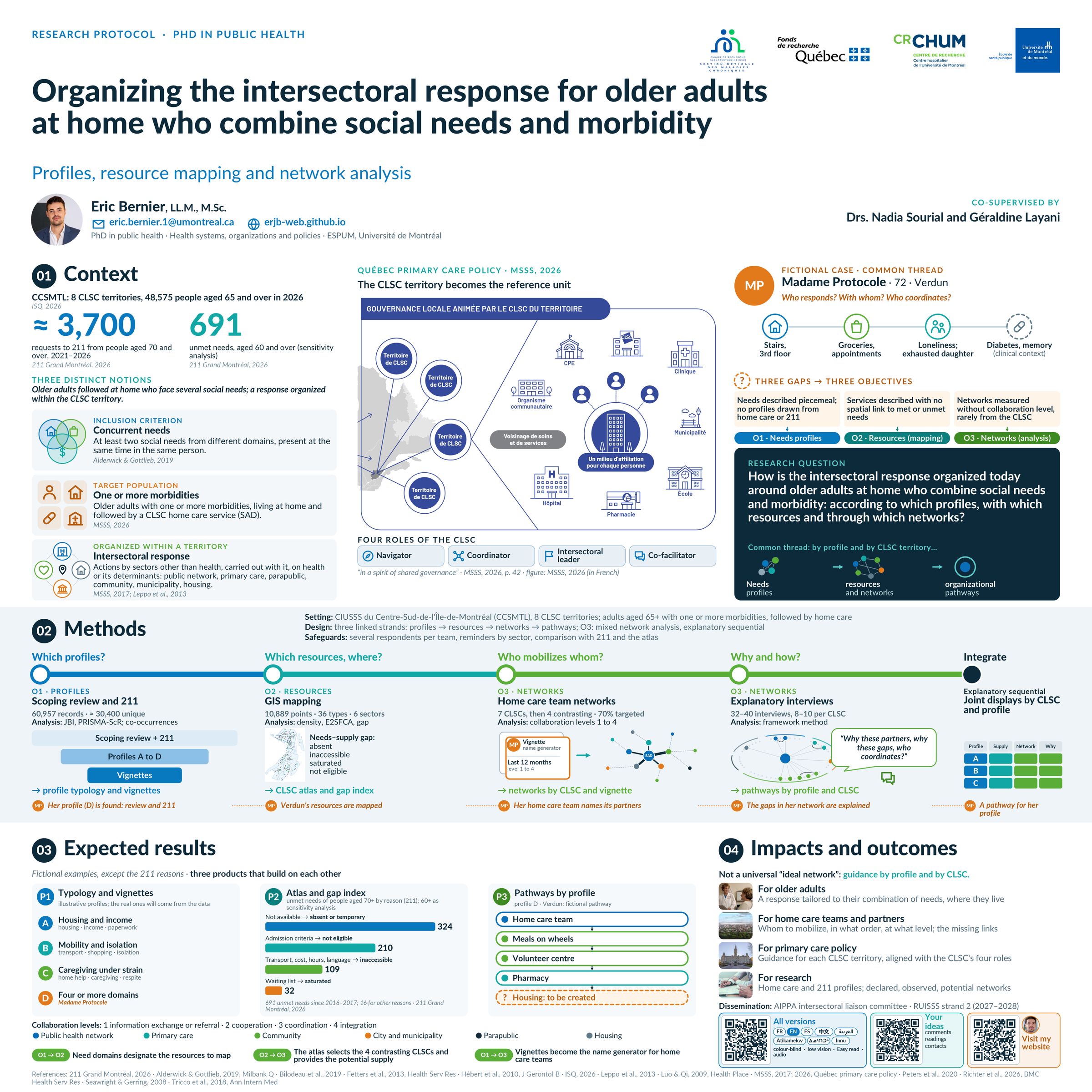
Read by the author, in five tracks. The text of each track is reproduced below.
The recordings are not online yet: this page can read the text with your device's voice.
No audio version in this language yet.
Track 1 · Introduction
Track 2 · 1. Context
Track 3 · 2. Methods
Track 4 · 3. Expected results
Track 5 · 4. Impacts and outcomes
Introduction
Hello, my name is Eric Bernier. I am a PhD candidate in public health at the School of Public Health of the Université de Montréal, co-supervised by Dr. Nadia Sourial and Dr. Géraldine Layani.
My project is entitled: Organizing the intersectoral response for older adults at home who combine social needs and morbidity. Profiles, resource mapping and network analysis.
This version describes the poster in four parts: the context, the methods, the expected results, and the impacts and outcomes.
1. Context
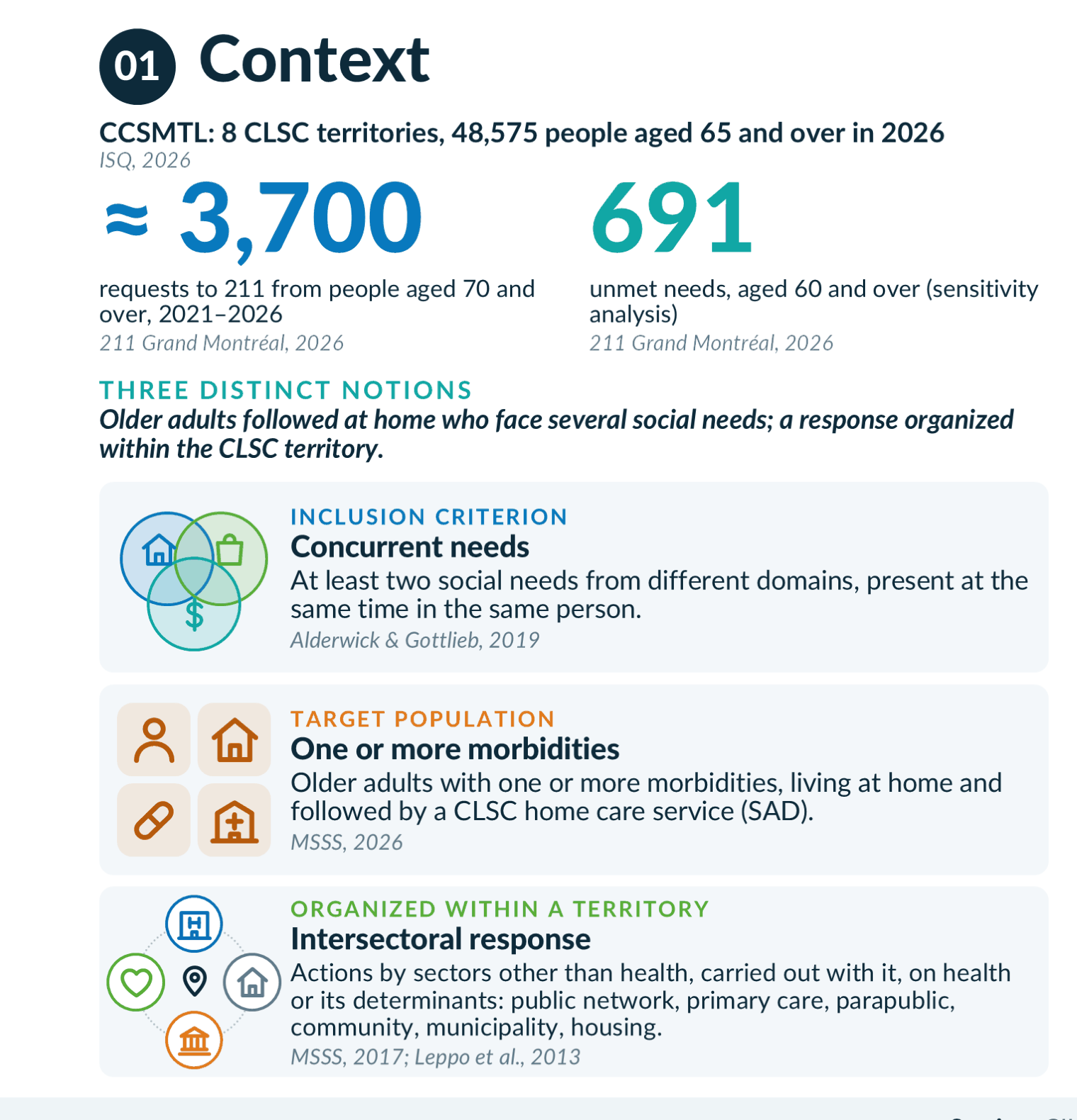
The setting is the CIUSSS du Centre-Sud-de-l'Île-de-Montréal, or CCSMTL: 8 CLSC territories and 48,575 people aged 65 and over in 2026. At 211, there were about 3,700 requests from people aged 70 and over between 2021 and 2026, and 691 unmet needs among people aged 60 and over (sensitivity analysis), all with a coded reason (211 Grand Montréal, 2026).
The poster defines three notions. Concurrent social needs are at least two social needs from different domains, present at the same time in the same person: this is the inclusion criterion. One or more morbidities define the target population: older adults with one or more morbidities, living at home and followed by a CLSC home care service (SAD). The intersectoral response refers to actions by sectors other than health, carried out with it, on health or its determinants: the public network, primary care, parapublic bodies, the community, the municipality and housing.
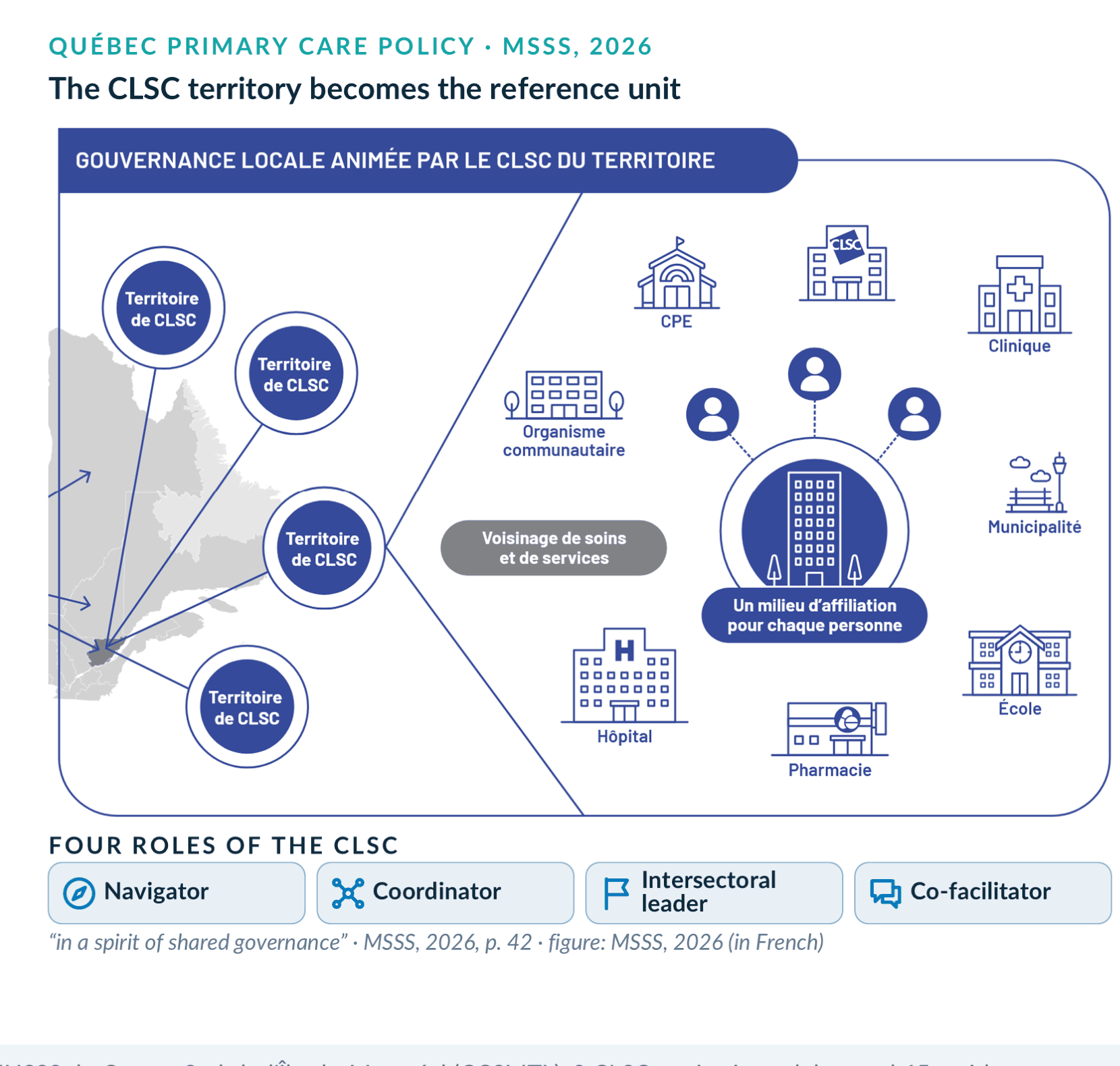
At the centre of the poster, a figure from Québec's 2026 primary care policy, issued by the Ministry of Health and Social Services, shows local governance led by the CLSC of the territory. On the left, a map of Québec divided into CLSC territories. On the right, around a CLSC that serves as an affiliation setting for every person, are a childcare centre, a clinic, a community organization, the municipality, the hospital, a pharmacy and a school: the neighbourhood of care and services. The CLSC territory becomes the reference unit, and the policy gives the CLSC four roles: navigator, coordinator, intersectoral leader and co-facilitator, in a spirit of shared governance.
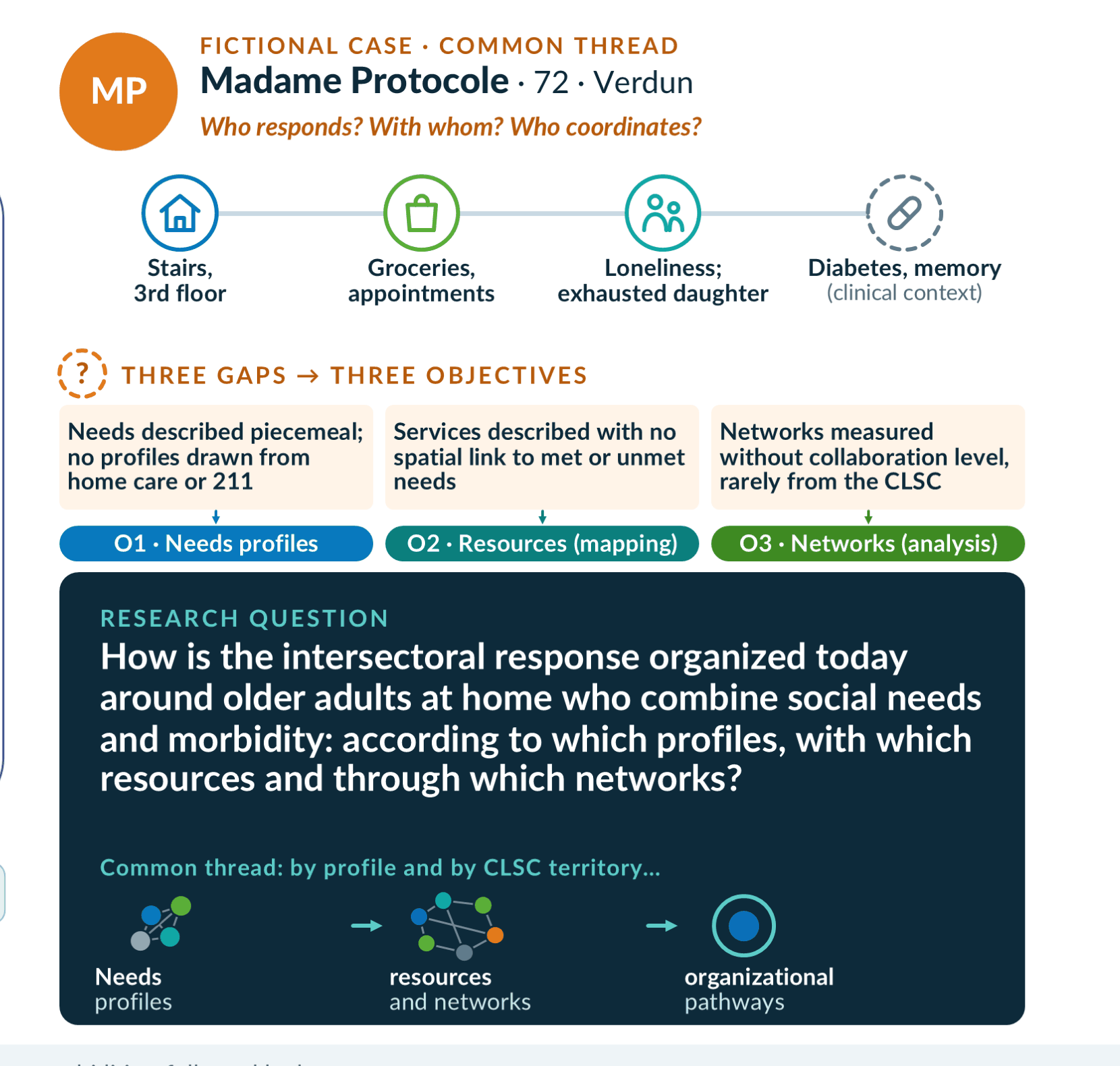
To follow the logic, the poster uses a fictional character: Madame Protocole, aged 72. She lives alone on the third floor in Verdun. She has diabetes and mild memory problems. The stairs, groceries, appointments, loneliness and forms weigh on her, and her daughter is exhausted. Who responds to her? With whom? And who coordinates?
Three gaps lead to three objectives. First, concurrent needs are described piecemeal, and no study found draws profiles from home care assessments or from 211 requests: hence objective 1, identify the profiles. Second, services are described with no spatial link to met or unmet needs: hence objective 2, map the resources of each CLSC territory. Third, networks are usually measured without a level of collaboration, and rarely from the CLSC: hence objective 3, identify organizational pathways by profile.
Hence the research question: how can an intersectoral response be organized, in each CLSC territory, that fits the different profiles of concurrent social needs of older adults followed by home care? The common thread runs from profiles to resources, then to networks and pathways.
2. Methods
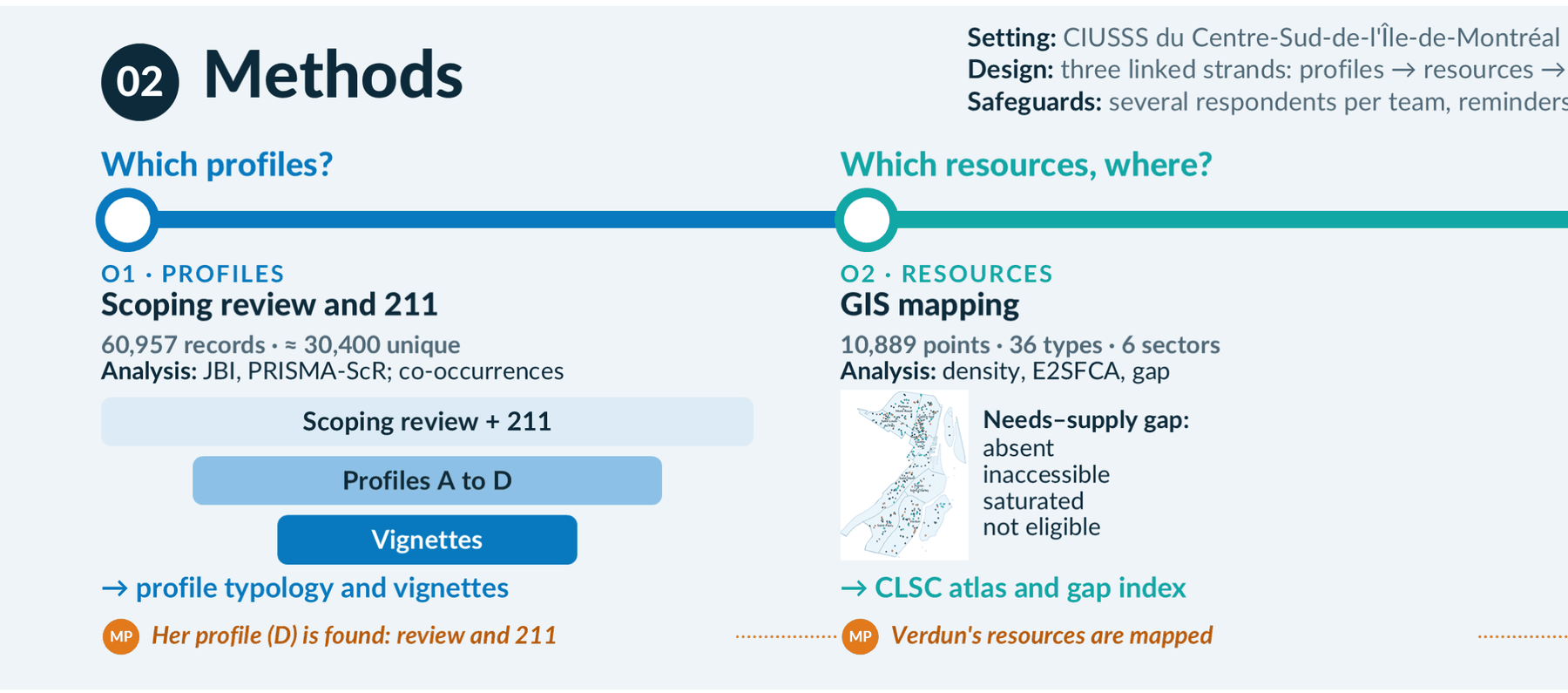
The population: older adults aged 65 and over, with one or more morbidities, who live at home and are followed by the home care services of a CCSMTL CLSC. The design has three linked strands, shown as a metro line with four stations.
First station, objective 1: which profiles? A scoping review following the JBI method and the PRISMA-ScR checklist. The searches of October 17, 2026 found 60,957 records before deduplication, about 30,400 unique articles, an estimate. We also analyze 211 requests: co-occurring needs, territorial profiles, unmet needs and their reasons. The product: a typology of profiles, turned into vignettes.
Second station, objective 2: which resources, and where? Mapping with QGIS and R. The harmonized inventory already has 10,889 points, 36 resource types and 6 sectors across the 8 CLSC territories. We measure density, accessibility on foot and by public transit with the E2SFCA method, then the gap between needs and supply. The poster shows the real map of the CCSMTL.
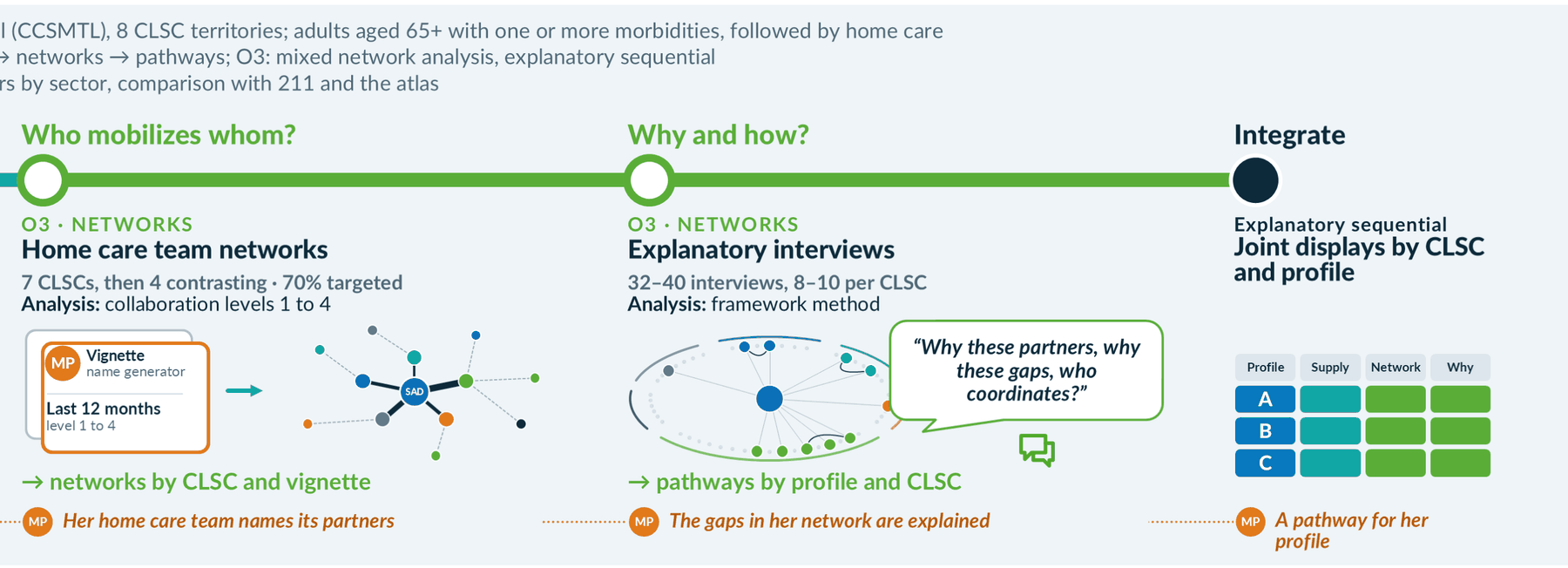
Third station, objective 3: who mobilizes whom? A mixed, egocentric network analysis centred on home care teams. First a session with the teams of the 7 CLSCs of the CIUSSS, then 4 contrasting CLSCs: Verdun, Saint-Henri, Saint-Louis-du-Parc and Centre-Sud. For each vignette, the team names the organizations to which it referred someone like Madame Protocole, or with which it collaborated, in the last 12 months. Each tie has a collaboration level from 1 to 4: information exchange or referral, cooperation, coordination, integration. A single wave targets organizations named at least twice, aiming for a 70% response rate.
Fourth station, still objective 3: why and how? Between 32 and 40 explanatory interviews, 8 to 10 per CLSC, take place around the network map: why these partners, why these gaps, who coordinates? The analysis follows the framework method.
The last stop integrates everything in an explanatory sequential design, in joint displays by CLSC and by profile.
Madame Protocole travels the whole line: her profile is found in the review and at 211, Verdun's resources are mapped, her home care team names its partners, the gaps in her network are explained, and we obtain a pathway for her profile.
3. Expected results
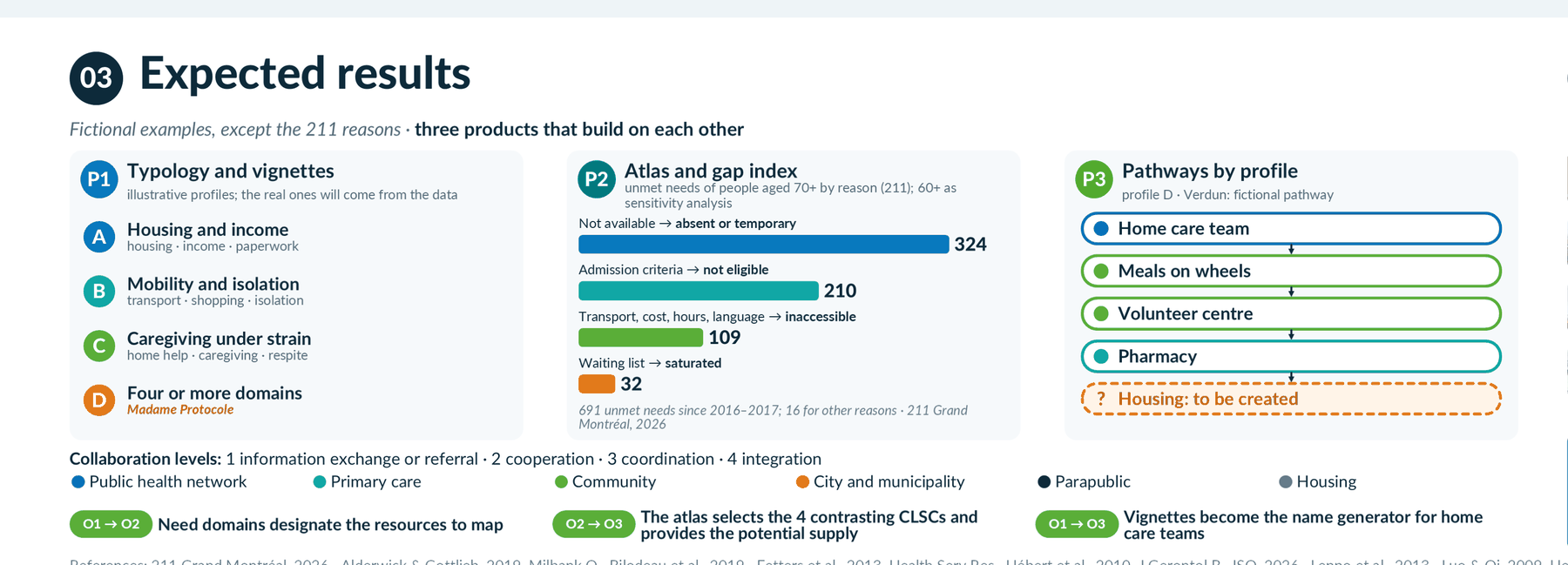
Three products build on each other. The examples are fictional, except the 211 reasons.
Product 1: a typology of profiles, turned into vignettes. Four illustrative profiles: A, housing and income; B, mobility and isolation; C, caregiving under strain; D, four or more domains, the profile of Madame Protocole. The real profiles will come from the data.
Product 2: an atlas for each CLSC territory and an index of the gap between needs and supply. The reasons already coded at 211 point to the four types of gap. In the sensitivity analysis among people aged 60 and over, 324 unmet needs were unmet because the resource was not available, an absent or temporary supply; 210 because of admission criteria, a supply for which people are not eligible; 109 because of transport, cost, hours or language, an inaccessible supply; and 32 because of a waiting list, a saturated supply.
Product 3: models of pathways by profile and by CLSC. A fictional example, profile D in Verdun: the home care team, then meals on wheels, the volunteer centre and the pharmacy; the housing link is still to be created.
Each objective feeds the next. Need domains designate the resources to map. The atlas selects the 4 contrasting CLSCs and provides the potential supply to compare. And the vignettes become the name generator for home care teams.
4. Impacts and outcomes
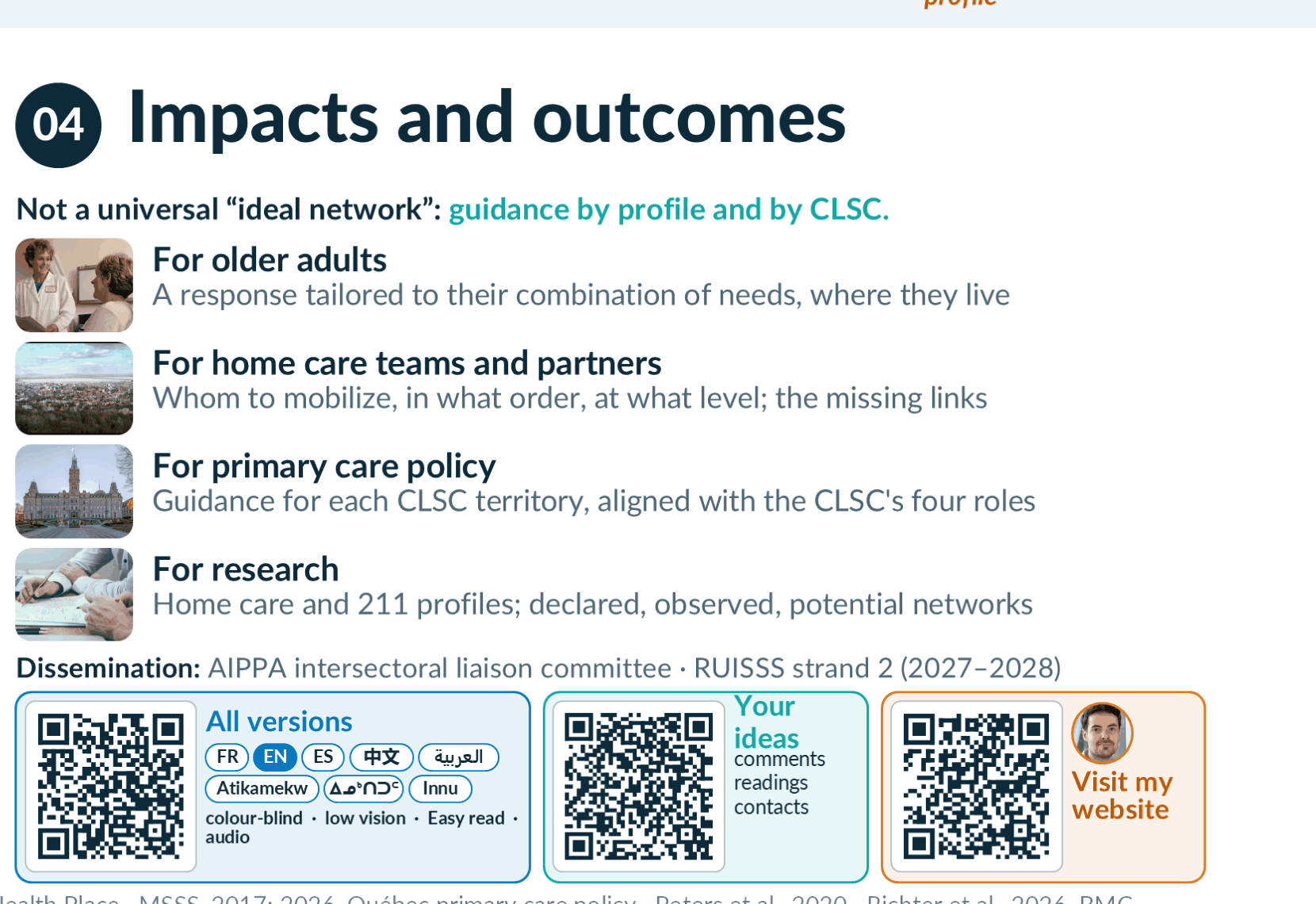
The thesis does not seek a universal ideal network, but guidance by profile and by CLSC territory. The outcomes range from the person to the system.
For older adults: a response tailored to their combination of needs, where they live. For home care teams and their partners: whom to mobilize, in what order, at what level of collaboration, and the missing links. For primary care policy: guidance for each CLSC territory, aligned with the CLSC's four roles. For research: profiles drawn from home care and 211, and a comparison of declared, observed and potential networks. The pathway models will go to the AIPPA intersectoral liaison committee and to strand 2 of the RUISSS, in 2027 and 2028.
I would love to hear your ideas: comments, readings, introductions or methodological improvements. You can email me at eric.bernier.1@umontreal.ca, or use the form linked on this page. Thank you for listening.
Comment, suggest, connect
Comments, reading suggestions, introductions, methodological or conceptual ideas: every contribution is welcome.